
Financial Programme Management at the speed of
Description: Financial Programme Management at the speed of Light Fernando Abaga Edjang DRR, UNDP Gambia March, 2016 Objectives of the working session The overall goal of this working session is to support delivery and the achievement of sustainable
Related Topics
Download Presentation
"Financial Programme Management at the speed of" is the property of its rightful owner. Permission is granted to download and print the materials on this website for personal, non-commercial use only, and to display it on your personal computer provided you do not modify the materials and that you retain all copyright notices contained in the materials. By downloading content from our website, you accept the terms of this agreement.
Presentation Transcript
slide1. Financial Programme Management
at the speed of Light Fernando Abaga Edjang
DRR, UNDP Gambia
March, 2016<br>
slide2. Objectives of the working session The overall goal of this working session is to support delivery and the achievement of sustainable results. By the end of this working session, therefore, participants should be:
Familiar with concepts, policies and procédures, Business Processes, systems, tools of programme finance management
Able to carry out the relevant programme finance operations effectively, efficiently and with JOY;
Fully understand their roles and related accountabilities<br>
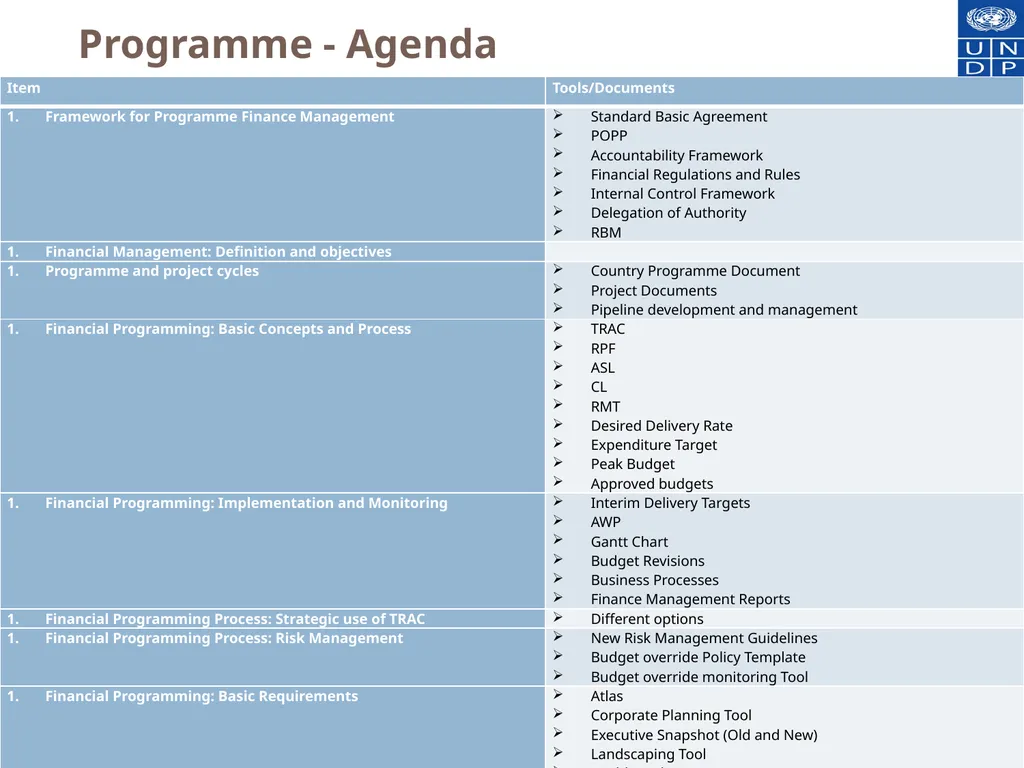
slide3. Programme - Agenda<br>
slide4. The importance of policies, procedures, processes, tools in achieving organization goals Outcomes without a process (the “what” without the “how”) – Process is the roadmap to the achievement of outcomes
Decisions not supported by evidence – Importance of evidence (data, facts, etc.), tools, systems in management;
No accountability
Poor results<br>
slide5. The Nature of our Work TRANSACTIONAL = things you do based on standard procedures that do not require interpretation / modification; many (but not all) administrative tasks would be transactional.
SUBSTANTIVE = where you may need to sit back, think about the task at hand, and make decisions on what exactly needs to happen; where standard procedures alone are not enough to guide you<br>
slide6. The Nature of our Work Substantive work:
Analytical skills - the ability to visualize, articulate, and solve both complex and complicated problems and concepts and make decisions that are sensible and based on available information. Such skills include demonstration of the ability to apply logical thinking to gathering and analyzing information, designing and testing solutions to problems, and formulating plans.
Critical thinking - clear, reasoned thinking involving critique; making clear, reasoned judgements. It is the intellectually disciplined process of actively and skillfully conceptualizing, applying, analyzing, synthesizing, and/or evaluating information gathered from, or generated by, observation, experience, reflection, reasoning, or communication, as a guide to belief and action.<br>
slide7. The Nature of our Work: Internal Control Framework Internal Control Framework
Segregation of duties - there must be a segregation of duties to implement an appropriate level of checks and balances upon the activities of individuals, thereby minimizing the risk of error or fraud and helping to detect errors or fraud.
Assign staff members only one Atlas profile that is consistent with their role. (ARGUS report)
Staff members who approve vouchers (approving managers) cannot create vouchers (finance); and
Staff members who approve POs (approving managers) cannot create POs (buyers).<br>
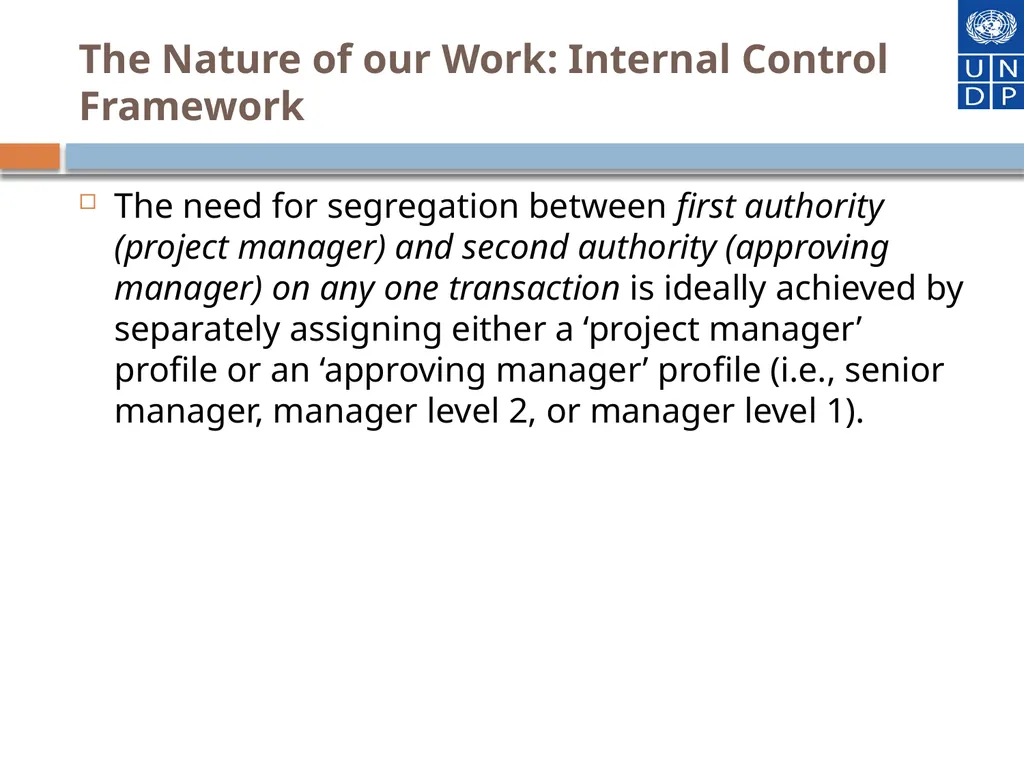
slide8. The Nature of our Work: Internal Control Framework The need for segregation between first authority (project manager) and second authority (approving manager) on any one transaction is ideally achieved by separately assigning either a ‘project manager’ profile or an ‘approving manager’ profile (i.e., senior manager, manager level 2, or manager level 1).<br>
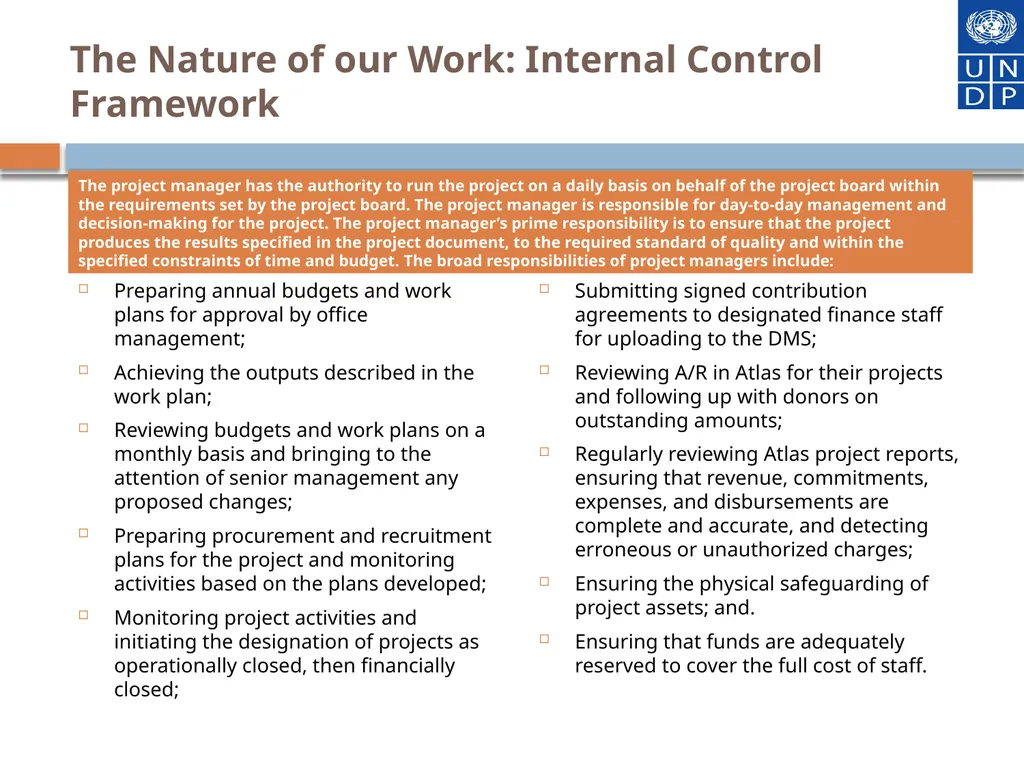
slide9. The Nature of our Work: Internal Control Framework Preparing annual budgets and work plans for approval by office management;
Achieving the outputs described in the work plan;
Reviewing budgets and work plans on a monthly basis and bringing to the attention of senior management any proposed changes;
Preparing procurement and recruitment plans for the project and monitoring activities based on the plans developed;
Monitoring project activities and initiating the designation of projects as operationally closed, then financially closed; Submitting signed contribution agreements to designated finance staff for uploading to the DMS;
Reviewing A/R in Atlas for their projects and following up with donors on outstanding amounts;
Regularly reviewing Atlas project reports, ensuring that revenue, commitments, expenses, and disbursements are complete and accurate, and detecting erroneous or unauthorized charges;
Ensuring the physical safeguarding of project assets; and.
Ensuring that funds are adequately reserved to cover the full cost of staff. The project manager has the authority to run the project on a daily basis on behalf of the project board within the requirements set by the project board. The project manager is responsible for day-to-day management and decision-making for the project. The project manager’s prime responsibility is to ensure that the project produces the results specified in the project document, to the required standard of quality and within the specified constraints of time and budget. The broad responsibilities of project managers include:<br>
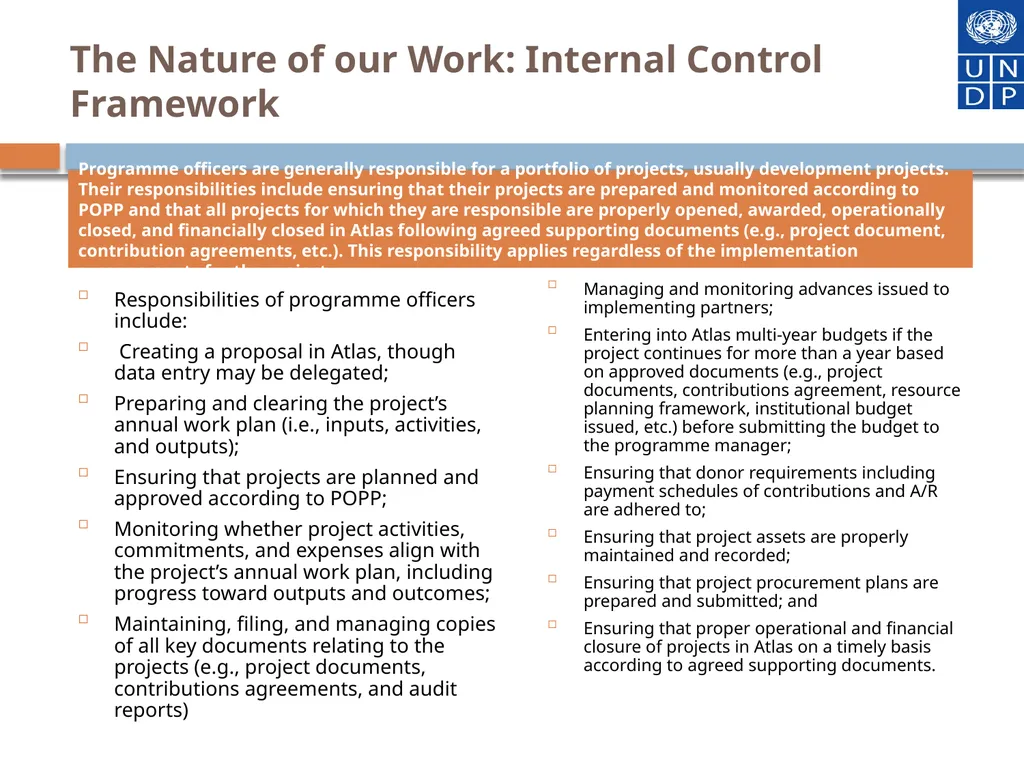
slide10. The Nature of our Work: Internal Control Framework Responsibilities of programme officers include:
Creating a proposal in Atlas, though data entry may be delegated;
Preparing and clearing the project’s annual work plan (i.e., inputs, activities, and outputs);
Ensuring that projects are planned and approved according to POPP;
Monitoring whether project activities, commitments, and expenses align with the project’s annual work plan, including progress toward outputs and outcomes;
Maintaining, filing, and managing copies of all key documents relating to the projects (e.g., project documents, contributions agreements, and audit reports) Managing and monitoring advances issued to implementing partners;
Entering into Atlas multi-year budgets if the project continues for more than a year based on approved documents (e.g., project documents, contributions agreement, resource planning framework, institutional budget issued, etc.) before submitting the budget to the programme manager;
Ensuring that donor requirements including payment schedules of contributions and A/R are adhered to;
Ensuring that project assets are properly maintained and recorded;
Ensuring that project procurement plans are prepared and submitted; and
Ensuring that proper operational and financial closure of projects in Atlas on a timely basis according to agreed supporting documents. Programme officers are generally responsible for a portfolio of projects, usually development projects. Their responsibilities include ensuring that their projects are prepared and monitored according to POPP and that all projects for which they are responsible are properly opened, awarded, operationally closed, and financially closed in Atlas following agreed supporting documents (e.g., project document, contribution agreements, etc.). This responsibility applies regardless of the implementation arrangements for the project.<br>
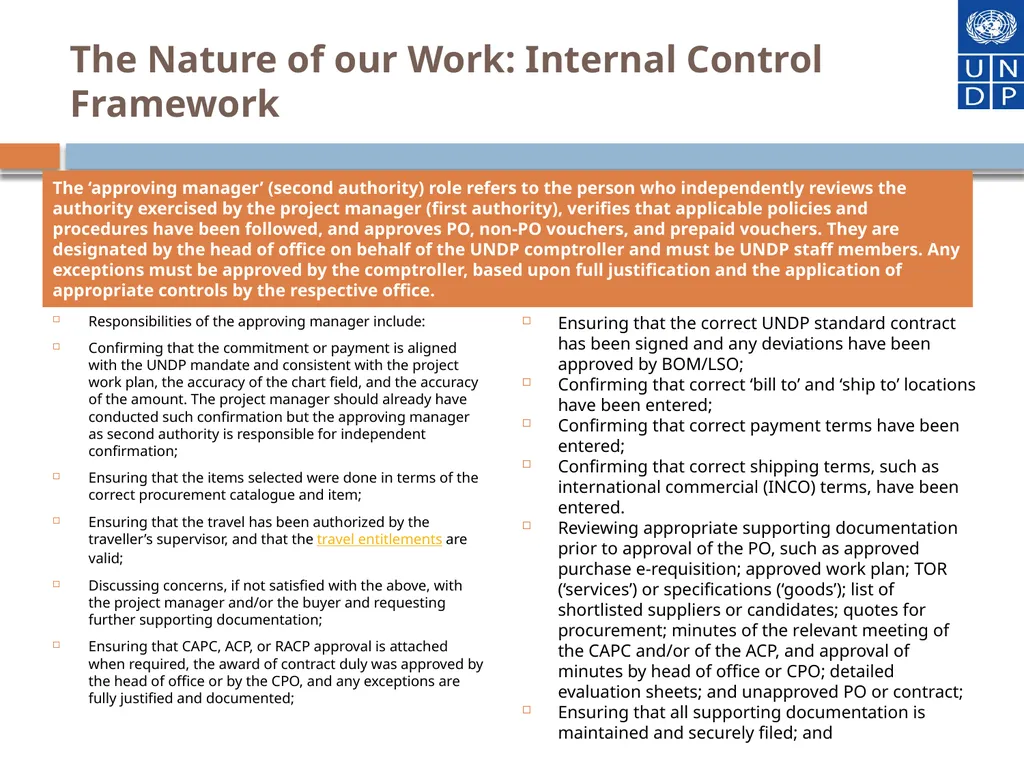
slide11. The Nature of our Work: Internal Control Framework Responsibilities of the approving manager include:
Confirming that the commitment or payment is aligned with the UNDP mandate and consistent with the project work plan, the accuracy of the chart field, and the accuracy of the amount. The project manager should already have conducted such confirmation but the approving manager as second authority is responsible for independent confirmation;
Ensuring that the items selected were done in terms of the correct procurement catalogue and item;
Ensuring that the travel has been authorized by the traveller’s supervisor, and that the travel entitlements are valid;
Discussing concerns, if not satisfied with the above, with the project manager and/or the buyer and requesting further supporting documentation;
Ensuring that CAPC, ACP, or RACP approval is attached when required, the award of contract duly was approved by the head of office or by the CPO, and any exceptions are fully justified and documented; Ensuring that the correct UNDP standard contract has been signed and any deviations have been approved by BOM/LSO;
Confirming that correct ‘bill to’ and ‘ship to’ locations have been entered;
Confirming that correct payment terms have been entered;
Confirming that correct shipping terms, such as international commercial (INCO) terms, have been entered.
Reviewing appropriate supporting documentation prior to approval of the PO, such as approved purchase e-requisition; approved work plan; TOR (‘services’) or specifications (‘goods’); list of shortlisted suppliers or candidates; quotes for procurement; minutes of the relevant meeting of the CAPC and/or of the ACP, and approval of minutes by head of office or CPO; detailed evaluation sheets; and unapproved PO or contract;
Ensuring that all supporting documentation is maintained and securely filed; and The ‘approving manager’ (second authority) role refers to the person who independently reviews the authority exercised by the project manager (first authority), verifies that applicable policies and procedures have been followed, and approves PO, non-PO vouchers, and prepaid vouchers. They are designated by the head of office on behalf of the UNDP comptroller and must be UNDP staff members. Any exceptions must be approved by the comptroller, based upon full justification and the application of appropriate controls by the respective office.<br>
slide12. Financial Management: Definition Efficient and effective management of money (funds) in such a manner as to accomplish the objectives of the organization (UNDP Gambia)<br>
slide13. Objectives of Financial Management To ensure regular and adequate supply of funds to the concern;
To ensure optimum funds utilization - Once the funds are secured, they should be utilized in maximum possible way at least cost;
To ensure safety on investment, i. e. funds should be invested in safe ventures so that adequate rate of return can be achieved.<br>
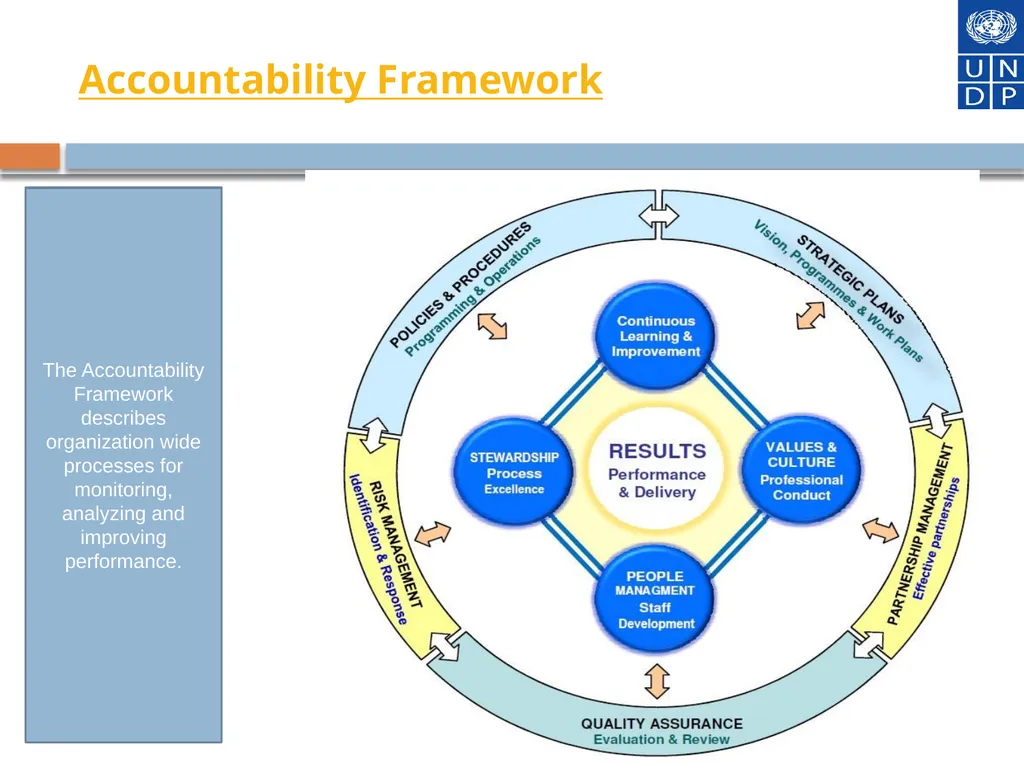
slide14. Accountability Framework The Accountability Framework describes organization wide processes for monitoring, analyzing and improving performance.<br>
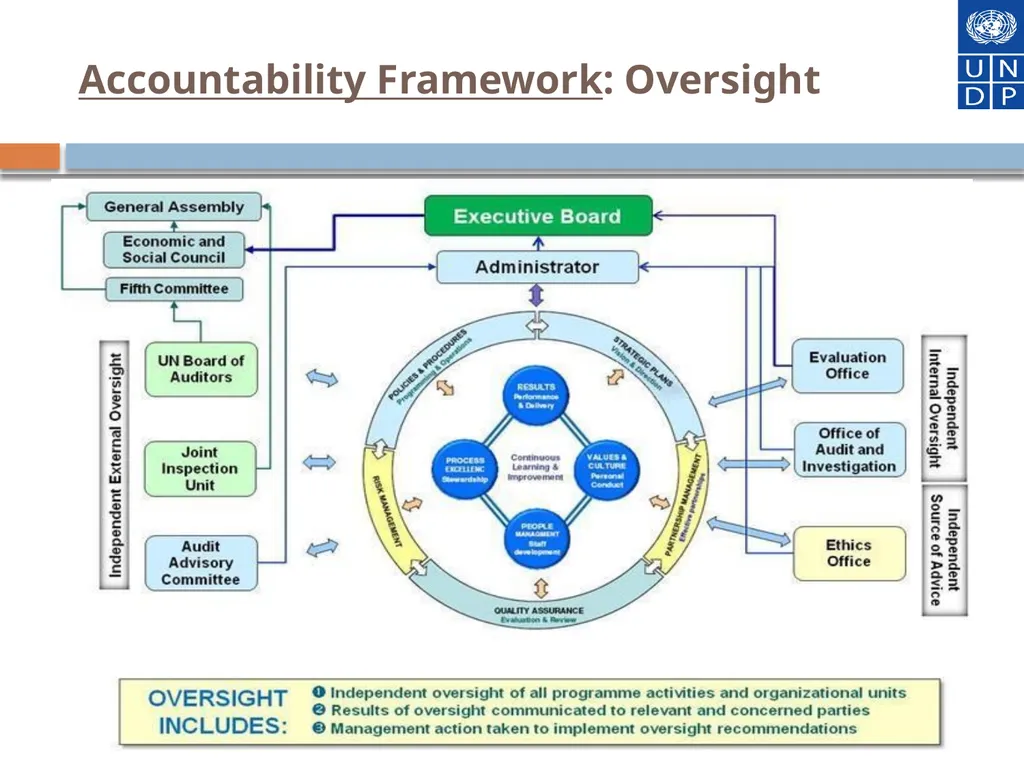
slide15. Accountability Framework: Oversight<br>
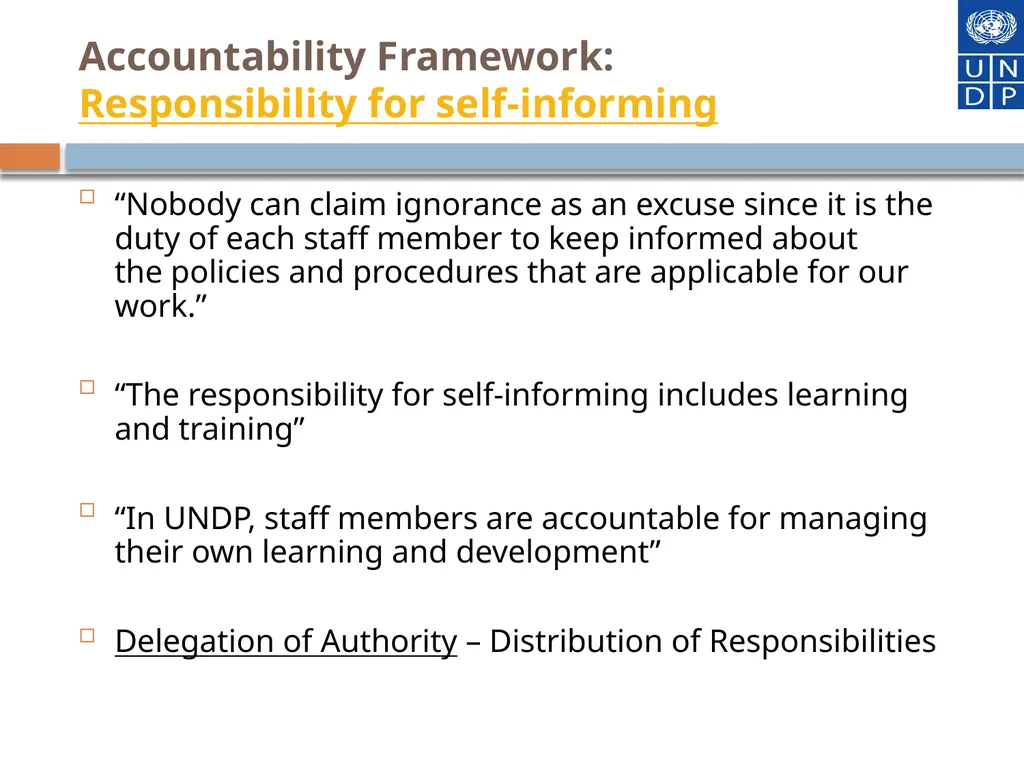
slide16. “Nobody can claim ignorance as an excuse since it is the duty of each staff member to keep informed about the policies and procedures that are applicable for our work.”
“The responsibility for self-informing includes learning and training”
“In UNDP, staff members are accountable for managing their own learning and development”
Delegation of Authority – Distribution of Responsibilities Accountability Framework: Responsibility for self-informing<br>
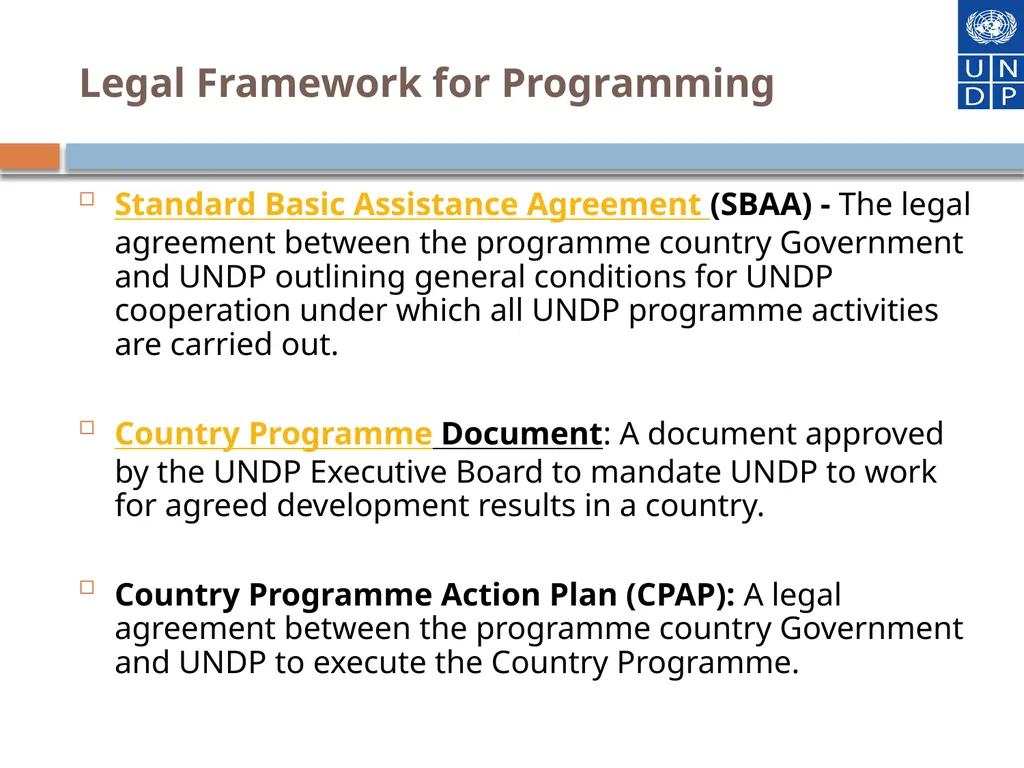
slide17. Legal Framework for Programming Standard Basic Assistance Agreement (SBAA) - The legal agreement between the programme country Government and UNDP outlining general conditions for UNDP cooperation under which all UNDP programme activities are carried out.
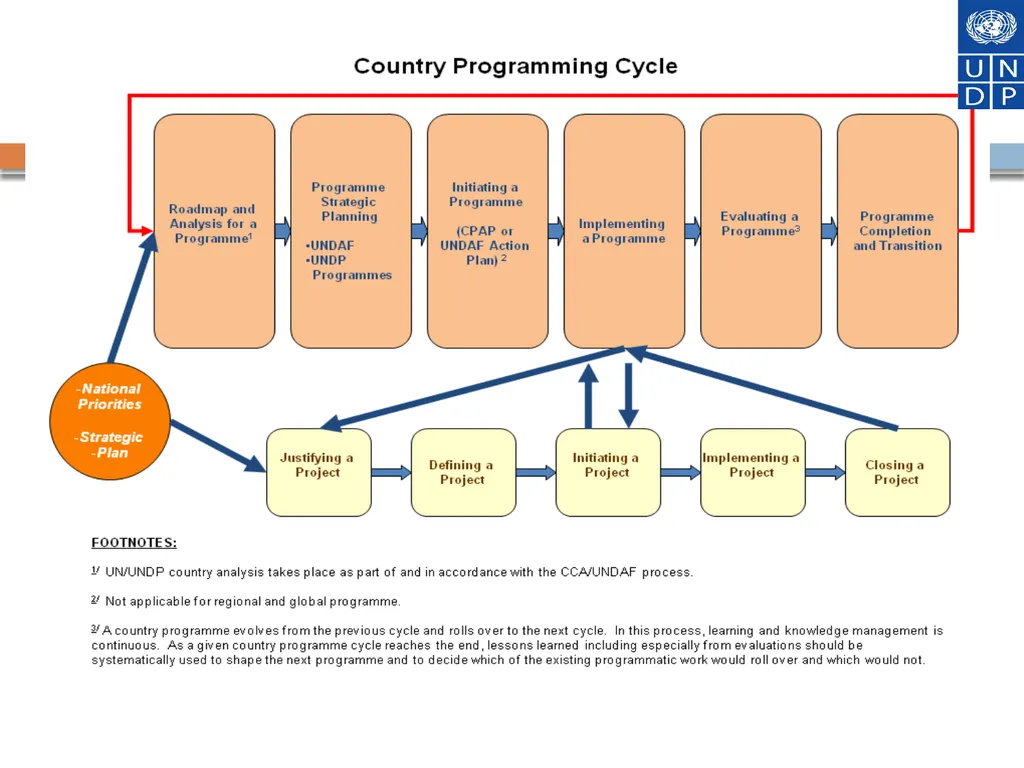
Country Programme Document: A document approved by the UNDP Executive Board to mandate UNDP to work for agreed development results in a country.
Country Programme Action Plan (CPAP): A legal agreement between the programme country Government and UNDP to execute the Country Programme.<br>
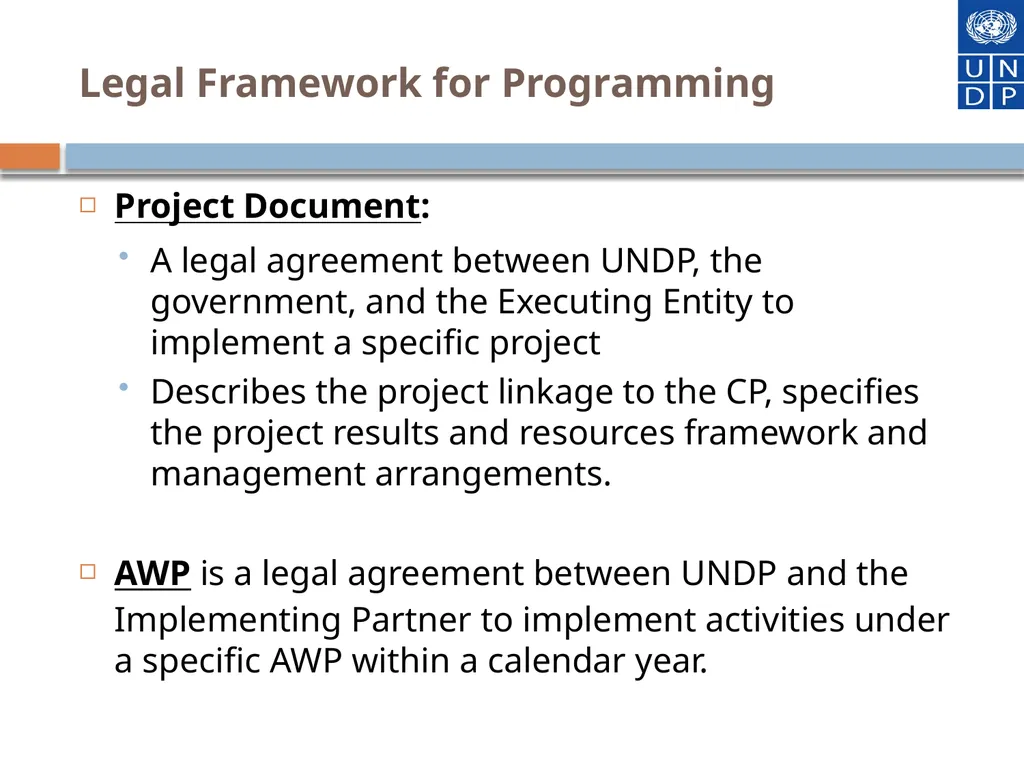
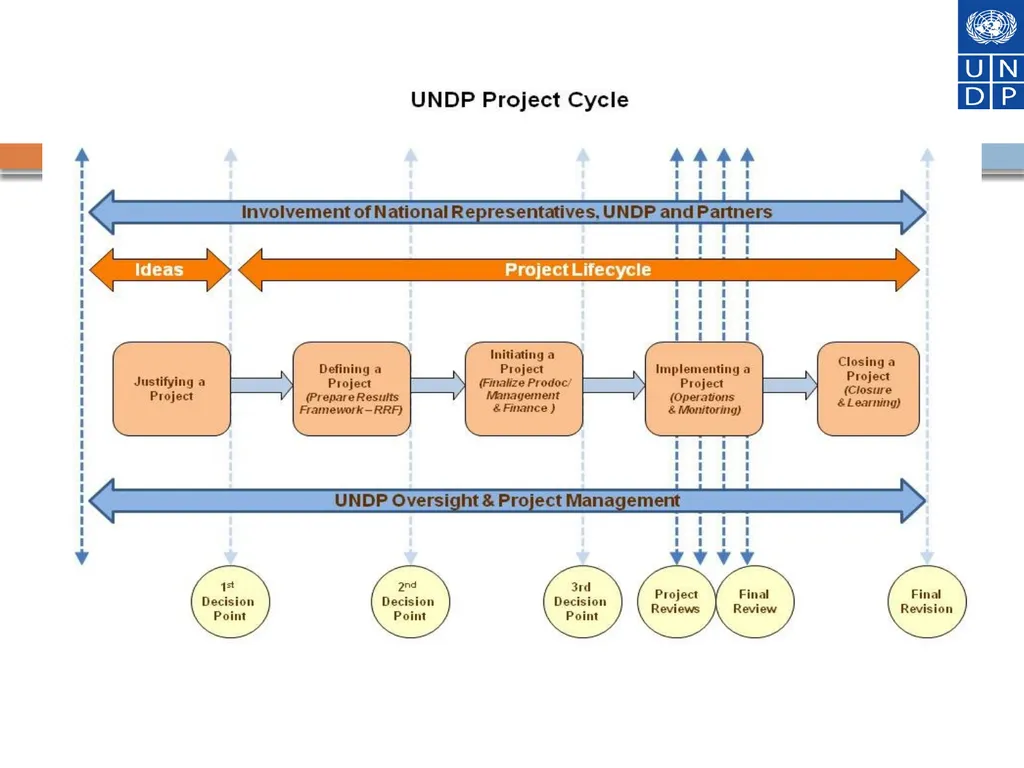
slide18. Legal Framework for Programming Project Document:
A legal agreement between UNDP, the government, and the Executing Entity to implement a specific project
Describes the project linkage to the CP, specifies the project results and resources framework and management arrangements.
AWP is a legal agreement between UNDP and the Implementing Partner to implement activities under a specific AWP within a calendar year.<br>
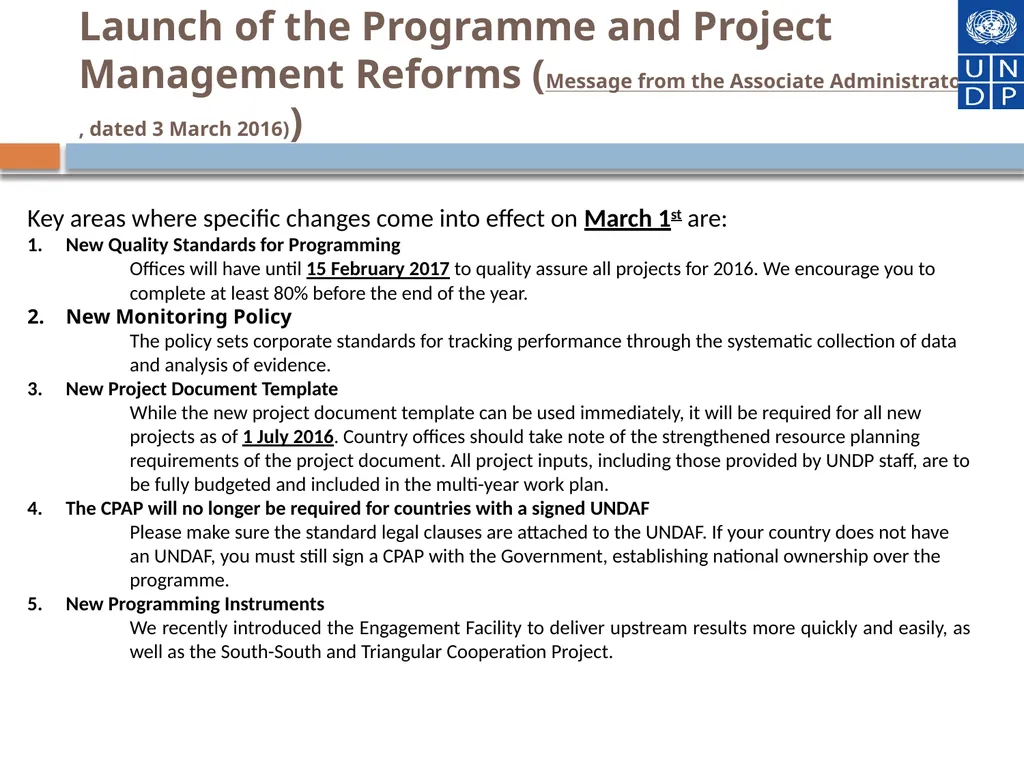
slide19. Launch of the Programme and Project Management Reforms (Message from the Associate Administrator, dated 3 March 2016)) Key areas where specific changes come into effect on March 1st are:
New Quality Standards for Programming
Offices will have until 15 February 2017 to quality assure all projects for 2016. We encourage you to complete at least 80% before the end of the year.
New Monitoring Policy
The policy sets corporate standards for tracking performance through the systematic collection of data and analysis of evidence.
New Project Document Template
While the new project document template can be used immediately, it will be required for all new projects as of 1 July 2016. Country offices should take note of the strengthened resource planning requirements of the project document. All project inputs, including those provided by UNDP staff, are to be fully budgeted and included in the multi-year work plan.
The CPAP will no longer be required for countries with a signed UNDAF
Please make sure the standard legal clauses are attached to the UNDAF. If your country does not have an UNDAF, you must still sign a CPAP with the Government, establishing national ownership over the programme.
New Programming Instruments
We recently introduced the Engagement Facility to deliver upstream results more quickly and easily, as well as the South-South and Triangular Cooperation Project.<br>
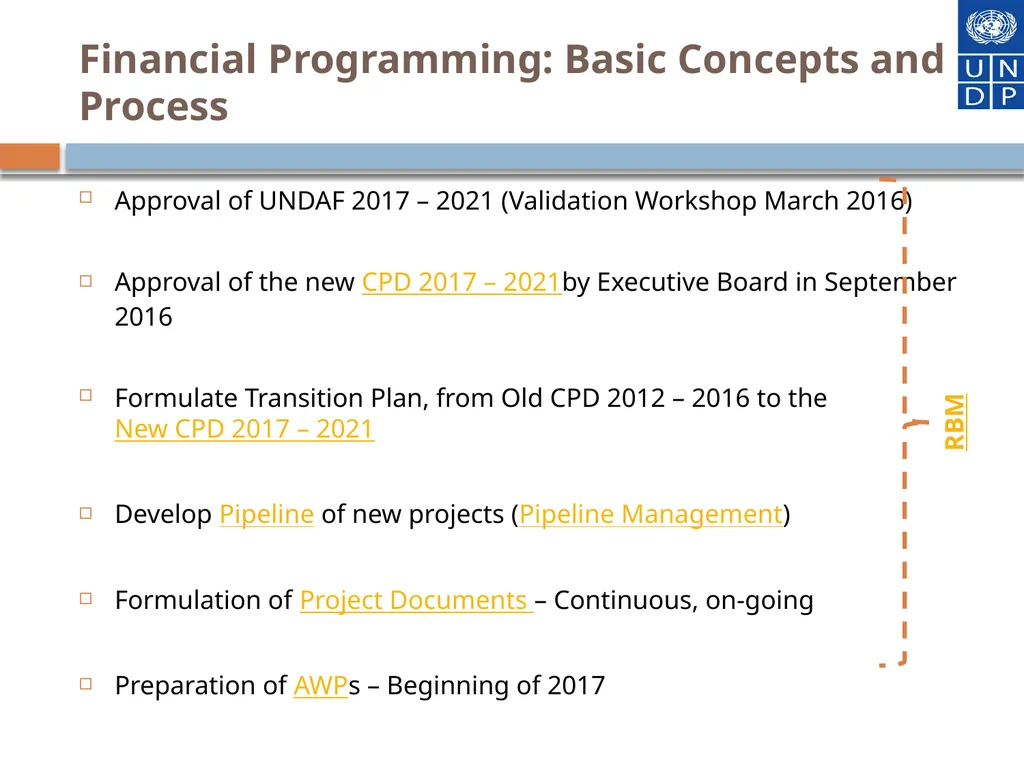
slide22. Financial Programming: Basic Concepts and Process Approval of UNDAF 2017 – 2021 (Validation Workshop March 2016)
Approval of the new CPD 2017 – 2021by Executive Board in September 2016
Formulate Transition Plan, from Old CPD 2012 – 2016 to the New CPD 2017 – 2021
Develop Pipeline of new projects (Pipeline Management)
Formulation of Project Documents – Continuous, on-going
Preparation of AWPs – Beginning of 2017 RBM<br>
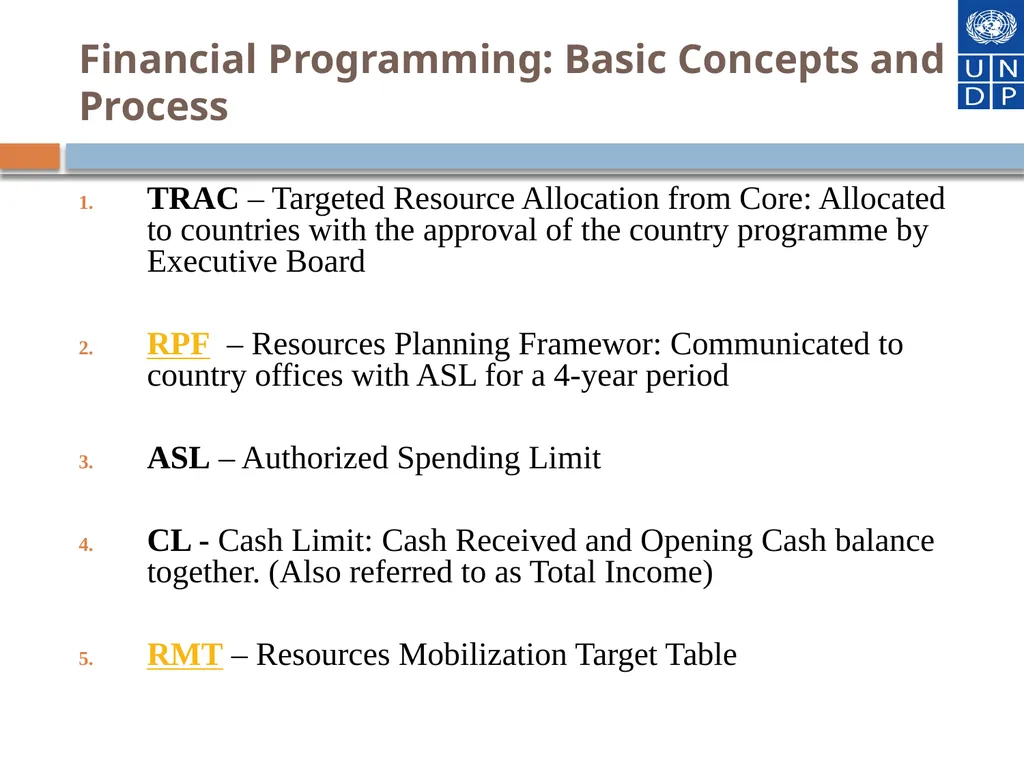
slide23. Financial Programming: Basic Concepts and Process TRAC – Targeted Resource Allocation from Core: Allocated to countries with the approval of the country programme by Executive Board
RPF – Resources Planning Framewor: Communicated to country offices with ASL for a 4-year period
ASL – Authorized Spending Limit
CL - Cash Limit: Cash Received and Opening Cash balance together. (Also referred to as Total Income)
RMT – Resources Mobilization Target Table<br>
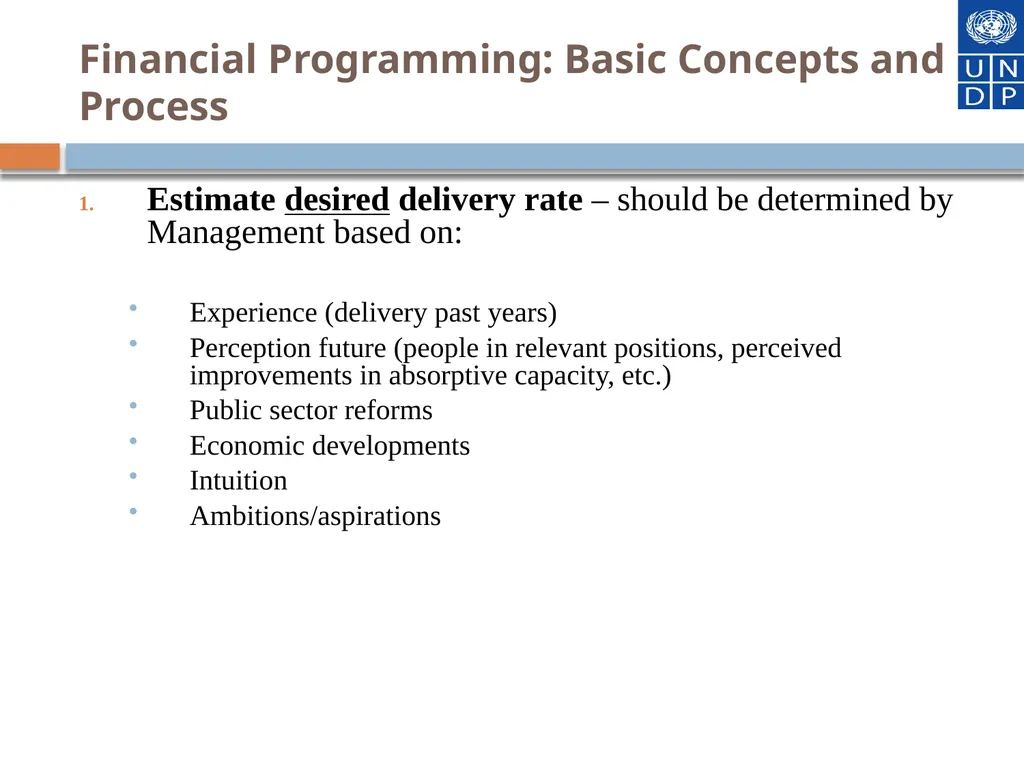
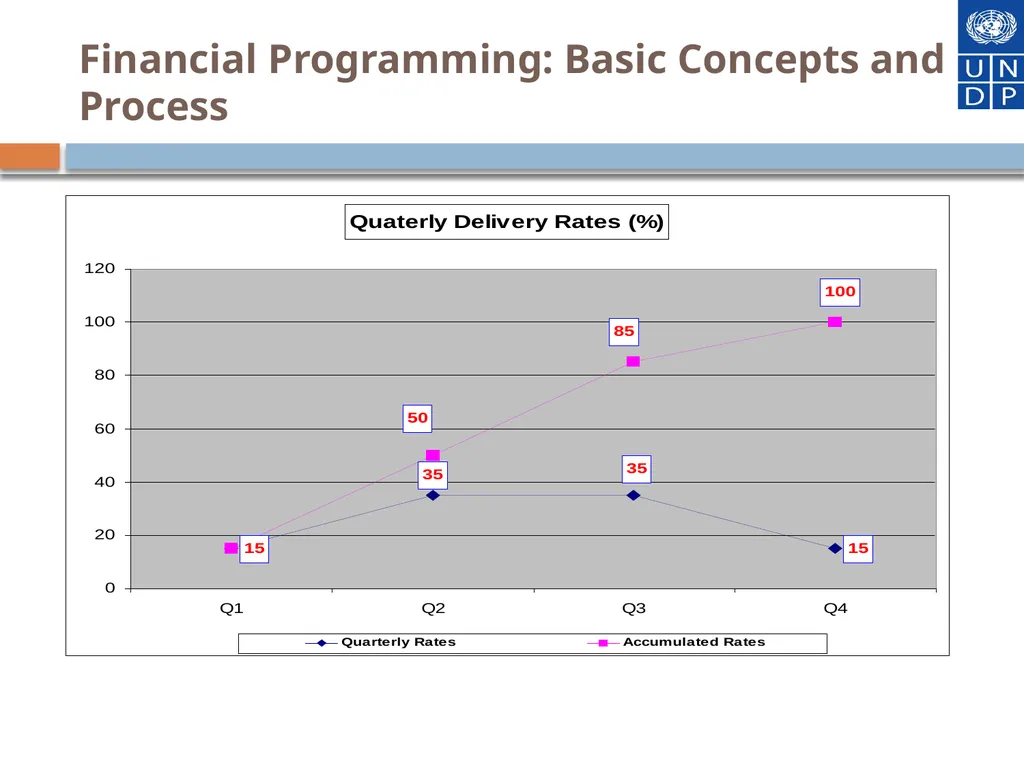
slide24. Financial Programming: Basic Concepts and Process Estimate desired delivery rate – should be determined by Management based on:
Experience (delivery past years)
Perception future (people in relevant positions, perceived improvements in absorptive capacity, etc.)
Public sector reforms
Economic developments
Intuition
Ambitions/aspirations<br>
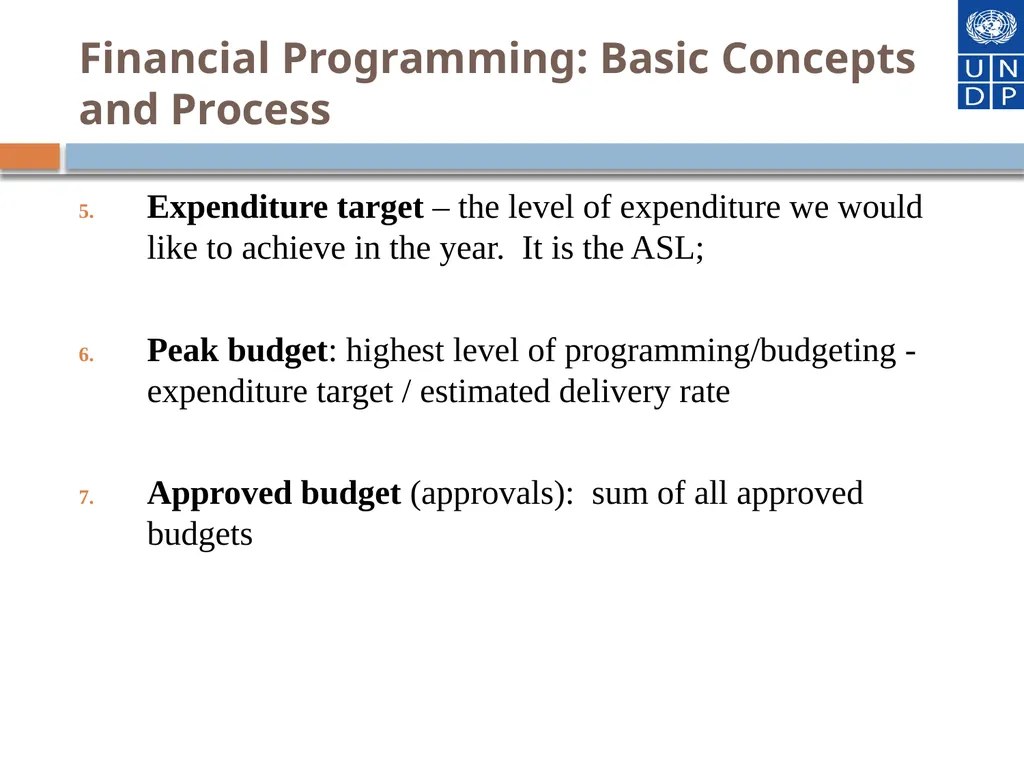
slide25. Financial Programming: Basic Concepts and Process Expenditure target – the level of expenditure we would like to achieve in the year. It is the ASL;
Peak budget: highest level of programming/budgeting - expenditure target / estimated delivery rate
Approved budget (approvals): sum of all approved budgets<br>
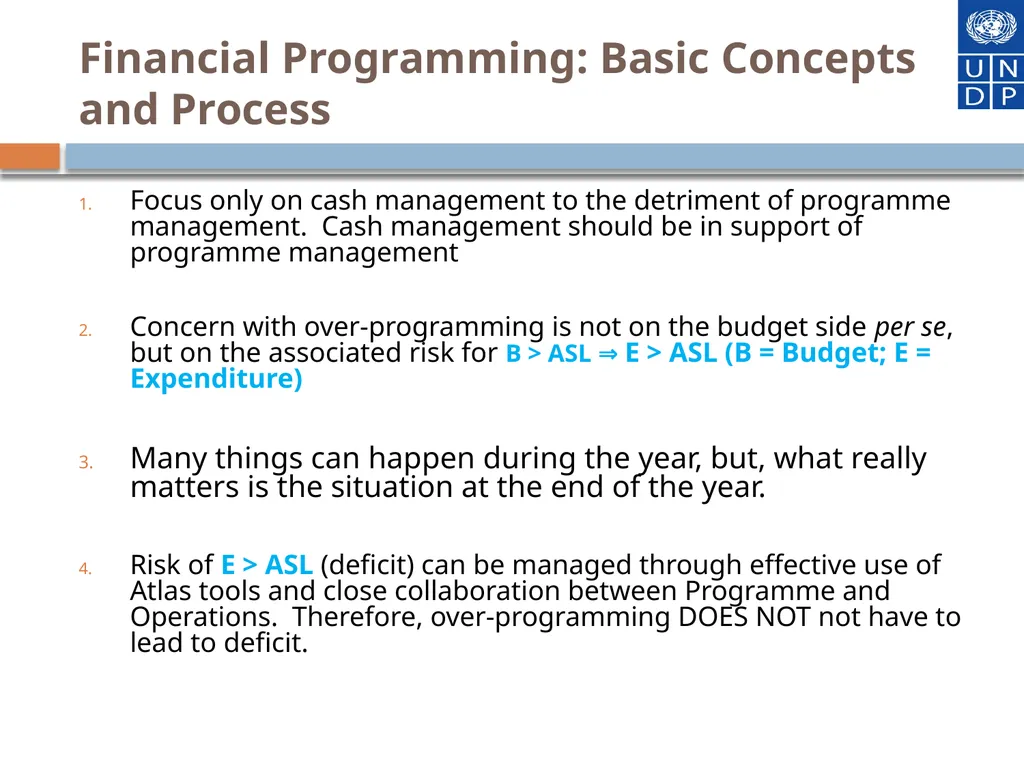
slide26. Financial Programming: Basic Concepts and Process Focus only on cash management to the detriment of programme management. Cash management should be in support of programme management
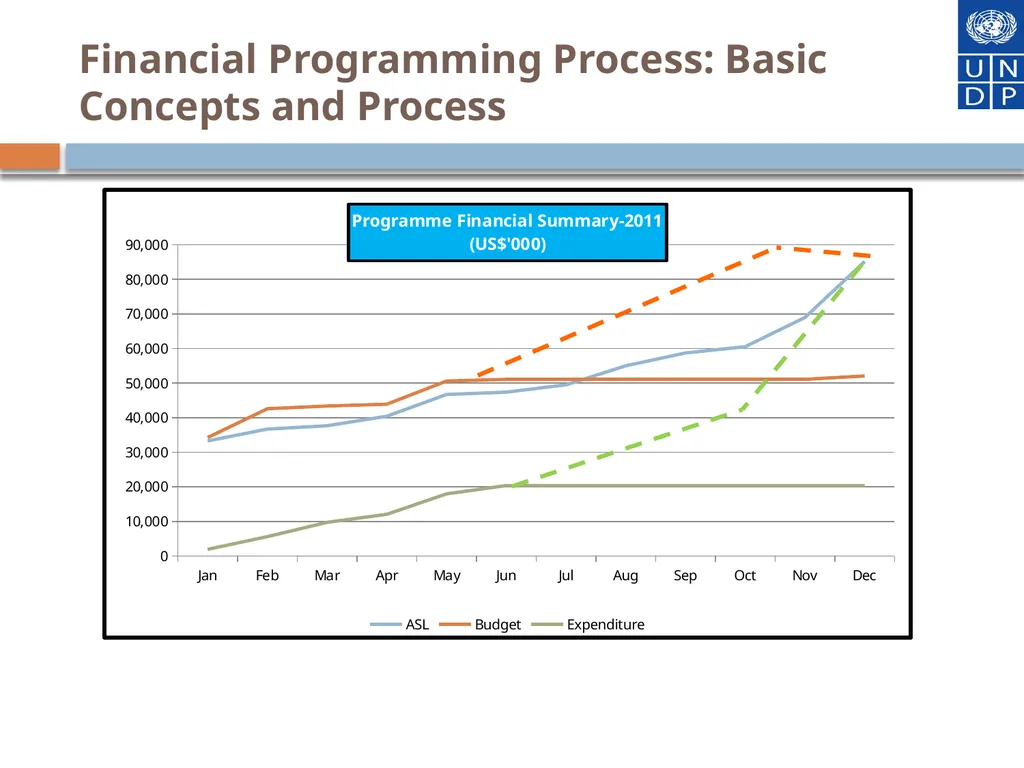
Concern with over-programming is not on the budget side per se, but on the associated risk for B > ASL ⇒ E > ASL (B = Budget; E = Expenditure)
Many things can happen during the year, but, what really matters is the situation at the end of the year.
Risk of E > ASL (deficit) can be managed through effective use of Atlas tools and close collaboration between Programme and Operations. Therefore, over-programming DOES NOT not have to lead to deficit.<br>
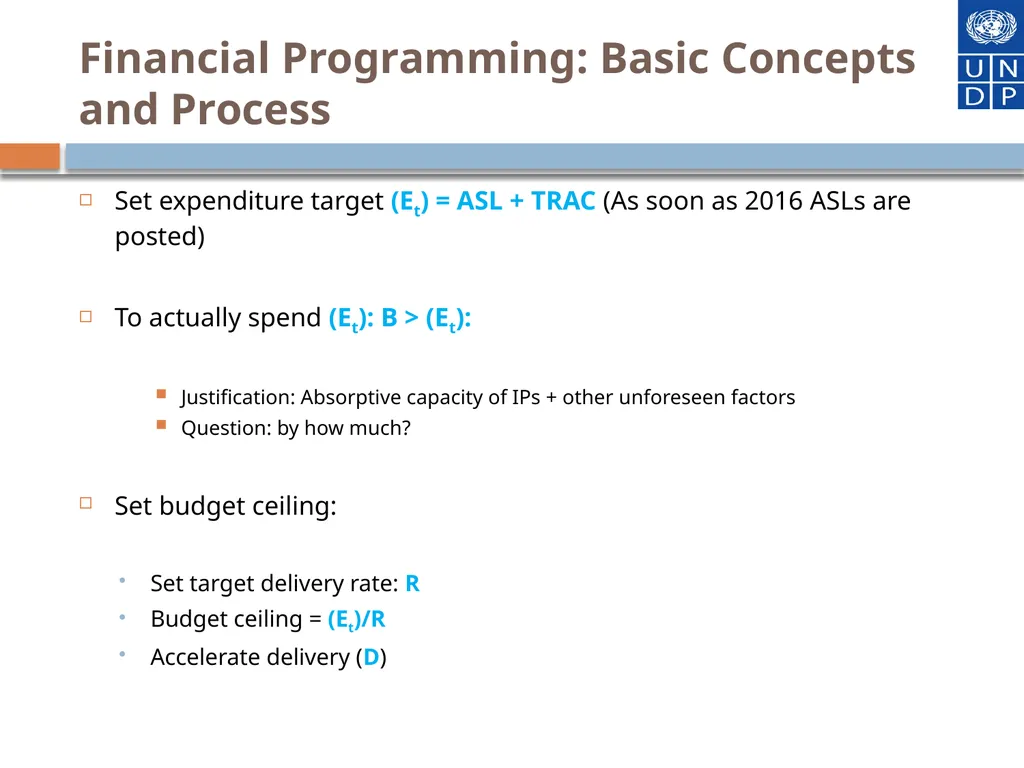
slide27. Financial Programming: Basic Concepts and Process Set expenditure target (Et) = ASL + TRAC (As soon as 2016 ASLs are posted)
To actually spend (Et): B > (Et):
Justification: Absorptive capacity of IPs + other unforeseen factors
Question: by how much?
Set budget ceiling:
Set target delivery rate: R
Budget ceiling = (Et)/R
Accelerate delivery (D)<br>
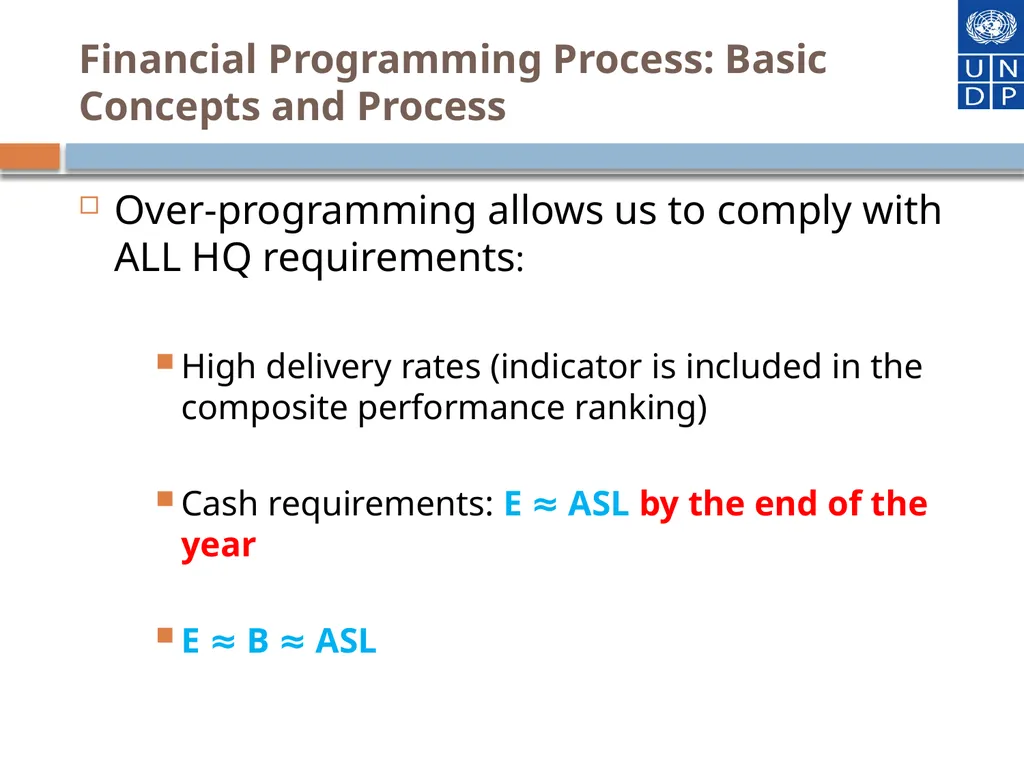
slide28. Financial Programming Process: Basic Concepts and Process Over-programming allows us to comply with ALL HQ requirements:
High delivery rates (indicator is included in the composite performance ranking)
Cash requirements: E ≈ ASL by the end of the year
E ≈ B ≈ ASL<br>
slide29. Financial Programming Process: Basic Concepts and Process<br>
slide30. Financial Programming: Basic Concepts and Process<br>
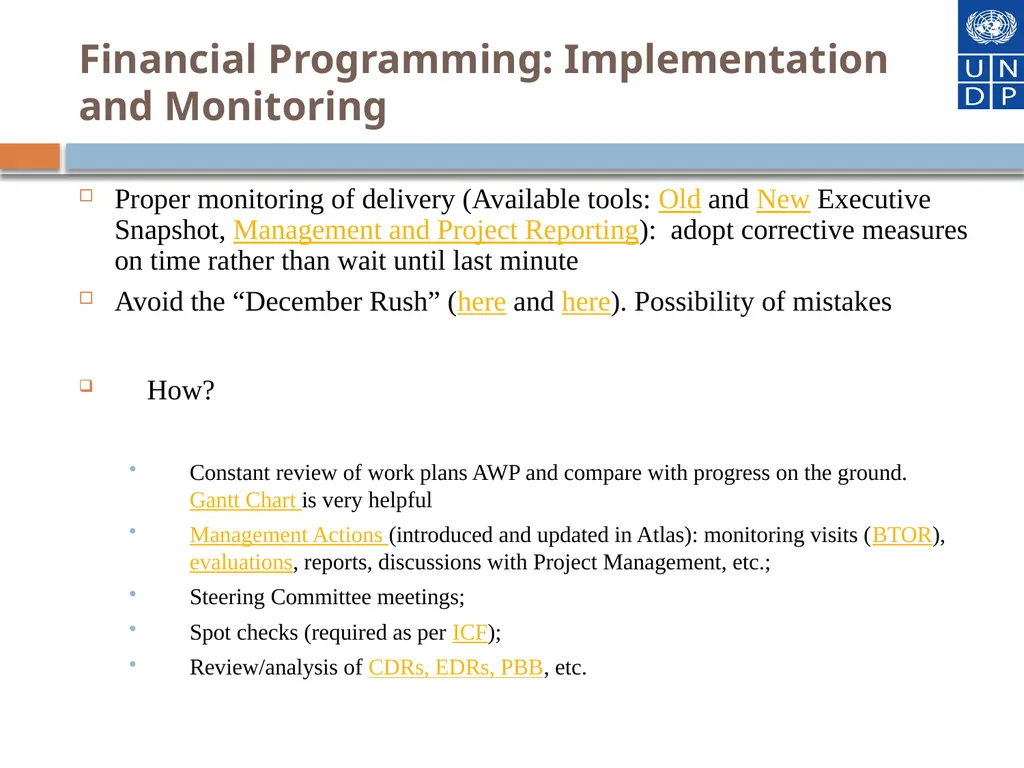
slide31. Financial Programming: Implementation and Monitoring Proper monitoring of delivery (Available tools: Old and New Executive Snapshot, Management and Project Reporting): adopt corrective measures on time rather than wait until last minute
Avoid the “December Rush” (here and here). Possibility of mistakes
How?
Constant review of work plans AWP and compare with progress on the ground. Gantt Chart is very helpful
Management Actions (introduced and updated in Atlas): monitoring visits (BTOR), evaluations, reports, discussions with Project Management, etc.;
Steering Committee meetings;
Spot checks (required as per ICF);
Review/analysis of CDRs, EDRs, PBB, etc.<br>
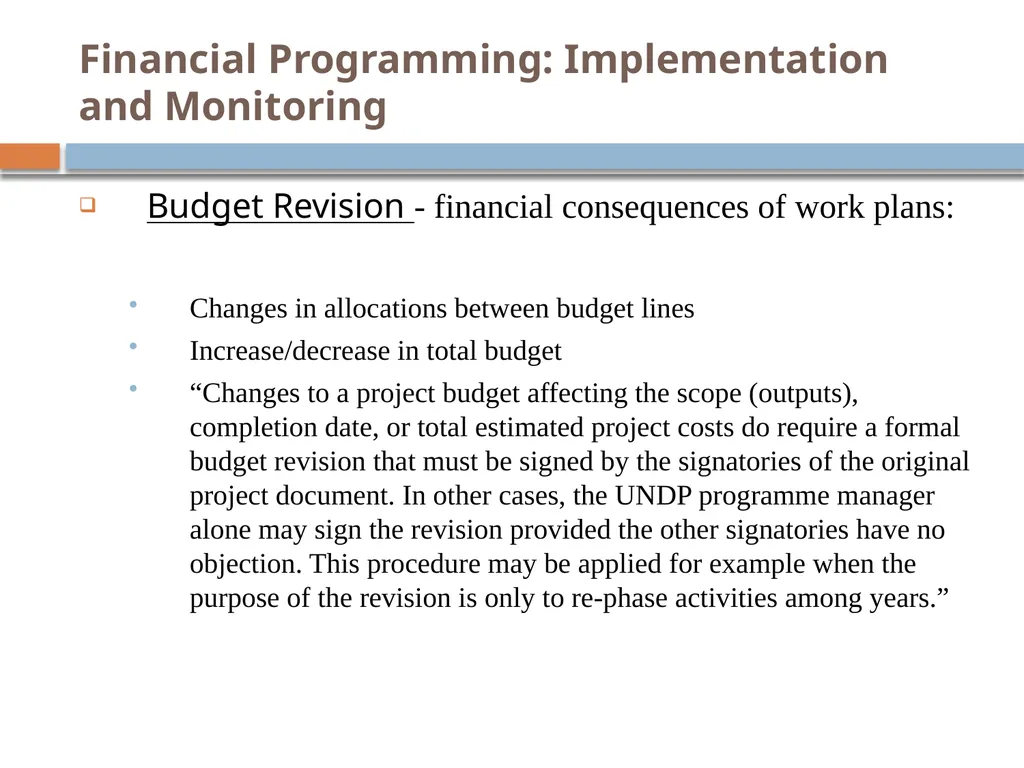
slide32. Financial Programming: Implementation and Monitoring Budget Revision - financial consequences of work plans:
Changes in allocations between budget lines
Increase/decrease in total budget
“Changes to a project budget affecting the scope (outputs), completion date, or total estimated project costs do require a formal budget revision that must be signed by the signatories of the original project document. In other cases, the UNDP programme manager alone may sign the revision provided the other signatories have no objection. This procedure may be applied for example when the purpose of the revision is only to re-phase activities among years.”<br>
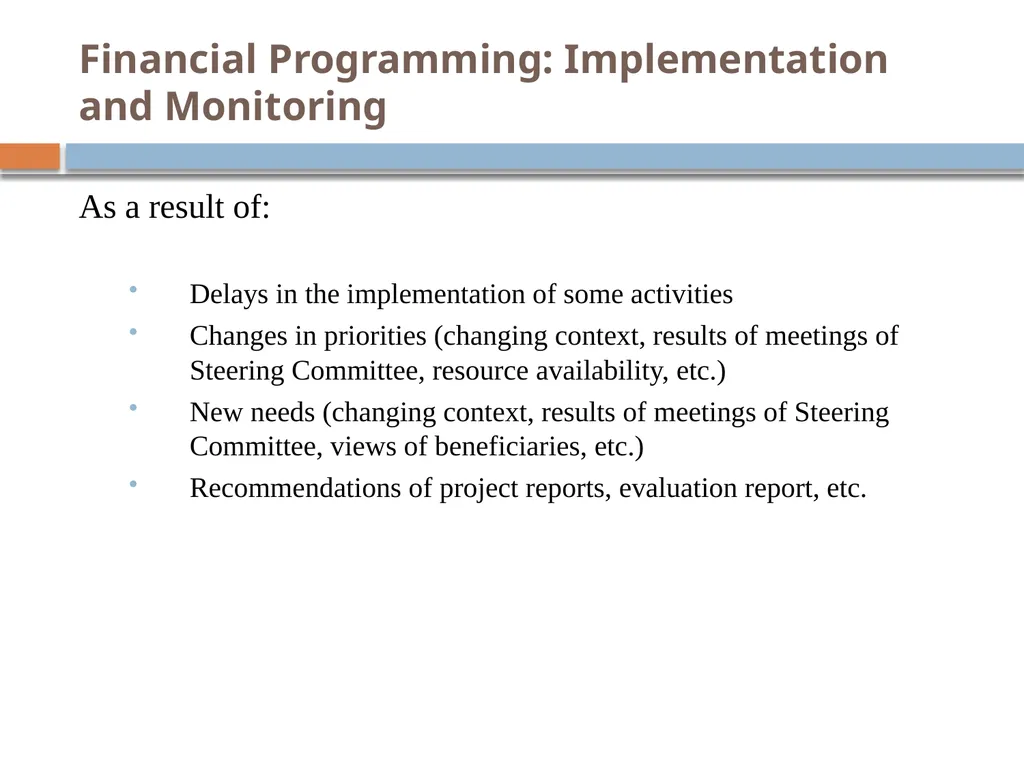
slide33. Financial Programming: Implementation and Monitoring As a result of:
Delays in the implementation of some activities
Changes in priorities (changing context, results of meetings of Steering Committee, resource availability, etc.)
New needs (changing context, results of meetings of Steering Committee, views of beneficiaries, etc.)
Recommendations of project reports, evaluation report, etc.<br>
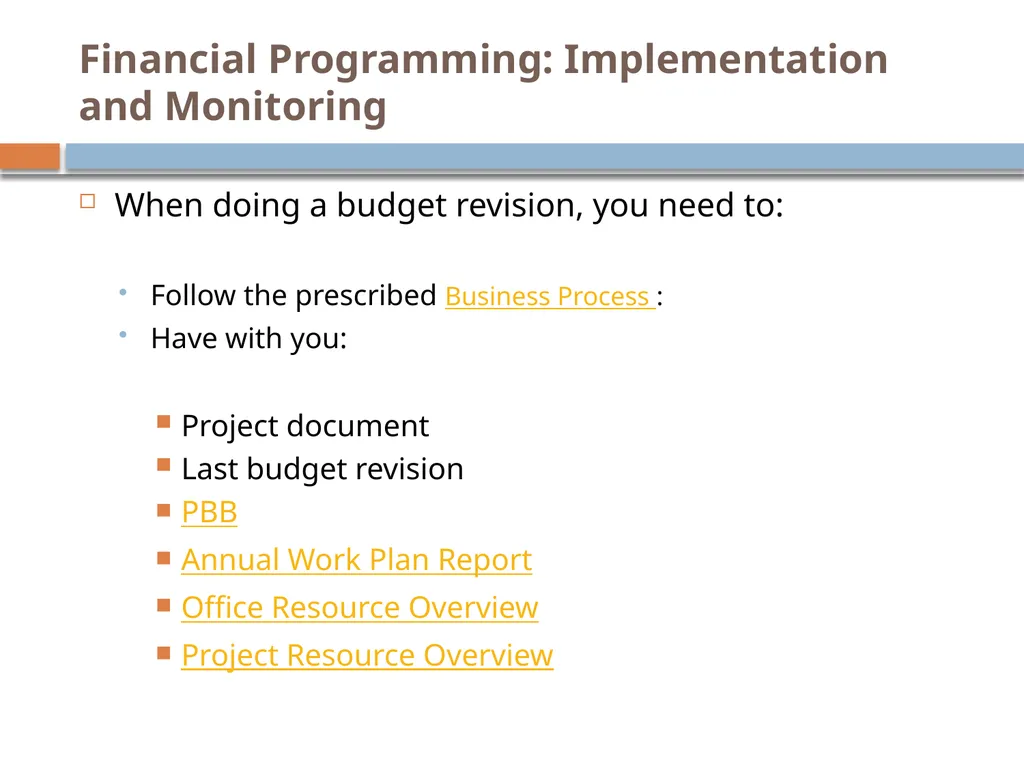
slide34. Financial Programming: Implementation and Monitoring When doing a budget revision, you need to:
Follow the prescribed Business Process :
Have with you:
Project document
Last budget revision
PBB
Annual Work Plan Report
Office Resource Overview
Project Resource Overview<br>
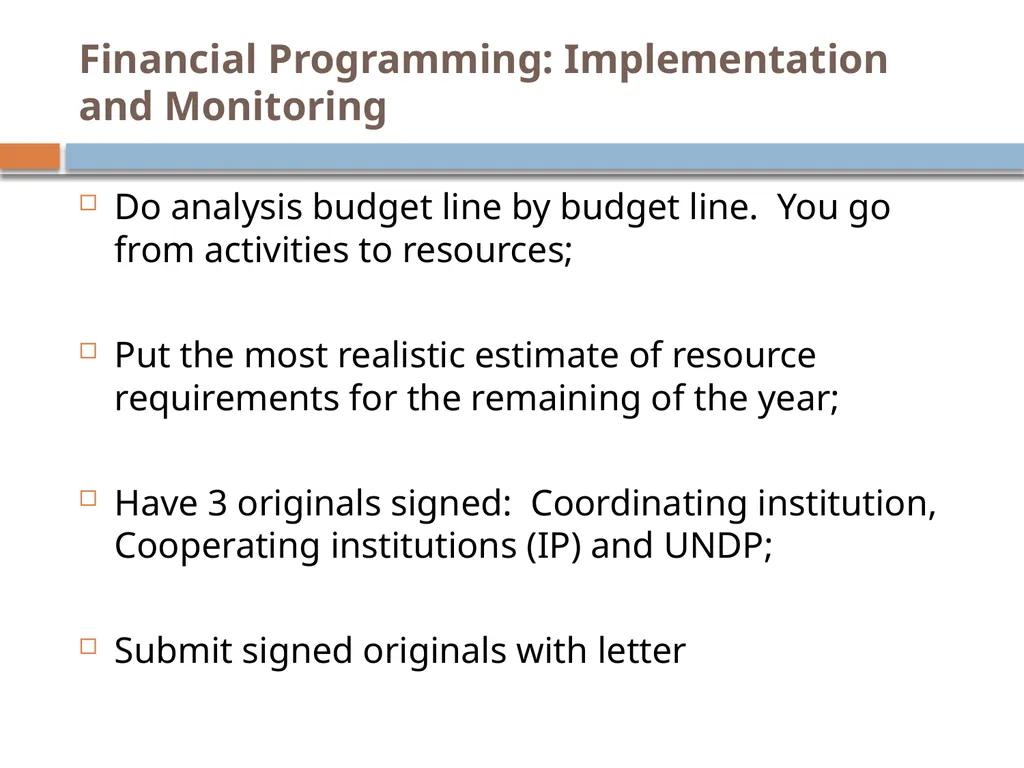
slide35. Financial Programming: Implementation and Monitoring Do analysis budget line by budget line. You go from activities to resources;
Put the most realistic estimate of resource requirements for the remaining of the year;
Have 3 originals signed: Coordinating institution, Cooperating institutions (IP) and UNDP;
Submit signed originals with letter<br>
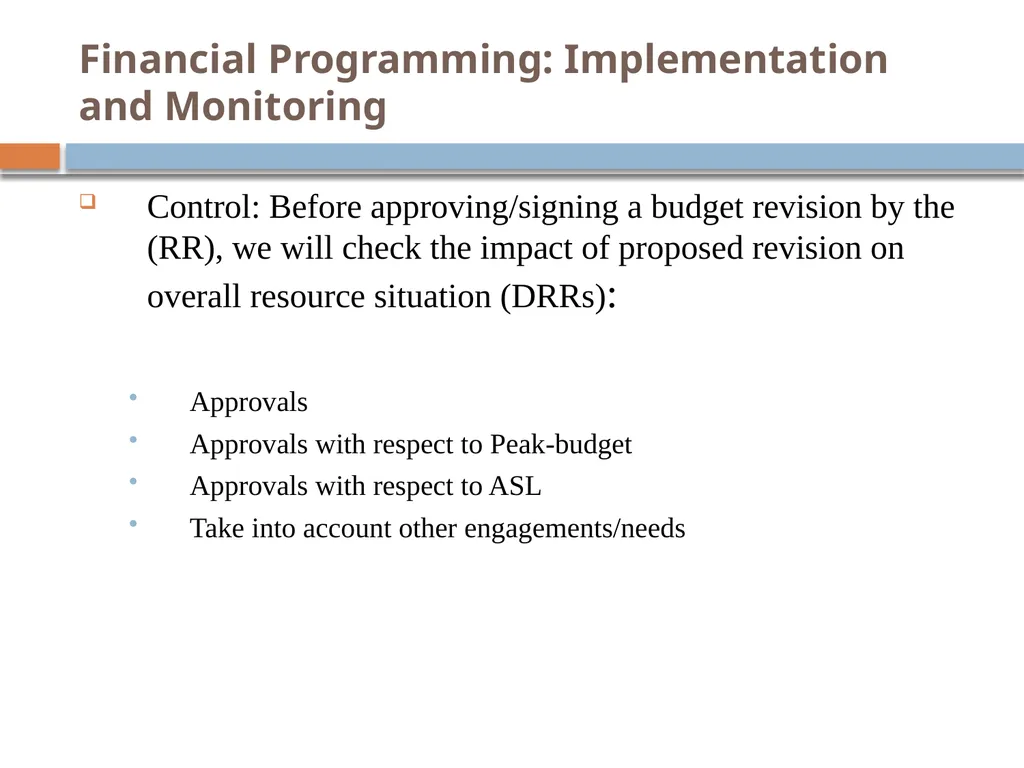
slide36. Financial Programming: Implementation and Monitoring Control: Before approving/signing a budget revision by the (RR), we will check the impact of proposed revision on overall resource situation (DRRs):
Approvals
Approvals with respect to Peak-budget
Approvals with respect to ASL
Take into account other engagements/needs<br>
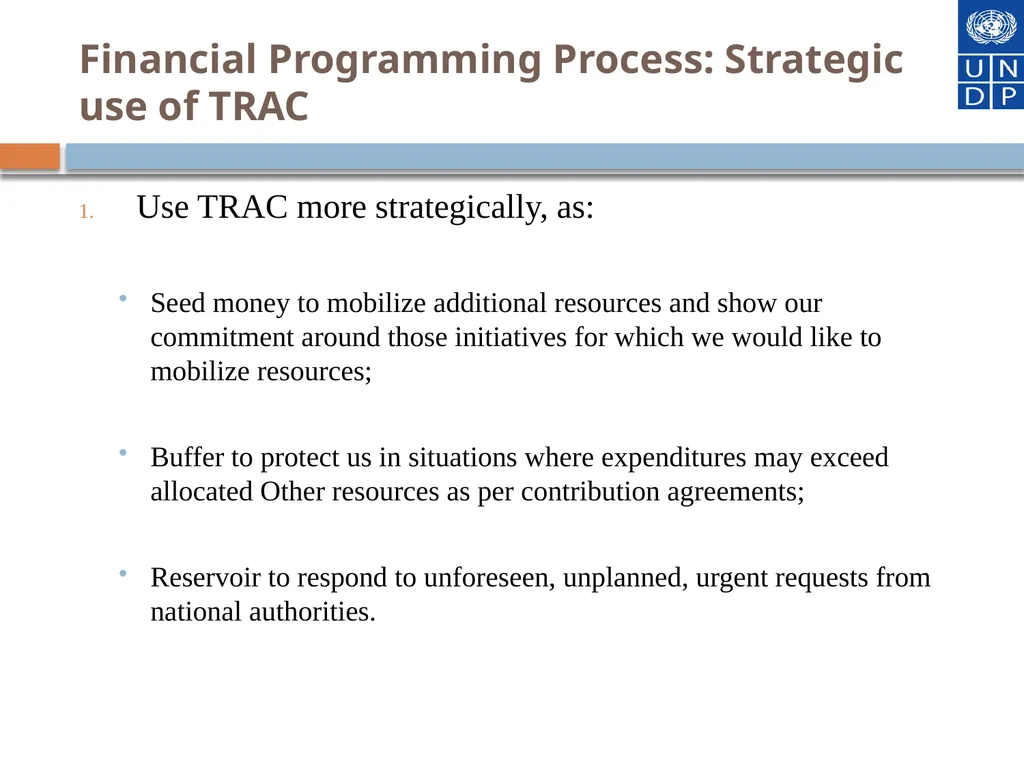
slide37. Financial Programming Process: Strategic use of TRAC Use TRAC more strategically, as:
Seed money to mobilize additional resources and show our commitment around those initiatives for which we would like to mobilize resources;
Buffer to protect us in situations where expenditures may exceed allocated Other resources as per contribution agreements;
Reservoir to respond to unforeseen, unplanned, urgent requests from national authorities.<br>
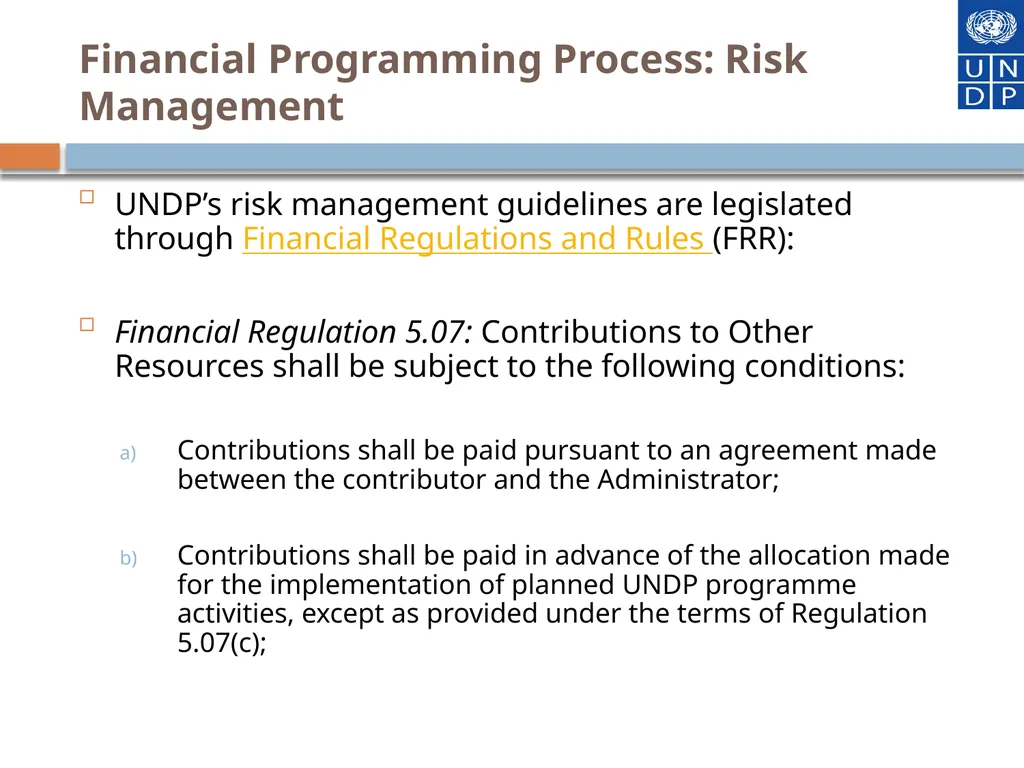
slide38. Financial Programming Process: Risk Management UNDP’s risk management guidelines are legislated through Financial Regulations and Rules (FRR):
Financial Regulation 5.07: Contributions to Other Resources shall be subject to the following conditions:
Contributions shall be paid pursuant to an agreement made between the contributor and the Administrator;
Contributions shall be paid in advance of the allocation made for the implementation of planned UNDP programme activities, except as provided under the terms of Regulation 5.07(c);<br>
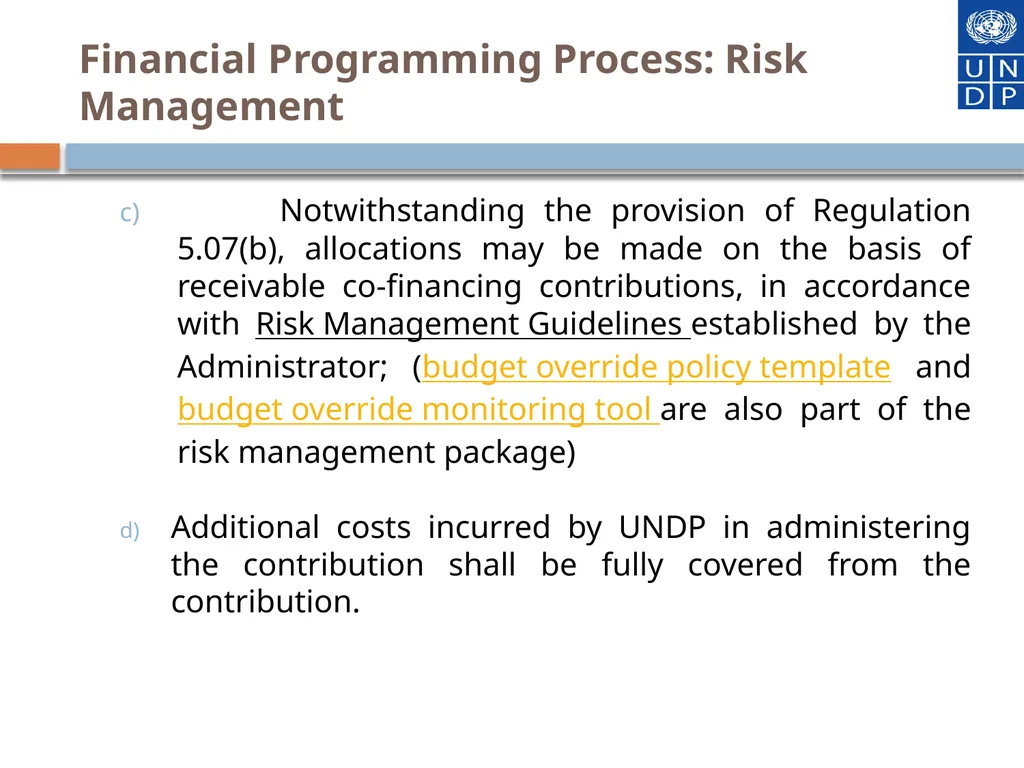
slide39. Financial Programming Process: Risk Management Notwithstanding the provision of Regulation 5.07(b), allocations may be made on the basis of receivable co-financing contributions, in accordance with Risk Management Guidelines established by the Administrator; (budget override policy template and budget override monitoring tool are also part of the risk management package)
Additional costs incurred by UNDP in administering the contribution shall be fully covered from the contribution.<br>
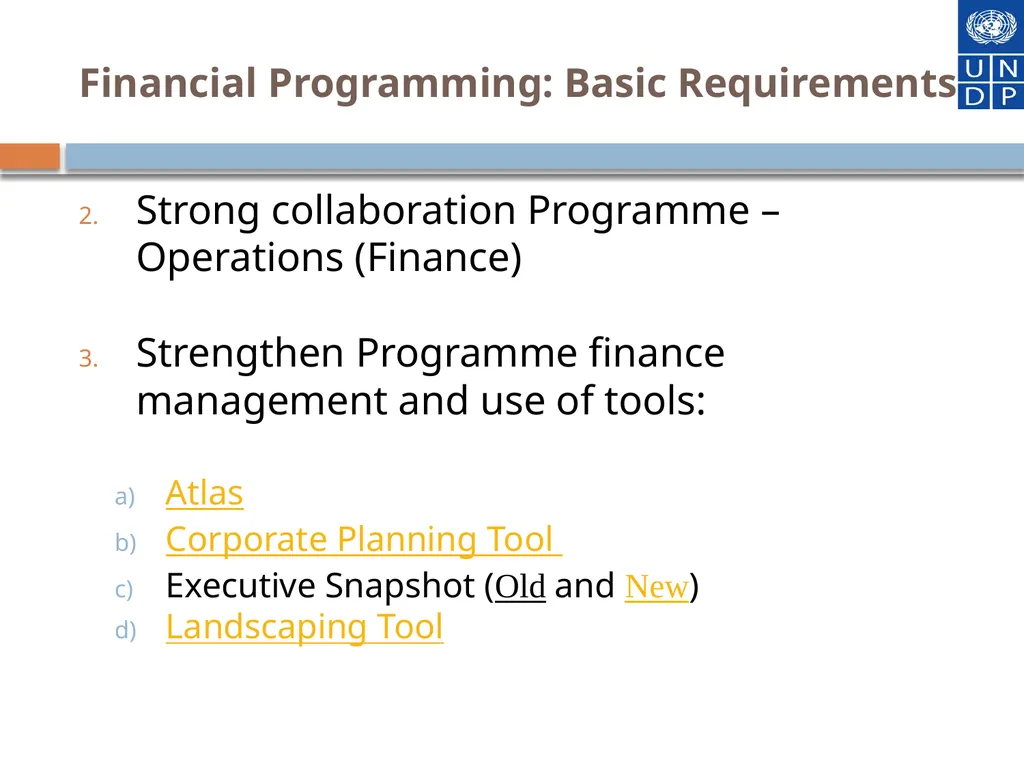
slide40. Financial Programming: Basic Requirements Strong collaboration Programme – Operations (Finance)
Strengthen Programme finance management and use of tools:
Atlas
Corporate Planning Tool
Executive Snapshot (Old and New)
Landscaping Tool<br>
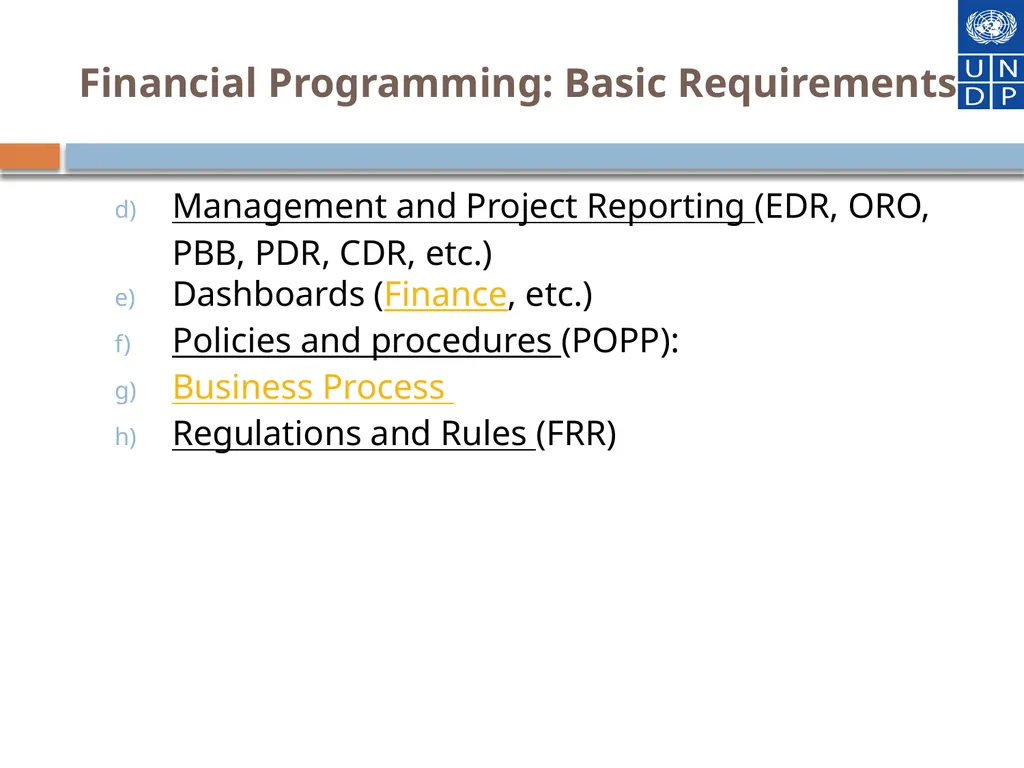
slide41. Financial Programming: Basic Requirements Management and Project Reporting (EDR, ORO, PBB, PDR, CDR, etc.)
Dashboards (Finance, etc.)
Policies and procedures (POPP):
Business Process
Regulations and Rules (FRR)<br>
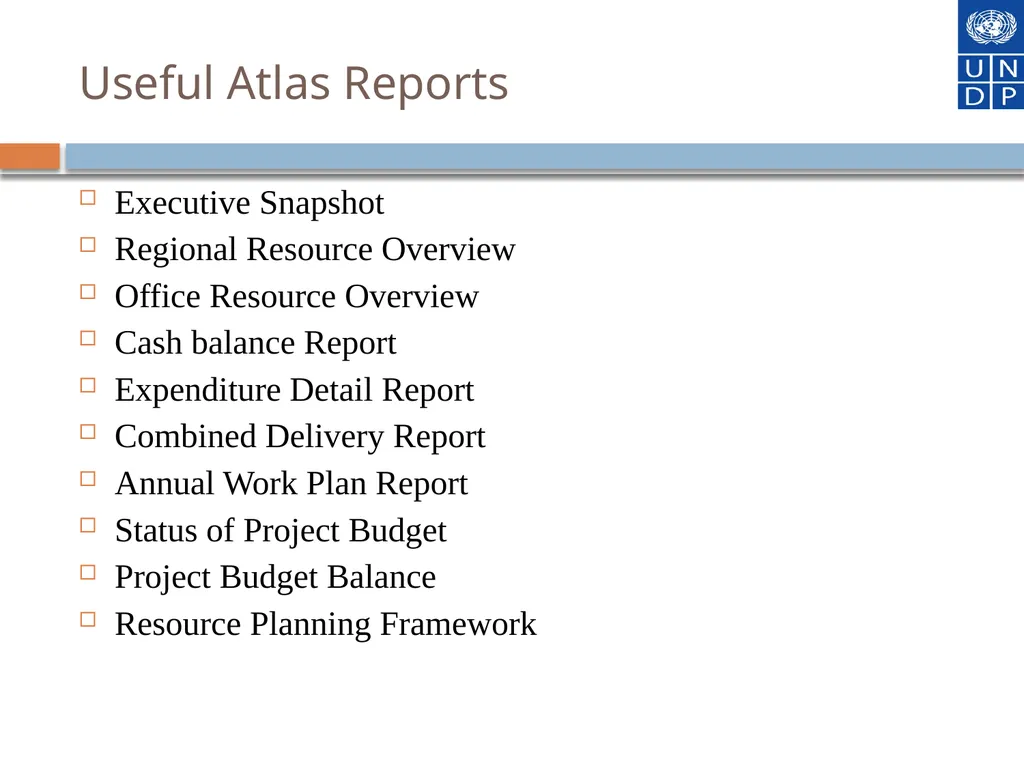
slide42. Useful Atlas Reports Executive Snapshot
Regional Resource Overview
Office Resource Overview
Cash balance Report
Expenditure Detail Report
Combined Delivery Report
Annual Work Plan Report
Status of Project Budget
Project Budget Balance
Resource Planning Framework<br>
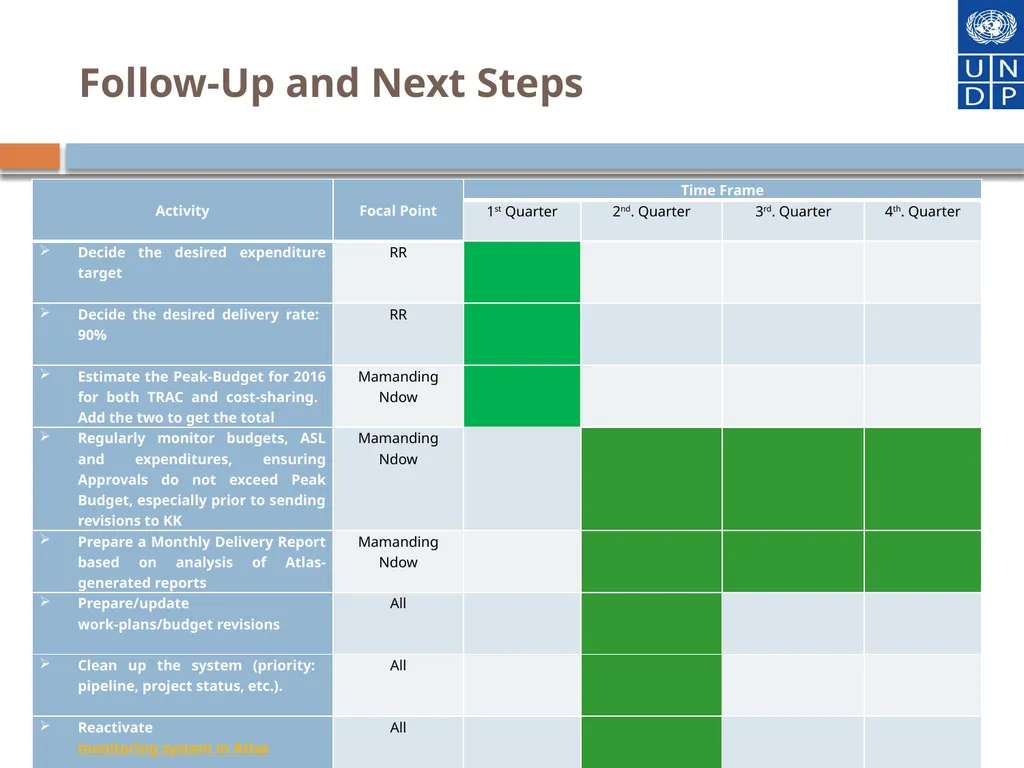
slide43. Follow-Up and Next Steps<br>
slide44. Thank you: More Questions?<br>
DRR, UNDP Gambia
March, 2016<br>
slide2. Objectives of the working session The overall goal of this working session is to support delivery and the achievement of sustainable results. By the end of this working session, therefore, participants should be:
Familiar with concepts, policies and procédures, Business Processes, systems, tools of programme finance management
Able to carry out the relevant programme finance operations effectively, efficiently and with JOY;
Fully understand their roles and related accountabilities<br>
slide3. Programme - Agenda<br>
slide4. The importance of policies, procedures, processes, tools in achieving organization goals Outcomes without a process (the “what” without the “how”) – Process is the roadmap to the achievement of outcomes
Decisions not supported by evidence – Importance of evidence (data, facts, etc.), tools, systems in management;
No accountability
Poor results<br>
slide5. The Nature of our Work TRANSACTIONAL = things you do based on standard procedures that do not require interpretation / modification; many (but not all) administrative tasks would be transactional.
SUBSTANTIVE = where you may need to sit back, think about the task at hand, and make decisions on what exactly needs to happen; where standard procedures alone are not enough to guide you<br>
slide6. The Nature of our Work Substantive work:
Analytical skills - the ability to visualize, articulate, and solve both complex and complicated problems and concepts and make decisions that are sensible and based on available information. Such skills include demonstration of the ability to apply logical thinking to gathering and analyzing information, designing and testing solutions to problems, and formulating plans.
Critical thinking - clear, reasoned thinking involving critique; making clear, reasoned judgements. It is the intellectually disciplined process of actively and skillfully conceptualizing, applying, analyzing, synthesizing, and/or evaluating information gathered from, or generated by, observation, experience, reflection, reasoning, or communication, as a guide to belief and action.<br>
slide7. The Nature of our Work: Internal Control Framework Internal Control Framework
Segregation of duties - there must be a segregation of duties to implement an appropriate level of checks and balances upon the activities of individuals, thereby minimizing the risk of error or fraud and helping to detect errors or fraud.
Assign staff members only one Atlas profile that is consistent with their role. (ARGUS report)
Staff members who approve vouchers (approving managers) cannot create vouchers (finance); and
Staff members who approve POs (approving managers) cannot create POs (buyers).<br>
slide8. The Nature of our Work: Internal Control Framework The need for segregation between first authority (project manager) and second authority (approving manager) on any one transaction is ideally achieved by separately assigning either a ‘project manager’ profile or an ‘approving manager’ profile (i.e., senior manager, manager level 2, or manager level 1).<br>
slide9. The Nature of our Work: Internal Control Framework Preparing annual budgets and work plans for approval by office management;
Achieving the outputs described in the work plan;
Reviewing budgets and work plans on a monthly basis and bringing to the attention of senior management any proposed changes;
Preparing procurement and recruitment plans for the project and monitoring activities based on the plans developed;
Monitoring project activities and initiating the designation of projects as operationally closed, then financially closed; Submitting signed contribution agreements to designated finance staff for uploading to the DMS;
Reviewing A/R in Atlas for their projects and following up with donors on outstanding amounts;
Regularly reviewing Atlas project reports, ensuring that revenue, commitments, expenses, and disbursements are complete and accurate, and detecting erroneous or unauthorized charges;
Ensuring the physical safeguarding of project assets; and.
Ensuring that funds are adequately reserved to cover the full cost of staff. The project manager has the authority to run the project on a daily basis on behalf of the project board within the requirements set by the project board. The project manager is responsible for day-to-day management and decision-making for the project. The project manager’s prime responsibility is to ensure that the project produces the results specified in the project document, to the required standard of quality and within the specified constraints of time and budget. The broad responsibilities of project managers include:<br>
slide10. The Nature of our Work: Internal Control Framework Responsibilities of programme officers include:
Creating a proposal in Atlas, though data entry may be delegated;
Preparing and clearing the project’s annual work plan (i.e., inputs, activities, and outputs);
Ensuring that projects are planned and approved according to POPP;
Monitoring whether project activities, commitments, and expenses align with the project’s annual work plan, including progress toward outputs and outcomes;
Maintaining, filing, and managing copies of all key documents relating to the projects (e.g., project documents, contributions agreements, and audit reports) Managing and monitoring advances issued to implementing partners;
Entering into Atlas multi-year budgets if the project continues for more than a year based on approved documents (e.g., project documents, contributions agreement, resource planning framework, institutional budget issued, etc.) before submitting the budget to the programme manager;
Ensuring that donor requirements including payment schedules of contributions and A/R are adhered to;
Ensuring that project assets are properly maintained and recorded;
Ensuring that project procurement plans are prepared and submitted; and
Ensuring that proper operational and financial closure of projects in Atlas on a timely basis according to agreed supporting documents. Programme officers are generally responsible for a portfolio of projects, usually development projects. Their responsibilities include ensuring that their projects are prepared and monitored according to POPP and that all projects for which they are responsible are properly opened, awarded, operationally closed, and financially closed in Atlas following agreed supporting documents (e.g., project document, contribution agreements, etc.). This responsibility applies regardless of the implementation arrangements for the project.<br>
slide11. The Nature of our Work: Internal Control Framework Responsibilities of the approving manager include:
Confirming that the commitment or payment is aligned with the UNDP mandate and consistent with the project work plan, the accuracy of the chart field, and the accuracy of the amount. The project manager should already have conducted such confirmation but the approving manager as second authority is responsible for independent confirmation;
Ensuring that the items selected were done in terms of the correct procurement catalogue and item;
Ensuring that the travel has been authorized by the traveller’s supervisor, and that the travel entitlements are valid;
Discussing concerns, if not satisfied with the above, with the project manager and/or the buyer and requesting further supporting documentation;
Ensuring that CAPC, ACP, or RACP approval is attached when required, the award of contract duly was approved by the head of office or by the CPO, and any exceptions are fully justified and documented; Ensuring that the correct UNDP standard contract has been signed and any deviations have been approved by BOM/LSO;
Confirming that correct ‘bill to’ and ‘ship to’ locations have been entered;
Confirming that correct payment terms have been entered;
Confirming that correct shipping terms, such as international commercial (INCO) terms, have been entered.
Reviewing appropriate supporting documentation prior to approval of the PO, such as approved purchase e-requisition; approved work plan; TOR (‘services’) or specifications (‘goods’); list of shortlisted suppliers or candidates; quotes for procurement; minutes of the relevant meeting of the CAPC and/or of the ACP, and approval of minutes by head of office or CPO; detailed evaluation sheets; and unapproved PO or contract;
Ensuring that all supporting documentation is maintained and securely filed; and The ‘approving manager’ (second authority) role refers to the person who independently reviews the authority exercised by the project manager (first authority), verifies that applicable policies and procedures have been followed, and approves PO, non-PO vouchers, and prepaid vouchers. They are designated by the head of office on behalf of the UNDP comptroller and must be UNDP staff members. Any exceptions must be approved by the comptroller, based upon full justification and the application of appropriate controls by the respective office.<br>
slide12. Financial Management: Definition Efficient and effective management of money (funds) in such a manner as to accomplish the objectives of the organization (UNDP Gambia)<br>
slide13. Objectives of Financial Management To ensure regular and adequate supply of funds to the concern;
To ensure optimum funds utilization - Once the funds are secured, they should be utilized in maximum possible way at least cost;
To ensure safety on investment, i. e. funds should be invested in safe ventures so that adequate rate of return can be achieved.<br>
slide14. Accountability Framework The Accountability Framework describes organization wide processes for monitoring, analyzing and improving performance.<br>
slide15. Accountability Framework: Oversight<br>
slide16. “Nobody can claim ignorance as an excuse since it is the duty of each staff member to keep informed about the policies and procedures that are applicable for our work.”
“The responsibility for self-informing includes learning and training”
“In UNDP, staff members are accountable for managing their own learning and development”
Delegation of Authority – Distribution of Responsibilities Accountability Framework: Responsibility for self-informing<br>
slide17. Legal Framework for Programming Standard Basic Assistance Agreement (SBAA) - The legal agreement between the programme country Government and UNDP outlining general conditions for UNDP cooperation under which all UNDP programme activities are carried out.
Country Programme Document: A document approved by the UNDP Executive Board to mandate UNDP to work for agreed development results in a country.
Country Programme Action Plan (CPAP): A legal agreement between the programme country Government and UNDP to execute the Country Programme.<br>
slide18. Legal Framework for Programming Project Document:
A legal agreement between UNDP, the government, and the Executing Entity to implement a specific project
Describes the project linkage to the CP, specifies the project results and resources framework and management arrangements.
AWP is a legal agreement between UNDP and the Implementing Partner to implement activities under a specific AWP within a calendar year.<br>
slide19. Launch of the Programme and Project Management Reforms (Message from the Associate Administrator, dated 3 March 2016)) Key areas where specific changes come into effect on March 1st are:
New Quality Standards for Programming
Offices will have until 15 February 2017 to quality assure all projects for 2016. We encourage you to complete at least 80% before the end of the year.
New Monitoring Policy
The policy sets corporate standards for tracking performance through the systematic collection of data and analysis of evidence.
New Project Document Template
While the new project document template can be used immediately, it will be required for all new projects as of 1 July 2016. Country offices should take note of the strengthened resource planning requirements of the project document. All project inputs, including those provided by UNDP staff, are to be fully budgeted and included in the multi-year work plan.
The CPAP will no longer be required for countries with a signed UNDAF
Please make sure the standard legal clauses are attached to the UNDAF. If your country does not have an UNDAF, you must still sign a CPAP with the Government, establishing national ownership over the programme.
New Programming Instruments
We recently introduced the Engagement Facility to deliver upstream results more quickly and easily, as well as the South-South and Triangular Cooperation Project.<br>
slide22. Financial Programming: Basic Concepts and Process Approval of UNDAF 2017 – 2021 (Validation Workshop March 2016)
Approval of the new CPD 2017 – 2021by Executive Board in September 2016
Formulate Transition Plan, from Old CPD 2012 – 2016 to the New CPD 2017 – 2021
Develop Pipeline of new projects (Pipeline Management)
Formulation of Project Documents – Continuous, on-going
Preparation of AWPs – Beginning of 2017 RBM<br>
slide23. Financial Programming: Basic Concepts and Process TRAC – Targeted Resource Allocation from Core: Allocated to countries with the approval of the country programme by Executive Board
RPF – Resources Planning Framewor: Communicated to country offices with ASL for a 4-year period
ASL – Authorized Spending Limit
CL - Cash Limit: Cash Received and Opening Cash balance together. (Also referred to as Total Income)
RMT – Resources Mobilization Target Table<br>
slide24. Financial Programming: Basic Concepts and Process Estimate desired delivery rate – should be determined by Management based on:
Experience (delivery past years)
Perception future (people in relevant positions, perceived improvements in absorptive capacity, etc.)
Public sector reforms
Economic developments
Intuition
Ambitions/aspirations<br>
slide25. Financial Programming: Basic Concepts and Process Expenditure target – the level of expenditure we would like to achieve in the year. It is the ASL;
Peak budget: highest level of programming/budgeting - expenditure target / estimated delivery rate
Approved budget (approvals): sum of all approved budgets<br>
slide26. Financial Programming: Basic Concepts and Process Focus only on cash management to the detriment of programme management. Cash management should be in support of programme management
Concern with over-programming is not on the budget side per se, but on the associated risk for B > ASL ⇒ E > ASL (B = Budget; E = Expenditure)
Many things can happen during the year, but, what really matters is the situation at the end of the year.
Risk of E > ASL (deficit) can be managed through effective use of Atlas tools and close collaboration between Programme and Operations. Therefore, over-programming DOES NOT not have to lead to deficit.<br>
slide27. Financial Programming: Basic Concepts and Process Set expenditure target (Et) = ASL + TRAC (As soon as 2016 ASLs are posted)
To actually spend (Et): B > (Et):
Justification: Absorptive capacity of IPs + other unforeseen factors
Question: by how much?
Set budget ceiling:
Set target delivery rate: R
Budget ceiling = (Et)/R
Accelerate delivery (D)<br>
slide28. Financial Programming Process: Basic Concepts and Process Over-programming allows us to comply with ALL HQ requirements:
High delivery rates (indicator is included in the composite performance ranking)
Cash requirements: E ≈ ASL by the end of the year
E ≈ B ≈ ASL<br>
slide29. Financial Programming Process: Basic Concepts and Process<br>
slide30. Financial Programming: Basic Concepts and Process<br>
slide31. Financial Programming: Implementation and Monitoring Proper monitoring of delivery (Available tools: Old and New Executive Snapshot, Management and Project Reporting): adopt corrective measures on time rather than wait until last minute
Avoid the “December Rush” (here and here). Possibility of mistakes
How?
Constant review of work plans AWP and compare with progress on the ground. Gantt Chart is very helpful
Management Actions (introduced and updated in Atlas): monitoring visits (BTOR), evaluations, reports, discussions with Project Management, etc.;
Steering Committee meetings;
Spot checks (required as per ICF);
Review/analysis of CDRs, EDRs, PBB, etc.<br>
slide32. Financial Programming: Implementation and Monitoring Budget Revision - financial consequences of work plans:
Changes in allocations between budget lines
Increase/decrease in total budget
“Changes to a project budget affecting the scope (outputs), completion date, or total estimated project costs do require a formal budget revision that must be signed by the signatories of the original project document. In other cases, the UNDP programme manager alone may sign the revision provided the other signatories have no objection. This procedure may be applied for example when the purpose of the revision is only to re-phase activities among years.”<br>
slide33. Financial Programming: Implementation and Monitoring As a result of:
Delays in the implementation of some activities
Changes in priorities (changing context, results of meetings of Steering Committee, resource availability, etc.)
New needs (changing context, results of meetings of Steering Committee, views of beneficiaries, etc.)
Recommendations of project reports, evaluation report, etc.<br>
slide34. Financial Programming: Implementation and Monitoring When doing a budget revision, you need to:
Follow the prescribed Business Process :
Have with you:
Project document
Last budget revision
PBB
Annual Work Plan Report
Office Resource Overview
Project Resource Overview<br>
slide35. Financial Programming: Implementation and Monitoring Do analysis budget line by budget line. You go from activities to resources;
Put the most realistic estimate of resource requirements for the remaining of the year;
Have 3 originals signed: Coordinating institution, Cooperating institutions (IP) and UNDP;
Submit signed originals with letter<br>
slide36. Financial Programming: Implementation and Monitoring Control: Before approving/signing a budget revision by the (RR), we will check the impact of proposed revision on overall resource situation (DRRs):
Approvals
Approvals with respect to Peak-budget
Approvals with respect to ASL
Take into account other engagements/needs<br>
slide37. Financial Programming Process: Strategic use of TRAC Use TRAC more strategically, as:
Seed money to mobilize additional resources and show our commitment around those initiatives for which we would like to mobilize resources;
Buffer to protect us in situations where expenditures may exceed allocated Other resources as per contribution agreements;
Reservoir to respond to unforeseen, unplanned, urgent requests from national authorities.<br>
slide38. Financial Programming Process: Risk Management UNDP’s risk management guidelines are legislated through Financial Regulations and Rules (FRR):
Financial Regulation 5.07: Contributions to Other Resources shall be subject to the following conditions:
Contributions shall be paid pursuant to an agreement made between the contributor and the Administrator;
Contributions shall be paid in advance of the allocation made for the implementation of planned UNDP programme activities, except as provided under the terms of Regulation 5.07(c);<br>
slide39. Financial Programming Process: Risk Management Notwithstanding the provision of Regulation 5.07(b), allocations may be made on the basis of receivable co-financing contributions, in accordance with Risk Management Guidelines established by the Administrator; (budget override policy template and budget override monitoring tool are also part of the risk management package)
Additional costs incurred by UNDP in administering the contribution shall be fully covered from the contribution.<br>
slide40. Financial Programming: Basic Requirements Strong collaboration Programme – Operations (Finance)
Strengthen Programme finance management and use of tools:
Atlas
Corporate Planning Tool
Executive Snapshot (Old and New)
Landscaping Tool<br>
slide41. Financial Programming: Basic Requirements Management and Project Reporting (EDR, ORO, PBB, PDR, CDR, etc.)
Dashboards (Finance, etc.)
Policies and procedures (POPP):
Business Process
Regulations and Rules (FRR)<br>
slide42. Useful Atlas Reports Executive Snapshot
Regional Resource Overview
Office Resource Overview
Cash balance Report
Expenditure Detail Report
Combined Delivery Report
Annual Work Plan Report
Status of Project Budget
Project Budget Balance
Resource Planning Framework<br>
slide43. Follow-Up and Next Steps<br>
slide44. Thank you: More Questions?<br>