
Financial Sustainability Workshop 2013 Day 1 Based
T
Published · 41 slides · 0 views
1 / 1


Description
Financial Sustainability Workshop 2013 Day 1 Based on guidance from Mango course FM2 Financial Sustainability Essentials How to Build a Financing Strategy What is Financial Sustainability? Financial sustainability is part of
Related Topics
Share
Embed code
Download this presentation From Below
"Financial Sustainability Workshop 2013 Day 1 Based" is the property of its rightful owner. Permission is granted to download and print the materials on this website for personal, non-commercial use only, and to display it on your personal computer provided you do not modify the materials and that you retain all copyright notices contained in the materials. By downloading content from our website, you accept the terms of this agreement.
Presentation Transcript
01
Financial Sustainability Workshop 2013 Day 1 Based on guidance from Mango course FM2 Financial Sustainability Essentials – How to Build a Financing Strategy<br>
02
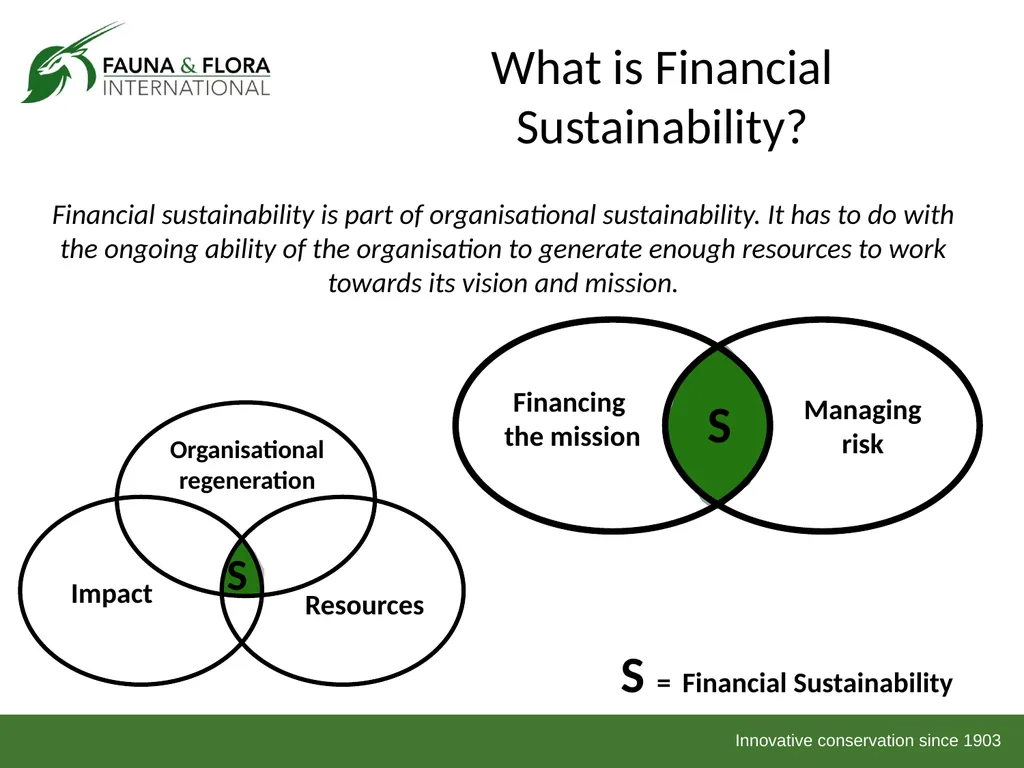
What is Financial Sustainability? Financial sustainability is part of organisational sustainability. It has to do with the ongoing ability of the organisation to generate enough resources to work towards its vision and mission. S Impact Resources Organisational regeneration Financing
the mission Managing risk S S = Financial Sustainability<br>
the mission Managing risk S S = Financial Sustainability<br>
03
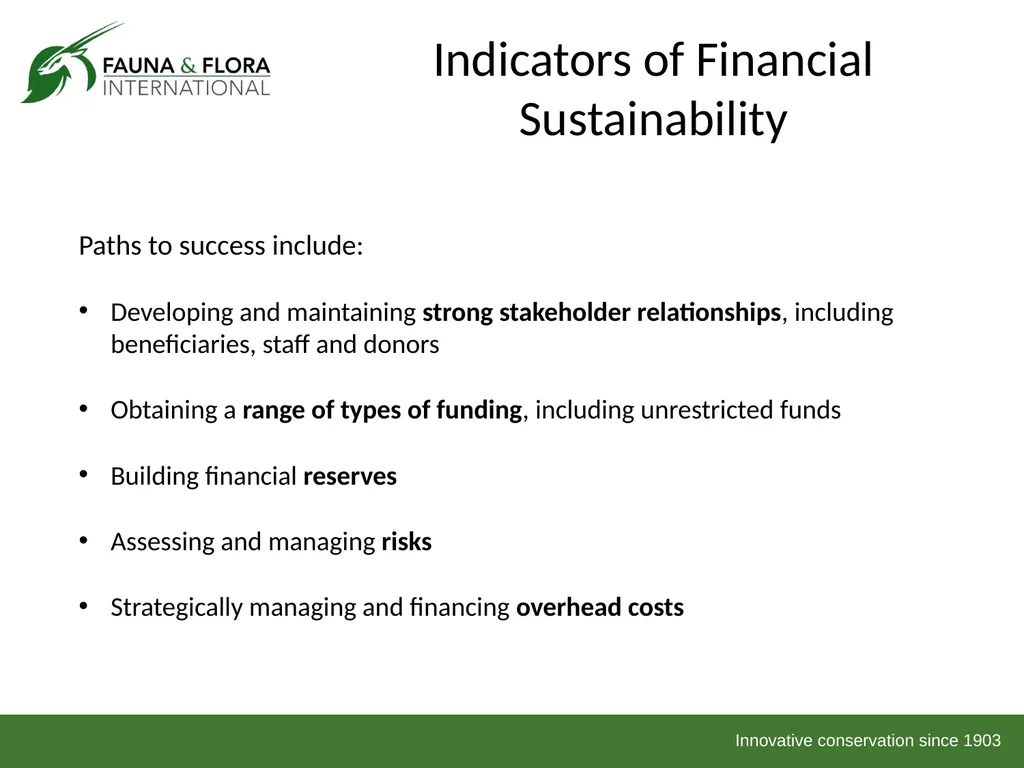
Indicators of Financial Sustainability Paths to success include:
Developing and maintaining strong stakeholder relationships, including beneficiaries, staff and donors
Obtaining a range of types of funding, including unrestricted funds
Building financial reserves
Assessing and managing risks
Strategically managing and financing overhead costs<br>
Developing and maintaining strong stakeholder relationships, including beneficiaries, staff and donors
Obtaining a range of types of funding, including unrestricted funds
Building financial reserves
Assessing and managing risks
Strategically managing and financing overhead costs<br>
04
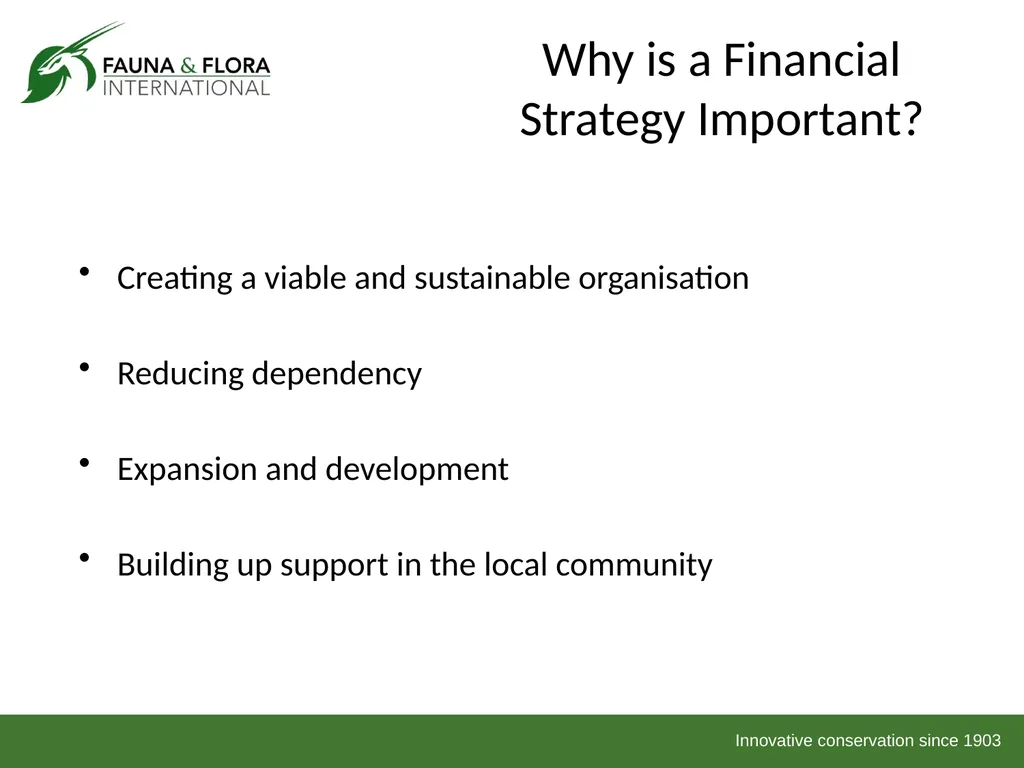
Why is a Financial Strategy Important? Creating a viable and sustainable organisation
Reducing dependency
Expansion and development
Building up support in the local community<br>
Reducing dependency
Expansion and development
Building up support in the local community<br>
05
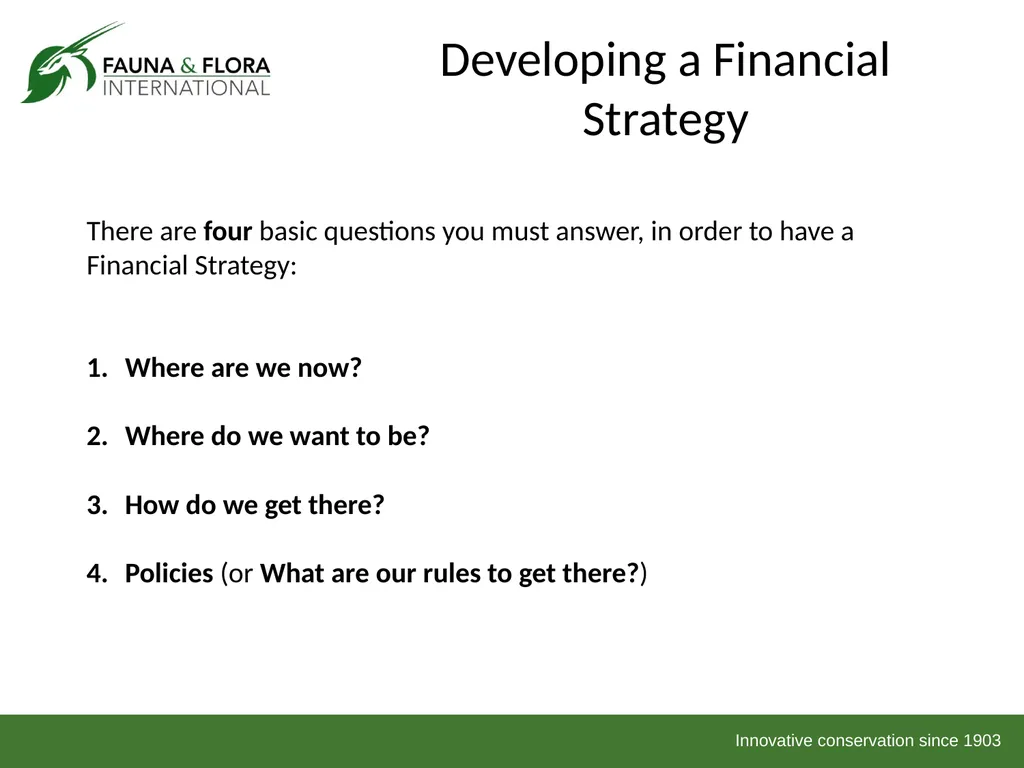
Developing a Financial Strategy There are four basic questions you must answer, in order to have a Financial Strategy:
Where are we now?
Where do we want to be?
How do we get there?
Policies (or What are our rules to get there?)<br>
Where are we now?
Where do we want to be?
How do we get there?
Policies (or What are our rules to get there?)<br>
06
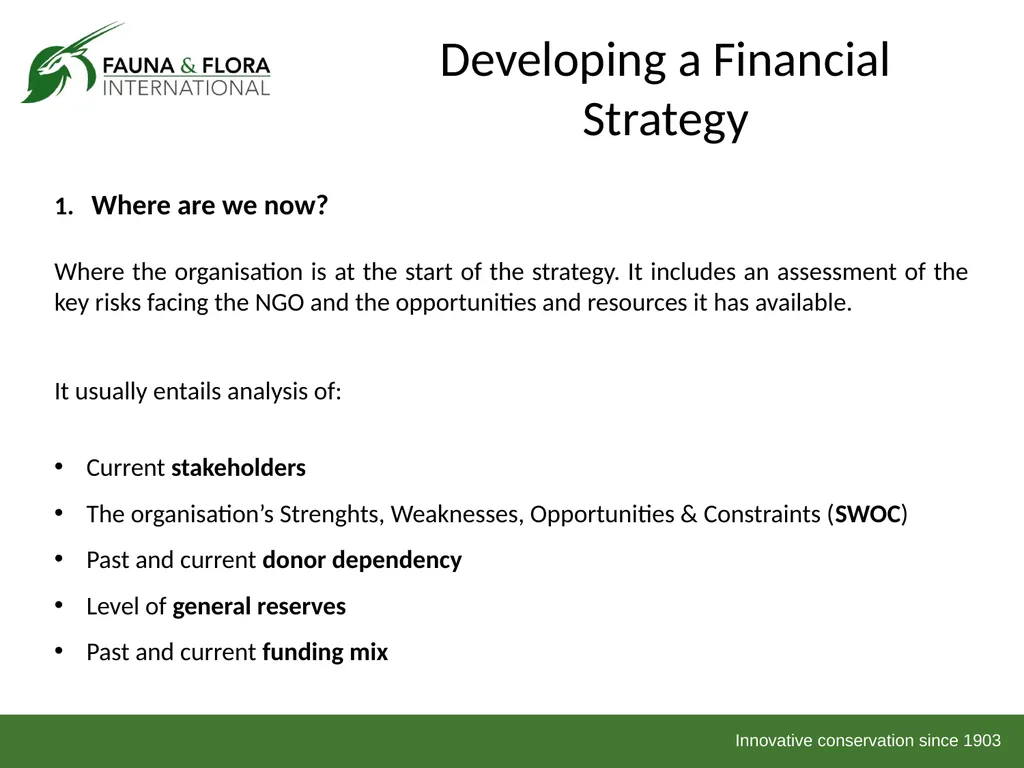
1. Where are we now?
Where the organisation is at the start of the strategy. It includes an assessment of the key risks facing the NGO and the opportunities and resources it has available.
It usually entails analysis of:
Current stakeholders
The organisation’s Strenghts, Weaknesses, Opportunities & Constraints (SWOC)
Past and current donor dependency
Level of general reserves
Past and current funding mix Developing a Financial Strategy<br>
Where the organisation is at the start of the strategy. It includes an assessment of the key risks facing the NGO and the opportunities and resources it has available.
It usually entails analysis of:
Current stakeholders
The organisation’s Strenghts, Weaknesses, Opportunities & Constraints (SWOC)
Past and current donor dependency
Level of general reserves
Past and current funding mix Developing a Financial Strategy<br>
07
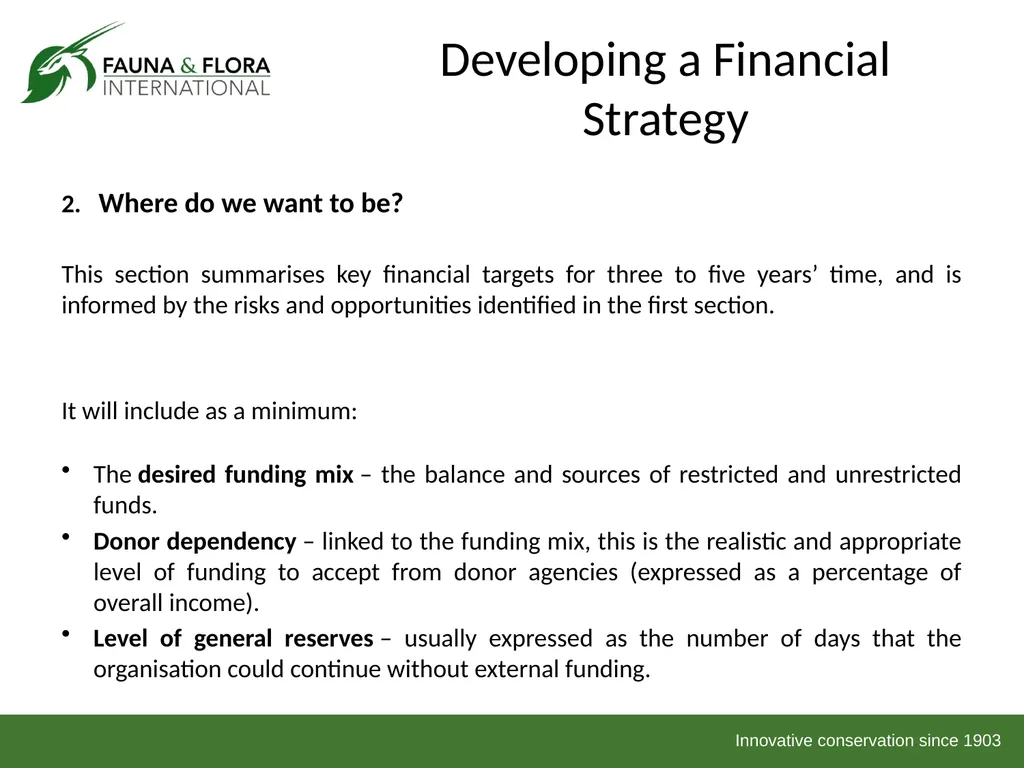
2. Where do we want to be?
This section summarises key financial targets for three to five years’ time, and is informed by the risks and opportunities identified in the first section.
It will include as a minimum:
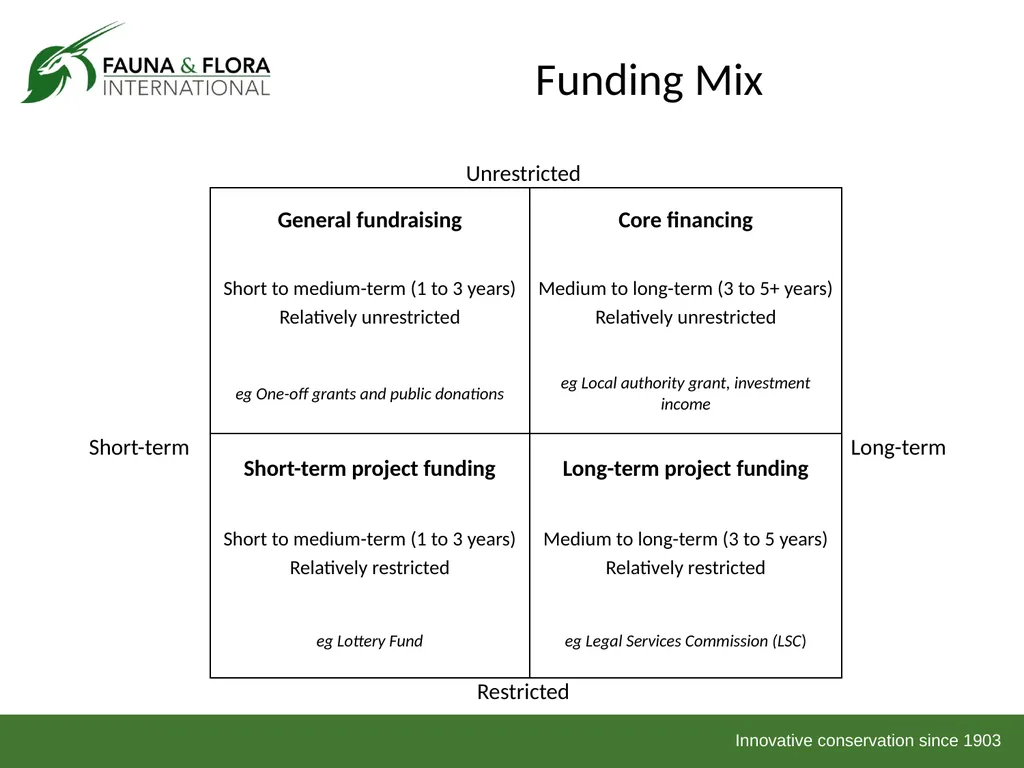
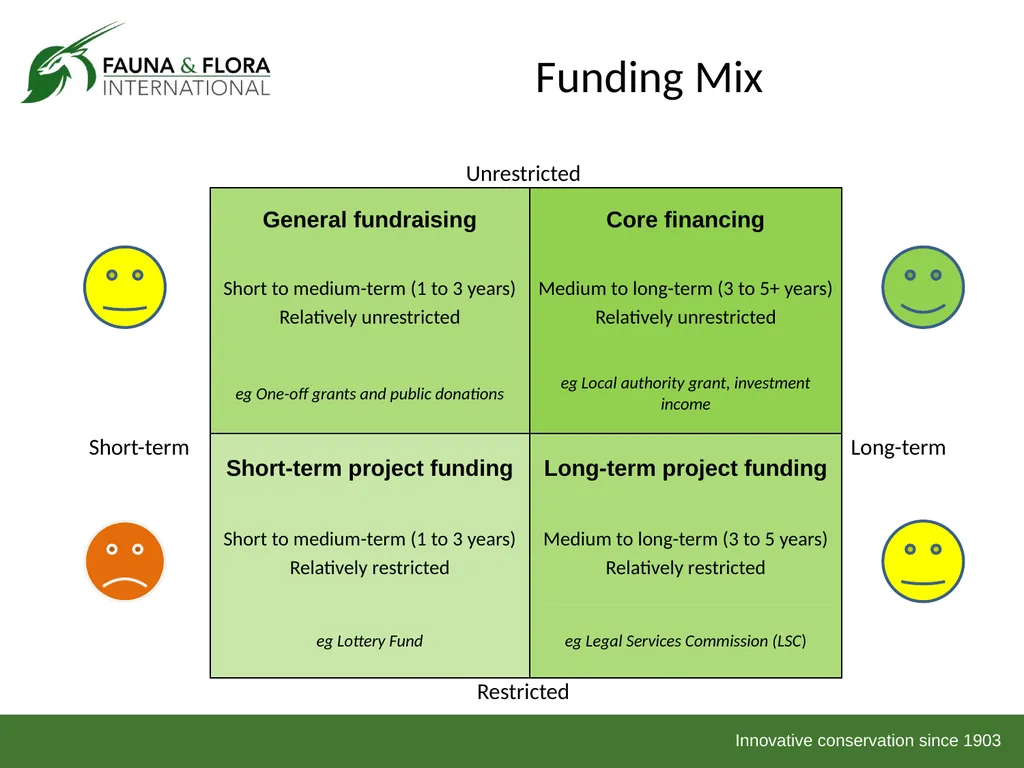
The desired funding mix – the balance and sources of restricted and unrestricted funds.
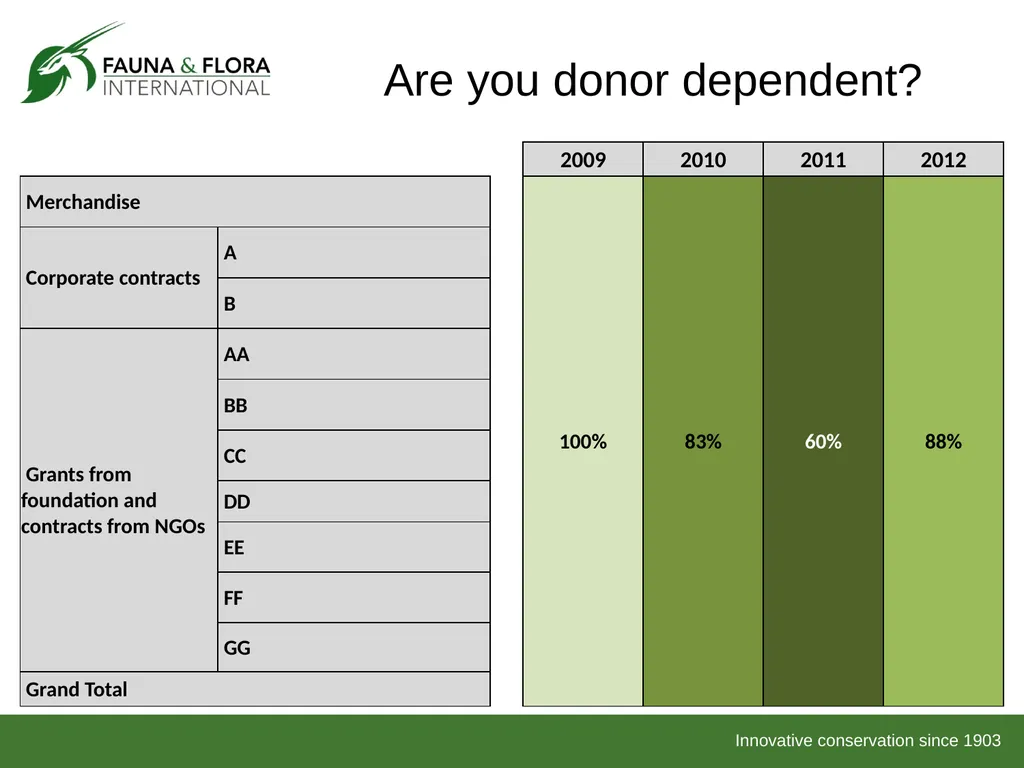
Donor dependency – linked to the funding mix, this is the realistic and appropriate level of funding to accept from donor agencies (expressed as a percentage of overall income).
Level of general reserves – usually expressed as the number of days that the organisation could continue without external funding. Developing a Financial Strategy<br>
This section summarises key financial targets for three to five years’ time, and is informed by the risks and opportunities identified in the first section.
It will include as a minimum:
The desired funding mix – the balance and sources of restricted and unrestricted funds.
Donor dependency – linked to the funding mix, this is the realistic and appropriate level of funding to accept from donor agencies (expressed as a percentage of overall income).
Level of general reserves – usually expressed as the number of days that the organisation could continue without external funding. Developing a Financial Strategy<br>
08
3. How do we get there?
This is the ‘meat’ of the financing strategy. It describes what actions you will take each year to finance the strategic plan and achieve the financial targets identified in the second section.
This might include sections on how to:
Increase the mix and level of unrestricted funds
Finance core costs
Build up reserves
Replace and maintain fixed assets
Apply funds to achieve maximum benefit Developing a Financial Strategy<br>
This is the ‘meat’ of the financing strategy. It describes what actions you will take each year to finance the strategic plan and achieve the financial targets identified in the second section.
This might include sections on how to:
Increase the mix and level of unrestricted funds
Finance core costs
Build up reserves
Replace and maintain fixed assets
Apply funds to achieve maximum benefit Developing a Financial Strategy<br>
09
4. Key Policies
Once you have established your goals and how to achieve them, you must define the conditions or ‘rules’ that guide your organisation’s activities, for both internal and external knowledge.
The most common policies for NGOs are:
Reserves policy – what level of reserves you aim to build up, and how surpluses will be handled.
Core costs policy – what method will be used to recover programme support costs from projects and funders.
Pricing and cost recovery policy – where charges are to be made to service users, this will explain the basis and formula used for the charging, and the pricing structure.
Ethical policy – this will explain who the NGO will or will not accept funds from and what funds may or may not be used for. Developing a Financial Strategy<br>
Once you have established your goals and how to achieve them, you must define the conditions or ‘rules’ that guide your organisation’s activities, for both internal and external knowledge.
The most common policies for NGOs are:
Reserves policy – what level of reserves you aim to build up, and how surpluses will be handled.
Core costs policy – what method will be used to recover programme support costs from projects and funders.
Pricing and cost recovery policy – where charges are to be made to service users, this will explain the basis and formula used for the charging, and the pricing structure.
Ethical policy – this will explain who the NGO will or will not accept funds from and what funds may or may not be used for. Developing a Financial Strategy<br>
10
Stakeholder Analysis Stakeholders are those who:
Are affected by or can affect your work
May place demands on you
Have an interest in your work
Stakeholders might be:
Individuals, groups or organisations - including government departments, private sector, donors, NGOs, local communities, staff and so on…
Analysis useful to help you to:
Clarify the content and scope of stakeholder influence
Highlight and tensions / contradictions in demands being made
Clarify scope of influence<br>
Are affected by or can affect your work
May place demands on you
Have an interest in your work
Stakeholders might be:
Individuals, groups or organisations - including government departments, private sector, donors, NGOs, local communities, staff and so on…
Analysis useful to help you to:
Clarify the content and scope of stakeholder influence
Highlight and tensions / contradictions in demands being made
Clarify scope of influence<br>
11
Activity: Basic Stakeholder Analysis Spend 5 minutes writing down all the stakeholders you can think of that can influence, are affected by, or have an interest in your organisation’s work.<br>
12
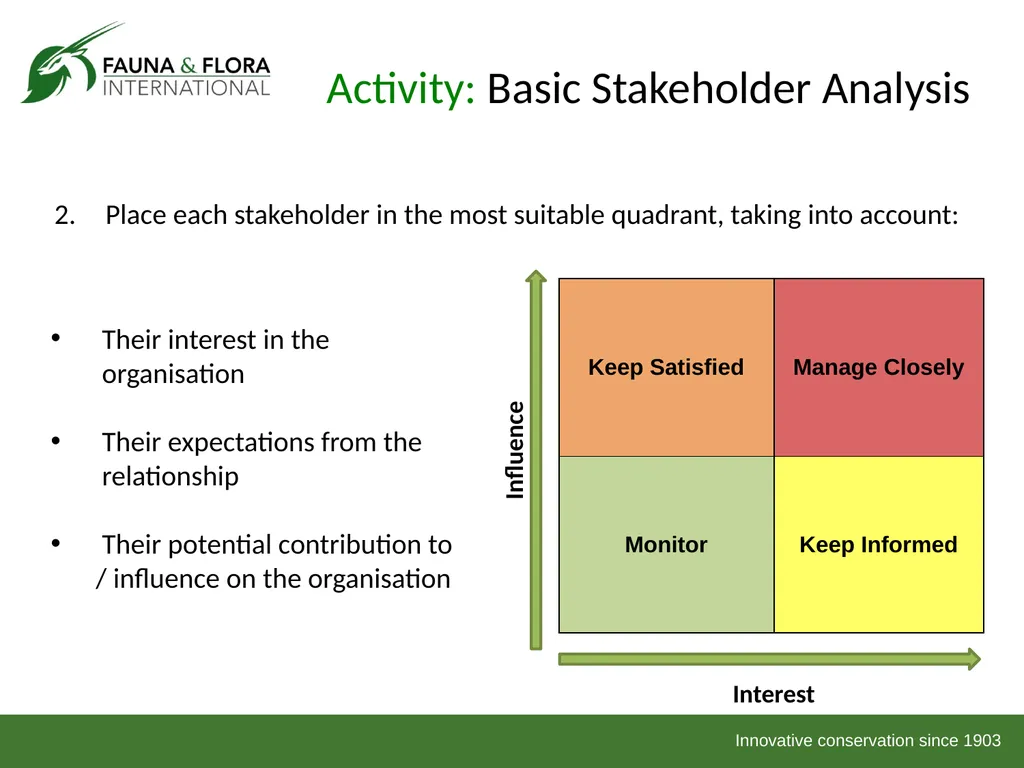
Place each stakeholder in the most suitable quadrant, taking into account: Their interest in the organisation
Their expectations from the relationship
Their potential contribution to
/ influence on the organisation Activity: Basic Stakeholder Analysis Influence Interest<br>
Their expectations from the relationship
Their potential contribution to
/ influence on the organisation Activity: Basic Stakeholder Analysis Influence Interest<br>
13
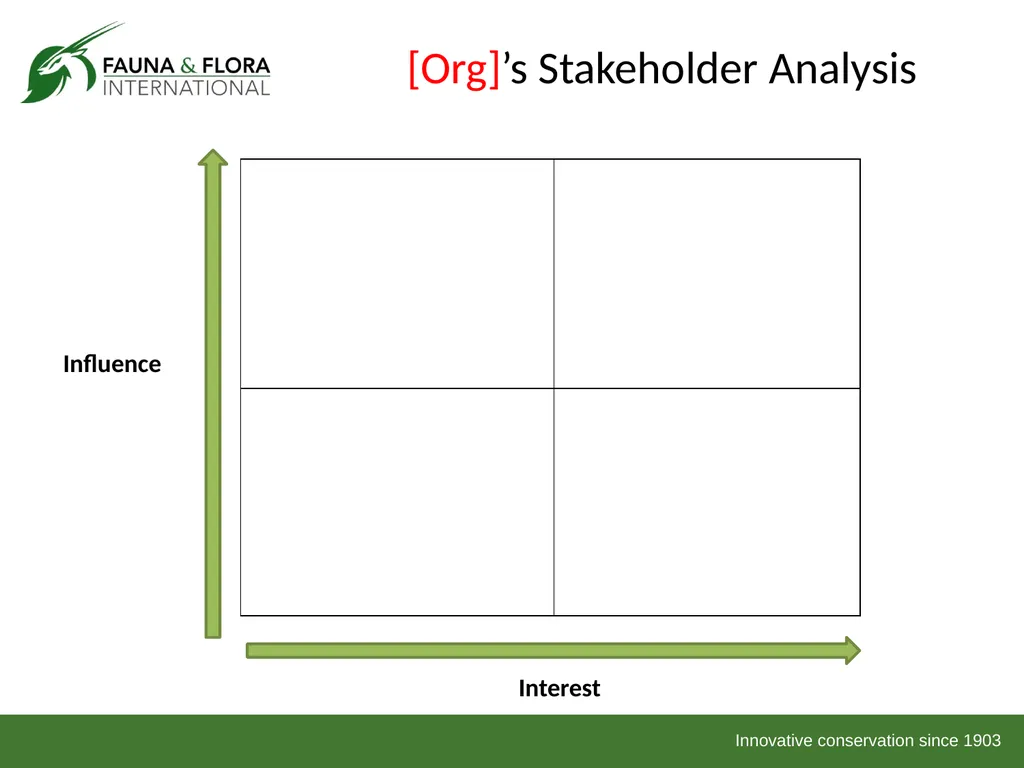
[Org]’s Stakeholder Analysis<br>
14
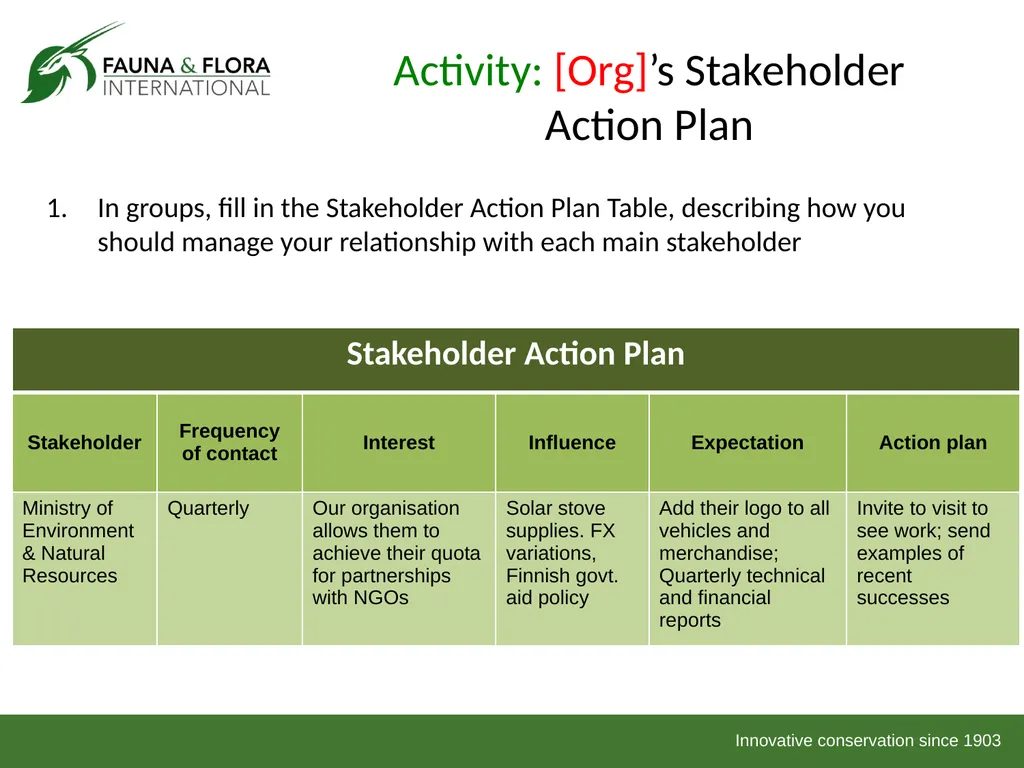
Activity: [Org]’s Stakeholder Action Plan In groups, fill in the Stakeholder Action Plan Table, describing how you should manage your relationship with each main stakeholder<br>
15
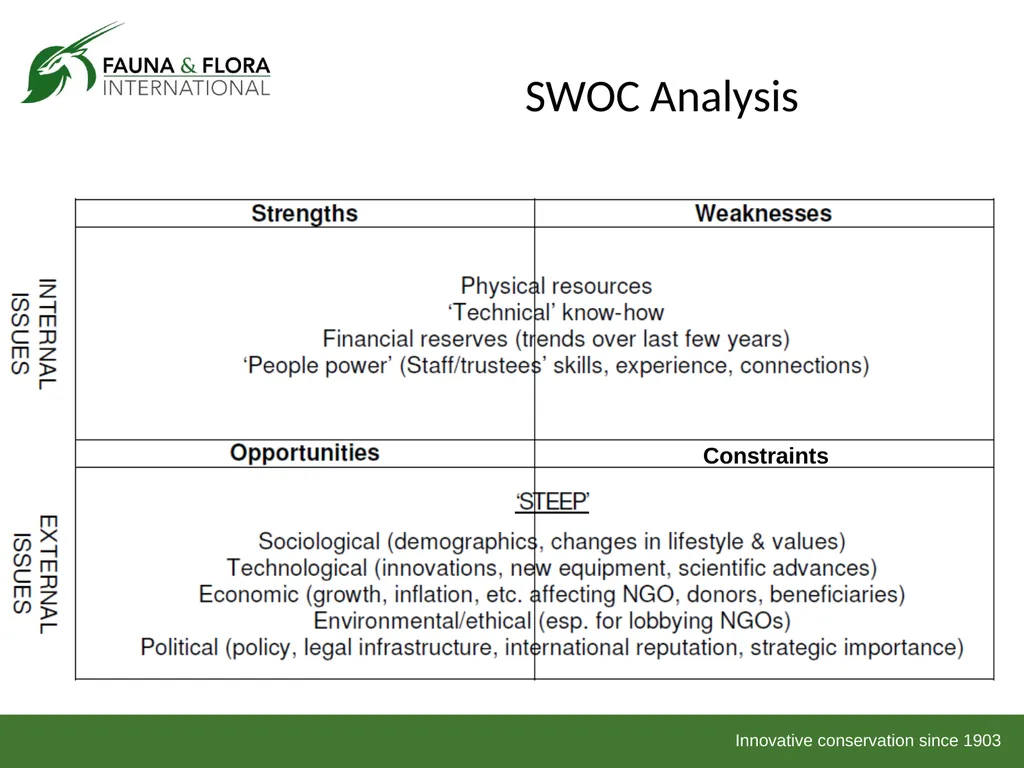
SWOC Analysis Constraints<br>
16
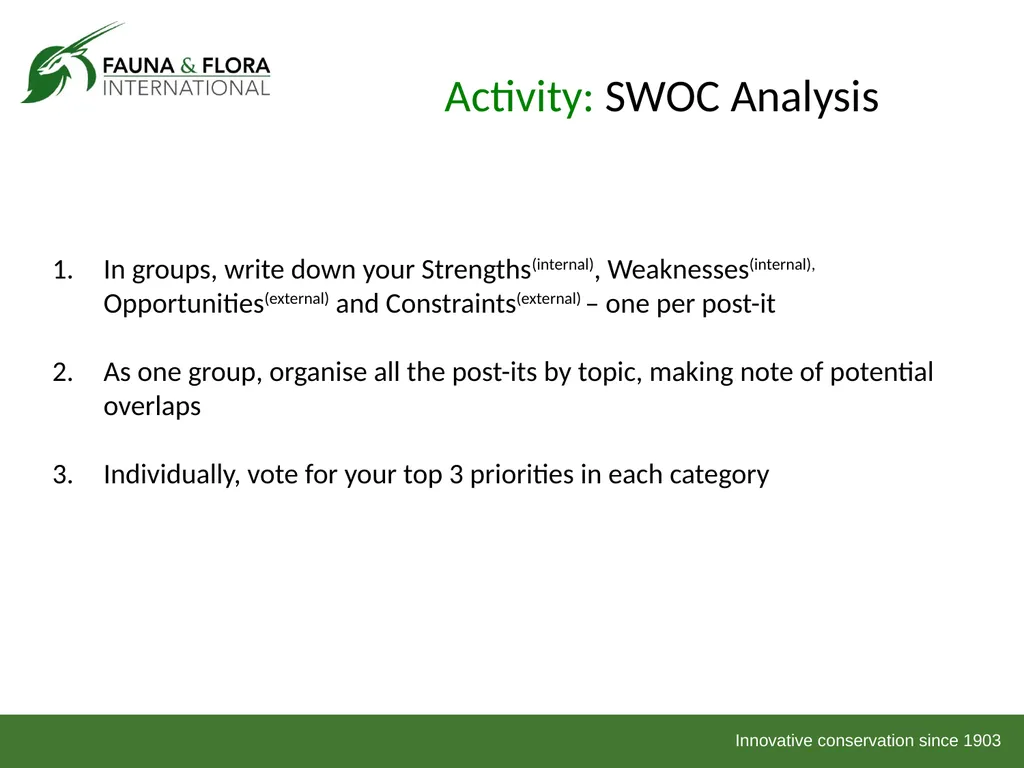
Activity: SWOC Analysis In groups, write down your Strengths(internal), Weaknesses(internal), Opportunities(external) and Constraints(external) – one per post-it
As one group, organise all the post-its by topic, making note of potential overlaps
Individually, vote for your top 3 priorities in each category<br>
As one group, organise all the post-its by topic, making note of potential overlaps
Individually, vote for your top 3 priorities in each category<br>
17
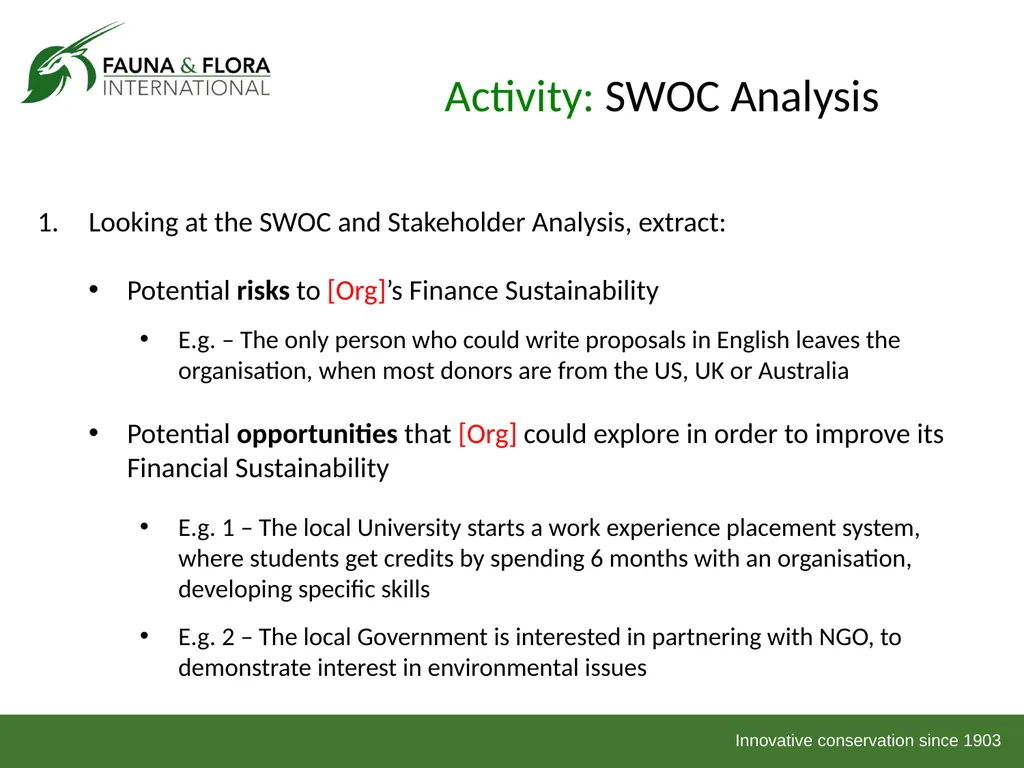
Looking at the SWOC and Stakeholder Analysis, extract:
Potential risks to [Org]’s Finance Sustainability
E.g. – The only person who could write proposals in English leaves the organisation, when most donors are from the US, UK or Australia
Potential opportunities that [Org] could explore in order to improve its Financial Sustainability
E.g. 1 – The local University starts a work experience placement system, where students get credits by spending 6 months with an organisation, developing specific skills
E.g. 2 – The local Government is interested in partnering with NGO, to demonstrate interest in environmental issues Activity: SWOC Analysis<br>
Potential risks to [Org]’s Finance Sustainability
E.g. – The only person who could write proposals in English leaves the organisation, when most donors are from the US, UK or Australia
Potential opportunities that [Org] could explore in order to improve its Financial Sustainability
E.g. 1 – The local University starts a work experience placement system, where students get credits by spending 6 months with an organisation, developing specific skills
E.g. 2 – The local Government is interested in partnering with NGO, to demonstrate interest in environmental issues Activity: SWOC Analysis<br>
18
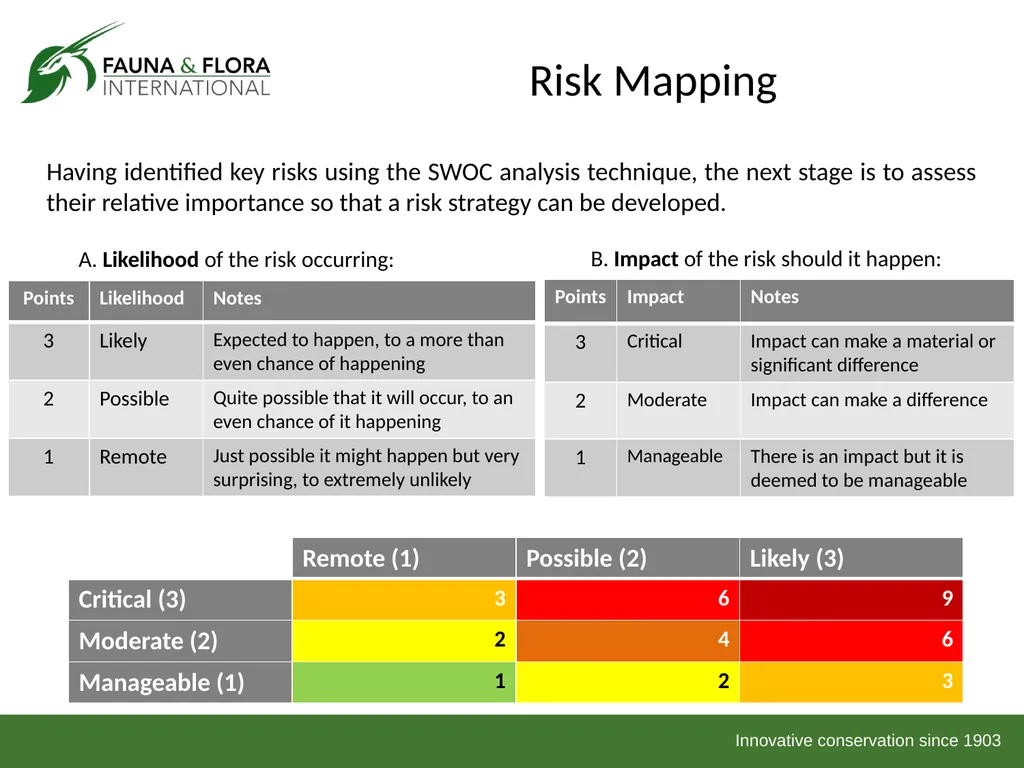
Risk Mapping Having identified key risks using the SWOC analysis technique, the next stage is to assess their relative importance so that a risk strategy can be developed. A. Likelihood of the risk occurring: B. Impact of the risk should it happen:<br>
19
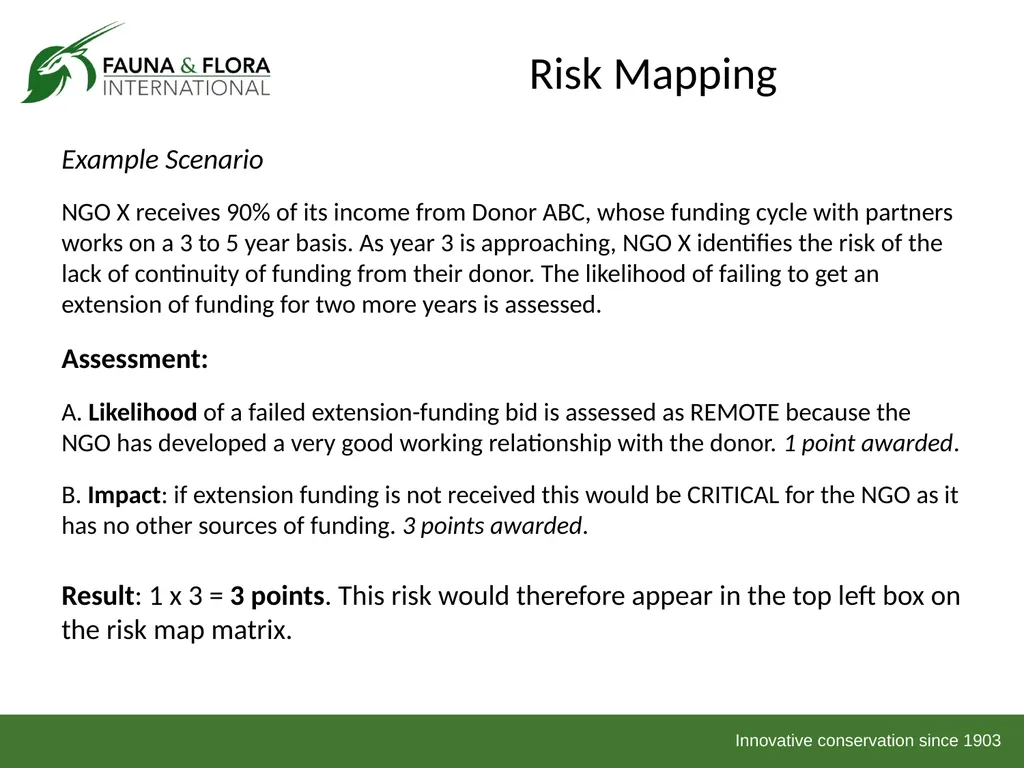
Example Scenario
NGO X receives 90% of its income from Donor ABC, whose funding cycle with partners works on a 3 to 5 year basis. As year 3 is approaching, NGO X identifies the risk of the lack of continuity of funding from their donor. The likelihood of failing to get an extension of funding for two more years is assessed.
Assessment:
A. Likelihood of a failed extension-funding bid is assessed as REMOTE because the NGO has developed a very good working relationship with the donor. 1 point awarded.
B. Impact: if extension funding is not received this would be CRITICAL for the NGO as it has no other sources of funding. 3 points awarded.
Result: 1 x 3 = 3 points. This risk would therefore appear in the top left box on the risk map matrix. Risk Mapping<br>
NGO X receives 90% of its income from Donor ABC, whose funding cycle with partners works on a 3 to 5 year basis. As year 3 is approaching, NGO X identifies the risk of the lack of continuity of funding from their donor. The likelihood of failing to get an extension of funding for two more years is assessed.
Assessment:
A. Likelihood of a failed extension-funding bid is assessed as REMOTE because the NGO has developed a very good working relationship with the donor. 1 point awarded.
B. Impact: if extension funding is not received this would be CRITICAL for the NGO as it has no other sources of funding. 3 points awarded.
Result: 1 x 3 = 3 points. This risk would therefore appear in the top left box on the risk map matrix. Risk Mapping<br>
20
Ok, but now imagine you didn’t take any action and it’s year 4…
Assessment:
A. Likelihood of a failed extension-funding bid is assessed as LIKELY because the donor only gives grants up to 5 years. 3 points awarded.
B. Impact: if extension funding is not received this would be CRITICAL for the NGO as it has no other sources of funding. 3 points awarded.
Result: 3 x 3 = 9 points. This risk would therefore appear in the top left box on the risk map matrix. Risk Mapping<br>
Assessment:
A. Likelihood of a failed extension-funding bid is assessed as LIKELY because the donor only gives grants up to 5 years. 3 points awarded.
B. Impact: if extension funding is not received this would be CRITICAL for the NGO as it has no other sources of funding. 3 points awarded.
Result: 3 x 3 = 9 points. This risk would therefore appear in the top left box on the risk map matrix. Risk Mapping<br>
21
Thank you!<br>
22
Financial Sustainability Workshop 2013 Day 2<br>
23
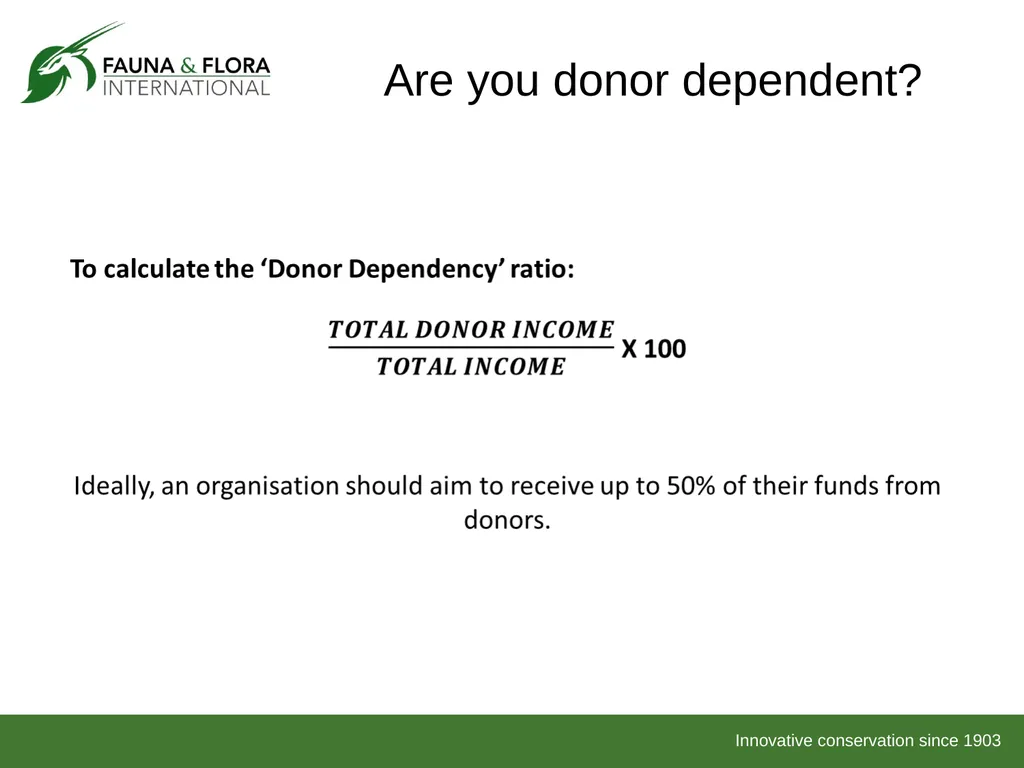
Are you donor dependent?<br>
24
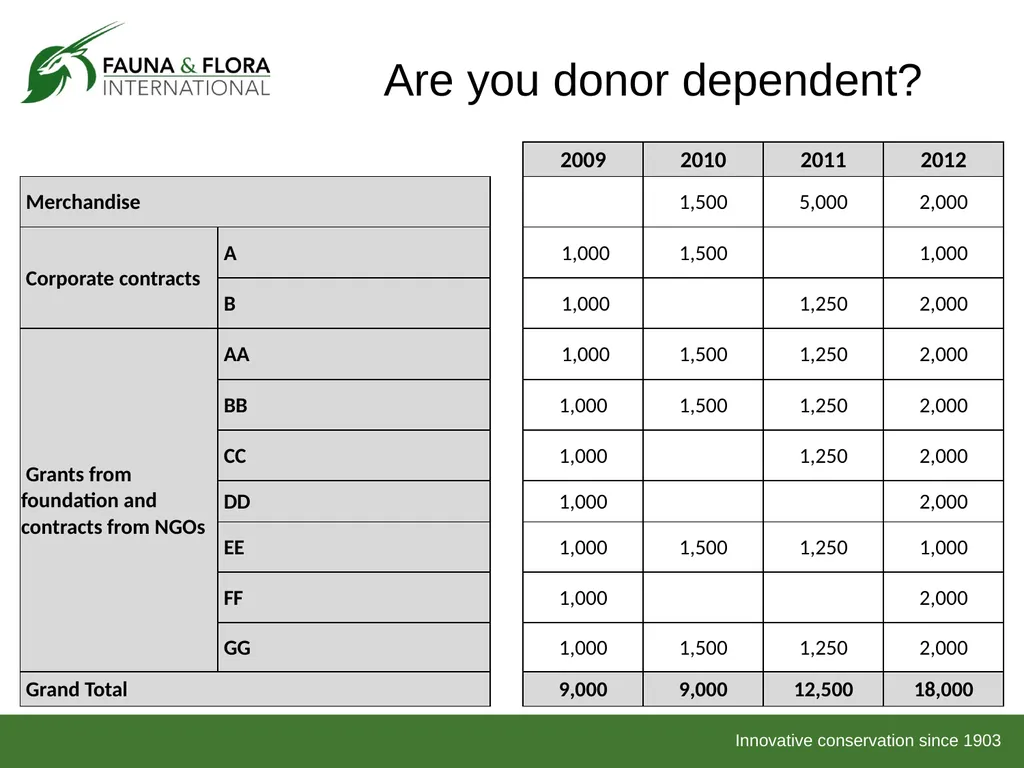
Are you donor dependent?<br>
25
Are you donor dependent?<br>
26
Reserves – What are they? Some specific reserves are:
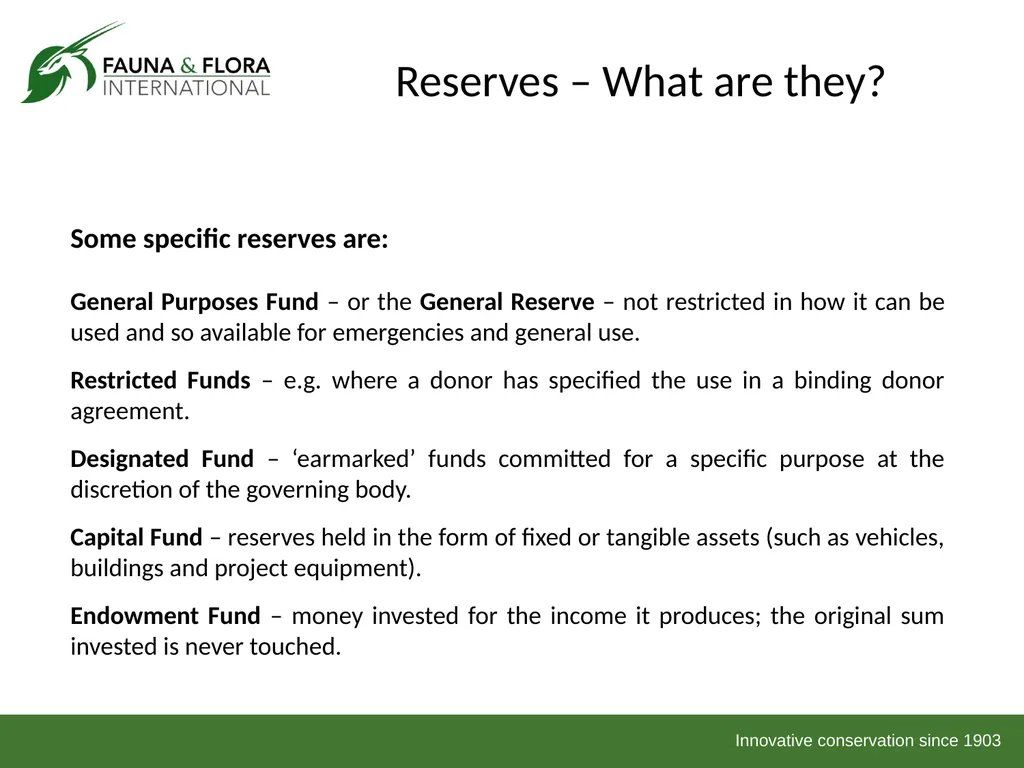
General Purposes Fund – or the General Reserve – not restricted in how it can be used and so available for emergencies and general use.
Restricted Funds – e.g. where a donor has specified the use in a binding donor agreement.
Designated Fund – ‘earmarked’ funds committed for a specific purpose at the discretion of the governing body.
Capital Fund – reserves held in the form of fixed or tangible assets (such as vehicles, buildings and project equipment).
Endowment Fund – money invested for the income it produces; the original sum invested is never touched.<br>
General Purposes Fund – or the General Reserve – not restricted in how it can be used and so available for emergencies and general use.
Restricted Funds – e.g. where a donor has specified the use in a binding donor agreement.
Designated Fund – ‘earmarked’ funds committed for a specific purpose at the discretion of the governing body.
Capital Fund – reserves held in the form of fixed or tangible assets (such as vehicles, buildings and project equipment).
Endowment Fund – money invested for the income it produces; the original sum invested is never touched.<br>
27
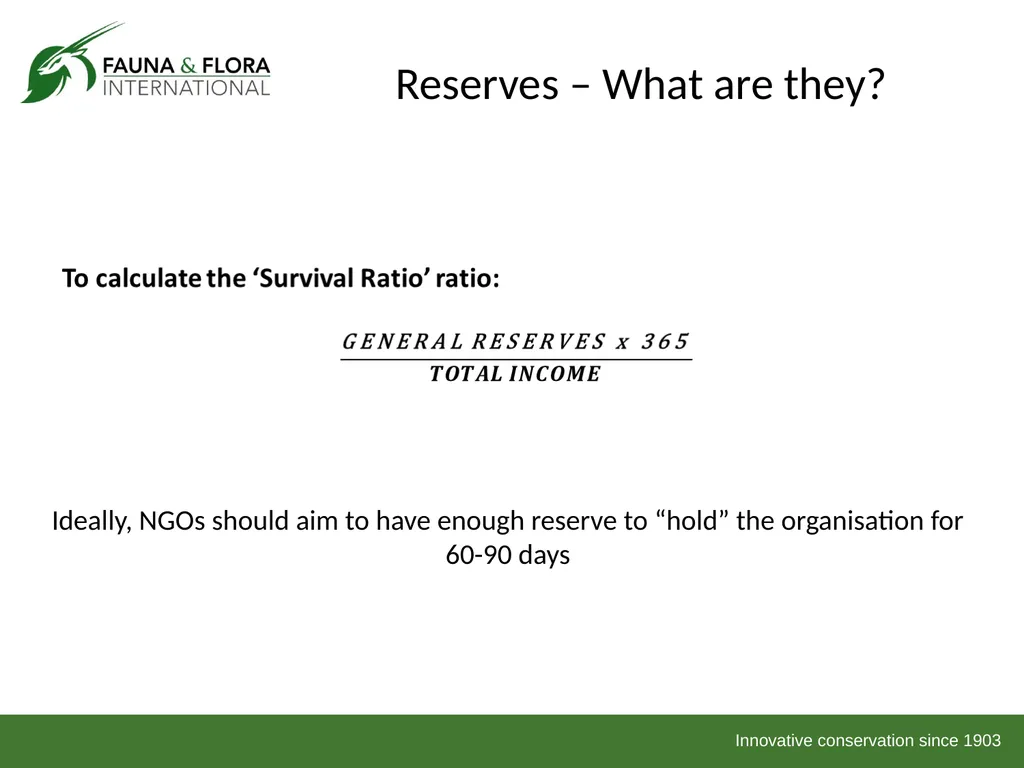
Ideally, NGOs should aim to have enough reserve to “hold” the organisation for 60-90 days Reserves – What are they?<br>
28
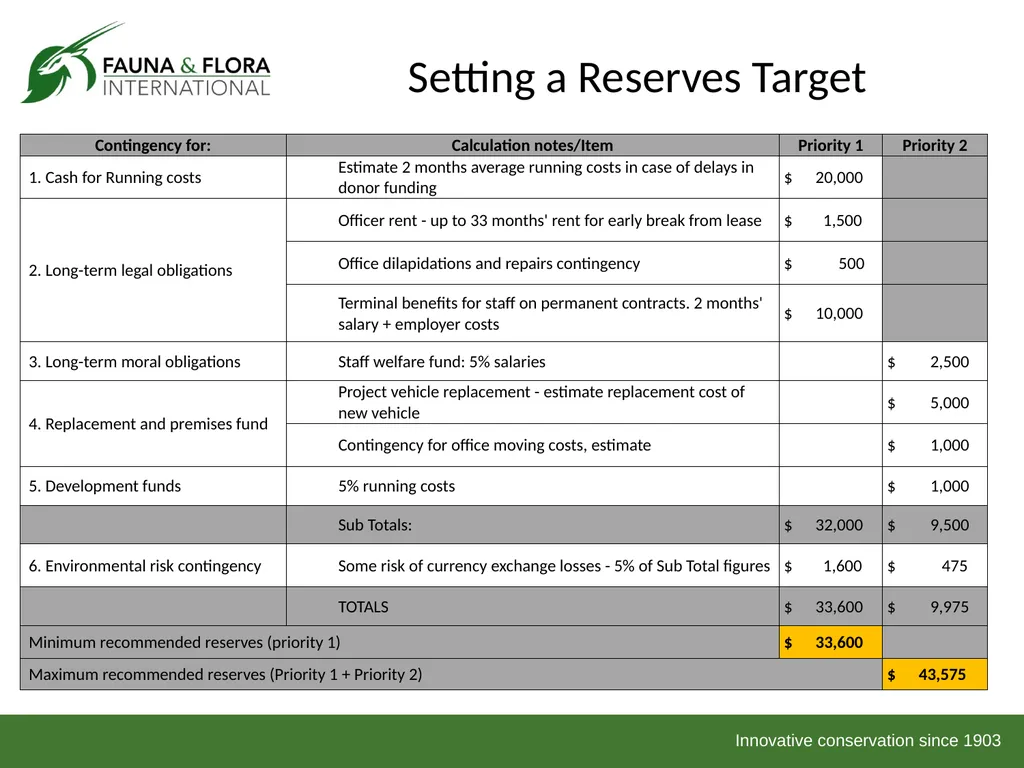
Setting a Reserves Target<br>
29
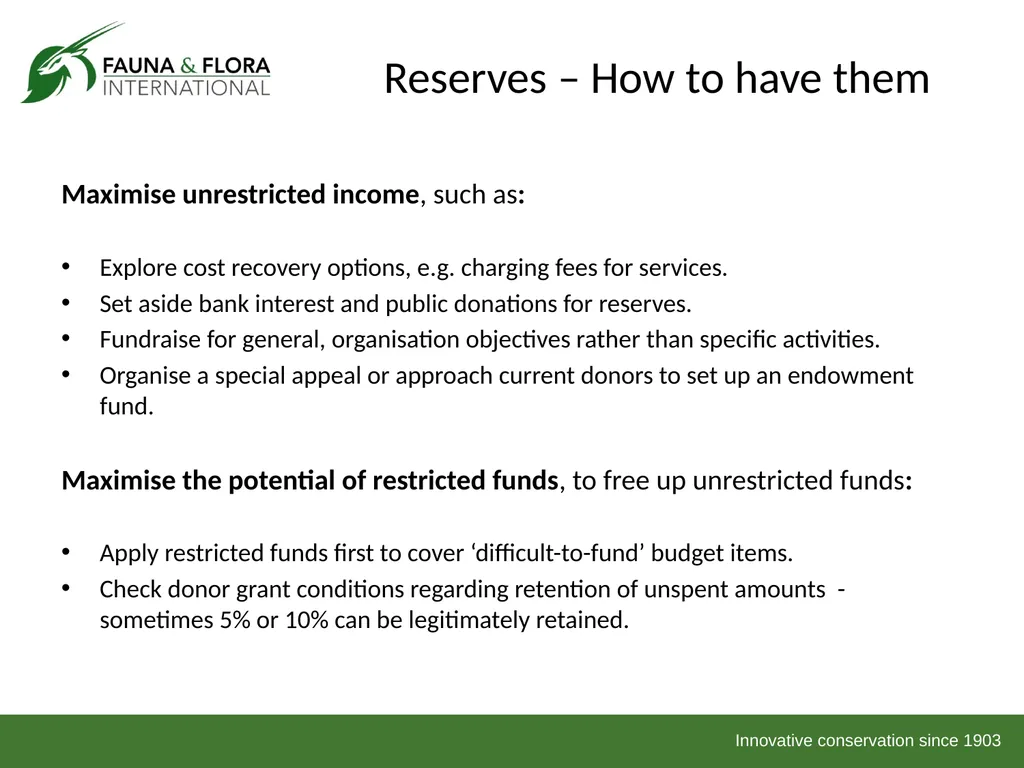
Reserves – How to have them Maximise unrestricted income, such as:
Explore cost recovery options, e.g. charging fees for services.
Set aside bank interest and public donations for reserves.
Fundraise for general, organisation objectives rather than specific activities.
Organise a special appeal or approach current donors to set up an endowment fund.
Maximise the potential of restricted funds, to free up unrestricted funds:
Apply restricted funds first to cover ‘difficult-to-fund’ budget items.
Check donor grant conditions regarding retention of unspent amounts - sometimes 5% or 10% can be legitimately retained.<br>
Explore cost recovery options, e.g. charging fees for services.
Set aside bank interest and public donations for reserves.
Fundraise for general, organisation objectives rather than specific activities.
Organise a special appeal or approach current donors to set up an endowment fund.
Maximise the potential of restricted funds, to free up unrestricted funds:
Apply restricted funds first to cover ‘difficult-to-fund’ budget items.
Check donor grant conditions regarding retention of unspent amounts - sometimes 5% or 10% can be legitimately retained.<br>
30
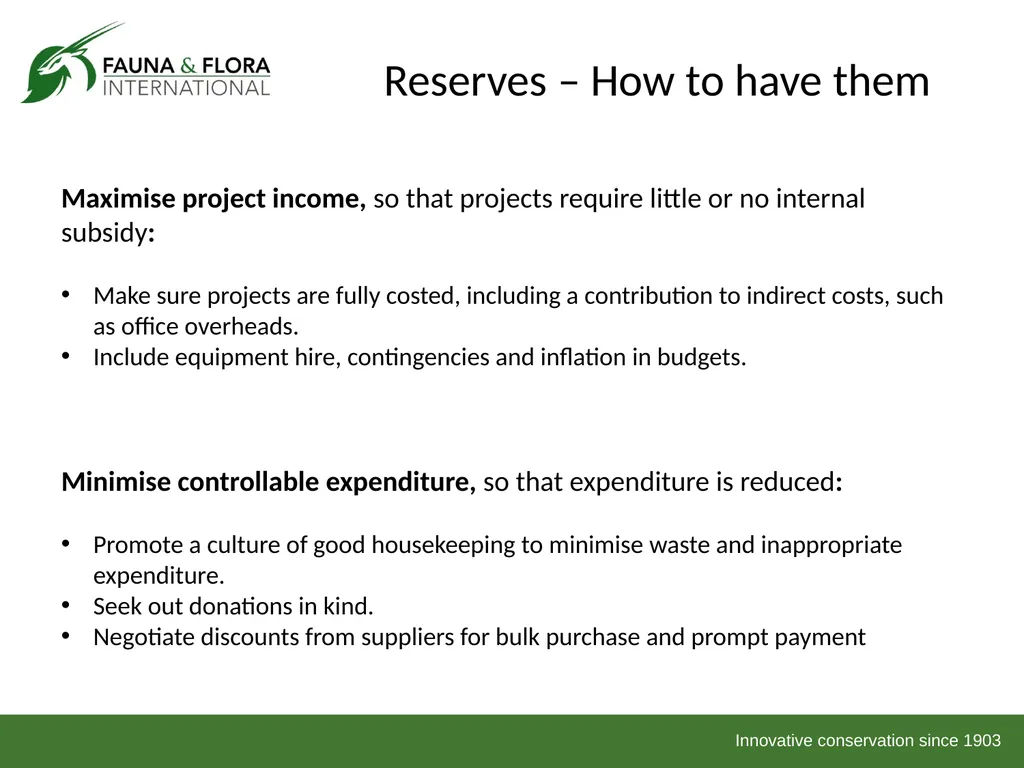
Reserves – How to have them Maximise project income, so that projects require little or no internal subsidy:
Make sure projects are fully costed, including a contribution to indirect costs, such as office overheads.
Include equipment hire, contingencies and inflation in budgets.
Minimise controllable expenditure, so that expenditure is reduced:
Promote a culture of good housekeeping to minimise waste and inappropriate expenditure.
Seek out donations in kind.
Negotiate discounts from suppliers for bulk purchase and prompt payment<br>
Make sure projects are fully costed, including a contribution to indirect costs, such as office overheads.
Include equipment hire, contingencies and inflation in budgets.
Minimise controllable expenditure, so that expenditure is reduced:
Promote a culture of good housekeeping to minimise waste and inappropriate expenditure.
Seek out donations in kind.
Negotiate discounts from suppliers for bulk purchase and prompt payment<br>
31
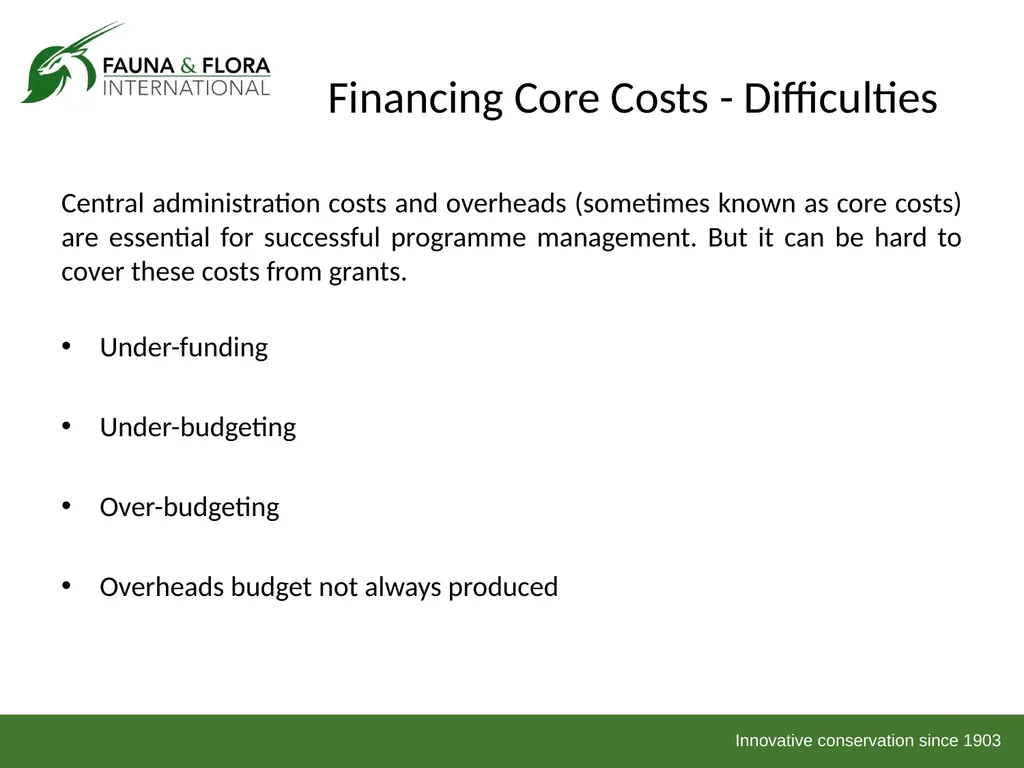
Financing Core Costs - Difficulties Central administration costs and overheads (sometimes known as core costs) are essential for successful programme management. But it can be hard to cover these costs from grants.
Under-funding
Under-budgeting
Over-budgeting
Overheads budget not always produced<br>
Under-funding
Under-budgeting
Over-budgeting
Overheads budget not always produced<br>
32
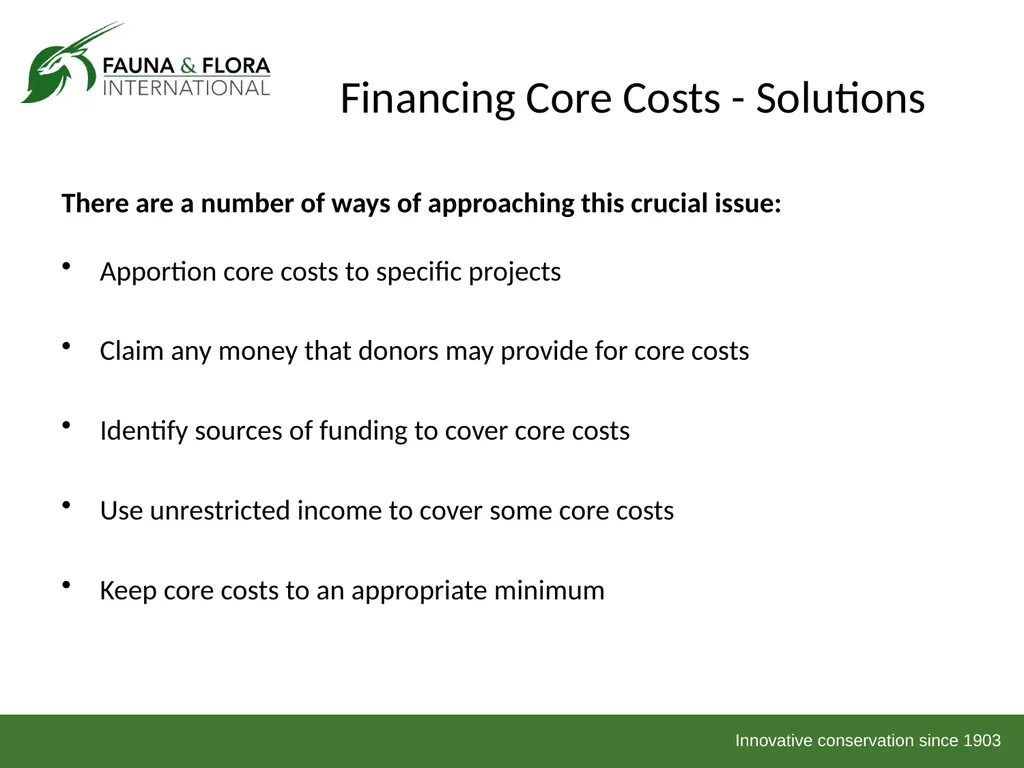
There are a number of ways of approaching this crucial issue:
Apportion core costs to specific projects
Claim any money that donors may provide for core costs
Identify sources of funding to cover core costs
Use unrestricted income to cover some core costs
Keep core costs to an appropriate minimum Financing Core Costs - Solutions<br>
Apportion core costs to specific projects
Claim any money that donors may provide for core costs
Identify sources of funding to cover core costs
Use unrestricted income to cover some core costs
Keep core costs to an appropriate minimum Financing Core Costs - Solutions<br>
33
Funding Mix<br>
34
Funding Mix<br>
35
Activity: Funding Mix 201X-201Y In groups, determine the Funding Mix you will aim for until 201Y, based on what was previously discussed about:
Donor Dependency
Reserves
Stakeholders
Opportunities & Constraints<br>
Donor Dependency
Reserves
Stakeholders
Opportunities & Constraints<br>
36
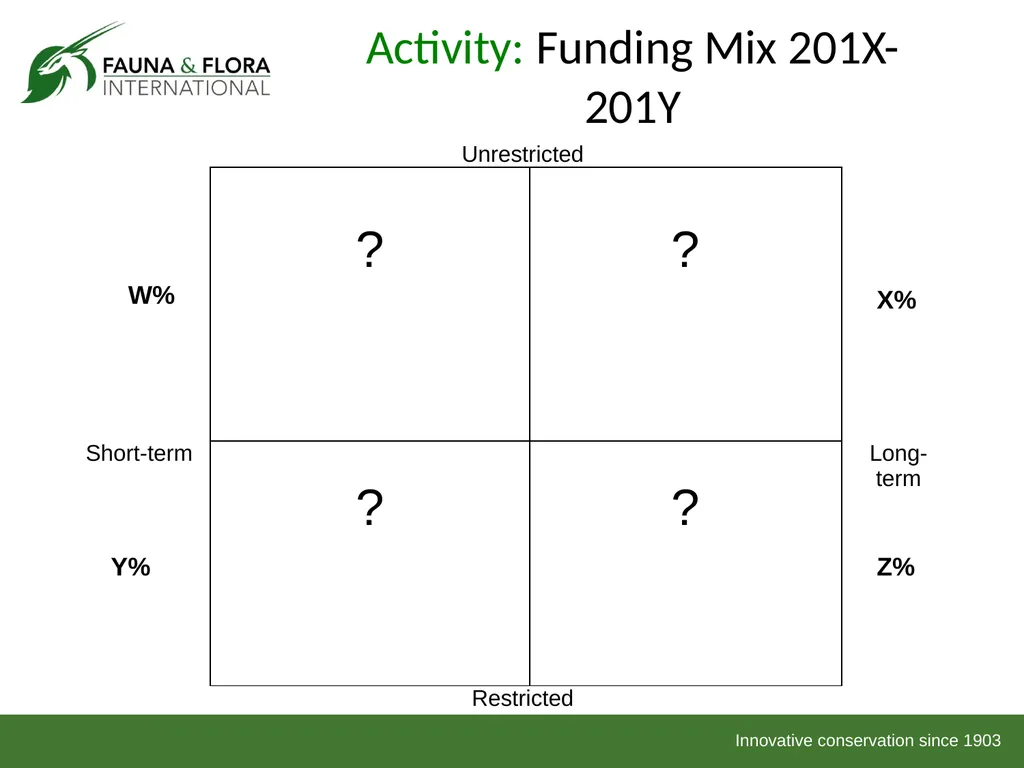
W% Y% Z% X% Activity: Funding Mix 201X-201Y<br>
37
The Strategy Where are we now?
Where do we want to be?
How do we get there?
Policies (or What are our rules to get there?)<br>
Where do we want to be?
How do we get there?
Policies (or What are our rules to get there?)<br>
38
Activity: The Strategy
Where do we want to be? Individually, think of where do you want [Org] to be in 201Y regarding its Financial Sustainability, whilst pursuing its mission.
Individually, write down up to 6 (financially related) goals you would like to have achieved by 201Y . Be specific!
[INSERT ORGANISATION’S MISSION]<br>
Individually, write down up to 6 (financially related) goals you would like to have achieved by 201Y . Be specific!
[INSERT ORGANISATION’S MISSION]<br>
39
In groups, discuss what your strategic actions will be in order to achieve the goals prioritised before, also in relation to:
Increasing Unrestricted Funding
Targeted Reserves
Desired/Proposed Funding Mix
Risks & Opportunities identified
…taking into account:
Donor Dependency
Relationship with Stakeholders
Strengths, Weaknesses, Opportunities & Constraints Activity: The Strategy How do we get there?<br>
Increasing Unrestricted Funding
Targeted Reserves
Desired/Proposed Funding Mix
Risks & Opportunities identified
…taking into account:
Donor Dependency
Relationship with Stakeholders
Strengths, Weaknesses, Opportunities & Constraints Activity: The Strategy How do we get there?<br>
40
Policies – Your rules Reserves policy – what level of reserves you aim to build up, and how surpluses will be handled.
Example: It is our policy to maintain general reserves equivalent to 6 months of operating expenditure. This policy is reviewed by the Board every three years. General fund surpluses in a given year will be added to this reserve. If the reserve level exceeds the policy level, we will spend it on behalf of the beneficiaries in line with our strategy. Core costs policy – what method will be used to recover programme support costs from projects and funders. It will also clarify the policy on subsidising ‘poorer’ projects and how that will be decided and managed.
Example: It is our policy to apportion overhead costs to projects on a monthly basis, in proportion to the direct costs incurred by each project. Each project should generate enough income to cover both its direct and apportioned indirect costs, unless the Board authorises otherwise for particular cases.<br>
Example: It is our policy to maintain general reserves equivalent to 6 months of operating expenditure. This policy is reviewed by the Board every three years. General fund surpluses in a given year will be added to this reserve. If the reserve level exceeds the policy level, we will spend it on behalf of the beneficiaries in line with our strategy. Core costs policy – what method will be used to recover programme support costs from projects and funders. It will also clarify the policy on subsidising ‘poorer’ projects and how that will be decided and managed.
Example: It is our policy to apportion overhead costs to projects on a monthly basis, in proportion to the direct costs incurred by each project. Each project should generate enough income to cover both its direct and apportioned indirect costs, unless the Board authorises otherwise for particular cases.<br>
41
Pricing and cost recovery policy – where charges are to be made to service users, this will explain the basis and formula used for the charging, and the pricing structure.
Example: It is our policy to charge users of the clinic for consultation, drugs and lab tests. The basis for the charge is cost plus 10% to cover overhead. Patients unable to pay may apply to our 'Special Scheme' for assistance.
Ethical policy – this will explain who the NGO will or will not accept funds from and what funds may or may not be used for. This will be particularly relevant to NGOs involved in advocacy work.
Example: It is our policy to consider the ethical nature of all funds offered to us before accepting. For example, we will not accept funds derived from any illegal source, or from corporates engaged in arms dealing or child labour. We will not accept funds that create a conflict of interest. We consider each case in line with our values. Policies – Your rules<br>
Example: It is our policy to charge users of the clinic for consultation, drugs and lab tests. The basis for the charge is cost plus 10% to cover overhead. Patients unable to pay may apply to our 'Special Scheme' for assistance.
Ethical policy – this will explain who the NGO will or will not accept funds from and what funds may or may not be used for. This will be particularly relevant to NGOs involved in advocacy work.
Example: It is our policy to consider the ethical nature of all funds offered to us before accepting. For example, we will not accept funds derived from any illegal source, or from corporates engaged in arms dealing or child labour. We will not accept funds that create a conflict of interest. We consider each case in line with our values. Policies – Your rules<br>