
Find your space Why work in the UK space sector?
DJ
Published · 20 slides · 0 views

1 / 1


Description
Find your space Why work in the UK space sector? This Photo by Unknown Author is licensed under CC BY Lesson guide The presentation gives some brief facts about the UK space industry. You could take the opportunity to ask the students some
Related Topics
Share
Embed code
Download this presentation From Below
"Find your space Why work in the UK space sector?" is the property of its rightful owner. Permission is granted to download and print the materials on this website for personal, non-commercial use only, and to display it on your personal computer provided you do not modify the materials and that you retain all copyright notices contained in the materials. By downloading content from our website, you accept the terms of this agreement.
Presentation Transcript
01
Find your space Why work in the UK space sector? This Photo by Unknown Author is licensed under CC BY<br>
02
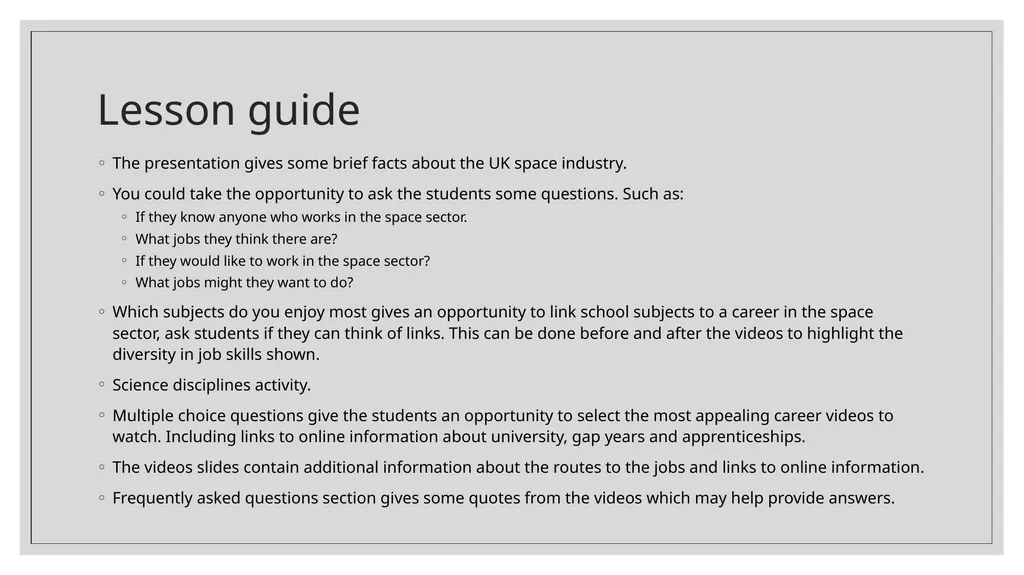
Lesson guide The presentation gives some brief facts about the UK space industry.
You could take the opportunity to ask the students some questions. Such as:
If they know anyone who works in the space sector.
What jobs they think there are?
If they would like to work in the space sector?
What jobs might they want to do?
Which subjects do you enjoy most gives an opportunity to link school subjects to a career in the space sector, ask students if they can think of links. This can be done before and after the videos to highlight the diversity in job skills shown.
Science disciplines activity.
Multiple choice questions give the students an opportunity to select the most appealing career videos to watch. Including links to online information about university, gap years and apprenticeships.
The videos slides contain additional information about the routes to the jobs and links to online information.
Frequently asked questions section gives some quotes from the videos which may help provide answers.<br>
You could take the opportunity to ask the students some questions. Such as:
If they know anyone who works in the space sector.
What jobs they think there are?
If they would like to work in the space sector?
What jobs might they want to do?
Which subjects do you enjoy most gives an opportunity to link school subjects to a career in the space sector, ask students if they can think of links. This can be done before and after the videos to highlight the diversity in job skills shown.
Science disciplines activity.
Multiple choice questions give the students an opportunity to select the most appealing career videos to watch. Including links to online information about university, gap years and apprenticeships.
The videos slides contain additional information about the routes to the jobs and links to online information.
Frequently asked questions section gives some quotes from the videos which may help provide answers.<br>
03
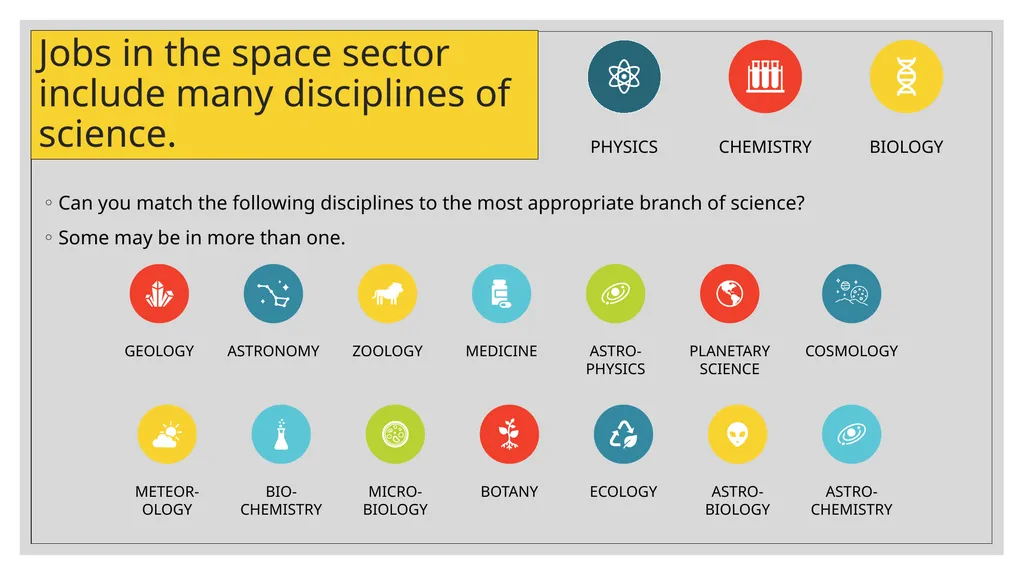
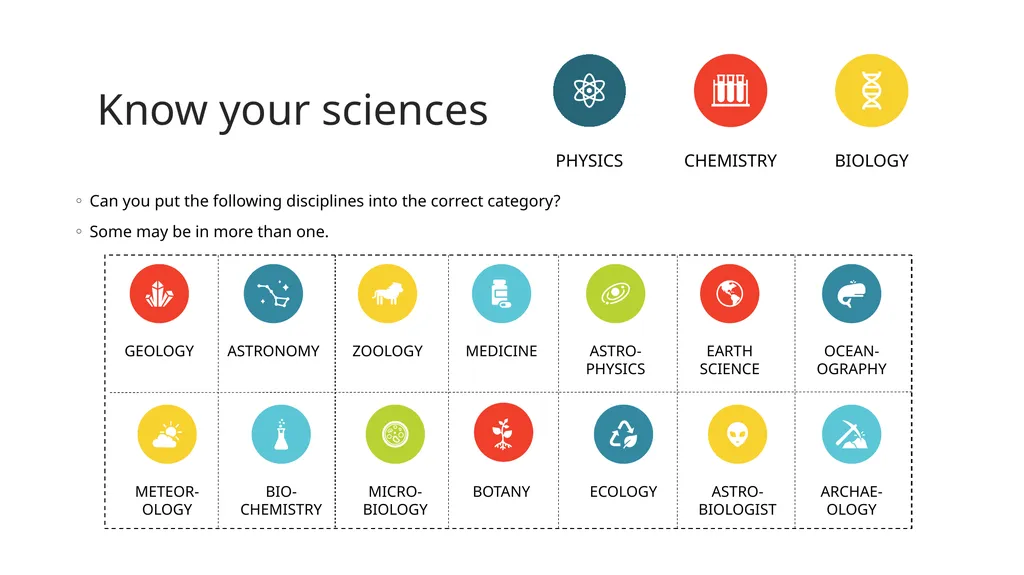
Jobs in the space sector include many disciplines of science. Can you match the following disciplines to the most appropriate branch of science?
Some may be in more than one.<br>
Some may be in more than one.<br>
04
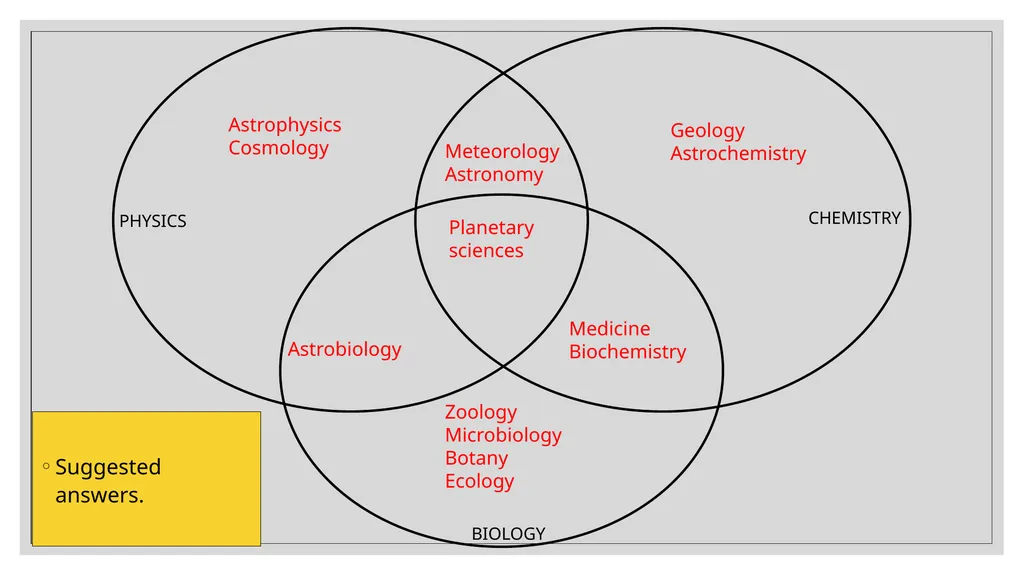
Suggested answers. Astrophysics
Cosmology Astrobiology Zoology
Microbiology
Botany
Ecology Medicine
Biochemistry Meteorology
Astronomy Planetary sciences Geology
Astrochemistry<br>
Cosmology Astrobiology Zoology
Microbiology
Botany
Ecology Medicine
Biochemistry Meteorology
Astronomy Planetary sciences Geology
Astrochemistry<br>
05
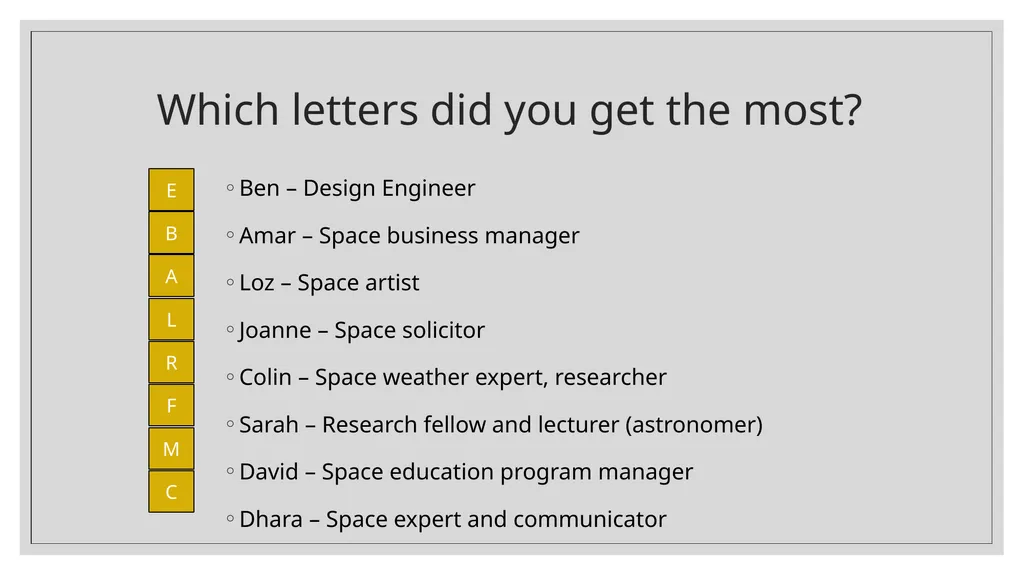
Which letters did you get the most? Ben – Design Engineer
Amar – Space business manager
Loz – Space artist
Joanne – Space solicitor
Colin – Space weather expert, researcher
Sarah – Research fellow and lecturer (astronomer)
David – Space education program manager
Dhara – Space expert and communicator E B A L R F M C<br>
Amar – Space business manager
Loz – Space artist
Joanne – Space solicitor
Colin – Space weather expert, researcher
Sarah – Research fellow and lecturer (astronomer)
David – Space education program manager
Dhara – Space expert and communicator E B A L R F M C<br>
06
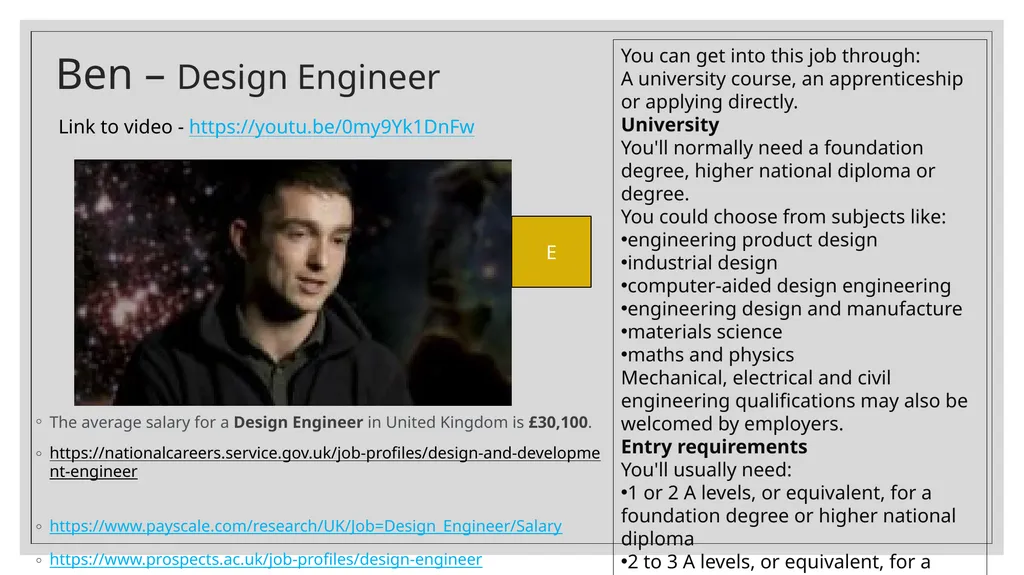
Ben – Design Engineer The average salary for a Design Engineer in United Kingdom is £30,100.
https://nationalcareers.service.gov.uk/job-profiles/design-and-development-engineer
https://www.payscale.com/research/UK/Job=Design_Engineer/Salary
https://www.prospects.ac.uk/job-profiles/design-engineer You can get into this job through:
A university course, an apprenticeship or applying directly.
University
You'll normally need a foundation degree, higher national diploma or degree.
You could choose from subjects like:
engineering product design
industrial design
computer-aided design engineering
engineering design and manufacture
materials science
maths and physics
Mechanical, electrical and civil engineering qualifications may also be welcomed by employers.
Entry requirements
You'll usually need:
1 or 2 A levels, or equivalent, for a foundation degree or higher national diploma
2 to 3 A levels, or equivalent, for a degree E Link to video - https://youtu.be/0my9Yk1DnFw<br>
https://nationalcareers.service.gov.uk/job-profiles/design-and-development-engineer
https://www.payscale.com/research/UK/Job=Design_Engineer/Salary
https://www.prospects.ac.uk/job-profiles/design-engineer You can get into this job through:
A university course, an apprenticeship or applying directly.
University
You'll normally need a foundation degree, higher national diploma or degree.
You could choose from subjects like:
engineering product design
industrial design
computer-aided design engineering
engineering design and manufacture
materials science
maths and physics
Mechanical, electrical and civil engineering qualifications may also be welcomed by employers.
Entry requirements
You'll usually need:
1 or 2 A levels, or equivalent, for a foundation degree or higher national diploma
2 to 3 A levels, or equivalent, for a degree E Link to video - https://youtu.be/0my9Yk1DnFw<br>
07
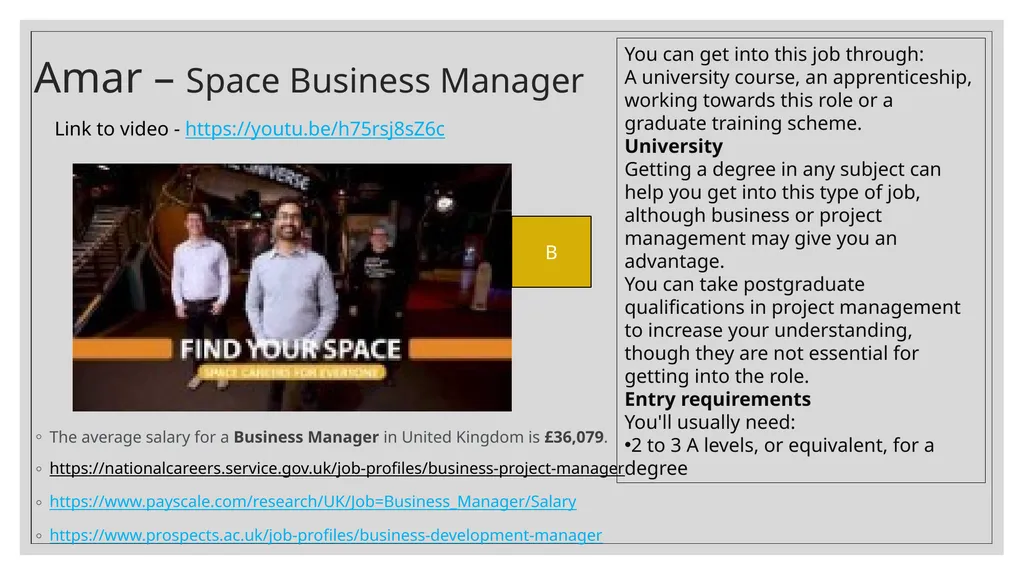
Amar – Space Business Manager The average salary for a Business Manager in United Kingdom is £36,079.
https://nationalcareers.service.gov.uk/job-profiles/business-project-manager
https://www.payscale.com/research/UK/Job=Business_Manager/Salary
https://www.prospects.ac.uk/job-profiles/business-development-manager You can get into this job through:
A university course, an apprenticeship, working towards this role or a graduate training scheme.
University
Getting a degree in any subject can help you get into this type of job, although business or project management may give you an advantage.
You can take postgraduate qualifications in project management to increase your understanding, though they are not essential for getting into the role.
Entry requirements
You'll usually need:
2 to 3 A levels, or equivalent, for a degree B Link to video - https://youtu.be/h75rsj8sZ6c<br>
https://nationalcareers.service.gov.uk/job-profiles/business-project-manager
https://www.payscale.com/research/UK/Job=Business_Manager/Salary
https://www.prospects.ac.uk/job-profiles/business-development-manager You can get into this job through:
A university course, an apprenticeship, working towards this role or a graduate training scheme.
University
Getting a degree in any subject can help you get into this type of job, although business or project management may give you an advantage.
You can take postgraduate qualifications in project management to increase your understanding, though they are not essential for getting into the role.
Entry requirements
You'll usually need:
2 to 3 A levels, or equivalent, for a degree B Link to video - https://youtu.be/h75rsj8sZ6c<br>
08
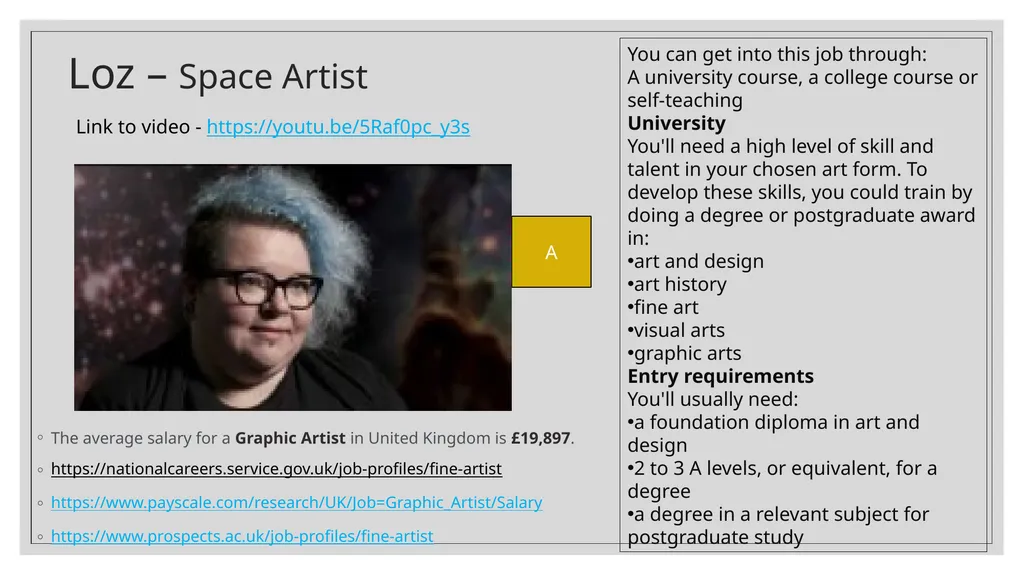
Loz – Space Artist The average salary for a Graphic Artist in United Kingdom is £19,897.
https://nationalcareers.service.gov.uk/job-profiles/fine-artist
https://www.payscale.com/research/UK/Job=Graphic_Artist/Salary
https://www.prospects.ac.uk/job-profiles/fine-artist You can get into this job through:
A university course, a college course or self-teaching
University
You'll need a high level of skill and talent in your chosen art form. To develop these skills, you could train by doing a degree or postgraduate award in:
art and design
art history
fine art
visual arts
graphic arts
Entry requirements
You'll usually need:
a foundation diploma in art and design
2 to 3 A levels, or equivalent, for a degree
a degree in a relevant subject for postgraduate study A Link to video - https://youtu.be/5Raf0pc_y3s<br>
https://nationalcareers.service.gov.uk/job-profiles/fine-artist
https://www.payscale.com/research/UK/Job=Graphic_Artist/Salary
https://www.prospects.ac.uk/job-profiles/fine-artist You can get into this job through:
A university course, a college course or self-teaching
University
You'll need a high level of skill and talent in your chosen art form. To develop these skills, you could train by doing a degree or postgraduate award in:
art and design
art history
fine art
visual arts
graphic arts
Entry requirements
You'll usually need:
a foundation diploma in art and design
2 to 3 A levels, or equivalent, for a degree
a degree in a relevant subject for postgraduate study A Link to video - https://youtu.be/5Raf0pc_y3s<br>
09
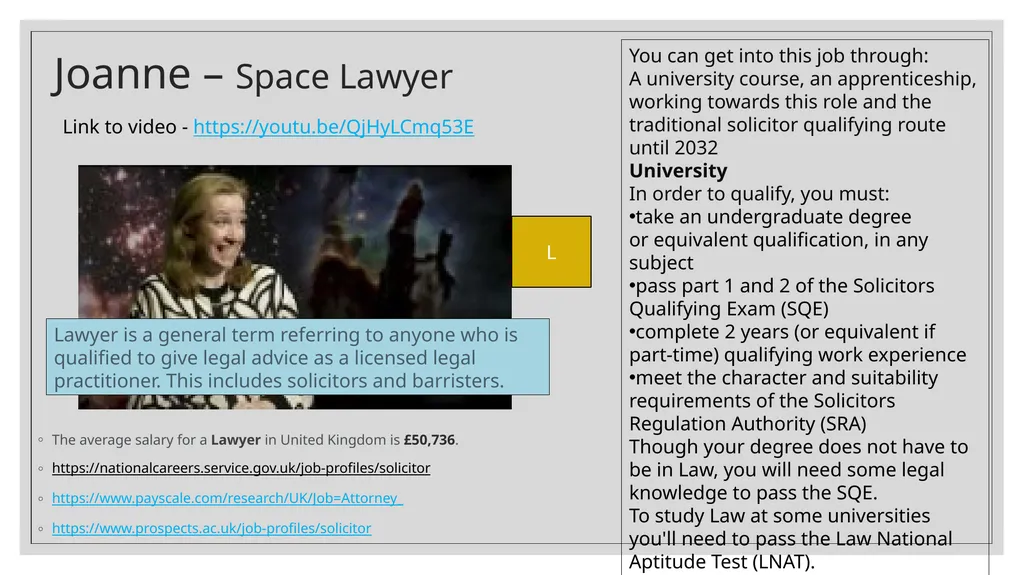
Joanne – Space Lawyer The average salary for a Lawyer in United Kingdom is £50,736.
https://nationalcareers.service.gov.uk/job-profiles/solicitor
https://www.payscale.com/research/UK/Job=Attorney_
https://www.prospects.ac.uk/job-profiles/solicitor You can get into this job through:
A university course, an apprenticeship, working towards this role and the traditional solicitor qualifying route until 2032
University
In order to qualify, you must:
take an undergraduate degree or equivalent qualification, in any subject
pass part 1 and 2 of the Solicitors Qualifying Exam (SQE)
complete 2 years (or equivalent if part-time) qualifying work experience
meet the character and suitability requirements of the Solicitors Regulation Authority (SRA)
Though your degree does not have to be in Law, you will need some legal knowledge to pass the SQE.
To study Law at some universities you'll need to pass the Law National Aptitude Test (LNAT). L Lawyer is a general term referring to anyone who is qualified to give legal advice as a licensed legal practitioner. This includes solicitors and barristers. Link to video - https://youtu.be/QjHyLCmq53E<br>
https://nationalcareers.service.gov.uk/job-profiles/solicitor
https://www.payscale.com/research/UK/Job=Attorney_
https://www.prospects.ac.uk/job-profiles/solicitor You can get into this job through:
A university course, an apprenticeship, working towards this role and the traditional solicitor qualifying route until 2032
University
In order to qualify, you must:
take an undergraduate degree or equivalent qualification, in any subject
pass part 1 and 2 of the Solicitors Qualifying Exam (SQE)
complete 2 years (or equivalent if part-time) qualifying work experience
meet the character and suitability requirements of the Solicitors Regulation Authority (SRA)
Though your degree does not have to be in Law, you will need some legal knowledge to pass the SQE.
To study Law at some universities you'll need to pass the Law National Aptitude Test (LNAT). L Lawyer is a general term referring to anyone who is qualified to give legal advice as a licensed legal practitioner. This includes solicitors and barristers. Link to video - https://youtu.be/QjHyLCmq53E<br>
10
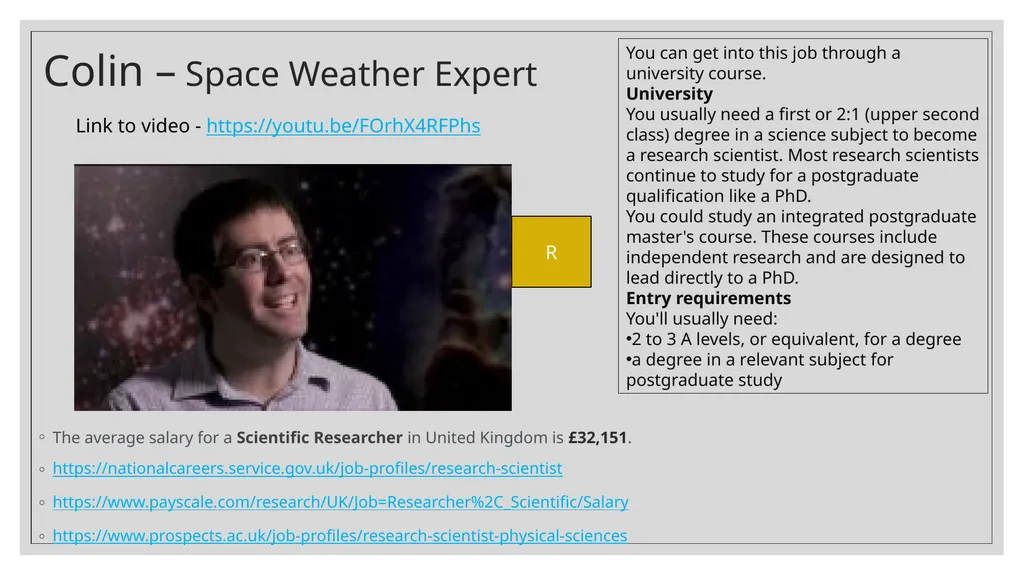
Colin – Space Weather Expert The average salary for a Scientific Researcher in United Kingdom is £32,151.
https://nationalcareers.service.gov.uk/job-profiles/research-scientist
https://www.payscale.com/research/UK/Job=Researcher%2C_Scientific/Salary
https://www.prospects.ac.uk/job-profiles/research-scientist-physical-sciences You can get into this job through a university course.
University
You usually need a first or 2:1 (upper second class) degree in a science subject to become a research scientist. Most research scientists continue to study for a postgraduate qualification like a PhD.
You could study an integrated postgraduate master's course. These courses include independent research and are designed to lead directly to a PhD.
Entry requirements
You'll usually need:
2 to 3 A levels, or equivalent, for a degree
a degree in a relevant subject for postgraduate study R Link to video - https://youtu.be/FOrhX4RFPhs<br>
https://nationalcareers.service.gov.uk/job-profiles/research-scientist
https://www.payscale.com/research/UK/Job=Researcher%2C_Scientific/Salary
https://www.prospects.ac.uk/job-profiles/research-scientist-physical-sciences You can get into this job through a university course.
University
You usually need a first or 2:1 (upper second class) degree in a science subject to become a research scientist. Most research scientists continue to study for a postgraduate qualification like a PhD.
You could study an integrated postgraduate master's course. These courses include independent research and are designed to lead directly to a PhD.
Entry requirements
You'll usually need:
2 to 3 A levels, or equivalent, for a degree
a degree in a relevant subject for postgraduate study R Link to video - https://youtu.be/FOrhX4RFPhs<br>
11
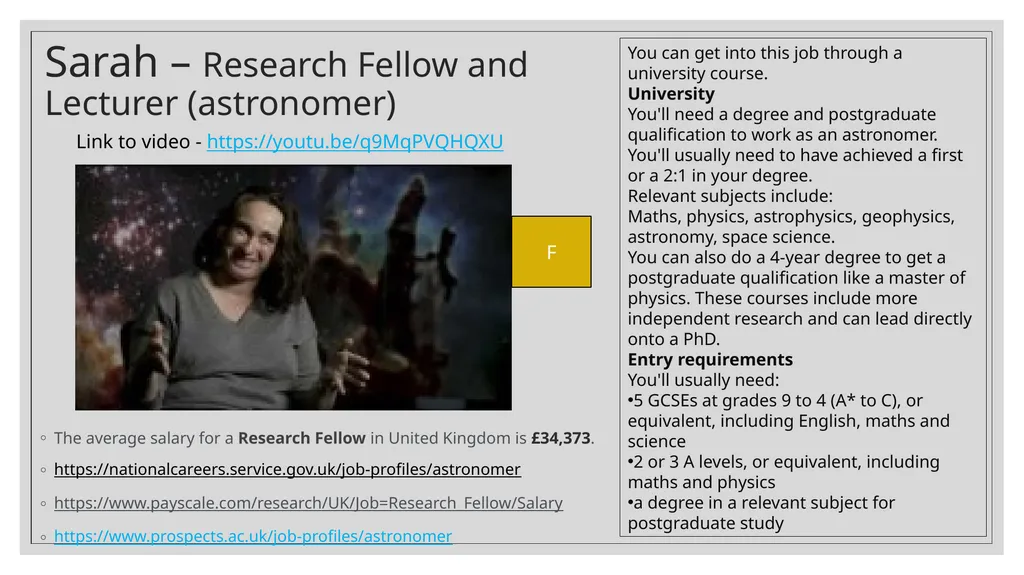
Sarah – Research Fellow and Lecturer (astronomer) The average salary for a Research Fellow in United Kingdom is £34,373.
https://nationalcareers.service.gov.uk/job-profiles/astronomer
https://www.payscale.com/research/UK/Job=Research_Fellow/Salary
https://www.prospects.ac.uk/job-profiles/astronomer You can get into this job through a university course.
University
You'll need a degree and postgraduate qualification to work as an astronomer. You'll usually need to have achieved a first or a 2:1 in your degree.
Relevant subjects include:
Maths, physics, astrophysics, geophysics, astronomy, space science.
You can also do a 4-year degree to get a postgraduate qualification like a master of physics. These courses include more independent research and can lead directly onto a PhD.
Entry requirements
You'll usually need:
5 GCSEs at grades 9 to 4 (A* to C), or equivalent, including English, maths and science
2 or 3 A levels, or equivalent, including maths and physics
a degree in a relevant subject for postgraduate study F Link to video - https://youtu.be/q9MqPVQHQXU<br>
https://nationalcareers.service.gov.uk/job-profiles/astronomer
https://www.payscale.com/research/UK/Job=Research_Fellow/Salary
https://www.prospects.ac.uk/job-profiles/astronomer You can get into this job through a university course.
University
You'll need a degree and postgraduate qualification to work as an astronomer. You'll usually need to have achieved a first or a 2:1 in your degree.
Relevant subjects include:
Maths, physics, astrophysics, geophysics, astronomy, space science.
You can also do a 4-year degree to get a postgraduate qualification like a master of physics. These courses include more independent research and can lead directly onto a PhD.
Entry requirements
You'll usually need:
5 GCSEs at grades 9 to 4 (A* to C), or equivalent, including English, maths and science
2 or 3 A levels, or equivalent, including maths and physics
a degree in a relevant subject for postgraduate study F Link to video - https://youtu.be/q9MqPVQHQXU<br>
12
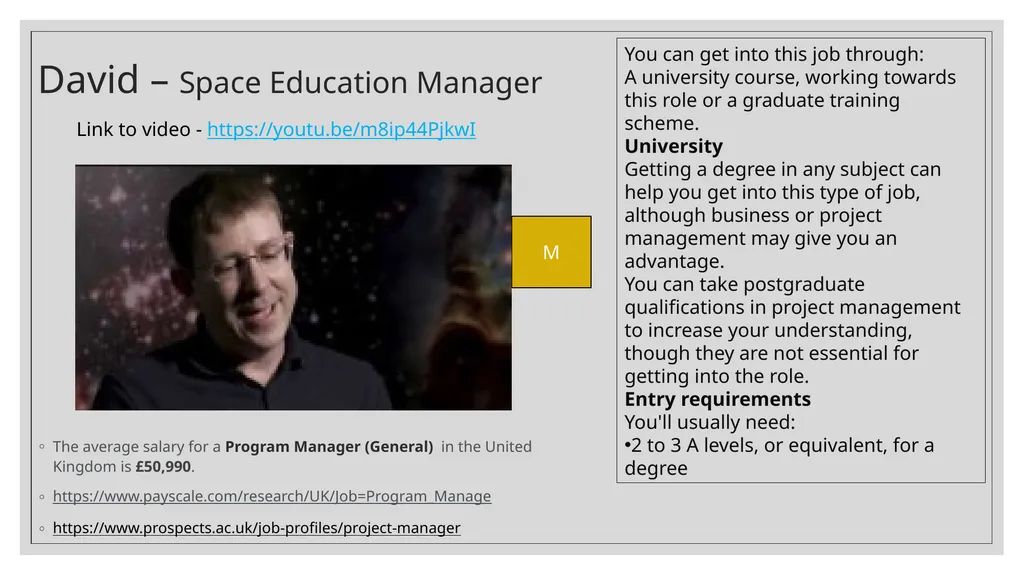
David – Space Education Manager The average salary for a Program Manager (General) in the United Kingdom is £50,990.
https://www.payscale.com/research/UK/Job=Program_Manage
https://www.prospects.ac.uk/job-profiles/project-manager You can get into this job through:
A university course, working towards this role or a graduate training scheme.
University
Getting a degree in any subject can help you get into this type of job, although business or project management may give you an advantage.
You can take postgraduate qualifications in project management to increase your understanding, though they are not essential for getting into the role.
Entry requirements
You'll usually need:
2 to 3 A levels, or equivalent, for a degree M Link to video - https://youtu.be/m8ip44PjkwI<br>
https://www.payscale.com/research/UK/Job=Program_Manage
https://www.prospects.ac.uk/job-profiles/project-manager You can get into this job through:
A university course, working towards this role or a graduate training scheme.
University
Getting a degree in any subject can help you get into this type of job, although business or project management may give you an advantage.
You can take postgraduate qualifications in project management to increase your understanding, though they are not essential for getting into the role.
Entry requirements
You'll usually need:
2 to 3 A levels, or equivalent, for a degree M Link to video - https://youtu.be/m8ip44PjkwI<br>
13
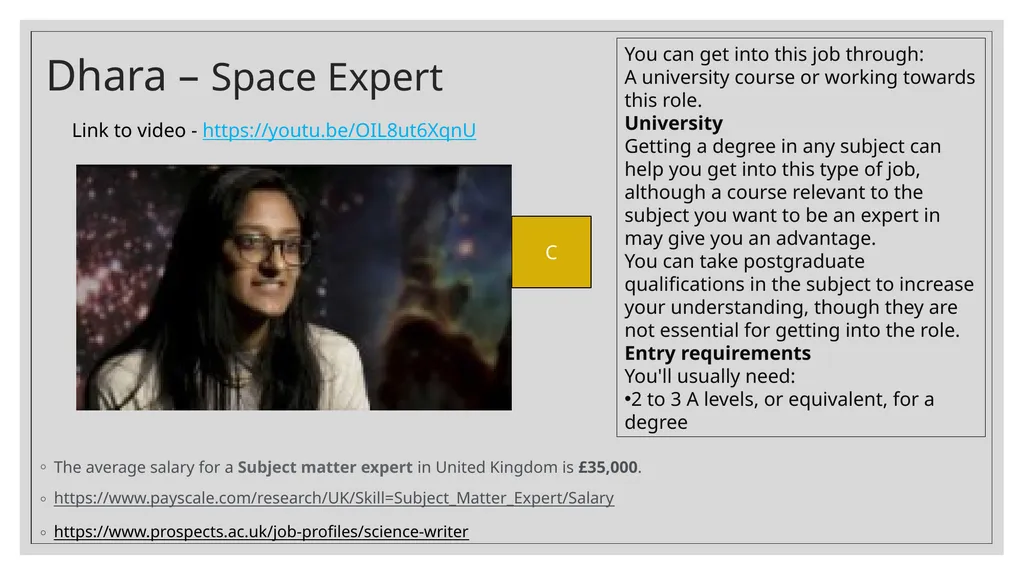
Dhara – Space Expert The average salary for a Subject matter expert in United Kingdom is £35,000.
https://www.payscale.com/research/UK/Skill=Subject_Matter_Expert/Salary
https://www.prospects.ac.uk/job-profiles/science-writer You can get into this job through:
A university course or working towards this role.
University
Getting a degree in any subject can help you get into this type of job, although a course relevant to the subject you want to be an expert in may give you an advantage.
You can take postgraduate qualifications in the subject to increase your understanding, though they are not essential for getting into the role.
Entry requirements
You'll usually need:
2 to 3 A levels, or equivalent, for a degree C Link to video - https://youtu.be/OIL8ut6XqnU<br>
https://www.payscale.com/research/UK/Skill=Subject_Matter_Expert/Salary
https://www.prospects.ac.uk/job-profiles/science-writer You can get into this job through:
A university course or working towards this role.
University
Getting a degree in any subject can help you get into this type of job, although a course relevant to the subject you want to be an expert in may give you an advantage.
You can take postgraduate qualifications in the subject to increase your understanding, though they are not essential for getting into the role.
Entry requirements
You'll usually need:
2 to 3 A levels, or equivalent, for a degree C Link to video - https://youtu.be/OIL8ut6XqnU<br>
14
Would you like more information?<br>
15
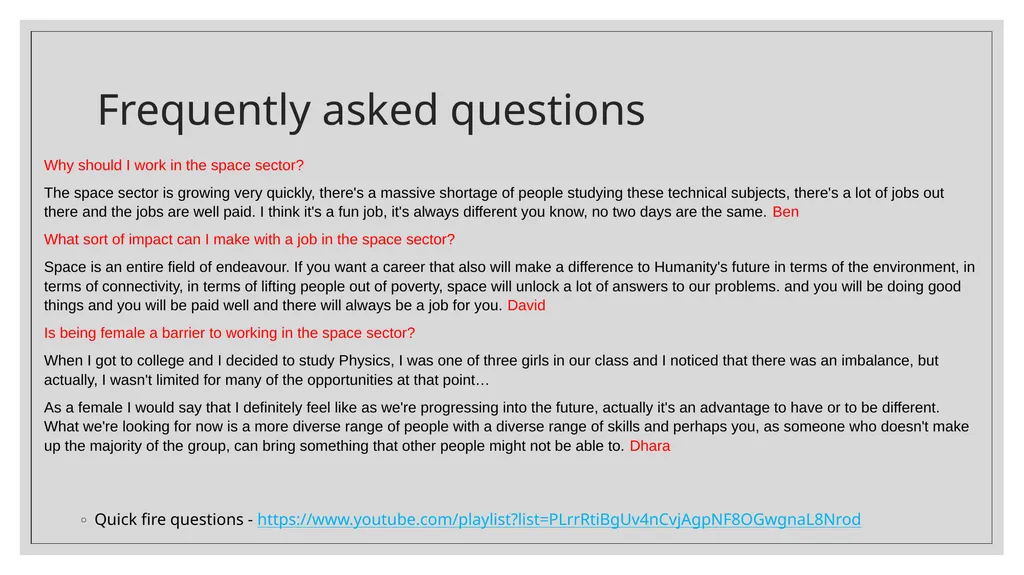
Frequently asked questions Quick fire questions - https://www.youtube.com/playlist?list=PLrrRtiBgUv4nCvjAgpNF8OGwgnaL8Nrod Why should I work in the space sector?
The space sector is growing very quickly, there's a massive shortage of people studying these technical subjects, there's a lot of jobs out there and the jobs are well paid. I think it's a fun job, it's always different you know, no two days are the same. Ben
What sort of impact can I make with a job in the space sector?
Space is an entire field of endeavour. If you want a career that also will make a difference to Humanity's future in terms of the environment, in terms of connectivity, in terms of lifting people out of poverty, space will unlock a lot of answers to our problems. and you will be doing good things and you will be paid well and there will always be a job for you. David
Is being female a barrier to working in the space sector?
When I got to college and I decided to study Physics, I was one of three girls in our class and I noticed that there was an imbalance, but actually, I wasn't limited for many of the opportunities at that point…
As a female I would say that I definitely feel like as we're progressing into the future, actually it's an advantage to have or to be different. What we're looking for now is a more diverse range of people with a diverse range of skills and perhaps you, as someone who doesn't make up the majority of the group, can bring something that other people might not be able to. Dhara<br>
The space sector is growing very quickly, there's a massive shortage of people studying these technical subjects, there's a lot of jobs out there and the jobs are well paid. I think it's a fun job, it's always different you know, no two days are the same. Ben
What sort of impact can I make with a job in the space sector?
Space is an entire field of endeavour. If you want a career that also will make a difference to Humanity's future in terms of the environment, in terms of connectivity, in terms of lifting people out of poverty, space will unlock a lot of answers to our problems. and you will be doing good things and you will be paid well and there will always be a job for you. David
Is being female a barrier to working in the space sector?
When I got to college and I decided to study Physics, I was one of three girls in our class and I noticed that there was an imbalance, but actually, I wasn't limited for many of the opportunities at that point…
As a female I would say that I definitely feel like as we're progressing into the future, actually it's an advantage to have or to be different. What we're looking for now is a more diverse range of people with a diverse range of skills and perhaps you, as someone who doesn't make up the majority of the group, can bring something that other people might not be able to. Dhara<br>
16
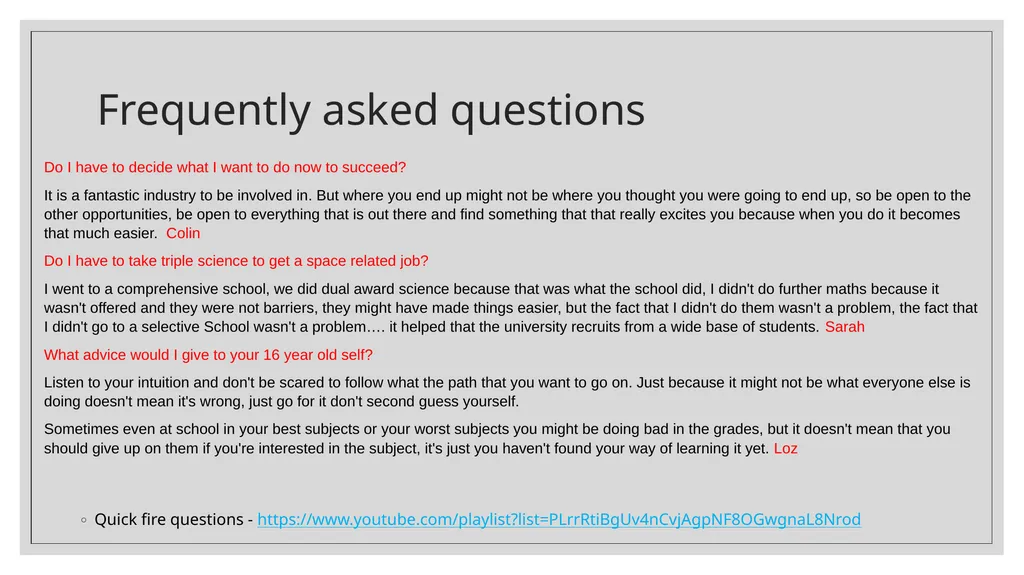
Frequently asked questions Quick fire questions - https://www.youtube.com/playlist?list=PLrrRtiBgUv4nCvjAgpNF8OGwgnaL8Nrod Do I have to decide what I want to do now to succeed?
It is a fantastic industry to be involved in. But where you end up might not be where you thought you were going to end up, so be open to the other opportunities, be open to everything that is out there and find something that that really excites you because when you do it becomes that much easier. Colin
Do I have to take triple science to get a space related job?
I went to a comprehensive school, we did dual award science because that was what the school did, I didn't do further maths because it wasn't offered and they were not barriers, they might have made things easier, but the fact that I didn't do them wasn't a problem, the fact that I didn't go to a selective School wasn't a problem…. it helped that the university recruits from a wide base of students. Sarah
What advice would I give to your 16 year old self?
Listen to your intuition and don't be scared to follow what the path that you want to go on. Just because it might not be what everyone else is doing doesn't mean it's wrong, just go for it don't second guess yourself.
Sometimes even at school in your best subjects or your worst subjects you might be doing bad in the grades, but it doesn't mean that you should give up on them if you're interested in the subject, it's just you haven't found your way of learning it yet. Loz<br>
It is a fantastic industry to be involved in. But where you end up might not be where you thought you were going to end up, so be open to the other opportunities, be open to everything that is out there and find something that that really excites you because when you do it becomes that much easier. Colin
Do I have to take triple science to get a space related job?
I went to a comprehensive school, we did dual award science because that was what the school did, I didn't do further maths because it wasn't offered and they were not barriers, they might have made things easier, but the fact that I didn't do them wasn't a problem, the fact that I didn't go to a selective School wasn't a problem…. it helped that the university recruits from a wide base of students. Sarah
What advice would I give to your 16 year old self?
Listen to your intuition and don't be scared to follow what the path that you want to go on. Just because it might not be what everyone else is doing doesn't mean it's wrong, just go for it don't second guess yourself.
Sometimes even at school in your best subjects or your worst subjects you might be doing bad in the grades, but it doesn't mean that you should give up on them if you're interested in the subject, it's just you haven't found your way of learning it yet. Loz<br>
17
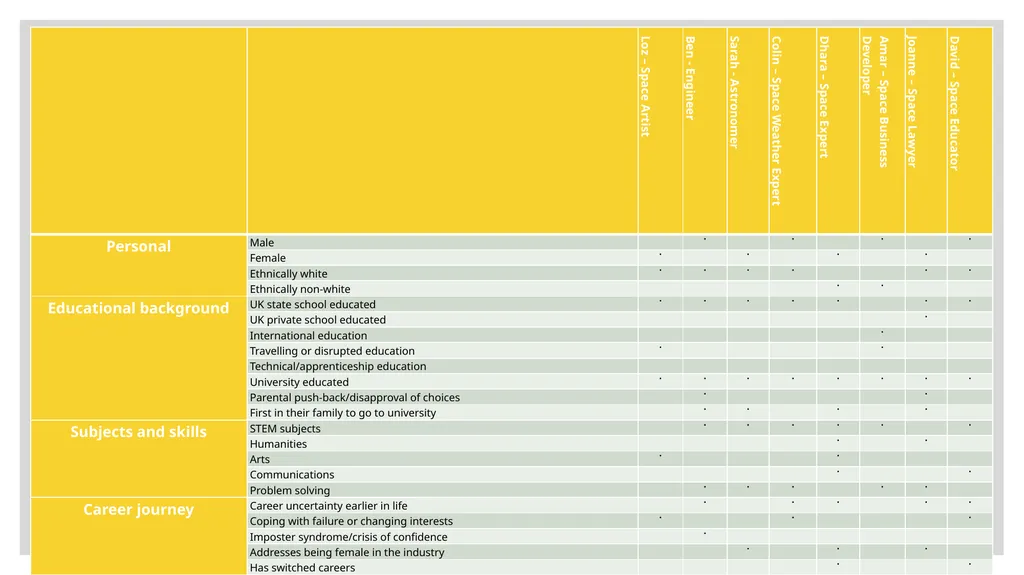
The eight Gatsby benchmarks of Good Career Guidance are:
1. A stable careers programme - Permanent fixture of developing resources on the site.
2. Learning from career and labour market information – Labour market info. The number of people employed in the relevant industry in the UK / Europe. Industry growth. Future study options. https://www.lmiforall.org.uk/
3. Addressing the needs of each pupil – Should be clear what age it is aimed at and relevant to them. Should embed equality and diversity throughout. Give examples of jobs at all levels of education. Show people of different backgrounds.
4. Linking curriculum learning to careers - What subjects does it relate to at school, A-levels / Degree required.
5. Encounters with employers and employees - Every pupil should have opportunities to learn from employers about work, employment and the skills that are valued in the workplace.
6. Experiences of workplaces
7. Encounters with further and higher education - All pupils should understand the full range of learning opportunities that are available to them. This includes both academic and vocational.
8. Personal guidance – Required from qualified practitioners.<br>
1. A stable careers programme - Permanent fixture of developing resources on the site.
2. Learning from career and labour market information – Labour market info. The number of people employed in the relevant industry in the UK / Europe. Industry growth. Future study options. https://www.lmiforall.org.uk/
3. Addressing the needs of each pupil – Should be clear what age it is aimed at and relevant to them. Should embed equality and diversity throughout. Give examples of jobs at all levels of education. Show people of different backgrounds.
4. Linking curriculum learning to careers - What subjects does it relate to at school, A-levels / Degree required.
5. Encounters with employers and employees - Every pupil should have opportunities to learn from employers about work, employment and the skills that are valued in the workplace.
6. Experiences of workplaces
7. Encounters with further and higher education - All pupils should understand the full range of learning opportunities that are available to them. This includes both academic and vocational.
8. Personal guidance – Required from qualified practitioners.<br>
18
Know your sciences Can you put the following disciplines into the correct category?
Some may be in more than one.<br>
Some may be in more than one.<br>
19
Can you put the science disciplines into the correct category?
Some may be in more than one.<br>
Some may be in more than one.<br>