Finding Community Solutions to Reducing Marine Litter CEC Project Overview Catherine Hallmich Project Lead, Commission for Environmental Cooperation 25 June 2019 Land-based Litter About 80 of all marine litter originates from land. Most of
"Finding Community Solutions to Reducing Marine" is the property of its rightful owner. Permission is granted to
download and print the materials on this website for personal, non-commercial use only, and to display it
on your personal computer provided you do not modify the materials and that you retain all copyright
notices contained in the materials. By downloading content from our website, you accept the terms of this
agreement.
Presentation Transcript
01
Finding Community Solutions to Reducing Marine Litter
Land-based Litter About 80% of all marine litter originates from land. Most of it is single-use plastic. Plastics are persistent and break down into small pieces that accumulate in the environment.
Litter accumulates in the watershed and enters the ocean through several pathways, including inadequate waste management, littering, and illegal dumping.
The problem is global, but solutions can be identified and implemented at the local level:
Engagement with communities in coastal areas and watersheds.
Coordination across multiple jurisdictions and stakeholder interests.<br>
03
Implementation Approach Describe the local marine litter status
Identify and engage local marine litter stakeholders
Convene stakeholders to identify solutions to local marine litter
Design and implement low-cost and low-technology solutions
Share the results and replicate the approach in other communities across North America Multi-stakeholder Engagement<br>
04
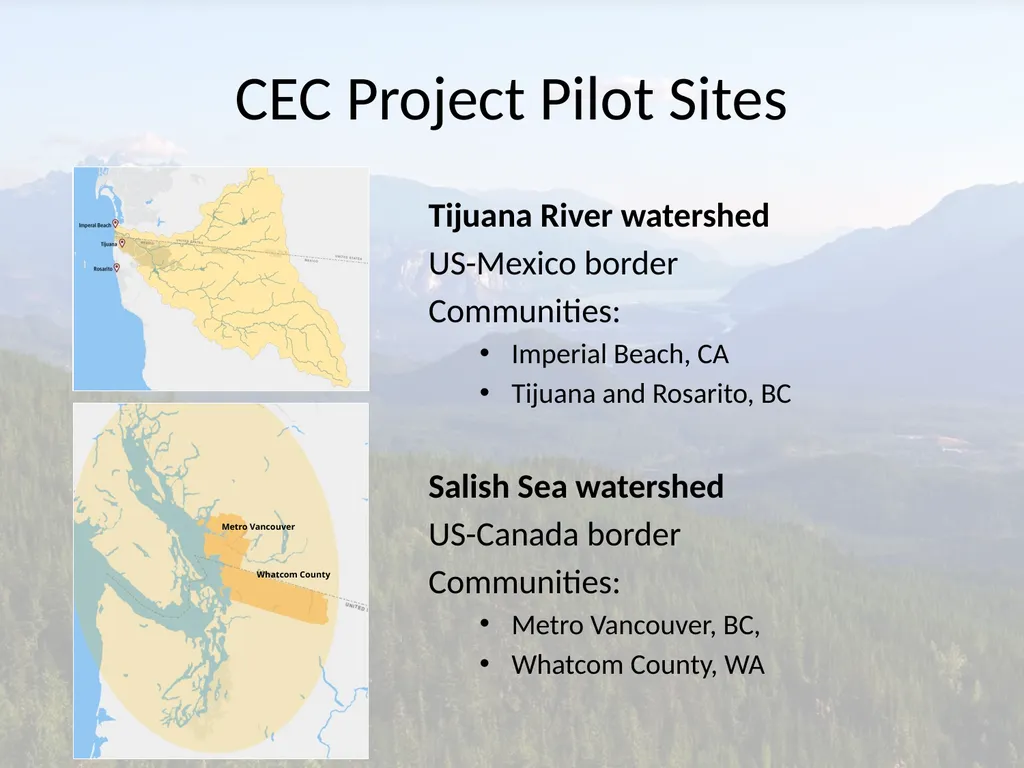
CEC Project Pilot Sites Tijuana River watershed
US-Mexico border
Communities:
Imperial Beach, CA
Tijuana and Rosarito, BC
Salish Sea watershed
US-Canada border
Communities:
Metro Vancouver, BC,
Whatcom County, WA<br>
05
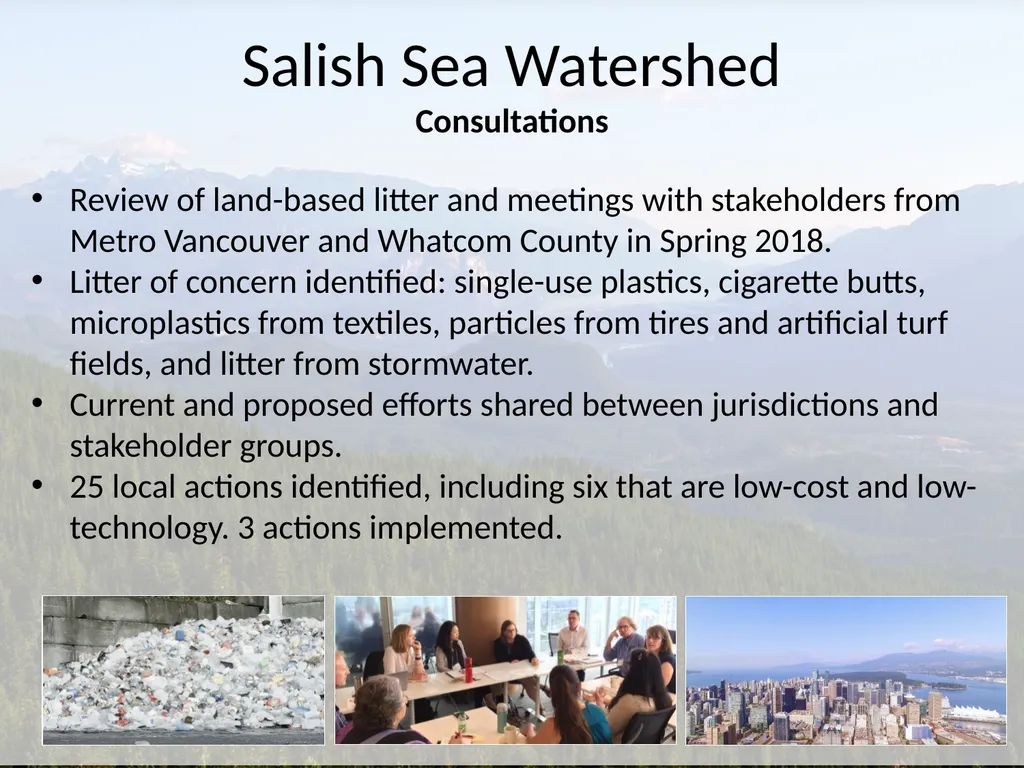
Salish Sea Watershed Review of land-based litter and meetings with stakeholders from Metro Vancouver and Whatcom County in Spring 2018.
Litter of concern identified: single-use plastics, cigarette butts, microplastics from textiles, particles from tires and artificial turf fields, and litter from stormwater.
Current and proposed efforts shared between jurisdictions and stakeholder groups.
25 local actions identified, including six that are low-cost and low-technology. 3 actions implemented. Consultations<br>
06
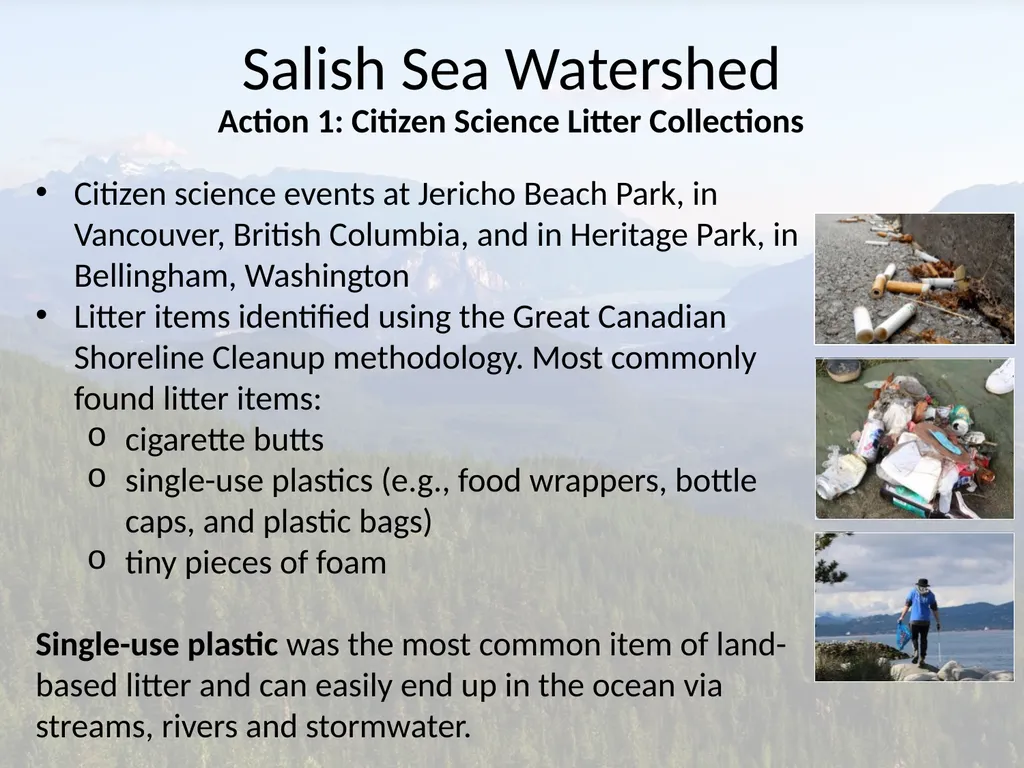
Salish Sea Watershed Citizen science events at Jericho Beach Park, in Vancouver, British Columbia, and in Heritage Park, in Bellingham, Washington
Litter items identified using the Great Canadian Shoreline Cleanup methodology. Most commonly found litter items:
cigarette butts
single-use plastics (e.g., food wrappers, bottle caps, and plastic bags)
tiny pieces of foam
Single-use plastic was the most common item of land-based litter and can easily end up in the ocean via streams, rivers and stormwater. Action 1: Citizen Science Litter Collections<br>
07
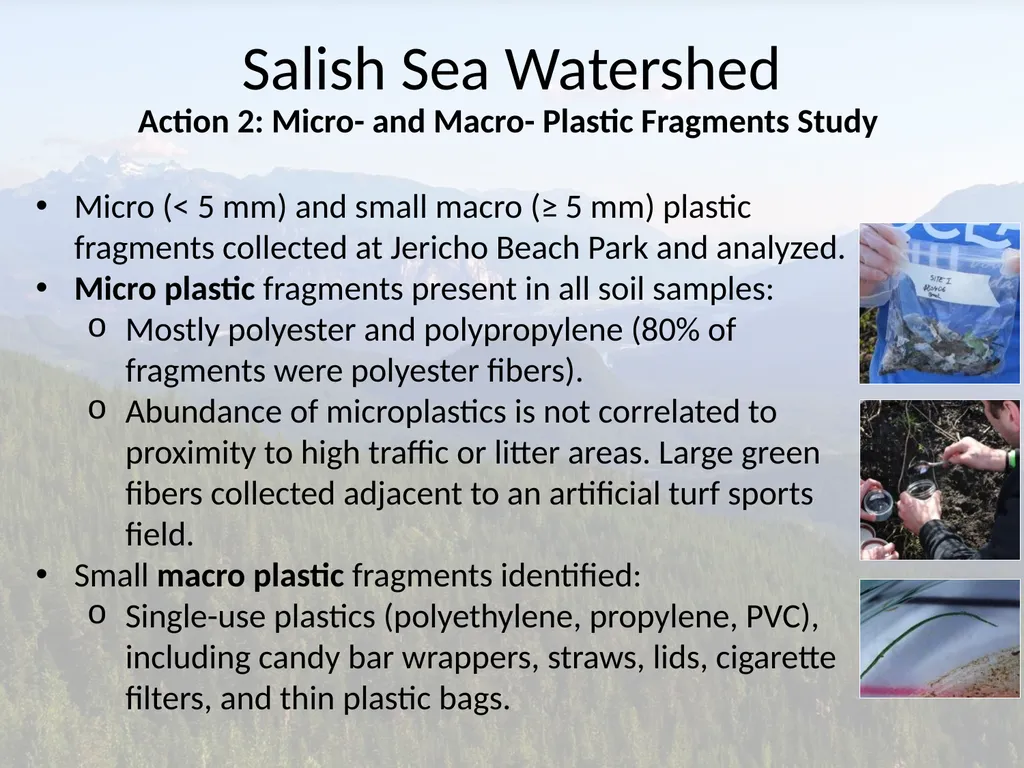
Salish Sea Watershed Micro (< 5 mm) and small macro (≥ 5 mm) plastic fragments collected at Jericho Beach Park and analyzed.
Micro plastic fragments present in all soil samples:
Mostly polyester and polypropylene (80% of fragments were polyester fibers).
Abundance of microplastics is not correlated to proximity to high traffic or litter areas. Large green fibers collected adjacent to an artificial turf sports field.
Small macro plastic fragments identified:
Single-use plastics (polyethylene, propylene, PVC), including candy bar wrappers, straws, lids, cigarette filters, and thin plastic bags. Action 2: Micro- and Macro- Plastic Fragments Study<br>
08
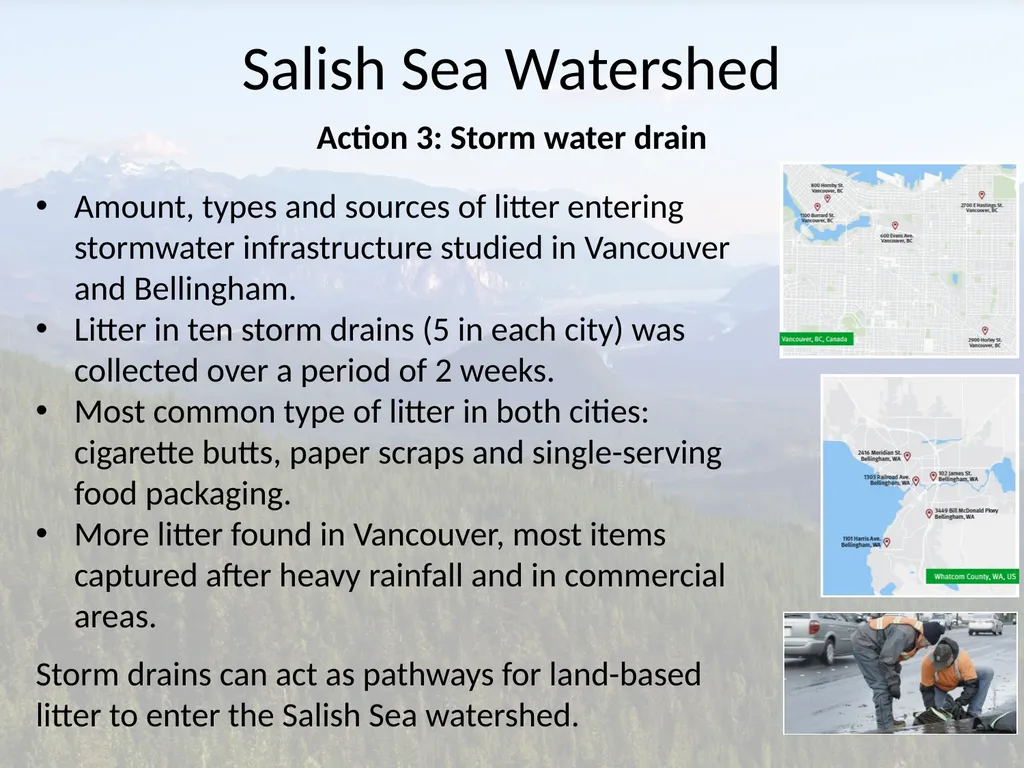
Salish Sea Watershed Amount, types and sources of litter entering stormwater infrastructure studied in Vancouver and Bellingham.
Litter in ten storm drains (5 in each city) was collected over a period of 2 weeks.
Most common type of litter in both cities: cigarette butts, paper scraps and single-serving food packaging.
More litter found in Vancouver, most items captured after heavy rainfall and in commercial areas. Action 3: Storm water drain Storm drains can act as pathways for land-based litter to enter the Salish Sea watershed.<br>
09
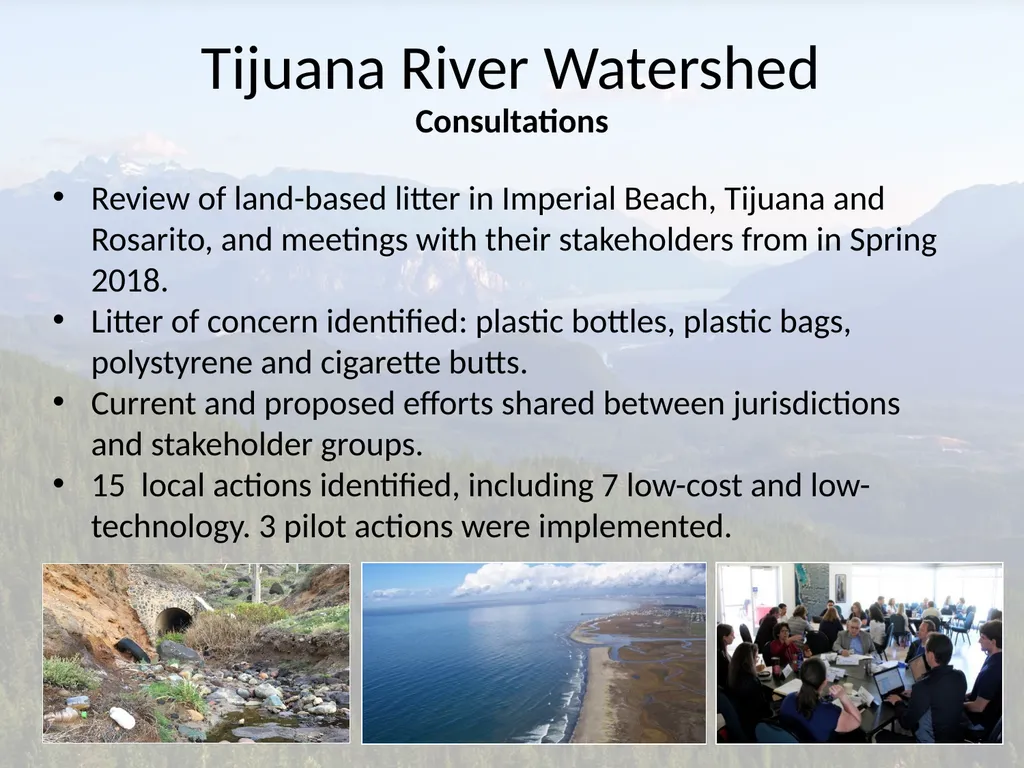
Tijuana River Watershed Consultations Review of land-based litter in Imperial Beach, Tijuana and Rosarito, and meetings with their stakeholders from in Spring 2018.
Litter of concern identified: plastic bottles, plastic bags, polystyrene and cigarette butts.
Current and proposed efforts shared between jurisdictions and stakeholder groups.
15 local actions identified, including 7 low-cost and low-technology. 3 pilot actions were implemented.<br>
10
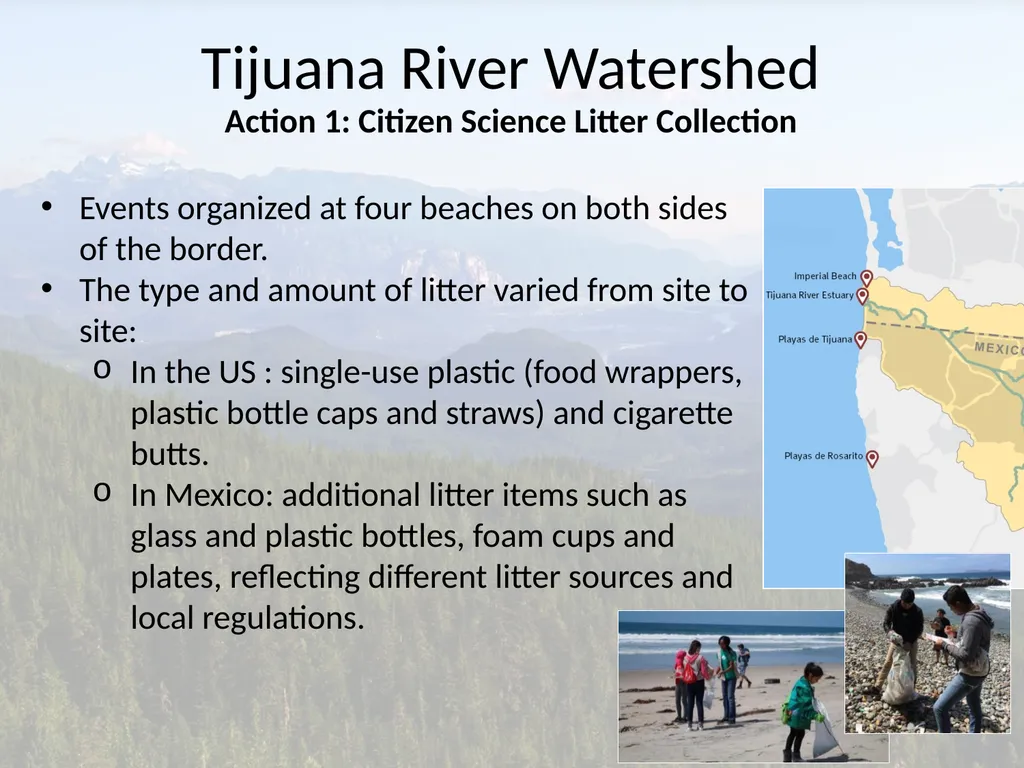
Tijuana River Watershed Action 1: Citizen Science Litter Collection Events organized at four beaches on both sides of the border.
The type and amount of litter varied from site to site:
In the US : single-use plastic (food wrappers, plastic bottle caps and straws) and cigarette butts.
In Mexico: additional litter items such as glass and plastic bottles, foam cups and plates, reflecting different litter sources and local regulations.<br>
11
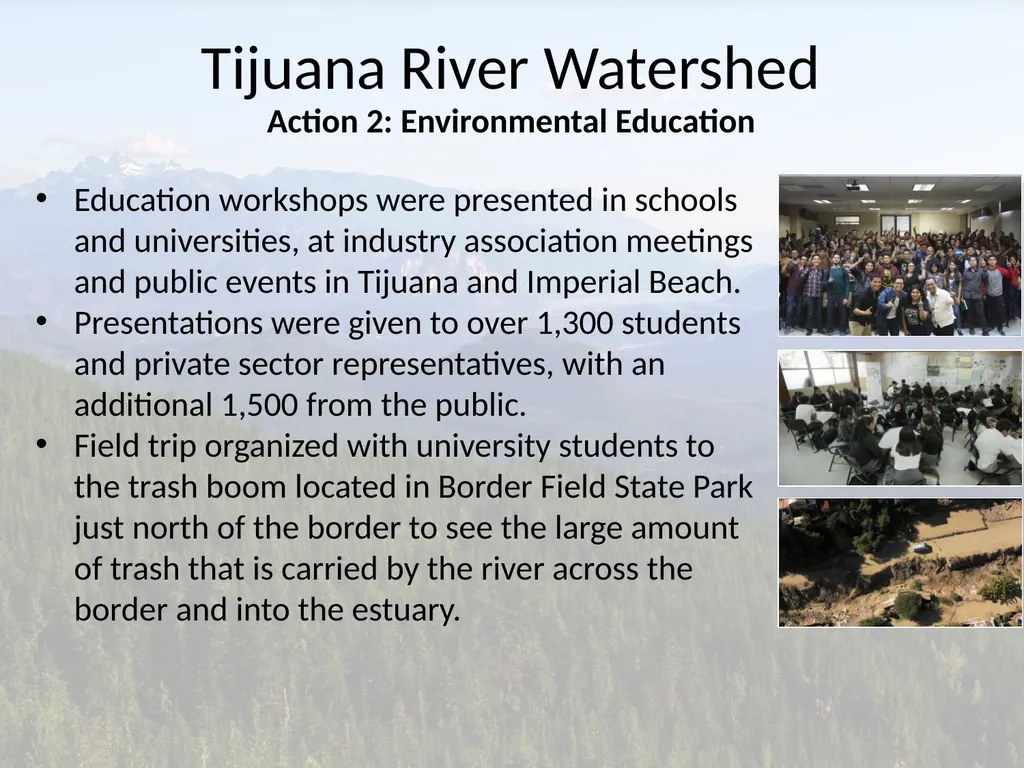
Tijuana River Watershed Action 2: Environmental Education Education workshops were presented in schools and universities, at industry association meetings and public events in Tijuana and Imperial Beach.
Presentations were given to over 1,300 students and private sector representatives, with an additional 1,500 from the public.
Field trip organized with university students to the trash boom located in Border Field State Park just north of the border to see the large amount of trash that is carried by the river across the border and into the estuary.<br>
12
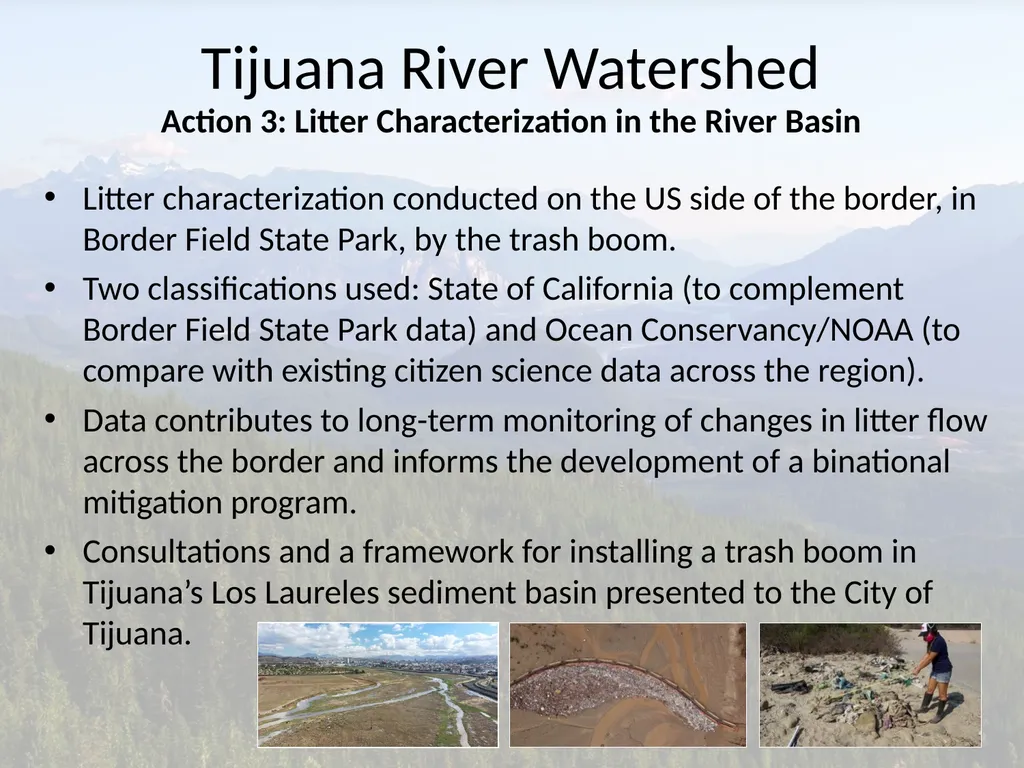
Tijuana River Watershed Action 3: Litter Characterization in the River Basin Litter characterization conducted on the US side of the border, in Border Field State Park, by the trash boom.
Two classifications used: State of California (to complement Border Field State Park data) and Ocean Conservancy/NOAA (to compare with existing citizen science data across the region).
Data contributes to long-term monitoring of changes in litter flow across the border and informs the development of a binational mitigation program.
Consultations and a framework for installing a trash boom in Tijuana’s Los Laureles sediment basin presented to the City of Tijuana.<br>
13
Conclusions Reducing litter by promoting behavioral changes through education campaigns and investigating sources of litter.
Preventing litter from reaching the ocean by designing physical barriers that prevent litter from entering waterways or the ocean.
Through this project, the CEC and its partners:
Improved coordination and networking between stakeholders and jurisdictions.
Created new knowledge and capacity for communities to take action and continue marine litter reduction efforts in each region.
Piloted an approach that can be replicated in other coastal community areas and watersheds.<br>
14
Case studies and videos available at: www.cec.org/marinelitter