
Finding Similar Items: Locality Sensitive Hashing
SN
Published · 58 slides · 0 views
1 / 1



Description
Finding Similar Items: Locality Sensitive Hashing Mining of Massive Datasets Jure Leskovec, Anand Rajaraman, Jeff Ullman Stanford University http:www.mmds.org Note to other teachers and users of these slides: We would be delighted if you
Related Topics
Share
Embed code
Download this presentation From Below
"Finding Similar Items: Locality Sensitive Hashing" is the property of its rightful owner. Permission is granted to download and print the materials on this website for personal, non-commercial use only, and to display it on your personal computer provided you do not modify the materials and that you retain all copyright notices contained in the materials. By downloading content from our website, you accept the terms of this agreement.
Presentation Transcript
01
Finding Similar Items:
Locality Sensitive Hashing Mining of Massive Datasets
Jure Leskovec, Anand Rajaraman, Jeff Ullman Stanford University
http://www.mmds.org Note to other teachers and users of these slides: We would be delighted if you found this our material useful in giving your own lectures. Feel free to use these slides verbatim, or to modify them to fit your own needs. If you make use of a significant portion of these slides in your own lecture, please include this message, or a link to our web site: http://www.mmds.org<br>
02
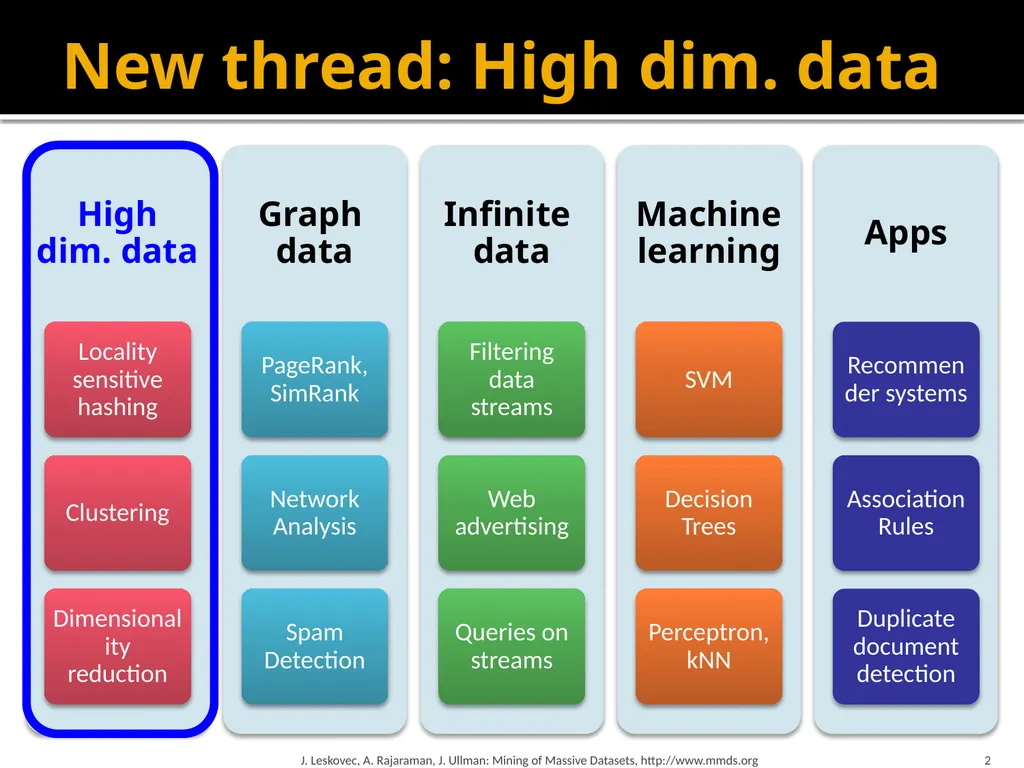
New thread: High dim. data J. Leskovec, A. Rajaraman, J. Ullman: Mining of Massive Datasets, http://www.mmds.org 2<br>
03
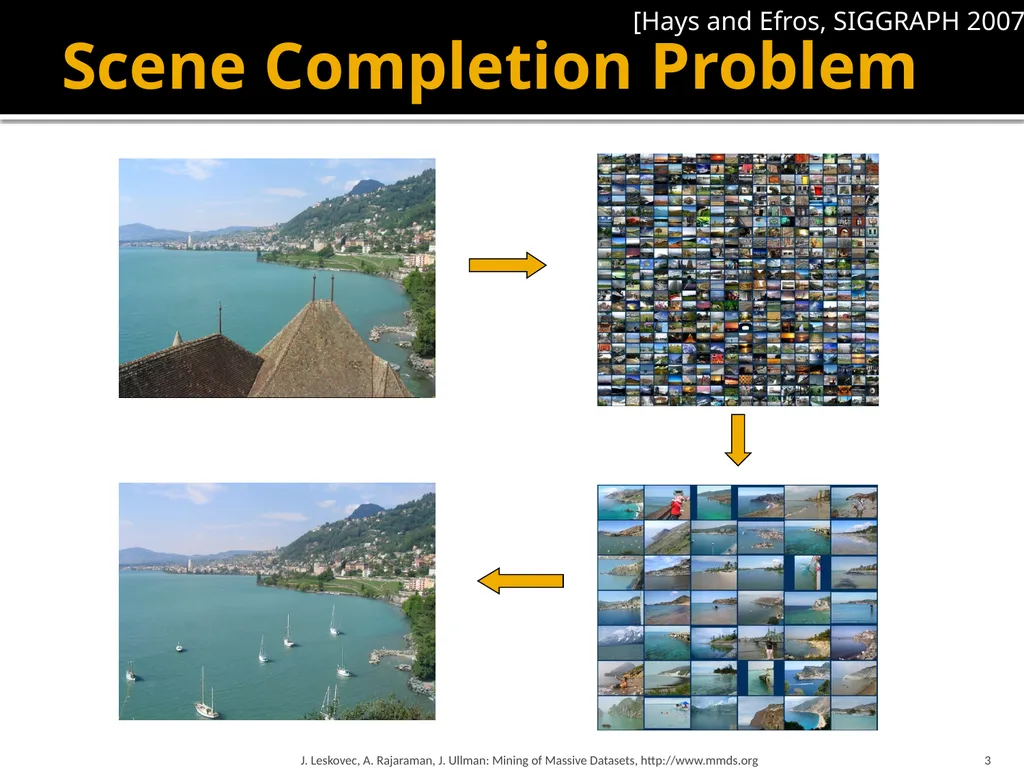
Scene Completion Problem 3 J. Leskovec, A. Rajaraman, J. Ullman: Mining of Massive Datasets, http://www.mmds.org [Hays and Efros, SIGGRAPH 2007]<br>
04
Scene Completion Problem 4 J. Leskovec, A. Rajaraman, J. Ullman: Mining of Massive Datasets, http://www.mmds.org [Hays and Efros, SIGGRAPH 2007]<br>
05
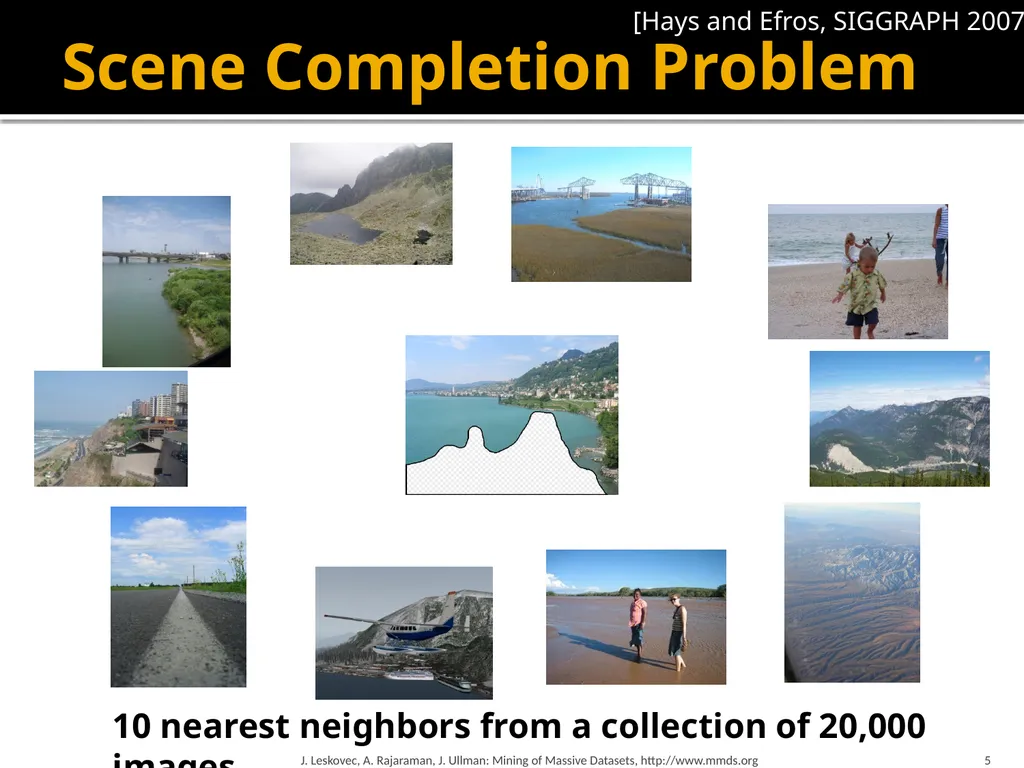
10 nearest neighbors from a collection of 20,000 images Scene Completion Problem J. Leskovec, A. Rajaraman, J. Ullman: Mining of Massive Datasets, http://www.mmds.org 5 [Hays and Efros, SIGGRAPH 2007]<br>
06
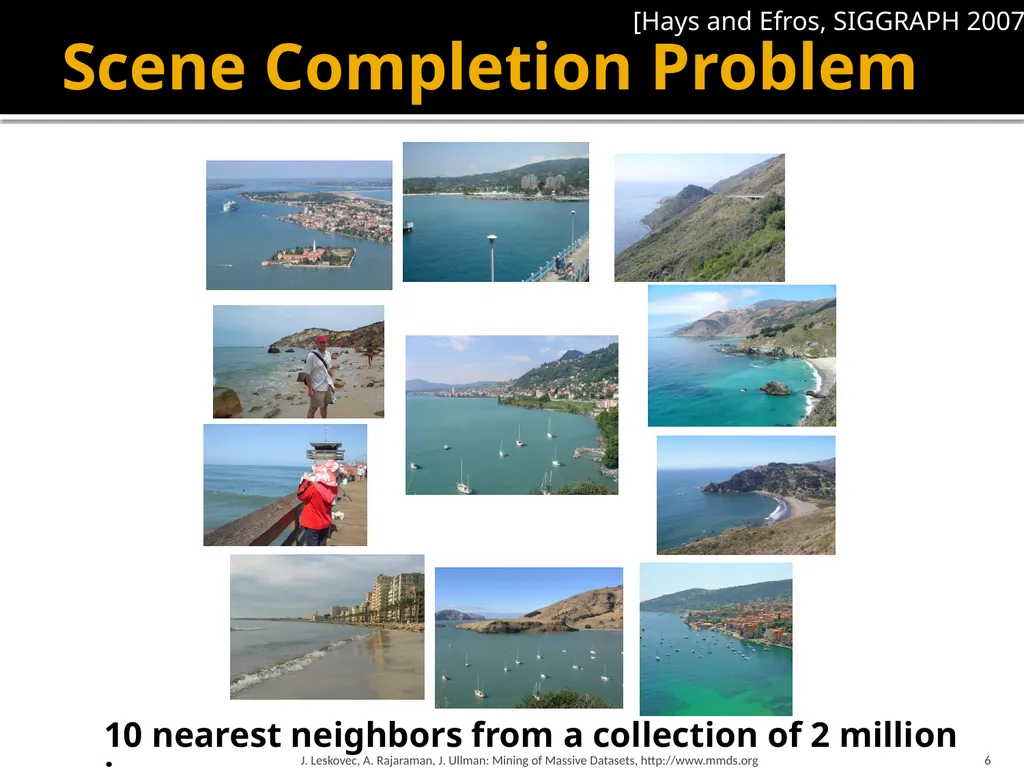
10 nearest neighbors from a collection of 2 million images Scene Completion Problem J. Leskovec, A. Rajaraman, J. Ullman: Mining of Massive Datasets, http://www.mmds.org 6 [Hays and Efros, SIGGRAPH 2007]<br>
07
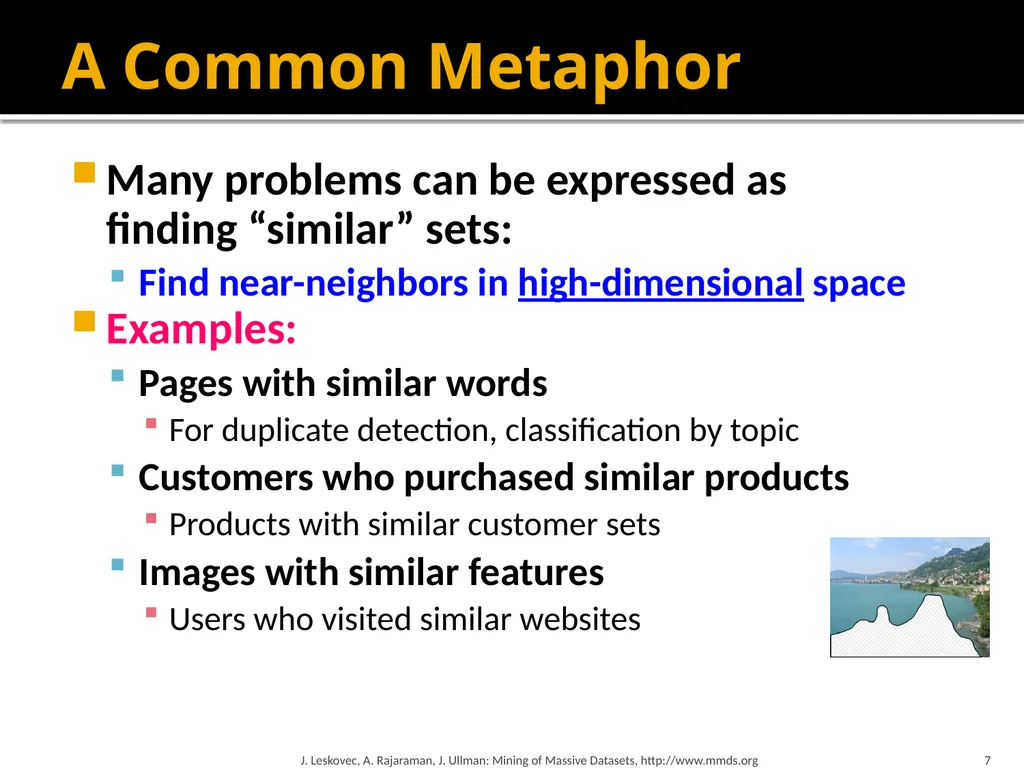
A Common Metaphor Many problems can be expressed as
finding “similar” sets:
Find near-neighbors in high-dimensional space
Examples:
Pages with similar words
For duplicate detection, classification by topic
Customers who purchased similar products
Products with similar customer sets
Images with similar features
Users who visited similar websites J. Leskovec, A. Rajaraman, J. Ullman: Mining of Massive Datasets, http://www.mmds.org 7<br>
08
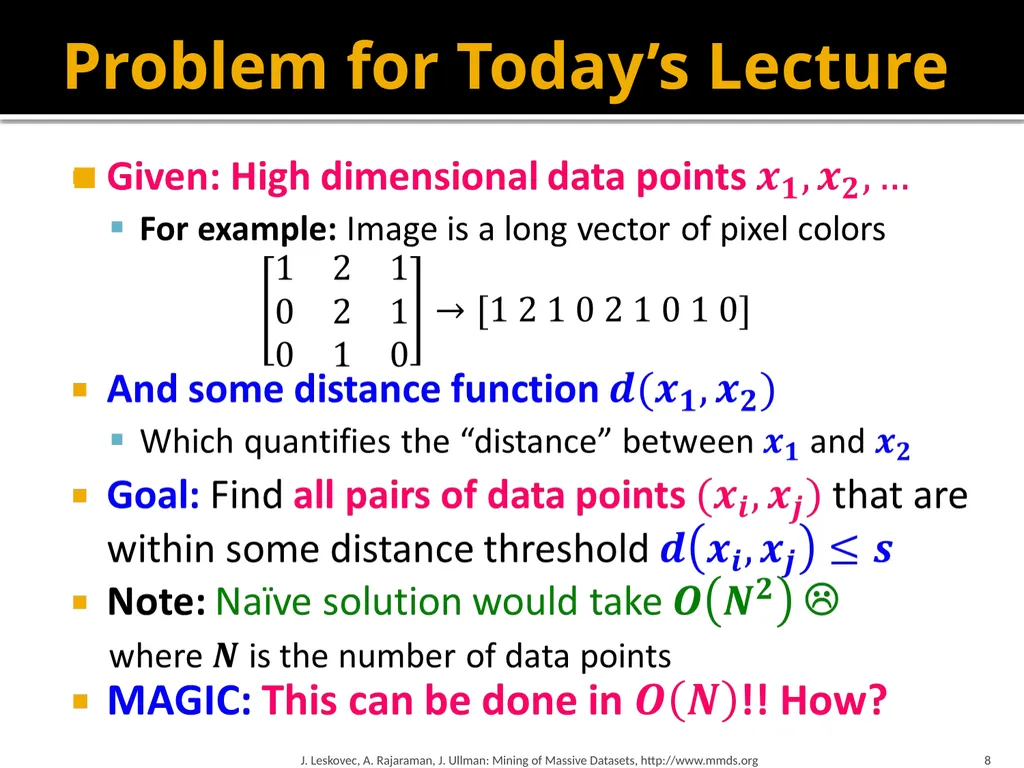
Problem for Today’s Lecture J. Leskovec, A. Rajaraman, J. Ullman: Mining of Massive Datasets, http://www.mmds.org 8<br>
09
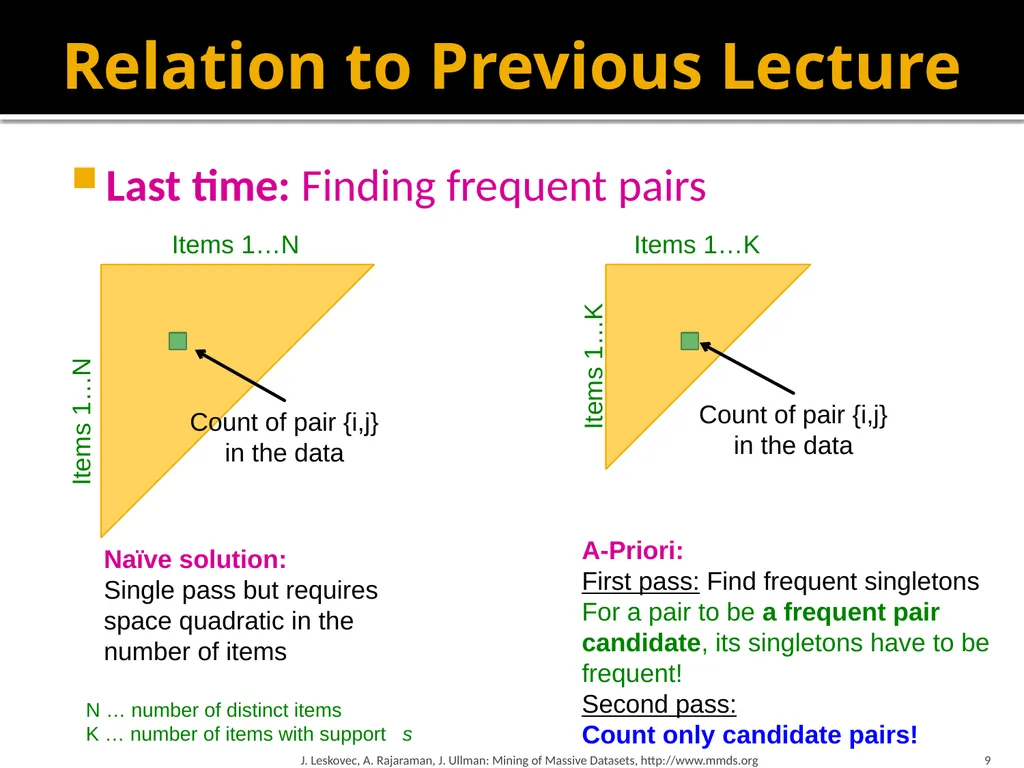
Relation to Previous Lecture Last time: Finding frequent pairs J. Leskovec, A. Rajaraman, J. Ullman: Mining of Massive Datasets, http://www.mmds.org 9 Items 1…N Items 1…N Count of pair {i,j} in the data Naïve solution:
Single pass but requires space quadratic in the number of items Items 1…K Items 1…K Count of pair {i,j} in the data A-Priori:
First pass: Find frequent singletons
For a pair to be a frequent pair candidate, its singletons have to be frequent! Second pass: Count only candidate pairs! N … number of distinct items
K … number of items with support s<br>
For a pair to be a frequent pair candidate, its singletons have to be frequent! Second pass: Count only candidate pairs! N … number of distinct items
K … number of items with support s<br>
10
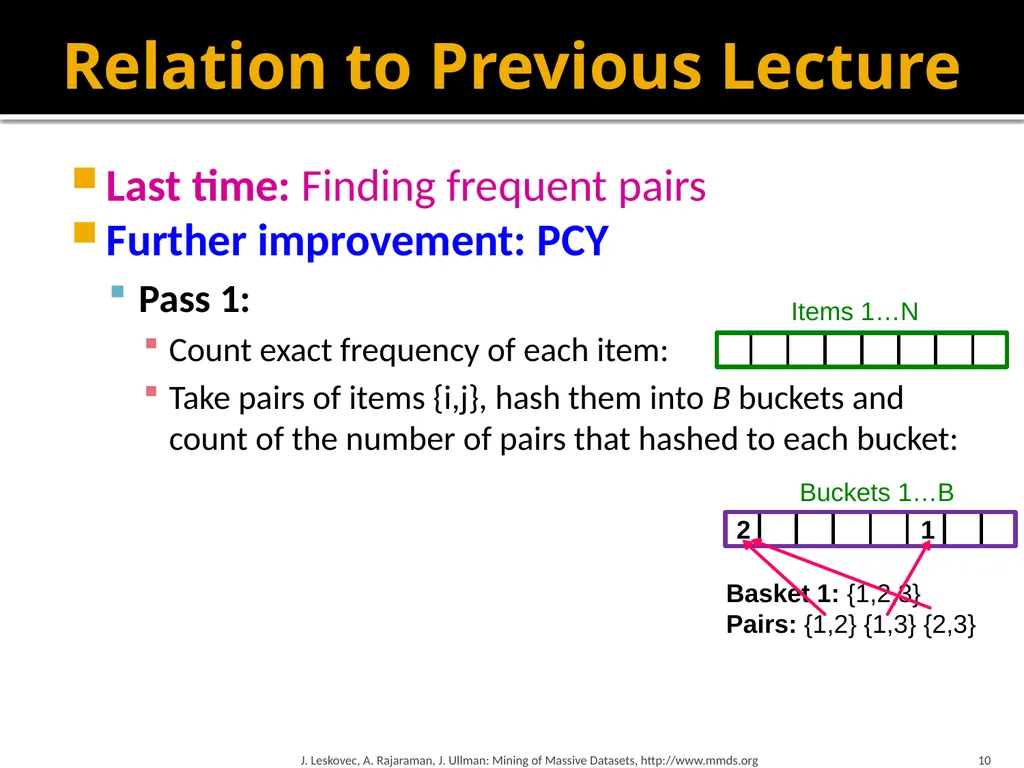
Relation to Previous Lecture Last time: Finding frequent pairs
Further improvement: PCY
Pass 1:
Count exact frequency of each item:
Take pairs of items {i,j}, hash them into B buckets and count of the number of pairs that hashed to each bucket: J. Leskovec, A. Rajaraman, J. Ullman: Mining of Massive Datasets, http://www.mmds.org 10 Items 1…N Basket 1: {1,2,3}
Pairs: {1,2} {1,3} {2,3} Buckets 1…B<br>
11
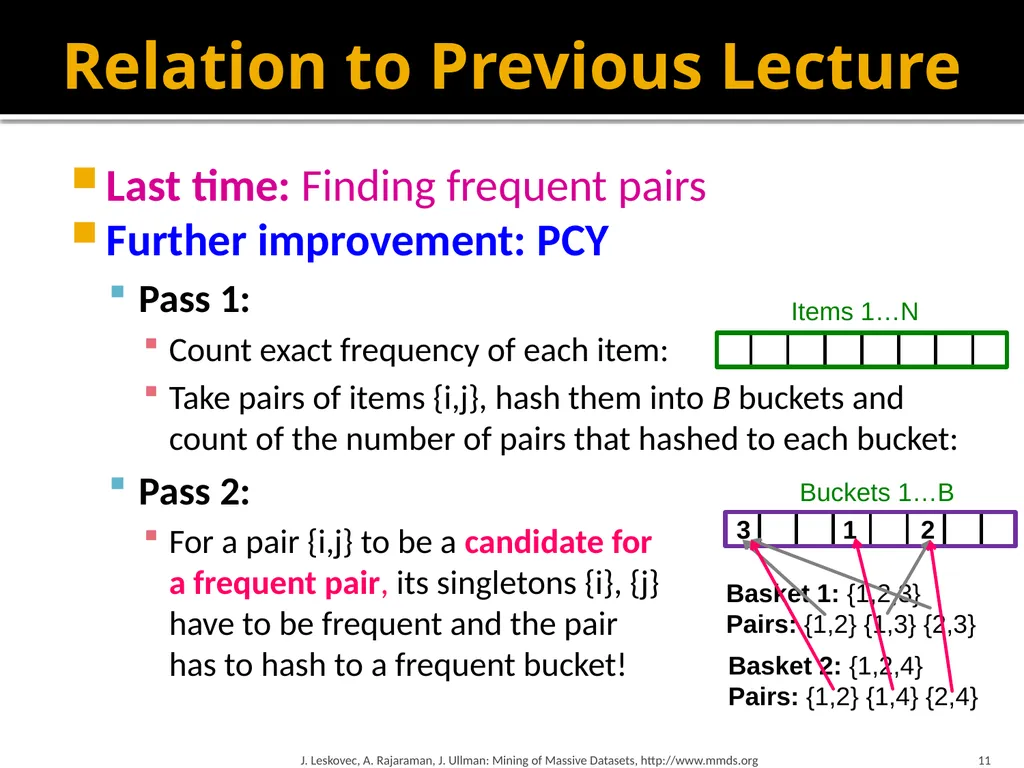
Relation to Previous Lecture Last time: Finding frequent pairs
Further improvement: PCY
Pass 1:
Count exact frequency of each item:
Take pairs of items {i,j}, hash them into B buckets and count of the number of pairs that hashed to each bucket:
Pass 2:
For a pair {i,j} to be a candidate for a frequent pair, its singletons {i}, {j} have to be frequent and the pair has to hash to a frequent bucket! J. Leskovec, A. Rajaraman, J. Ullman: Mining of Massive Datasets, http://www.mmds.org 11 Items 1…N Basket 1: {1,2,3}
Pairs: {1,2} {1,3} {2,3} Basket 2: {1,2,4}
Pairs: {1,2} {1,4} {2,4} Buckets 1…B<br>
12
Relation to Previous Lecture Last time: Finding frequent pairs
Further improvement: PCY
Pass 1:
Count exact frequency of each item:
Take pairs of items {i,j}, hash them into B buckets and count of the number of pairs that hashed to each bucket:
Pass 2:
For a pair {i,j} to be a candidate for a frequent pair, its singletons have to be frequent and its has to hash to a frequent bucket! J. Leskovec, A. Rajaraman, J. Ullman: Mining of Massive Datasets, http://www.mmds.org 12 Items 1…N Basket 1: {1,2,3}
Pairs: {1,2} {1,3} {2,3} Basket 2: {1,2,4}
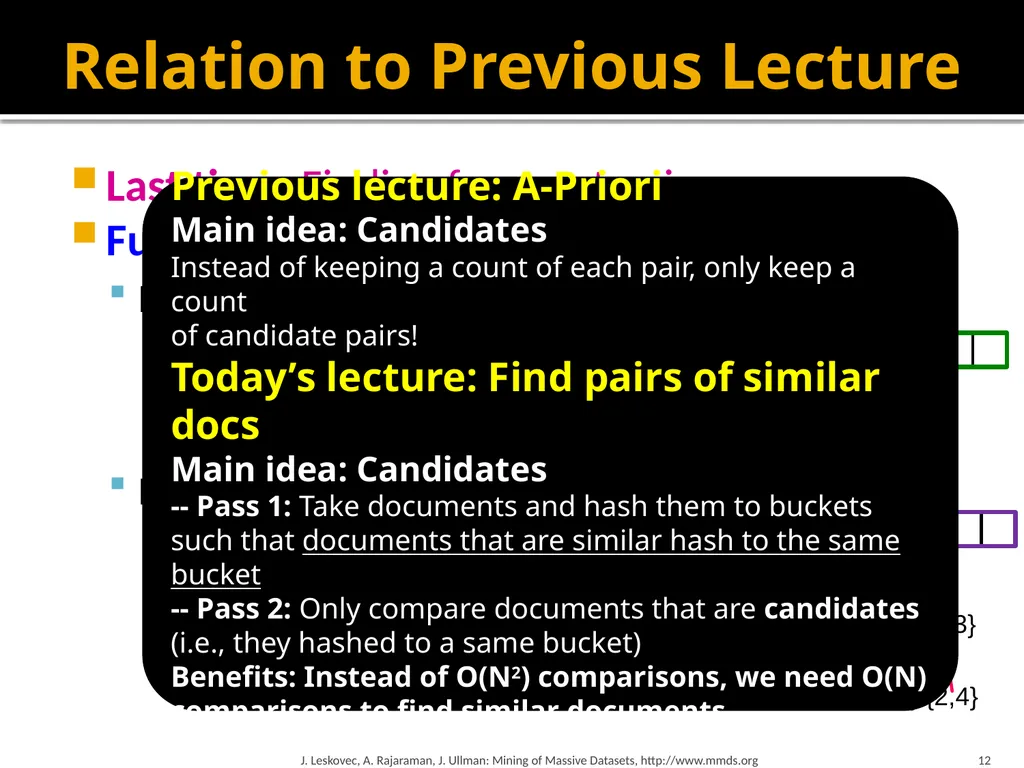
Pairs: {1,2} {1,4} {2,4} Buckets 1…B Previous lecture: A-Priori
Main idea: Candidates
Instead of keeping a count of each pair, only keep a count of candidate pairs!
Today’s lecture: Find pairs of similar docs
Main idea: Candidates
-- Pass 1: Take documents and hash them to buckets such that documents that are similar hash to the same bucket
-- Pass 2: Only compare documents that are candidates (i.e., they hashed to a same bucket)
Benefits: Instead of O(N2) comparisons, we need O(N) comparisons to find similar documents<br>
13
Finding Similar Items<br>
14
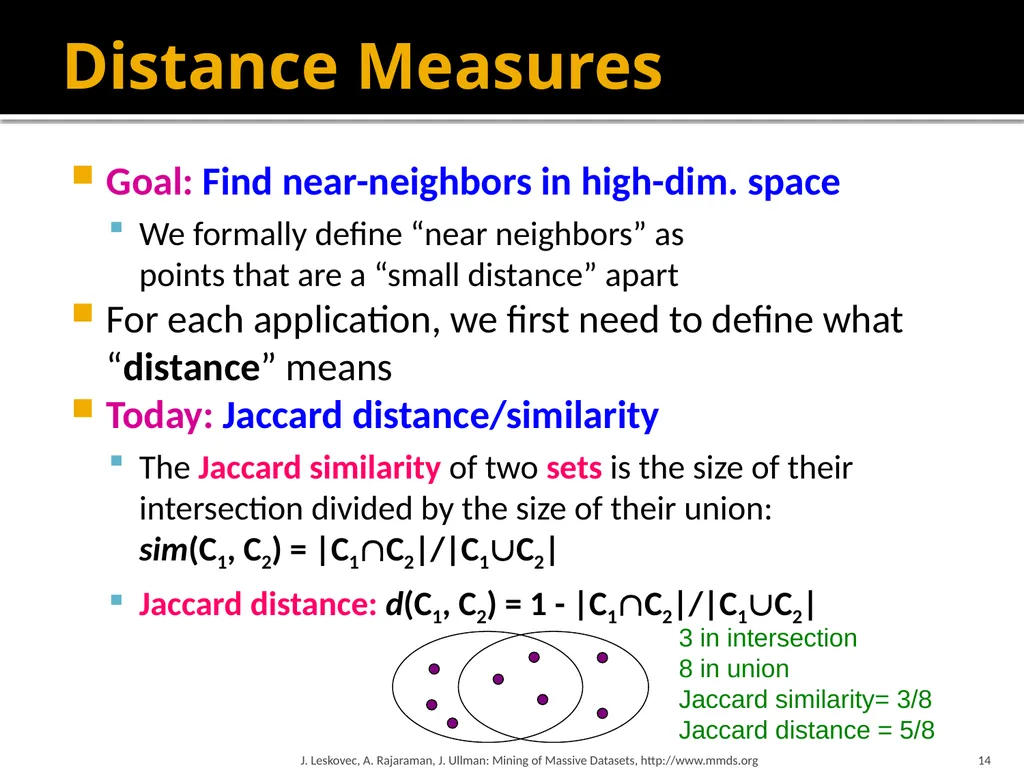
Distance Measures Goal: Find near-neighbors in high-dim. space
We formally define “near neighbors” as points that are a “small distance” apart
For each application, we first need to define what “distance” means
Today: Jaccard distance/similarity
The Jaccard similarity of two sets is the size of their intersection divided by the size of their union: sim(C1, C2) = |C1C2|/|C1C2|
Jaccard distance: d(C1, C2) = 1 - |C1C2|/|C1C2| 14 J. Leskovec, A. Rajaraman, J. Ullman: Mining of Massive Datasets, http://www.mmds.org 3 in intersection
8 in union
Jaccard similarity= 3/8
Jaccard distance = 5/8<br>
15
Task: Finding Similar Documents J. Leskovec, A. Rajaraman, J. Ullman: Mining of Massive Datasets, http://www.mmds.org 15<br>
16
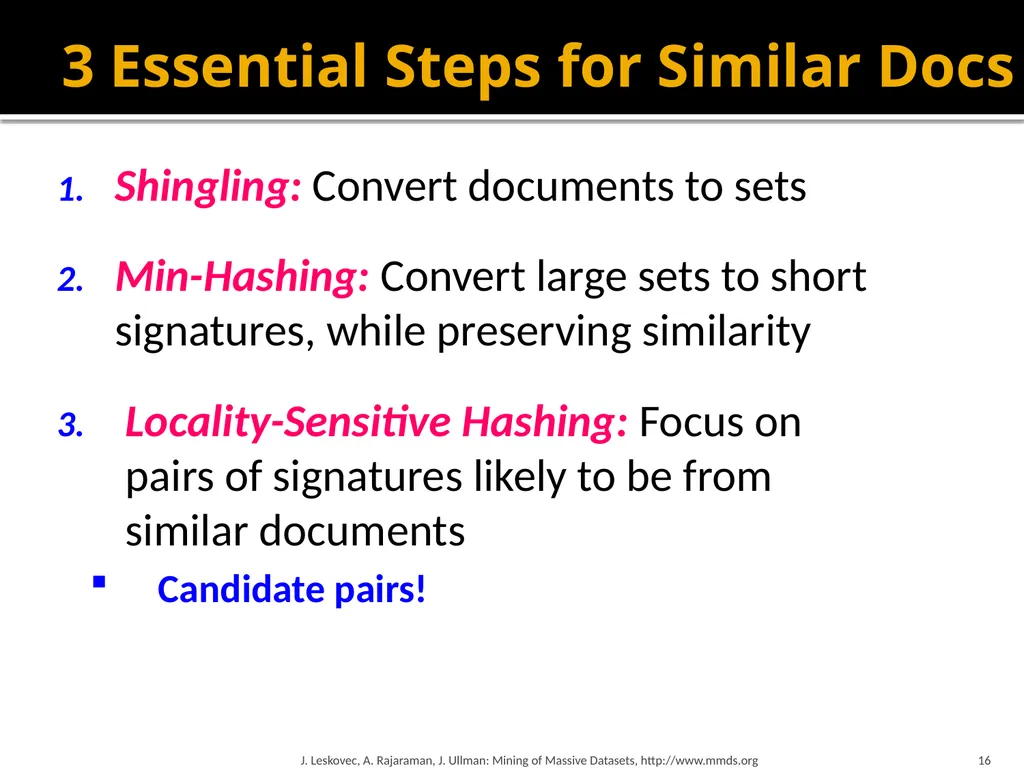
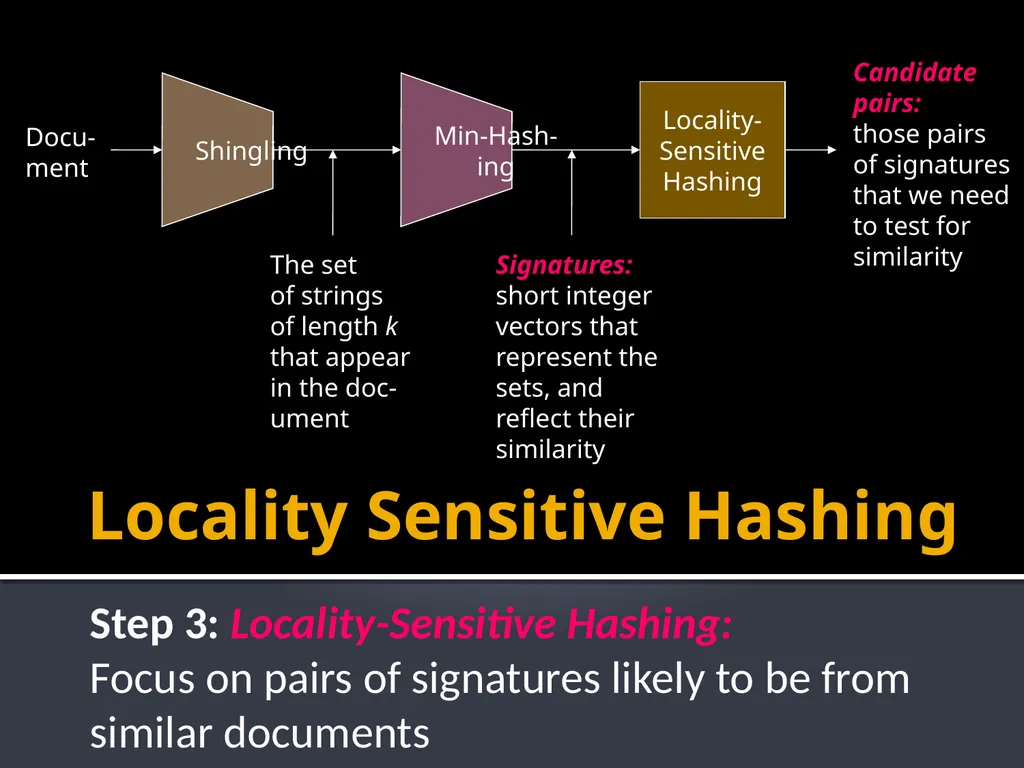
3 Essential Steps for Similar Docs Shingling: Convert documents to sets
Min-Hashing: Convert large sets to short signatures, while preserving similarity
Locality-Sensitive Hashing: Focus on pairs of signatures likely to be from similar documents
Candidate pairs! J. Leskovec, A. Rajaraman, J. Ullman: Mining of Massive Datasets, http://www.mmds.org 16<br>
Min-Hashing: Convert large sets to short signatures, while preserving similarity
Locality-Sensitive Hashing: Focus on pairs of signatures likely to be from similar documents
Candidate pairs! J. Leskovec, A. Rajaraman, J. Ullman: Mining of Massive Datasets, http://www.mmds.org 16<br>
17
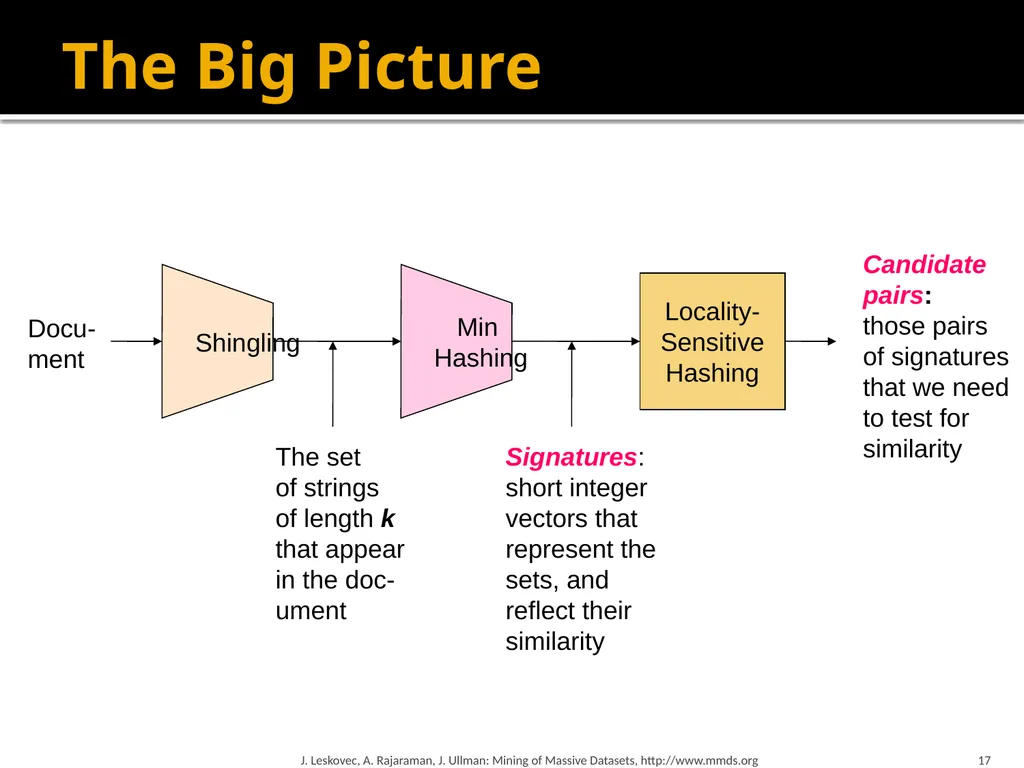
The Big Picture 17 Shingling Docu-
ment J. Leskovec, A. Rajaraman, J. Ullman: Mining of Massive Datasets, http://www.mmds.org<br>
ment J. Leskovec, A. Rajaraman, J. Ullman: Mining of Massive Datasets, http://www.mmds.org<br>
18
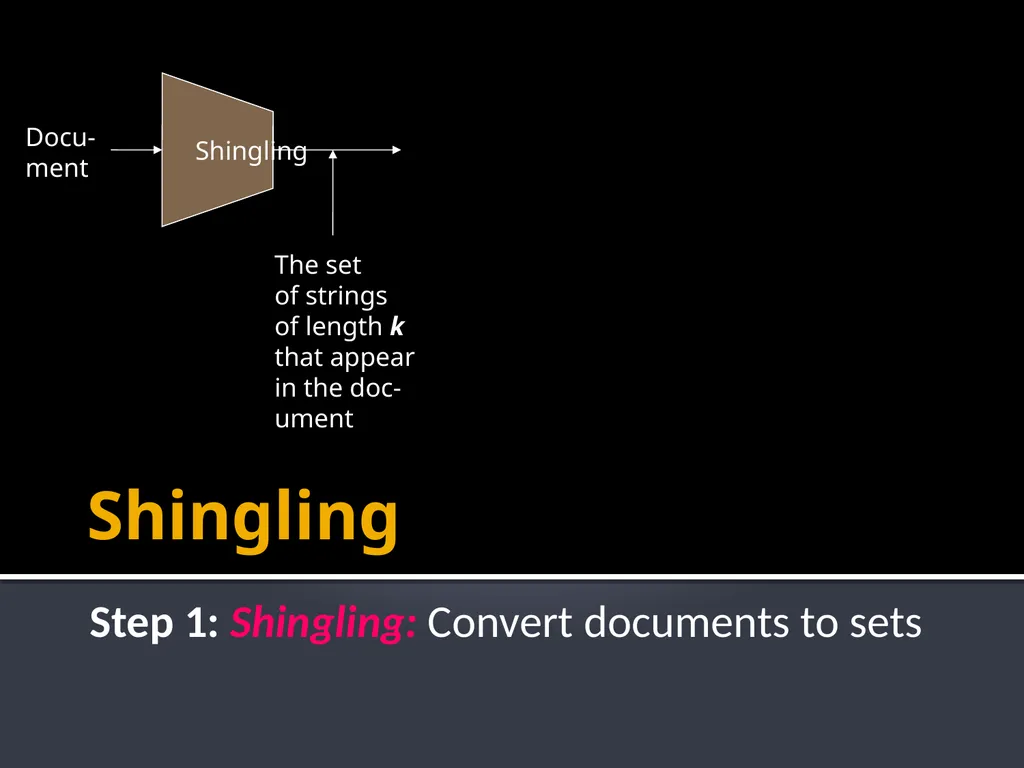
Shingling Step 1: Shingling: Convert documents to sets Shingling Docu-
ment<br>
ment<br>
19
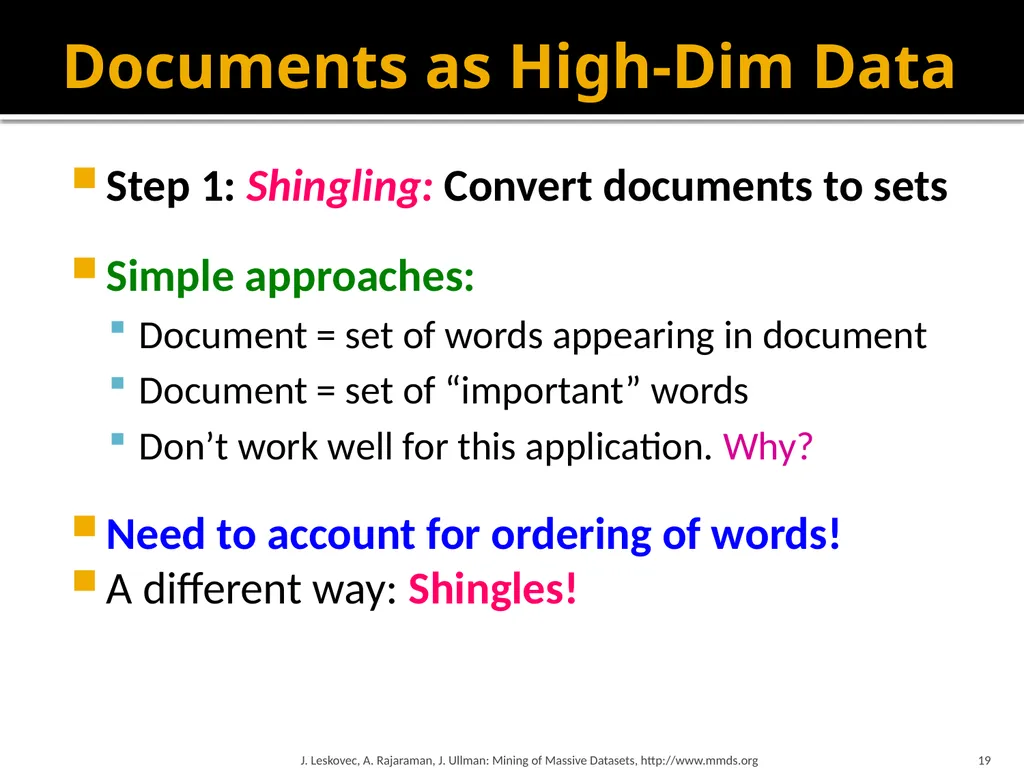
Documents as High-Dim Data Step 1: Shingling: Convert documents to sets
Simple approaches:
Document = set of words appearing in document
Document = set of “important” words
Don’t work well for this application. Why?
Need to account for ordering of words!
A different way: Shingles! J. Leskovec, A. Rajaraman, J. Ullman: Mining of Massive Datasets, http://www.mmds.org 19<br>
20
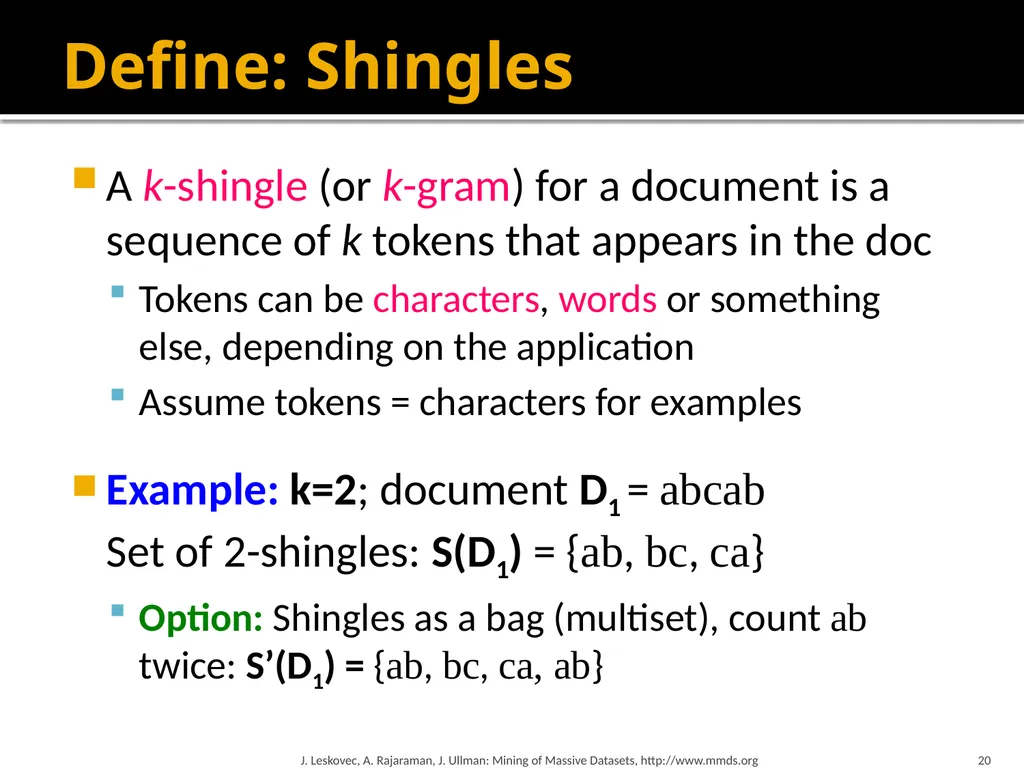
Define: Shingles A k-shingle (or k-gram) for a document is a sequence of k tokens that appears in the doc
Tokens can be characters, words or something else, depending on the application
Assume tokens = characters for examples
Example: k=2; document D1 = abcab Set of 2-shingles: S(D1) = {ab, bc, ca}
Option: Shingles as a bag (multiset), count ab twice: S’(D1) = {ab, bc, ca, ab} J. Leskovec, A. Rajaraman, J. Ullman: Mining of Massive Datasets, http://www.mmds.org 20<br>
21
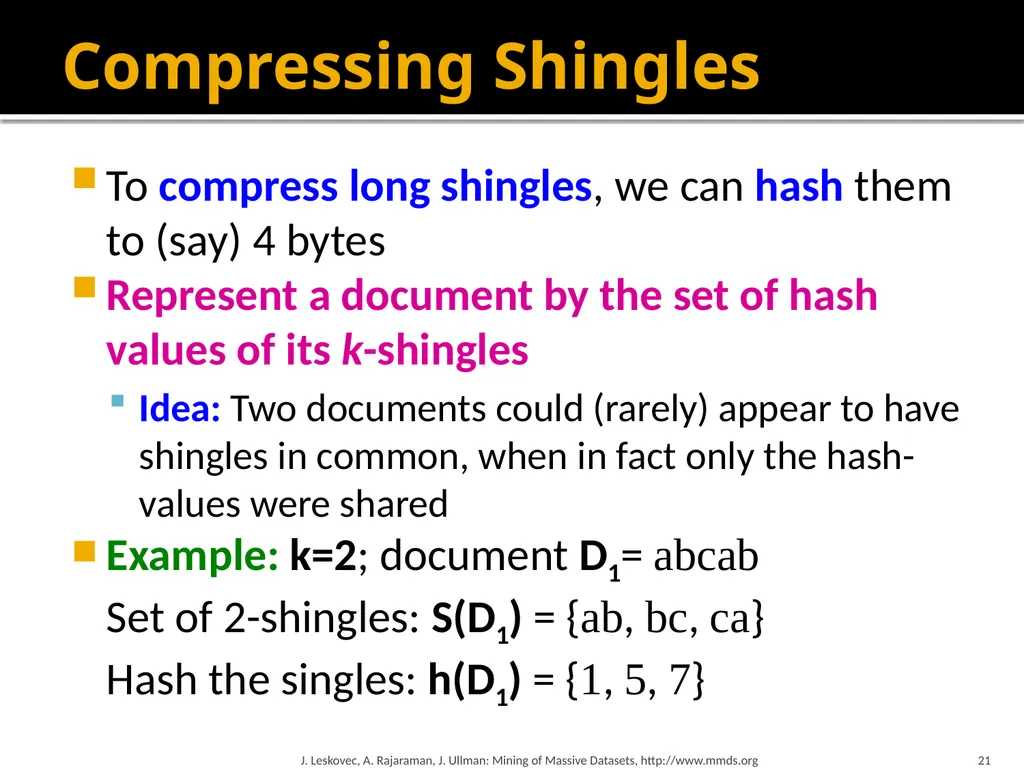
Compressing Shingles To compress long shingles, we can hash them to (say) 4 bytes
Represent a document by the set of hash values of its k-shingles
Idea: Two documents could (rarely) appear to have shingles in common, when in fact only the hash-values were shared
Example: k=2; document D1= abcab Set of 2-shingles: S(D1) = {ab, bc, ca} Hash the singles: h(D1) = {1, 5, 7} J. Leskovec, A. Rajaraman, J. Ullman: Mining of Massive Datasets, http://www.mmds.org 21<br>
22
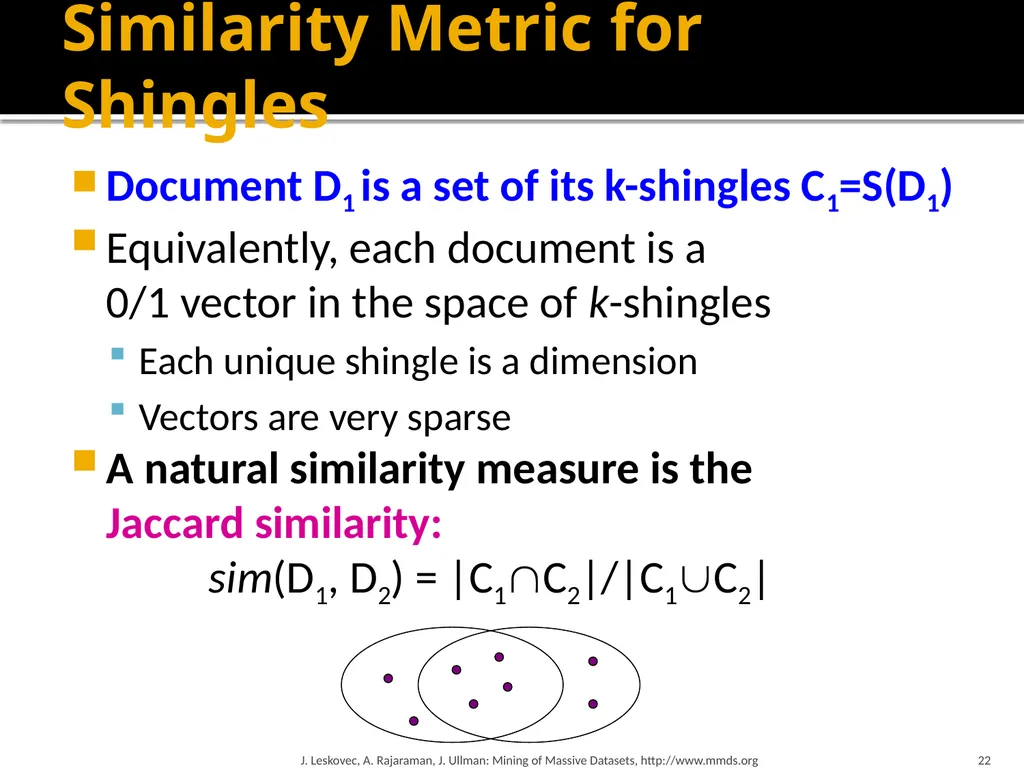
Similarity Metric for Shingles Document D1 is a set of its k-shingles C1=S(D1)
Equivalently, each document is a 0/1 vector in the space of k-shingles
Each unique shingle is a dimension
Vectors are very sparse
A natural similarity measure is the Jaccard similarity:
sim(D1, D2) = |C1C2|/|C1C2| J. Leskovec, A. Rajaraman, J. Ullman: Mining of Massive Datasets, http://www.mmds.org 22<br>
23
Working Assumption Documents that have lots of shingles in common have similar text, even if the text appears in different order
Caveat: You must pick k large enough, or most documents will have most shingles
k = 5 is OK for short documents
k = 10 is better for long documents J. Leskovec, A. Rajaraman, J. Ullman: Mining of Massive Datasets, http://www.mmds.org 23<br>
Caveat: You must pick k large enough, or most documents will have most shingles
k = 5 is OK for short documents
k = 10 is better for long documents J. Leskovec, A. Rajaraman, J. Ullman: Mining of Massive Datasets, http://www.mmds.org 23<br>
24
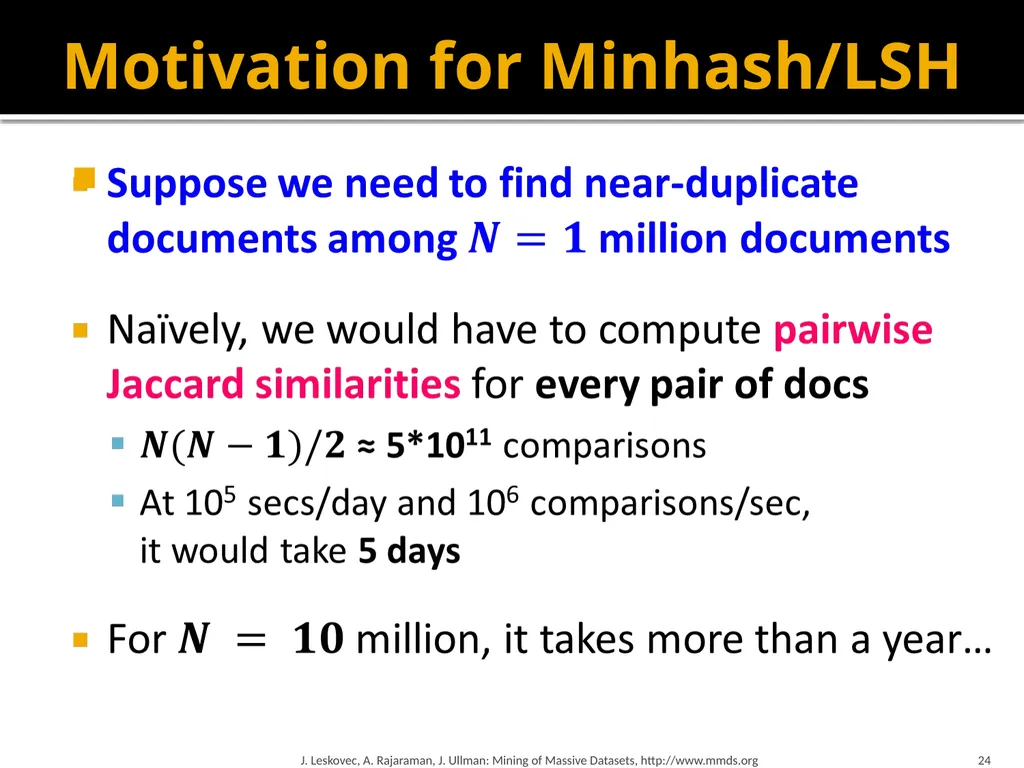
Motivation for Minhash/LSH J. Leskovec, A. Rajaraman, J. Ullman: Mining of Massive Datasets, http://www.mmds.org 24<br>
25
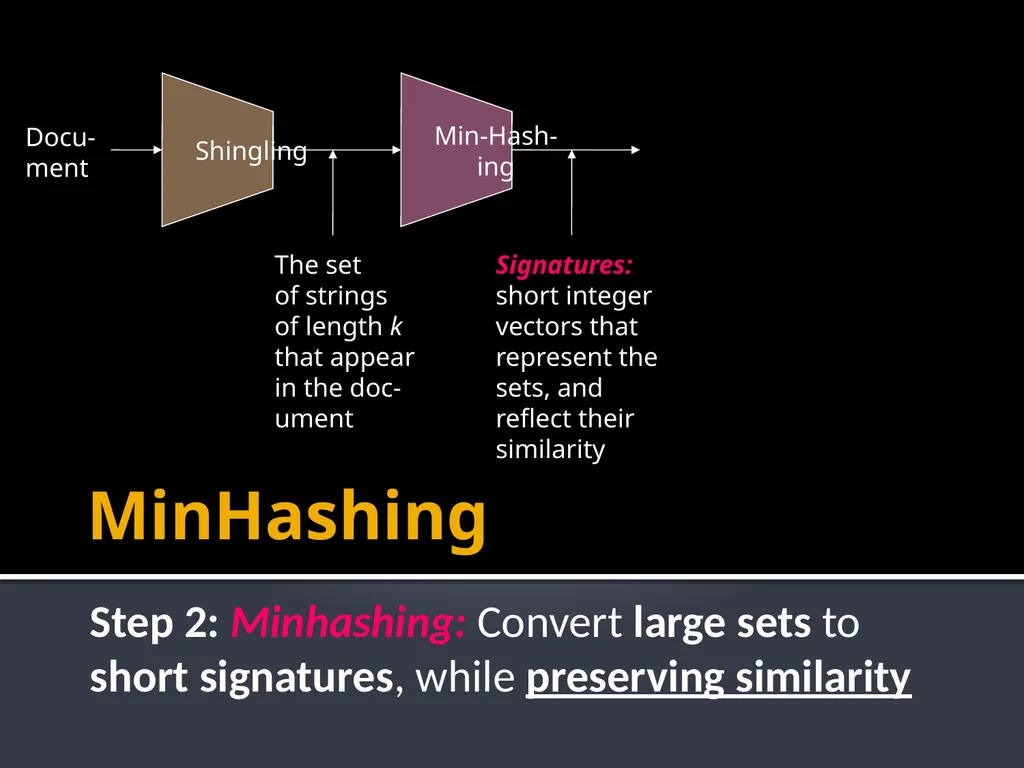
MinHashing Step 2: Minhashing: Convert large sets to short signatures, while preserving similarity Shingling Docu-
ment<br>
ment<br>
26
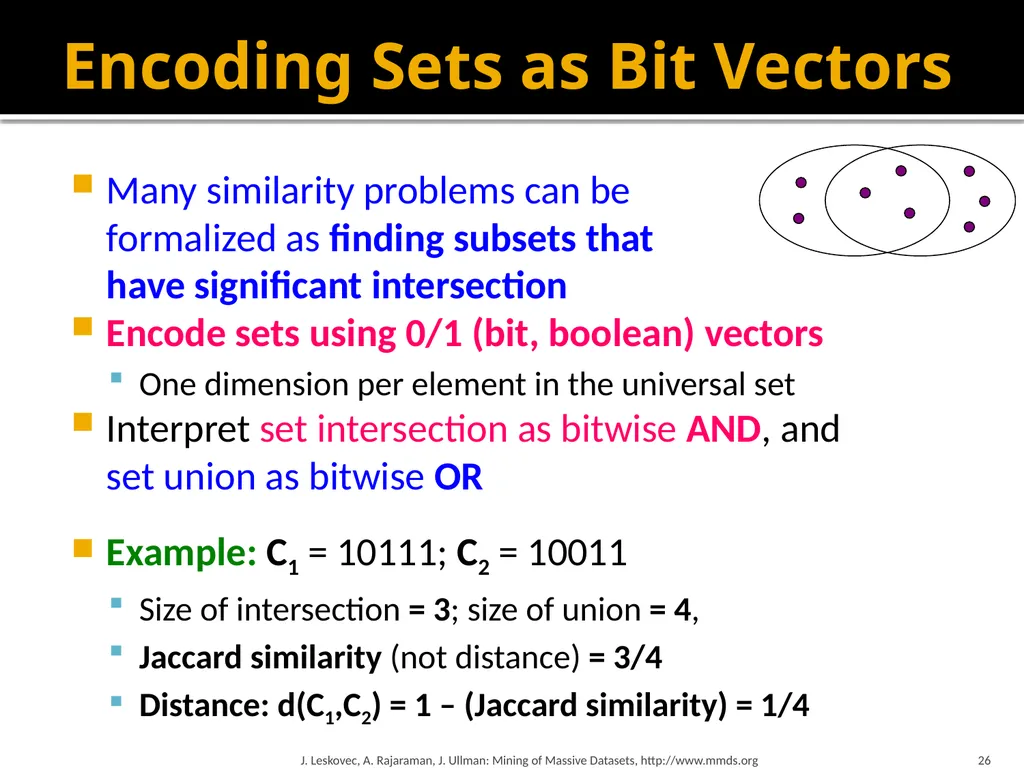
Encoding Sets as Bit Vectors Many similarity problems can be
formalized as finding subsets that
have significant intersection
Encode sets using 0/1 (bit, boolean) vectors
One dimension per element in the universal set
Interpret set intersection as bitwise AND, and set union as bitwise OR
Example: C1 = 10111; C2 = 10011
Size of intersection = 3; size of union = 4,
Jaccard similarity (not distance) = 3/4
Distance: d(C1,C2) = 1 – (Jaccard similarity) = 1/4 J. Leskovec, A. Rajaraman, J. Ullman: Mining of Massive Datasets, http://www.mmds.org 26<br>
27
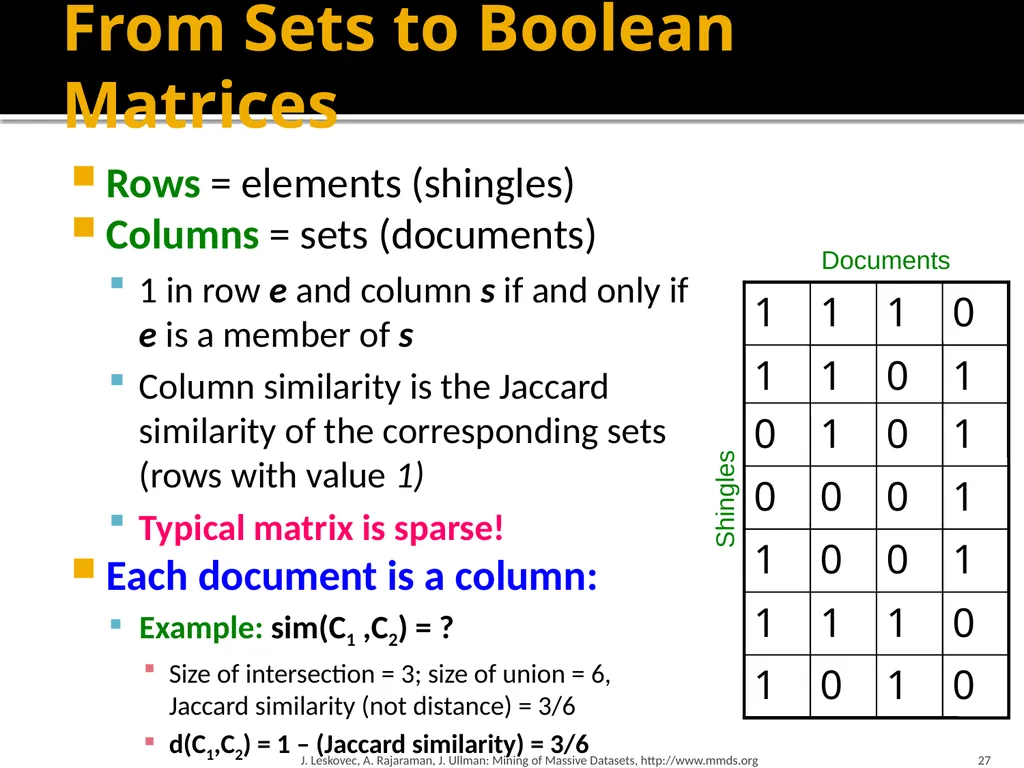
From Sets to Boolean Matrices Rows = elements (shingles)
Columns = sets (documents)
1 in row e and column s if and only if e is a member of s
Column similarity is the Jaccard similarity of the corresponding sets (rows with value 1)
Typical matrix is sparse!
Each document is a column:
Example: sim(C1 ,C2) = ?
Size of intersection = 3; size of union = 6, Jaccard similarity (not distance) = 3/6
d(C1,C2) = 1 – (Jaccard similarity) = 3/6 27 J. Leskovec, A. Rajaraman, J. Ullman: Mining of Massive Datasets, http://www.mmds.org Documents Shingles<br>
28
Outline: Finding Similar Columns So far:
Documents Sets of shingles
Represent sets as boolean vectors in a matrix
Next goal: Find similar columns while computing small signatures
Similarity of columns == similarity of signatures J. Leskovec, A. Rajaraman, J. Ullman: Mining of Massive Datasets, http://www.mmds.org 28<br>
Documents Sets of shingles
Represent sets as boolean vectors in a matrix
Next goal: Find similar columns while computing small signatures
Similarity of columns == similarity of signatures J. Leskovec, A. Rajaraman, J. Ullman: Mining of Massive Datasets, http://www.mmds.org 28<br>
29
Outline: Finding Similar Columns Next Goal: Find similar columns, Small signatures
Naïve approach:
1) Signatures of columns: small summaries of columns
2) Examine pairs of signatures to find similar columns
Essential: Similarities of signatures and columns are related
3) Optional: Check that columns with similar signatures are really similar
Warnings:
Comparing all pairs may take too much time: Job for LSH
These methods can produce false negatives, and even false positives (if the optional check is not made) J. Leskovec, A. Rajaraman, J. Ullman: Mining of Massive Datasets, http://www.mmds.org 29<br>
30
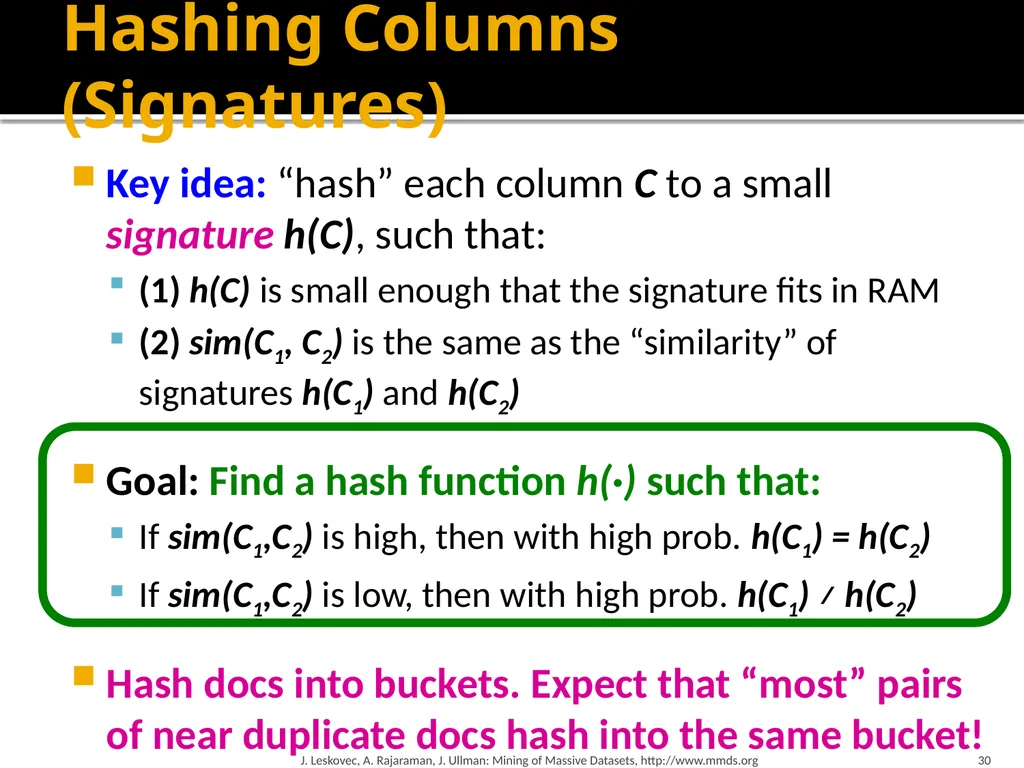
Hashing Columns (Signatures) Key idea: “hash” each column C to a small signature h(C), such that:
(1) h(C) is small enough that the signature fits in RAM
(2) sim(C1, C2) is the same as the “similarity” of signatures h(C1) and h(C2)
Goal: Find a hash function h(·) such that:
If sim(C1,C2) is high, then with high prob. h(C1) = h(C2)
If sim(C1,C2) is low, then with high prob. h(C1) ≠ h(C2)
Hash docs into buckets. Expect that “most” pairs of near duplicate docs hash into the same bucket! J. Leskovec, A. Rajaraman, J. Ullman: Mining of Massive Datasets, http://www.mmds.org 30<br>
31
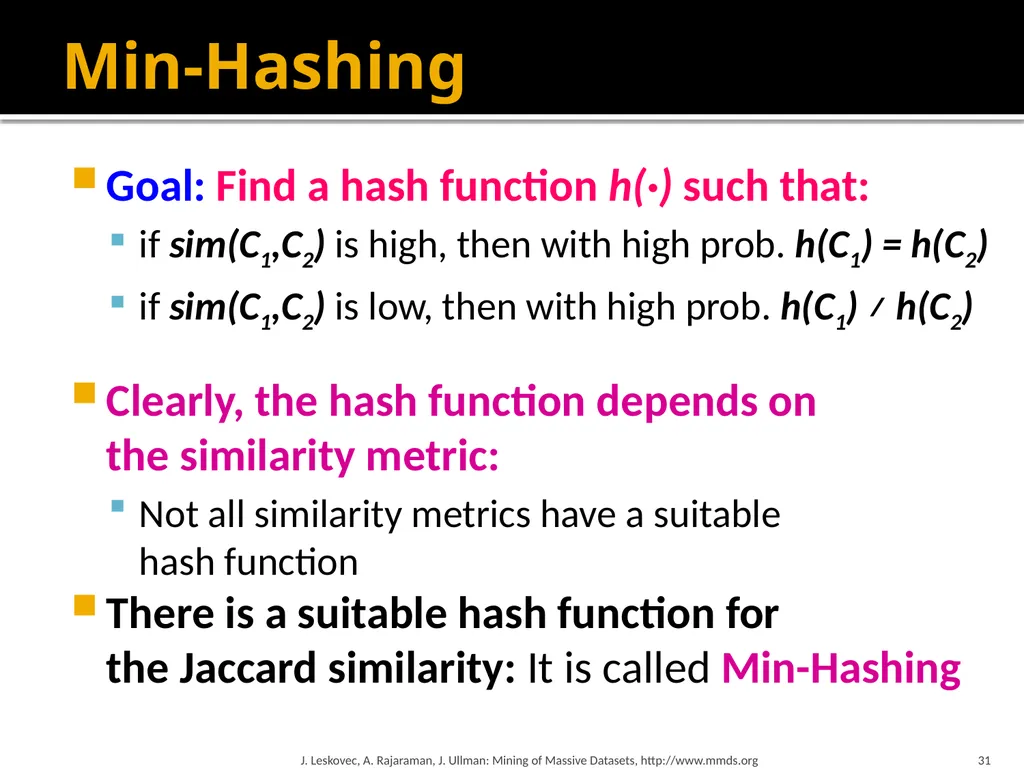
Min-Hashing Goal: Find a hash function h(·) such that:
if sim(C1,C2) is high, then with high prob. h(C1) = h(C2)
if sim(C1,C2) is low, then with high prob. h(C1) ≠ h(C2)
Clearly, the hash function depends on the similarity metric:
Not all similarity metrics have a suitable hash function
There is a suitable hash function for the Jaccard similarity: It is called Min-Hashing J. Leskovec, A. Rajaraman, J. Ullman: Mining of Massive Datasets, http://www.mmds.org 31<br>
32
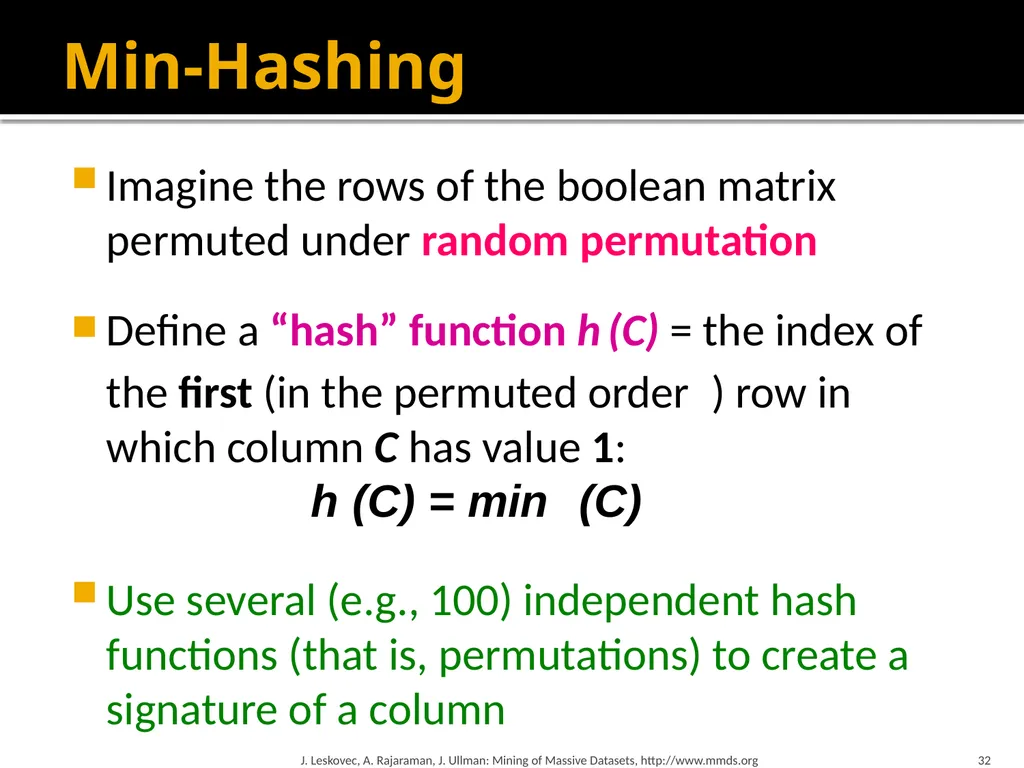
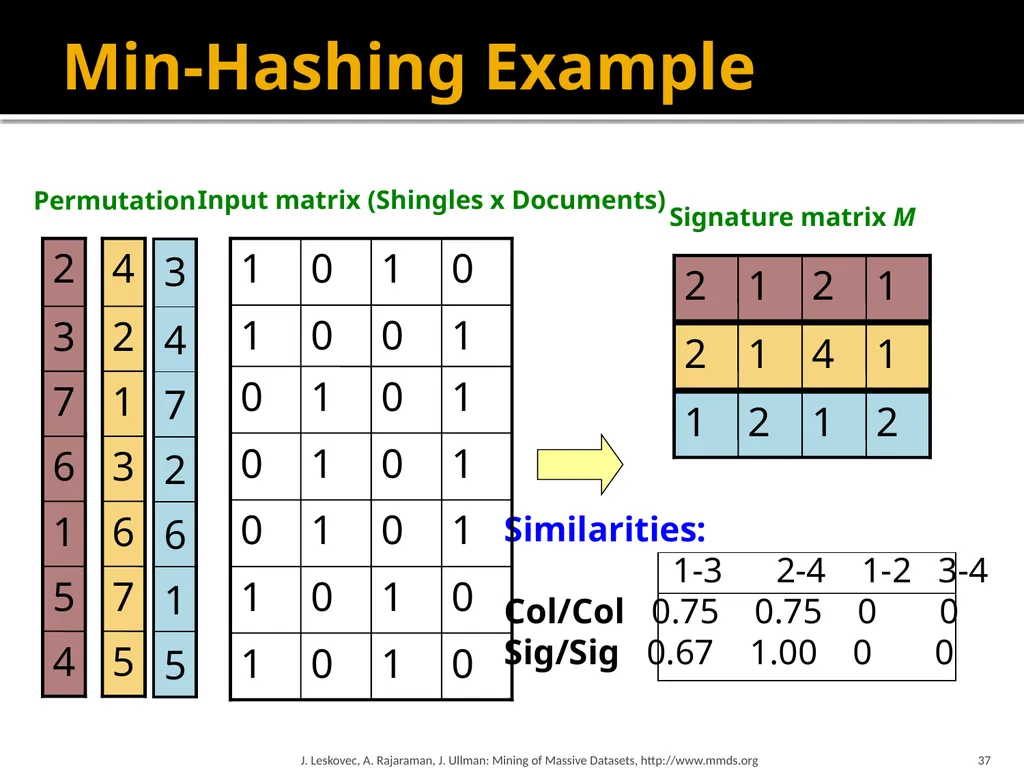
32 Min-Hashing Imagine the rows of the boolean matrix permuted under random permutation
Define a “hash” function h(C) = the index of the first (in the permuted order ) row in which column C has value 1:
h (C) = min (C)
Use several (e.g., 100) independent hash functions (that is, permutations) to create a signature of a column J. Leskovec, A. Rajaraman, J. Ullman: Mining of Massive Datasets, http://www.mmds.org<br>
33
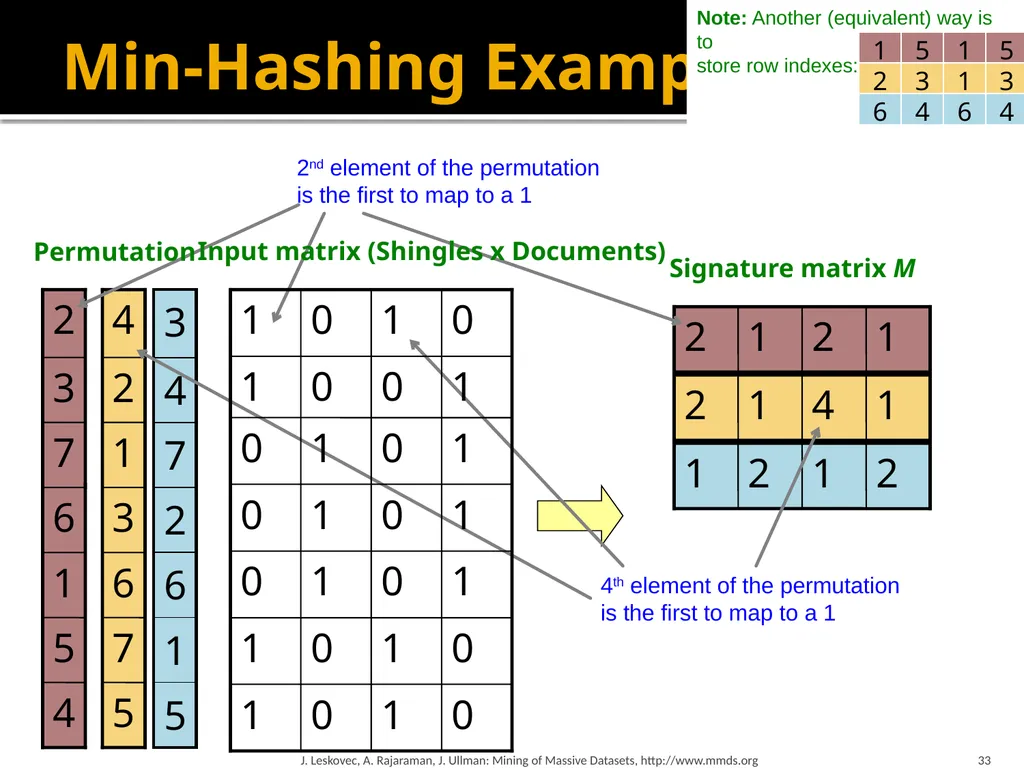
33 Min-Hashing Example J. Leskovec, A. Rajaraman, J. Ullman: Mining of Massive Datasets, http://www.mmds.org Permutation Note: Another (equivalent) way is to
store row indexes:<br>
34
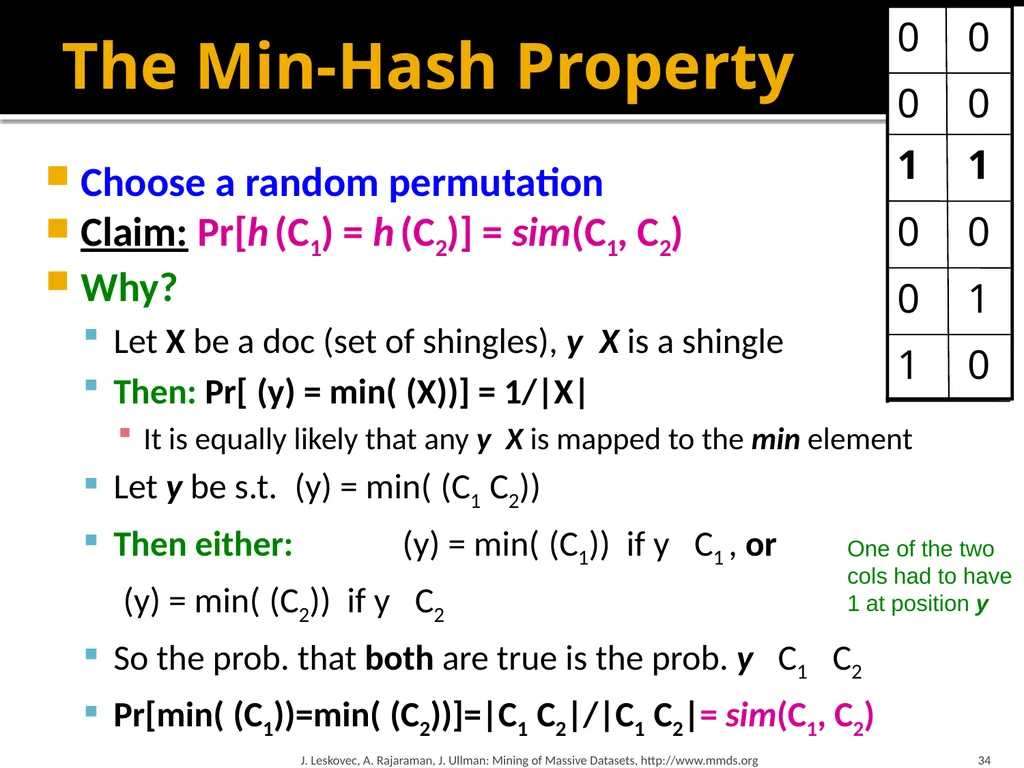
The Min-Hash Property Choose a random permutation
Claim: Pr[h(C1) = h(C2)] = sim(C1, C2)
Why?
Let X be a doc (set of shingles), y X is a shingle
Then: Pr[(y) = min((X))] = 1/|X|
It is equally likely that any y X is mapped to the min element
Let y be s.t. (y) = min((C1C2))
Then either: (y) = min((C1)) if y C1 , or
(y) = min((C2)) if y C2
So the prob. that both are true is the prob. y C1 C2
Pr[min((C1))=min((C2))]=|C1C2|/|C1C2|= sim(C1, C2) J. Leskovec, A. Rajaraman, J. Ullman: Mining of Massive Datasets, http://www.mmds.org 34 One of the two cols had to have 1 at position y<br>
35
Four Types of Rows Given cols C1 and C2, rows may be classified as:
C1 C2
A 1 1
B 1 0
C 0 1
D 0 0
a = # rows of type A, etc.
Note: sim(C1, C2) = a/(a +b +c)
Then: Pr[h(C1) = h(C2)] = Sim(C1, C2)
Look down the cols C1 and C2 until we see a 1
If it’s a type-A row, then h(C1) = h(C2) If a type-B or type-C row, then not 35 J. Leskovec, A. Rajaraman, J. Ullman: Mining of Massive Datasets, http://www.mmds.org<br>
36
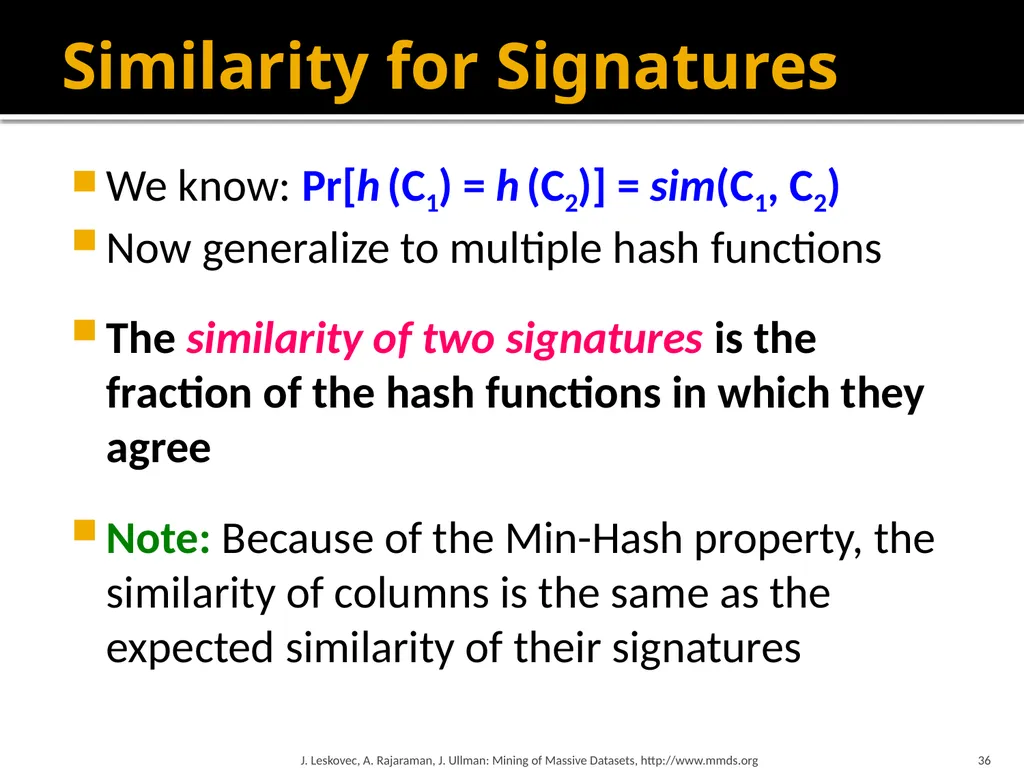
36 Similarity for Signatures We know: Pr[h(C1) = h(C2)] = sim(C1, C2)
Now generalize to multiple hash functions
The similarity of two signatures is the fraction of the hash functions in which they agree
Note: Because of the Min-Hash property, the similarity of columns is the same as the expected similarity of their signatures J. Leskovec, A. Rajaraman, J. Ullman: Mining of Massive Datasets, http://www.mmds.org<br>
37
37 Min-Hashing Example J. Leskovec, A. Rajaraman, J. Ullman: Mining of Massive Datasets, http://www.mmds.org Similarities:
1-3 2-4 1-2 3-4
Col/Col 0.75 0.75 0 0
Sig/Sig 0.67 1.00 0 0 Permutation <br>
1-3 2-4 1-2 3-4
Col/Col 0.75 0.75 0 0
Sig/Sig 0.67 1.00 0 0 Permutation <br>
38
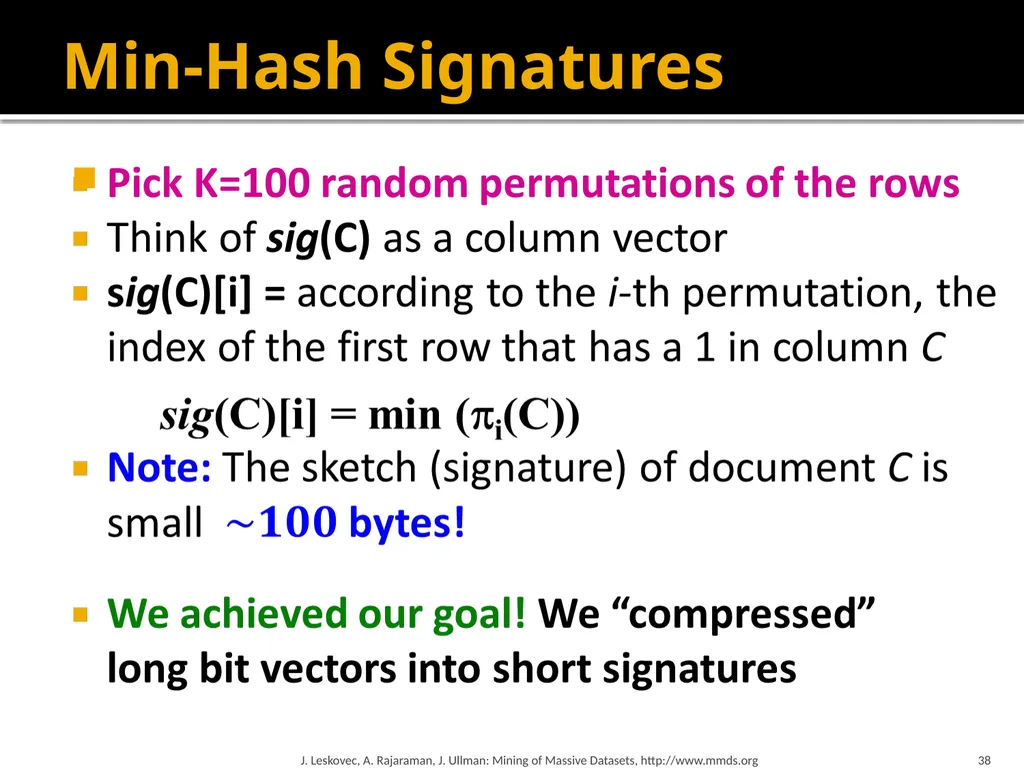
Min-Hash Signatures J. Leskovec, A. Rajaraman, J. Ullman: Mining of Massive Datasets, http://www.mmds.org 38<br>
39
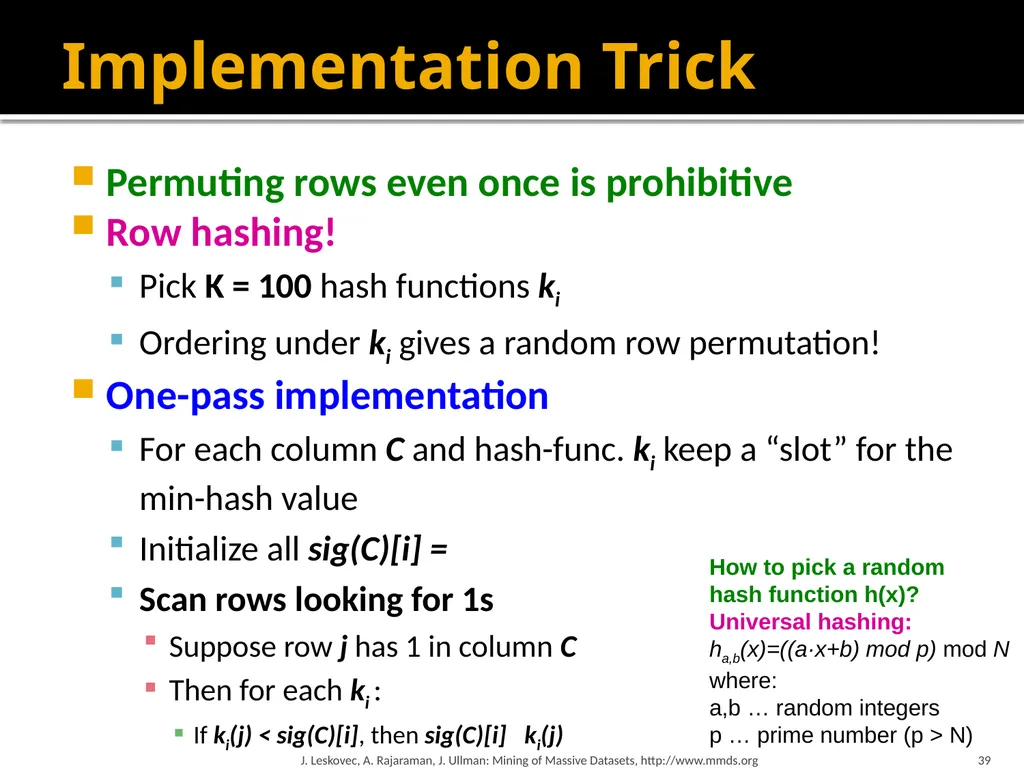
Implementation Trick Permuting rows even once is prohibitive
Row hashing!
Pick K = 100 hash functions ki
Ordering under ki gives a random row permutation!
One-pass implementation
For each column C and hash-func. ki keep a “slot” for the min-hash value
Initialize all sig(C)[i] =
Scan rows looking for 1s
Suppose row j has 1 in column C
Then for each ki :
If ki(j) < sig(C)[i], then sig(C)[i] ki(j) J. Leskovec, A. Rajaraman, J. Ullman: Mining of Massive Datasets, http://www.mmds.org 39 How to pick a random hash function h(x)?
Universal hashing:
ha,b(x)=((a·x+b) mod p) mod N
where:
a,b … random integers
p … prime number (p > N)<br>
40
Locality Sensitive Hashing Step 3: Locality-Sensitive Hashing:
Focus on pairs of signatures likely to be from similar documents Shingling Docu-
ment<br>
ment<br>
41
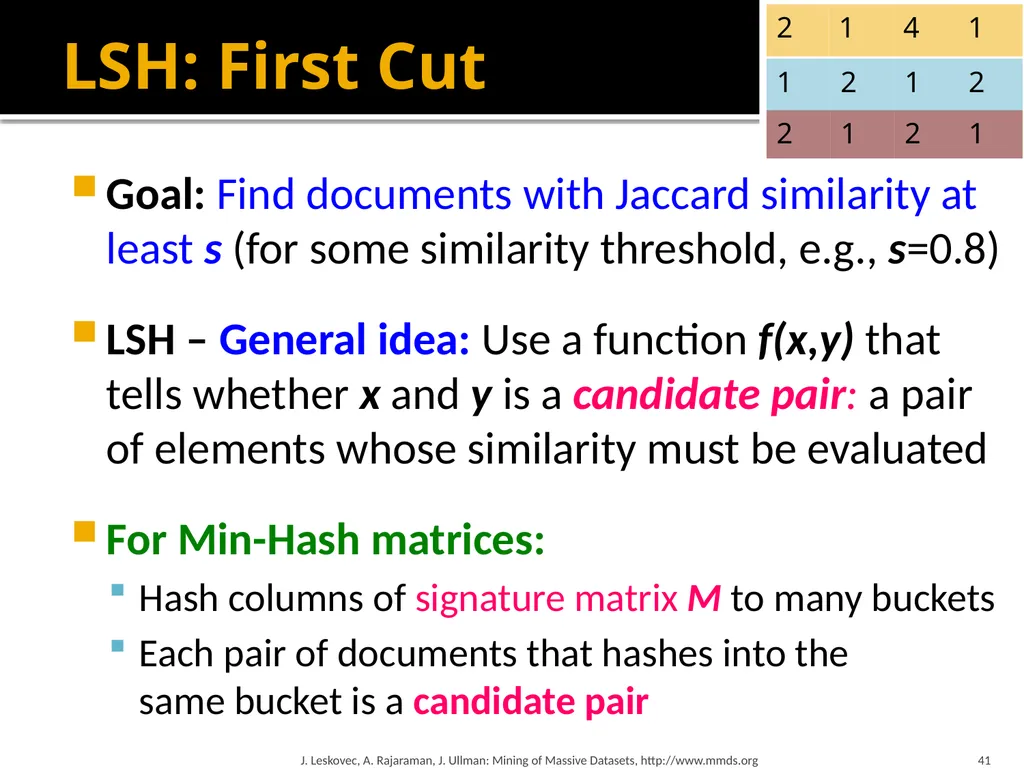
LSH: First Cut Goal: Find documents with Jaccard similarity at least s (for some similarity threshold, e.g., s=0.8)
LSH – General idea: Use a function f(x,y) that tells whether x and y is a candidate pair: a pair of elements whose similarity must be evaluated
For Min-Hash matrices:
Hash columns of signature matrix M to many buckets
Each pair of documents that hashes into the same bucket is a candidate pair 41 J. Leskovec, A. Rajaraman, J. Ullman: Mining of Massive Datasets, http://www.mmds.org<br>
42
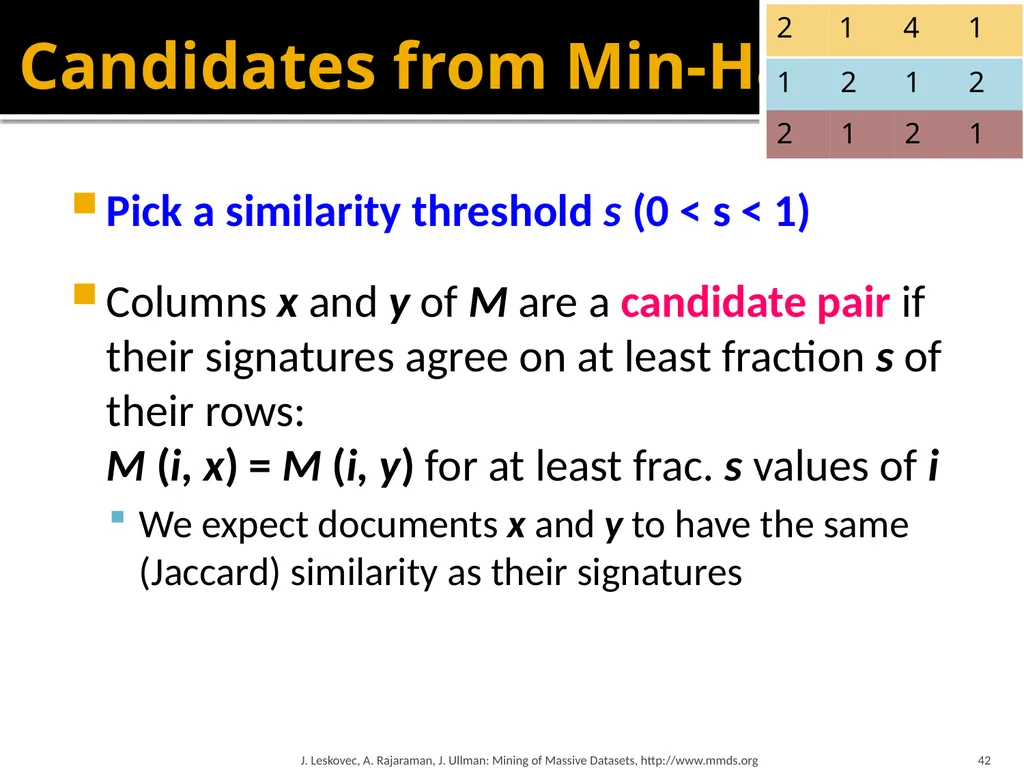
Candidates from Min-Hash Pick a similarity threshold s (0 < s < 1)
Columns x and y of M are a candidate pair if their signatures agree on at least fraction s of their rows: M (i, x) = M (i, y) for at least frac. s values of i
We expect documents x and y to have the same (Jaccard) similarity as their signatures J. Leskovec, A. Rajaraman, J. Ullman: Mining of Massive Datasets, http://www.mmds.org 42<br>
43
LSH for Min-Hash Big idea: Hash columns of
signature matrix M several times
Arrange that (only) similar columns are likely to hash to the same bucket, with high probability
Candidate pairs are those that hash to the same bucket J. Leskovec, A. Rajaraman, J. Ullman: Mining of Massive Datasets, http://www.mmds.org 43<br>
Arrange that (only) similar columns are likely to hash to the same bucket, with high probability
Candidate pairs are those that hash to the same bucket J. Leskovec, A. Rajaraman, J. Ullman: Mining of Massive Datasets, http://www.mmds.org 43<br>
44
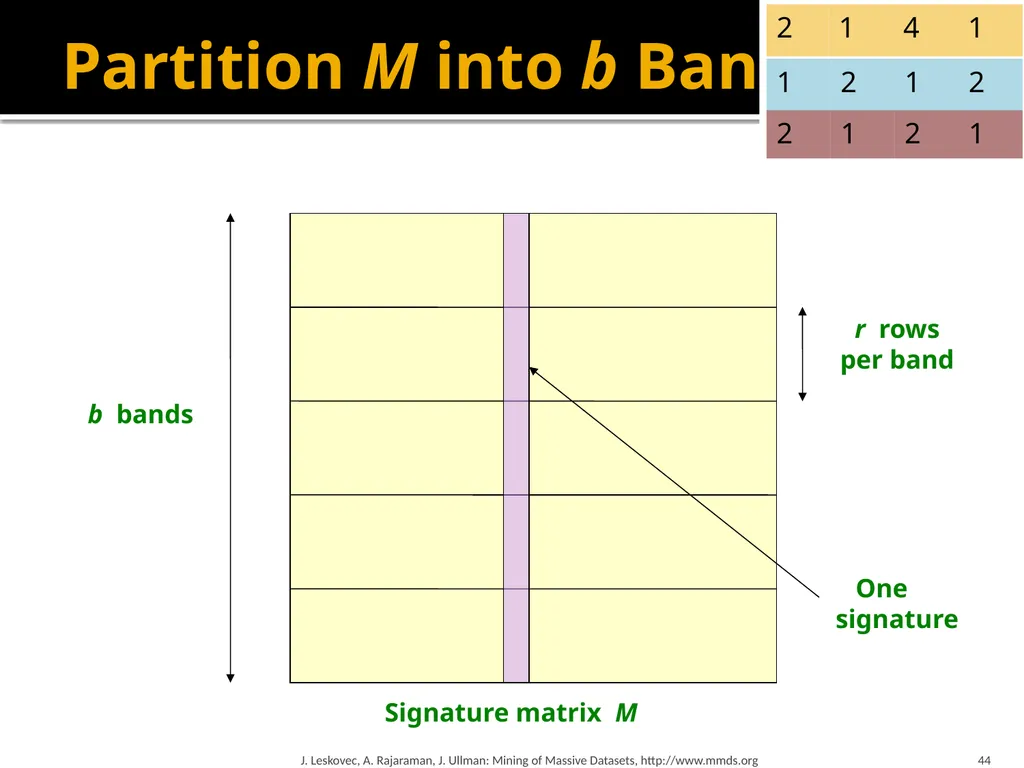
Partition M into b Bands J. Leskovec, A. Rajaraman, J. Ullman: Mining of Massive Datasets, http://www.mmds.org 44 Signature matrix M r rows
per band b bands One
signature<br>
per band b bands One
signature<br>
45
Partition M into Bands Divide matrix M into b bands of r rows
For each band, hash its portion of each column to a hash table with k buckets
Make k as large as possible
Candidate column pairs are those that hash to the same bucket for ≥ 1 band
Tune b and r to catch most similar pairs, but few non-similar pairs 45 J. Leskovec, A. Rajaraman, J. Ullman: Mining of Massive Datasets, http://www.mmds.org<br>
46
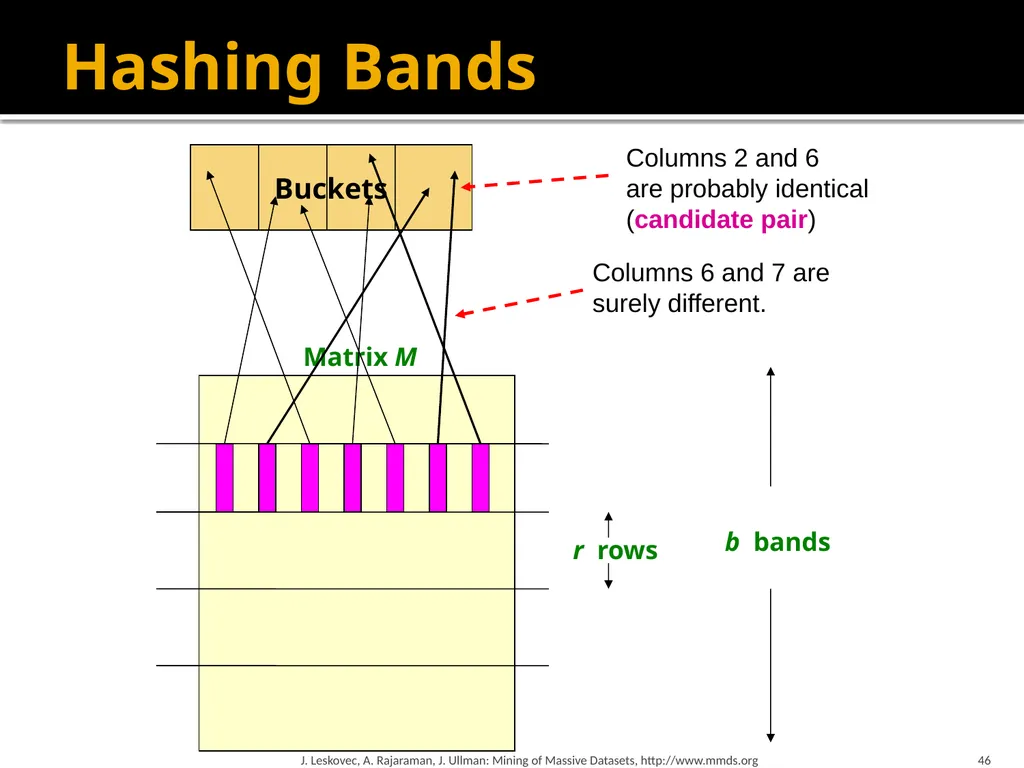
Matrix M r rows b bands Buckets Hashing Bands J. Leskovec, A. Rajaraman, J. Ullman: Mining of Massive Datasets, http://www.mmds.org 46<br>
47
Simplifying Assumption There are enough buckets that columns are unlikely to hash to the same bucket unless they are identical in a particular band
Hereafter, we assume that “same bucket” means “identical in that band”
Assumption needed only to simplify analysis, not for correctness of algorithm 47 J. Leskovec, A. Rajaraman, J. Ullman: Mining of Massive Datasets, http://www.mmds.org<br>
Hereafter, we assume that “same bucket” means “identical in that band”
Assumption needed only to simplify analysis, not for correctness of algorithm 47 J. Leskovec, A. Rajaraman, J. Ullman: Mining of Massive Datasets, http://www.mmds.org<br>
48
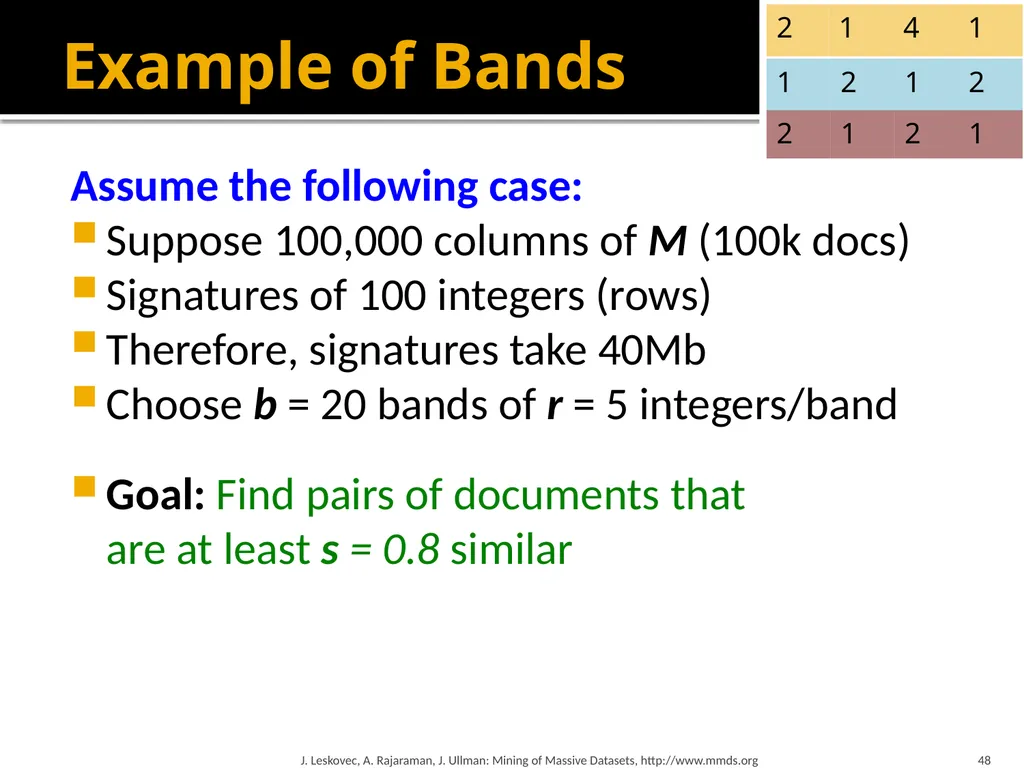
Example of Bands Assume the following case:
Suppose 100,000 columns of M (100k docs)
Signatures of 100 integers (rows)
Therefore, signatures take 40Mb
Choose b = 20 bands of r = 5 integers/band
Goal: Find pairs of documents that are at least s = 0.8 similar J. Leskovec, A. Rajaraman, J. Ullman: Mining of Massive Datasets, http://www.mmds.org 48<br>
49
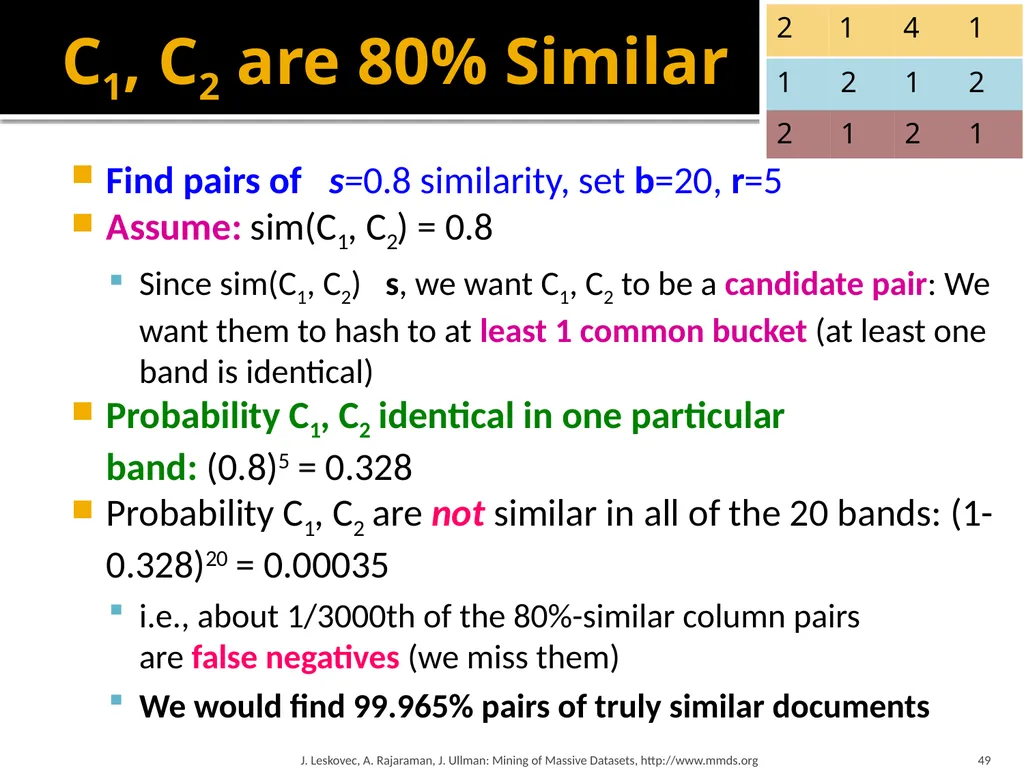
C1, C2 are 80% Similar Find pairs of s=0.8 similarity, set b=20, r=5
Assume: sim(C1, C2) = 0.8
Since sim(C1, C2) s, we want C1, C2 to be a candidate pair: We want them to hash to at least 1 common bucket (at least one band is identical)
Probability C1, C2 identical in one particular band: (0.8)5 = 0.328
Probability C1, C2 are not similar in all of the 20 bands: (1-0.328)20 = 0.00035
i.e., about 1/3000th of the 80%-similar column pairs are false negatives (we miss them)
We would find 99.965% pairs of truly similar documents 49 J. Leskovec, A. Rajaraman, J. Ullman: Mining of Massive Datasets, http://www.mmds.org<br>
50
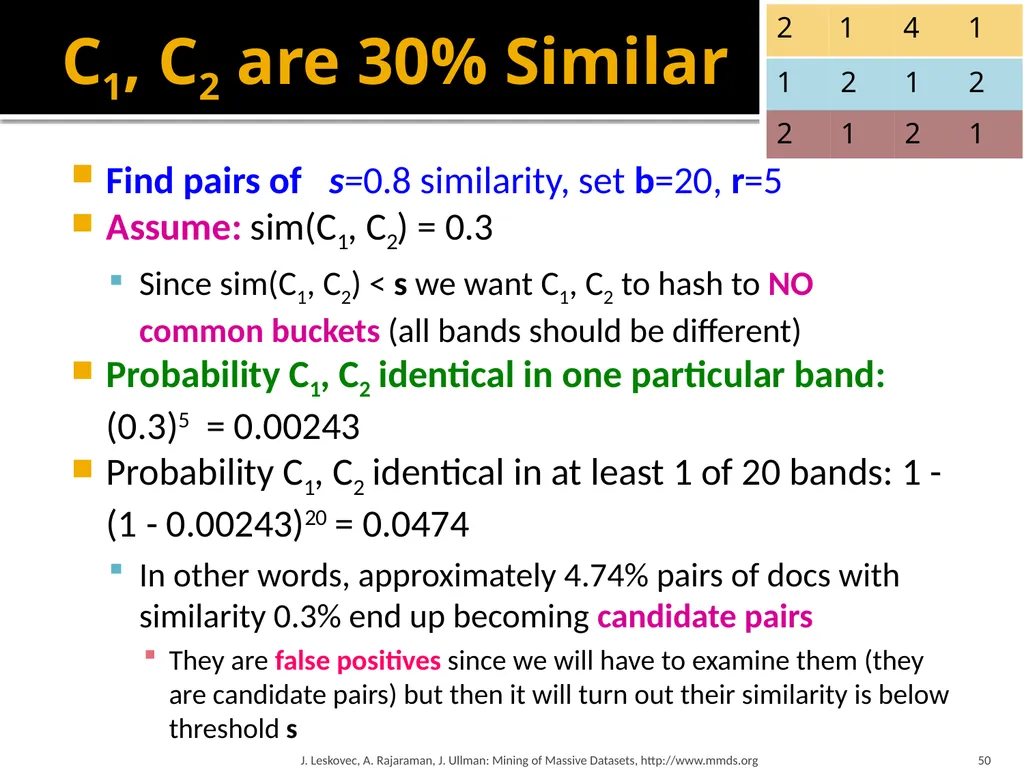
C1, C2 are 30% Similar Find pairs of s=0.8 similarity, set b=20, r=5
Assume: sim(C1, C2) = 0.3
Since sim(C1, C2) < s we want C1, C2 to hash to NO common buckets (all bands should be different)
Probability C1, C2 identical in one particular band: (0.3)5 = 0.00243
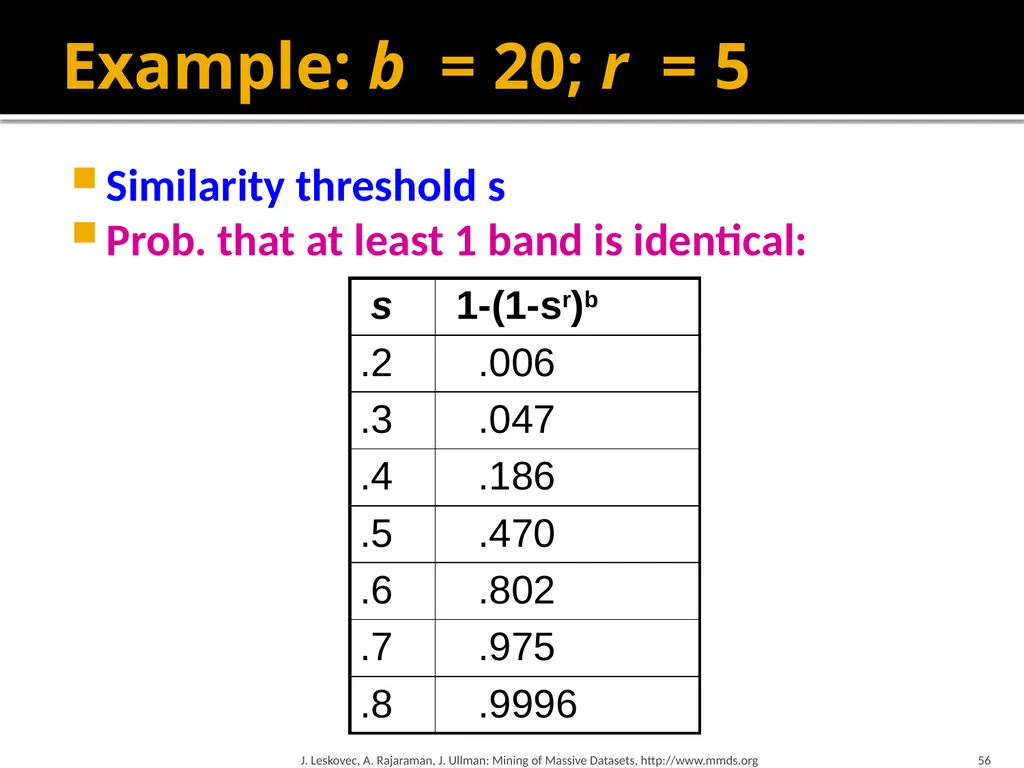
Probability C1, C2 identical in at least 1 of 20 bands: 1 - (1 - 0.00243)20 = 0.0474
In other words, approximately 4.74% pairs of docs with similarity 0.3% end up becoming candidate pairs
They are false positives since we will have to examine them (they are candidate pairs) but then it will turn out their similarity is below threshold s J. Leskovec, A. Rajaraman, J. Ullman: Mining of Massive Datasets, http://www.mmds.org 50<br>
51
LSH Involves a Tradeoff Pick:
The number of Min-Hashes (rows of M)
The number of bands b, and
The number of rows r per band
to balance false positives/negatives
Example: If we had only 15 bands of 5 rows, the number of false positives would go down, but the number of false negatives would go up 51 J. Leskovec, A. Rajaraman, J. Ullman: Mining of Massive Datasets, http://www.mmds.org<br>
52
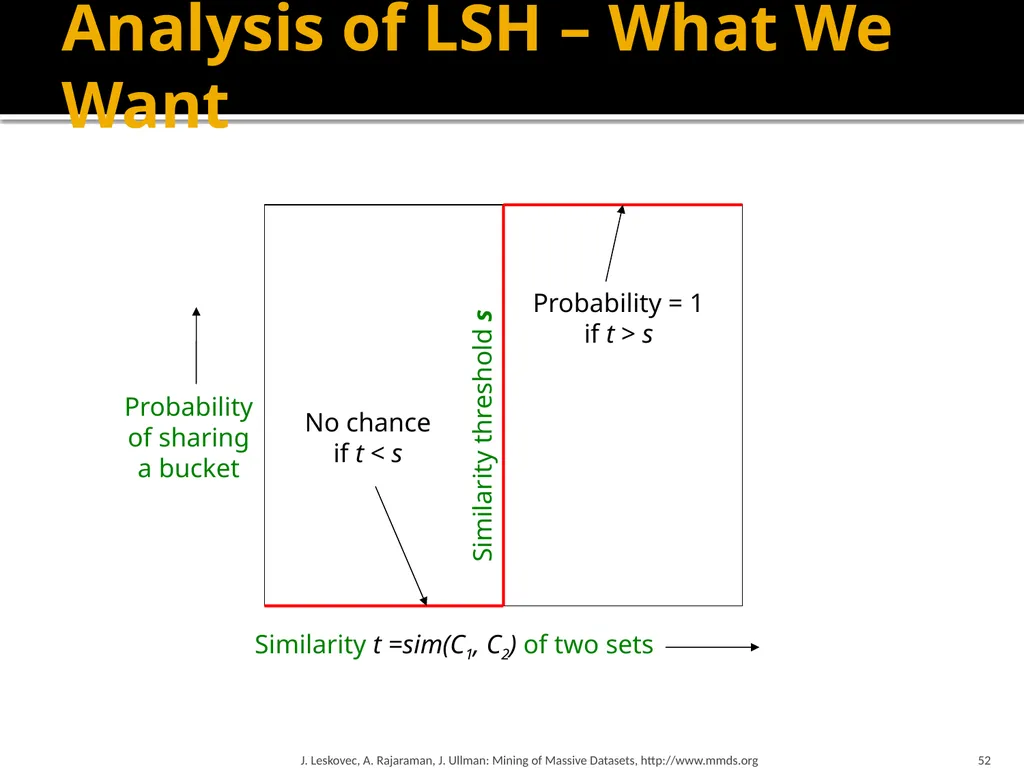
Analysis of LSH – What We Want Similarity t =sim(C1, C2) of two sets Probability
of sharing
a bucket Similarity threshold s 52 J. Leskovec, A. Rajaraman, J. Ullman: Mining of Massive Datasets, http://www.mmds.org<br>
of sharing
a bucket Similarity threshold s 52 J. Leskovec, A. Rajaraman, J. Ullman: Mining of Massive Datasets, http://www.mmds.org<br>
53
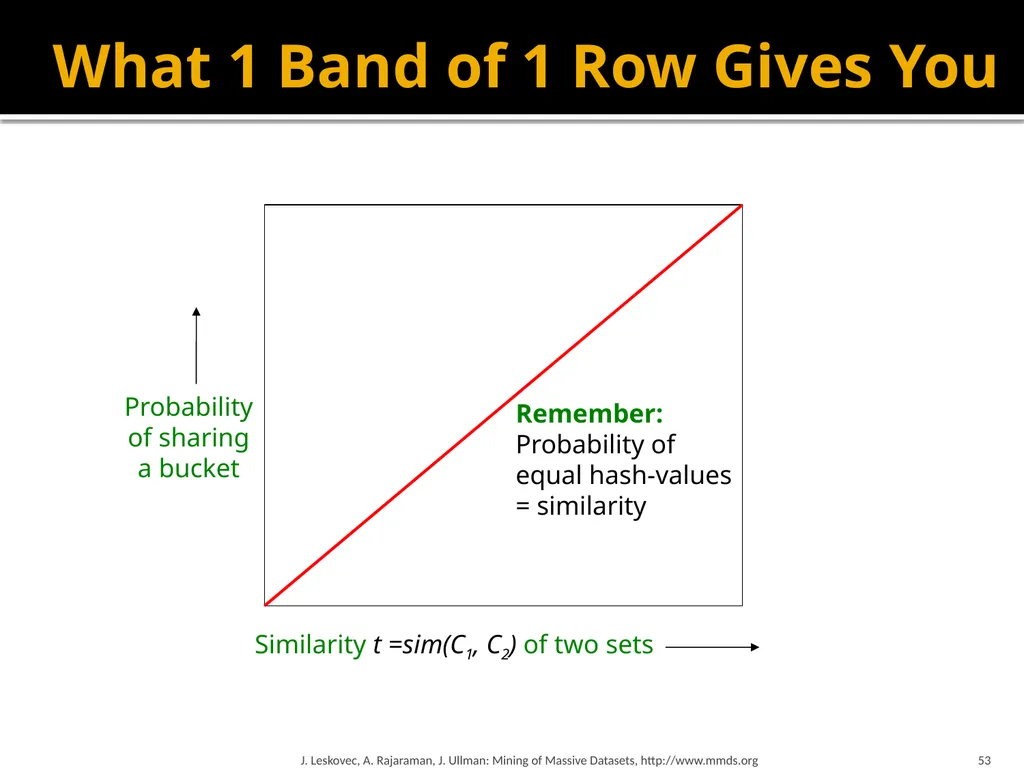
What 1 Band of 1 Row Gives You J. Leskovec, A. Rajaraman, J. Ullman: Mining of Massive Datasets, http://www.mmds.org 53 Remember:
Probability of
equal hash-values
= similarity Similarity t =sim(C1, C2) of two sets Probability
of sharing
a bucket<br>
Probability of
equal hash-values
= similarity Similarity t =sim(C1, C2) of two sets Probability
of sharing
a bucket<br>
54
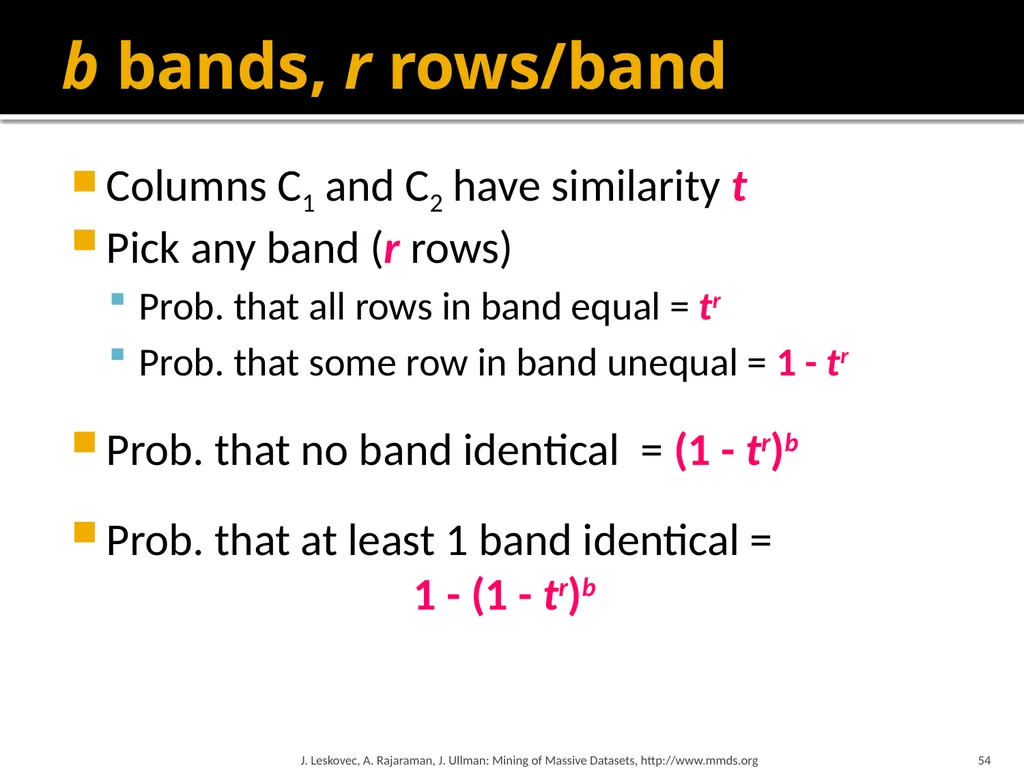
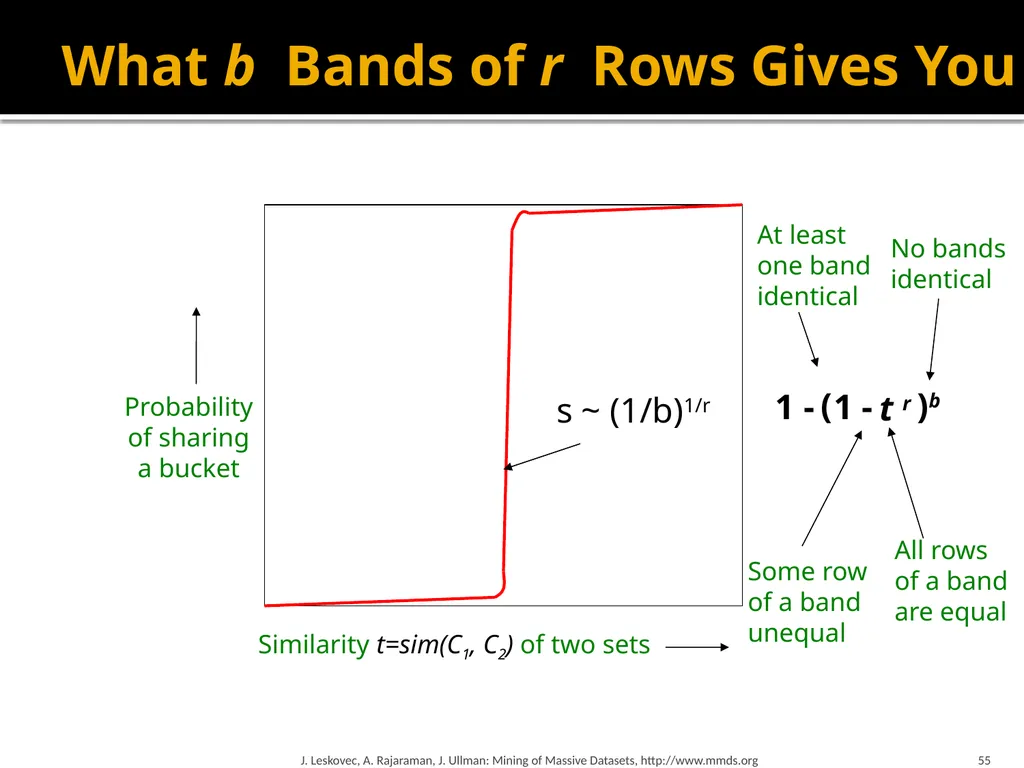
b bands, r rows/band Columns C1 and C2 have similarity t
Pick any band (r rows)
Prob. that all rows in band equal = tr
Prob. that some row in band unequal = 1 - tr
Prob. that no band identical = (1 - tr)b
Prob. that at least 1 band identical = 1 - (1 - tr)b 54 J. Leskovec, A. Rajaraman, J. Ullman: Mining of Massive Datasets, http://www.mmds.org<br>
Pick any band (r rows)
Prob. that all rows in band equal = tr
Prob. that some row in band unequal = 1 - tr
Prob. that no band identical = (1 - tr)b
Prob. that at least 1 band identical = 1 - (1 - tr)b 54 J. Leskovec, A. Rajaraman, J. Ullman: Mining of Massive Datasets, http://www.mmds.org<br>
55
What b Bands of r Rows Gives You 55 J. Leskovec, A. Rajaraman, J. Ullman: Mining of Massive Datasets, http://www.mmds.org Similarity t=sim(C1, C2) of two sets Probability
of sharing
a bucket<br>
of sharing
a bucket<br>
56
Example: b = 20; r = 5 Similarity threshold s
Prob. that at least 1 band is identical: J. Leskovec, A. Rajaraman, J. Ullman: Mining of Massive Datasets, http://www.mmds.org 56<br>
Prob. that at least 1 band is identical: J. Leskovec, A. Rajaraman, J. Ullman: Mining of Massive Datasets, http://www.mmds.org 56<br>
57
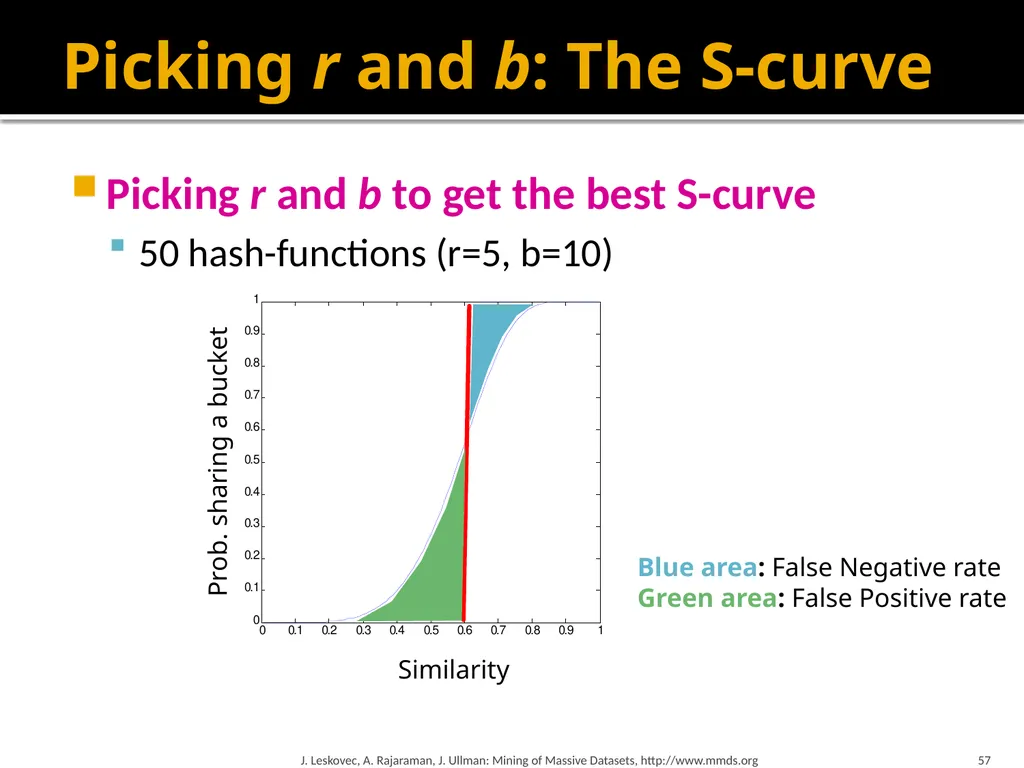
Picking r and b: The S-curve Picking r and b to get the best S-curve
50 hash-functions (r=5, b=10) J. Leskovec, A. Rajaraman, J. Ullman: Mining of Massive Datasets, http://www.mmds.org 57 Blue area: False Negative rate
Green area: False Positive rate Similarity Prob. sharing a bucket<br>
50 hash-functions (r=5, b=10) J. Leskovec, A. Rajaraman, J. Ullman: Mining of Massive Datasets, http://www.mmds.org 57 Blue area: False Negative rate
Green area: False Positive rate Similarity Prob. sharing a bucket<br>
58
LSH Summary Tune M, b, r to get almost all pairs with similar signatures, but eliminate most pairs that do not have similar signatures
Check in main memory that candidate pairs really do have similar signatures
Optional: In another pass through data, check that the remaining candidate pairs really represent similar documents 58 J. Leskovec, A. Rajaraman, J. Ullman: Mining of Massive Datasets, http://www.mmds.org<br>
Check in main memory that candidate pairs really do have similar signatures
Optional: In another pass through data, check that the remaining candidate pairs really represent similar documents 58 J. Leskovec, A. Rajaraman, J. Ullman: Mining of Massive Datasets, http://www.mmds.org<br>
59
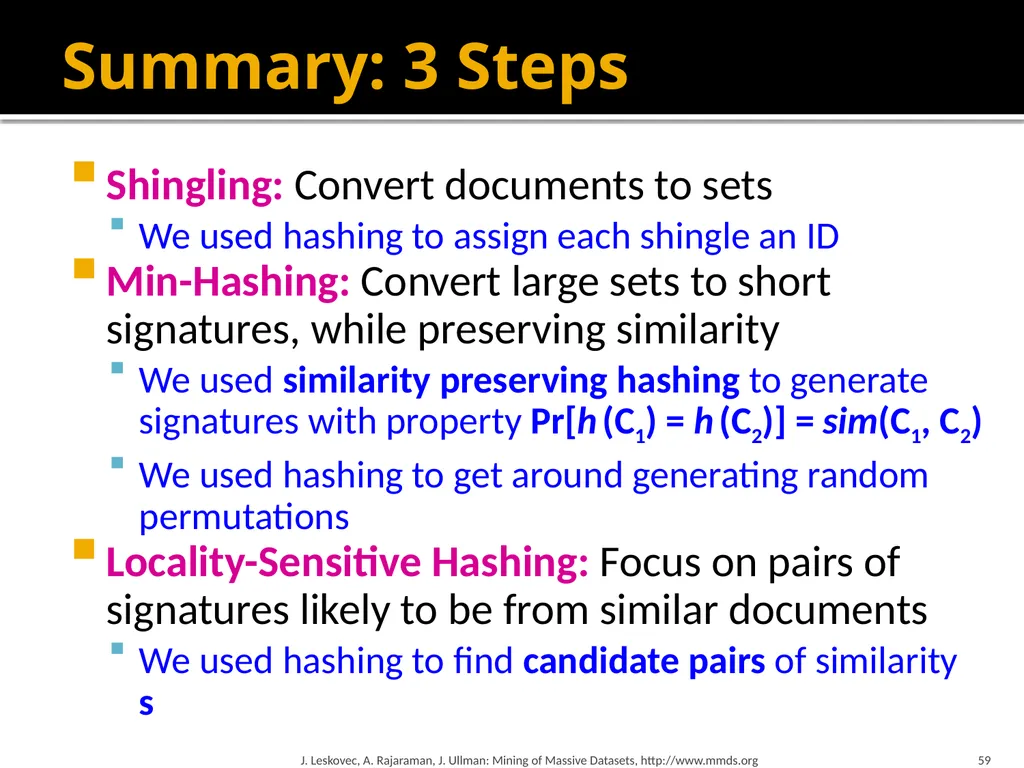
Summary: 3 Steps Shingling: Convert documents to sets
We used hashing to assign each shingle an ID
Min-Hashing: Convert large sets to short signatures, while preserving similarity
We used similarity preserving hashing to generate signatures with property Pr[h(C1) = h(C2)] = sim(C1, C2)
We used hashing to get around generating random permutations
Locality-Sensitive Hashing: Focus on pairs of signatures likely to be from similar documents
We used hashing to find candidate pairs of similarity s J. Leskovec, A. Rajaraman, J. Ullman: Mining of Massive Datasets, http://www.mmds.org 59<br>