
Fire Safety Training CAPCO Loss Prevention &
CB
Published · 24 slides · 0 views
1 / 1


Description
Fire Safety Training CAPCO Loss Prevention Office Risk Management Elements of Fire Fuel: Any combustible materialsolid, liquid or gas Heat: The energy necessary to increase the temperature of fuel to where sufficient vapors are given off
Related Topics
Download this presentation From Below
"Fire Safety Training CAPCO Loss Prevention &" is the property of its rightful owner. Permission is granted to download and print the materials on this website for personal, non-commercial use only, and to display it on your personal computer provided you do not modify the materials and that you retain all copyright notices contained in the materials. By downloading content from our website, you accept the terms of this agreement.
Share
Embed code
Presentation Transcript
01
Fire Safety Training CAPCO Loss Prevention & Office Risk Management<br>
02
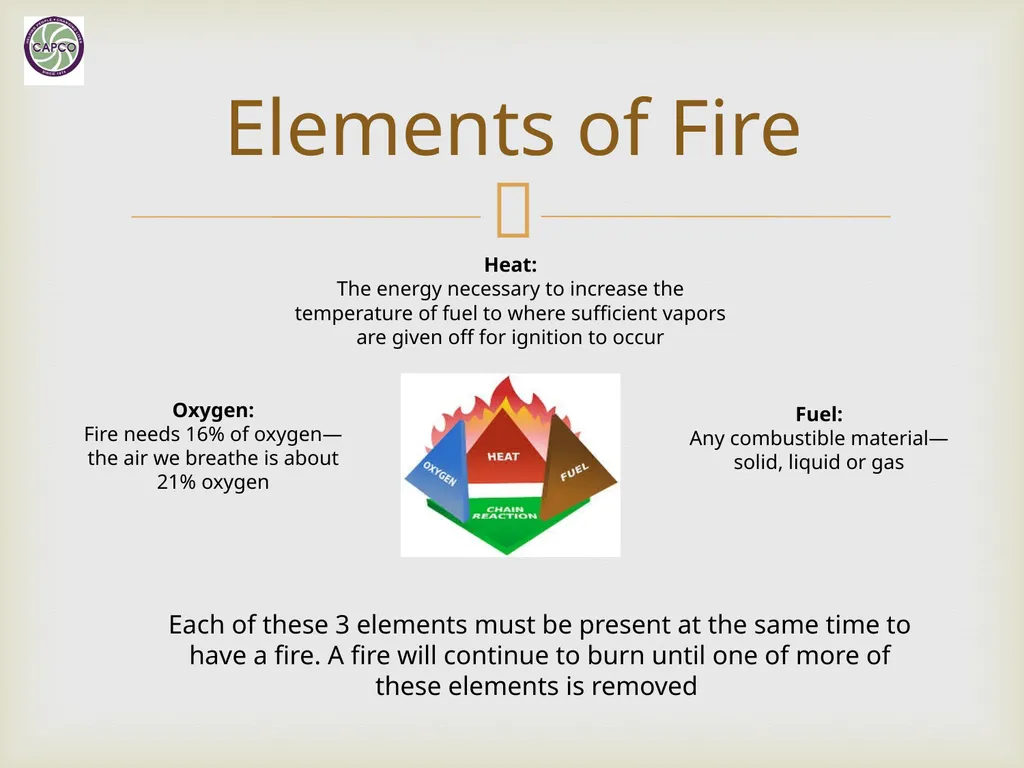
Elements of Fire Fuel:
Any combustible material—solid, liquid or gas Heat:
The energy necessary to increase the temperature of fuel to where sufficient vapors are given off for ignition to occur Oxygen:
Fire needs 16% of oxygen—the air we breathe is about 21% oxygen Each of these 3 elements must be present at the same time to have a fire. A fire will continue to burn until one of more of these elements is removed<br>
Any combustible material—solid, liquid or gas Heat:
The energy necessary to increase the temperature of fuel to where sufficient vapors are given off for ignition to occur Oxygen:
Fire needs 16% of oxygen—the air we breathe is about 21% oxygen Each of these 3 elements must be present at the same time to have a fire. A fire will continue to burn until one of more of these elements is removed<br>
03
Potential hazardous fuel sources for a fire can be in the form of liquids, solids, or gases.
Liquid: Grease, Oil, Fuel
Solid: Wood, Paper, Metal
Gas: Natural Gas, Propane, Acetylene Hazardous Fuel Sources<br>
Liquid: Grease, Oil, Fuel
Solid: Wood, Paper, Metal
Gas: Natural Gas, Propane, Acetylene Hazardous Fuel Sources<br>
04
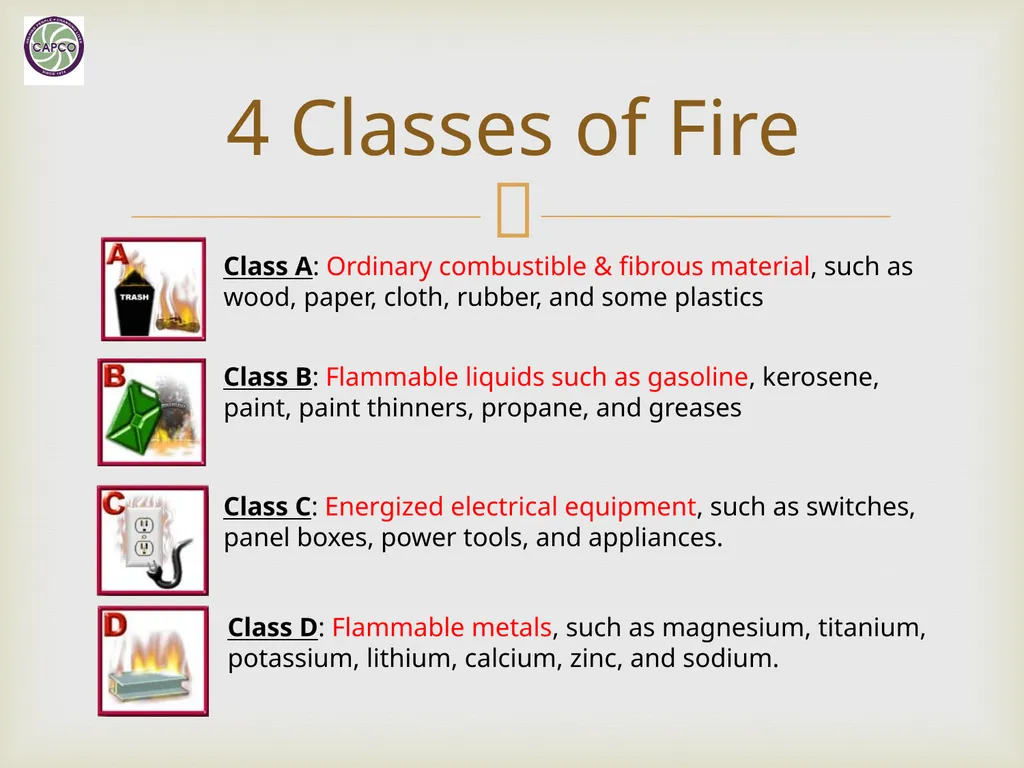
4 Classes of Fire Class A: Ordinary combustible & fibrous material, such as wood, paper, cloth, rubber, and some plastics Class B: Flammable liquids such as gasoline, kerosene, paint, paint thinners, propane, and greases Class C: Energized electrical equipment, such as switches, panel boxes, power tools, and appliances. Class D: Flammable metals, such as magnesium, titanium, potassium, lithium, calcium, zinc, and sodium.<br>
05
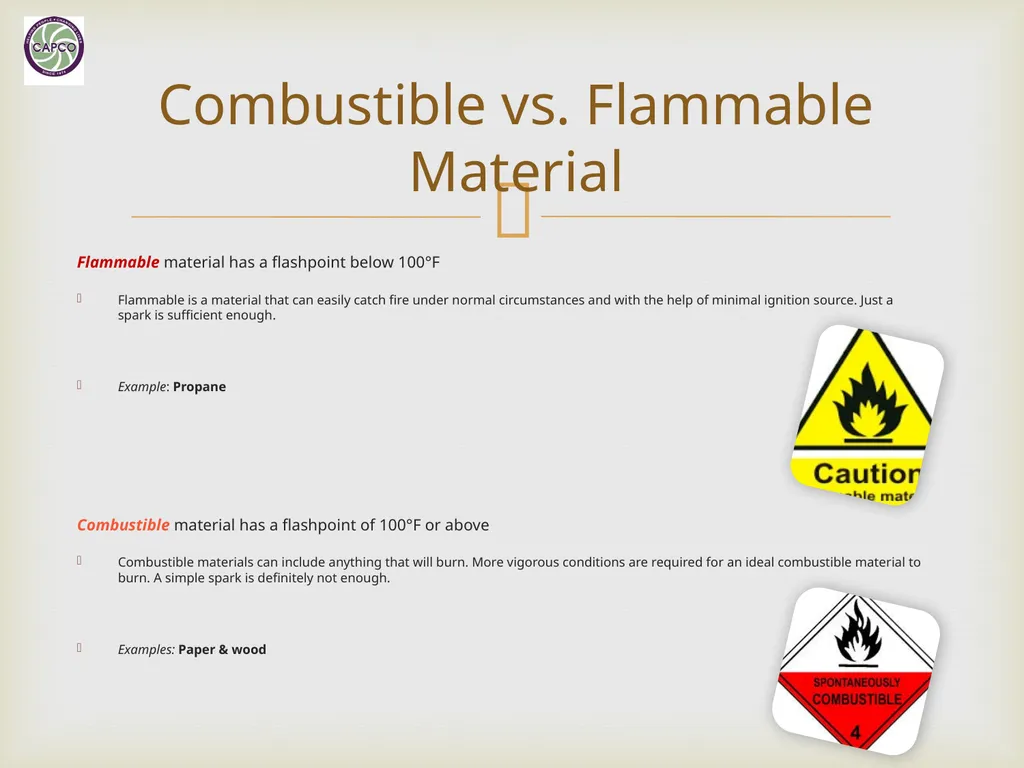
Flammable material has a flashpoint below 100°F
Flammable is a material that can easily catch fire under normal circumstances and with the help of minimal ignition source. Just a spark is sufficient enough.
Example: Propane
Combustible material has a flashpoint of 100°F or above
Combustible materials can include anything that will burn. More vigorous conditions are required for an ideal combustible material to burn. A simple spark is definitely not enough.
Examples: Paper & wood Combustible vs. Flammable Material<br>
Flammable is a material that can easily catch fire under normal circumstances and with the help of minimal ignition source. Just a spark is sufficient enough.
Example: Propane
Combustible material has a flashpoint of 100°F or above
Combustible materials can include anything that will burn. More vigorous conditions are required for an ideal combustible material to burn. A simple spark is definitely not enough.
Examples: Paper & wood Combustible vs. Flammable Material<br>
06
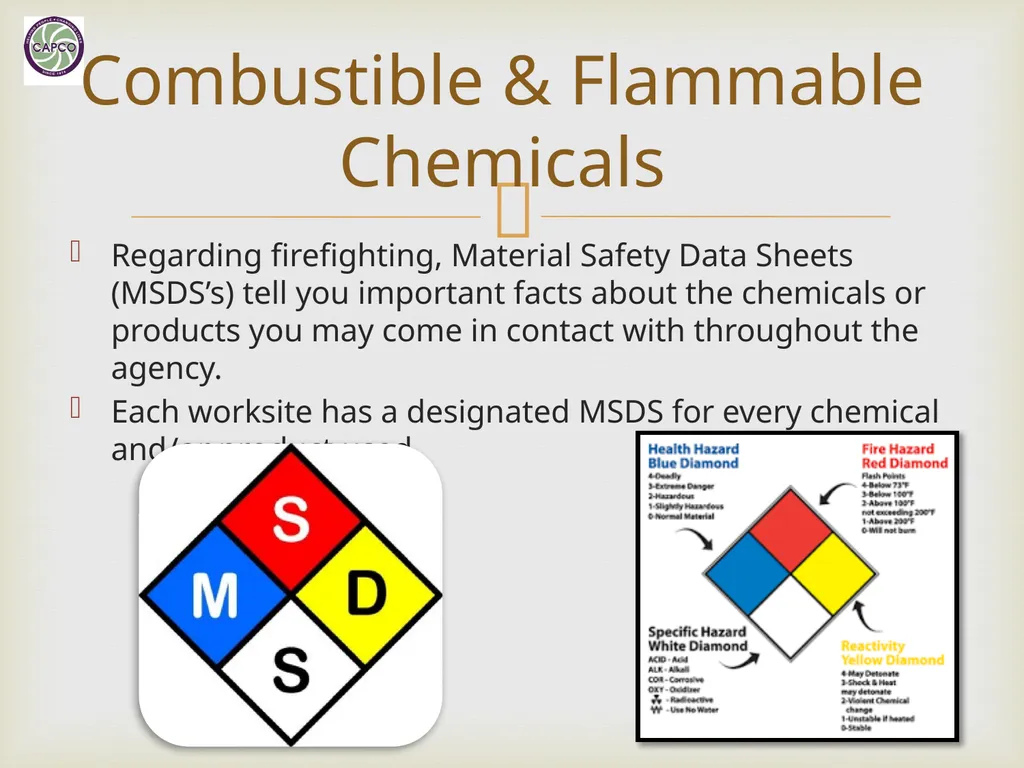
Regarding firefighting, Material Safety Data Sheets (MSDS’s) tell you important facts about the chemicals or products you may come in contact with throughout the agency.
Each worksite has a designated MSDS for every chemical and/or product used Combustible & Flammable Chemicals<br>
Each worksite has a designated MSDS for every chemical and/or product used Combustible & Flammable Chemicals<br>
07
Locked or blocked exits
Blocked exit signs, isles, hallways
Smoking areas
Trash or debris
Cooking hazards
Emergency stairway doors blocked or propped open
Emergency lighting hazards Fire Hazards in the Workplace<br>
Blocked exit signs, isles, hallways
Smoking areas
Trash or debris
Cooking hazards
Emergency stairway doors blocked or propped open
Emergency lighting hazards Fire Hazards in the Workplace<br>
08
Class A Ordinary Combustibles
Keep storage and working areas free of trash
Place oily rags in covered containers
Class B Flammable liquids or gases
Don’t refuel gasoline-powered equipment in a confined space, in the presence of an open flame, or while the equipment is hot.
Keep flammable liquids stored in a tightly closed container and away from spark producing sources.
Use flammable liquids only in well ventilated areas. To Prevent Fires<br>
Keep storage and working areas free of trash
Place oily rags in covered containers
Class B Flammable liquids or gases
Don’t refuel gasoline-powered equipment in a confined space, in the presence of an open flame, or while the equipment is hot.
Keep flammable liquids stored in a tightly closed container and away from spark producing sources.
Use flammable liquids only in well ventilated areas. To Prevent Fires<br>
09
Class C Electrical equipment
Investigate any appliance or electrical equipment that smells strange. Unusual odors can be the first sign of potential fire.
Utility lights should always have some type of wire guard over them
Never install a fuse rated higher than specified for the circuit.
Class D Flammable metals
Before working with metals, be sure to gather knowledge about the properties of such metals and use good judgment in your use of metals to avoid potential ignition of flammable metals To Prevent Fires<br>
Investigate any appliance or electrical equipment that smells strange. Unusual odors can be the first sign of potential fire.
Utility lights should always have some type of wire guard over them
Never install a fuse rated higher than specified for the circuit.
Class D Flammable metals
Before working with metals, be sure to gather knowledge about the properties of such metals and use good judgment in your use of metals to avoid potential ignition of flammable metals To Prevent Fires<br>
10
Check location of fire alarms and know how they work.
Learn your site-specific evacuation plan. All work sites have their own unique emergency evacuation process that you must familiarize yourself with.
Make sure nothing blocks fire alarms, extinguishers, and designated emergency exits. If you see this, it is your duty to correct the issue and/or notify your supervisor.
Familiarize yourself with the sound of your fire alarm.
Post emergency numbers near your telephone.
Based on your site’s fire evacuation plan, plan your escape if the fire alarm should sound. Preparing for a Fire Emergency<br>
Learn your site-specific evacuation plan. All work sites have their own unique emergency evacuation process that you must familiarize yourself with.
Make sure nothing blocks fire alarms, extinguishers, and designated emergency exits. If you see this, it is your duty to correct the issue and/or notify your supervisor.
Familiarize yourself with the sound of your fire alarm.
Post emergency numbers near your telephone.
Based on your site’s fire evacuation plan, plan your escape if the fire alarm should sound. Preparing for a Fire Emergency<br>
11
Every CAPCO work site has a fire evacuation plan. It is your obligation to familiarize yourself with this plan. If you have questions regarding your evacuation plan, you must ask your supervisor and/or Human Resources before you start work and anytime thereafter.
Components of CAPCO’s Evacuation Plan:
Safety Committee – develops plan
Emergency crew – administers the plan
Escape routes – primary & secondary
Maps – posted in every room, office, common area of each work site. Indicate escape routs, first aide kits, and extinguishers Fire Evacuation Plan<br>
Components of CAPCO’s Evacuation Plan:
Safety Committee – develops plan
Emergency crew – administers the plan
Escape routes – primary & secondary
Maps – posted in every room, office, common area of each work site. Indicate escape routs, first aide kits, and extinguishers Fire Evacuation Plan<br>
12
Pull the nearest fire alarm
If you there is not a fire alarm visibly close by, Dial 911
Never assume that anyone else has already called the fire department
Stay clam and be prepared to answer the operator’s questions
EVACUATE THE BUILDING If You Notice a Fire<br>
If you there is not a fire alarm visibly close by, Dial 911
Never assume that anyone else has already called the fire department
Stay clam and be prepared to answer the operator’s questions
EVACUATE THE BUILDING If You Notice a Fire<br>
13
Leave at once, keeping in mind your site’s evacuation plan and taking direction from the emergency warden
Each evacuation plan has a designated emergency warden specified in the plan.
Do not take time to gather your personal items. Your safety always comes first.
Feel the back of doors with your hand for heat before opening any door. If the door is cold, slowly open the door and check for smoke.
If there is no smoke in the hallways or stairwells, follow your site’s evacuation plan. Get out of the building quickly using designated emergency exits. If You Hear the Fire Alarm<br>
Each evacuation plan has a designated emergency warden specified in the plan.
Do not take time to gather your personal items. Your safety always comes first.
Feel the back of doors with your hand for heat before opening any door. If the door is cold, slowly open the door and check for smoke.
If there is no smoke in the hallways or stairwells, follow your site’s evacuation plan. Get out of the building quickly using designated emergency exits. If You Hear the Fire Alarm<br>
14
Be sure to close all doors behind you. NEVER lock any doors. Locking the doors could trap others & hinder the fire department’s efforts
If on an upper level, always use stairways as your primary escape route. NEVER use elevators under any circumstances
Always proceed to the first floor. NEVER go up. If You Hear the Fire Alarm (Cont.)<br>
If on an upper level, always use stairways as your primary escape route. NEVER use elevators under any circumstances
Always proceed to the first floor. NEVER go up. If You Hear the Fire Alarm (Cont.)<br>
15
Don’t panic!
Try to find a secondary exit
Before opening any door, feel the door with the back of your hand. If the door is warm, DO NOT attempt to open it!
If you can’t find another safe exit, stay where you are!
Seal cracks around doors & vents with towels, rags, clothing, or tape to prevent smoke penetration.
Stay low to the floor & cover your mouth and nose to avoid smoke and heat.
If possible, call “911” and report your exact location If You’re Trapped in the Building<br>
Try to find a secondary exit
Before opening any door, feel the door with the back of your hand. If the door is warm, DO NOT attempt to open it!
If you can’t find another safe exit, stay where you are!
Seal cracks around doors & vents with towels, rags, clothing, or tape to prevent smoke penetration.
Stay low to the floor & cover your mouth and nose to avoid smoke and heat.
If possible, call “911” and report your exact location If You’re Trapped in the Building<br>
16
Once you are out of the building, STAY OUT. Do not go back inside for any reason.
Report to your warden for roll call at your designated meeting point as delineated by your site’s evacuation plan.
Be sure to tell your warden and/or the fire department if you know of anyone trapped in the building.
Only re-enter the building when the fire department instructs you to do so. After a Fire Emergency<br>
Report to your warden for roll call at your designated meeting point as delineated by your site’s evacuation plan.
Be sure to tell your warden and/or the fire department if you know of anyone trapped in the building.
Only re-enter the building when the fire department instructs you to do so. After a Fire Emergency<br>
17
In the event of a fire, your personal safety is the most important concern. Evacuate the building immediately & do not delay yourself by gathering personal items
You are not required to fight a fire! REMEMBER!<br>
You are not required to fight a fire! REMEMBER!<br>
18
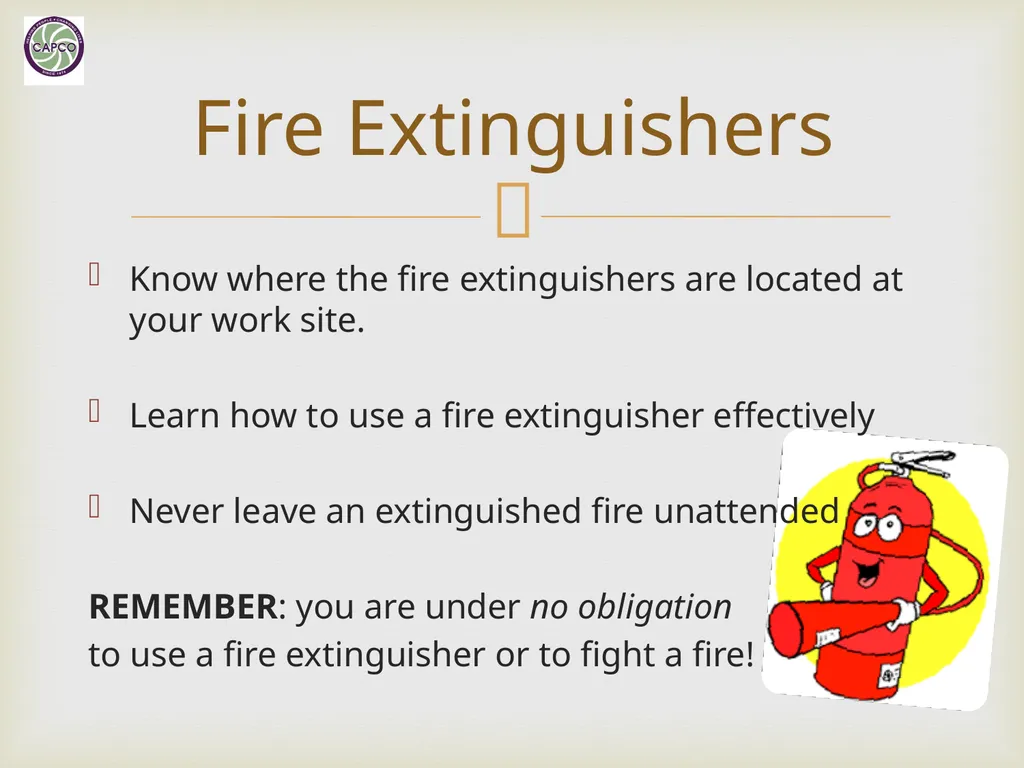
Know where the fire extinguishers are located at your work site.
Learn how to use a fire extinguisher effectively
Never leave an extinguished fire unattended
REMEMBER: you are under no obligation
to use a fire extinguisher or to fight a fire! Fire Extinguishers<br>
Learn how to use a fire extinguisher effectively
Never leave an extinguished fire unattended
REMEMBER: you are under no obligation
to use a fire extinguisher or to fight a fire! Fire Extinguishers<br>
19
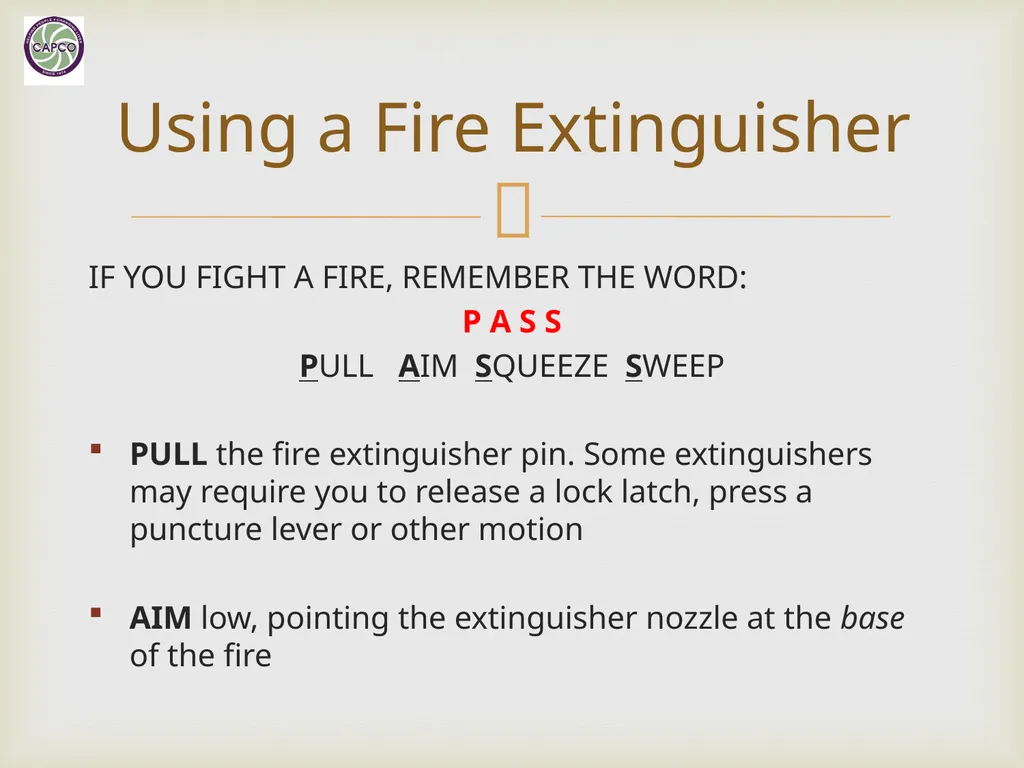
IF YOU FIGHT A FIRE, REMEMBER THE WORD:
P A S S
PULL AIM SQUEEZE SWEEP
PULL the fire extinguisher pin. Some extinguishers may require you to release a lock latch, press a puncture lever or other motion
AIM low, pointing the extinguisher nozzle at the base of the fire Using a Fire Extinguisher<br>
P A S S
PULL AIM SQUEEZE SWEEP
PULL the fire extinguisher pin. Some extinguishers may require you to release a lock latch, press a puncture lever or other motion
AIM low, pointing the extinguisher nozzle at the base of the fire Using a Fire Extinguisher<br>
20
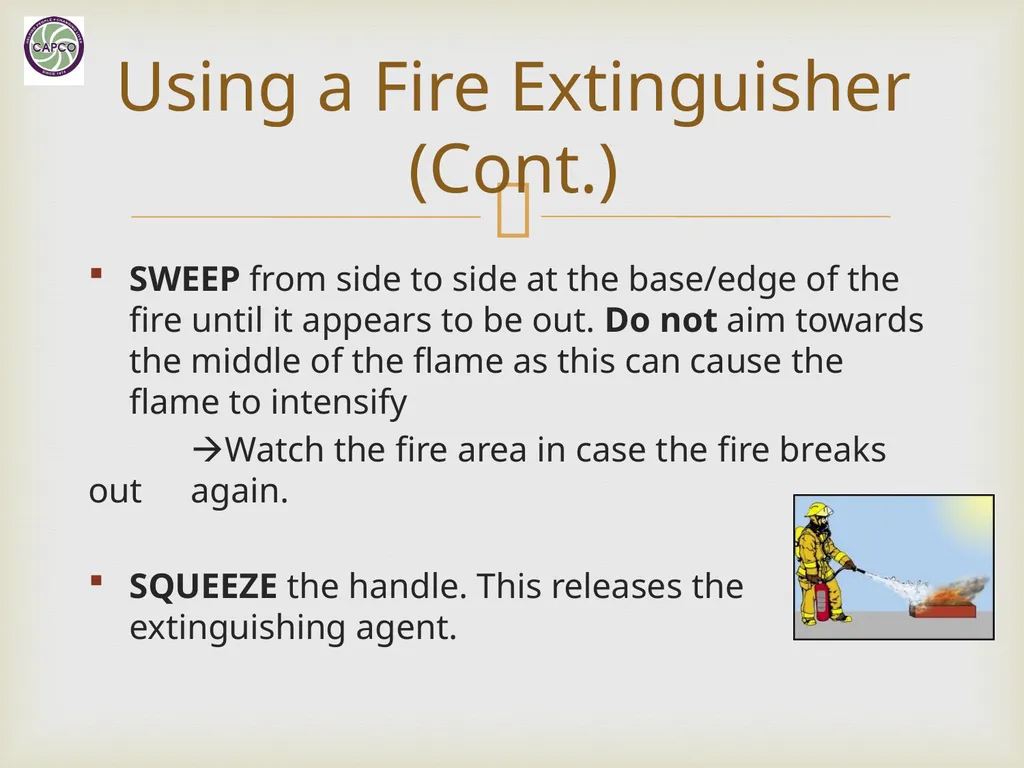
SWEEP from side to side at the base/edge of the fire until it appears to be out. Do not aim towards the middle of the flame as this can cause the flame to intensify
Watch the fire area in case the fire breaks out again.
SQUEEZE the handle. This releases the extinguishing agent. Using a Fire Extinguisher (Cont.)<br>
Watch the fire area in case the fire breaks out again.
SQUEEZE the handle. This releases the extinguishing agent. Using a Fire Extinguisher (Cont.)<br>
21
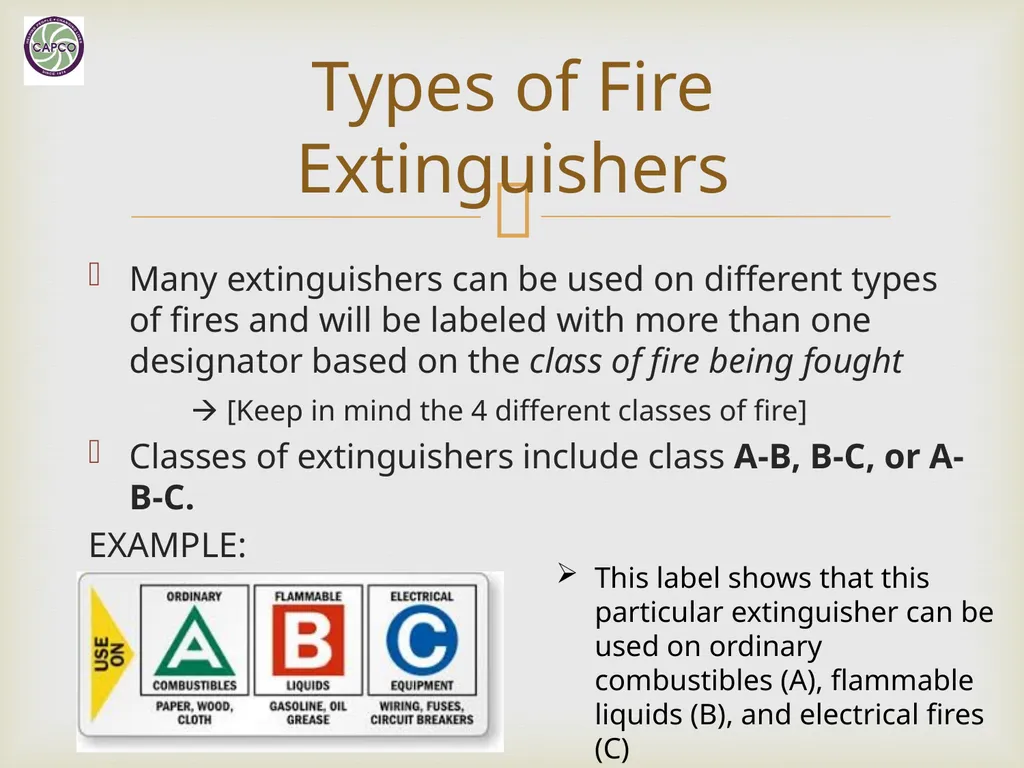
Many extinguishers can be used on different types of fires and will be labeled with more than one designator based on the class of fire being fought
[Keep in mind the 4 different classes of fire]
Classes of extinguishers include class A-B, B-C, or A-B-C.
EXAMPLE: Types of Fire Extinguishers This label shows that this particular extinguisher can be used on ordinary combustibles (A), flammable liquids (B), and electrical fires (C)<br>
[Keep in mind the 4 different classes of fire]
Classes of extinguishers include class A-B, B-C, or A-B-C.
EXAMPLE: Types of Fire Extinguishers This label shows that this particular extinguisher can be used on ordinary combustibles (A), flammable liquids (B), and electrical fires (C)<br>
22
A fire extinguisher should be labeled with the classes of fire it is designed to fight.
High-rated units are heavier models—make sure you can hold and operate the model you are using.
Be sure everyone is out of the area & ensure the fire department has been called.
If the fire starts to spread or threaten your escape path, evacuate immediately.
**Fire extinguishers will only function for 40 seconds or less! Before Using a Fire Extinguisher<br>
High-rated units are heavier models—make sure you can hold and operate the model you are using.
Be sure everyone is out of the area & ensure the fire department has been called.
If the fire starts to spread or threaten your escape path, evacuate immediately.
**Fire extinguishers will only function for 40 seconds or less! Before Using a Fire Extinguisher<br>
23
The National Fire Protection Association (NFPA) requires extinguishers to be inspected monthly or more frequently if circumstances require it.
Inspection Procedures:
Is the extinguisher located in a designated place?
Are there obstructions to extinguisher visibility?
Are operating instructions on nameplate legible and facing outward?
Are seals and tamper indicators in place & intact?
Is the extinguisher sufficiently full?
Is there any physical damage, corrosion, leakage, or a clogged nozzle? Fire Extinguisher Inspections<br>
Inspection Procedures:
Is the extinguisher located in a designated place?
Are there obstructions to extinguisher visibility?
Are operating instructions on nameplate legible and facing outward?
Are seals and tamper indicators in place & intact?
Is the extinguisher sufficiently full?
Is there any physical damage, corrosion, leakage, or a clogged nozzle? Fire Extinguisher Inspections<br>
24
Your safety comes first! When in doubt, leave the fire fighting to the professionals!
Learn your work site’s fire evacuation procedure!
Evacuate the building immediately on the first floor as soon as you hear a fire alarm
Never take time to collect personal items & never re-enter the building until instructed to do so.
Be aware of fire hazards in the workplace
Report any hazards you see immediately to your supervisor and/or human resources
CAPCO cares about your safety in the workplace! REMEMBER!<br>
Learn your work site’s fire evacuation procedure!
Evacuate the building immediately on the first floor as soon as you hear a fire alarm
Never take time to collect personal items & never re-enter the building until instructed to do so.
Be aware of fire hazards in the workplace
Report any hazards you see immediately to your supervisor and/or human resources
CAPCO cares about your safety in the workplace! REMEMBER!<br>