04
What would you do? You are at home with Grandpa Buzzy. The rest of your family is at your brother’s 20th hockey game this weekend. Grandpa Buzzy is talking to you, but his words are slurred and he isn’t making sense. He looks clumsy and trips on the rug.<br>
05
What would you do? You are at home with Grandpa Buzzy. The rest of your family is at your brother’s 20th hockey game this weekend. Grandpa Buzzy is talking to you, but his words are slurred and he isn’t making sense. He looks clumsy and trips on the rug.
You should:
Call 911
Call your family
You no longer have a land line and your phone is out battery… You can go to a neighbor’s house.<br>
06
What would you do? You are camping in the Rocky Mountains. You and another scout, Wiley, take a side trip from camp. Wiley slips and falls down the side of the mountain, tumbling over rocks, sticks and down about 25 feet. He cries out in pain. He has cuts on his legs and arms and says his ankle hurts. He tries to get up, but can’t walk.<br>
07
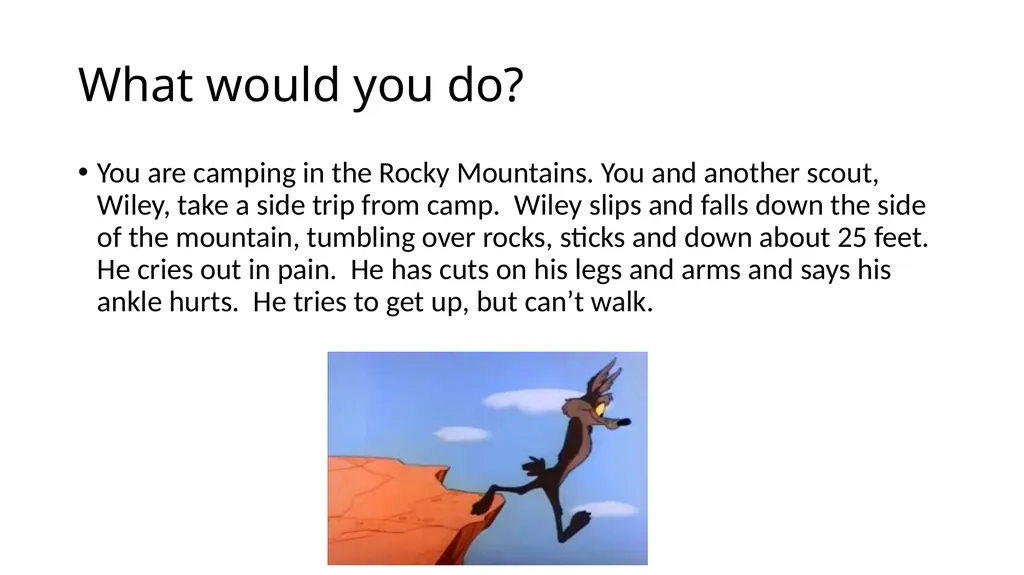
What would you do? You are camping in the Rocky Mountains. You and another scout, Wiley, take a side trip from camp. Wiley slips and falls down the side of the mountain, tumbling over rocks, sticks and down about 25 feet. He cries out in pain. He has cuts on his legs and arms and says his ankle hurts. He tries to get up, but can’t walk.
You should:
Call your patrol
Oops, no service…go back to camp to get help
What if the others are off on another adventure and you can’t find them?
Call or go to ranger station, trailhead
Send anther help signal (mirror, air horn, whistle, smoke signal)<br>
08
What would you do? You are out sailing on Lake Michigan. Your dad gets hit in the head with the boom and is unconscious. You don’t know how to sail in on your own.
You should:
Radio coast guard on Channel 16 OR call 911
What if you were not prepared and don’t have a radio or cell service…
Other signals for help: flare, air horn, GPS beacon, reflect light from mirror
Raise paddle, wave arms<br>
09
What would you do? You are out sailing on Lake Michigan. Your dad gets hit in the head with the boom and is unconscious. You don’t know how to sail in on your own.<br>
10
Question 2: How would you respond to an emergency… At Home:
Call 911
Call parent, sibling, neighbor
Go to neighbor's house (don't go inside if you don't know them)
Send buddy for help
Panic button/alarm system
In the Wilderness:
Call or send for help (911, ranger station, trailhead)
Other signals for help: mirror reflection, smoke signal, air horn, whistle
Evaluate surroundings for danger
Can you move the patient or can you wait?
On the water:
Call for help (911, radio coast guard (channel 16) or marina)
Other signals for help: flare, air horn, GPS beacon
Raise paddle
Send someone for help
THEN…do First Aid!<br>
11
Triage What does triage mean?
Process of determining the most urgent/critical conditions for treatment when multiple injuries/conditions exist in one person or in multiple people<br>
12
Who & what needs immediate attention? Life threatening emergencies need to be addressed first
Massive bleeding
Loss of consciousness
Difficulty breathing
Severe allergic reaction
Higher energy injuries<br>
13
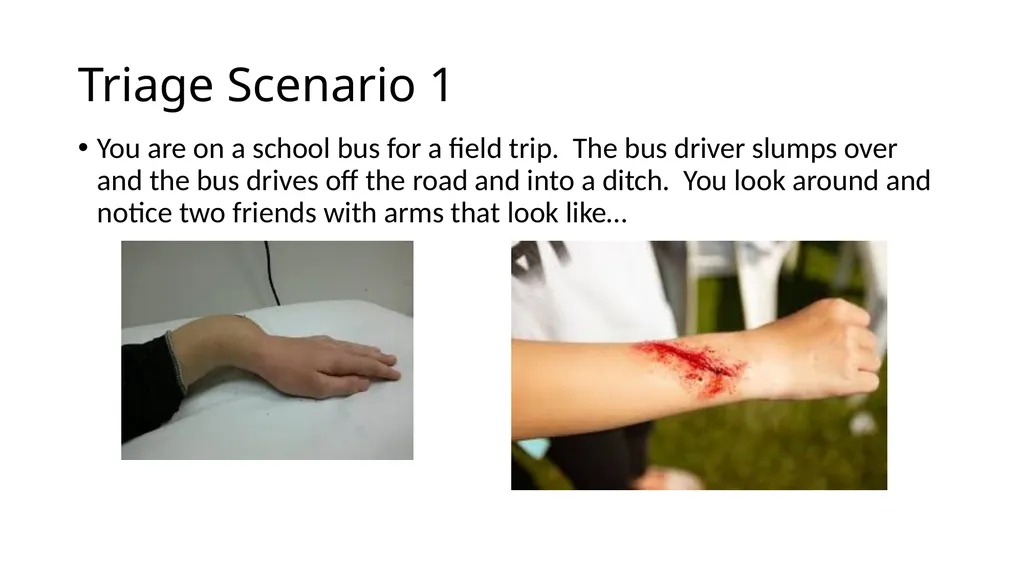
Triage Scenario 1 You are on a school bus for a field trip. The bus driver slumps over and the bus drives off the road and into a ditch. You look around and notice two friends with arms that look like…<br>
14
What should you do? Stay calm
Call for help
Assess situation
Who is hurt?
Who needs your help first?<br>
15
Triage Scenario 2 You are driving on a winding mountain road at night with your mom. You come upon an accident. A Prius and a Ford F150 appear to have collided head on. The driver of the truck is pacing around the scene. The driver of the Prius is unconscious in the car. The passenger in the Prius is awake, but appears to be in pain. It smells like gasoline.<br>
16
What should you do? Stay calm
Is the situation safe?
Nighttime: Put flashers on, try to light the scene
Winding road: Watch for other cars, try to stay on the side of the road
Gasoline smell: Potential for fire
Be aware! Do not put yourself in significant danger!
Call for help
Assess situation
Who is hurt?
Who needs your help first?<br>
17
Assessing the Scene You are walking to school with your younger sister. You are in a crosswalk when a distracted driver barreling down the road makes a left turn and is coming right for you. At the last second, he swerves to avoid hitting you but runs into an electrical pole, knocking it over. You see that that the driver’s airbags have deployed and that he is unconscious in the car.<br>
18
What should you do? Is the scene safe?
Other traffic
What about the pole?
You hear buzzing, and there is an electrical wire on the car
Call for help
Re-direct traffic
Do NOT approach the vehicle<br>
19
Question 3 Triage
Process of determining the most urgent/critical conditions for treatment when multiple injuries/conditions exist in one person or in multiple people
The most obvious is not always the most important
What do do
Stay calm
Check for danger. Protect yourself and the injured person from fire, explosions or other hazards (electricity, rushing water, lightning, falling objects, wildlife (bees, snakes, moose, rabid squirrel))
Call for help
Assess situation
How many people are injured?
What injuries/conditions have occurred?
Which are life threatening/most serious and require immediate attention?<br>
20
Universal Precautions Guidelines to prevent transmission of blood born pathogens or other infectious materials
Mostly means blood, but any fluids contaminated with blood also count
If it’s bloody, assume it is infectious
Personal protective equipment (PPE)
Gloves, gowns, masks, face shields, googles
Hand hygiene
Before and after contact<br>
21
Protecting Yourself and the Patient Universal precautions/PPE
Protects you from the patient and protects the patient from you
Be aware of your environment
What caused the injury/accident?
Falling rocks, riptide/rushing water, heat, cold
Can it hurt me?
Is there the potential for further injury to the patient?
Are there other dangers
Traffic, fire, electricity, cold, heat
Make the situation safer
Move patient to safety if possible
Wait for help if too dangerous
Don’t need more injuries<br>
22
First Aid Kit 2 2-inch gauze bandages
Roll of 1-inch adhesive tape
12 3-by-3-inch sterile pads
12 assorted adhesive bandages
2 elastic bandages, 3 to 6 inches wide
Thermometer
Scissors
Tweezers
Antiseptic wipes
2 pairs latex gloves
Safety pins
Calamine lotion
Eye goggles
Mouth-barrier device
Small bottle antihistamines (Benadryl)
Small bottle acetaminophen for pain and fever
Small bottle ibuprofen for inflammation, muscle aches, pain and fever<br>