
First and Second Corinthians Lesson 9 Love-driven

Description: First and Second Corinthians Lesson 9 Love-driven Ministry Memory Text 2 Corinthians 2:4 NKJV For out of much affliction and anguish of heart I wrote to you, with many tears, not that you should be grieved, but that you might know the love
Related Topics
Download Presentation
"First and Second Corinthians Lesson 9 Love-driven" is the property of its rightful owner. Permission is granted to download and print the materials on this website for personal, non-commercial use only, and to display it on your personal computer provided you do not modify the materials and that you retain all copyright notices contained in the materials. By downloading content from our website, you accept the terms of this agreement.
Presentation Transcript
slide1. First and Second Corinthians Lesson 9
Love-driven Ministry<br>
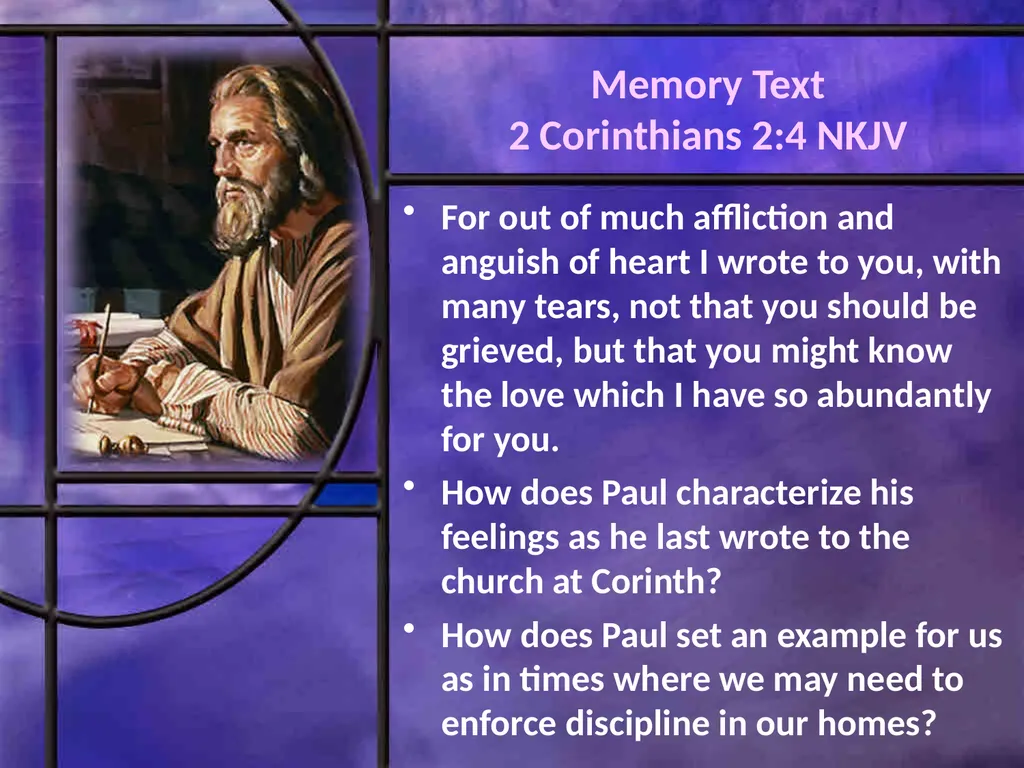
slide2. Memory Text 2 Corinthians 2:4 NKJV For out of much affliction and anguish of heart I wrote to you, with many tears, not that you should be grieved, but that you might know the love which I have so abundantly for you.
How does Paul characterize his feelings as he last wrote to the church at Corinth?
How does Paul set an example for us as in times where we may need to enforce discipline in our homes?<br>
slide3. Overview Paul opens 2 Corinthians by praising God, who comforts believers in suffering so they can comfort others. He explains his hardships and delayed visit to Corinth, defending his sincerity. He rejoices that his severe letter has produced repentance and offers forgiveness to the offenders. He rejoices for triumph in Christ and the opportunity to be sincere followers spreading the aroma of His love.
Reasons for Praise
Letters and Visits
Reconciliation and Triumph
Summary<br>
slide4. Reasons for Praise How does Paul open his letter of 2 Cor? (2 Cor 1:1-2)
How does Paul feel about the comfort God provides for Christian believers? (2 Cor 1:3-5)
What dangers did Paul face in Asia that caused him to be thankful for God’s deliverance? (2 Cor 1:8-9)<br>
slide5. Visits and Letters What were Paul’s original plans to visit Corinth a 2nd and 3rd time? (2 Cor 1:15-16)
What happened to change Paul’s original plans? (2 Cor 2:1-4)
What hint does Paul give us of the problem that was occurring at Corinth? (2 Cor 2:5-10)
How did Paul find out bout the repentance at Corinth? (2 Cor 2:12-13)
How can we summarize the visits and letters of the apostle Paul with the church at Corinth? [Summary]<br>
slide6. Reconciliation and Triumph How does Paul respond to the reconciliation that has occurred in Corinth? (2 Cor 2:14)
What contrasting effects does the same aroma have on believers and non-believers? (2 Cor 2:15-16)
How does Paul contrast his ministry with that of others who may have ulterior motives? (2 Cor 2:17)<br>
slide7. Summary Paul begins 2 Corinthians by affirming, as he does in the majority of his epistles, his apostolic calling and authority.
He praises God as our merciful Father who is the source of all comfort.
God comforts us so that we can comfort others who are suffering.
It is reasonable to conclude that God’s comfort comes to us through the Holy Spirit who is our Comforter, Helper, Advocate, and Counselor.
The Holy Spirit is fulfilling God’s promise to never leave us or forsake us.
In the dangers Paul faced in Asia, he learned to rely only on God, confident that He is able to raise the dead, so not even death can separate us from His love.<br>
slide8. Summary After writing 1 Corinthians from Ephesus, Paul had to make a “painful visit” to Corinth, after which he returned to Ephesus and wrote them a “severe letter.”
Out of necessity, this changed his travel plans: he didn’t want to return to Corinth until he heard how they received his letter and whether those who opposed him in Corinth had repented.
After he met up with Titus in Macedonia and heard the report of their repentance in Corinth and their love for him, Paul called them to forgive and restore the ones who had opposed him earlier, and Paul assured them of his forgiveness for those who opposed him.
Here again Paul sets the example that church discipline should be restorative.<br>
slide9. Summary Paul ends chapter 2 by seeing himself as a captive in Christ’s triumphal victory procession, as Christ uses him to spread the aroma of the gospel everywhere.
The same gospel can be an aroma of both life and death.
For those who believe, it brings life because they receive Christ. For those who do not believe, it brings judgment and death.
Paul distinguishes his ministry for Christ from that of hucksters that peddle the word of God for profit: He speaks sincerely, as one sent by God and accountable before God in Christ.
Will you seek to be an aroma of life to those around you this week?<br>
slide11. 2 Corinthians 1:1-2 NLT This letter is from Paul, chosen by the will of God to be an apostle of Christ Jesus, and from our brother Timothy. I am writing to God's church in Corinth and to all of his holy people throughout Greece. 2 May God our Father and the Lord Jesus Christ give you grace and peace. [R]<br>
slide12. 2 Corinthians 1:3-5 NLT All praise to God, the Father of our Lord Jesus Christ. God is our merciful Father and the source of all comfort. 4 He comforts us in all our troubles so that we can comfort others. When they are troubled, we will be able to give them the same comfort God has given us. 5 For the more we suffer for Christ, the more God will shower us with his comfort through Christ. [R]<br>
slide13. 2 Corinthians 1:8-9 NLT We think you ought to know, dear brothers and sisters, about the trouble we went through in the province of Asia. We were crushed and overwhelmed beyond our ability to endure, and we thought we would never live through it. 9 In fact, we expected to die. But as a result, we stopped relying on ourselves and learned to rely only on God, who raises the dead. [R]<br>
slide14. 2 Corinthians 1:15-16 NLT Since I was so sure of your understanding and trust, I wanted to give you a double blessing by visiting you twice-- first on my way to Macedonia and again when I returned from Macedonia. Then you could send me on my way to Judea. [R]<br>
slide15. 2 Corinthians 2:1, 3-4 NLT So I decided that I would not bring you grief with another painful visit. ... 3 That is why I wrote to you as I did, so that when I do come, I won't be grieved by the very ones who ought to give me the greatest joy. … 4 I wrote that letter in great anguish, with a troubled heart and many tears. I didn't want to grieve you, but I wanted to let you know how much love I have for you. [R]<br>
slide16. 2 Corinthians 2:5-8, 10 NLT I am not overstating it when I say that the man who caused all the trouble hurt all of you more than he hurt me. 6 Most of you opposed him, and that was punishment enough. 7 Now, however, it is time to forgive and comfort him. Otherwise he may be overcome by discouragement. 8 So I urge you now to reaffirm your love for him. ... 10 When you forgive this man, I forgive him, too. And when I forgive whatever needs to be forgiven, I do so with Christ's authority for your benefit, [R]<br>
slide17. 2 Corinthians 2:12-13 NLT When I came to the city of Troas to preach the Good News of Christ, the Lord opened a door of opportunity for me. 13 But I had no peace of mind because my dear brother Titus hadn't yet arrived with a report from you. So I said good-bye and went on to Macedonia to find him. [R]<br>
slide18. 2 Corinthians 7:7-9 NLT His presence [of Titus in Macedonia] was a joy, but so was the news he brought of the encouragement he received from you. When he told us how much you long to see me, and how sorry you are for what happened, and how loyal you are to me, I was filled with joy! 8 I am not sorry that I sent that severe letter to you, though I was sorry at first, for I know it was painful to you for a little while. 9 Now I am glad I sent it, not because it hurt you, but because the pain caused you to repent and change your ways. [R]<br>
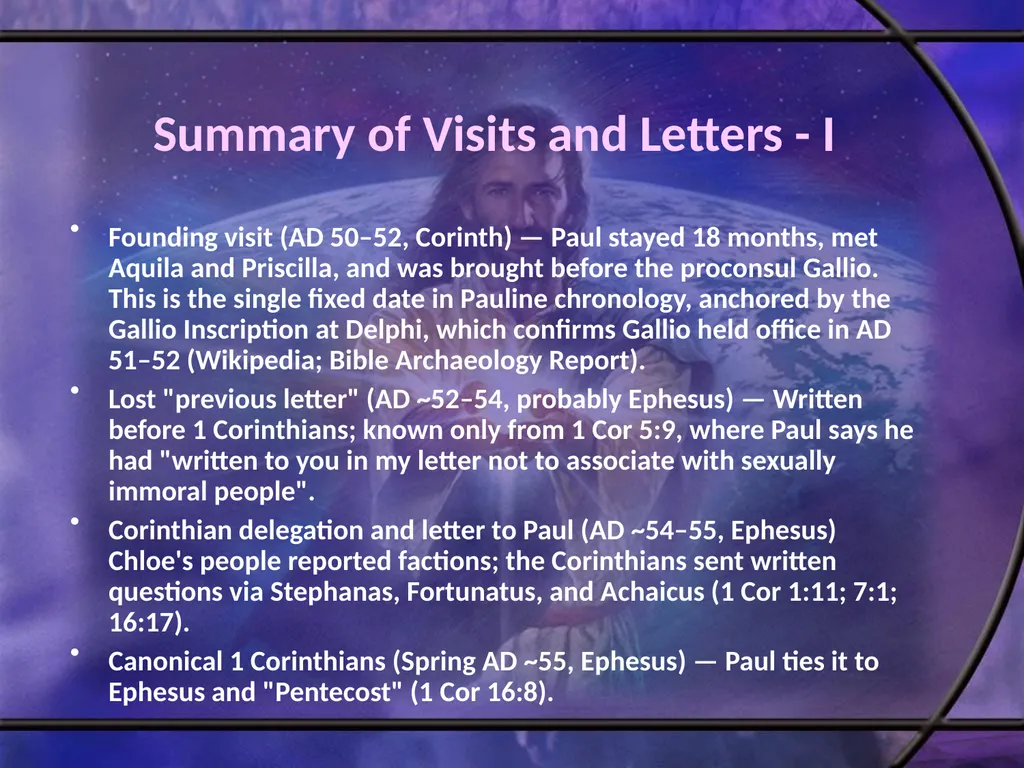
slide19. Summary of Visits and Letters - I Founding visit (AD 50–52, Corinth) — Paul stayed 18 months, met Aquila and Priscilla, and was brought before the proconsul Gallio. This is the single fixed date in Pauline chronology, anchored by the Gallio Inscription at Delphi, which confirms Gallio held office in AD 51–52 (Wikipedia; Bible Archaeology Report).
Lost "previous letter" (AD ~52–54, probably Ephesus) — Written before 1 Corinthians; known only from 1 Cor 5:9, where Paul says he had "written to you in my letter not to associate with sexually immoral people".
Corinthian delegation and letter to Paul (AD ~54–55, Ephesus) Chloe's people reported factions; the Corinthians sent written questions via Stephanas, Fortunatus, and Achaicus (1 Cor 1:11; 7:1; 16:17).
Canonical 1 Corinthians (Spring AD ~55, Ephesus) — Paul ties it to Ephesus and "Pentecost" (1 Cor 16:8).<br>
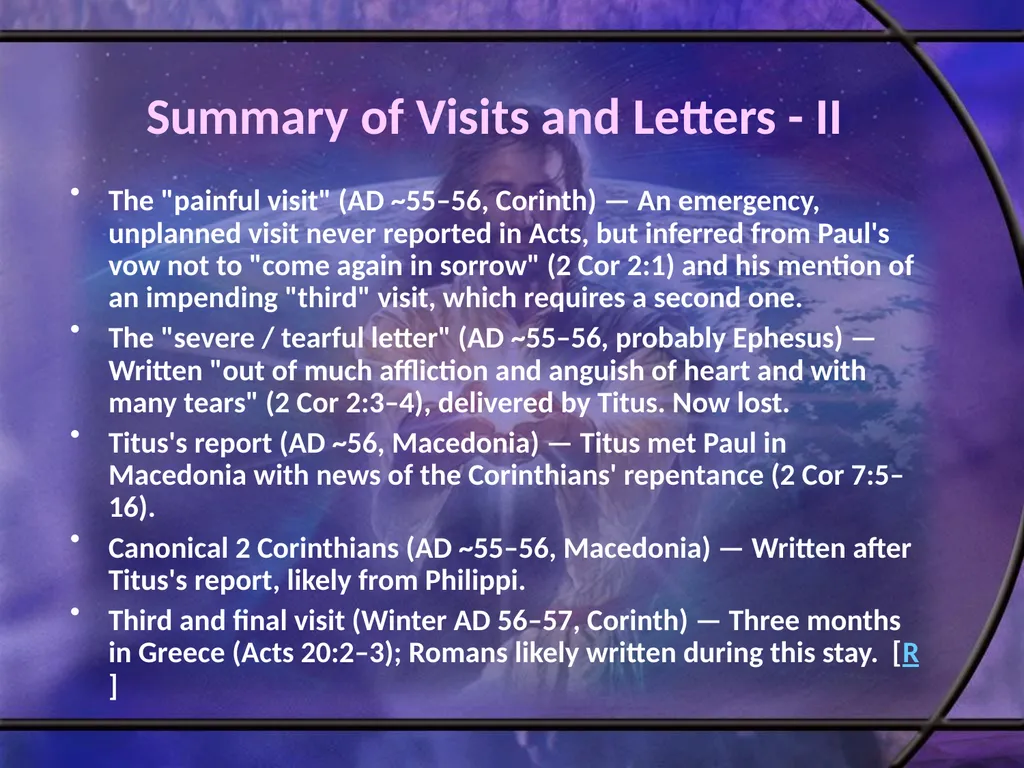
slide20. Summary of Visits and Letters - II The "painful visit" (AD ~55–56, Corinth) — An emergency, unplanned visit never reported in Acts, but inferred from Paul's vow not to "come again in sorrow" (2 Cor 2:1) and his mention of an impending "third" visit, which requires a second one.
The "severe / tearful letter" (AD ~55–56, probably Ephesus) — Written "out of much affliction and anguish of heart and with many tears" (2 Cor 2:3–4), delivered by Titus. Now lost.
Titus's report (AD ~56, Macedonia) — Titus met Paul in Macedonia with news of the Corinthians' repentance (2 Cor 7:5–16).
Canonical 2 Corinthians (AD ~55–56, Macedonia) — Written after Titus's report, likely from Philippi.
Third and final visit (Winter AD 56–57, Corinth) — Three months in Greece (Acts 20:2–3); Romans likely written during this stay. [R]<br>
slide21. 2 Corinthians 2:14 NIV But thanks be to God, who always leads us as captives in Christ's triumphal procession and uses us to spread the aroma of the knowledge of him everywhere. [R]<br>
slide22. 2 Corinthians 2:15-16 NIV For we are to God the pleasing aroma of Christ among those who are being saved and those who are perishing. 16 To the one we are an aroma that brings death; to the other, an aroma that brings life. And who is equal to such a task? [R]<br>
slide23. 2 Corinthians 2:17 NIV Unlike so many, we do not peddle the word of God for profit. On the contrary, in Christ we speak before God with sincerity, as those sent from God. [R]<br>
Love-driven Ministry<br>
slide2. Memory Text 2 Corinthians 2:4 NKJV For out of much affliction and anguish of heart I wrote to you, with many tears, not that you should be grieved, but that you might know the love which I have so abundantly for you.
How does Paul characterize his feelings as he last wrote to the church at Corinth?
How does Paul set an example for us as in times where we may need to enforce discipline in our homes?<br>
slide3. Overview Paul opens 2 Corinthians by praising God, who comforts believers in suffering so they can comfort others. He explains his hardships and delayed visit to Corinth, defending his sincerity. He rejoices that his severe letter has produced repentance and offers forgiveness to the offenders. He rejoices for triumph in Christ and the opportunity to be sincere followers spreading the aroma of His love.
Reasons for Praise
Letters and Visits
Reconciliation and Triumph
Summary<br>
slide4. Reasons for Praise How does Paul open his letter of 2 Cor? (2 Cor 1:1-2)
How does Paul feel about the comfort God provides for Christian believers? (2 Cor 1:3-5)
What dangers did Paul face in Asia that caused him to be thankful for God’s deliverance? (2 Cor 1:8-9)<br>
slide5. Visits and Letters What were Paul’s original plans to visit Corinth a 2nd and 3rd time? (2 Cor 1:15-16)
What happened to change Paul’s original plans? (2 Cor 2:1-4)
What hint does Paul give us of the problem that was occurring at Corinth? (2 Cor 2:5-10)
How did Paul find out bout the repentance at Corinth? (2 Cor 2:12-13)
How can we summarize the visits and letters of the apostle Paul with the church at Corinth? [Summary]<br>
slide6. Reconciliation and Triumph How does Paul respond to the reconciliation that has occurred in Corinth? (2 Cor 2:14)
What contrasting effects does the same aroma have on believers and non-believers? (2 Cor 2:15-16)
How does Paul contrast his ministry with that of others who may have ulterior motives? (2 Cor 2:17)<br>
slide7. Summary Paul begins 2 Corinthians by affirming, as he does in the majority of his epistles, his apostolic calling and authority.
He praises God as our merciful Father who is the source of all comfort.
God comforts us so that we can comfort others who are suffering.
It is reasonable to conclude that God’s comfort comes to us through the Holy Spirit who is our Comforter, Helper, Advocate, and Counselor.
The Holy Spirit is fulfilling God’s promise to never leave us or forsake us.
In the dangers Paul faced in Asia, he learned to rely only on God, confident that He is able to raise the dead, so not even death can separate us from His love.<br>
slide8. Summary After writing 1 Corinthians from Ephesus, Paul had to make a “painful visit” to Corinth, after which he returned to Ephesus and wrote them a “severe letter.”
Out of necessity, this changed his travel plans: he didn’t want to return to Corinth until he heard how they received his letter and whether those who opposed him in Corinth had repented.
After he met up with Titus in Macedonia and heard the report of their repentance in Corinth and their love for him, Paul called them to forgive and restore the ones who had opposed him earlier, and Paul assured them of his forgiveness for those who opposed him.
Here again Paul sets the example that church discipline should be restorative.<br>
slide9. Summary Paul ends chapter 2 by seeing himself as a captive in Christ’s triumphal victory procession, as Christ uses him to spread the aroma of the gospel everywhere.
The same gospel can be an aroma of both life and death.
For those who believe, it brings life because they receive Christ. For those who do not believe, it brings judgment and death.
Paul distinguishes his ministry for Christ from that of hucksters that peddle the word of God for profit: He speaks sincerely, as one sent by God and accountable before God in Christ.
Will you seek to be an aroma of life to those around you this week?<br>
slide11. 2 Corinthians 1:1-2 NLT This letter is from Paul, chosen by the will of God to be an apostle of Christ Jesus, and from our brother Timothy. I am writing to God's church in Corinth and to all of his holy people throughout Greece. 2 May God our Father and the Lord Jesus Christ give you grace and peace. [R]<br>
slide12. 2 Corinthians 1:3-5 NLT All praise to God, the Father of our Lord Jesus Christ. God is our merciful Father and the source of all comfort. 4 He comforts us in all our troubles so that we can comfort others. When they are troubled, we will be able to give them the same comfort God has given us. 5 For the more we suffer for Christ, the more God will shower us with his comfort through Christ. [R]<br>
slide13. 2 Corinthians 1:8-9 NLT We think you ought to know, dear brothers and sisters, about the trouble we went through in the province of Asia. We were crushed and overwhelmed beyond our ability to endure, and we thought we would never live through it. 9 In fact, we expected to die. But as a result, we stopped relying on ourselves and learned to rely only on God, who raises the dead. [R]<br>
slide14. 2 Corinthians 1:15-16 NLT Since I was so sure of your understanding and trust, I wanted to give you a double blessing by visiting you twice-- first on my way to Macedonia and again when I returned from Macedonia. Then you could send me on my way to Judea. [R]<br>
slide15. 2 Corinthians 2:1, 3-4 NLT So I decided that I would not bring you grief with another painful visit. ... 3 That is why I wrote to you as I did, so that when I do come, I won't be grieved by the very ones who ought to give me the greatest joy. … 4 I wrote that letter in great anguish, with a troubled heart and many tears. I didn't want to grieve you, but I wanted to let you know how much love I have for you. [R]<br>
slide16. 2 Corinthians 2:5-8, 10 NLT I am not overstating it when I say that the man who caused all the trouble hurt all of you more than he hurt me. 6 Most of you opposed him, and that was punishment enough. 7 Now, however, it is time to forgive and comfort him. Otherwise he may be overcome by discouragement. 8 So I urge you now to reaffirm your love for him. ... 10 When you forgive this man, I forgive him, too. And when I forgive whatever needs to be forgiven, I do so with Christ's authority for your benefit, [R]<br>
slide17. 2 Corinthians 2:12-13 NLT When I came to the city of Troas to preach the Good News of Christ, the Lord opened a door of opportunity for me. 13 But I had no peace of mind because my dear brother Titus hadn't yet arrived with a report from you. So I said good-bye and went on to Macedonia to find him. [R]<br>
slide18. 2 Corinthians 7:7-9 NLT His presence [of Titus in Macedonia] was a joy, but so was the news he brought of the encouragement he received from you. When he told us how much you long to see me, and how sorry you are for what happened, and how loyal you are to me, I was filled with joy! 8 I am not sorry that I sent that severe letter to you, though I was sorry at first, for I know it was painful to you for a little while. 9 Now I am glad I sent it, not because it hurt you, but because the pain caused you to repent and change your ways. [R]<br>
slide19. Summary of Visits and Letters - I Founding visit (AD 50–52, Corinth) — Paul stayed 18 months, met Aquila and Priscilla, and was brought before the proconsul Gallio. This is the single fixed date in Pauline chronology, anchored by the Gallio Inscription at Delphi, which confirms Gallio held office in AD 51–52 (Wikipedia; Bible Archaeology Report).
Lost "previous letter" (AD ~52–54, probably Ephesus) — Written before 1 Corinthians; known only from 1 Cor 5:9, where Paul says he had "written to you in my letter not to associate with sexually immoral people".
Corinthian delegation and letter to Paul (AD ~54–55, Ephesus) Chloe's people reported factions; the Corinthians sent written questions via Stephanas, Fortunatus, and Achaicus (1 Cor 1:11; 7:1; 16:17).
Canonical 1 Corinthians (Spring AD ~55, Ephesus) — Paul ties it to Ephesus and "Pentecost" (1 Cor 16:8).<br>
slide20. Summary of Visits and Letters - II The "painful visit" (AD ~55–56, Corinth) — An emergency, unplanned visit never reported in Acts, but inferred from Paul's vow not to "come again in sorrow" (2 Cor 2:1) and his mention of an impending "third" visit, which requires a second one.
The "severe / tearful letter" (AD ~55–56, probably Ephesus) — Written "out of much affliction and anguish of heart and with many tears" (2 Cor 2:3–4), delivered by Titus. Now lost.
Titus's report (AD ~56, Macedonia) — Titus met Paul in Macedonia with news of the Corinthians' repentance (2 Cor 7:5–16).
Canonical 2 Corinthians (AD ~55–56, Macedonia) — Written after Titus's report, likely from Philippi.
Third and final visit (Winter AD 56–57, Corinth) — Three months in Greece (Acts 20:2–3); Romans likely written during this stay. [R]<br>
slide21. 2 Corinthians 2:14 NIV But thanks be to God, who always leads us as captives in Christ's triumphal procession and uses us to spread the aroma of the knowledge of him everywhere. [R]<br>
slide22. 2 Corinthians 2:15-16 NIV For we are to God the pleasing aroma of Christ among those who are being saved and those who are perishing. 16 To the one we are an aroma that brings death; to the other, an aroma that brings life. And who is equal to such a task? [R]<br>
slide23. 2 Corinthians 2:17 NIV Unlike so many, we do not peddle the word of God for profit. On the contrary, in Christ we speak before God with sincerity, as those sent from God. [R]<br>