04
Functions and continuity in records creation
Stability of functions in comparison to administrative structures
Functions as causatively connected to records on their creation and use
Debunking the 1:1 model of archival description The functional approach to archival description<br>
05
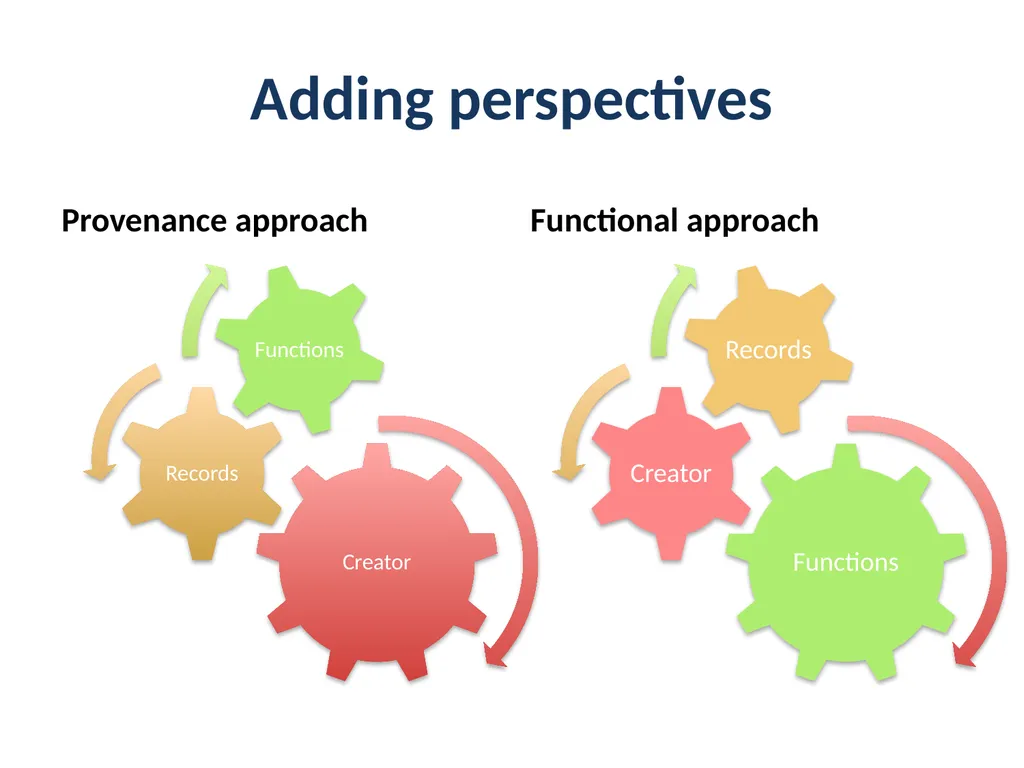
Adding perspectives Provenance approach Functional approach<br>
06
Definition of function: subfunctions, business processes, activities, tasks, transactions, and others
Descriptions used:
Describe as units
Control the creation and use of access points
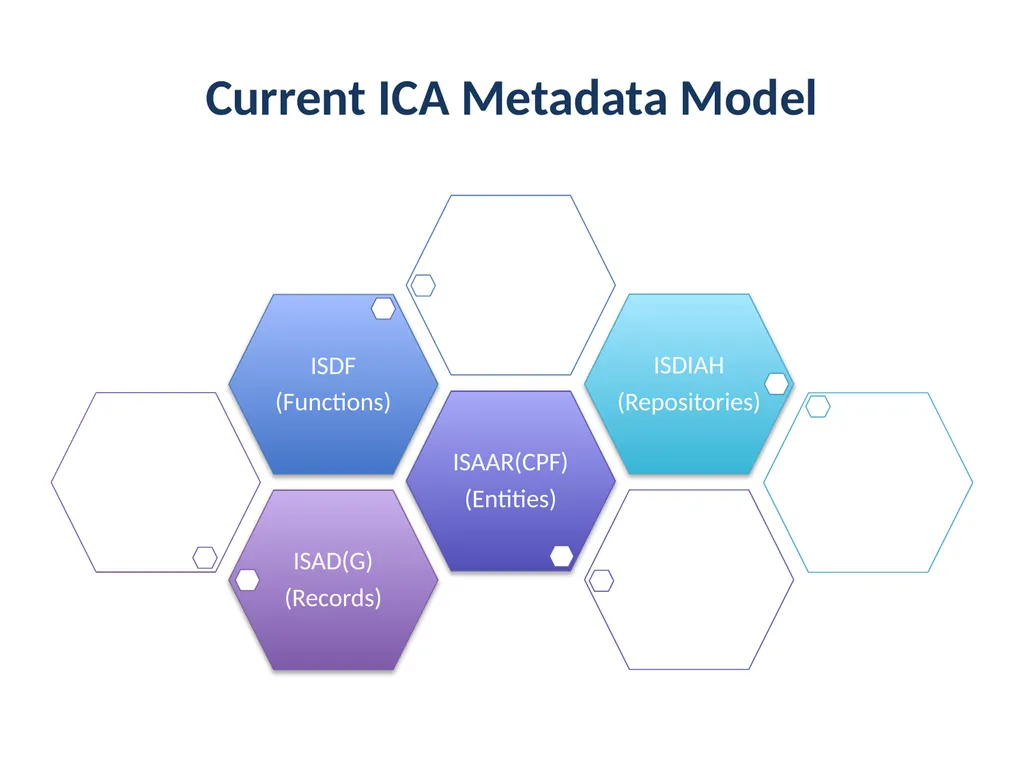
Document relationships ISDF: International Standard for the Description of Functions<br>
07
“Description of functions plays a vital role in explaining the provenance of records. Descriptions of functions can help place records more securely in the context of their creation and use. They can help explain how and why records were created and subsequently used, the purpose or function within an organisation which the records were designed to fulfil, and how records fitted in with and related to other records produced by the same organisation.”
ISDF 1.4, p. 7 Functions as Context<br>
08
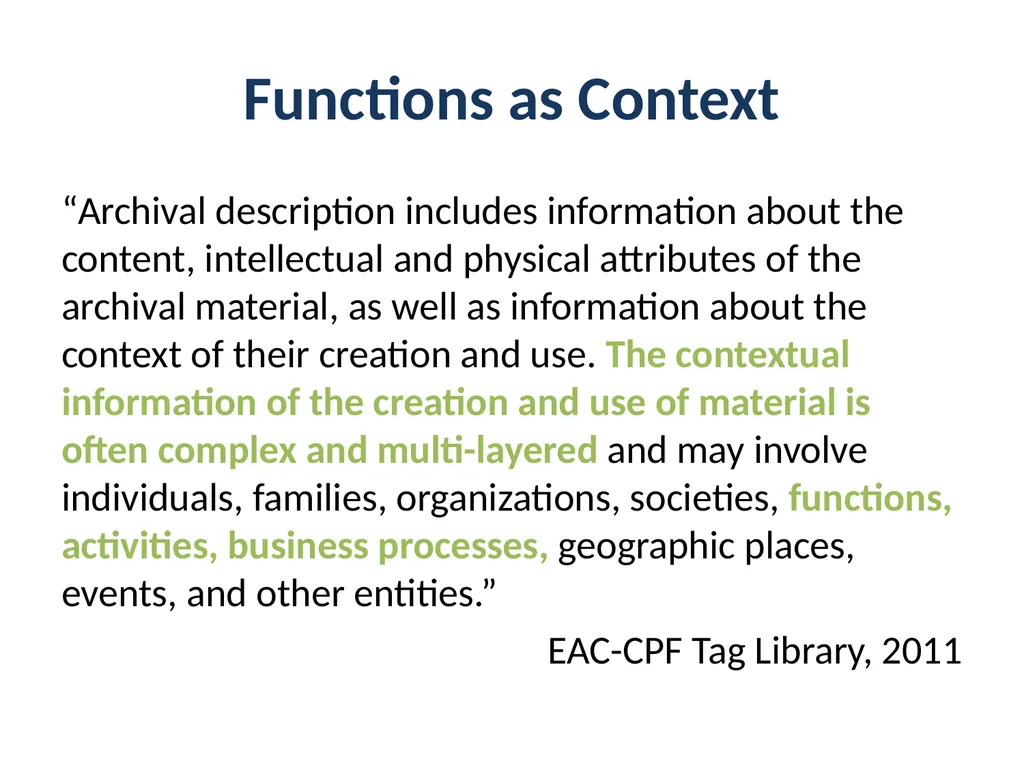
Functions as Context “Archival description includes information about the content, intellectual and physical attributes of the archival material, as well as information about the context of their creation and use. The contextual information of the creation and use of material is often complex and multi-layered and may involve individuals, families, organizations, societies, functions, activities, business processes, geographic places, events, and other entities.”
EAC-CPF Tag Library, 2011<br>
09
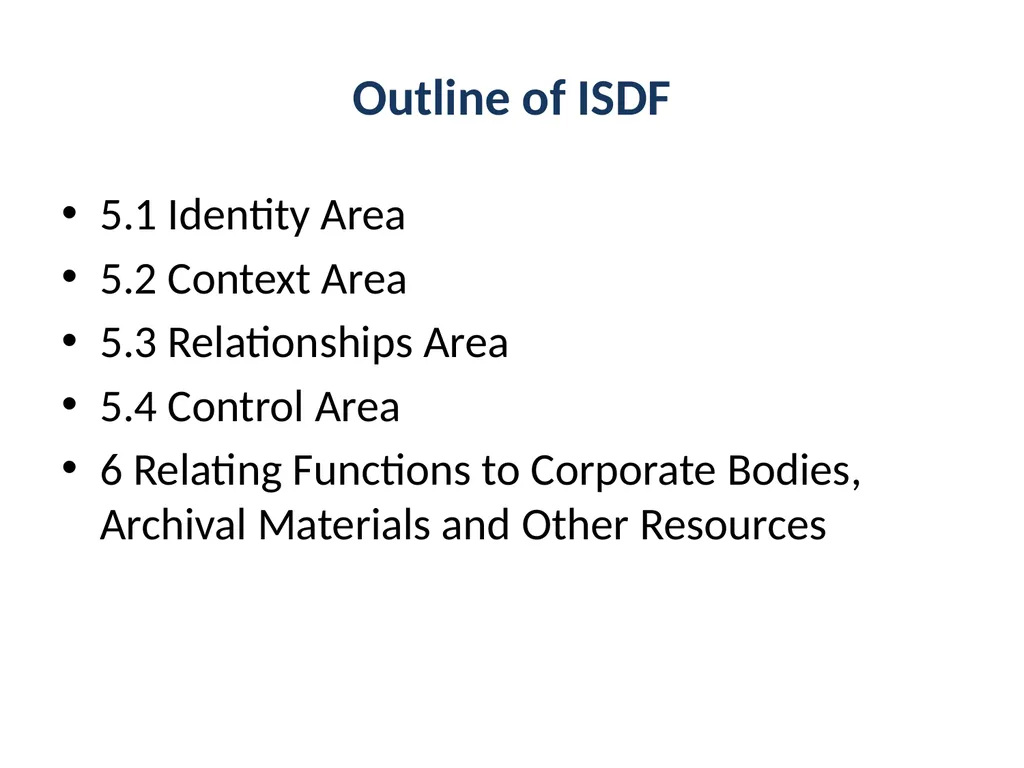
5.1 Identity Area
5.2 Context Area
5.3 Relationships Area
5.4 Control Area
6 Relating Functions to Corporate Bodies, Archival Materials and Other Resources Outline of ISDF<br>
10
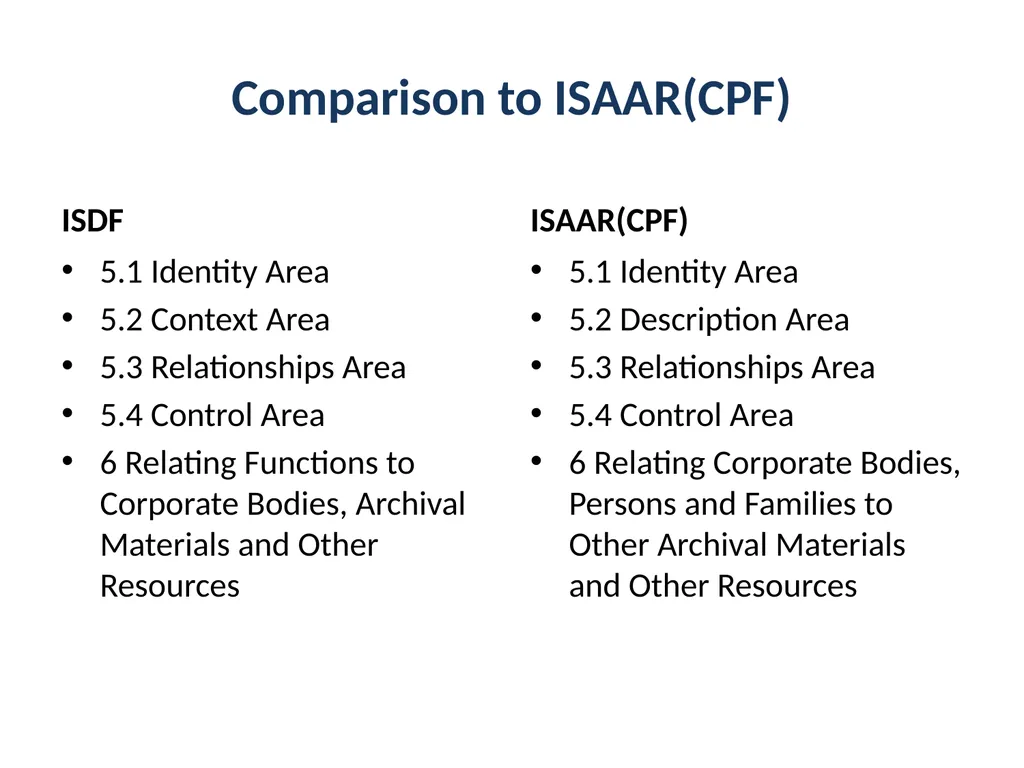
Comparison to ISAAR(CPF) ISDF 5.1 Identity Area
5.2 Context Area
5.3 Relationships Area
5.4 Control Area
6 Relating Functions to Corporate Bodies, Archival Materials and Other Resources ISAAR(CPF) 5.1 Identity Area
5.2 Description Area
5.3 Relationships Area
5.4 Control Area
6 Relating Corporate Bodies, Persons and Families to Other Archival Materials and Other Resources<br>
11
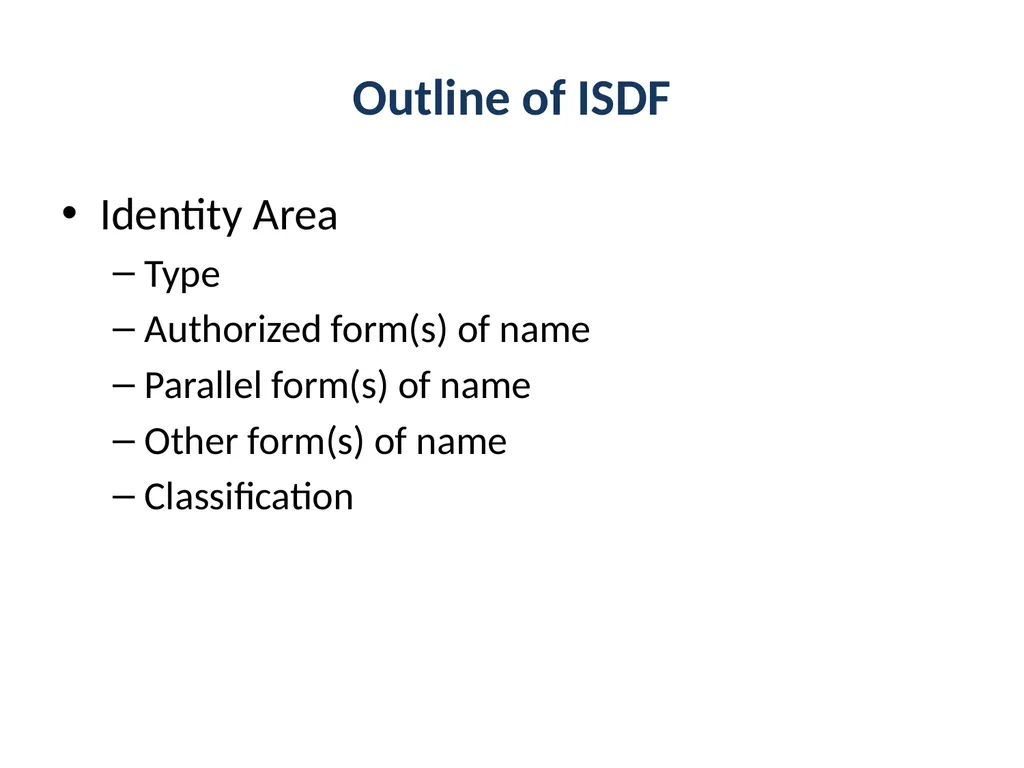
Identity Area
Type
Authorized form(s) of name
Parallel form(s) of name
Other form(s) of name
Classification Outline of ISDF<br>
12
Context Area
Dates
Description
History
Legislation Outline of ISDF<br>
13
Relationships Area
Authorized form(s) of name/Identifier of related function
Type
Category
Description of relationship
Dates of relationship Outline of ISDF<br>
14
We need an EAC-F Standard Karsten Kühnel, “The Role of Functional Provenance between Archival Appraisal and Description – do we need an EAC-F standard?”
http://www.apex-project.eu/index.php/en/articles/210-the-role-of-functional-provenance-between-archival-appraisal-and-description-do-we-need-an-eac-f-standard<br>
15
TS-EAC and Functions<br>
16
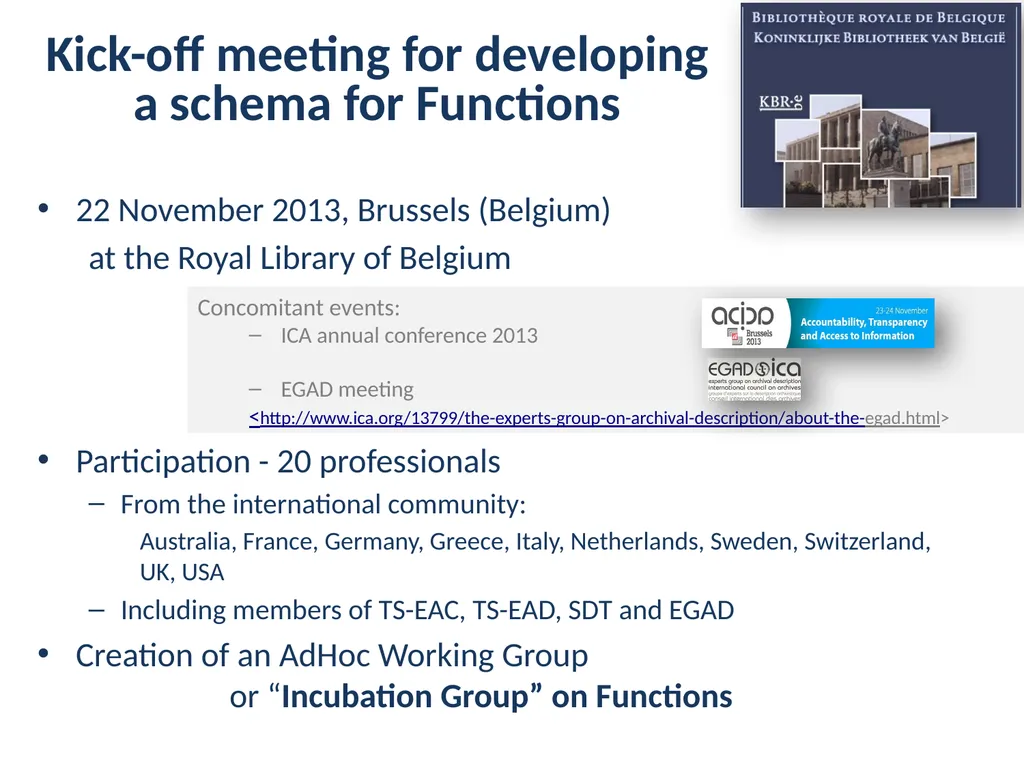
Concomitant events:
ICA annual conference 2013
EGAD meeting
<http://www.ica.org/13799/the-experts-group-on-archival-description/about-the-egad.html> Kick-off meeting for developing �a schema for Functions Participation - 20 professionals
From the international community:
Australia, France, Germany, Greece, Italy, Netherlands, Sweden, Switzerland, UK, USA
Including members of TS-EAC, TS-EAD, SDT and EGAD
Creation of an AdHoc Working Group � or “Incubation Group” on Functions 22 November 2013, Brussels (Belgium)
at the Royal Library of Belgium<br>
17
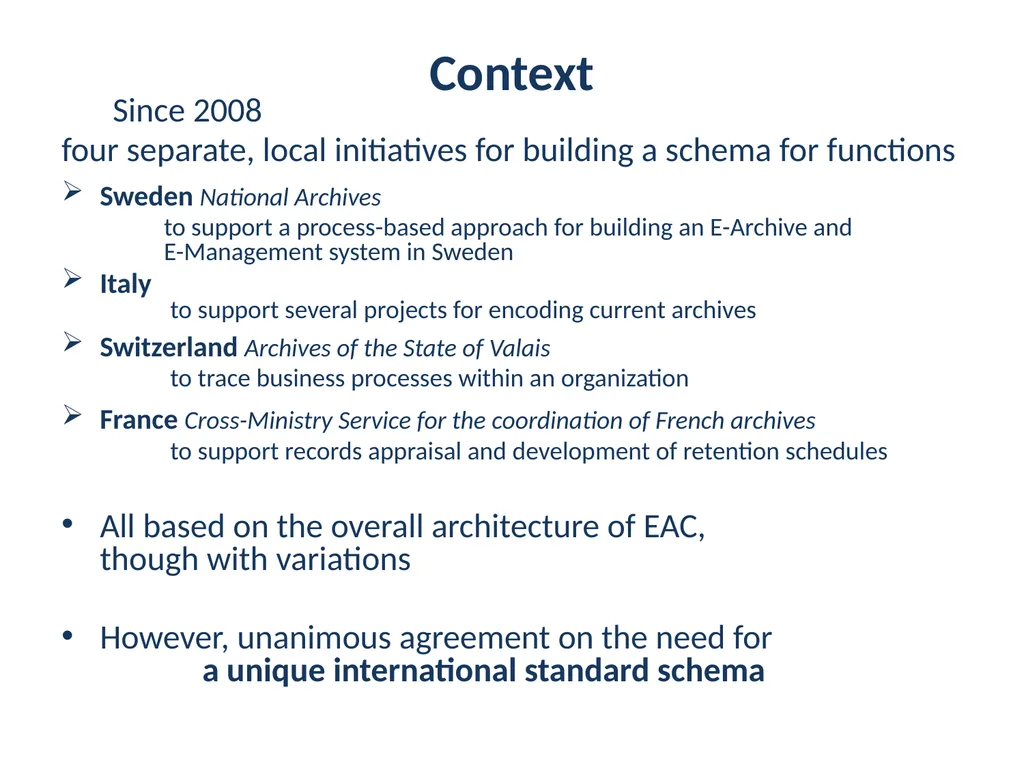
Context Since 2008
four separate, local initiatives for building a schema for functions
Sweden National Archives
to support a process-based approach for building an E-Archive and �E-Management system in Sweden
Italy
to support several projects for encoding current archives
Switzerland Archives of the State of Valais
to trace business processes within an organization
France Cross-Ministry Service for the coordination of French archives
to support records appraisal and development of retention schedules
All based on the overall architecture of EAC, �though with variations
However, unanimous agreement on the need for � a unique international standard schema<br>
18
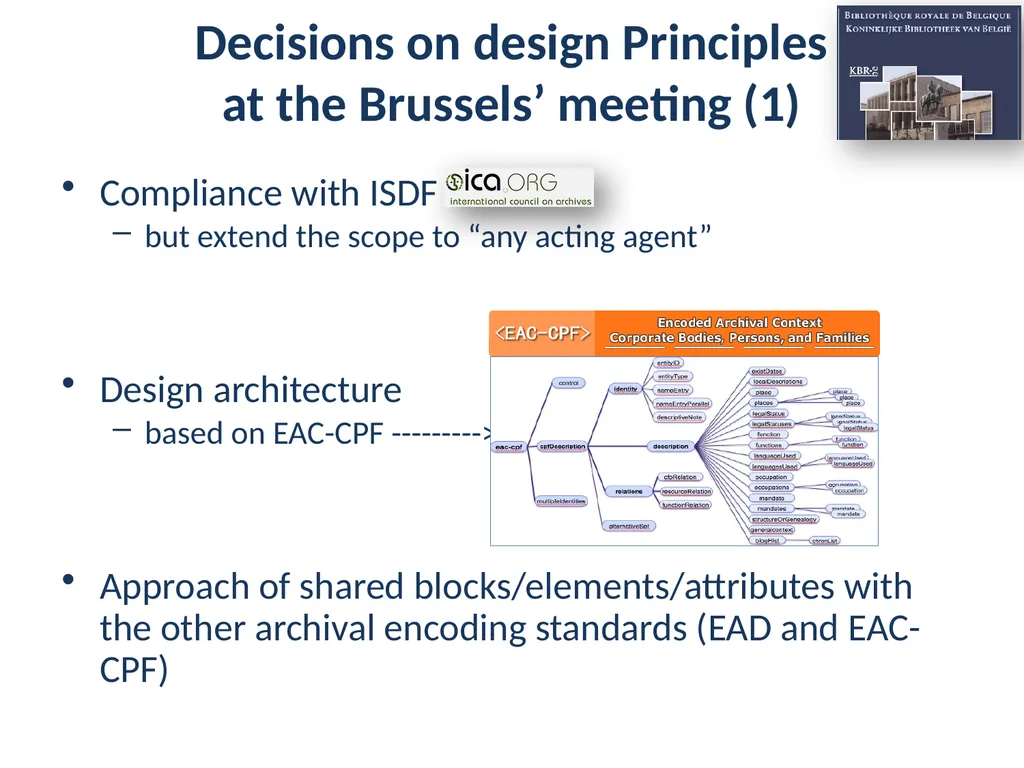
Decisions on design Principles�at the Brussels’ meeting (1) Compliance with ISDF
but extend the scope to “any acting agent”
Design architecture
based on EAC-CPF --------->
Approach of shared blocks/elements/attributes with the other archival encoding standards (EAD and EAC-CPF)<br>
19
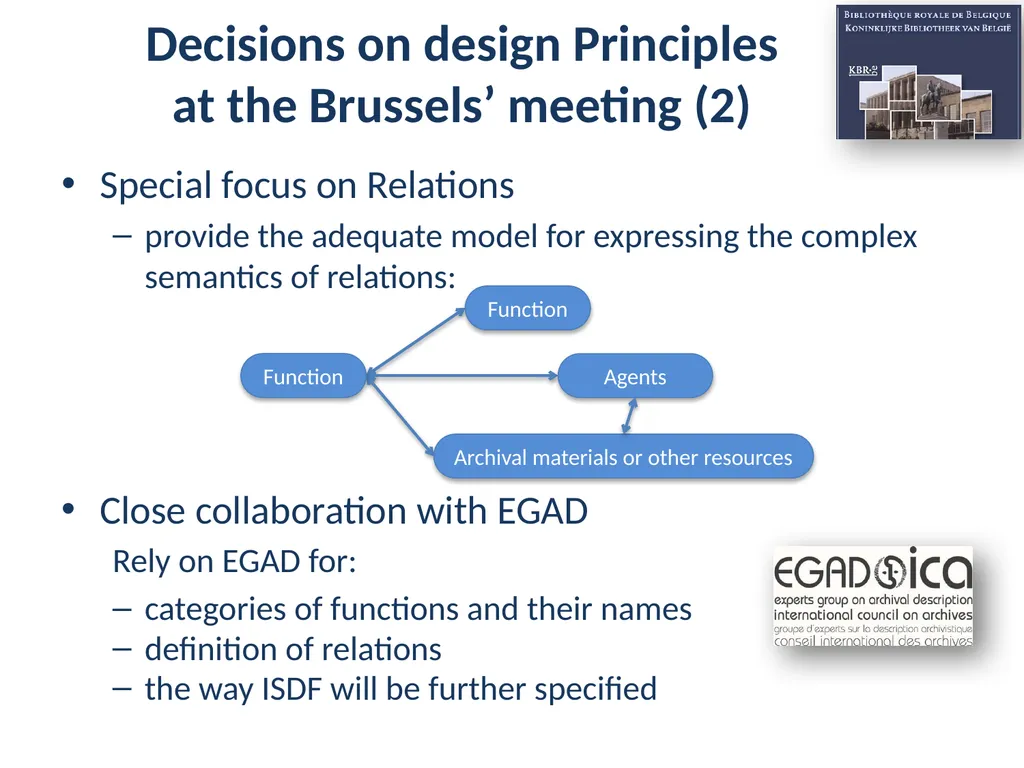
Special focus on Relations
provide the adequate model for expressing the complex semantics of relations: Decisions on design Principles�at the Brussels’ meeting (2) Close collaboration with EGAD
Rely on EGAD for:
categories of functions and their names
definition of relations
the way ISDF will be further specified Function Function Agents Archival materials or other resources<br>
20
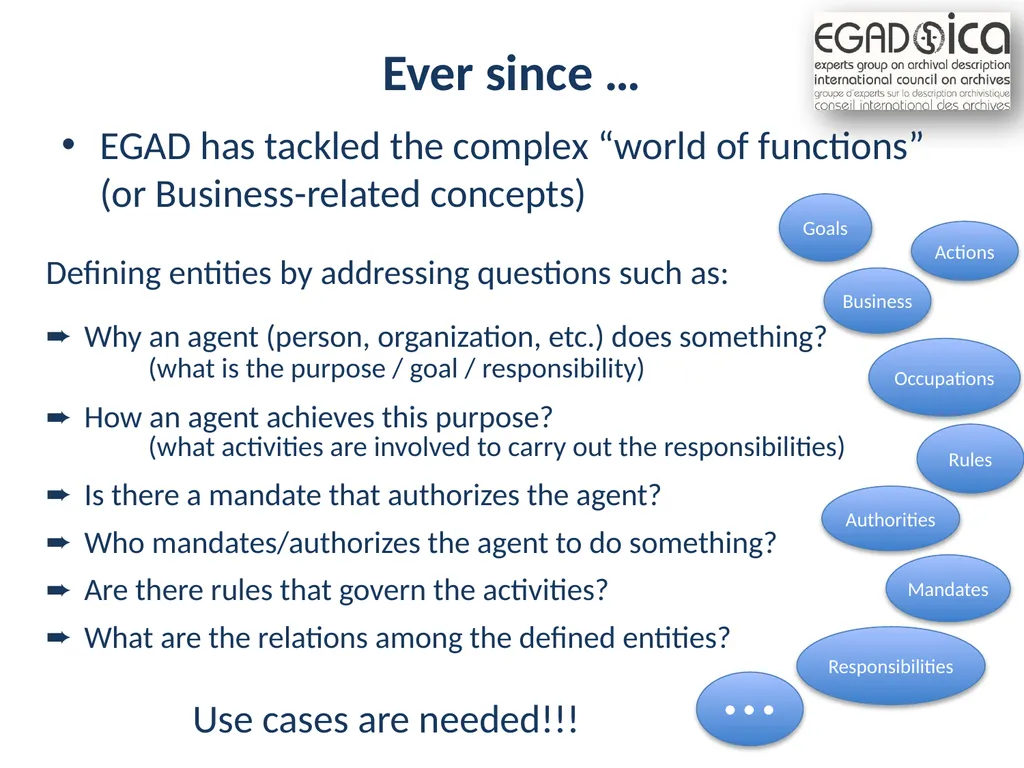
EGAD has tackled the complex “world of functions” �(or Business-related concepts) Goals Ever since … Use cases are needed!!! Actions Defining entities by addressing questions such as:
Why an agent (person, organization, etc.) does something?
(what is the purpose / goal / responsibility)
How an agent achieves this purpose?
(what activities are involved to carry out the responsibilities)
Is there a mandate that authorizes the agent?
Who mandates/authorizes the agent to do something?
Are there rules that govern the activities?
What are the relations among the defined entities? Occupations Responsibilities Mandates Authorities Rules … Business<br>
21
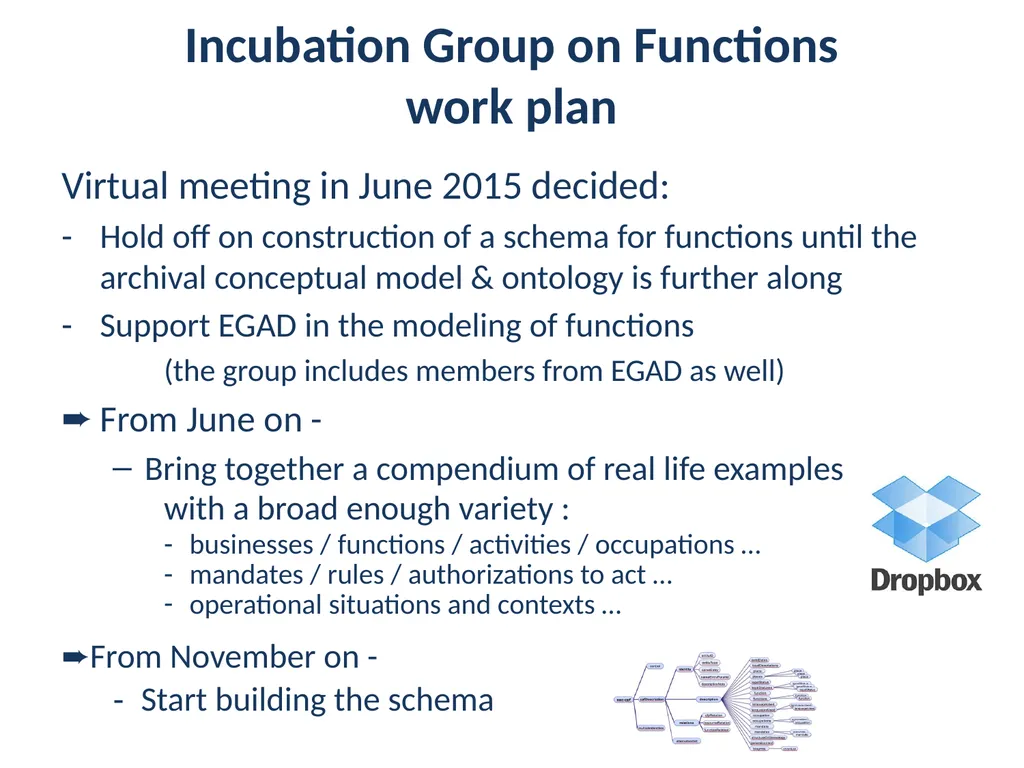
Incubation Group on Functions�work plan Virtual meeting in June 2015 decided:
Hold off on construction of a schema for functions until the archival conceptual model & ontology is further along
Support EGAD in the modeling of functions
(the group includes members from EGAD as well)
From June on -
Bring together a compendium of real life examples
with a broad enough variety :
businesses / functions / activities / occupations …
mandates / rules / authorizations to act …
operational situations and contexts …
➨From November on -
Start building the schema<br>
22
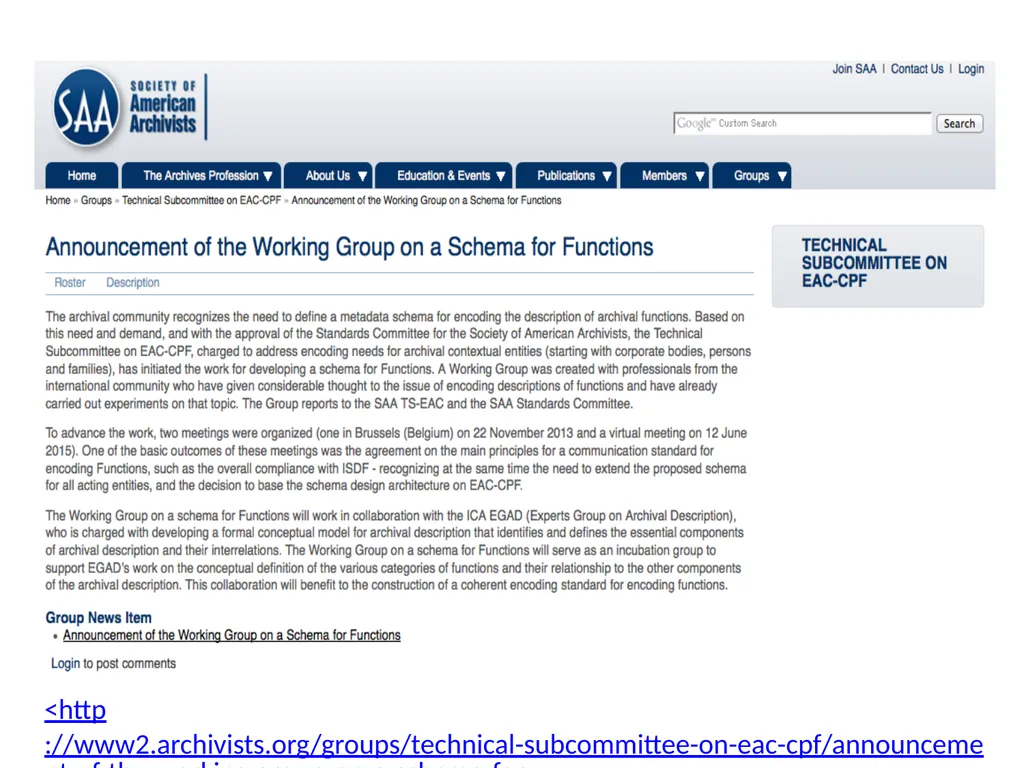
<http://www2.archivists.org/groups/technical-subcommittee-on-eac-cpf/announcement-of-the-working-group-on-a-schema-for-function><br>