
FIWARE Data Spaces Decentralized Identity and
LV
Published · 46 slides · 0 views
1 / 1

Description
FIWARE Data Spaces Decentralized Identity and Access Management Stefan Wiedemann - Senior Software Engineer Decentralized IAM Decentralized IAM in Data Spaces - Why? Introduction into Decentralized Identity Verifiable Credentials
Related Topics
Share
Embed code
Download this presentation From Below
"FIWARE Data Spaces Decentralized Identity and" is the property of its rightful owner. Permission is granted to download and print the materials on this website for personal, non-commercial use only, and to display it on your personal computer provided you do not modify the materials and that you retain all copyright notices contained in the materials. By downloading content from our website, you accept the terms of this agreement.
Presentation Transcript
01
FIWARE Data Spaces
Decentralized Identity and Access Management Stefan Wiedemann - Senior Software Engineer<br>
Decentralized Identity and Access Management Stefan Wiedemann - Senior Software Engineer<br>
02
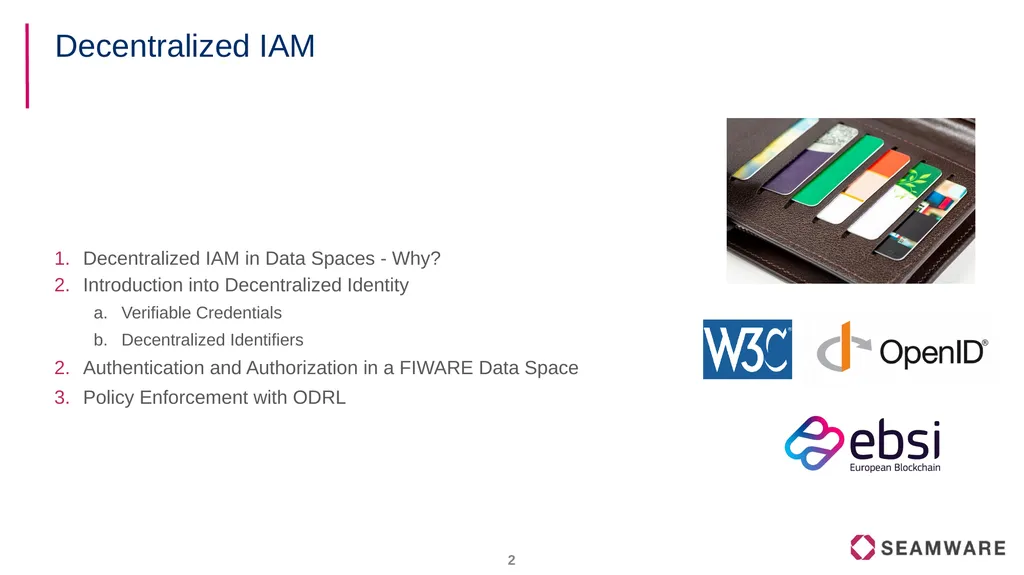
Decentralized IAM Decentralized IAM in Data Spaces - Why?
Introduction into Decentralized Identity
Verifiable Credentials
Decentralized Identifiers
Authentication and Authorization in a FIWARE Data Space
Policy Enforcement with ODRL 1<br>
Introduction into Decentralized Identity
Verifiable Credentials
Decentralized Identifiers
Authentication and Authorization in a FIWARE Data Space
Policy Enforcement with ODRL 1<br>
03
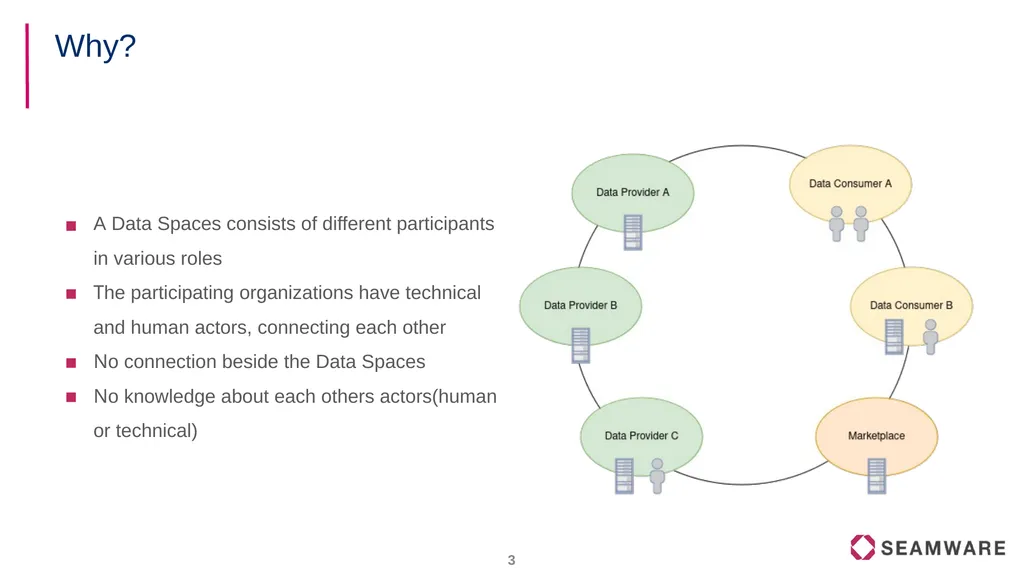
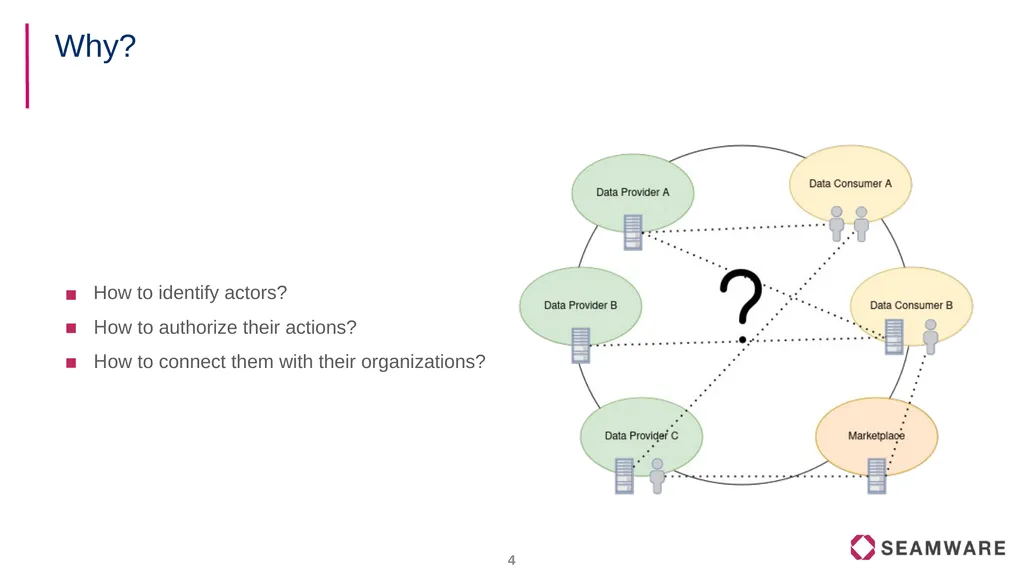
Why? A Data Spaces consists of different participants in various roles
The participating organizations have technical and human actors, connecting each other
No connection beside the Data Spaces
No knowledge about each others actors(human or technical) 2<br>
The participating organizations have technical and human actors, connecting each other
No connection beside the Data Spaces
No knowledge about each others actors(human or technical) 2<br>
04
Why? How to identify actors?
How to authorize their actions?
How to connect them with their organizations? 3<br>
How to authorize their actions?
How to connect them with their organizations? 3<br>
05
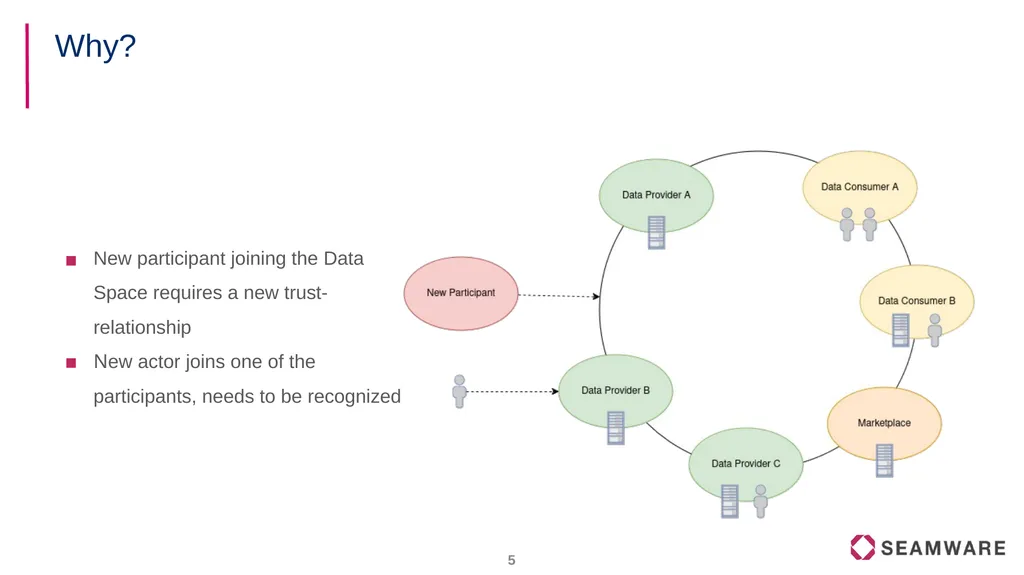
Why? New participant joining the Data Space requires a new trust-relationship
New actor joins one of the participants, needs to be recognized 4<br>
New actor joins one of the participants, needs to be recognized 4<br>
06
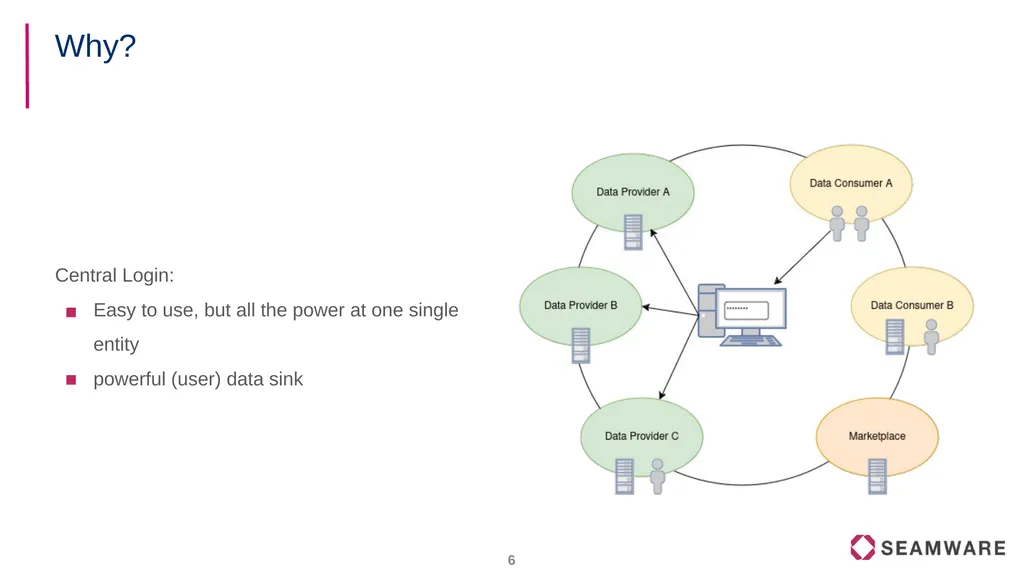
Why? Central Login:
Easy to use, but all the power at one single entity
powerful (user) data sink 5<br>
Easy to use, but all the power at one single entity
powerful (user) data sink 5<br>
07
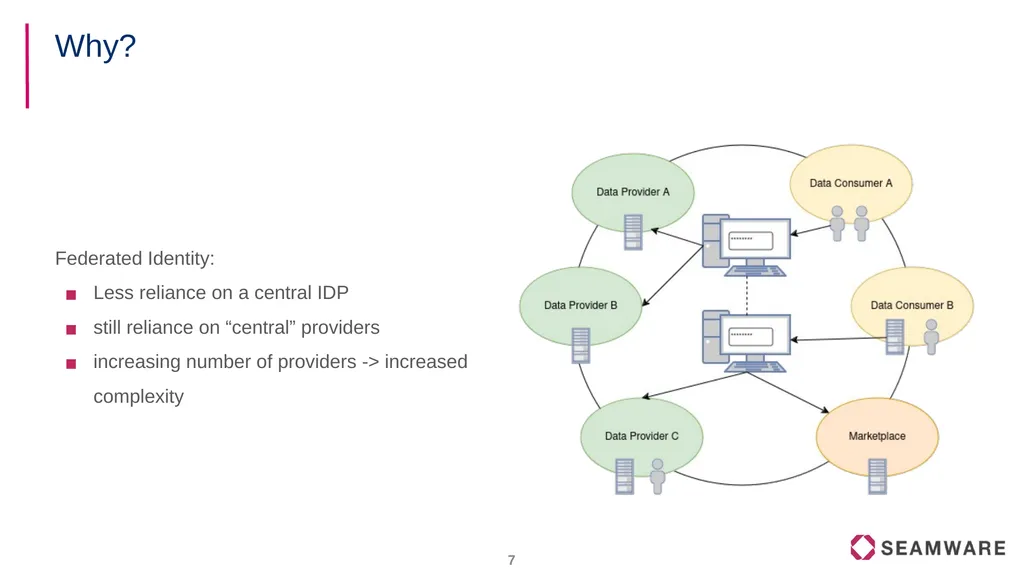
Why? Federated Identity:
Less reliance on a central IDP
still reliance on “central” providers
increasing number of providers -> increased complexity 6<br>
Less reliance on a central IDP
still reliance on “central” providers
increasing number of providers -> increased complexity 6<br>
08
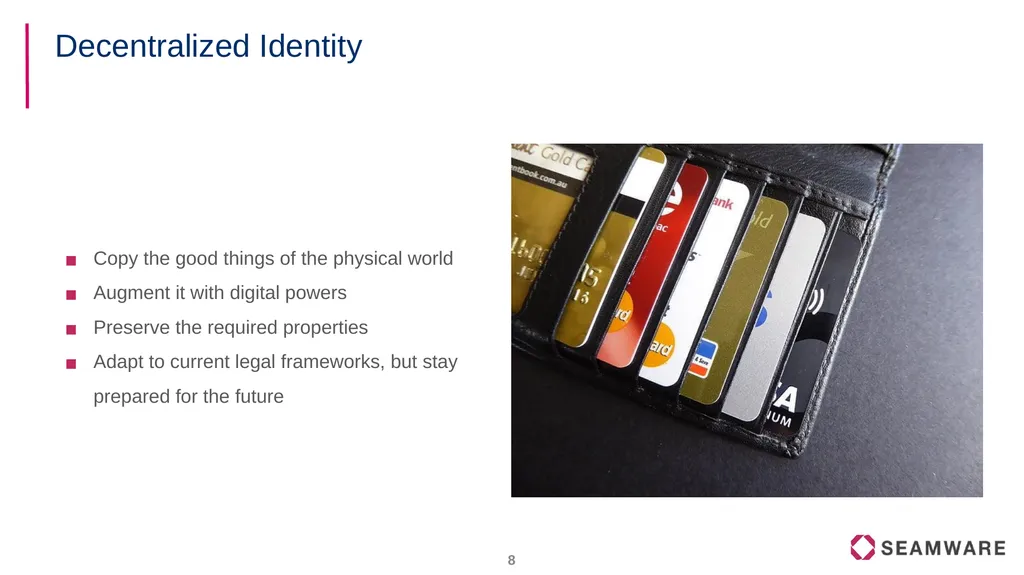
Decentralized Identity Copy the good things of the physical world
Augment it with digital powers
Preserve the required properties
Adapt to current legal frameworks, but stay prepared for the future 7<br>
Augment it with digital powers
Preserve the required properties
Adapt to current legal frameworks, but stay prepared for the future 7<br>
09
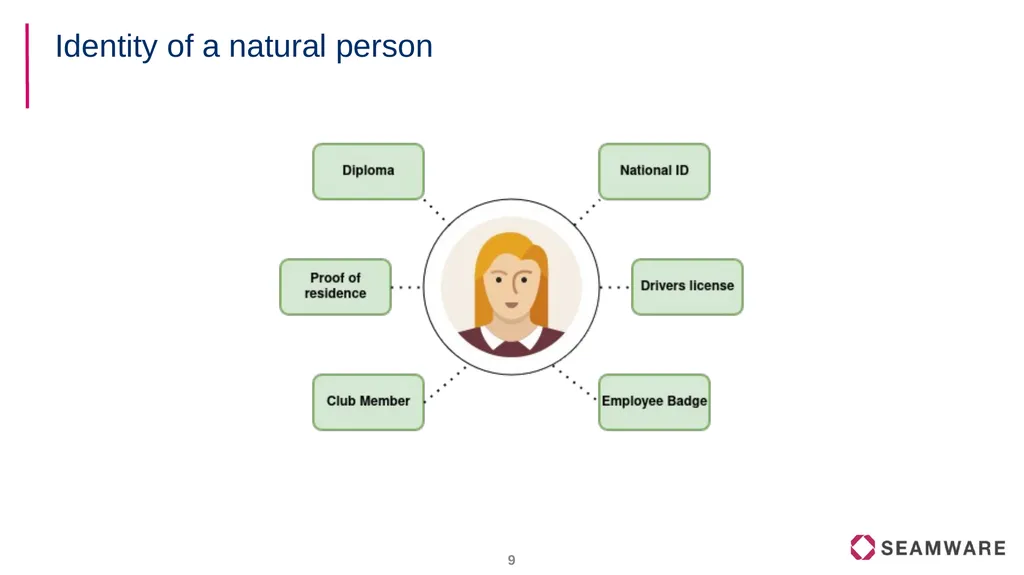
Identity of a natural person 8<br>
10
Identity of a legal person 9<br>
11
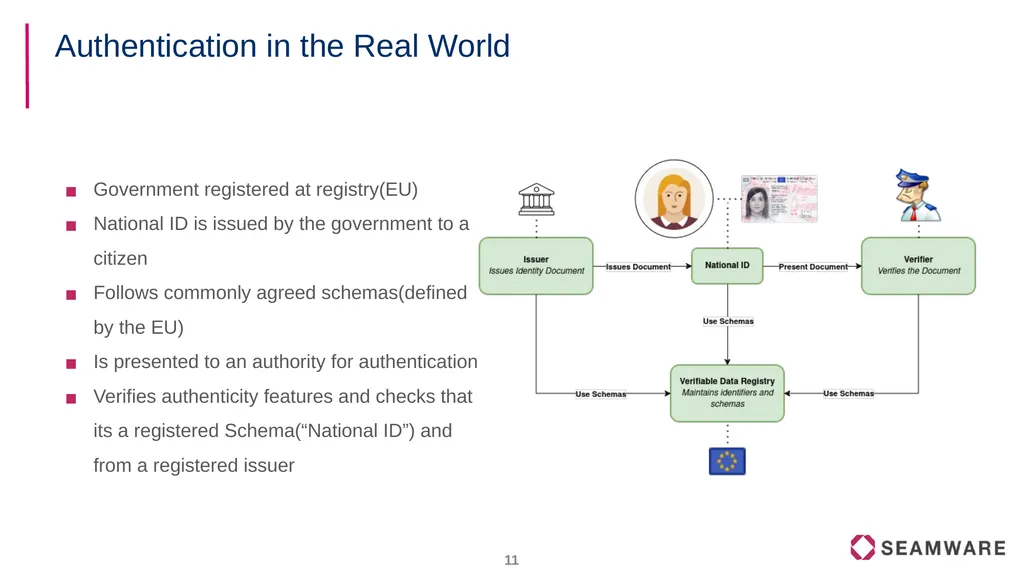
Authentication in the Real World Government registered at registry(EU)
National ID is issued by the government to a citizen
Follows commonly agreed schemas(defined by the EU)
Is presented to an authority for authentication
Verifies authenticity features and checks that its a registered Schema(“National ID”) and from a registered issuer 10<br>
National ID is issued by the government to a citizen
Follows commonly agreed schemas(defined by the EU)
Is presented to an authority for authentication
Verifies authenticity features and checks that its a registered Schema(“National ID”) and from a registered issuer 10<br>
12
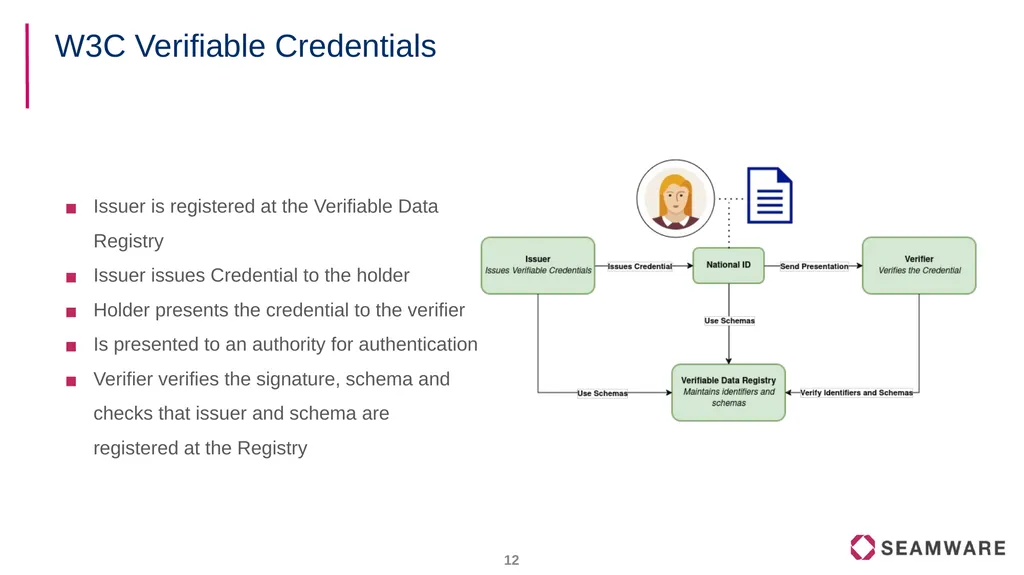
W3C Verifiable Credentials Issuer is registered at the Verifiable Data Registry
Issuer issues Credential to the holder
Holder presents the credential to the verifier
Is presented to an authority for authentication
Verifier verifies the signature, schema and checks that issuer and schema are registered at the Registry 11<br>
Issuer issues Credential to the holder
Holder presents the credential to the verifier
Is presented to an authority for authentication
Verifier verifies the signature, schema and checks that issuer and schema are registered at the Registry 11<br>
13
W3C Verifiable Credentials Specified by W3C - VC-Data-Model-2.0
Defines a basic document structure and the essential features of the credential documents
Can contain any kind of (json-representable) data
Tamper-proof, due to digital signatures as part of the credential
Already adopted by various regulatory and standardization bodys(f.e. EUDI Wallet Reference Architecture, OpenID4VC) 12 Verifiable Credentials are tamper-proof, digitally signed documents that securely prove claims about an individual or entity, allowing verification without directly involving the issuer.<br>
Defines a basic document structure and the essential features of the credential documents
Can contain any kind of (json-representable) data
Tamper-proof, due to digital signatures as part of the credential
Already adopted by various regulatory and standardization bodys(f.e. EUDI Wallet Reference Architecture, OpenID4VC) 12 Verifiable Credentials are tamper-proof, digitally signed documents that securely prove claims about an individual or entity, allowing verification without directly involving the issuer.<br>
14
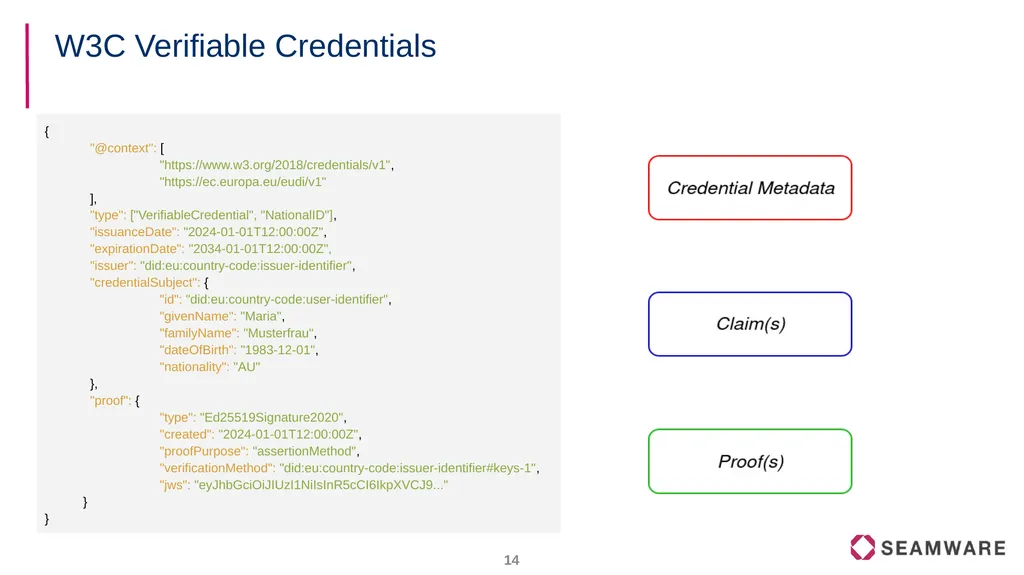
W3C Verifiable Credentials 13 {
"@context": [
"https://www.w3.org/2018/credentials/v1",
"https://ec.europa.eu/eudi/v1"
],
"type": ["VerifiableCredential", "NationalID"],
"issuanceDate": "2024-01-01T12:00:00Z",
"expirationDate": "2034-01-01T12:00:00Z",
"issuer": "did:eu:country-code:issuer-identifier",
"credentialSubject": {
"id": "did:eu:country-code:user-identifier",
"givenName": "Maria",
"familyName": "Musterfrau",
"dateOfBirth": "1983-12-01",
"nationality": "AU"
},
"proof": {
"type": "Ed25519Signature2020",
"created": "2024-01-01T12:00:00Z",
"proofPurpose": "assertionMethod",
"verificationMethod": "did:eu:country-code:issuer-identifier#keys-1",
"jws": "eyJhbGciOiJIUzI1NiIsInR5cCI6IkpXVCJ9..."
}
}<br>
"@context": [
"https://www.w3.org/2018/credentials/v1",
"https://ec.europa.eu/eudi/v1"
],
"type": ["VerifiableCredential", "NationalID"],
"issuanceDate": "2024-01-01T12:00:00Z",
"expirationDate": "2034-01-01T12:00:00Z",
"issuer": "did:eu:country-code:issuer-identifier",
"credentialSubject": {
"id": "did:eu:country-code:user-identifier",
"givenName": "Maria",
"familyName": "Musterfrau",
"dateOfBirth": "1983-12-01",
"nationality": "AU"
},
"proof": {
"type": "Ed25519Signature2020",
"created": "2024-01-01T12:00:00Z",
"proofPurpose": "assertionMethod",
"verificationMethod": "did:eu:country-code:issuer-identifier#keys-1",
"jws": "eyJhbGciOiJIUzI1NiIsInR5cCI6IkpXVCJ9..."
}
}<br>
15
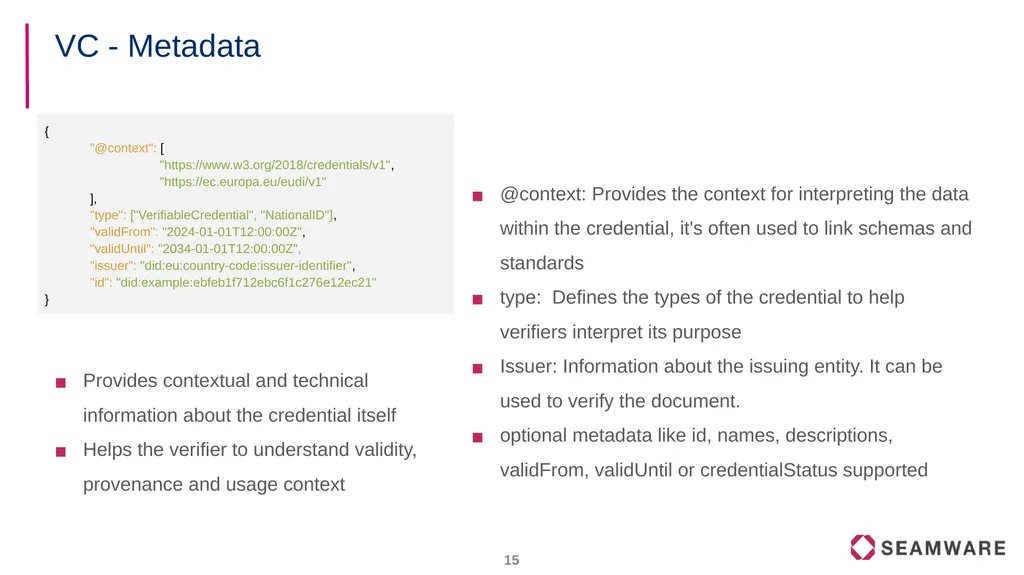
VC - Metadata 14 {
"@context": [
"https://www.w3.org/2018/credentials/v1",
"https://ec.europa.eu/eudi/v1"
],
"type": ["VerifiableCredential", "NationalID"],
"validFrom": "2024-01-01T12:00:00Z",
"validUntil": "2034-01-01T12:00:00Z",
"issuer": "did:eu:country-code:issuer-identifier",
"id": "did:example:ebfeb1f712ebc6f1c276e12ec21"
} Provides contextual and technical information about the credential itself
Helps the verifier to understand validity, provenance and usage context @context: Provides the context for interpreting the data within the credential, it's often used to link schemas and standards
type: Defines the types of the credential to help verifiers interpret its purpose
Issuer: Information about the issuing entity. It can be used to verify the document.
optional metadata like id, names, descriptions, validFrom, validUntil or credentialStatus supported<br>
"@context": [
"https://www.w3.org/2018/credentials/v1",
"https://ec.europa.eu/eudi/v1"
],
"type": ["VerifiableCredential", "NationalID"],
"validFrom": "2024-01-01T12:00:00Z",
"validUntil": "2034-01-01T12:00:00Z",
"issuer": "did:eu:country-code:issuer-identifier",
"id": "did:example:ebfeb1f712ebc6f1c276e12ec21"
} Provides contextual and technical information about the credential itself
Helps the verifier to understand validity, provenance and usage context @context: Provides the context for interpreting the data within the credential, it's often used to link schemas and standards
type: Defines the types of the credential to help verifiers interpret its purpose
Issuer: Information about the issuing entity. It can be used to verify the document.
optional metadata like id, names, descriptions, validFrom, validUntil or credentialStatus supported<br>
16
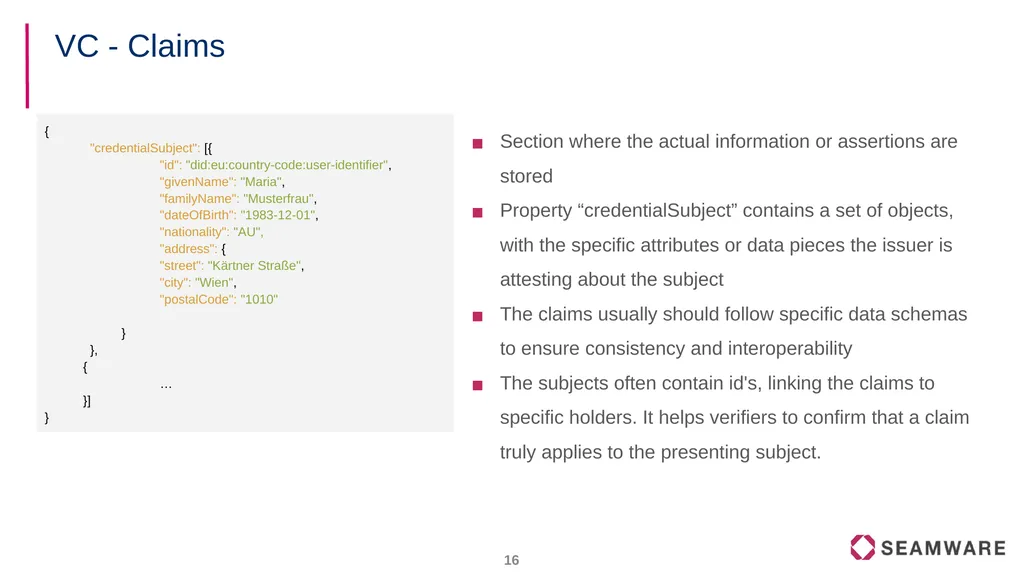
VC - Claims 15 {
"credentialSubject": [{
"id": "did:eu:country-code:user-identifier",
"givenName": "Maria",
"familyName": "Musterfrau",
"dateOfBirth": "1983-12-01",
"nationality": "AU",
"address": {
"street": "Kärtner Straße",
"city": "Wien",
"postalCode": "1010"
}
},
{
…
}]
} Section where the actual information or assertions are stored
Property “credentialSubject” contains a set of objects, with the specific attributes or data pieces the issuer is attesting about the subject
The claims usually should follow specific data schemas to ensure consistency and interoperability
The subjects often contain id's, linking the claims to specific holders. It helps verifiers to confirm that a claim truly applies to the presenting subject.<br>
"credentialSubject": [{
"id": "did:eu:country-code:user-identifier",
"givenName": "Maria",
"familyName": "Musterfrau",
"dateOfBirth": "1983-12-01",
"nationality": "AU",
"address": {
"street": "Kärtner Straße",
"city": "Wien",
"postalCode": "1010"
}
},
{
…
}]
} Section where the actual information or assertions are stored
Property “credentialSubject” contains a set of objects, with the specific attributes or data pieces the issuer is attesting about the subject
The claims usually should follow specific data schemas to ensure consistency and interoperability
The subjects often contain id's, linking the claims to specific holders. It helps verifiers to confirm that a claim truly applies to the presenting subject.<br>
17
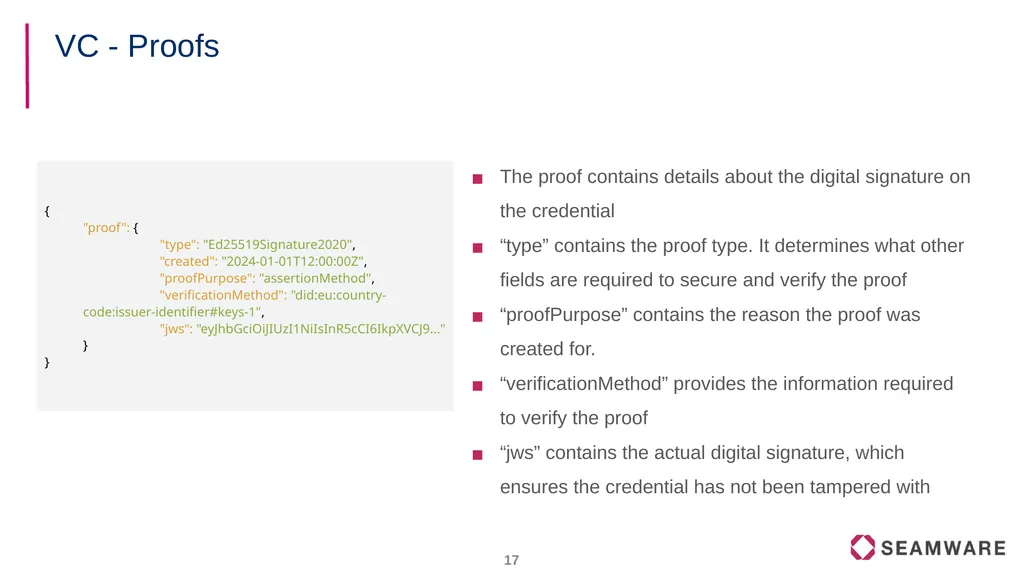
VC - Proofs 16 {
"proof": {
"type": "Ed25519Signature2020",
"created": "2024-01-01T12:00:00Z",
"proofPurpose": "assertionMethod",
"verificationMethod": "did:eu:country-code:issuer-identifier#keys-1",
"jws": "eyJhbGciOiJIUzI1NiIsInR5cCI6IkpXVCJ9..."
}
} The proof contains details about the digital signature on the credential
“type” contains the proof type. It determines what other fields are required to secure and verify the proof
“proofPurpose” contains the reason the proof was created for.
“verificationMethod” provides the information required to verify the proof
“jws” contains the actual digital signature, which ensures the credential has not been tampered with<br>
"proof": {
"type": "Ed25519Signature2020",
"created": "2024-01-01T12:00:00Z",
"proofPurpose": "assertionMethod",
"verificationMethod": "did:eu:country-code:issuer-identifier#keys-1",
"jws": "eyJhbGciOiJIUzI1NiIsInR5cCI6IkpXVCJ9..."
}
} The proof contains details about the digital signature on the credential
“type” contains the proof type. It determines what other fields are required to secure and verify the proof
“proofPurpose” contains the reason the proof was created for.
“verificationMethod” provides the information required to verify the proof
“jws” contains the actual digital signature, which ensures the credential has not been tampered with<br>
18
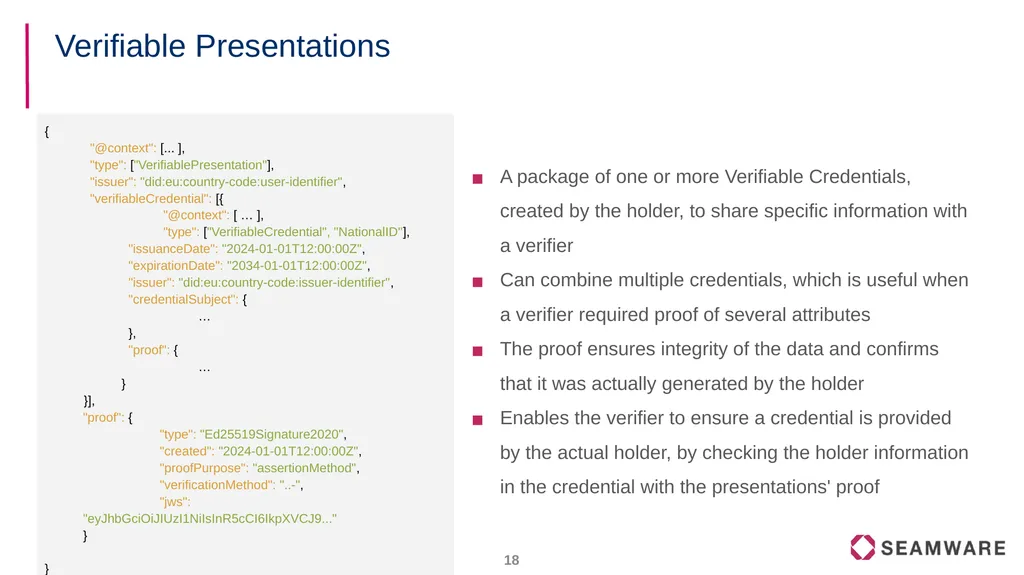
Verifiable Presentations 17 {
"@context": [... ],
"type": ["VerifiablePresentation"],
"issuer": "did:eu:country-code:user-identifier",
"verifiableCredential": [{
"@context": [ … ],
"type": ["VerifiableCredential", "NationalID"],
"issuanceDate": "2024-01-01T12:00:00Z",
"expirationDate": "2034-01-01T12:00:00Z",
"issuer": "did:eu:country-code:issuer-identifier",
"credentialSubject": {
…
},
"proof": {
…
}
}],
"proof": {
"type": "Ed25519Signature2020",
"created": "2024-01-01T12:00:00Z",
"proofPurpose": "assertionMethod",
"verificationMethod": "..-",
"jws": "eyJhbGciOiJIUzI1NiIsInR5cCI6IkpXVCJ9..."
}
} A package of one or more Verifiable Credentials, created by the holder, to share specific information with a verifier
Can combine multiple credentials, which is useful when a verifier required proof of several attributes
The proof ensures integrity of the data and confirms that it was actually generated by the holder
Enables the verifier to ensure a credential is provided by the actual holder, by checking the holder information in the credential with the presentations' proof<br>
"@context": [... ],
"type": ["VerifiablePresentation"],
"issuer": "did:eu:country-code:user-identifier",
"verifiableCredential": [{
"@context": [ … ],
"type": ["VerifiableCredential", "NationalID"],
"issuanceDate": "2024-01-01T12:00:00Z",
"expirationDate": "2034-01-01T12:00:00Z",
"issuer": "did:eu:country-code:issuer-identifier",
"credentialSubject": {
…
},
"proof": {
…
}
}],
"proof": {
"type": "Ed25519Signature2020",
"created": "2024-01-01T12:00:00Z",
"proofPurpose": "assertionMethod",
"verificationMethod": "..-",
"jws": "eyJhbGciOiJIUzI1NiIsInR5cCI6IkpXVCJ9..."
}
} A package of one or more Verifiable Credentials, created by the holder, to share specific information with a verifier
Can combine multiple credentials, which is useful when a verifier required proof of several attributes
The proof ensures integrity of the data and confirms that it was actually generated by the holder
Enables the verifier to ensure a credential is provided by the actual holder, by checking the holder information in the credential with the presentations' proof<br>
19
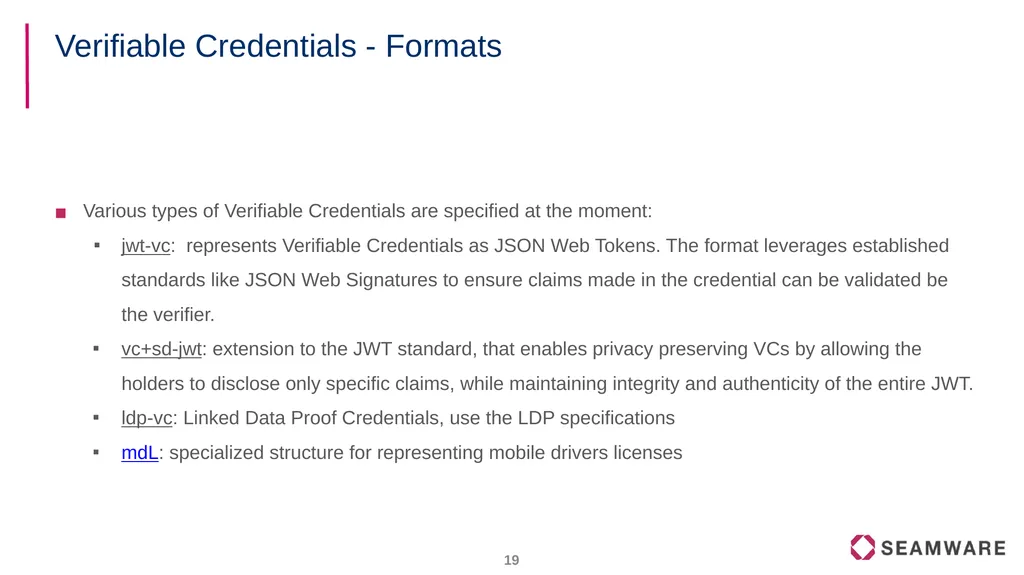
Verifiable Credentials - Formats Various types of Verifiable Credentials are specified at the moment:
jwt-vc: represents Verifiable Credentials as JSON Web Tokens. The format leverages established standards like JSON Web Signatures to ensure claims made in the credential can be validated be the verifier.
vc+sd-jwt: extension to the JWT standard, that enables privacy preserving VCs by allowing the holders to disclose only specific claims, while maintaining integrity and authenticity of the entire JWT.
ldp-vc: Linked Data Proof Credentials, use the LDP specifications
mdL: specialized structure for representing mobile drivers licenses 18<br>
jwt-vc: represents Verifiable Credentials as JSON Web Tokens. The format leverages established standards like JSON Web Signatures to ensure claims made in the credential can be validated be the verifier.
vc+sd-jwt: extension to the JWT standard, that enables privacy preserving VCs by allowing the holders to disclose only specific claims, while maintaining integrity and authenticity of the entire JWT.
ldp-vc: Linked Data Proof Credentials, use the LDP specifications
mdL: specialized structure for representing mobile drivers licenses 18<br>
20
Decentralized Identifiers Specified by W3C - Decentralized Identifiers
Defines the syntax of an identifier
Allows the controller of the identity to prove control without requiring permission from anyone else
Tamper-proof, due to digital signatures as part of the credential
DIDs are URIs associated with a document allowing trustable interaction. The document can contain:
cryptographic material
verification methods
services to prove control 19 Decentralized Identifiers(DIDs) are a new type of identifier that enables verifiable, self-sovereign digital identities without relying on a central authority, allowing individual to control their own identities and associated data securely and independent.<br>
Defines the syntax of an identifier
Allows the controller of the identity to prove control without requiring permission from anyone else
Tamper-proof, due to digital signatures as part of the credential
DIDs are URIs associated with a document allowing trustable interaction. The document can contain:
cryptographic material
verification methods
services to prove control 19 Decentralized Identifiers(DIDs) are a new type of identifier that enables verifiable, self-sovereign digital identities without relying on a central authority, allowing individual to control their own identities and associated data securely and independent.<br>
21
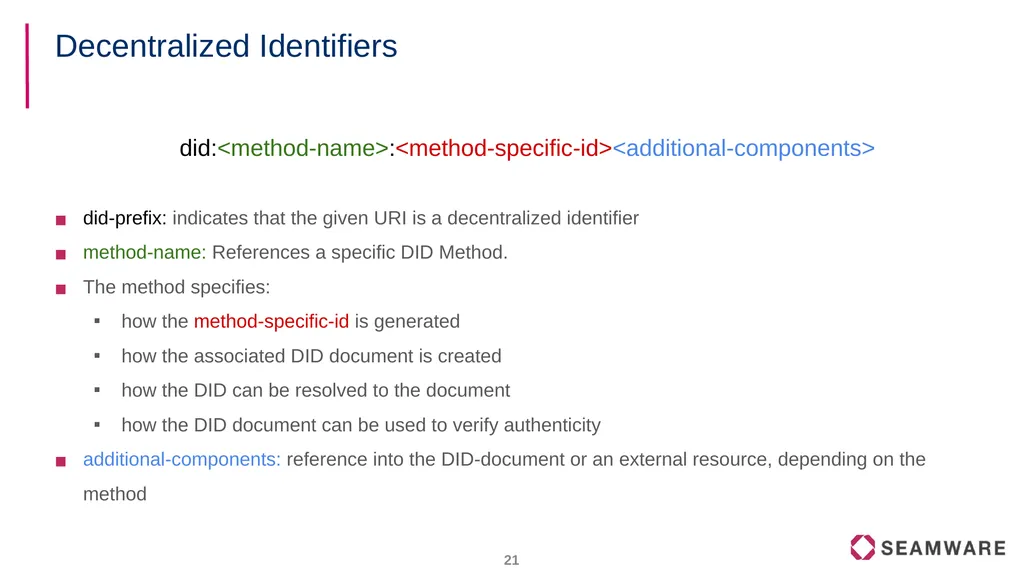
Decentralized Identifiers did-prefix: indicates that the given URI is a decentralized identifier
method-name: References a specific DID Method.
The method specifies:
how the method-specific-id is generated
how the associated DID document is created
how the DID can be resolved to the document
how the DID document can be used to verify authenticity
additional-components: reference into the DID-document or an external resource, depending on the method 20 did:<method-name>:<method-specific-id><additional-components><br>
method-name: References a specific DID Method.
The method specifies:
how the method-specific-id is generated
how the associated DID document is created
how the DID can be resolved to the document
how the DID document can be used to verify authenticity
additional-components: reference into the DID-document or an external resource, depending on the method 20 did:<method-name>:<method-specific-id><additional-components><br>
22
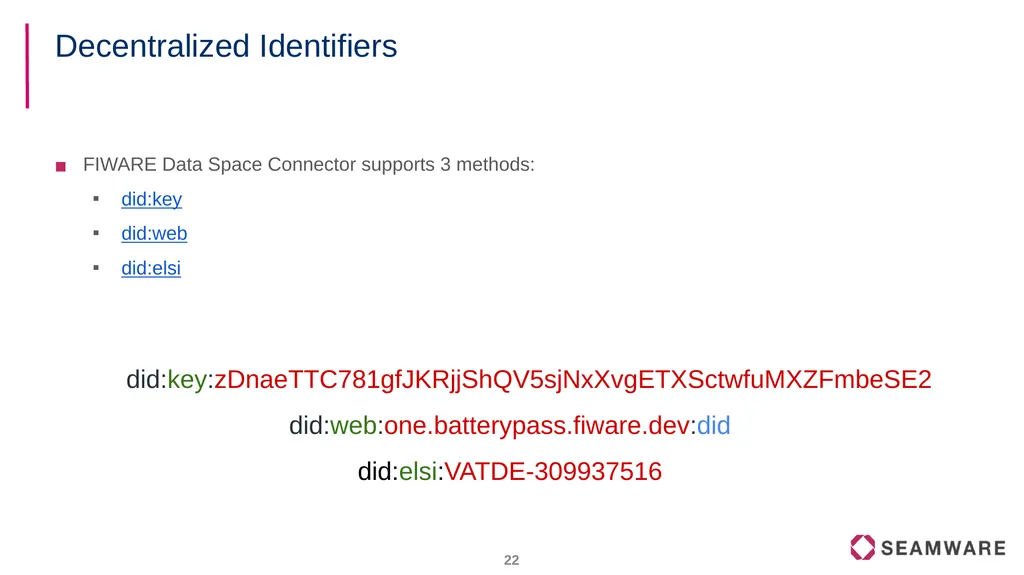
Decentralized Identifiers FIWARE Data Space Connector supports 3 methods:
did:key
did:web
did:elsi
did:key:zDnaeTTC781gfJKRjjShQV5sjNxXvgETXSctwfuMXZFmbeSE2
did:web:one.batterypass.fiware.dev:did
did:elsi:VATDE-309937516 21<br>
did:key
did:web
did:elsi
did:key:zDnaeTTC781gfJKRjjShQV5sjNxXvgETXSctwfuMXZFmbeSE2
did:web:one.batterypass.fiware.dev:did
did:elsi:VATDE-309937516 21<br>
23
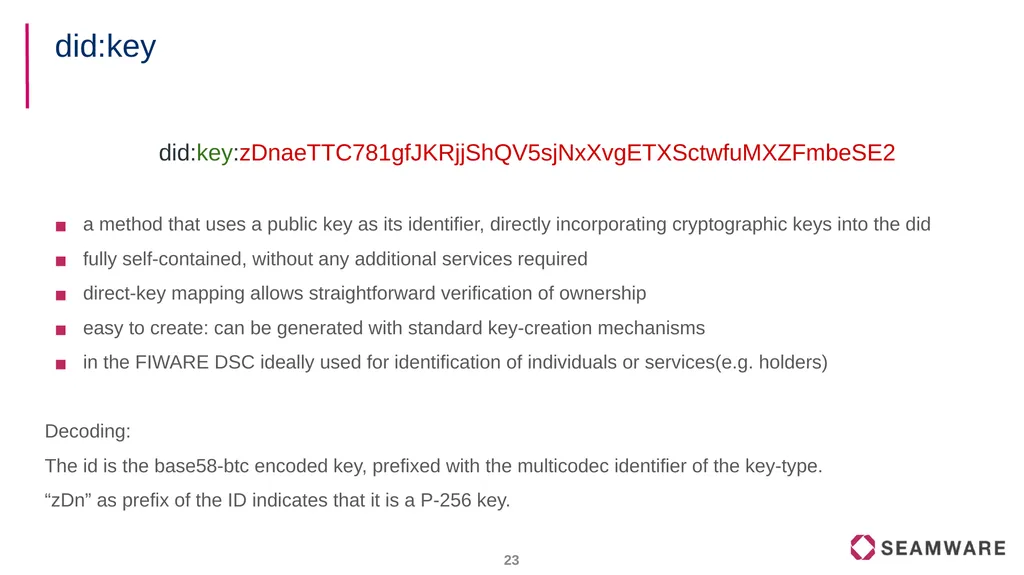
did:key a method that uses a public key as its identifier, directly incorporating cryptographic keys into the did
fully self-contained, without any additional services required
direct-key mapping allows straightforward verification of ownership
easy to create: can be generated with standard key-creation mechanisms
in the FIWARE DSC ideally used for identification of individuals or services(e.g. holders)
Decoding:
The id is the base58-btc encoded key, prefixed with the multicodec identifier of the key-type.
“zDn” as prefix of the ID indicates that it is a P-256 key. 22 did:key:zDnaeTTC781gfJKRjjShQV5sjNxXvgETXSctwfuMXZFmbeSE2<br>
fully self-contained, without any additional services required
direct-key mapping allows straightforward verification of ownership
easy to create: can be generated with standard key-creation mechanisms
in the FIWARE DSC ideally used for identification of individuals or services(e.g. holders)
Decoding:
The id is the base58-btc encoded key, prefixed with the multicodec identifier of the key-type.
“zDn” as prefix of the ID indicates that it is a P-256 key. 22 did:key:zDnaeTTC781gfJKRjjShQV5sjNxXvgETXSctwfuMXZFmbeSE2<br>
24
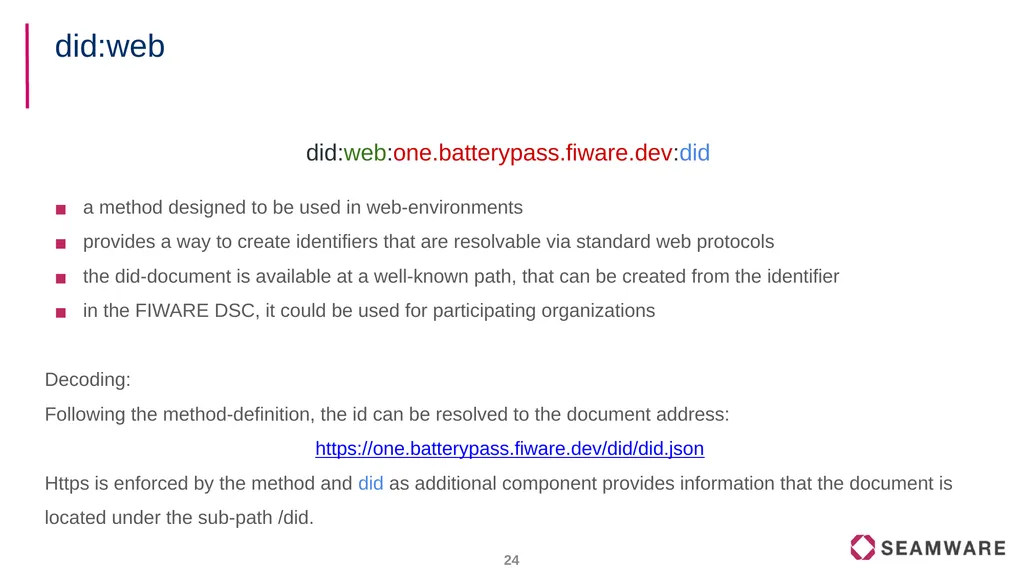
did:web a method designed to be used in web-environments
provides a way to create identifiers that are resolvable via standard web protocols
the did-document is available at a well-known path, that can be created from the identifier
in the FIWARE DSC, it could be used for participating organizations
Decoding:
Following the method-definition, the id can be resolved to the document address:
https://one.batterypass.fiware.dev/did/did.json
Https is enforced by the method and did as additional component provides information that the document is located under the sub-path /did. 23 did:web:one.batterypass.fiware.dev:did<br>
provides a way to create identifiers that are resolvable via standard web protocols
the did-document is available at a well-known path, that can be created from the identifier
in the FIWARE DSC, it could be used for participating organizations
Decoding:
Following the method-definition, the id can be resolved to the document address:
https://one.batterypass.fiware.dev/did/did.json
Https is enforced by the method and did as additional component provides information that the document is located under the sub-path /did. 23 did:web:one.batterypass.fiware.dev:did<br>
25
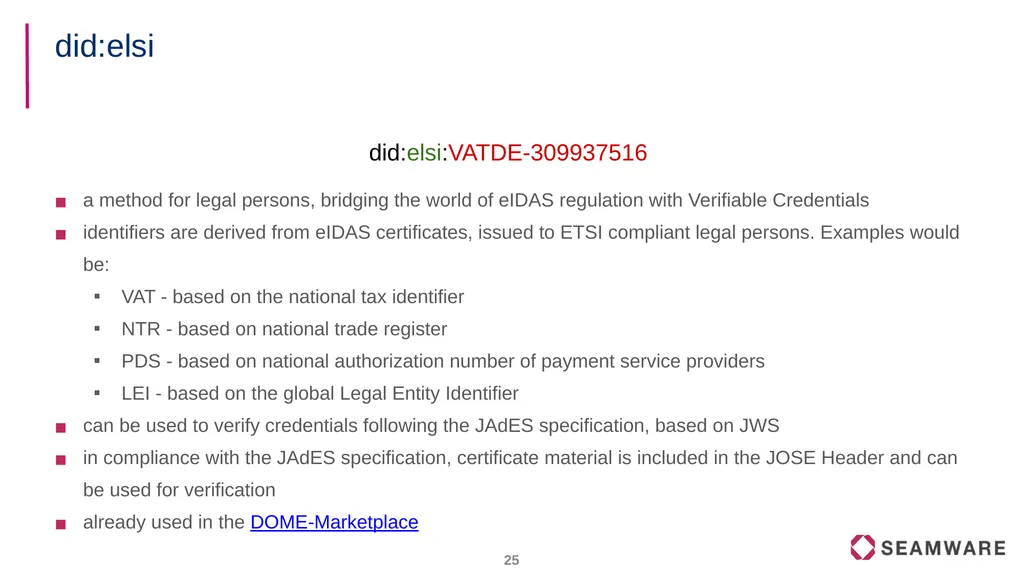
did:elsi a method for legal persons, bridging the world of eIDAS regulation with Verifiable Credentials
identifiers are derived from eIDAS certificates, issued to ETSI compliant legal persons. Examples would be:
VAT - based on the national tax identifier
NTR - based on national trade register
PDS - based on national authorization number of payment service providers
LEI - based on the global Legal Entity Identifier
can be used to verify credentials following the JAdES specification, based on JWS
in compliance with the JAdES specification, certificate material is included in the JOSE Header and can be used for verification
already used in the DOME-Marketplace 24 did:elsi:VATDE-309937516<br>
identifiers are derived from eIDAS certificates, issued to ETSI compliant legal persons. Examples would be:
VAT - based on the national tax identifier
NTR - based on national trade register
PDS - based on national authorization number of payment service providers
LEI - based on the global Legal Entity Identifier
can be used to verify credentials following the JAdES specification, based on JWS
in compliance with the JAdES specification, certificate material is included in the JOSE Header and can be used for verification
already used in the DOME-Marketplace 24 did:elsi:VATDE-309937516<br>
26
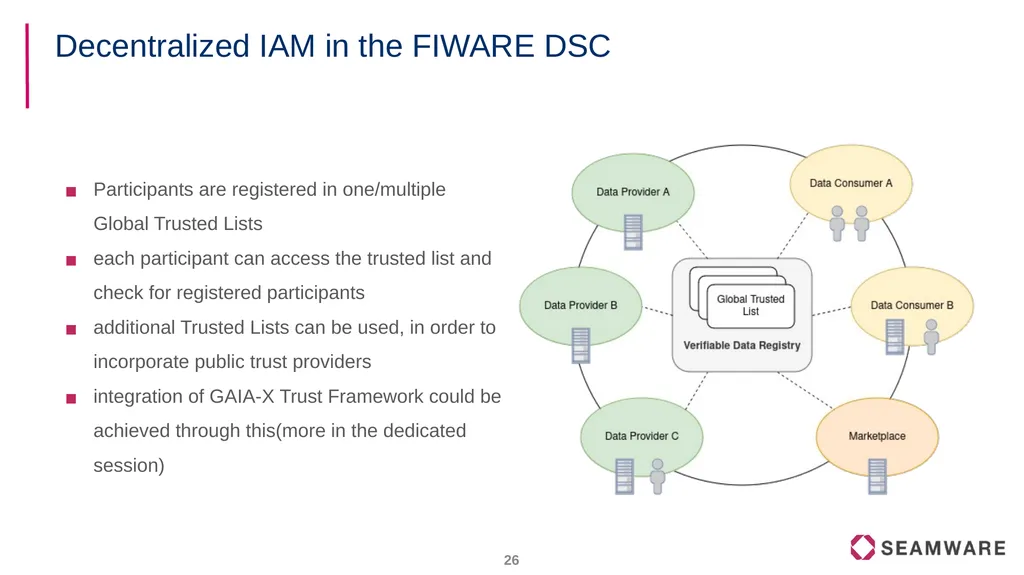
Decentralized IAM in the FIWARE DSC Participants are registered in one/multiple Global Trusted Lists
each participant can access the trusted list and check for registered participants
additional Trusted Lists can be used, in order to incorporate public trust providers
integration of GAIA-X Trust Framework could be achieved through this(more in the dedicated session) 25<br>
each participant can access the trusted list and check for registered participants
additional Trusted Lists can be used, in order to incorporate public trust providers
integration of GAIA-X Trust Framework could be achieved through this(more in the dedicated session) 25<br>
27
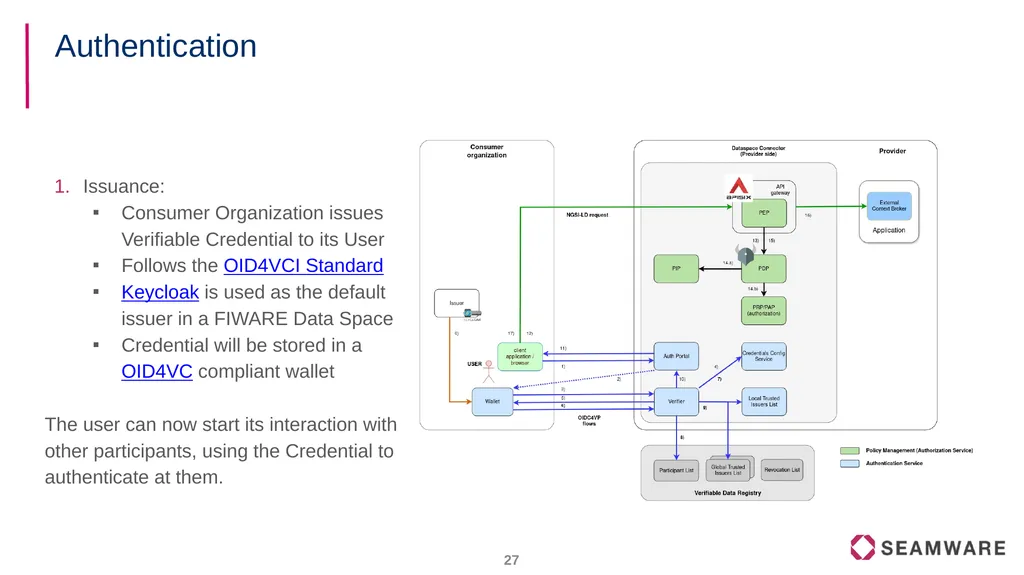
Authentication Issuance:
Consumer Organization issues Verifiable Credential to its User
Follows the OID4VCI Standard
Keycloak is used as the default issuer in a FIWARE Data Space
Credential will be stored in a OID4VC compliant wallet
The user can now start its interaction with other participants, using the Credential to authenticate at them. 26<br>
Consumer Organization issues Verifiable Credential to its User
Follows the OID4VCI Standard
Keycloak is used as the default issuer in a FIWARE Data Space
Credential will be stored in a OID4VC compliant wallet
The user can now start its interaction with other participants, using the Credential to authenticate at them. 26<br>
28
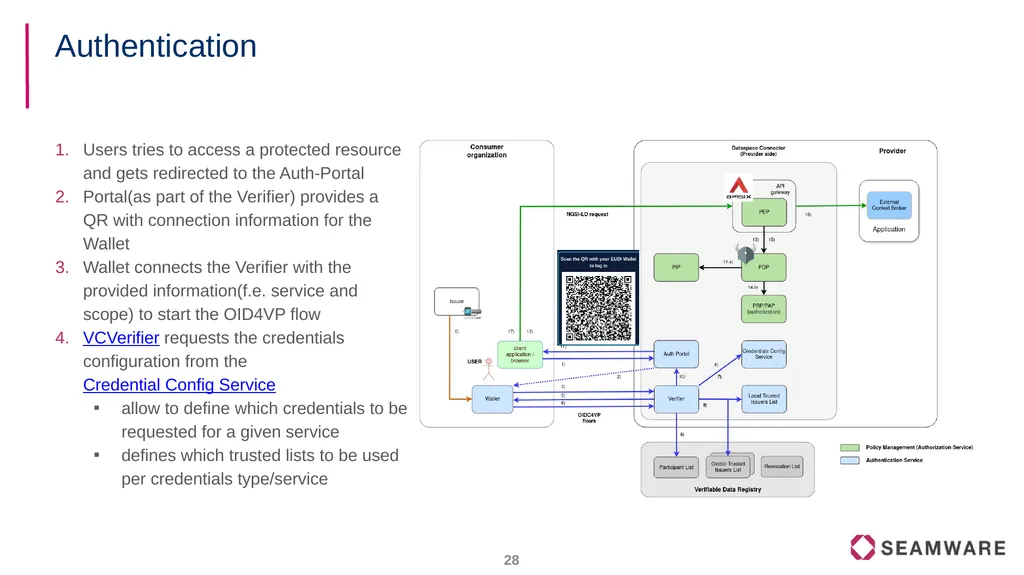
Authentication Users tries to access a protected resource and gets redirected to the Auth-Portal
Portal(as part of the Verifier) provides a QR with connection information for the Wallet
Wallet connects the Verifier with the provided information(f.e. service and scope) to start the OID4VP flow
VCVerifier requests the credentials configuration from the Credential Config Service
allow to define which credentials to be requested for a given service
defines which trusted lists to be used per credentials type/service 27<br>
Portal(as part of the Verifier) provides a QR with connection information for the Wallet
Wallet connects the Verifier with the provided information(f.e. service and scope) to start the OID4VP flow
VCVerifier requests the credentials configuration from the Credential Config Service
allow to define which credentials to be requested for a given service
defines which trusted lists to be used per credentials type/service 27<br>
29
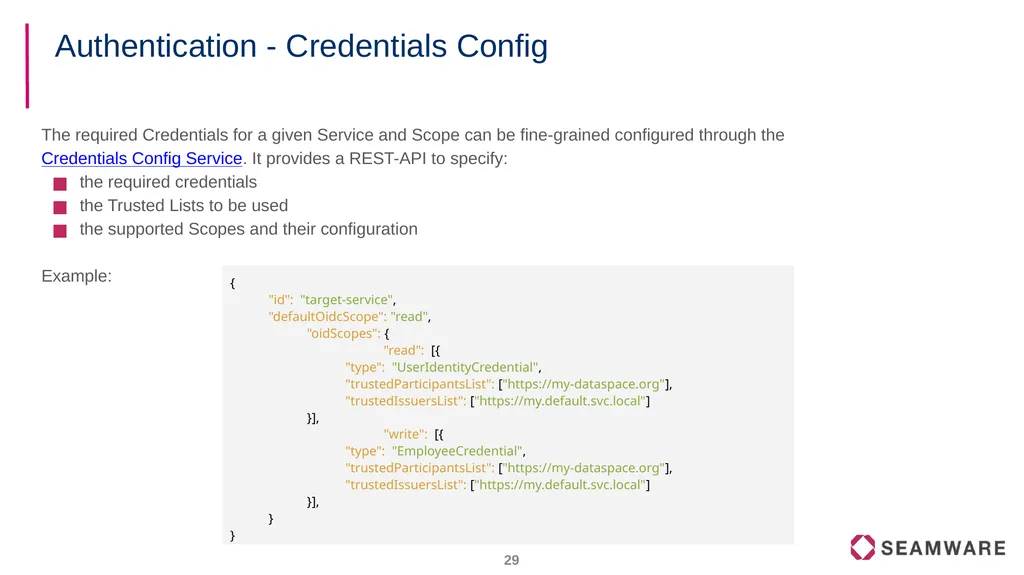
Authentication - Credentials Config 28 The required Credentials for a given Service and Scope can be fine-grained configured through the Credentials Config Service. It provides a REST-API to specify:
the required credentials
the Trusted Lists to be used
the supported Scopes and their configuration
Example: {
"id": "target-service",
"defaultOidcScope": "read",
"oidScopes": {
"read": [{
"type": "UserIdentityCredential",
"trustedParticipantsList": ["https://my-dataspace.org"],
"trustedIssuersList": ["https://my.default.svc.local"]
}],
"write": [{
"type": "EmployeeCredential",
"trustedParticipantsList": ["https://my-dataspace.org"],
"trustedIssuersList": ["https://my.default.svc.local"]
}],
}
}<br>
the required credentials
the Trusted Lists to be used
the supported Scopes and their configuration
Example: {
"id": "target-service",
"defaultOidcScope": "read",
"oidScopes": {
"read": [{
"type": "UserIdentityCredential",
"trustedParticipantsList": ["https://my-dataspace.org"],
"trustedIssuersList": ["https://my.default.svc.local"]
}],
"write": [{
"type": "EmployeeCredential",
"trustedParticipantsList": ["https://my-dataspace.org"],
"trustedIssuersList": ["https://my.default.svc.local"]
}],
}
}<br>
30
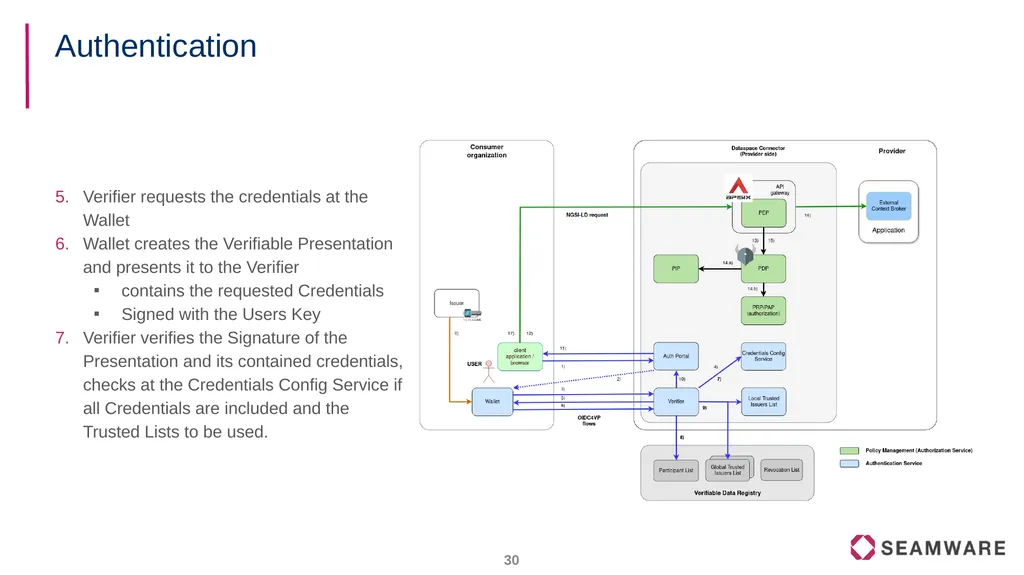
Authentication Verifier requests the credentials at the Wallet
Wallet creates the Verifiable Presentation and presents it to the Verifier
contains the requested Credentials
Signed with the Users Key
Verifier verifies the Signature of the Presentation and its contained credentials, checks at the Credentials Config Service if all Credentials are included and the Trusted Lists to be used. 29<br>
Wallet creates the Verifiable Presentation and presents it to the Verifier
contains the requested Credentials
Signed with the Users Key
Verifier verifies the Signature of the Presentation and its contained credentials, checks at the Credentials Config Service if all Credentials are included and the Trusted Lists to be used. 29<br>
31
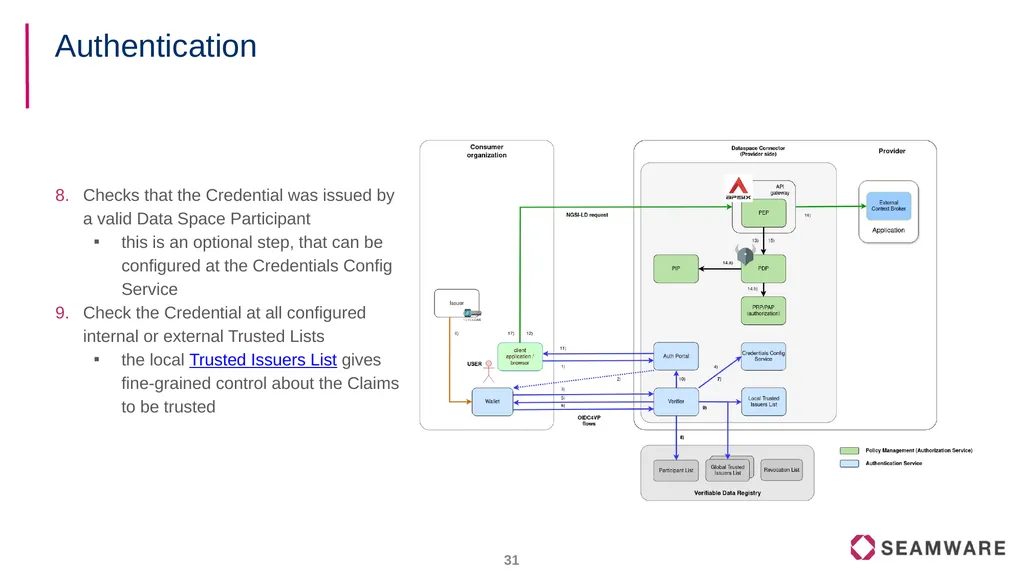
Authentication Checks that the Credential was issued by a valid Data Space Participant
this is an optional step, that can be configured at the Credentials Config Service
Check the Credential at all configured internal or external Trusted Lists
the local Trusted Issuers List gives fine-grained control about the Claims to be trusted 30<br>
this is an optional step, that can be configured at the Credentials Config Service
Check the Credential at all configured internal or external Trusted Lists
the local Trusted Issuers List gives fine-grained control about the Claims to be trusted 30<br>
32
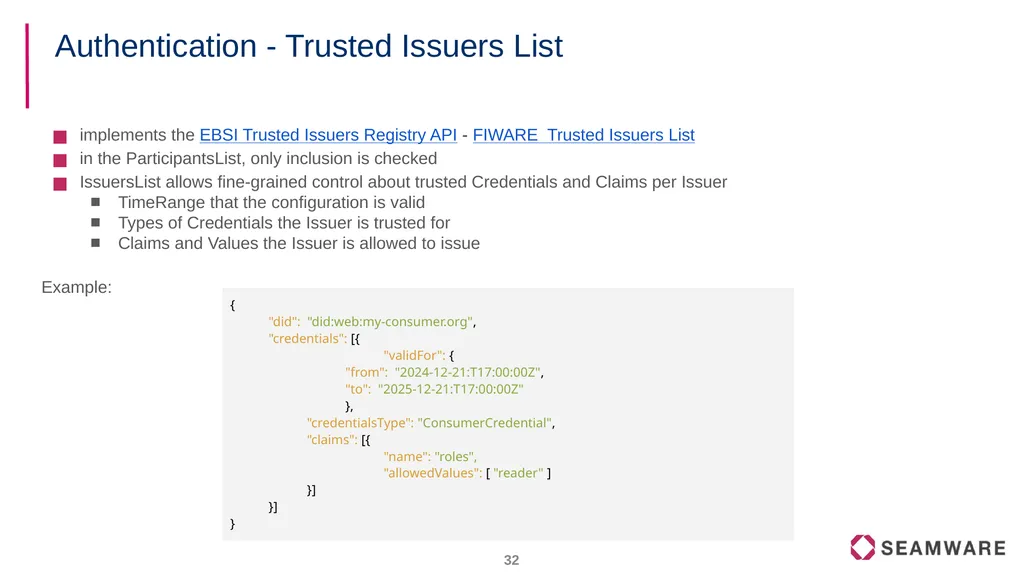
Authentication - Trusted Issuers List 31 implements the EBSI Trusted Issuers Registry API - FIWARE Trusted Issuers List
in the ParticipantsList, only inclusion is checked
IssuersList allows fine-grained control about trusted Credentials and Claims per Issuer
TimeRange that the configuration is valid
Types of Credentials the Issuer is trusted for
Claims and Values the Issuer is allowed to issue
Example: {
"did": "did:web:my-consumer.org",
"credentials": [{
"validFor": {
"from": "2024-12-21:T17:00:00Z",
"to": "2025-12-21:T17:00:00Z"
},
"credentialsType": "ConsumerCredential",
"claims": [{
"name": "roles",
"allowedValues": [ "reader" ]
}]
}]
}<br>
in the ParticipantsList, only inclusion is checked
IssuersList allows fine-grained control about trusted Credentials and Claims per Issuer
TimeRange that the configuration is valid
Types of Credentials the Issuer is trusted for
Claims and Values the Issuer is allowed to issue
Example: {
"did": "did:web:my-consumer.org",
"credentials": [{
"validFor": {
"from": "2024-12-21:T17:00:00Z",
"to": "2025-12-21:T17:00:00Z"
},
"credentialsType": "ConsumerCredential",
"claims": [{
"name": "roles",
"allowedValues": [ "reader" ]
}]
}]
}<br>
33
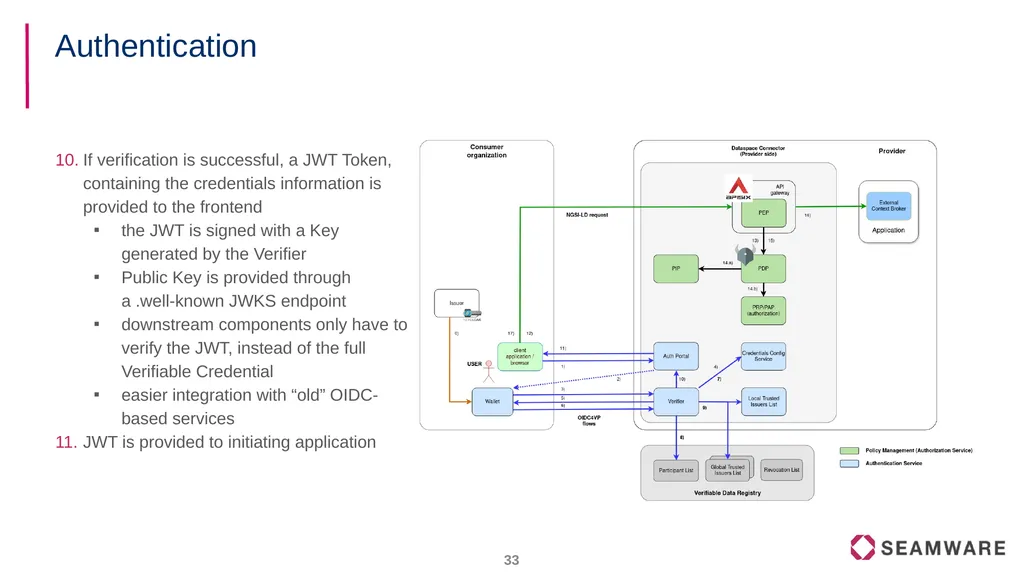
Authentication If verification is successful, a JWT Token, containing the credentials information is provided to the frontend
the JWT is signed with a Key generated by the Verifier
Public Key is provided through a .well-known JWKS endpoint
downstream components only have to verify the JWT, instead of the full Verifiable Credential
easier integration with “old” OIDC-based services
JWT is provided to initiating application 32<br>
the JWT is signed with a Key generated by the Verifier
Public Key is provided through a .well-known JWKS endpoint
downstream components only have to verify the JWT, instead of the full Verifiable Credential
easier integration with “old” OIDC-based services
JWT is provided to initiating application 32<br>
34
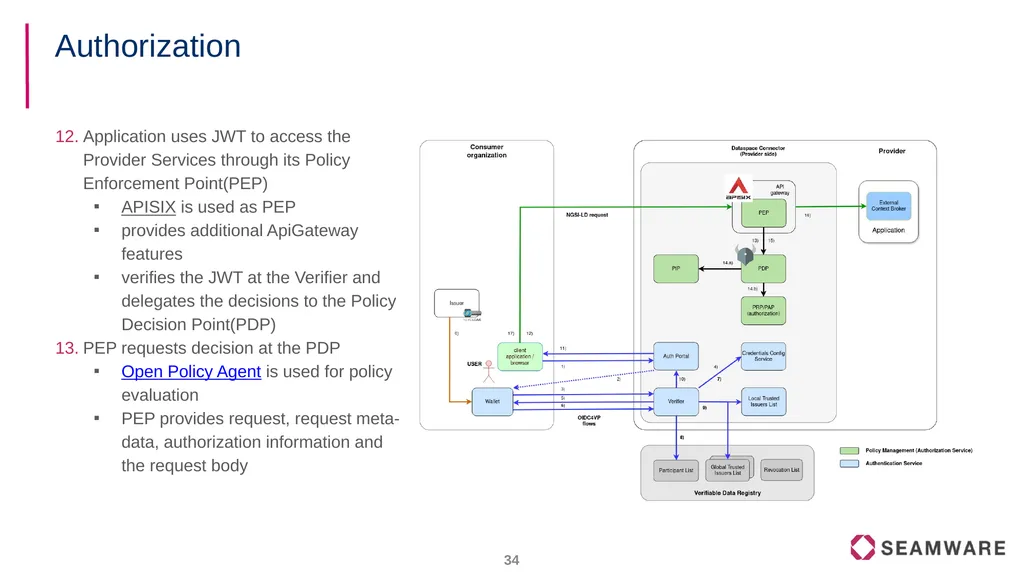
Authorization Application uses JWT to access the Provider Services through its Policy Enforcement Point(PEP)
APISIX is used as PEP
provides additional ApiGateway features
verifies the JWT at the Verifier and delegates the decisions to the Policy Decision Point(PDP)
PEP requests decision at the PDP
Open Policy Agent is used for policy evaluation
PEP provides request, request meta-data, authorization information and the request body 33<br>
APISIX is used as PEP
provides additional ApiGateway features
verifies the JWT at the Verifier and delegates the decisions to the Policy Decision Point(PDP)
PEP requests decision at the PDP
Open Policy Agent is used for policy evaluation
PEP provides request, request meta-data, authorization information and the request body 33<br>
35
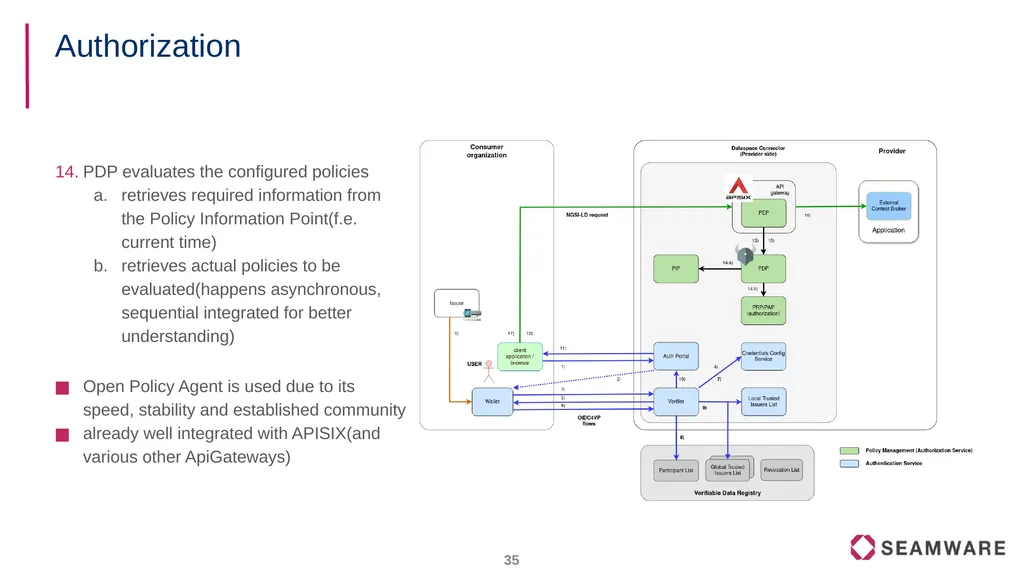
Authorization PDP evaluates the configured policies
retrieves required information from the Policy Information Point(f.e. current time)
retrieves actual policies to be evaluated(happens asynchronous, sequential integrated for better understanding)
Open Policy Agent is used due to its speed, stability and established community
already well integrated with APISIX(and various other ApiGateways) 34<br>
retrieves required information from the Policy Information Point(f.e. current time)
retrieves actual policies to be evaluated(happens asynchronous, sequential integrated for better understanding)
Open Policy Agent is used due to its speed, stability and established community
already well integrated with APISIX(and various other ApiGateways) 34<br>
36
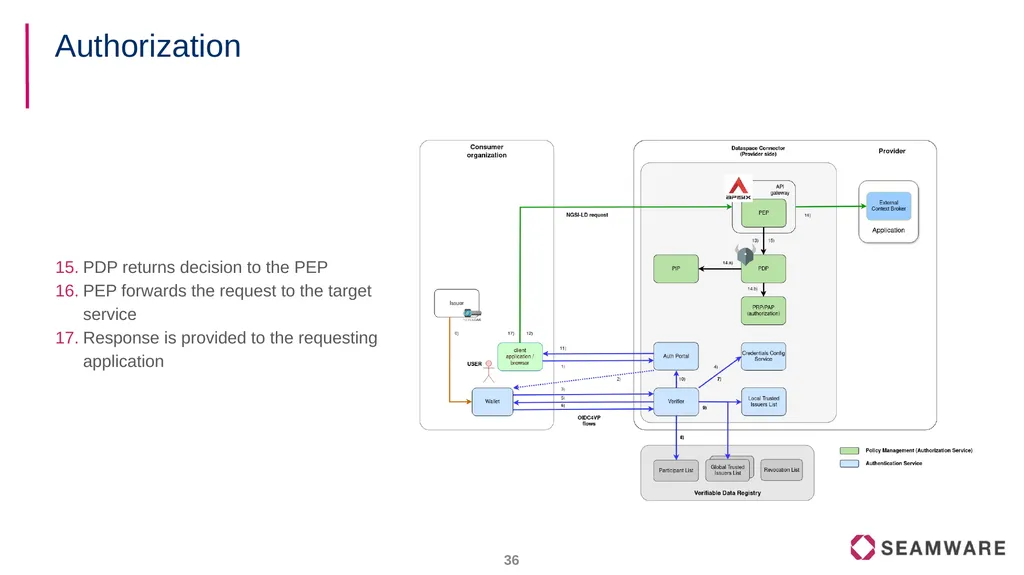
Authorization PDP returns decision to the PEP
PEP forwards the request to the target service
Response is provided to the requesting application 35<br>
PEP forwards the request to the target service
Response is provided to the requesting application 35<br>
37
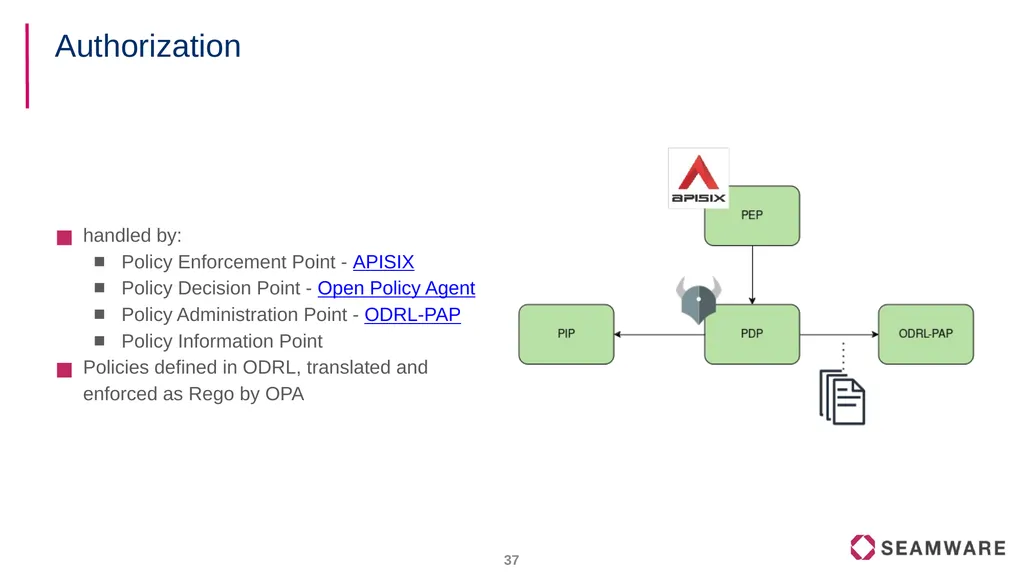
Authorization handled by:
Policy Enforcement Point - APISIX
Policy Decision Point - Open Policy Agent
Policy Administration Point - ODRL-PAP
Policy Information Point
Policies defined in ODRL, translated and enforced as Rego by OPA 36<br>
Policy Enforcement Point - APISIX
Policy Decision Point - Open Policy Agent
Policy Administration Point - ODRL-PAP
Policy Information Point
Policies defined in ODRL, translated and enforced as Rego by OPA 36<br>
38
ODRL Specified by W3C - ODRL
allows to define policies on digital content
Permissions can be used to express access-rights to resources
possibility to couple them with resources - DOME ODRL Profile 37 The Open Digital Rights Language(ODRL) is a standardized policy expression language used to represent permissions, prohibitions and obligations associated with digital content, enabling clear and enforceable rights management.<br>
allows to define policies on digital content
Permissions can be used to express access-rights to resources
possibility to couple them with resources - DOME ODRL Profile 37 The Open Digital Rights Language(ODRL) is a standardized policy expression language used to represent permissions, prohibitions and obligations associated with digital content, enabling clear and enforceable rights management.<br>
39
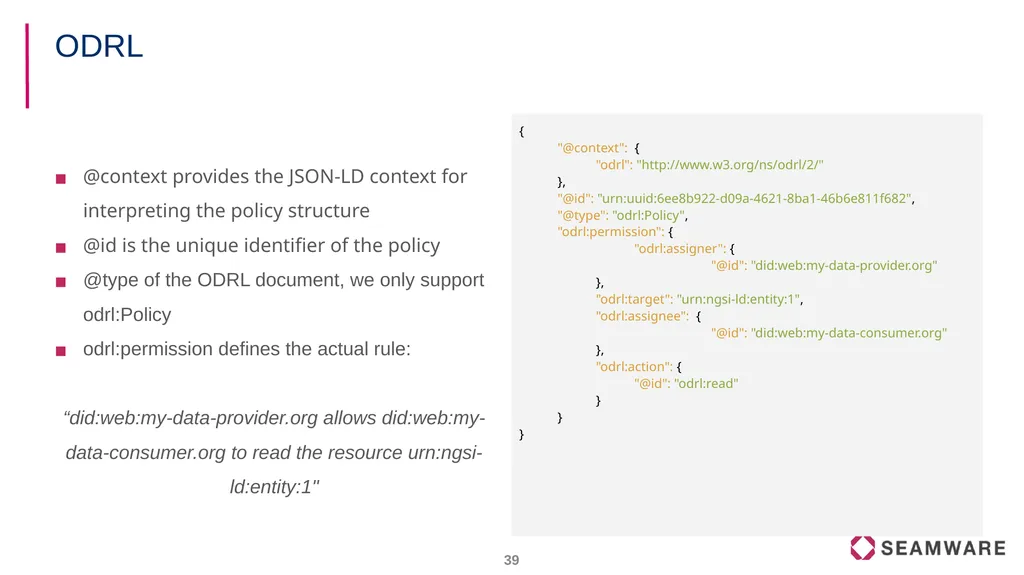
ODRL @context provides the JSON-LD context for interpreting the policy structure
@id is the unique identifier of the policy
@type of the ODRL document, we only support odrl:Policy
odrl:permission defines the actual rule:
“did:web:my-data-provider.org allows did:web:my-data-consumer.org to read the resource urn:ngsi-ld:entity:1" 38 {
"@context": {
"odrl": "http://www.w3.org/ns/odrl/2/"
},
"@id": "urn:uuid:6ee8b922-d09a-4621-8ba1-46b6e811f682",
"@type": "odrl:Policy",
"odrl:permission": {
"odrl:assigner": {
"@id": "did:web:my-data-provider.org"
},
"odrl:target": "urn:ngsi-ld:entity:1",
"odrl:assignee": {
"@id": "did:web:my-data-consumer.org"
},
"odrl:action": {
"@id": "odrl:read"
}
}
}<br>
@id is the unique identifier of the policy
@type of the ODRL document, we only support odrl:Policy
odrl:permission defines the actual rule:
“did:web:my-data-provider.org allows did:web:my-data-consumer.org to read the resource urn:ngsi-ld:entity:1" 38 {
"@context": {
"odrl": "http://www.w3.org/ns/odrl/2/"
},
"@id": "urn:uuid:6ee8b922-d09a-4621-8ba1-46b6e811f682",
"@type": "odrl:Policy",
"odrl:permission": {
"odrl:assigner": {
"@id": "did:web:my-data-provider.org"
},
"odrl:target": "urn:ngsi-ld:entity:1",
"odrl:assignee": {
"@id": "did:web:my-data-consumer.org"
},
"odrl:action": {
"@id": "odrl:read"
}
}
}<br>
40
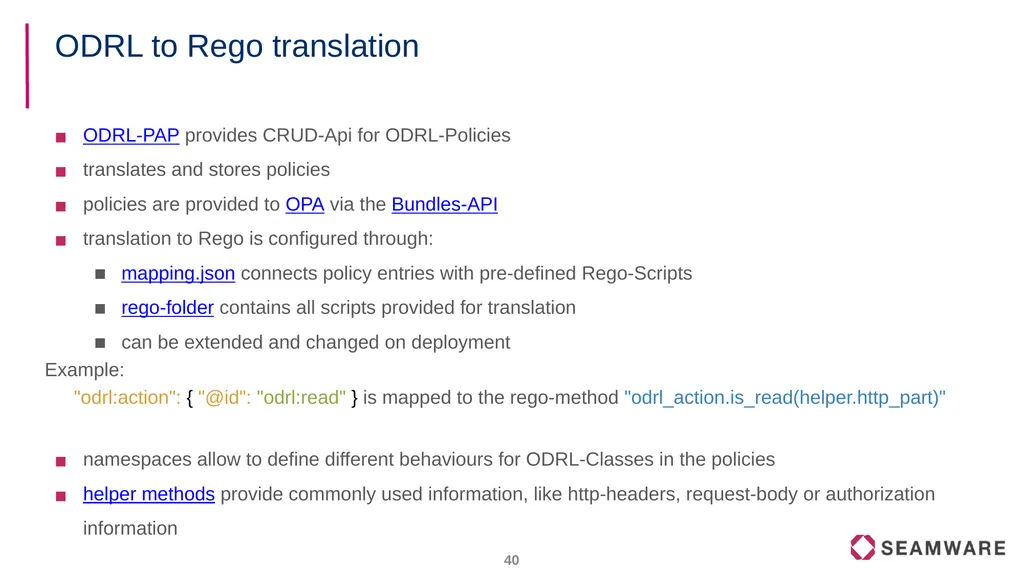
ODRL to Rego translation ODRL-PAP provides CRUD-Api for ODRL-Policies
translates and stores policies
policies are provided to OPA via the Bundles-API
translation to Rego is configured through:
mapping.json connects policy entries with pre-defined Rego-Scripts
rego-folder contains all scripts provided for translation
can be extended and changed on deployment
Example:
"odrl:action": { "@id": "odrl:read" } is mapped to the rego-method "odrl_action.is_read(helper.http_part)"
namespaces allow to define different behaviours for ODRL-Classes in the policies
helper methods provide commonly used information, like http-headers, request-body or authorization information 39<br>
translates and stores policies
policies are provided to OPA via the Bundles-API
translation to Rego is configured through:
mapping.json connects policy entries with pre-defined Rego-Scripts
rego-folder contains all scripts provided for translation
can be extended and changed on deployment
Example:
"odrl:action": { "@id": "odrl:read" } is mapped to the rego-method "odrl_action.is_read(helper.http_part)"
namespaces allow to define different behaviours for ODRL-Classes in the policies
helper methods provide commonly used information, like http-headers, request-body or authorization information 39<br>
41
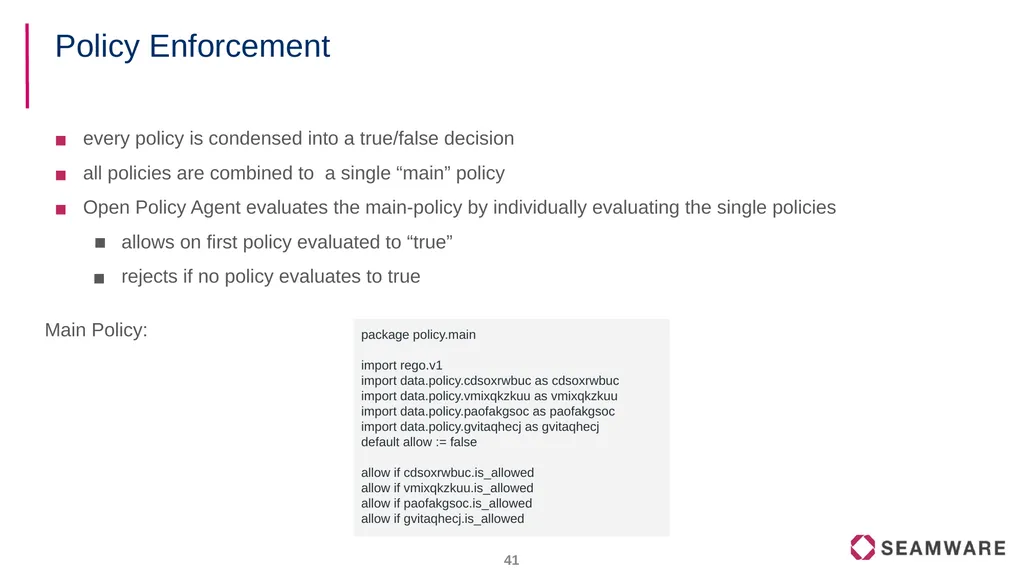
Policy Enforcement every policy is condensed into a true/false decision
all policies are combined to a single “main” policy
Open Policy Agent evaluates the main-policy by individually evaluating the single policies
allows on first policy evaluated to “true”
rejects if no policy evaluates to true 40 package policy.main
import rego.v1
import data.policy.cdsoxrwbuc as cdsoxrwbuc
import data.policy.vmixqkzkuu as vmixqkzkuu
import data.policy.paofakgsoc as paofakgsoc
import data.policy.gvitaqhecj as gvitaqhecj
default allow := false
allow if cdsoxrwbuc.is_allowed
allow if vmixqkzkuu.is_allowed
allow if paofakgsoc.is_allowed
allow if gvitaqhecj.is_allowed Main Policy:<br>
all policies are combined to a single “main” policy
Open Policy Agent evaluates the main-policy by individually evaluating the single policies
allows on first policy evaluated to “true”
rejects if no policy evaluates to true 40 package policy.main
import rego.v1
import data.policy.cdsoxrwbuc as cdsoxrwbuc
import data.policy.vmixqkzkuu as vmixqkzkuu
import data.policy.paofakgsoc as paofakgsoc
import data.policy.gvitaqhecj as gvitaqhecj
default allow := false
allow if cdsoxrwbuc.is_allowed
allow if vmixqkzkuu.is_allowed
allow if paofakgsoc.is_allowed
allow if gvitaqhecj.is_allowed Main Policy:<br>
42
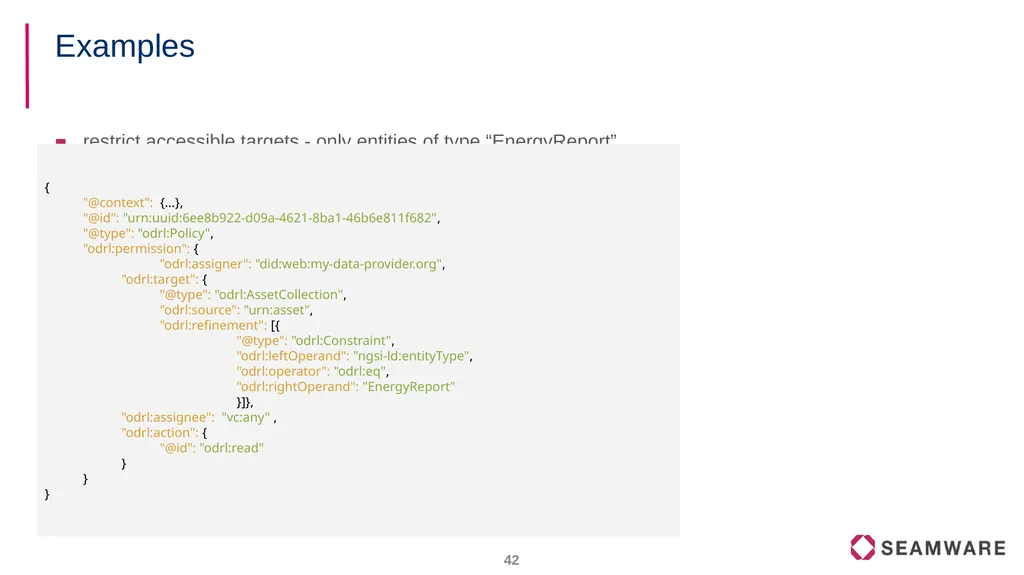
Examples restrict accessible targets - only entities of type “EnergyReport” 41 {
"@context": {...},
"@id": "urn:uuid:6ee8b922-d09a-4621-8ba1-46b6e811f682",
"@type": "odrl:Policy",
"odrl:permission": {
"odrl:assigner": "did:web:my-data-provider.org",
"odrl:target": {
"@type": "odrl:AssetCollection",
"odrl:source": "urn:asset",
"odrl:refinement": [{
"@type": "odrl:Constraint",
"odrl:leftOperand": "ngsi-ld:entityType",
"odrl:operator": "odrl:eq",
"odrl:rightOperand": "EnergyReport"
}]},
"odrl:assignee": "vc:any" ,
"odrl:action": {
"@id": "odrl:read"
}
}
}<br>
"@context": {...},
"@id": "urn:uuid:6ee8b922-d09a-4621-8ba1-46b6e811f682",
"@type": "odrl:Policy",
"odrl:permission": {
"odrl:assigner": "did:web:my-data-provider.org",
"odrl:target": {
"@type": "odrl:AssetCollection",
"odrl:source": "urn:asset",
"odrl:refinement": [{
"@type": "odrl:Constraint",
"odrl:leftOperand": "ngsi-ld:entityType",
"odrl:operator": "odrl:eq",
"odrl:rightOperand": "EnergyReport"
}]},
"odrl:assignee": "vc:any" ,
"odrl:action": {
"@id": "odrl:read"
}
}
}<br>
43
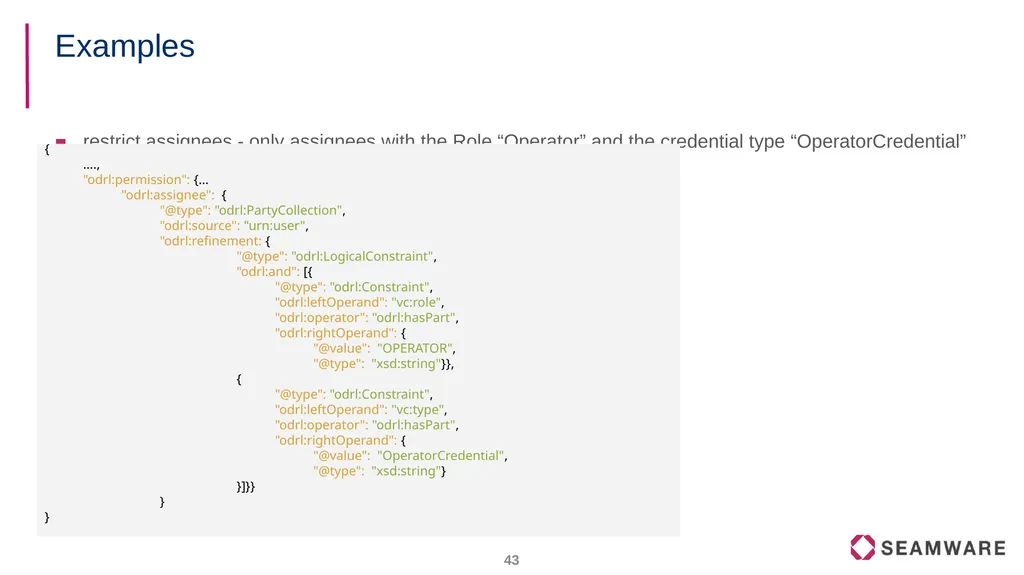
Examples restrict assignees - only assignees with the Role “Operator” and the credential type “OperatorCredential” 42 {
....,
"odrl:permission": {...
"odrl:assignee": {
"@type": "odrl:PartyCollection",
"odrl:source": "urn:user",
"odrl:refinement: {
"@type": "odrl:LogicalConstraint",
"odrl:and": [{
"@type": "odrl:Constraint",
"odrl:leftOperand": "vc:role",
"odrl:operator": "odrl:hasPart",
"odrl:rightOperand": {
"@value": "OPERATOR",
"@type": "xsd:string"}},
{
"@type": "odrl:Constraint",
"odrl:leftOperand": "vc:type",
"odrl:operator": "odrl:hasPart",
"odrl:rightOperand": {
"@value": "OperatorCredential",
"@type": "xsd:string"}
}]}}
}
}<br>
....,
"odrl:permission": {...
"odrl:assignee": {
"@type": "odrl:PartyCollection",
"odrl:source": "urn:user",
"odrl:refinement: {
"@type": "odrl:LogicalConstraint",
"odrl:and": [{
"@type": "odrl:Constraint",
"odrl:leftOperand": "vc:role",
"odrl:operator": "odrl:hasPart",
"odrl:rightOperand": {
"@value": "OPERATOR",
"@type": "xsd:string"}},
{
"@type": "odrl:Constraint",
"odrl:leftOperand": "vc:type",
"odrl:operator": "odrl:hasPart",
"odrl:rightOperand": {
"@value": "OperatorCredential",
"@type": "xsd:string"}
}]}}
}
}<br>
44
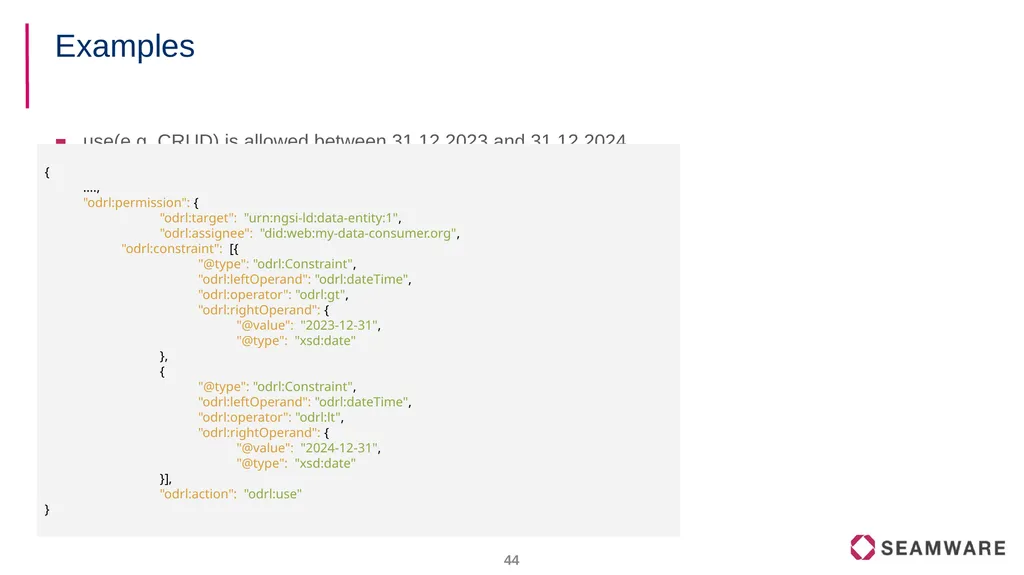
Examples use(e.g. CRUD) is allowed between 31.12.2023 and 31.12.2024 43 {
....,
"odrl:permission": {
"odrl:target": "urn:ngsi-ld:data-entity:1",
"odrl:assignee": "did:web:my-data-consumer.org",
"odrl:constraint": [{
"@type": "odrl:Constraint",
"odrl:leftOperand": "odrl:dateTime",
"odrl:operator": "odrl:gt",
"odrl:rightOperand": {
"@value": "2023-12-31",
"@type": "xsd:date"
},
{
"@type": "odrl:Constraint",
"odrl:leftOperand": "odrl:dateTime",
"odrl:operator": "odrl:lt",
"odrl:rightOperand": {
"@value": "2024-12-31",
"@type": "xsd:date"
}],
"odrl:action": "odrl:use"
}<br>
....,
"odrl:permission": {
"odrl:target": "urn:ngsi-ld:data-entity:1",
"odrl:assignee": "did:web:my-data-consumer.org",
"odrl:constraint": [{
"@type": "odrl:Constraint",
"odrl:leftOperand": "odrl:dateTime",
"odrl:operator": "odrl:gt",
"odrl:rightOperand": {
"@value": "2023-12-31",
"@type": "xsd:date"
},
{
"@type": "odrl:Constraint",
"odrl:leftOperand": "odrl:dateTime",
"odrl:operator": "odrl:lt",
"odrl:rightOperand": {
"@value": "2024-12-31",
"@type": "xsd:date"
}],
"odrl:action": "odrl:use"
}<br>
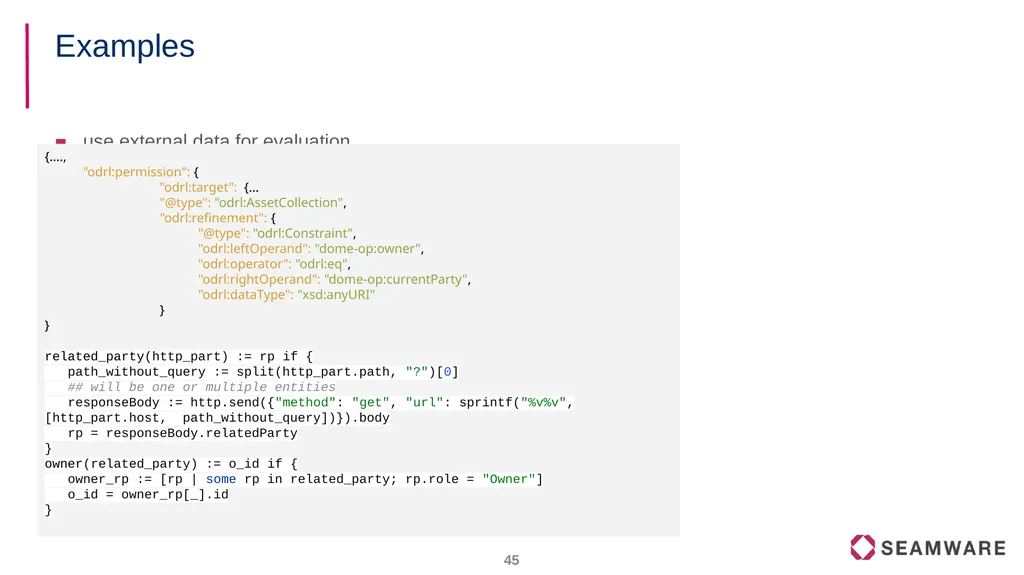
45
Examples use external data for evaluation 44 {....,
"odrl:permission": {
"odrl:target": {…
"@type": "odrl:AssetCollection",
"odrl:refinement": {
"@type": "odrl:Constraint",
"odrl:leftOperand": "dome-op:owner",
"odrl:operator": "odrl:eq",
"odrl:rightOperand": "dome-op:currentParty",
"odrl:dataType": "xsd:anyURI"
}
}
related_party(http_part) := rp if {
path_without_query := split(http_part.path, "?")[0]
## will be one or multiple entities
responseBody := http.send({"method": "get", "url": sprintf("%v%v", [http_part.host, path_without_query])}).body
rp = responseBody.relatedParty
}
owner(related_party) := o_id if {
owner_rp := [rp | some rp in related_party; rp.role = "Owner"]
o_id = owner_rp[_].id
}<br>
"odrl:permission": {
"odrl:target": {…
"@type": "odrl:AssetCollection",
"odrl:refinement": {
"@type": "odrl:Constraint",
"odrl:leftOperand": "dome-op:owner",
"odrl:operator": "odrl:eq",
"odrl:rightOperand": "dome-op:currentParty",
"odrl:dataType": "xsd:anyURI"
}
}
related_party(http_part) := rp if {
path_without_query := split(http_part.path, "?")[0]
## will be one or multiple entities
responseBody := http.send({"method": "get", "url": sprintf("%v%v", [http_part.host, path_without_query])}).body
rp = responseBody.relatedParty
}
owner(related_party) := o_id if {
owner_rp := [rp | some rp in related_party; rp.role = "Owner"]
o_id = owner_rp[_].id
}<br>
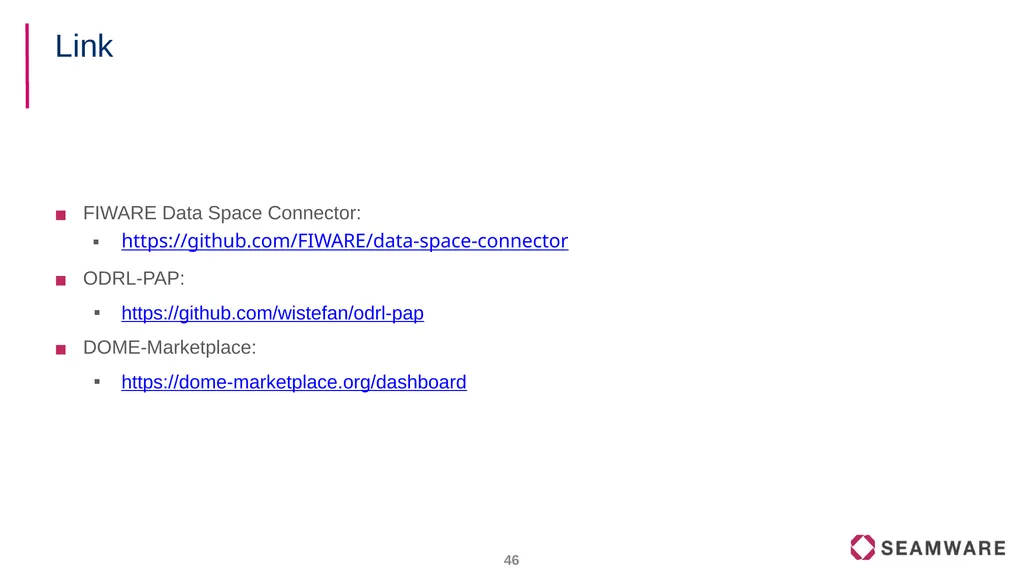
46
Link FIWARE Data Space Connector:
https://github.com/FIWARE/data-space-connector
ODRL-PAP:
https://github.com/wistefan/odrl-pap
DOME-Marketplace:
https://dome-marketplace.org/dashboard 45<br>
https://github.com/FIWARE/data-space-connector
ODRL-PAP:
https://github.com/wistefan/odrl-pap
DOME-Marketplace:
https://dome-marketplace.org/dashboard 45<br>