
Fixed installations TSIs INF,ENE and PRM 1
KL
Published · 40 slides · 0 views
1 / 1




Description
Fixed installations TSIs INF,ENE and PRM 1 24.11.2023 Webinar Photo: Adobe Srock by Tarasylo Clarification note Competence and emergency management 2 QA session 241123 Photo: Adobe Srock by Tarasylo TSI OPE- 2023 TSI OPE
Related Topics
Share
Embed code
Download this presentation From Below
"Fixed installations TSIs INF,ENE and PRM 1" is the property of its rightful owner. Permission is granted to download and print the materials on this website for personal, non-commercial use only, and to display it on your personal computer provided you do not modify the materials and that you retain all copyright notices contained in the materials. By downloading content from our website, you accept the terms of this agreement.
Presentation Transcript
01
Fixed installations
TSIs INF,ENE and PRM 1 24.11.2023 | Webinar Photo: Adobe Srock / by Tarasylo<br>
02
Clarification note
Competence and emergency management 2 Q&A session| 24/11/23 Photo: Adobe Srock / by Tarasylo<br>
03
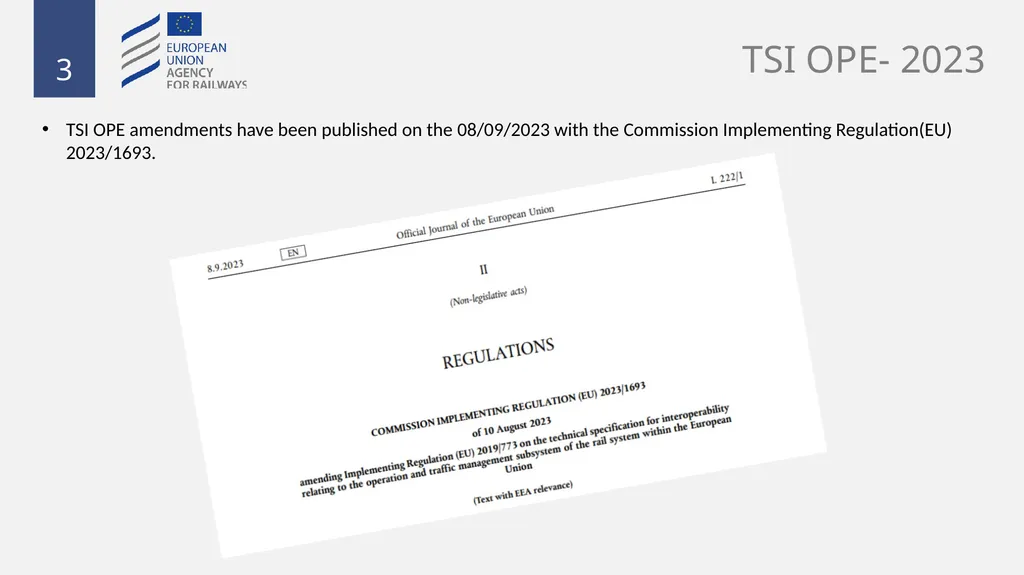
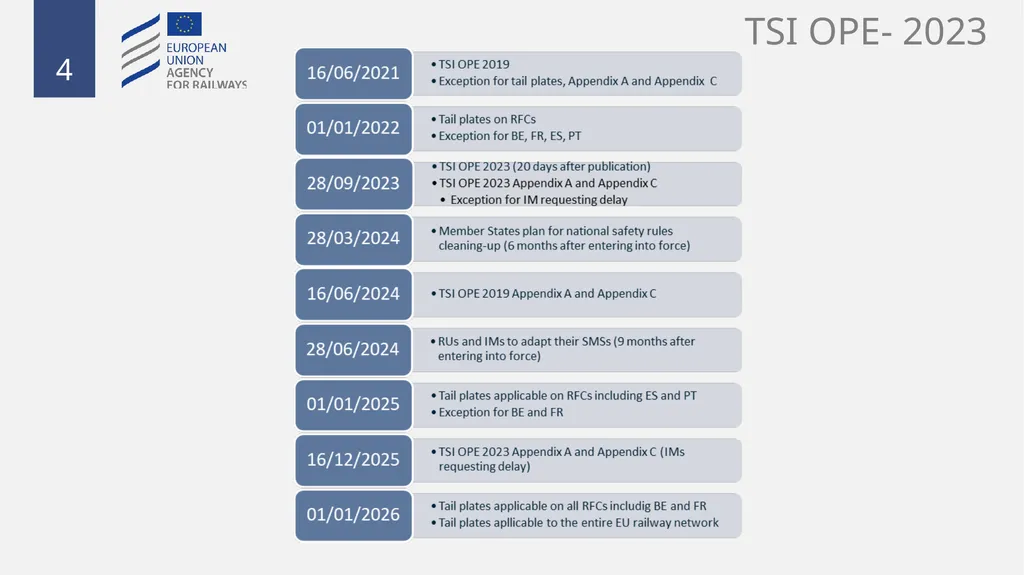
TSI OPE- 2023 TSI OPE amendments have been published on the 08/09/2023 with the Commission Implementing Regulation(EU) 2023/1693.<br>
04
TSI OPE- 2023<br>
05
ERA Clarification note on competence and emergency management<br>
06
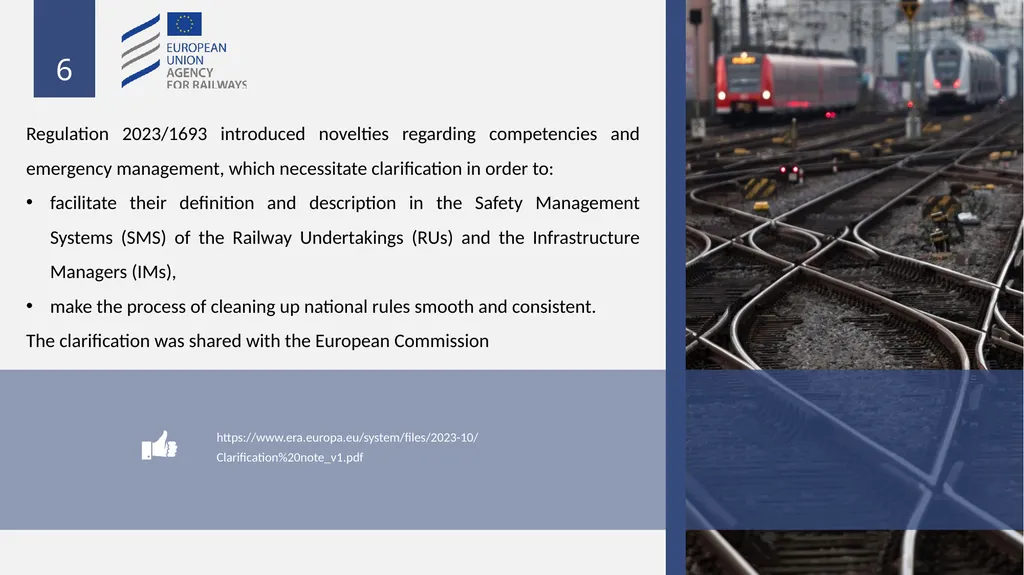
https://www.era.europa.eu/system/files/2023-10/Clarification%20note_v1.pdf Regulation 2023/1693 introduced novelties regarding competencies and emergency management, which necessitate clarification in order to:
facilitate their definition and description in the Safety Management Systems (SMS) of the Railway Undertakings (RUs) and the Infrastructure Managers (IMs),
make the process of cleaning up national rules smooth and consistent.
The clarification was shared with the European Commission<br>
facilitate their definition and description in the Safety Management Systems (SMS) of the Railway Undertakings (RUs) and the Infrastructure Managers (IMs),
make the process of cleaning up national rules smooth and consistent.
The clarification was shared with the European Commission<br>
07
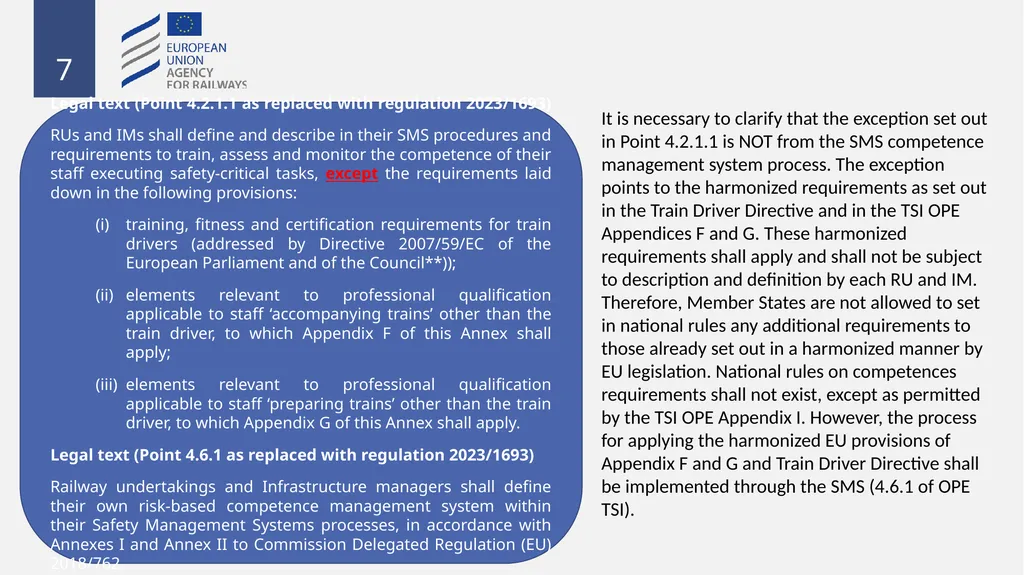
Legal text (Point 4.2.1.1 as replaced with regulation 2023/1693)
RUs and IMs shall define and describe in their SMS procedures and requirements to train, assess and monitor the competence of their staff executing safety-critical tasks, except the requirements laid down in the following provisions:
(i) training, fitness and certification requirements for train drivers (addressed by Directive 2007/59/EC of the European Parliament and of the Council**));
(ii) elements relevant to professional qualification applicable to staff ‘accompanying trains’ other than the train driver, to which Appendix F of this Annex shall apply;
(iii) elements relevant to professional qualification applicable to staff ‘preparing trains’ other than the train driver, to which Appendix G of this Annex shall apply.
Legal text (Point 4.6.1 as replaced with regulation 2023/1693)
Railway undertakings and Infrastructure managers shall define their own risk-based competence management system within their Safety Management Systems processes, in accordance with Annexes I and Annex II to Commission Delegated Regulation (EU) 2018/762. It is necessary to clarify that the exception set out in Point 4.2.1.1 is NOT from the SMS competence management system process. The exception points to the harmonized requirements as set out in the Train Driver Directive and in the TSI OPE Appendices F and G. These harmonized requirements shall apply and shall not be subject to description and definition by each RU and IM. Therefore, Member States are not allowed to set in national rules any additional requirements to those already set out in a harmonized manner by EU legislation. National rules on competences requirements shall not exist, except as permitted by the TSI OPE Appendix I. However, the process for applying the harmonized EU provisions of Appendix F and G and Train Driver Directive shall be implemented through the SMS (4.6.1 of OPE TSI).<br>
RUs and IMs shall define and describe in their SMS procedures and requirements to train, assess and monitor the competence of their staff executing safety-critical tasks, except the requirements laid down in the following provisions:
(i) training, fitness and certification requirements for train drivers (addressed by Directive 2007/59/EC of the European Parliament and of the Council**));
(ii) elements relevant to professional qualification applicable to staff ‘accompanying trains’ other than the train driver, to which Appendix F of this Annex shall apply;
(iii) elements relevant to professional qualification applicable to staff ‘preparing trains’ other than the train driver, to which Appendix G of this Annex shall apply.
Legal text (Point 4.6.1 as replaced with regulation 2023/1693)
Railway undertakings and Infrastructure managers shall define their own risk-based competence management system within their Safety Management Systems processes, in accordance with Annexes I and Annex II to Commission Delegated Regulation (EU) 2018/762. It is necessary to clarify that the exception set out in Point 4.2.1.1 is NOT from the SMS competence management system process. The exception points to the harmonized requirements as set out in the Train Driver Directive and in the TSI OPE Appendices F and G. These harmonized requirements shall apply and shall not be subject to description and definition by each RU and IM. Therefore, Member States are not allowed to set in national rules any additional requirements to those already set out in a harmonized manner by EU legislation. National rules on competences requirements shall not exist, except as permitted by the TSI OPE Appendix I. However, the process for applying the harmonized EU provisions of Appendix F and G and Train Driver Directive shall be implemented through the SMS (4.6.1 of OPE TSI).<br>
08
Appendix I point 2 contains a list of open points. One of these points is point (f). It has to be clarified that the second element point (f) concerns merely a harmonized way of providing evidence, namely of documenting the professional competences of staff. This harmonized documentation is used in cases such staff moves to a new employer. Point (f) does neither introduce nor relate to a national certification regime, which is not permitted as a national rule. Only the format of the evidence/documentation can be considered as a national rule. Legal text (Appendix I 2 (f) as replaced with regulation 2023/1693)
Professional competences (see point 4.2.1.1 and 4.6)
Evidence of professional competences<br>
Professional competences (see point 4.2.1.1 and 4.6)
Evidence of professional competences<br>
09
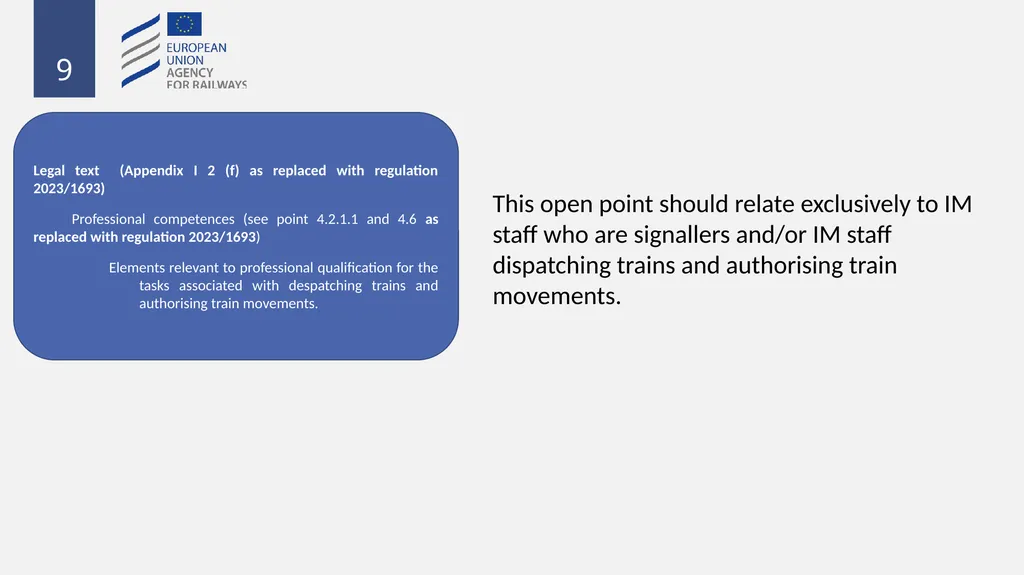
This open point should relate exclusively to IM staff who are signallers and/or IM staff dispatching trains and authorising train movements. Legal text (Appendix I 2 (f) as replaced with regulation 2023/1693)
Professional competences (see point 4.2.1.1 and 4.6 as replaced with regulation 2023/1693)
Elements relevant to professional qualification for the tasks associated with despatching trains and authorising train movements.<br>
Professional competences (see point 4.2.1.1 and 4.6 as replaced with regulation 2023/1693)
Elements relevant to professional qualification for the tasks associated with despatching trains and authorising train movements.<br>
10
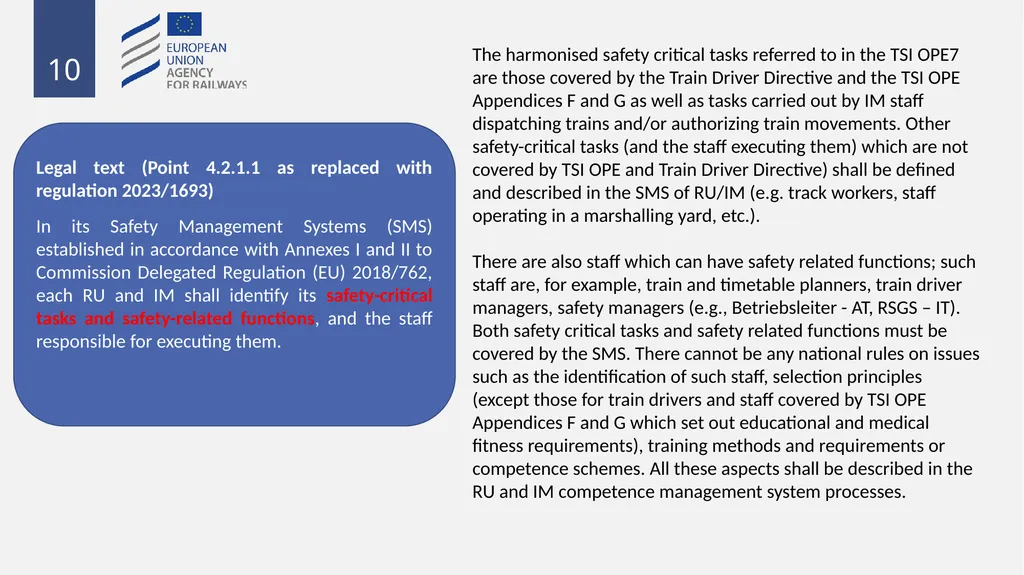
The harmonised safety critical tasks referred to in the TSI OPE7 are those covered by the Train Driver Directive and the TSI OPE Appendices F and G as well as tasks carried out by IM staff dispatching trains and/or authorizing train movements. Other safety-critical tasks (and the staff executing them) which are not covered by TSI OPE and Train Driver Directive) shall be defined and described in the SMS of RU/IM (e.g. track workers, staff operating in a marshalling yard, etc.).
There are also staff which can have safety related functions; such staff are, for example, train and timetable planners, train driver managers, safety managers (e.g., Betriebsleiter - AT, RSGS – IT). Both safety critical tasks and safety related functions must be covered by the SMS. There cannot be any national rules on issues such as the identification of such staff, selection principles (except those for train drivers and staff covered by TSI OPE Appendices F and G which set out educational and medical fitness requirements), training methods and requirements or competence schemes. All these aspects shall be described in the RU and IM competence management system processes. Legal text (Point 4.2.1.1 as replaced with regulation 2023/1693)
In its Safety Management Systems (SMS) established in accordance with Annexes I and II to Commission Delegated Regulation (EU) 2018/762, each RU and IM shall identify its safety-critical tasks and safety-related functions, and the staff responsible for executing them.<br>
There are also staff which can have safety related functions; such staff are, for example, train and timetable planners, train driver managers, safety managers (e.g., Betriebsleiter - AT, RSGS – IT). Both safety critical tasks and safety related functions must be covered by the SMS. There cannot be any national rules on issues such as the identification of such staff, selection principles (except those for train drivers and staff covered by TSI OPE Appendices F and G which set out educational and medical fitness requirements), training methods and requirements or competence schemes. All these aspects shall be described in the RU and IM competence management system processes. Legal text (Point 4.2.1.1 as replaced with regulation 2023/1693)
In its Safety Management Systems (SMS) established in accordance with Annexes I and II to Commission Delegated Regulation (EU) 2018/762, each RU and IM shall identify its safety-critical tasks and safety-related functions, and the staff responsible for executing them.<br>
11
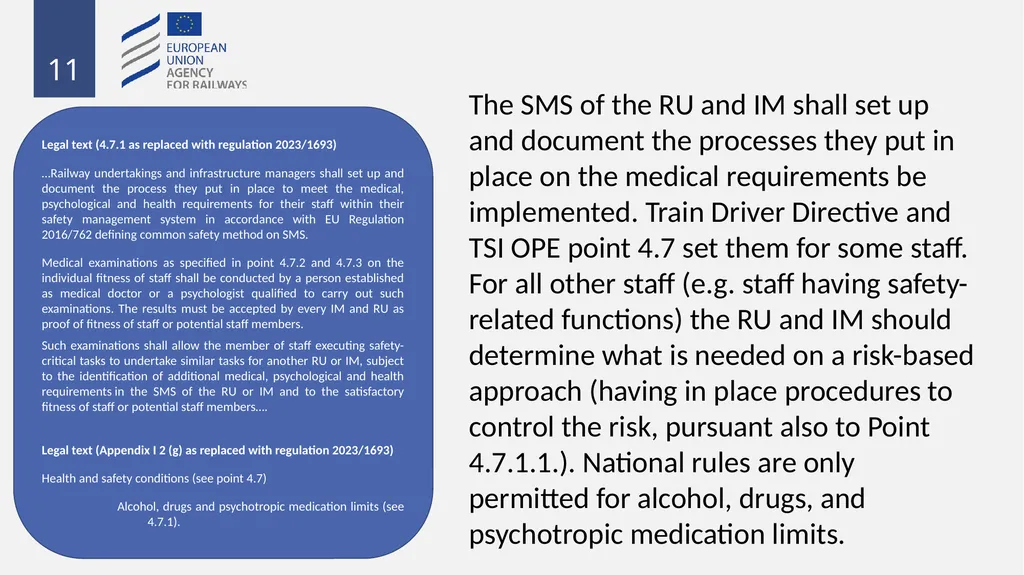
The SMS of the RU and IM shall set up and document the processes they put in place on the medical requirements be implemented. Train Driver Directive and TSI OPE point 4.7 set them for some staff. For all other staff (e.g. staff having safety-related functions) the RU and IM should determine what is needed on a risk-based approach (having in place procedures to control the risk, pursuant also to Point 4.7.1.1.). National rules are only permitted for alcohol, drugs, and psychotropic medication limits. Legal text (4.7.1 as replaced with regulation 2023/1693)
…Railway undertakings and infrastructure managers shall set up and document the process they put in place to meet the medical, psychological and health requirements for their staff within their safety management system in accordance with EU Regulation 2016/762 defining common safety method on SMS.
Medical examinations as specified in point 4.7.2 and 4.7.3 on the individual fitness of staff shall be conducted by a person established as medical doctor or a psychologist qualified to carry out such examinations. The results must be accepted by every IM and RU as proof of fitness of staff or potential staff members.
Such examinations shall allow the member of staff executing safety-critical tasks to undertake similar tasks for another RU or IM, subject to the identification of additional medical, psychological and health requirements in the SMS of the RU or IM and to the satisfactory fitness of staff or potential staff members….
Legal text (Appendix I 2 (g) as replaced with regulation 2023/1693)
Health and safety conditions (see point 4.7)
Alcohol, drugs and psychotropic medication limits (see 4.7.1).<br>
…Railway undertakings and infrastructure managers shall set up and document the process they put in place to meet the medical, psychological and health requirements for their staff within their safety management system in accordance with EU Regulation 2016/762 defining common safety method on SMS.
Medical examinations as specified in point 4.7.2 and 4.7.3 on the individual fitness of staff shall be conducted by a person established as medical doctor or a psychologist qualified to carry out such examinations. The results must be accepted by every IM and RU as proof of fitness of staff or potential staff members.
Such examinations shall allow the member of staff executing safety-critical tasks to undertake similar tasks for another RU or IM, subject to the identification of additional medical, psychological and health requirements in the SMS of the RU or IM and to the satisfactory fitness of staff or potential staff members….
Legal text (Appendix I 2 (g) as replaced with regulation 2023/1693)
Health and safety conditions (see point 4.7)
Alcohol, drugs and psychotropic medication limits (see 4.7.1).<br>
12
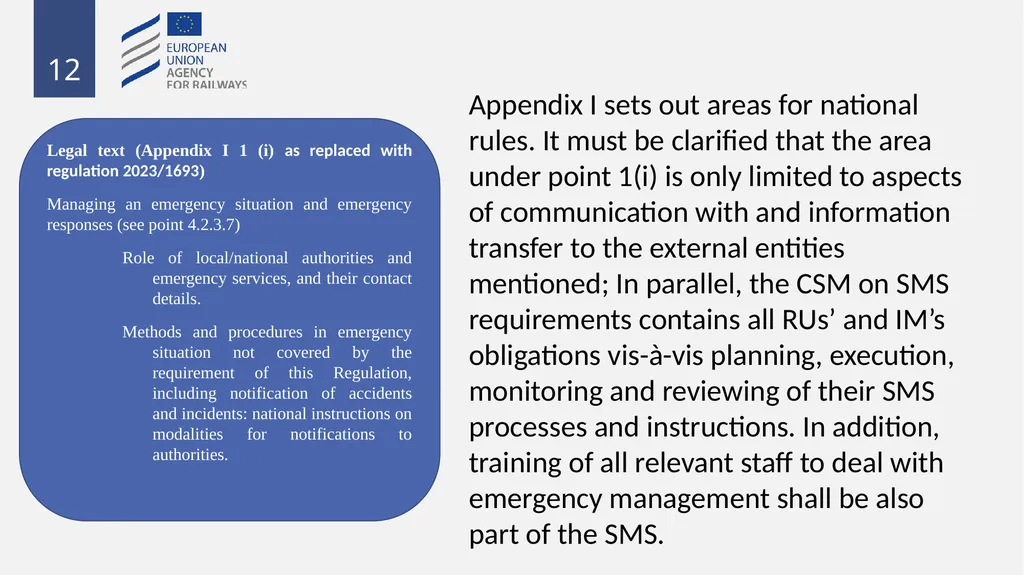
Appendix I sets out areas for national rules. It must be clarified that the area under point 1(i) is only limited to aspects of communication with and information transfer to the external entities mentioned; In parallel, the CSM on SMS requirements contains all RUs’ and IM’s obligations vis-à-vis planning, execution, monitoring and reviewing of their SMS processes and instructions. In addition, training of all relevant staff to deal with emergency management shall be also part of the SMS. Legal text (Appendix I 1 (i) as replaced with regulation 2023/1693)
Managing an emergency situation and emergency responses (see point 4.2.3.7)
Role of local/national authorities and emergency services, and their contact details.
Methods and procedures in emergency situation not covered by the requirement of this Regulation, including notification of accidents and incidents: national instructions on modalities for notifications to authorities.<br>
Managing an emergency situation and emergency responses (see point 4.2.3.7)
Role of local/national authorities and emergency services, and their contact details.
Methods and procedures in emergency situation not covered by the requirement of this Regulation, including notification of accidents and incidents: national instructions on modalities for notifications to authorities.<br>
13
Questions received at
TSI-QA-2023@era.europa.eu Many can be summarized as:
Will I need to move to the latest TSIs INF and ENE?
How is my project impacted?<br>
Will I need to move to the latest TSIs INF and ENE?
How is my project impacted?<br>
14
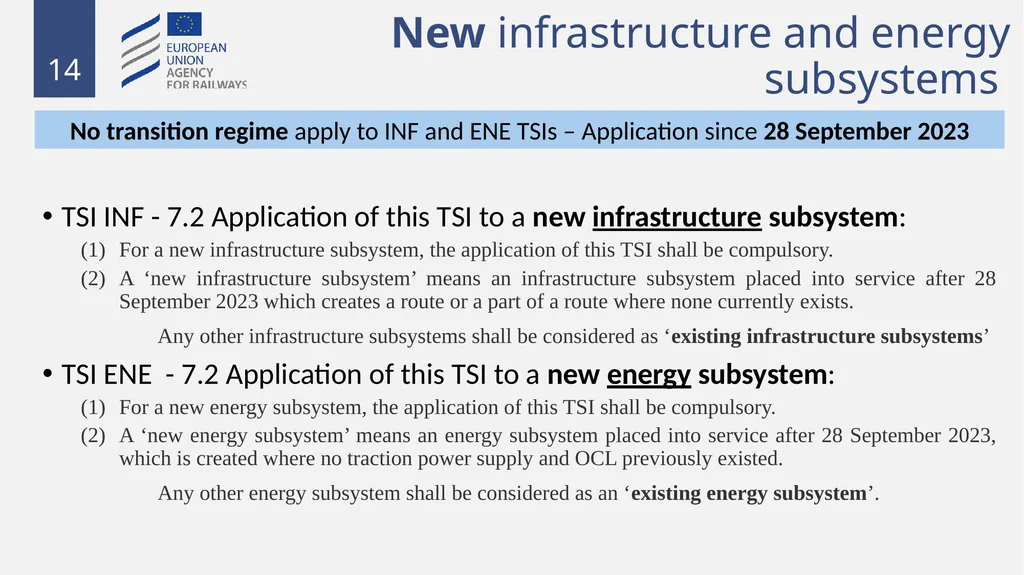
New infrastructure and energy subsystems TSI INF - 7.2 Application of this TSI to a new infrastructure subsystem:
For a new infrastructure subsystem, the application of this TSI shall be compulsory.
A ‘new infrastructure subsystem’ means an infrastructure subsystem placed into service after 28 September 2023 which creates a route or a part of a route where none currently exists.
Any other infrastructure subsystems shall be considered as ‘existing infrastructure subsystems’
TSI ENE - 7.2 Application of this TSI to a new energy subsystem:
For a new energy subsystem, the application of this TSI shall be compulsory.
A ‘new energy subsystem’ means an energy subsystem placed into service after 28 September 2023, which is created where no traction power supply and OCL previously existed.
Any other energy subsystem shall be considered as an ‘existing energy subsystem’. No transition regime apply to INF and ENE TSIs – Application since 28 September 2023<br>
For a new infrastructure subsystem, the application of this TSI shall be compulsory.
A ‘new infrastructure subsystem’ means an infrastructure subsystem placed into service after 28 September 2023 which creates a route or a part of a route where none currently exists.
Any other infrastructure subsystems shall be considered as ‘existing infrastructure subsystems’
TSI ENE - 7.2 Application of this TSI to a new energy subsystem:
For a new energy subsystem, the application of this TSI shall be compulsory.
A ‘new energy subsystem’ means an energy subsystem placed into service after 28 September 2023, which is created where no traction power supply and OCL previously existed.
Any other energy subsystem shall be considered as an ‘existing energy subsystem’. No transition regime apply to INF and ENE TSIs – Application since 28 September 2023<br>
15
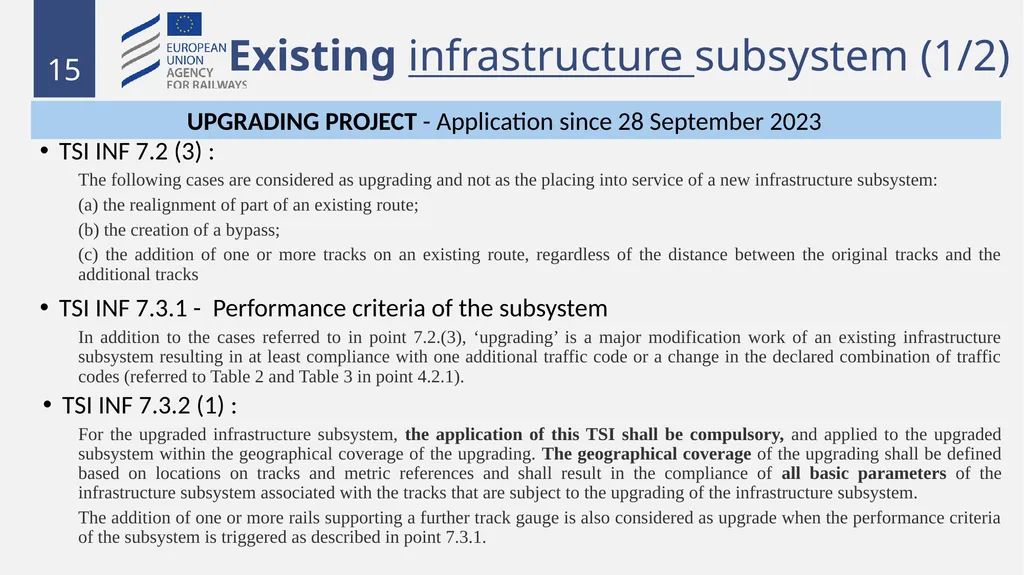
Existing infrastructure subsystem (1/2) TSI INF 7.2 (3) :
The following cases are considered as upgrading and not as the placing into service of a new infrastructure subsystem:
(a) the realignment of part of an existing route;
(b) the creation of a bypass;
(c) the addition of one or more tracks on an existing route, regardless of the distance between the original tracks and the additional tracks
TSI INF 7.3.1 - Performance criteria of the subsystem
In addition to the cases referred to in point 7.2.(3), ‘upgrading’ is a major modification work of an existing infrastructure subsystem resulting in at least compliance with one additional traffic code or a change in the declared combination of traffic codes (referred to Table 2 and Table 3 in point 4.2.1).
TSI INF 7.3.2 (1) :
For the upgraded infrastructure subsystem, the application of this TSI shall be compulsory, and applied to the upgraded subsystem within the geographical coverage of the upgrading. The geographical coverage of the upgrading shall be defined based on locations on tracks and metric references and shall result in the compliance of all basic parameters of the infrastructure subsystem associated with the tracks that are subject to the upgrading of the infrastructure subsystem.
The addition of one or more rails supporting a further track gauge is also considered as upgrade when the performance criteria of the subsystem is triggered as described in point 7.3.1. UPGRADING PROJECT - Application since 28 September 2023<br>
The following cases are considered as upgrading and not as the placing into service of a new infrastructure subsystem:
(a) the realignment of part of an existing route;
(b) the creation of a bypass;
(c) the addition of one or more tracks on an existing route, regardless of the distance between the original tracks and the additional tracks
TSI INF 7.3.1 - Performance criteria of the subsystem
In addition to the cases referred to in point 7.2.(3), ‘upgrading’ is a major modification work of an existing infrastructure subsystem resulting in at least compliance with one additional traffic code or a change in the declared combination of traffic codes (referred to Table 2 and Table 3 in point 4.2.1).
TSI INF 7.3.2 (1) :
For the upgraded infrastructure subsystem, the application of this TSI shall be compulsory, and applied to the upgraded subsystem within the geographical coverage of the upgrading. The geographical coverage of the upgrading shall be defined based on locations on tracks and metric references and shall result in the compliance of all basic parameters of the infrastructure subsystem associated with the tracks that are subject to the upgrading of the infrastructure subsystem.
The addition of one or more rails supporting a further track gauge is also considered as upgrade when the performance criteria of the subsystem is triggered as described in point 7.3.1. UPGRADING PROJECT - Application since 28 September 2023<br>
16
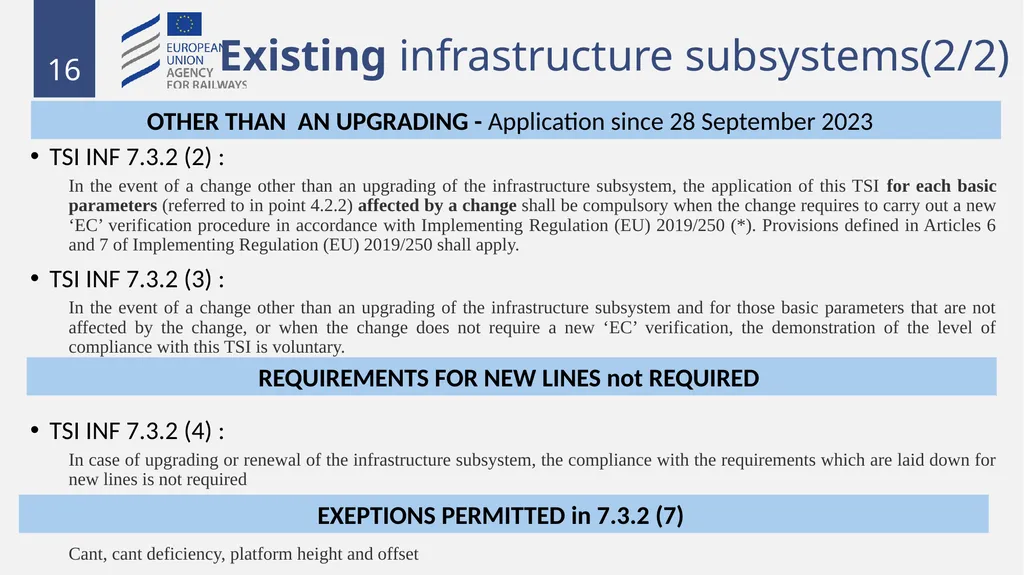
Existing infrastructure subsystems(2/2) TSI INF 7.3.2 (2) :
In the event of a change other than an upgrading of the infrastructure subsystem, the application of this TSI for each basic parameters (referred to in point 4.2.2) affected by a change shall be compulsory when the change requires to carry out a new ‘EC’ verification procedure in accordance with Implementing Regulation (EU) 2019/250 (*). Provisions defined in Articles 6 and 7 of Implementing Regulation (EU) 2019/250 shall apply.
TSI INF 7.3.2 (3) :
In the event of a change other than an upgrading of the infrastructure subsystem and for those basic parameters that are not affected by the change, or when the change does not require a new ‘EC’ verification, the demonstration of the level of compliance with this TSI is voluntary.
TSI INF 7.3.2 (4) :
In case of upgrading or renewal of the infrastructure subsystem, the compliance with the requirements which are laid down for new lines is not required
Cant, cant deficiency, platform height and offset OTHER THAN AN UPGRADING - Application since 28 September 2023 REQUIREMENTS FOR NEW LINES not REQUIRED EXEPTIONS PERMITTED in 7.3.2 (7)<br>
In the event of a change other than an upgrading of the infrastructure subsystem, the application of this TSI for each basic parameters (referred to in point 4.2.2) affected by a change shall be compulsory when the change requires to carry out a new ‘EC’ verification procedure in accordance with Implementing Regulation (EU) 2019/250 (*). Provisions defined in Articles 6 and 7 of Implementing Regulation (EU) 2019/250 shall apply.
TSI INF 7.3.2 (3) :
In the event of a change other than an upgrading of the infrastructure subsystem and for those basic parameters that are not affected by the change, or when the change does not require a new ‘EC’ verification, the demonstration of the level of compliance with this TSI is voluntary.
TSI INF 7.3.2 (4) :
In case of upgrading or renewal of the infrastructure subsystem, the compliance with the requirements which are laid down for new lines is not required
Cant, cant deficiency, platform height and offset OTHER THAN AN UPGRADING - Application since 28 September 2023 REQUIREMENTS FOR NEW LINES not REQUIRED EXEPTIONS PERMITTED in 7.3.2 (7)<br>
17
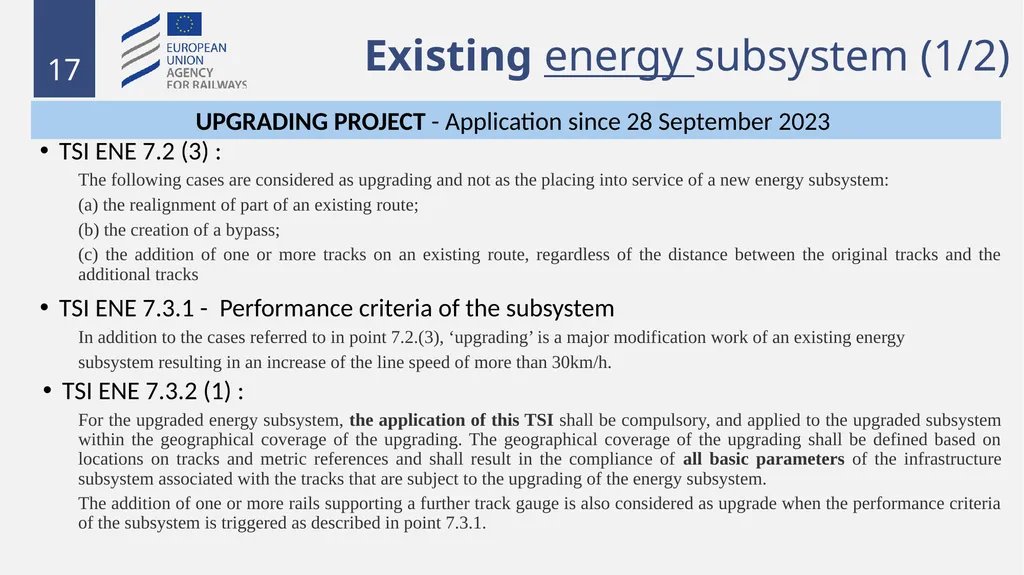
Existing energy subsystem (1/2) TSI ENE 7.2 (3) :
The following cases are considered as upgrading and not as the placing into service of a new energy subsystem:
(a) the realignment of part of an existing route;
(b) the creation of a bypass;
(c) the addition of one or more tracks on an existing route, regardless of the distance between the original tracks and the additional tracks
TSI ENE 7.3.1 - Performance criteria of the subsystem
In addition to the cases referred to in point 7.2.(3), ‘upgrading’ is a major modification work of an existing energy
subsystem resulting in an increase of the line speed of more than 30km/h.
TSI ENE 7.3.2 (1) :
For the upgraded energy subsystem, the application of this TSI shall be compulsory, and applied to the upgraded subsystem within the geographical coverage of the upgrading. The geographical coverage of the upgrading shall be defined based on locations on tracks and metric references and shall result in the compliance of all basic parameters of the infrastructure subsystem associated with the tracks that are subject to the upgrading of the energy subsystem.
The addition of one or more rails supporting a further track gauge is also considered as upgrade when the performance criteria of the subsystem is triggered as described in point 7.3.1. UPGRADING PROJECT - Application since 28 September 2023<br>
The following cases are considered as upgrading and not as the placing into service of a new energy subsystem:
(a) the realignment of part of an existing route;
(b) the creation of a bypass;
(c) the addition of one or more tracks on an existing route, regardless of the distance between the original tracks and the additional tracks
TSI ENE 7.3.1 - Performance criteria of the subsystem
In addition to the cases referred to in point 7.2.(3), ‘upgrading’ is a major modification work of an existing energy
subsystem resulting in an increase of the line speed of more than 30km/h.
TSI ENE 7.3.2 (1) :
For the upgraded energy subsystem, the application of this TSI shall be compulsory, and applied to the upgraded subsystem within the geographical coverage of the upgrading. The geographical coverage of the upgrading shall be defined based on locations on tracks and metric references and shall result in the compliance of all basic parameters of the infrastructure subsystem associated with the tracks that are subject to the upgrading of the energy subsystem.
The addition of one or more rails supporting a further track gauge is also considered as upgrade when the performance criteria of the subsystem is triggered as described in point 7.3.1. UPGRADING PROJECT - Application since 28 September 2023<br>
18
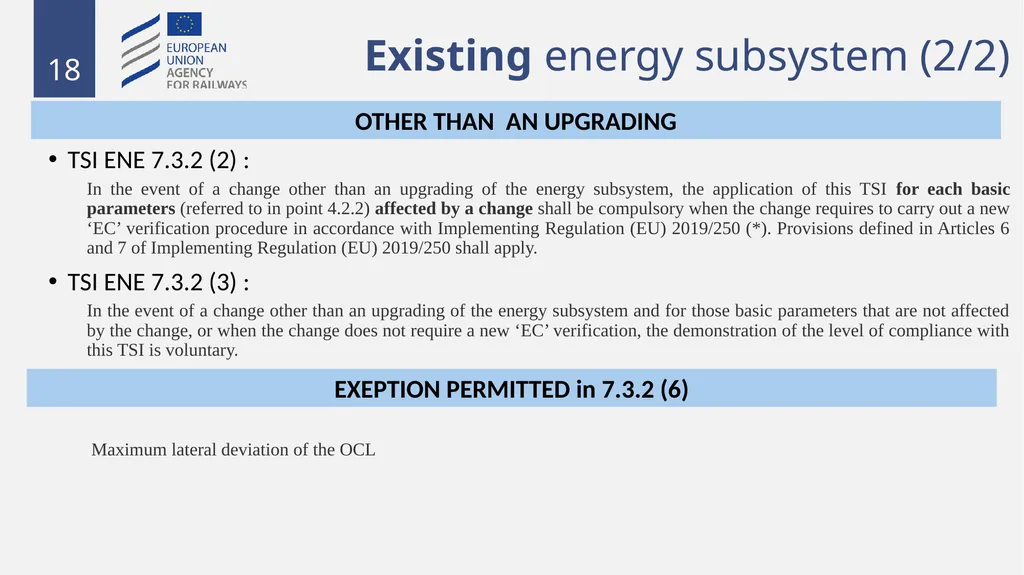
Existing energy subsystem (2/2) TSI ENE 7.3.2 (2) :
In the event of a change other than an upgrading of the energy subsystem, the application of this TSI for each basic parameters (referred to in point 4.2.2) affected by a change shall be compulsory when the change requires to carry out a new ‘EC’ verification procedure in accordance with Implementing Regulation (EU) 2019/250 (*). Provisions defined in Articles 6 and 7 of Implementing Regulation (EU) 2019/250 shall apply.
TSI ENE 7.3.2 (3) :
In the event of a change other than an upgrading of the energy subsystem and for those basic parameters that are not affected by the change, or when the change does not require a new ‘EC’ verification, the demonstration of the level of compliance with this TSI is voluntary.
Maximum lateral deviation of the OCL OTHER THAN AN UPGRADING EXEPTION PERMITTED in 7.3.2 (6)<br>
In the event of a change other than an upgrading of the energy subsystem, the application of this TSI for each basic parameters (referred to in point 4.2.2) affected by a change shall be compulsory when the change requires to carry out a new ‘EC’ verification procedure in accordance with Implementing Regulation (EU) 2019/250 (*). Provisions defined in Articles 6 and 7 of Implementing Regulation (EU) 2019/250 shall apply.
TSI ENE 7.3.2 (3) :
In the event of a change other than an upgrading of the energy subsystem and for those basic parameters that are not affected by the change, or when the change does not require a new ‘EC’ verification, the demonstration of the level of compliance with this TSI is voluntary.
Maximum lateral deviation of the OCL OTHER THAN AN UPGRADING EXEPTION PERMITTED in 7.3.2 (6)<br>
19
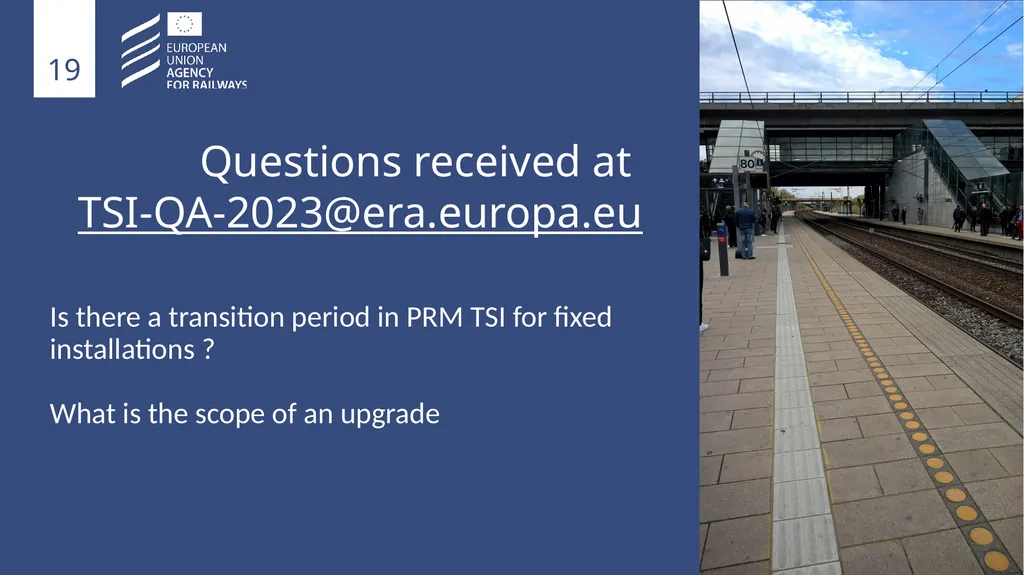
Questions received at
TSI-QA-2023@era.europa.eu Is there a transition period in PRM TSI for fixed installations ?
What is the scope of an upgrade<br>
20
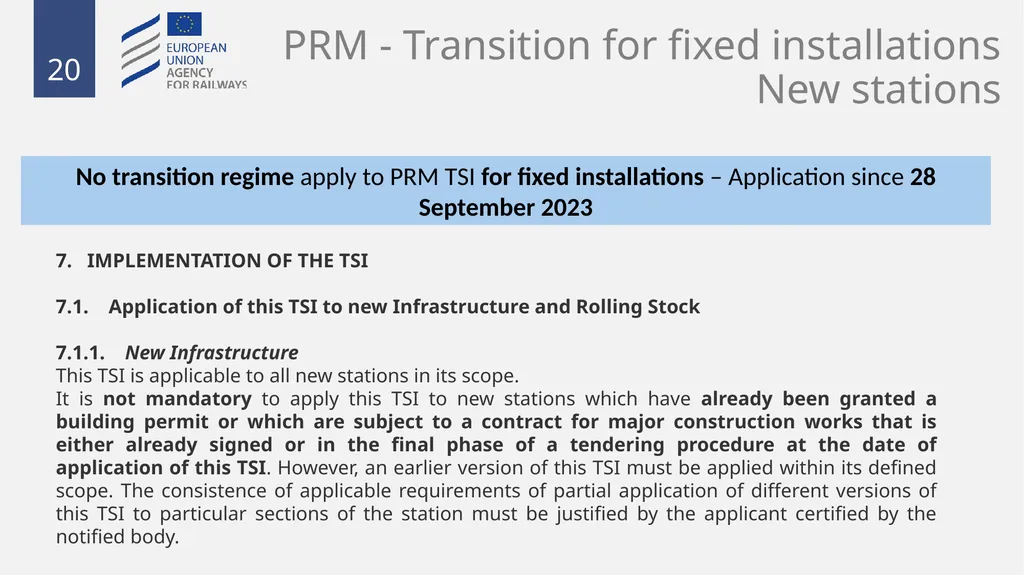
PRM - Transition for fixed installations
New stations 7. IMPLEMENTATION OF THE TSI
7.1. Application of this TSI to new Infrastructure and Rolling Stock
7.1.1. New Infrastructure
This TSI is applicable to all new stations in its scope.
It is not mandatory to apply this TSI to new stations which have already been granted a building permit or which are subject to a contract for major construction works that is either already signed or in the final phase of a tendering procedure at the date of application of this TSI. However, an earlier version of this TSI must be applied within its defined scope. The consistence of applicable requirements of partial application of different versions of this TSI to particular sections of the station must be justified by the applicant certified by the notified body. No transition regime apply to PRM TSI for fixed installations – Application since 28 September 2023<br>
7.1. Application of this TSI to new Infrastructure and Rolling Stock
7.1.1. New Infrastructure
This TSI is applicable to all new stations in its scope.
It is not mandatory to apply this TSI to new stations which have already been granted a building permit or which are subject to a contract for major construction works that is either already signed or in the final phase of a tendering procedure at the date of application of this TSI. However, an earlier version of this TSI must be applied within its defined scope. The consistence of applicable requirements of partial application of different versions of this TSI to particular sections of the station must be justified by the applicant certified by the notified body. No transition regime apply to PRM TSI for fixed installations – Application since 28 September 2023<br>
21
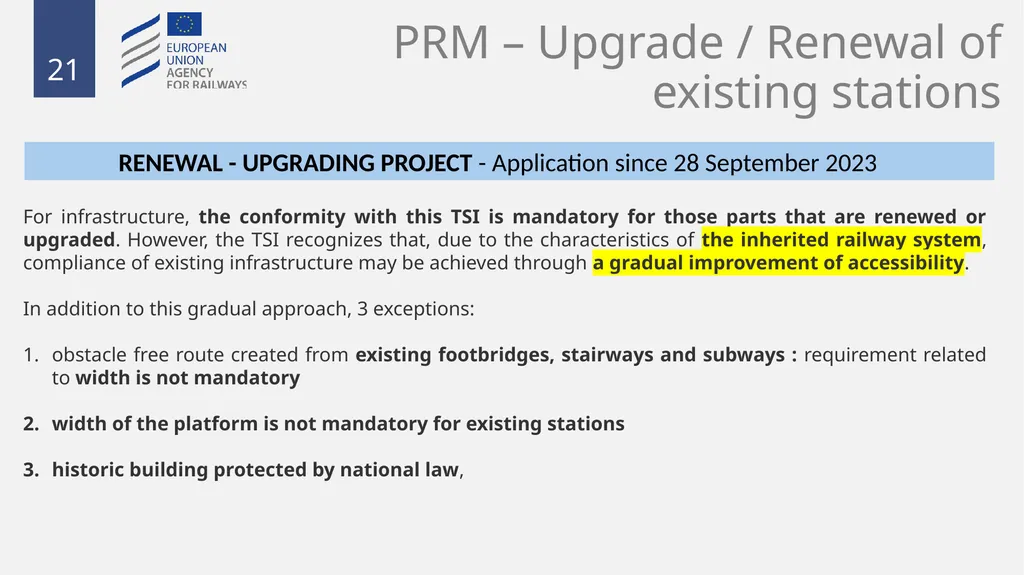
For infrastructure, the conformity with this TSI is mandatory for those parts that are renewed or upgraded. However, the TSI recognizes that, due to the characteristics of the inherited railway system, compliance of existing infrastructure may be achieved through a gradual improvement of accessibility.
In addition to this gradual approach, 3 exceptions:
obstacle free route created from existing footbridges, stairways and subways : requirement related to width is not mandatory
width of the platform is not mandatory for existing stations
historic building protected by national law, RENEWAL - UPGRADING PROJECT - Application since 28 September 2023 PRM – Upgrade / Renewal of existing stations<br>
In addition to this gradual approach, 3 exceptions:
obstacle free route created from existing footbridges, stairways and subways : requirement related to width is not mandatory
width of the platform is not mandatory for existing stations
historic building protected by national law, RENEWAL - UPGRADING PROJECT - Application since 28 September 2023 PRM – Upgrade / Renewal of existing stations<br>
22
Principle of application of the PRM TSI
to existing stations Improvement of accessibility :
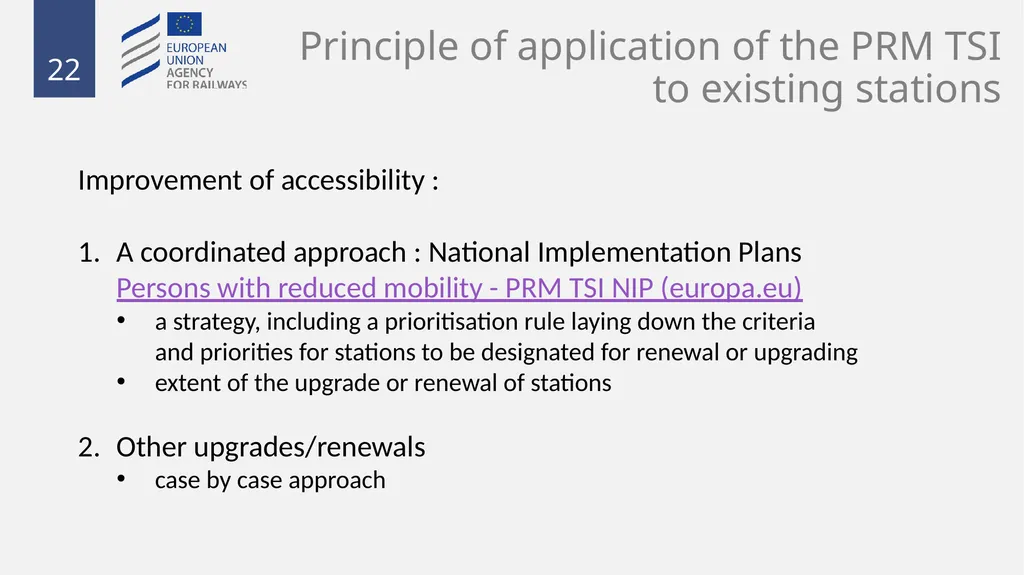
A coordinated approach : National Implementation Plans Persons with reduced mobility - PRM TSI NIP (europa.eu)
a strategy, including a prioritisation rule laying down the criteria and priorities for stations to be designated for renewal or upgrading
extent of the upgrade or renewal of stations
Other upgrades/renewals
case by case approach<br>
A coordinated approach : National Implementation Plans Persons with reduced mobility - PRM TSI NIP (europa.eu)
a strategy, including a prioritisation rule laying down the criteria and priorities for stations to be designated for renewal or upgrading
extent of the upgrade or renewal of stations
Other upgrades/renewals
case by case approach<br>
23
Example of application of the PRM TSI
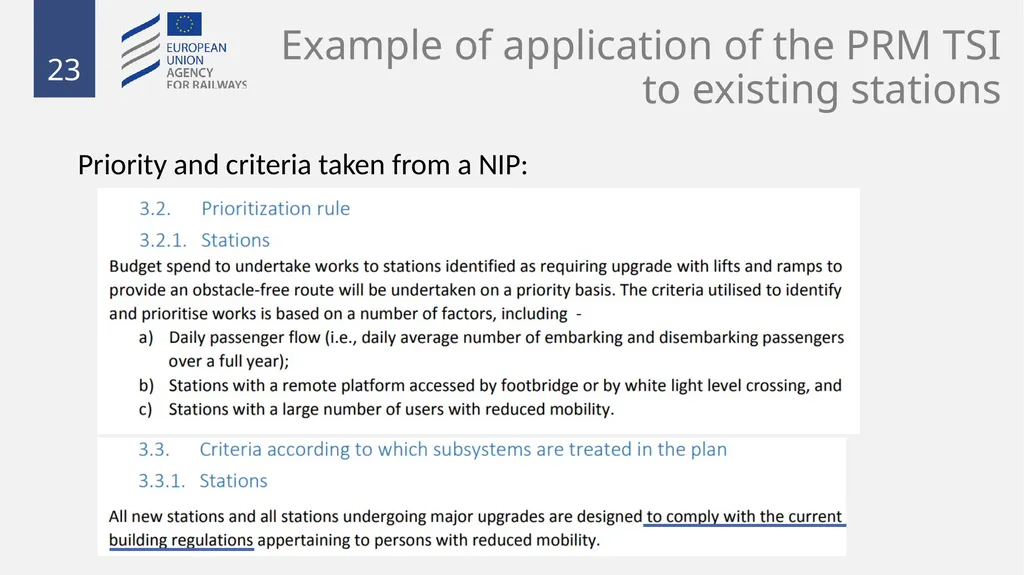
to existing stations Priority and criteria taken from a NIP:<br>
24
Example of application of the PRM TSI
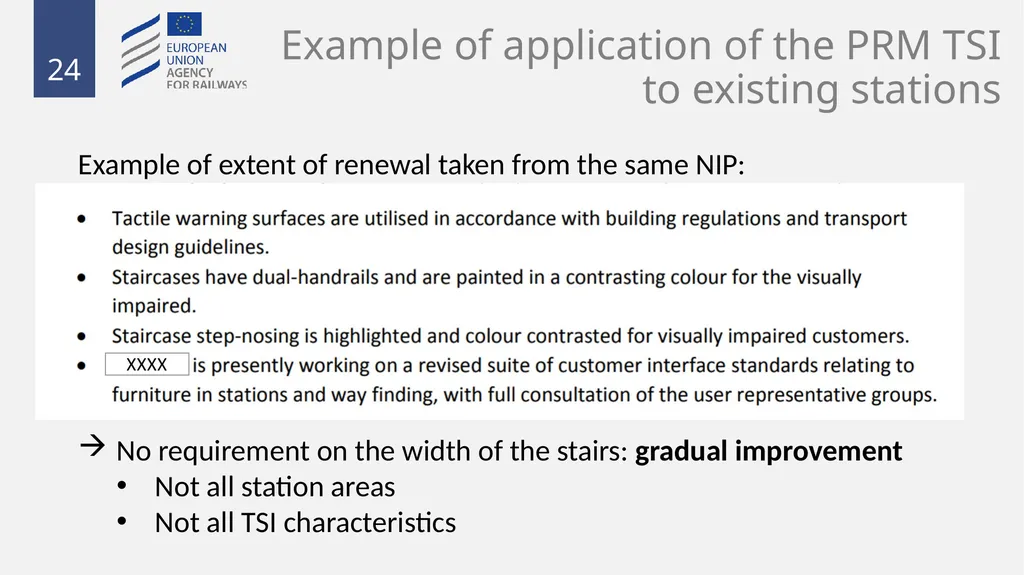
to existing stations Example of extent of renewal taken from the same NIP:
No requirement on the width of the stairs: gradual improvement
Not all station areas
Not all TSI characteristics<br>
No requirement on the width of the stairs: gradual improvement
Not all station areas
Not all TSI characteristics<br>
25
Role of the Notified Body When assessing a station, difficult to close the eyes on non-conformities…<br>
26
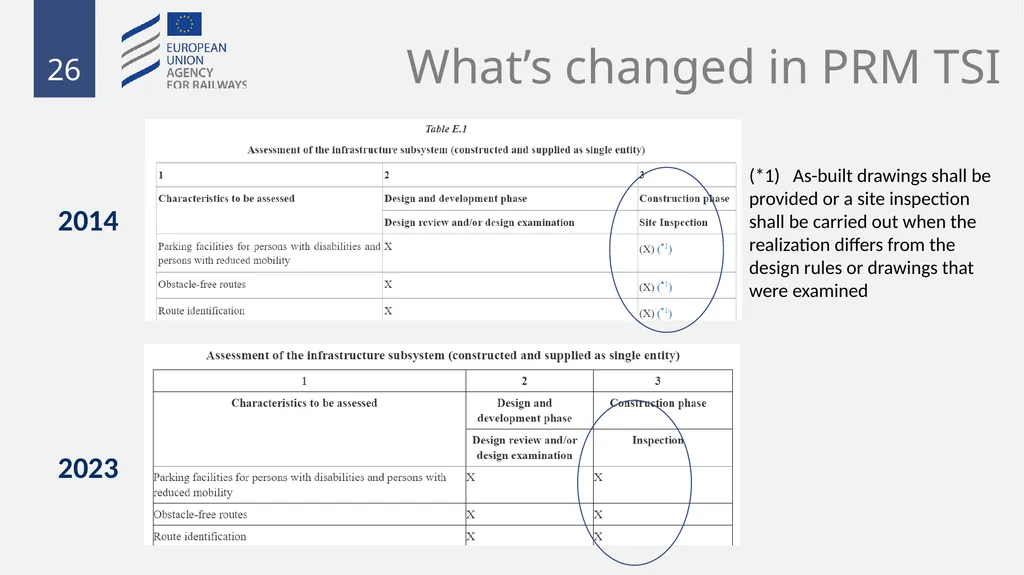
What’s changed in PRM TSI (*1) As-built drawings shall be provided or a site inspection shall be carried out when the realization differs from the design rules or drawings that were examined 2014 2023<br>
27
Scope of NoBo assessment For the PRM TSI part applicable to Fixed Installations, the Notified Body should assess the parts of the station that have been renewed/upgraded and, for those parts, only the characteristics that have been renewed/upgraded<br>
28
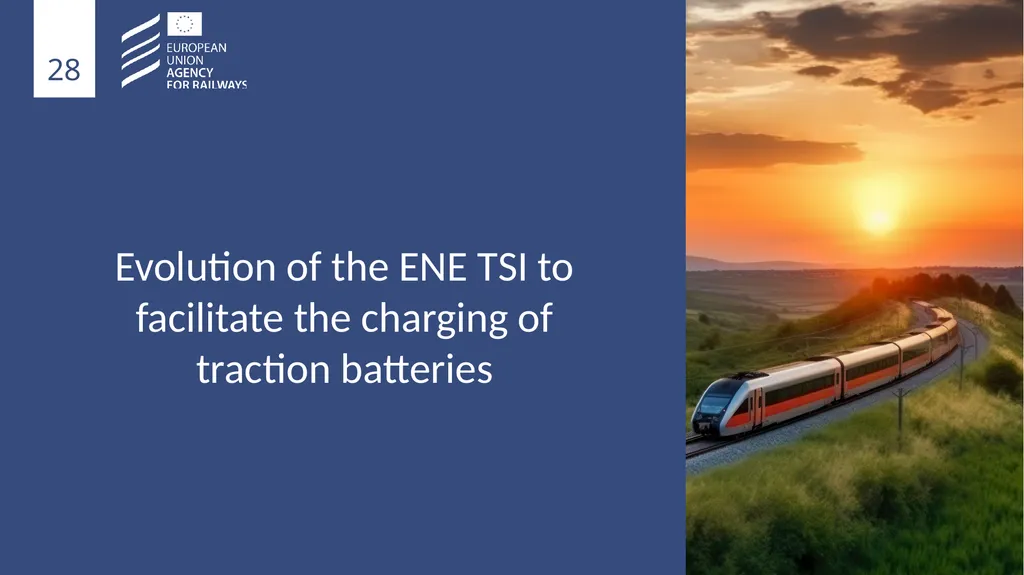
Evolution of the ENE TSI to facilitate the charging of traction batteries<br>
29
Evolution of the ENE TSI to facilitate the charging of traction batteries PROBLEM:
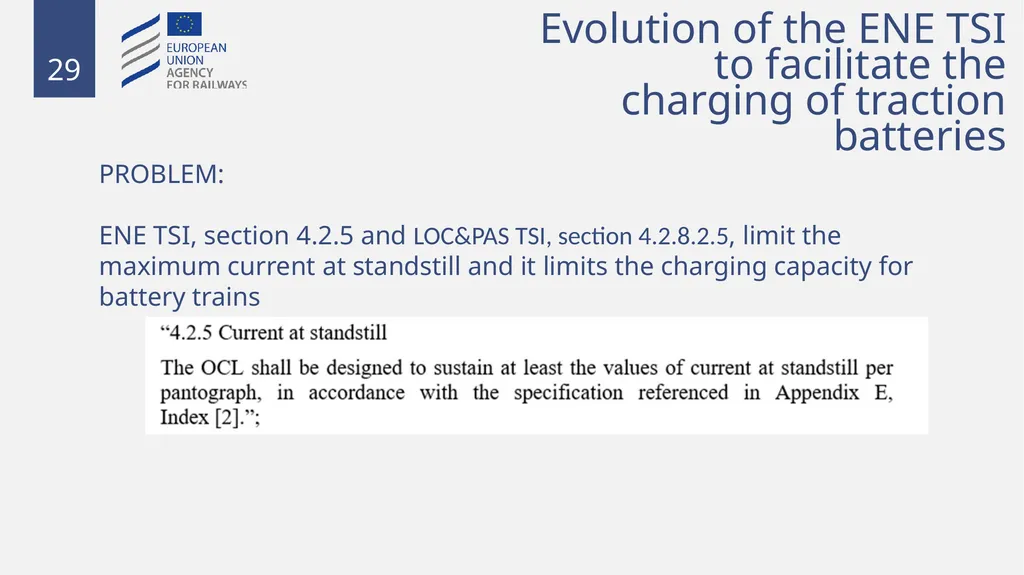
ENE TSI, section 4.2.5 and LOC&PAS TSI, section 4.2.8.2.5, limit the maximum current at standstill and it limits the charging capacity for battery trains<br>
ENE TSI, section 4.2.5 and LOC&PAS TSI, section 4.2.8.2.5, limit the maximum current at standstill and it limits the charging capacity for battery trains<br>
30
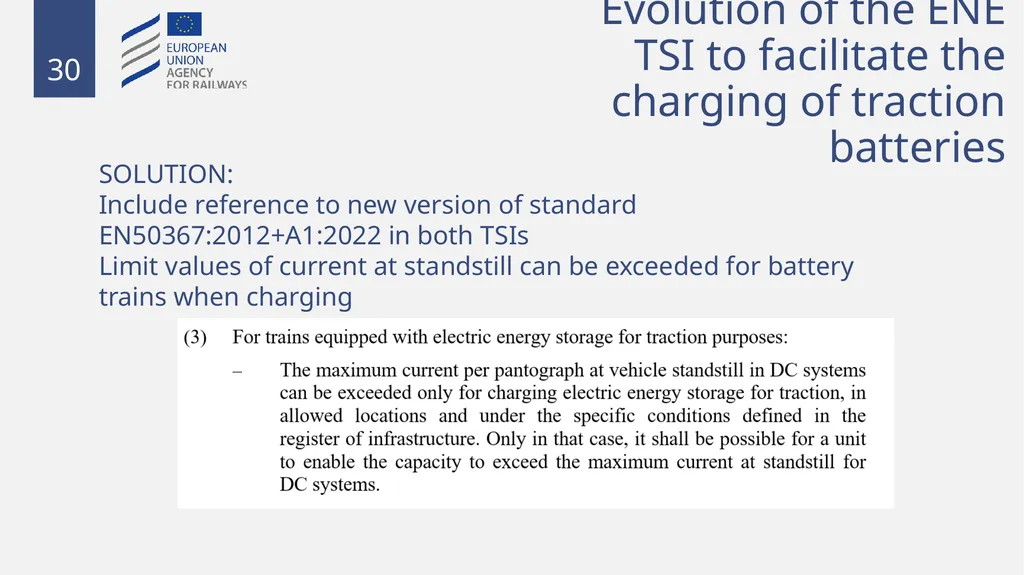
Evolution of the ENE TSI to facilitate the charging of traction batteries SOLUTION:
Include reference to new version of standard EN50367:2012+A1:2022 in both TSIs
Limit values of current at standstill can be exceeded for battery trains when charging<br>
Include reference to new version of standard EN50367:2012+A1:2022 in both TSIs
Limit values of current at standstill can be exceeded for battery trains when charging<br>
31
Multiple pantograph operation (more than 2)<br>
32
Multiple pantograph operation (more than 2) Design of the OCL and pantograph distribution
in case of multiple pantograph operation (more than 2):
Analysis of rules in different Member States
Analysis of results from measurements and simulations
Check of actual TSI regarding necessary improvements<br>
Analysis of rules in different Member States
Analysis of results from measurements and simulations
Check of actual TSI regarding necessary improvements<br>
33
Multiple pantograph operation (more than 2) It was concluded that more measurements/simulations are necessary to finally define TSI adjustments
Definition of necessary future research steps for general use of proposed rules
Adjustment in the text for a consistent use:
ENE TSI, sections 4.2.12 and 4.2.13
LOC&PAS TSI, sections 4.2.8.2.9.7 and 6.2.3.21<br>
Definition of necessary future research steps for general use of proposed rules
Adjustment in the text for a consistent use:
ENE TSI, sections 4.2.12 and 4.2.13
LOC&PAS TSI, sections 4.2.8.2.9.7 and 6.2.3.21<br>
34
Evolution protective provisions against electric shock<br>
35
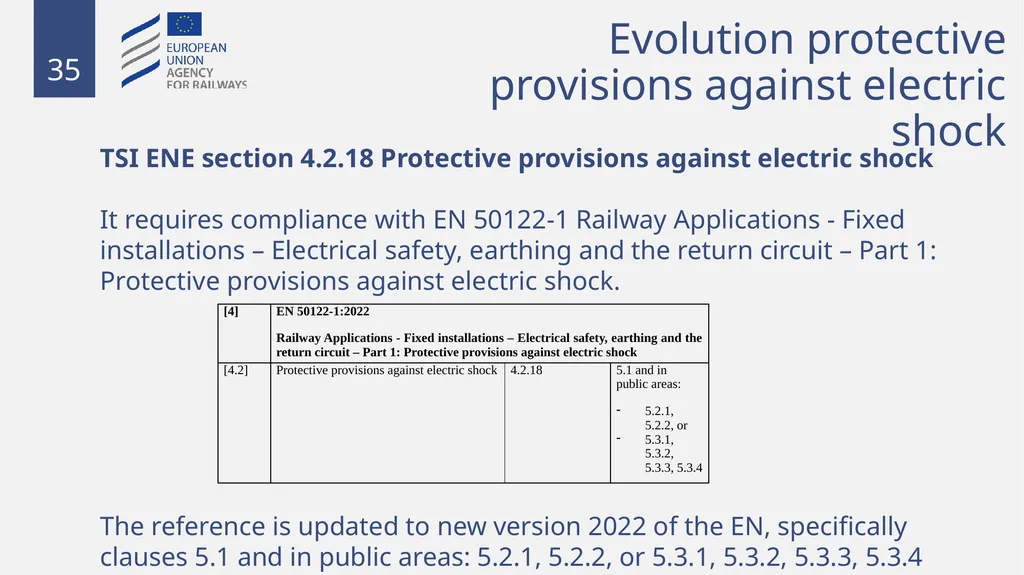
TSI ENE section 4.2.18 Protective provisions against electric shock
It requires compliance with EN 50122-1 Railway Applications - Fixed installations – Electrical safety, earthing and the return circuit – Part 1: Protective provisions against electric shock.
The reference is updated to new version 2022 of the EN, specifically clauses 5.1 and in public areas: 5.2.1, 5.2.2, or 5.3.1, 5.3.2, 5.3.3, 5.3.4 Evolution protective provisions against electric shock<br>
It requires compliance with EN 50122-1 Railway Applications - Fixed installations – Electrical safety, earthing and the return circuit – Part 1: Protective provisions against electric shock.
The reference is updated to new version 2022 of the EN, specifically clauses 5.1 and in public areas: 5.2.1, 5.2.2, or 5.3.1, 5.3.2, 5.3.3, 5.3.4 Evolution protective provisions against electric shock<br>
36
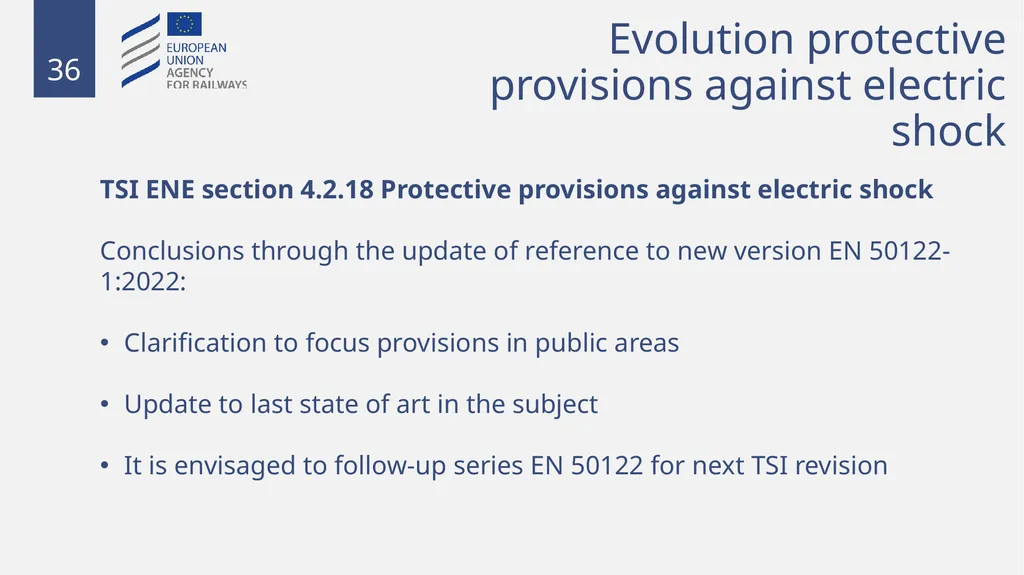
TSI ENE section 4.2.18 Protective provisions against electric shock
Conclusions through the update of reference to new version EN 50122-1:2022:
Clarification to focus provisions in public areas
Update to last state of art in the subject
It is envisaged to follow-up series EN 50122 for next TSI revision Evolution protective provisions against electric shock<br>
Conclusions through the update of reference to new version EN 50122-1:2022:
Clarification to focus provisions in public areas
Update to last state of art in the subject
It is envisaged to follow-up series EN 50122 for next TSI revision Evolution protective provisions against electric shock<br>
37
Harmonics and dynamic effects<br>
38
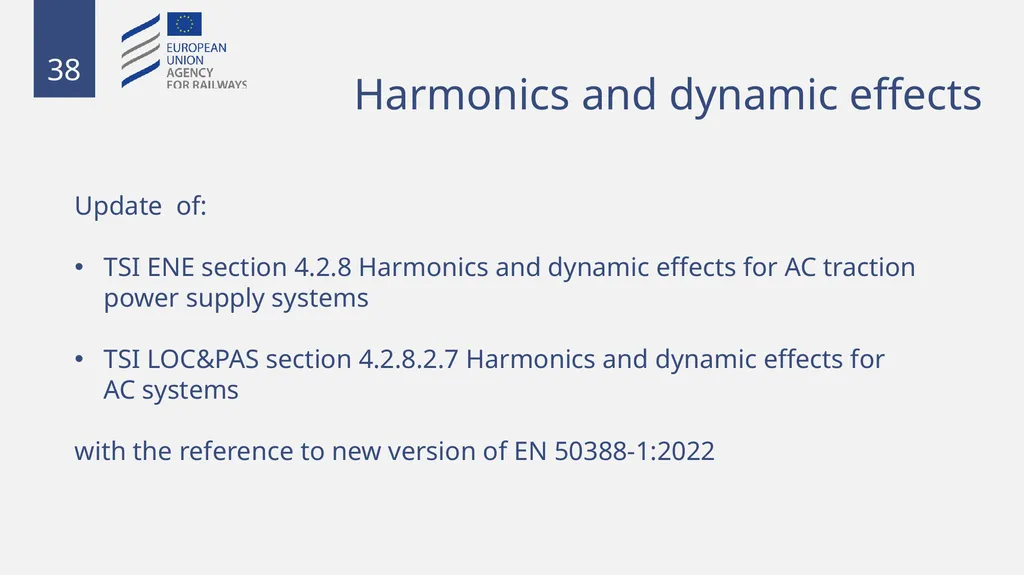
Update of:
TSI ENE section 4.2.8 Harmonics and dynamic effects for AC traction power supply systems
TSI LOC&PAS section 4.2.8.2.7 Harmonics and dynamic effects for AC systems
with the reference to new version of EN 50388-1:2022 Harmonics and dynamic effects<br>
TSI ENE section 4.2.8 Harmonics and dynamic effects for AC traction power supply systems
TSI LOC&PAS section 4.2.8.2.7 Harmonics and dynamic effects for AC systems
with the reference to new version of EN 50388-1:2022 Harmonics and dynamic effects<br>
39
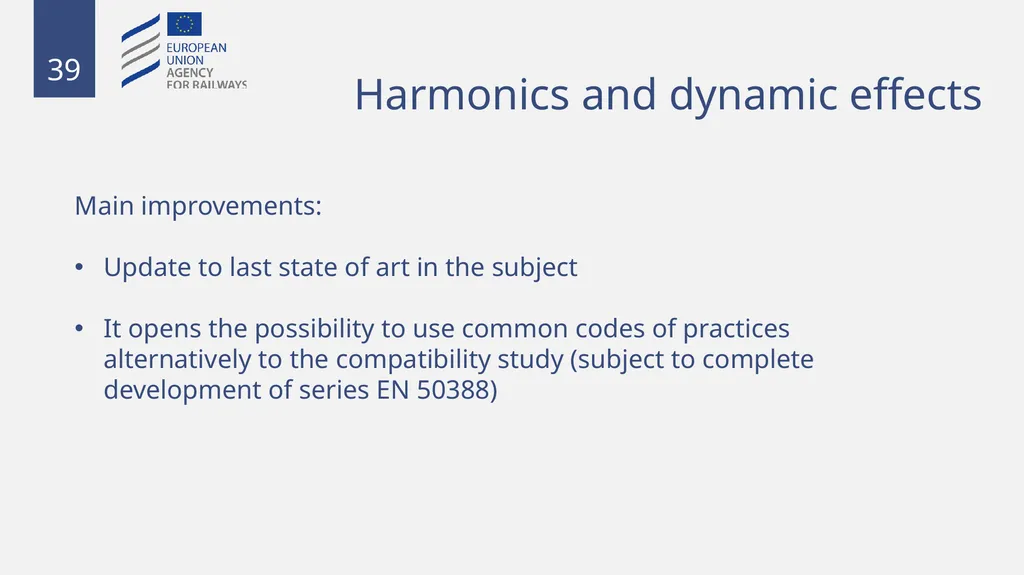
Main improvements:
Update to last state of art in the subject
It opens the possibility to use common codes of practices alternatively to the compatibility study (subject to complete development of series EN 50388) Harmonics and dynamic effects<br>
Update to last state of art in the subject
It opens the possibility to use common codes of practices alternatively to the compatibility study (subject to complete development of series EN 50388) Harmonics and dynamic effects<br>
40
THANK YOU Moving Europe towards a sustainable and safe railway system without frontiers. 40 Follow us:<br>