
Florence Nightingale By Lytton Strachey Lytton
JO
Published · 15 slides · 0 views

1 / 1





Description
Florence Nightingale By Lytton Strachey Lytton Strachey (1880-1932) -English biographer and critic -After studying at Cambridge, Strachey lived in London, became a founding member of the artistic, intellectual and literary Bloomsbury group.
Related Topics
Share
Embed code
Download this presentation From Below
"Florence Nightingale By Lytton Strachey Lytton" is the property of its rightful owner. Permission is granted to download and print the materials on this website for personal, non-commercial use only, and to display it on your personal computer provided you do not modify the materials and that you retain all copyright notices contained in the materials. By downloading content from our website, you accept the terms of this agreement.
Presentation Transcript
01
Florence Nightingale By Lytton Strachey Lytton Strachey (1880-1932)
-English biographer and critic
-After studying at Cambridge, Strachey lived in London, became a founding member of the artistic, intellectual and literary Bloomsbury group.
-He has many critical writings to his credit, but his greatest achievement was in biography.
He was greatly influenced by Dostoyevsky in the writing biographies like-
Eminent Victorians (1918)
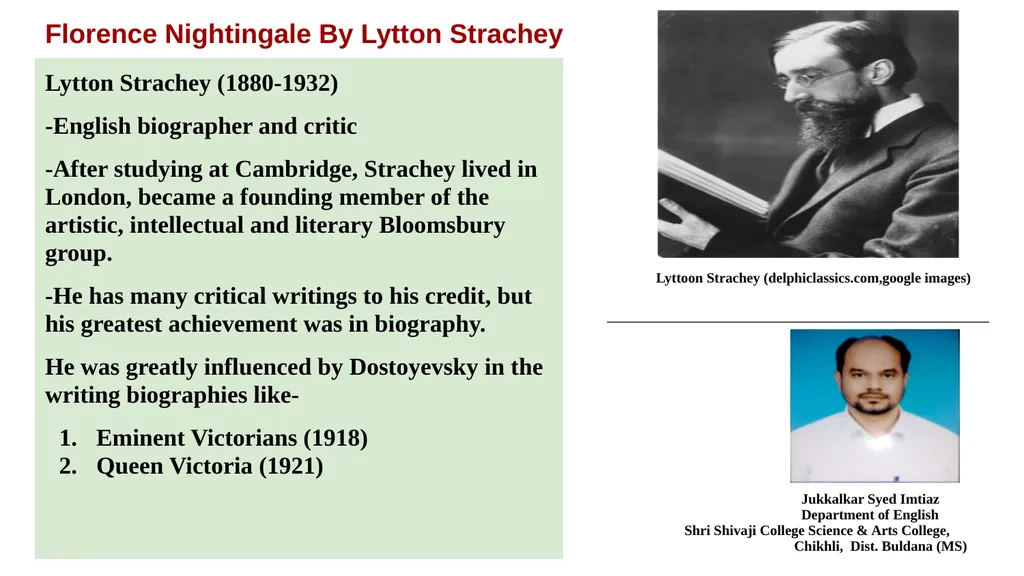
Queen Victoria (1921) Lyttoon Strachey (delphiclassics.com,google images)
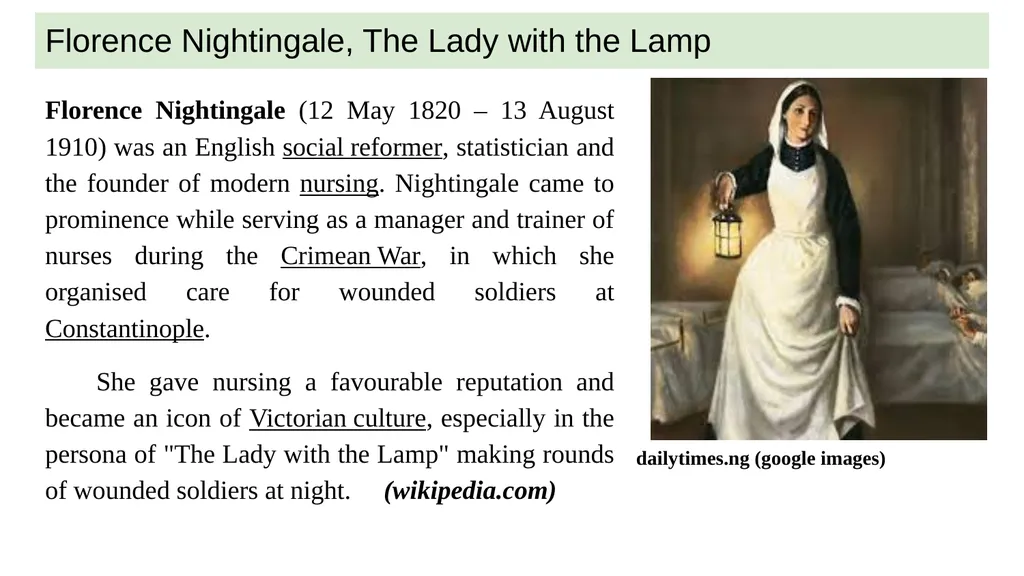
Jukkalkar Syed Imtiaz
Department of English
Shri Shivaji College Science & Arts College,
Chikhli, Dist. Buldana (MS)<br>
-English biographer and critic
-After studying at Cambridge, Strachey lived in London, became a founding member of the artistic, intellectual and literary Bloomsbury group.
-He has many critical writings to his credit, but his greatest achievement was in biography.
He was greatly influenced by Dostoyevsky in the writing biographies like-
Eminent Victorians (1918)
Queen Victoria (1921) Lyttoon Strachey (delphiclassics.com,google images)
Jukkalkar Syed Imtiaz
Department of English
Shri Shivaji College Science & Arts College,
Chikhli, Dist. Buldana (MS)<br>
02
Florence Nightingale, The Lady with the Lamp Florence Nightingale (12 May 1820 – 13 August 1910) was an English social reformer, statistician and the founder of modern nursing. Nightingale came to prominence while serving as a manager and trainer of nurses during the Crimean War, in which she organised care for wounded soldiers at Constantinople.
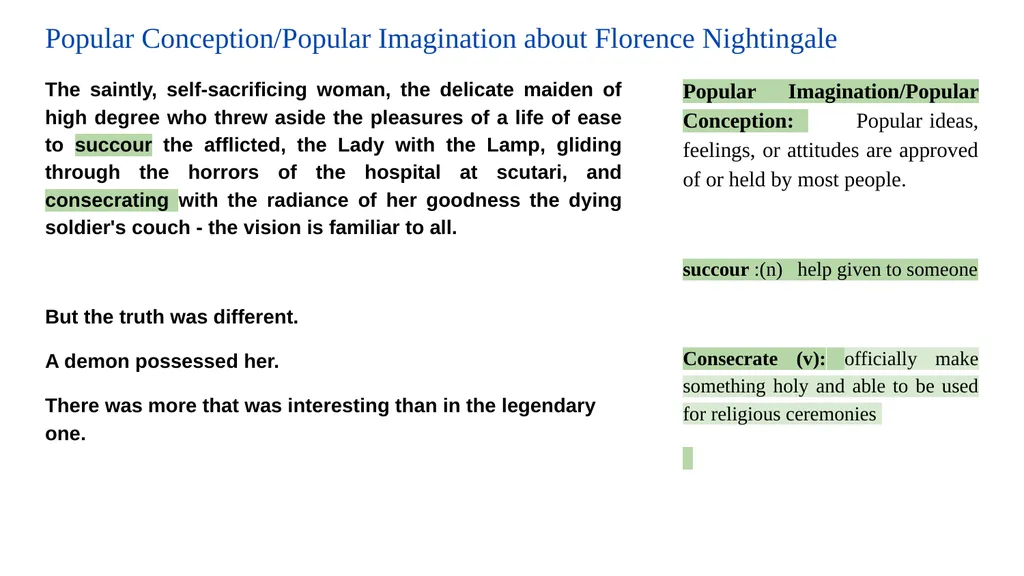
She gave nursing a favourable reputation and became an icon of Victorian culture, especially in the persona of "The Lady with the Lamp" making rounds of wounded soldiers at night. (wikipedia.com) dailytimes.ng (google images)<br>
She gave nursing a favourable reputation and became an icon of Victorian culture, especially in the persona of "The Lady with the Lamp" making rounds of wounded soldiers at night. (wikipedia.com) dailytimes.ng (google images)<br>
03
Popular Conception/Popular Imagination about Florence Nightingale The saintly, self-sacrificing woman, the delicate maiden of high degree who threw aside the pleasures of a life of ease to succour the afflicted, the Lady with the Lamp, gliding through the horrors of the hospital at scutari, and consecrating with the radiance of her goodness the dying soldier's couch - the vision is familiar to all.
But the truth was different.
A demon possessed her.
There was more that was interesting than in the legendary one. Popular Imagination/Popular Conception: Popular ideas, feelings, or attitudes are approved of or held by most people.
succour :(n) help given to someone
Consecrate (v): officially make something holy and able to be used for religious ceremonies<br>
But the truth was different.
A demon possessed her.
There was more that was interesting than in the legendary one. Popular Imagination/Popular Conception: Popular ideas, feelings, or attitudes are approved of or held by most people.
succour :(n) help given to someone
Consecrate (v): officially make something holy and able to be used for religious ceremonies<br>
04
Family Background Her family was extremely well to do and connected by marriage with a spreading circle of other well to do families.
There was a large country house in Derbyshire, another in the New Forest, there were Mayfair rooms for the London season, finest parties, - tours to the Continent- Italian Operas - glimpses at the celebrities of Paris.
Proper appreciation for all the richness on her part is - to marry an eligible gentleman and lead happy life.
But she was not interested in marriage. Derbyshire : Derbyshire is a county in the East Midlands of England. It includes much of the Peak District National Park.
New Forest: The New Forest is one of the largest remaining tracts of unenclosed pasture land, heathland and forest in Southern England.
Mayfair: An annual two-week-long fair that took place in central London
glimpse: to see something or someone for a very short time or only partly.
appreciation: when you recognize or understand that something is valuable,<br>
There was a large country house in Derbyshire, another in the New Forest, there were Mayfair rooms for the London season, finest parties, - tours to the Continent- Italian Operas - glimpses at the celebrities of Paris.
Proper appreciation for all the richness on her part is - to marry an eligible gentleman and lead happy life.
But she was not interested in marriage. Derbyshire : Derbyshire is a county in the East Midlands of England. It includes much of the Peak District National Park.
New Forest: The New Forest is one of the largest remaining tracts of unenclosed pasture land, heathland and forest in Southern England.
Mayfair: An annual two-week-long fair that took place in central London
glimpse: to see something or someone for a very short time or only partly.
appreciation: when you recognize or understand that something is valuable,<br>
05
God’s call are many and they are strange. God’s call are many and they are strange. Unto what state of life had it pleased him to call Charlotte Corday or Elizabeth of Hungary?
- What was secret voice in her ear, if it was not a call? Why she had felt, from her earliest years, those mysterious promptings towards… she hardly knew what, but certainly towards something very different from anything around her?
-Why as a child in the nursery, when her sister had shown a healthy pleasure in tearing her dolls to pieces, had she shown an almost morbid one in sewing up again? Why was she driven now to minister to the poor in their cottages, to watch by sick beds, to put her dog’s wounded paw into elaborate splints as if it was a human being?
- Taking her diary, she poured agitations of her soul. Charlotte Corday (1768 – 17 July 1793), was an important figure of the French Revolution.
Elizabeth of Hungary (1207–1231), was a princess of the Kingdom of Hungary, venerated Catholic saint. She was married at the age of 14, and widowed at 20. After her husband's death she sent her children away and regained her dowry, using the money, she built a hospital where she herself served the sick. She became a symbol of Christian charity.<br>
- What was secret voice in her ear, if it was not a call? Why she had felt, from her earliest years, those mysterious promptings towards… she hardly knew what, but certainly towards something very different from anything around her?
-Why as a child in the nursery, when her sister had shown a healthy pleasure in tearing her dolls to pieces, had she shown an almost morbid one in sewing up again? Why was she driven now to minister to the poor in their cottages, to watch by sick beds, to put her dog’s wounded paw into elaborate splints as if it was a human being?
- Taking her diary, she poured agitations of her soul. Charlotte Corday (1768 – 17 July 1793), was an important figure of the French Revolution.
Elizabeth of Hungary (1207–1231), was a princess of the Kingdom of Hungary, venerated Catholic saint. She was married at the age of 14, and widowed at 20. After her husband's death she sent her children away and regained her dowry, using the money, she built a hospital where she herself served the sick. She became a symbol of Christian charity.<br>
06
Florence who was now twenty five felt that the dream of her life had been shattered. -As years passed, Florence grew restless and unhappy.
-Mrs. Nightingale observed that there was something wrong. Mr. Nightingale suggested that a husband might be advisable.
- But she was not interested in marriage.
Then, Florence, announced in extreme desire to go to Salisbury Hospital for several months as a nurse and confessed to some visionary plan of eventually setting up in a house of her own in a neighbouring village.
-Her parents were shocked to listen to Florence’s desire.
-The whole scheme was summarily brushed aside as preposterous.
Florence who was now twenty five felt that the dream of her life had been shattered. Salisbury: is a cathedral city in Wiltshire, England,
preposterous: (adj.): very silly or stupid<br>
-Mrs. Nightingale observed that there was something wrong. Mr. Nightingale suggested that a husband might be advisable.
- But she was not interested in marriage.
Then, Florence, announced in extreme desire to go to Salisbury Hospital for several months as a nurse and confessed to some visionary plan of eventually setting up in a house of her own in a neighbouring village.
-Her parents were shocked to listen to Florence’s desire.
-The whole scheme was summarily brushed aside as preposterous.
Florence who was now twenty five felt that the dream of her life had been shattered. Salisbury: is a cathedral city in Wiltshire, England,
preposterous: (adj.): very silly or stupid<br>
07
A nurse in those days means -The difficulties in her path were great.
It was unthinkable in those days that a woman of means, making her own way in the world and living independent.
-The profession, she was interested in was considered disrespectful in those days.
-In those days a nurse meant -
- notorious for immoral conduct, sobriety was almost unknown among them,
-they were hardly trusted to carry out the simplest medical duties.
It was but natural the way her parents react to her wish. a man/woman of means : a rich man or woman.<br>
It was unthinkable in those days that a woman of means, making her own way in the world and living independent.
-The profession, she was interested in was considered disrespectful in those days.
-In those days a nurse meant -
- notorious for immoral conduct, sobriety was almost unknown among them,
-they were hardly trusted to carry out the simplest medical duties.
It was but natural the way her parents react to her wish. a man/woman of means : a rich man or woman.<br>
08
She was an Eagle Three more years passed.
Florence was 28 years old now.
Her Parents thought that she is old enough to take her own decisions.
She joined as a Superintendent of a charitable nursing home in Harley Street.
She gained her independence but her mother still unhappy and often wept among intimates.
She said, “We hatched a wild swan.”
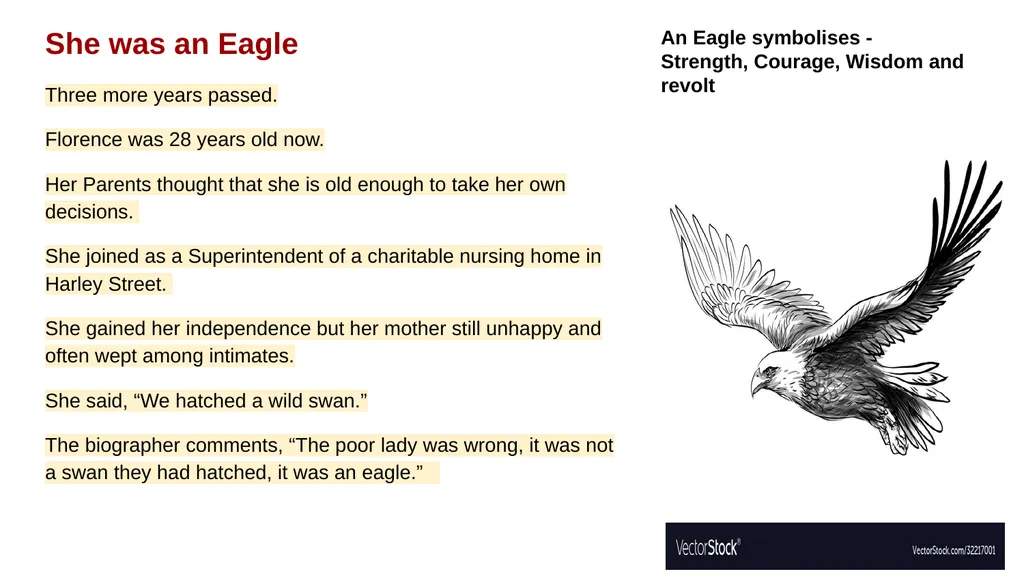
The biographer comments, “The poor lady was wrong, it was not a swan they had hatched, it was an eagle.” An Eagle symbolises -
Strength, Courage, Wisdom and revolt<br>
Florence was 28 years old now.
Her Parents thought that she is old enough to take her own decisions.
She joined as a Superintendent of a charitable nursing home in Harley Street.
She gained her independence but her mother still unhappy and often wept among intimates.
She said, “We hatched a wild swan.”
The biographer comments, “The poor lady was wrong, it was not a swan they had hatched, it was an eagle.” An Eagle symbolises -
Strength, Courage, Wisdom and revolt<br>
09
Fate knocked at the door. -Florence Nightingale had been a year in her nursing home in Harley street, when fate knocked at her door.
-The Crimean War broke out, the battle of Alma was fought.
- The terrible conditions of military hospitals at Scutari began to be known in England.
-This was great opportunity for Florence Nightingale. She was well experience and desired to serve.
With thirty-eight nursed she left for Constantinople. Historical Background:
The Crimean War(Battle of Alma) was a military conflict fought from October 1853 to February 1856 in which Russia lost to an alliance made up of France, the Ottoman Empire, the United Kingdom and Sardinia. The immediate cause of the war involved the rights of Christian minorities in the Holy Land, then a part of the Ottoman Empire (Turkey)
Constantinople is the largest city of Turkey, at present it is called Istanbul.<br>
-The Crimean War broke out, the battle of Alma was fought.
- The terrible conditions of military hospitals at Scutari began to be known in England.
-This was great opportunity for Florence Nightingale. She was well experience and desired to serve.
With thirty-eight nursed she left for Constantinople. Historical Background:
The Crimean War(Battle of Alma) was a military conflict fought from October 1853 to February 1856 in which Russia lost to an alliance made up of France, the Ottoman Empire, the United Kingdom and Sardinia. The immediate cause of the war involved the rights of Christian minorities in the Holy Land, then a part of the Ottoman Empire (Turkey)
Constantinople is the largest city of Turkey, at present it is called Istanbul.<br>
10
What did they find in the hospital- want, neglect, confusion, misery… What did they find in the hospital- want, neglect, confusion, misery…
The barrack house, without forethought or preparation had been hurriedly set aside as the chief shelter for the victims of war.
The building was defective- huge sewers underlay it, and cesspools loaded with filth wafted their poison into the upper rooms.
The floors were in rotten condition, the walls were thick with dirt, incredible multitudes of vermin swarmed everywhere.
The barrack contained four miles of beds, placed very close.
There was no ventilation.
The stench was indescribable.
There wasn’t any furniture. Empty beer bottles were used for candle sticks.<br>
The barrack house, without forethought or preparation had been hurriedly set aside as the chief shelter for the victims of war.
The building was defective- huge sewers underlay it, and cesspools loaded with filth wafted their poison into the upper rooms.
The floors were in rotten condition, the walls were thick with dirt, incredible multitudes of vermin swarmed everywhere.
The barrack contained four miles of beds, placed very close.
There was no ventilation.
The stench was indescribable.
There wasn’t any furniture. Empty beer bottles were used for candle sticks.<br>
11
Facilities in the hospital: A Big NO There were – no basins, no towels, no soap, no brooms, no mops, no trays, no plates, there were neither slippers nor scissors, there were no knives, no forks, or spoons.
The supply of fuel was constantly deficient. The cooking arrangements were preposterously inadequate, and the laundry was a farce.
Splinters, bandages and most ordinary drugs were lacking.
As per the hospital rule, Florence need to provide service of her and her nurses when they were asked by the doctors.
Moreover, some surgeons would have nothing to say to her. The majority of doctors were hostile to her. But some welcomed her.<br>
The supply of fuel was constantly deficient. The cooking arrangements were preposterously inadequate, and the laundry was a farce.
Splinters, bandages and most ordinary drugs were lacking.
As per the hospital rule, Florence need to provide service of her and her nurses when they were asked by the doctors.
Moreover, some surgeons would have nothing to say to her. The majority of doctors were hostile to her. But some welcomed her.<br>
12
She was not merely nurse, she became an administrative chief. But Florence Nightingale stood firm. She was a rock in the angry ocean. And so it was that hope dawned at Scutari. The reign of chaos and old night began to dwindle, order came upon the scene. The Lady Superintendent was at her task. Progress might be slow but it was sure.
The first sign of change- 1) the appearance of some necessary objects- The sick men bega to enjoy the use of towels and soap, knives and forks, combs and tooth brushes.
2) The changes she brought in the kitchens and laundries in the hospitals.
The ill cooked hunks of meat, vilely served at irregular intervals, which had hitherto been the only diet for the sick men were replaced by punctual meals, well prepared and appetizing. And extra food like soups and wines and jellies were distributed to those who needed them.
She was not merely nurse, she became an administrative chief.
The hospital at Scutari was in fact disorganized. It was devoid of the necessary elements of civilized life-the commonest material objects the most ordinary-cleanliness, the rudimentary habits of order and authority.<br>
The first sign of change- 1) the appearance of some necessary objects- The sick men bega to enjoy the use of towels and soap, knives and forks, combs and tooth brushes.
2) The changes she brought in the kitchens and laundries in the hospitals.
The ill cooked hunks of meat, vilely served at irregular intervals, which had hitherto been the only diet for the sick men were replaced by punctual meals, well prepared and appetizing. And extra food like soups and wines and jellies were distributed to those who needed them.
She was not merely nurse, she became an administrative chief.
The hospital at Scutari was in fact disorganized. It was devoid of the necessary elements of civilized life-the commonest material objects the most ordinary-cleanliness, the rudimentary habits of order and authority.<br>
13
She was heroic. She was heroic.
The biographer is of the opinion that the mankind loves to invest the chosen people who perform extraordinary work in this world with romantic sentiments. This might be true for the wounded soldier on his couch of agony, she might well appear in the guise of a gracious angel of mercy, the lady with the lamp but actually she brought about the change through her strict methods, stern discipline, by rigid attention to detail, by ceaseless labour, by the fixed determination of an indomitable will.<br>
The biographer is of the opinion that the mankind loves to invest the chosen people who perform extraordinary work in this world with romantic sentiments. This might be true for the wounded soldier on his couch of agony, she might well appear in the guise of a gracious angel of mercy, the lady with the lamp but actually she brought about the change through her strict methods, stern discipline, by rigid attention to detail, by ceaseless labour, by the fixed determination of an indomitable will.<br>
14
In those days soldiers were considered as brutes. In May 1855, after six months of labour, Miss Nightingale could look with satisfaction at the condition of Scutari hospitals.
As a result of this ceaseless work the mortality rate had fallen from 42% to 22% per thousand.
In those days soldiers were considered as brutes.
But yet she was not satisfied. The physical needs of the soldiers were well provided. But the spiritual and mental needs remained. She set up well furnished reading-rooms and recreation rooms. She started classed and lectures. The private soldier began to drink less and even thought to save his pay for his family.<br>
As a result of this ceaseless work the mortality rate had fallen from 42% to 22% per thousand.
In those days soldiers were considered as brutes.
But yet she was not satisfied. The physical needs of the soldiers were well provided. But the spiritual and mental needs remained. She set up well furnished reading-rooms and recreation rooms. She started classed and lectures. The private soldier began to drink less and even thought to save his pay for his family.<br>
15
Notes on Hospitals (1859) revolutionized the theory of hospital construction and hospital management. After returning from Scutari, her real life began. Scutari was just a stepping stone, the fulcrum with which she had shown the world that the hospitals all over the world need change. Her book Notes on Hospitals(1859) revolutionized the theory of hospital construction and hospital management.
With the opening of the Nightingale Training School for Nurses at St. Thomas Hospital (1860), she became the founder of modern nursing.<br>
With the opening of the Nightingale Training School for Nurses at St. Thomas Hospital (1860), she became the founder of modern nursing.<br>