
Flower Production in a Nursery Environment





Description: Flower Production in a Nursery Environment Advanced Plant Production Level 4 Topic 2: flower production SO 2.0 Lo 2.1.1 2.1.5 Mr Motsoetsoe t.e SEFIKENG CAMPUS Lesson Outcomes Students should be able to explain the concept of flower
Related Topics
Download Presentation
"Flower Production in a Nursery Environment" is the property of its rightful owner. Permission is granted to download and print the materials on this website for personal, non-commercial use only, and to display it on your personal computer provided you do not modify the materials and that you retain all copyright notices contained in the materials. By downloading content from our website, you accept the terms of this agreement.
Presentation Transcript
slide1. Flower Production in a Nursery Environment
Advanced Plant Production Level 4 Topic 2: flower production
SO 2.0
Lo 2.1.1 – 2.1.5
Mr Motsoetsoe t.e SEFIKENG CAMPUS<br>
slide2. Lesson Outcomes Students should be able to explain the concept of flower ‘cultivar’ and give examples.
Each cultivar is cultivated according to its economical importance.
Relevant propagation techniques will be applied in flower production.
Control measures for pest and diseases affecting flowers are identified.
Flower production process from planting to wholesaler must be explained.<br>
slide3. cultivars (cultivated variety)
Is an assembly of plants selected for desirable characteristics that are maintained during propagation.<br>
slide4. cultivars (cultivated variety) (cont.)<br>
slide5. A cultivar is a plant that is produced and maintained by horticulturists. Example: Lavender twist is a weeping form of redbud, twigs have a slight zigzag pattern. Although some cultivars occurs in nature as plant mutations, most cultivars are developed by plant breeders and are called hybrids. The first letter of a cultivar is capitalized and the term is never utilized, they are surrounded by single quotation. Lavender twist redbud<br>
slide6. The cultivar’s economical importance Flower market increased emphasis on quality.
Quality factors related to post – harvest keeping quality including environmental influence on flower longevity, as well as the influence of pathogenic microorganisms such as virus and diseases
As competition in the world market increases, quality becomes a more important factor.
Increasing vase life of flower life on a pot plant is an important goal.<br>
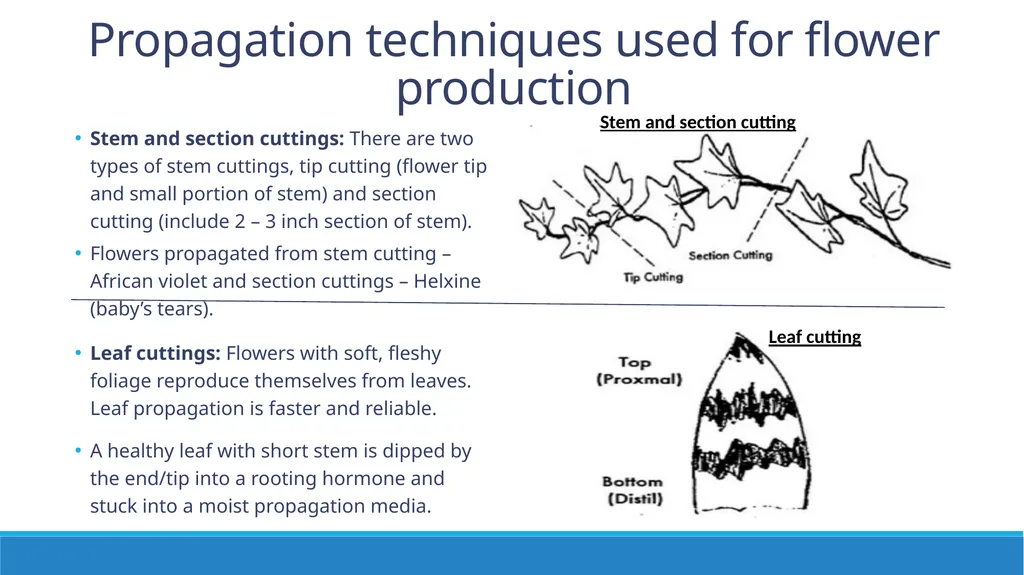
slide7. Propagation techniques used for flower production Stem and section cuttings: There are two types of stem cuttings, tip cutting (flower tip and small portion of stem) and section cutting (include 2 – 3 inch section of stem).
Flowers propagated from stem cutting – African violet and section cuttings – Helxine (baby’s tears).
Leaf cuttings: Flowers with soft, fleshy foliage reproduce themselves from leaves. Leaf propagation is faster and reliable.
A healthy leaf with short stem is dipped by the end/tip into a rooting hormone and stuck into a moist propagation media.
Flowers such as African violet and Sanseviera. Stem and section cutting Leaf cutting<br>
slide8. Leaf vein cuttings:
1st method – cut leaf veins into sections, then place the bottom of the vein pressed into the propagation medium with leaf portion sticking up.
2nd method – slash vein of a larger leaf at 1 to 2 inch intervals on the underside of the leaf. Flower examples such as Rex begonia and Smithianthas (temple bells).<br>
slide9. Flower process Students should remember the nursery operations from previous lesson
A greenhouse extends the growing season and lets you produce more flower variety
In the greenhouse, measures against heat and cold apply to keep winter plants during winter or whenever the weather is not conducive to growing outdoor
Some flowers can only be grown in a greenhouse
These greenhouse must be equipped with automatic cooling heating and light shade adjustment systems.
Irrigation can be manual or automatic
Fields are transplanted with greenhouse grown transplants cuttings can also be used
Flowers must be planted and raised in beds, furrows depending on cut flowers type.
Flowers will have better quality when provided with staking and netting<br>
slide10. Flower process (Cont.) When harvesting, cut flowers quality should be at it peak at the moment of harvesting. Some flowers are picked before opening, others when florets are half or fully open
Harvesting is done by hand with sheers or sharp knife to prevent damage and maintain optimum freshness
Do not lay flowers on the ground otherwise they may become contaminated by diseases.
Immediately after picking, put flowers in water mixed with floral preservative solution and keep in a cool shaded area
Flower grading include stem length, straightness and strength, flower size, vase life, lack of defects, maturity, uniformity and foliage quality.<br>
slide11. Flower process (Cont.) Flowers that do not meet quality standard will fetch lower prices and have reduced ability to sell
Store flowers in cool temperature to maintain freshness
Transportation of flowers to buyers must be in a tempt and humid controlled environment.
When harvesting, cut flowers quality should be at it peak at the moment of harvesting. Some flowers are picked before opening, others when florets are half or fully open
Harvesting is done by hand with sheers or sharp knife to prevent damage and maintain optimum freshness<br>
slide12. Flower process (Cont.) Do not lay flowers on the ground otherwise they may become contaminated by diseases.
Immediately after picking, put flowers in water mixed with floral preservative solution and keep in a cool shaded area
Flower grading include stem length, straightness and strength, flower size, vase life, lack of defects, maturity, uniformity and foliage quality.
Flowers that do not meet quality standard will fetch lower prices and have reduced ability to sell
Store flowers in cool temperature to maintain freshness
Transportation of flowers to buyers must be in a tempt and humid controlled environment.<br>
slide13. Recap The flower production is explained how it should be applied in the nursery environment.
Different kinds of flower cultivar is identified and explained
The economic importance of cultivars is explained.
Pests and diseases affecting flowers and the control methods are identified.<br>
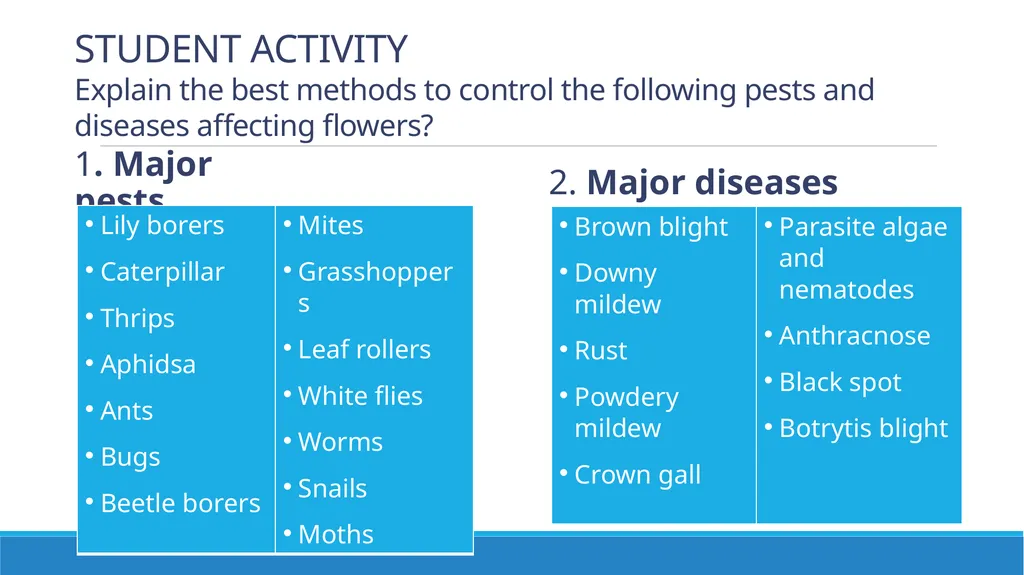
slide14. STUDENT ACTIVITY Explain the best methods to control the following pests and diseases affecting flowers? 1. Major pests 2. Major diseases<br>
slide15. The end<br>
SO 2.0
Lo 2.1.1 – 2.1.5
Mr Motsoetsoe t.e SEFIKENG CAMPUS<br>
slide2. Lesson Outcomes Students should be able to explain the concept of flower ‘cultivar’ and give examples.
Each cultivar is cultivated according to its economical importance.
Relevant propagation techniques will be applied in flower production.
Control measures for pest and diseases affecting flowers are identified.
Flower production process from planting to wholesaler must be explained.<br>
slide3. cultivars (cultivated variety)
Is an assembly of plants selected for desirable characteristics that are maintained during propagation.<br>
slide4. cultivars (cultivated variety) (cont.)<br>
slide5. A cultivar is a plant that is produced and maintained by horticulturists. Example: Lavender twist is a weeping form of redbud, twigs have a slight zigzag pattern. Although some cultivars occurs in nature as plant mutations, most cultivars are developed by plant breeders and are called hybrids. The first letter of a cultivar is capitalized and the term is never utilized, they are surrounded by single quotation. Lavender twist redbud<br>
slide6. The cultivar’s economical importance Flower market increased emphasis on quality.
Quality factors related to post – harvest keeping quality including environmental influence on flower longevity, as well as the influence of pathogenic microorganisms such as virus and diseases
As competition in the world market increases, quality becomes a more important factor.
Increasing vase life of flower life on a pot plant is an important goal.<br>
slide7. Propagation techniques used for flower production Stem and section cuttings: There are two types of stem cuttings, tip cutting (flower tip and small portion of stem) and section cutting (include 2 – 3 inch section of stem).
Flowers propagated from stem cutting – African violet and section cuttings – Helxine (baby’s tears).
Leaf cuttings: Flowers with soft, fleshy foliage reproduce themselves from leaves. Leaf propagation is faster and reliable.
A healthy leaf with short stem is dipped by the end/tip into a rooting hormone and stuck into a moist propagation media.
Flowers such as African violet and Sanseviera. Stem and section cutting Leaf cutting<br>
slide8. Leaf vein cuttings:
1st method – cut leaf veins into sections, then place the bottom of the vein pressed into the propagation medium with leaf portion sticking up.
2nd method – slash vein of a larger leaf at 1 to 2 inch intervals on the underside of the leaf. Flower examples such as Rex begonia and Smithianthas (temple bells).<br>
slide9. Flower process Students should remember the nursery operations from previous lesson
A greenhouse extends the growing season and lets you produce more flower variety
In the greenhouse, measures against heat and cold apply to keep winter plants during winter or whenever the weather is not conducive to growing outdoor
Some flowers can only be grown in a greenhouse
These greenhouse must be equipped with automatic cooling heating and light shade adjustment systems.
Irrigation can be manual or automatic
Fields are transplanted with greenhouse grown transplants cuttings can also be used
Flowers must be planted and raised in beds, furrows depending on cut flowers type.
Flowers will have better quality when provided with staking and netting<br>
slide10. Flower process (Cont.) When harvesting, cut flowers quality should be at it peak at the moment of harvesting. Some flowers are picked before opening, others when florets are half or fully open
Harvesting is done by hand with sheers or sharp knife to prevent damage and maintain optimum freshness
Do not lay flowers on the ground otherwise they may become contaminated by diseases.
Immediately after picking, put flowers in water mixed with floral preservative solution and keep in a cool shaded area
Flower grading include stem length, straightness and strength, flower size, vase life, lack of defects, maturity, uniformity and foliage quality.<br>
slide11. Flower process (Cont.) Flowers that do not meet quality standard will fetch lower prices and have reduced ability to sell
Store flowers in cool temperature to maintain freshness
Transportation of flowers to buyers must be in a tempt and humid controlled environment.
When harvesting, cut flowers quality should be at it peak at the moment of harvesting. Some flowers are picked before opening, others when florets are half or fully open
Harvesting is done by hand with sheers or sharp knife to prevent damage and maintain optimum freshness<br>
slide12. Flower process (Cont.) Do not lay flowers on the ground otherwise they may become contaminated by diseases.
Immediately after picking, put flowers in water mixed with floral preservative solution and keep in a cool shaded area
Flower grading include stem length, straightness and strength, flower size, vase life, lack of defects, maturity, uniformity and foliage quality.
Flowers that do not meet quality standard will fetch lower prices and have reduced ability to sell
Store flowers in cool temperature to maintain freshness
Transportation of flowers to buyers must be in a tempt and humid controlled environment.<br>
slide13. Recap The flower production is explained how it should be applied in the nursery environment.
Different kinds of flower cultivar is identified and explained
The economic importance of cultivars is explained.
Pests and diseases affecting flowers and the control methods are identified.<br>
slide14. STUDENT ACTIVITY Explain the best methods to control the following pests and diseases affecting flowers? 1. Major pests 2. Major diseases<br>
slide15. The end<br>