Focus Group - Introduction Dr Karen Lumsden Full resource, see: https:www.ncrm.ac.ukresourcesonlineall?id20852 Introduction Focus groups are a qualitative method They are used to obtain a wide variety of views or opinions
"Focus Group - Introduction Dr Karen Lumsden Full" is the property of its rightful owner. Permission is granted to
download and print the materials on this website for personal, non-commercial use only, and to display it
on your personal computer provided you do not modify the materials and that you retain all copyright
notices contained in the materials. By downloading content from our website, you accept the terms of this
agreement.
Presentation Transcript
01
Focus Group - Introduction Dr Karen Lumsden
Full resource, see: https://www.ncrm.ac.uk/resources/online/all/?id=20852<br>
02
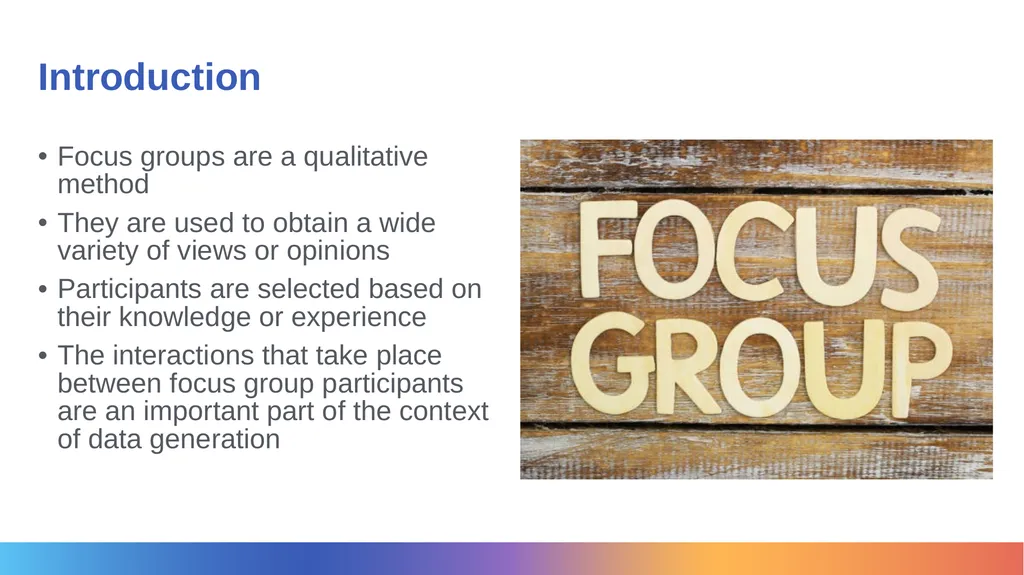
Introduction Focus groups are a qualitative method
They are used to obtain a wide variety of views or opinions
Participants are selected based on their knowledge or experience
The interactions that take place between focus group participants are an important part of the context of data generation<br>
03
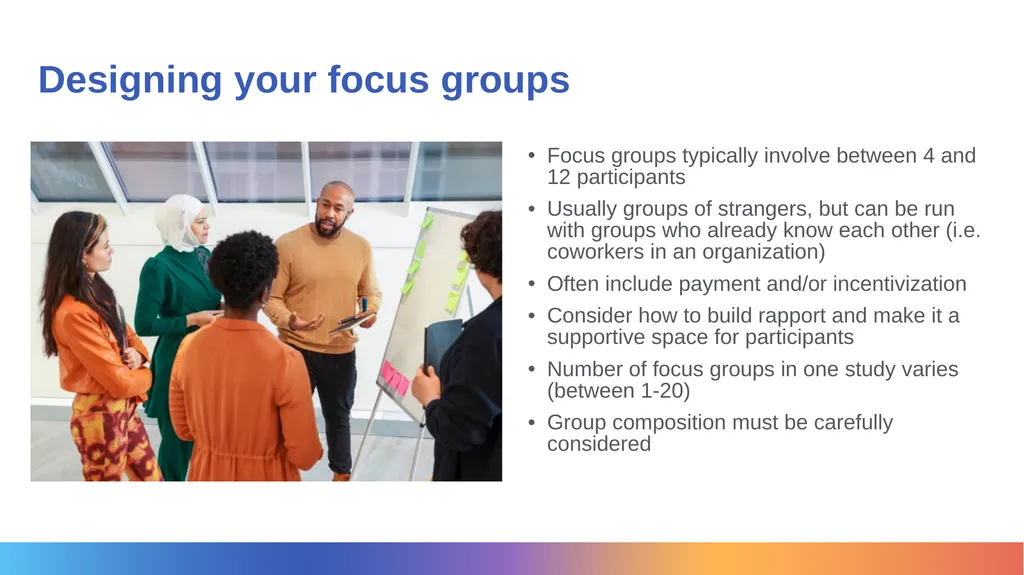
Designing your focus groups Focus groups typically involve between 4 and 12 participants
Usually groups of strangers, but can be run with groups who already know each other (i.e. coworkers in an organization)
Often include payment and/or incentivization
Consider how to build rapport and make it a supportive space for participants
Number of focus groups in one study varies (between 1-20)
Group composition must be carefully considered<br>
04
Focus group agenda, focusing activities and questions Focus group questions are usually open and exploratory
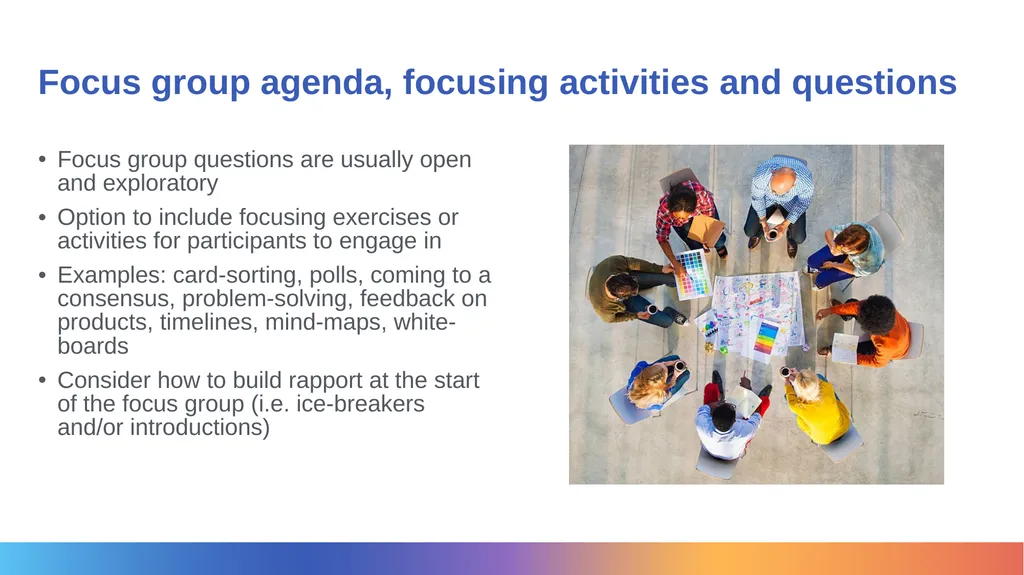
Option to include focusing exercises or activities for participants to engage in
Examples: card-sorting, polls, coming to a consensus, problem-solving, feedback on products, timelines, mind-maps, white-boards
Consider how to build rapport at the start of the focus group (i.e. ice-breakers and/or introductions)<br>
05
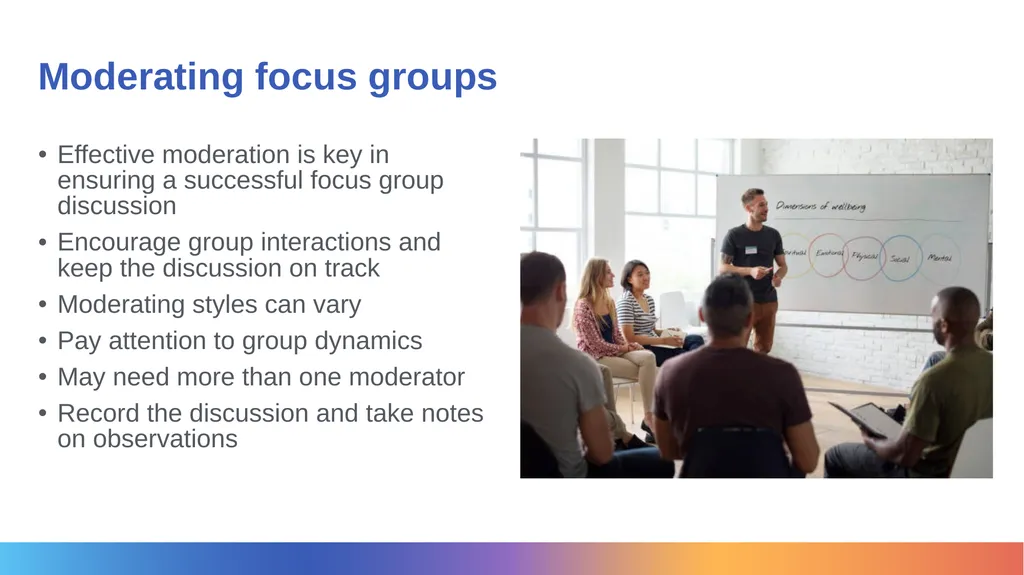
Moderating focus groups Effective moderation is key in ensuring a successful focus group discussion
Encourage group interactions and keep the discussion on track
Moderating styles can vary
Pay attention to group dynamics
May need more than one moderator
Record the discussion and take notes on observations<br>
06
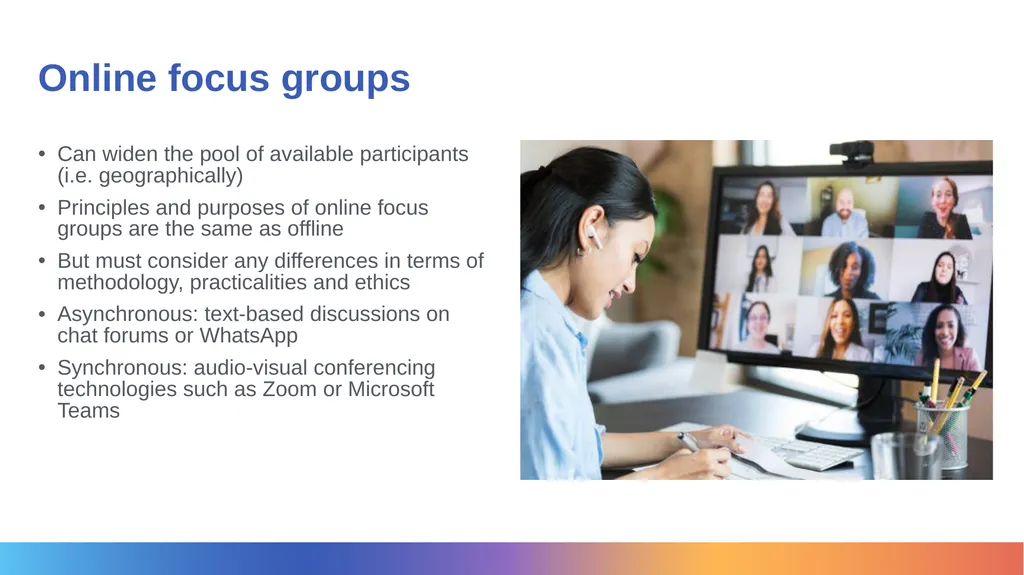
Online focus groups Can widen the pool of available participants (i.e. geographically)
Principles and purposes of online focus groups are the same as offline
But must consider any differences in terms of methodology, practicalities and ethics
Asynchronous: text-based discussions on chat forums or WhatsApp
Synchronous: audio-visual conferencing technologies such as Zoom or Microsoft Teams<br>
07
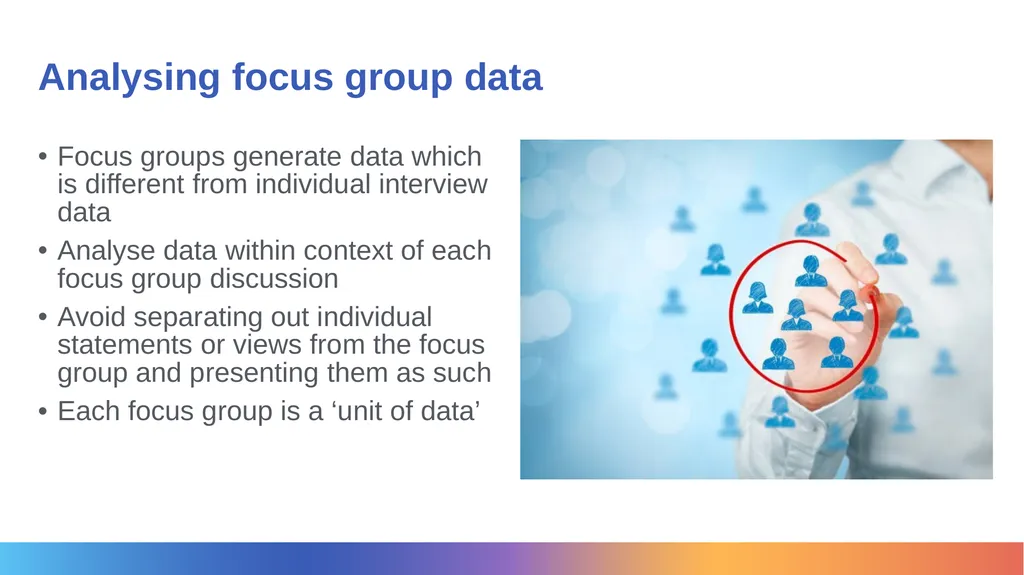
Analysing focus group data Focus groups generate data which is different from individual interview data
Analyse data within context of each focus group discussion
Avoid separating out individual statements or views from the focus group and presenting them as such
Each focus group is a ‘unit of data’<br>
08
Reflexivity and ethics Reflexivity is a key principle in qualitative research
Consider the impact of the moderator/s on each focus group
Researcher positionality
Ethical considerations include consent, confidentiality, anonymity, privacy and right to withdraw
Ensure safety and wellbeing of participants<br>
09
Summary Focus groups help us to address a variety of questions and insights in social research
E.g. views of marginalized groups, citizens, people’s lived experiences, expert knowledge, community membership, the dynamics of political processes
They explore ‘what’ people think and also ‘why’ they think as they do
They are flexible in terms of how we design and conduct them (i.e. online or in person)<br>