
Focused Lecture Chapter 22 Immunologic Emergencies




Description: Focused Lecture Chapter 22 Immunologic Emergencies National EMS Education Standard Competencies (1 of 2) Medicine Applies fundamental knowledge to provide basic and selected advanced emergency care and transportation based on assessment
Related Topics
Download Presentation
"Focused Lecture Chapter 22 Immunologic Emergencies" is the property of its rightful owner. Permission is granted to download and print the materials on this website for personal, non-commercial use only, and to display it on your personal computer provided you do not modify the materials and that you retain all copyright notices contained in the materials. By downloading content from our website, you accept the terms of this agreement.
Presentation Transcript
slide1. Focused Lecture Chapter 22
Immunologic Emergencies<br>
slide2. National EMS Education Standard Competencies (1 of 2) Medicine
Applies fundamental knowledge to provide basic and selected advanced emergency care and transportation based on assessment findings for an acutely ill patient.<br>
slide3. National EMS Education Standard Competencies (2 of 2) Immunology
Recognition and management of shock and difficulty breathing related to
Anaphylactic reactions
Anatomy, physiology, pathophysiology, assessment, and management of hypersensitivity disorders and/or emergencies
Allergic and anaphylactic reactions<br>
slide4. Introduction Allergy-related emergencies can involve:
Acute airway obstruction
Cardiovascular collapse
Distinguish between the body’s usual response to an allergen and an allergic reaction.<br>
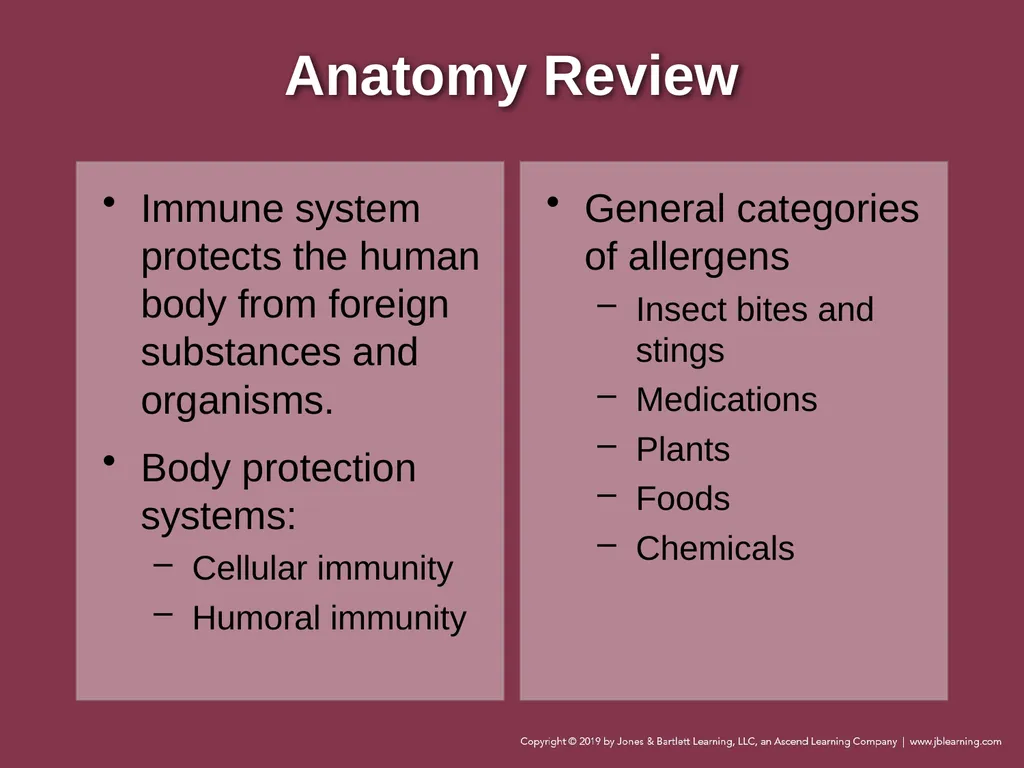
slide5. Anatomy Review Immune system protects the human body from foreign substances and organisms.
Body protection systems:
Cellular immunity
Humoral immunity General categories of allergens
Insect bites and stings
Medications
Plants
Foods
Chemicals<br>
slide6. Physiology Review (1 of 3) Body develops sensitivity through the primary response.
Body places specific antibodies on:
Basophils
Mast cells
When chemical mediators cause systemic effects, they cause anaphylactic reactions.<br>
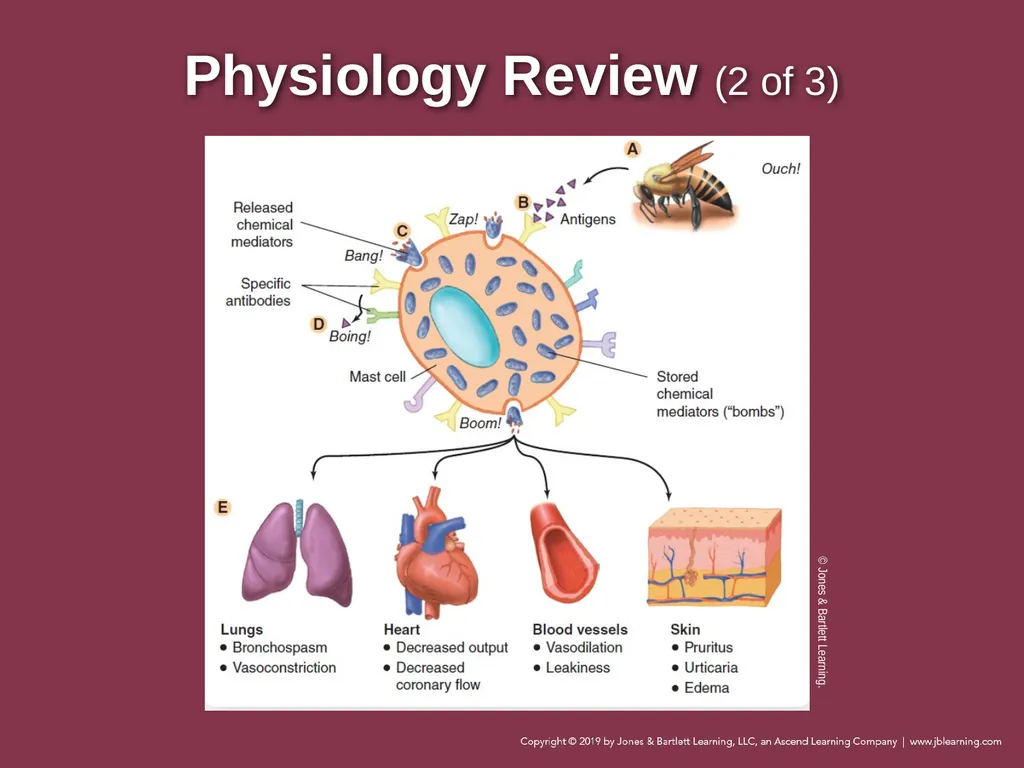
slide7. Physiology Review (2 of 3) © Jones & Bartlett Learning.<br>
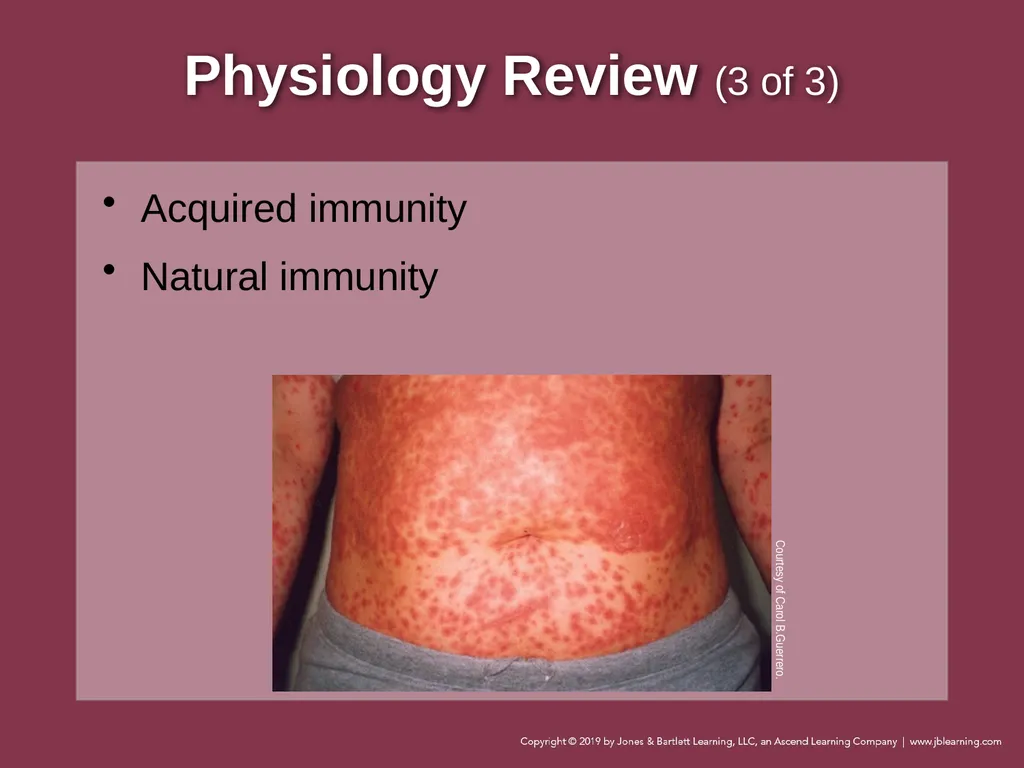
slide8. Physiology Review (3 of 3) Acquired immunity
Natural immunity Courtesy of Carol B.Guerrero.<br>
slide9. Physiology Review (3 of 3) Pathophysiology
Immune system becomes hypersensitive to one or more substances during abnormal reactions.
Allergic reaction: immune system reaction that occurs when a person has been previously exposed or sensitized to a substance or allergen.<br>
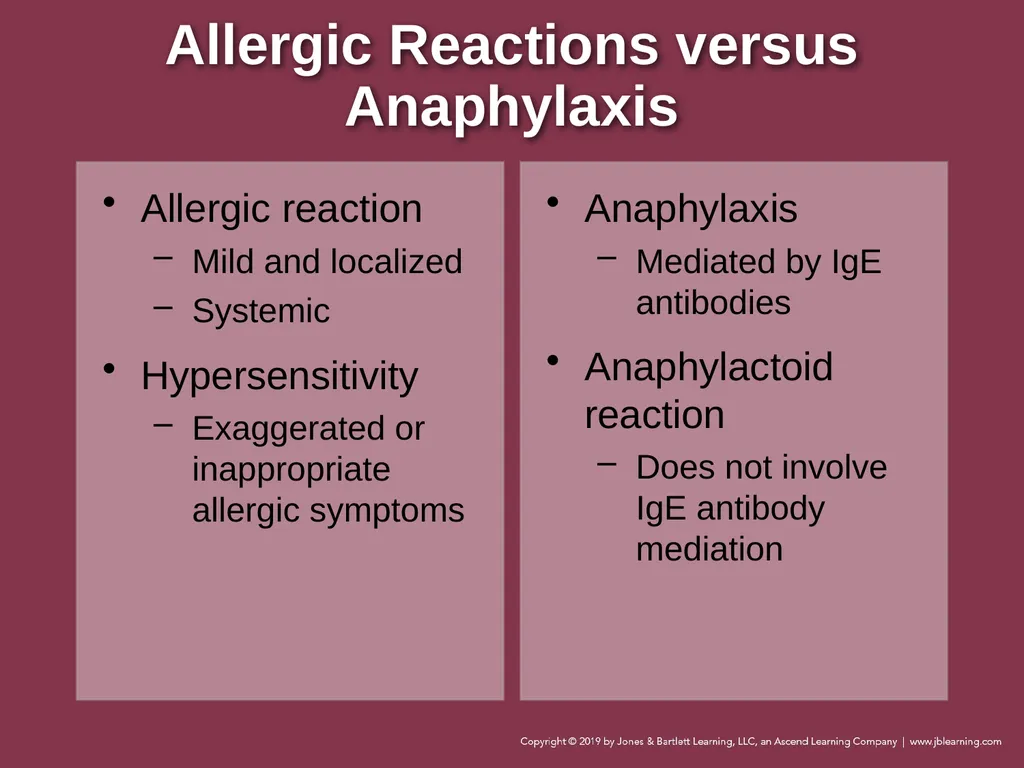
slide10. Allergic Reactions versus Anaphylaxis Allergic reaction
Mild and localized
Systemic
Hypersensitivity
Exaggerated or inappropriate allergic symptoms Anaphylaxis
Mediated by IgE antibodies
Anaphylactoid reaction
Does not involve IgE antibody mediation<br>
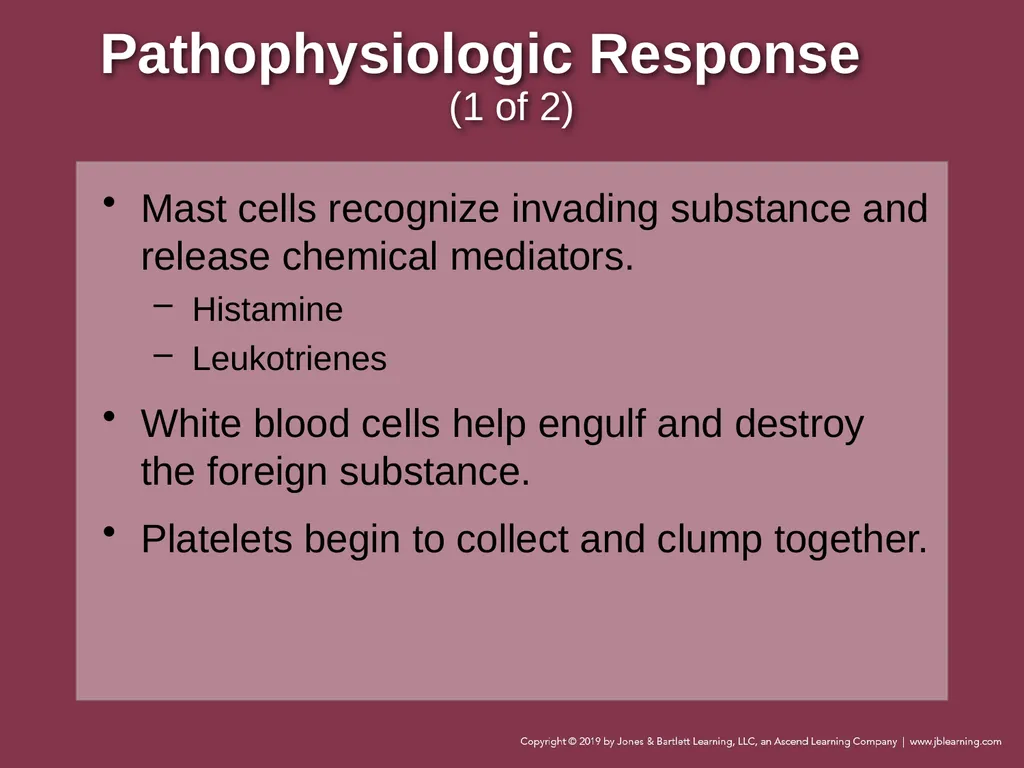
slide11. Pathophysiologic Response (1 of 2) Mast cells recognize invading substance and release chemical mediators.
Histamine
Leukotrienes
White blood cells help engulf and destroy the foreign substance.
Platelets begin to collect and clump together.<br>
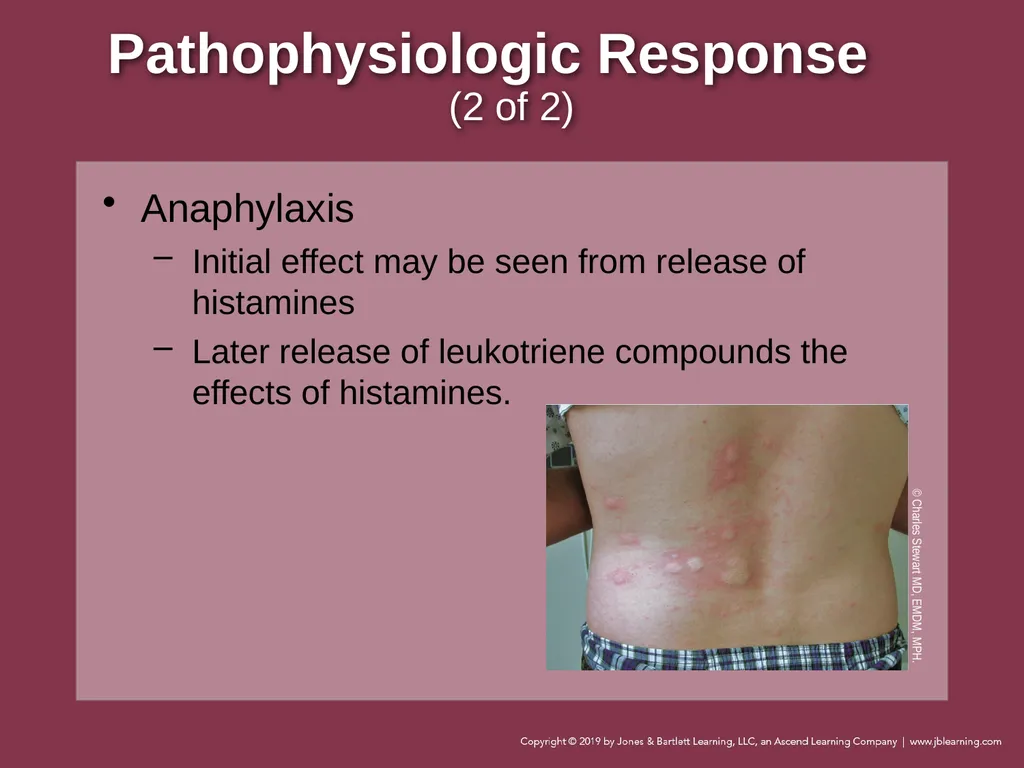
slide12. Pathophysiologic Response (2 of 2) Anaphylaxis
Initial effect may be seen from release of histamines
Later release of leukotriene compounds the effects of histamines. © Charles Stewart MD, EMDM, MPH.<br>
slide13. Clinical Symptoms of Anaphylaxis (1 of 2) Skin symptoms (often first indications)
Angioedema
Swelling of the hands and feet
Respiratory symptoms are most common complaints.
Cardiovascular symptoms are serious complications of anaphylaxis.<br>
slide14. Clinical Symptoms of Anaphylaxis (2 of 2) Blood volume moving from the intravascular space to the extravascular space can cause shock.
Gastrointestinal symptoms may occur.
Central nervous system symptoms
Headache, dizziness, confusion, and anxiety
Sense of “impending doom”<br>
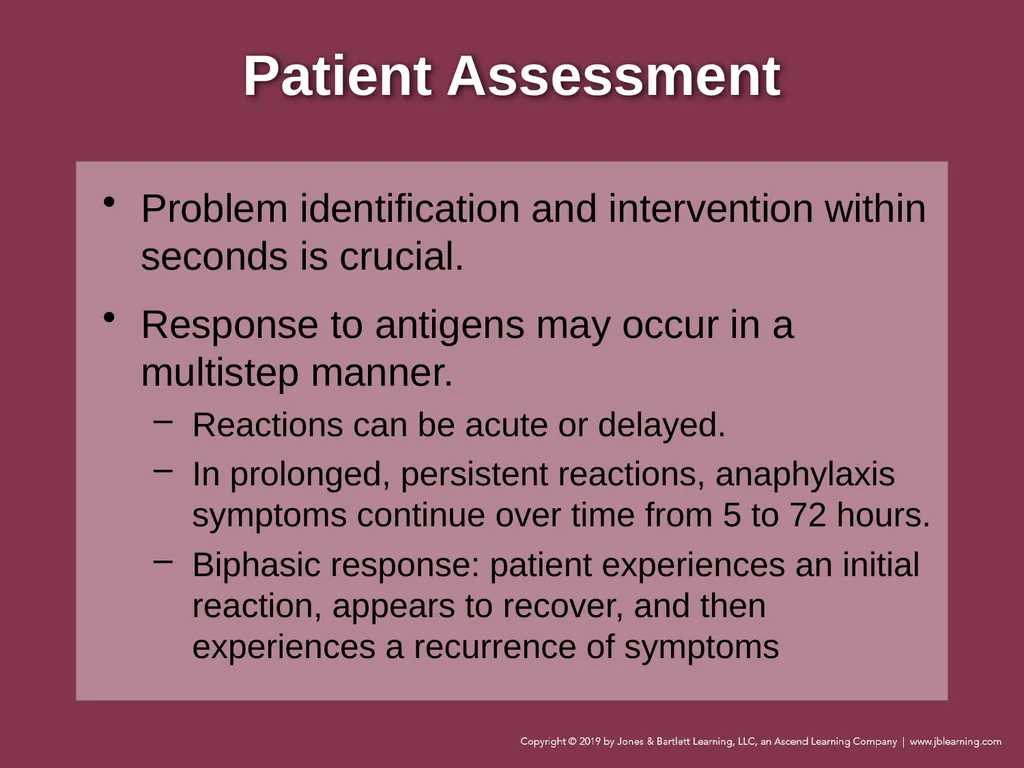
slide15. Patient Assessment Problem identification and intervention within seconds is crucial.
Response to antigens may occur in a multistep manner.
Reactions can be acute or delayed.
In prolonged, persistent reactions, anaphylaxis symptoms continue over time from 5 to 72 hours.
Biphasic response: patient experiences an initial reaction, appears to recover, and then experiences a recurrence of symptoms<br>
slide16. Scene Size-up Patient’s environment or recent activity may indicate the source of the reaction.
Never enter a scene where more than one person is experiencing the same symptoms with a similar onset.
Consider potential for trauma.
Determine MOI or NOI.<br>
slide17. Primary Survey (1 of 2) Severity of the problem will be indicated by the patient’s presentation.
Respiratory symptoms should be swiftly assessed.
Position an alert patient in a tripod position, leaning forward.
For unresponsive patients, assist ventilations using a bag-mask device.<br>
slide18. Primary Survey (2 of 2) Begin basic life support measures if a patient is unresponsive or pulseless.
Treatment for shock includes:
Administering oxygen
Placing the patient supine
Preventing the loss of body heat
Continue the assessment at scene if the patient is calm and does not exhibit any symptoms.<br>
slide19. History Taking Investigate the chief complaint and history of illness.
Identify associated signs and symptoms.
If the patient is responsive, begin by obtaining the SAMPLE history.<br>
slide20. Secondary Assessment Perform a physical examination.
Vital signs help determine whether the body is compensating for stress.
Use monitoring devices.<br>
slide21. Reassessment (1 of 2) Conducted typically en route to the receiving hospital
Special attention should be given to any signs of airway compromise.
Interventions
Check the effect of epinephrine administration.
Check if the patient’s condition has improved or if a second dose is required.
Recheck interventions.<br>
slide22. Reassessment (2 of 2) Communication and documentation
When to contact medical control depends on your findings.
In some allergic reactions, you may use standing orders to administer epinephrine.
Documentation should include detailed signs and symptoms and reason for specific care.
Ensure to record patient’s response to the treatment.<br>
slide23. Emergency Medical Care Essential to differentiate between anaphylaxis and other conditions with similar symptoms
People with allergic reactions are separated into two groups for treatment purposes.
First group: patients who have signs of an allergic reaction but not anaphylaxis
Second group: patients with signs of anaphylaxis; require 100% oxygen, epinephrine, and antihistamines<br>
slide24. Administering Epinephrine (1 of 2) Early administration of epinephrine should be a priority.
Use the IM route if patient shows evidence of airway or respiratory compromise or hypotension.
Administration in the thigh is preferred over the deltoid site for more rapid absorption.
Epinephrine can rapidly reverse the histamine-related effects of anaphylaxis.<br>
slide25. Administering Epinephrine (2 of 2) Side effects of epinephrine:
Tachycardia
Hypertension
Anxiety
Pallor
Dizziness
Chest pain
Headache
Nausea
Vomiting<br>
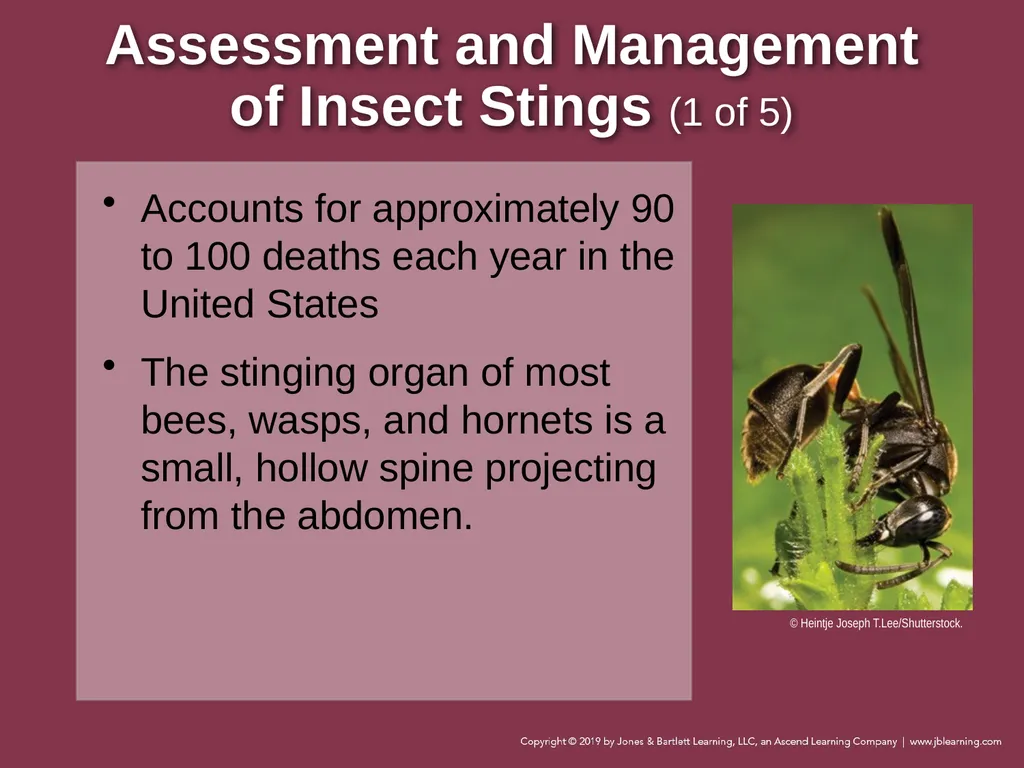
slide26. Assessment and Management of Insect Stings (1 of 5) Accounts for approximately 90 to 100 deaths each year in the United States
The stinging organ of most bees, wasps, and hornets is a small, hollow spine projecting from the abdomen. © Heintje Joseph T.Lee/Shutterstock.<br>
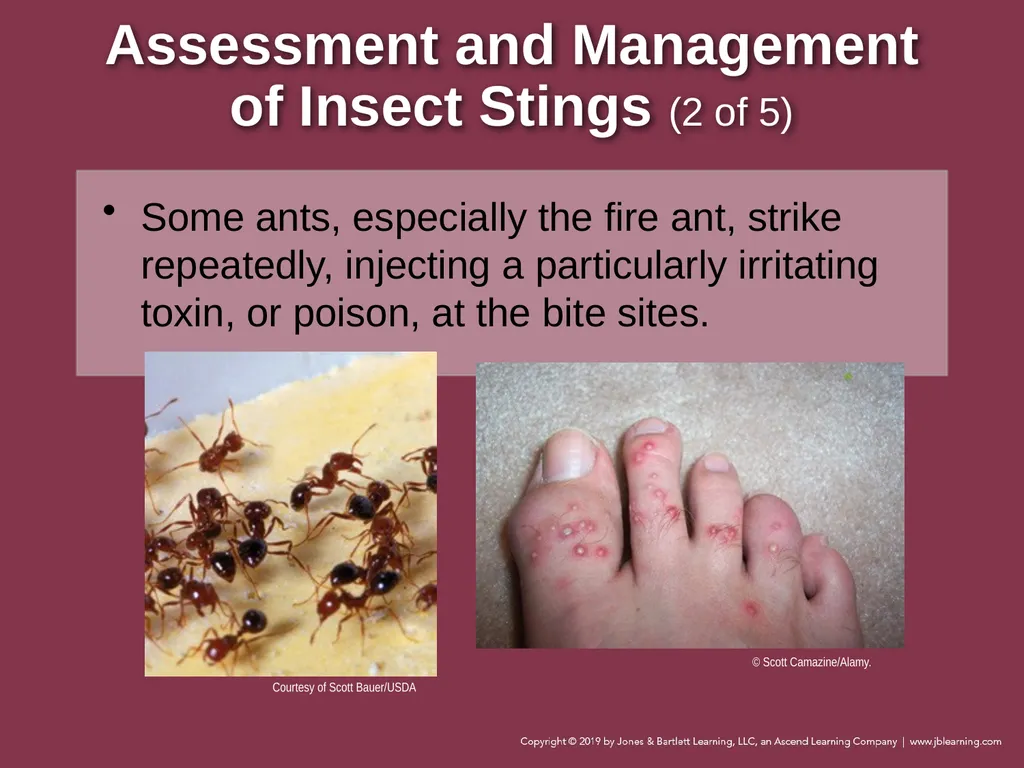
slide27. Assessment and Management of Insect Stings (2 of 5) Some ants, especially the fire ant, strike repeatedly, injecting a particularly irritating toxin, or poison, at the bite sites. Courtesy of Scott Bauer/USDA © Scott Camazine/Alamy.<br>
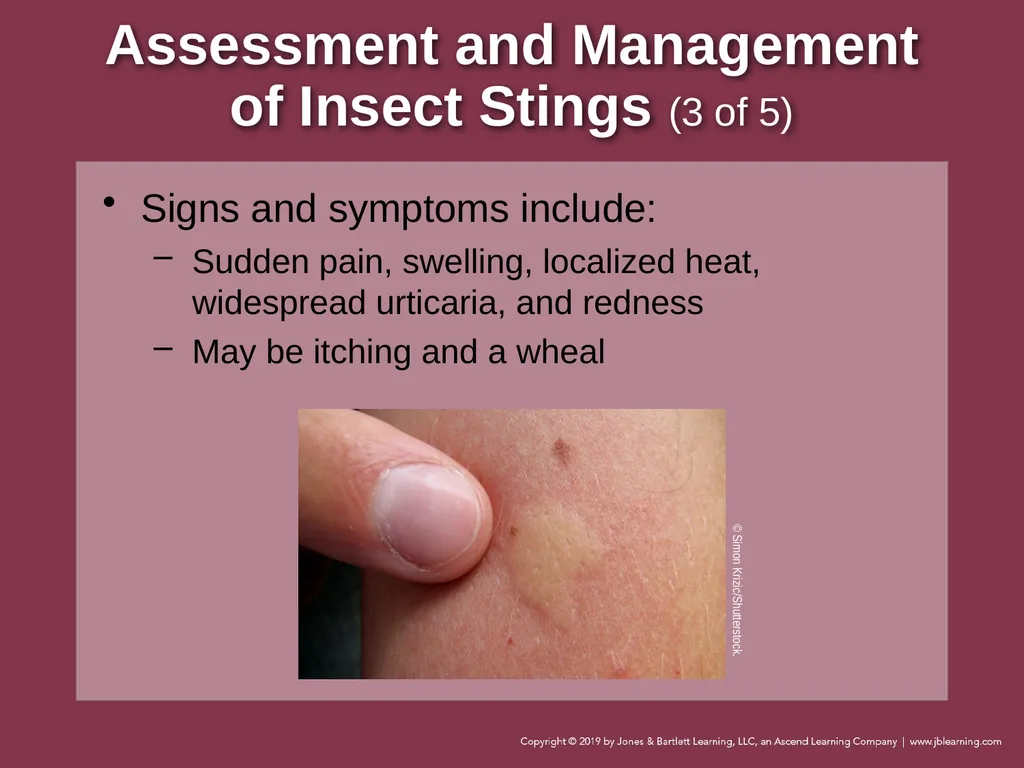
slide28. Assessment and Management of Insect Stings (3 of 5) Signs and symptoms include:
Sudden pain, swelling, localized heat, widespread urticaria, and redness
May be itching and a wheal © Simon Krizic/Shutterstock.<br>
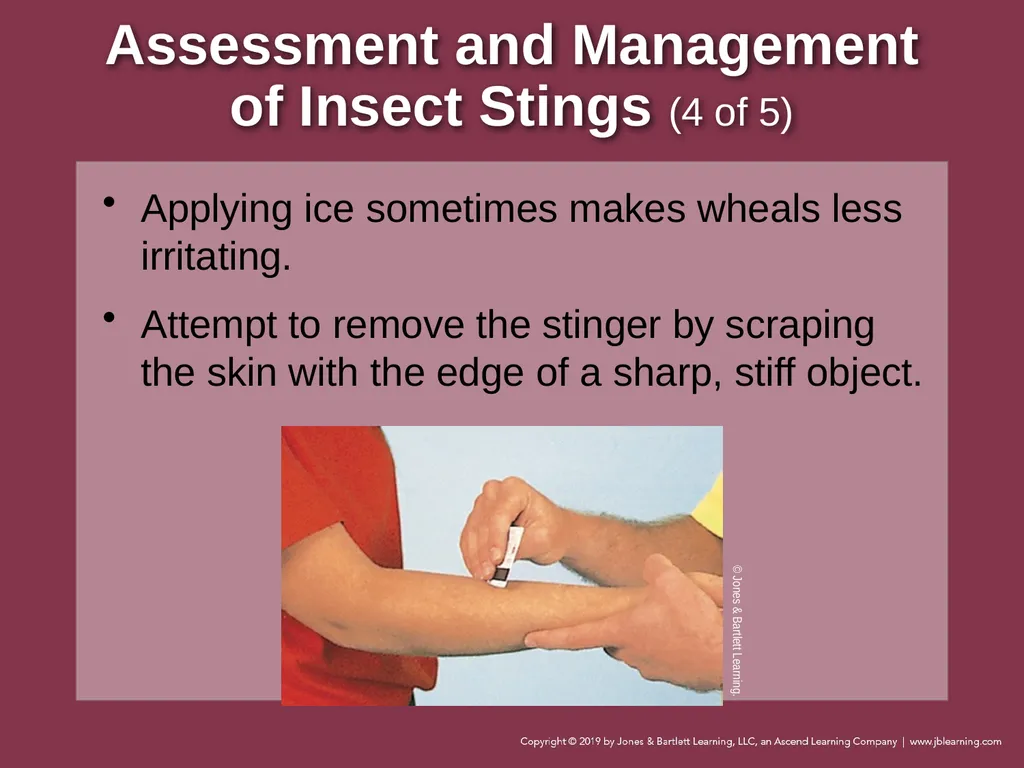
slide29. Assessment and Management of Insect Stings (4 of 5) Applying ice sometimes makes wheals less irritating.
Attempt to remove the stinger by scraping the skin with the edge of a sharp, stiff object. © Jones & Bartlett Learning.<br>
slide30. Assessment and Management of Insect Stings (5 of 5) Be alert for signs of airway swelling and other signs of anaphylaxis.
Place the patient in the supine position if indicated, and give oxygen if needed.
Monitor the patient’s vital signs and be prepared to provide additional support as needed.<br>
slide31. Patient Education Educate patients about prevention and self-preservation.
Avoid the antigen.
Notify all health personnel of the allergy.
Wear identification tags or bracelets.
Carry an anaphylaxis kit or EpiPen.
Report symptoms early.<br>
slide2. National EMS Education Standard Competencies (1 of 2) Medicine
Applies fundamental knowledge to provide basic and selected advanced emergency care and transportation based on assessment findings for an acutely ill patient.<br>
slide3. National EMS Education Standard Competencies (2 of 2) Immunology
Recognition and management of shock and difficulty breathing related to
Anaphylactic reactions
Anatomy, physiology, pathophysiology, assessment, and management of hypersensitivity disorders and/or emergencies
Allergic and anaphylactic reactions<br>
slide4. Introduction Allergy-related emergencies can involve:
Acute airway obstruction
Cardiovascular collapse
Distinguish between the body’s usual response to an allergen and an allergic reaction.<br>
slide5. Anatomy Review Immune system protects the human body from foreign substances and organisms.
Body protection systems:
Cellular immunity
Humoral immunity General categories of allergens
Insect bites and stings
Medications
Plants
Foods
Chemicals<br>
slide6. Physiology Review (1 of 3) Body develops sensitivity through the primary response.
Body places specific antibodies on:
Basophils
Mast cells
When chemical mediators cause systemic effects, they cause anaphylactic reactions.<br>
slide7. Physiology Review (2 of 3) © Jones & Bartlett Learning.<br>
slide8. Physiology Review (3 of 3) Acquired immunity
Natural immunity Courtesy of Carol B.Guerrero.<br>
slide9. Physiology Review (3 of 3) Pathophysiology
Immune system becomes hypersensitive to one or more substances during abnormal reactions.
Allergic reaction: immune system reaction that occurs when a person has been previously exposed or sensitized to a substance or allergen.<br>
slide10. Allergic Reactions versus Anaphylaxis Allergic reaction
Mild and localized
Systemic
Hypersensitivity
Exaggerated or inappropriate allergic symptoms Anaphylaxis
Mediated by IgE antibodies
Anaphylactoid reaction
Does not involve IgE antibody mediation<br>
slide11. Pathophysiologic Response (1 of 2) Mast cells recognize invading substance and release chemical mediators.
Histamine
Leukotrienes
White blood cells help engulf and destroy the foreign substance.
Platelets begin to collect and clump together.<br>
slide12. Pathophysiologic Response (2 of 2) Anaphylaxis
Initial effect may be seen from release of histamines
Later release of leukotriene compounds the effects of histamines. © Charles Stewart MD, EMDM, MPH.<br>
slide13. Clinical Symptoms of Anaphylaxis (1 of 2) Skin symptoms (often first indications)
Angioedema
Swelling of the hands and feet
Respiratory symptoms are most common complaints.
Cardiovascular symptoms are serious complications of anaphylaxis.<br>
slide14. Clinical Symptoms of Anaphylaxis (2 of 2) Blood volume moving from the intravascular space to the extravascular space can cause shock.
Gastrointestinal symptoms may occur.
Central nervous system symptoms
Headache, dizziness, confusion, and anxiety
Sense of “impending doom”<br>
slide15. Patient Assessment Problem identification and intervention within seconds is crucial.
Response to antigens may occur in a multistep manner.
Reactions can be acute or delayed.
In prolonged, persistent reactions, anaphylaxis symptoms continue over time from 5 to 72 hours.
Biphasic response: patient experiences an initial reaction, appears to recover, and then experiences a recurrence of symptoms<br>
slide16. Scene Size-up Patient’s environment or recent activity may indicate the source of the reaction.
Never enter a scene where more than one person is experiencing the same symptoms with a similar onset.
Consider potential for trauma.
Determine MOI or NOI.<br>
slide17. Primary Survey (1 of 2) Severity of the problem will be indicated by the patient’s presentation.
Respiratory symptoms should be swiftly assessed.
Position an alert patient in a tripod position, leaning forward.
For unresponsive patients, assist ventilations using a bag-mask device.<br>
slide18. Primary Survey (2 of 2) Begin basic life support measures if a patient is unresponsive or pulseless.
Treatment for shock includes:
Administering oxygen
Placing the patient supine
Preventing the loss of body heat
Continue the assessment at scene if the patient is calm and does not exhibit any symptoms.<br>
slide19. History Taking Investigate the chief complaint and history of illness.
Identify associated signs and symptoms.
If the patient is responsive, begin by obtaining the SAMPLE history.<br>
slide20. Secondary Assessment Perform a physical examination.
Vital signs help determine whether the body is compensating for stress.
Use monitoring devices.<br>
slide21. Reassessment (1 of 2) Conducted typically en route to the receiving hospital
Special attention should be given to any signs of airway compromise.
Interventions
Check the effect of epinephrine administration.
Check if the patient’s condition has improved or if a second dose is required.
Recheck interventions.<br>
slide22. Reassessment (2 of 2) Communication and documentation
When to contact medical control depends on your findings.
In some allergic reactions, you may use standing orders to administer epinephrine.
Documentation should include detailed signs and symptoms and reason for specific care.
Ensure to record patient’s response to the treatment.<br>
slide23. Emergency Medical Care Essential to differentiate between anaphylaxis and other conditions with similar symptoms
People with allergic reactions are separated into two groups for treatment purposes.
First group: patients who have signs of an allergic reaction but not anaphylaxis
Second group: patients with signs of anaphylaxis; require 100% oxygen, epinephrine, and antihistamines<br>
slide24. Administering Epinephrine (1 of 2) Early administration of epinephrine should be a priority.
Use the IM route if patient shows evidence of airway or respiratory compromise or hypotension.
Administration in the thigh is preferred over the deltoid site for more rapid absorption.
Epinephrine can rapidly reverse the histamine-related effects of anaphylaxis.<br>
slide25. Administering Epinephrine (2 of 2) Side effects of epinephrine:
Tachycardia
Hypertension
Anxiety
Pallor
Dizziness
Chest pain
Headache
Nausea
Vomiting<br>
slide26. Assessment and Management of Insect Stings (1 of 5) Accounts for approximately 90 to 100 deaths each year in the United States
The stinging organ of most bees, wasps, and hornets is a small, hollow spine projecting from the abdomen. © Heintje Joseph T.Lee/Shutterstock.<br>
slide27. Assessment and Management of Insect Stings (2 of 5) Some ants, especially the fire ant, strike repeatedly, injecting a particularly irritating toxin, or poison, at the bite sites. Courtesy of Scott Bauer/USDA © Scott Camazine/Alamy.<br>
slide28. Assessment and Management of Insect Stings (3 of 5) Signs and symptoms include:
Sudden pain, swelling, localized heat, widespread urticaria, and redness
May be itching and a wheal © Simon Krizic/Shutterstock.<br>
slide29. Assessment and Management of Insect Stings (4 of 5) Applying ice sometimes makes wheals less irritating.
Attempt to remove the stinger by scraping the skin with the edge of a sharp, stiff object. © Jones & Bartlett Learning.<br>
slide30. Assessment and Management of Insect Stings (5 of 5) Be alert for signs of airway swelling and other signs of anaphylaxis.
Place the patient in the supine position if indicated, and give oxygen if needed.
Monitor the patient’s vital signs and be prepared to provide additional support as needed.<br>
slide31. Patient Education Educate patients about prevention and self-preservation.
Avoid the antigen.
Notify all health personnel of the allergy.
Wear identification tags or bracelets.
Carry an anaphylaxis kit or EpiPen.
Report symptoms early.<br>