
Foot Care Chapter 32 John M. Embil MD FRCPC FACP,
SN
Published · 29 slides · 0 views

1 / 1

Description
Foot Care Chapter 32 John M. Embil MD FRCPC FACP, Zaina Albalawi MD FRCPC, Keith Bowering MD FRCPC FACP, Elly Trepman MD 2018 Clinical Practice Guidelines Disclaimer All Content contained on this slide deck is the property of Diabetes
Related Topics
Share
Embed code
Download this presentation From Below
"Foot Care Chapter 32 John M. Embil MD FRCPC FACP," is the property of its rightful owner. Permission is granted to download and print the materials on this website for personal, non-commercial use only, and to display it on your personal computer provided you do not modify the materials and that you retain all copyright notices contained in the materials. By downloading content from our website, you accept the terms of this agreement.
Presentation Transcript
01
Foot Care Chapter 32
John M. Embil MD FRCPC FACP, Zaina Albalawi MD FRCPC, Keith Bowering MD FRCPC FACP, Elly Trepman MD 2018 Clinical Practice Guidelines<br>
John M. Embil MD FRCPC FACP, Zaina Albalawi MD FRCPC, Keith Bowering MD FRCPC FACP, Elly Trepman MD 2018 Clinical Practice Guidelines<br>
02
Disclaimer
All Content contained on this slide deck is the property of Diabetes Canada, its content suppliers or its licensors as the case may be, and is protected by Canadian and international copyright, trademark, and other applicable laws. Diabetes Canada grants personal, limited, revocable, non-transferable and non-exclusive license to access and read content in this slide deck for personal, non-commercial and not-for-profit use only. The slide deck is made available for lawful, personal use only and not for commercial use.
The unauthorized reproduction, distribution of this copyrighted work is not permitted.
For permission to use this slide deck for commercial or any use other than personal, please contact guidelines@diabetes.ca<br>
03
Key Changes New information on
Detailed instructions on use of the 10 gram monofilament to screen for the presence or absence of protective sensation 2018 2018 Diabetes Canada CPG – Chapter 32. Foot Care<br>
Detailed instructions on use of the 10 gram monofilament to screen for the presence or absence of protective sensation 2018 2018 Diabetes Canada CPG – Chapter 32. Foot Care<br>
04
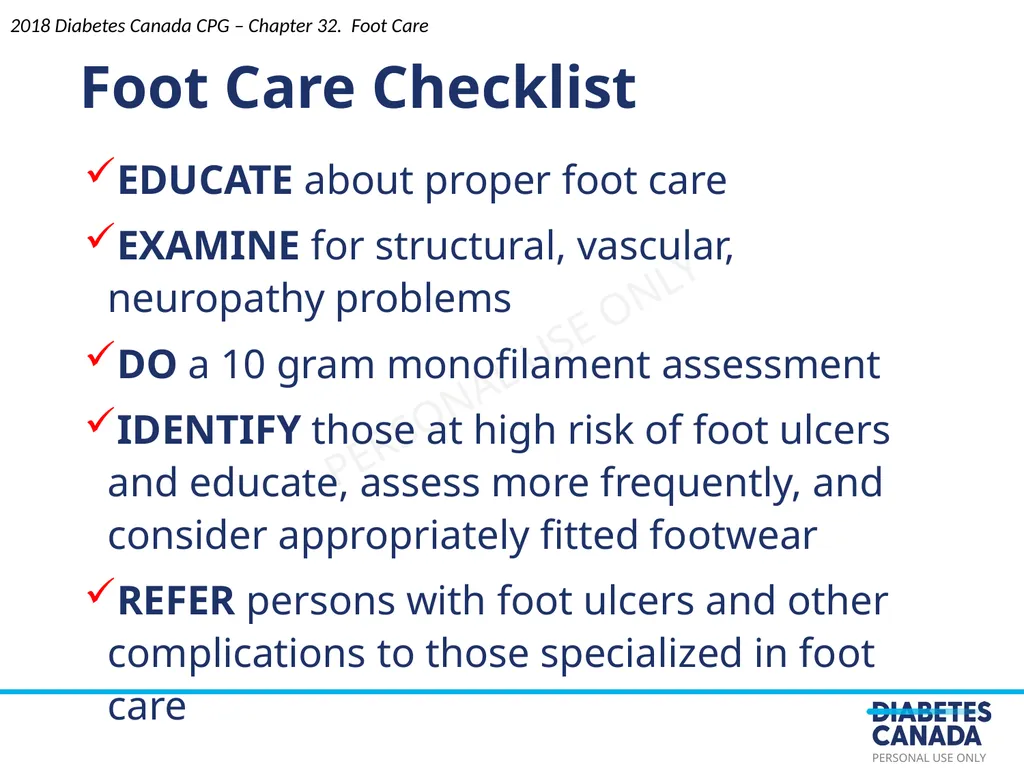
EDUCATE about proper foot care
EXAMINE for structural, vascular, neuropathy problems
DO a 10 gram monofilament assessment
IDENTIFY those at high risk of foot ulcers and educate, assess more frequently, and consider appropriately fitted footwear
REFER persons with foot ulcers and other complications to those specialized in foot care Foot Care Checklist 2018 Diabetes Canada CPG – Chapter 32. Foot Care<br>
05
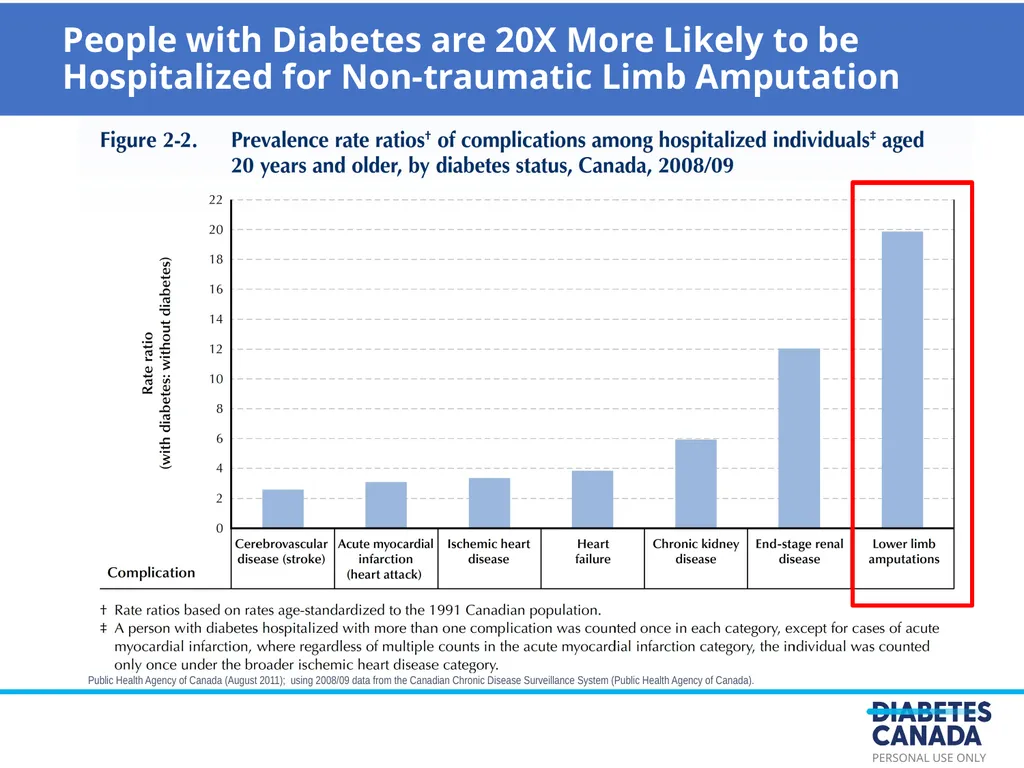
Public Health Agency of Canada (August 2011); using 2008/09 data from the Canadian Chronic Disease Surveillance System (Public Health Agency of Canada). People with Diabetes are 20X More Likely to be
Hospitalized for Non-traumatic Limb Amputation<br>
06
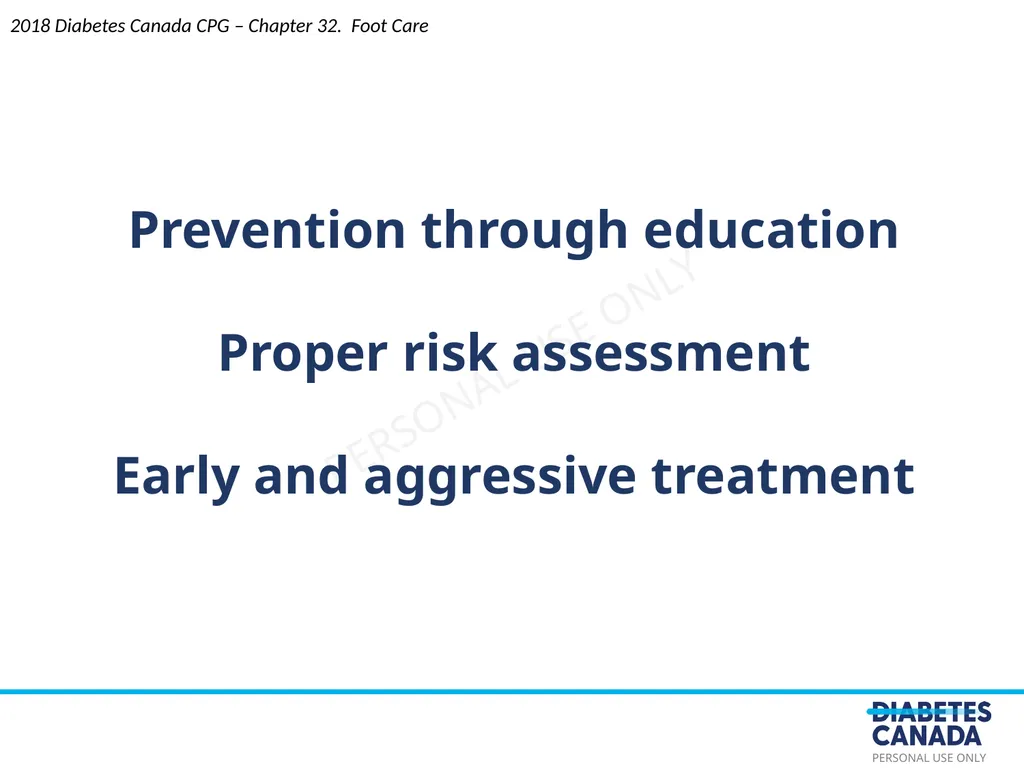
Prevention through education
Proper risk assessment
Early and aggressive treatment 2018 Diabetes Canada CPG – Chapter 32. Foot Care<br>
07
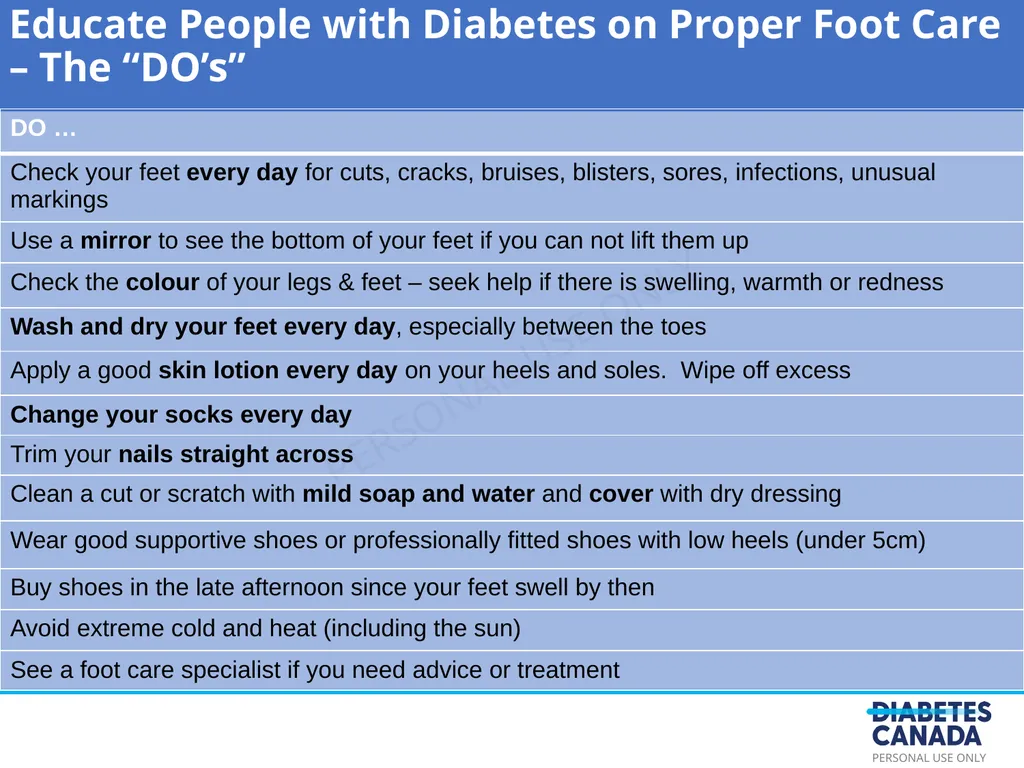
Educate People with Diabetes on Proper Foot Care – The “DO’s”<br>
08
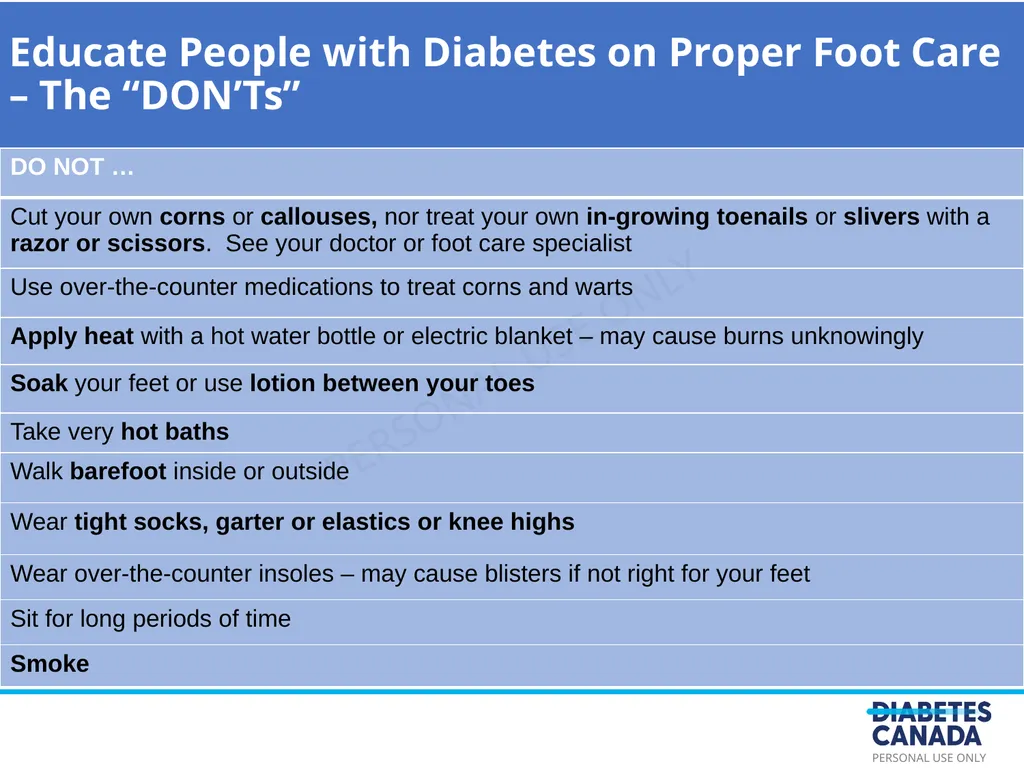
Educate People with Diabetes on Proper Foot Care – The “DON’Ts”<br>
09
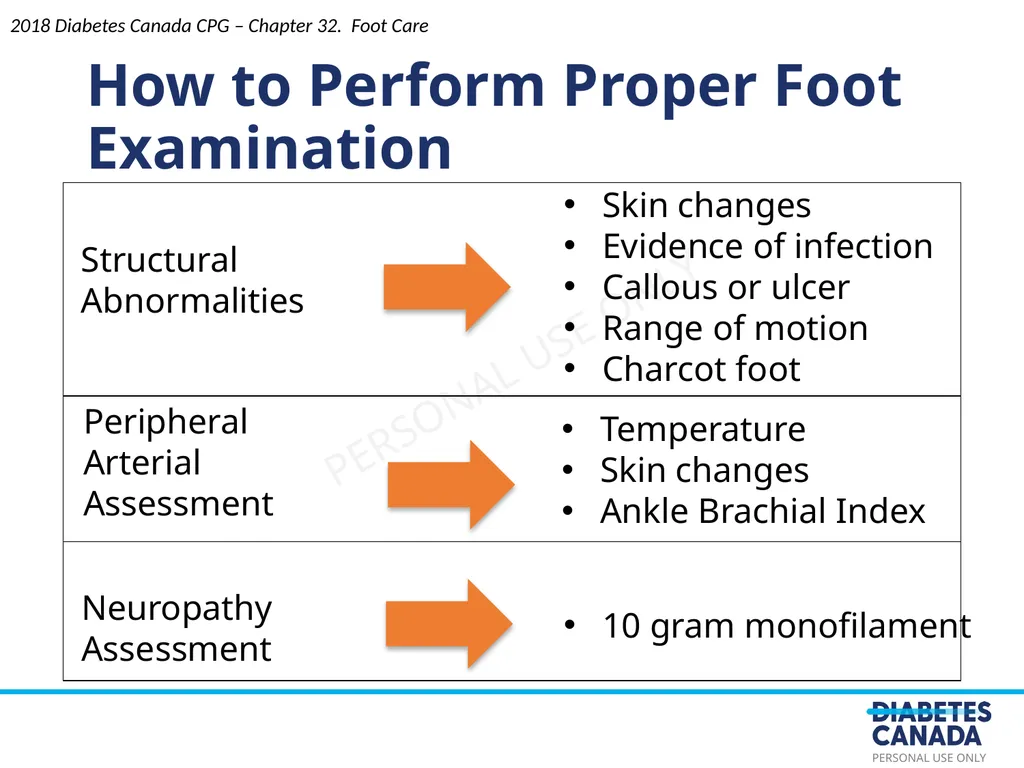
How to Perform Proper Foot Examination 2018 Diabetes Canada CPG – Chapter 32. Foot Care Structural
Abnormalities Skin changes
Evidence of infection
Callous or ulcer
Range of motion
Charcot foot Peripheral Arterial Assessment Temperature
Skin changes
Ankle Brachial Index Neuropathy Assessment 10 gram monofilament<br>
Abnormalities Skin changes
Evidence of infection
Callous or ulcer
Range of motion
Charcot foot Peripheral Arterial Assessment Temperature
Skin changes
Ankle Brachial Index Neuropathy Assessment 10 gram monofilament<br>
10
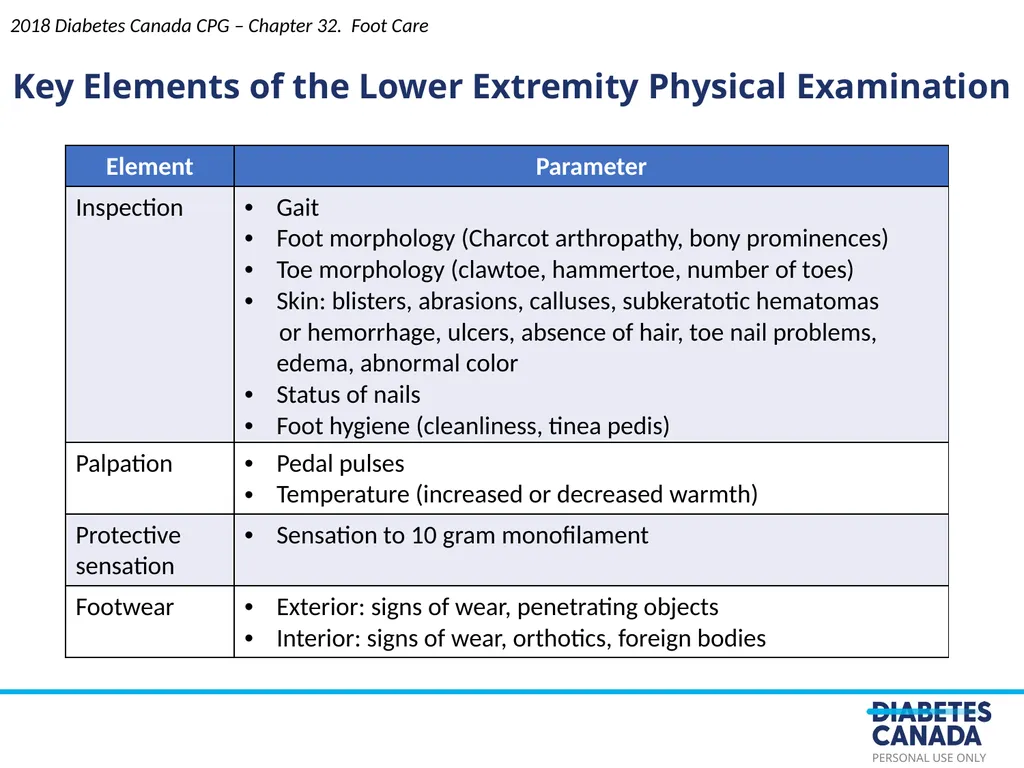
Key Elements of the Lower Extremity Physical Examination 2018 Diabetes Canada CPG – Chapter 32. Foot Care<br>
11
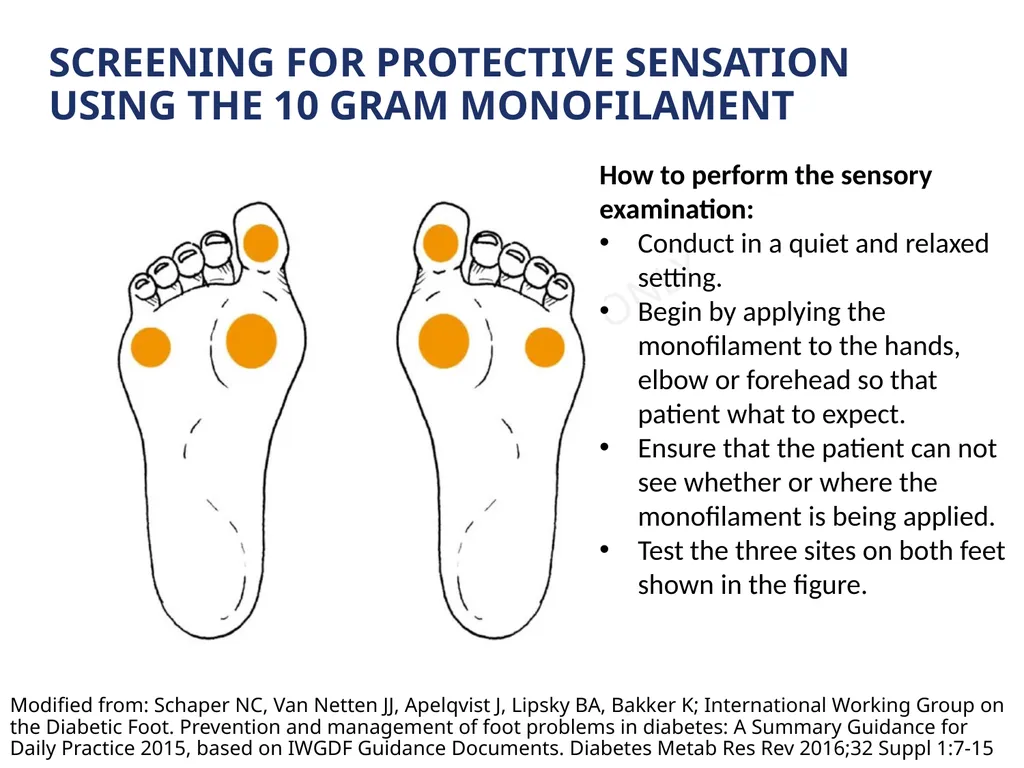
Screening for Protective Sensation Using The 10 gram Monofilament Modified from: Schaper NC, Van Netten JJ, Apelqvist J, Lipsky BA, Bakker K; International Working Group on the Diabetic Foot. Prevention and management of foot problems in diabetes: A Summary Guidance for Daily Practice 2015, based on IWGDF Guidance Documents. Diabetes Metab Res Rev 2016;32 Suppl 1:7-15 How to perform the sensory examination:
Conduct in a quiet and relaxed setting.
Begin by applying the monofilament to the hands, elbow or forehead so that patient what to expect.
Ensure that the patient can not see whether or where the monofilament is being applied.
Test the three sites on both feet shown in the figure.<br>
Conduct in a quiet and relaxed setting.
Begin by applying the monofilament to the hands, elbow or forehead so that patient what to expect.
Ensure that the patient can not see whether or where the monofilament is being applied.
Test the three sites on both feet shown in the figure.<br>
12
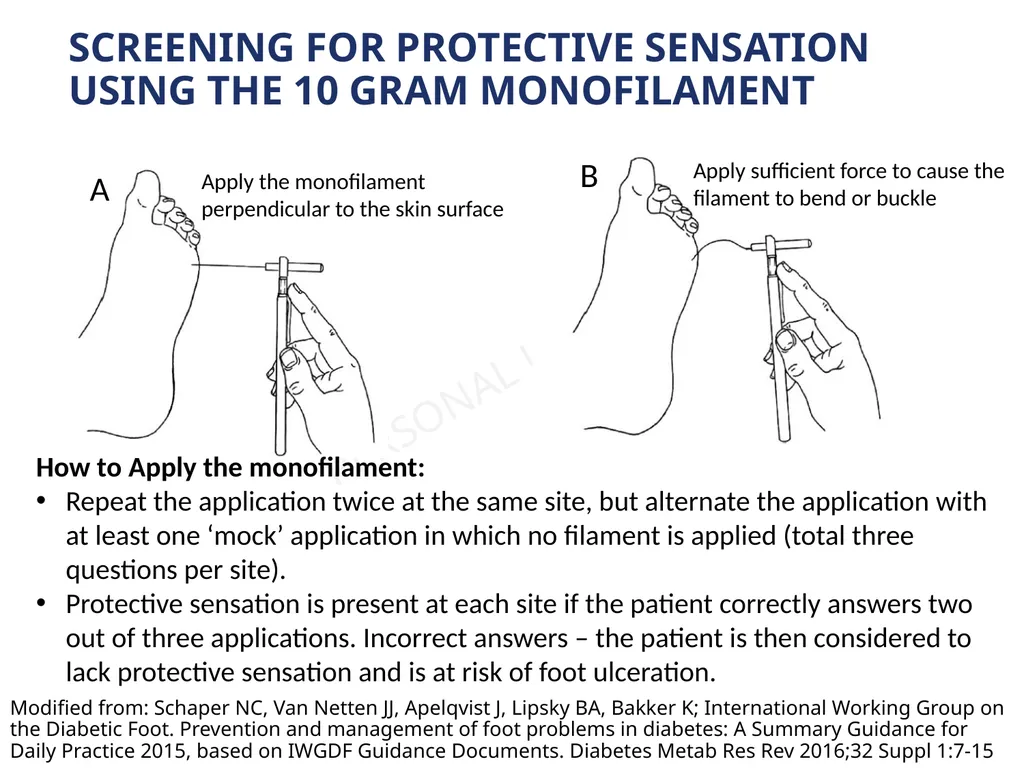
Screening for Protective Sensation Using The 10 gram Monofilament Modified from: Schaper NC, Van Netten JJ, Apelqvist J, Lipsky BA, Bakker K; International Working Group on the Diabetic Foot. Prevention and management of foot problems in diabetes: A Summary Guidance for Daily Practice 2015, based on IWGDF Guidance Documents. Diabetes Metab Res Rev 2016;32 Suppl 1:7-15 How to Apply the monofilament:
Repeat the application twice at the same site, but alternate the application with at least one ‘mock’ application in which no filament is applied (total three questions per site).
Protective sensation is present at each site if the patient correctly answers two out of three applications. Incorrect answers – the patient is then considered to lack protective sensation and is at risk of foot ulceration. Apply the monofilament perpendicular to the skin surface Apply sufficient force to cause the filament to bend or buckle<br>
13
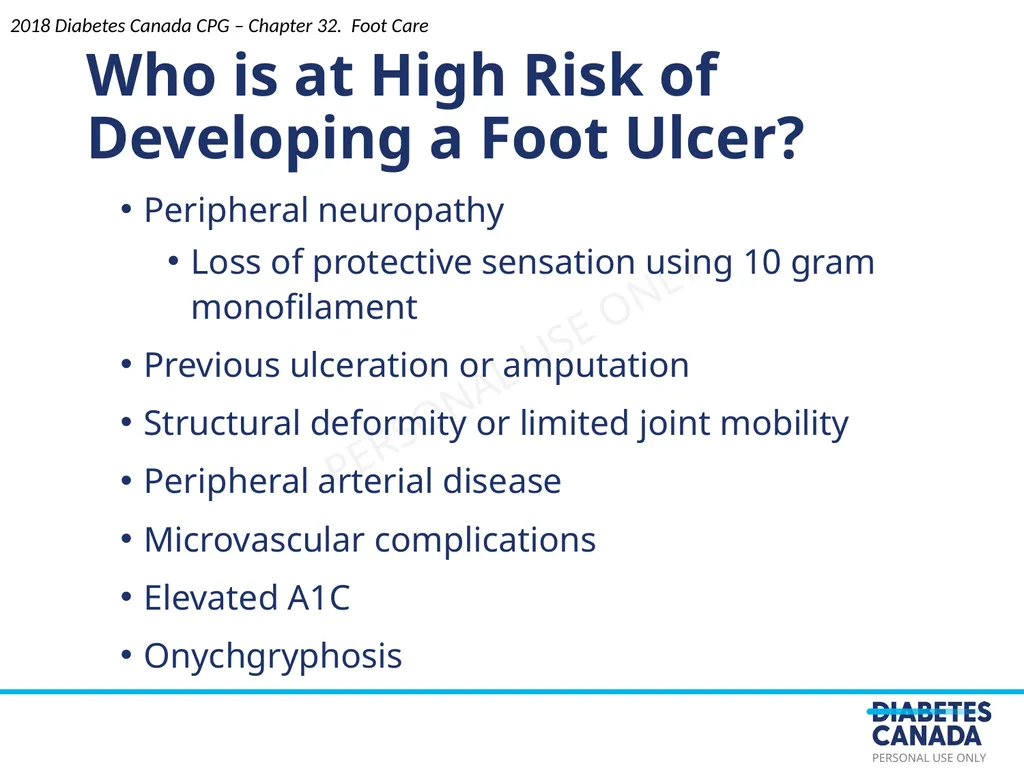
Who is at High Risk of Developing a Foot Ulcer? Peripheral neuropathy
Loss of protective sensation using 10 gram monofilament
Previous ulceration or amputation
Structural deformity or limited joint mobility
Peripheral arterial disease
Microvascular complications
Elevated A1C
Onychgryphosis 2018 Diabetes Canada CPG – Chapter 32. Foot Care<br>
Loss of protective sensation using 10 gram monofilament
Previous ulceration or amputation
Structural deformity or limited joint mobility
Peripheral arterial disease
Microvascular complications
Elevated A1C
Onychgryphosis 2018 Diabetes Canada CPG – Chapter 32. Foot Care<br>
14
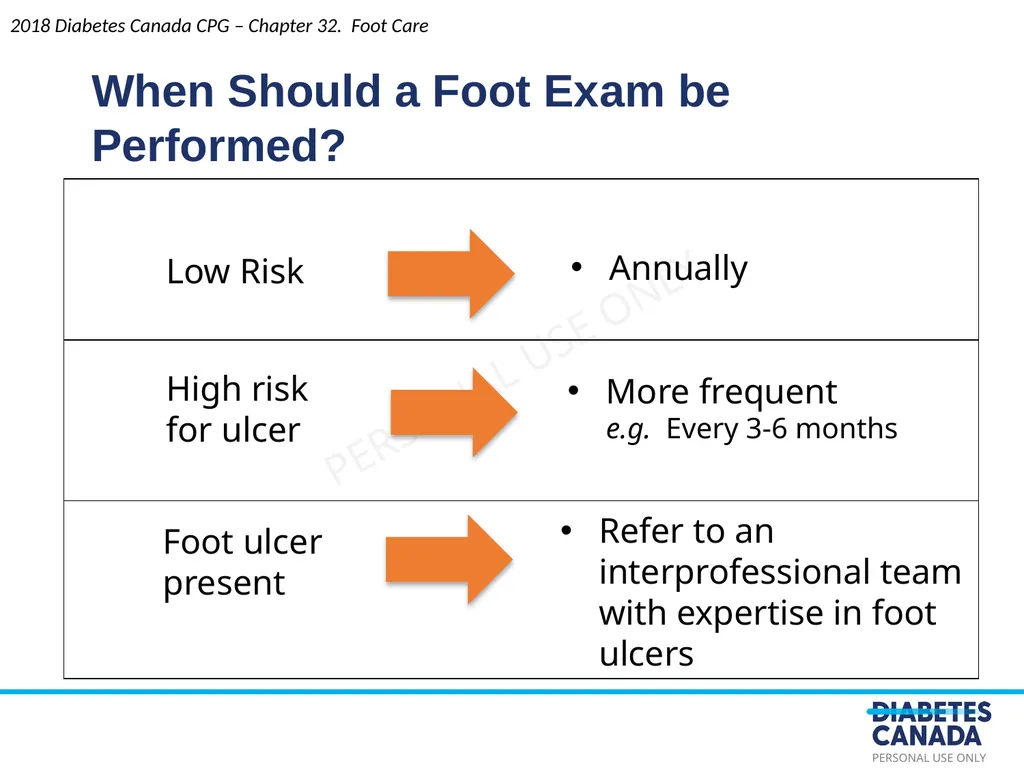
When Should a Foot Exam be Performed? 2018 Diabetes Canada CPG – Chapter 32. Foot Care Low Risk Annually High risk for ulcer More frequent
e.g. Every 3-6 months Refer to an interprofessional team with expertise in foot ulcers Foot ulcer present<br>
e.g. Every 3-6 months Refer to an interprofessional team with expertise in foot ulcers Foot ulcer present<br>
15
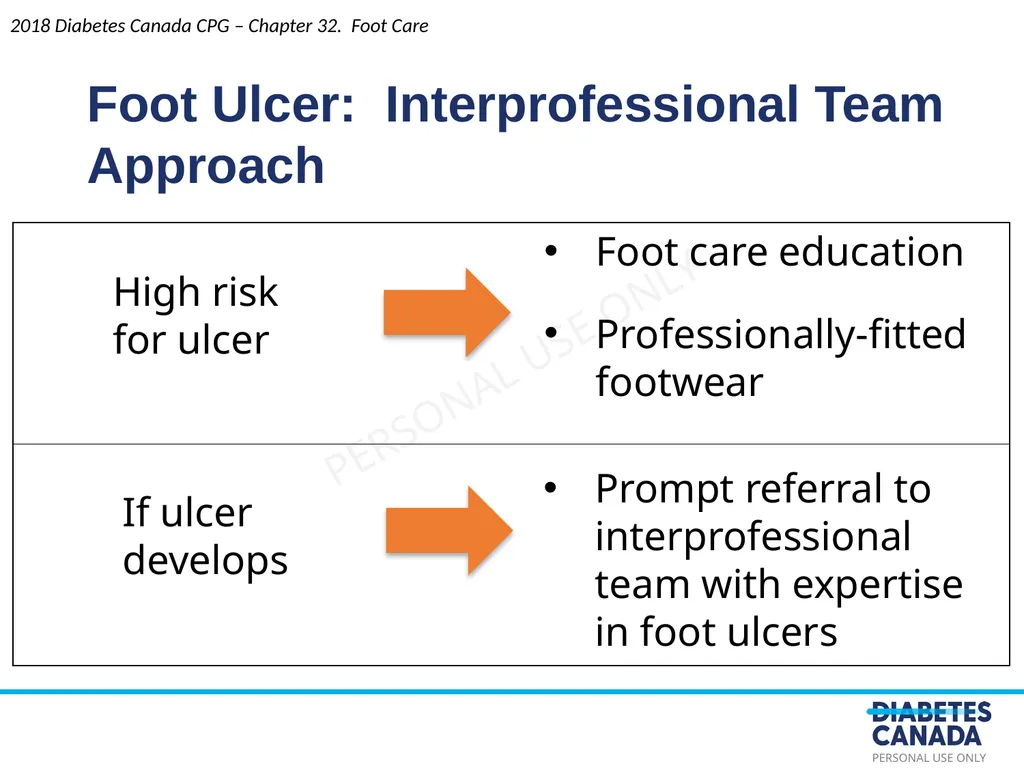
Foot Ulcer: Interprofessional Team Approach 2018 Diabetes Canada CPG – Chapter 32. Foot Care High risk for ulcer Foot care education
Professionally-fitted footwear Prompt referral to interprofessional team with expertise in foot ulcers If ulcer develops<br>
Professionally-fitted footwear Prompt referral to interprofessional team with expertise in foot ulcers If ulcer develops<br>
16
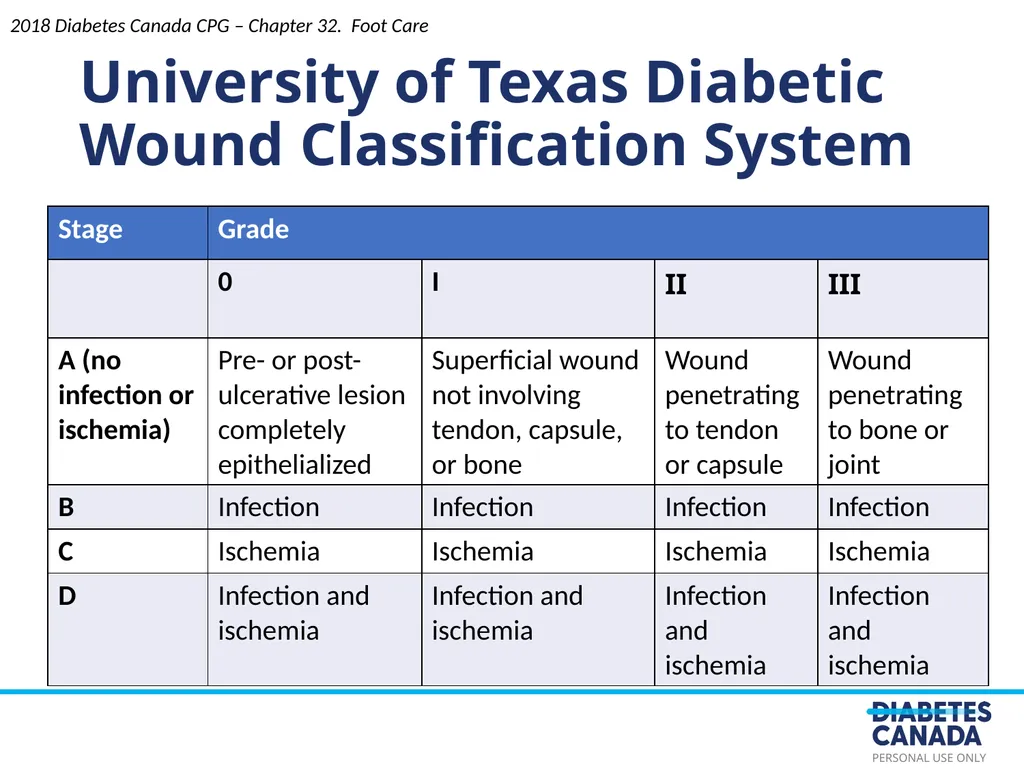
University of Texas Diabetic Wound Classification System 2018 Diabetes Canada CPG – Chapter 32. Foot Care<br>
17
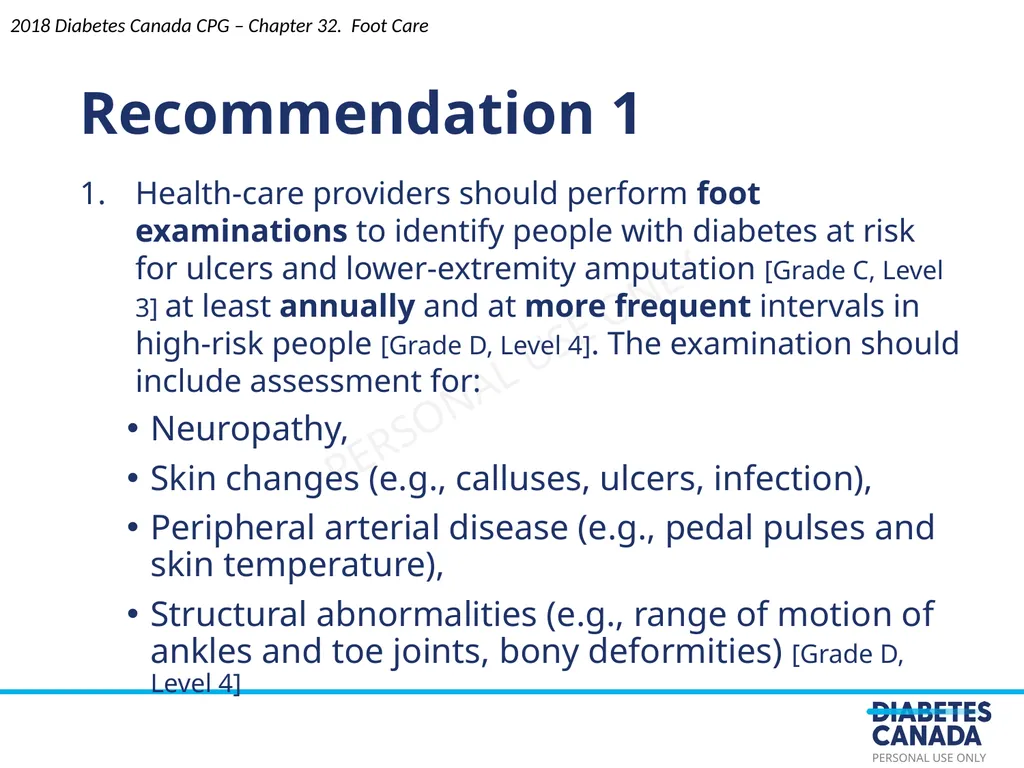
Recommendation 1 Health-care providers should perform foot examinations to identify people with diabetes at risk for ulcers and lower-extremity amputation [Grade C, Level 3] at least annually and at more frequent intervals in high-risk people [Grade D, Level 4]. The examination should include assessment for:
Neuropathy,
Skin changes (e.g., calluses, ulcers, infection),
Peripheral arterial disease (e.g., pedal pulses and skin temperature),
Structural abnormalities (e.g., range of motion of ankles and toe joints, bony deformities) [Grade D, Level 4] 2018 Diabetes Canada CPG – Chapter 32. Foot Care<br>
Neuropathy,
Skin changes (e.g., calluses, ulcers, infection),
Peripheral arterial disease (e.g., pedal pulses and skin temperature),
Structural abnormalities (e.g., range of motion of ankles and toe joints, bony deformities) [Grade D, Level 4] 2018 Diabetes Canada CPG – Chapter 32. Foot Care<br>
18
Recommendation 2 People with diabetes who are at high risk of developing foot ulcers should receive foot care education (including counseling to avoid foot trauma) and professionally fitted footwear [Grade D, Consensus].
When foot complications occur, early referral to a health-care professional trained in foot care is recommended [Grade C, Level 3] 2018 Diabetes Canada CPG – Chapter 32. Foot Care 2 2018<br>
When foot complications occur, early referral to a health-care professional trained in foot care is recommended [Grade C, Level 3] 2018 Diabetes Canada CPG – Chapter 32. Foot Care 2 2018<br>
19
Recommendation 3 3. People with diabetes who develop a foot ulcer or show signs of infection even in the absence of pain should be treated promptly by an interprofessional health-care team (when available) with expertise in the treatment of foot ulcers to prevent recurrent foot ulcers and amputation [Grade C, Level 3] 2018 Diabetes Canada CPG – Chapter 32. Foot Care<br>
20
Recommendation 4 There is insufficient evidence to recommend any specific dressing type for typical diabetic foot ulcers [Grade C, Level 3].
Debridement of nonviable tissue [Grade A, Level 1A] and general principles of wound care include the provision of a physiologically moist wound environment, and off-loading the ulcer [Grade D, Consensus] 2018 Diabetes Canada CPG – Chapter 32. Foot Care<br>
Debridement of nonviable tissue [Grade A, Level 1A] and general principles of wound care include the provision of a physiologically moist wound environment, and off-loading the ulcer [Grade D, Consensus] 2018 Diabetes Canada CPG – Chapter 32. Foot Care<br>
21
Recommendation 5 2018 Diabetes Canada CPG – Chapter 32. Foot Care There is insufficient evidence to recommend the routine use of adjunctive wound-healing therapies (eg. topical growth factors, granulocyte colony-stimulating factors, or dermal substitutes), for typical diabetic foot ulcers.
Provided that all other modifiable factors (e.g. pressure offloading, infection, foot deformity etc) have been addressed, adjunctive wound-healing therapies may be considered for non-healing, non-ischemic wounds [Grade A, Level 1].<br>
Provided that all other modifiable factors (e.g. pressure offloading, infection, foot deformity etc) have been addressed, adjunctive wound-healing therapies may be considered for non-healing, non-ischemic wounds [Grade A, Level 1].<br>
22
Key Messages In persons with diabetes, lower extremity complications are a major cause of morbidity and mortality
The treatment of foot ulcers in people who have diabetes requires a interprofessional approach that addresses glycemic control, infection, off-loading of high-pressure areas, lower-extremity vascular status, and local wound care 2018 Diabetes Canada CPG – Chapter 32. Foot Care<br>
The treatment of foot ulcers in people who have diabetes requires a interprofessional approach that addresses glycemic control, infection, off-loading of high-pressure areas, lower-extremity vascular status, and local wound care 2018 Diabetes Canada CPG – Chapter 32. Foot Care<br>
23
Key Messages Antibiotic therapy is not required for uninfected neuropathic foot ulcers
Proprietary adjunctive wound dressings and technologies including antimicrobial dressings lack sufficient evidence to support their routine use in the treatment of neuropathic ulcers 2018 Diabetes Canada CPG – Chapter 32. Foot Care<br>
Proprietary adjunctive wound dressings and technologies including antimicrobial dressings lack sufficient evidence to support their routine use in the treatment of neuropathic ulcers 2018 Diabetes Canada CPG – Chapter 32. Foot Care<br>
24
Key Messages for People with Diabetes Diabetes can cause nerve damage (also known as diabetic peripheral neuropathy) and poor blood flow or circulation to the legs and feet (also known as peripheral arterial disease)
As a result of neuropathy, people with diabetes are less likely to feel a foot injury, such as a blister or cut. Diabetes can also make these injuries more difficult to heal. Unnoticed and untreated, even small foot injuries can quickly become infected, potentially leading to serious complications 2018 Diabetes Canada CPG – Chapter 32. Foot Care<br>
As a result of neuropathy, people with diabetes are less likely to feel a foot injury, such as a blister or cut. Diabetes can also make these injuries more difficult to heal. Unnoticed and untreated, even small foot injuries can quickly become infected, potentially leading to serious complications 2018 Diabetes Canada CPG – Chapter 32. Foot Care<br>
25
Key Messages for People with Diabetes A good daily foot care routine will help keep your feet healthy.
Examine your feet and legs daily
Care for you nails regularly
Apply moisturizing lotion if your feet are dry
Avoid lotion between the toes
Massage well, minimize residue
Wear properly fitting footwear
Test your bath water with your hand before you step in, to make sure the water is not too hot 2018 Diabetes Canada CPG – Chapter 32. Foot Care<br>
26
Key Messages for People with Diabetes Do not treat any of the following yourself, rather, have them treated by your doctor or other foot care specialist (such as foot care nurse, podiatrist or chiropodist):
Corns (thick or hard skin on toes)
Callouses (thick skin on bottom of feet)
Ingrown toenails
Warts, splinters, or other wounds
If you have any swelling, warmth, redness or pain in your legs or feet, see your health-care provider or foot specialist right away 2018 Diabetes Canada CPG – Chapter 32. Foot Care<br>
27
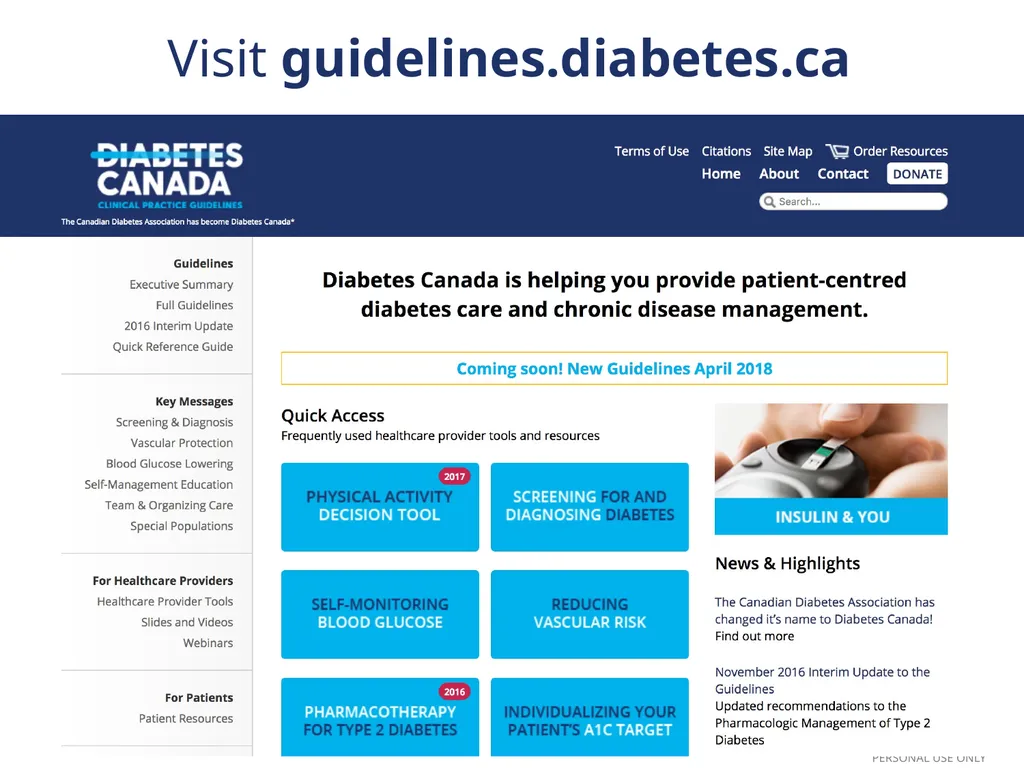
Visit guidelines.diabetes.ca<br>
28
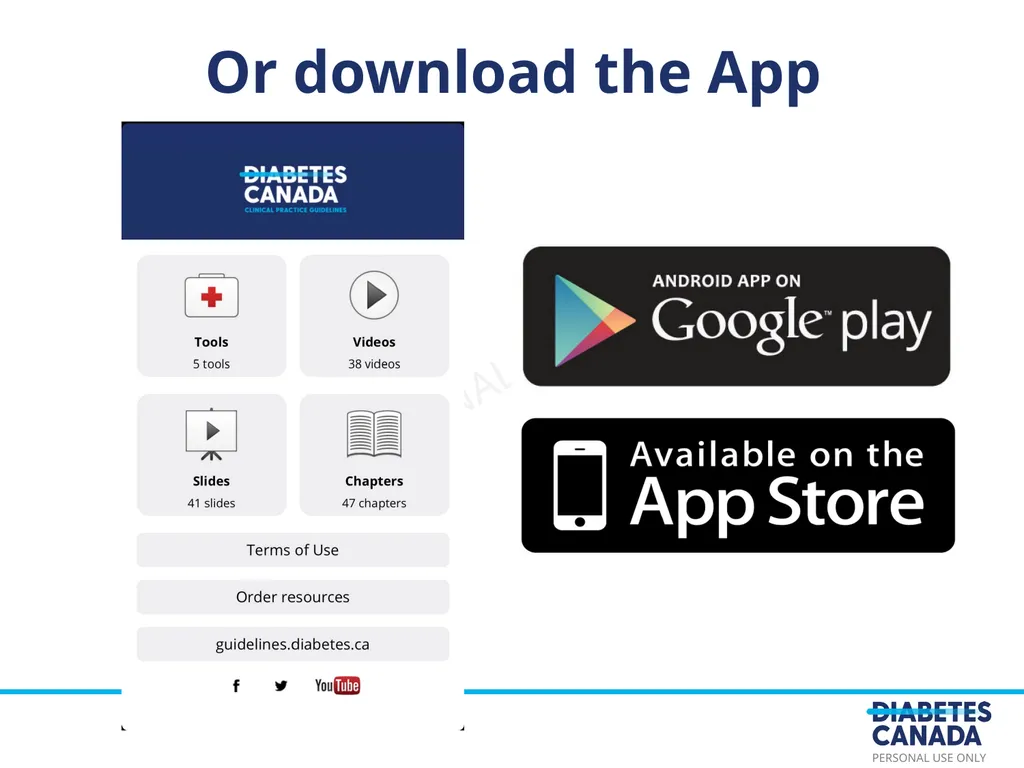
Or download the App<br>
29
Diabetes Canada Clinical Practice Guidelines www.guidelines.diabetes.ca – for health-care providers
1-800-BANTING (226-8464)
www.diabetes.ca – for people with diabetes<br>
1-800-BANTING (226-8464)
www.diabetes.ca – for people with diabetes<br>