
For a Campus Security Authority (CSA) 1 In 1986
YM
Published · 34 slides · 0 views

1 / 1


Description
For a Campus Security Authority (CSA) 1 In 1986 Jeanne Clery was raped and murdered in her dorm room at Lehigh University. The Jeanne Clery Disclosure of Campus Security Policy and Campus Crime Statistics Act (Clery Act) was enacted in her
Related Topics
Share
Embed code
Download this presentation From Below
"For a Campus Security Authority (CSA) 1 In 1986" is the property of its rightful owner. Permission is granted to download and print the materials on this website for personal, non-commercial use only, and to display it on your personal computer provided you do not modify the materials and that you retain all copyright notices contained in the materials. By downloading content from our website, you accept the terms of this agreement.
Presentation Transcript
01
For a Campus Security Authority (CSA) 1<br>
02
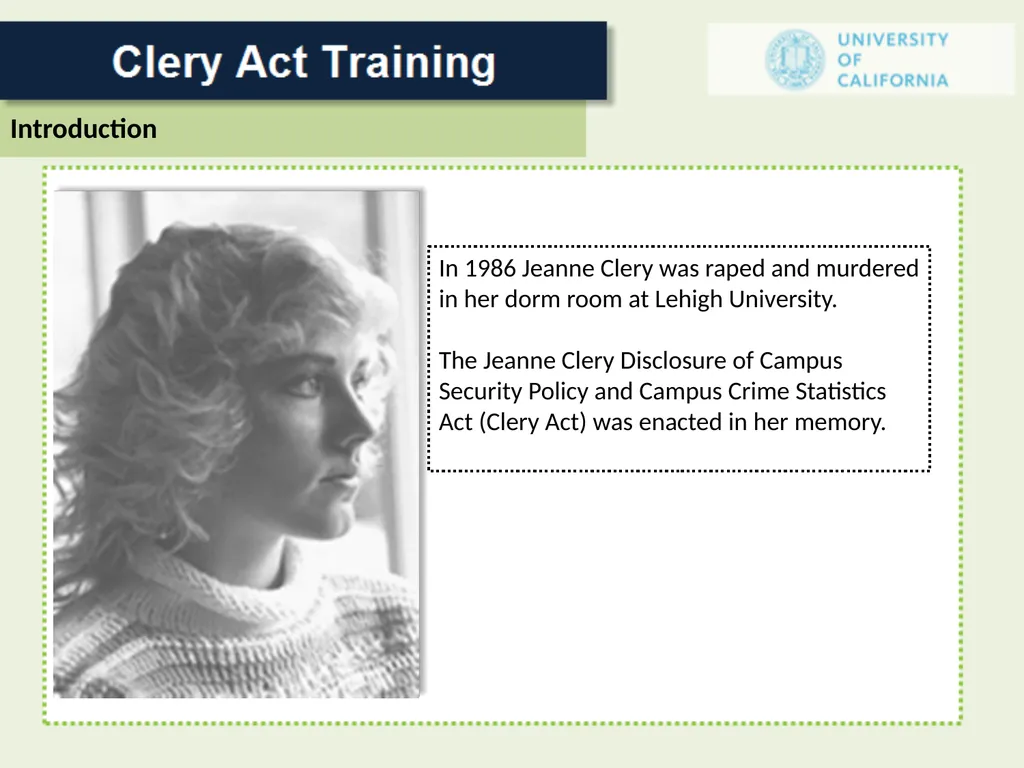
In 1986 Jeanne Clery was raped and murdered in her dorm room at Lehigh University.
The Jeanne Clery Disclosure of Campus Security Policy and Campus Crime Statistics Act (Clery Act) was enacted in her memory. Introduction 2<br>
The Jeanne Clery Disclosure of Campus Security Policy and Campus Crime Statistics Act (Clery Act) was enacted in her memory. Introduction 2<br>
03
The goal of the Clery Act is to ensure students, prospective students, parents and employees have access to accurate information about crimes committed on campus and campus security procedures. 3 Introduction<br>
04
The
Clery Act Information disclosed under the Clery Act can assist students and parents in making decisions which affect their personal safety.
The following information is general guidance for a Campus Security Authority (CSA). Each campus is responsible for establishing appropriate procedures to implement these requirements. 4 Introduction<br>
Clery Act Information disclosed under the Clery Act can assist students and parents in making decisions which affect their personal safety.
The following information is general guidance for a Campus Security Authority (CSA). Each campus is responsible for establishing appropriate procedures to implement these requirements. 4 Introduction<br>
05
Section 1: Clery Act Definitions and Requirements 06
Section 2: Campus Security Authority 12
Section 3: Responsibilities and Reporting 18
Section 4: Review and Guidance 31 Table of Contents 5<br>
Section 2: Campus Security Authority 12
Section 3: Responsibilities and Reporting 18
Section 4: Review and Guidance 31 Table of Contents 5<br>
06
Section 1:
Clery Act Overview –
Definitions and Requirements 6 Section 1<br>
Clery Act Overview –
Definitions and Requirements 6 Section 1<br>
07
What is the Clery Act?
The Clery Act requires institutions of higher
education receiving federal financial aid to report
specific crime statistics on campus and provide safety and crime
information to members of the campus community.
Law is tied to federal student financial aid programs and requires colleges and universities to make timely warnings, emergency notifications, and provide annual information about campus crime statistics and security policies.
Violators can be “fined” up to $35,000 per incident by the U.S. Department of Education, the agency charged with enforcement of the Act. 7 Section 1: Clery Act Overview<br>
The Clery Act requires institutions of higher
education receiving federal financial aid to report
specific crime statistics on campus and provide safety and crime
information to members of the campus community.
Law is tied to federal student financial aid programs and requires colleges and universities to make timely warnings, emergency notifications, and provide annual information about campus crime statistics and security policies.
Violators can be “fined” up to $35,000 per incident by the U.S. Department of Education, the agency charged with enforcement of the Act. 7 Section 1: Clery Act Overview<br>
08
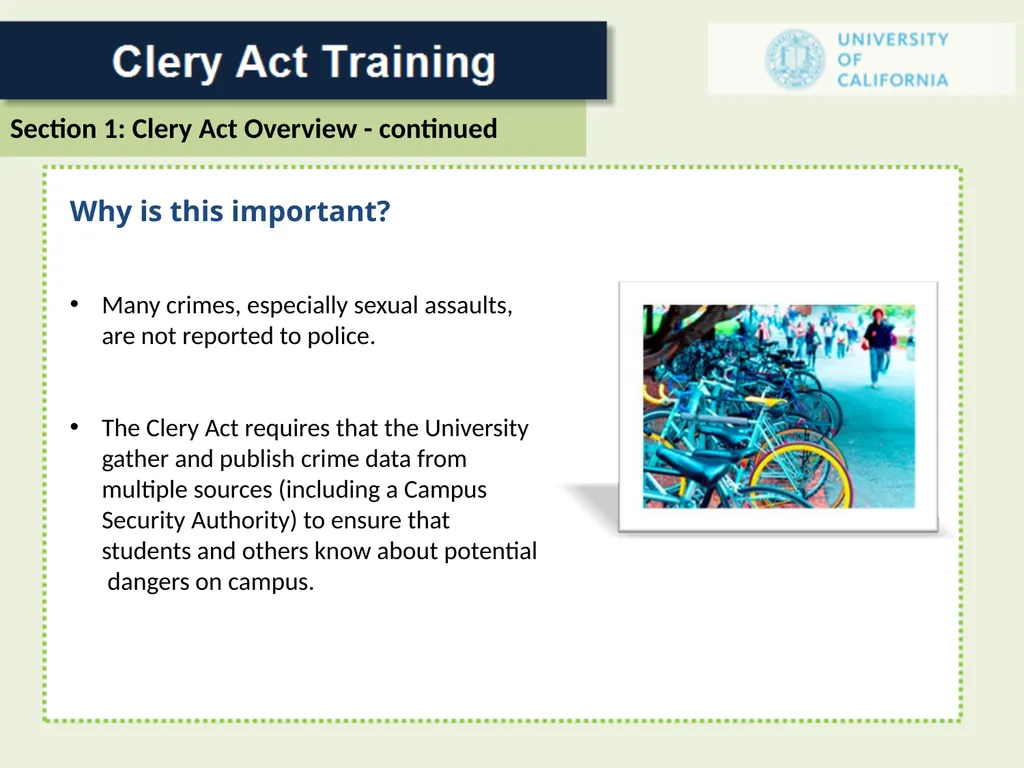
Why is this important?
Many crimes, especially sexual assaults, are not reported to police.
The Clery Act requires that the University gather and publish crime data from multiple sources (including a Campus Security Authority) to ensure that students and others know about potential dangers on campus. 8 Section 1: Clery Act Overview - continued<br>
Many crimes, especially sexual assaults, are not reported to police.
The Clery Act requires that the University gather and publish crime data from multiple sources (including a Campus Security Authority) to ensure that students and others know about potential dangers on campus. 8 Section 1: Clery Act Overview - continued<br>
09
Requirements of the Clery Act
Disclose, collect, classify and count crime reports and statistics
Issue Crime Alerts - timely warning for any Clery Act-specified crime that represents an ongoing threat to the safety of students or employees
Issue Emergency Notifications upon confirmation of significant emergency or dangerous situation involving immediate threat to health or safety
Publish Annual Security Report
Submit Crime Statistics to Department of Education
Maintain a publicly available daily crime log
Implement missing student notification procedures
Maintain Fire Safety information - including fire log, annual fire report with statistics and policy statements 9 Section 1: Clery Act Overview - continued<br>
Disclose, collect, classify and count crime reports and statistics
Issue Crime Alerts - timely warning for any Clery Act-specified crime that represents an ongoing threat to the safety of students or employees
Issue Emergency Notifications upon confirmation of significant emergency or dangerous situation involving immediate threat to health or safety
Publish Annual Security Report
Submit Crime Statistics to Department of Education
Maintain a publicly available daily crime log
Implement missing student notification procedures
Maintain Fire Safety information - including fire log, annual fire report with statistics and policy statements 9 Section 1: Clery Act Overview - continued<br>
10
Requirements of the Clery Act
Requires institutions to report (annually and on-going)
the following:
Where crimes occurred
Type of crimes reported
Employees and students are notified by October 1 of each year that the campus annual security report is updated and available 10 Section 1: Clery Act Overview - continued<br>
Requires institutions to report (annually and on-going)
the following:
Where crimes occurred
Type of crimes reported
Employees and students are notified by October 1 of each year that the campus annual security report is updated and available 10 Section 1: Clery Act Overview - continued<br>
11
Review
Many crimes, especially sexual assaults, are not reported to police
The Clery Act requires institutions of higher education receiving federal financial aid to report specific crime statistics on campus and provide safety and crime information to members of the campus community
Each campus is responsible for establishing appropriate procedures to implement these requirements
Employees and students are notified by October 1 of each year that the campus annual security report is updated and available 11 Section 1: Clery Act Overview - continued<br>
Many crimes, especially sexual assaults, are not reported to police
The Clery Act requires institutions of higher education receiving federal financial aid to report specific crime statistics on campus and provide safety and crime information to members of the campus community
Each campus is responsible for establishing appropriate procedures to implement these requirements
Employees and students are notified by October 1 of each year that the campus annual security report is updated and available 11 Section 1: Clery Act Overview - continued<br>
12
Section 2:
Campus Security Authority 12 Section 2<br>
Campus Security Authority 12 Section 2<br>
13
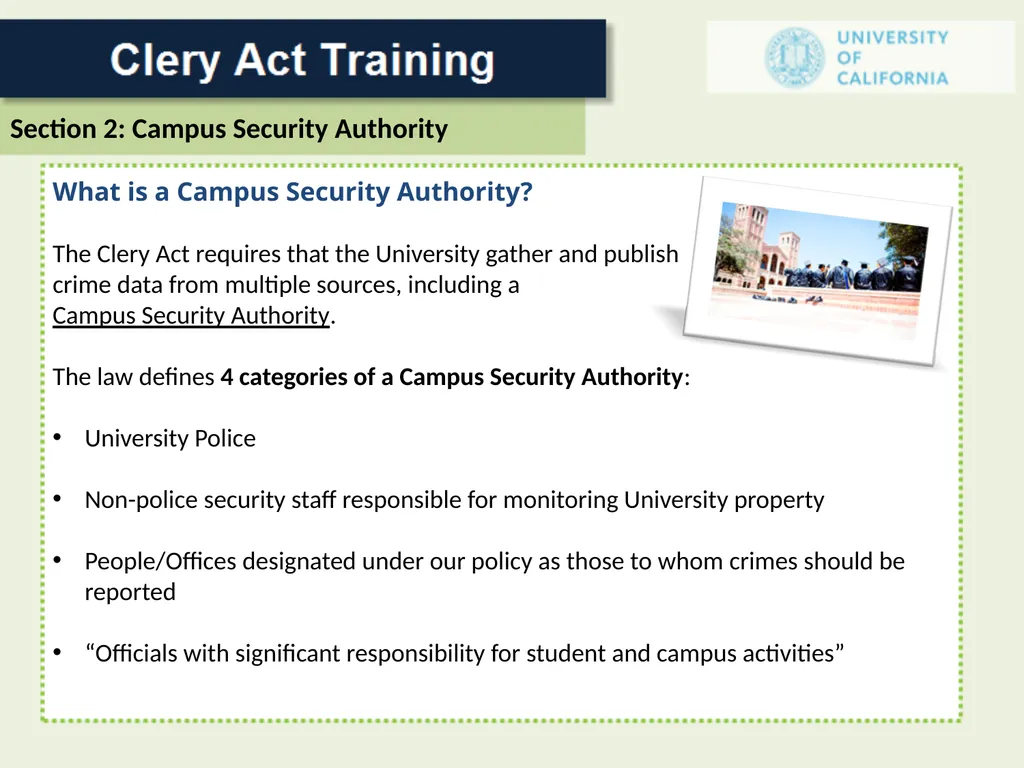
What is a Campus Security Authority?
The Clery Act requires that the University gather and publish
crime data from multiple sources, including a
Campus Security Authority.
The law defines 4 categories of a Campus Security Authority:
University Police
Non-police security staff responsible for monitoring University property
People/Offices designated under our policy as those to whom crimes should be reported
“Officials with significant responsibility for student and campus activities” 13 Section 2: Campus Security Authority<br>
The Clery Act requires that the University gather and publish
crime data from multiple sources, including a
Campus Security Authority.
The law defines 4 categories of a Campus Security Authority:
University Police
Non-police security staff responsible for monitoring University property
People/Offices designated under our policy as those to whom crimes should be reported
“Officials with significant responsibility for student and campus activities” 13 Section 2: Campus Security Authority<br>
14
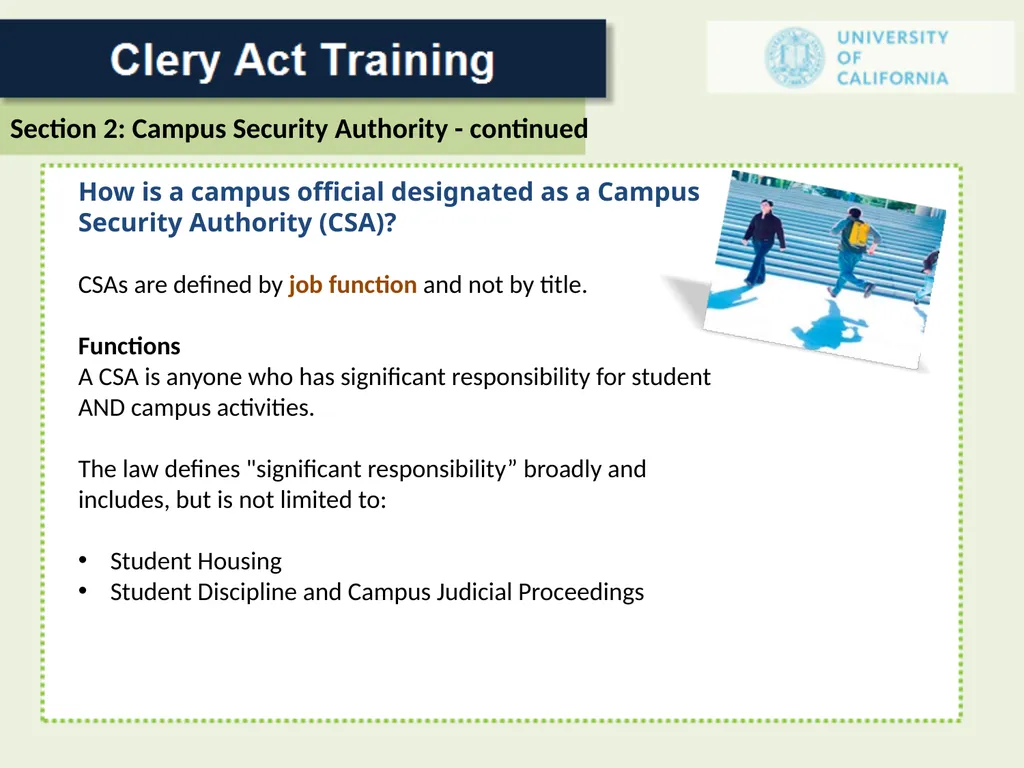
How is a campus official designated as a Campus Security Authority (CSA)?
CSAs are defined by job function and not by title.
Functions
A CSA is anyone who has significant responsibility for student AND campus activities.
The law defines "significant responsibility” broadly and includes, but is not limited to:
Student Housing
Student Discipline and Campus Judicial Proceedings 14 Section 2: Campus Security Authority - continued<br>
CSAs are defined by job function and not by title.
Functions
A CSA is anyone who has significant responsibility for student AND campus activities.
The law defines "significant responsibility” broadly and includes, but is not limited to:
Student Housing
Student Discipline and Campus Judicial Proceedings 14 Section 2: Campus Security Authority - continued<br>
15
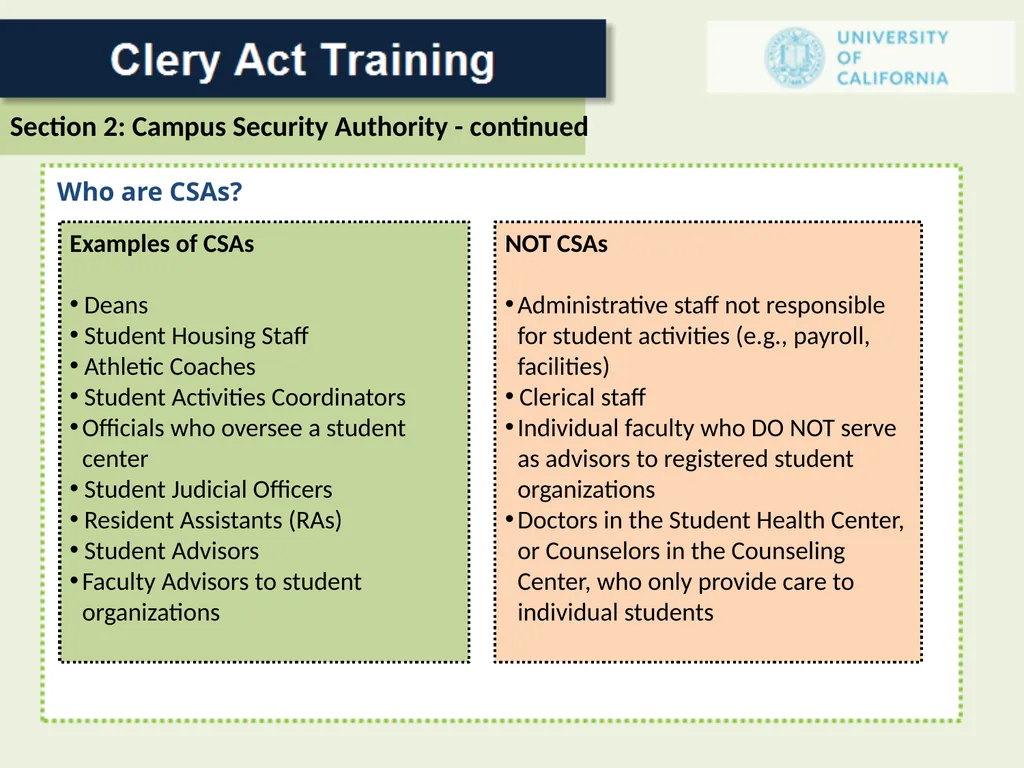
Who are CSAs? 15 Section 2: Campus Security Authority - continued Examples of CSAs
Deans
Student Housing Staff
Athletic Coaches
Student Activities Coordinators
Officials who oversee a student center
Student Judicial Officers
Resident Assistants (RAs)
Student Advisors
Faculty Advisors to student organizations NOT CSAs
Administrative staff not responsible for student activities (e.g., payroll, facilities)
Clerical staff
Individual faculty who DO NOT serve as advisors to registered student organizations
Doctors in the Student Health Center, or Counselors in the Counseling Center, who only provide care to individual students<br>
Deans
Student Housing Staff
Athletic Coaches
Student Activities Coordinators
Officials who oversee a student center
Student Judicial Officers
Resident Assistants (RAs)
Student Advisors
Faculty Advisors to student organizations NOT CSAs
Administrative staff not responsible for student activities (e.g., payroll, facilities)
Clerical staff
Individual faculty who DO NOT serve as advisors to registered student organizations
Doctors in the Student Health Center, or Counselors in the Counseling Center, who only provide care to individual students<br>
16
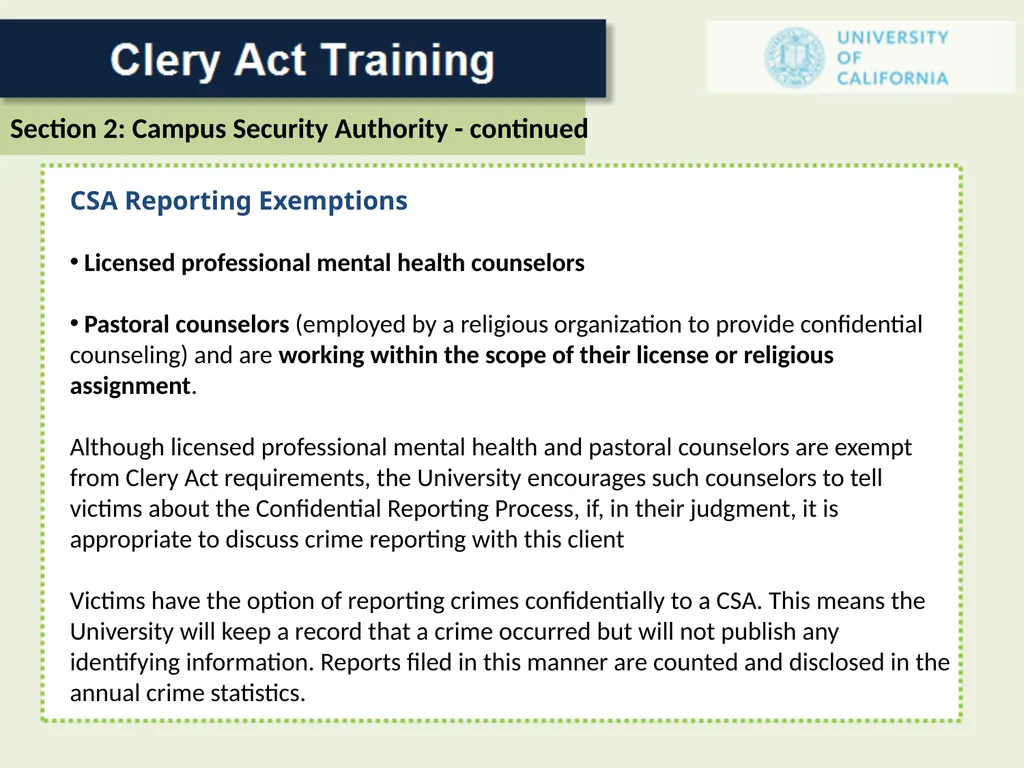
CSA Reporting Exemptions
Licensed professional mental health counselors
Pastoral counselors (employed by a religious organization to provide confidential counseling) and are working within the scope of their license or religious assignment.
Although licensed professional mental health and pastoral counselors are exempt from Clery Act requirements, the University encourages such counselors to tell victims about the Confidential Reporting Process, if, in their judgment, it is appropriate to discuss crime reporting with this client
Victims have the option of reporting crimes confidentially to a CSA. This means the University will keep a record that a crime occurred but will not publish any identifying information. Reports filed in this manner are counted and disclosed in the annual crime statistics. 16 Section 2: Campus Security Authority - continued<br>
Licensed professional mental health counselors
Pastoral counselors (employed by a religious organization to provide confidential counseling) and are working within the scope of their license or religious assignment.
Although licensed professional mental health and pastoral counselors are exempt from Clery Act requirements, the University encourages such counselors to tell victims about the Confidential Reporting Process, if, in their judgment, it is appropriate to discuss crime reporting with this client
Victims have the option of reporting crimes confidentially to a CSA. This means the University will keep a record that a crime occurred but will not publish any identifying information. Reports filed in this manner are counted and disclosed in the annual crime statistics. 16 Section 2: Campus Security Authority - continued<br>
17
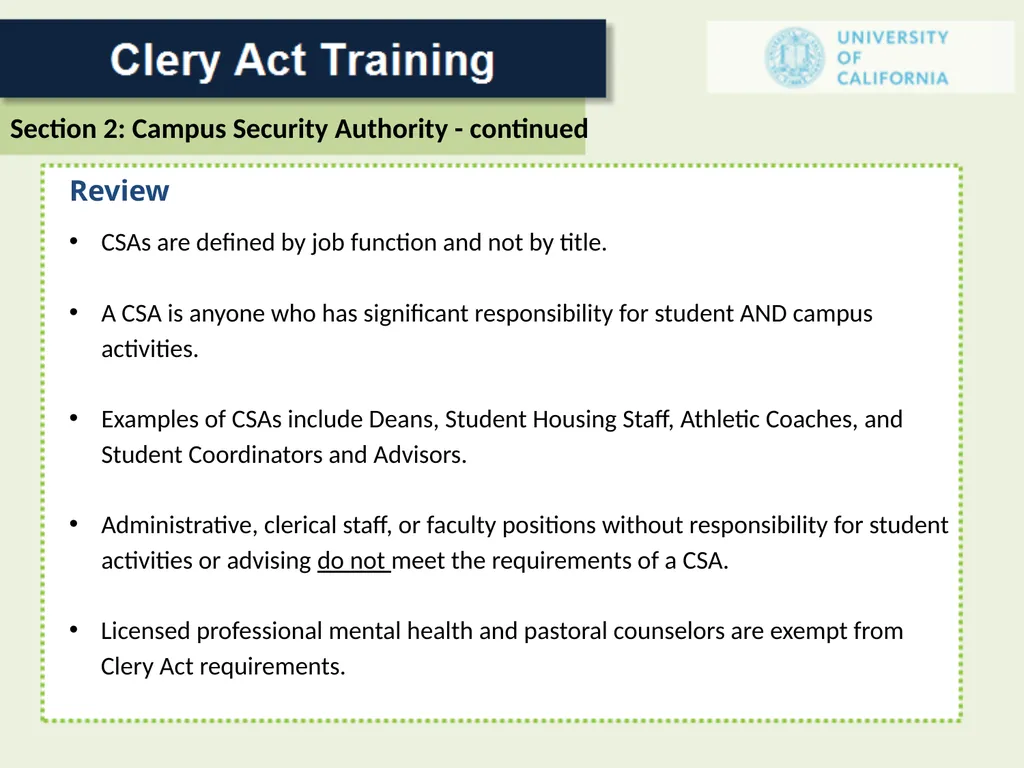
Review
CSAs are defined by job function and not by title.
A CSA is anyone who has significant responsibility for student AND campus activities.
Examples of CSAs include Deans, Student Housing Staff, Athletic Coaches, and Student Coordinators and Advisors.
Administrative, clerical staff, or faculty positions without responsibility for student activities or advising do not meet the requirements of a CSA.
Licensed professional mental health and pastoral counselors are exempt from Clery Act requirements. 17 Section 2: Campus Security Authority - continued<br>
CSAs are defined by job function and not by title.
A CSA is anyone who has significant responsibility for student AND campus activities.
Examples of CSAs include Deans, Student Housing Staff, Athletic Coaches, and Student Coordinators and Advisors.
Administrative, clerical staff, or faculty positions without responsibility for student activities or advising do not meet the requirements of a CSA.
Licensed professional mental health and pastoral counselors are exempt from Clery Act requirements. 17 Section 2: Campus Security Authority - continued<br>
18
Section 3:
Responsibilities and Reporting 18 Section 3<br>
Responsibilities and Reporting 18 Section 3<br>
19
CSAs are responsible for collecting and reporting on certain crimes that are reported to them by students and employees
The following slides in this section will help CSAs know what crimes need to be reported and how to report them within the Clery Act provisions. 19 Section 3: Responsibilities and Reporting<br>
The following slides in this section will help CSAs know what crimes need to be reported and how to report them within the Clery Act provisions. 19 Section 3: Responsibilities and Reporting<br>
20
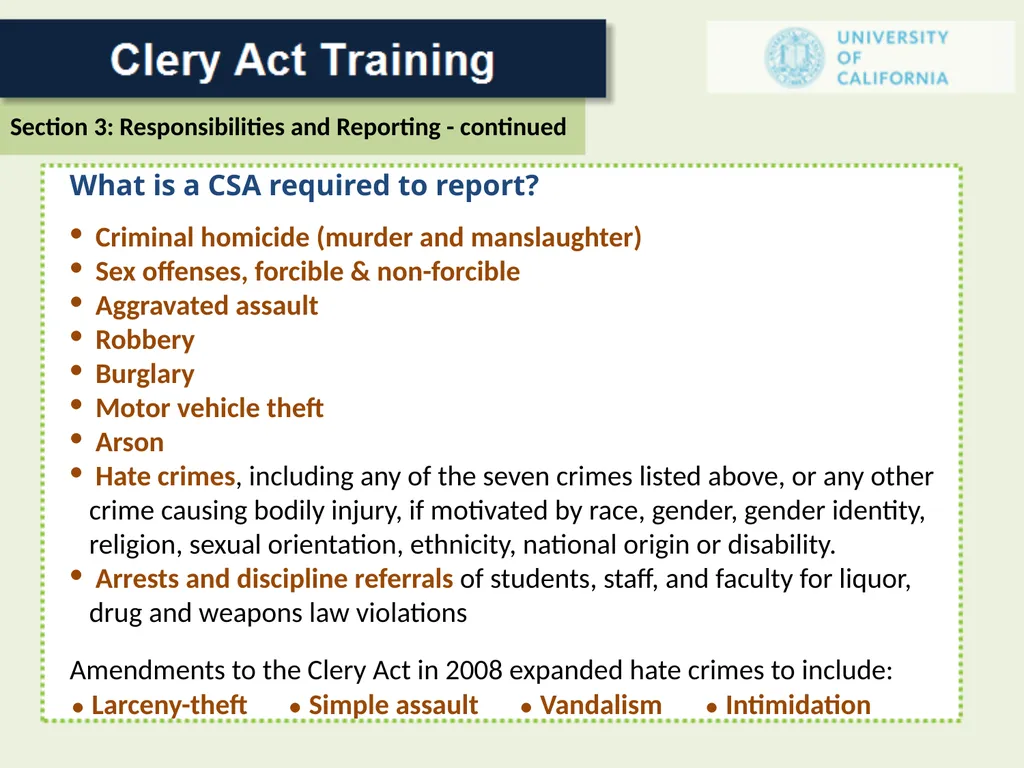
What is a CSA required to report?
Criminal homicide (murder and manslaughter)
Sex offenses, forcible & non-forcible
Aggravated assault
Robbery
Burglary
Motor vehicle theft
Arson
Hate crimes, including any of the seven crimes listed above, or any other crime causing bodily injury, if motivated by race, gender, gender identity, religion, sexual orientation, ethnicity, national origin or disability.
Arrests and discipline referrals of students, staff, and faculty for liquor, drug and weapons law violations
Amendments to the Clery Act in 2008 expanded hate crimes to include: ● Larceny-theft ● Simple assault ● Vandalism ● Intimidation 20 Section 3: Responsibilities and Reporting - continued<br>
Criminal homicide (murder and manslaughter)
Sex offenses, forcible & non-forcible
Aggravated assault
Robbery
Burglary
Motor vehicle theft
Arson
Hate crimes, including any of the seven crimes listed above, or any other crime causing bodily injury, if motivated by race, gender, gender identity, religion, sexual orientation, ethnicity, national origin or disability.
Arrests and discipline referrals of students, staff, and faculty for liquor, drug and weapons law violations
Amendments to the Clery Act in 2008 expanded hate crimes to include: ● Larceny-theft ● Simple assault ● Vandalism ● Intimidation 20 Section 3: Responsibilities and Reporting - continued<br>
21
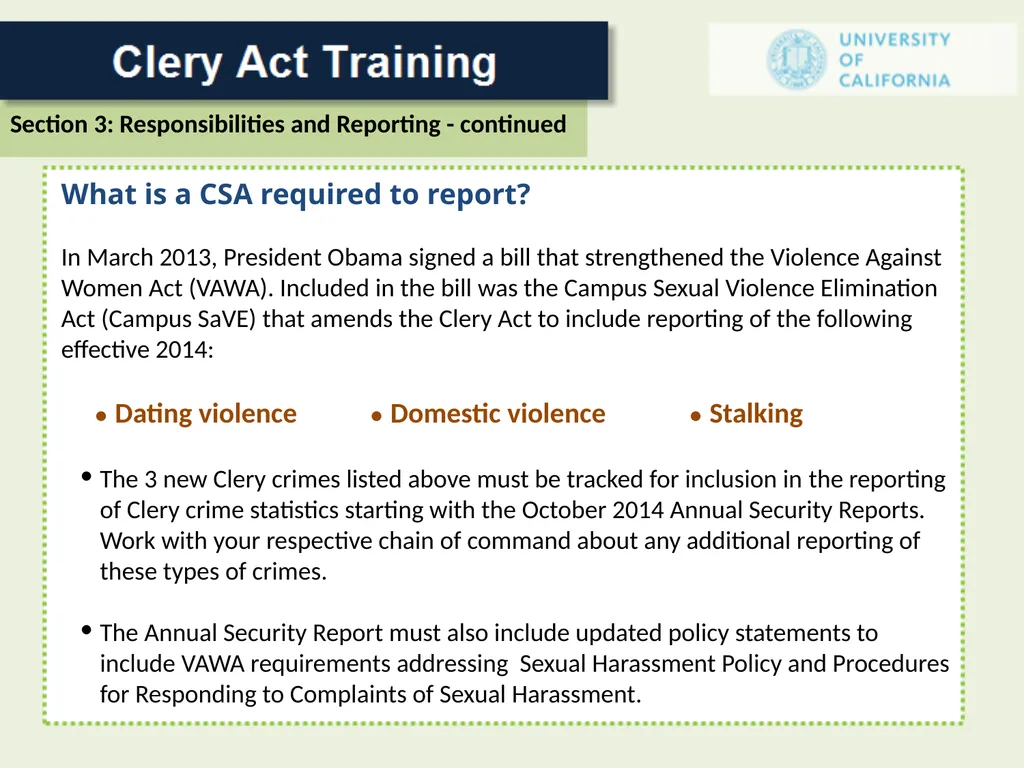
What is a CSA required to report?
In March 2013, President Obama signed a bill that strengthened the Violence Against Women Act (VAWA). Included in the bill was the Campus Sexual Violence Elimination Act (Campus SaVE) that amends the Clery Act to include reporting of the following effective 2014:
● Dating violence ● Domestic violence ● Stalking
The 3 new Clery crimes listed above must be tracked for inclusion in the reporting of Clery crime statistics starting with the October 2014 Annual Security Reports. Work with your respective chain of command about any additional reporting of these types of crimes.
The Annual Security Report must also include updated policy statements to include VAWA requirements addressing Sexual Harassment Policy and Procedures for Responding to Complaints of Sexual Harassment. 21 Section 3: Responsibilities and Reporting - continued<br>
In March 2013, President Obama signed a bill that strengthened the Violence Against Women Act (VAWA). Included in the bill was the Campus Sexual Violence Elimination Act (Campus SaVE) that amends the Clery Act to include reporting of the following effective 2014:
● Dating violence ● Domestic violence ● Stalking
The 3 new Clery crimes listed above must be tracked for inclusion in the reporting of Clery crime statistics starting with the October 2014 Annual Security Reports. Work with your respective chain of command about any additional reporting of these types of crimes.
The Annual Security Report must also include updated policy statements to include VAWA requirements addressing Sexual Harassment Policy and Procedures for Responding to Complaints of Sexual Harassment. 21 Section 3: Responsibilities and Reporting - continued<br>
22
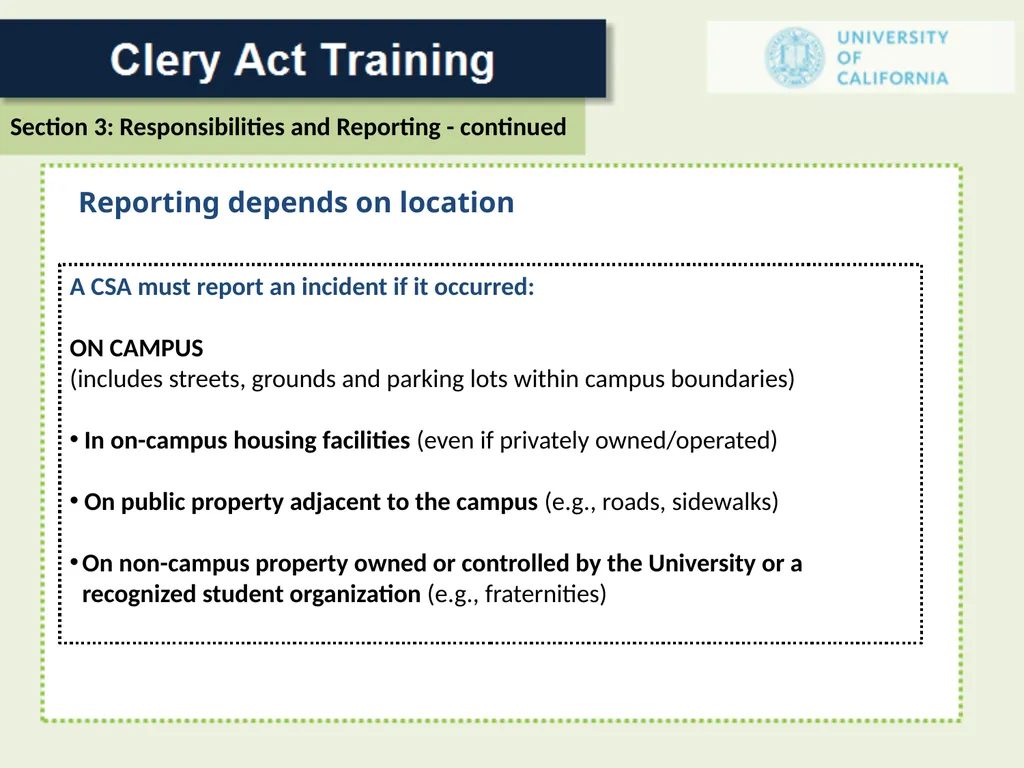
Reporting depends on location 22 Section 3: Responsibilities and Reporting - continued A CSA must report an incident if it occurred:
ON CAMPUS
(includes streets, grounds and parking lots within campus boundaries)
In on-campus housing facilities (even if privately owned/operated)
On public property adjacent to the campus (e.g., roads, sidewalks)
On non-campus property owned or controlled by the University or a recognized student organization (e.g., fraternities)<br>
ON CAMPUS
(includes streets, grounds and parking lots within campus boundaries)
In on-campus housing facilities (even if privately owned/operated)
On public property adjacent to the campus (e.g., roads, sidewalks)
On non-campus property owned or controlled by the University or a recognized student organization (e.g., fraternities)<br>
23
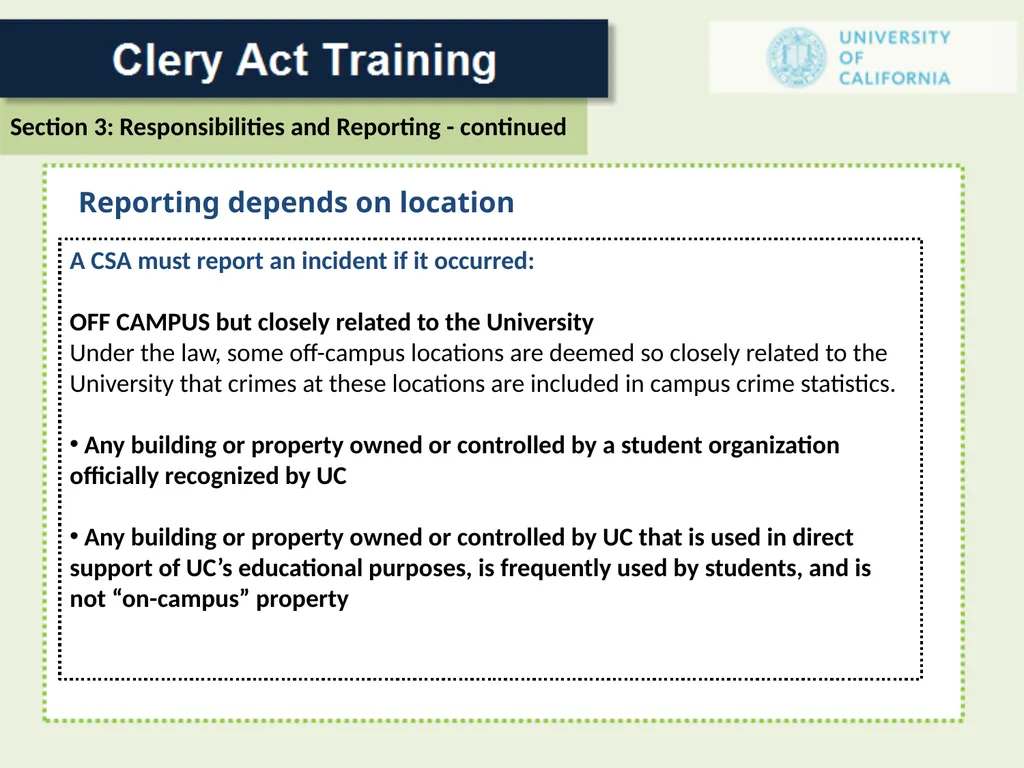
Reporting depends on location 23 Section 3: Responsibilities and Reporting - continued A CSA must report an incident if it occurred:
OFF CAMPUS but closely related to the University
Under the law, some off-campus locations are deemed so closely related to the University that crimes at these locations are included in campus crime statistics.
Any building or property owned or controlled by a student organization officially recognized by UC
Any building or property owned or controlled by UC that is used in direct support of UC’s educational purposes, is frequently used by students, and is not “on-campus” property<br>
OFF CAMPUS but closely related to the University
Under the law, some off-campus locations are deemed so closely related to the University that crimes at these locations are included in campus crime statistics.
Any building or property owned or controlled by a student organization officially recognized by UC
Any building or property owned or controlled by UC that is used in direct support of UC’s educational purposes, is frequently used by students, and is not “on-campus” property<br>
24
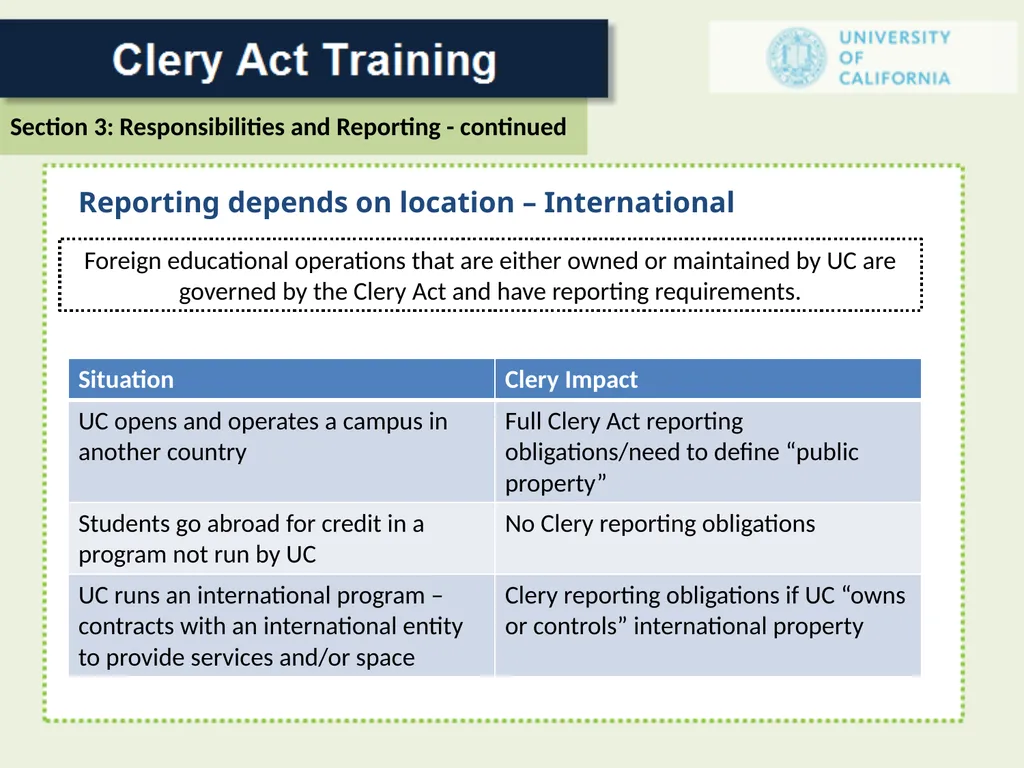
Reporting depends on location – International 24 Section 3: Responsibilities and Reporting - continued Foreign educational operations that are either owned or maintained by UC are governed by the Clery Act and have reporting requirements.<br>
25
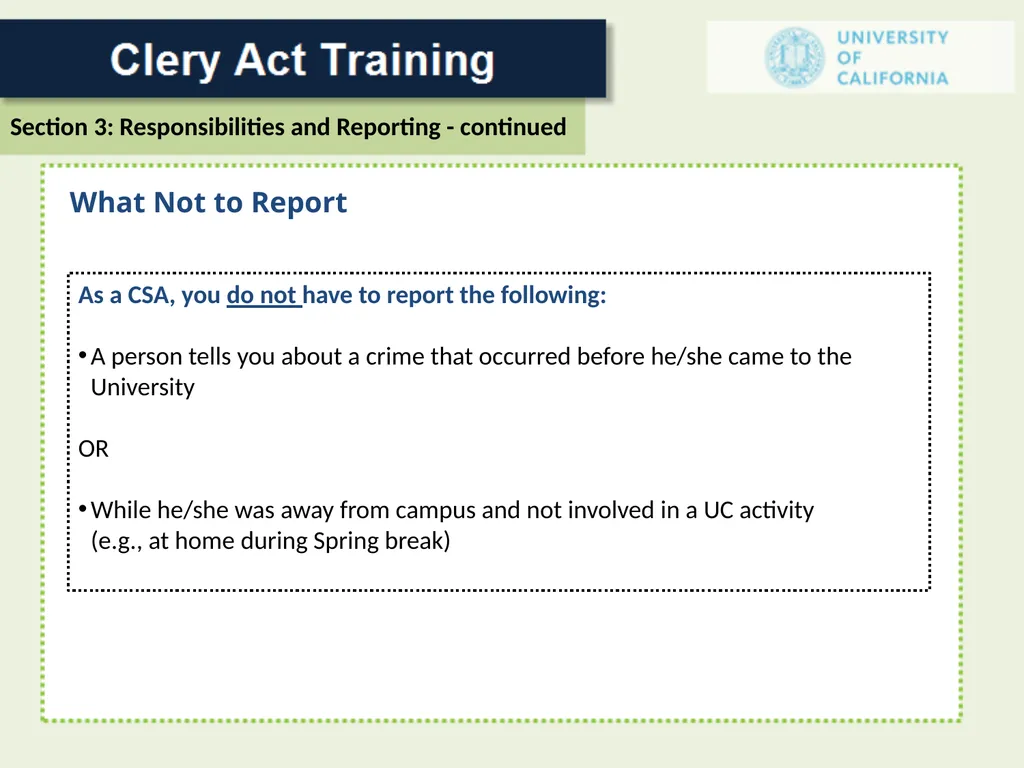
What Not to Report 25 Section 3: Responsibilities and Reporting - continued As a CSA, you do not have to report the following:
A person tells you about a crime that occurred before he/she came to the University
OR
While he/she was away from campus and not involved in a UC activity (e.g., at home during Spring break)<br>
A person tells you about a crime that occurred before he/she came to the University
OR
While he/she was away from campus and not involved in a UC activity (e.g., at home during Spring break)<br>
26
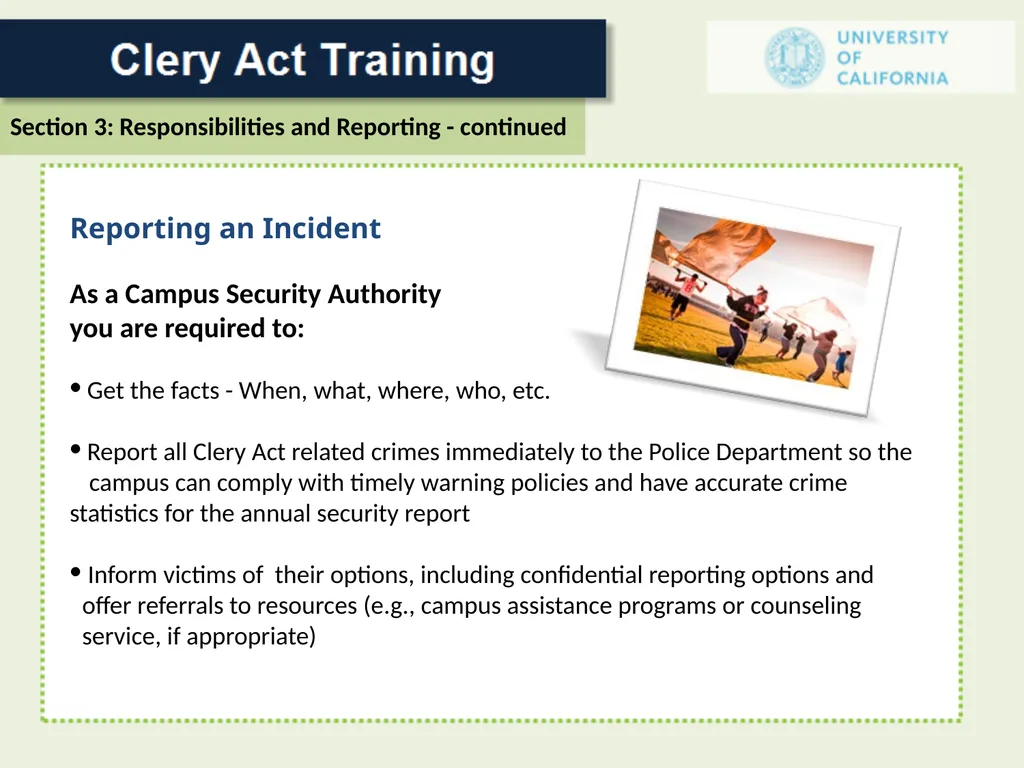
Reporting an Incident
As a Campus Security Authority
you are required to:
Get the facts - When, what, where, who, etc.
Report all Clery Act related crimes immediately to the Police Department so the campus can comply with timely warning policies and have accurate crime statistics for the annual security report
Inform victims of their options, including confidential reporting options and offer referrals to resources (e.g., campus assistance programs or counseling service, if appropriate) 26 Section 3: Responsibilities and Reporting - continued<br>
As a Campus Security Authority
you are required to:
Get the facts - When, what, where, who, etc.
Report all Clery Act related crimes immediately to the Police Department so the campus can comply with timely warning policies and have accurate crime statistics for the annual security report
Inform victims of their options, including confidential reporting options and offer referrals to resources (e.g., campus assistance programs or counseling service, if appropriate) 26 Section 3: Responsibilities and Reporting - continued<br>
27
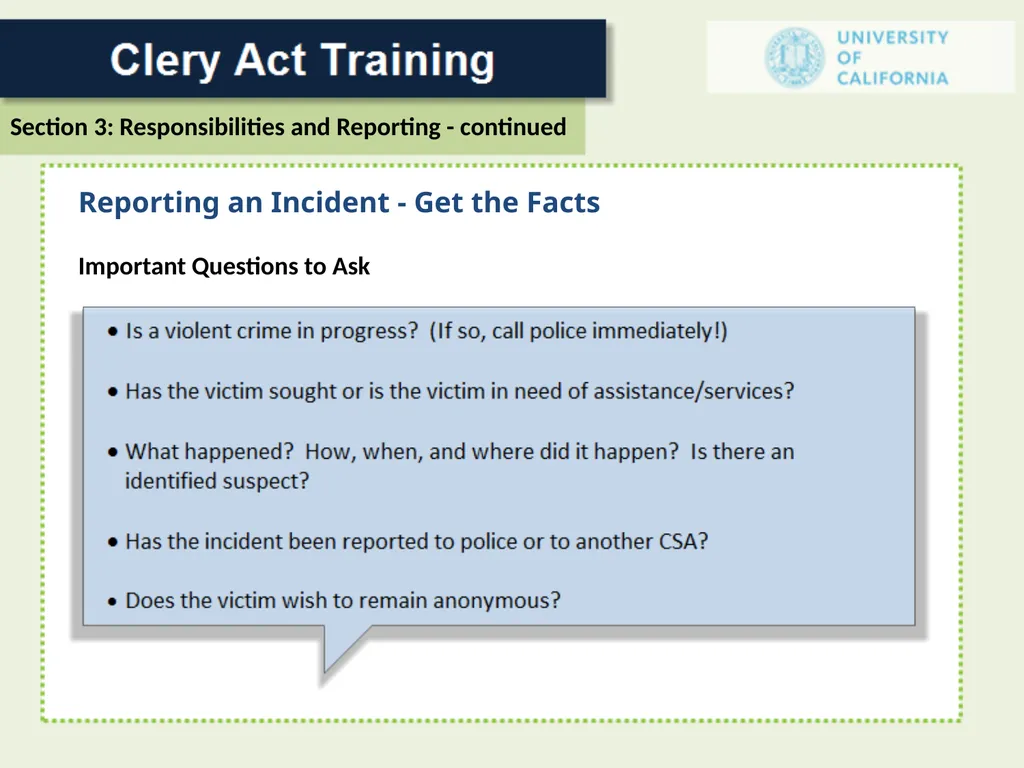
Reporting an Incident - Get the Facts
Important Questions to Ask 27 Section 3: Responsibilities and Reporting - continued<br>
Important Questions to Ask 27 Section 3: Responsibilities and Reporting - continued<br>
28
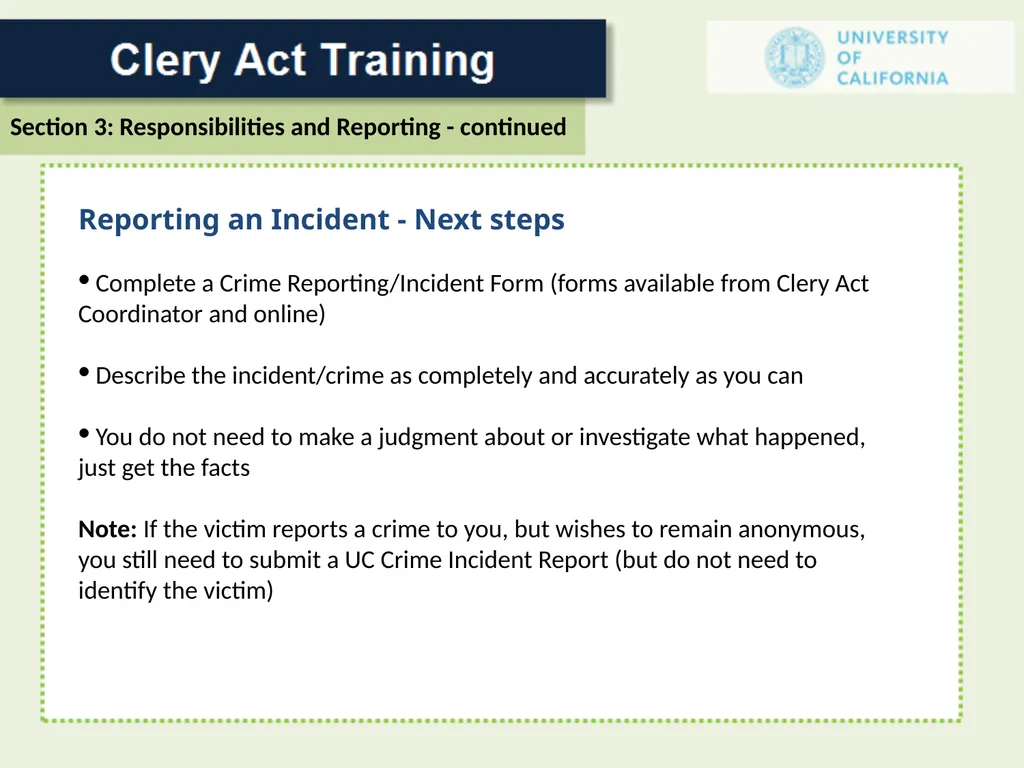
Reporting an Incident - Next steps
Complete a Crime Reporting/Incident Form (forms available from Clery Act Coordinator and online)
Describe the incident/crime as completely and accurately as you can
You do not need to make a judgment about or investigate what happened, just get the facts
Note: If the victim reports a crime to you, but wishes to remain anonymous, you still need to submit a UC Crime Incident Report (but do not need to identify the victim) 28 Section 3: Responsibilities and Reporting - continued<br>
Complete a Crime Reporting/Incident Form (forms available from Clery Act Coordinator and online)
Describe the incident/crime as completely and accurately as you can
You do not need to make a judgment about or investigate what happened, just get the facts
Note: If the victim reports a crime to you, but wishes to remain anonymous, you still need to submit a UC Crime Incident Report (but do not need to identify the victim) 28 Section 3: Responsibilities and Reporting - continued<br>
29
Reporting an Incident - Filling out the Report
Answering questions on the form will help determine the correct category (you don’t have to know the classification)
Write a brief description of the incident
Timely reporting is critical 29 Section 3: Responsibilities and Reporting - continued<br>
Answering questions on the form will help determine the correct category (you don’t have to know the classification)
Write a brief description of the incident
Timely reporting is critical 29 Section 3: Responsibilities and Reporting - continued<br>
30
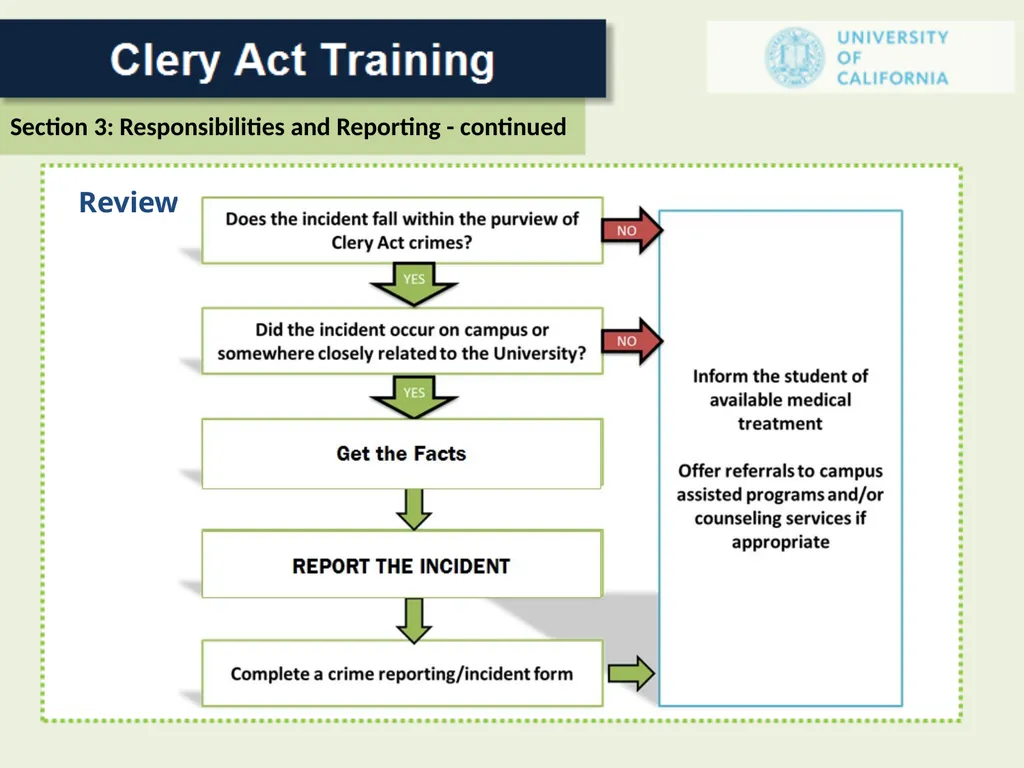
Review 30 Section 3: Responsibilities and Reporting - continued<br>
31
Section 4:
Review and Guidance 31 Section 4<br>
Review and Guidance 31 Section 4<br>
32
Review
The Clery Act requires institutions of higher education receiving federal financial aid to report specific crime statistics on campus and provide safety and crime information to members of the campus community.
Each campus is responsible for establishing appropriate procedures to implement these requirements.
A Campus Security Authority (CSA) is anyone who has significant responsibility for student AND campus activities.
CSAs are required to: Get the facts, report all Clery related crimes to the police, inform victims of confidential reporting options and offer referrals to resources. 32 Section 4: Review and Guidance<br>
The Clery Act requires institutions of higher education receiving federal financial aid to report specific crime statistics on campus and provide safety and crime information to members of the campus community.
Each campus is responsible for establishing appropriate procedures to implement these requirements.
A Campus Security Authority (CSA) is anyone who has significant responsibility for student AND campus activities.
CSAs are required to: Get the facts, report all Clery related crimes to the police, inform victims of confidential reporting options and offer referrals to resources. 32 Section 4: Review and Guidance<br>
33
Additional Guidance and Resources You can get additional information and advice
from your campus Clery Act Coordinator
Listing of University of California Clery Coordinators:
http://www.ucop.edu/ethics-compliance-audit-services/compliance/clery-act/campus-reporting-and-contacts.html
Guidance is also available in the U.S. Department of Education Handbook for Campus Safety and Security Reporting. http://www2.ed.gov/admins/lead/safety/handbook.pdf
Also refer to the 2013 CANRA (Child Abuse and Neglect Reporting Act) and the University's policy on Reporting Child Abuse and Neglect.
http://policy.ucop.edu/doc/4000603 33 Section 4: Review and Guidance - continued<br>
from your campus Clery Act Coordinator
Listing of University of California Clery Coordinators:
http://www.ucop.edu/ethics-compliance-audit-services/compliance/clery-act/campus-reporting-and-contacts.html
Guidance is also available in the U.S. Department of Education Handbook for Campus Safety and Security Reporting. http://www2.ed.gov/admins/lead/safety/handbook.pdf
Also refer to the 2013 CANRA (Child Abuse and Neglect Reporting Act) and the University's policy on Reporting Child Abuse and Neglect.
http://policy.ucop.edu/doc/4000603 33 Section 4: Review and Guidance - continued<br>
34
34 University of California
Office of Ethics, Compliance and Audit Services
http://www.ucop.edu/ethics-compliance-audit-services/index.html THANK YOU<br>
Office of Ethics, Compliance and Audit Services
http://www.ucop.edu/ethics-compliance-audit-services/index.html THANK YOU<br>