
For Information Finance Report December 2022
NS
Published · 36 slides · 0 views

1 / 1






Description
For Information Finance Report December 2022 (Month 9), FY23 Report to Board of Directors Executive Summary Income Statement Forecast Outturn Forecast Movement from Previous Month Forecast Risks Opportunities Directorate Financial
Related Topics
Share
Embed code
Download this presentation From Below
"For Information Finance Report December 2022" is the property of its rightful owner. Permission is granted to download and print the materials on this website for personal, non-commercial use only, and to display it on your personal computer provided you do not modify the materials and that you retain all copyright notices contained in the materials. By downloading content from our website, you accept the terms of this agreement.
Presentation Transcript
01
For Information
Finance Report
December 2022 (Month 9), FY23
Report to Board of Directors Executive Summary
Income Statement & Forecast Outturn
Forecast Movement from Previous Month
Forecast Risks & Opportunities
Directorate Financial Performance
Provider Collaborative Financial Performance
Covid-19 costs
Pay Trends
Agency Analysis
Cost Improvement Plan
Out of Area Placements
Statement of Position
Cash-flow
Working Capital Indicators
Capital Investment Programme
Reconciliation to NHSE/I Template Contents A risk assessment has been undertaken around the legal issues that this paper presents and there are no issues that need to be referred to the Trust Solicitors. 1<br>
Finance Report
December 2022 (Month 9), FY23
Report to Board of Directors Executive Summary
Income Statement & Forecast Outturn
Forecast Movement from Previous Month
Forecast Risks & Opportunities
Directorate Financial Performance
Provider Collaborative Financial Performance
Covid-19 costs
Pay Trends
Agency Analysis
Cost Improvement Plan
Out of Area Placements
Statement of Position
Cash-flow
Working Capital Indicators
Capital Investment Programme
Reconciliation to NHSE/I Template Contents A risk assessment has been undertaken around the legal issues that this paper presents and there are no issues that need to be referred to the Trust Solicitors. 1<br>
02
2 Executive Summary Income & Expenditure position
YTD - £2.2m better than plan
Forecast - £3.0m better than plan The forecast continues to be better than plan by £3.0m Risks = £6.1m
Opportunities = £8.8m
Net = £2.7m Cash
Actual £81.0m
Forecast £59.0m Capital Expenditure
YTD - £4.8m, lower than plan
Forecast - £2.6m above funding allocation including risks. Highlights:
The Trust has committed to a forecast outturn of £3.0m better than plan with the Buckinghamshire, Oxfordshire & Berkshire West Integrated Care System (BOB ICS). This takes into account agreed non-recurrent spend for this year.
The Community directorate continues to be the main area of concern with a forecast outturn of £8.3m worse than plan.
The month 9 position included an increase in the personal injury provision of £1.2m due to a settlement reached on a case through HR. This was not in the previous month’s forecast.
The forecast now includes £1.0m additional spend for Mental Health Out of Area Placements (OAPs) due to an increase in placements in December and January. This was identified as a risk last month.
The base forecast also now includes agreed unbudgeted non-recurrent spend in directorate positions.
The base forecast has worsened to £2.5m better than plan with these changes, but it is expected that some opportunities will be realised before year-end to make the forecast of £3.0m better than plan still achievable.<br>
YTD - £2.2m better than plan
Forecast - £3.0m better than plan The forecast continues to be better than plan by £3.0m Risks = £6.1m
Opportunities = £8.8m
Net = £2.7m Cash
Actual £81.0m
Forecast £59.0m Capital Expenditure
YTD - £4.8m, lower than plan
Forecast - £2.6m above funding allocation including risks. Highlights:
The Trust has committed to a forecast outturn of £3.0m better than plan with the Buckinghamshire, Oxfordshire & Berkshire West Integrated Care System (BOB ICS). This takes into account agreed non-recurrent spend for this year.
The Community directorate continues to be the main area of concern with a forecast outturn of £8.3m worse than plan.
The month 9 position included an increase in the personal injury provision of £1.2m due to a settlement reached on a case through HR. This was not in the previous month’s forecast.
The forecast now includes £1.0m additional spend for Mental Health Out of Area Placements (OAPs) due to an increase in placements in December and January. This was identified as a risk last month.
The base forecast also now includes agreed unbudgeted non-recurrent spend in directorate positions.
The base forecast has worsened to £2.5m better than plan with these changes, but it is expected that some opportunities will be realised before year-end to make the forecast of £3.0m better than plan still achievable.<br>
03
Year-to-Date Performance
The Trust reports a £1.4m deficit at month 9, which is £2.2m better than plan. This includes a £5.9m overspend in the Community Directorate, offset by a £5.6m underspend on Covid-19 funding, a breakeven position across Mental Health Directorates, £1.3m unutilised reserves, favourable variances in Oxford Pharmacy Store (£0.4m), Research & Development (£0.8m) and Corporate (£0.6m) and a £0.6m underspend on Financing costs. 1. Income Statement & Forecast Outturn 3<br>
The Trust reports a £1.4m deficit at month 9, which is £2.2m better than plan. This includes a £5.9m overspend in the Community Directorate, offset by a £5.6m underspend on Covid-19 funding, a breakeven position across Mental Health Directorates, £1.3m unutilised reserves, favourable variances in Oxford Pharmacy Store (£0.4m), Research & Development (£0.8m) and Corporate (£0.6m) and a £0.6m underspend on Financing costs. 1. Income Statement & Forecast Outturn 3<br>
04
Forecast Outturn
The Trust’s Forecast Outturn is for a £3.1m deficit, which is £3.0m better than plan. Last month the forecast included a £2.6m of contingency for risks and additional spend for known backlogs across several services that the Trust is addressing with non recurrent resources. This additional spend has now been agreed and this is included in the base forecast. The forecast discounts the agreed additional spend amounts by £0.5m agreed due to the operational challenge of delivering these activities before the end of March.
The forecast is based on the YTD trend continuing with adjustments for known changes. The main points to note are:
Costs related to the Warneford Park project of £1.4m have been included.
Additional non-recurrent spend agreed by the Executive Team is included: £1.8m for urgently required maintenance, £1.5m in Mental Health directorates, £0.2m for beds in Community Hospitals, £0.1m for HR system development, £0.4m for additional neuro-developmental collaborative assessments in CAMHS.
£0.3m has been included in the year-to-go position for costs relating to the system outage. Overtime payments in the clinical systems team have not yet been paid and additional admin staff are expected to be required to enter backlog information onto the new systems.
Additional costs for winter pressures have been included in the forecast for Community Hospitals and the GP Out of Hours service but not other services.
Income will be deferred for Provider Collaboratives underspends (so that this can be invested next year) and unspent System Development Funding (SDF) will also be deferred as has been done in previous years
Reductions in agency spend due to initiatives from the Improving Quality Reducing Agency programme are not in the forecast and are an opportunity for it to improve. The new staff bank arrangements are due to be in place from 23 January.
Costs for the implementation of the new clinical information systems are included in the forecast
The forecast for Oxford Pharmacy Store includes £1.1m of additional profit above plan from contracts with the Department for Health & Social Care.
An increase of £1.0m in the forecast spend on Mental Health Out of Area Placements due the increase in placements in December and January.
An assumption that £1.1m of unspent funding in BSW CAMHS will be deferred to next year. 4<br>
The Trust’s Forecast Outturn is for a £3.1m deficit, which is £3.0m better than plan. Last month the forecast included a £2.6m of contingency for risks and additional spend for known backlogs across several services that the Trust is addressing with non recurrent resources. This additional spend has now been agreed and this is included in the base forecast. The forecast discounts the agreed additional spend amounts by £0.5m agreed due to the operational challenge of delivering these activities before the end of March.
The forecast is based on the YTD trend continuing with adjustments for known changes. The main points to note are:
Costs related to the Warneford Park project of £1.4m have been included.
Additional non-recurrent spend agreed by the Executive Team is included: £1.8m for urgently required maintenance, £1.5m in Mental Health directorates, £0.2m for beds in Community Hospitals, £0.1m for HR system development, £0.4m for additional neuro-developmental collaborative assessments in CAMHS.
£0.3m has been included in the year-to-go position for costs relating to the system outage. Overtime payments in the clinical systems team have not yet been paid and additional admin staff are expected to be required to enter backlog information onto the new systems.
Additional costs for winter pressures have been included in the forecast for Community Hospitals and the GP Out of Hours service but not other services.
Income will be deferred for Provider Collaboratives underspends (so that this can be invested next year) and unspent System Development Funding (SDF) will also be deferred as has been done in previous years
Reductions in agency spend due to initiatives from the Improving Quality Reducing Agency programme are not in the forecast and are an opportunity for it to improve. The new staff bank arrangements are due to be in place from 23 January.
Costs for the implementation of the new clinical information systems are included in the forecast
The forecast for Oxford Pharmacy Store includes £1.1m of additional profit above plan from contracts with the Department for Health & Social Care.
An increase of £1.0m in the forecast spend on Mental Health Out of Area Placements due the increase in placements in December and January.
An assumption that £1.1m of unspent funding in BSW CAMHS will be deferred to next year. 4<br>
05
2. Forecast movement from previous month The month 9 base forecast worsened by £3.2m from the forecast at month 8 and the graph above illustrates the main movements. The adjusted forecast has remained the same with a favourable variance to plan of £3.0m as the non-recurrent spend has now been agreed and included in the base forecast.
The release of SDF income relates to income released to match expenditure which has been already incurred following an exercise to reconcile what has been spent so far. Increase = Favourable change
Decrease = Adverse change 5<br>
The release of SDF income relates to income released to match expenditure which has been already incurred following an exercise to reconcile what has been spent so far. Increase = Favourable change
Decrease = Adverse change 5<br>
06
3. Forecast Risks & Opportunities There are £6.1m of risks and £8.8m of opportunities to the forecast. This gives a forecast range of between £11.8m better than plan and £3.1m worse than plan.
Taking into account only those risks and opportunities assessed as high likelihood there is a forecast range of between £3.5m better than plan and £2.0m better than plan.
The forecast assumes that the Trust will defer at least £15.5m of income at year-end, of which £10.9m relates to Provider Collaboratives.
The balance sheet adjustments risk represents the risk of audit opinion requiring the Trust to adjust balance sheet values with an effect on the revenue position. 6<br>
Taking into account only those risks and opportunities assessed as high likelihood there is a forecast range of between £3.5m better than plan and £2.0m better than plan.
The forecast assumes that the Trust will defer at least £15.5m of income at year-end, of which £10.9m relates to Provider Collaboratives.
The balance sheet adjustments risk represents the risk of audit opinion requiring the Trust to adjust balance sheet values with an effect on the revenue position. 6<br>
07
4. Directorate Financial Performance The Corporate position includes £4.7m of agreed spend which is not budgeted for but which offsets with the Reserves underspend - made up of: £1.5m for clinical system costs that were originally in the capital plan, £1.4m for costs related to the Warneford Park development and £1.8m for non-recurrent necessary maintenance costs.
The Provider Collaboratives position is reported as breakeven as any underspends will be carried forward for investment next financial year. The actual position against budget of the Provider Collaboratives is detailed in this section below.
The following pages include more details on the financial position of each directorate. 7<br>
The Provider Collaboratives position is reported as breakeven as any underspends will be carried forward for investment next financial year. The actual position against budget of the Provider Collaboratives is detailed in this section below.
The following pages include more details on the financial position of each directorate. 7<br>
08
Oxfordshire & BSW Mental Health 8<br>
09
Year-to-Date Performance
The Directorate is reporting a favourable position of £1,429k at the end of December driven by the following:
Agency use and premiums within Medical and inpatient services (£5.8m adverse)
Out of area inpatient placements driven by Acute & Female PICU beds (£2.1m adverse)
Slippage in IAPT recruitment against Long Term Plan projections which will be resolved in FY24 (£3.0m favourable)
Vacancies across Oxon CAMHS, BSW CAMHS, MH Community Services, Urgent Care, Complex Needs, Management & Community Eating Disorders, Perinatal & Psychological Therapies – (£6.3m favourable)
Forecast Outturn
The Directorate is forecast to be £1.6m adverse at the year end which represents a worsening of £3.0m against the year to date position.
The main assumptions driving this are:
Income deferrals of £1.1m against BSW CAMHS confirmed which were previously shown as a risk. This will enable the service to deliver more activity next financial year.
A worsening of £600k against Out of Area Placements due to an increase in placements in December.
Additional spend of £1.3m within the directorate for one off spend items approved by the Executive Team.
Risks and Opportunities
Items not included in the forecast which may represent a risk to the financial position are as follows:
£1.8m of income expected from Oxfordshire County Council towards Residential Care overspend linked to Section 117 needs.
Items not included in the forecast which may present a benefit to the financial position are as follows:
An increase of SDF income for the Crisis & Home Treatment team for which expenditure is already forecast £197k
An increase in SDF income for the CAMHS Keyworker Pilot for which expenditure is already forecast £502k
Actions Required
Further work with Inpatient areas and Medical to reduce agency spend
Recurrent plans for the Cost Improvement target (this is being met non recurrently in FY23) Oxfordshire & BSW Mental Health (cont.) 9<br>
The Directorate is reporting a favourable position of £1,429k at the end of December driven by the following:
Agency use and premiums within Medical and inpatient services (£5.8m adverse)
Out of area inpatient placements driven by Acute & Female PICU beds (£2.1m adverse)
Slippage in IAPT recruitment against Long Term Plan projections which will be resolved in FY24 (£3.0m favourable)
Vacancies across Oxon CAMHS, BSW CAMHS, MH Community Services, Urgent Care, Complex Needs, Management & Community Eating Disorders, Perinatal & Psychological Therapies – (£6.3m favourable)
Forecast Outturn
The Directorate is forecast to be £1.6m adverse at the year end which represents a worsening of £3.0m against the year to date position.
The main assumptions driving this are:
Income deferrals of £1.1m against BSW CAMHS confirmed which were previously shown as a risk. This will enable the service to deliver more activity next financial year.
A worsening of £600k against Out of Area Placements due to an increase in placements in December.
Additional spend of £1.3m within the directorate for one off spend items approved by the Executive Team.
Risks and Opportunities
Items not included in the forecast which may represent a risk to the financial position are as follows:
£1.8m of income expected from Oxfordshire County Council towards Residential Care overspend linked to Section 117 needs.
Items not included in the forecast which may present a benefit to the financial position are as follows:
An increase of SDF income for the Crisis & Home Treatment team for which expenditure is already forecast £197k
An increase in SDF income for the CAMHS Keyworker Pilot for which expenditure is already forecast £502k
Actions Required
Further work with Inpatient areas and Medical to reduce agency spend
Recurrent plans for the Cost Improvement target (this is being met non recurrently in FY23) Oxfordshire & BSW Mental Health (cont.) 9<br>
10
Buckinghamshire Mental Health Year-to-Date Performance
Buckinghamshire Mental Health reports a YTD adverse variance of £1,235k. The main drivers of this position are:
Adults - Overspends in Medical (£1.2m) and Inpatient teams (£1.1m) driven by agency premiums & an overspend on Out of Area Placements (OAPs) of (£0.2m). These are offset by £1.1m of underspends in Urgent care, Community Mental Health Teams (driven by Community Mental Health Framework & Additional Roles Reimbursement Scheme (ARRS) underspend), Perinatal & Management teams driven by vacancies and reduced non pay spend due to changes in ways of working.
CAMHS – Overspends in Medical (£0.3m) & Risk Support (£0.1m) driven by agency premiums. Unfunded posts in Neurodevelopment (£0.3m) due to service pressures. Offset by underspend of £0.5m in the Vulnerable, Learning Disabilities, Getting more Help & Mental Health Support teams due to vacancies.
Older Adults – Overspends on Medical and Inpatient teams driven by agency premiums (£0.5m) . Offset by £0.1m underspend on Older Adults CMHTs due to vacancies.
Psychological Therapies – Underspend of £0.7m driven by psychologist vacancies & non pay underspend in IAPT against contracts.
Forecast Outturn
The Directorate is forecast to be £2.5m adverse to budget with existing agency spend pressures expected to continue in line with current trends. The year end position represents a significant worsening against the YTD position. The main assumptions driving this are:
£0.2m of planned spend in Psychological Therapies to help deal with waiting lists and utilise underspend from vacancies.
£0.2m of spend on Learning Disabilities nurse support for a complex patient on 2:1 observations.
£0.3m of non recurrent spend items as agreed by the Trust’s Executive Team. (£0.6m was agreed but it will be difficult for some of this to be spent this financial year).
£0.3m Increased spend for Out of Area Placements due to the current high number of patients in these placements. 10<br>
Buckinghamshire Mental Health reports a YTD adverse variance of £1,235k. The main drivers of this position are:
Adults - Overspends in Medical (£1.2m) and Inpatient teams (£1.1m) driven by agency premiums & an overspend on Out of Area Placements (OAPs) of (£0.2m). These are offset by £1.1m of underspends in Urgent care, Community Mental Health Teams (driven by Community Mental Health Framework & Additional Roles Reimbursement Scheme (ARRS) underspend), Perinatal & Management teams driven by vacancies and reduced non pay spend due to changes in ways of working.
CAMHS – Overspends in Medical (£0.3m) & Risk Support (£0.1m) driven by agency premiums. Unfunded posts in Neurodevelopment (£0.3m) due to service pressures. Offset by underspend of £0.5m in the Vulnerable, Learning Disabilities, Getting more Help & Mental Health Support teams due to vacancies.
Older Adults – Overspends on Medical and Inpatient teams driven by agency premiums (£0.5m) . Offset by £0.1m underspend on Older Adults CMHTs due to vacancies.
Psychological Therapies – Underspend of £0.7m driven by psychologist vacancies & non pay underspend in IAPT against contracts.
Forecast Outturn
The Directorate is forecast to be £2.5m adverse to budget with existing agency spend pressures expected to continue in line with current trends. The year end position represents a significant worsening against the YTD position. The main assumptions driving this are:
£0.2m of planned spend in Psychological Therapies to help deal with waiting lists and utilise underspend from vacancies.
£0.2m of spend on Learning Disabilities nurse support for a complex patient on 2:1 observations.
£0.3m of non recurrent spend items as agreed by the Trust’s Executive Team. (£0.6m was agreed but it will be difficult for some of this to be spent this financial year).
£0.3m Increased spend for Out of Area Placements due to the current high number of patients in these placements. 10<br>
11
Risks and opportunities
Items not included in the forecast which may represent a risk to the financial position are as follows:
£200k estimated increase in agency related to winter pressures (sickness cover in inpatient areas)
£200k estimated potential further Healios spend within CAMHS for neurodevelopmental assessments.
£280k of non-recurrent spend not included in forecast due to likelihood it is not spent by year end.
Items not included in the forecast which may represent a benefit to the financial position are as follows:
£750k related to SDF underspends against Community Mental Health Framework which are expected to be deferred into FY24
£550k of Non Recurrent income in CAMHS Neurodevelopment for which only £440k spend proposals have been identified. (Only £295k of the spend and income is in forecast – the rest is expected to be deferred into FY24).
£100k Winter pressures funding for items of spend currently in the forecast.
Actions Required
Further work with Inpatient areas and Medical to reduce agency spend
Recurrent plans for the Cost Improvement target
Begin planning with service leads for next year’s budgets
Agree plans for SDF underspend and deferral into FY24
Ensure services action non-recurrent spend plans before the end of the financial year Buckinghamshire Mental Health (cont.) 11<br>
Items not included in the forecast which may represent a risk to the financial position are as follows:
£200k estimated increase in agency related to winter pressures (sickness cover in inpatient areas)
£200k estimated potential further Healios spend within CAMHS for neurodevelopmental assessments.
£280k of non-recurrent spend not included in forecast due to likelihood it is not spent by year end.
Items not included in the forecast which may represent a benefit to the financial position are as follows:
£750k related to SDF underspends against Community Mental Health Framework which are expected to be deferred into FY24
£550k of Non Recurrent income in CAMHS Neurodevelopment for which only £440k spend proposals have been identified. (Only £295k of the spend and income is in forecast – the rest is expected to be deferred into FY24).
£100k Winter pressures funding for items of spend currently in the forecast.
Actions Required
Further work with Inpatient areas and Medical to reduce agency spend
Recurrent plans for the Cost Improvement target
Begin planning with service leads for next year’s budgets
Agree plans for SDF underspend and deferral into FY24
Ensure services action non-recurrent spend plans before the end of the financial year Buckinghamshire Mental Health (cont.) 11<br>
12
Forensic Services 12<br>
13
Year-to-Date Performance
Forensic Services report a £746k adverse YTD position due in main to a £670k overspend on Forensic Wards (agency costs, numbers above establishments due to acuity, and penalties for bed day occupation), and £350k adverse position in Forensic Support due to agency Consultant usage and pressure on the PFI budget. These are offset with favourable positions in the new Prisons service due to the current high level of vacancies (£231k).
Forecast Outturn
The forecast outturn is £1,084k adverse to budget driven by continued pressure on Forensic wards (although agency usage is reducing throughout, and bed occupancy has improved apart from Thames House). Additionally, the forecast assumes that Consultant agency usage within Forensic Support will continue, along with the PFI spend. CIP plans are not based around a direct reduction in spend, so this is currently showing as a pressure – offset against a forecast favourable position in the new Prison Service, which is very understaffed currently and the forecast includes a substantial underspend (£360k) for this service.
Risks and opportunities
The main risks to the forecast outturn are any worsening on bed occupancy or agency usage. Opportunities are centred around developing CIP plans.
Actions required
The Directorate Accountant to work with Financial Accounts to see how much budget can be transferred from Interest Payable, to assist with covering the increasing PFI cost profile in Forensics.
CIP plans need to be developed to meet the CIP targets recurrently
Continued focus on reducing agency spend Forensic Services (cont.) 13<br>
Forensic Services report a £746k adverse YTD position due in main to a £670k overspend on Forensic Wards (agency costs, numbers above establishments due to acuity, and penalties for bed day occupation), and £350k adverse position in Forensic Support due to agency Consultant usage and pressure on the PFI budget. These are offset with favourable positions in the new Prisons service due to the current high level of vacancies (£231k).
Forecast Outturn
The forecast outturn is £1,084k adverse to budget driven by continued pressure on Forensic wards (although agency usage is reducing throughout, and bed occupancy has improved apart from Thames House). Additionally, the forecast assumes that Consultant agency usage within Forensic Support will continue, along with the PFI spend. CIP plans are not based around a direct reduction in spend, so this is currently showing as a pressure – offset against a forecast favourable position in the new Prison Service, which is very understaffed currently and the forecast includes a substantial underspend (£360k) for this service.
Risks and opportunities
The main risks to the forecast outturn are any worsening on bed occupancy or agency usage. Opportunities are centred around developing CIP plans.
Actions required
The Directorate Accountant to work with Financial Accounts to see how much budget can be transferred from Interest Payable, to assist with covering the increasing PFI cost profile in Forensics.
CIP plans need to be developed to meet the CIP targets recurrently
Continued focus on reducing agency spend Forensic Services (cont.) 13<br>
14
Learning Disabilities 14 Year-to-Date Performance
Learning Disabilities are currently in a £263k favourable position, due to having a large number of vacant posts throughout the year (pay is £692k favourable as a result, there are plans to recruit in FY24), and £100k of income received over budget (mainly one-off funding from FY22 for equipment purchases in FY23), offset against £528k adverse variance in non-Pay expenditure, mainly in relation to inpatient admissions over budgeted level.
Forecast Outturn
The Forecast Outturn is £311k favourable variance at year, which is a continuation of the current high level of vacancies (with some recruitment in Q4), and a reduction in inpatient admissions spend as service users are discharged.
Risks and opportunities
Current risks are centred around inpatient admissions – Learning Disabilities admissions are extremely expensive, so can materially affect the financial position. Opportunities are centred around developing CIP plans (FY23 remaining target £48k).
Actions required
Development of CIP plans
Working towards a two-team Community structure for FY24, and recruitment to vacancies<br>
Learning Disabilities are currently in a £263k favourable position, due to having a large number of vacant posts throughout the year (pay is £692k favourable as a result, there are plans to recruit in FY24), and £100k of income received over budget (mainly one-off funding from FY22 for equipment purchases in FY23), offset against £528k adverse variance in non-Pay expenditure, mainly in relation to inpatient admissions over budgeted level.
Forecast Outturn
The Forecast Outturn is £311k favourable variance at year, which is a continuation of the current high level of vacancies (with some recruitment in Q4), and a reduction in inpatient admissions spend as service users are discharged.
Risks and opportunities
Current risks are centred around inpatient admissions – Learning Disabilities admissions are extremely expensive, so can materially affect the financial position. Opportunities are centred around developing CIP plans (FY23 remaining target £48k).
Actions required
Development of CIP plans
Working towards a two-team Community structure for FY24, and recruitment to vacancies<br>
15
Community Services 15<br>
16
Year-to-Date Performance
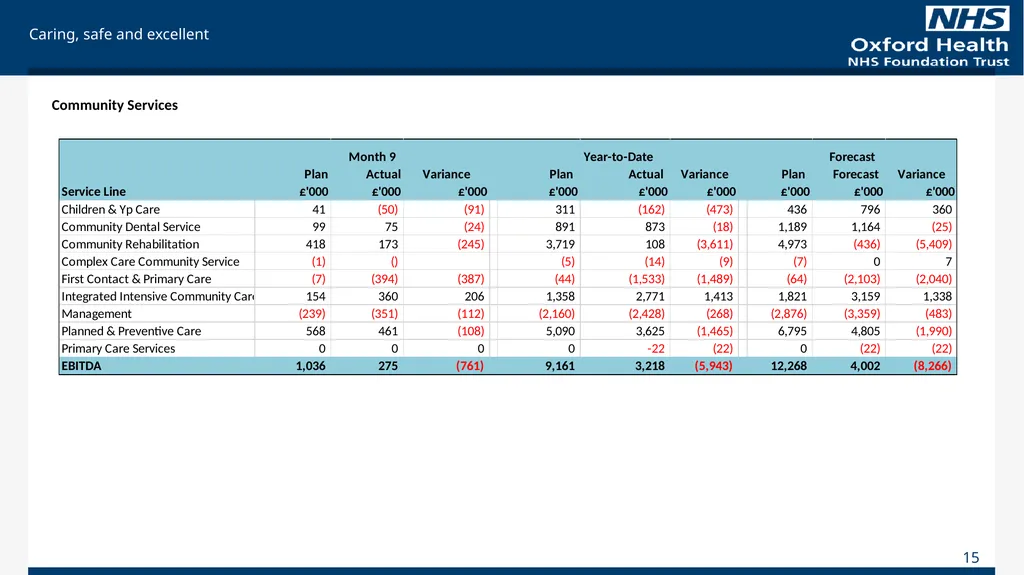
The Community YTD position is £5,943k adverse to budget. The main drivers for the position are the following:
Community Hospitals £3,611k adverse due to pay variance of £3,476k with £1,842k Agency spend and £1,645k Sessional staff expenditure.
First Contact and Primary Care £1,489k adverse driven by £1,348k pay expenditure due to high agency spend in GP Out of Hours and the Minor Injuries Units at £994k and £554k respectively. Sessional staffing spend is £510k across the pathway. This includes a pay uplift of 40% which was agreed for all staff for the Christmas and New Year Period. The Directorate leadership team have undertaken an ‘innovation week’ redesign of the service clinical and operating model of GP Out of Hours, leading to development of a new costed model with an operational saving on paper of c.£1 million per year, although further work is ongoing to verify this position.
Continuing Healthcare (CHC) is £904k adverse to budget due to high agency spend in Buckinghamshire and Oxfordshire CHC totalling £1,043k; £179k adverse in Oxfordshire CHC due to over establishment and unfunded care packages; Children’s CHC unfunded care packages and over establishment £167k adverse. These are offset by £582k favourable variance in Buckinghamshire CHC due to high vacancies.
Forecast Outturn Community forecast outturn is £8,266k adverse to budget based on the continuation of pressures in the Community Hospitals, GP Out of Hours and Continuing Healthcare adjusted for winter pressures modelled on the trend for the last 3 years. The forecast takes into account the additional income of £620k for Children’s Integrated Therapies and £425k for the Children’s Virtual Ward.
Risks and opportunities There is always some uncertainty as to the accuracy of the forecast due to winter pressures being more or less than the modelling used in the forecast. Community Hospitals, the GP Out of Hours (OOH) and Urgent Care Response (UCR) services are under increased pressure this time of year, so there is a possibility that the forecast will be worse as a result of additional shifts in GP OOH services and the need to offering higher pay rates to fill them, and the increase of agency usage in the other areas.
Actions needed
Agency spend across the directorate is very high especially in Community Hospitals – a plan to reduce this is needed.
Finance to support service developments and transformation work. Community Services (cont.) 16<br>
Community Hospitals £3,611k adverse due to pay variance of £3,476k with £1,842k Agency spend and £1,645k Sessional staff expenditure.
First Contact and Primary Care £1,489k adverse driven by £1,348k pay expenditure due to high agency spend in GP Out of Hours and the Minor Injuries Units at £994k and £554k respectively. Sessional staffing spend is £510k across the pathway. This includes a pay uplift of 40% which was agreed for all staff for the Christmas and New Year Period. The Directorate leadership team have undertaken an ‘innovation week’ redesign of the service clinical and operating model of GP Out of Hours, leading to development of a new costed model with an operational saving on paper of c.£1 million per year, although further work is ongoing to verify this position.
Continuing Healthcare (CHC) is £904k adverse to budget due to high agency spend in Buckinghamshire and Oxfordshire CHC totalling £1,043k; £179k adverse in Oxfordshire CHC due to over establishment and unfunded care packages; Children’s CHC unfunded care packages and over establishment £167k adverse. These are offset by £582k favourable variance in Buckinghamshire CHC due to high vacancies.
Forecast Outturn Community forecast outturn is £8,266k adverse to budget based on the continuation of pressures in the Community Hospitals, GP Out of Hours and Continuing Healthcare adjusted for winter pressures modelled on the trend for the last 3 years. The forecast takes into account the additional income of £620k for Children’s Integrated Therapies and £425k for the Children’s Virtual Ward.
Risks and opportunities There is always some uncertainty as to the accuracy of the forecast due to winter pressures being more or less than the modelling used in the forecast. Community Hospitals, the GP Out of Hours (OOH) and Urgent Care Response (UCR) services are under increased pressure this time of year, so there is a possibility that the forecast will be worse as a result of additional shifts in GP OOH services and the need to offering higher pay rates to fill them, and the increase of agency usage in the other areas.
Actions needed
Agency spend across the directorate is very high especially in Community Hospitals – a plan to reduce this is needed.
Finance to support service developments and transformation work. Community Services (cont.) 16<br>
17
Corporate Services Year-to-Date Performance
The Corporate Services YTD position is £558k adverse against budget. The main drivers of this are:
The Finance overspend of £1,089k mainly due to the Warneford Park project which is not budgeted for (£893k YTD) and which is being temporarily held in Finance.
Digital & Transformation is £907k adverse, mainly due to costs that were in the capital plan now being accounted for as revenue costs.
Estates & Facilities £0.6m adverse due to pressure on SCAS contract, and starting works on one-off back log maintenance.
The Human Resources underspend of £952k, made up of £130k vacancies in HR, £138k from non-pay underspend which is due to additional budget for HR systems to be spent in this financial year and reflected in the forecast for M10-12, BOB ICS income for Workforce Development £78k, Backdated apprenticeship income for End point assessments & Nurse top up programmes £250k, Oxfordshire Training Hub contribution of £74k. The balance is driven by non pay underspend due to ongoing discussions around estates use at Unipart and £120k of invoices outstanding for secondments into Health Education England funded project posts.
The Nursing & Clinical Standards underspend of £574k is driven by new transformation funding in the Oxford Health Improvement team resulting in vacancies which are actively being recruited to – the forecast assumes that these vacancies will be filled in the coming months.
The Oxford Institute of Clinical Psychology Training favourable variance of £400k is due to additional cost per case income and contribution on Health Education England income contracts. 17<br>
The Corporate Services YTD position is £558k adverse against budget. The main drivers of this are:
The Finance overspend of £1,089k mainly due to the Warneford Park project which is not budgeted for (£893k YTD) and which is being temporarily held in Finance.
Digital & Transformation is £907k adverse, mainly due to costs that were in the capital plan now being accounted for as revenue costs.
Estates & Facilities £0.6m adverse due to pressure on SCAS contract, and starting works on one-off back log maintenance.
The Human Resources underspend of £952k, made up of £130k vacancies in HR, £138k from non-pay underspend which is due to additional budget for HR systems to be spent in this financial year and reflected in the forecast for M10-12, BOB ICS income for Workforce Development £78k, Backdated apprenticeship income for End point assessments & Nurse top up programmes £250k, Oxfordshire Training Hub contribution of £74k. The balance is driven by non pay underspend due to ongoing discussions around estates use at Unipart and £120k of invoices outstanding for secondments into Health Education England funded project posts.
The Nursing & Clinical Standards underspend of £574k is driven by new transformation funding in the Oxford Health Improvement team resulting in vacancies which are actively being recruited to – the forecast assumes that these vacancies will be filled in the coming months.
The Oxford Institute of Clinical Psychology Training favourable variance of £400k is due to additional cost per case income and contribution on Health Education England income contracts. 17<br>
18
Forecast Outturn
The Forecast Outturn for Corporate Services is £3.6m worse than budget. This includes £4.7m of agreed spend which is not budgeted - £1.5m for clinical system costs that were originally in the capital plan (Digital & Transformation), £1.4m for costs related to the Warneford Park development (Finance) and £1.8m for non-recurrent backlog maintenance costs (Estates & Facilities). Other pressures include an increase in the South Central Ambulance Service patient transport contract in Estates & Facilities (£407k) partly offset with other underspends and a historical pressure on clinical contracts with Oxford University Hospitals (mainly Pathology) show in the Finance position (£305k). These are offset with continued underspends in Human Resources, Nursing & Clinical Standards and the Oxford Institute of Clinical Psychology Training.
Risks and opportunities
The forecast may improve if additional costs included in the year-to-go position for clinical system development and backlog maintenance costs are less than planned due to the time constraint of completing the work before the end of March 2023.
The forecast for the Warneford Park development needs to be worked on in more detail which could result in a change in the forecast.
Actions Required
Close monitoring of the additional spend in the YTG position to determine how much is likely to be committed by year-end to ensure the forecast is updated accurately each month.
A project to re-tender for patient transport services to determine the budget required for this going forward.
Budget setting to adequately budget for the Oxford University Hospitals contracts currently held within the Finance Directorate.
The Corporate Services directorates have £359k of unmet CIP targets. These are being offset in year by non-recurrent underspends but Directorates need to develop plans for them recurrently. Corporate Services (cont.) 18<br>
The Forecast Outturn for Corporate Services is £3.6m worse than budget. This includes £4.7m of agreed spend which is not budgeted - £1.5m for clinical system costs that were originally in the capital plan (Digital & Transformation), £1.4m for costs related to the Warneford Park development (Finance) and £1.8m for non-recurrent backlog maintenance costs (Estates & Facilities). Other pressures include an increase in the South Central Ambulance Service patient transport contract in Estates & Facilities (£407k) partly offset with other underspends and a historical pressure on clinical contracts with Oxford University Hospitals (mainly Pathology) show in the Finance position (£305k). These are offset with continued underspends in Human Resources, Nursing & Clinical Standards and the Oxford Institute of Clinical Psychology Training.
Risks and opportunities
The forecast may improve if additional costs included in the year-to-go position for clinical system development and backlog maintenance costs are less than planned due to the time constraint of completing the work before the end of March 2023.
The forecast for the Warneford Park development needs to be worked on in more detail which could result in a change in the forecast.
Actions Required
Close monitoring of the additional spend in the YTG position to determine how much is likely to be committed by year-end to ensure the forecast is updated accurately each month.
A project to re-tender for patient transport services to determine the budget required for this going forward.
Budget setting to adequately budget for the Oxford University Hospitals contracts currently held within the Finance Directorate.
The Corporate Services directorates have £359k of unmet CIP targets. These are being offset in year by non-recurrent underspends but Directorates need to develop plans for them recurrently. Corporate Services (cont.) 18<br>
19
Research & Development Year-to-Date Performance
Research & Development is currently £772k favourable against budget. This is from the release of Novavax vaccine trial income of £446k and Management savings including vacancies and maternity leave of £172k.
Forecast Outturn
The forecast outturn is predicted to be £644k favourable at the year end, the main reason for the reduction in the variance is £100k for a new laboratory in the Clinical Research Facility at the Warneford Hospital. The bulk of the forecast underspend is from the release of Novavax income, expected to be £545k at the year end and R&D Management vacancy savings of £92k.
Risks and opportunities
Included in the forecast is £100k of costs for Estates work to create a new laboratory at the Clinical Research Facility at the Warneford Hospital. There is a risk that this work won't take place this year, increasing the forecast favourable variance further.
Actions required
R&D Clinical Research Facility Management Team are liaising with Estates currently, in the hope that the laboratory work will begin in early March. 19<br>
Research & Development is currently £772k favourable against budget. This is from the release of Novavax vaccine trial income of £446k and Management savings including vacancies and maternity leave of £172k.
Forecast Outturn
The forecast outturn is predicted to be £644k favourable at the year end, the main reason for the reduction in the variance is £100k for a new laboratory in the Clinical Research Facility at the Warneford Hospital. The bulk of the forecast underspend is from the release of Novavax income, expected to be £545k at the year end and R&D Management vacancy savings of £92k.
Risks and opportunities
Included in the forecast is £100k of costs for Estates work to create a new laboratory at the Clinical Research Facility at the Warneford Hospital. There is a risk that this work won't take place this year, increasing the forecast favourable variance further.
Actions required
R&D Clinical Research Facility Management Team are liaising with Estates currently, in the hope that the laboratory work will begin in early March. 19<br>
20
Oxford Pharmacy Store Year-to-Date Performance
The YTD position is £433K better due to one off Covid-19 drugs distribution and savings on pay & non pay costs.
Forecast Outturn
The Forecast Outturn is £1,136K better than plan due to a one-off contract with NHS England for Covid-19 drugs distribution.
Risks and opportunities
There is an opportunity for further contracts with NHS Scotland/Wales/NI to distribute Covid-19 drugs with a medium likelihood of an improvement in the forecast position of at least £50k.
There is always a risk of lower than anticipated sales as they can be very unpredictable due to the nature of the dynamic market.
Actions required
The Senior Management Team to discuss implementing new measure to bring in new business and also review existing business to fill the sales gap. 20<br>
The YTD position is £433K better due to one off Covid-19 drugs distribution and savings on pay & non pay costs.
Forecast Outturn
The Forecast Outturn is £1,136K better than plan due to a one-off contract with NHS England for Covid-19 drugs distribution.
Risks and opportunities
There is an opportunity for further contracts with NHS Scotland/Wales/NI to distribute Covid-19 drugs with a medium likelihood of an improvement in the forecast position of at least £50k.
There is always a risk of lower than anticipated sales as they can be very unpredictable due to the nature of the dynamic market.
Actions required
The Senior Management Team to discuss implementing new measure to bring in new business and also review existing business to fill the sales gap. 20<br>
21
5. Provider Collaboratives Financial Performance - Secure NB: position based on Tariff inflator and prices at 2.4%. Further adjustments pending
Year-to-Date Performance
The Secure Provider Collaborative (PC) YTD position is £1,011k favourable against budget. Patient care activity (PCA) is £756k favourable: Occupied beddays (OBD) are £767k favourable offsetting overspend on extra packages of care (EPC) which are £12k adverse. The PCA position is reported as breakeven in the Trust overall position in line with the principles of the PC to reinvest savings into services. Infrastructure costs are £255k favourable due to less than planned expenditure across the Forensic Intellectual and Neurodevelopment Disabilities (FIND) service and provider collaborative teams.
Forecast Outturn
The Forecast Outturn for the Secure PC is £1,008k favourable to budget. This does not include potential benefits of accrued recharges and savings in respect of FY22 which is c.£2.4m. The principles of the PC are that savings are considered for re-investment over the period of the contract term and the underspend is not included in the Trust forecast. 21<br>
Year-to-Date Performance
The Secure Provider Collaborative (PC) YTD position is £1,011k favourable against budget. Patient care activity (PCA) is £756k favourable: Occupied beddays (OBD) are £767k favourable offsetting overspend on extra packages of care (EPC) which are £12k adverse. The PCA position is reported as breakeven in the Trust overall position in line with the principles of the PC to reinvest savings into services. Infrastructure costs are £255k favourable due to less than planned expenditure across the Forensic Intellectual and Neurodevelopment Disabilities (FIND) service and provider collaborative teams.
Forecast Outturn
The Forecast Outturn for the Secure PC is £1,008k favourable to budget. This does not include potential benefits of accrued recharges and savings in respect of FY22 which is c.£2.4m. The principles of the PC are that savings are considered for re-investment over the period of the contract term and the underspend is not included in the Trust forecast. 21<br>
22
Provider Collaboratives Financial Performance - CAMHS NB: position based on Tariff inflator and prices at 2.4%. Further adjustments pending
Year-to-Date Performance
The CAMHS Provider Collaborative (PC) YTD position is £1,319k favourable against budget. Patient care activity (PCA) is £1,313k favourable : occupied beddays (OBD) are £1,550k favourable offsetting overspend on extra packages of care (EPC) which are £237k adverse. The PCA position is reported as breakeven in the Trust overall position in line with the principles of the PC to reinvest savings into services. Infrastructure costs are £6k favourable due less than planned expenditure across the provider collaborative team.
Forecast Outturn
The Forecast Outturn for the CAMHS PC is £1,758k favourable to budget. This does not include potential benefits of accrued recharges and savings in respect of FY22 which is c.£3.8m. The principles of the PC are that savings are considered for re-investment over the period of the contract term and are not included in the Trust forecast. 22<br>
Year-to-Date Performance
The CAMHS Provider Collaborative (PC) YTD position is £1,319k favourable against budget. Patient care activity (PCA) is £1,313k favourable : occupied beddays (OBD) are £1,550k favourable offsetting overspend on extra packages of care (EPC) which are £237k adverse. The PCA position is reported as breakeven in the Trust overall position in line with the principles of the PC to reinvest savings into services. Infrastructure costs are £6k favourable due less than planned expenditure across the provider collaborative team.
Forecast Outturn
The Forecast Outturn for the CAMHS PC is £1,758k favourable to budget. This does not include potential benefits of accrued recharges and savings in respect of FY22 which is c.£3.8m. The principles of the PC are that savings are considered for re-investment over the period of the contract term and are not included in the Trust forecast. 22<br>
23
Provider Collaboratives Financial Performance – Adult Eating Disorder (AED) NB: position based on Tariff inflator and prices at 2.4%. Further adjustments pending
Year-to-Date Performance
The AED Provider Collaborative (PC) YTD position is £125k favourable against budget. Patient care activity (PCA) is breakeven: occupied beddays (OBD) are £708k adverse offset by transformation funding to support the transition to the integrated step care model (ISCM) of care. Infrastructure costs are £125k favourable due to less than planned expenditure across the provider collaborative team.
Forecast Outturn
The Forecast Outturn for the AED PC is breakeven supported by transformation funding of £850k available in FY23 to support the double running during the implementation of ISCM. 23<br>
Year-to-Date Performance
The AED Provider Collaborative (PC) YTD position is £125k favourable against budget. Patient care activity (PCA) is breakeven: occupied beddays (OBD) are £708k adverse offset by transformation funding to support the transition to the integrated step care model (ISCM) of care. Infrastructure costs are £125k favourable due to less than planned expenditure across the provider collaborative team.
Forecast Outturn
The Forecast Outturn for the AED PC is breakeven supported by transformation funding of £850k available in FY23 to support the double running during the implementation of ISCM. 23<br>
24
6. Covid-19 Costs Year-to-Date Performance
There is a £5,617k underspend on Covid-19 budgets YTD. The majority of this is Covid-19 funding which is being used to offset pressures elsewhere in the Trust (£5,635k), offset with a small overspend (£20k) on the PPE Warehouse. The vaccination centres are shown as on plan while waiting for additional expected income to be confirmed by NHS England.
Forecast Outturn
The forecast is for a favourable variance of £7,482k. This is made up of £7,502k Covid-19 funding offset with £20k adverse variance on the PPE Warehouse.
Risks and opportunities
The income position is likely to be better than forecast. A meeting has been arranged with NHS England to confirm the income the Trust is due.
Actions required
The vaccination cost centres need to be moved into the Community Directorate as the vaccination service is now being managed by the Community leadership team.
The finance team will meet with NHS England to confirm the income figures. 24<br>
There is a £5,617k underspend on Covid-19 budgets YTD. The majority of this is Covid-19 funding which is being used to offset pressures elsewhere in the Trust (£5,635k), offset with a small overspend (£20k) on the PPE Warehouse. The vaccination centres are shown as on plan while waiting for additional expected income to be confirmed by NHS England.
Forecast Outturn
The forecast is for a favourable variance of £7,482k. This is made up of £7,502k Covid-19 funding offset with £20k adverse variance on the PPE Warehouse.
Risks and opportunities
The income position is likely to be better than forecast. A meeting has been arranged with NHS England to confirm the income the Trust is due.
Actions required
The vaccination cost centres need to be moved into the Community Directorate as the vaccination service is now being managed by the Community leadership team.
The finance team will meet with NHS England to confirm the income figures. 24<br>
25
7. Pay Trends The increase in pay costs and budget in September 2021 and September 2022 reflect when the pay award was paid to staff along with back pay.
The increased costs in March 2022 reflect year-end accounting adjustments for pension costs 25<br>
The increased costs in March 2022 reflect year-end accounting adjustments for pension costs 25<br>
26
The increase in budget in Forensics in October 2022 is due to budget which was transferred from Reserves – this was growth funding received from NHS England and mainly covers existing cost pressures. 26<br>
27
27<br>
28
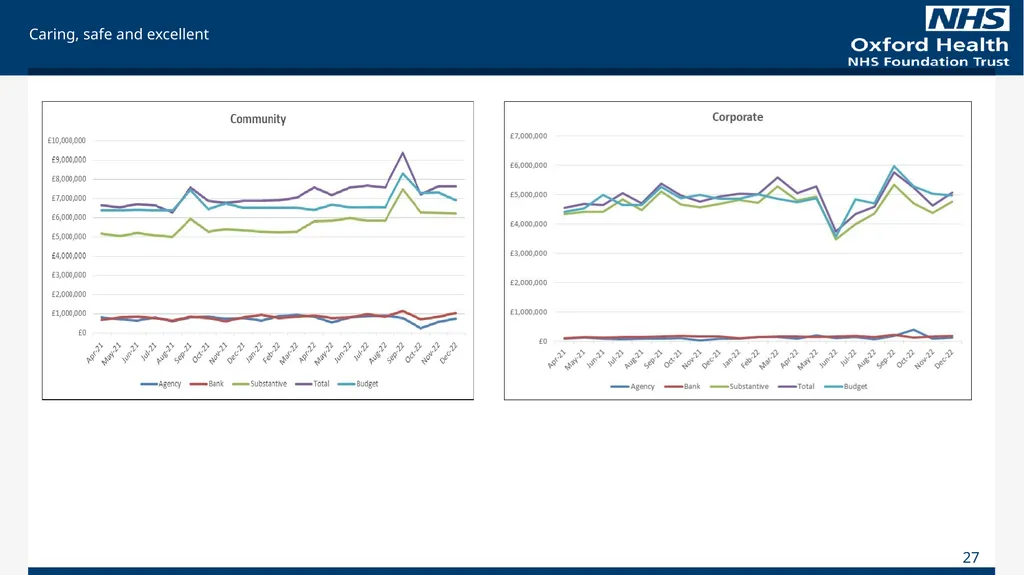
8. Agency Analysis At month 9 £34.8m has been spent on agency staff (excluding £7.0m for agency staff at the Covid mass vaccination sites). This is 13% of total staff costs. Note that the graphs above exclude spend in the Covid-19 vaccination centres to show a normalised position.
The Trust’s agency target set by NHS England is £40.5m. The forecasted agency spend for the year is £52.4m including the mass vaccination sites and £44.1m excluding them. The forecast takes into account winter pressures but is not adjusted for any expected savings relating to the move to NHS Professionals and the new contracts being put in place for agency staff, and therefore is likely to improve in February and March when these savings start.
Please refer to the HR report for further details. 28<br>
The Trust’s agency target set by NHS England is £40.5m. The forecasted agency spend for the year is £52.4m including the mass vaccination sites and £44.1m excluding them. The forecast takes into account winter pressures but is not adjusted for any expected savings relating to the move to NHS Professionals and the new contracts being put in place for agency staff, and therefore is likely to improve in February and March when these savings start.
Please refer to the HR report for further details. 28<br>
29
9. Cost Improvement Programme (CIP) CIP Programme:
In line with NHS efficiency requirements that Trust has a CIP target of £7.9m. Budget reductions totalling £7.9m were applied to all Directorates at the start of Financial year. These were reduced by £2.8m in month 7 through allocating reserves to directorates recurrently and this is now shown as CIP delivery. This was a result of agreement by the Executive Team to use available reserves to reduce the requirement for CIPs. Plans to deliver the £7.9m target total £6.1m. Savings reported as at the end of month 8 are £4.4m, £1.5m adverse to target.
PIP Programme Schemes :
The PIP programme encompasses schemes that are cost avoidance i.e. expenditure items for which there is no funding. It is centred on initiatives to reduce agency costs e.g. price reductions and usage. The target is a £9.0m reduction. The Improving Quality Reducing Agency (IQRA) programme has delivered £2.0m reductions as at the end of month 9, £3.4m adverse to target. Several initiatives for this programme are starting in January which should result in increased savings, notably the move of bank staff to NHS Professionals and a master vendor contract for agency staff.
Covid Cost Reduction:
Covid cost reductions is a cost avoidance programme to address the continuance of expenditure incurred during the 2 year covid period. It is centred on initiatives to reduce staffing costs and the use of independent sector provider contracted beds that have become business as usual and to challenge their validity in the context of the retained covid budget of £7.3m. 29<br>
In line with NHS efficiency requirements that Trust has a CIP target of £7.9m. Budget reductions totalling £7.9m were applied to all Directorates at the start of Financial year. These were reduced by £2.8m in month 7 through allocating reserves to directorates recurrently and this is now shown as CIP delivery. This was a result of agreement by the Executive Team to use available reserves to reduce the requirement for CIPs. Plans to deliver the £7.9m target total £6.1m. Savings reported as at the end of month 8 are £4.4m, £1.5m adverse to target.
PIP Programme Schemes :
The PIP programme encompasses schemes that are cost avoidance i.e. expenditure items for which there is no funding. It is centred on initiatives to reduce agency costs e.g. price reductions and usage. The target is a £9.0m reduction. The Improving Quality Reducing Agency (IQRA) programme has delivered £2.0m reductions as at the end of month 9, £3.4m adverse to target. Several initiatives for this programme are starting in January which should result in increased savings, notably the move of bank staff to NHS Professionals and a master vendor contract for agency staff.
Covid Cost Reduction:
Covid cost reductions is a cost avoidance programme to address the continuance of expenditure incurred during the 2 year covid period. It is centred on initiatives to reduce staffing costs and the use of independent sector provider contracted beds that have become business as usual and to challenge their validity in the context of the retained covid budget of £7.3m. 29<br>
30
10. Out of Area Placements (OAPs) Out of Area Placements are £2.2m overspent at month 9 - £2.1m adverse in Oxfordshire and £115k adverse in Buckinghamshire.
This includes the cost of the Elysium block contract beds at Potters Bar and Chadwick Lodge, which reduced from 21 beds in April to 4 as of November.
These costs exclude Secure Transport spend which is currently £327k across the two directorates. An additional £350k PICU Budget was allocated to the budget in month 8.
The large movement in month 9 is due to an increase in Acute patients being sent out of area, there is a 48% increase on month 8 admissions. 30<br>
This includes the cost of the Elysium block contract beds at Potters Bar and Chadwick Lodge, which reduced from 21 beds in April to 4 as of November.
These costs exclude Secure Transport spend which is currently £327k across the two directorates. An additional £350k PICU Budget was allocated to the budget in month 8.
The large movement in month 9 is due to an increase in Acute patients being sent out of area, there is a 48% increase on month 8 admissions. 30<br>
31
Oxon & Bucks OAPS Spend by bed type The above graphs show spend a sharp increase in cost against Acute beds in month 1 of FY23. This is due to allocations of costs prior to this period being reclaimed from national COVID funding.
There was a sharp decrease in cost for Oxfordshire Acute OAPs in month 4 due to release of an FY21 provision
A small increase against PICU beds in Buckinghamshire can be seen – there are limited PICU beds available within the trust and this is a male only ward meaning that all female patients requiring a PICU bed are placed out of area
There is a sharp decrease in cost for Buckinghamshire PICU Placements in month 8 due to the release of an old year provision.
Increase in costs for month 9 is due to out of area acute admissions, an increase of 12 patients in Oxfordshire and 3 patients in Buckinghamshire compared to month 8 admissions.
Still out at the end of December: Oxfordshire has 16 Acute, 5 PICU, 6 Rehab and 1 Continuing Care beds being used and in Buckinghamshire there is 7 Acute, 1 PICU and 1 Rehab bed. 31<br>
There was a sharp decrease in cost for Oxfordshire Acute OAPs in month 4 due to release of an FY21 provision
A small increase against PICU beds in Buckinghamshire can be seen – there are limited PICU beds available within the trust and this is a male only ward meaning that all female patients requiring a PICU bed are placed out of area
There is a sharp decrease in cost for Buckinghamshire PICU Placements in month 8 due to the release of an old year provision.
Increase in costs for month 9 is due to out of area acute admissions, an increase of 12 patients in Oxfordshire and 3 patients in Buckinghamshire compared to month 8 admissions.
Still out at the end of December: Oxfordshire has 16 Acute, 5 PICU, 6 Rehab and 1 Continuing Care beds being used and in Buckinghamshire there is 7 Acute, 1 PICU and 1 Rehab bed. 31<br>
32
11. Statement of Financial Position Non-current assets have increased by £24.1m in-year. The in-year increase is driven by the capitalisation of £27.8m of leased assets in accordance with the accounting standard IFRS16 which was adopted by the Trust from the 1st April, and capital additions of £4.8m in the first 9 months of the year. These additions were offset by depreciation of £8.5m.
Inventories increased by £7.9m in year and £7.7m in month. The increase is largely due to expenditure on remdesivir stock (£7.4m). OPS are currently the sole supplier of this covid antiviral treatment across the NHS following an agreement with NHSE.
Trade and other receivables have increased by £14.1m in year. Most of this increase is due to an increase in outstanding debt of £16.2m (of which £11.5m is current debt < 30 days old). Prepayments have increased by £1.0m and Accrued Income and the Trust's VAT debtor have decreased by (£3.5m).
Cash has increased by £4.9m in month and decreased by £8.4m in year. These movements are in line with the cash flow statement. The year-to-date decrease is largely due to cash payments against financing activities of (£6.8m), payments for capital assets of (£10.3m), including FY22, and net working capital outflows of £7.6m.
Trade and other payables have increased by £14.3m in year and £14.2m in month. Increases in accrued expenditure of £19.9m in year have been offset by decreases in other payable balances of £5.5m
Short term finance lease liabilities have increased by £5.4m in year following the capitalisation of leased assets – see note1.
Deferred income has decreased by £1.4m in month and £1.7m in year.
Long term finance leases have increased by £19.0m in year and decreased by £0.4m in-month (repayments against liability) following the capitalisation of leased assets – see note 1.
Provisions increased by £1.5m in months and year to date. This is due to a new long term permanent injury provision.
The in-year movements in the I&E reserve reflect the Trust’s reported deficit for the year of £1.4m. 32<br>
Inventories increased by £7.9m in year and £7.7m in month. The increase is largely due to expenditure on remdesivir stock (£7.4m). OPS are currently the sole supplier of this covid antiviral treatment across the NHS following an agreement with NHSE.
Trade and other receivables have increased by £14.1m in year. Most of this increase is due to an increase in outstanding debt of £16.2m (of which £11.5m is current debt < 30 days old). Prepayments have increased by £1.0m and Accrued Income and the Trust's VAT debtor have decreased by (£3.5m).
Cash has increased by £4.9m in month and decreased by £8.4m in year. These movements are in line with the cash flow statement. The year-to-date decrease is largely due to cash payments against financing activities of (£6.8m), payments for capital assets of (£10.3m), including FY22, and net working capital outflows of £7.6m.
Trade and other payables have increased by £14.3m in year and £14.2m in month. Increases in accrued expenditure of £19.9m in year have been offset by decreases in other payable balances of £5.5m
Short term finance lease liabilities have increased by £5.4m in year following the capitalisation of leased assets – see note1.
Deferred income has decreased by £1.4m in month and £1.7m in year.
Long term finance leases have increased by £19.0m in year and decreased by £0.4m in-month (repayments against liability) following the capitalisation of leased assets – see note 1.
Provisions increased by £1.5m in months and year to date. This is due to a new long term permanent injury provision.
The in-year movements in the I&E reserve reflect the Trust’s reported deficit for the year of £1.4m. 32<br>
33
12. Cash Flow Summary Notes
The cash flow movements are consistent with the comments made on the Statement of Financial Position.
The closing cash position at the end of December was £81m. 33<br>
The cash flow movements are consistent with the comments made on the Statement of Financial Position.
The closing cash position at the end of December was £81m. 33<br>
34
13. Working Capital Indicators Summary Notes
Debtor days at month 9 are better than plan.
Debtors % over 90 days is marginally below plan. This is mostly due to unpaid invoices from NHS debtors, specifically in relation to outstanding provider collaborative invoices totalling £1,052k and Frimley Park £275k.
The Creditor days position is worse than plan, due to high accrual levels for NHS and Non-NHS suppliers, and BPPC figures being below target.
NHS Better Payment Practice Code (BPPC) (which represents 20% of non-pay expenditure) is below target for the year, but broadly on target in month at 94.5%
Non-NHS BPPC (which represents 80% of non-pay expenditure) is below target for the year, and below target in month at 87.9% .
Cash is better than plan, as outlined in section 9. 34<br>
Debtor days at month 9 are better than plan.
Debtors % over 90 days is marginally below plan. This is mostly due to unpaid invoices from NHS debtors, specifically in relation to outstanding provider collaborative invoices totalling £1,052k and Frimley Park £275k.
The Creditor days position is worse than plan, due to high accrual levels for NHS and Non-NHS suppliers, and BPPC figures being below target.
NHS Better Payment Practice Code (BPPC) (which represents 20% of non-pay expenditure) is below target for the year, but broadly on target in month at 94.5%
Non-NHS BPPC (which represents 80% of non-pay expenditure) is below target for the year, and below target in month at 87.9% .
Cash is better than plan, as outlined in section 9. 34<br>
35
14. Capital Investment Programme The Trust has a capital expenditure plan of £15,593k against capital funding of £14,151k in FY23, an overspend/funding gap of £1,442k.
The Trust is now forecasting an overall overspend against funding of £118k (Forecast spend of £14,269k against funding of £14,151k).
Although the YTD expenditure is low, there is a real risk that the overspend will significantly overshoot. This is due to the sale of Shrublands and Harlow slipping into FY24 (£1,382k) and the reduced recovery of VAT against the PICU project and fit out costs (£1,148k). This could result in an overspend of £2,648k. Estates and Facilities teams are considering mitigating actions in case needed.
In light of these events, the Trust has flagged a potential overspend of up to £2,000k with the ICS and this will be managed within the ICS’s overall capital allocation.
Year to date expenditure is £4,813k and new leases anticipated in FY23 (signed and unsigned) have a capital additions value of £9,305k. 35<br>
The Trust is now forecasting an overall overspend against funding of £118k (Forecast spend of £14,269k against funding of £14,151k).
Although the YTD expenditure is low, there is a real risk that the overspend will significantly overshoot. This is due to the sale of Shrublands and Harlow slipping into FY24 (£1,382k) and the reduced recovery of VAT against the PICU project and fit out costs (£1,148k). This could result in an overspend of £2,648k. Estates and Facilities teams are considering mitigating actions in case needed.
In light of these events, the Trust has flagged a potential overspend of up to £2,000k with the ICS and this will be managed within the ICS’s overall capital allocation.
Year to date expenditure is £4,813k and new leases anticipated in FY23 (signed and unsigned) have a capital additions value of £9,305k. 35<br>
36
15. Reconciliation to NHSE/I Template The financial figures reported in this report are taken directly form the finance ledger. The financial figures reported to NHSE/I each month differ from these figures as they exclude income and costs related to the Section 75 pooled budget and are some minor adjustments to the categories certain items are reported under. The table below provides a reconciliation between the figures reported in this board report to the figures reported on the NHSI template. 36<br>