
For the trainer: Please note this slide deck is
Description: For the trainer: Please note this slide deck is not a train the trainer presentation with fully developed scripts and exercises. These slides and accompanying notes are offered as suggestions. Slides may be used separate from the slide deck
Related Topics
Download Presentation
"For the trainer: Please note this slide deck is" is the property of its rightful owner. Permission is granted to download and print the materials on this website for personal, non-commercial use only, and to display it on your personal computer provided you do not modify the materials and that you retain all copyright notices contained in the materials. By downloading content from our website, you accept the terms of this agreement.
Presentation Transcript
slide1. For the trainer:
Please note this slide deck is not a train the trainer presentation with fully developed scripts and exercises. These slides and accompanying notes are offered as suggestions. Slides may be used separate from the slide deck and in a different order than how they are currently presented.
If slides are used, please use the citation below and maintain all original citations found on the slides.
National Council for Behavioral Health. Fostering Resilience and Recovery: A Change Package for Advancing Trauma-Informed Primary Care. 2019.<br>
slide2. Compassion in our Work and our World Secondary Traumatic Stress and Staff Self-Care<br>
slide4. Staff and Providers Often have their own traumatic histories
Seek to avoid re-experiencing their own emotions
Respond personally to others’ emotional states
Perceive behavior as personal threat or provocation<br>
slide5. Work Force Concerns Compassion Fatigue
Secondary Traumatic Stress
Vicarious Trauma
Burnout<br>
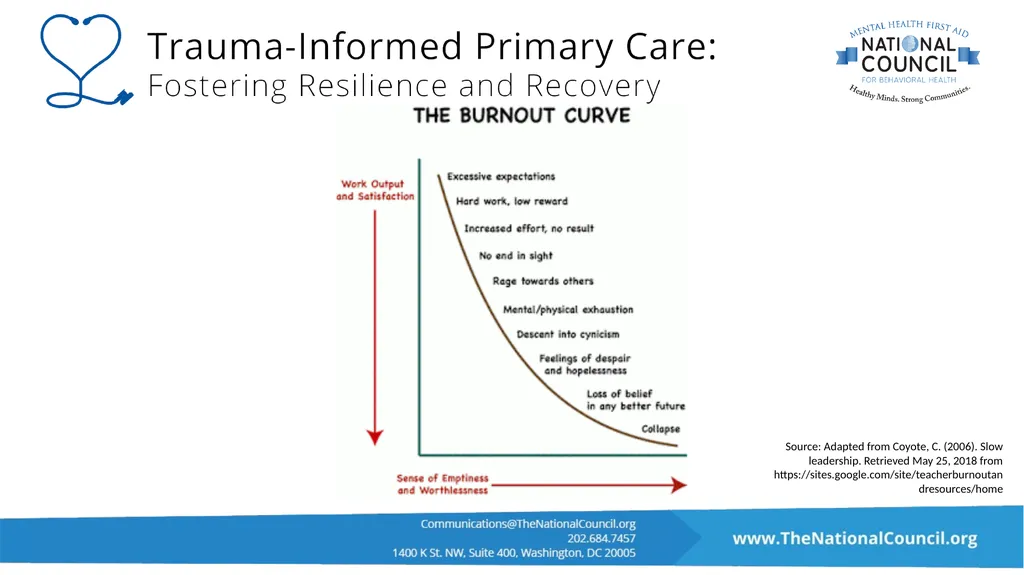
slide6. Source: Adapted from Coyote, C. (2006). Slow leadership. Retrieved May 25, 2018 from https://sites.google.com/site/teacherburnoutandresources/home<br>
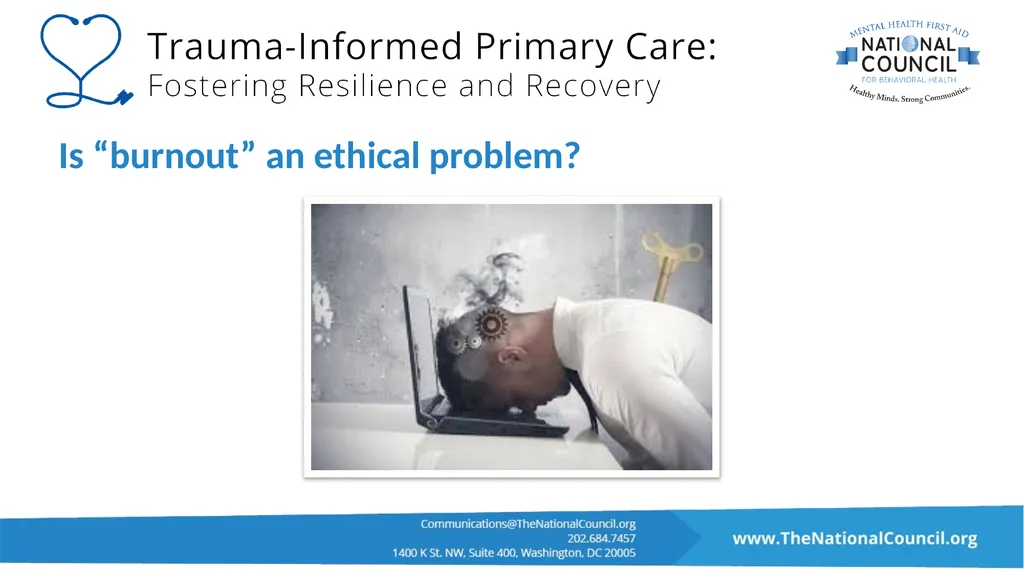
slide7. Is “burnout” an ethical problem?<br>
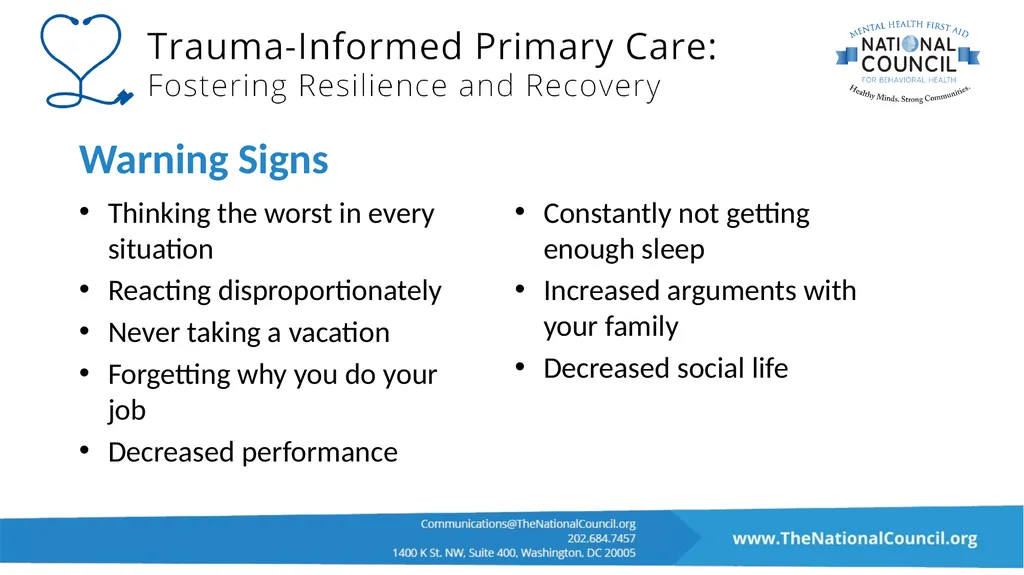
slide8. Warning Signs Thinking the worst in every situation
Reacting disproportionately
Never taking a vacation
Forgetting why you do your job
Decreased performance
Constantly not getting enough sleep
Increased arguments with your family
Decreased social life<br>
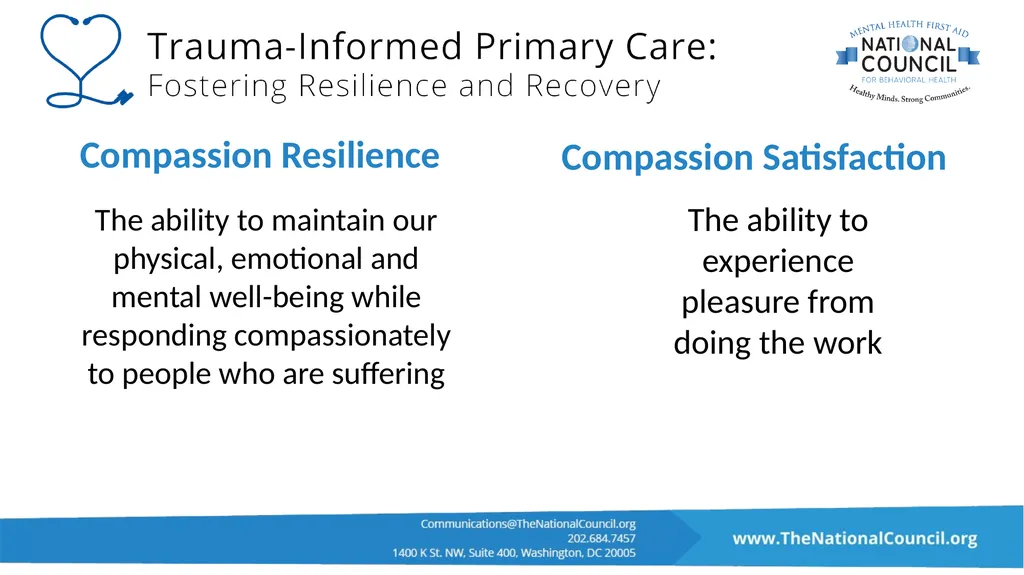
slide9. The ability to maintain our physical, emotional and mental well-being while responding compassionately to people who are suffering Compassion Resilience Compassion Satisfaction The ability to experience pleasure from doing the work<br>
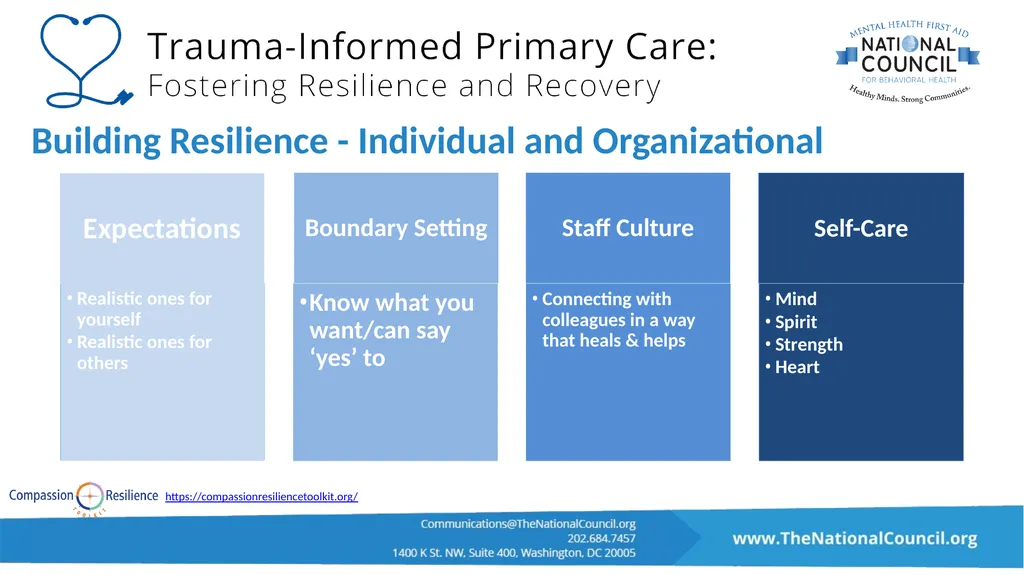
slide10. Building Resilience - Individual and Organizational https://compassionresiliencetoolkit.org/<br>
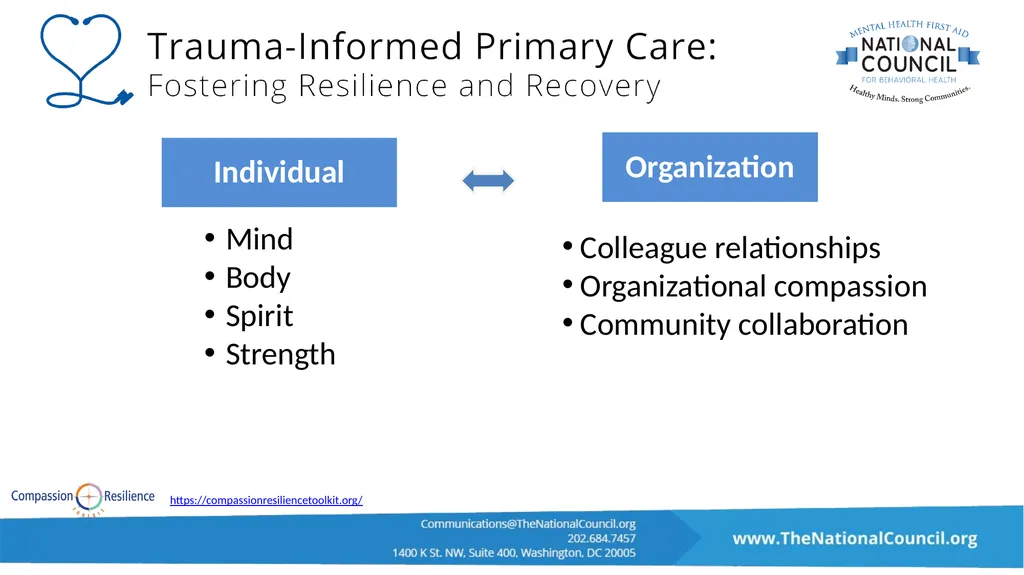
slide11. Mind
Body
Spirit
Strength Colleague relationships
Organizational compassion
Community collaboration https://compassionresiliencetoolkit.org/<br>
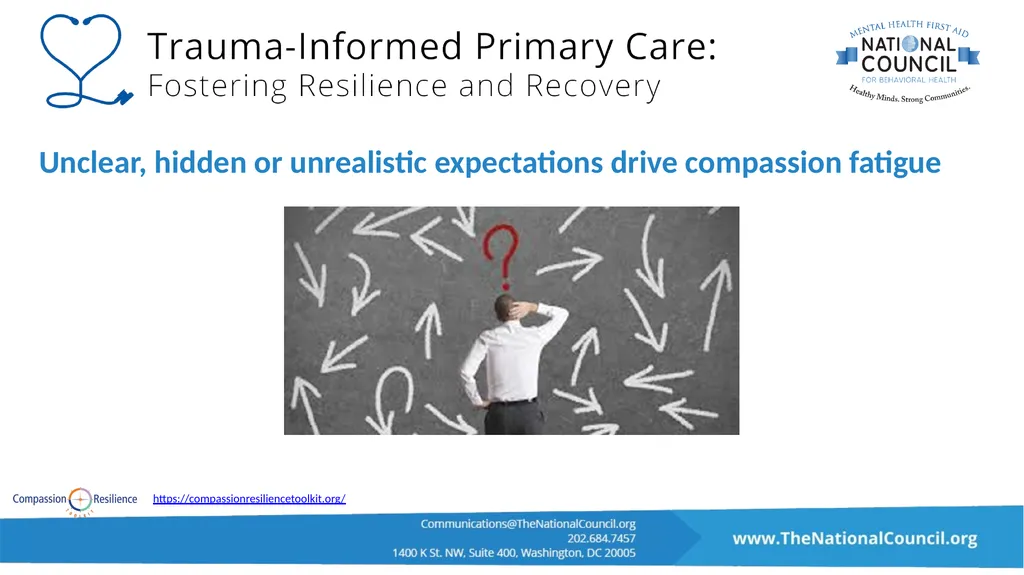
slide12. Unclear, hidden or unrealistic expectations drive compassion fatigue https://compassionresiliencetoolkit.org/<br>
slide13. What positive role do expectations play?
What impact have your unrealistic self-expectations had on your well-being?
What has the impact been of others’ unrealistic expectations of your capacity?
How do you assess if expectations are set at a helpful, aspirational level? Understanding your expectations https://compassionresiliencetoolkit.org/<br>
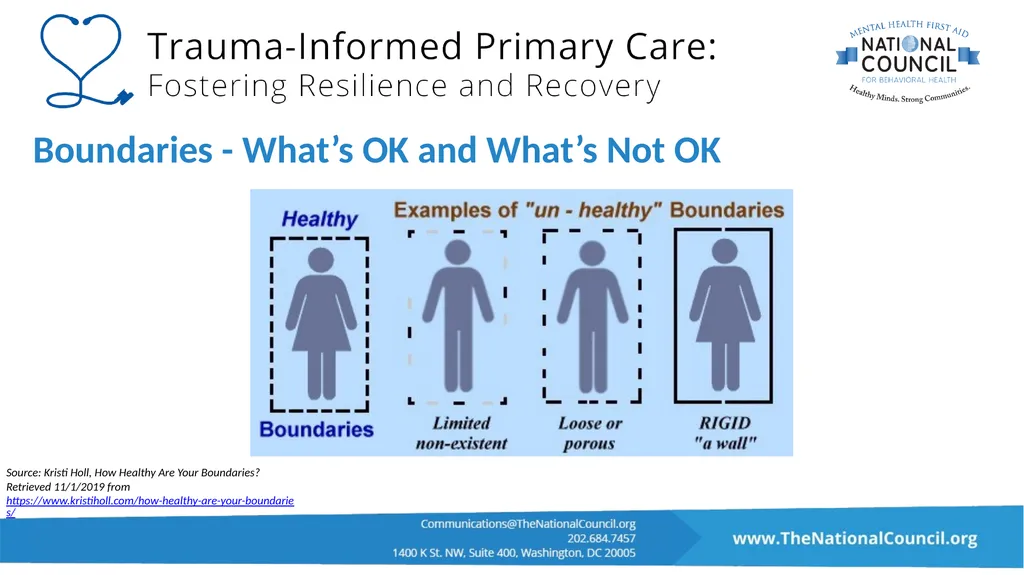
slide14. Boundaries - What’s OK and What’s Not OK Source: Kristi Holl, How Healthy Are Your Boundaries? Retrieved 11/1/2019 from https://www.kristiholl.com/how-healthy-are-your-boundaries/<br>
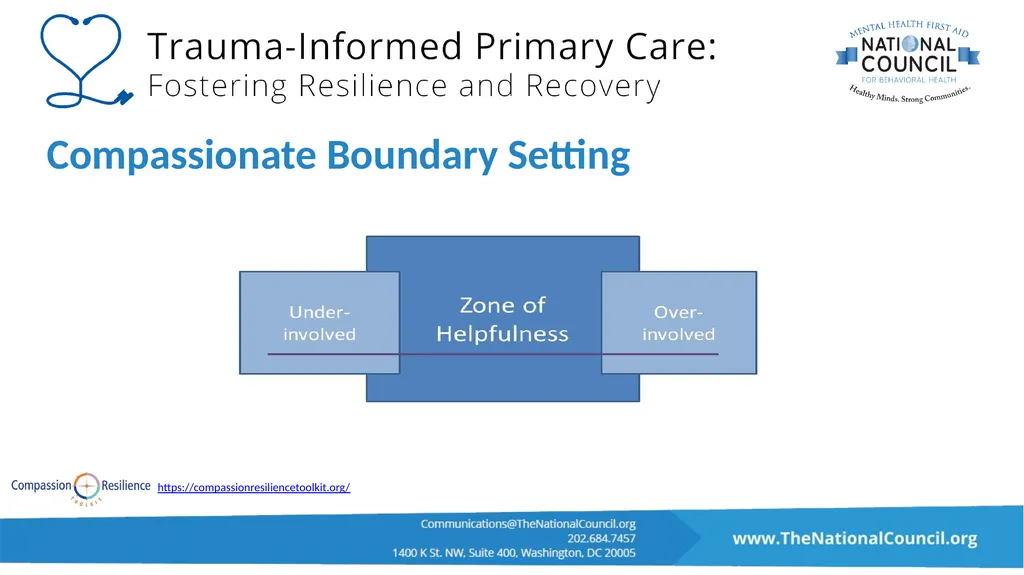
slide15. Compassionate Boundary Setting https://compassionresiliencetoolkit.org/<br>
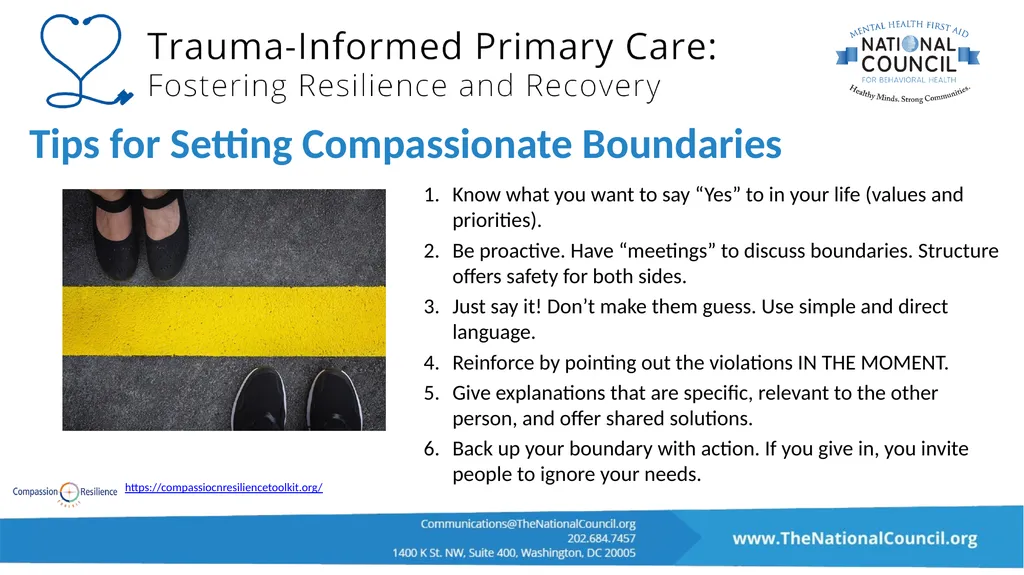
slide16. Tips for Setting Compassionate Boundaries Know what you want to say “Yes” to in your life (values and priorities).
Be proactive. Have “meetings” to discuss boundaries. Structure offers safety for both sides.
Just say it! Don’t make them guess. Use simple and direct language.
Reinforce by pointing out the violations IN THE MOMENT.
Give explanations that are specific, relevant to the other person, and offer shared solutions.
Back up your boundary with action. If you give in, you invite people to ignore your needs. https://compassiocnresiliencetoolkit.org/<br>
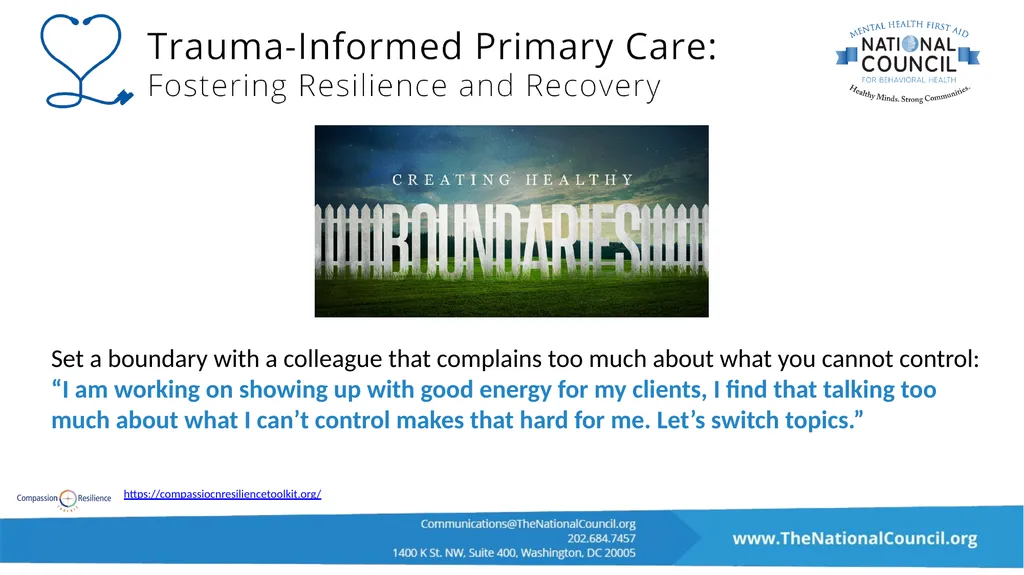
slide17. Set a boundary with a colleague that complains too much about what you cannot control:
“I am working on showing up with good energy for my clients, I find that talking too much about what I can’t control makes that hard for me. Let’s switch topics.” https://compassiocnresiliencetoolkit.org/<br>
slide18. Empathy The ability to understand and share the feelings of another<br>
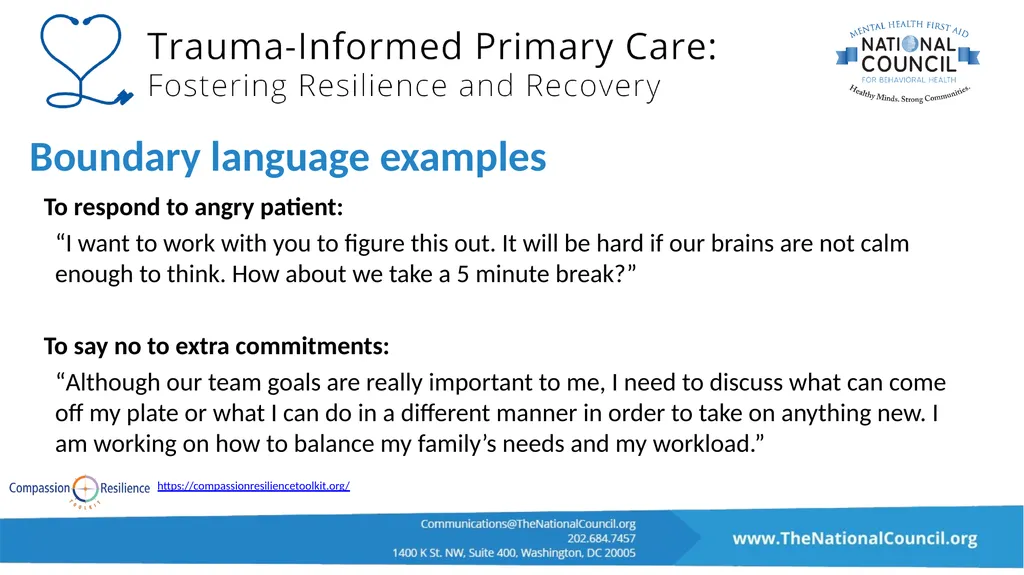
slide19. Boundary language examples To respond to angry patient:
“I want to work with you to figure this out. It will be hard if our brains are not calm enough to think. How about we take a 5 minute break?”
To say no to extra commitments:
“Although our team goals are really important to me, I need to discuss what can come off my plate or what I can do in a different manner in order to take on anything new. I am working on how to balance my family’s needs and my workload.” https://compassionresiliencetoolkit.org/<br>
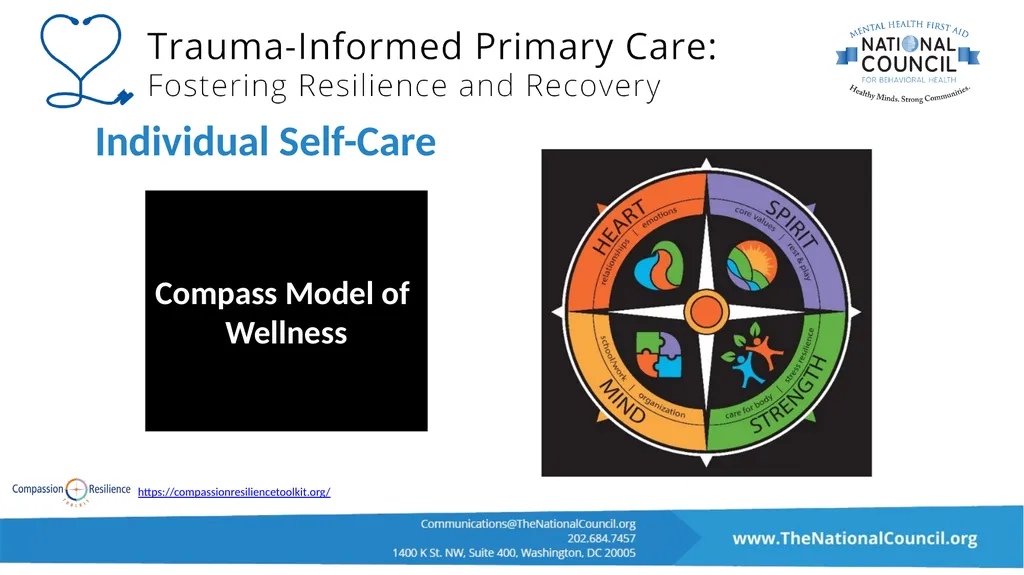
slide20. Compass Model of Wellness Individual Self-Care https://compassionresiliencetoolkit.org/<br>
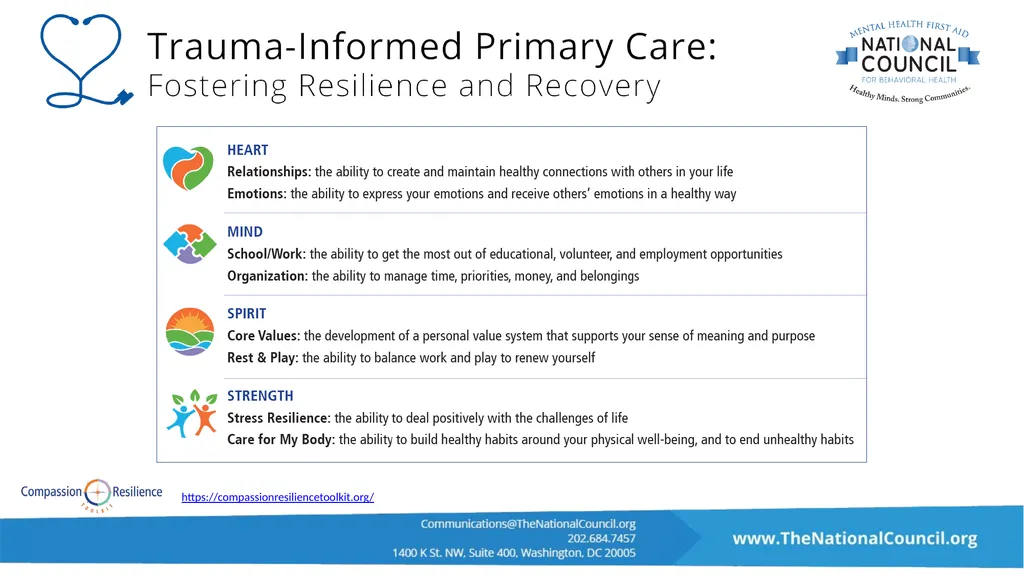
slide21. https://compassionresiliencetoolkit.org/<br>
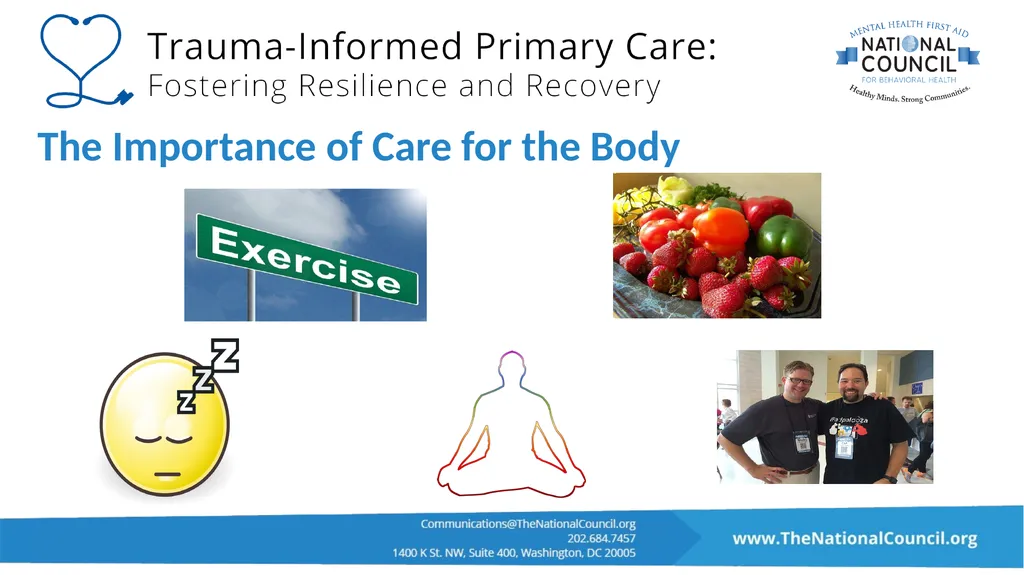
slide22. The Importance of Care for the Body<br>
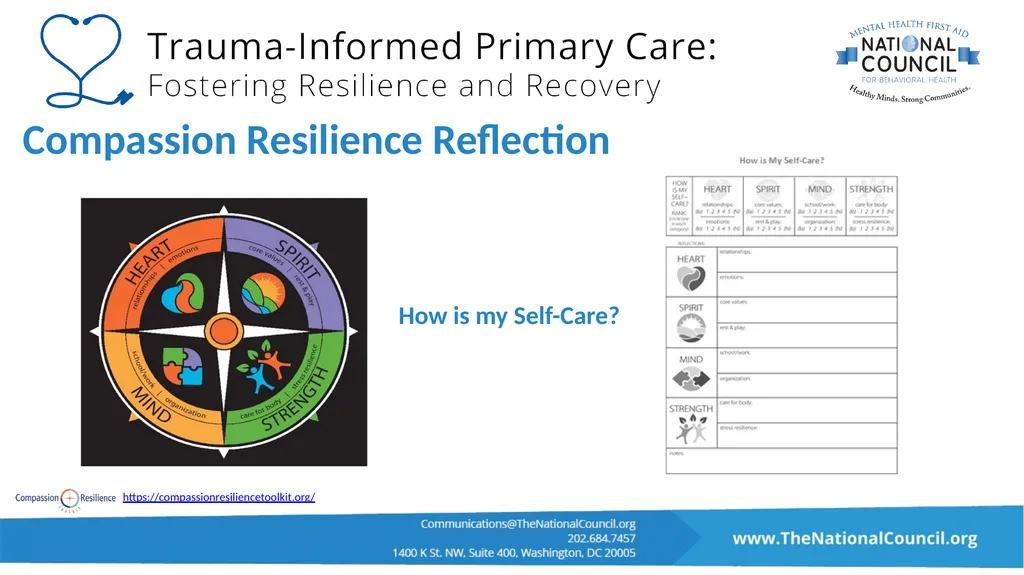
slide23. How is my Self-Care? Compassion Resilience Reflection https://compassionresiliencetoolkit.org/<br>
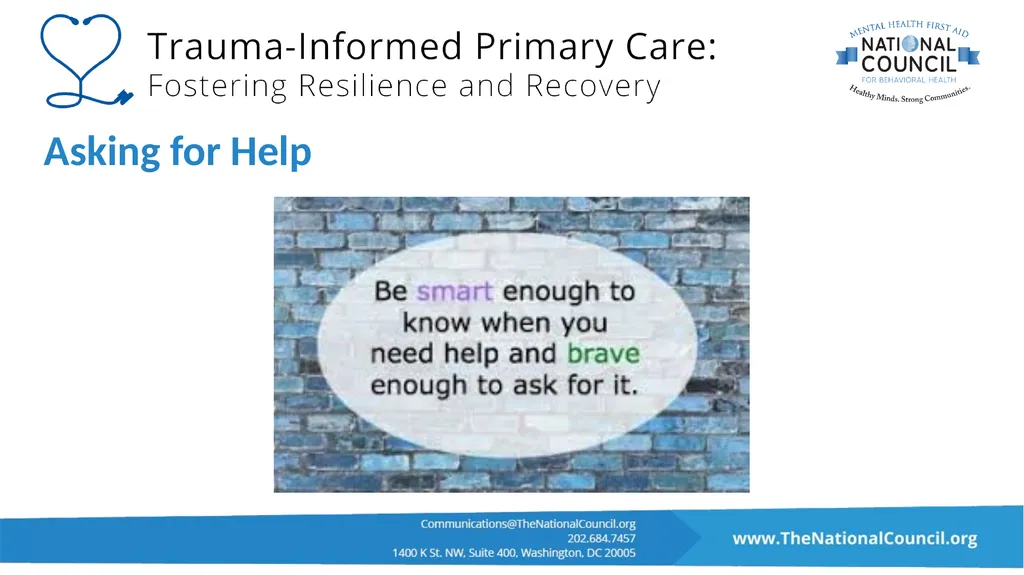
slide24. Asking for Help<br>
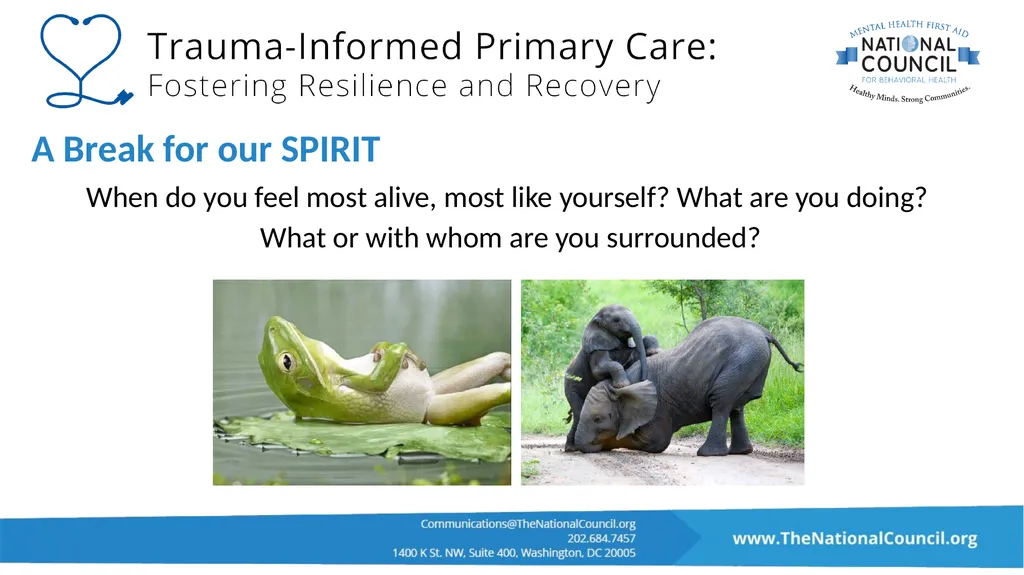
slide25. A Break for our SPIRIT When do you feel most alive, most like yourself? What are you doing?
What or with whom are you surrounded?<br>
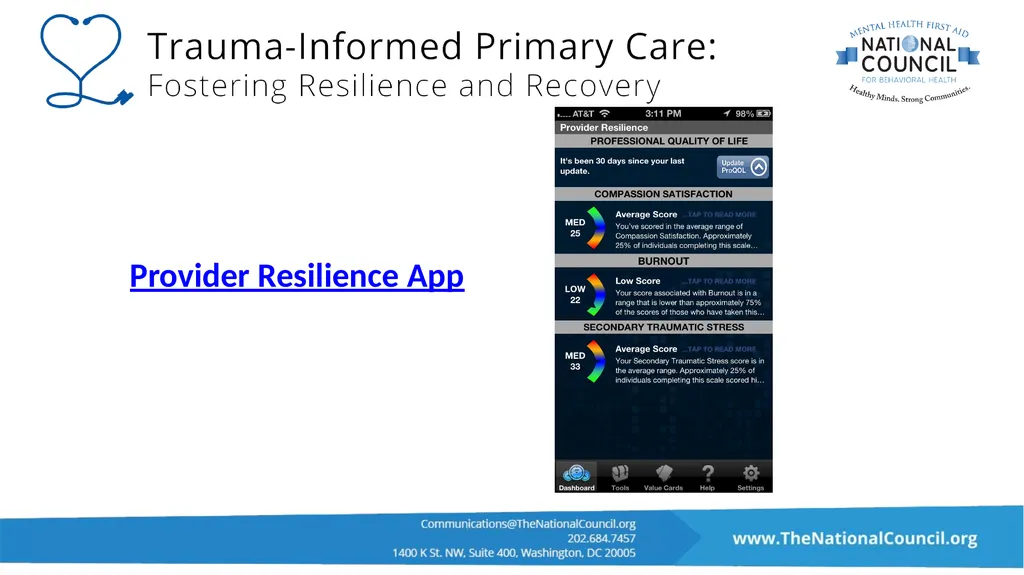
slide26. Provider Resilience App<br>
Please note this slide deck is not a train the trainer presentation with fully developed scripts and exercises. These slides and accompanying notes are offered as suggestions. Slides may be used separate from the slide deck and in a different order than how they are currently presented.
If slides are used, please use the citation below and maintain all original citations found on the slides.
National Council for Behavioral Health. Fostering Resilience and Recovery: A Change Package for Advancing Trauma-Informed Primary Care. 2019.<br>
slide2. Compassion in our Work and our World Secondary Traumatic Stress and Staff Self-Care<br>
slide4. Staff and Providers Often have their own traumatic histories
Seek to avoid re-experiencing their own emotions
Respond personally to others’ emotional states
Perceive behavior as personal threat or provocation<br>
slide5. Work Force Concerns Compassion Fatigue
Secondary Traumatic Stress
Vicarious Trauma
Burnout<br>
slide6. Source: Adapted from Coyote, C. (2006). Slow leadership. Retrieved May 25, 2018 from https://sites.google.com/site/teacherburnoutandresources/home<br>
slide7. Is “burnout” an ethical problem?<br>
slide8. Warning Signs Thinking the worst in every situation
Reacting disproportionately
Never taking a vacation
Forgetting why you do your job
Decreased performance
Constantly not getting enough sleep
Increased arguments with your family
Decreased social life<br>
slide9. The ability to maintain our physical, emotional and mental well-being while responding compassionately to people who are suffering Compassion Resilience Compassion Satisfaction The ability to experience pleasure from doing the work<br>
slide10. Building Resilience - Individual and Organizational https://compassionresiliencetoolkit.org/<br>
slide11. Mind
Body
Spirit
Strength Colleague relationships
Organizational compassion
Community collaboration https://compassionresiliencetoolkit.org/<br>
slide12. Unclear, hidden or unrealistic expectations drive compassion fatigue https://compassionresiliencetoolkit.org/<br>
slide13. What positive role do expectations play?
What impact have your unrealistic self-expectations had on your well-being?
What has the impact been of others’ unrealistic expectations of your capacity?
How do you assess if expectations are set at a helpful, aspirational level? Understanding your expectations https://compassionresiliencetoolkit.org/<br>
slide14. Boundaries - What’s OK and What’s Not OK Source: Kristi Holl, How Healthy Are Your Boundaries? Retrieved 11/1/2019 from https://www.kristiholl.com/how-healthy-are-your-boundaries/<br>
slide15. Compassionate Boundary Setting https://compassionresiliencetoolkit.org/<br>
slide16. Tips for Setting Compassionate Boundaries Know what you want to say “Yes” to in your life (values and priorities).
Be proactive. Have “meetings” to discuss boundaries. Structure offers safety for both sides.
Just say it! Don’t make them guess. Use simple and direct language.
Reinforce by pointing out the violations IN THE MOMENT.
Give explanations that are specific, relevant to the other person, and offer shared solutions.
Back up your boundary with action. If you give in, you invite people to ignore your needs. https://compassiocnresiliencetoolkit.org/<br>
slide17. Set a boundary with a colleague that complains too much about what you cannot control:
“I am working on showing up with good energy for my clients, I find that talking too much about what I can’t control makes that hard for me. Let’s switch topics.” https://compassiocnresiliencetoolkit.org/<br>
slide18. Empathy The ability to understand and share the feelings of another<br>
slide19. Boundary language examples To respond to angry patient:
“I want to work with you to figure this out. It will be hard if our brains are not calm enough to think. How about we take a 5 minute break?”
To say no to extra commitments:
“Although our team goals are really important to me, I need to discuss what can come off my plate or what I can do in a different manner in order to take on anything new. I am working on how to balance my family’s needs and my workload.” https://compassionresiliencetoolkit.org/<br>
slide20. Compass Model of Wellness Individual Self-Care https://compassionresiliencetoolkit.org/<br>
slide21. https://compassionresiliencetoolkit.org/<br>
slide22. The Importance of Care for the Body<br>
slide23. How is my Self-Care? Compassion Resilience Reflection https://compassionresiliencetoolkit.org/<br>
slide24. Asking for Help<br>
slide25. A Break for our SPIRIT When do you feel most alive, most like yourself? What are you doing?
What or with whom are you surrounded?<br>
slide26. Provider Resilience App<br>