Force-controlled walls and their application for shear tester simulations LAMMPS workshop on August 8, 2013 Andreas Aigner andreas.aignerjku.at CD Laboratory on Particulate Flow Modelling Johannes Kepler University Linz Austria 2
"Force-controlled walls and their application for" is the property of its rightful owner. Permission is granted to
download and print the materials on this website for personal, non-commercial use only, and to display it
on your personal computer provided you do not modify the materials and that you retain all copyright
notices contained in the materials. By downloading content from our website, you accept the terms of this
agreement.
Presentation Transcript
01
Force-controlled walls and their application for shear tester simulations LAMMPS workshop on August 8, 2013
Andreas Aigner
<andreas.aigner@jku.at>
CD Laboratory on Particulate Flow Modelling
Johannes Kepler University | Linz | Austria<br>
02
2 Outline Material properties
Jenike shear tester
Basic idea
Experimental set-up
Numerical model
What LIGGGHTS already can…
Force controller
Comparison of experimental and numerical results
Conclusions<br>
03
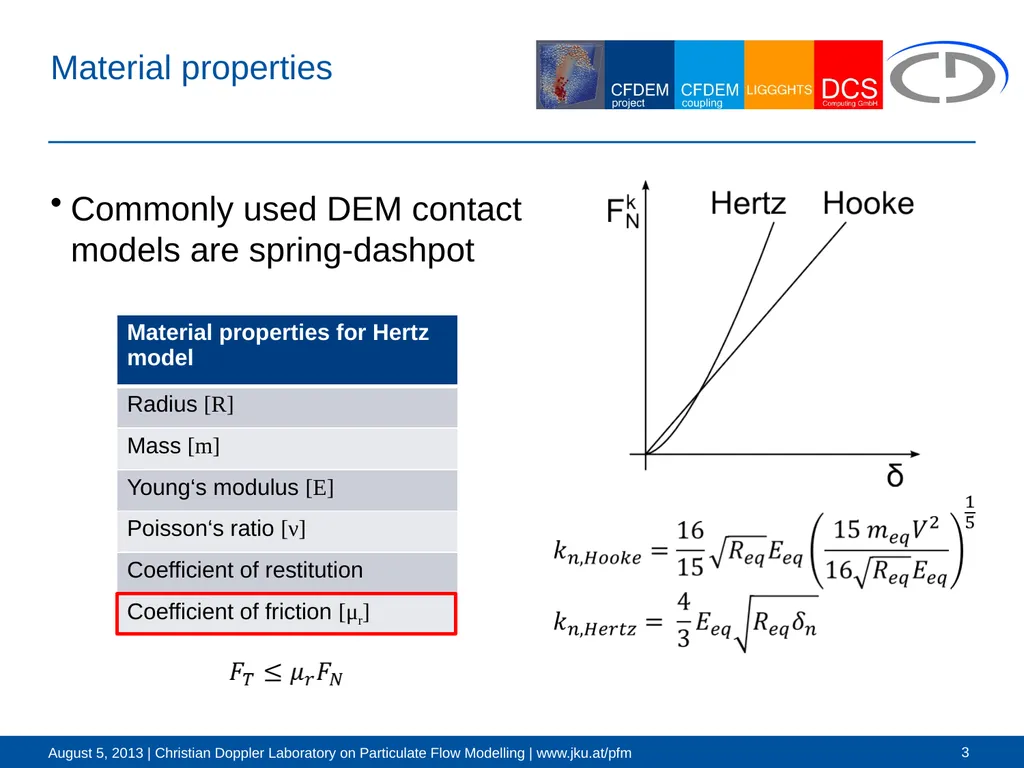
Material properties Commonly used DEM contact models are spring-dashpot 3<br>
04
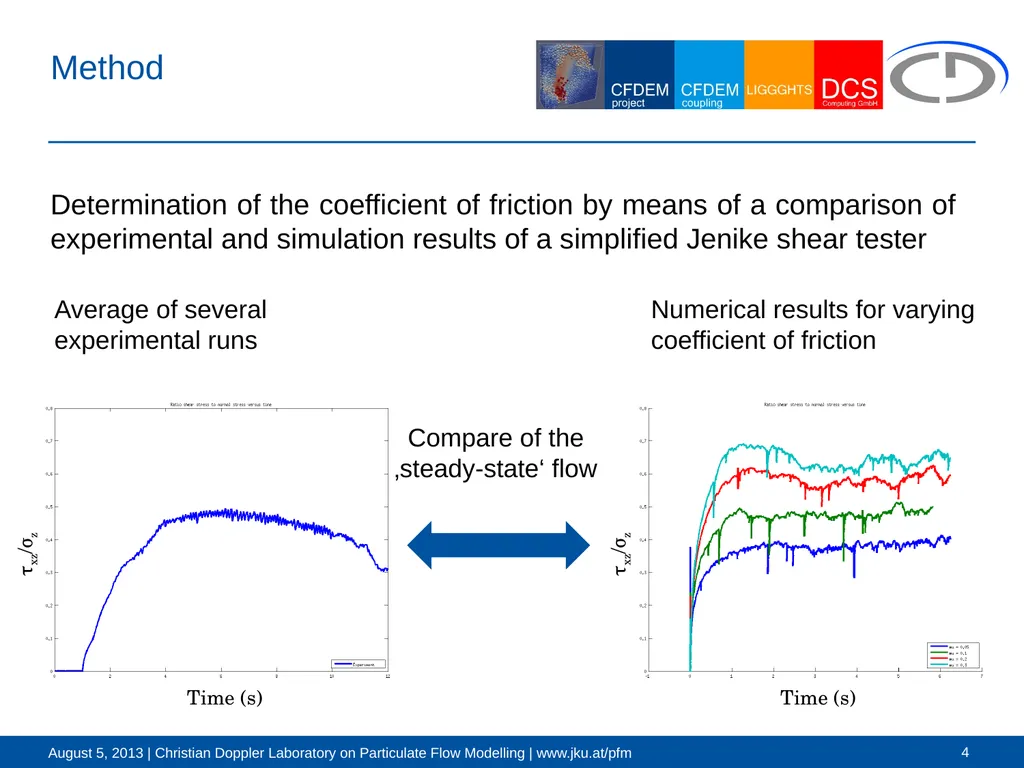
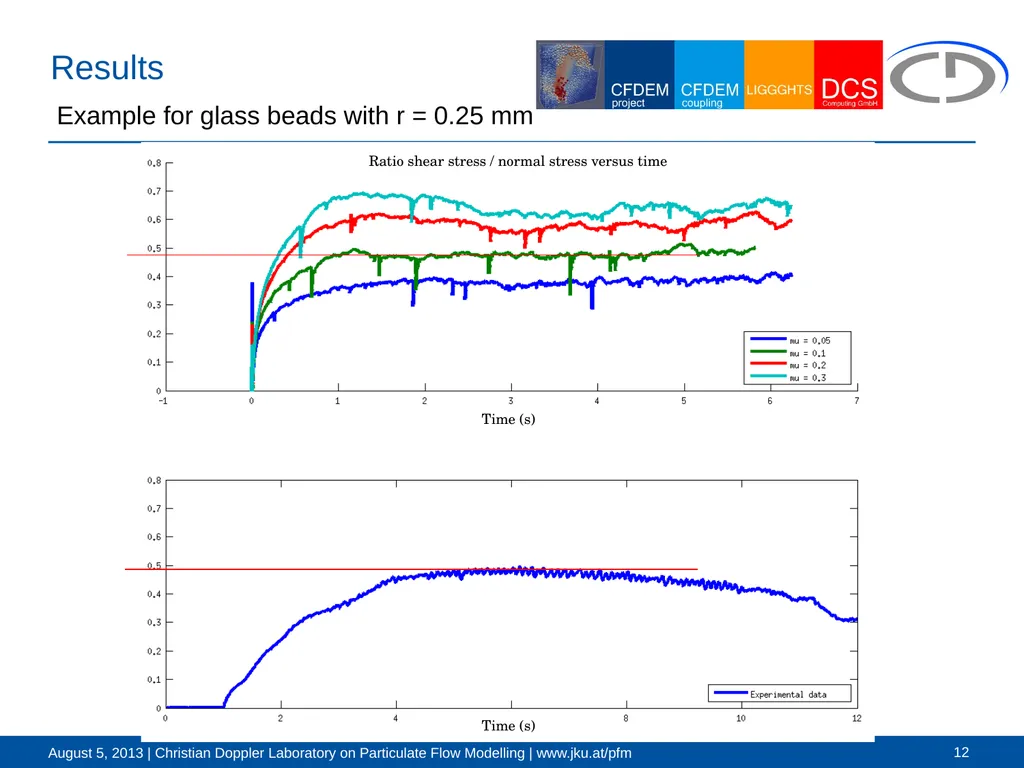
Method Determination of the coefficient of friction by means of a comparison of experimental and simulation results of a simplified Jenike shear tester 4 Average of several experimental runs Numerical results for varying coefficient of friction Compare of the ‚steady-state‘ flow τxz/σz τxz/σz Time (s) Time (s)<br>
05
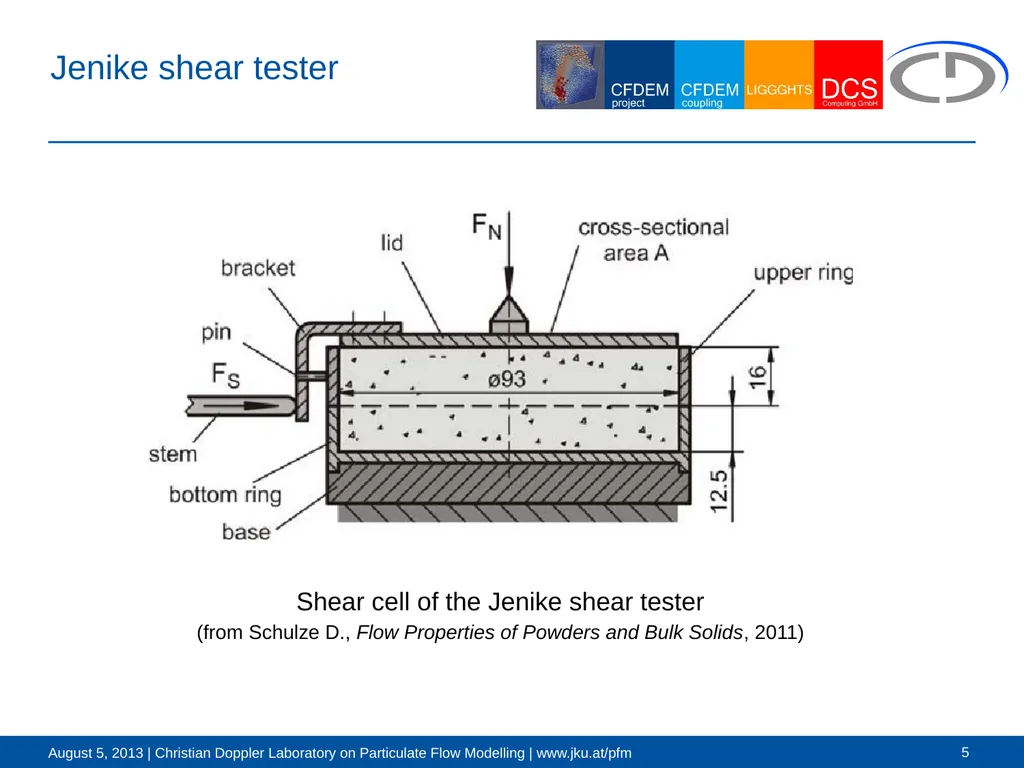
Jenike shear tester 5 Shear cell of the Jenike shear tester
(from Schulze D., Flow Properties of Powders and Bulk Solids, 2011)<br>
06
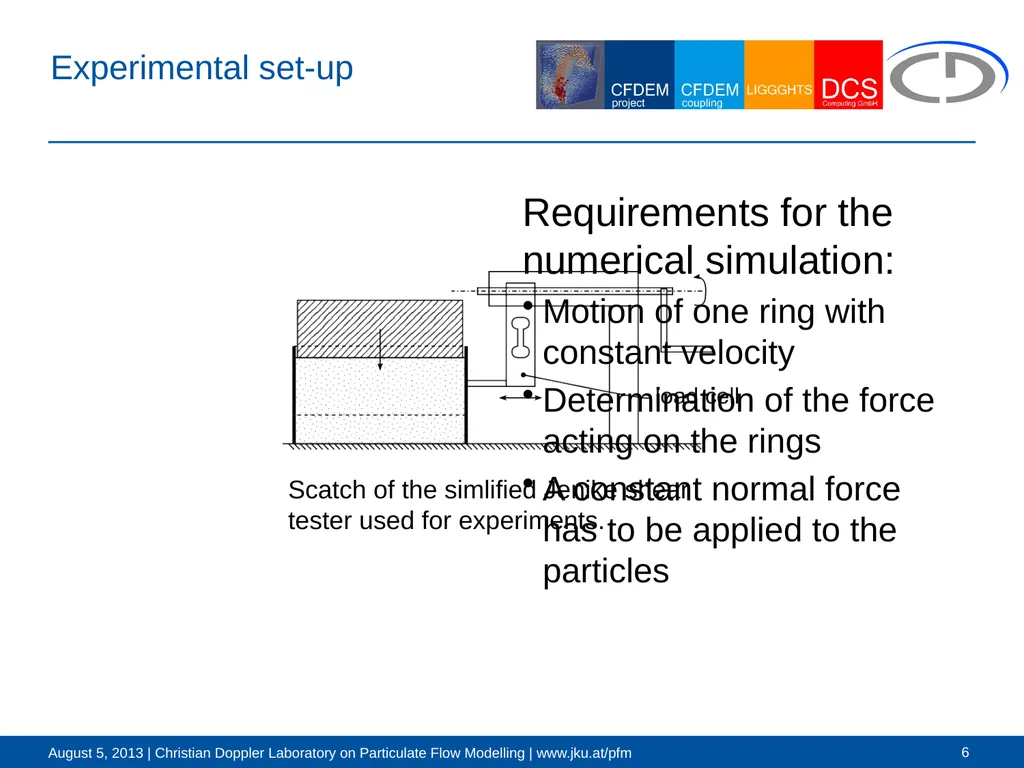
Experimental set-up Requirements for the numerical simulation:
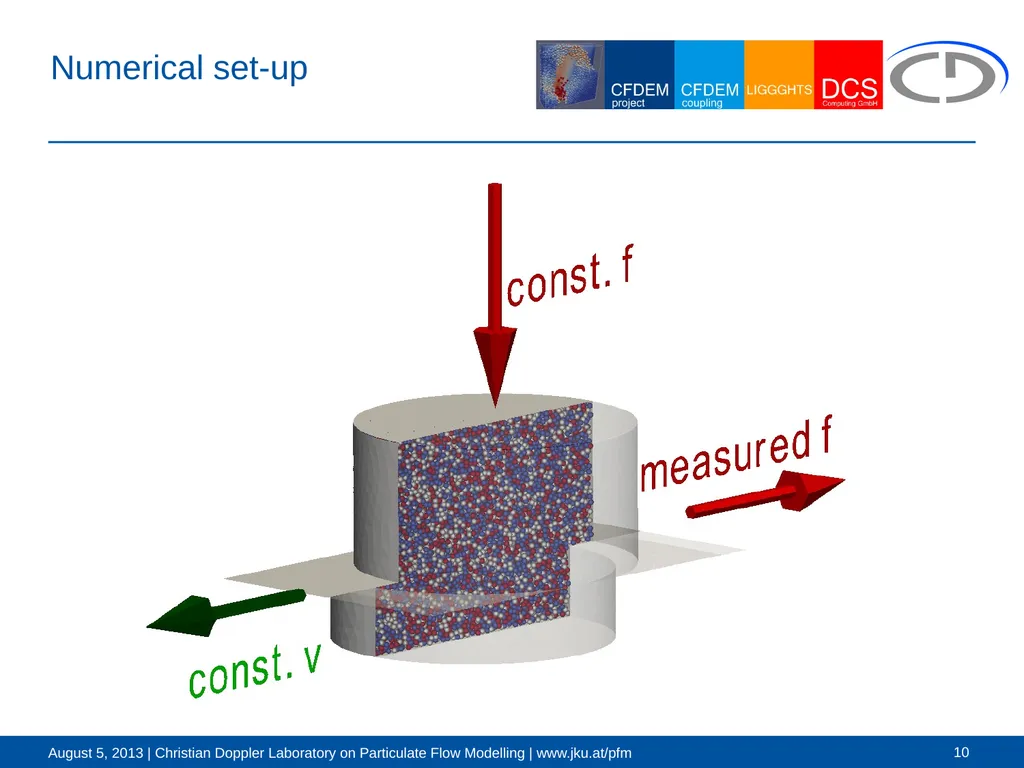
Motion of one ring with constant velocity
Determination of the force acting on the rings
A constant normal force has to be applied to the particles 6 Scatch of the simlified Jenike shear tester used for experiments.<br>
07
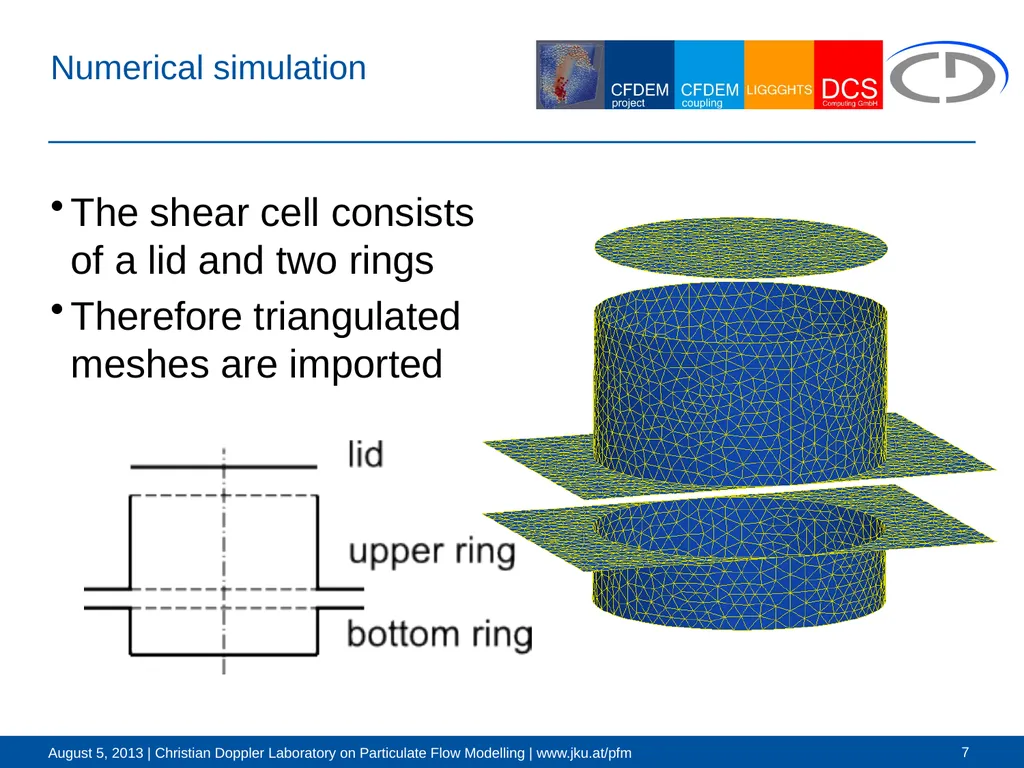
Numerical simulation The shear cell consists of a lid and two rings
Therefore triangulated meshes are imported 7<br>
08
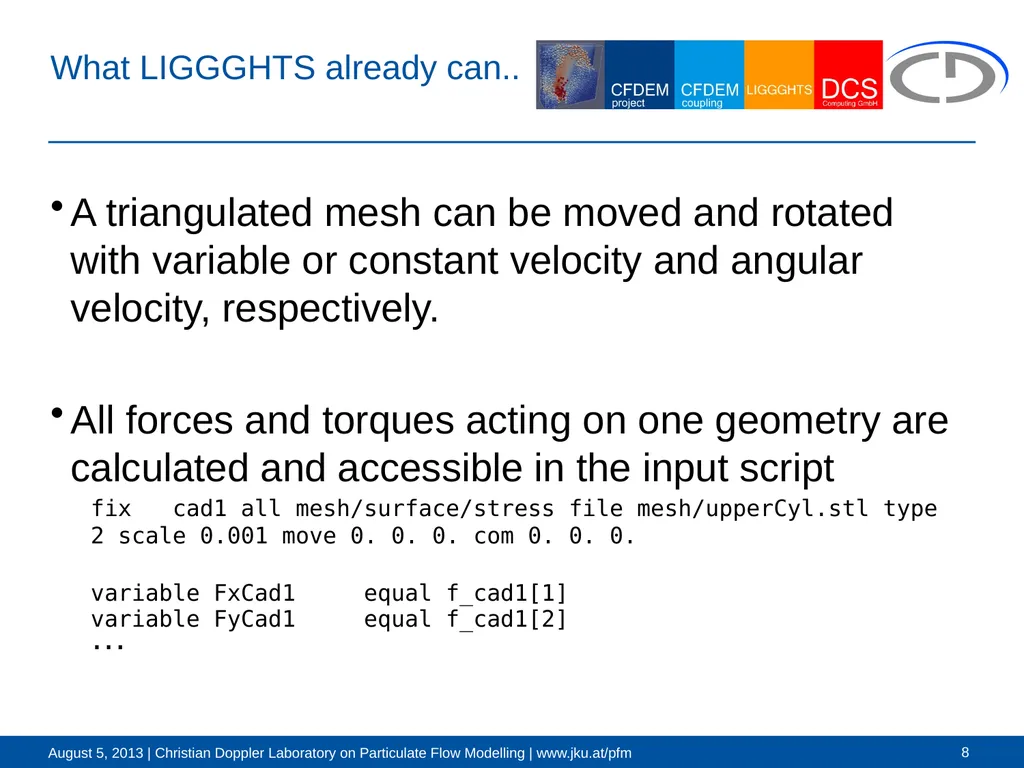
What LIGGGHTS already can.. A triangulated mesh can be moved and rotated with variable or constant velocity and angular velocity, respectively.
All forces and torques acting on one geometry are calculated and accessible in the input script
fix cad1 all mesh/surface/stress file mesh/upperCyl.stl type 2 scale 0.001 move 0. 0. 0. com 0. 0. 0.
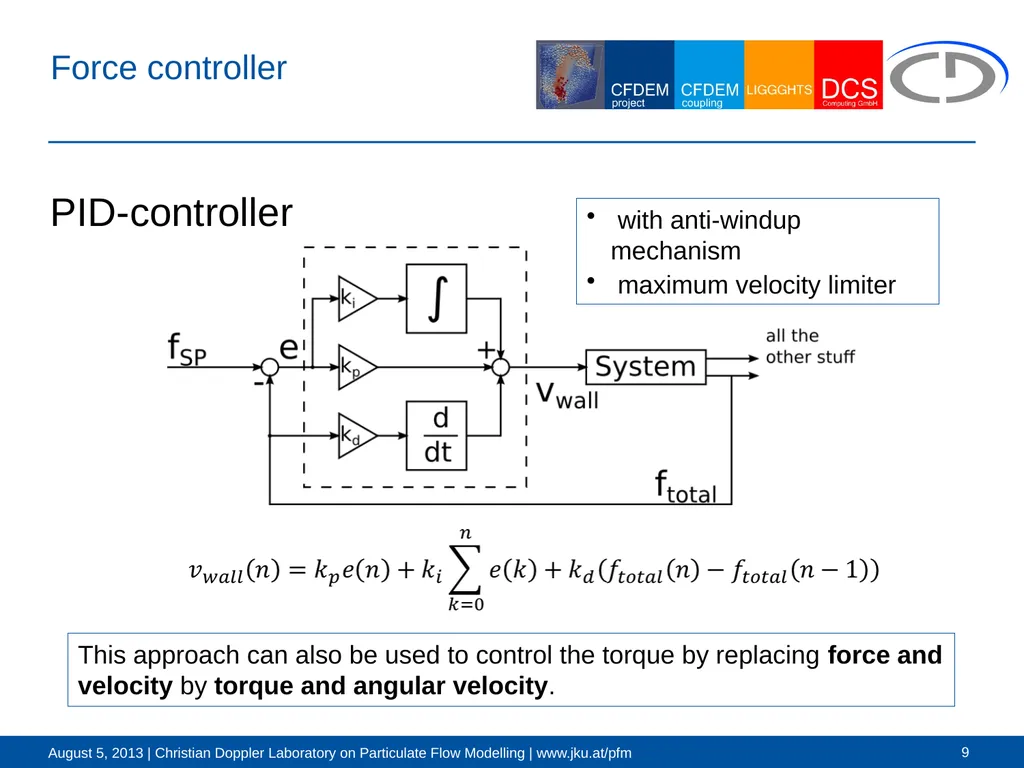
Force controller PID-controller 9 with anti-windup mechanism
maximum velocity limiter This approach can also be used to control the torque by replacing force and velocity by torque and angular velocity.<br>
10
Numerical set-up 10<br>
11
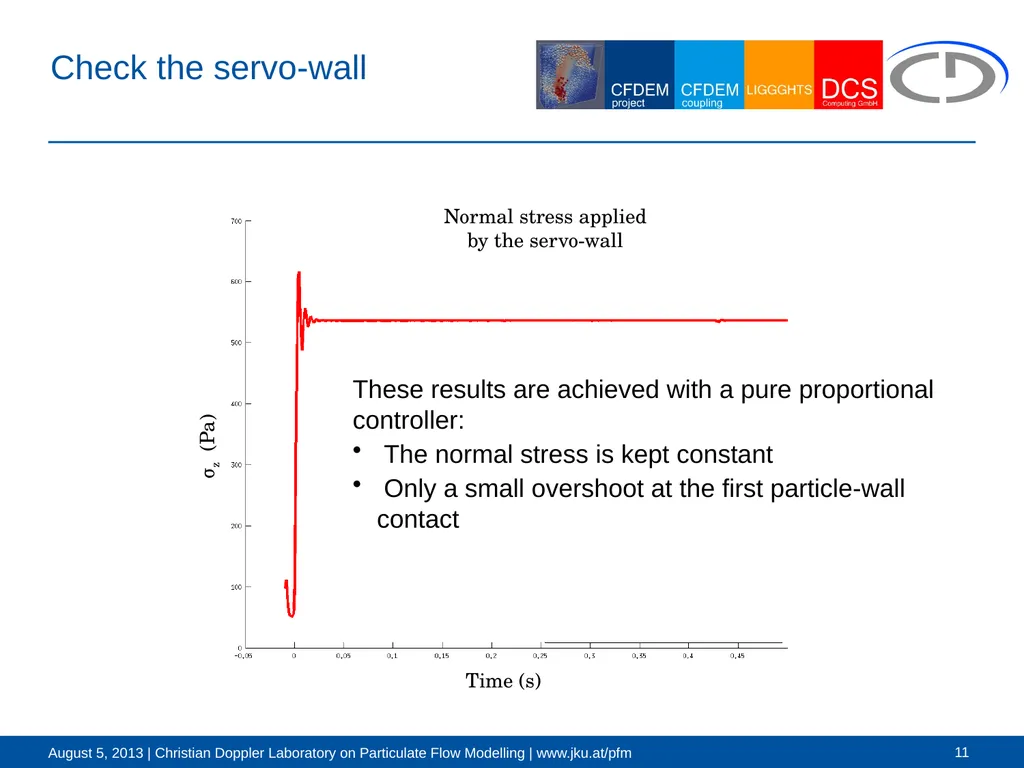
Check the servo-wall 11 Time (s) σz (Pa) Normal stress applied by the servo-wall These results are achieved with a pure proportional controller:
The normal stress is kept constant
Only a small overshoot at the first particle-wall contact<br>
12
Results 12 Time (s) Time (s) Example for glass beads with r = 0.25 mm Ratio shear stress / normal stress versus time<br>
13
Conclusions A force controlled ‘servo-wall’ was implemented into the framework of LIGGGHTS
This new wall type provides a constant normal stress for the simulation of a simplified Jenike shear tester.
By comparing experimental and numerical results the coefficient of friction is determined for individual granular material. 13<br>
14
Thank you. Questions? Johannes Kepler University Linz
CD Laboratory on Particlulate Flow Modelling Contact:
andreas.aigner@jku.at<br>