
Forces and Uniform Circular Motion Physics Unit 2
MJ
Published · 106 slides · 0 views

1 / 1




Description
Forces and Uniform Circular Motion Physics Unit 2 This Slideshow was developed to accompany the textbook OpenStax Physics Available for free at https:openstaxcollege.orgtextbookscollege-physics By OpenStax College and Rice University
Related Topics
Share
Embed code
Download this presentation From Below
"Forces and Uniform Circular Motion Physics Unit 2" is the property of its rightful owner. Permission is granted to download and print the materials on this website for personal, non-commercial use only, and to display it on your personal computer provided you do not modify the materials and that you retain all copyright notices contained in the materials. By downloading content from our website, you accept the terms of this agreement.
Presentation Transcript
01
Forces and Uniform Circular Motion Physics
Unit 2<br>
Unit 2<br>
02
This Slideshow was developed to accompany the textbook
OpenStax Physics
Available for free at https://openstaxcollege.org/textbooks/college-physics
By OpenStax College and Rice University
2013 edition
Some examples and diagrams are taken from the OpenStax Physics and Cutnell & Johnson Physics 6th ed. Slides created by
Richard Wright, Andrews Academy
rwright@andrews.edu<br>
OpenStax Physics
Available for free at https://openstaxcollege.org/textbooks/college-physics
By OpenStax College and Rice University
2013 edition
Some examples and diagrams are taken from the OpenStax Physics and Cutnell & Johnson Physics 6th ed. Slides created by
Richard Wright, Andrews Academy
rwright@andrews.edu<br>
03
02-01 Newton’s Laws of Motion In this lesson you will…
• Understand the definition of force.
• Define mass and inertia.
• Understand Newton's first law of motion.
• Define net force, external force, and system.
• Understand Newton’s second law of motion.
• Understand Newton's third law of motion.<br>
• Understand the definition of force.
• Define mass and inertia.
• Understand Newton's first law of motion.
• Define net force, external force, and system.
• Understand Newton’s second law of motion.
• Understand Newton's third law of motion.<br>
04
02-01 Newton’s Laws of Motion Kinematics
How things move
Dynamics
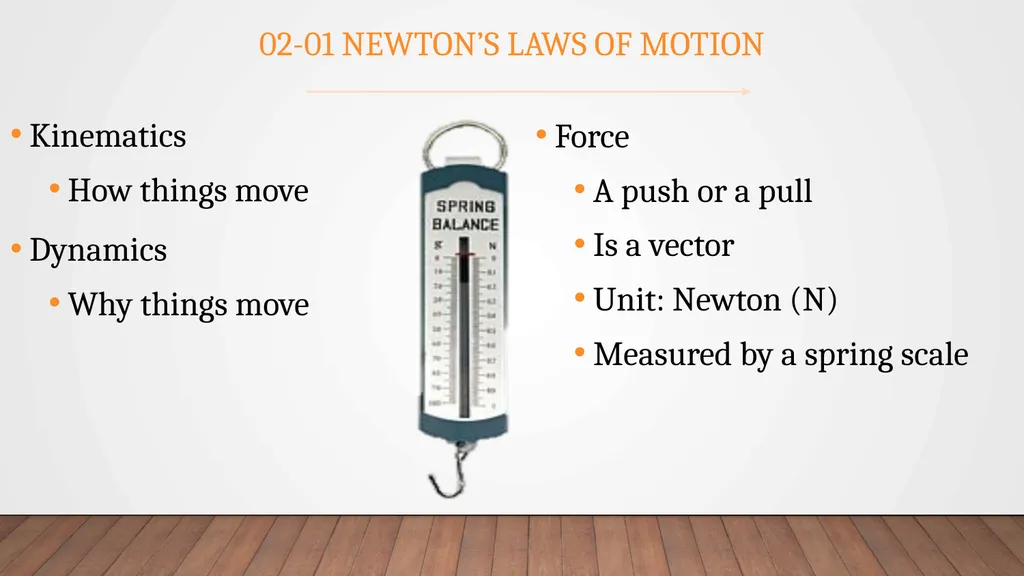
Why things move Force
A push or a pull
Is a vector
Unit: Newton (N)
Measured by a spring scale<br>
How things move
Dynamics
Why things move Force
A push or a pull
Is a vector
Unit: Newton (N)
Measured by a spring scale<br>
05
02-01 Newton’s Laws of Motion Place a marble on your desk so that it is at rest (not moving).
Observe the marble for a minute. What happens to it?
Without applying a force to the marble, make it move. Remember gravity is a force, so tipping the desk is the same as applying a force. Were you able to move the marble?
Roll the marble across your desk at a moderate speed so that it has no sidewise spin. Describe the path the marble took.
Without a sidewise spin, tipping the desk, or applying a force, can you make the marble take a curved path?<br>
Observe the marble for a minute. What happens to it?
Without applying a force to the marble, make it move. Remember gravity is a force, so tipping the desk is the same as applying a force. Were you able to move the marble?
Roll the marble across your desk at a moderate speed so that it has no sidewise spin. Describe the path the marble took.
Without a sidewise spin, tipping the desk, or applying a force, can you make the marble take a curved path?<br>
06
02-01 Newton’s Laws of Motion Newton’s First Law of Motion
A body at rest remains at rest, or, if in motion, remains in motion at a constant velocity unless acted on by a net external force.
Inertia
Property of objects to remain in constant motion or rest.
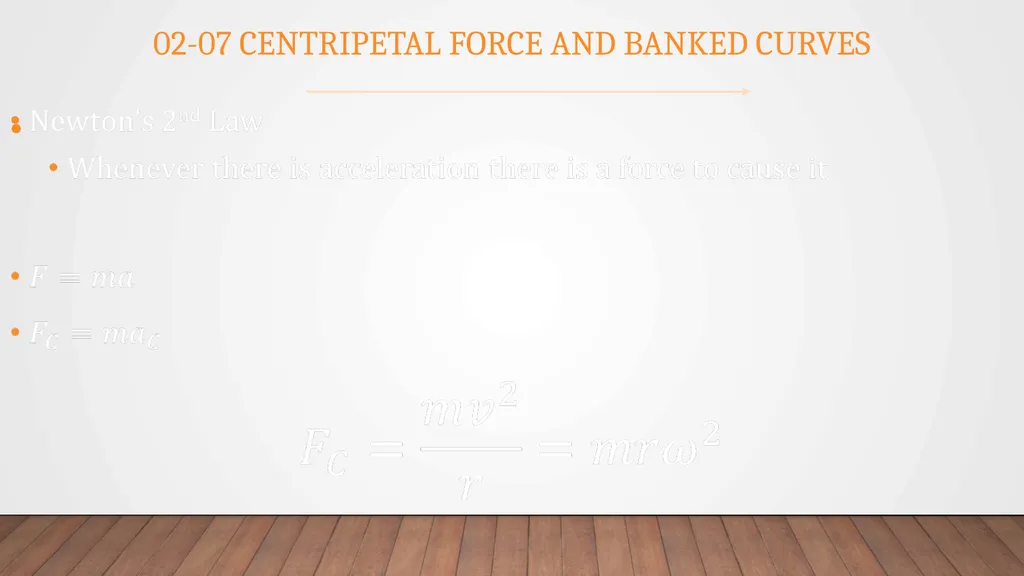
Mass is a measure of inertia
Watch Eureka! 01
Watch Eureka! 02<br>
A body at rest remains at rest, or, if in motion, remains in motion at a constant velocity unless acted on by a net external force.
Inertia
Property of objects to remain in constant motion or rest.
Mass is a measure of inertia
Watch Eureka! 01
Watch Eureka! 02<br>
07
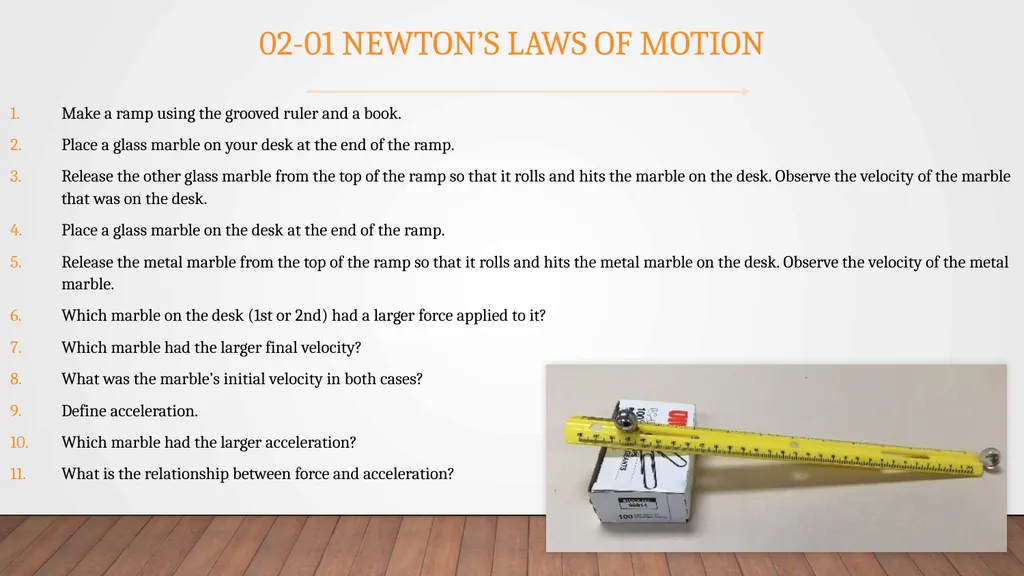
02-01 Newton’s Laws of Motion Make a ramp using the grooved ruler and a book.
Place a glass marble on your desk at the end of the ramp.
Release the other glass marble from the top of the ramp so that it rolls and hits the marble on the desk. Observe the velocity of the marble that was on the desk.
Place a glass marble on the desk at the end of the ramp.
Release the metal marble from the top of the ramp so that it rolls and hits the metal marble on the desk. Observe the velocity of the metal marble.
Which marble on the desk (1st or 2nd) had a larger force applied to it?
Which marble had the larger final velocity?
What was the marble’s initial velocity in both cases?
Define acceleration.
Which marble had the larger acceleration?
What is the relationship between force and acceleration?<br>
Place a glass marble on your desk at the end of the ramp.
Release the other glass marble from the top of the ramp so that it rolls and hits the marble on the desk. Observe the velocity of the marble that was on the desk.
Place a glass marble on the desk at the end of the ramp.
Release the metal marble from the top of the ramp so that it rolls and hits the metal marble on the desk. Observe the velocity of the metal marble.
Which marble on the desk (1st or 2nd) had a larger force applied to it?
Which marble had the larger final velocity?
What was the marble’s initial velocity in both cases?
Define acceleration.
Which marble had the larger acceleration?
What is the relationship between force and acceleration?<br>
08
02-01 Newton’s Laws of Motion Place a glass marble on your desk at the end of the ramp.
Release the other glass marble from the top of the ramp so that it rolls and hits the marble on the desk. Observe the velocity of the marble that was on the desk.
Place a metal marble on the desk at the end of the ramp.
Release the glass marble from the top of the ramp so that it rolls and hits the metal marble on the desk. Observe the velocity of the metal marble.
Which marble on the desk (glass or metal) had a larger force applied to it?
Which marble had the larger final velocity?
Which marble had the larger acceleration?
Which marble had more mass?
What is the relationship between mass and acceleration?<br>
Release the other glass marble from the top of the ramp so that it rolls and hits the marble on the desk. Observe the velocity of the marble that was on the desk.
Place a metal marble on the desk at the end of the ramp.
Release the glass marble from the top of the ramp so that it rolls and hits the metal marble on the desk. Observe the velocity of the metal marble.
Which marble on the desk (glass or metal) had a larger force applied to it?
Which marble had the larger final velocity?
Which marble had the larger acceleration?
Which marble had more mass?
What is the relationship between mass and acceleration?<br>
09
02-01 Newton’s Laws of Motion<br>
10
02-01 Newton’s Laws of Motion Take two spring scales and hook their ends together. Lay them horizontally on the desk.
Gently pull on one spring scale so it reads 4 N.
What do the scales read for the force?
Apply 3-N force. What do the scales read?
With the scales hooked together, try to pull only one scale so that the other one does not experience a force. Were you successful, explain.<br>
Gently pull on one spring scale so it reads 4 N.
What do the scales read for the force?
Apply 3-N force. What do the scales read?
With the scales hooked together, try to pull only one scale so that the other one does not experience a force. Were you successful, explain.<br>
11
02-01 Newton’s Laws of Motion Newton’s Third Law of Motion
Whenever one body exerts a force on a second body, the first body experiences a force that is equal in magnitude and opposite in direction to the force that it exerts.
Every force has an equal and opposite reaction force.
You push down on your chair, so the chair pushed back up on you.<br>
Whenever one body exerts a force on a second body, the first body experiences a force that is equal in magnitude and opposite in direction to the force that it exerts.
Every force has an equal and opposite reaction force.
You push down on your chair, so the chair pushed back up on you.<br>
12
02-01 Newton’s Laws of Motion A football player named Al is blocking a player on the other team named Bob. Al applies a 1500 N force on Bob. If Bob's mass is 100 kg, what is his acceleration?
What is the size of the force on Al?
If Al's mass is 75 kg, what is his acceleration?<br>
What is the size of the force on Al?
If Al's mass is 75 kg, what is his acceleration?<br>
13
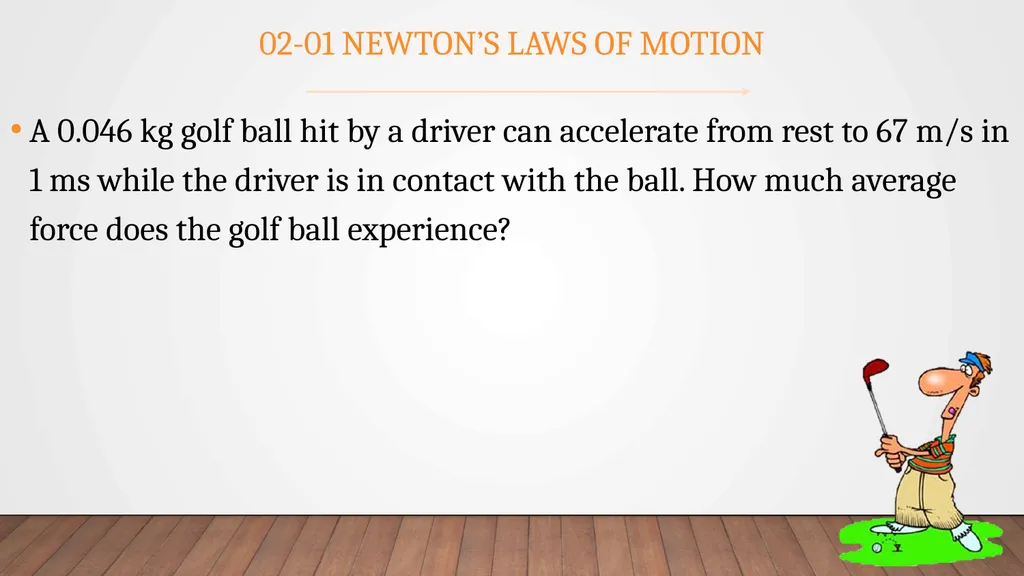
02-01 Newton’s Laws of Motion A 0.046 kg golf ball hit by a driver can accelerate from rest to 67 m/s in 1 ms while the driver is in contact with the ball. How much average force does the golf ball experience?<br>
14
02-01 Newton’s Laws of Motion Force yourself to do these problems
Read 4.5, 4.6, 6.5<br>
Read 4.5, 4.6, 6.5<br>
15
02-02 Weight and Gravity In this lesson you will…
• Define normal force.
• Apply Newton's laws of motion to solve problems involving a variety of forces.
• Use trigonometric identities to resolve weight into components.
• Understand and apply a problem-solving procedure to solve problems using Newton's laws of motion.
• Explain Earth’s gravitational force.<br>
• Define normal force.
• Apply Newton's laws of motion to solve problems involving a variety of forces.
• Use trigonometric identities to resolve weight into components.
• Understand and apply a problem-solving procedure to solve problems using Newton's laws of motion.
• Explain Earth’s gravitational force.<br>
16
02-02 Weight and Gravity Mass
Not a force
Measure of inertia or amount of matter
Unit: kg
Constant
Watch Eureka! 6<br>
Not a force
Measure of inertia or amount of matter
Unit: kg
Constant
Watch Eureka! 6<br>
17
02-02 Weight and Gravity<br>
18
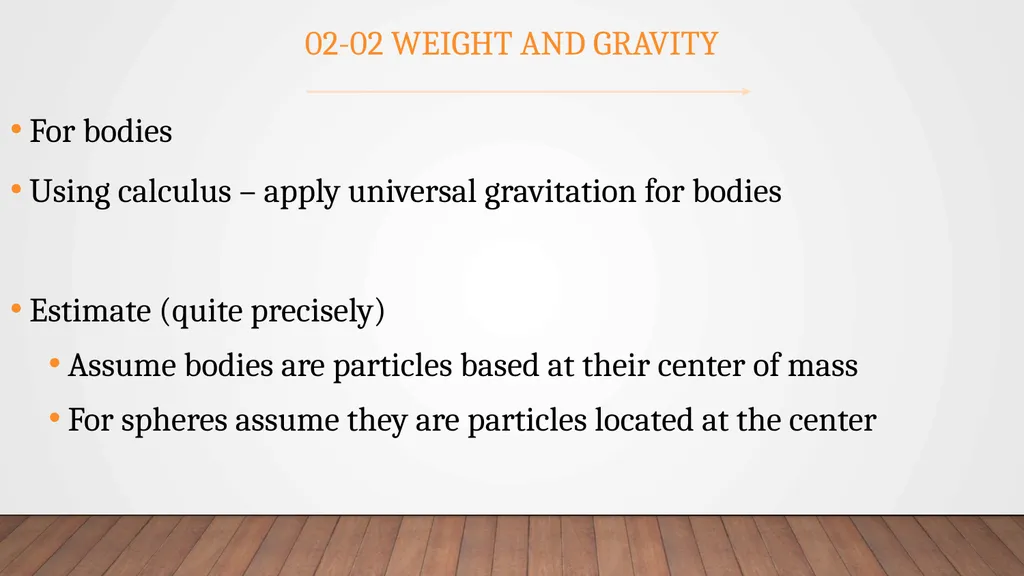
02-02 Weight and Gravity For bodies
Using calculus – apply universal gravitation for bodies
Estimate (quite precisely)
Assume bodies are particles based at their center of mass
For spheres assume they are particles located at the center<br>
Using calculus – apply universal gravitation for bodies
Estimate (quite precisely)
Assume bodies are particles based at their center of mass
For spheres assume they are particles located at the center<br>
19
02-02 Weight and Gravity<br>
20
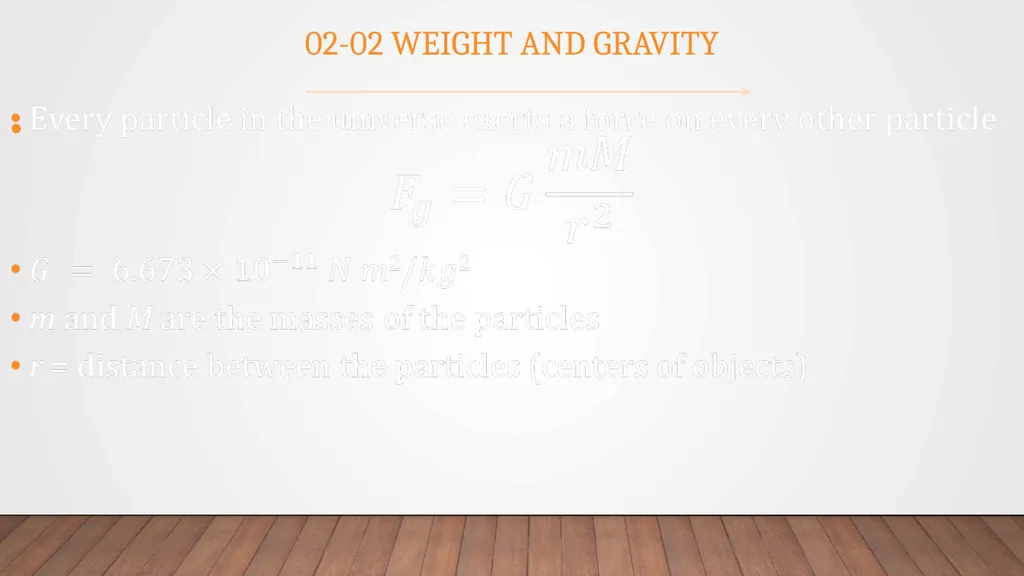
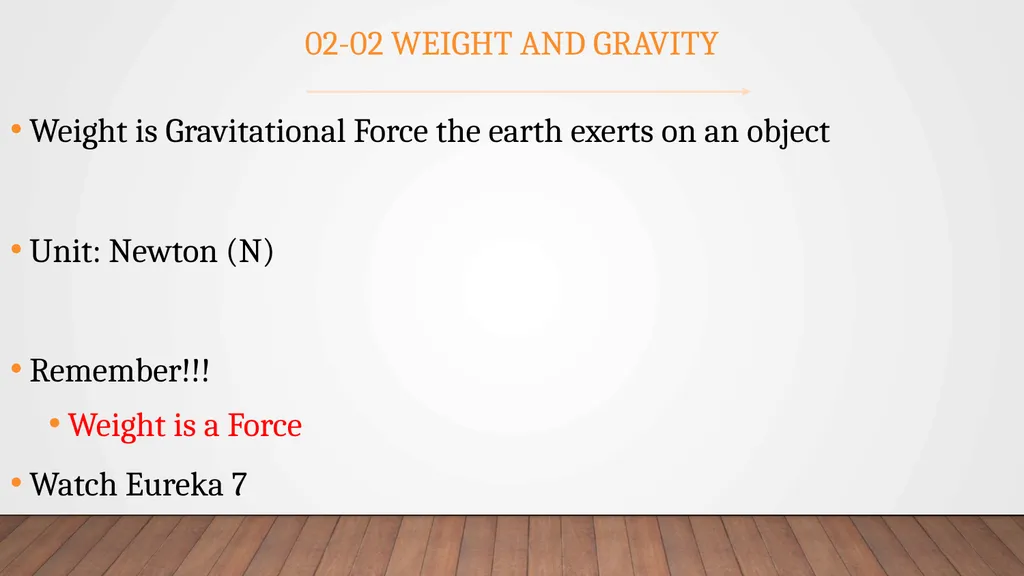
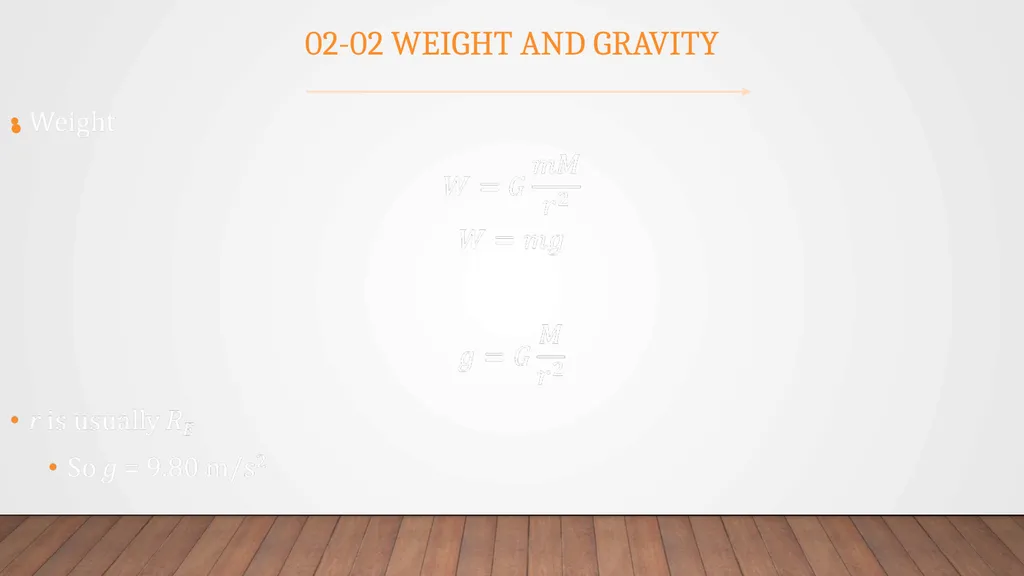
02-02 Weight and Gravity Weight is Gravitational Force the earth exerts on an object
Unit: Newton (N)
Remember!!!
Weight is a Force
Watch Eureka 7<br>
Unit: Newton (N)
Remember!!!
Weight is a Force
Watch Eureka 7<br>
21
02-02 Weight and Gravity<br>
22
02-02 Weight and Gravity The gravitational pull from the moon and sun causes tides
Water is pulled in the direction of the moon and sun
Gravitational pull from satellites causes the main body to move slightly
Moon causes earth to move
Planets cause sun/star to move<br>
Water is pulled in the direction of the moon and sun
Gravitational pull from satellites causes the main body to move slightly
Moon causes earth to move
Planets cause sun/star to move<br>
23
02-02 Weight and Gravity<br>
24
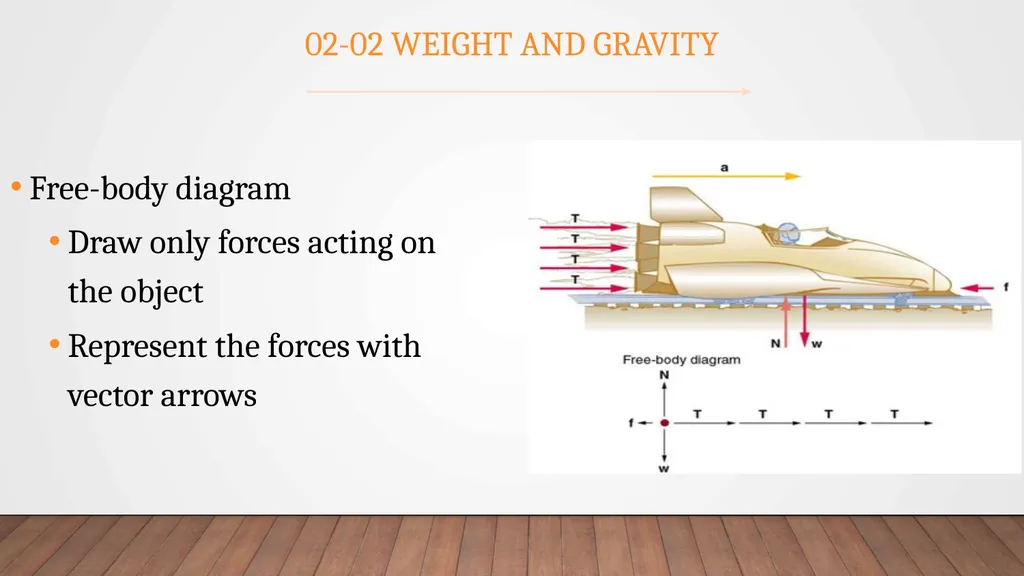
02-02 Weight and Gravity Free-body diagram
Draw only forces acting on the object
Represent the forces with vector arrows<br>
Draw only forces acting on the object
Represent the forces with vector arrows<br>
25
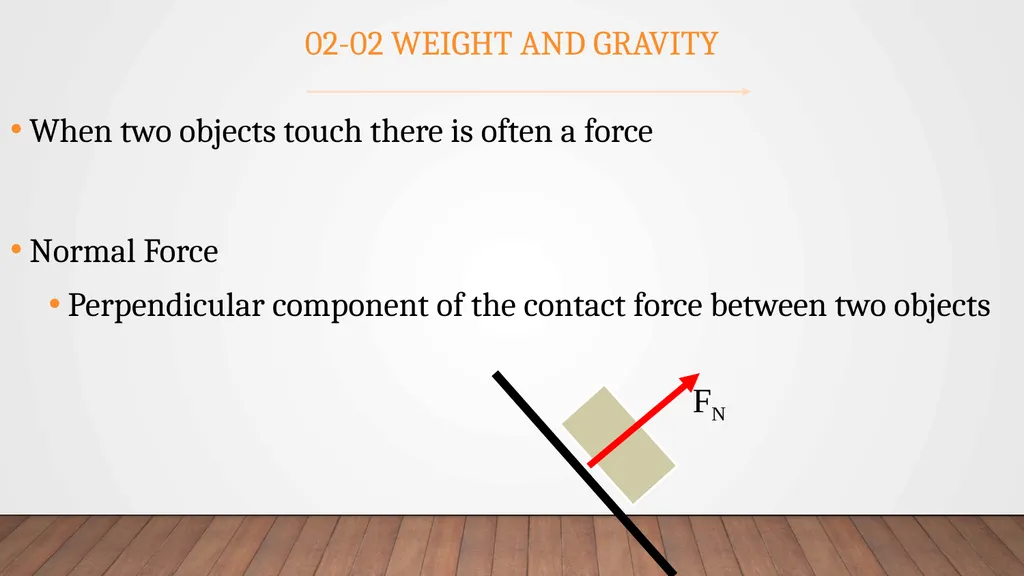
02-02 Weight and Gravity When two objects touch there is often a force
Normal Force
Perpendicular component of the contact force between two objects<br>
Normal Force
Perpendicular component of the contact force between two objects<br>
26
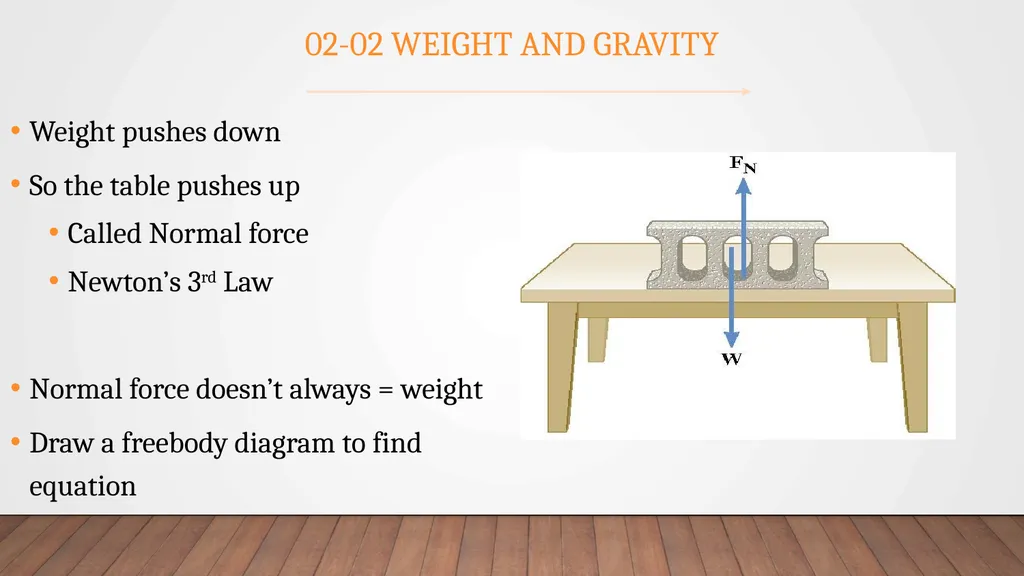
02-02 Weight and Gravity Weight pushes down
So the table pushes up
Called Normal force
Newton’s 3rd Law
Normal force doesn’t always = weight
Draw a freebody diagram to find equation<br>
So the table pushes up
Called Normal force
Newton’s 3rd Law
Normal force doesn’t always = weight
Draw a freebody diagram to find equation<br>
27
02-02 Weight and Gravity Hang the mass from the spring scale. The scale will measure the force applied to hold the mass in place. This is the weight.
What is the weight of your mass?
Carefully watch the spring scale as you quickly move the scale upwards. What happens to the weight?
Carefully watch the spring scale as you quickly move the scale downwards. What happens to the weight?
The other weights are called apparent weight and is what you feel as the net force pulling you down. An upward acceleration produces a _______________________ apparent weight. A downward acceleration produces a ______________________ apparent weight.
When a problem asks for apparent weight, find the normal force<br>
What is the weight of your mass?
Carefully watch the spring scale as you quickly move the scale upwards. What happens to the weight?
Carefully watch the spring scale as you quickly move the scale downwards. What happens to the weight?
The other weights are called apparent weight and is what you feel as the net force pulling you down. An upward acceleration produces a _______________________ apparent weight. A downward acceleration produces a ______________________ apparent weight.
When a problem asks for apparent weight, find the normal force<br>
28
02-02 Weight and Gravity A lady is weighing some bananas in a grocery store when the floor collapses. If the bananas mass is 2 kg and the floor is accelerating at -2.25 m/s2, what is the apparent weight (normal force) of the bananas?
FN = 15.1 N<br>
FN = 15.1 N<br>
29
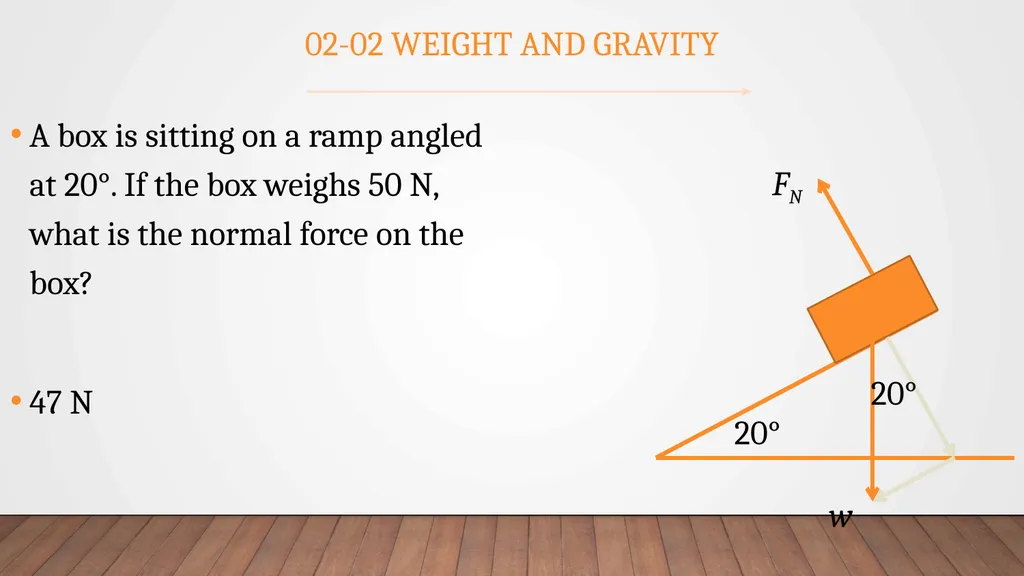
02-02 Weight and Gravity A box is sitting on a ramp angled at 20°. If the box weighs 50 N, what is the normal force on the box?
47 N<br>
47 N<br>
30
02-02 Weight and Gravity Just like gravity, these problems are attractive.
Read 5.1<br>
Read 5.1<br>
31
02-03 Friction In this lesson you will…
• Discuss the general characteristics of friction.
• Describe the various types of friction.
• Calculate the magnitude of static and kinetic friction.<br>
• Discuss the general characteristics of friction.
• Describe the various types of friction.
• Calculate the magnitude of static and kinetic friction.<br>
32
02-03 Friction Do the lab in your worksheet
How is friction reduced in car engines? Hovercraft?<br>
How is friction reduced in car engines? Hovercraft?<br>
33
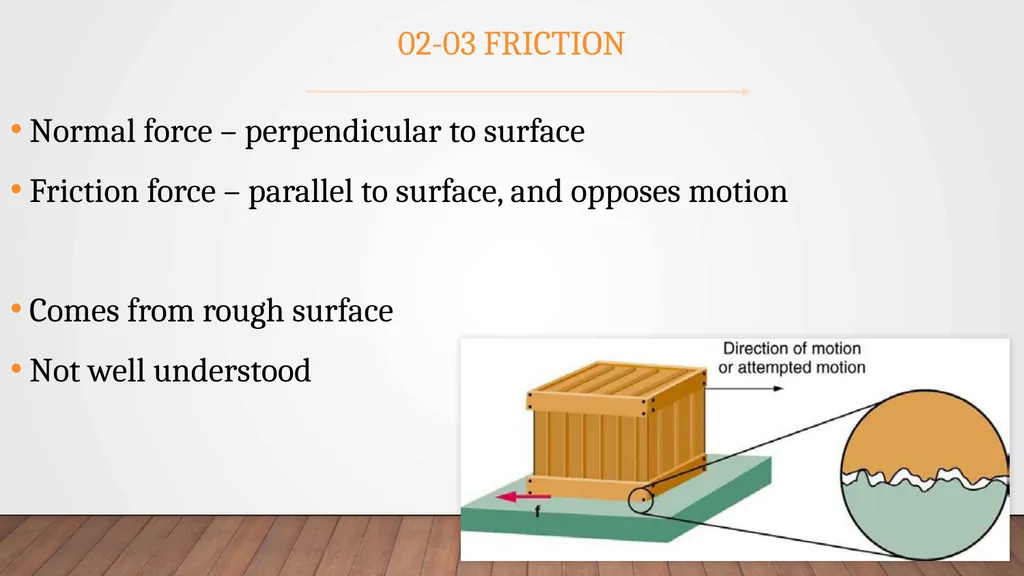
02-03 Friction Normal force – perpendicular to surface
Friction force – parallel to surface, and opposes motion
Comes from rough surface
Not well understood<br>
Friction force – parallel to surface, and opposes motion
Comes from rough surface
Not well understood<br>
34
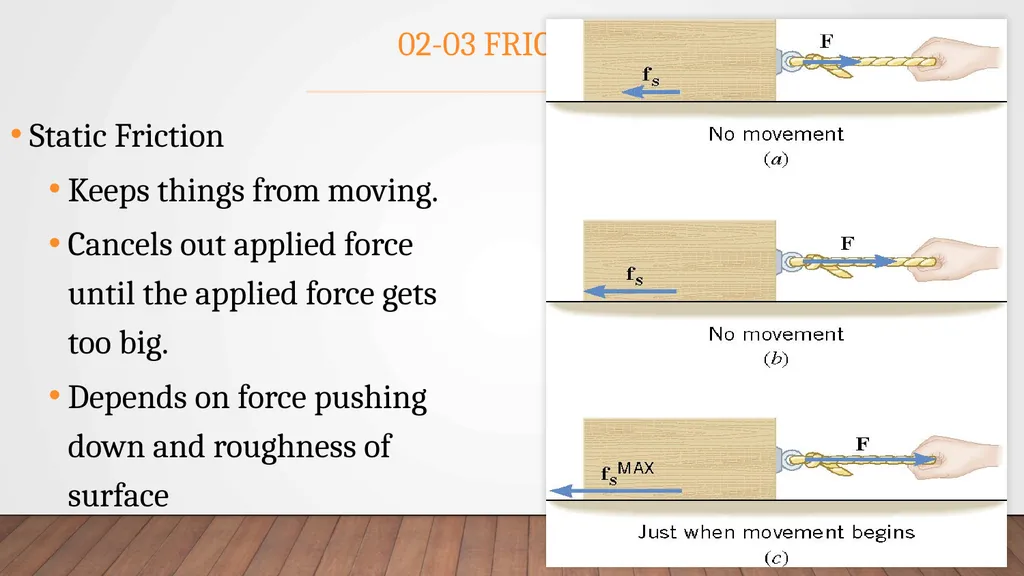
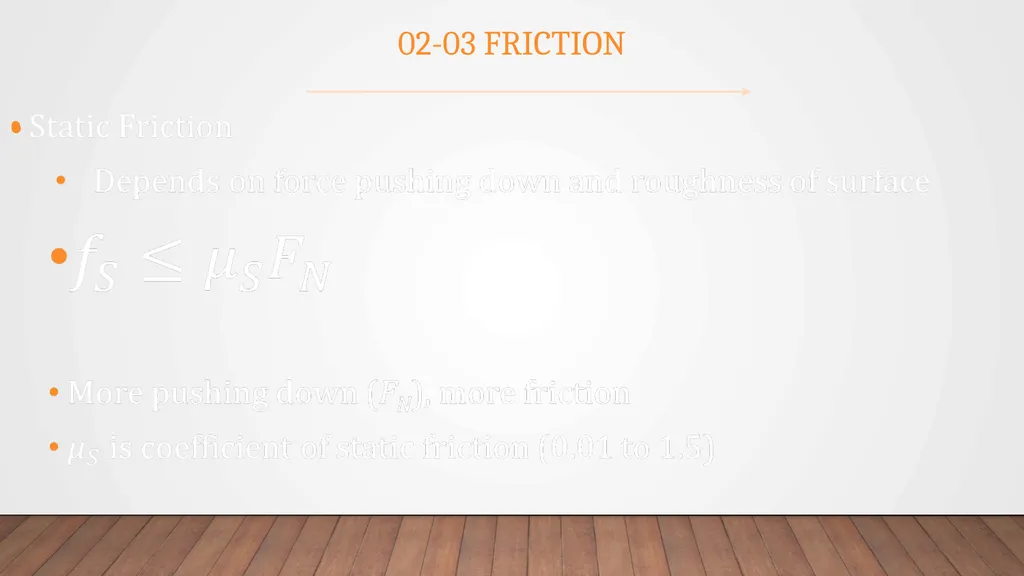
02-03 Friction Static Friction
Keeps things from moving.
Cancels out applied force until the applied force gets too big.
Depends on force pushing down and roughness of surface<br>
Keeps things from moving.
Cancels out applied force until the applied force gets too big.
Depends on force pushing down and roughness of surface<br>
35
02-03 Friction<br>
36
02-03 Friction<br>
37
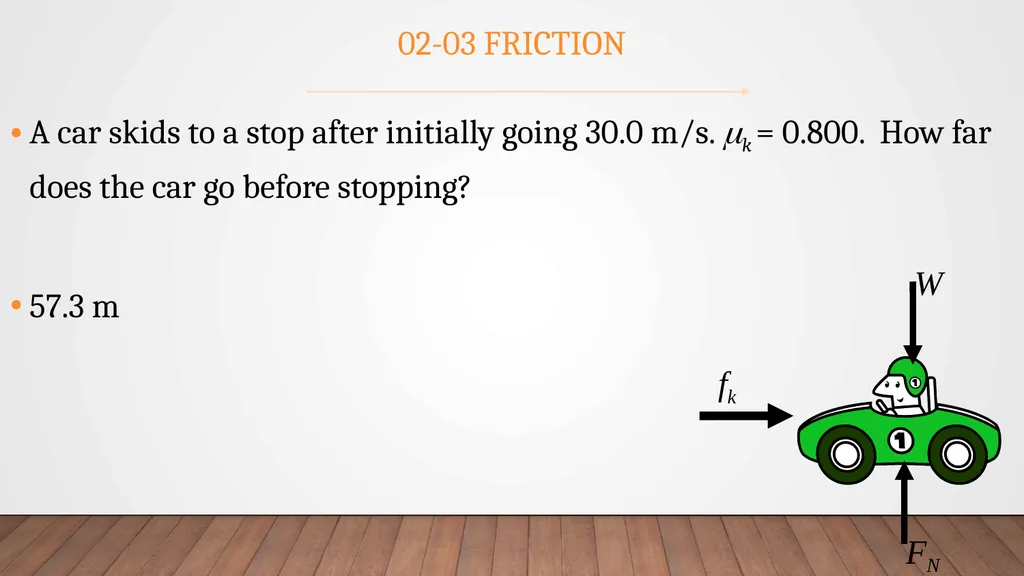
02-03 Friction A car skids to a stop after initially going 30.0 m/s. k = 0.800. How far does the car go before stopping?
57.3 m<br>
57.3 m<br>
38
02-03 Friction<br>
39
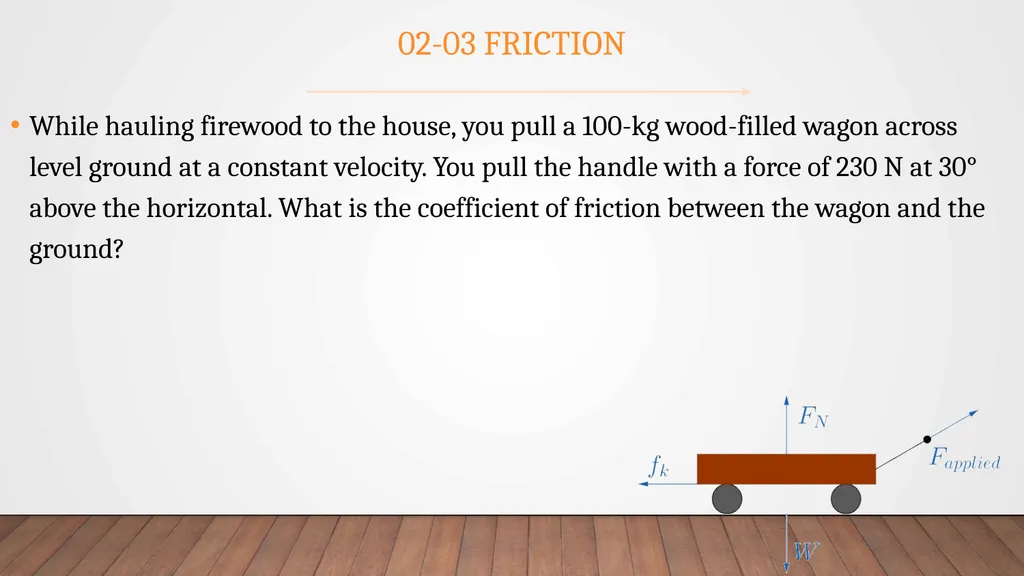
02-03 Friction While hauling firewood to the house, you pull a 100-kg wood-filled wagon across level ground at a constant velocity. You pull the handle with a force of 230 N at 30° above the horizontal. What is the coefficient of friction between the wagon and the ground?<br>
40
02-03 Friction Don’t let these problems cause friction between us
Read 4.5, 5.2, 4.7<br>
Read 4.5, 5.2, 4.7<br>
41
02-04 Tension, Hooke's Law, Drag, and Equilibrium In this lesson you will…
• Define tension force.
• Apply Newton's laws of motion to solve problems involving a variety of forces.
• Express mathematically the drag force.
• Discuss the applications of drag force.
• Define terminal velocity.
• Determine the terminal velocity given mass.
• Apply problem-solving techniques to solve for quantities in more complex systems of forces.<br>
• Define tension force.
• Apply Newton's laws of motion to solve problems involving a variety of forces.
• Express mathematically the drag force.
• Discuss the applications of drag force.
• Define terminal velocity.
• Determine the terminal velocity given mass.
• Apply problem-solving techniques to solve for quantities in more complex systems of forces.<br>
42
02-04 Tension, Hooke's Law, Drag, and Equilibrium Do the lab on your worksheet<br>
43
02-04 Tension, Hooke's Law, Drag, and Equilibrium<br>
44
02-04 Tension, Hooke's Law, Drag, and Equilibrium Tension
Pulling force from rope, chain, etc.
Everywhere the rope connects to something, there is an identical tension<br>
Pulling force from rope, chain, etc.
Everywhere the rope connects to something, there is an identical tension<br>
45
02-04 Tension, Hooke's Law, Drag, and Equilibrium Drag
Resistive force from moving through a fluid
Size depends on area, speed, and properties of the fluid<br>
Resistive force from moving through a fluid
Size depends on area, speed, and properties of the fluid<br>
46
02-04 Tension, Hooke's Law, Drag, and Equilibrium<br>
47
02-04 Tension, Hooke's Law, Drag, and Equilibrium<br>
48
02-04 Tension, Hooke's Law, Drag, and Equilibrium The helicopter in the drawing is moving horizontally to the right at a constant velocity. The weight of the helicopter is 53,800 N. The lift force L generated by the rotating blade makes an angle of 21.0° with respect to the vertical. What is the magnitude of the lift force?
57600 N<br>
57600 N<br>
49
02-04 Tension, Hooke's Law, Drag, and Equilibrium A stoplight is suspended by two cables over a street. Weight of the light is 110 N and the cables make a 122° angle with each side of the light. Find the tension in each cable.
104 N<br>
104 N<br>
50
02-04 Tension, Hooke's Law, Drag, and Equilibrium A mountain climber, in the process of crossing between two cliffs by a rope, pauses to rest. She weighs 535 N. Find the tensions in the rope to the left and to the right of the mountain climber.<br>
51
02-04 Tension, Hooke's Law, Drag, and Equilibrium A 10-g toy plastic bunny is connected to its base by a spring. The spring is compressed and a suction cup on the bunny holds it to the base so that the bunny doesn't move. If the spring is compressed 3 cm and has a constant of 330 N/m, how much force must the suction cup provide?<br>
52
02-04 Tension, Hooke's Law, Drag, and Equilibrium The tension is mounting… I can’t wait to see what’s next!
Read 4.8<br>
Read 4.8<br>
53
02-05 Nonequilibrium and Fundamental Forces In this lesson you will…
• Understand the four basic forces that underlie the processes in nature.<br>
• Understand the four basic forces that underlie the processes in nature.<br>
54
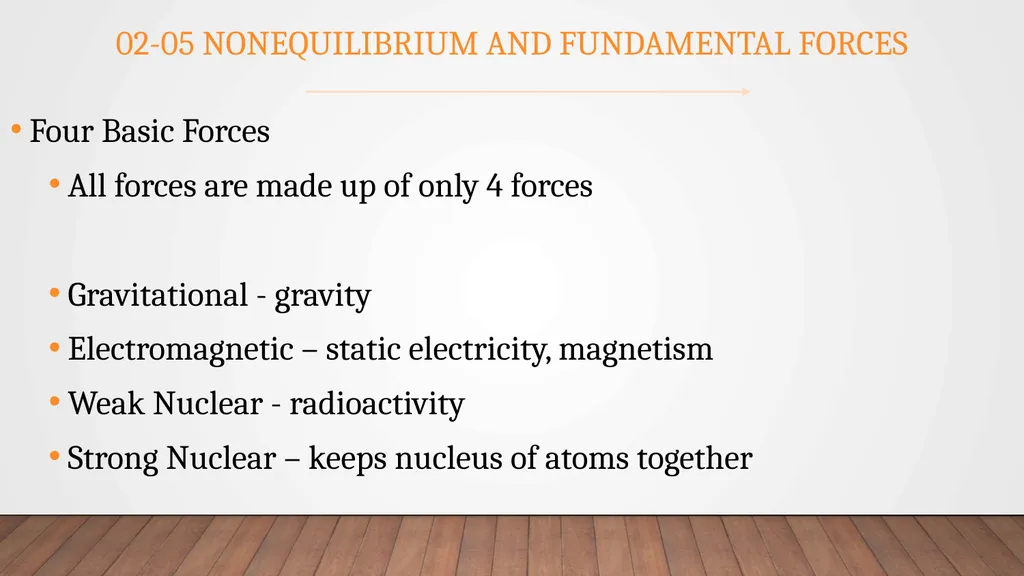
02-05 Nonequilibrium and Fundamental Forces Four Basic Forces
All forces are made up of only 4 forces
Gravitational - gravity
Electromagnetic – static electricity, magnetism
Weak Nuclear - radioactivity
Strong Nuclear – keeps nucleus of atoms together<br>
All forces are made up of only 4 forces
Gravitational - gravity
Electromagnetic – static electricity, magnetism
Weak Nuclear - radioactivity
Strong Nuclear – keeps nucleus of atoms together<br>
55
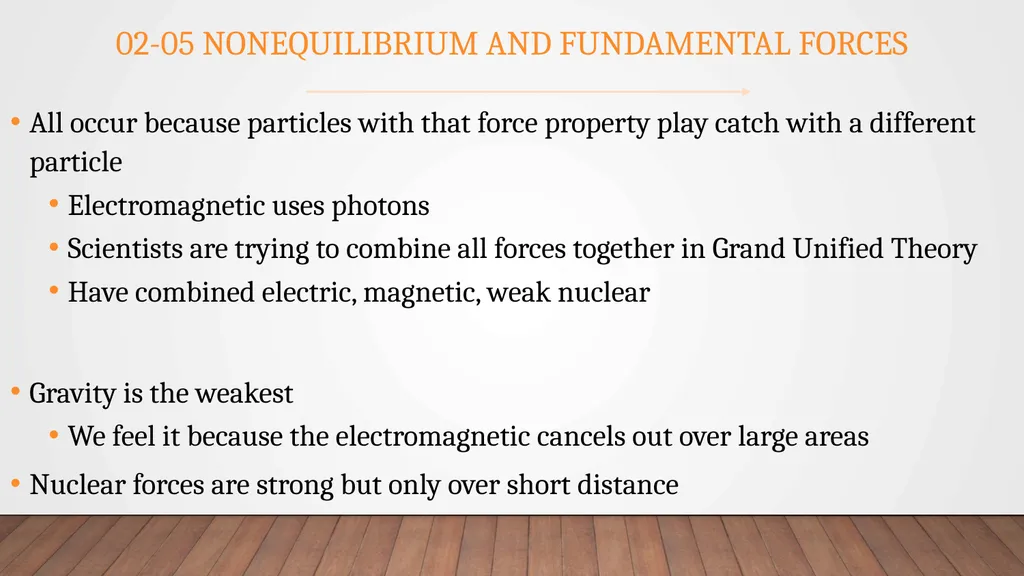
02-05 Nonequilibrium and Fundamental Forces All occur because particles with that force property play catch with a different particle
Electromagnetic uses photons
Scientists are trying to combine all forces together in Grand Unified Theory
Have combined electric, magnetic, weak nuclear
Gravity is the weakest
We feel it because the electromagnetic cancels out over large areas
Nuclear forces are strong but only over short distance<br>
Electromagnetic uses photons
Scientists are trying to combine all forces together in Grand Unified Theory
Have combined electric, magnetic, weak nuclear
Gravity is the weakest
We feel it because the electromagnetic cancels out over large areas
Nuclear forces are strong but only over short distance<br>
56
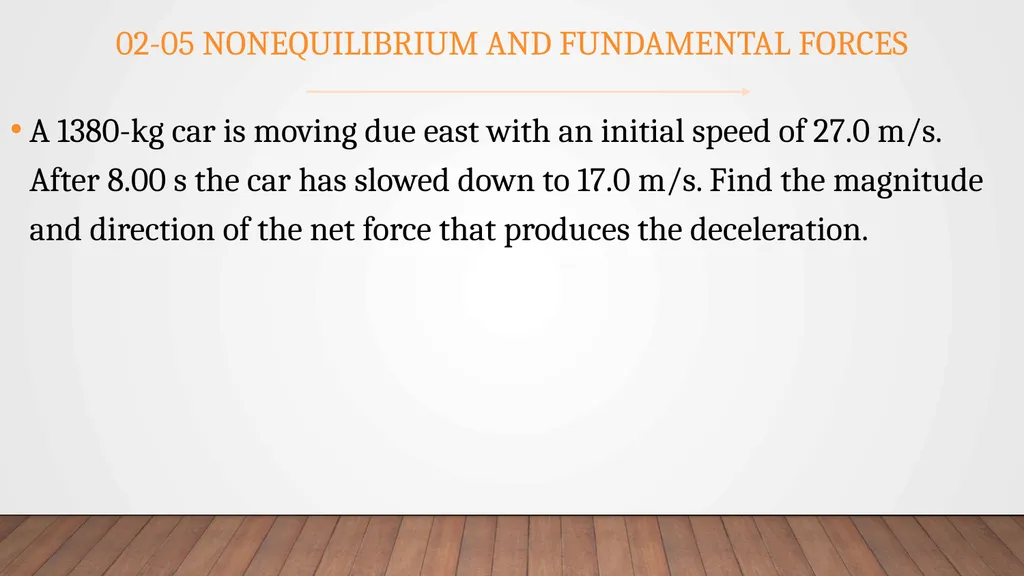
02-05 Nonequilibrium and Fundamental Forces A 1380-kg car is moving due east with an initial speed of 27.0 m/s. After 8.00 s the car has slowed down to 17.0 m/s. Find the magnitude and direction of the net force that produces the deceleration.<br>
57
02-05 Nonequilibrium and Fundamental Forces<br>
58
02-05 Nonequilibrium and Fundamental Forces<br>
59
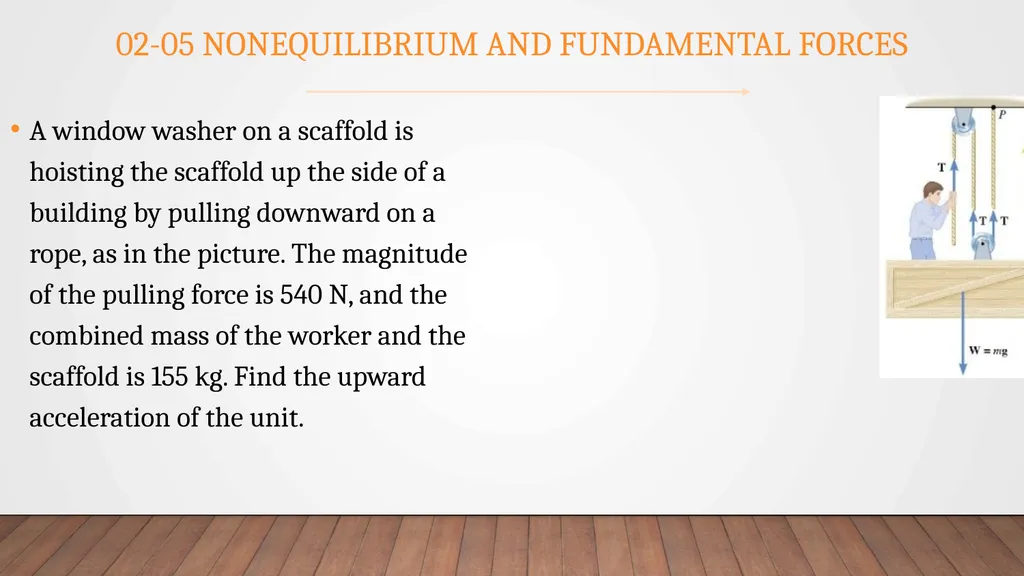
02-05 Nonequilibrium and Fundamental Forces A window washer on a scaffold is hoisting the scaffold up the side of a building by pulling downward on a rope, as in the picture. The magnitude of the pulling force is 540 N, and the combined mass of the worker and the scaffold is 155 kg. Find the upward acceleration of the unit.<br>
60
02-05 Nonequilibrium and Fundamental Forces Electromagnetic forces are responsible for doing homework.
Read 6.1, 6.2<br>
Read 6.1, 6.2<br>
61
02-06 Angular Velocity and Centripetal Acceleration In this lesson you will…
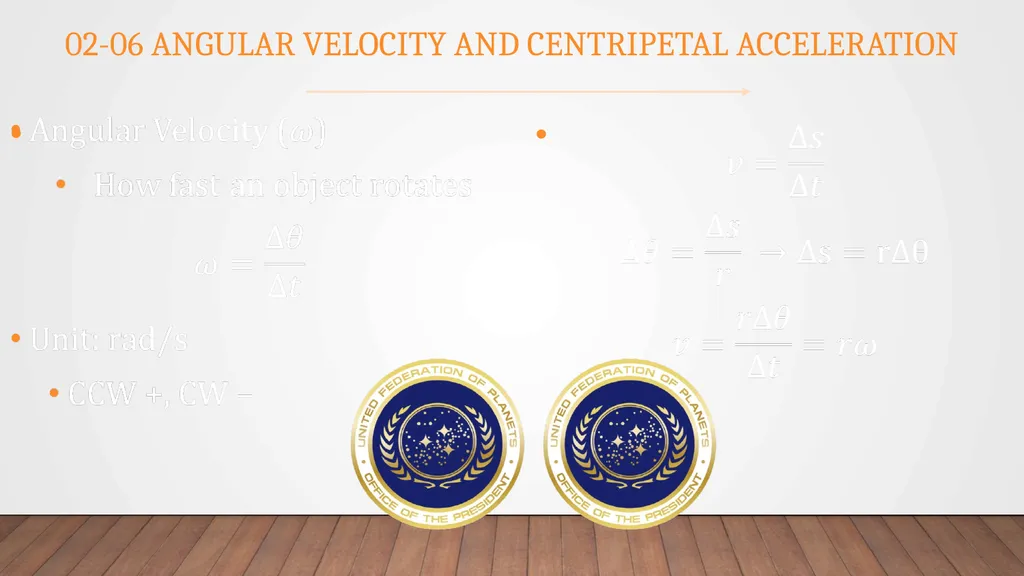
• Define arc length, rotation angle, radius of curvature and angular velocity.
• Calculate the angular velocity of a car wheel spin.
• Establish the expression for centripetal acceleration.
• Explain the centrifuge.<br>
• Define arc length, rotation angle, radius of curvature and angular velocity.
• Calculate the angular velocity of a car wheel spin.
• Establish the expression for centripetal acceleration.
• Explain the centrifuge.<br>
62
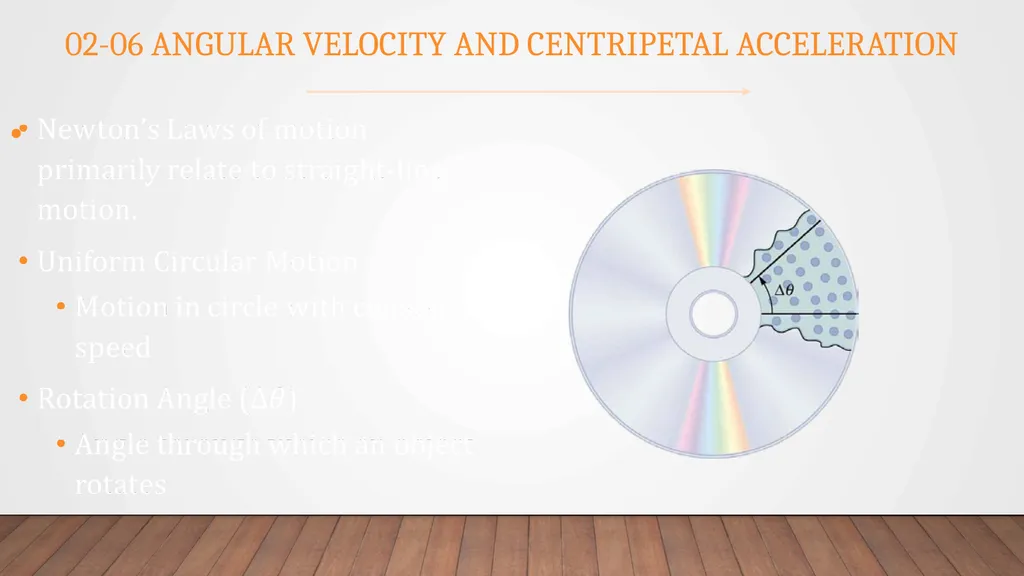
02-06 Angular Velocity and Centripetal Acceleration<br>
63
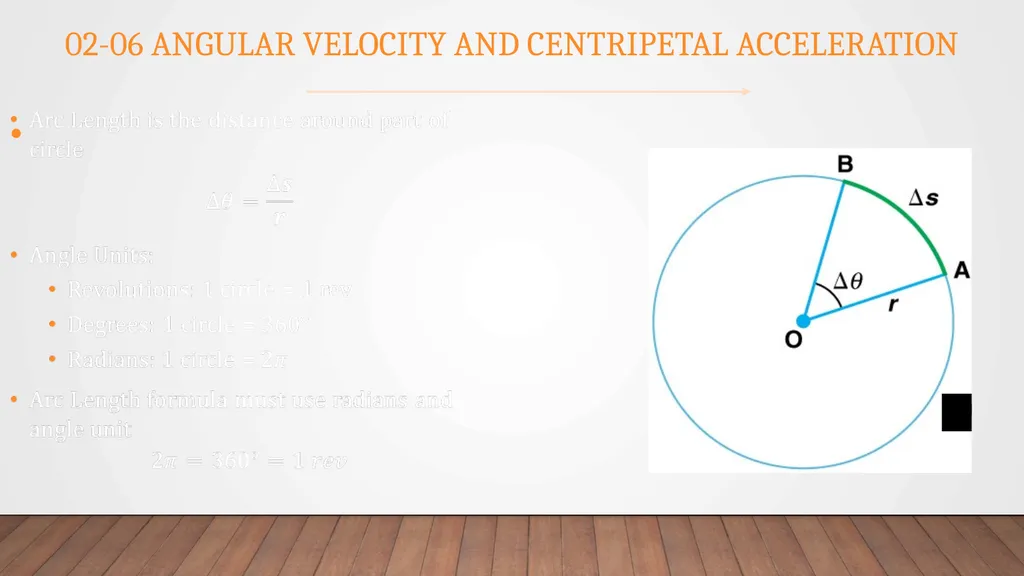
02-06 Angular Velocity and Centripetal Acceleration<br>
64
02-06 Angular Velocity and Centripetal Acceleration Convert 60° to radians Convert 2 revolutions to radians<br>
65
02-06 Angular Velocity and Centripetal Acceleration<br>
66
02-06 Angular Velocity and Centripetal Acceleration A CD rotates 320 times in 2.4 s. What is its angular velocity in rad/s? What is the linear velocity of a point 5 cm from the center?<br>
67
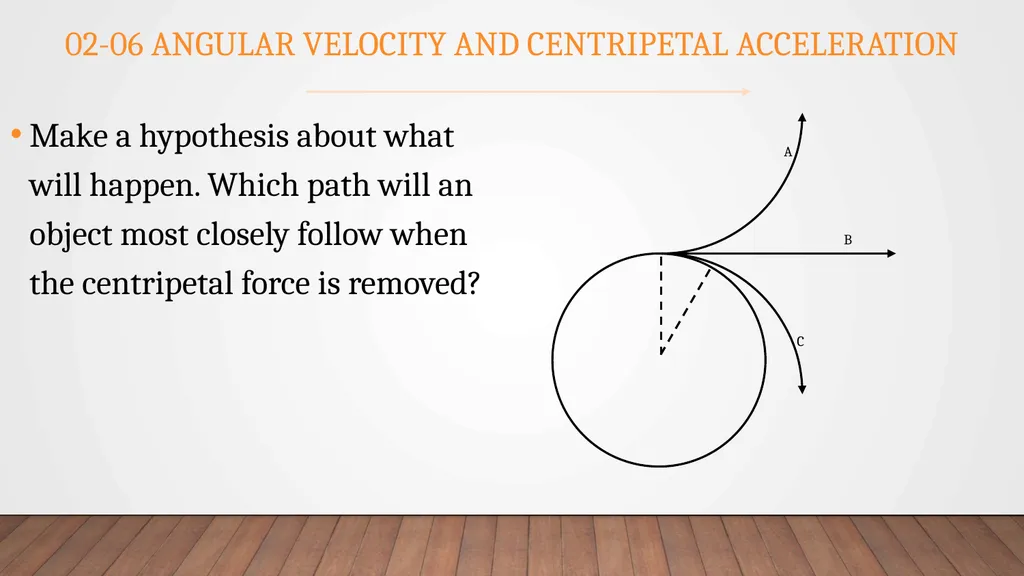
02-06 Angular Velocity and Centripetal Acceleration Make a hypothesis about what will happen. Which path will an object most closely follow when the centripetal force is removed?<br>
68
02-06 Angular Velocity and Centripetal Acceleration Put the plate on a flat surface and put a marble in the ridge.
Push the marble in the ridge so that it travels around the plate and then out of the removed section.
What is providing the centripetal force? i.e. what is keeping the marble traveling in a circle?
Perform the test several times and record your results.
Which of Newton’s Laws explains the results?
This would have been more complicated if the object moved in a vertical circle. Why?<br>
Push the marble in the ridge so that it travels around the plate and then out of the removed section.
What is providing the centripetal force? i.e. what is keeping the marble traveling in a circle?
Perform the test several times and record your results.
Which of Newton’s Laws explains the results?
This would have been more complicated if the object moved in a vertical circle. Why?<br>
69
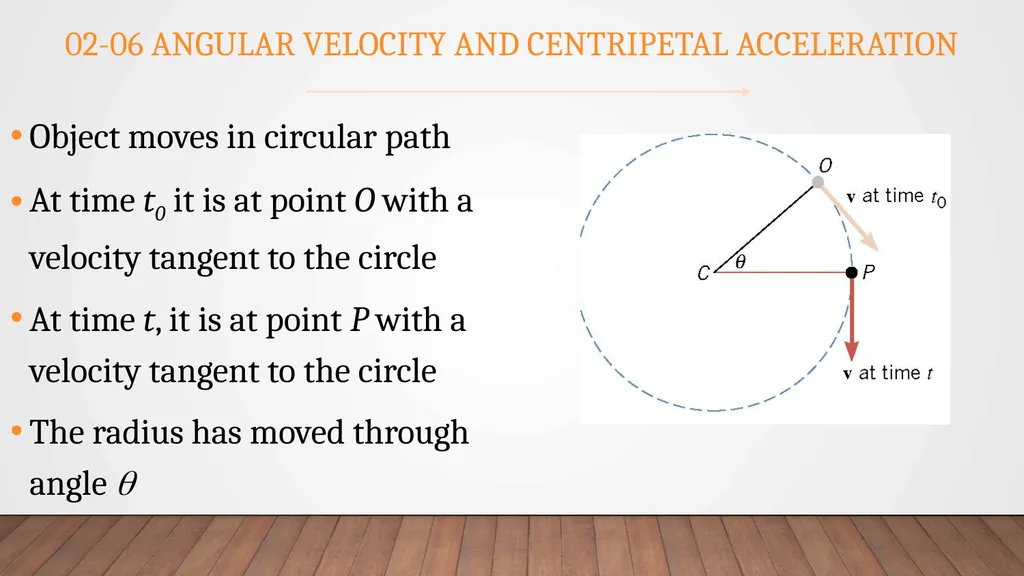
02-06 Angular Velocity and Centripetal Acceleration Object moves in circular path
At time t0 it is at point O with a velocity tangent to the circle
At time t, it is at point P with a velocity tangent to the circle
The radius has moved through angle <br>
At time t0 it is at point O with a velocity tangent to the circle
At time t, it is at point P with a velocity tangent to the circle
The radius has moved through angle <br>
70
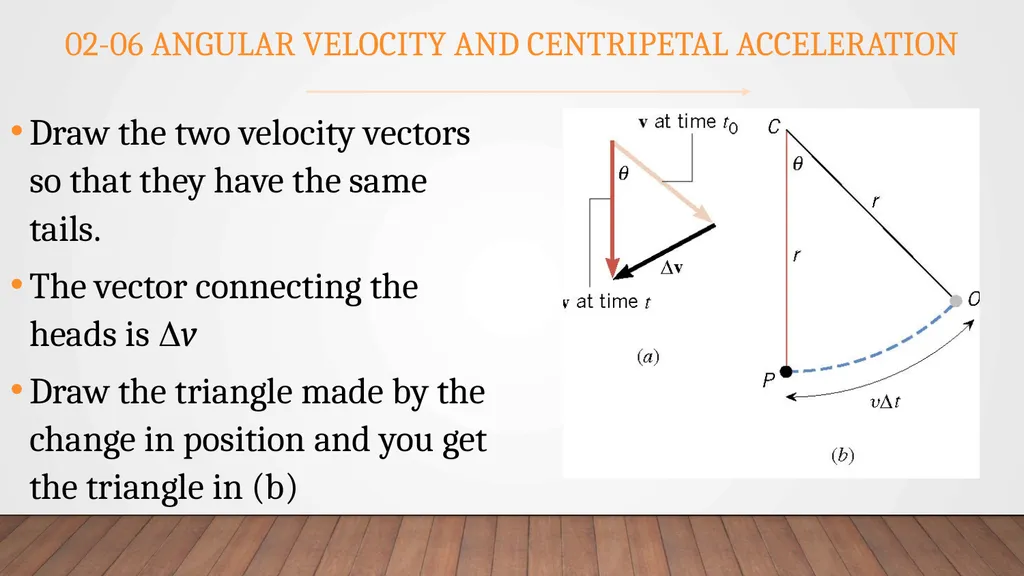
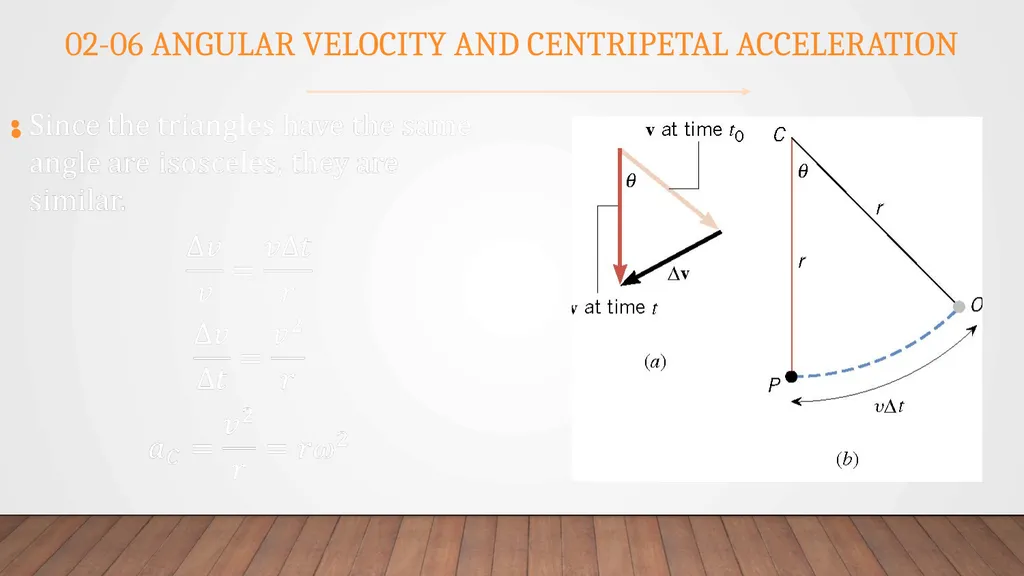
02-06 Angular Velocity and Centripetal Acceleration Draw the two velocity vectors so that they have the same tails.
The vector connecting the heads is v
Draw the triangle made by the change in position and you get the triangle in (b)<br>
The vector connecting the heads is v
Draw the triangle made by the change in position and you get the triangle in (b)<br>
71
02-06 Angular Velocity and Centripetal Acceleration<br>
72
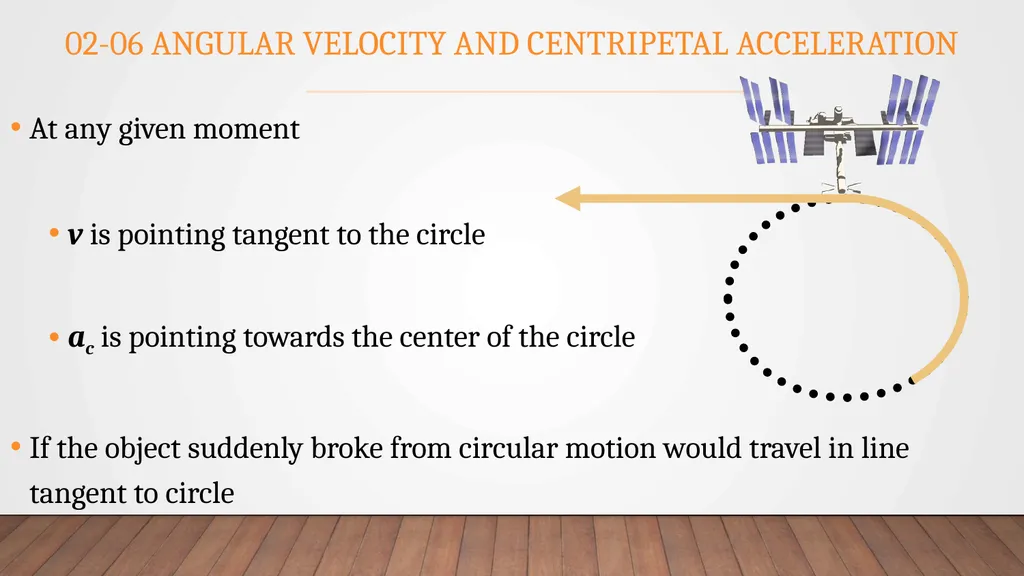
02-06 Angular Velocity and Centripetal Acceleration At any given moment
v is pointing tangent to the circle
ac is pointing towards the center of the circle
If the object suddenly broke from circular motion would travel in line tangent to circle<br>
v is pointing tangent to the circle
ac is pointing towards the center of the circle
If the object suddenly broke from circular motion would travel in line tangent to circle<br>
73
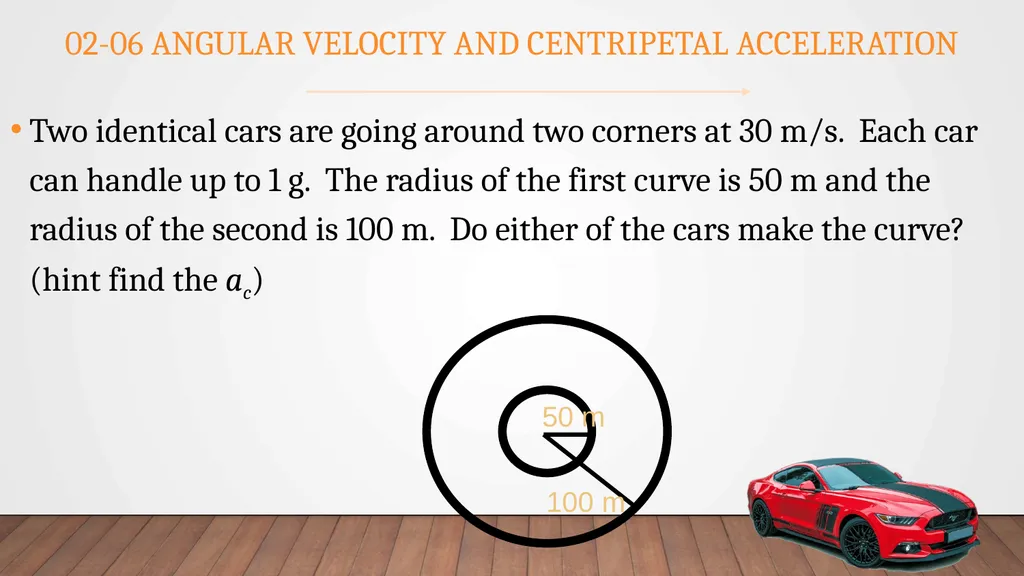
02-06 Angular Velocity and Centripetal Acceleration Two identical cars are going around two corners at 30 m/s. Each car can handle up to 1 g. The radius of the first curve is 50 m and the radius of the second is 100 m. Do either of the cars make the curve? (hint find the ac)<br>
74
02-06 Angular Velocity and Centripetal Acceleration Rotating too fast can make you sick, but these problems won’t.
Read 6.3<br>
Read 6.3<br>
75
02-07 Centripetal Force and Banked Curves In this lesson you will…
• Calculate coefficient of friction on a car tire.
• Calculate ideal speed and angle of a car on a turn.<br>
• Calculate coefficient of friction on a car tire.
• Calculate ideal speed and angle of a car on a turn.<br>
76
02-07 Centripetal Force and Banked Curves Do the lab on your worksheet
Are force and mass a direct or inverse relation?
Are force and speed a direct or inverse relation?
Are force and radius a direct or inverse relation?
A car will skid when the centripetal force required to make it turn is greater than the force of friction. What are two things the driver could do to lessen the change of a skid in a curve?<br>
Are force and mass a direct or inverse relation?
Are force and speed a direct or inverse relation?
Are force and radius a direct or inverse relation?
A car will skid when the centripetal force required to make it turn is greater than the force of friction. What are two things the driver could do to lessen the change of a skid in a curve?<br>
77
02-07 Centripetal Force and Banked Curves<br>
78
02-07 Centripetal Force and Banked Curves Centripetal Force is not a new, separate force created by nature!
Some other force creates centripetal force
Swinging something from a string tension
Satellite in orbit gravity
Car going around curve friction<br>
Some other force creates centripetal force
Swinging something from a string tension
Satellite in orbit gravity
Car going around curve friction<br>
79
02-07 Centripetal Force and Banked Curves A 1.25-kg toy airplane is attached to a string and swung in a circle with radius = 0.50 m. What was the centripetal force for a speed of 20 m/s? What provides the Fc?
Fc = 1000 N
Tension in the string<br>
Fc = 1000 N
Tension in the string<br>
80
02-07 Centripetal Force and Banked Curves What affects Fc more: a change in mass, a change in radius, or a change in speed?
A change in speed since it is squared and the others aren’t.<br>
A change in speed since it is squared and the others aren’t.<br>
81
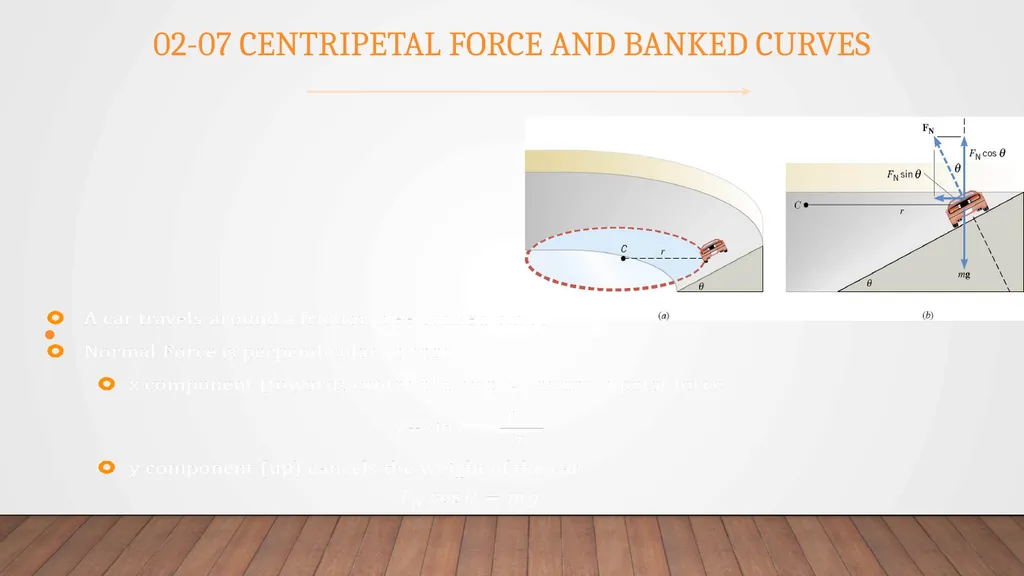
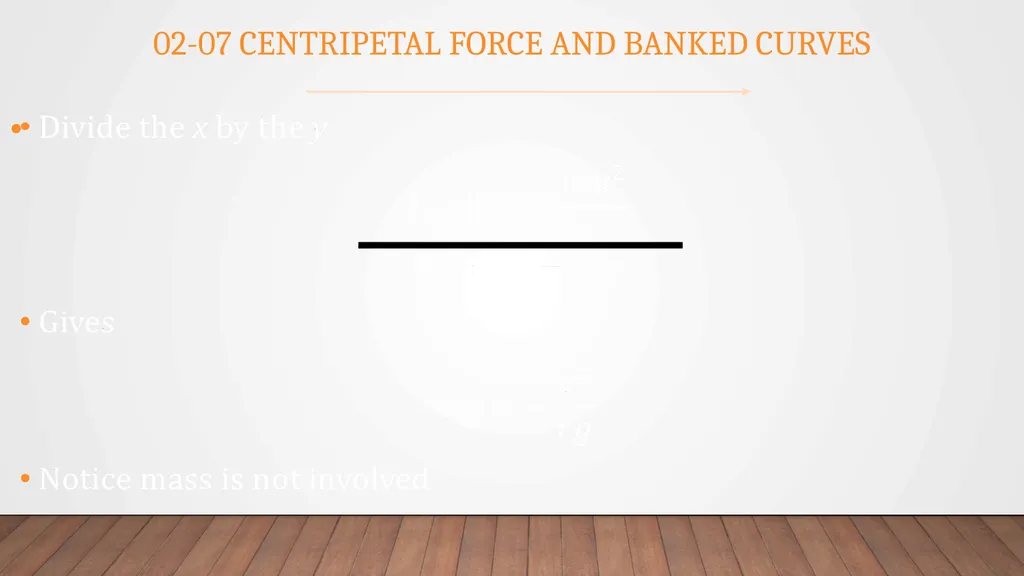
02-07 Centripetal Force and Banked Curves When a car travels around an unbanked curve, static friction provides the centripetal force.
By banking a curve, this reliance on friction can be eliminated for a given speed.<br>
By banking a curve, this reliance on friction can be eliminated for a given speed.<br>
82
02-07 Centripetal Force and Banked Curves<br>
83
02-07 Centripetal Force and Banked Curves<br>
84
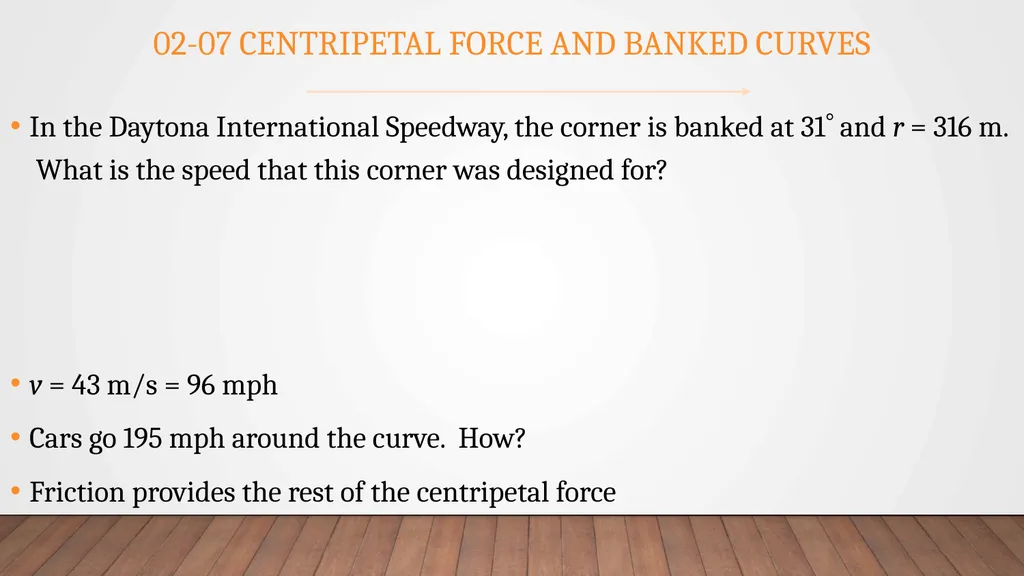
02-07 Centripetal Force and Banked Curves In the Daytona International Speedway, the corner is banked at 31 and r = 316 m. What is the speed that this corner was designed for?
v = 43 m/s = 96 mph
Cars go 195 mph around the curve. How?
Friction provides the rest of the centripetal force<br>
v = 43 m/s = 96 mph
Cars go 195 mph around the curve. How?
Friction provides the rest of the centripetal force<br>
85
02-07 Centripetal Force and Banked Curves Why do objects seem to fly away from circular motion?
They really go in a straight line according to Newton's First Law.<br>
They really go in a straight line according to Newton's First Law.<br>
86
02-07 Centripetal Force and Banked Curves How does the spin cycle in a washing machine work?
The drum’s normal forces makes the clothes to travel in a circle. The water can go through the holes, so it goes in a straight line. The water is not spun out, the clothes are moved away from the water.<br>
The drum’s normal forces makes the clothes to travel in a circle. The water can go through the holes, so it goes in a straight line. The water is not spun out, the clothes are moved away from the water.<br>
87
02-07 Centripetal Force and Banked Curves Remember the good old days when cars were big, the seats were vinyl bench seats, and there were no seat belts? Well when a guy would take a girl out on a date and he wanted to get cozy, he would put his arm on the back of the seat then make a right hand turn. The car and the guy would turn since the tires and steering wheel provided the centripetal force. The friction between the seat and the girl was not enough, so the girl would continue in a straight path while the car turned underneath her. She would end up in the guy’s arms.<br>
88
02-07 Centripetal Force and Banked Curves There is a real force to make you do these problems.
Read 6.5<br>
Read 6.5<br>
89
02-08 Satellites and Kepler’s Laws In this lesson you will…
• Explain Earth’s gravitational force.
• Describe the gravitational effect of the Moon on Earth.
• Discuss weightlessness in space.
• State Kepler’s laws of planetary motion.<br>
• Explain Earth’s gravitational force.
• Describe the gravitational effect of the Moon on Earth.
• Discuss weightlessness in space.
• State Kepler’s laws of planetary motion.<br>
90
02-08 Satellites and Kepler’s Laws Do the lab on your worksheet
What effect did moving the pins have on the eccentricity?
The earth’s orbit eccentricity is about 0.0167. One of these ellipses has an eccentricity of 0.0167. Which is it?
Does the ovalness of the earth’s orbit cause the seasons as based on the shape of the earth’s orbit from this lab?<br>
What effect did moving the pins have on the eccentricity?
The earth’s orbit eccentricity is about 0.0167. One of these ellipses has an eccentricity of 0.0167. Which is it?
Does the ovalness of the earth’s orbit cause the seasons as based on the shape of the earth’s orbit from this lab?<br>
91
02-08 Satellites and Kepler’s Laws Satellites
Any object orbiting another object only under the influence of gravity
Gravity provides the centripetal force
There is only one speed that a satellite can have if the satellite is to remain in an orbit with a fixed radius.<br>
Any object orbiting another object only under the influence of gravity
Gravity provides the centripetal force
There is only one speed that a satellite can have if the satellite is to remain in an orbit with a fixed radius.<br>
92
02-08 Satellites and Kepler’s Laws<br>
93
02-08 Satellites and Kepler’s Laws<br>
94
02-08 Satellites and Kepler’s Laws Calculate the speed of a satellite 500 km above the earth’s surface.<br>
95
02-08 Satellites and Kepler’s Laws<br>
96
02-08 Satellites and Kepler’s Laws Astronauts in the space shuttles and international space station seem to float
They appear weightless
They are really falling
Acceleration is about g towards earth<br>
They appear weightless
They are really falling
Acceleration is about g towards earth<br>
97
02-08 Satellites and Kepler’s Laws … they were finally able to close and repressurize the hatch. Several months later a new team of cosmonauts returned and found the hatch impossible to permanently repair. Instead they attached a set of clamps to secure it in place.
It is this set of clamps that Linenger and Tsibliyev are staring at uneasily seven years later. To his relief, the commander opens the hatch Without incident and crawls outside onto an adjoining ladder just after nine o’clock. Linenger begins to follow. Outside the Sun is rising. The Russians have planned the EVA at a sunrise so as to get the longest period of light. But because of that, Linenger’s first view of space is straight into the blazing Sun. “The first view I got was just blinding rays coming at me,” Linenger told his postflight debriefing session. “Even with my gold visor down, it was just blinding. [I] was basically unable to see for the first three or four minutes going out the hatch.”<br>
It is this set of clamps that Linenger and Tsibliyev are staring at uneasily seven years later. To his relief, the commander opens the hatch Without incident and crawls outside onto an adjoining ladder just after nine o’clock. Linenger begins to follow. Outside the Sun is rising. The Russians have planned the EVA at a sunrise so as to get the longest period of light. But because of that, Linenger’s first view of space is straight into the blazing Sun. “The first view I got was just blinding rays coming at me,” Linenger told his postflight debriefing session. “Even with my gold visor down, it was just blinding. [I] was basically unable to see for the first three or four minutes going out the hatch.”<br>
98
02-08 Satellites and Kepler’s Laws The situation only gets worse once his eyes clear. Exiting the airlock, Linenger climbs out onto a horizontal ladder that stretches out along the side of the module into the darkness. Glancing about, trying in vain to get his bearings, he is suddenly hit by an overwhelming sense that he is falling, as if from a cliff. Clamping his tethers onto the handrail, he fights back a wave of panic and tightens his grip on the ladder. But he still can’t shake the feeling that he is plummeting through space at eighteen thousand miles an hour. His mind races.
You’re okay. You’re okay. You’re not going to fall. The bottom is way far away.<br>
You’re okay. You’re okay. You’re not going to fall. The bottom is way far away.<br>
99
02-08 Satellites and Kepler’s Laws And now a second, even more intense feeling washes over him: He’s not just plunging off a cliff. The entire cliff is crumbling away. “It wasn’t just me falling, but everything was falling, which gave [me] even a more unsettling feeling,” Linenger told his debriefers. “So, it was like you had to overcome forty years or whatever of life experiences that [you] don’t let go when everything falls. It was a very strong, almost overwhelming sensation that you just had to control. And I was able to control it, and I was glad I was able to control it. But I could see where it could have put me over the edge.”<br>
100
02-08 Satellites and Kepler’s Laws The disorientation is paralyzing. There is no up, no down, no side. There is only three-dimensional space. It is an entirely different sensation from spacewalking on the shuttle, where the astronauts are surrounded on three sides by a cargo bay. And it feels nothing—nothing—like the Star City pool. Linenger is an ant on the side of a falling apple, hurtling through space at eighteen thousand miles an hour, acutely aware what will happen if his Russian-made tethers break. As he clings to the thin railing, he tries not to think about the handrail on Kvant that came apart during a cosmonaut’s spacewalk in the early days of Mir. Loose bolts, the Russians said.
Loose bolts.<br>
Loose bolts.<br>
101
02-08 Satellites and Kepler’s Laws After studying motion of planets, Kepler came up with his laws of planetary motion
Newton then proved them all using his Universal Law of Gravitation
Assumptions:
A small mass, m, orbits much larger mass, M, so we can use M as an approximate inertia reference frame
The system is isolated<br>
Newton then proved them all using his Universal Law of Gravitation
Assumptions:
A small mass, m, orbits much larger mass, M, so we can use M as an approximate inertia reference frame
The system is isolated<br>
102
02-08 Satellites and Kepler’s Laws The orbit of each planet about the Sun is an ellipse with the sun at one focus.
Watch video Kepler’s First Law<br>
Watch video Kepler’s First Law<br>
103
02-08 Satellites and Kepler’s Laws Each planet moves so that an imaginary line drawn from the sun to the planet sweeps out equal areas in equal times.
Watch video Kepler’s Second Law<br>
Watch video Kepler’s Second Law<br>
104
02-08 Satellites and Kepler’s Laws<br>
105
02-08 Satellites and Kepler’s Laws<br>
106
02-08 Satellites and Kepler’s Laws Draw an ellipse around your answers to these homework problems<br>