
Foreign Direct Investment (FDI) Lesson 05 Chapter
PC
Published · 29 slides · 0 views

1 / 1




Description
Foreign Direct Investment (FDI) Lesson 05 Chapter 07 BUS 368 Session 1 2 International Business Spring 2025 TIU Learning Objectives Recognize the importance of foreign direct investment in the world economy Explain the different theories
Related Topics
Share
Embed code
Download this presentation From Below
"Foreign Direct Investment (FDI) Lesson 05 Chapter" is the property of its rightful owner. Permission is granted to download and print the materials on this website for personal, non-commercial use only, and to display it on your personal computer provided you do not modify the materials and that you retain all copyright notices contained in the materials. By downloading content from our website, you accept the terms of this agreement.
Presentation Transcript
01
Foreign Direct Investment (FDI) Lesson 05
Chapter 07
BUS 368
Session 1 & 2
International Business
Spring 2025
TIU<br>
Chapter 07
BUS 368
Session 1 & 2
International Business
Spring 2025
TIU<br>
02
Learning Objectives Recognize the importance of foreign direct investment in the world economy
Explain the different theories of FDI
Understand how political ideology shapes a government's attitudes toward FDI
Describe the benefits and costs of FDI to host countries
Explain the range of policy instruments that governments use to influence FDI
Identify the implications for managers of the theory and government policies associated with FDI<br>
Explain the different theories of FDI
Understand how political ideology shapes a government's attitudes toward FDI
Describe the benefits and costs of FDI to host countries
Explain the range of policy instruments that governments use to influence FDI
Identify the implications for managers of the theory and government policies associated with FDI<br>
03
Background Knowledge Probe<br>
04
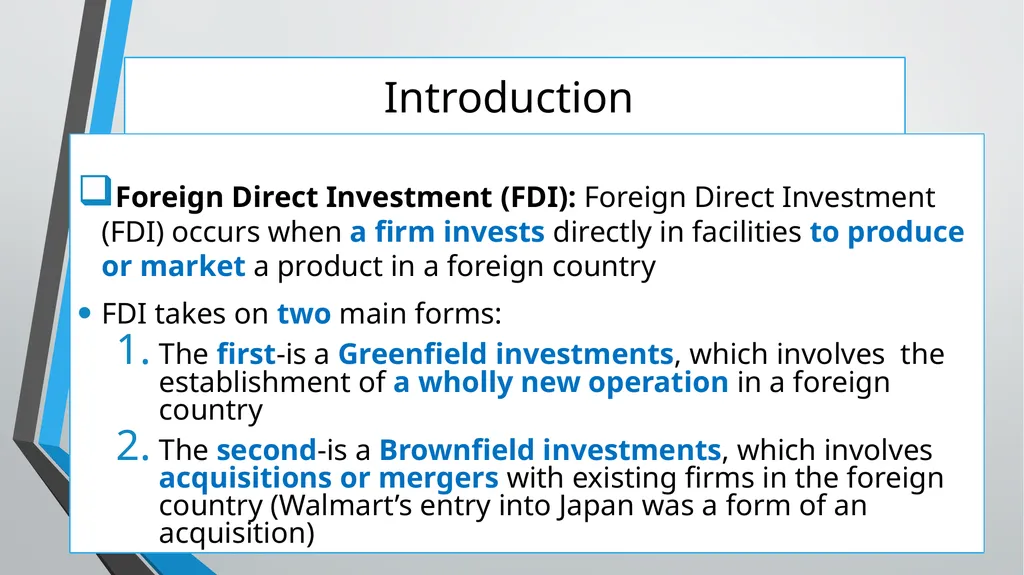
Introduction Foreign Direct Investment (FDI): Foreign Direct Investment (FDI) occurs when a firm invests directly in facilities to produce or market a product in a foreign country
FDI takes on two main forms:
The first-is a Greenfield investments, which involves the establishment of a wholly new operation in a foreign country
The second-is a Brownfield investments, which involves acquisitions or mergers with existing firms in the foreign country (Walmart’s entry into Japan was a form of an acquisition)<br>
FDI takes on two main forms:
The first-is a Greenfield investments, which involves the establishment of a wholly new operation in a foreign country
The second-is a Brownfield investments, which involves acquisitions or mergers with existing firms in the foreign country (Walmart’s entry into Japan was a form of an acquisition)<br>
05
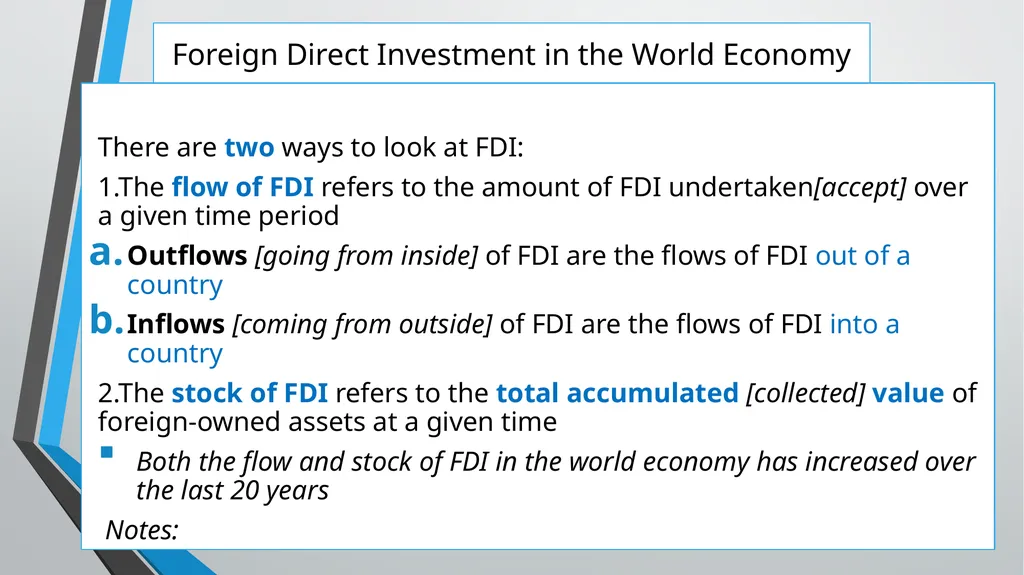
There are two ways to look at FDI:
1.The flow of FDI refers to the amount of FDI undertaken[accept] over a given time period
Outflows [going from inside] of FDI are the flows of FDI out of a country
Inflows [coming from outside] of FDI are the flows of FDI into a country
2.The stock of FDI refers to the total accumulated [collected] value of foreign-owned assets at a given time
Both the flow and stock of FDI in the world economy has increased over the last 20 years
Notes: Foreign Direct Investment in the World Economy<br>
1.The flow of FDI refers to the amount of FDI undertaken[accept] over a given time period
Outflows [going from inside] of FDI are the flows of FDI out of a country
Inflows [coming from outside] of FDI are the flows of FDI into a country
2.The stock of FDI refers to the total accumulated [collected] value of foreign-owned assets at a given time
Both the flow and stock of FDI in the world economy has increased over the last 20 years
Notes: Foreign Direct Investment in the World Economy<br>
06
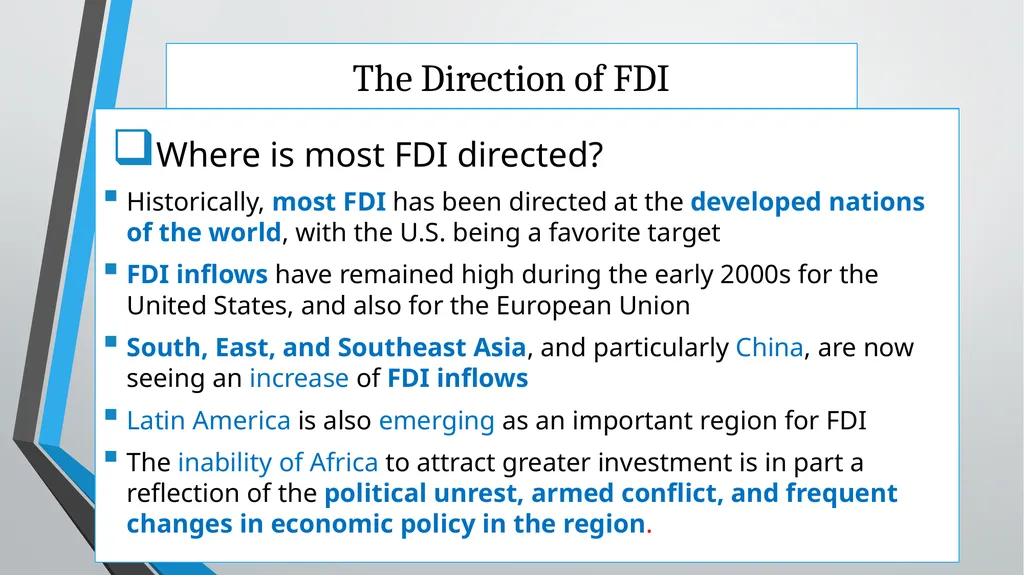
Where is most FDI directed?
Historically, most FDI has been directed at the developed nations of the world, with the U.S. being a favorite target
FDI inflows have remained high during the early 2000s for the United States, and also for the European Union
South, East, and Southeast Asia, and particularly China, are now seeing an increase of FDI inflows
Latin America is also emerging as an important region for FDI
The inability of Africa to attract greater investment is in part a reflection of the political unrest, armed conflict, and frequent changes in economic policy in the region. The Direction of FDI<br>
Historically, most FDI has been directed at the developed nations of the world, with the U.S. being a favorite target
FDI inflows have remained high during the early 2000s for the United States, and also for the European Union
South, East, and Southeast Asia, and particularly China, are now seeing an increase of FDI inflows
Latin America is also emerging as an important region for FDI
The inability of Africa to attract greater investment is in part a reflection of the political unrest, armed conflict, and frequent changes in economic policy in the region. The Direction of FDI<br>
07
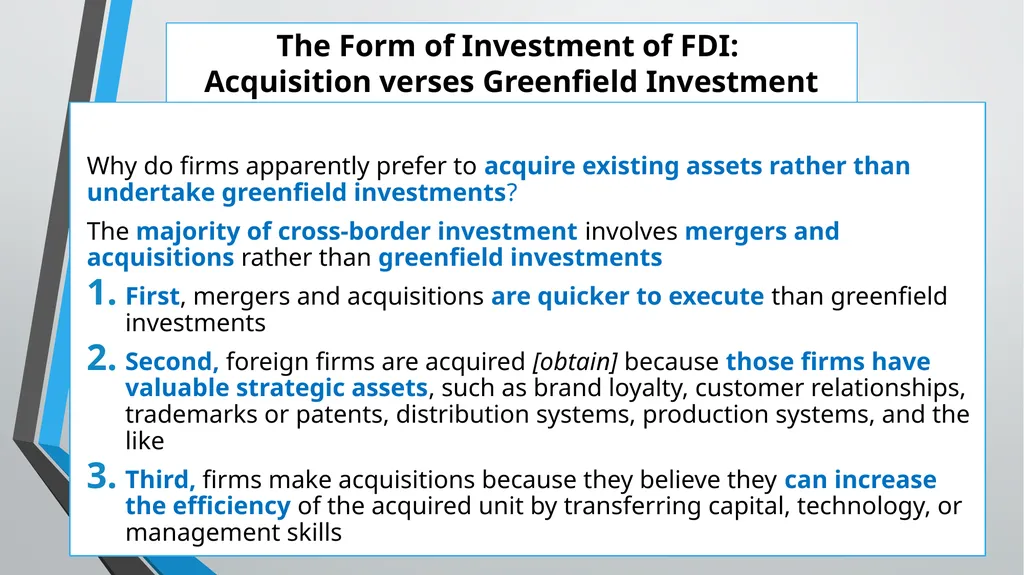
Why do firms apparently prefer to acquire existing assets rather than undertake greenfield investments?
The majority of cross-border investment involves mergers and acquisitions rather than greenfield investments
First, mergers and acquisitions are quicker to execute than greenfield investments
Second, foreign firms are acquired [obtain] because those firms have valuable strategic assets, such as brand loyalty, customer relationships, trademarks or patents, distribution systems, production systems, and the like
Third, firms make acquisitions because they believe they can increase the efficiency of the acquired unit by transferring capital, technology, or management skills The Form of Investment of FDI: Acquisition verses Greenfield Investment<br>
The majority of cross-border investment involves mergers and acquisitions rather than greenfield investments
First, mergers and acquisitions are quicker to execute than greenfield investments
Second, foreign firms are acquired [obtain] because those firms have valuable strategic assets, such as brand loyalty, customer relationships, trademarks or patents, distribution systems, production systems, and the like
Third, firms make acquisitions because they believe they can increase the efficiency of the acquired unit by transferring capital, technology, or management skills The Form of Investment of FDI: Acquisition verses Greenfield Investment<br>
08
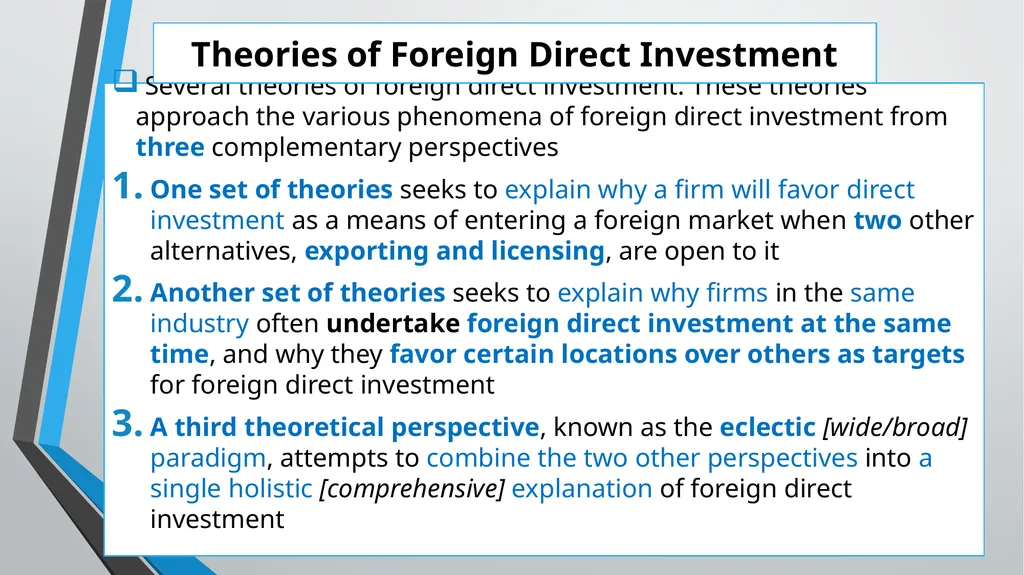
Several theories of foreign direct investment. These theories approach the various phenomena of foreign direct investment from three complementary perspectives
One set of theories seeks to explain why a firm will favor direct investment as a means of entering a foreign market when two other alternatives, exporting and licensing, are open to it
Another set of theories seeks to explain why firms in the same industry often undertake foreign direct investment at the same time, and why they favor certain locations over others as targets for foreign direct investment
A third theoretical perspective, known as the eclectic [wide/broad] paradigm, attempts to combine the two other perspectives into a single holistic [comprehensive] explanation of foreign direct investment Theories of Foreign Direct Investment<br>
One set of theories seeks to explain why a firm will favor direct investment as a means of entering a foreign market when two other alternatives, exporting and licensing, are open to it
Another set of theories seeks to explain why firms in the same industry often undertake foreign direct investment at the same time, and why they favor certain locations over others as targets for foreign direct investment
A third theoretical perspective, known as the eclectic [wide/broad] paradigm, attempts to combine the two other perspectives into a single holistic [comprehensive] explanation of foreign direct investment Theories of Foreign Direct Investment<br>
09
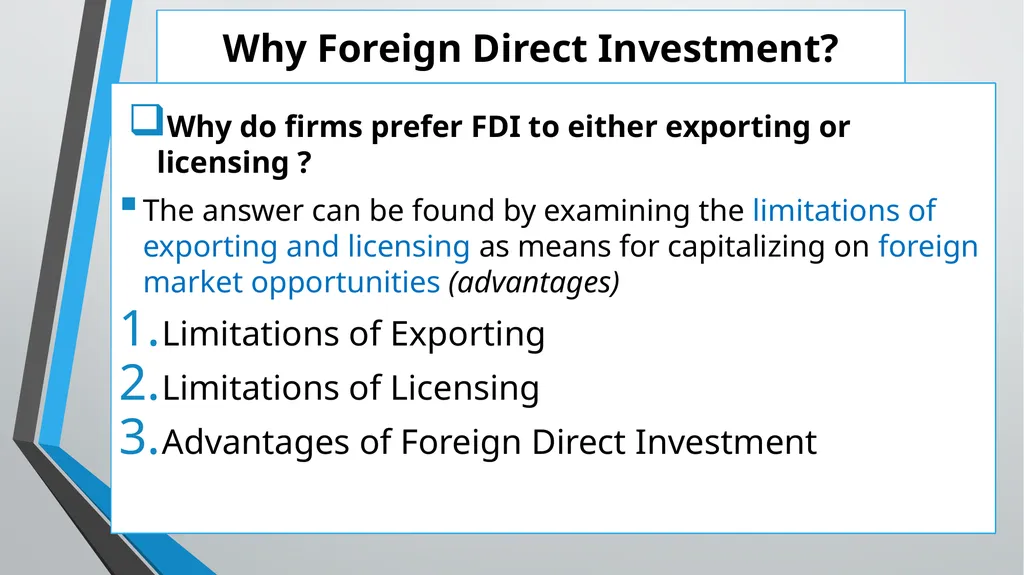
Why do firms prefer FDI to either exporting or licensing ?
The answer can be found by examining the limitations of exporting and licensing as means for capitalizing on foreign market opportunities (advantages)
Limitations of Exporting
Limitations of Licensing
Advantages of Foreign Direct Investment Why Foreign Direct Investment?<br>
The answer can be found by examining the limitations of exporting and licensing as means for capitalizing on foreign market opportunities (advantages)
Limitations of Exporting
Limitations of Licensing
Advantages of Foreign Direct Investment Why Foreign Direct Investment?<br>
10
Why do firms prefer FDI to either exporting or licensing ?
Exporting involves producing goods at home and then shipping them to the receiving country for sale
Licensing involves granting a foreign entity (the licensee) the right to produce and sell the firm's product in return for a royalty fee on every unit sold Why Foreign Direct Investment?<br>
Exporting involves producing goods at home and then shipping them to the receiving country for sale
Licensing involves granting a foreign entity (the licensee) the right to produce and sell the firm's product in return for a royalty fee on every unit sold Why Foreign Direct Investment?<br>
11
Limitations of licensing
Firms often prefer FDI to licensing when:
A firm has valuable know-how that cannot be adequately protected by a licensing contract,
A firm needs tight control over a foreign entity in order to maximize its market share and earnings in that country, and
A firm's skills and capabilities are not amenable [manageable] to licensing Why Foreign Direct Investment?<br>
Firms often prefer FDI to licensing when:
A firm has valuable know-how that cannot be adequately protected by a licensing contract,
A firm needs tight control over a foreign entity in order to maximize its market share and earnings in that country, and
A firm's skills and capabilities are not amenable [manageable] to licensing Why Foreign Direct Investment?<br>
12
Advantages of Foreign Direct Investment
A firm will favor foreign direct investment over exporting as an entry strategy when transportation costs or trade barriers make exporting unattractive
The firm will favor foreign direct investment over licensing (or franchising) --
when it wishes to maintain control over its technological know-how,
or over its operations and business strategy,
or when the firm's capabilities are simply not amenable [manageable] to licensing, as may often be the case Why Foreign Direct Investment?<br>
A firm will favor foreign direct investment over exporting as an entry strategy when transportation costs or trade barriers make exporting unattractive
The firm will favor foreign direct investment over licensing (or franchising) --
when it wishes to maintain control over its technological know-how,
or over its operations and business strategy,
or when the firm's capabilities are simply not amenable [manageable] to licensing, as may often be the case Why Foreign Direct Investment?<br>
13
What is the pattern of FDI?
It is common for firms in the same industry to:
Strategic Behavior-Have similar strategic behavior and undertake FDI around the same time [See note below]
The Product life Cycle-Direct their investment activities towards certain locations at certain stages in the product life cycle
The Eclectic [extensive] Paradigm - in addition to the various factors discussed earlier, two additional factors- location-specific advantages and externalities - must be considered when explaining both the rationale for and the direction of FDI
Notes: The Pattern of Foreign Direct Investment<br>
It is common for firms in the same industry to:
Strategic Behavior-Have similar strategic behavior and undertake FDI around the same time [See note below]
The Product life Cycle-Direct their investment activities towards certain locations at certain stages in the product life cycle
The Eclectic [extensive] Paradigm - in addition to the various factors discussed earlier, two additional factors- location-specific advantages and externalities - must be considered when explaining both the rationale for and the direction of FDI
Notes: The Pattern of Foreign Direct Investment<br>
14
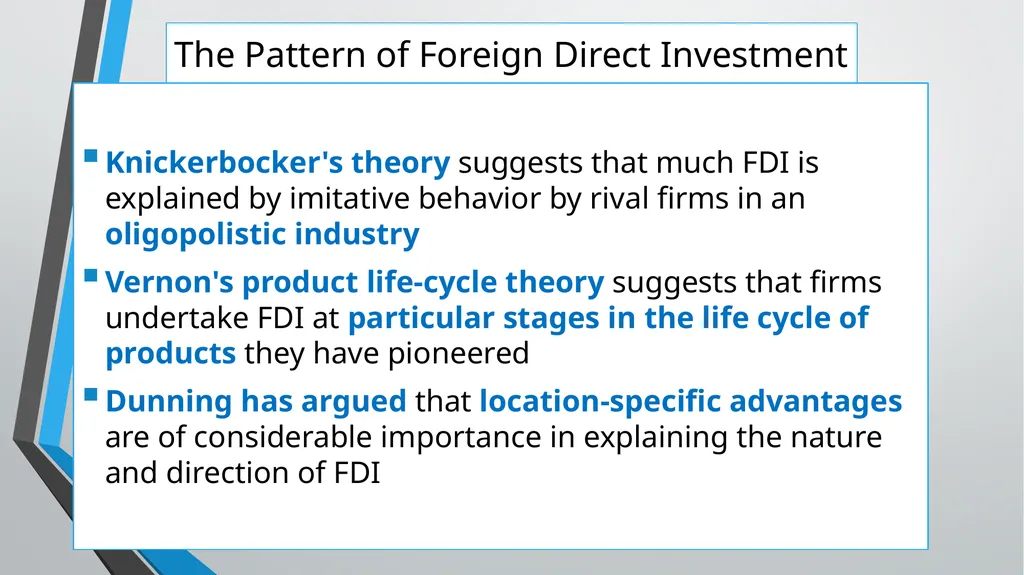
Knickerbocker's theory suggests that much FDI is explained by imitative behavior by rival firms in an oligopolistic industry
Vernon's product life-cycle theory suggests that firms undertake FDI at particular stages in the life cycle of products they have pioneered
Dunning has argued that location-specific advantages are of considerable importance in explaining the nature and direction of FDI The Pattern of Foreign Direct Investment<br>
Vernon's product life-cycle theory suggests that firms undertake FDI at particular stages in the life cycle of products they have pioneered
Dunning has argued that location-specific advantages are of considerable importance in explaining the nature and direction of FDI The Pattern of Foreign Direct Investment<br>
15
The Pattern of Foreign Direct Investment The Eclectic Paradigm
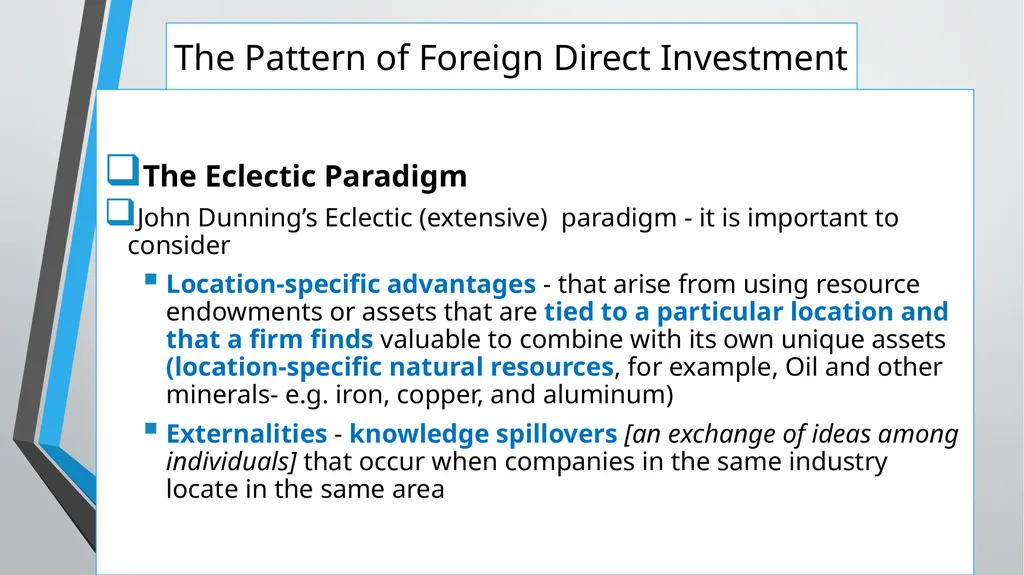
John Dunning’s Eclectic (extensive) paradigm - it is important to consider
Location-specific advantages - that arise from using resource endowments or assets that are tied to a particular location and that a firm finds valuable to combine with its own unique assets (location-specific natural resources, for example, Oil and other minerals- e.g. iron, copper, and aluminum)
Externalities - knowledge spillovers [an exchange of ideas among individuals] that occur when companies in the same industry locate in the same area<br>
John Dunning’s Eclectic (extensive) paradigm - it is important to consider
Location-specific advantages - that arise from using resource endowments or assets that are tied to a particular location and that a firm finds valuable to combine with its own unique assets (location-specific natural resources, for example, Oil and other minerals- e.g. iron, copper, and aluminum)
Externalities - knowledge spillovers [an exchange of ideas among individuals] that occur when companies in the same industry locate in the same area<br>
16
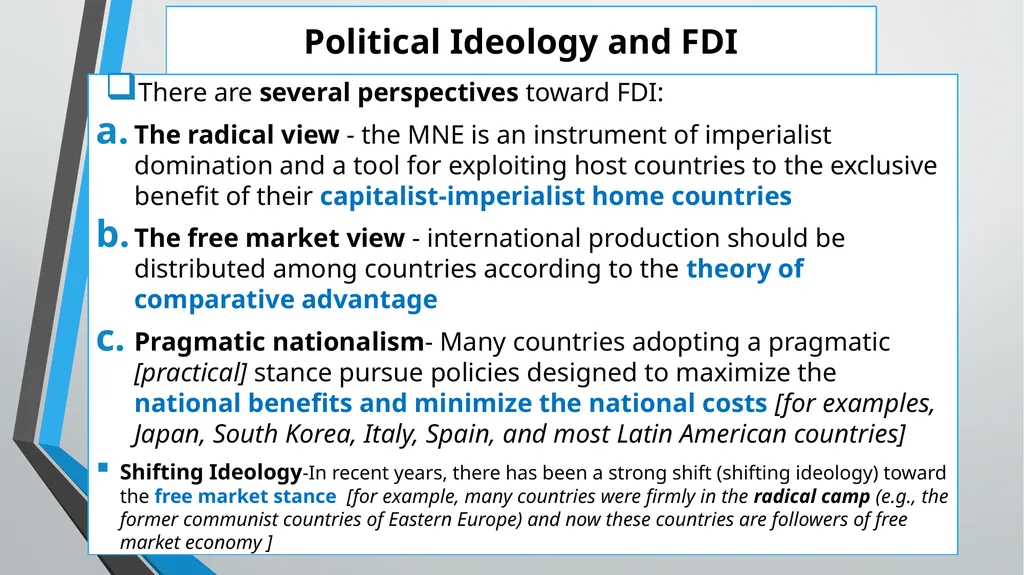
There are several perspectives toward FDI:
The radical view - the MNE is an instrument of imperialist domination and a tool for exploiting host countries to the exclusive benefit of their capitalist-imperialist home countries
The free market view - international production should be distributed among countries according to the theory of comparative advantage
Pragmatic nationalism- Many countries adopting a pragmatic [practical] stance pursue policies designed to maximize the national benefits and minimize the national costs [for examples, Japan, South Korea, Italy, Spain, and most Latin American countries]
Shifting Ideology-In recent years, there has been a strong shift (shifting ideology) toward the free market stance [for example, many countries were firmly in the radical camp (e.g., the former communist countries of Eastern Europe) and now these countries are followers of free market economy ] Political Ideology and FDI<br>
The radical view - the MNE is an instrument of imperialist domination and a tool for exploiting host countries to the exclusive benefit of their capitalist-imperialist home countries
The free market view - international production should be distributed among countries according to the theory of comparative advantage
Pragmatic nationalism- Many countries adopting a pragmatic [practical] stance pursue policies designed to maximize the national benefits and minimize the national costs [for examples, Japan, South Korea, Italy, Spain, and most Latin American countries]
Shifting Ideology-In recent years, there has been a strong shift (shifting ideology) toward the free market stance [for example, many countries were firmly in the radical camp (e.g., the former communist countries of Eastern Europe) and now these countries are followers of free market economy ] Political Ideology and FDI<br>
17
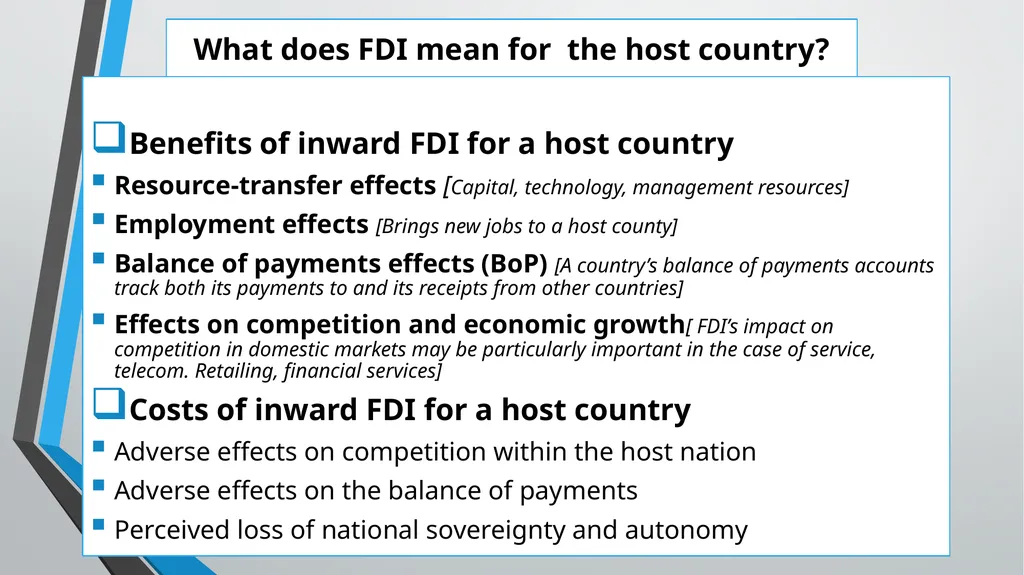
What does FDI mean for the host country? Benefits of inward FDI for a host country
Resource-transfer effects [Capital, technology, management resources]
Employment effects [Brings new jobs to a host county]
Balance of payments effects (BoP) [A country’s balance of payments accounts track both its payments to and its receipts from other countries]
Effects on competition and economic growth[ FDI’s impact on competition in domestic markets may be particularly important in the case of service, telecom. Retailing, financial services]
Costs of inward FDI for a host country
Adverse effects on competition within the host nation
Adverse effects on the balance of payments
Perceived loss of national sovereignty and autonomy<br>
Resource-transfer effects [Capital, technology, management resources]
Employment effects [Brings new jobs to a host county]
Balance of payments effects (BoP) [A country’s balance of payments accounts track both its payments to and its receipts from other countries]
Effects on competition and economic growth[ FDI’s impact on competition in domestic markets may be particularly important in the case of service, telecom. Retailing, financial services]
Costs of inward FDI for a host country
Adverse effects on competition within the host nation
Adverse effects on the balance of payments
Perceived loss of national sovereignty and autonomy<br>
18
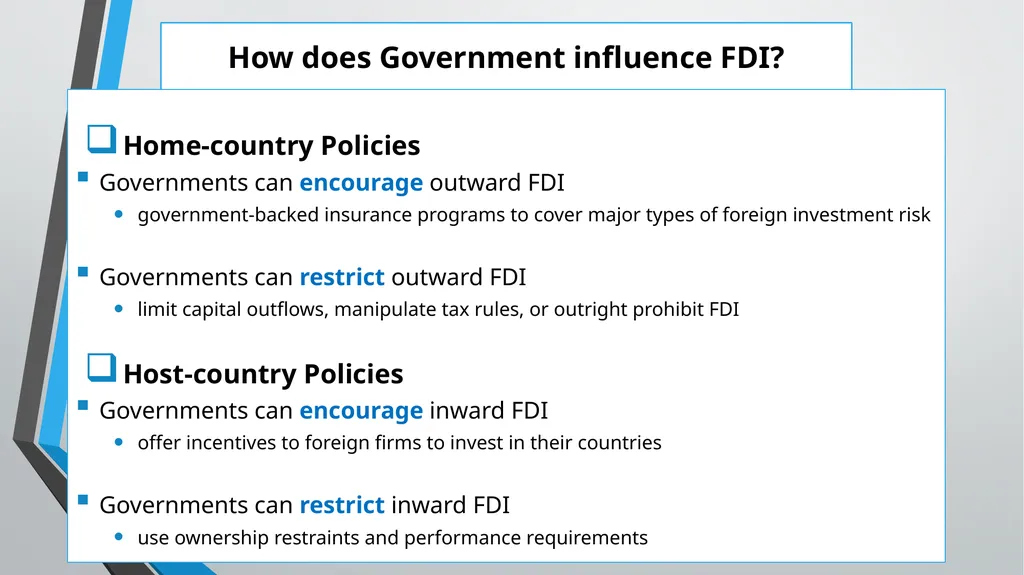
How does Government influence FDI? Home-country Policies
Governments can encourage outward FDI
government-backed insurance programs to cover major types of foreign investment risk
Governments can restrict outward FDI
limit capital outflows, manipulate tax rules, or outright prohibit FDI
Host-country Policies
Governments can encourage inward FDI
offer incentives to foreign firms to invest in their countries
Governments can restrict inward FDI
use ownership restraints and performance requirements<br>
Governments can encourage outward FDI
government-backed insurance programs to cover major types of foreign investment risk
Governments can restrict outward FDI
limit capital outflows, manipulate tax rules, or outright prohibit FDI
Host-country Policies
Governments can encourage inward FDI
offer incentives to foreign firms to invest in their countries
Governments can restrict inward FDI
use ownership restraints and performance requirements<br>
19
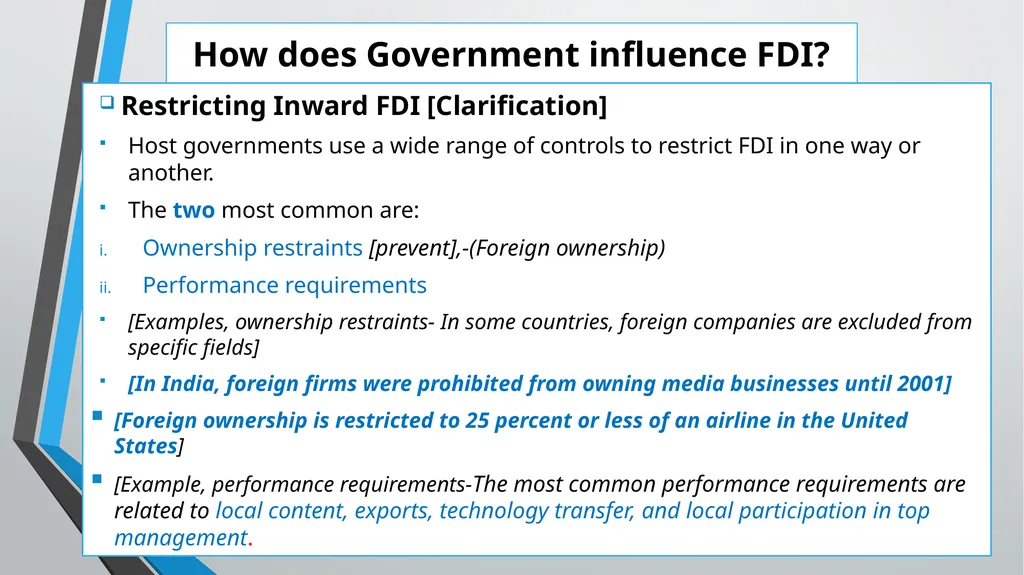
Restricting Inward FDI [Clarification]
Host governments use a wide range of controls to restrict FDI in one way or another.
The two most common are:
Ownership restraints [prevent],-(Foreign ownership)
Performance requirements
[Examples, ownership restraints- In some countries, foreign companies are excluded from specific fields]
[In India, foreign firms were prohibited from owning media businesses until 2001]
[Foreign ownership is restricted to 25 percent or less of an airline in the United States]
[Example, performance requirements-The most common performance requirements are related to local content, exports, technology transfer, and local participation in top management. How does Government influence FDI?<br>
Host governments use a wide range of controls to restrict FDI in one way or another.
The two most common are:
Ownership restraints [prevent],-(Foreign ownership)
Performance requirements
[Examples, ownership restraints- In some countries, foreign companies are excluded from specific fields]
[In India, foreign firms were prohibited from owning media businesses until 2001]
[Foreign ownership is restricted to 25 percent or less of an airline in the United States]
[Example, performance requirements-The most common performance requirements are related to local content, exports, technology transfer, and local participation in top management. How does Government influence FDI?<br>
20
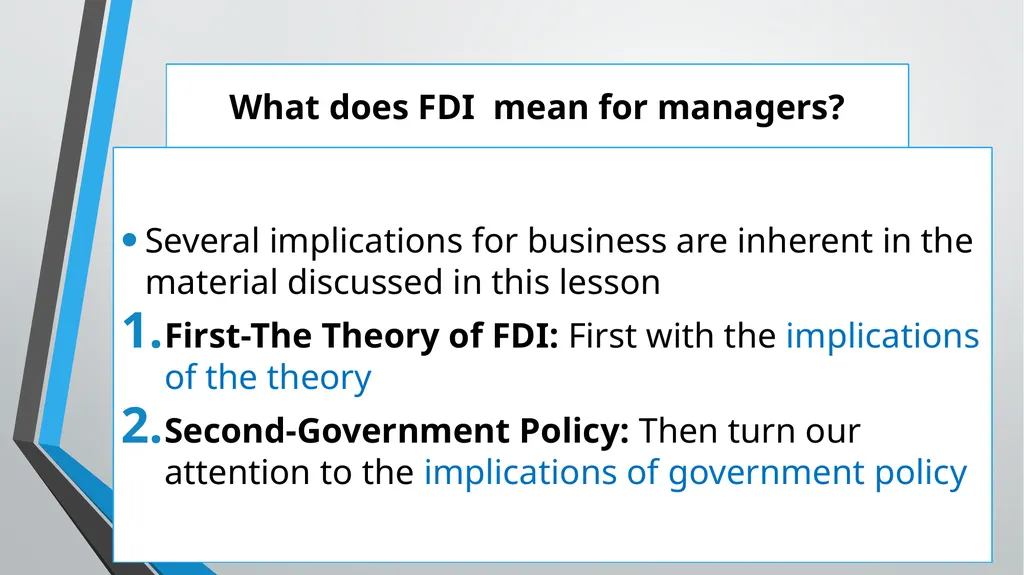
Several implications for business are inherent in the material discussed in this lesson
First-The Theory of FDI: First with the implications of the theory
Second-Government Policy: Then turn our attention to the implications of government policy What does FDI mean for managers?<br>
First-The Theory of FDI: First with the implications of the theory
Second-Government Policy: Then turn our attention to the implications of government policy What does FDI mean for managers?<br>
21
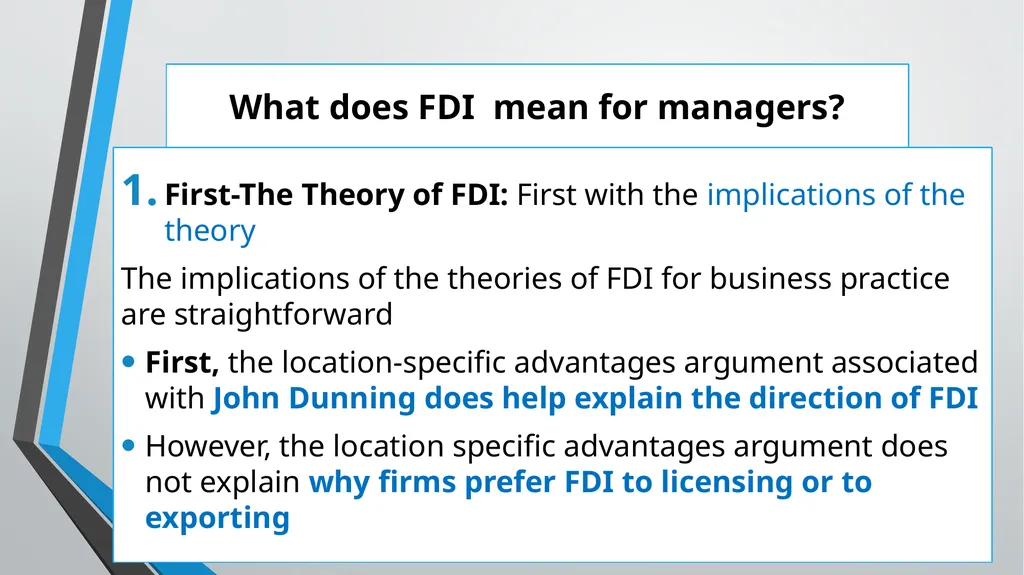
First-The Theory of FDI: First with the implications of the theory
The implications of the theories of FDI for business practice are straightforward
First, the location-specific advantages argument associated with John Dunning does help explain the direction of FDI
However, the location specific advantages argument does not explain why firms prefer FDI to licensing or to exporting What does FDI mean for managers?<br>
The implications of the theories of FDI for business practice are straightforward
First, the location-specific advantages argument associated with John Dunning does help explain the direction of FDI
However, the location specific advantages argument does not explain why firms prefer FDI to licensing or to exporting What does FDI mean for managers?<br>
22
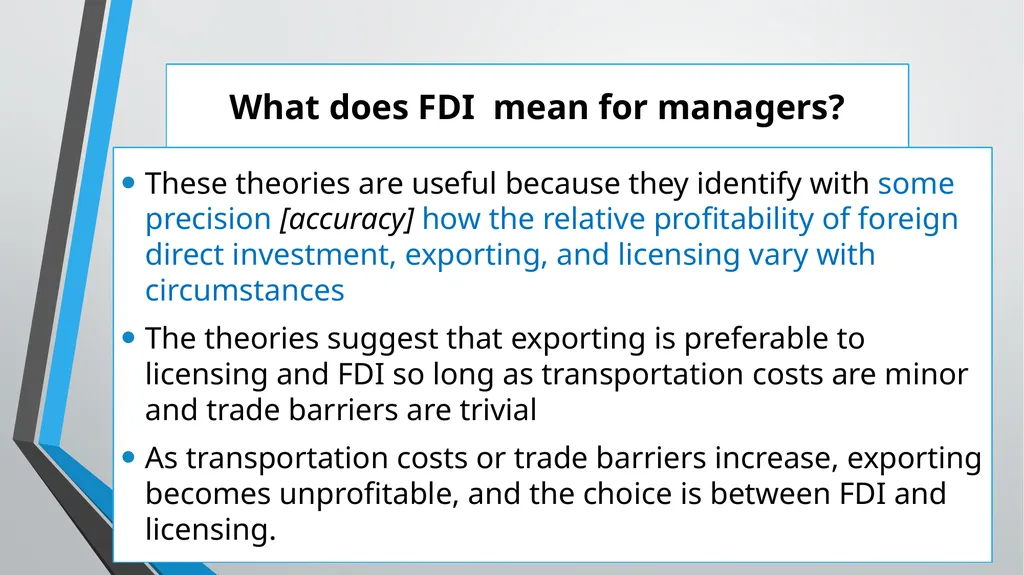
These theories are useful because they identify with some precision [accuracy] how the relative profitability of foreign direct investment, exporting, and licensing vary with circumstances
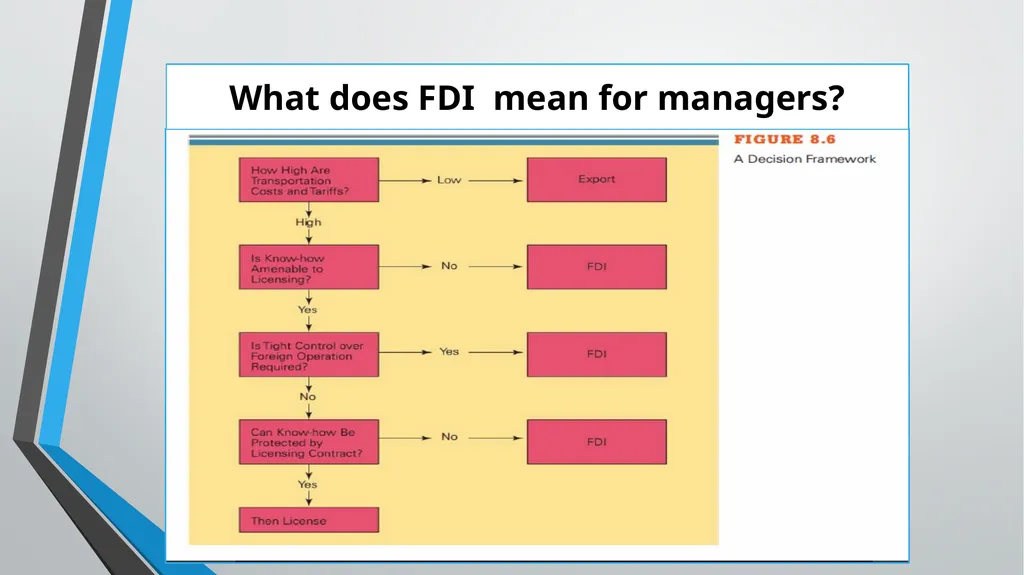
The theories suggest that exporting is preferable to licensing and FDI so long as transportation costs are minor and trade barriers are trivial
As transportation costs or trade barriers increase, exporting becomes unprofitable, and the choice is between FDI and licensing. What does FDI mean for managers?<br>
The theories suggest that exporting is preferable to licensing and FDI so long as transportation costs are minor and trade barriers are trivial
As transportation costs or trade barriers increase, exporting becomes unprofitable, and the choice is between FDI and licensing. What does FDI mean for managers?<br>
23
What does FDI mean for managers?<br>
24
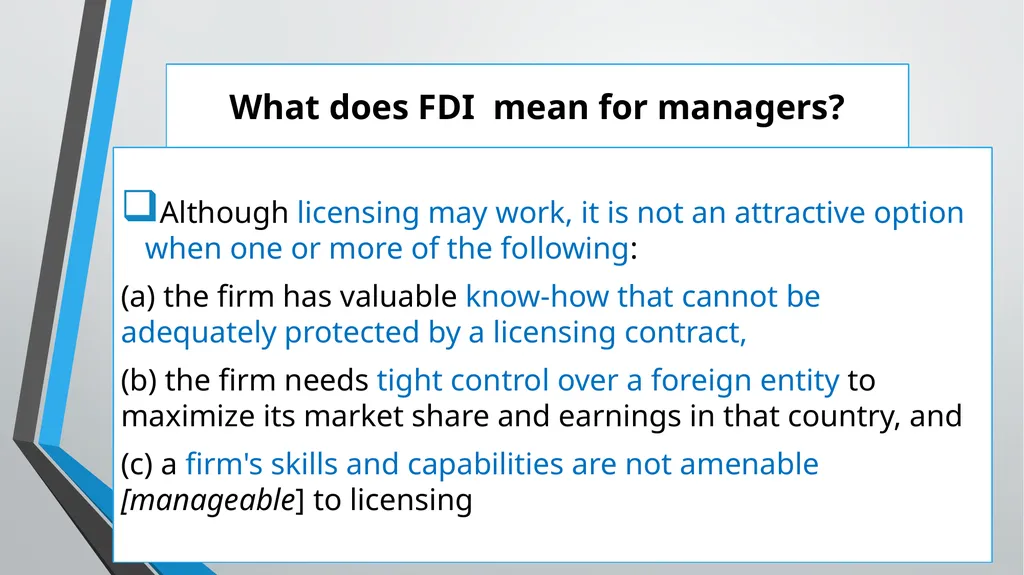
Although licensing may work, it is not an attractive option when one or more of the following:
(a) the firm has valuable know-how that cannot be adequately protected by a licensing contract,
(b) the firm needs tight control over a foreign entity to maximize its market share and earnings in that country, and
(c) a firm's skills and capabilities are not amenable [manageable] to licensing What does FDI mean for managers?<br>
(a) the firm has valuable know-how that cannot be adequately protected by a licensing contract,
(b) the firm needs tight control over a foreign entity to maximize its market share and earnings in that country, and
(c) a firm's skills and capabilities are not amenable [manageable] to licensing What does FDI mean for managers?<br>
25
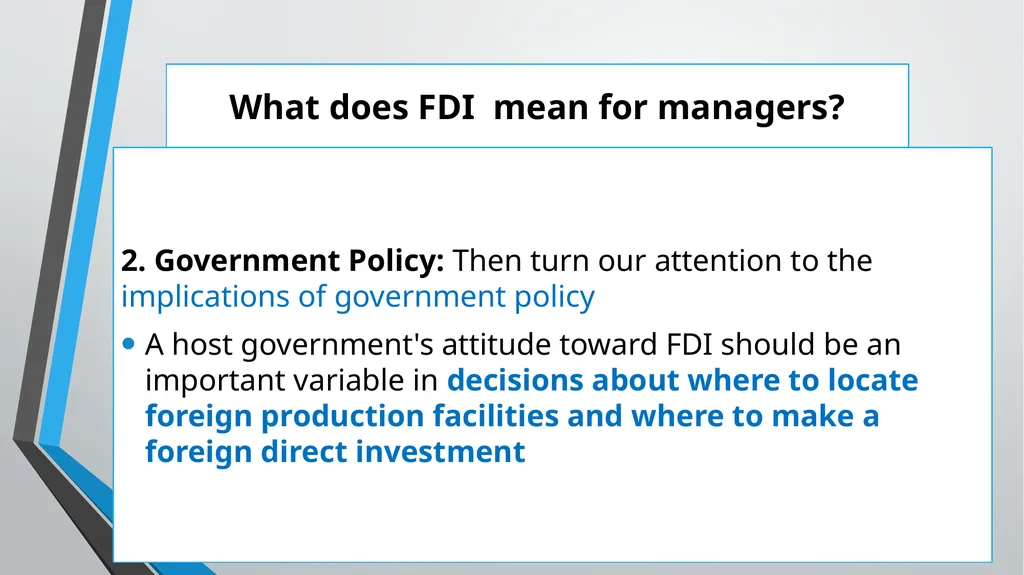
2. Government Policy: Then turn our attention to the implications of government policy
A host government's attitude toward FDI should be an important variable in decisions about where to locate foreign production facilities and where to make a foreign direct investment What does FDI mean for managers?<br>
A host government's attitude toward FDI should be an important variable in decisions about where to locate foreign production facilities and where to make a foreign direct investment What does FDI mean for managers?<br>
26
Case 07: Burberry Shifts Its Strategy in Japan (Page no. 248-249) Case Study<br>
27
Classroom Assessment Techniques (CATs):
The Minute Paper 1. What are the two [three, four, five] most significant [central, useful, meaningful, surprising, disturbing] things you have learned during this session?<br>
28
Classroom Assessment Techniques (CATs) :
The Muddiest points 2. What has been the “muddiest” [most unclear or most confusing] point so far in this session? That is, what topic remains the least clear to you?<br>
29
Book: International Business: Competing in the Global Marketplace
Author : Charles W. L. Hill
Published by McGraw-Hill/Irwin, Acknowledgement and Thanks<br>
Author : Charles W. L. Hill
Published by McGraw-Hill/Irwin, Acknowledgement and Thanks<br>