Forest Grazing: Impacts Management REM 456 - Integrated Rangeland Management Competition between young seedlings and existing vegetation can reduce growth of young trees. Dense ground vegetation can improve habitat for voles, and other
"Forest Grazing: Impacts & Management REM 456 -" is the property of its rightful owner. Permission is granted to
download and print the materials on this website for personal, non-commercial use only, and to display it
on your personal computer provided you do not modify the materials and that you retain all copyright
notices contained in the materials. By downloading content from our website, you accept the terms of this
agreement.
Competition between young seedlings and existing vegetation can reduce growth of young trees.
Dense ground vegetation can improve habitat for voles, and other small rodents, which can damage trees.
Dense vegetation can increase risk of fire.
Grazing could provide a solution... but grazing can also cause damage. A Problem in Plantations:<br>
03
Heavy livestock grazing can reduce weeds and prepare site before tree planting.
Grazing can reduce herbaceous fuels and risk of fire.
Grazing can reduce herbaceous vegetation that competes. Controlled Grazing... A Potential Solution<br>
04
Grazing reduces root growth of competing herbaceous plants.<br>
05
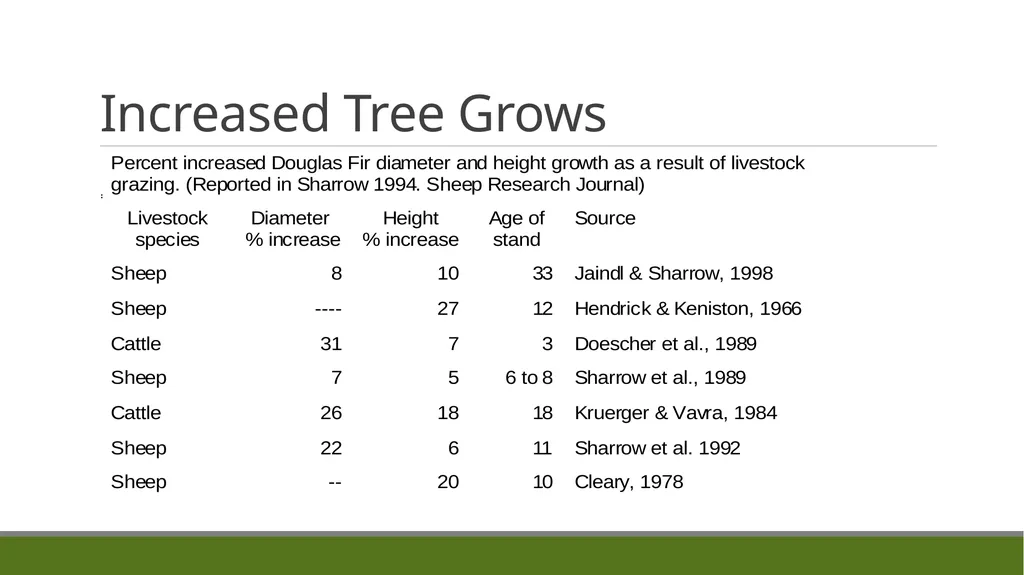
Increased Tree Grows<br>
06
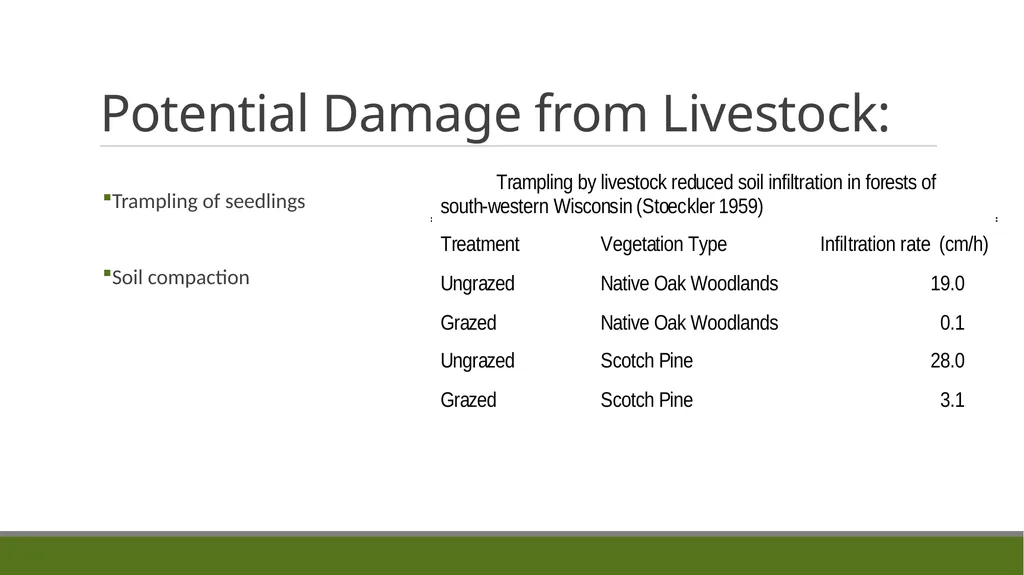
Trampling of seedlings
Soil compaction Potential Damage from Livestock:<br>
07
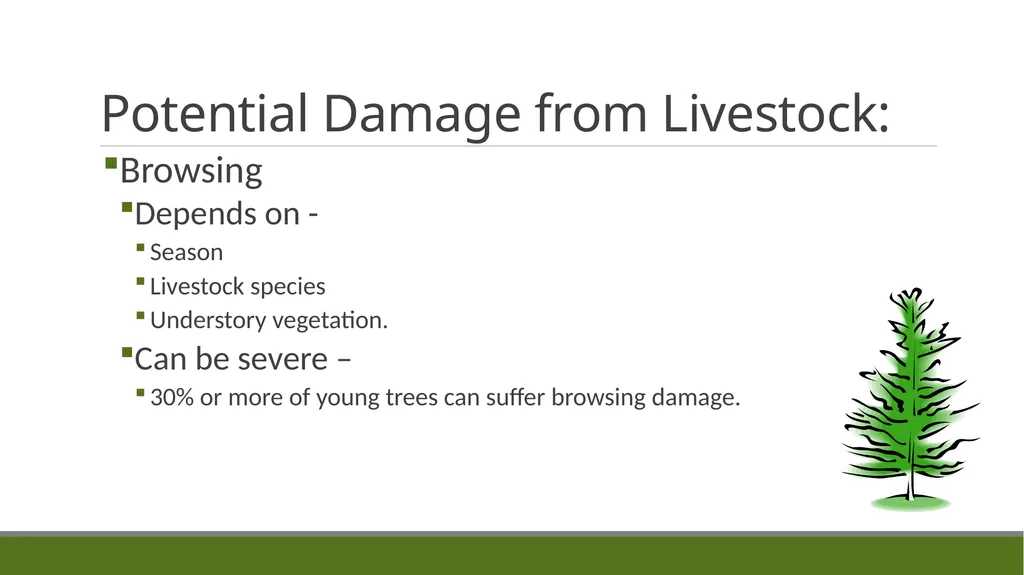
Browsing
Depends on -
Season
Livestock species
Understory vegetation.
Can be severe –
30% or more of young trees can suffer browsing damage. Potential Damage from Livestock:<br>
08
Effectiveness of prescribed grazing depends on species of tree and understory.
Deciduous trees are generally more palatable than evergreens.
Evergreens differ in their palatability among species.
Understory must contain abundant and palatable forage.
Herbaceous forage species can be selected and planted during site prep for tree plantings. Plantation Grazing Guidelines<br>
09
Palatable herbaceous forage must be available.
Depends on species of animal
Cattle generally eat more grass than sheep.
Cattle generally cause more trampling damage than sheep.
Sheep more readily browse deciduous trees than cattle.
Goats can be used, but this is difficult because they are browsers.
Season
When herbaceous forage is available and palatable.
Before conifers start “bud break.” Plantation Grazing Guidelines<br>
10
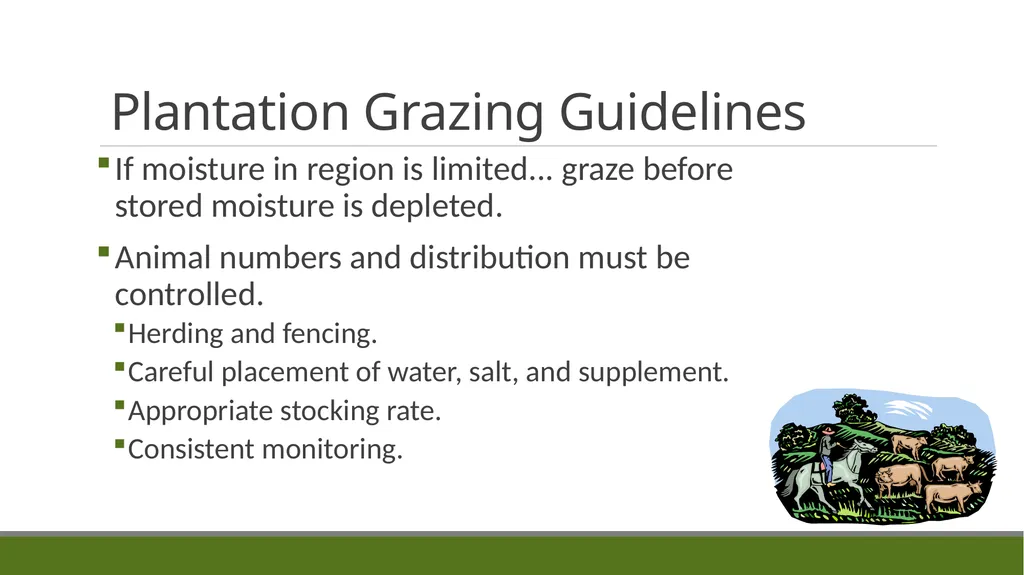
If moisture in region is limited... graze before stored moisture is depleted.
Animal numbers and distribution must be controlled.
Herding and fencing.
Careful placement of water, salt, and supplement.
Appropriate stocking rate.
Consistent monitoring. Plantation Grazing Guidelines<br>
11
Orchard & Vineyard Grazing Lamb in the Vineyards: The Benefits of Targeted Grazing
https://youtu.be/C0quSRoBnSk
Or, search “Lambs in the Vineyards”<br>
12
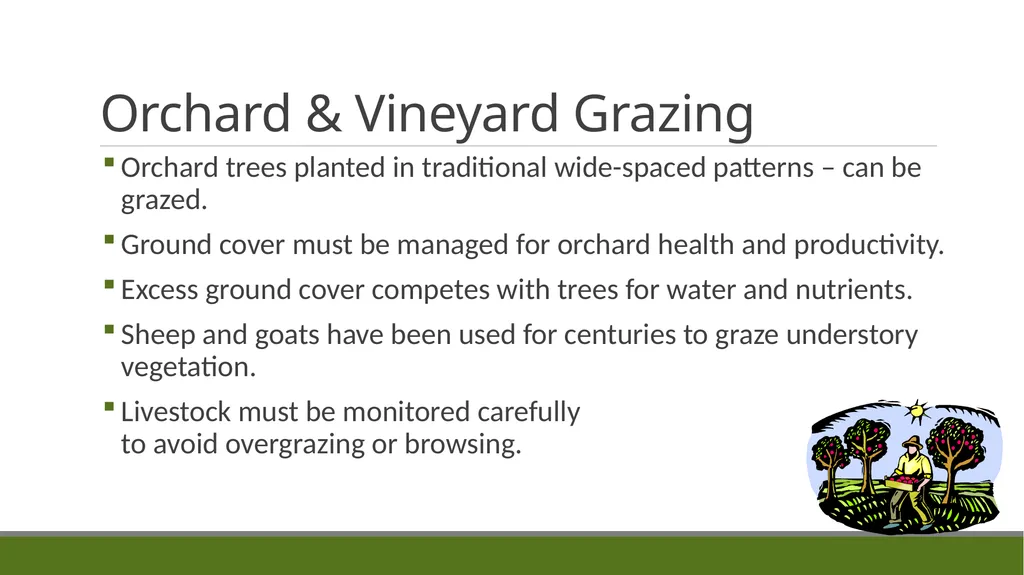
Orchard trees planted in traditional wide-spaced patterns – can be grazed.
Ground cover must be managed for orchard health and productivity.
Excess ground cover competes with trees for water and nutrients.
Sheep and goats have been used for centuries to graze understory vegetation.
Livestock must be monitored carefully to avoid overgrazing or browsing. Orchard & Vineyard Grazing<br>
13
The number of animals needed for targeted grazing fluctuates during the growing season.
Livestock should be removed when the orchard is wet.
May need to remove animals for orchard management and harvest.
May be health considerations with fecal material in orchards and vineyards.
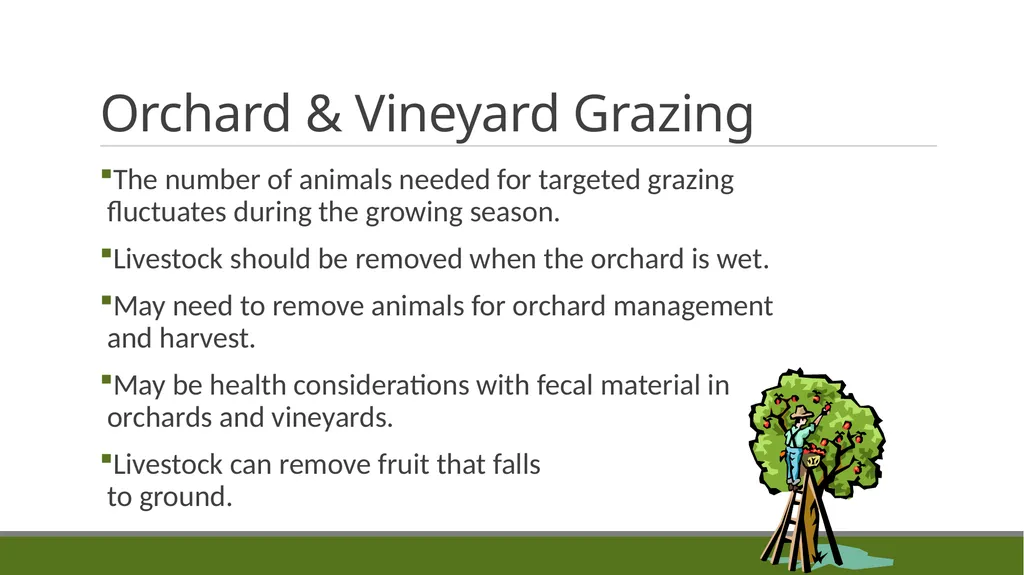
Livestock can remove fruit that falls to ground. Orchard & Vineyard Grazing<br>
14
Literature Referenced Cleary, B.D. 1978. Vegetation management and its importance in reforestation. Oregon State University, Forest Resources Lab., Corvallis. Res. Note 60. 4.
Doescher, P.S., S.D. Tesch, and W.E. Drewien. 1989. Water relations and growth of conifer seedlings during three years of cattle grazing on a southwestern Oregon plantation. Northwest Science 63:232-240.
Hedrick, D.W. and R.F. Keniston. 1966. Grazing and Douglas-fir growth in the Oregon white-oak type. Journal of Forestry 64:735-738.
Jaindl, R.G. and S.H. Sharrow. 1988. Oak/Douglas-fir/sheep: A three-crop silvopastoral system. Agroforestry Systems 6:147-152.
Krueger, W.C. and M. Vavra. 1984. Twentieth year results from a plantation grazing study. 20-24. IN: Research in rangeland management. Oregon Agriculture Experimental Station Special Report 715. p. 20-24
Sharrow, S.H., W.C. Leininger, and B. Rhodes. 1989. Sheep grazing as a silvicultural tool to suppress brush. Journal of Range Management 42:2-4.
Sharrow, S.H., W.C. Leininger, and K.A. Osman. 1992. Sheep grazing effects on coastal Douglas-fir forest growth: A ten-year perspective. Forest Ecology and Management 50:75-84.
Sharrow, S. H. 1994. Sheep as a silvicultural management tool in temperature conifer forest. Sheep research journal. Special Issue pp. 97–104
Stoeckler, J.H. 1959. Trampling by livestock drastically reduces infiltration rate of soil in oak and pine woods in southwestern Wisconsin. USDA For. Serv., Lake State Forest. Exp. Sm. Tech. Note 55<br>