Forest School an inspirational process, that offers children and young people opportunities to achieve, develop confidence and self-esteem, through hands on learning experiences in a local woodland environment Teresa Dowding 2018
"Forest School “an inspirational process, that" is the property of its rightful owner. Permission is granted to
download and print the materials on this website for personal, non-commercial use only, and to display it
on your personal computer provided you do not modify the materials and that you retain all copyright
notices contained in the materials. By downloading content from our website, you accept the terms of this
agreement.
Presentation Transcript
01
Forest School “an inspirational process, that offers children and young people opportunities to achieve, develop confidence and self-esteem, through hands on learning experiences in a local woodland environment” Teresa Dowding 2018<br>
02
Development of Forest School in UK Within the context of the history of outdoor play in UK (see FSA website)
Visit to Denmark in 1993 (EY practitioners from Bridgewater College, Somerset)
BTEC qualification developed
Training opportunities increased
Some county councils supported training of practitioners
2011 National Forest School Association (FSA) established to share good practice and provide networking opportunities. National conference held annually.
Development of local groups affiliated to national FSA supporting quality practice and networking and CPD opportunities locally.
2018 FSA conference being run as a family friendly festival for the first time, in Norfolk. All welcome! Teresa Dowding 2018<br>
03
6 Principles of Good Practice at Forest School (2011) Forest School is a long-term process of frequent and regular sessions in a woodland or natural environment, rather than a one-off visit. Planning, adaptation, observations and reviewing are integral elements of Forest School.
Forest School takes place in a woodland or natural wooded environment to support the development of a relationship between the learner and the natural world.
Forest School aims to promote the holistic development of all those involved, fostering resilient, confident, independent and creative learners.
Forest School offers learners the opportunity to take supported risks appropriate to the environment and to themselves.
Forest School is run by qualified Forest School practitioners who continuously maintain and develop their professional practice.
Forest School uses a range of learner-centred processes to create a community for development and learning
http://www.forestschoolassociation.org/ Teresa Dowding 2018<br>
04
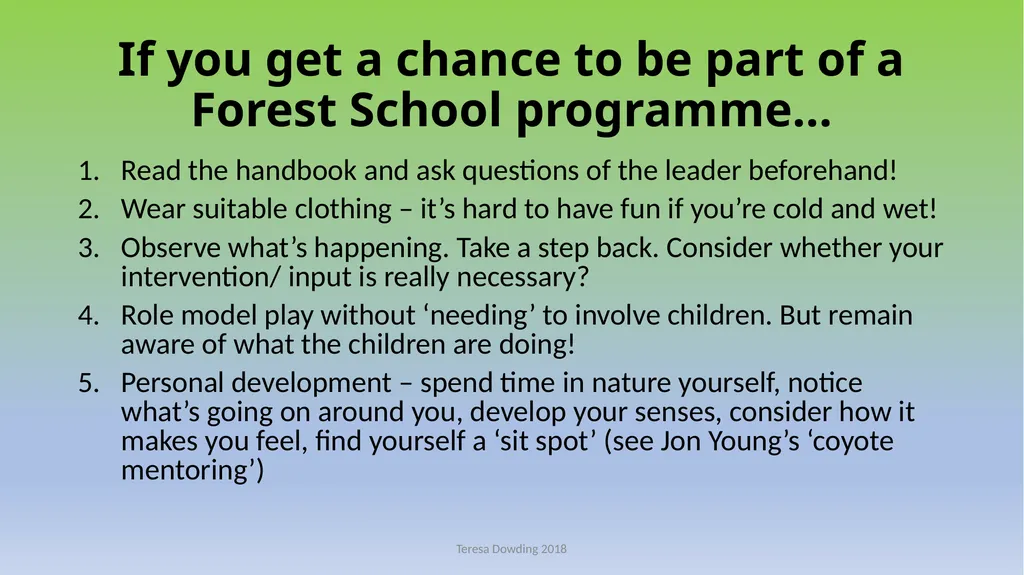
If you get a chance to be part of a Forest School programme… Read the handbook and ask questions of the leader beforehand!
Wear suitable clothing – it’s hard to have fun if you’re cold and wet!
Observe what’s happening. Take a step back. Consider whether your intervention/ input is really necessary?
Role model play without ‘needing’ to involve children. But remain aware of what the children are doing!
Personal development – spend time in nature yourself, notice what’s going on around you, develop your senses, consider how it makes you feel, find yourself a ‘sit spot’ (see Jon Young’s ‘coyote mentoring’) Teresa Dowding 2018<br>
05
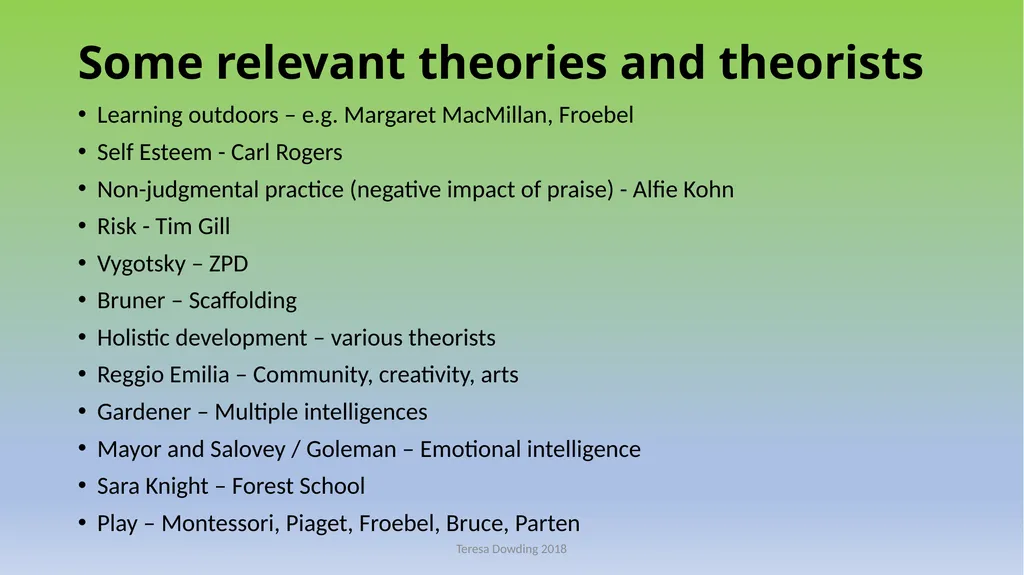
Some relevant theories and theorists Learning outdoors – e.g. Margaret MacMillan, Froebel
Self Esteem - Carl Rogers
Non-judgmental practice (negative impact of praise) - Alfie Kohn
Risk - Tim Gill
Vygotsky – ZPD
Bruner – Scaffolding
Holistic development – various theorists
Reggio Emilia – Community, creativity, arts
Gardener – Multiple intelligences
Mayor and Salovey / Goleman – Emotional intelligence
Sara Knight – Forest School
Play – Montessori, Piaget, Froebel, Bruce, Parten Teresa Dowding 2018<br>