
Formal Writing Style Complex – Longer sentences


Description: Formal Writing Style Complex Longer sentences are likely to be more prevalent in formal writing. You need to be as thorough as possible with your approach to each topic when you are using a formal style. Each main point needs to be
Related Topics
Download Presentation
"Formal Writing Style Complex – Longer sentences" is the property of its rightful owner. Permission is granted to download and print the materials on this website for personal, non-commercial use only, and to display it on your personal computer provided you do not modify the materials and that you retain all copyright notices contained in the materials. By downloading content from our website, you accept the terms of this agreement.
Presentation Transcript
slide2. Formal Writing Style
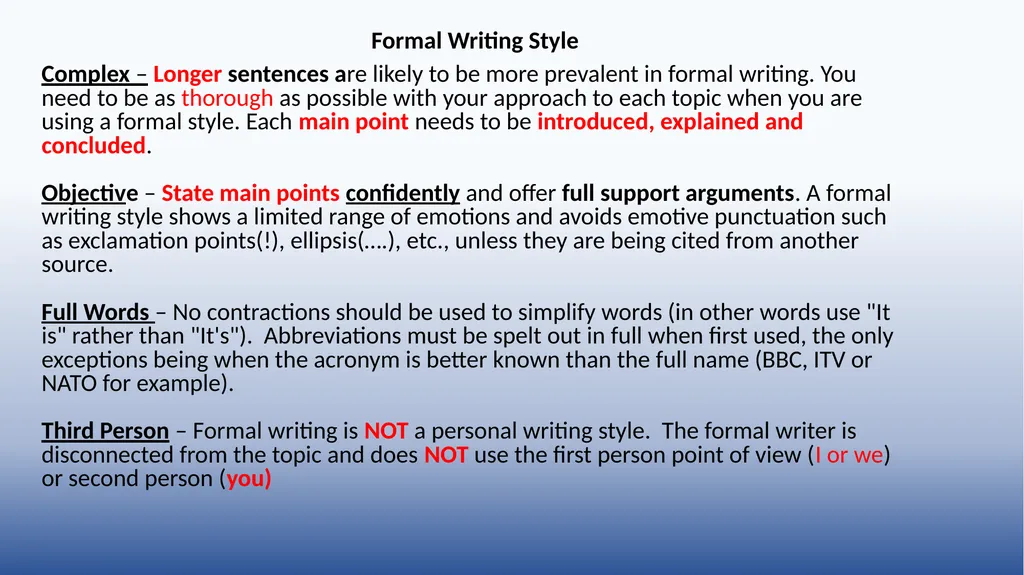
Complex – Longer sentences are likely to be more prevalent in formal writing. You need to be as thorough as possible with your approach to each topic when you are using a formal style. Each main point needs to be introduced, explained and concluded. Objective – State main points confidently and offer full support arguments. A formal writing style shows a limited range of emotions and avoids emotive punctuation such as exclamation points(!), ellipsis(….), etc., unless they are being cited from another source. Full Words – No contractions should be used to simplify words (in other words use "It is" rather than "It's"). Abbreviations must be spelt out in full when first used, the only exceptions being when the acronym is better known than the full name (BBC, ITV or NATO for example). Third Person – Formal writing is NOT a personal writing style. The formal writer is disconnected from the topic and does NOT use the first person point of view (I or we) or second person (you)<br>
Complex – Longer sentences are likely to be more prevalent in formal writing. You need to be as thorough as possible with your approach to each topic when you are using a formal style. Each main point needs to be introduced, explained and concluded. Objective – State main points confidently and offer full support arguments. A formal writing style shows a limited range of emotions and avoids emotive punctuation such as exclamation points(!), ellipsis(….), etc., unless they are being cited from another source. Full Words – No contractions should be used to simplify words (in other words use "It is" rather than "It's"). Abbreviations must be spelt out in full when first used, the only exceptions being when the acronym is better known than the full name (BBC, ITV or NATO for example). Third Person – Formal writing is NOT a personal writing style. The formal writer is disconnected from the topic and does NOT use the first person point of view (I or we) or second person (you)<br>