
Fortson 12: Greek Hints for Exercises wikipedia
SB
Published · 19 slides · 0 views

1 / 1

Description
Fortson 12: Greek Hints for Exercises wikipedia helps Fortson usually supplies what we need, but the largyngeals are explained more fully and perhaps more understandably (in charts) on wikipedias laryngeal theory page:
Related Topics
Share
Embed code
Download this presentation From Below
"Fortson 12: Greek Hints for Exercises wikipedia" is the property of its rightful owner. Permission is granted to download and print the materials on this website for personal, non-commercial use only, and to display it on your personal computer provided you do not modify the materials and that you retain all copyright notices contained in the materials. By downloading content from our website, you accept the terms of this agreement.
Presentation Transcript
01
Fortson 12: Greek Hints for Exercises<br>
02
wikipedia helps Fortson usually supplies what we need, but the largyngeals are explained more fully and perhaps more understandably (in charts) on wikipedia’s “laryngeal theory” page:
https://en.wikipedia.org/wiki/Laryngeal_theory#H-loss_adjacent_to_other_sounds
In addition, the Wikipedia page on (Classical) ‘Ancient Greek Phonology’ helps:
https://en.wikipedia.org/wiki/Ancient_Greek_phonology
Wikipedia’s Proto-Greek page also helps:
https://en.wikipedia.org/wiki/Proto-Greek_language
I’m going to feel free to consult those for these exercises, and you should too.<br>
03
Another resource Go to Howe Library online.
Go to ‘research databases’: it’s an option on the very front page when I go to Howe Library.
You’ll probably have to sign in at some point.
Go to the i’s and find Indo-European etymological dictionaries online
There you can use Beekes for Greek (or others for some other languages).
This is a very important (and very expensive) database for PIE studies which you should know about.
Bookmark it.<br>
04
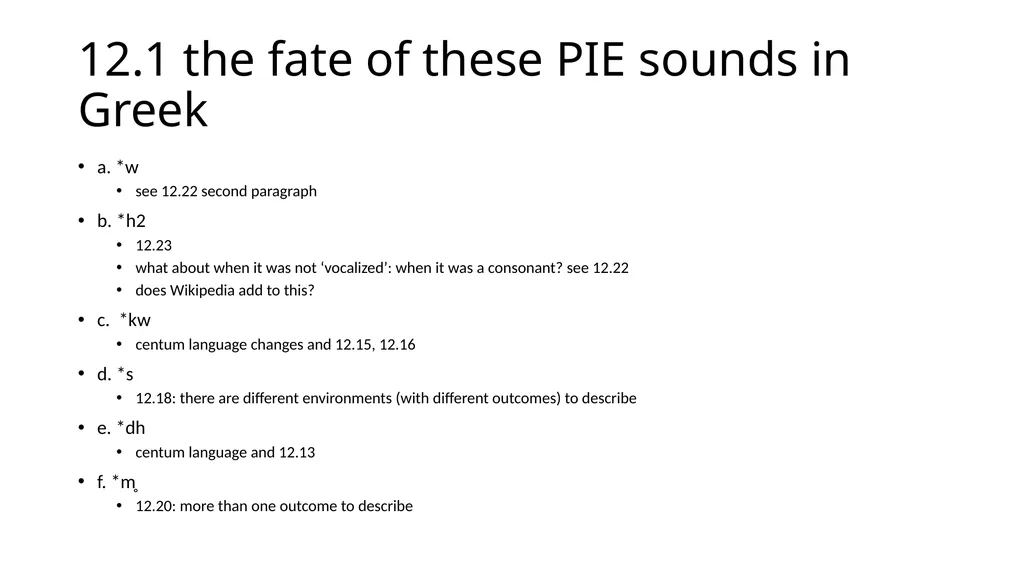
12.1 the fate of these PIE sounds in Greek a. *w
see 12.22 second paragraph
b. *h2
12.23
what about when it was not ‘vocalized’: when it was a consonant? see 12.22
does Wikipedia add to this?
c. *kw
centum language changes and 12.15, 12.16
d. *s
12.18: there are different environments (with different outcomes) to describe
e. *dh
centum language and 12.13
f. *m̥
12.20: more than one outcome to describe<br>
05
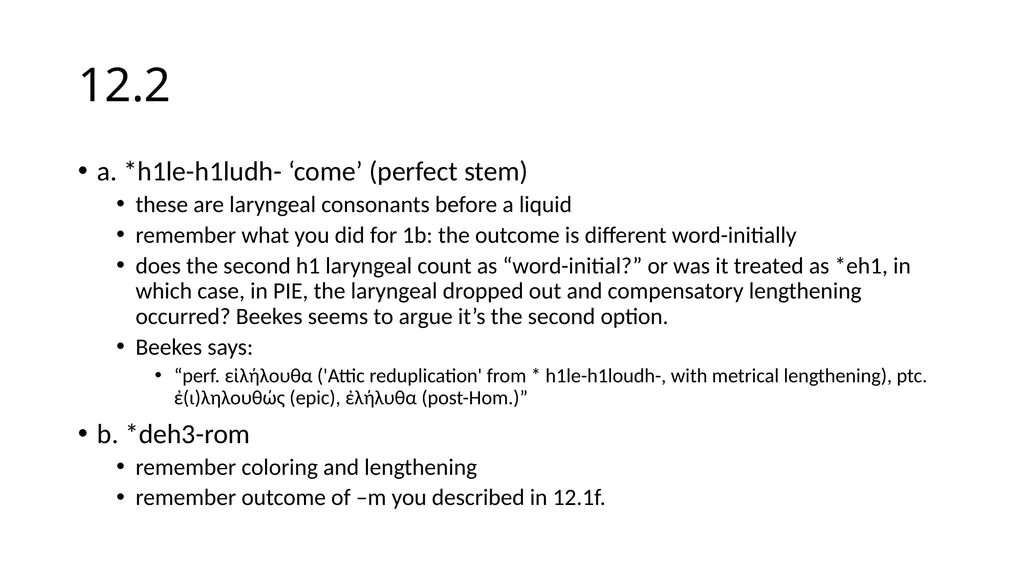
12.2 a. *h1le-h1ludh- ‘come’ (perfect stem)
these are laryngeal consonants before a liquid
remember what you did for 1b: the outcome is different word-initially
does the second h1 laryngeal count as “word-initial?” or was it treated as *eh1, in which case, in PIE, the laryngeal dropped out and compensatory lengthening occurred? Beekes seems to argue it’s the second option.
Beekes says:
“perf. εἰλήλουθα ('Attic reduplication' from * h1le-h1loudh-, with metrical lengthening), ptc. ἐ(ι)ληλουθώς (epic), ἐλήλυθα (post-Hom.)”
b. *deh3-rom
remember coloring and lengthening
remember outcome of –m you described in 12.1f.<br>
06
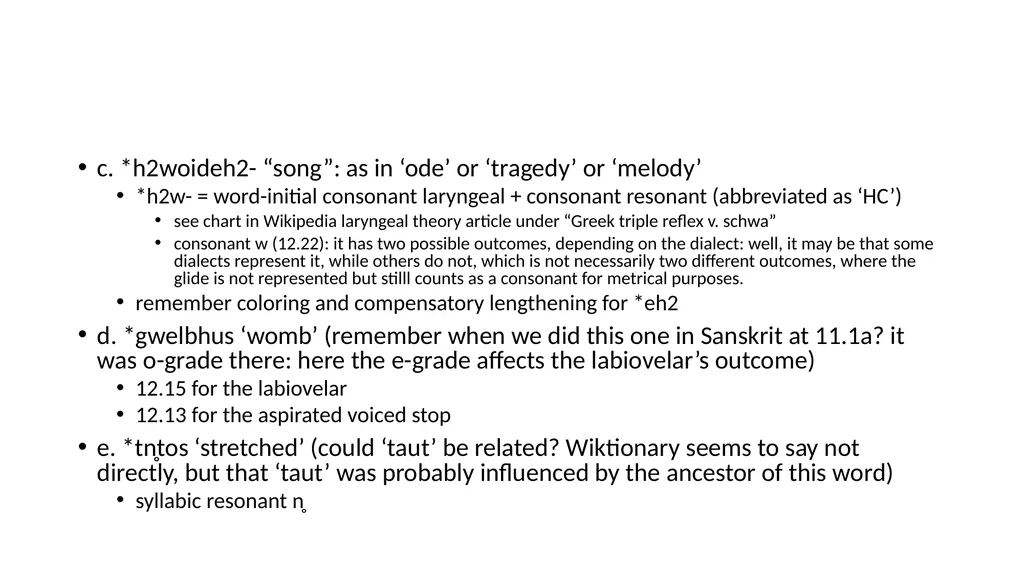
c. *h2woideh2- “song”: as in ‘ode’ or ‘tragedy’ or ‘melody’
*h2w- = word-initial consonant laryngeal + consonant resonant (abbreviated as ‘HC’)
see chart in Wikipedia laryngeal theory article under “Greek triple reflex v. schwa”
consonant w (12.22): it has two possible outcomes, depending on the dialect: well, it may be that some dialects represent it, while others do not, which is not necessarily two different outcomes, where the glide is not represented but stilll counts as a consonant for metrical purposes.
remember coloring and compensatory lengthening for *eh2
d. *gwelbhus ‘womb’ (remember when we did this one in Sanskrit at 11.1a? it was o-grade there: here the e-grade affects the labiovelar’s outcome)
12.15 for the labiovelar
12.13 for the aspirated voiced stop
e. *tn̥tos ‘stretched’ (could ‘taut’ be related? Wiktionary seems to say not directly, but that ‘taut’ was probably influenced by the ancestor of this word)
syllabic resonant n̥<br>
07
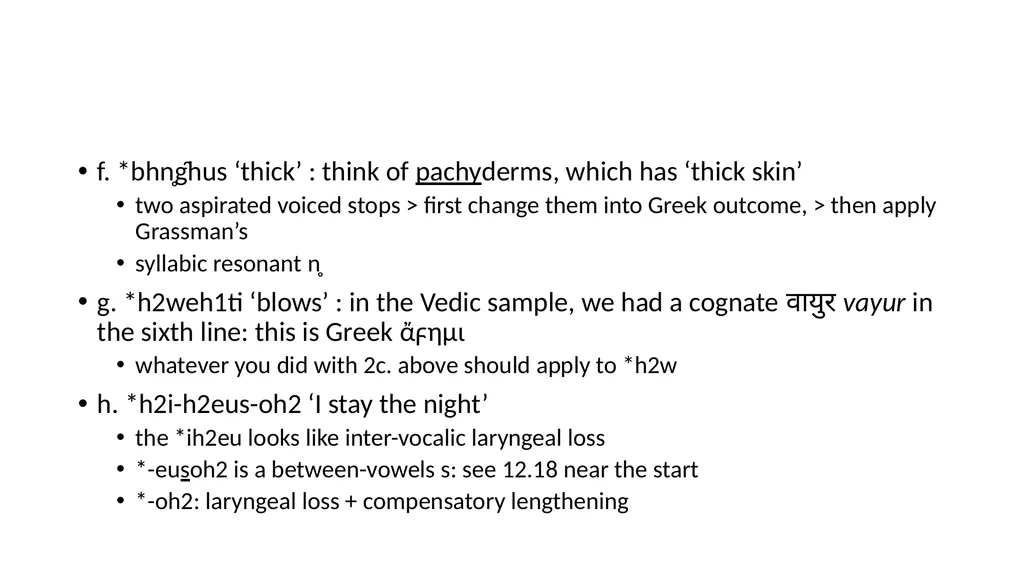
f. *bhn̥g̑hus ‘thick’ : think of pachyderms, which has ‘thick skin’
two aspirated voiced stops > first change them into Greek outcome, > then apply Grassman’s
syllabic resonant n̥
g. *h2weh1ti ‘blows’ : in the Vedic sample, we had a cognate वायुर vayur in the sixth line: this is Greek ἄϝημι
whatever you did with 2c. above should apply to *h2w
h. *h2i-h2eus-oh2 ‘I stay the night’
the *ih2eu looks like inter-vocalic laryngeal loss
*-eusoh2 is a between-vowels s: see 12.18 near the start
*-oh2: laryngeal loss + compensatory lengthening<br>
08
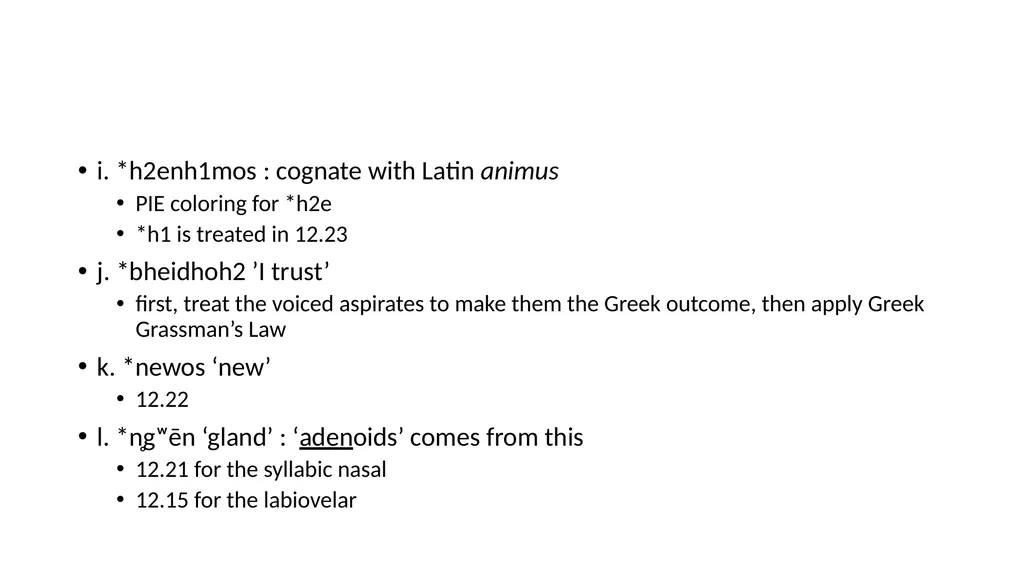
i. *h2enh1mos : cognate with Latin animus
PIE coloring for *h2e
*h1 is treated in 12.23
j. *bheidhoh2 ’I trust’
first, treat the voiced aspirates to make them the Greek outcome, then apply Greek Grassman’s Law
k. *newos ‘new’
12.22
l. *n̥gʷēn ‘gland’ : ‘adenoids’ comes from this
12.21 for the syllabic nasal
12.15 for the labiovelar<br>
PIE coloring for *h2e
*h1 is treated in 12.23
j. *bheidhoh2 ’I trust’
first, treat the voiced aspirates to make them the Greek outcome, then apply Greek Grassman’s Law
k. *newos ‘new’
12.22
l. *n̥gʷēn ‘gland’ : ‘adenoids’ comes from this
12.21 for the syllabic nasal
12.15 for the labiovelar<br>
09
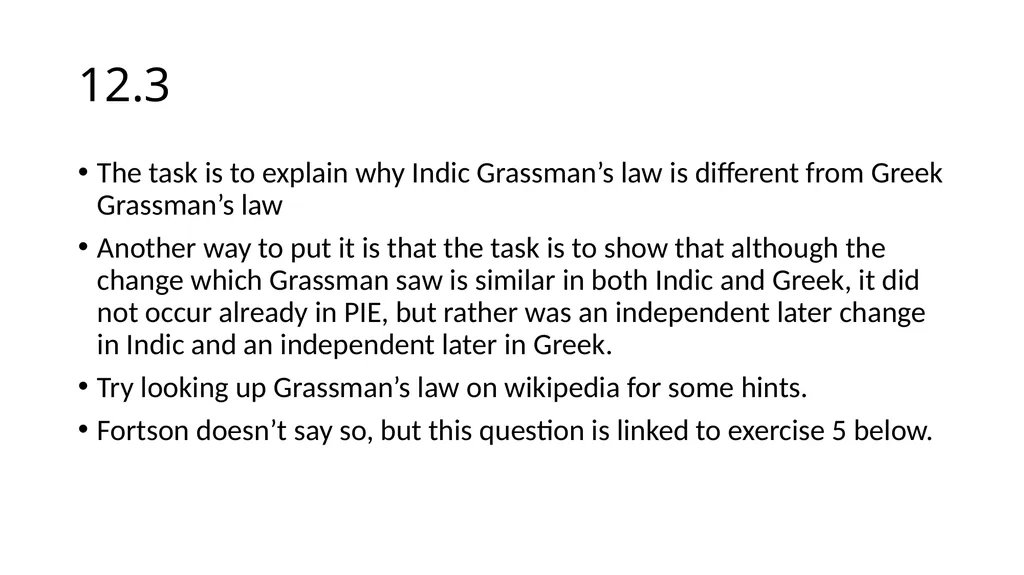
12.3 The task is to explain why Indic Grassman’s law is different from Greek Grassman’s law
Another way to put it is that the task is to show that although the change which Grassman saw is similar in both Indic and Greek, it did not occur already in PIE, but rather was an independent later change in Indic and an independent later in Greek.
Try looking up Grassman’s law on wikipedia for some hints.
Fortson doesn’t say so, but this question is linked to exercise 5 below.<br>
10
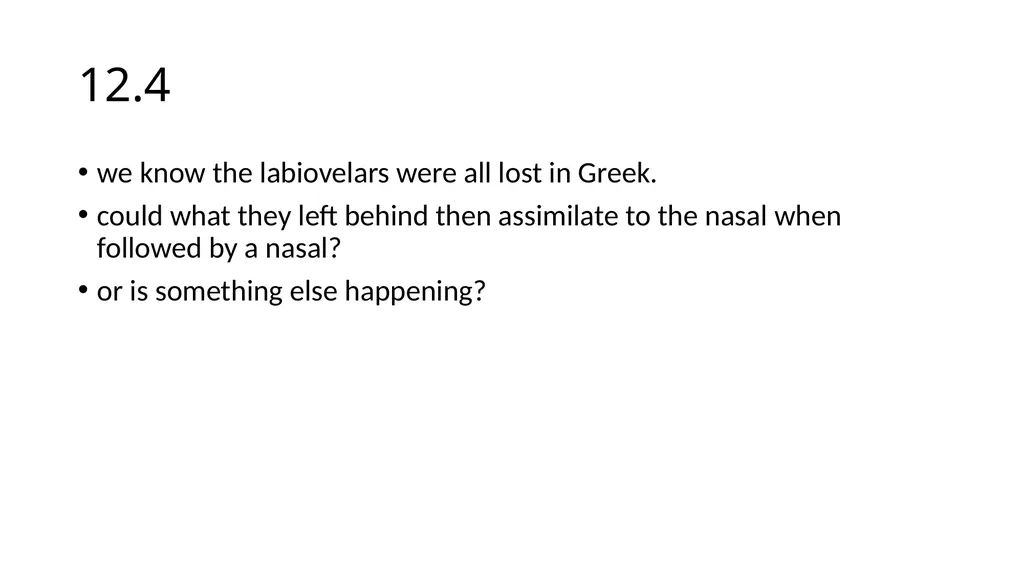
12.4 we know the labiovelars were all lost in Greek.
could what they left behind then assimilate to the nasal when followed by a nasal?
or is something else happening?<br>
could what they left behind then assimilate to the nasal when followed by a nasal?
or is something else happening?<br>
11
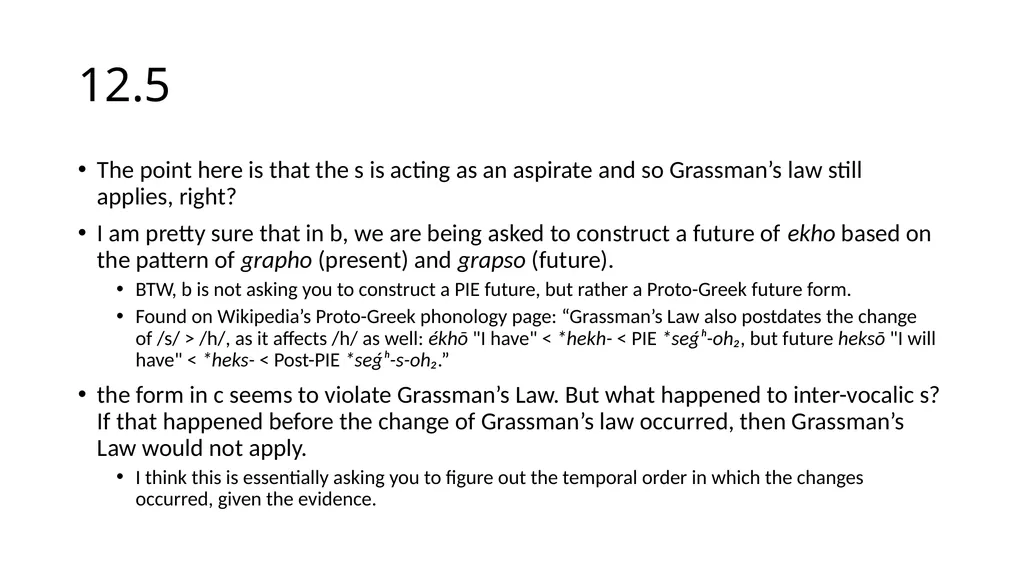
12.5 The point here is that the s is acting as an aspirate and so Grassman’s law still applies, right?
I am pretty sure that in b, we are being asked to construct a future of ekho based on the pattern of grapho (present) and grapso (future).
BTW, b is not asking you to construct a PIE future, but rather a Proto-Greek future form.
Found on Wikipedia’s Proto-Greek phonology page: “Grassman’s Law also postdates the change of /s/ > /h/, as it affects /h/ as well: ékhō "I have" < *hekh- < PIE *seǵʰ-oh₂, but future heksō "I will have" < *heks- < Post-PIE *seǵʰ-s-oh₂.”
the form in c seems to violate Grassman’s Law. But what happened to inter-vocalic s? If that happened before the change of Grassman’s law occurred, then Grassman’s Law would not apply.
I think this is essentially asking you to figure out the temporal order in which the changes occurred, given the evidence.<br>
12
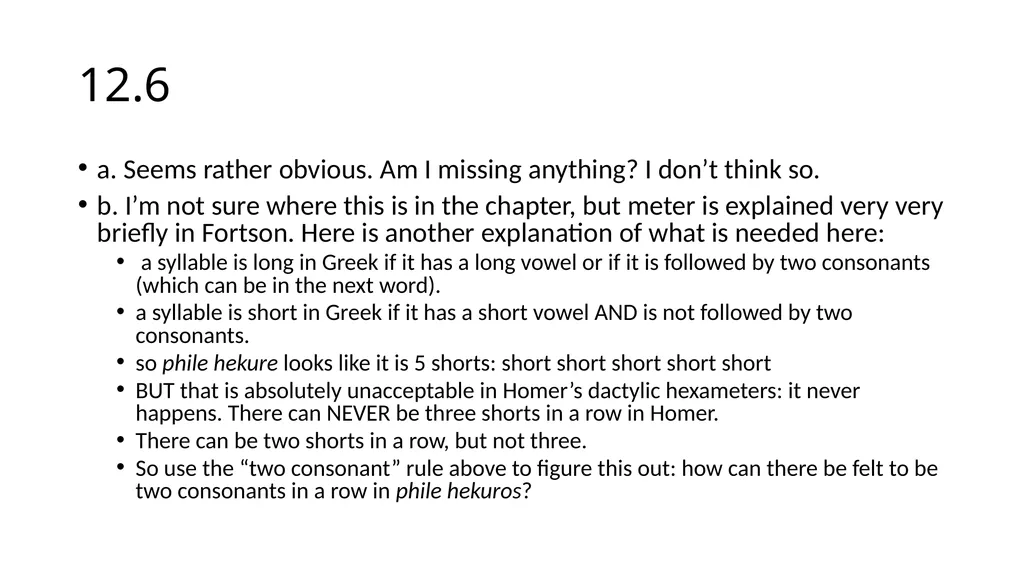
12.6 a. Seems rather obvious. Am I missing anything? I don’t think so.
b. I’m not sure where this is in the chapter, but meter is explained very very briefly in Fortson. Here is another explanation of what is needed here:
a syllable is long in Greek if it has a long vowel or if it is followed by two consonants (which can be in the next word).
a syllable is short in Greek if it has a short vowel AND is not followed by two consonants.
so phile hekure looks like it is 5 shorts: short short short short short
BUT that is absolutely unacceptable in Homer’s dactylic hexameters: it never happens. There can NEVER be three shorts in a row in Homer.
There can be two shorts in a row, but not three.
So use the “two consonant” rule above to figure this out: how can there be felt to be two consonants in a row in phile hekuros?<br>
13
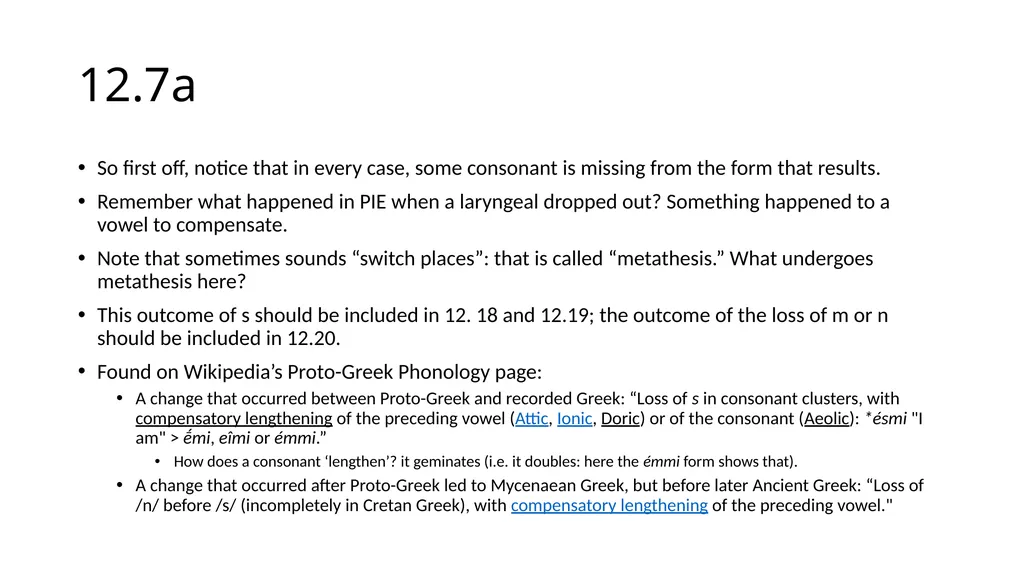
12.7a So first off, notice that in every case, some consonant is missing from the form that results.
Remember what happened in PIE when a laryngeal dropped out? Something happened to a vowel to compensate.
Note that sometimes sounds “switch places”: that is called “metathesis.” What undergoes metathesis here?
This outcome of s should be included in 12. 18 and 12.19; the outcome of the loss of m or n should be included in 12.20.
Found on Wikipedia’s Proto-Greek Phonology page:
A change that occurred between Proto-Greek and recorded Greek: “Loss of s in consonant clusters, with compensatory lengthening of the preceding vowel (Attic, Ionic, Doric) or of the consonant (Aeolic): *ésmi "I am" > ḗmi, eîmi or émmi.”
How does a consonant ‘lengthen’? it geminates (i.e. it doubles: here the émmi form shows that).
A change that occurred after Proto-Greek led to Mycenaean Greek, but before later Ancient Greek: “Loss of /n/ before /s/ (incompletely in Cretan Greek), with compensatory lengthening of the preceding vowel."<br>
14
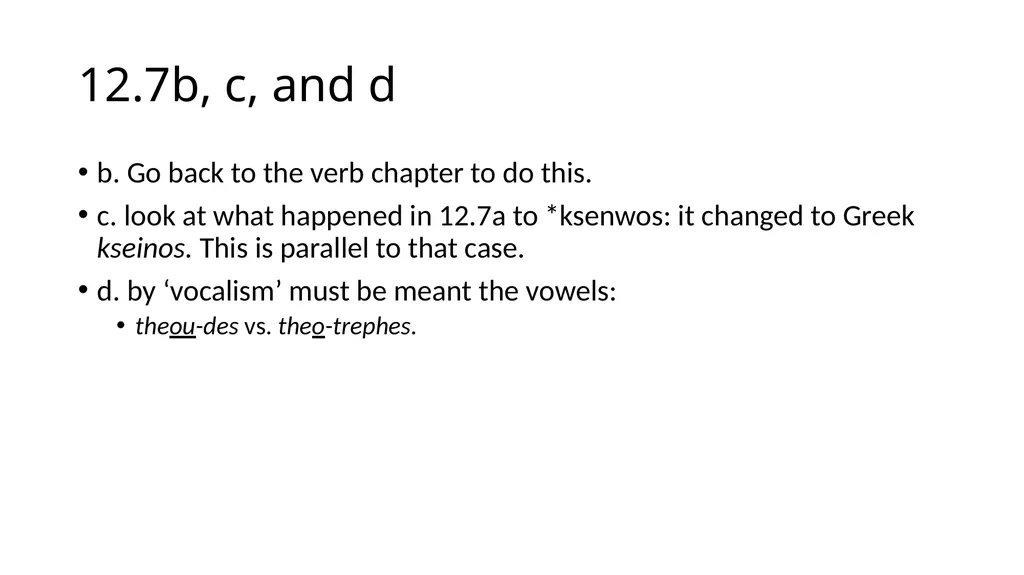
12.7b, c, and d b. Go back to the verb chapter to do this.
c. look at what happened in 12.7a to *ksenwos: it changed to Greek kseinos. This is parallel to that case.
d. by ‘vocalism’ must be meant the vowels:
theou-des vs. theo-trephes.<br>
c. look at what happened in 12.7a to *ksenwos: it changed to Greek kseinos. This is parallel to that case.
d. by ‘vocalism’ must be meant the vowels:
theou-des vs. theo-trephes.<br>
15
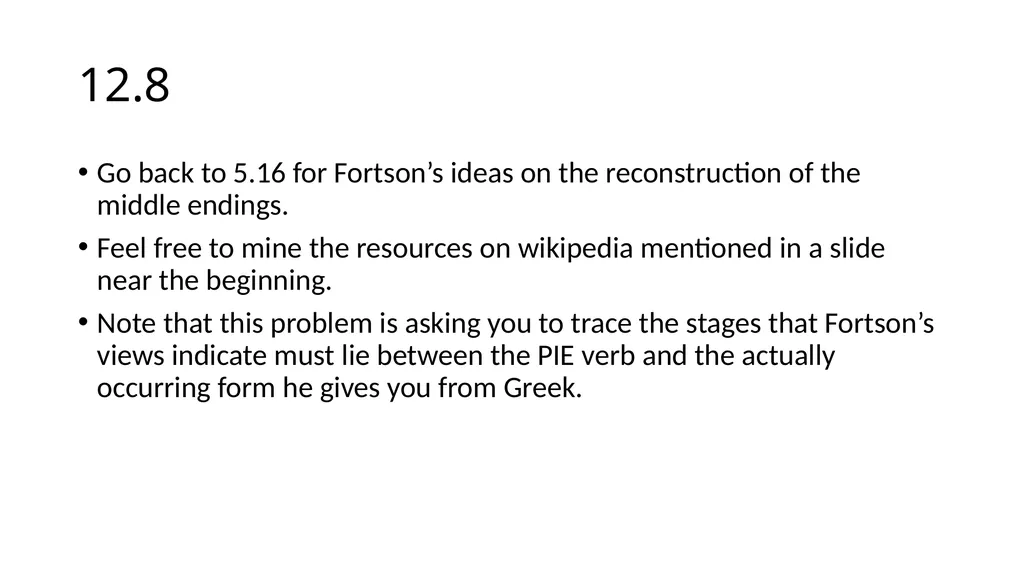
12.8 Go back to 5.16 for Fortson’s ideas on the reconstruction of the middle endings.
Feel free to mine the resources on wikipedia mentioned in a slide near the beginning.
Note that this problem is asking you to trace the stages that Fortson’s views indicate must lie between the PIE verb and the actually occurring form he gives you from Greek.<br>
Feel free to mine the resources on wikipedia mentioned in a slide near the beginning.
Note that this problem is asking you to trace the stages that Fortson’s views indicate must lie between the PIE verb and the actually occurring form he gives you from Greek.<br>
16
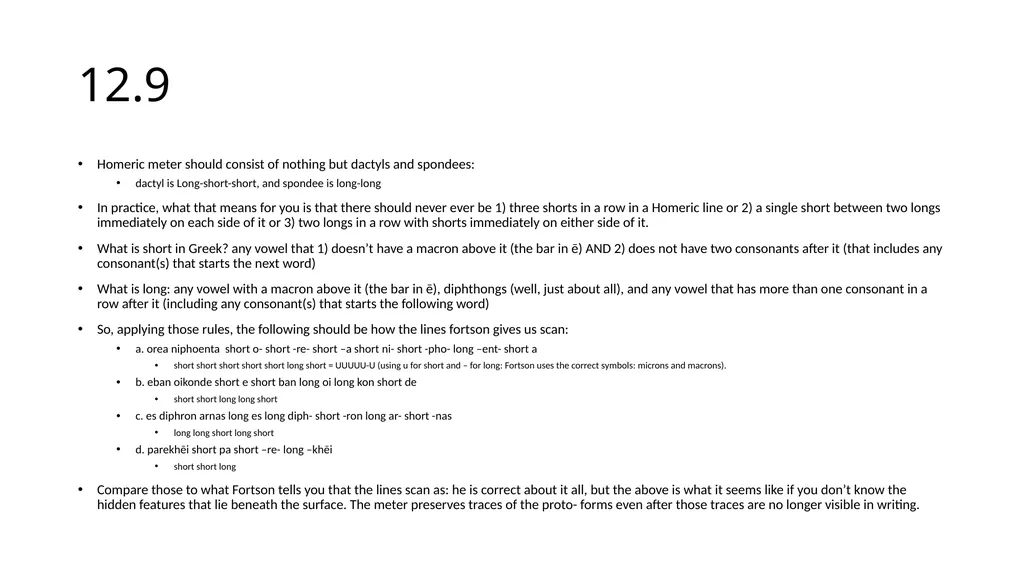
12.9 Homeric meter should consist of nothing but dactyls and spondees:
dactyl is Long-short-short, and spondee is long-long
In practice, what that means for you is that there should never ever be 1) three shorts in a row in a Homeric line or 2) a single short between two longs immediately on each side of it or 3) two longs in a row with shorts immediately on either side of it.
What is short in Greek? any vowel that 1) doesn’t have a macron above it (the bar in ē) AND 2) does not have two consonants after it (that includes any consonant(s) that starts the next word)
What is long: any vowel with a macron above it (the bar in ē), diphthongs (well, just about all), and any vowel that has more than one consonant in a row after it (including any consonant(s) that starts the following word)
So, applying those rules, the following should be how the lines fortson gives us scan:
a. orea niphoenta short o- short -re- short –a short ni- short -pho- long –ent- short a
short short short short short long short = UUUUU-U (using u for short and – for long: Fortson uses the correct symbols: microns and macrons).
b. eban oikonde short e short ban long oi long kon short de
short short long long short
c. es diphron arnas long es long diph- short -ron long ar- short -nas
long long short long short
d. parekhēi short pa short –re- long –khēi
short short long
Compare those to what Fortson tells you that the lines scan as: he is correct about it all, but the above is what it seems like if you don’t know the hidden features that lie beneath the surface. The meter preserves traces of the proto- forms even after those traces are no longer visible in writing.<br>
17
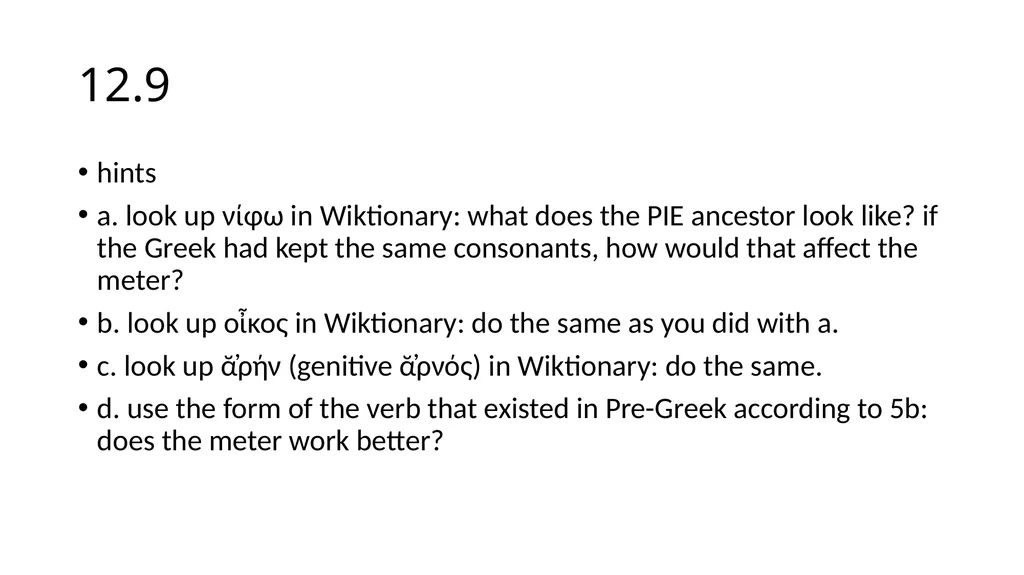
12.9 hints
a. look up νίφω in Wiktionary: what does the PIE ancestor look like? if the Greek had kept the same consonants, how would that affect the meter?
b. look up οἶκος in Wiktionary: do the same as you did with a.
c. look up ᾰ̓ρήν (genitive ᾰ̓ρνός) in Wiktionary: do the same.
d. use the form of the verb that existed in Pre-Greek according to 5b: does the meter work better?<br>
18
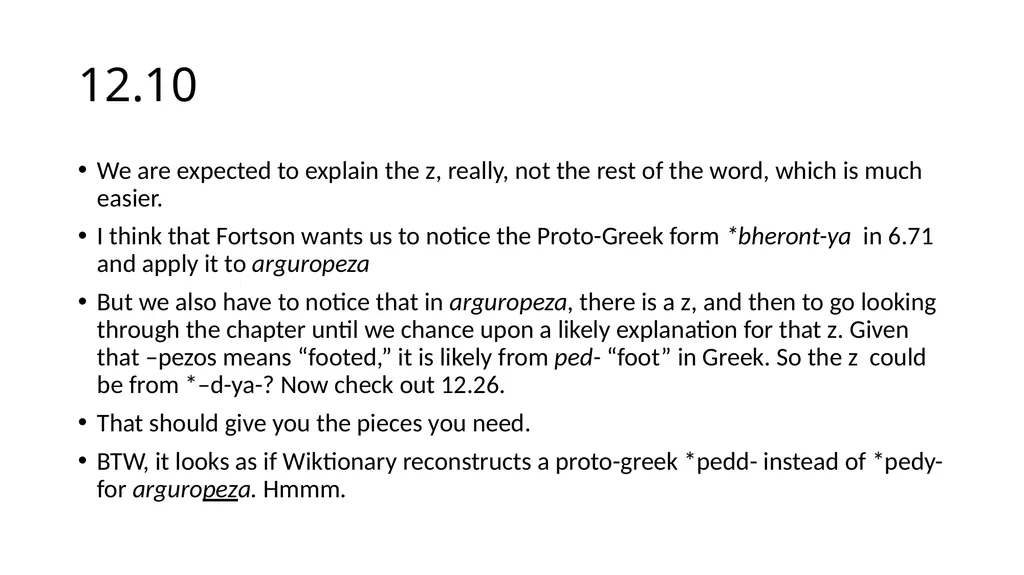
12.10 We are expected to explain the z, really, not the rest of the word, which is much easier.
I think that Fortson wants us to notice the Proto-Greek form *bheront-ya in 6.71 and apply it to arguropeza
But we also have to notice that in arguropeza, there is a z, and then to go looking through the chapter until we chance upon a likely explanation for that z. Given that –pezos means “footed,” it is likely from ped- “foot” in Greek. So the z could be from *–d-ya-? Now check out 12.26.
That should give you the pieces you need.
BTW, it looks as if Wiktionary reconstructs a proto-greek *pedd- instead of *pedy- for arguropeza. Hmmm.<br>
19
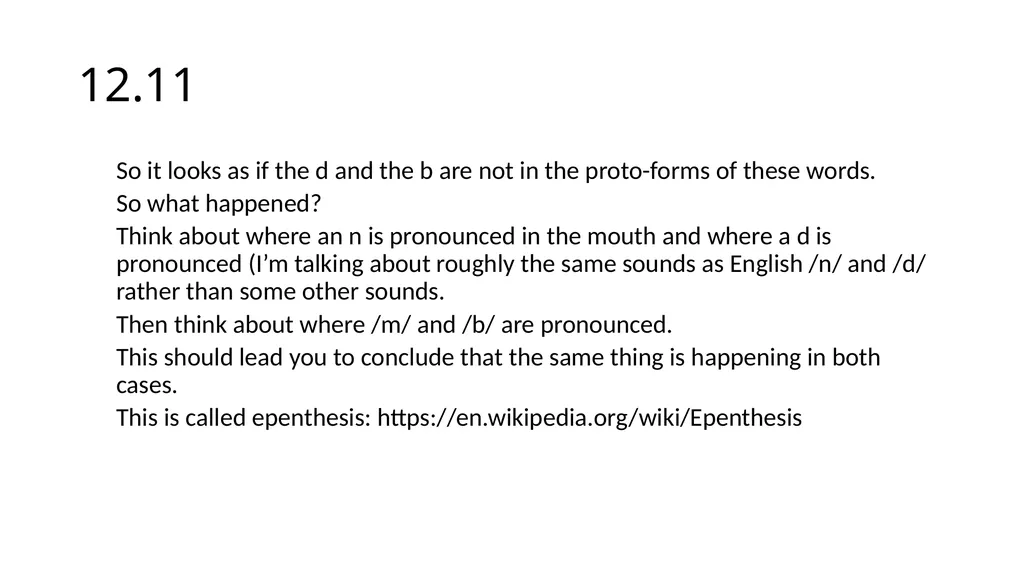
12.11 So it looks as if the d and the b are not in the proto-forms of these words.
So what happened?
Think about where an n is pronounced in the mouth and where a d is pronounced (I’m talking about roughly the same sounds as English /n/ and /d/ rather than some other sounds.
Then think about where /m/ and /b/ are pronounced.
This should lead you to conclude that the same thing is happening in both cases.
This is called epenthesis: https://en.wikipedia.org/wiki/Epenthesis<br>