
Foundational Liveability: a new approach to making
MT
Published · 21 slides · 0 views
1 / 1


Description
Foundational Liveability: a new approach to making places work better Luca Calafati, Jill Ebrey, Julie Froud, Colin Haslam, Sukhdev Johal Karel Williams Foundational Economy Collective foundational liveability: approach policy object: A
Related Topics
Share
Embed code
Download this presentation From Below
"Foundational Liveability: a new approach to making" is the property of its rightful owner. Permission is granted to download and print the materials on this website for personal, non-commercial use only, and to display it on your personal computer provided you do not modify the materials and that you retain all copyright notices contained in the materials. By downloading content from our website, you accept the terms of this agreement.
Presentation Transcript
01
Foundational Liveability:
a new approach to making places work better Luca Calafati, Jill Ebrey, Julie Froud, Colin Haslam, Sukhdev Johal + Karel Williams
Foundational Economy Collective<br>
Foundational Economy Collective<br>
02
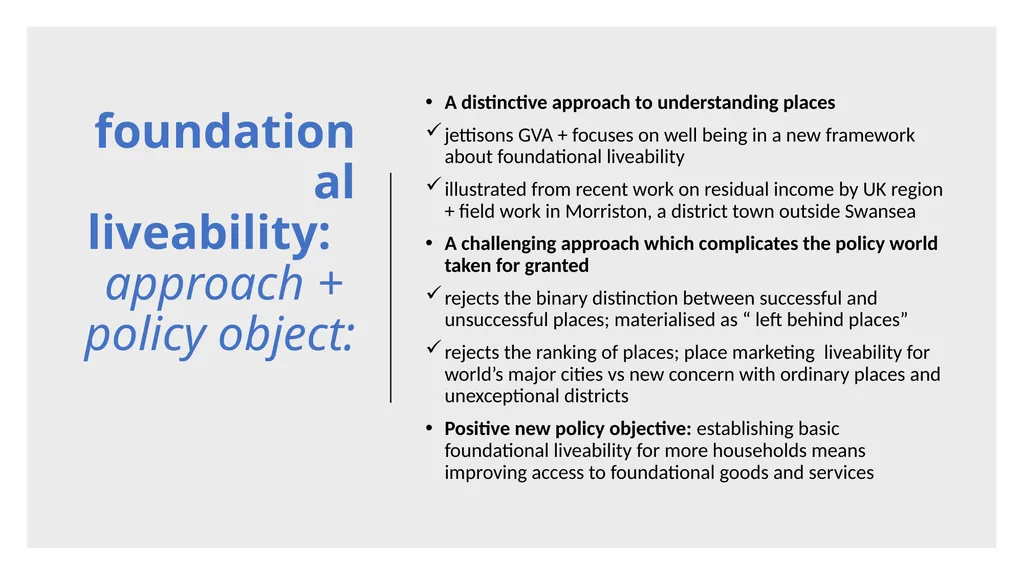
foundational liveability: approach + policy object: A distinctive approach to understanding places
jettisons GVA + focuses on well being in a new framework about foundational liveability
illustrated from recent work on residual income by UK region + field work in Morriston, a district town outside Swansea
A challenging approach which complicates the policy world taken for granted
rejects the binary distinction between successful and unsuccessful places; materialised as “ left behind places”
rejects the ranking of places; place marketing liveability for world’s major cities vs new concern with ordinary places and unexceptional districts
Positive new policy objective: establishing basic foundational liveability for more households means improving access to foundational goods and services<br>
jettisons GVA + focuses on well being in a new framework about foundational liveability
illustrated from recent work on residual income by UK region + field work in Morriston, a district town outside Swansea
A challenging approach which complicates the policy world taken for granted
rejects the binary distinction between successful and unsuccessful places; materialised as “ left behind places”
rejects the ranking of places; place marketing liveability for world’s major cities vs new concern with ordinary places and unexceptional districts
Positive new policy objective: establishing basic foundational liveability for more households means improving access to foundational goods and services<br>
03
Outline:
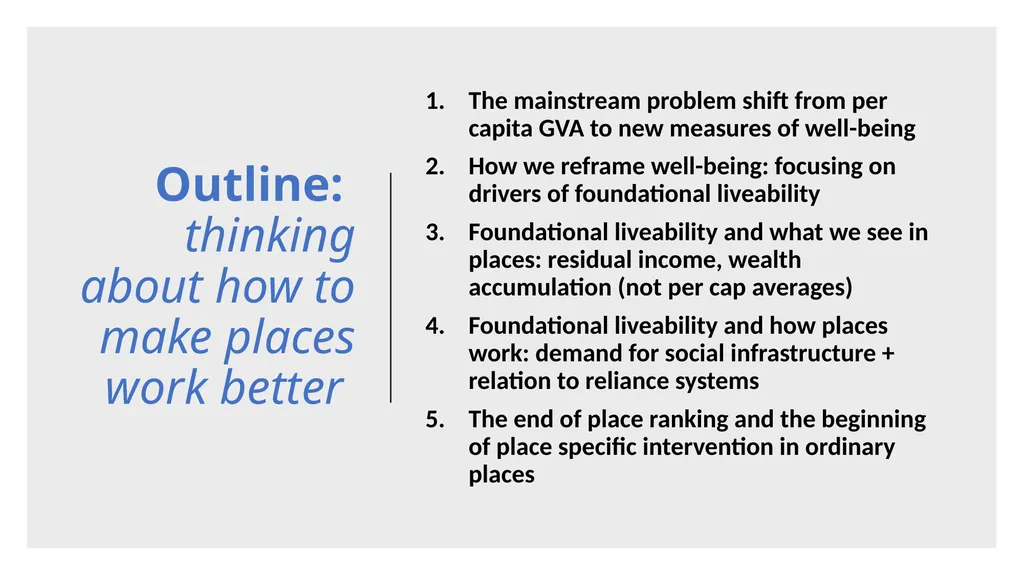
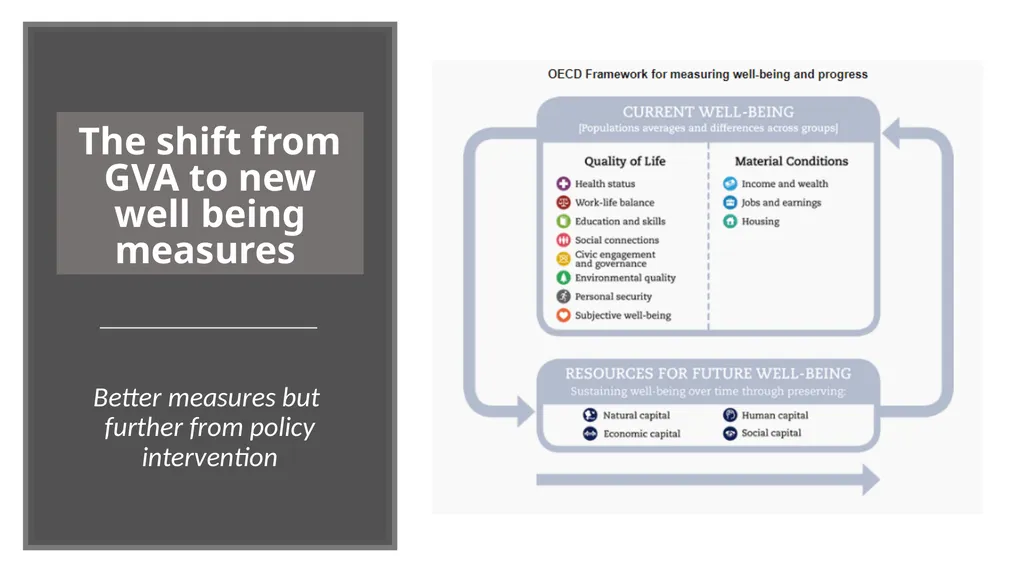
thinking about how to make places work better The mainstream problem shift from per capita GVA to new measures of well-being
How we reframe well-being: focusing on drivers of foundational liveability
Foundational liveability and what we see in places: residual income, wealth accumulation (not per cap averages)
Foundational liveability and how places work: demand for social infrastructure + relation to reliance systems
The end of place ranking and the beginning of place specific intervention in ordinary places<br>
How we reframe well-being: focusing on drivers of foundational liveability
Foundational liveability and what we see in places: residual income, wealth accumulation (not per cap averages)
Foundational liveability and how places work: demand for social infrastructure + relation to reliance systems
The end of place ranking and the beginning of place specific intervention in ordinary places<br>
04
The shift from GVA to new well being measures Better measures but further from policy intervention<br>
05
Per capita GVA:
limits of the standard metric Per capita GVA = standard measure of region or city success + trigger for policy to close GVA gaps (which have not succeeded eg in Wales or NE)
Issues of national income accounting: GVA = GDP – taxes + subsidies = a per cap output measure which roughly corresponds to disposable income (post tax) and expenditure (consumption + savings)
Intellectual weakness = adds heterogeneous outputs + forms of consumption according to one order of worth ie market value or cost which disrespects social reproduction + the planet
Practical weakness = per capita disposable income is a poor guide to living standard differences within or between places: ONS experimental series shows that Londoners spend £10k more each year + £7k of that goes on more expensive housing<br>
Issues of national income accounting: GVA = GDP – taxes + subsidies = a per cap output measure which roughly corresponds to disposable income (post tax) and expenditure (consumption + savings)
Intellectual weakness = adds heterogeneous outputs + forms of consumption according to one order of worth ie market value or cost which disrespects social reproduction + the planet
Practical weakness = per capita disposable income is a poor guide to living standard differences within or between places: ONS experimental series shows that Londoners spend £10k more each year + £7k of that goes on more expensive housing<br>
06
Well- being ? better measures
add policy
confusion More sophisticated, multi dimensional measures because subjective + objective well being cannot be encapsulated in one dimension giving a bottom line (like GVA per cap)
OECD framework, dashboards + KPIs reflecting aspects of the object + claims of different discourses (eg Wales Well Being of Future Generations has 7 goals + 46 KPIs);
UK ONS measuring national well-being project goes further (e.g. mental health in ‘personal’ and cost of essential items in ‘economic’)
Better measures confuse policy intervention and evaluation; because policy makers face a bank of flashing green, amber and red lights with no agreement on causal drivers + loose problem definitions<br>
OECD framework, dashboards + KPIs reflecting aspects of the object + claims of different discourses (eg Wales Well Being of Future Generations has 7 goals + 46 KPIs);
UK ONS measuring national well-being project goes further (e.g. mental health in ‘personal’ and cost of essential items in ‘economic’)
Better measures confuse policy intervention and evaluation; because policy makers face a bank of flashing green, amber and red lights with no agreement on causal drivers + loose problem definitions<br>
07
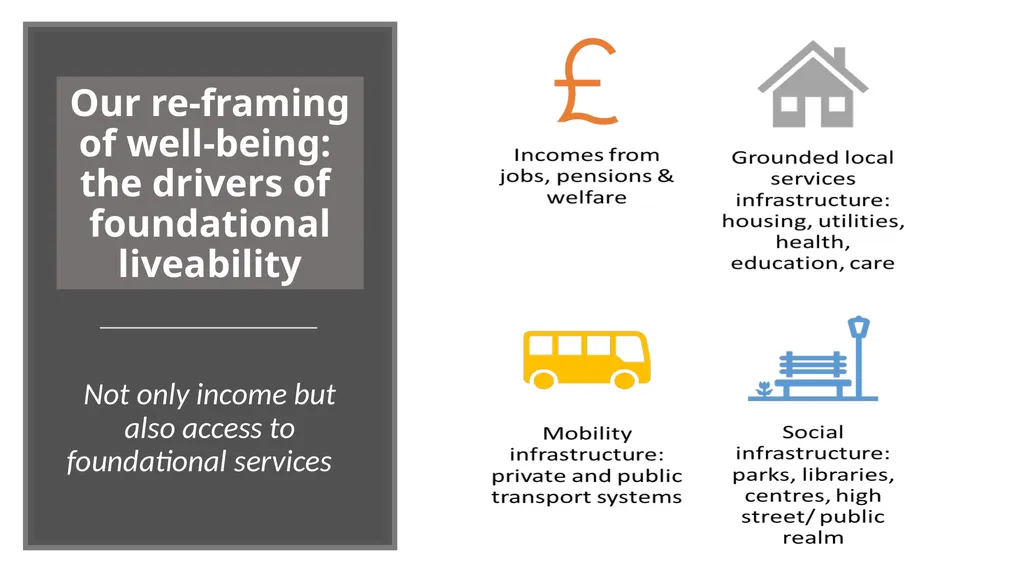
Our re-framing of well-being:
the drivers of foundational
liveability Not only income but also access to foundational services<br>
08
well-being
as liberal freedom
and its
material
conditions Well being is about meeting basic human needs; but that’s complicated when needs are culturally defined + socially mediated using available technologies (eg railways or cheap air flights = new mass mobilities)
Hence we start from the Senian capability approach: quality of life/well being is capacity to function (being and doing)+ freedom of citizens depends on their capacity to “live the lives they have reason to value”
Foundational approach then shifts from measuring outcomes to conceptualising drivers of liveability ie qualifying Sen’s liberal individualism because the material conditions of citizen well-being are collective provision as much as individual consumption; and individuals live in households with income sharing<br>
Hence we start from the Senian capability approach: quality of life/well being is capacity to function (being and doing)+ freedom of citizens depends on their capacity to “live the lives they have reason to value”
Foundational approach then shifts from measuring outcomes to conceptualising drivers of liveability ie qualifying Sen’s liberal individualism because the material conditions of citizen well-being are collective provision as much as individual consumption; and individuals live in households with income sharing<br>
09
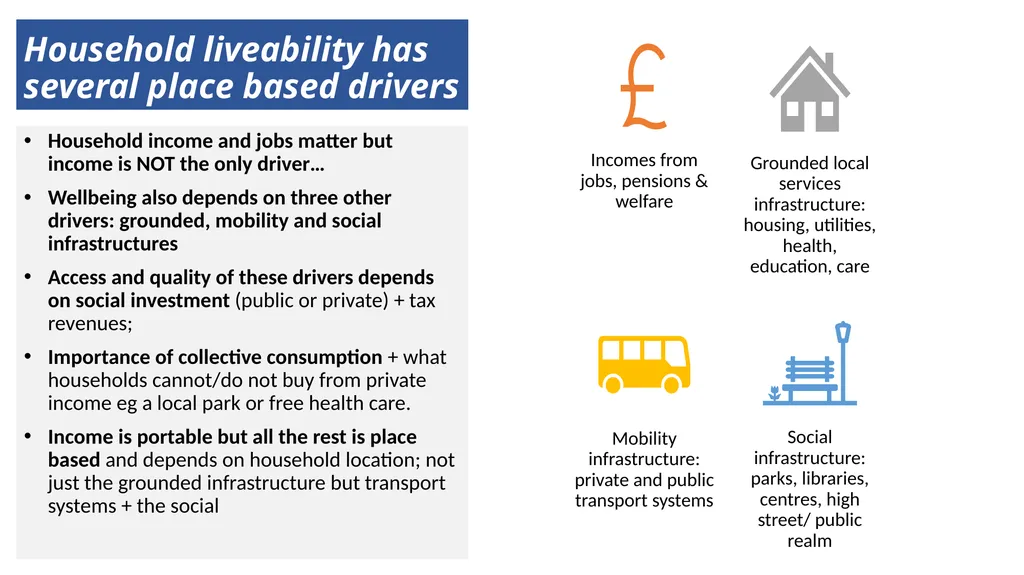
Household liveability has several place based drivers Household income and jobs matter but income is NOT the only driver…
Wellbeing also depends on three other drivers: grounded, mobility and social infrastructures
Access and quality of these drivers depends on social investment (public or private) + tax revenues;
Importance of collective consumption + what households cannot/do not buy from private income eg a local park or free health care.
Income is portable but all the rest is place based and depends on household location; not just the grounded infrastructure but transport systems + the social<br>
Wellbeing also depends on three other drivers: grounded, mobility and social infrastructures
Access and quality of these drivers depends on social investment (public or private) + tax revenues;
Importance of collective consumption + what households cannot/do not buy from private income eg a local park or free health care.
Income is portable but all the rest is place based and depends on household location; not just the grounded infrastructure but transport systems + the social<br>
10
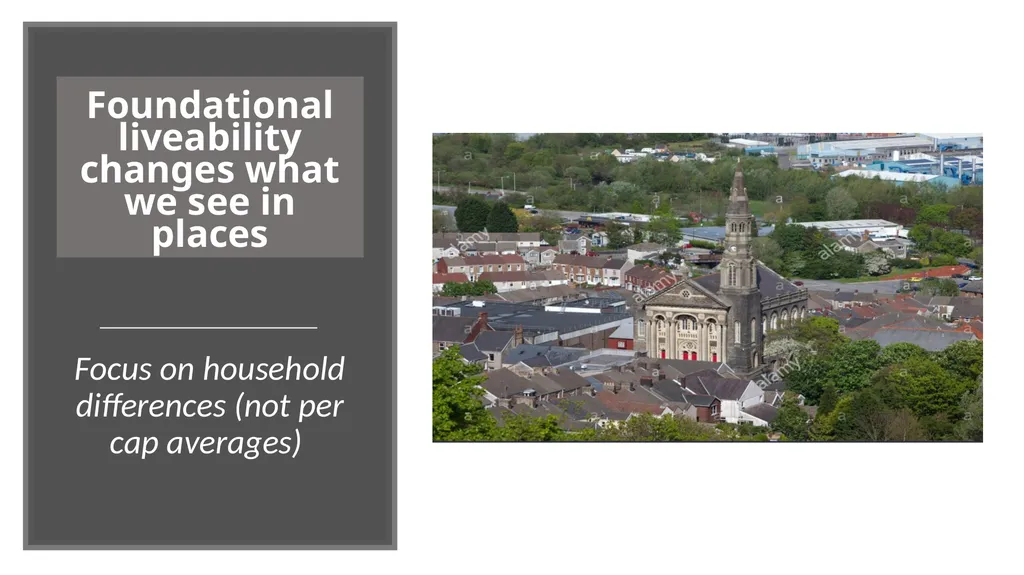
Foundational liveability changes what we see in places Focus on household differences (not per cap averages)<br>
11
(1) Places are mosaic income variation:
residual
income varies
by household type High or low average per capita disposable income is meaningless because of varying housing + transport costs: residual household income under 50% for London first time buyers vs 70% for DB pensioners with paid off mortgages
Recognise different types of household –by tenure, age and composition and whether members of the household are economically active/inactive.
Well being is impossible if the household cannot afford essentials or has a small residual; a big issue when house prices are high as in London with trapped renters paying off somebody else’s mortgage (first time buyers In London need two incomes in the top half of the income distribution + £140k deposit; )<br>
Recognise different types of household –by tenure, age and composition and whether members of the household are economically active/inactive.
Well being is impossible if the household cannot afford essentials or has a small residual; a big issue when house prices are high as in London with trapped renters paying off somebody else’s mortgage (first time buyers In London need two incomes in the top half of the income distribution + £140k deposit; )<br>
12
(2) Places are sites of wealth accumulation:
via house property
(but only for some) Income level and growth is only one part of a bigger story about household wealth accumulation via house property which drives differences between households within and between regions
Differences between regions: under post 2008 monetary policy London house prices have increased steadily but not in the NE or Wales; the average home owner in London made £20k a year untaxed and unearned every year from 2008 -18; while house prices have flatlined in much of North.
Differences within regions according to income quintile; Q1 London households make no gains; household needs disposable income to take out a mortgage + benefit from the feedback loop to income via equity withdrawal<br>
Differences between regions: under post 2008 monetary policy London house prices have increased steadily but not in the NE or Wales; the average home owner in London made £20k a year untaxed and unearned every year from 2008 -18; while house prices have flatlined in much of North.
Differences within regions according to income quintile; Q1 London households make no gains; household needs disposable income to take out a mortgage + benefit from the feedback loop to income via equity withdrawal<br>
13
(3) Places are 70/30 or 80/20 divided:
low GVA per cap but comfortable for many Morriston is 70/80% comfortable varying according to ward, housing tenure, age group: eg DB pensioners with paid off mortgages + high residual income vs the 16% of >65s claiming pension credit
Morriston has low earned incomes but is liveable for many because nearly 70% are owner occupiers of relatively cheap housing; two median wage earners can afford a terrace house at £85k as first time buyers + 30% own outright with paid off mortgages + low cash housing costs
Hard edge of foundational deprivation for a minority with eg 30% of survey respondents saying they “ sometimes find it difficult to feed their family”<br>
Morriston has low earned incomes but is liveable for many because nearly 70% are owner occupiers of relatively cheap housing; two median wage earners can afford a terrace house at £85k as first time buyers + 30% own outright with paid off mortgages + low cash housing costs
Hard edge of foundational deprivation for a minority with eg 30% of survey respondents saying they “ sometimes find it difficult to feed their family”<br>
14
Foundational liveability engages with how places work Connecting with what citizens want and households do<br>
15
(1) Connecting policy with what citizens want:
the demand for social infrastructure Disconnect of growth n jobs econ policy from what citizens want; growth? citizens don’t think in these terms because only 39% can define GDP correctly for Yougov; better jobs? many citizens want jobs which fit into their lives because 71 % of Brits favour a 4 day week and 37 % think we would be just as productive
In Morriston outside Swansea, what citizens tell us they want is social infrastructure like parks, libraries and community centres + the free or low cost activities therein; coherent with other evidence eg Happy Places mobile phone pics are of parks, beaches +community places (not the multiplex or the shopping centre)
NB Crucially important to understand the intertwining of economic and social within places which aren’t simply about private consumption from personal income; and wouldn’t be fixed by raising incomes<br>
In Morriston outside Swansea, what citizens tell us they want is social infrastructure like parks, libraries and community centres + the free or low cost activities therein; coherent with other evidence eg Happy Places mobile phone pics are of parks, beaches +community places (not the multiplex or the shopping centre)
NB Crucially important to understand the intertwining of economic and social within places which aren’t simply about private consumption from personal income; and wouldn’t be fixed by raising incomes<br>
16
(1) Connecting policy with what households do: eg relation to reliance systems like public transport Policy makers are much concerned with public transport; travel to work/ extending labour market in econ policy with social policy pro cheap or free fares.
Like most of Europe’s towns and smaller cities, Morriston is formatted around the car as tool for accessing all the resources of work, consumption and leisure (with bus use residualised);
86% of survey respondents usually had access to a car and 40 % never use a bus:
Complex issues + policy choices:
majority have access at a cost in air quality + global warming; pricing or restricting car use is unpopular (gilet jaunes)
motoring poor cannot afford to run, repair or replace the car; participation at high cost
bus dependent cannot easily access the local value supermarkets; public transport is not a substitute for many jouneys<br>
Like most of Europe’s towns and smaller cities, Morriston is formatted around the car as tool for accessing all the resources of work, consumption and leisure (with bus use residualised);
86% of survey respondents usually had access to a car and 40 % never use a bus:
Complex issues + policy choices:
majority have access at a cost in air quality + global warming; pricing or restricting car use is unpopular (gilet jaunes)
motoring poor cannot afford to run, repair or replace the car; participation at high cost
bus dependent cannot easily access the local value supermarkets; public transport is not a substitute for many jouneys<br>
17
Foundational liveability means the end of place ranking And beginning to value ordinary places Vienna ranked as most liveable city in the world (BBC News, 14 august 2018)
“The Austrian capital, Vienna, has beaten Australia's Melbourne to be named the world's most liveable city. It's the first time a European city has topped the rankings of the Economist Intelligence Unit (EIU) annual survey. The worldwide league table ranks 140 cities on a range of factors, including political and social stability, crime, education and access to health care. In the survey, Manchester saw the biggest improvement of any European city, rising by 16 places to rank 35th……”<br>
“The Austrian capital, Vienna, has beaten Australia's Melbourne to be named the world's most liveable city. It's the first time a European city has topped the rankings of the Economist Intelligence Unit (EIU) annual survey. The worldwide league table ranks 140 cities on a range of factors, including political and social stability, crime, education and access to health care. In the survey, Manchester saw the biggest improvement of any European city, rising by 16 places to rank 35th……”<br>
18
Marketing liveability:
indexes +
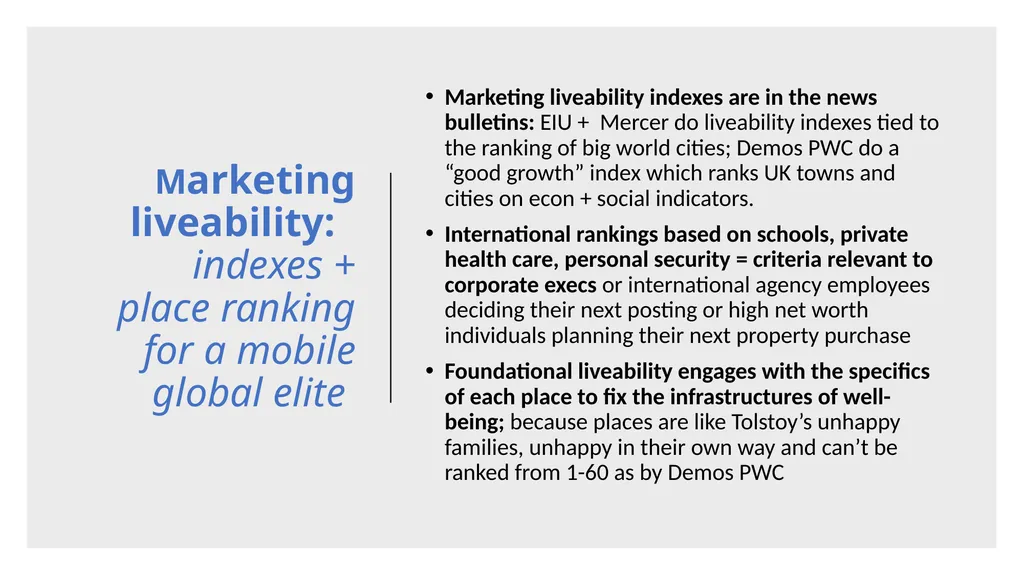
place ranking for a mobile global elite Marketing liveability indexes are in the news bulletins: EIU + Mercer do liveability indexes tied to the ranking of big world cities; Demos PWC do a “good growth” index which ranks UK towns and cities on econ + social indicators.
International rankings based on schools, private health care, personal security = criteria relevant to corporate execs or international agency employees deciding their next posting or high net worth individuals planning their next property purchase
Foundational liveability engages with the specifics of each place to fix the infrastructures of well- being; because places are like Tolstoy’s unhappy families, unhappy in their own way and can’t be ranked from 1-60 as by Demos PWC<br>
International rankings based on schools, private health care, personal security = criteria relevant to corporate execs or international agency employees deciding their next posting or high net worth individuals planning their next property purchase
Foundational liveability engages with the specifics of each place to fix the infrastructures of well- being; because places are like Tolstoy’s unhappy families, unhappy in their own way and can’t be ranked from 1-60 as by Demos PWC<br>
19
Foundational liveability:
the start of
place specific
intervention
for ordinary
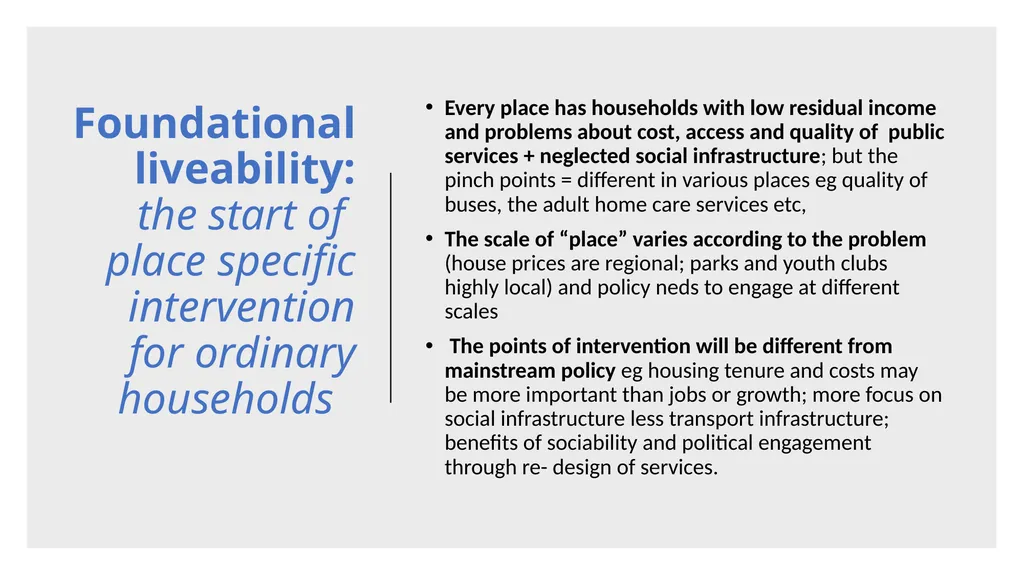
households Every place has households with low residual income and problems about cost, access and quality of public services + neglected social infrastructure; but the pinch points = different in various places eg quality of buses, the adult home care services etc,
The scale of “place” varies according to the problem (house prices are regional; parks and youth clubs highly local) and policy neds to engage at different scales
The points of intervention will be different from mainstream policy eg housing tenure and costs may be more important than jobs or growth; more focus on social infrastructure less transport infrastructure; benefits of sociability and political engagement through re- design of services.<br>
The scale of “place” varies according to the problem (house prices are regional; parks and youth clubs highly local) and policy neds to engage at different scales
The points of intervention will be different from mainstream policy eg housing tenure and costs may be more important than jobs or growth; more focus on social infrastructure less transport infrastructure; benefits of sociability and political engagement through re- design of services.<br>
20
No place is “left behind”:
every place
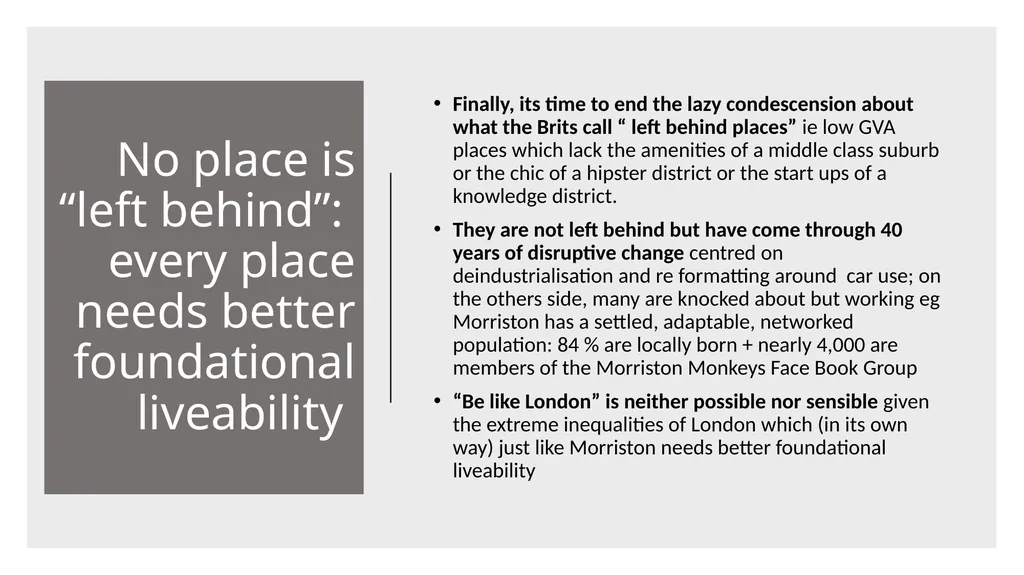
needs better foundational liveability Finally, its time to end the lazy condescension about what the Brits call “ left behind places” ie low GVA places which lack the amenities of a middle class suburb or the chic of a hipster district or the start ups of a knowledge district.
They are not left behind but have come through 40 years of disruptive change centred on deindustrialisation and re formatting around car use; on the others side, many are knocked about but working eg Morriston has a settled, adaptable, networked population: 84 % are locally born + nearly 4,000 are members of the Morriston Monkeys Face Book Group
“Be like London” is neither possible nor sensible given the extreme inequalities of London which (in its own way) just like Morriston needs better foundational liveability<br>
They are not left behind but have come through 40 years of disruptive change centred on deindustrialisation and re formatting around car use; on the others side, many are knocked about but working eg Morriston has a settled, adaptable, networked population: 84 % are locally born + nearly 4,000 are members of the Morriston Monkeys Face Book Group
“Be like London” is neither possible nor sensible given the extreme inequalities of London which (in its own way) just like Morriston needs better foundational liveability<br>
21
Argument based on a working paper and public interest report both at foundational economy.com Foundational liveability: rethinking territorial inequalities Working Paper No 5 https://foundationaleconomycom.files.wordpress.com/2018/12/foundational-livability-wp-no-5-fe-collective.pdf
How an ordinary place works: understanding Morriston https://foundationaleconomycom.files.wordpress.com/2019/05/morriston-report-v6-13-may-2019.pdf<br>
How an ordinary place works: understanding Morriston https://foundationaleconomycom.files.wordpress.com/2019/05/morriston-report-v6-13-may-2019.pdf<br>