Four quadrant approach Professor Heather Draper, Catherine Hale, Lt Cdr Alan Brockie Who are these slides for? These slides introduce the four quadrant approach (4QA) to making ethical decisions They can be used to familiarise yourself with
"Four quadrant approach Professor Heather Draper," is the property of its rightful owner. Permission is granted to
download and print the materials on this website for personal, non-commercial use only, and to display it
on your personal computer provided you do not modify the materials and that you retain all copyright
notices contained in the materials. By downloading content from our website, you accept the terms of this
agreement.
Presentation Transcript
01
Four quadrant approach Professor Heather Draper, Catherine Hale, Lt Cdr Alan Brockie<br>
02
Who are these slides for? These slides introduce the four quadrant approach (4QA) to making ethical decisions
They can be used to familiarise yourself with this tool, or to present the tool to others to use – perhaps in conjunction with some of our case studies as a group work exercise.
Anyone is free to use them. We ask only that you preserve the accreditation in full.<br>
03
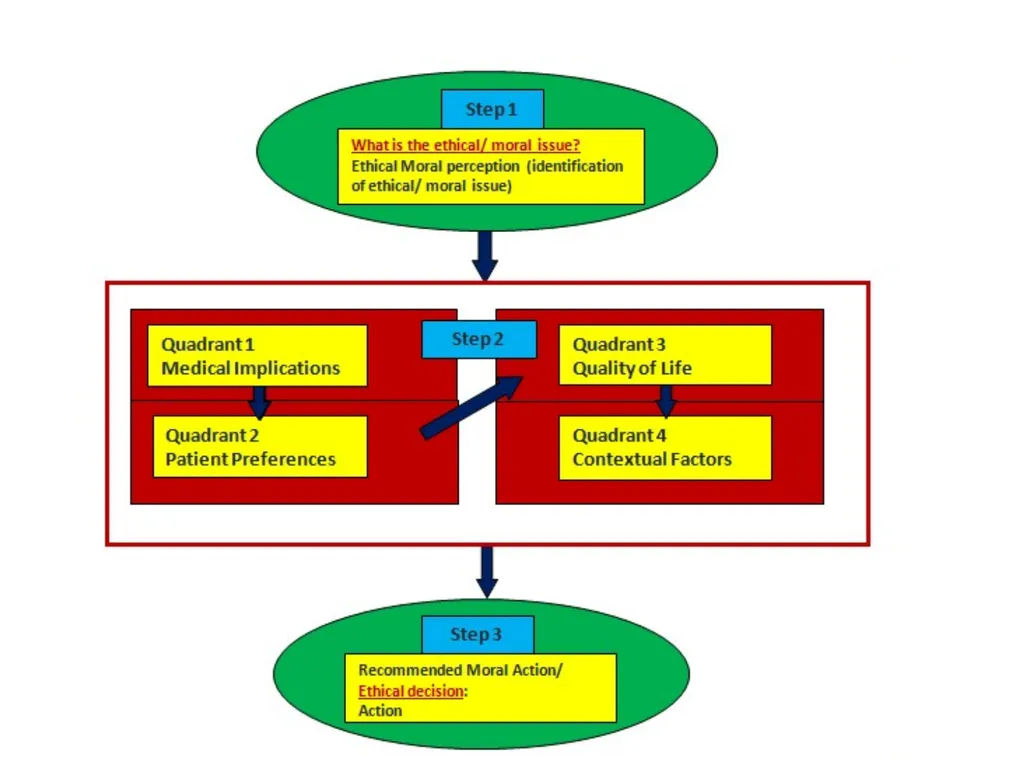
What is the 4QA? The 4QA has been adopted by UK Defence Medical Services as a useful way working through an ethical issue in clinical practice1
It is not a theory or principle or formula. It is more of a tool for organising your thoughts
Here we are using a slightly modified representation of the 4QA based on the work conducted to evaluate it use by the military2
1.Ministry of Defence. Joint Service Publication ( JSP 999). Clinical Guidelines for 14 Operations. Section 5: Pathways 7 Version Change 3 September, London: MoD, 2012.
2. Bernthall, EMM, Russell, RJ Draper, H A qualitative study of the use of the four quadrant approach to assist ethical decision-making during deployment. JR Army Corps 2014 160; 96-202<br>
04
The 4QA was adapted by Sokel3 from the ‘four topics approach’ to assist ethical decision-making in palliative care4.
It assumes a reasonable amount of time for discussion and this time may not be available in kinetic situations.
3. Sokol DK. The ‘four quadrants’ approach to clinical ethics case analysis: an application and review. J Med Ethics 2008;34:513–16.
4. Schumann JH, Alfandre D. Clinical ethical decision making: the four topics approach. Semin Med Pract 2008;11:36–42.<br>
05
In a training context, we suggest that groups are given a case to tackle, literally draw the four quadrants on a large flip chart/white board and discuss what information or considerations should go in each of the quadrants.
It is important, however, that they follow all three steps, rather than jumping straight to Step 2<br>
06
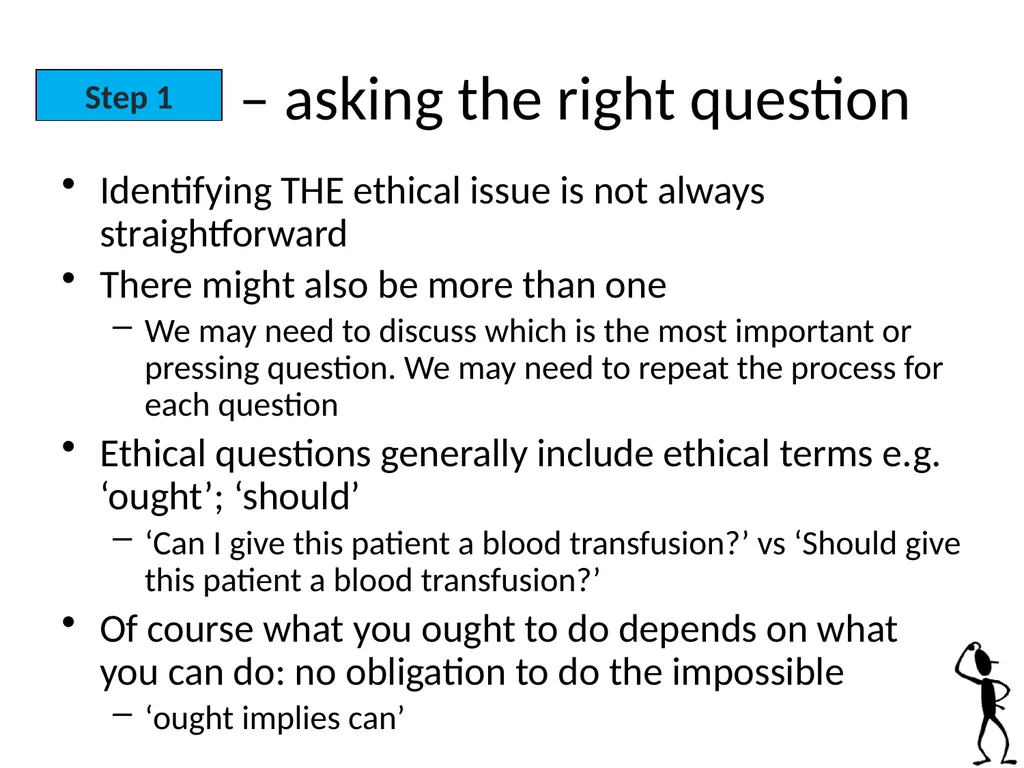
– asking the right question Identifying THE ethical issue is not always straightforward
There might also be more than one
We may need to discuss which is the most important or pressing question. We may need to repeat the process for each question
Ethical questions generally include ethical terms e.g. ‘ought’; ‘should’
‘Can I give this patient a blood transfusion?’ vs ‘Should give this patient a blood transfusion?’
Of course what you ought to do depends on what you can do: no obligation to do the impossible
‘ought implies can’ Step 1<br>
07
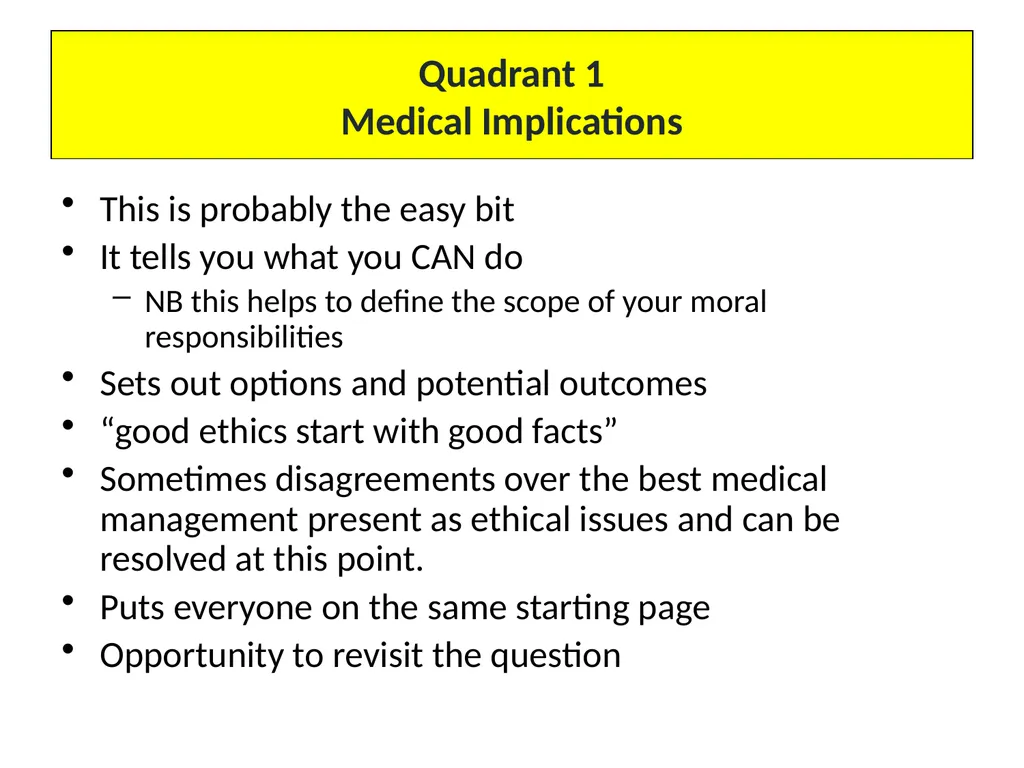
This is probably the easy bit
It tells you what you CAN do
NB this helps to define the scope of your moral responsibilities
Sets out options and potential outcomes
“good ethics start with good facts”
Sometimes disagreements over the best medical management present as ethical issues and can be resolved at this point.
Puts everyone on the same starting page
Opportunity to revisit the question Quadrant 1
Medical Implications<br>
08
However Q1 assumes that the medical indications are clear
Whereas often ethical issues arise because of uncertainty
And also what seems likely turns out not to be
And sometimes this resolves the ethical issue
E.g. Patient dies unexpectedly
And sometimes it changes the question
E.g. Patient unexpectedly survives withdrawal of care: now what?
This may mean going back to step one<br>
09
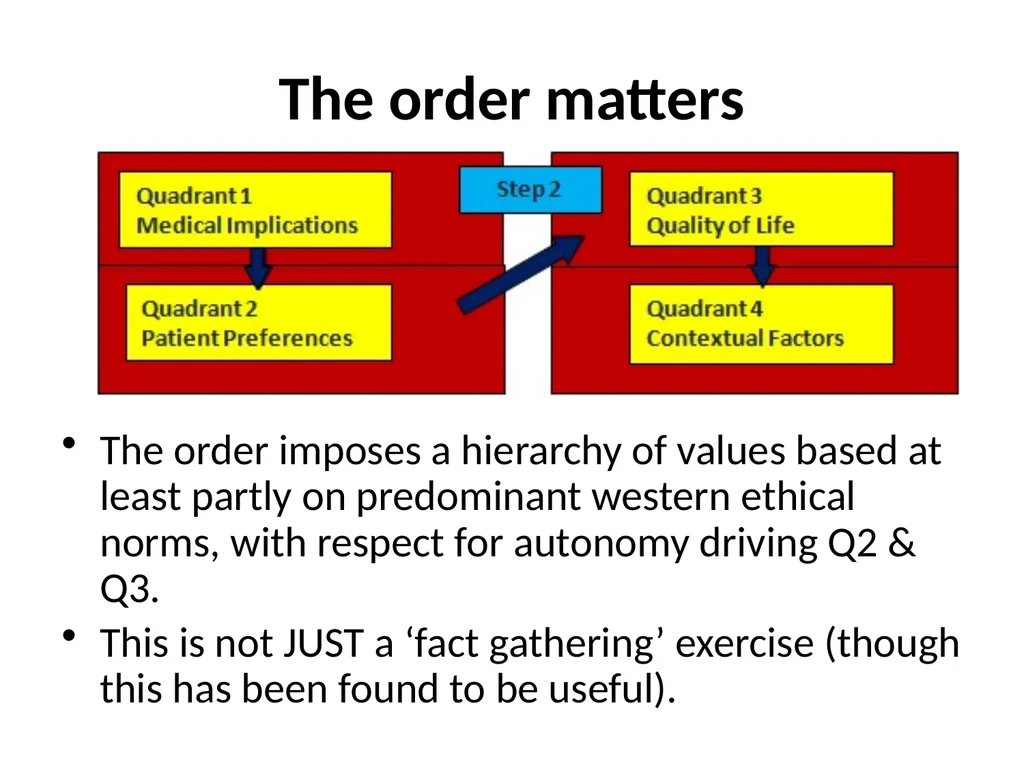
The order matters The order imposes a hierarchy of values based at least partly on predominant western ethical norms, with respect for autonomy driving Q2 & Q3.
This is not JUST a ‘fact gathering’ exercise (though this has been found to be useful).<br>
10
Can put an end to the matter
Refusal of consent by a competent patient has to be respected; go no further?
Previously stated wishes; go no further?
Go no further?
Assumes autonomy trumps other concerns
Have sufficient evidence of wishes
Might not be known
Adult without capacity & no one available to provide information
Might not exist - minors
Though parental wishes might be relevant, assuming parents present
And parents acting in the best interests of minor Quadrant 2
Patient Preferences<br>
11
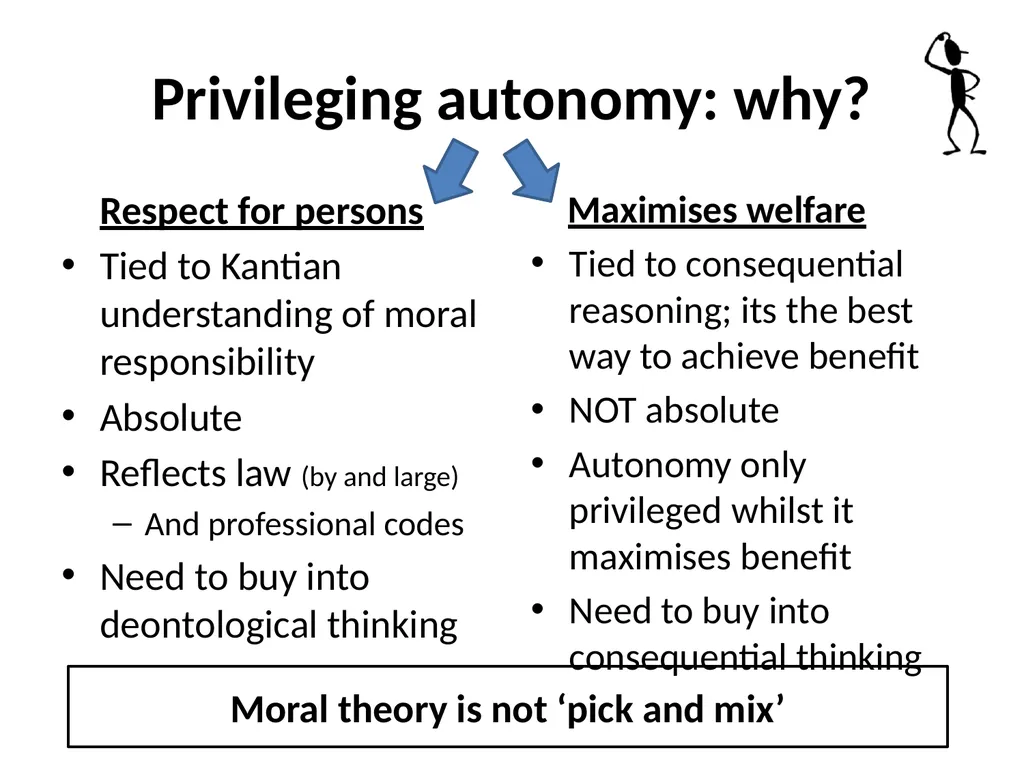
Privileging autonomy: why? Respect for persons
Tied to Kantian understanding of moral responsibility
Absolute
Reflects law (by and large)
And professional codes
Need to buy into deontological thinking Maximises welfare
Tied to consequential reasoning; its the best way to achieve benefit
NOT absolute
Autonomy only privileged whilst it maximises benefit
Need to buy into consequential thinking Moral theory is not ‘pick and mix’<br>
12
Supposed only get here if the patient unable to express a preference (including through others)
Assumes patient best judge, if able to judge, including of their QoL
But patient’s preferences could be unreasonable
Reasons for privileging autonomy may now start to bite
Aspect of first do no harm / beneficence
Likely to be informed by Q1
People disagree on what gives life quality
People disagree especially about the relationship between quality of life and value of life. Quadrant 3
Quality of Life<br>
13
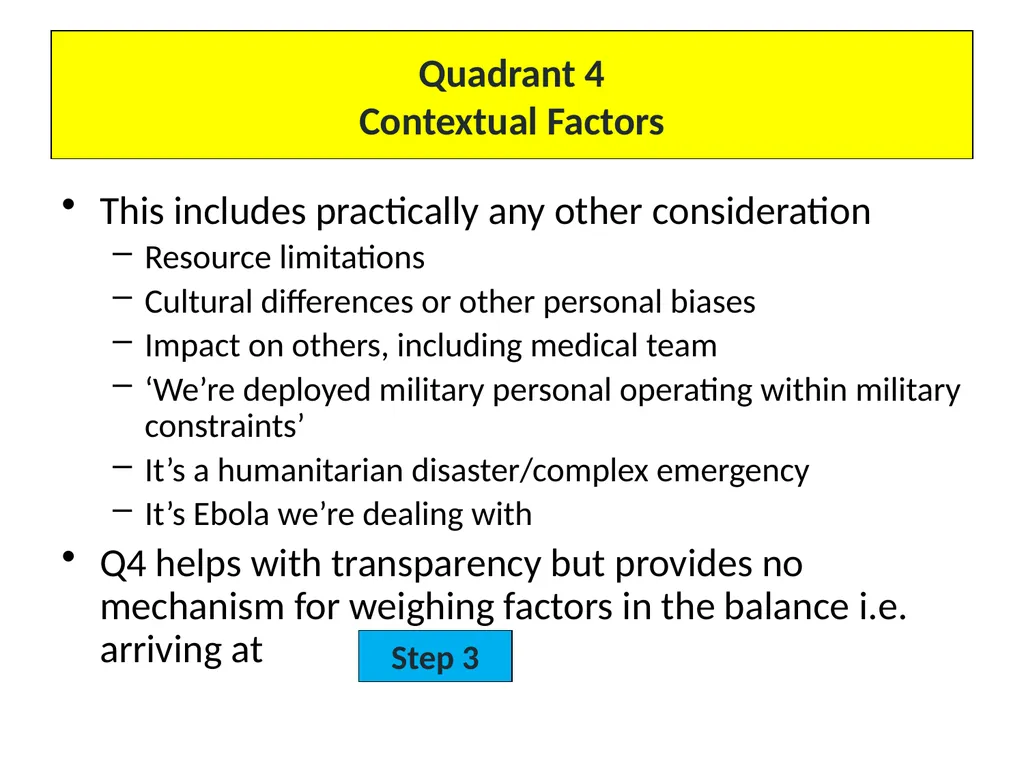
This includes practically any other consideration
Resource limitations
Cultural differences or other personal biases
Impact on others, including medical team
‘We’re deployed military personal operating within military constraints’
It’s a humanitarian disaster/complex emergency
It’s Ebola we’re dealing with
Q4 helps with transparency but provides no mechanism for weighing factors in the balance i.e. arriving at Quadrant 4
Contextual Factors Step 3<br>
14
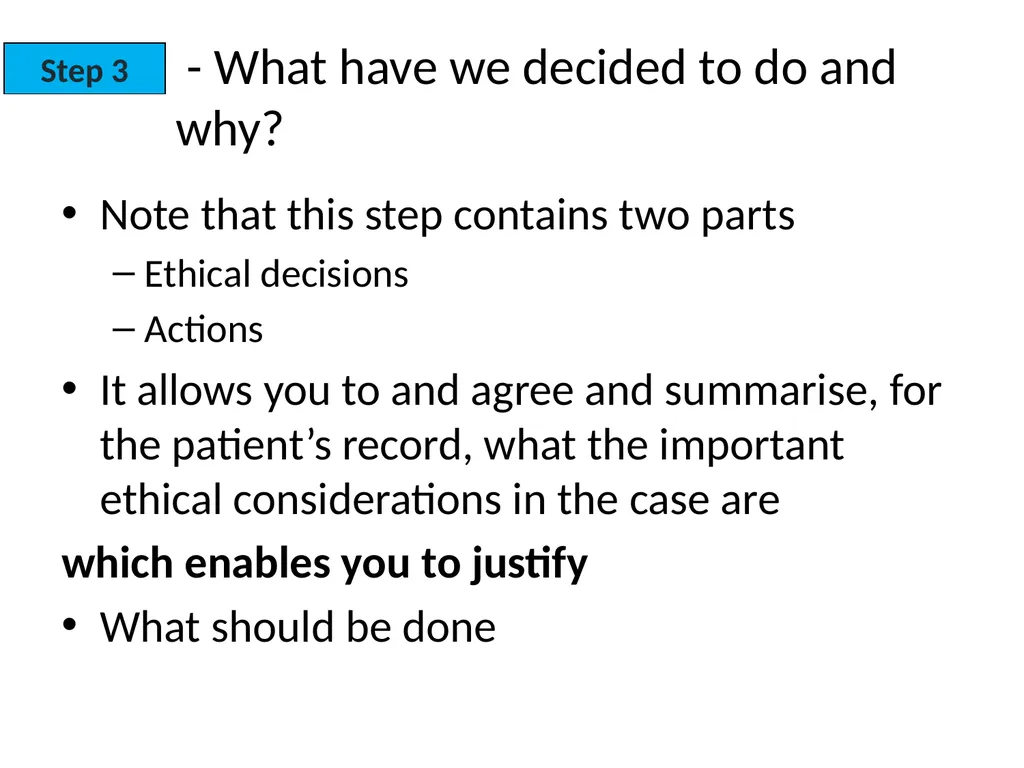
- What have we decided to do and why? Note that this step contains two parts
Ethical decisions
Actions
It allows you to and agree and summarise, for the patient’s record, what the important ethical considerations in the case are
which enables you to justify
What should be done Step 3<br>