
Fourth Edition 2020
T
Published · 46 slides · 0 views
1 / 1

Description
Fourth Edition 2020 www.smilesforlifeoralhealth.org Last Modified September 2021 Copyright STFM 2005-2021 Image: Catherine YeuletPhotos.com Image: Miroslav Ferkuniak Photos.com Image: Ken HurstPhotos.com Authors and Editors Hugh Silk,
Related Topics
Share
Embed code
Download this presentation From Below
"Fourth Edition 2020" is the property of its rightful owner. Permission is granted to download and print the materials on this website for personal, non-commercial use only, and to display it on your personal computer provided you do not modify the materials and that you retain all copyright notices contained in the materials. By downloading content from our website, you accept the terms of this agreement.
Presentation Transcript
01
Fourth Edition 2020
www.smilesforlifeoralhealth.org
Last Modified September 2021 Copyright STFM 2005-2021 Image: Catherine Yeulet/Photos.com Image: Miroslav Ferkuniak /Photos.com Image: Ken Hurst/Photos.com<br>
www.smilesforlifeoralhealth.org
Last Modified September 2021 Copyright STFM 2005-2021 Image: Catherine Yeulet/Photos.com Image: Miroslav Ferkuniak /Photos.com Image: Ken Hurst/Photos.com<br>
02
Authors and Editors
Hugh Silk, M.D., M.P.H.
Emily Cooper, M.D.
Consultants
OB/GYN – Lucy Chie, M.D., M.P.H.
Dentistry - Rocio Quinonez, D.M.S, M.P.H.
Smiles for Life Editors
Melinda Clark, M.D.
Karlynn Sievers, M.D.
Funded By The images in this presentation are not to be reproduced/downloaded for purposes other than personal use. Republication, retransmission, reproduction, or other use of the Licensed Material is prohibited.<br>
Hugh Silk, M.D., M.P.H.
Emily Cooper, M.D.
Consultants
OB/GYN – Lucy Chie, M.D., M.P.H.
Dentistry - Rocio Quinonez, D.M.S, M.P.H.
Smiles for Life Editors
Melinda Clark, M.D.
Karlynn Sievers, M.D.
Funded By The images in this presentation are not to be reproduced/downloaded for purposes other than personal use. Republication, retransmission, reproduction, or other use of the Licensed Material is prohibited.<br>
03
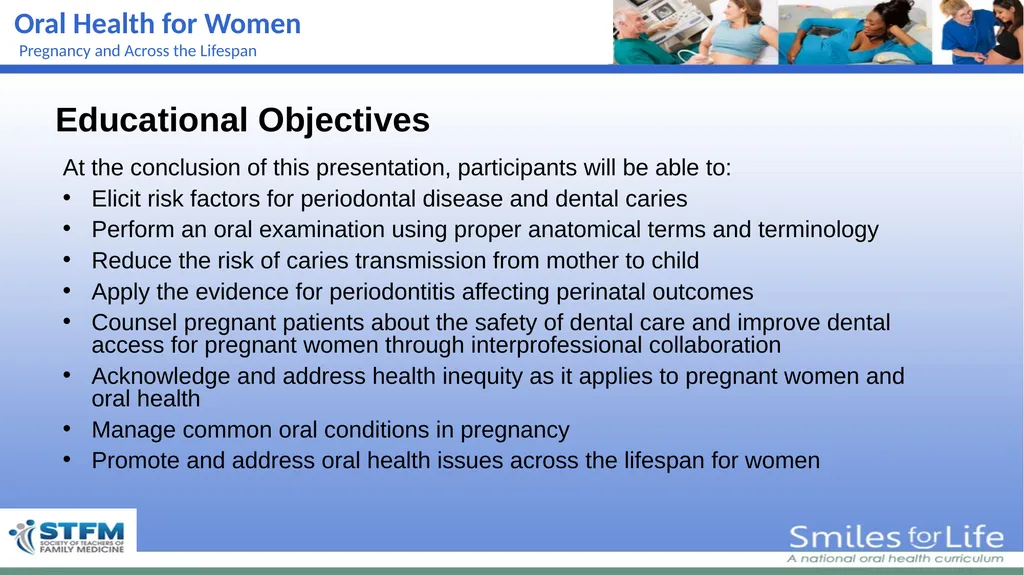
Educational Objectives At the conclusion of this presentation, participants will be able to:
Elicit risk factors for periodontal disease and dental caries
Perform an oral examination using proper anatomical terms and terminology
Reduce the risk of caries transmission from mother to child
Apply the evidence for periodontitis affecting perinatal outcomes
Counsel pregnant patients about the safety of dental care and improve dental access for pregnant women through interprofessional collaboration
Acknowledge and address health inequity as it applies to pregnant women and oral health
Manage common oral conditions in pregnancy
Promote and address oral health issues across the lifespan for women<br>
Elicit risk factors for periodontal disease and dental caries
Perform an oral examination using proper anatomical terms and terminology
Reduce the risk of caries transmission from mother to child
Apply the evidence for periodontitis affecting perinatal outcomes
Counsel pregnant patients about the safety of dental care and improve dental access for pregnant women through interprofessional collaboration
Acknowledge and address health inequity as it applies to pregnant women and oral health
Manage common oral conditions in pregnancy
Promote and address oral health issues across the lifespan for women<br>
04
Oral Anatomy, Terminology
and Examination Chapter Objectives
Elicit risk factors for periodontal disease and dental caries
Perform an oral examination using proper anatomical terms and terminology<br>
Elicit risk factors for periodontal disease and dental caries
Perform an oral examination using proper anatomical terms and terminology<br>
05
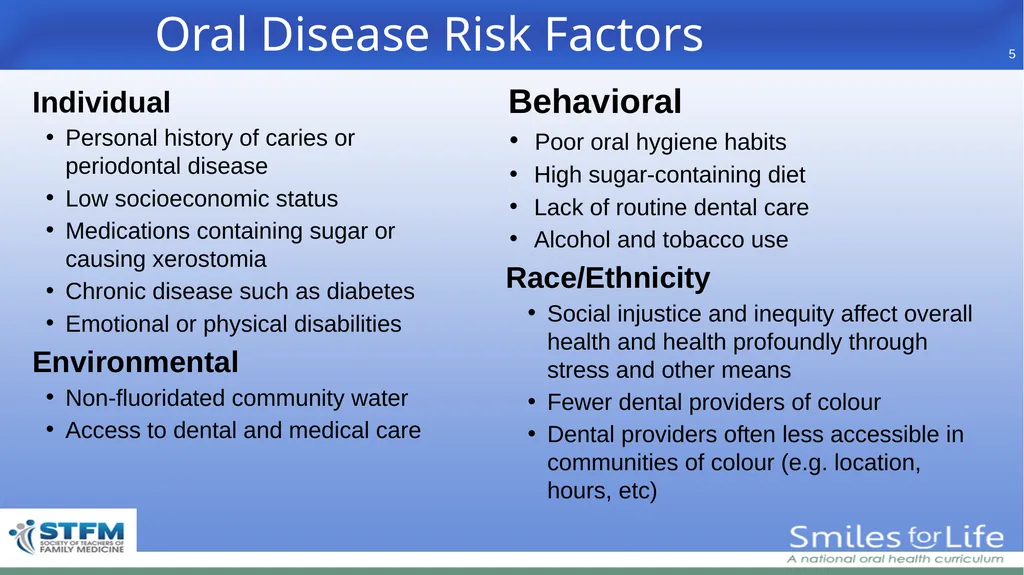
Oral Disease Risk Factors 5 Individual
Personal history of caries or periodontal disease
Low socioeconomic status
Medications containing sugar or causing xerostomia
Chronic disease such as diabetes
Emotional or physical disabilities
Environmental
Non-fluoridated community water
Access to dental and medical care Behavioral
Poor oral hygiene habits
High sugar-containing diet
Lack of routine dental care
Alcohol and tobacco use
Race/Ethnicity
Social injustice and inequity affect overall health and health profoundly through stress and other means
Fewer dental providers of colour
Dental providers often less accessible in communities of colour (e.g. location, hours, etc)<br>
Personal history of caries or periodontal disease
Low socioeconomic status
Medications containing sugar or causing xerostomia
Chronic disease such as diabetes
Emotional or physical disabilities
Environmental
Non-fluoridated community water
Access to dental and medical care Behavioral
Poor oral hygiene habits
High sugar-containing diet
Lack of routine dental care
Alcohol and tobacco use
Race/Ethnicity
Social injustice and inequity affect overall health and health profoundly through stress and other means
Fewer dental providers of colour
Dental providers often less accessible in communities of colour (e.g. location, hours, etc)<br>
06
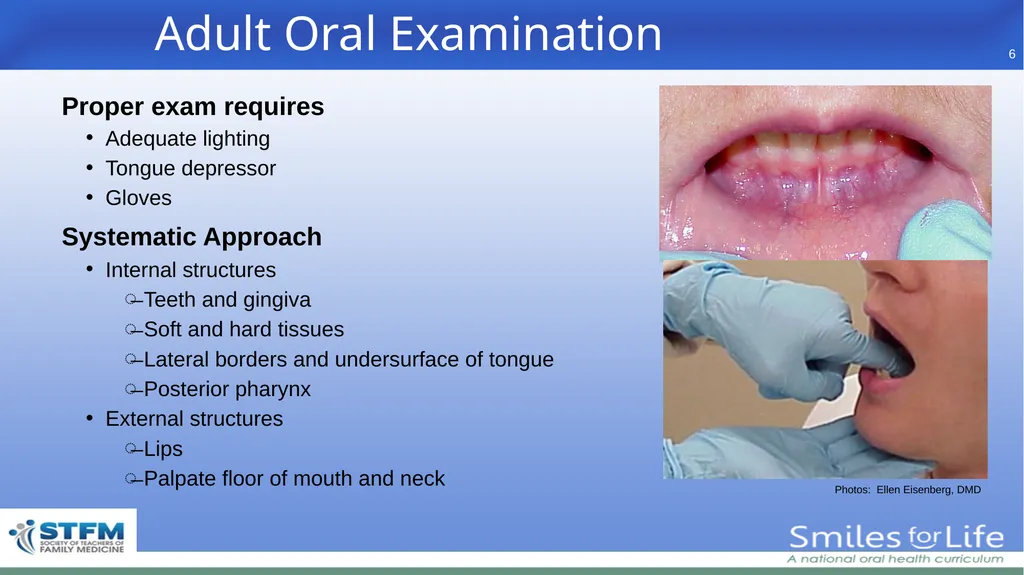
Adult Oral Examination Proper exam requires
Adequate lighting
Tongue depressor
Gloves
Systematic Approach
Internal structures
Teeth and gingiva
Soft and hard tissues
Lateral borders and undersurface of tongue
Posterior pharynx
External structures
Lips
Palpate floor of mouth and neck Photos: Ellen Eisenberg, DMD 6<br>
Adequate lighting
Tongue depressor
Gloves
Systematic Approach
Internal structures
Teeth and gingiva
Soft and hard tissues
Lateral borders and undersurface of tongue
Posterior pharynx
External structures
Lips
Palpate floor of mouth and neck Photos: Ellen Eisenberg, DMD 6<br>
07
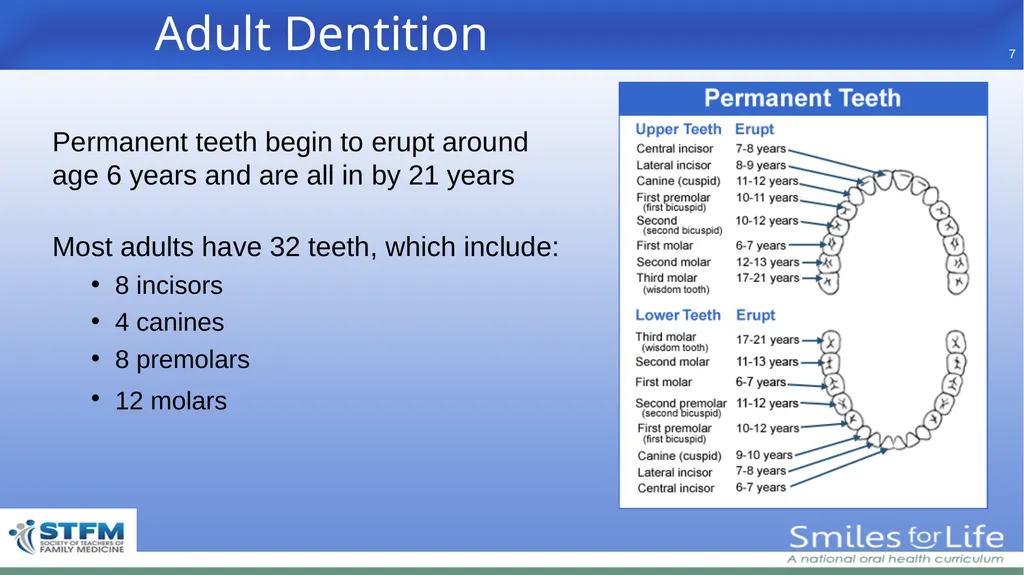
7 Adult Dentition Permanent teeth begin to erupt around age 6 years and are all in by 21 years
Most adults have 32 teeth, which include:
8 incisors
4 canines
8 premolars
12 molars<br>
Most adults have 32 teeth, which include:
8 incisors
4 canines
8 premolars
12 molars<br>
08
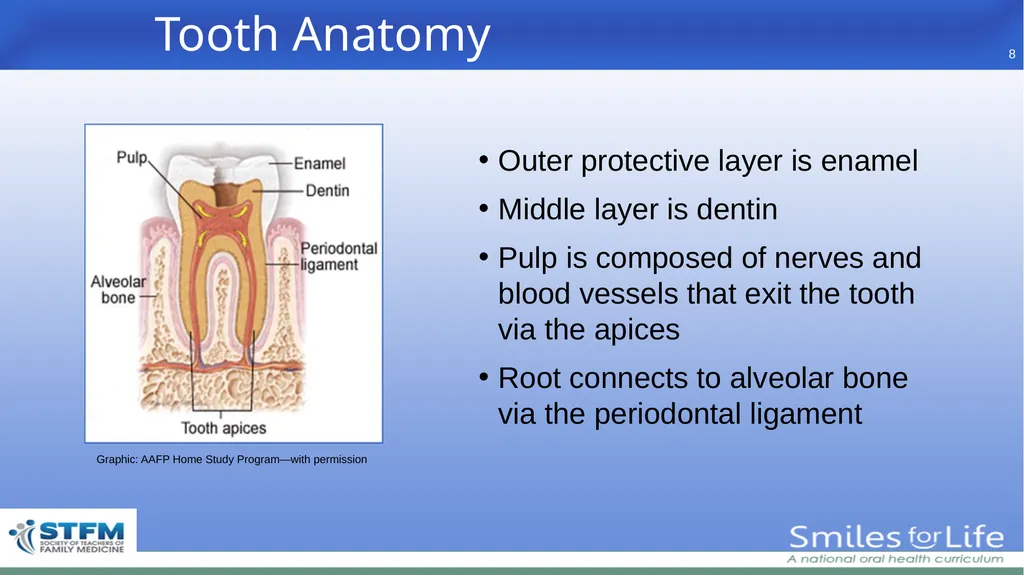
Tooth Anatomy Outer protective layer is enamel
Middle layer is dentin
Pulp is composed of nerves and blood vessels that exit the tooth via the apices
Root connects to alveolar bone via the periodontal ligament Graphic: AAFP Home Study Program—with permission 8<br>
Middle layer is dentin
Pulp is composed of nerves and blood vessels that exit the tooth via the apices
Root connects to alveolar bone via the periodontal ligament Graphic: AAFP Home Study Program—with permission 8<br>
09
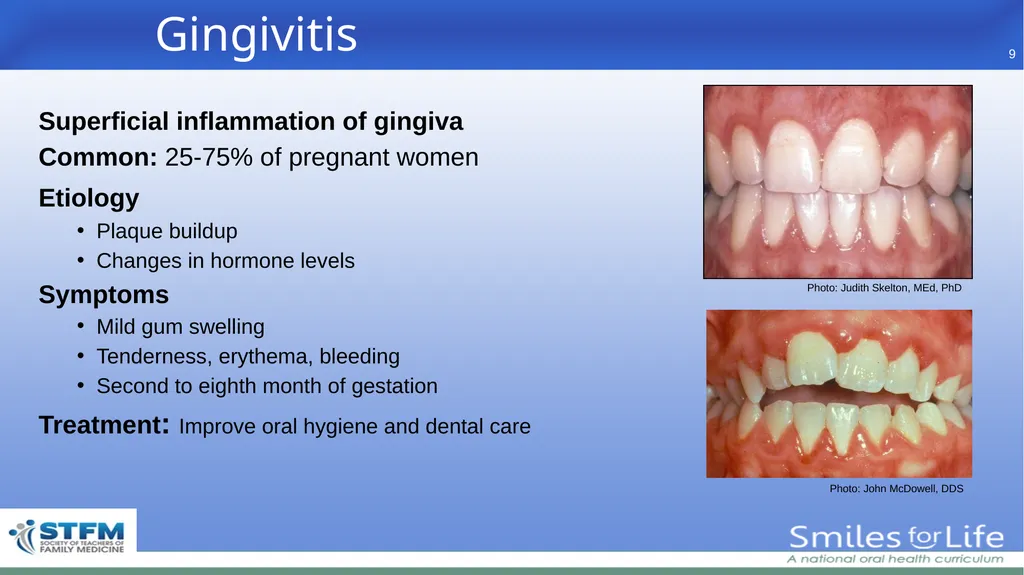
Gingivitis Superficial inflammation of gingiva
Common: 25-75% of pregnant women
Etiology
Plaque buildup
Changes in hormone levels
Symptoms
Mild gum swelling
Tenderness, erythema, bleeding
Second to eighth month of gestation
Treatment: Improve oral hygiene and dental care Photo: Judith Skelton, MEd, PhD Photo: John McDowell, DDS 9<br>
Common: 25-75% of pregnant women
Etiology
Plaque buildup
Changes in hormone levels
Symptoms
Mild gum swelling
Tenderness, erythema, bleeding
Second to eighth month of gestation
Treatment: Improve oral hygiene and dental care Photo: Judith Skelton, MEd, PhD Photo: John McDowell, DDS 9<br>
10
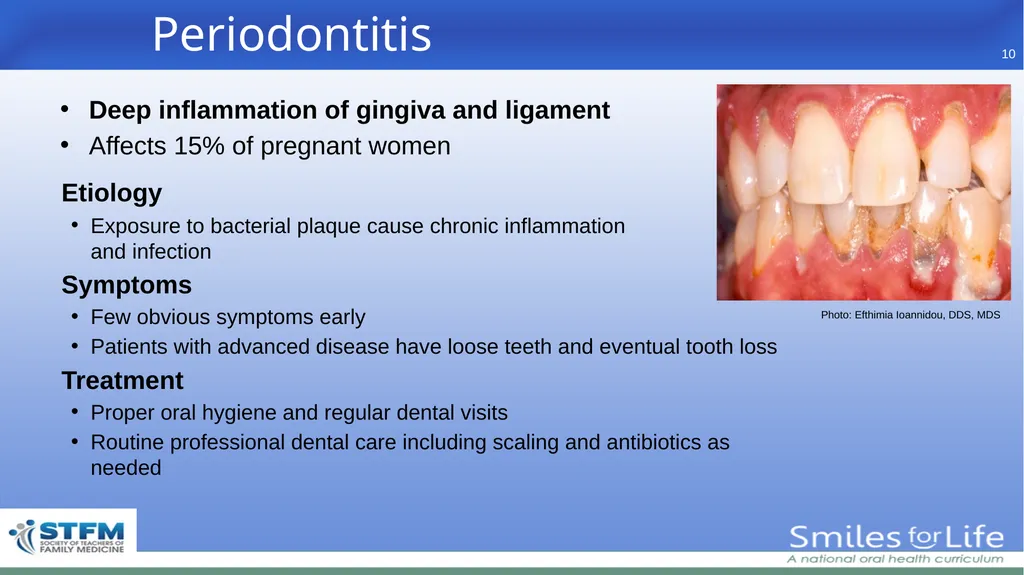
Periodontitis Etiology
Exposure to bacterial plaque cause chronic inflammation and infection
Symptoms
Few obvious symptoms early
Patients with advanced disease have loose teeth and eventual tooth loss
Treatment
Proper oral hygiene and regular dental visits
Routine professional dental care including scaling and antibiotics as needed Photo: Efthimia Ioannidou, DDS, MDS 10 Deep inflammation of gingiva and ligament
Affects 15% of pregnant women<br>
Exposure to bacterial plaque cause chronic inflammation and infection
Symptoms
Few obvious symptoms early
Patients with advanced disease have loose teeth and eventual tooth loss
Treatment
Proper oral hygiene and regular dental visits
Routine professional dental care including scaling and antibiotics as needed Photo: Efthimia Ioannidou, DDS, MDS 10 Deep inflammation of gingiva and ligament
Affects 15% of pregnant women<br>
11
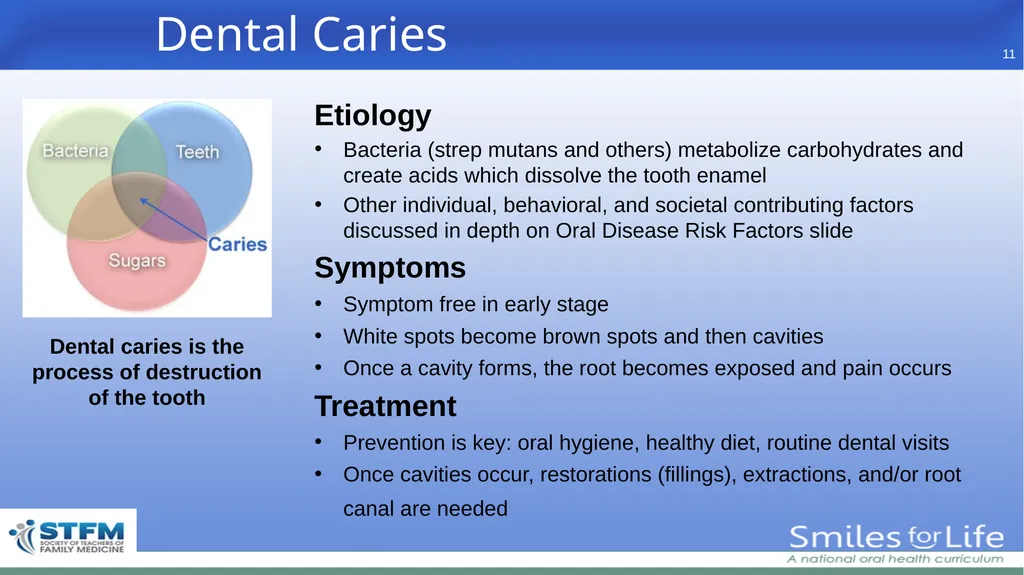
Dental Caries Etiology
Bacteria (strep mutans and others) metabolize carbohydrates and create acids which dissolve the tooth enamel
Other individual, behavioral, and societal contributing factors discussed in depth on Oral Disease Risk Factors slide
Symptoms
Symptom free in early stage
White spots become brown spots and then cavities
Once a cavity forms, the root becomes exposed and pain occurs
Treatment
Prevention is key: oral hygiene, healthy diet, routine dental visits
Once cavities occur, restorations (fillings), extractions, and/or root canal are needed 11 Dental caries is the process of destruction of the tooth<br>
Bacteria (strep mutans and others) metabolize carbohydrates and create acids which dissolve the tooth enamel
Other individual, behavioral, and societal contributing factors discussed in depth on Oral Disease Risk Factors slide
Symptoms
Symptom free in early stage
White spots become brown spots and then cavities
Once a cavity forms, the root becomes exposed and pain occurs
Treatment
Prevention is key: oral hygiene, healthy diet, routine dental visits
Once cavities occur, restorations (fillings), extractions, and/or root canal are needed 11 Dental caries is the process of destruction of the tooth<br>
12
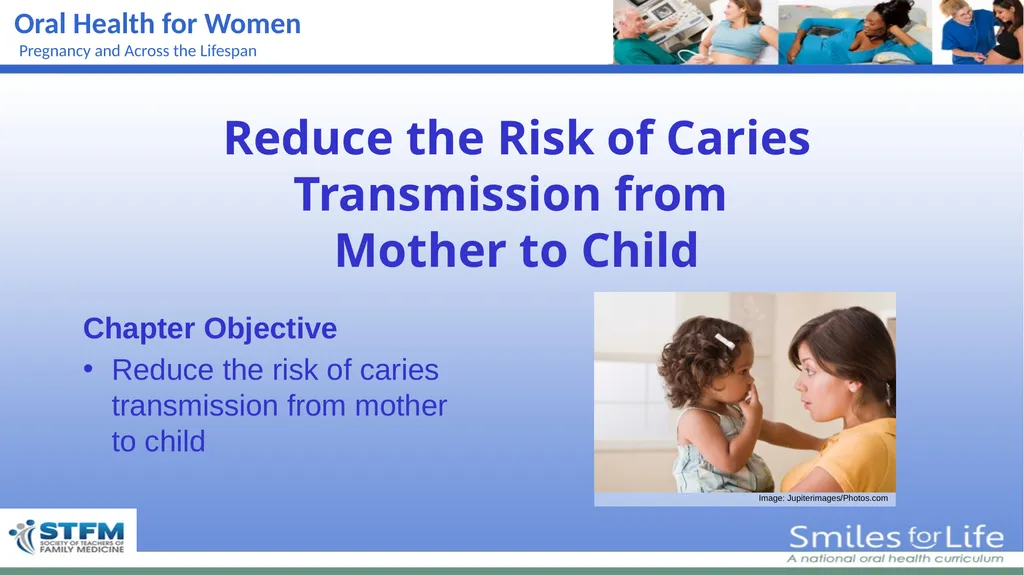
Reduce the Risk of Caries Transmission from
Mother to Child Chapter Objective
Reduce the risk of caries transmission from mother to child Image: Jupiterimages/Photos.com<br>
Reduce the risk of caries transmission from mother to child Image: Jupiterimages/Photos.com<br>
13
The Maternal-Child Linkage Dental caries is a transmissible disease! Mothers are the main source of passing caries-causing bacteria to their infants
Any caregiver is a potential source of transmission
Transmission occurs via saliva contact such as tasting food
If caregiver bacterial levels are high, transmission is more likely
Transmission can occur even before the first teeth erupt
Babies born by caesarean delivery more likely to have early acquisition of S. mutans
May be due to decreased exposure to maternal microorganisms during birth, compete for colonization in the predentate mouth
If colonization is delayed (>age 2), child may have fewer caries
Caregivers often pass on bad habits (high sugar intake, poor oral hygiene)
Message is: BRUSH FOR TWO! 13<br>
Any caregiver is a potential source of transmission
Transmission occurs via saliva contact such as tasting food
If caregiver bacterial levels are high, transmission is more likely
Transmission can occur even before the first teeth erupt
Babies born by caesarean delivery more likely to have early acquisition of S. mutans
May be due to decreased exposure to maternal microorganisms during birth, compete for colonization in the predentate mouth
If colonization is delayed (>age 2), child may have fewer caries
Caregivers often pass on bad habits (high sugar intake, poor oral hygiene)
Message is: BRUSH FOR TWO! 13<br>
14
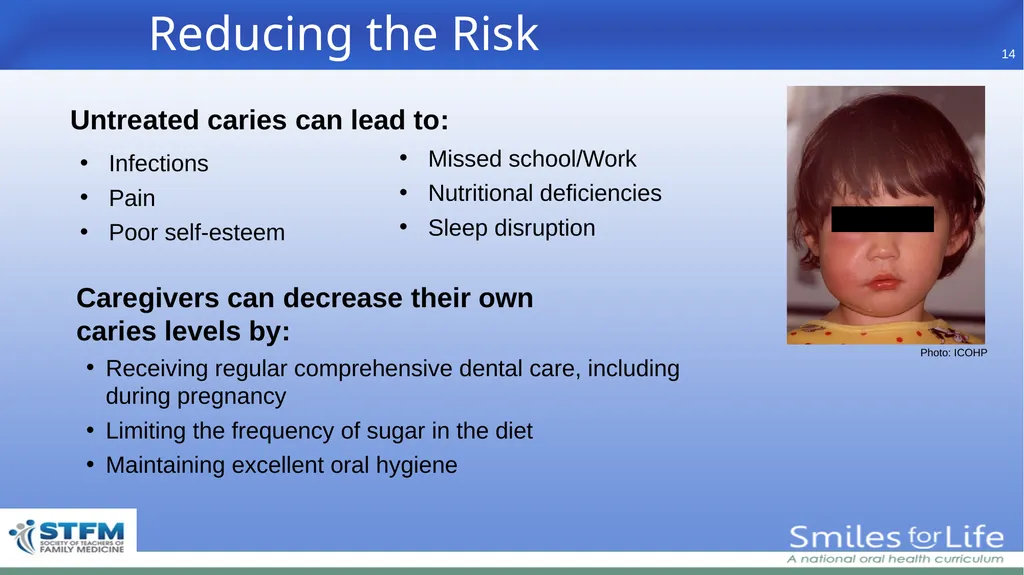
14 Reducing the Risk Untreated caries can lead to:
Infections
Pain
Poor self-esteem Photo: ICOHP Caregivers can decrease their own caries levels by:
Receiving regular comprehensive dental care, including during pregnancy
Limiting the frequency of sugar in the diet
Maintaining excellent oral hygiene Missed school/Work
Nutritional deficiencies
Sleep disruption<br>
Infections
Pain
Poor self-esteem Photo: ICOHP Caregivers can decrease their own caries levels by:
Receiving regular comprehensive dental care, including during pregnancy
Limiting the frequency of sugar in the diet
Maintaining excellent oral hygiene Missed school/Work
Nutritional deficiencies
Sleep disruption<br>
15
Postpartum Interventions Promote breast feeding
Breast fed children are less likely to develop caries
American Academy of Pediatrics recommends exclusive breastfeeding for the first 6 months of life and continuing until at least age 12 months
Consider xylitol gum or brief chlorhexidine rinse programs for mothers until child is age 2
Child care:
Ensure children are not put to bed with a bottle
Teeth are at highest risk overnight when saliva levels are low
Gently clean infants' gums after breastfeeding, brush twice daily with smear of fluoride toothpaste once teeth erupt (AAP AAPD recommendation)
Recommend children see a dentist at 12 months of age 15<br>
Breast fed children are less likely to develop caries
American Academy of Pediatrics recommends exclusive breastfeeding for the first 6 months of life and continuing until at least age 12 months
Consider xylitol gum or brief chlorhexidine rinse programs for mothers until child is age 2
Child care:
Ensure children are not put to bed with a bottle
Teeth are at highest risk overnight when saliva levels are low
Gently clean infants' gums after breastfeeding, brush twice daily with smear of fluoride toothpaste once teeth erupt (AAP AAPD recommendation)
Recommend children see a dentist at 12 months of age 15<br>
16
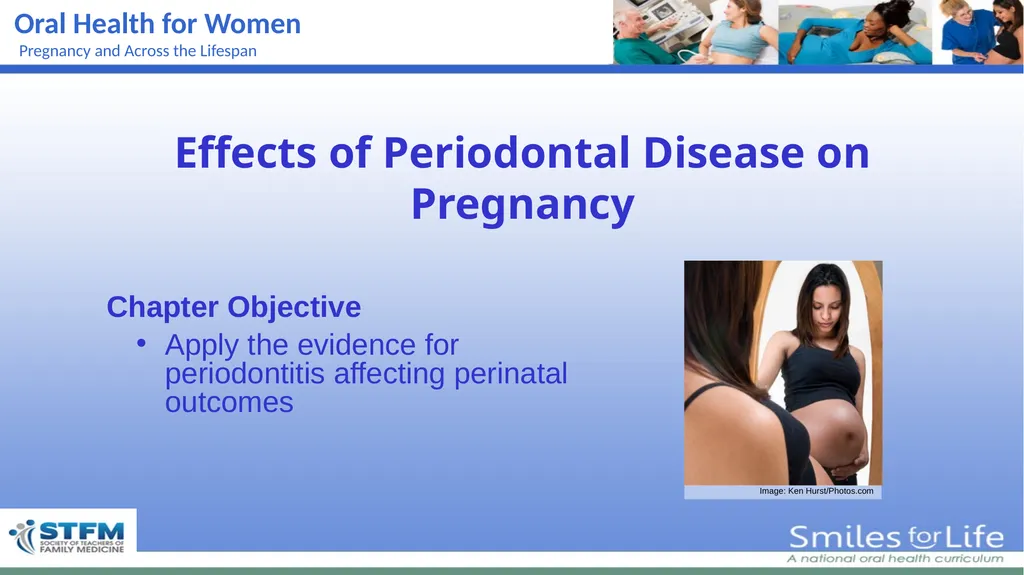
Effects of Periodontal Disease on Pregnancy Chapter Objective
Apply the evidence for periodontitis affecting perinatal outcomes Image: Ken Hurst/Photos.com<br>
Apply the evidence for periodontitis affecting perinatal outcomes Image: Ken Hurst/Photos.com<br>
17
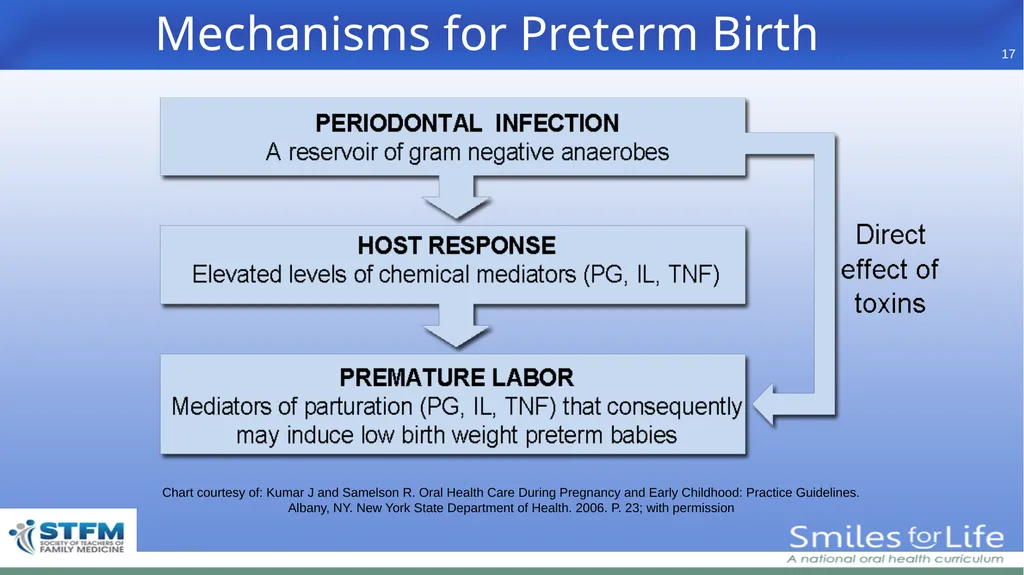
Mechanisms for Preterm Birth Chart courtesy of: Kumar J and Samelson R. Oral Health Care During Pregnancy and Early Childhood: Practice Guidelines. Albany, NY. New York State Department of Health. 2006. P. 23; with permission 17<br>
18
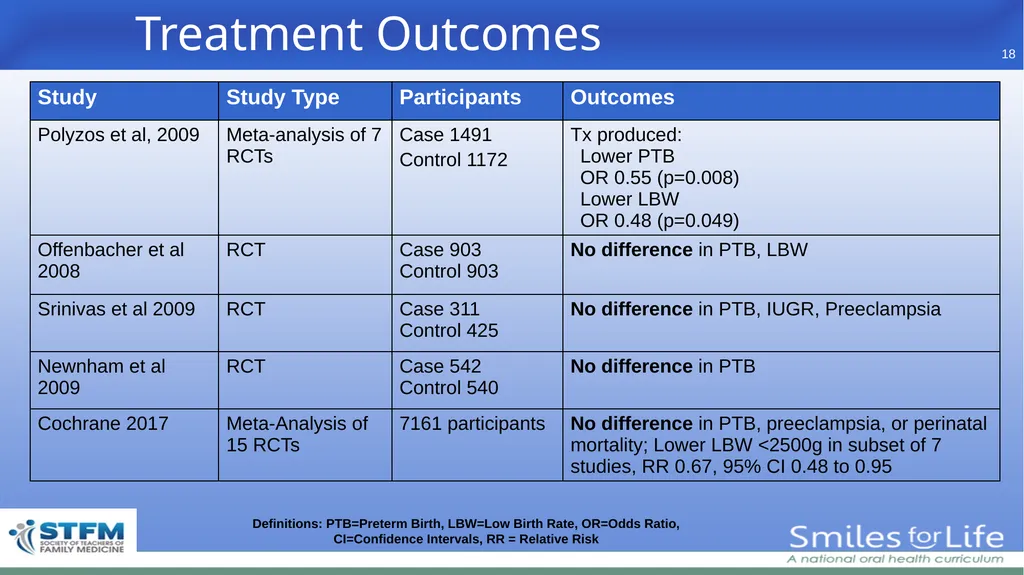
Treatment Outcomes Definitions: PTB=Preterm Birth, LBW=Low Birth Rate, OR=Odds Ratio, CI=Confidence Intervals, RR = Relative Risk 18<br>
19
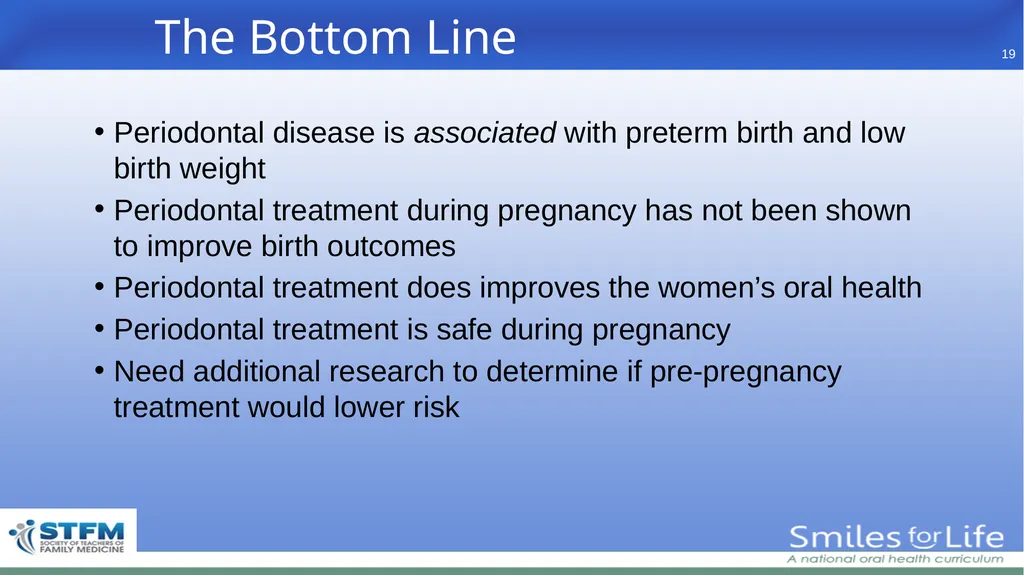
The Bottom Line Periodontal disease is associated with preterm birth and low birth weight
Periodontal treatment during pregnancy has not been shown to improve birth outcomes
Periodontal treatment does improves the women’s oral health
Periodontal treatment is safe during pregnancy
Need additional research to determine if pre-pregnancy treatment would lower risk 19<br>
Periodontal treatment during pregnancy has not been shown to improve birth outcomes
Periodontal treatment does improves the women’s oral health
Periodontal treatment is safe during pregnancy
Need additional research to determine if pre-pregnancy treatment would lower risk 19<br>
20
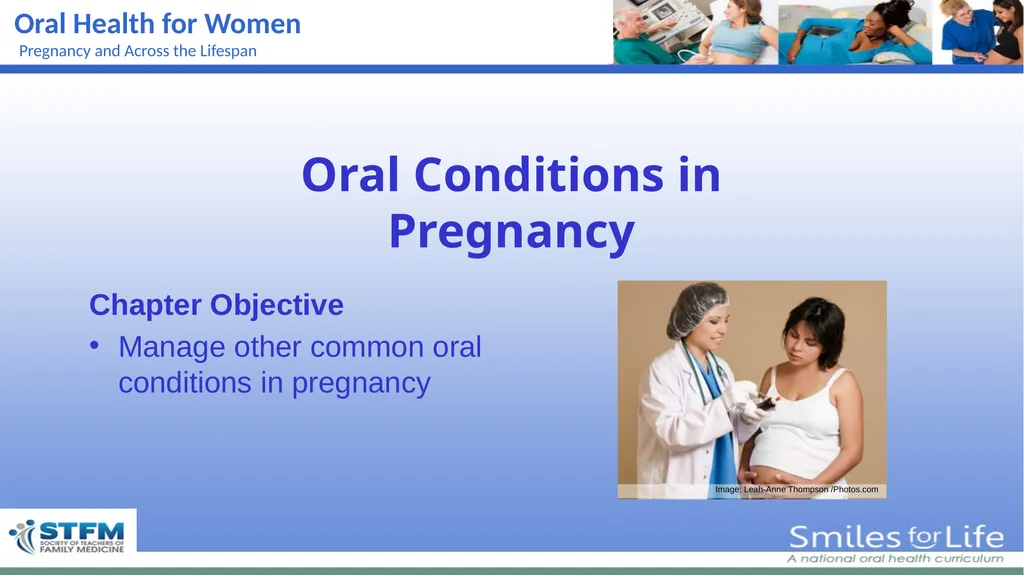
Oral Conditions in Pregnancy Chapter Objective
Manage other common oral conditions in pregnancy Image: Leah-Anne Thompson /Photos.com<br>
Manage other common oral conditions in pregnancy Image: Leah-Anne Thompson /Photos.com<br>
21
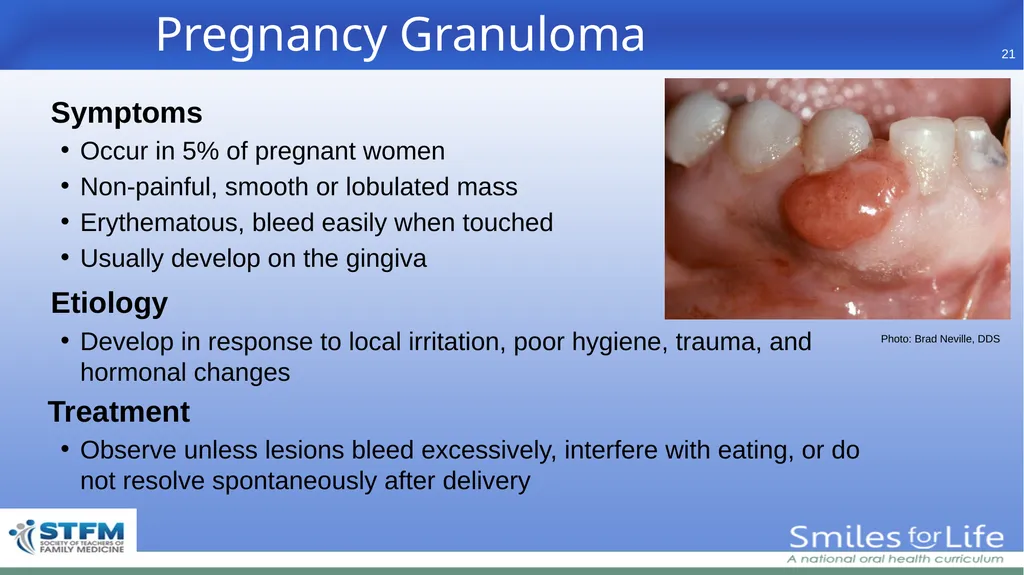
Pregnancy Granuloma Symptoms
Occur in 5% of pregnant women
Non-painful, smooth or lobulated mass
Erythematous, bleed easily when touched
Usually develop on the gingiva
Etiology
Develop in response to local irritation, poor hygiene, trauma, and hormonal changes
Treatment
Observe unless lesions bleed excessively, interfere with eating, or do not resolve spontaneously after delivery Photo: Brad Neville, DDS 21<br>
Occur in 5% of pregnant women
Non-painful, smooth or lobulated mass
Erythematous, bleed easily when touched
Usually develop on the gingiva
Etiology
Develop in response to local irritation, poor hygiene, trauma, and hormonal changes
Treatment
Observe unless lesions bleed excessively, interfere with eating, or do not resolve spontaneously after delivery Photo: Brad Neville, DDS 21<br>
22
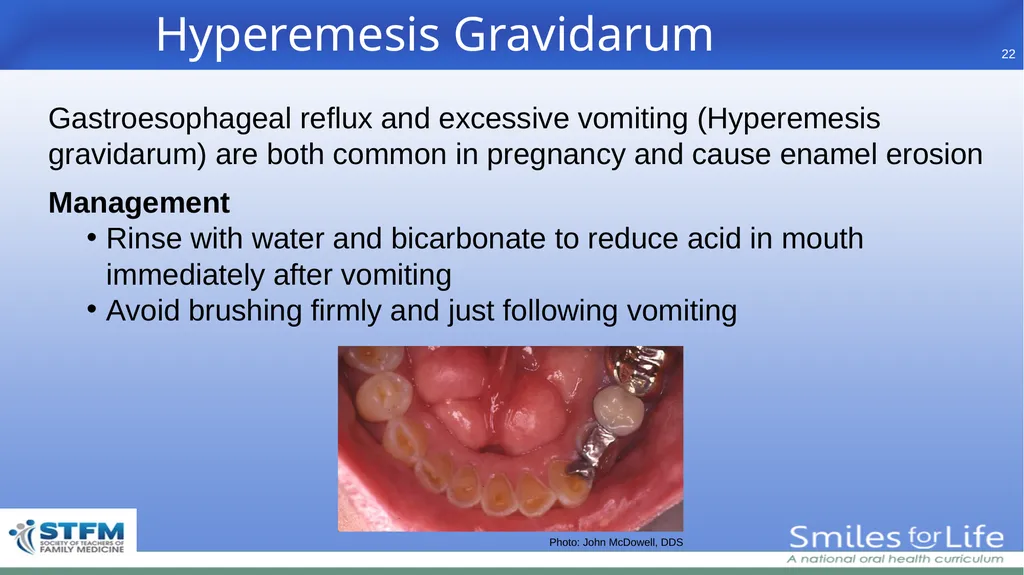
Hyperemesis Gravidarum Photo: John McDowell, DDS Gastroesophageal reflux and excessive vomiting (Hyperemesis gravidarum) are both common in pregnancy and cause enamel erosion
Management
Rinse with water and bicarbonate to reduce acid in mouth immediately after vomiting
Avoid brushing firmly and just following vomiting 22<br>
Management
Rinse with water and bicarbonate to reduce acid in mouth immediately after vomiting
Avoid brushing firmly and just following vomiting 22<br>
23
Dental Treatment in Pregnancy is Safe Chapter Objectives
Counsel patients about the safety of common dental interventions in pregnancy
Acknowledge and address health inequity as it applies to pregnant women and oral health Image: Vicki Reid/Photos.com<br>
Counsel patients about the safety of common dental interventions in pregnancy
Acknowledge and address health inequity as it applies to pregnant women and oral health Image: Vicki Reid/Photos.com<br>
24
The Dental Disconnect Women frequently do not see a dentist when pregnant
Only 33-67% of all pregnant women visit the dentist in the U.S.
Percentage is lower for Hispanic, low SES, non-English speaking, non-white, and women who are not aware of importance of oral health during pregnancy
Only 50% of pregnant woman with a dental problem visit a dentist
Even among women with dental insurance, dental care rated decline during pregnancy 24<br>
Only 33-67% of all pregnant women visit the dentist in the U.S.
Percentage is lower for Hispanic, low SES, non-English speaking, non-white, and women who are not aware of importance of oral health during pregnancy
Only 50% of pregnant woman with a dental problem visit a dentist
Even among women with dental insurance, dental care rated decline during pregnancy 24<br>
25
Barriers to Dental Care Reasons pregnant women do not obtain dental care
Obstetric and primary care providers do not routinely refer for dental care
Uncertainty about safety of dental interventions
Lack of training
Competing health demands limits focus on this topic
Dentists may be reluctant to manage pregnant patients
Lack of practical training
Dentists may fear malpractice repercussions
Patients have competing health demands and may receive conflicting or unclear information about the importance of dental care during pregnancy 25<br>
Obstetric and primary care providers do not routinely refer for dental care
Uncertainty about safety of dental interventions
Lack of training
Competing health demands limits focus on this topic
Dentists may be reluctant to manage pregnant patients
Lack of practical training
Dentists may fear malpractice repercussions
Patients have competing health demands and may receive conflicting or unclear information about the importance of dental care during pregnancy 25<br>
26
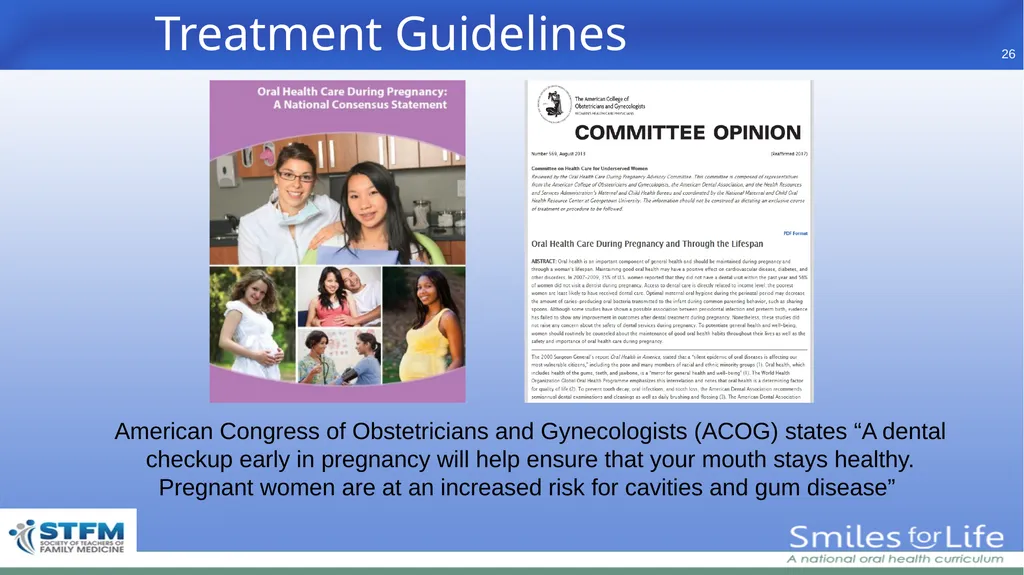
26 Treatment Guidelines American Congress of Obstetricians and Gynecologists (ACOG) states “A dental checkup early in pregnancy will help ensure that your mouth stays healthy. Pregnant women are at an increased risk for cavities and gum disease”<br>
27
Treatment Tips First Trimester
Care should begin early especially if extensive care is needed
Schedule visits in the afternoon to avoid morning sickness
Second Trimester
Ideal time for dental care
Fetus is not large, making it easier for mother to recline longer in the dental chair
Organogenesis is complete, reducing fear of harm to the baby (even though dental procedures are safe throughout pregnancy)
Third Trimester
Position woman slightly on left side with a towel prop to avoid vena cava compression
Encourage standing and walking periodically
Elevating the head helps avoid shortness of breath 27<br>
Care should begin early especially if extensive care is needed
Schedule visits in the afternoon to avoid morning sickness
Second Trimester
Ideal time for dental care
Fetus is not large, making it easier for mother to recline longer in the dental chair
Organogenesis is complete, reducing fear of harm to the baby (even though dental procedures are safe throughout pregnancy)
Third Trimester
Position woman slightly on left side with a towel prop to avoid vena cava compression
Encourage standing and walking periodically
Elevating the head helps avoid shortness of breath 27<br>
28
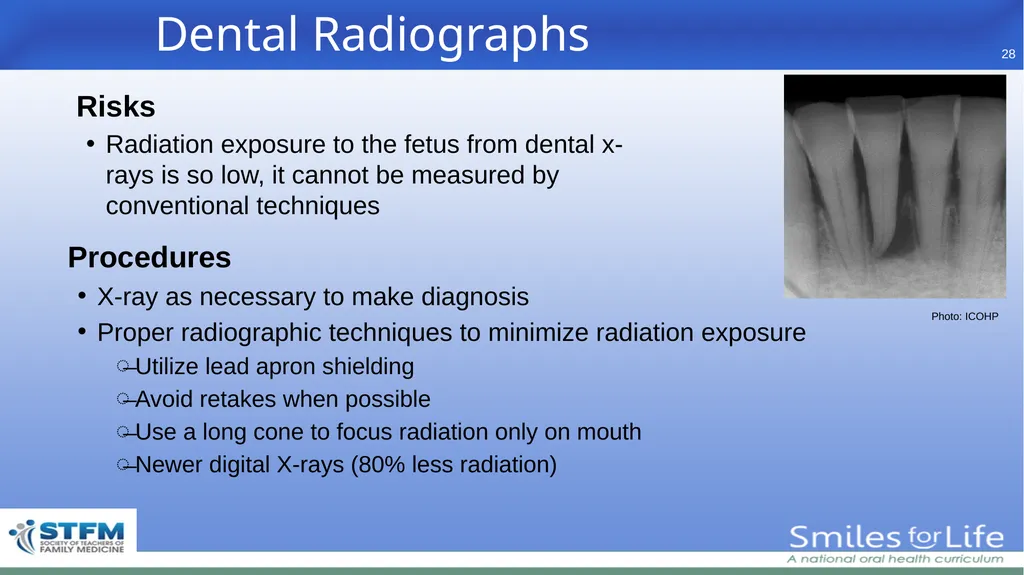
Dental Radiographs Photo: ICOHP Risks
Radiation exposure to the fetus from dental x-rays is so low, it cannot be measured by conventional techniques Procedures
X-ray as necessary to make diagnosis
Proper radiographic techniques to minimize radiation exposure
Utilize lead apron shielding
Avoid retakes when possible
Use a long cone to focus radiation only on mouth
Newer digital X-rays (80% less radiation) 28<br>
Radiation exposure to the fetus from dental x-rays is so low, it cannot be measured by conventional techniques Procedures
X-ray as necessary to make diagnosis
Proper radiographic techniques to minimize radiation exposure
Utilize lead apron shielding
Avoid retakes when possible
Use a long cone to focus radiation only on mouth
Newer digital X-rays (80% less radiation) 28<br>
29
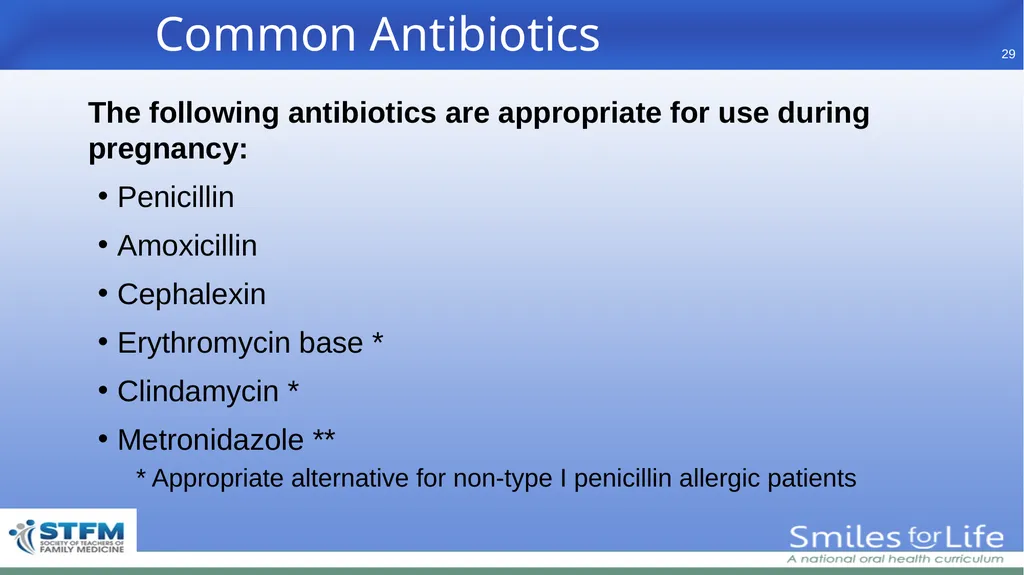
Common Antibiotics The following antibiotics are appropriate for use during pregnancy:
Penicillin
Amoxicillin
Cephalexin
Erythromycin base *
Clindamycin *
Metronidazole **
* Appropriate alternative for non-type I penicillin allergic patients 29<br>
Penicillin
Amoxicillin
Cephalexin
Erythromycin base *
Clindamycin *
Metronidazole **
* Appropriate alternative for non-type I penicillin allergic patients 29<br>
30
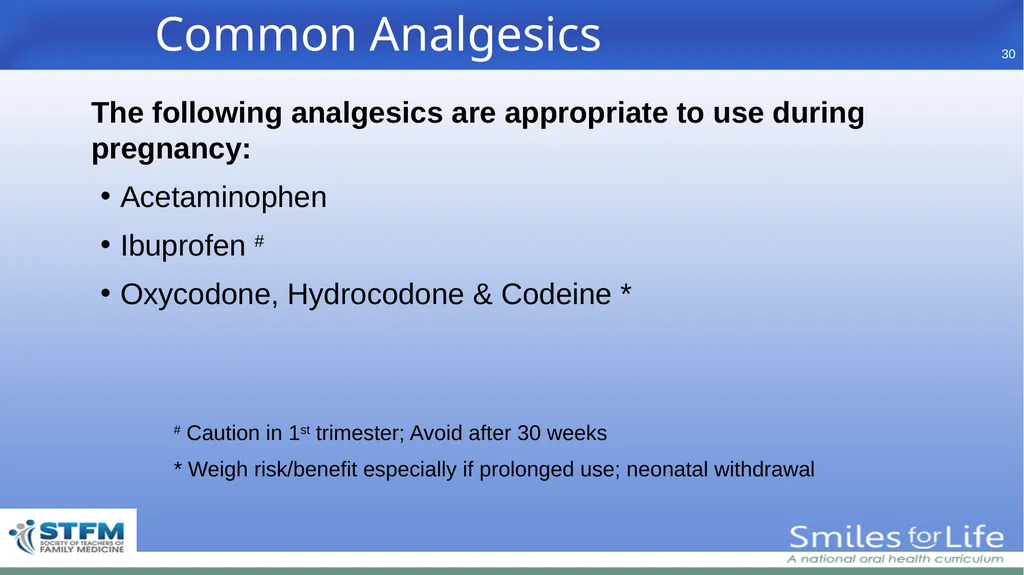
Common Analgesics The following analgesics are appropriate to use during pregnancy:
Acetaminophen
Ibuprofen #
Oxycodone, Hydrocodone & Codeine * # Caution in 1st trimester; Avoid after 30 weeks
* Weigh risk/benefit especially if prolonged use; neonatal withdrawal 30<br>
Acetaminophen
Ibuprofen #
Oxycodone, Hydrocodone & Codeine * # Caution in 1st trimester; Avoid after 30 weeks
* Weigh risk/benefit especially if prolonged use; neonatal withdrawal 30<br>
31
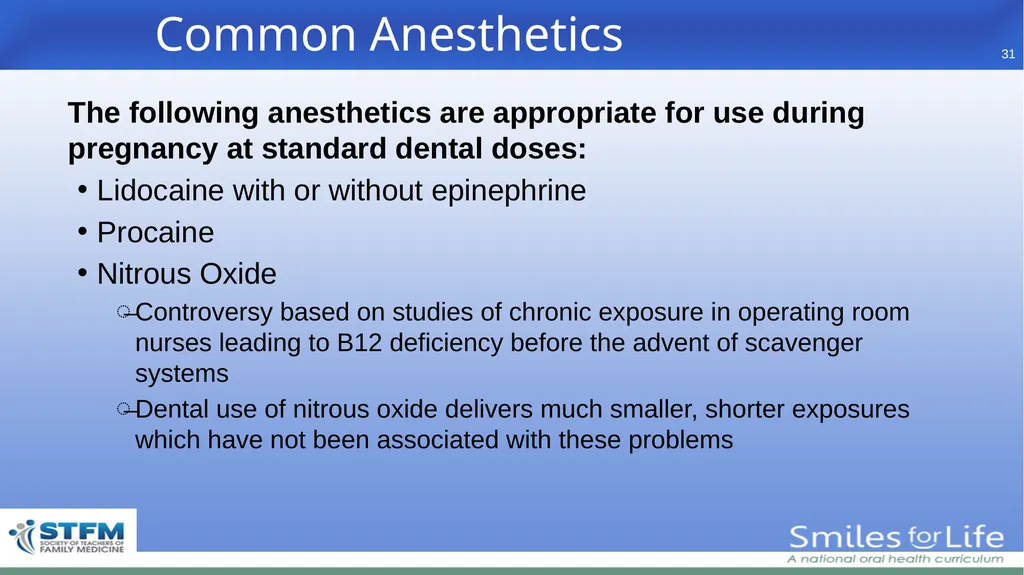
Common Anesthetics The following anesthetics are appropriate for use during pregnancy at standard dental doses:
Lidocaine with or without epinephrine
Procaine
Nitrous Oxide
Controversy based on studies of chronic exposure in operating room nurses leading to B12 deficiency before the advent of scavenger systems
Dental use of nitrous oxide delivers much smaller, shorter exposures which have not been associated with these problems 31<br>
Lidocaine with or without epinephrine
Procaine
Nitrous Oxide
Controversy based on studies of chronic exposure in operating room nurses leading to B12 deficiency before the advent of scavenger systems
Dental use of nitrous oxide delivers much smaller, shorter exposures which have not been associated with these problems 31<br>
32
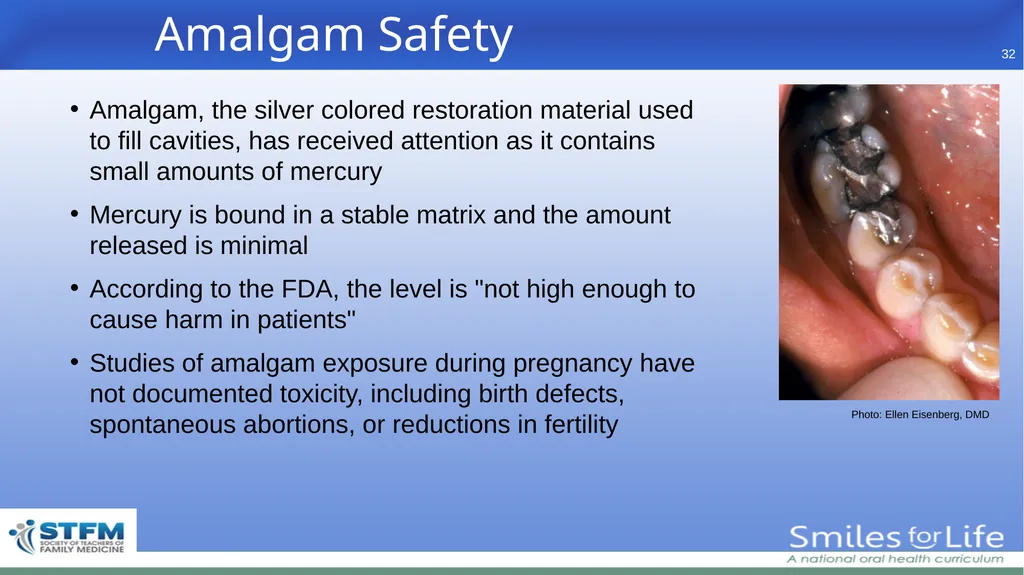
Amalgam Safety Photo: Ellen Eisenberg, DMD Amalgam, the silver colored restoration material used to fill cavities, has received attention as it contains small amounts of mercury
Mercury is bound in a stable matrix and the amount released is minimal
According to the FDA, the level is "not high enough to cause harm in patients"
Studies of amalgam exposure during pregnancy have not documented toxicity, including birth defects, spontaneous abortions, or reductions in fertility 32<br>
Mercury is bound in a stable matrix and the amount released is minimal
According to the FDA, the level is "not high enough to cause harm in patients"
Studies of amalgam exposure during pregnancy have not documented toxicity, including birth defects, spontaneous abortions, or reductions in fertility 32<br>
33
Preventive Agents Fluoride
Inhibits bacteria growth and strengthens enamel
Used topically to prevent dental caries
AAP and ACOG recommend pregnant women & children drink fluoridated water
Xylitol Gum
Decreases level of bacteria in saliva and plaque
Selects for less virulent strains of mutans streptococci
Chlorhexidine
Used as mouthwash to decrease bacteria
Reduces gingivitis and plaque 33<br>
Inhibits bacteria growth and strengthens enamel
Used topically to prevent dental caries
AAP and ACOG recommend pregnant women & children drink fluoridated water
Xylitol Gum
Decreases level of bacteria in saliva and plaque
Selects for less virulent strains of mutans streptococci
Chlorhexidine
Used as mouthwash to decrease bacteria
Reduces gingivitis and plaque 33<br>
34
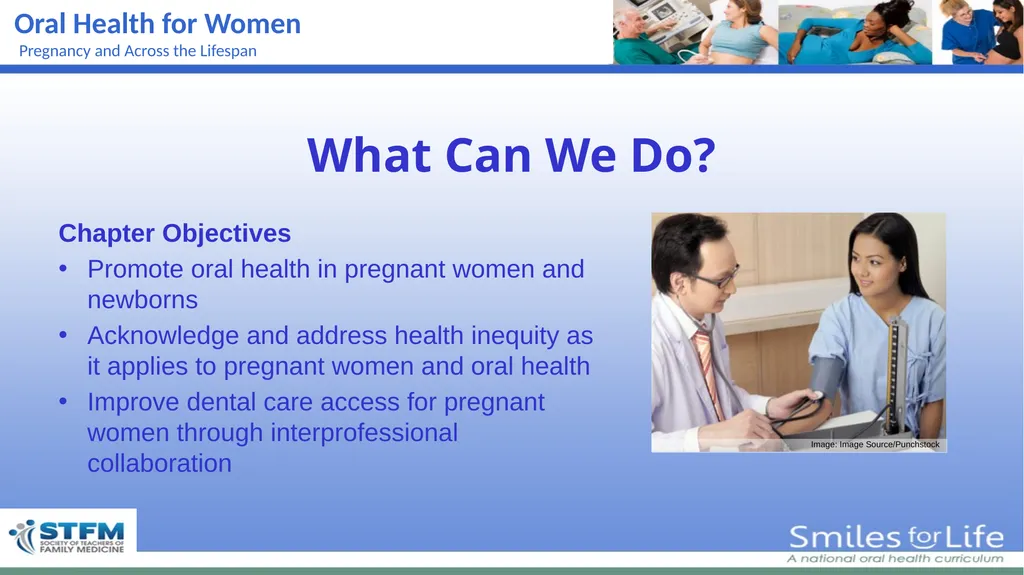
What Can We Do? Chapter Objectives
Promote oral health in pregnant women and newborns
Acknowledge and address health inequity as it applies to pregnant women and oral health
Improve dental care access for pregnant women through interprofessional collaboration Image: Image Source/Punchstock<br>
Promote oral health in pregnant women and newborns
Acknowledge and address health inequity as it applies to pregnant women and oral health
Improve dental care access for pregnant women through interprofessional collaboration Image: Image Source/Punchstock<br>
35
Providing Optimal Care Screening
Evaluate oral health risk history
Perform an oral exam
Document findings in prenatal record and share with dentist
Anticipatory Guidance
Brush with soft toothbrush twice daily with fluoride toothpaste
Floss daily
Limit sugary snacks and drinks to meal times only
Chew xylitol gum four to five times per day after eating
Establish a dental home for the family
Regular dental visits q 6 months (or at dental discretion)
Reassure regarding safety of dental treatment during pregnancy 35<br>
Evaluate oral health risk history
Perform an oral exam
Document findings in prenatal record and share with dentist
Anticipatory Guidance
Brush with soft toothbrush twice daily with fluoride toothpaste
Floss daily
Limit sugary snacks and drinks to meal times only
Chew xylitol gum four to five times per day after eating
Establish a dental home for the family
Regular dental visits q 6 months (or at dental discretion)
Reassure regarding safety of dental treatment during pregnancy 35<br>
36
Providing Optimal Care Standardize Office Processes
Modify prenatal flowchart to include dental screening, advice, and referral
Develop a role for office staff in taking risk history, offering advice, and providing referral information
Be mindful of barriers to care (cultural, language, literacy) and engage office staff, case managers, and social workers assist in overcoming barriers to dental care
Maintain an up-to-date list of local dental providers that see pregnant patients, accept all insurances
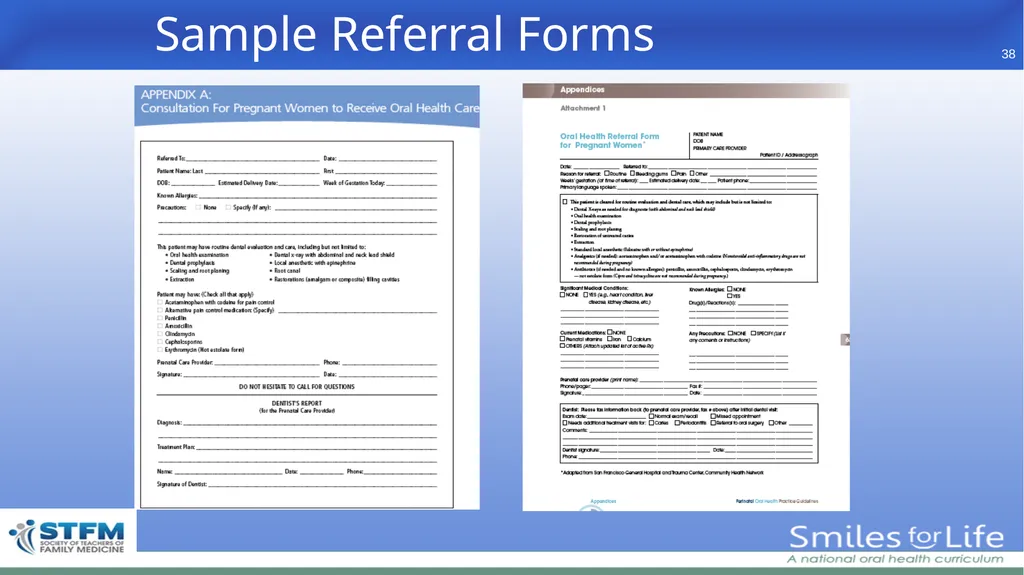
Use a referral form to improve communication
Follow up to ensure dental care occurred
Include oral handouts in prenatal packets 36<br>
Modify prenatal flowchart to include dental screening, advice, and referral
Develop a role for office staff in taking risk history, offering advice, and providing referral information
Be mindful of barriers to care (cultural, language, literacy) and engage office staff, case managers, and social workers assist in overcoming barriers to dental care
Maintain an up-to-date list of local dental providers that see pregnant patients, accept all insurances
Use a referral form to improve communication
Follow up to ensure dental care occurred
Include oral handouts in prenatal packets 36<br>
37
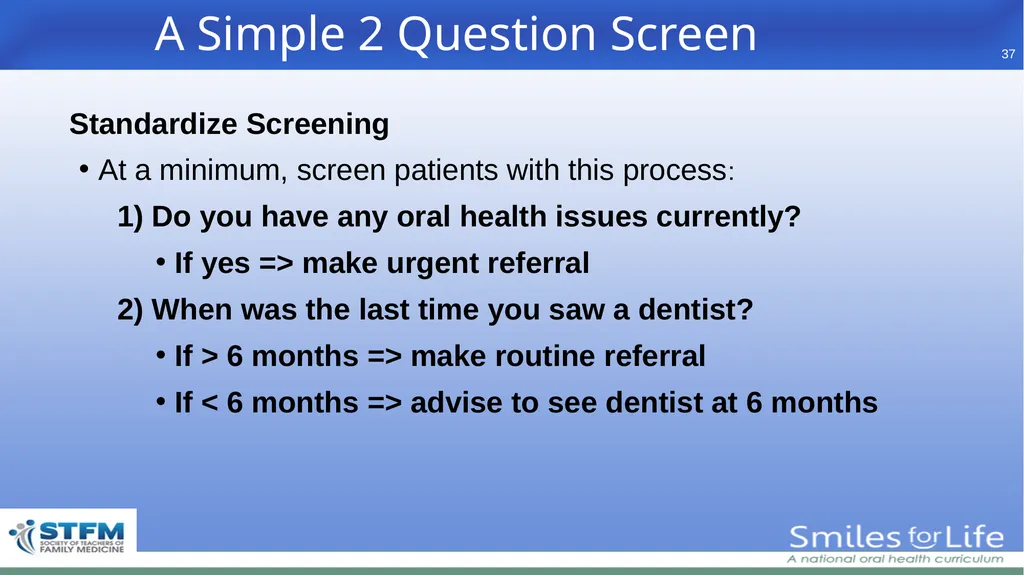
A Simple 2 Question Screen Standardize Screening
At a minimum, screen patients with this process:
1) Do you have any oral health issues currently?
If yes => make urgent referral
2) When was the last time you saw a dentist?
If > 6 months => make routine referral
If < 6 months => advise to see dentist at 6 months 37<br>
At a minimum, screen patients with this process:
1) Do you have any oral health issues currently?
If yes => make urgent referral
2) When was the last time you saw a dentist?
If > 6 months => make routine referral
If < 6 months => advise to see dentist at 6 months 37<br>
38
Sample Referral Forms 38<br>
39
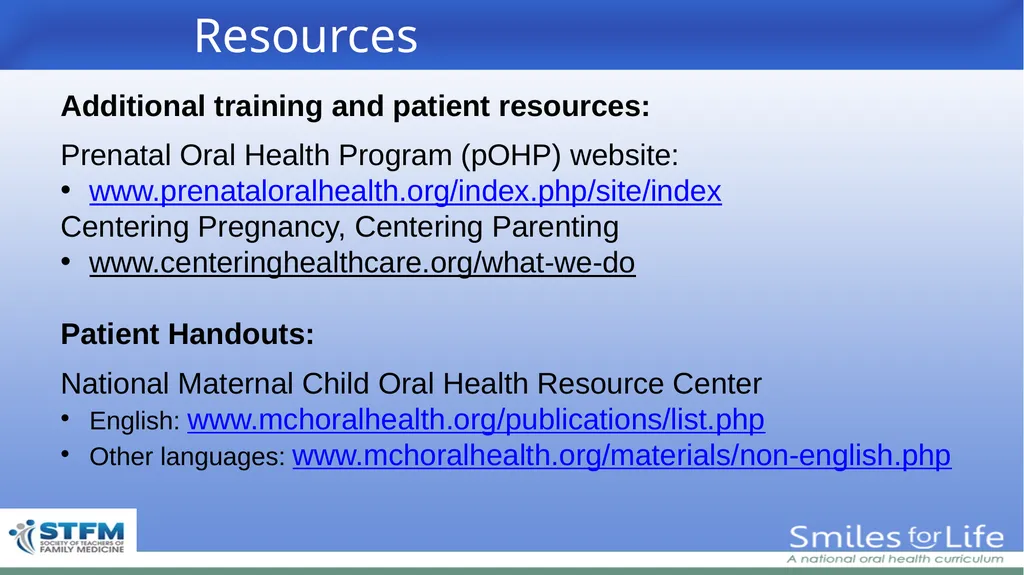
Resources Additional training and patient resources:
Prenatal Oral Health Program (pOHP) website:
www.prenataloralhealth.org/index.php/site/index
Centering Pregnancy, Centering Parenting
www.centeringhealthcare.org/what-we-do
Patient Handouts:
National Maternal Child Oral Health Resource Center
English: www.mchoralhealth.org/publications/list.php
Other languages: www.mchoralhealth.org/materials/non-english.php<br>
Prenatal Oral Health Program (pOHP) website:
www.prenataloralhealth.org/index.php/site/index
Centering Pregnancy, Centering Parenting
www.centeringhealthcare.org/what-we-do
Patient Handouts:
National Maternal Child Oral Health Resource Center
English: www.mchoralhealth.org/publications/list.php
Other languages: www.mchoralhealth.org/materials/non-english.php<br>
40
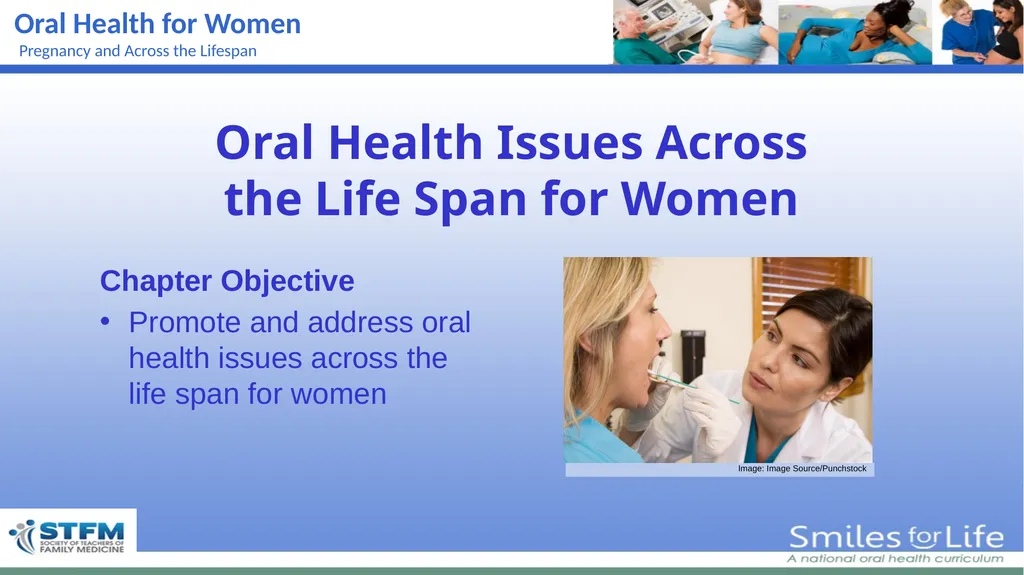
Oral Health Issues Across the Life Span for Women Chapter Objective
Promote and address oral health issues across the life span for women Image: Image Source/Punchstock<br>
Promote and address oral health issues across the life span for women Image: Image Source/Punchstock<br>
41
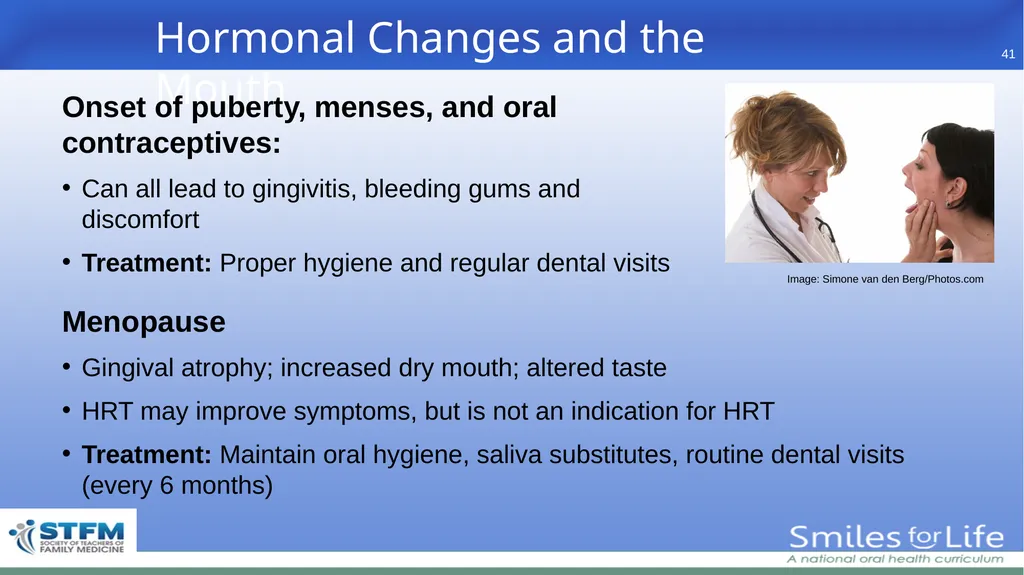
Hormonal Changes and the Mouth Image: Simone van den Berg/Photos.com Onset of puberty, menses, and oral contraceptives:
Can all lead to gingivitis, bleeding gums and discomfort
Treatment: Proper hygiene and regular dental visits 41 Menopause
Gingival atrophy; increased dry mouth; altered taste
HRT may improve symptoms, but is not an indication for HRT
Treatment: Maintain oral hygiene, saliva substitutes, routine dental visits (every 6 months)<br>
Can all lead to gingivitis, bleeding gums and discomfort
Treatment: Proper hygiene and regular dental visits 41 Menopause
Gingival atrophy; increased dry mouth; altered taste
HRT may improve symptoms, but is not an indication for HRT
Treatment: Maintain oral hygiene, saliva substitutes, routine dental visits (every 6 months)<br>
42
Mouth Pain Oral pain can result from causes other than caries and periodontitis
Burning Mouth Syndrome (more prevalent in women)
Causes: Medications (ACE inhibitors), candidiasis, B12 deficiency, dry mouth
Screen for underlying conditions and correct
Tricyclic antidepressants and gabapentin can ease symptoms
Tooth Erosion
GERD and eating disorders should be considered and addressed
Temporomandibular Joint (TMJ) pain
Evaluate and consider dental referral for a mouth guard fitting
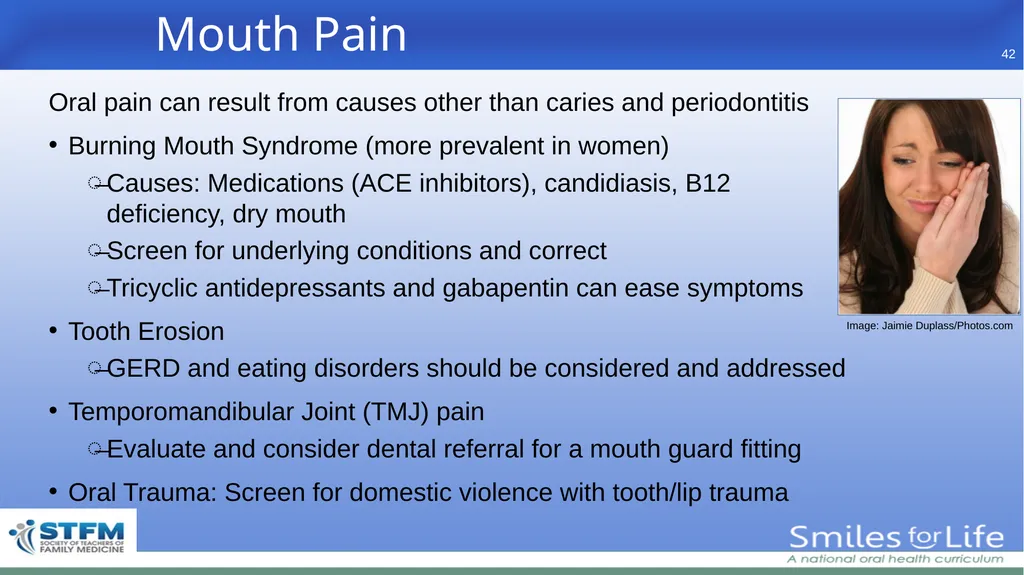
Oral Trauma: Screen for domestic violence with tooth/lip trauma 42 Image: Jaimie Duplass/Photos.com<br>
Burning Mouth Syndrome (more prevalent in women)
Causes: Medications (ACE inhibitors), candidiasis, B12 deficiency, dry mouth
Screen for underlying conditions and correct
Tricyclic antidepressants and gabapentin can ease symptoms
Tooth Erosion
GERD and eating disorders should be considered and addressed
Temporomandibular Joint (TMJ) pain
Evaluate and consider dental referral for a mouth guard fitting
Oral Trauma: Screen for domestic violence with tooth/lip trauma 42 Image: Jaimie Duplass/Photos.com<br>
43
Oral Health and Annual Visits Ask about oral health when you are examining the mouth
Discuss oral health habits, proper diet, and referrals to dental providers
Provide oral health promotion handouts
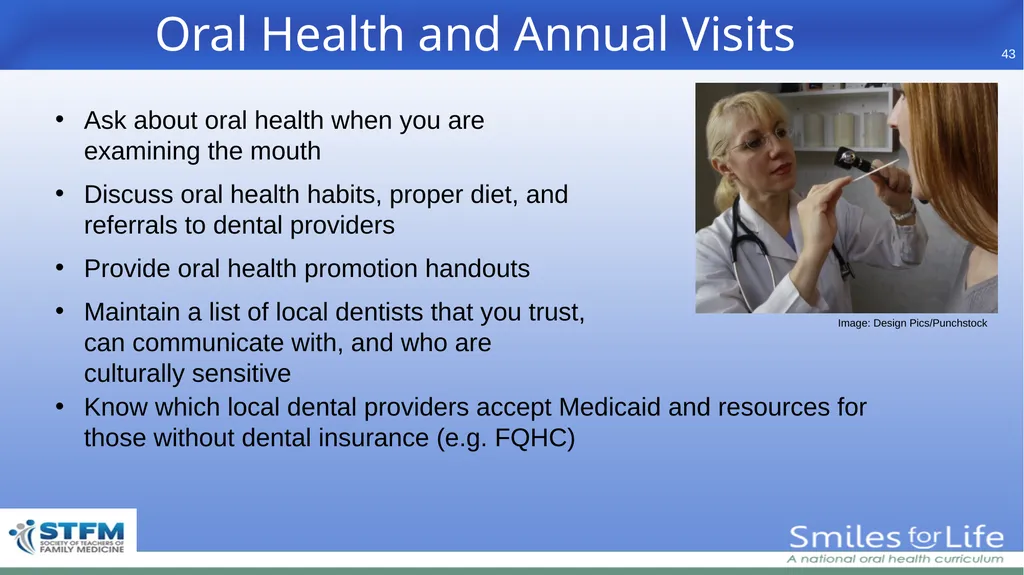
Maintain a list of local dentists that you trust, can communicate with, and who are culturally sensitive 43 Image: Design Pics/Punchstock Know which local dental providers accept Medicaid and resources for those without dental insurance (e.g. FQHC)<br>
Discuss oral health habits, proper diet, and referrals to dental providers
Provide oral health promotion handouts
Maintain a list of local dentists that you trust, can communicate with, and who are culturally sensitive 43 Image: Design Pics/Punchstock Know which local dental providers accept Medicaid and resources for those without dental insurance (e.g. FQHC)<br>
44
Expanding Your Oral Health Knowledge Comprehensive care of women mandates a broader understanding of oral health issues. Consider reviewing other Smiles for Life Modules.
Based on the population you serve, the following may be of value in your clinical practice:
Module 1: Relationship of Oral to Systemic Health
Module 3: Adult Oral Health, including oral lesions and the oral cancer-HPV link
Module 4: Acute Dental Problems, including oral infections and trauma
Module 7: Oral Examination
Module 8: Geriatric Oral Health, including how medications affect the mouth 44<br>
Based on the population you serve, the following may be of value in your clinical practice:
Module 1: Relationship of Oral to Systemic Health
Module 3: Adult Oral Health, including oral lesions and the oral cancer-HPV link
Module 4: Acute Dental Problems, including oral infections and trauma
Module 7: Oral Examination
Module 8: Geriatric Oral Health, including how medications affect the mouth 44<br>
45
Take Home Messages Periodontal disease is associated with preterm birth and low birth weight
Decreased levels of cariogenic bacteria in mothers is associated with improved child oral health
Periodontal therapy during pregnancy does not improve pregnancy outcomes, but is safe in pregnancy
Routine dental interventions are safe during pregnancy
Health professionals should promote good oral health during pregnancy and throughout the life cycle to improve overall health<br>
Decreased levels of cariogenic bacteria in mothers is associated with improved child oral health
Periodontal therapy during pregnancy does not improve pregnancy outcomes, but is safe in pregnancy
Routine dental interventions are safe during pregnancy
Health professionals should promote good oral health during pregnancy and throughout the life cycle to improve overall health<br>
46
Questions? Image: Stockebyte/Photos.com<br>