04
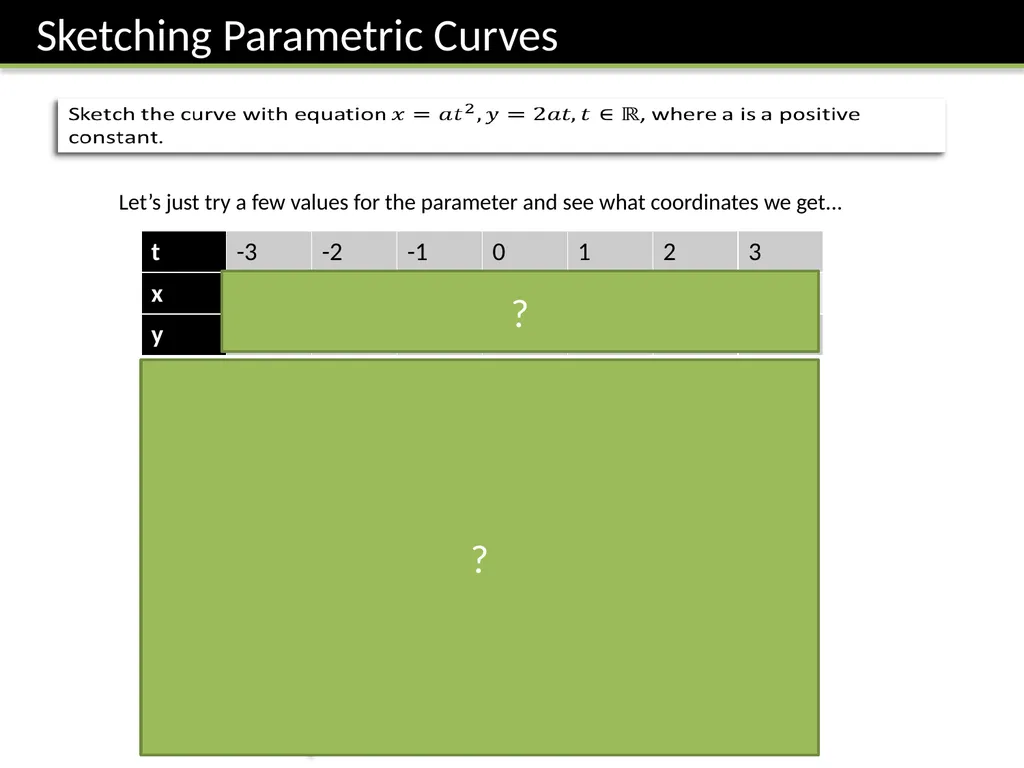
Let’s just try a few values for the parameter and see what coordinates we get... ? 2a 4a 6a 8a 6a
4a
2a
O
-2a
-4a
-6a ?<br>
05
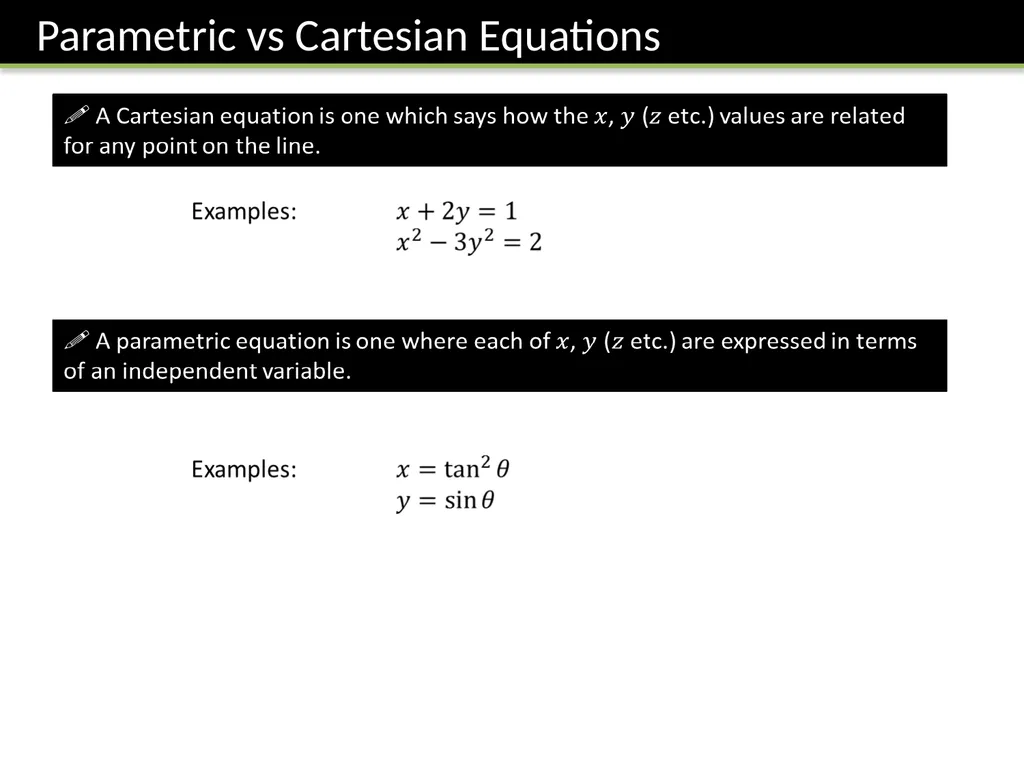
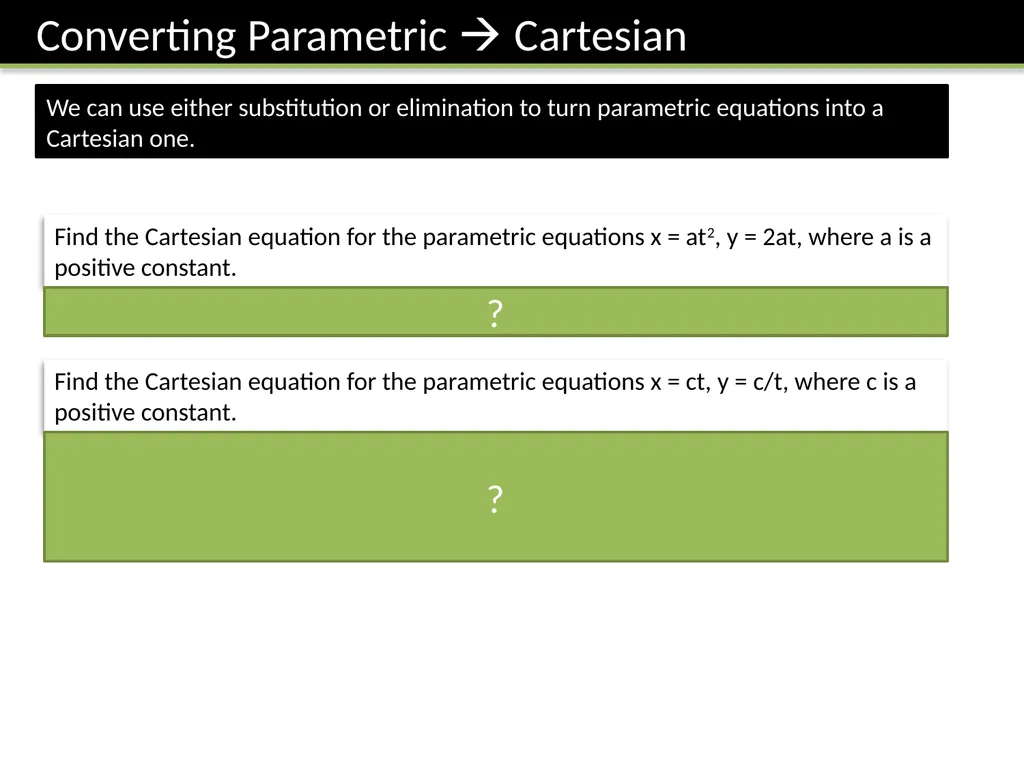
We can use either substitution or elimination to turn parametric equations into a Cartesian one. Find the Cartesian equation for the parametric equations x = at2, y = 2at, where a is a positive constant. y2 = 4ax Find the Cartesian equation for the parametric equations x = ct, y = c/t, where c is a positive constant. y = c2/x
We could either have obtained this by substituting c, or by observing that the t’s cancel when we multiply x by y. ? ?<br>
06
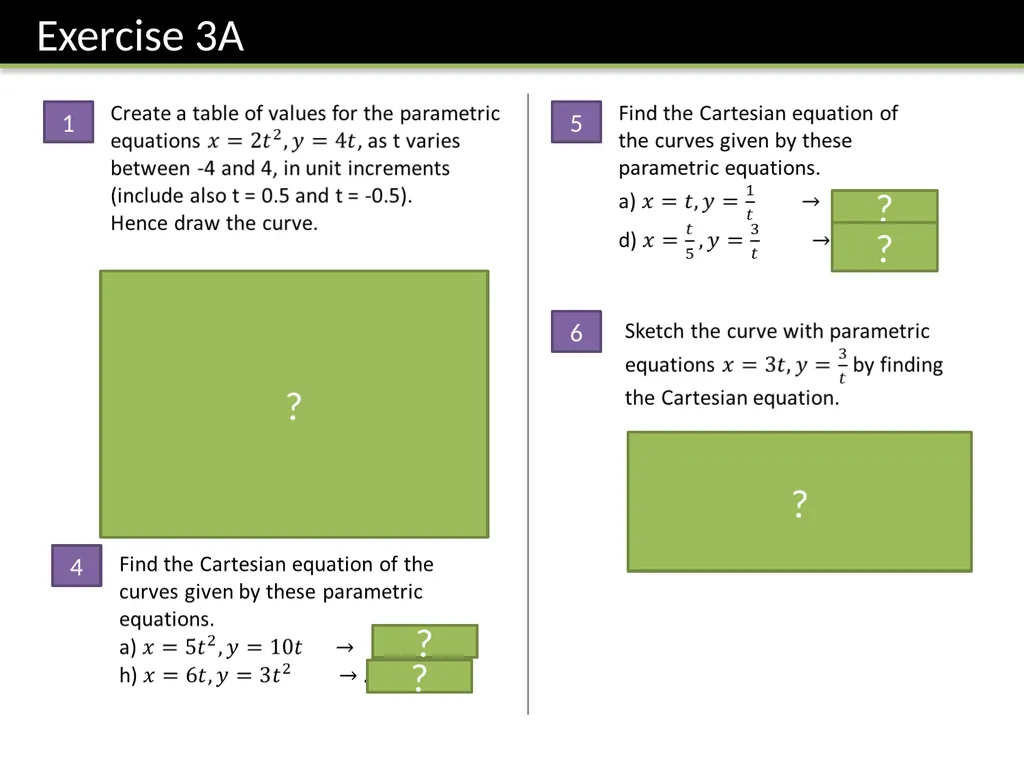
1 4 5 6 ? ? ? ? ? ?<br>
07
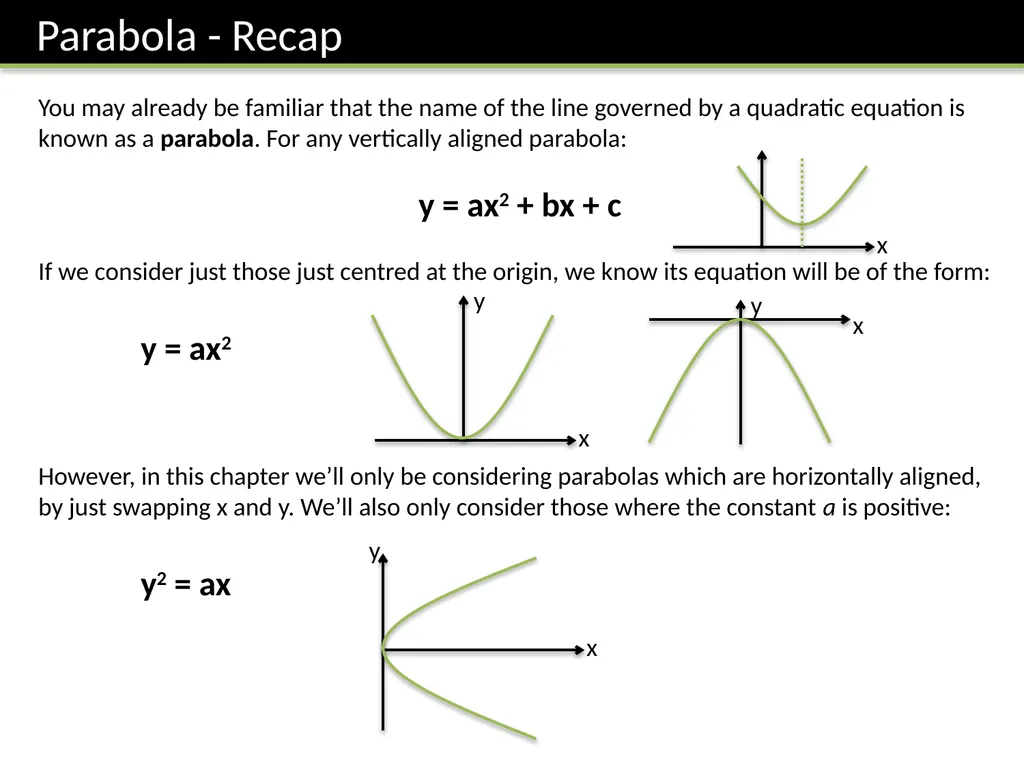
You may already be familiar that the name of the line governed by a quadratic equation is known as a parabola. For any vertically aligned parabola:
y = ax2 + bx + c
If we consider just those just centred at the origin, we know its equation will be of the form:
y = ax2
However, in this chapter we’ll only be considering parabolas which are horizontally aligned, by just swapping x and y. We’ll also only consider those where the constant a is positive:
y2 = ax x y x y x x y<br>
08
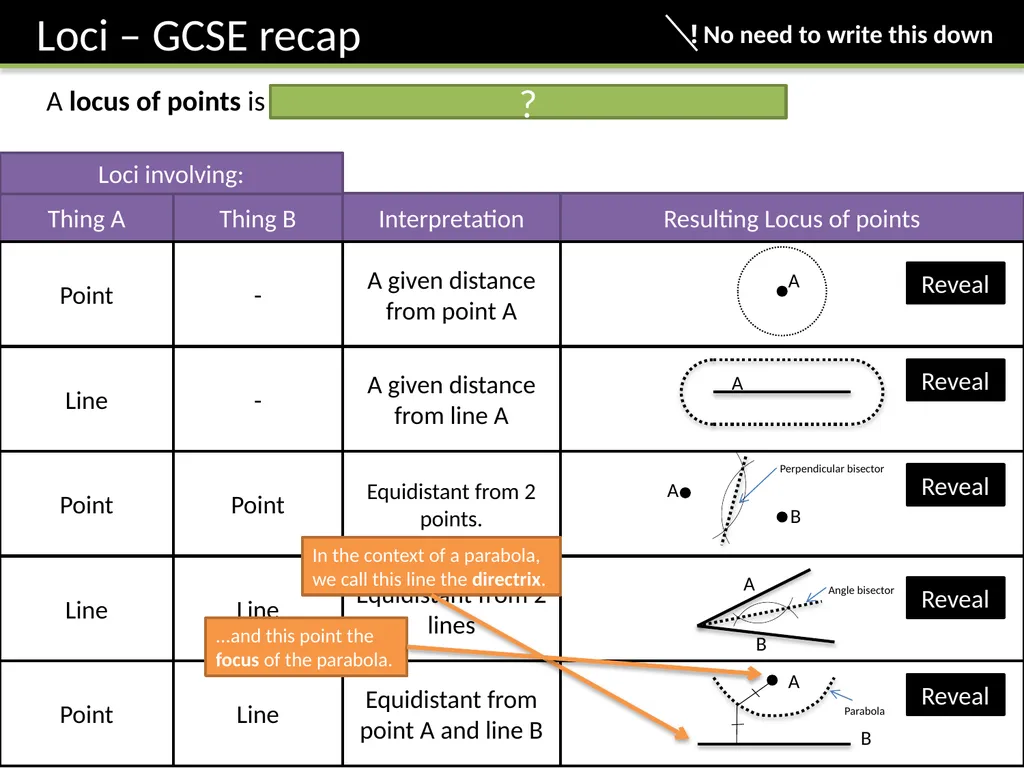
A locus of points is a set of points satisfying a certain condition. Thing A Thing B Loci involving: Interpretation A given distance from point A Point Resulting Locus of points - A A given distance from line A Line - A Equidistant from 2 points. Point Point A B Equidistant from 2 lines Line Line A B Equidistant from point A and line B Point Line B A ! No need to write this down Reveal Reveal Reveal Reveal Reveal ?<br>
09
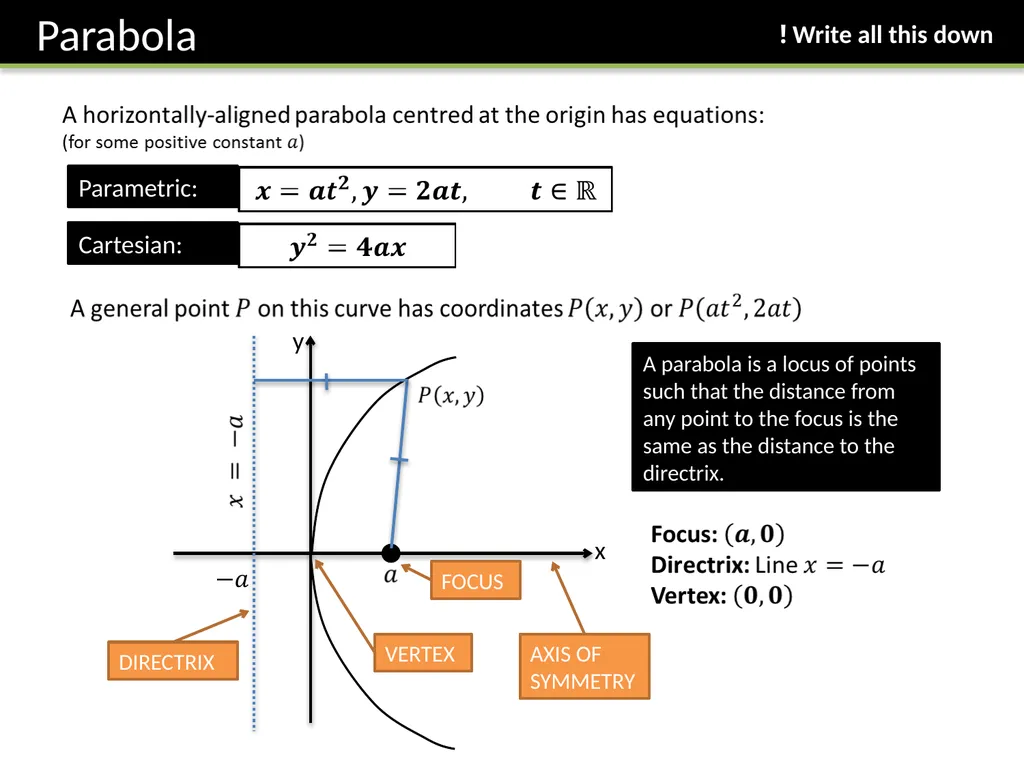
Parametric: Cartesian: x y FOCUS DIRECTRIX VERTEX A parabola is a locus of points such that the distance from any point to the focus is the same as the distance to the directrix. ! Write all this down AXIS OF SYMMETRY<br>
10
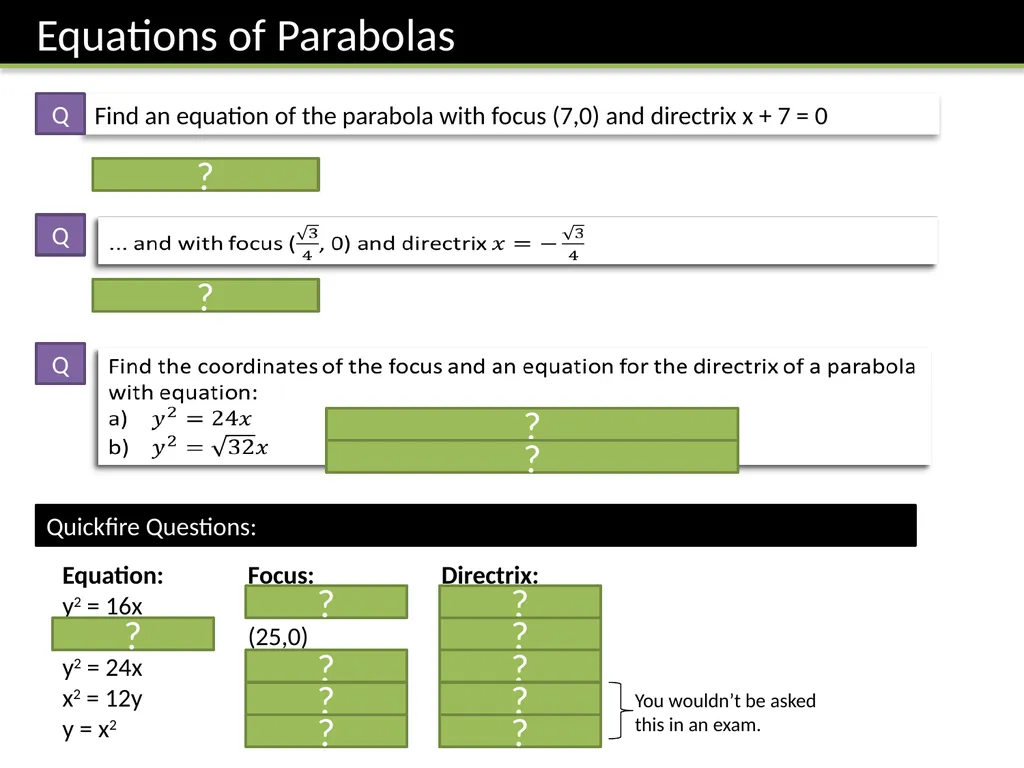
Find an equation of the parabola with focus (7,0) and directrix x + 7 = 0 a = 7, so y2 = 28x Q Q y2 = √3 x Q Focus: (6, 0) Directrix: x = -6
Focus: (√2, 0) Directrix: x = - √2 ? ? ? ? Quickfire Questions: Equation:
y2 = 16x
y2 = 100x
y2 = 24x
x2 = 12y
y = x2 Focus:
(4, 0)
(25,0)
(6,0)
(0,3)
(0, 0.25) Directrix:
x = -4
x = -25
x = -6
y = -3
y = -0.25 You wouldn’t be asked this in an exam. ? ? ? ? ? ? ? ? ? ?<br>
11
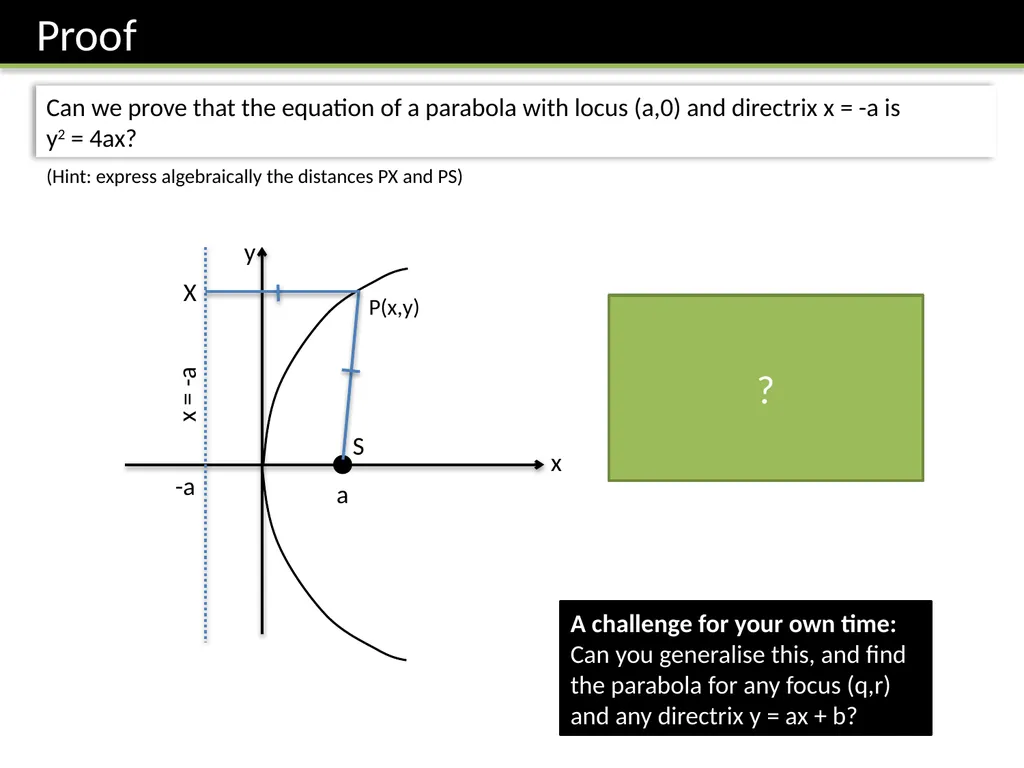
Can we prove that the equation of a parabola with locus (a,0) and directrix x = -a is
y2 = 4ax? x = -a -a y P(x,y) a (Hint: express algebraically the distances PX and PS) X S PX = x + a
PS = √[(x-a)2 + y2]
So (x-a)2 + y2 = (x+a)2
This simplifies to y2 = 4ax ? A challenge for your own time:
Can you generalise this, and find the parabola for any focus (q,r) and any directrix y = ax + b? x<br>
13
A point P(8, -8) lies on the parabola C with equation y2 = 8x. The point S is the focus of the parabola. The line l passes through S and P.
Find the coordinates of S.�(2, 0), as we just quarter the 8.
Find a equation for l, giving your answers in the form ax + by + c = 0, where a, b, c are integers.�m = -8/6 = -4/3�Using point S: y – 0 = -4/3(x – 2) �Rearranging: 4x + 3y – 8 = 0
The line l meets the parabola C again at the point Q. The point M is the mid-point of PQ. Find the coordinates of Q.�l: 4x + 3y – 8 = 0�C: y2 = 8x�Solving simultaneously gives us (1/2, 2)
Find the coordinates of M.�(17/4, -3)
Draw a sketch showing parabola C, the line l �and the points P, Q, S and M. y x C: y2 = 8x L: 4x + 3y – 8 = 0 Q(0.5, 2) S(2, 0) M(17/4, -3) P(8, -8) ? ? ? ? ?<br>
15
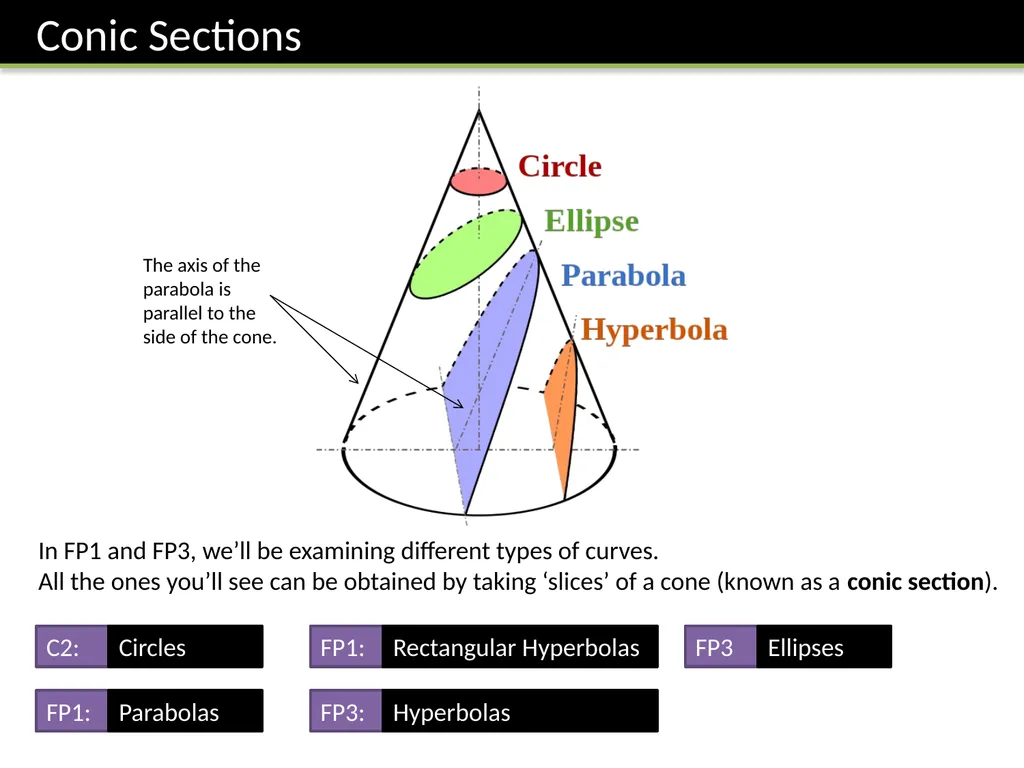
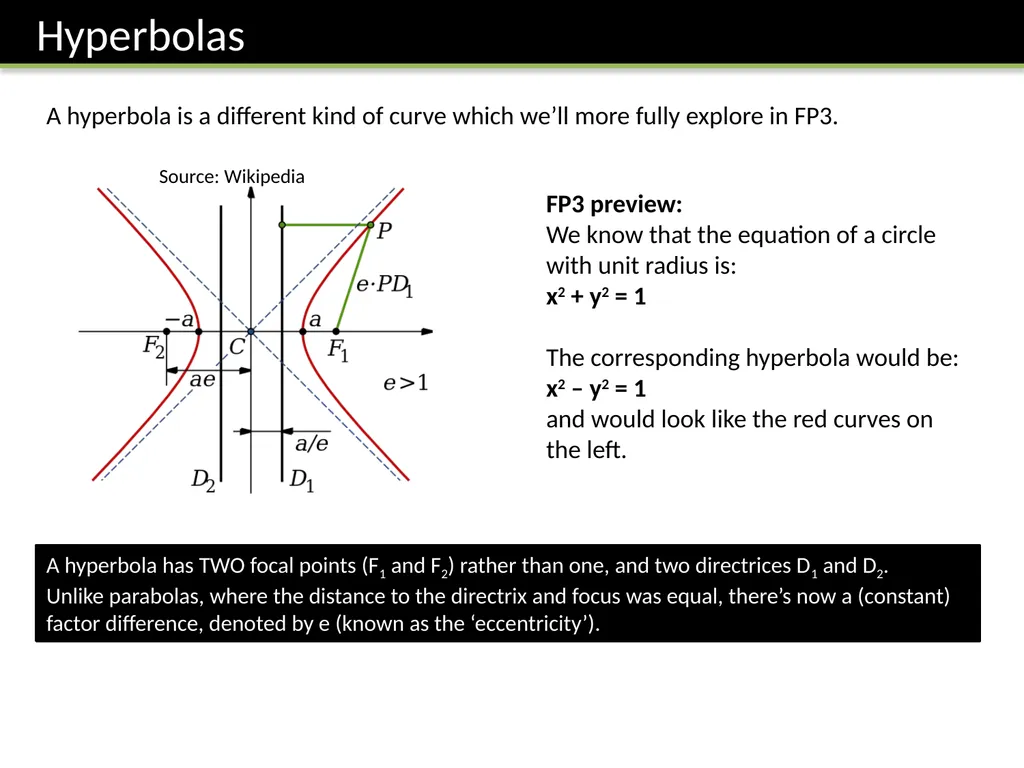
A hyperbola is a different kind of curve which we’ll more fully explore in FP3. Source: Wikipedia FP3 preview:
We know that the equation of a circle with unit radius is:
x2 + y2 = 1
The corresponding hyperbola would be:
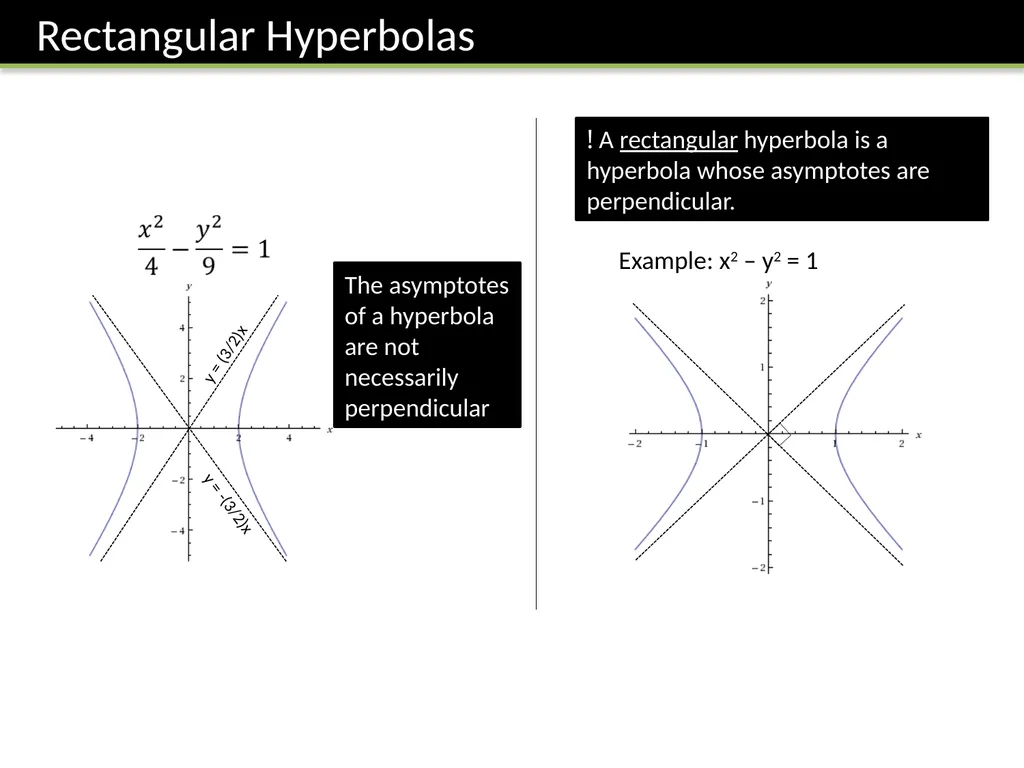
x2 – y2 = 1
and would look like the red curves on the left. A hyperbola has TWO focal points (F1 and F2) rather than one, and two directrices D1 and D2.
Unlike parabolas, where the distance to the directrix and focus was equal, there’s now a (constant) factor difference, denoted by e (known as the ‘eccentricity’).<br>
16
The asymptotes of a hyperbola are not necessarily perpendicular Example: x2 – y2 = 1 ! A rectangular hyperbola is a hyperbola whose asymptotes are perpendicular. y = (3/2)x y = -(3/2)x<br>
17
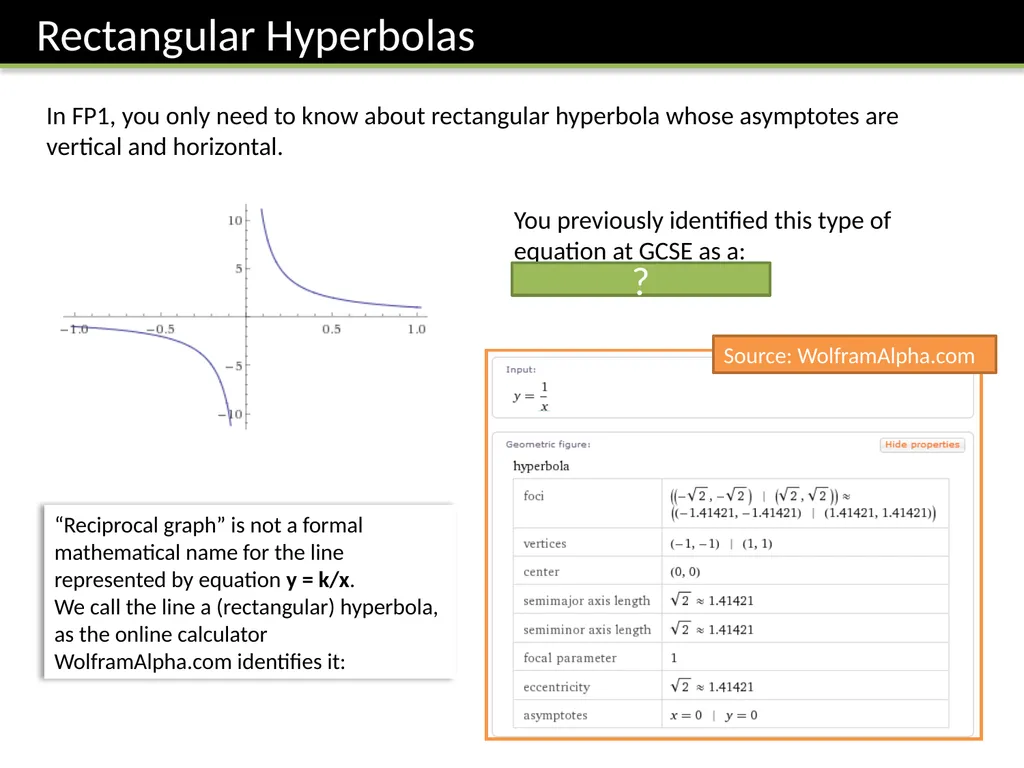
In FP1, you only need to know about rectangular hyperbola whose asymptotes are vertical and horizontal. You previously identified this type of equation at GCSE as a:
Recriprocal equation! “Reciprocal graph” is not a formal mathematical name for the line represented by equation y = k/x.
We call the line a (rectangular) hyperbola, as the online calculator WolframAlpha.com identifies it: Source: WolframAlpha.com ?<br>
18
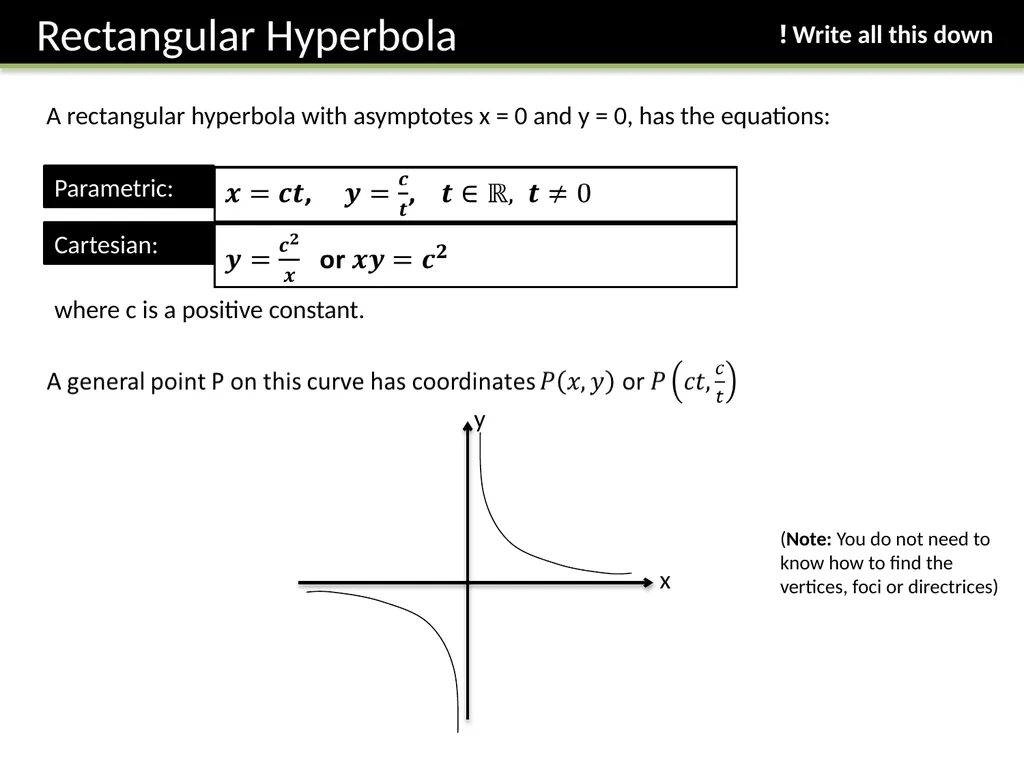
! Write all this down A rectangular hyperbola with asymptotes x = 0 and y = 0, has the equations: Parametric: Cartesian: (Note: You do not need to know how to find the vertices, foci or directrices) where c is a positive constant. y x<br>
19
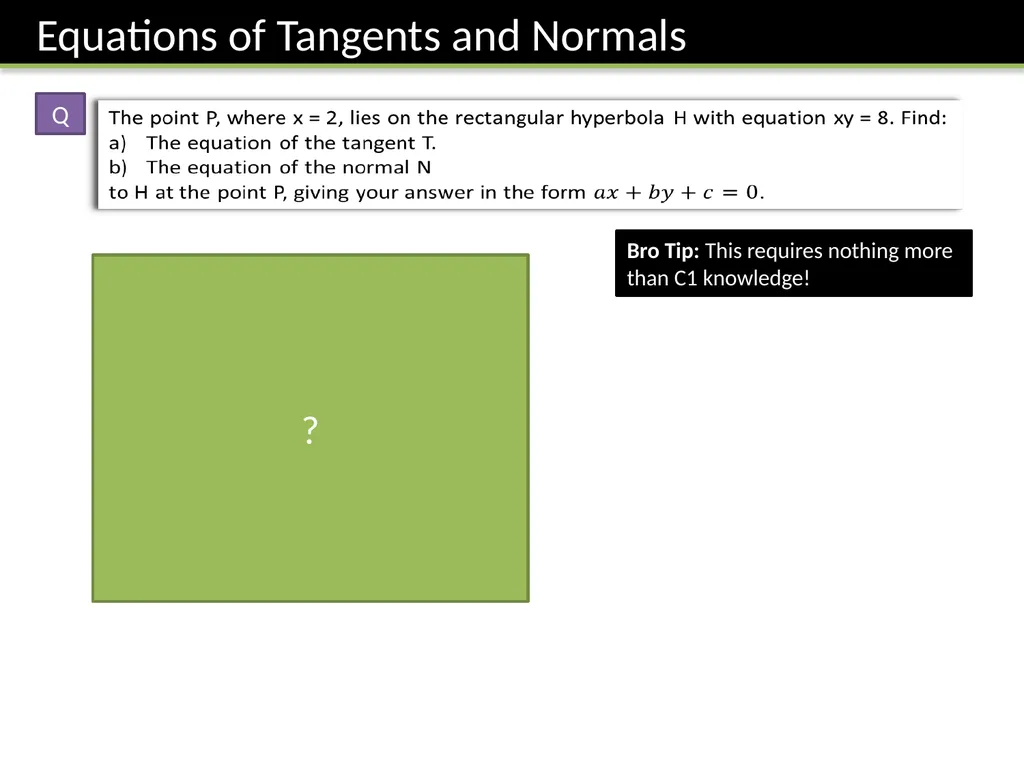
Q Bro Tip: This requires nothing more than C1 knowledge! y = 8x-1
dy/dx = -8x-2 = -8/x2
When x = 2, y = 4, mT = -2, mN = 1/2,
So equation of tangent:
y – 4 = -2(x – 2)
This becomes 2x + y – 8 = 0
Equation of normal:
x – 2y + 6 = 0 ?<br>
20
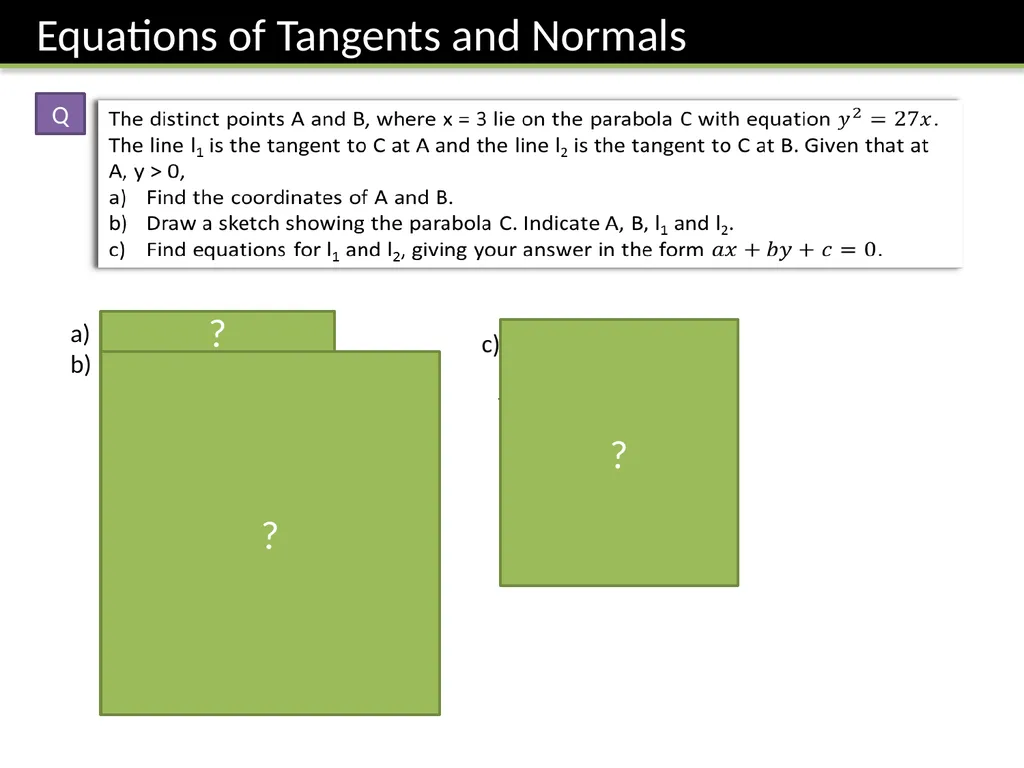
Q y2 = 81, so y = 9 l1 l2 B(3,-9) B(3,9) ? ? ?<br>
21
Odd numbered questions.<br>
22
The point P(at2, 2at) lies on the parabola C with equation y2 = 4ax, where a is a positive constant. Show that an equation of the normal to C at P is y + tx = 2at + at3 Q y = 2√a x1/2 dy/dx = √a / √x
At P, x = at2, so dy/dx = 1/t
mT = 1/t, so mN = -t
y – 2at = -t(x – at2) ...some rearrangement
y + tx = 2at + at3 ?<br>
23
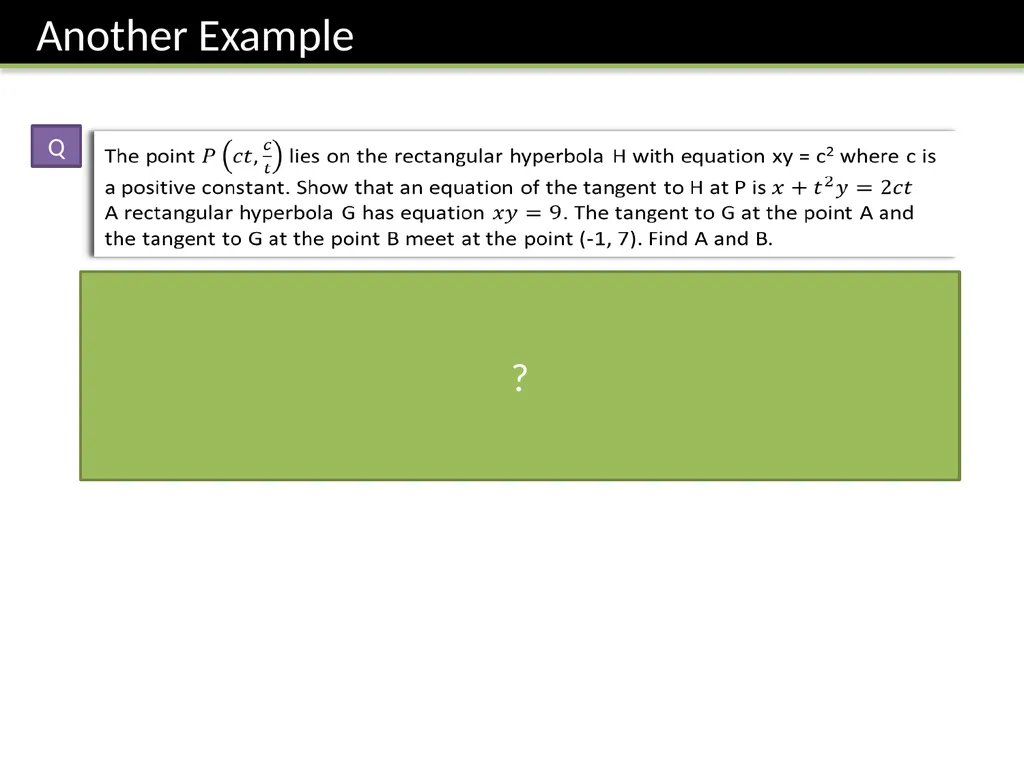
Q For G, c = 3.
Using general equation for G, we find t = -1/7, 1
P has coordinates (ct, c/t) = (3t, 3/t)
For to two values of t, this gives us coordinates (-3/7, -21) and (3, 3). ?<br>
24
Odd numbered questions.<br>
25
A parabola is:
a locus of points such that the distance from any point to the focus is the same as the distance to the directrix. y X S PARABOLA ? ? ? ? ? ? ? ?<br>
26
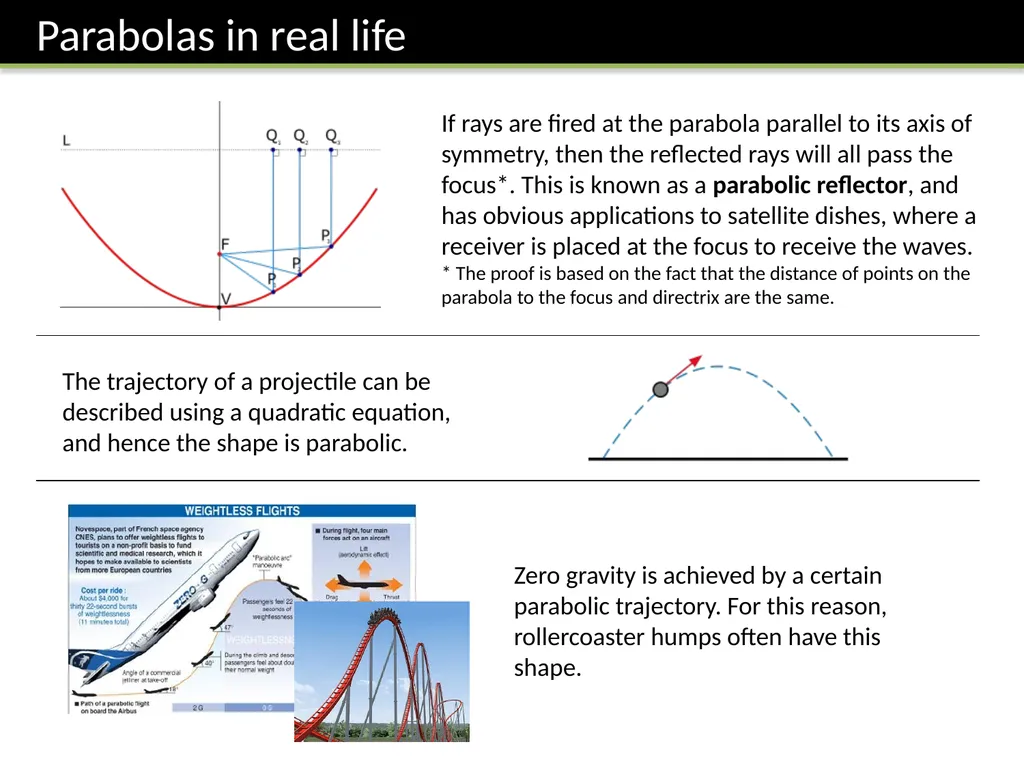
If rays are fired at the parabola parallel to its axis of symmetry, then the reflected rays will all pass the focus*. This is known as a parabolic reflector, and has obvious applications to satellite dishes, where a receiver is placed at the focus to receive the waves.
* The proof is based on the fact that the distance of points on the parabola to the focus and directrix are the same. The trajectory of a projectile can be described using a quadratic equation, and hence the shape is parabolic. Zero gravity is achieved by a certain parabolic trajectory. For this reason, rollercoaster humps often have this shape.<br>
27
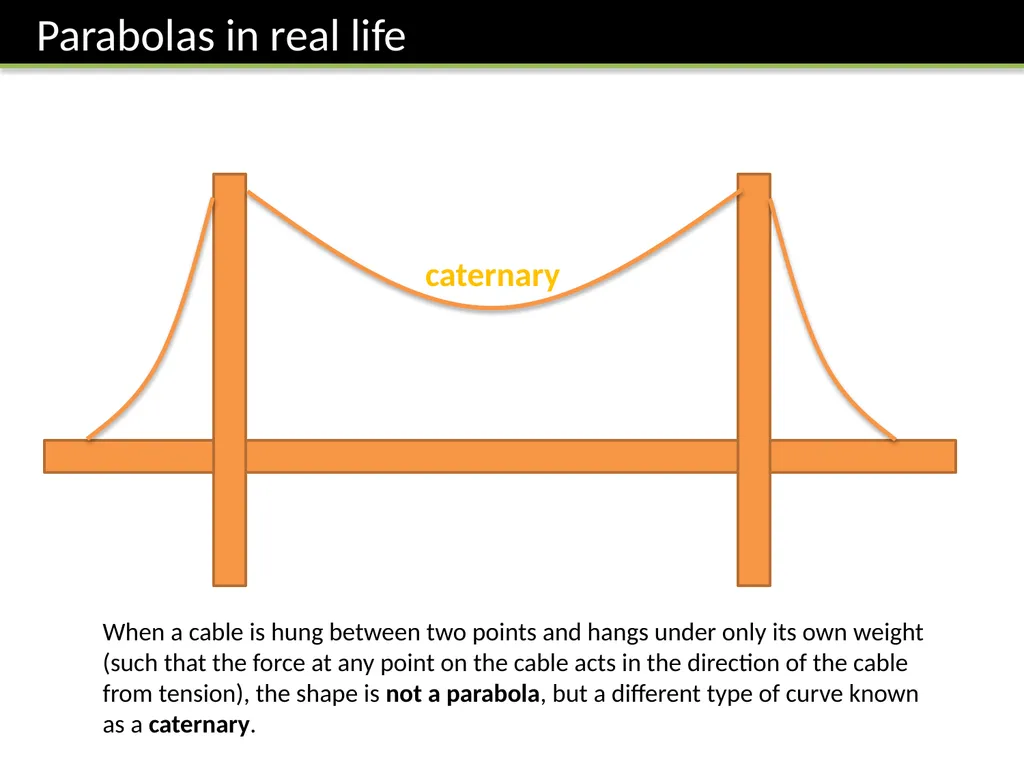
When a cable is hung between two points and hangs under only its own weight (such that the force at any point on the cable acts in the direction of the cable from tension), the shape is not a parabola, but a different type of curve known as a caternary. caternary<br>
28
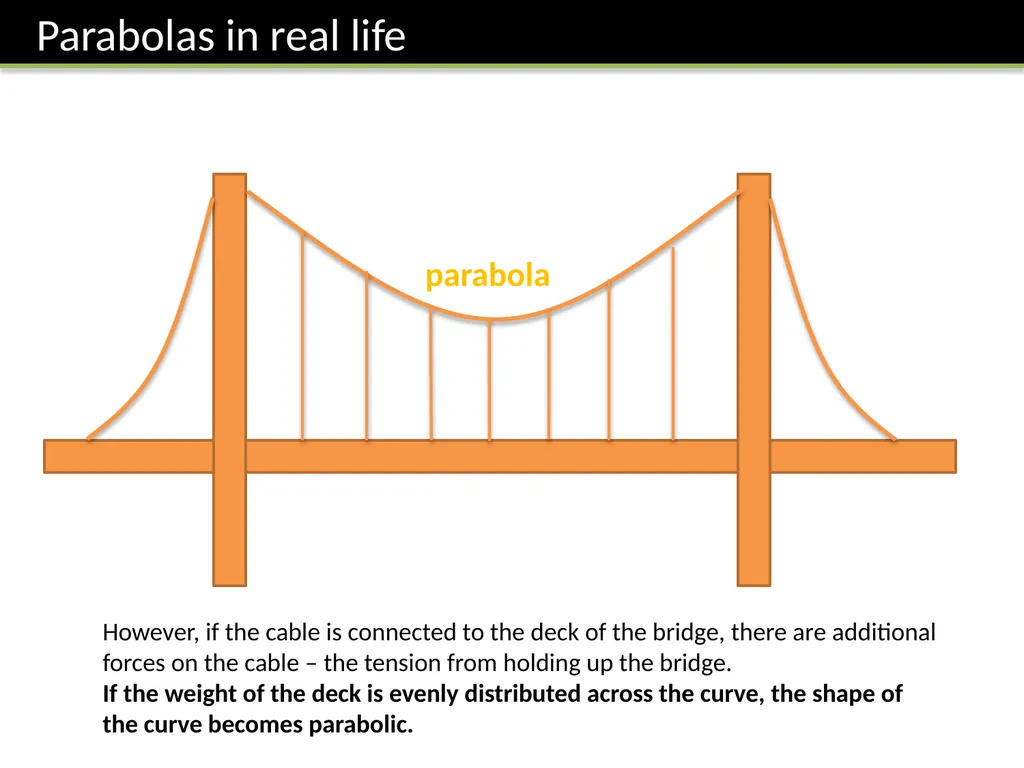
However, if the cable is connected to the deck of the bridge, there are additional forces on the cable – the tension from holding up the bridge.
If the weight of the deck is evenly distributed across the curve, the shape of the curve becomes parabolic. parabola<br>