
Framework in LD Climb The Mountain Roles and





Description: Framework in LD Climb The Mountain Roles and Burdens Aff needs to provide a justification of the resolution Negative needs to provide a reason not to vote aff: Dont changeprefer the status quo Wont solve for what it says, so not
Related Topics
Download Presentation
"Framework in LD Climb The Mountain Roles and" is the property of its rightful owner. Permission is granted to download and print the materials on this website for personal, non-commercial use only, and to display it on your personal computer provided you do not modify the materials and that you retain all copyright notices contained in the materials. By downloading content from our website, you accept the terms of this agreement.
Presentation Transcript
slide1. Framework in LD Climb The Mountain<br>
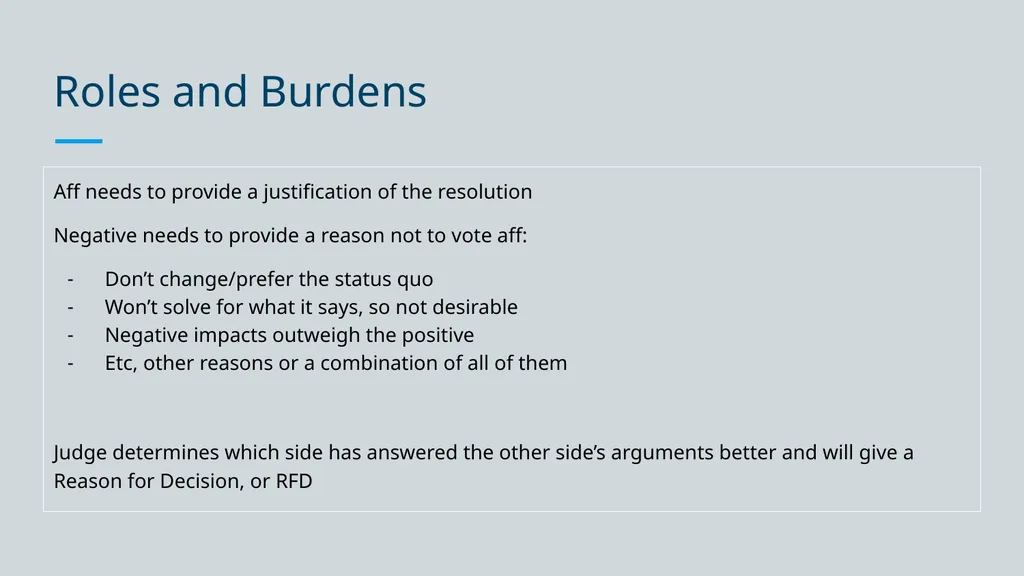
slide2. Roles and Burdens Aff needs to provide a justification of the resolution
Negative needs to provide a reason not to vote aff:
Don’t change/prefer the status quo
Won’t solve for what it says, so not desirable
Negative impacts outweigh the positive
Etc, other reasons or a combination of all of them
Judge determines which side has answered the other side’s arguments better and will give a Reason for Decision, or RFD<br>
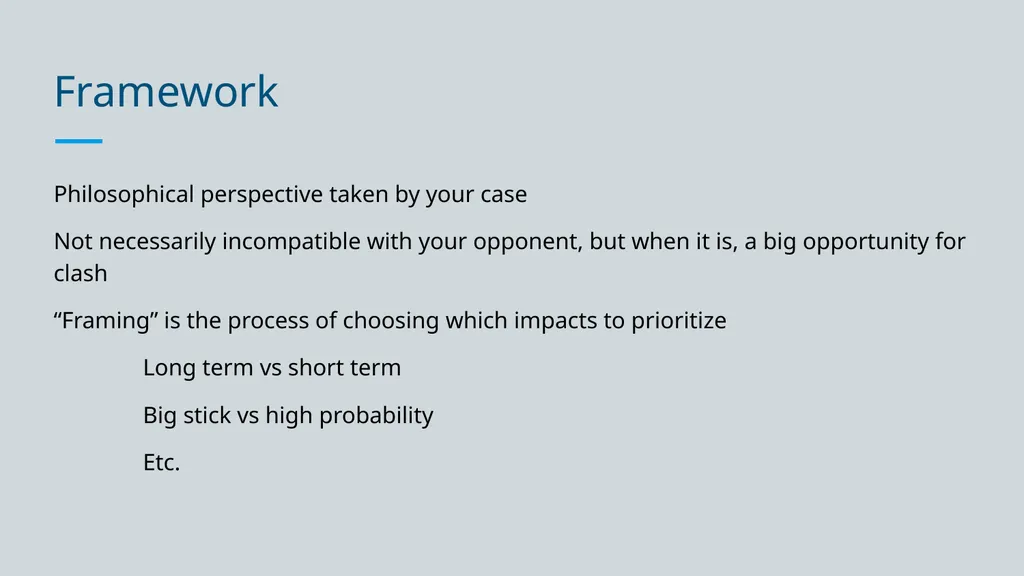
slide3. Framework Philosophical perspective taken by your case
Not necessarily incompatible with your opponent, but when it is, a big opportunity for clash
“Framing” is the process of choosing which impacts to prioritize
Long term vs short term
Big stick vs high probability
Etc.<br>
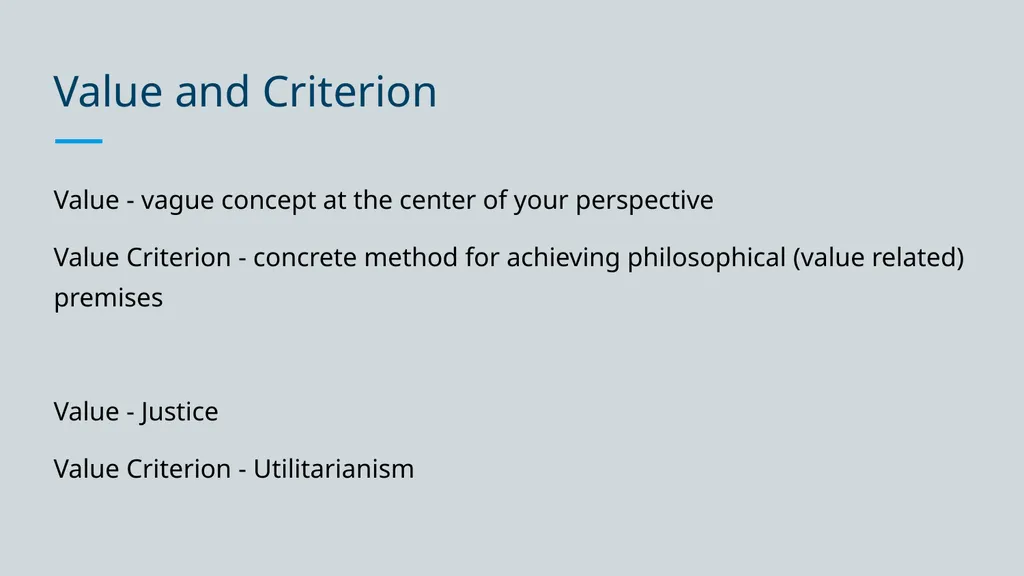
slide4. Value and Criterion Value - vague concept at the center of your perspective
Value Criterion - concrete method for achieving philosophical (value related) premises
Value - Justice
Value Criterion - Utilitarianism<br>
slide5. Values<br>
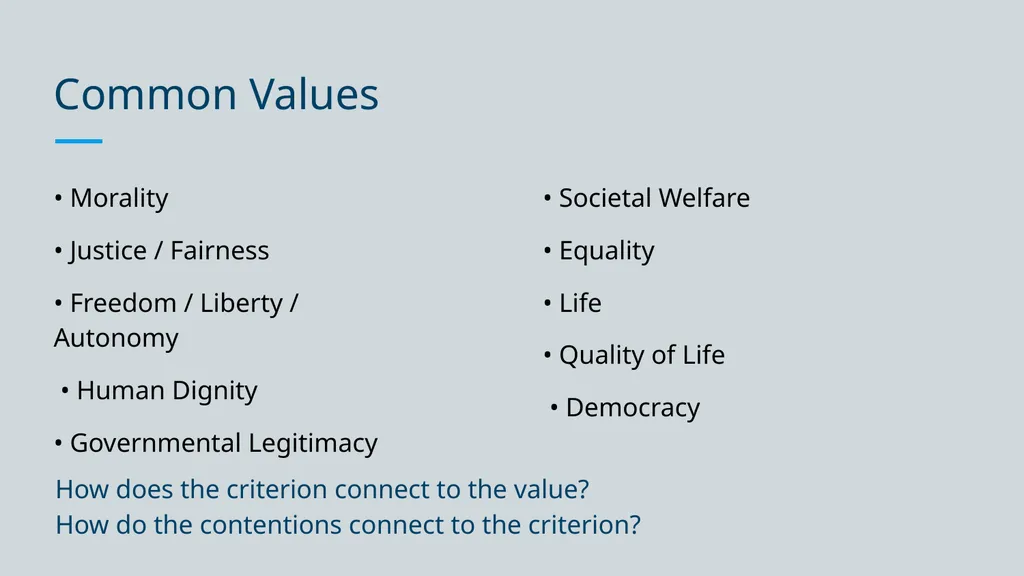
slide6. Common Values • Morality
• Justice / Fairness
• Freedom / Liberty / Autonomy
• Human Dignity
• Governmental Legitimacy • Societal Welfare
• Equality
• Life
• Quality of Life
• Democracy How does the criterion connect to the value?
How do the contentions connect to the criterion?<br>
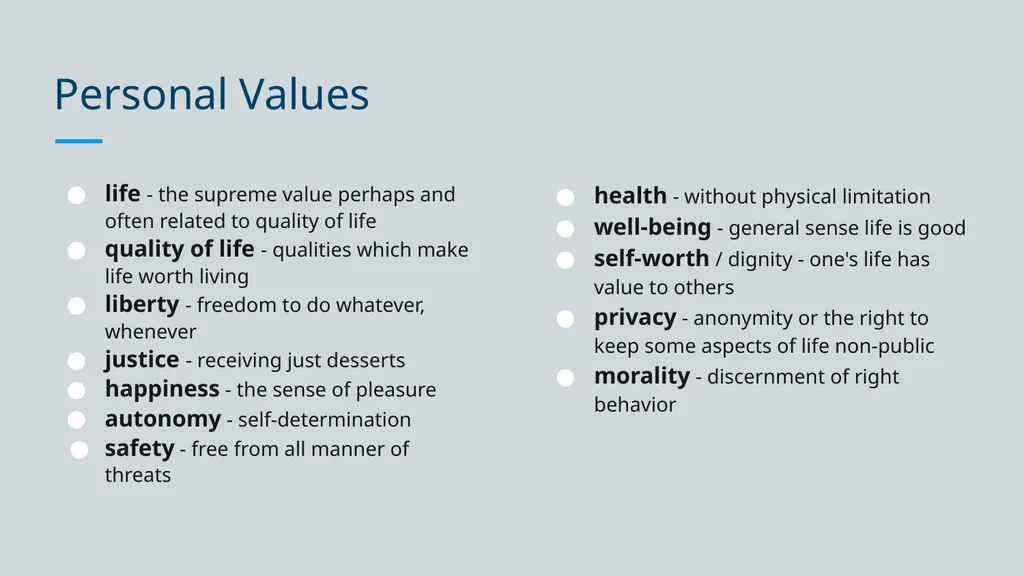
slide7. Personal Values life - the supreme value perhaps and often related to quality of life
quality of life - qualities which make life worth living
liberty - freedom to do whatever, whenever
justice - receiving just desserts
happiness - the sense of pleasure
autonomy - self-determination
safety - free from all manner of threats health - without physical limitation
well-being - general sense life is good
self-worth / dignity - one's life has value to others
privacy - anonymity or the right to keep some aspects of life non-public
morality - discernment of right behavior<br>
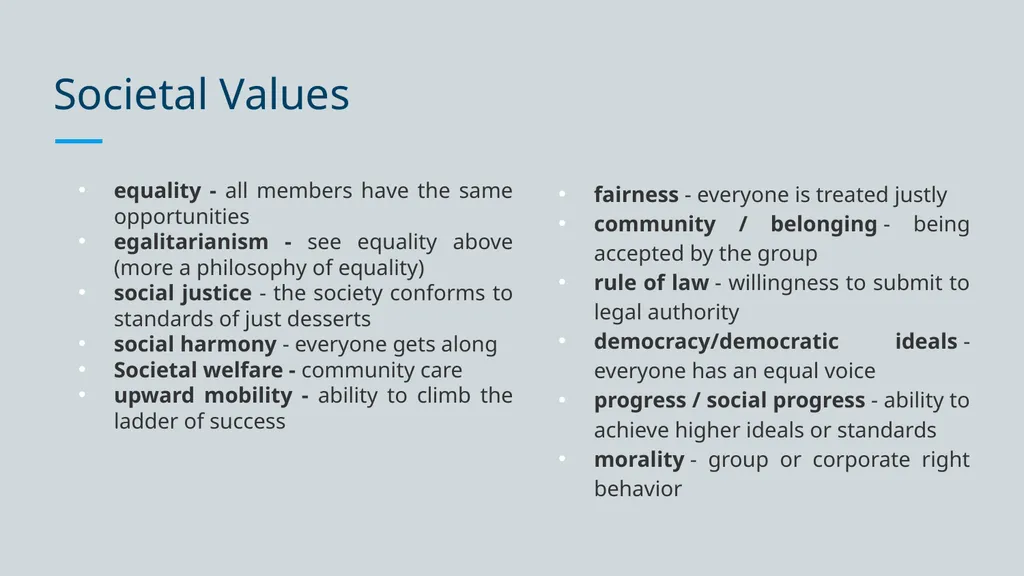
slide8. Societal Values fairness - everyone is treated justly
community / belonging - being accepted by the group
rule of law - willingness to submit to legal authority
democracy/democratic ideals - everyone has an equal voice
progress / social progress - ability to achieve higher ideals or standards
morality - group or corporate right behavior equality - all members have the same opportunities
egalitarianism - see equality above (more a philosophy of equality)
social justice - the society conforms to standards of just desserts
social harmony - everyone gets along
Societal welfare - community care
upward mobility - ability to climb the ladder of success<br>
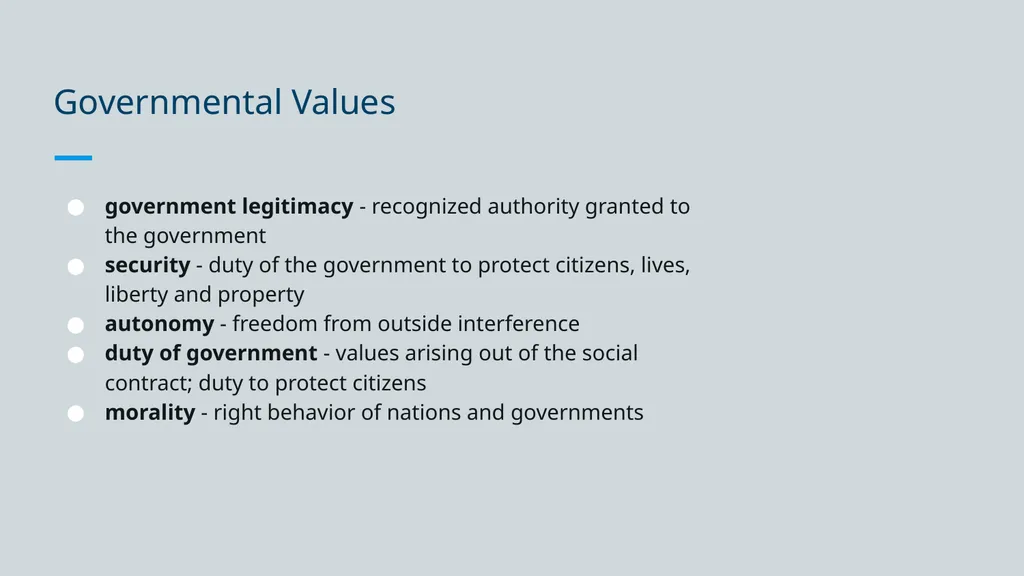
slide9. Governmental Values government legitimacy - recognized authority granted to the government
security - duty of the government to protect citizens, lives, liberty and property
autonomy - freedom from outside interference
duty of government - values arising out of the social contract; duty to protect citizens
morality - right behavior of nations and governments<br>
slide10. Criterions<br>
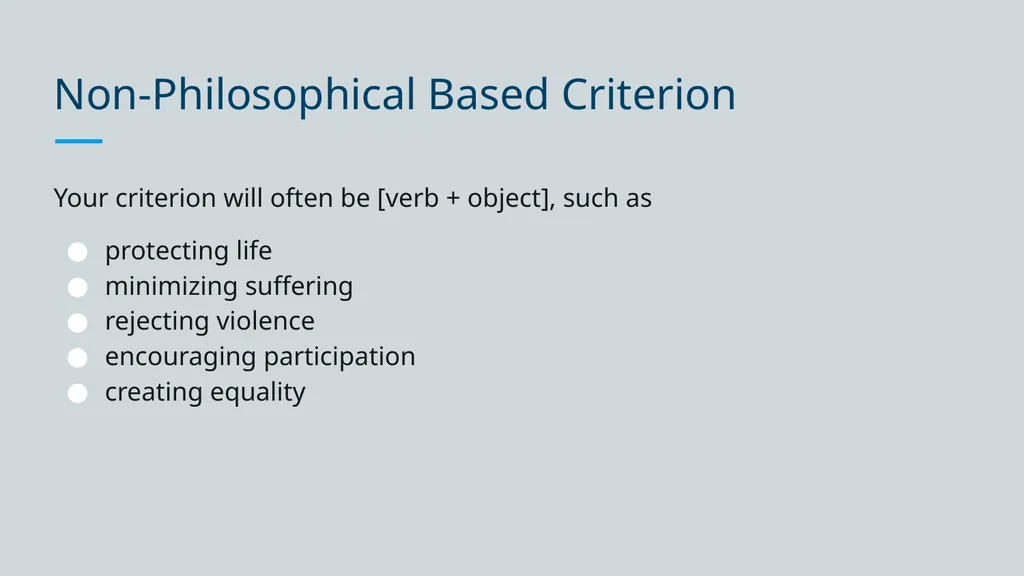
slide11. Non-Philosophical Based Criterion Your criterion will often be [verb + object], such as
protecting life
minimizing suffering
rejecting violence
encouraging participation
creating equality<br>
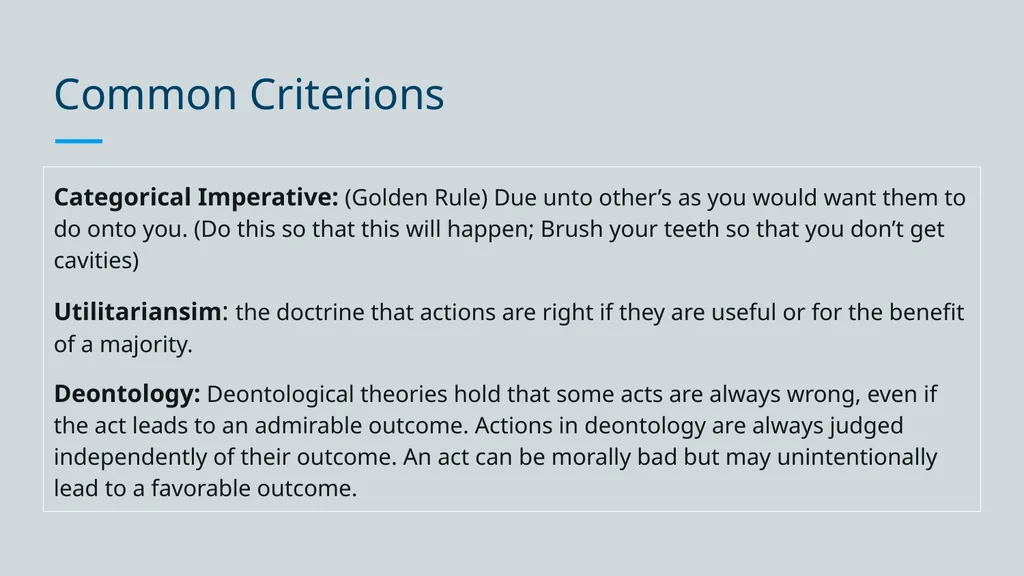
slide12. Common Criterions Categorical Imperative: (Golden Rule) Due unto other’s as you would want them to do onto you. (Do this so that this will happen; Brush your teeth so that you don’t get cavities)
Utilitariansim: the doctrine that actions are right if they are useful or for the benefit of a majority.
Deontology: Deontological theories hold that some acts are always wrong, even if the act leads to an admirable outcome. Actions in deontology are always judged independently of their outcome. An act can be morally bad but may unintentionally lead to a favorable outcome.<br>
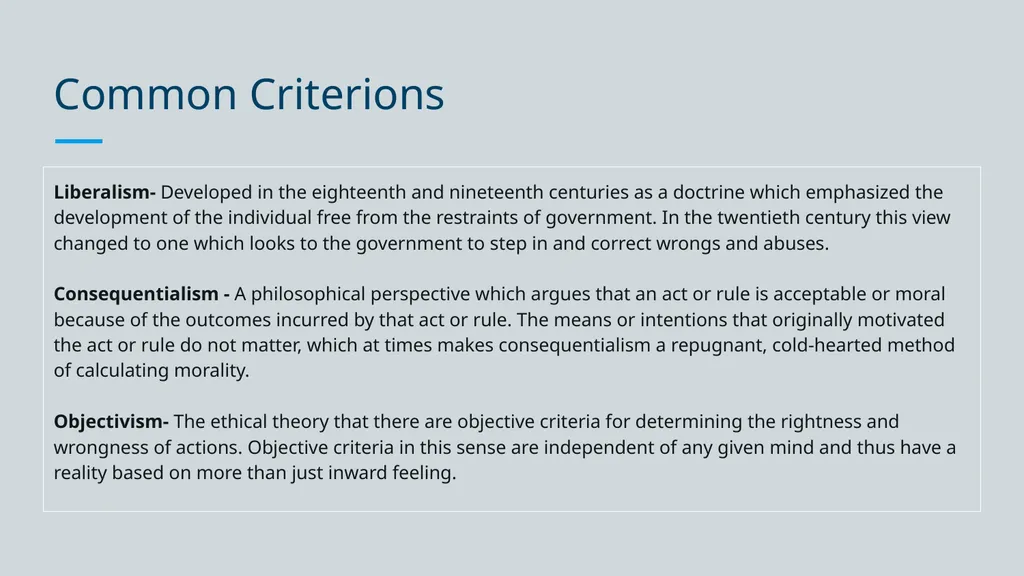
slide13. Common Criterions Liberalism- Developed in the eighteenth and nineteenth centuries as a doctrine which emphasized the development of the individual free from the restraints of government. In the twentieth century this view changed to one which looks to the government to step in and correct wrongs and abuses.
Consequentialism - A philosophical perspective which argues that an act or rule is acceptable or moral because of the outcomes incurred by that act or rule. The means or intentions that originally motivated the act or rule do not matter, which at times makes consequentialism a repugnant, cold-hearted method of calculating morality.
Objectivism- The ethical theory that there are objective criteria for determining the rightness and wrongness of actions. Objective criteria in this sense are independent of any given mind and thus have a reality based on more than just inward feeling.<br>
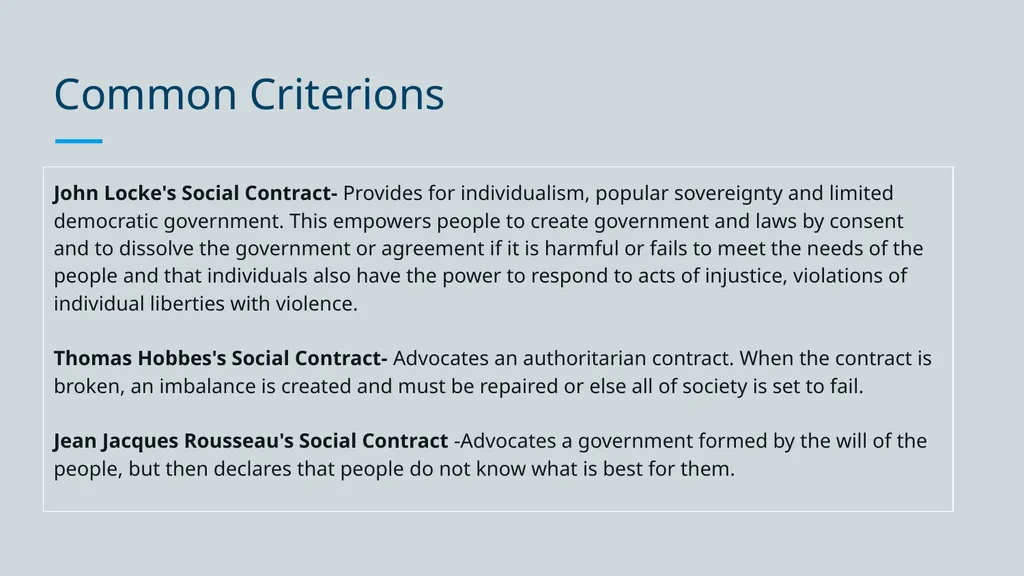
slide14. Common Criterions John Locke's Social Contract- Provides for individualism, popular sovereignty and limited democratic government. This empowers people to create government and laws by consent and to dissolve the government or agreement if it is harmful or fails to meet the needs of the people and that individuals also have the power to respond to acts of injustice, violations of individual liberties with violence.
Thomas Hobbes's Social Contract- Advocates an authoritarian contract. When the contract is broken, an imbalance is created and must be repaired or else all of society is set to fail.
Jean Jacques Rousseau's Social Contract -Advocates a government formed by the will of the people, but then declares that people do not know what is best for them.<br>
slide15. Examples with cards<br>
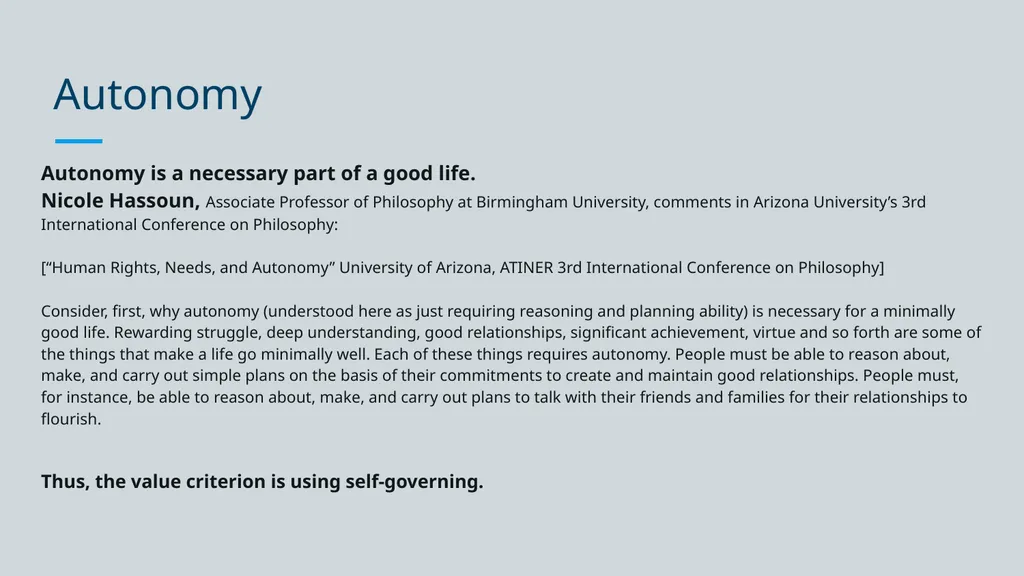
slide16. Autonomy Autonomy is a necessary part of a good life.
Nicole Hassoun, Associate Professor of Philosophy at Birmingham University, comments in Arizona University’s 3rd International Conference on Philosophy:
[“Human Rights, Needs, and Autonomy” University of Arizona, ATINER 3rd International Conference on Philosophy]
Consider, first, why autonomy (understood here as just requiring reasoning and planning ability) is necessary for a minimally good life. Rewarding struggle, deep understanding, good relationships, significant achievement, virtue and so forth are some of the things that make a life go minimally well. Each of these things requires autonomy. People must be able to reason about, make, and carry out simple plans on the basis of their commitments to create and maintain good relationships. People must, for instance, be able to reason about, make, and carry out plans to talk with their friends and families for their relationships to flourish.
Thus, the value criterion is using self-governing.<br>
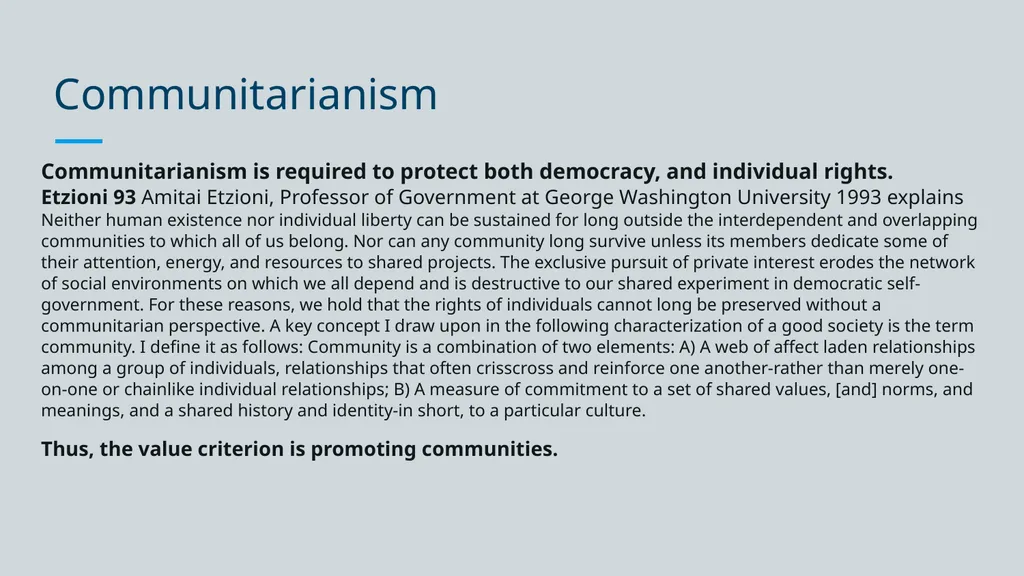
slide17. Communitarianism Communitarianism is required to protect both democracy, and individual rights. Etzioni 93 Amitai Etzioni, Professor of Government at George Washington University 1993 explains Neither human existence nor individual liberty can be sustained for long outside the interdependent and overlapping communities to which all of us belong. Nor can any community long survive unless its members dedicate some of their attention, energy, and resources to shared projects. The exclusive pursuit of private interest erodes the network of social environments on which we all depend and is destructive to our shared experiment in democratic self-government. For these reasons, we hold that the rights of individuals cannot long be preserved without a communitarian perspective. A key concept I draw upon in the following characterization of a good society is the term community. I define it as follows: Community is a combination of two elements: A) A web of affect laden relationships among a group of individuals, relationships that often crisscross and reinforce one another-rather than merely one-on-one or chainlike individual relationships; B) A measure of commitment to a set of shared values, [and] norms, and meanings, and a shared history and identity-in short, to a particular culture.
Thus, the value criterion is promoting communities.<br>
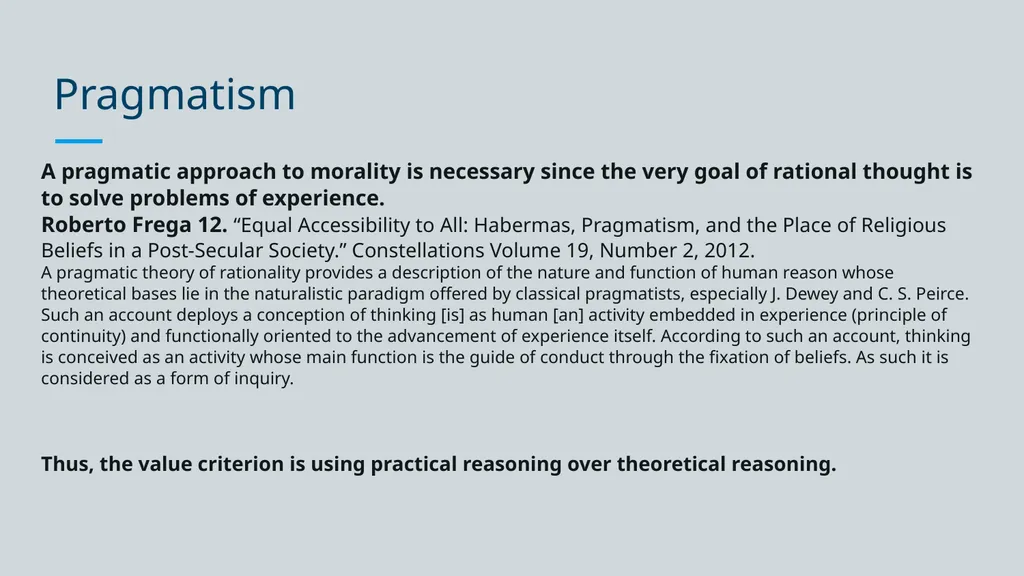
slide18. Pragmatism A pragmatic approach to morality is necessary since the very goal of rational thought is to solve problems of experience.
Roberto Frega 12. “Equal Accessibility to All: Habermas, Pragmatism, and the Place of Religious Beliefs in a Post-Secular Society.” Constellations Volume 19, Number 2, 2012.
A pragmatic theory of rationality provides a description of the nature and function of human reason whose theoretical bases lie in the naturalistic paradigm offered by classical pragmatists, especially J. Dewey and C. S. Peirce. Such an account deploys a conception of thinking [is] as human [an] activity embedded in experience (principle of continuity) and functionally oriented to the advancement of experience itself. According to such an account, thinking is conceived as an activity whose main function is the guide of conduct through the fixation of beliefs. As such it is considered as a form of inquiry.
Thus, the value criterion is using practical reasoning over theoretical reasoning.<br>
slide19. Now you try!<br>
slide2. Roles and Burdens Aff needs to provide a justification of the resolution
Negative needs to provide a reason not to vote aff:
Don’t change/prefer the status quo
Won’t solve for what it says, so not desirable
Negative impacts outweigh the positive
Etc, other reasons or a combination of all of them
Judge determines which side has answered the other side’s arguments better and will give a Reason for Decision, or RFD<br>
slide3. Framework Philosophical perspective taken by your case
Not necessarily incompatible with your opponent, but when it is, a big opportunity for clash
“Framing” is the process of choosing which impacts to prioritize
Long term vs short term
Big stick vs high probability
Etc.<br>
slide4. Value and Criterion Value - vague concept at the center of your perspective
Value Criterion - concrete method for achieving philosophical (value related) premises
Value - Justice
Value Criterion - Utilitarianism<br>
slide5. Values<br>
slide6. Common Values • Morality
• Justice / Fairness
• Freedom / Liberty / Autonomy
• Human Dignity
• Governmental Legitimacy • Societal Welfare
• Equality
• Life
• Quality of Life
• Democracy How does the criterion connect to the value?
How do the contentions connect to the criterion?<br>
slide7. Personal Values life - the supreme value perhaps and often related to quality of life
quality of life - qualities which make life worth living
liberty - freedom to do whatever, whenever
justice - receiving just desserts
happiness - the sense of pleasure
autonomy - self-determination
safety - free from all manner of threats health - without physical limitation
well-being - general sense life is good
self-worth / dignity - one's life has value to others
privacy - anonymity or the right to keep some aspects of life non-public
morality - discernment of right behavior<br>
slide8. Societal Values fairness - everyone is treated justly
community / belonging - being accepted by the group
rule of law - willingness to submit to legal authority
democracy/democratic ideals - everyone has an equal voice
progress / social progress - ability to achieve higher ideals or standards
morality - group or corporate right behavior equality - all members have the same opportunities
egalitarianism - see equality above (more a philosophy of equality)
social justice - the society conforms to standards of just desserts
social harmony - everyone gets along
Societal welfare - community care
upward mobility - ability to climb the ladder of success<br>
slide9. Governmental Values government legitimacy - recognized authority granted to the government
security - duty of the government to protect citizens, lives, liberty and property
autonomy - freedom from outside interference
duty of government - values arising out of the social contract; duty to protect citizens
morality - right behavior of nations and governments<br>
slide10. Criterions<br>
slide11. Non-Philosophical Based Criterion Your criterion will often be [verb + object], such as
protecting life
minimizing suffering
rejecting violence
encouraging participation
creating equality<br>
slide12. Common Criterions Categorical Imperative: (Golden Rule) Due unto other’s as you would want them to do onto you. (Do this so that this will happen; Brush your teeth so that you don’t get cavities)
Utilitariansim: the doctrine that actions are right if they are useful or for the benefit of a majority.
Deontology: Deontological theories hold that some acts are always wrong, even if the act leads to an admirable outcome. Actions in deontology are always judged independently of their outcome. An act can be morally bad but may unintentionally lead to a favorable outcome.<br>
slide13. Common Criterions Liberalism- Developed in the eighteenth and nineteenth centuries as a doctrine which emphasized the development of the individual free from the restraints of government. In the twentieth century this view changed to one which looks to the government to step in and correct wrongs and abuses.
Consequentialism - A philosophical perspective which argues that an act or rule is acceptable or moral because of the outcomes incurred by that act or rule. The means or intentions that originally motivated the act or rule do not matter, which at times makes consequentialism a repugnant, cold-hearted method of calculating morality.
Objectivism- The ethical theory that there are objective criteria for determining the rightness and wrongness of actions. Objective criteria in this sense are independent of any given mind and thus have a reality based on more than just inward feeling.<br>
slide14. Common Criterions John Locke's Social Contract- Provides for individualism, popular sovereignty and limited democratic government. This empowers people to create government and laws by consent and to dissolve the government or agreement if it is harmful or fails to meet the needs of the people and that individuals also have the power to respond to acts of injustice, violations of individual liberties with violence.
Thomas Hobbes's Social Contract- Advocates an authoritarian contract. When the contract is broken, an imbalance is created and must be repaired or else all of society is set to fail.
Jean Jacques Rousseau's Social Contract -Advocates a government formed by the will of the people, but then declares that people do not know what is best for them.<br>
slide15. Examples with cards<br>
slide16. Autonomy Autonomy is a necessary part of a good life.
Nicole Hassoun, Associate Professor of Philosophy at Birmingham University, comments in Arizona University’s 3rd International Conference on Philosophy:
[“Human Rights, Needs, and Autonomy” University of Arizona, ATINER 3rd International Conference on Philosophy]
Consider, first, why autonomy (understood here as just requiring reasoning and planning ability) is necessary for a minimally good life. Rewarding struggle, deep understanding, good relationships, significant achievement, virtue and so forth are some of the things that make a life go minimally well. Each of these things requires autonomy. People must be able to reason about, make, and carry out simple plans on the basis of their commitments to create and maintain good relationships. People must, for instance, be able to reason about, make, and carry out plans to talk with their friends and families for their relationships to flourish.
Thus, the value criterion is using self-governing.<br>
slide17. Communitarianism Communitarianism is required to protect both democracy, and individual rights. Etzioni 93 Amitai Etzioni, Professor of Government at George Washington University 1993 explains Neither human existence nor individual liberty can be sustained for long outside the interdependent and overlapping communities to which all of us belong. Nor can any community long survive unless its members dedicate some of their attention, energy, and resources to shared projects. The exclusive pursuit of private interest erodes the network of social environments on which we all depend and is destructive to our shared experiment in democratic self-government. For these reasons, we hold that the rights of individuals cannot long be preserved without a communitarian perspective. A key concept I draw upon in the following characterization of a good society is the term community. I define it as follows: Community is a combination of two elements: A) A web of affect laden relationships among a group of individuals, relationships that often crisscross and reinforce one another-rather than merely one-on-one or chainlike individual relationships; B) A measure of commitment to a set of shared values, [and] norms, and meanings, and a shared history and identity-in short, to a particular culture.
Thus, the value criterion is promoting communities.<br>
slide18. Pragmatism A pragmatic approach to morality is necessary since the very goal of rational thought is to solve problems of experience.
Roberto Frega 12. “Equal Accessibility to All: Habermas, Pragmatism, and the Place of Religious Beliefs in a Post-Secular Society.” Constellations Volume 19, Number 2, 2012.
A pragmatic theory of rationality provides a description of the nature and function of human reason whose theoretical bases lie in the naturalistic paradigm offered by classical pragmatists, especially J. Dewey and C. S. Peirce. Such an account deploys a conception of thinking [is] as human [an] activity embedded in experience (principle of continuity) and functionally oriented to the advancement of experience itself. According to such an account, thinking is conceived as an activity whose main function is the guide of conduct through the fixation of beliefs. As such it is considered as a form of inquiry.
Thus, the value criterion is using practical reasoning over theoretical reasoning.<br>
slide19. Now you try!<br>