
Franklin Township Public Schools Lesson Plan
BR
Published · 24 slides · 0 views

1 / 1

Description
Franklin Township Public Schools Lesson Plan Repository Daniel Loughran, Ed.D., Assistant Superintendent for Curriculum Instruction Giselle Perez, Supervisor of English Language Arts, K-5 July 29, 2025 Problem Teachers faced significant
Related Topics
Share
Embed code
Download this presentation From Below
"Franklin Township Public Schools Lesson Plan" is the property of its rightful owner. Permission is granted to download and print the materials on this website for personal, non-commercial use only, and to display it on your personal computer provided you do not modify the materials and that you retain all copyright notices contained in the materials. By downloading content from our website, you accept the terms of this agreement.
Presentation Transcript
01
Franklin Township Public Schools
Lesson Plan Repository Daniel Loughran, Ed.D., Assistant Superintendent for Curriculum & Instruction
Giselle Perez, Supervisor of English Language Arts, K-5
July 29, 2025<br>
Giselle Perez, Supervisor of English Language Arts, K-5
July 29, 2025<br>
02
Problem Teachers faced significant time challenges with lesson planning, particularly following the adoption of a new K-5 ELA resource, Benchmark Advance. Teachers were spending considerable time creating detailed lesson plans from scratch, while also learning a comprehensive new curriculum, which was an increasingly difficult and unsustainable expectation—especially for newer teachers. 2<br>
03
Solution: Exemplar Lesson Plans The core planning team -- consisting of teachers’ association leaders, teachers, coaches, and supervisors -- came together and conceptualized a Lesson Plan Repository and Pre-Planned Guided Lessons, to attempt to alleviate K-5 literacy teachers’ workloads. Such a PPGE would
Reduce daily administrative burden on educators.
Allow for more time for data analysis.
Allow for more time for professional conversation around the new resource, including embedding Culturally and Linguistically Responsive (CLR) practices.
Provide consistency of instructional delivery across schools/grade levels. 3<br>
Reduce daily administrative burden on educators.
Allow for more time for data analysis.
Allow for more time for professional conversation around the new resource, including embedding Culturally and Linguistically Responsive (CLR) practices.
Provide consistency of instructional delivery across schools/grade levels. 3<br>
04
The Vision The vision for this project was to “reclaim teacher time” by developing a centralized repository of exemplar K–5 ELA lesson plans aligned with the new New Jersey Student Learning Standards (NJSLS) and culturally and linguistically responsive (CLR) practices.
The primary goal was to reduce the time teachers spent on administrative lesson planning tasks, enabling them to dedicate more time to instructional preparation, student data analysis, and professional growth.
By streamlining the lesson planning process, the project aimed to enhance teacher satisfaction and strengthen the overall instructional climate across K–5 literacy classrooms. 4<br>
The primary goal was to reduce the time teachers spent on administrative lesson planning tasks, enabling them to dedicate more time to instructional preparation, student data analysis, and professional growth.
By streamlining the lesson planning process, the project aimed to enhance teacher satisfaction and strengthen the overall instructional climate across K–5 literacy classrooms. 4<br>
05
Today’s Session Objectives Objectives:
Share Franklin Township’s journey.
Identify the issues involved as well as solutions to these issues.
By engaging with the presenters, members of the audience will experience the journey and take away a plan to implement a similar PPGE in their own districts. 5<br>
Share Franklin Township’s journey.
Identify the issues involved as well as solutions to these issues.
By engaging with the presenters, members of the audience will experience the journey and take away a plan to implement a similar PPGE in their own districts. 5<br>
06
Journey: Lesson Planning Activity On your own, process the materials you have been given.
With a partner, design a literacy lesson using these materials.
Next, pair up with partners to discuss the Lesson Planning Activity Reflection Questions. 6<br>
With a partner, design a literacy lesson using these materials.
Next, pair up with partners to discuss the Lesson Planning Activity Reflection Questions. 6<br>
07
Journey: Reflection Questions (1) Lesson Planning Activity Reflection Questions:
What did it “feel” like trying to process so much information for each day’s lesson plan?
Given the proscribed nature of most of the lesson elements, to what extent do you think lesson plans might be similar?
To what degree do you think there would be variability in lesson delivery? 7<br>
What did it “feel” like trying to process so much information for each day’s lesson plan?
Given the proscribed nature of most of the lesson elements, to what extent do you think lesson plans might be similar?
To what degree do you think there would be variability in lesson delivery? 7<br>
08
Journey: Reflection Questions (2) Lesson Planning Activity Reflection Questions:
How much time can you imagine it would take for teachers to write their weekly literacy plans?
What would veteran teachers have to contend with, using all these materials?
How difficult do you think this weekly task would be for NEW teachers? 8<br>
How much time can you imagine it would take for teachers to write their weekly literacy plans?
What would veteran teachers have to contend with, using all these materials?
How difficult do you think this weekly task would be for NEW teachers? 8<br>
09
The Project -- Franklin’s Journey Coaches and Teachers from all seven elementary schools joined grade-level teams to unpack the materials and design lesson plans that aligned with the learning standards.
While designing the lesson plan exemplars, teachers focused on simplicity, so that teachers would have flexibility to add to their plans if they wished, but ultimately the plans would also invite teacher reflection and conversation with colleagues, especially around CLR practices, allowing them to respond to student needs, analyze data, and differentiate instruction accordingly, ultimately making their work more strategic and beneficial. 9<br>
While designing the lesson plan exemplars, teachers focused on simplicity, so that teachers would have flexibility to add to their plans if they wished, but ultimately the plans would also invite teacher reflection and conversation with colleagues, especially around CLR practices, allowing them to respond to student needs, analyze data, and differentiate instruction accordingly, ultimately making their work more strategic and beneficial. 9<br>
10
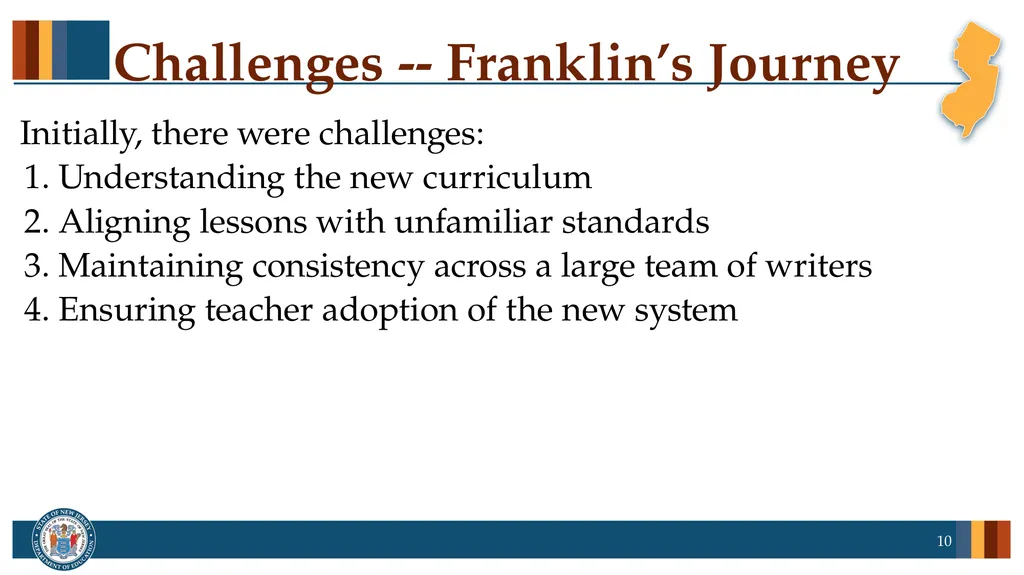
Challenges -- Franklin’s Journey Initially, there were challenges:
Understanding the new curriculum
Aligning lessons with unfamiliar standards
Maintaining consistency across a large team of writers
Ensuring teacher adoption of the new system 10<br>
Understanding the new curriculum
Aligning lessons with unfamiliar standards
Maintaining consistency across a large team of writers
Ensuring teacher adoption of the new system 10<br>
11
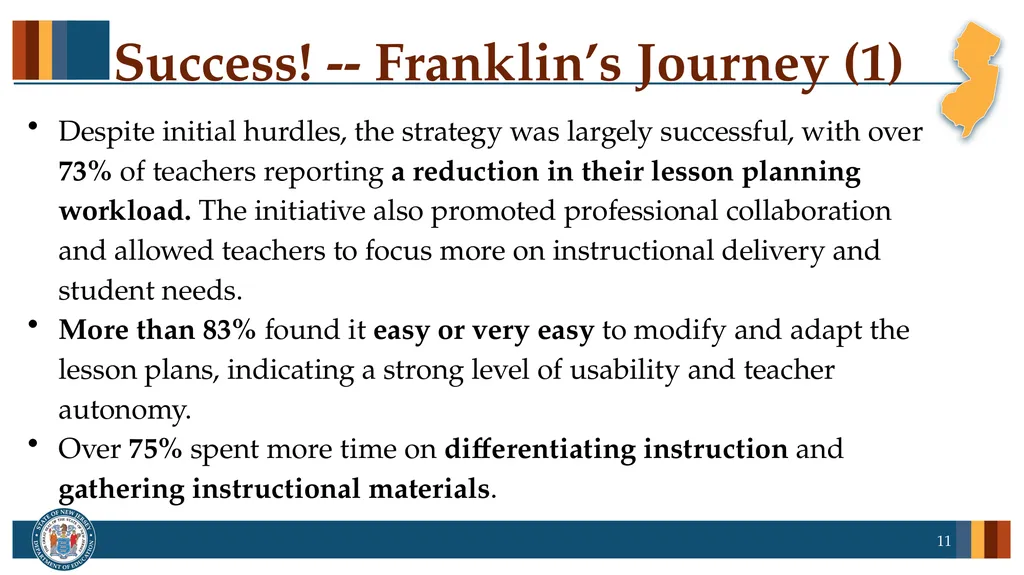
Success! -- Franklin’s Journey (1) Despite initial hurdles, the strategy was largely successful, with over 73% of teachers reporting a reduction in their lesson planning workload. The initiative also promoted professional collaboration and allowed teachers to focus more on instructional delivery and student needs.
More than 83% found it easy or very easy to modify and adapt the lesson plans, indicating a strong level of usability and teacher autonomy.
Over 75% spent more time on differentiating instruction and gathering instructional materials. 11<br>
More than 83% found it easy or very easy to modify and adapt the lesson plans, indicating a strong level of usability and teacher autonomy.
Over 75% spent more time on differentiating instruction and gathering instructional materials. 11<br>
12
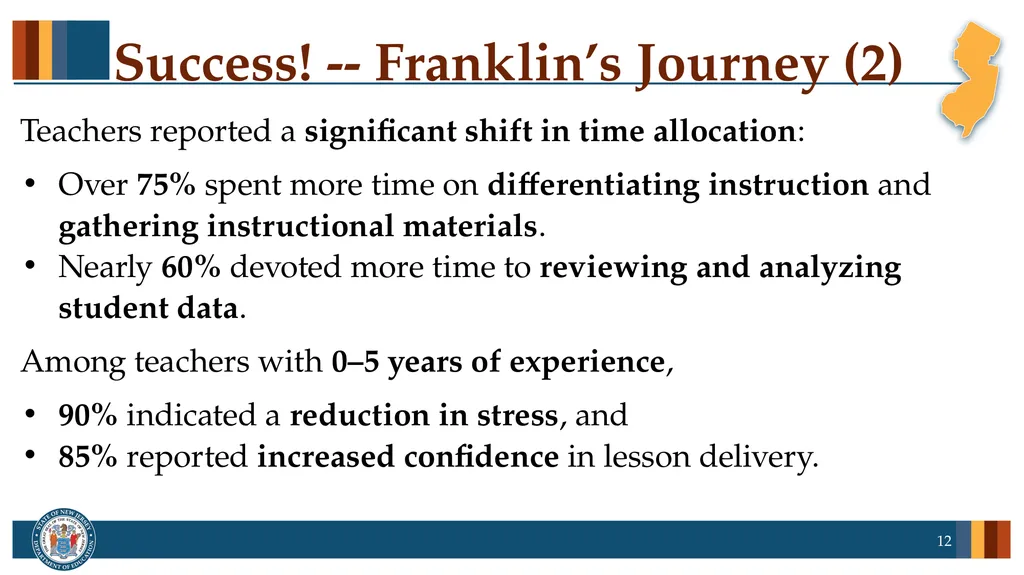
Success! -- Franklin’s Journey (2) Teachers reported a significant shift in time allocation:
Over 75% spent more time on differentiating instruction and gathering instructional materials.
Nearly 60% devoted more time to reviewing and analyzing student data.
Among teachers with 0–5 years of experience,
90% indicated a reduction in stress, and
85% reported increased confidence in lesson delivery. 12<br>
Over 75% spent more time on differentiating instruction and gathering instructional materials.
Nearly 60% devoted more time to reviewing and analyzing student data.
Among teachers with 0–5 years of experience,
90% indicated a reduction in stress, and
85% reported increased confidence in lesson delivery. 12<br>
13
Success! These findings demonstrate that the PPGEs have had a measurable, positive impact on teacher workload, instructional preparation, and professional confidence. Furthermore, the feedback has helped identify areas for future growth, including the potential expansion of exemplar lesson plans into additional content areas. 13<br>
14
Time Well Spent Activity (1) What can teachers do to enhance their effectiveness when they find additional time?
-- Step 1: Reflecting on your own knowledge of how K-5 teachers use their time, fill in the "Time Well Spent" Mapping & Reflection and discuss your input with a partner.
-- Step 2: Imagine how professional time could be better spent when lesson plan writing is removed. 14<br>
-- Step 1: Reflecting on your own knowledge of how K-5 teachers use their time, fill in the "Time Well Spent" Mapping & Reflection and discuss your input with a partner.
-- Step 2: Imagine how professional time could be better spent when lesson plan writing is removed. 14<br>
15
Time Well Spent Activity (2) -- Step 3: Share Reflections with your partner:
What insights does this reflection provide?
How can we put any of these insights into practice?
What changes would be needed in your district to fully shift to a data-driven, student-focused planning model? Could streamlined lesson planning be helpful? 15<br>
What insights does this reflection provide?
How can we put any of these insights into practice?
What changes would be needed in your district to fully shift to a data-driven, student-focused planning model? Could streamlined lesson planning be helpful? 15<br>
16
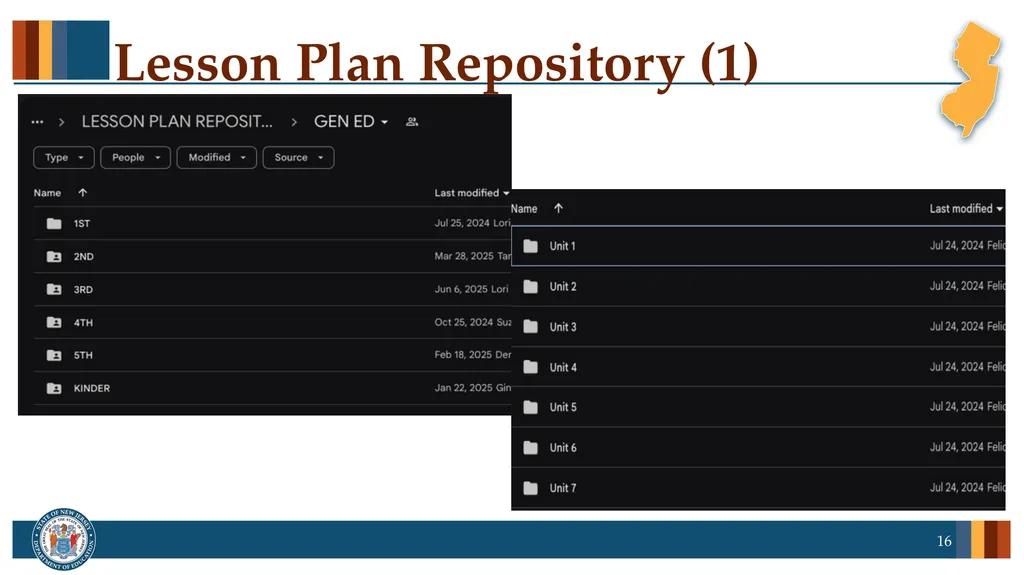
Lesson Plan Repository (1) 16<br>
17
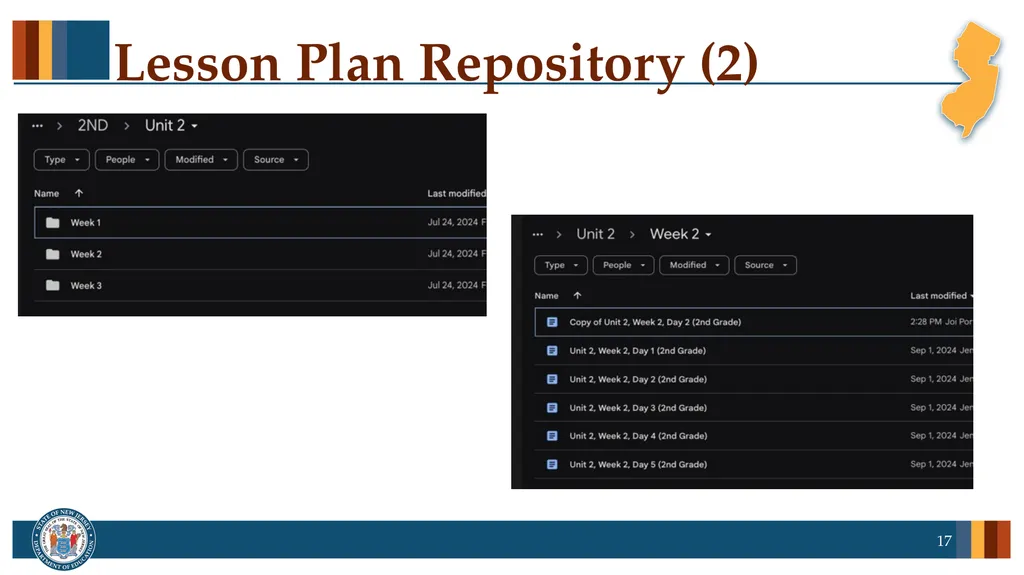
Lesson Plan Repository (2) 17<br>
18
Additional Success! These findings demonstrate that the PPGEs have had a measurable, positive impact on teacher workload, instructional preparation, and professional confidence. Furthermore, the feedback has helped identify areas for future growth, including the potential expansion of exemplar lesson plans into additional content areas. 18<br>
19
Challenges Impact has been measured through a combination of teacher surveys, climate surveys, and administrator feedback from classroom observations.
Early data suggested that while teachers appreciated the availability of the lesson plan repository, they required continued support in effectively implementing and adapting the materials to meet the diverse needs of their students.
As the year progressed, teachers received additional support from their instructional coaches. 19<br>
Early data suggested that while teachers appreciated the availability of the lesson plan repository, they required continued support in effectively implementing and adapting the materials to meet the diverse needs of their students.
As the year progressed, teachers received additional support from their instructional coaches. 19<br>
20
Impact The vision for the project was realized as it significantly reduced time spent on lesson planning, giving teachers more time for instructional preparation and professional growth. The repository's impact was measured through surveys, revealing that over 83% of teachers found it easy to modify and adapt the lessons to their students' needs. Early-career teachers, in particular, reported reduced stress and increased confidence. 20<br>
21
Looking Ahead Looking ahead, the district plans to expand its work into other content areas, such as math and science, and continue supporting teachers' professional development. The project’s sustainability is ensured through the use of a shared Google Drive, and the district aims to build on it to further improve instructional practices and reduce teacher burdens in the future. 21<br>
22
You Can Do It Too! While the initiative can be replicated in other districts, challenges such as funding, scheduling, and capacity for professional development need to be considered. Successful implementation requires collaboration, clear communication, professional development, and ongoing feedback to ensure long-term success and sustainability. 22<br>
23
To Summarize… If you wish to create a similar practice in your district, remember to
Determine the need by surveying staff.
Involve all stakeholders (teachers, association leaders, coaches, supervisors, principals).
Identify available funding for work outside of the school day; if this is not possible, determine your capacity for teacher release time.
Have teams plan a schedule for writing and reviewing exemplar lesson plans.
Organize the lesson plans for easy access. 23<br>
Determine the need by surveying staff.
Involve all stakeholders (teachers, association leaders, coaches, supervisors, principals).
Identify available funding for work outside of the school day; if this is not possible, determine your capacity for teacher release time.
Have teams plan a schedule for writing and reviewing exemplar lesson plans.
Organize the lesson plans for easy access. 23<br>
24
Thank You! New Jersey Department of Education: nj.gov/education Daniel Loughran, Ed.D., Assistant Superintendent
for Curriculum & Instruction
dloughran@franklinboe.org
Giselle Perez, Supervisor of English Language Arts, K-5
giselleperez@franklinboe.org 24<br>
for Curriculum & Instruction
dloughran@franklinboe.org
Giselle Perez, Supervisor of English Language Arts, K-5
giselleperez@franklinboe.org 24<br>