Fraud Awareness Training: Detection and Prevention Agenda Office of Inspector General Overview What is Fraud? Who Commits Fraud? Why? Common Types of Fraud Fraud Detection Red Flags Example Cases Fraud Prevention What can you do? How to
"Fraud Awareness Training: Detection and Prevention" is the property of its rightful owner. Permission is granted to
download and print the materials on this website for personal, non-commercial use only, and to display it
on your personal computer provided you do not modify the materials and that you retain all copyright
notices contained in the materials. By downloading content from our website, you accept the terms of this
agreement.
Presentation Transcript
01
Fraud Awareness Training:
Detection and Prevention<br>
02
Agenda Office of Inspector General Overview
What is Fraud?
Who Commits Fraud?
Why?
Common Types of Fraud
Fraud Detection
Red Flags
Example Cases
Fraud Prevention
What can you do?
How to report suspected fraud?<br>
03
Office of Inspector General Overview Authority of the Office of Inspector General:
The IG Act of 1978- Congress established the Office of Inspector General (IG) in each of the Government’s major departments. The GPO Inspector General Act of 1988. IG’s conduct audits, inspections, and investigations in order to prevent and detect fraud, waste, and abuse and increase effectiveness and efficiency of agency programs.
Other Authority:
44 USC § 3903 (GPO-OIG’s Statutory Law Enforcement Authority)
Indicators of Procurement Fraud, GPO Publication 825.25, August 2004.<br>
04
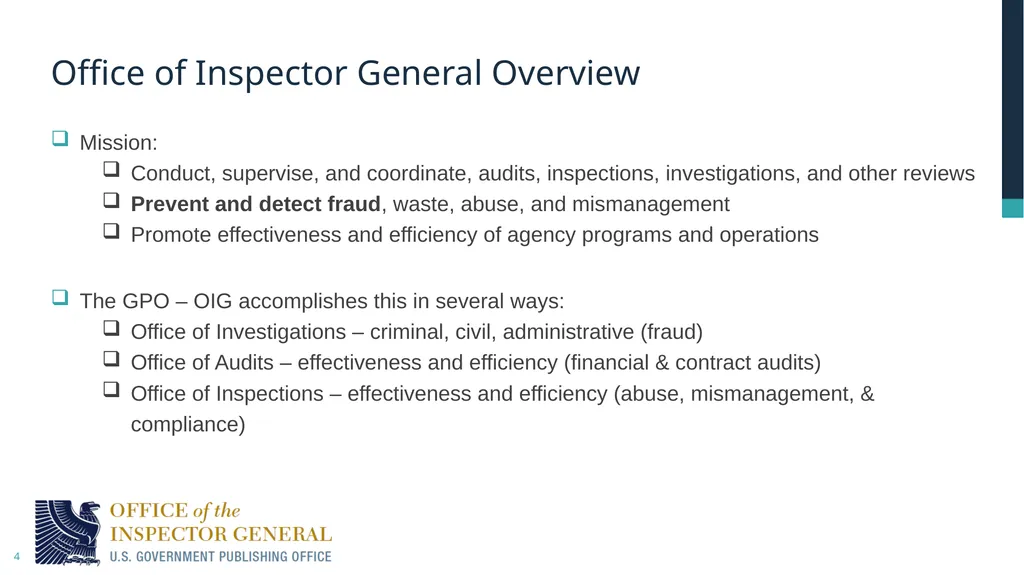
Office of Inspector General Overview Mission:
Conduct, supervise, and coordinate, audits, inspections, investigations, and other reviews
Prevent and detect fraud, waste, abuse, and mismanagement
Promote effectiveness and efficiency of agency programs and operations
The GPO – OIG accomplishes this in several ways:
Office of Investigations – criminal, civil, administrative (fraud)
Office of Audits – effectiveness and efficiency (financial & contract audits)
Office of Inspections – effectiveness and efficiency (abuse, mismanagement, & compliance)<br>
05
Fraud Overview<br>
06
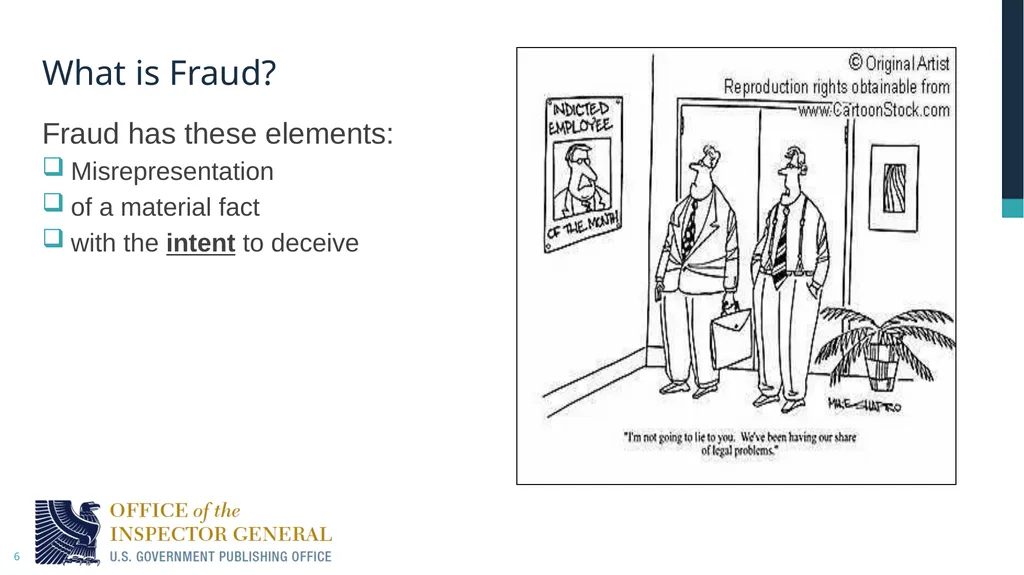
What is Fraud? Fraud has these elements:
Misrepresentation
of a material fact
with the intent to deceive<br>
07
Who Commits Fraud? People do!
Employees or management
Contractor personnel or government employees
Military or civilian Companies can also be held responsible for actions of their employees
(Source: United States Air Force, “Fraud Awareness Training for COR-QAE Training Module” October 2008)<br>
08
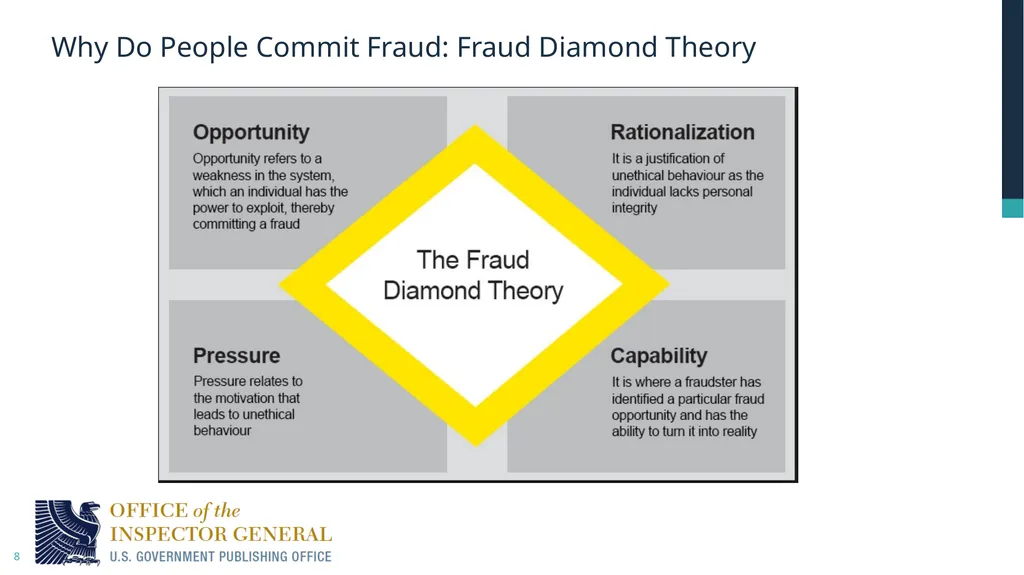
Why Do People Commit Fraud: Fraud Diamond Theory<br>
09
Fraud Detection<br>
10
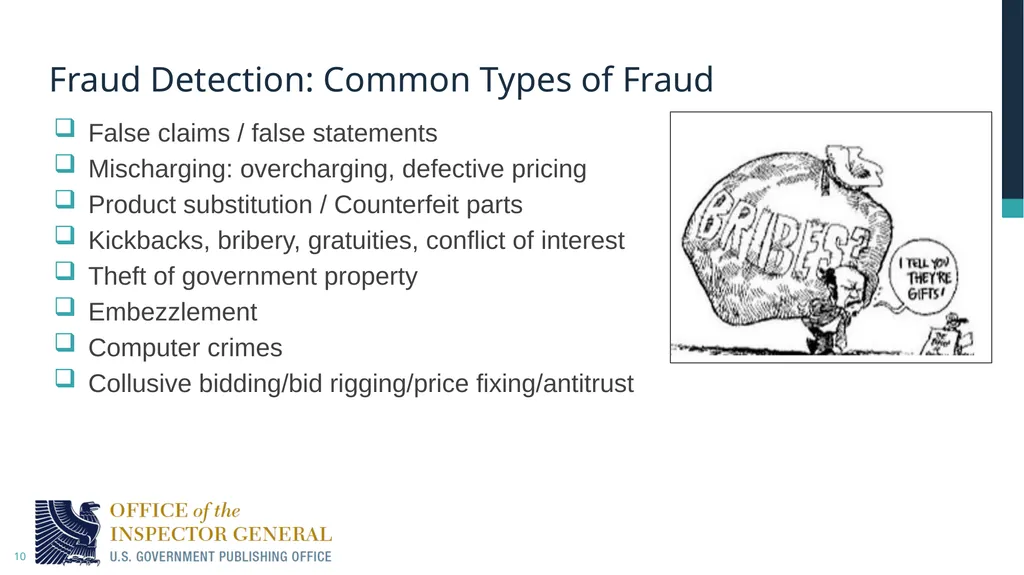
Fraud Detection: Common Types of Fraud False claims / false statements
Mischarging: overcharging, defective pricing
Product substitution / Counterfeit parts
Kickbacks, bribery, gratuities, conflict of interest
Theft of government property
Embezzlement
Computer crimes
Collusive bidding/bid rigging/price fixing/antitrust<br>
11
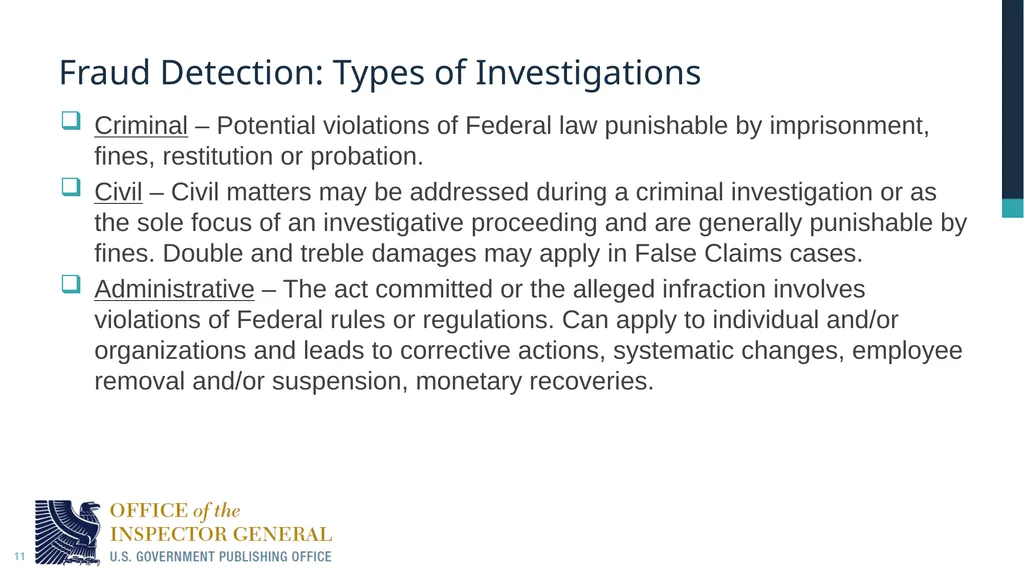
Fraud Detection: Types of Investigations Criminal – Potential violations of Federal law punishable by imprisonment, fines, restitution or probation.
Civil – Civil matters may be addressed during a criminal investigation or as the sole focus of an investigative proceeding and are generally punishable by fines. Double and treble damages may apply in False Claims cases.
Administrative – The act committed or the alleged infraction involves violations of Federal rules or regulations. Can apply to individual and/or organizations and leads to corrective actions, systematic changes, employee removal and/or suspension, monetary recoveries.<br>
12
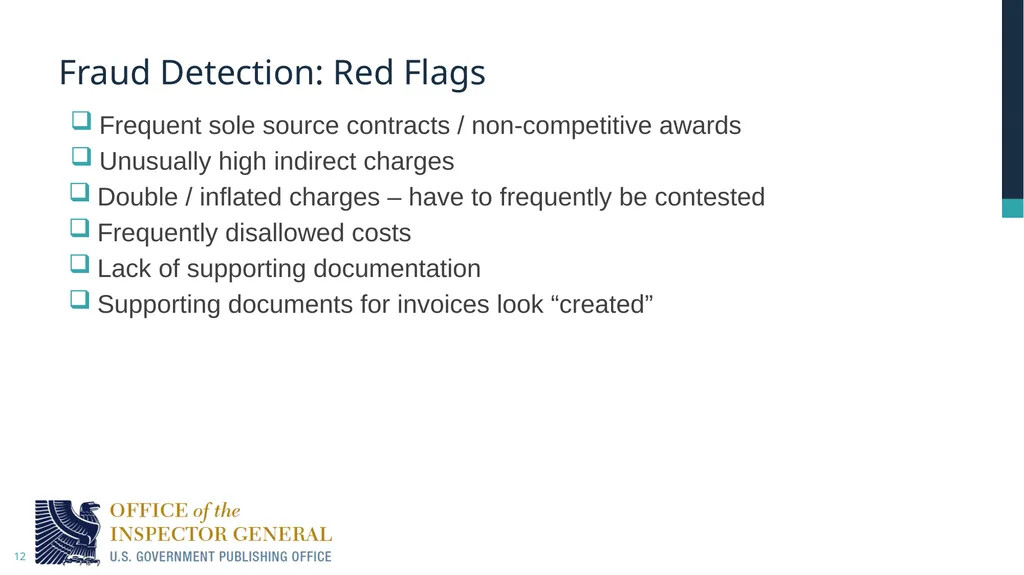
Fraud Detection: Red Flags Frequent sole source contracts / non-competitive awards
Unusually high indirect charges
Double / inflated charges – have to frequently be contested
Frequently disallowed costs
Lack of supporting documentation
Supporting documents for invoices look “created”<br>
13
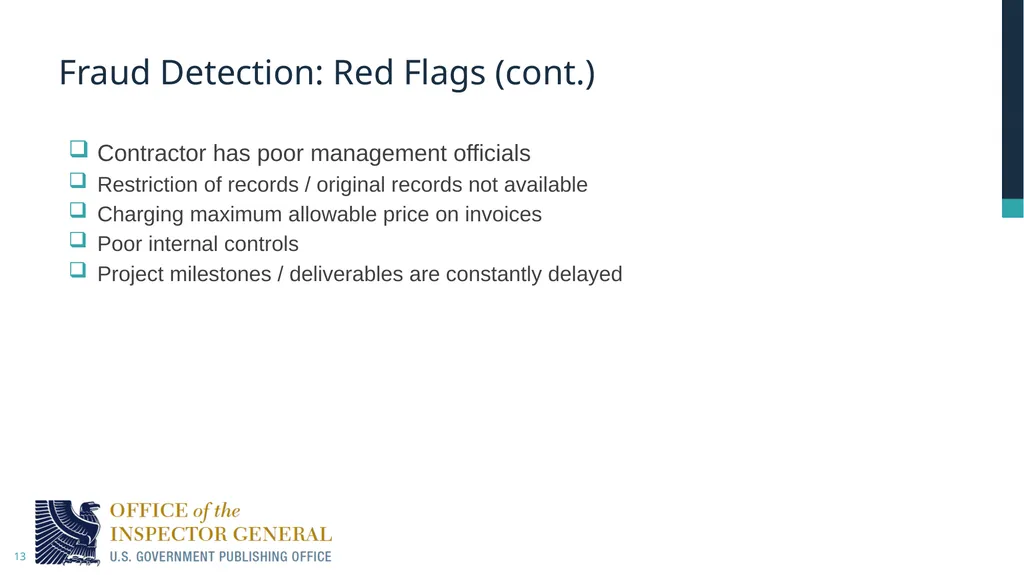
Fraud Detection: Red Flags (cont.) Contractor has poor management officials
Restriction of records / original records not available
Charging maximum allowable price on invoices
Poor internal controls
Project milestones / deliverables are constantly delayed<br>
14
Fraud Prevention<br>
15
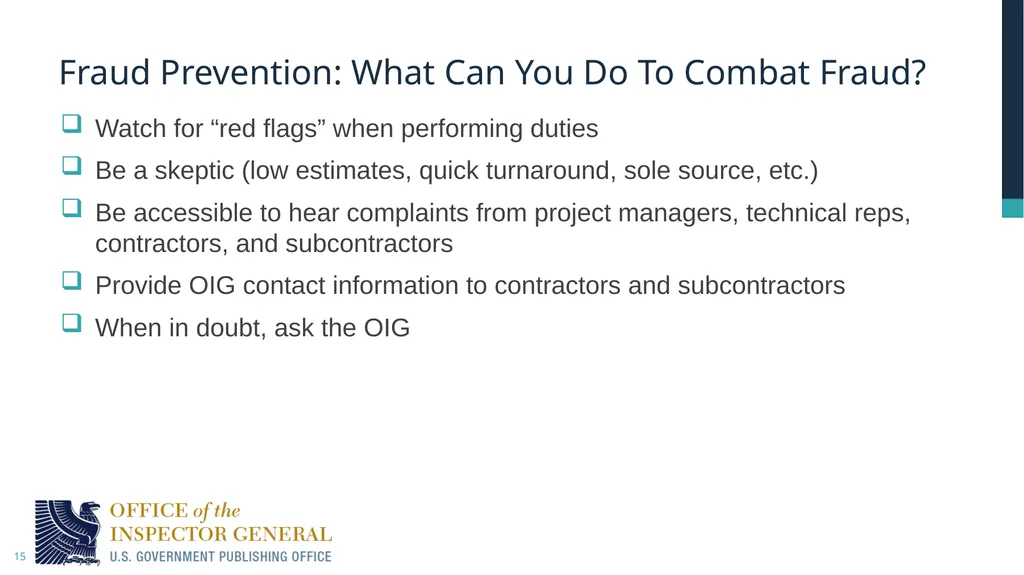
Fraud Prevention: What Can You Do To Combat Fraud? Watch for “red flags” when performing duties
Be a skeptic (low estimates, quick turnaround, sole source, etc.)
Be accessible to hear complaints from project managers, technical reps, contractors, and subcontractors
Provide OIG contact information to contractors and subcontractors
When in doubt, ask the OIG<br>
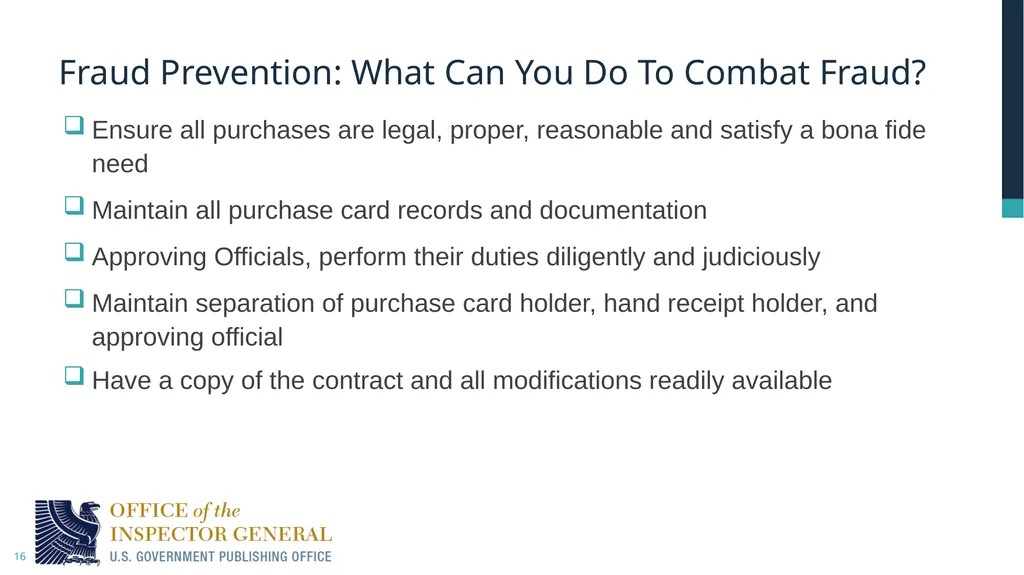
16
Fraud Prevention: What Can You Do To Combat Fraud? Ensure all purchases are legal, proper, reasonable and satisfy a bona fide need
Maintain all purchase card records and documentation
Approving Officials, perform their duties diligently and judiciously
Maintain separation of purchase card holder, hand receipt holder, and approving official
Have a copy of the contract and all modifications readily available<br>
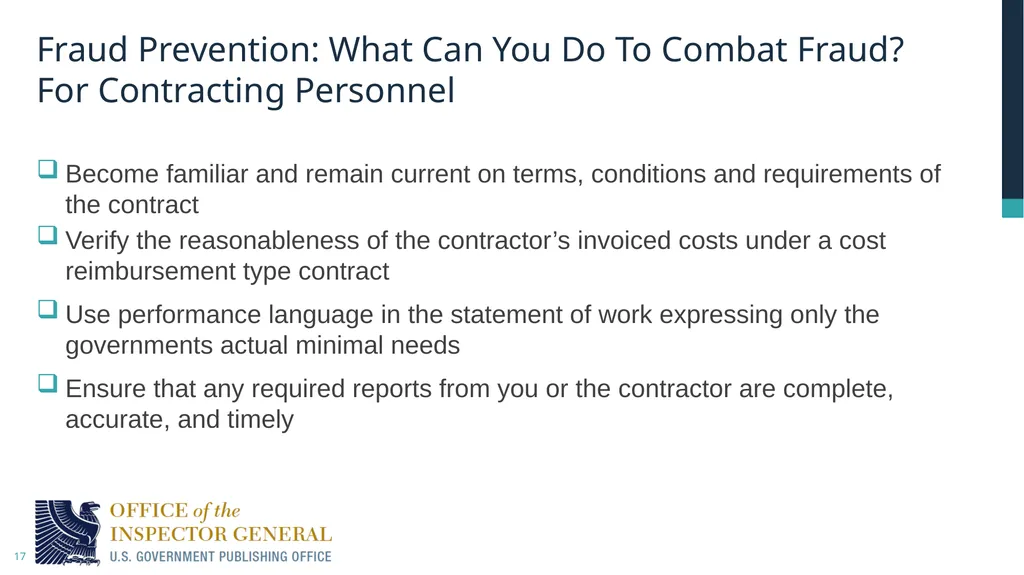
17
Fraud Prevention: What Can You Do To Combat Fraud? For Contracting Personnel Become familiar and remain current on terms, conditions and requirements of the contract
Verify the reasonableness of the contractor’s invoiced costs under a cost reimbursement type contract
Use performance language in the statement of work expressing only the governments actual minimal needs
Ensure that any required reports from you or the contractor are complete, accurate, and timely<br>
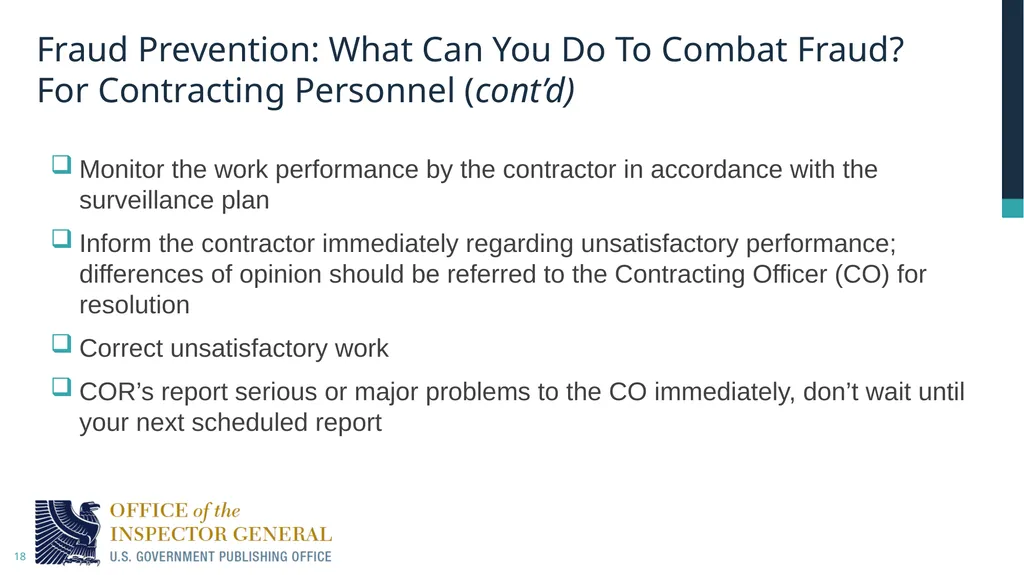
18
Fraud Prevention: What Can You Do To Combat Fraud? For Contracting Personnel (cont’d) Monitor the work performance by the contractor in accordance with the surveillance plan
Inform the contractor immediately regarding unsatisfactory performance; differences of opinion should be referred to the Contracting Officer (CO) for resolution
Correct unsatisfactory work
COR’s report serious or major problems to the CO immediately, don’t wait until your next scheduled report<br>
19
Ways to Report Fraud to the OIG? GPO employees should report to the OIG – matters related to fraud, waste, and abuse in GPO programs and services, to include violations of law, rules, or agency regulations, mismanagement, and gross waste of funds.
This may include issues related to contract fraud and other financial crimes.
To reach the OIG Hotline:
1-800-743-7574
gpoighotline@gpo.gov
All reports to the OIG hotline will be treated as confidential.<br>