
Fraud, Waste & Abuse Overview: General Compliance
KL
Published · 24 slides · 0 views

1 / 1

Description
Fraud, Waste Abuse Overview: General Compliance Training 2023 Healthcare Fraud, Waste and Abuse Fraud, waste and abuse (FWA) continue to take a heavy toll on the healthcare system. In 2021, the Federal Government won or negotiated more
Related Topics
Share
Embed code
Download this presentation From Below
"Fraud, Waste & Abuse Overview: General Compliance" is the property of its rightful owner. Permission is granted to download and print the materials on this website for personal, non-commercial use only, and to display it on your personal computer provided you do not modify the materials and that you retain all copyright notices contained in the materials. By downloading content from our website, you accept the terms of this agreement.
Presentation Transcript
01
Fraud, Waste & Abuse Overview:
General Compliance Training 2023<br>
02
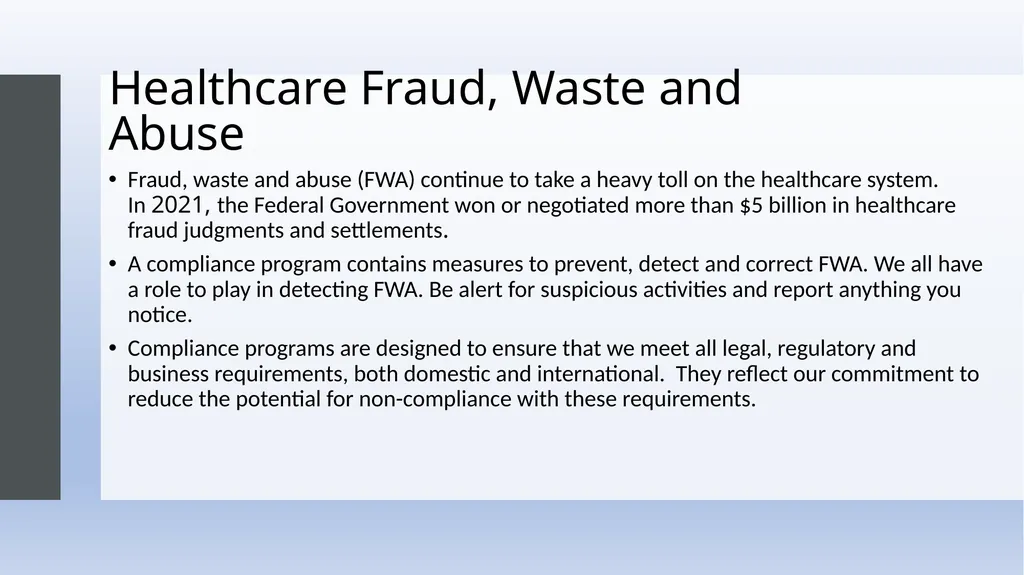
Healthcare Fraud, Waste and Abuse Fraud, waste and abuse (FWA) continue to take a heavy toll on the healthcare system. In 2021, the Federal Government won or negotiated more than $5 billion in healthcare fraud judgments and settlements.
A compliance program contains measures to prevent, detect and correct FWA. We all have a role to play in detecting FWA. Be alert for suspicious activities and report anything you notice.
Compliance programs are designed to ensure that we meet all legal, regulatory and business requirements, both domestic and international. They reflect our commitment to reduce the potential for non-compliance with these requirements.<br>
A compliance program contains measures to prevent, detect and correct FWA. We all have a role to play in detecting FWA. Be alert for suspicious activities and report anything you notice.
Compliance programs are designed to ensure that we meet all legal, regulatory and business requirements, both domestic and international. They reflect our commitment to reduce the potential for non-compliance with these requirements.<br>
03
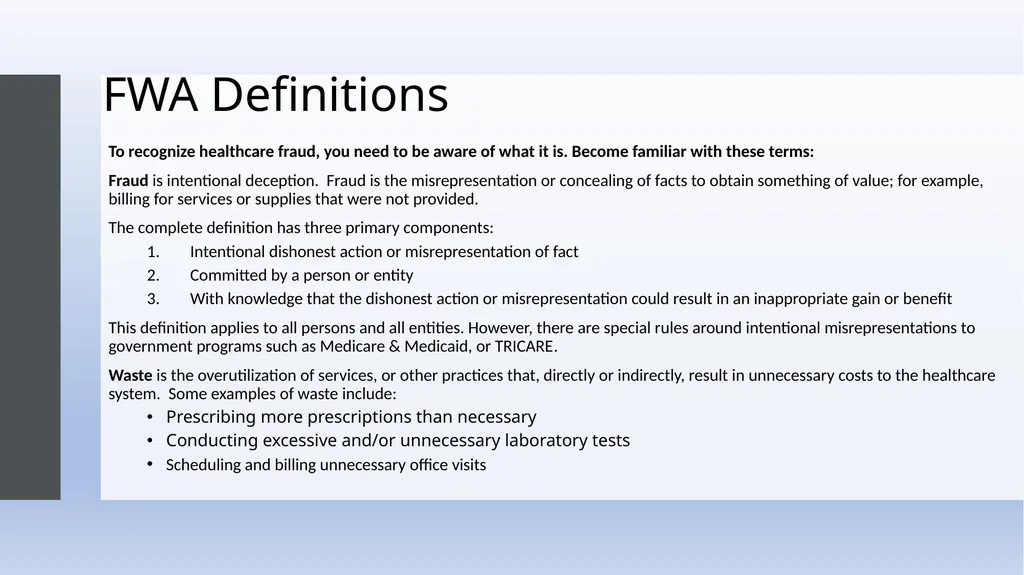
FWA Definitions To recognize healthcare fraud, you need to be aware of what it is. Become familiar with these terms:
Fraud is intentional deception. Fraud is the misrepresentation or concealing of facts to obtain something of value; for example, billing for services or supplies that were not provided.
The complete definition has three primary components:
Intentional dishonest action or misrepresentation of fact
Committed by a person or entity
With knowledge that the dishonest action or misrepresentation could result in an inappropriate gain or benefit
This definition applies to all persons and all entities. However, there are special rules around intentional misrepresentations to government programs such as Medicare & Medicaid, or TRICARE.
Waste is the overutilization of services, or other practices that, directly or indirectly, result in unnecessary costs to the healthcare system. Some examples of waste include:
Prescribing more prescriptions than necessary
Conducting excessive and/or unnecessary laboratory tests
Scheduling and billing unnecessary office visits<br>
Fraud is intentional deception. Fraud is the misrepresentation or concealing of facts to obtain something of value; for example, billing for services or supplies that were not provided.
The complete definition has three primary components:
Intentional dishonest action or misrepresentation of fact
Committed by a person or entity
With knowledge that the dishonest action or misrepresentation could result in an inappropriate gain or benefit
This definition applies to all persons and all entities. However, there are special rules around intentional misrepresentations to government programs such as Medicare & Medicaid, or TRICARE.
Waste is the overutilization of services, or other practices that, directly or indirectly, result in unnecessary costs to the healthcare system. Some examples of waste include:
Prescribing more prescriptions than necessary
Conducting excessive and/or unnecessary laboratory tests
Scheduling and billing unnecessary office visits<br>
04
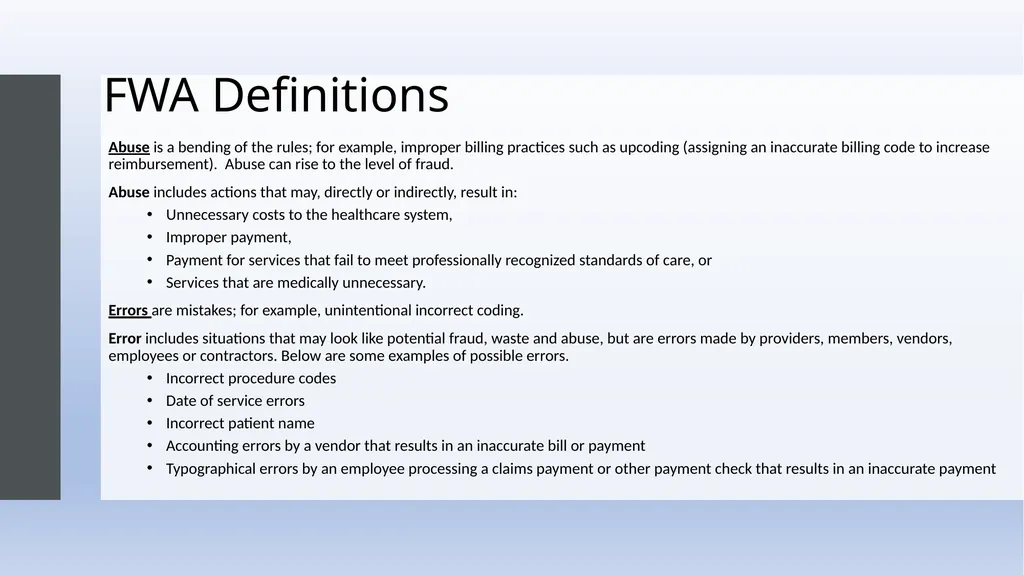
FWA Definitions Abuse is a bending of the rules; for example, improper billing practices such as upcoding (assigning an inaccurate billing code to increase reimbursement). Abuse can rise to the level of fraud.
Abuse includes actions that may, directly or indirectly, result in:
Unnecessary costs to the healthcare system,
Improper payment,
Payment for services that fail to meet professionally recognized standards of care, or
Services that are medically unnecessary.
Errors are mistakes; for example, unintentional incorrect coding.
Error includes situations that may look like potential fraud, waste and abuse, but are errors made by providers, members, vendors, employees or contractors. Below are some examples of possible errors.
Incorrect procedure codes
Date of service errors
Incorrect patient name
Accounting errors by a vendor that results in an inaccurate bill or payment
Typographical errors by an employee processing a claims payment or other payment check that results in an inaccurate payment<br>
Abuse includes actions that may, directly or indirectly, result in:
Unnecessary costs to the healthcare system,
Improper payment,
Payment for services that fail to meet professionally recognized standards of care, or
Services that are medically unnecessary.
Errors are mistakes; for example, unintentional incorrect coding.
Error includes situations that may look like potential fraud, waste and abuse, but are errors made by providers, members, vendors, employees or contractors. Below are some examples of possible errors.
Incorrect procedure codes
Date of service errors
Incorrect patient name
Accounting errors by a vendor that results in an inaccurate bill or payment
Typographical errors by an employee processing a claims payment or other payment check that results in an inaccurate payment<br>
05
U.S. Fraud, Waste and Abuse Laws These are some of the laws in the U.S. that address healthcare fraud, waste and abuse.
HIPAA (Health Insurance Portability and Accountability Act)
Health Care Fraud Statute
Anti-Kickback/Stark Laws
Federal & State False Claims Acts<br>
HIPAA (Health Insurance Portability and Accountability Act)
Health Care Fraud Statute
Anti-Kickback/Stark Laws
Federal & State False Claims Acts<br>
06
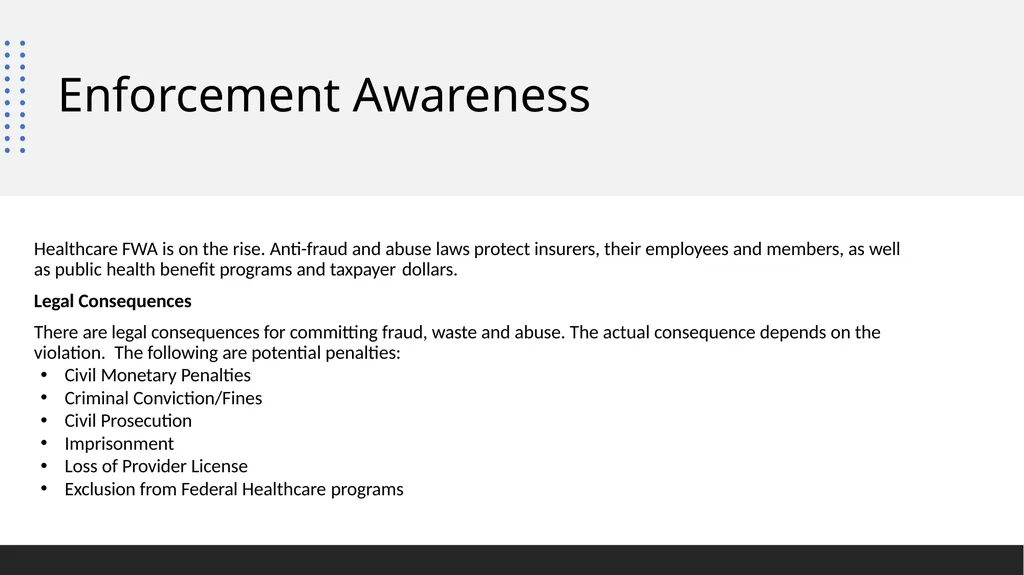
Enforcement Awareness Healthcare FWA is on the rise. Anti-fraud and abuse laws protect insurers, their employees and members, as well as public health benefit programs and taxpayer dollars.
Legal Consequences
There are legal consequences for committing fraud, waste and abuse. The actual consequence depends on the violation. The following are potential penalties:
Civil Monetary Penalties
Criminal Conviction/Fines
Civil Prosecution
Imprisonment
Loss of Provider License
Exclusion from Federal Healthcare programs<br>
Legal Consequences
There are legal consequences for committing fraud, waste and abuse. The actual consequence depends on the violation. The following are potential penalties:
Civil Monetary Penalties
Criminal Conviction/Fines
Civil Prosecution
Imprisonment
Loss of Provider License
Exclusion from Federal Healthcare programs<br>
07
Enforcement Awareness - HIPAA HIPAA
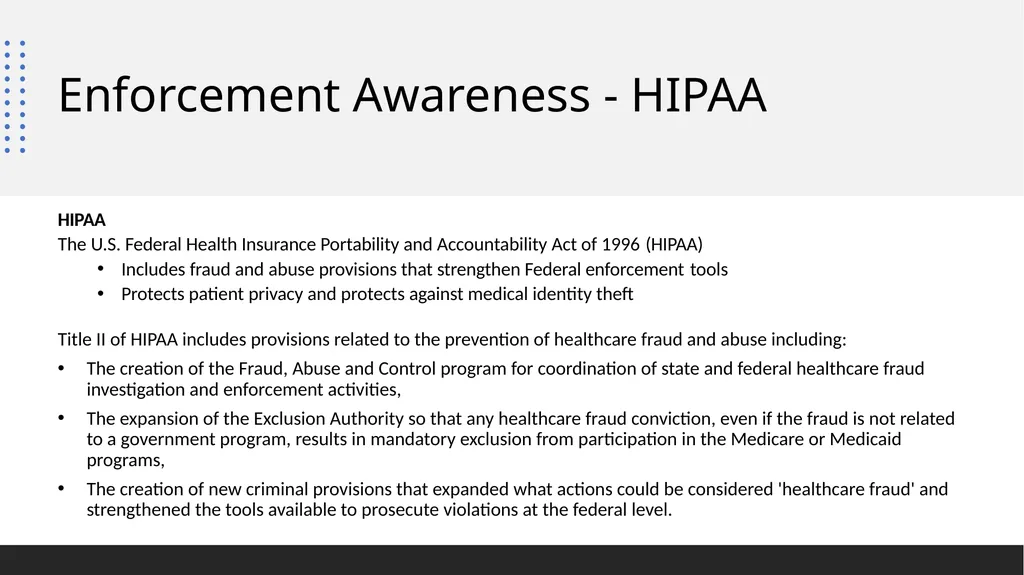
The U.S. Federal Health Insurance Portability and Accountability Act of 1996 (HIPAA)
Includes fraud and abuse provisions that strengthen Federal enforcement tools
Protects patient privacy and protects against medical identity theft
Title II of HIPAA includes provisions related to the prevention of healthcare fraud and abuse including:
The creation of the Fraud, Abuse and Control program for coordination of state and federal healthcare fraud investigation and enforcement activities,
The expansion of the Exclusion Authority so that any healthcare fraud conviction, even if the fraud is not related to a government program, results in mandatory exclusion from participation in the Medicare or Medicaid programs,
The creation of new criminal provisions that expanded what actions could be considered 'healthcare fraud' and strengthened the tools available to prosecute violations at the federal level.<br>
The U.S. Federal Health Insurance Portability and Accountability Act of 1996 (HIPAA)
Includes fraud and abuse provisions that strengthen Federal enforcement tools
Protects patient privacy and protects against medical identity theft
Title II of HIPAA includes provisions related to the prevention of healthcare fraud and abuse including:
The creation of the Fraud, Abuse and Control program for coordination of state and federal healthcare fraud investigation and enforcement activities,
The expansion of the Exclusion Authority so that any healthcare fraud conviction, even if the fraud is not related to a government program, results in mandatory exclusion from participation in the Medicare or Medicaid programs,
The creation of new criminal provisions that expanded what actions could be considered 'healthcare fraud' and strengthened the tools available to prosecute violations at the federal level.<br>
08
Enforcement Awareness - U.S. Federal Health Care Fraud Statute U.S. Federal Health Care Fraud Statute
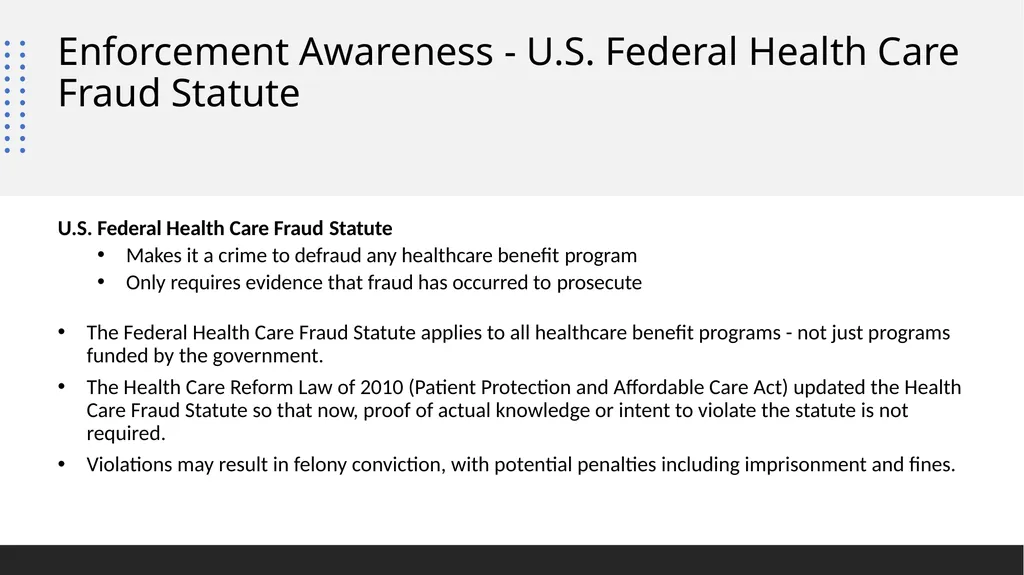
Makes it a crime to defraud any healthcare benefit program
Only requires evidence that fraud has occurred to prosecute
The Federal Health Care Fraud Statute applies to all healthcare benefit programs - not just programs funded by the government.
The Health Care Reform Law of 2010 (Patient Protection and Affordable Care Act) updated the Health Care Fraud Statute so that now, proof of actual knowledge or intent to violate the statute is not required.
Violations may result in felony conviction, with potential penalties including imprisonment and fines.<br>
Makes it a crime to defraud any healthcare benefit program
Only requires evidence that fraud has occurred to prosecute
The Federal Health Care Fraud Statute applies to all healthcare benefit programs - not just programs funded by the government.
The Health Care Reform Law of 2010 (Patient Protection and Affordable Care Act) updated the Health Care Fraud Statute so that now, proof of actual knowledge or intent to violate the statute is not required.
Violations may result in felony conviction, with potential penalties including imprisonment and fines.<br>
09
Enforcement Awareness - Anti-Kickback Statutes U.S. Federal and State Anti-Kickback Statutes
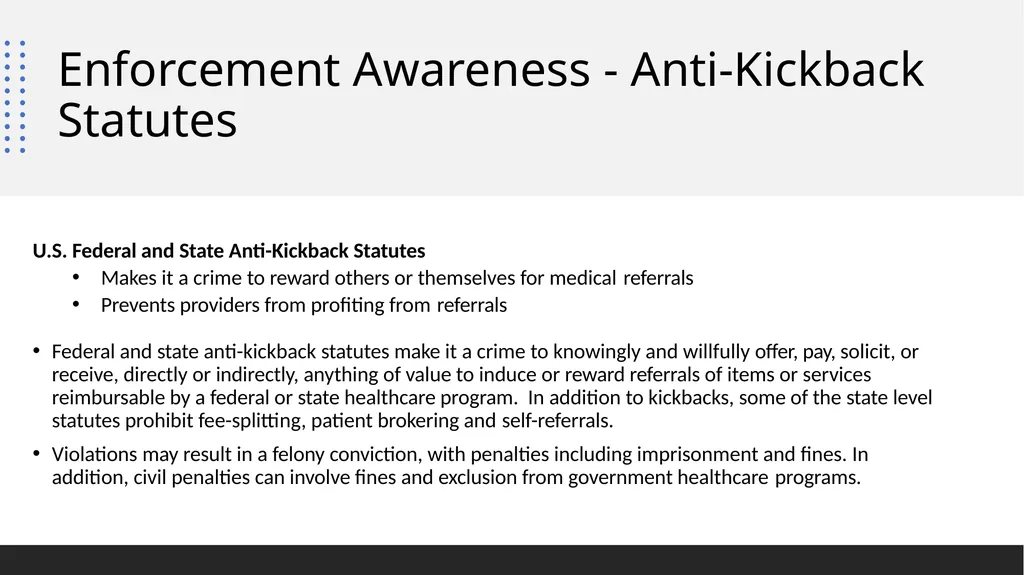
Makes it a crime to reward others or themselves for medical referrals
Prevents providers from profiting from referrals
Federal and state anti-kickback statutes make it a crime to knowingly and willfully offer, pay, solicit, or receive, directly or indirectly, anything of value to induce or reward referrals of items or services reimbursable by a federal or state healthcare program. In addition to kickbacks, some of the state level statutes prohibit fee-splitting, patient brokering and self-referrals.
Violations may result in a felony conviction, with penalties including imprisonment and fines. In addition, civil penalties can involve fines and exclusion from government healthcare programs.<br>
Makes it a crime to reward others or themselves for medical referrals
Prevents providers from profiting from referrals
Federal and state anti-kickback statutes make it a crime to knowingly and willfully offer, pay, solicit, or receive, directly or indirectly, anything of value to induce or reward referrals of items or services reimbursable by a federal or state healthcare program. In addition to kickbacks, some of the state level statutes prohibit fee-splitting, patient brokering and self-referrals.
Violations may result in a felony conviction, with penalties including imprisonment and fines. In addition, civil penalties can involve fines and exclusion from government healthcare programs.<br>
10
Enforcement Awareness - U.S. Stark Law U.S. Stark Law
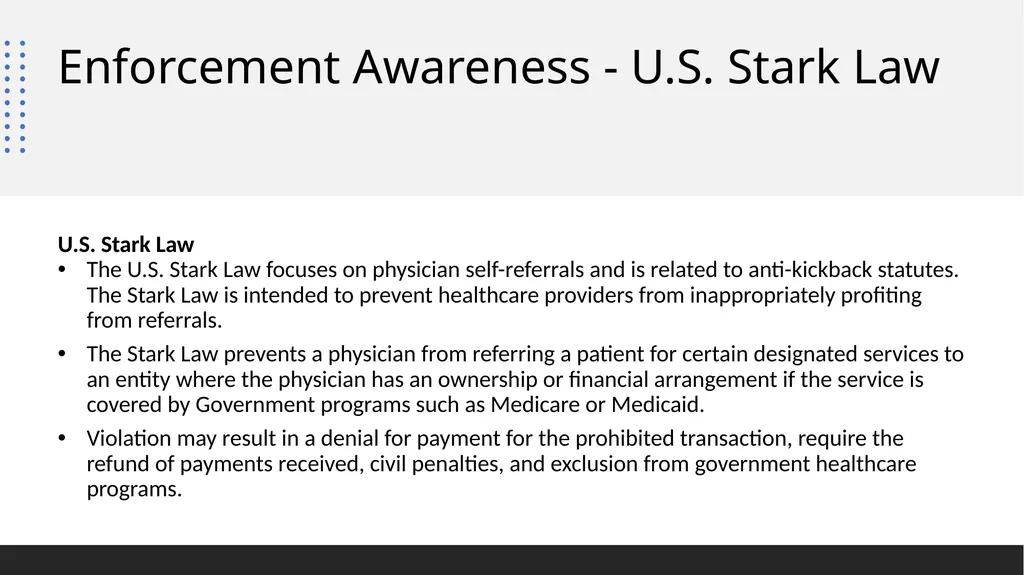
The U.S. Stark Law focuses on physician self-referrals and is related to anti-kickback statutes. The Stark Law is intended to prevent healthcare providers from inappropriately profiting from referrals.
The Stark Law prevents a physician from referring a patient for certain designated services to an entity where the physician has an ownership or financial arrangement if the service is covered by Government programs such as Medicare or Medicaid.
Violation may result in a denial for payment for the prohibited transaction, require the refund of payments received, civil penalties, and exclusion from government healthcare programs.<br>
The U.S. Stark Law focuses on physician self-referrals and is related to anti-kickback statutes. The Stark Law is intended to prevent healthcare providers from inappropriately profiting from referrals.
The Stark Law prevents a physician from referring a patient for certain designated services to an entity where the physician has an ownership or financial arrangement if the service is covered by Government programs such as Medicare or Medicaid.
Violation may result in a denial for payment for the prohibited transaction, require the refund of payments received, civil penalties, and exclusion from government healthcare programs.<br>
11
Enforcement Awareness - U.S. False Claims Act U.S. False Claims Act
Prohibits filing of false or fraudulent records, statements or claims for payment
Provides protection for those who report suspicions of fraud
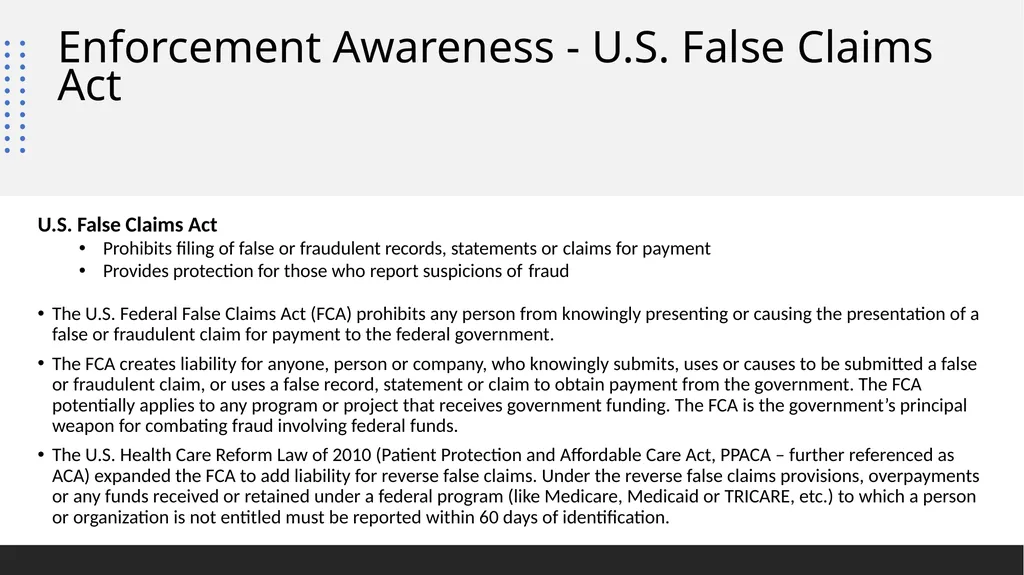
The U.S. Federal False Claims Act (FCA) prohibits any person from knowingly presenting or causing the presentation of a false or fraudulent claim for payment to the federal government.
The FCA creates liability for anyone, person or company, who knowingly submits, uses or causes to be submitted a false or fraudulent claim, or uses a false record, statement or claim to obtain payment from the government. The FCA potentially applies to any program or project that receives government funding. The FCA is the government’s principal weapon for combating fraud involving federal funds.
The U.S. Health Care Reform Law of 2010 (Patient Protection and Affordable Care Act, PPACA – further referenced as ACA) expanded the FCA to add liability for reverse false claims. Under the reverse false claims provisions, overpayments or any funds received or retained under a federal program (like Medicare, Medicaid or TRICARE, etc.) to which a person or organization is not entitled must be reported within 60 days of identification.<br>
Prohibits filing of false or fraudulent records, statements or claims for payment
Provides protection for those who report suspicions of fraud
The U.S. Federal False Claims Act (FCA) prohibits any person from knowingly presenting or causing the presentation of a false or fraudulent claim for payment to the federal government.
The FCA creates liability for anyone, person or company, who knowingly submits, uses or causes to be submitted a false or fraudulent claim, or uses a false record, statement or claim to obtain payment from the government. The FCA potentially applies to any program or project that receives government funding. The FCA is the government’s principal weapon for combating fraud involving federal funds.
The U.S. Health Care Reform Law of 2010 (Patient Protection and Affordable Care Act, PPACA – further referenced as ACA) expanded the FCA to add liability for reverse false claims. Under the reverse false claims provisions, overpayments or any funds received or retained under a federal program (like Medicare, Medicaid or TRICARE, etc.) to which a person or organization is not entitled must be reported within 60 days of identification.<br>
12
Enforcements Awareness - U.S. False Claims Act (cont.) U.S. False Claims Act (cont.)
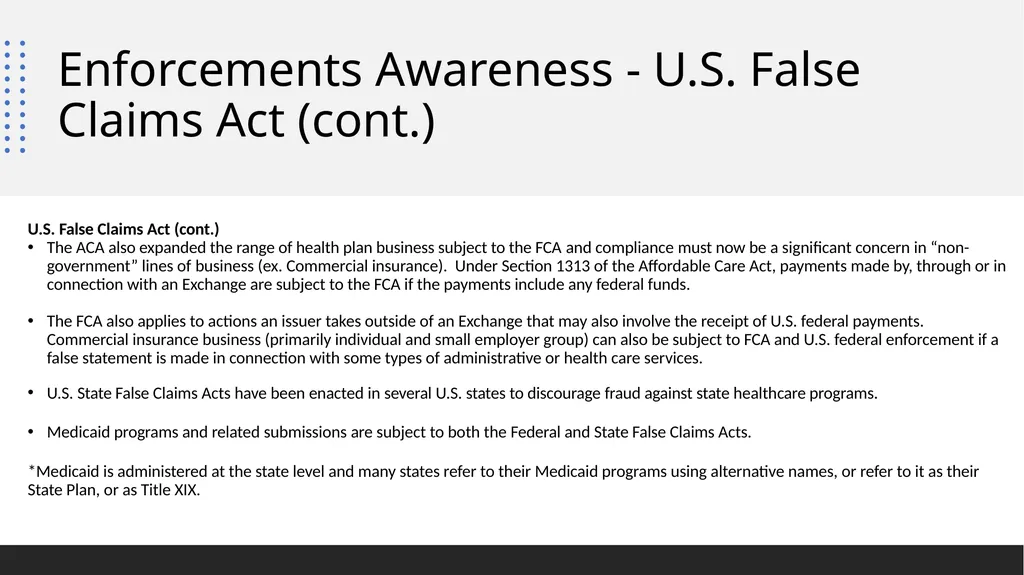
The ACA also expanded the range of health plan business subject to the FCA and compliance must now be a significant concern in “non-government” lines of business (ex. Commercial insurance). Under Section 1313 of the Affordable Care Act, payments made by, through or in connection with an Exchange are subject to the FCA if the payments include any federal funds.
The FCA also applies to actions an issuer takes outside of an Exchange that may also involve the receipt of U.S. federal payments. Commercial insurance business (primarily individual and small employer group) can also be subject to FCA and U.S. federal enforcement if a false statement is made in connection with some types of administrative or health care services.
U.S. State False Claims Acts have been enacted in several U.S. states to discourage fraud against state healthcare programs.
Medicaid programs and related submissions are subject to both the Federal and State False Claims Acts.
*Medicaid is administered at the state level and many states refer to their Medicaid programs using alternative names, or refer to it as their State Plan, or as Title XIX.<br>
The ACA also expanded the range of health plan business subject to the FCA and compliance must now be a significant concern in “non-government” lines of business (ex. Commercial insurance). Under Section 1313 of the Affordable Care Act, payments made by, through or in connection with an Exchange are subject to the FCA if the payments include any federal funds.
The FCA also applies to actions an issuer takes outside of an Exchange that may also involve the receipt of U.S. federal payments. Commercial insurance business (primarily individual and small employer group) can also be subject to FCA and U.S. federal enforcement if a false statement is made in connection with some types of administrative or health care services.
U.S. State False Claims Acts have been enacted in several U.S. states to discourage fraud against state healthcare programs.
Medicaid programs and related submissions are subject to both the Federal and State False Claims Acts.
*Medicaid is administered at the state level and many states refer to their Medicaid programs using alternative names, or refer to it as their State Plan, or as Title XIX.<br>
13
Enforcement Awareness - U.S. State False Claims Acts U.S. State False Claims Acts
Penalties
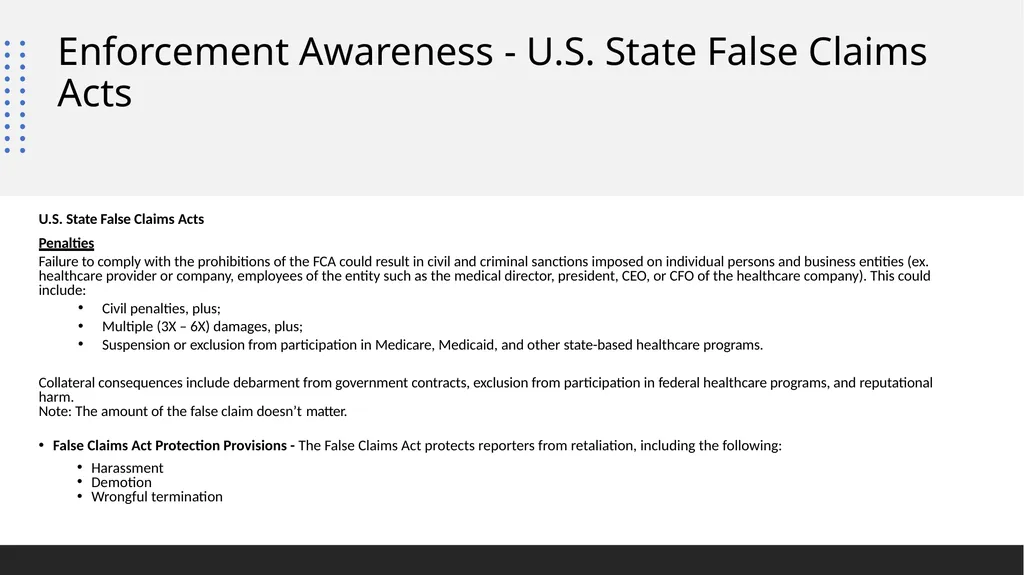
Failure to comply with the prohibitions of the FCA could result in civil and criminal sanctions imposed on individual persons and business entities (ex. healthcare provider or company, employees of the entity such as the medical director, president, CEO, or CFO of the healthcare company). This could include:
Civil penalties, plus;
Multiple (3X – 6X) damages, plus;
Suspension or exclusion from participation in Medicare, Medicaid, and other state-based healthcare programs.
Collateral consequences include debarment from government contracts, exclusion from participation in federal healthcare programs, and reputational harm.
Note: The amount of the false claim doesn’t matter.
False Claims Act Protection Provisions - The False Claims Act protects reporters from retaliation, including the following:
Harassment
Demotion
Wrongful termination<br>
Penalties
Failure to comply with the prohibitions of the FCA could result in civil and criminal sanctions imposed on individual persons and business entities (ex. healthcare provider or company, employees of the entity such as the medical director, president, CEO, or CFO of the healthcare company). This could include:
Civil penalties, plus;
Multiple (3X – 6X) damages, plus;
Suspension or exclusion from participation in Medicare, Medicaid, and other state-based healthcare programs.
Collateral consequences include debarment from government contracts, exclusion from participation in federal healthcare programs, and reputational harm.
Note: The amount of the false claim doesn’t matter.
False Claims Act Protection Provisions - The False Claims Act protects reporters from retaliation, including the following:
Harassment
Demotion
Wrongful termination<br>
14
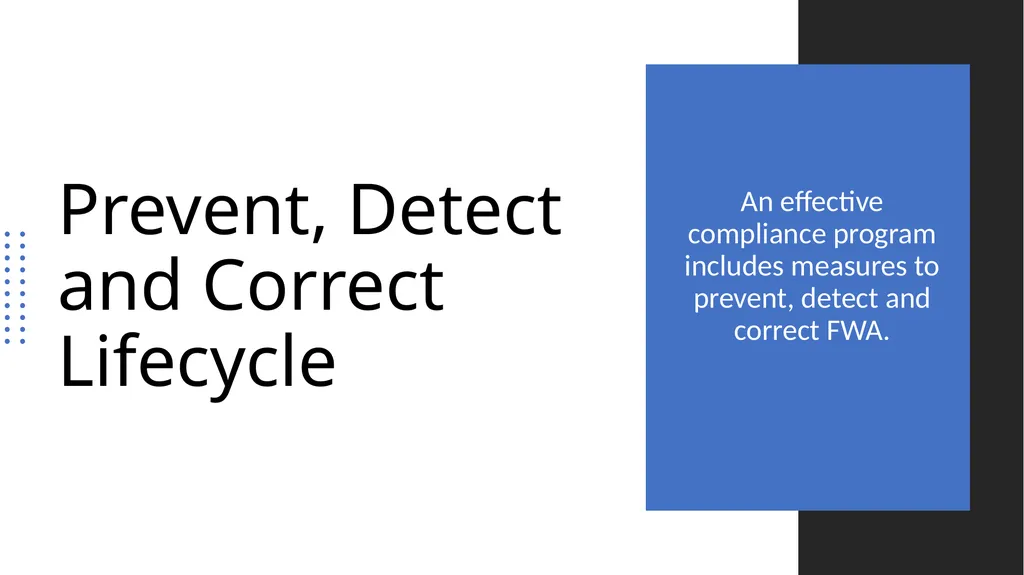
Prevent, Detect and Correct Lifecycle An effective compliance program includes measures to prevent, detect and correct FWA.<br>
15
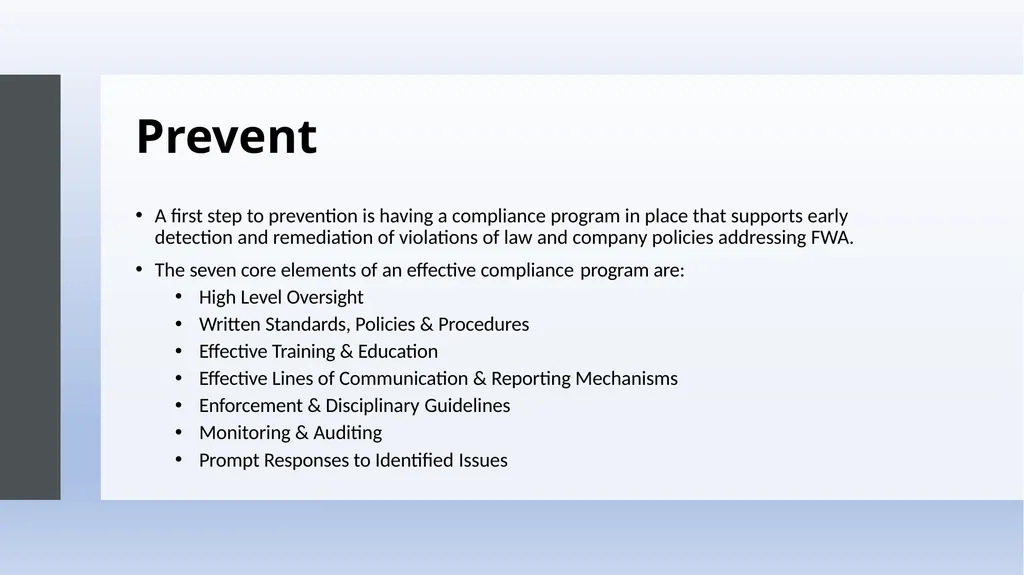
Prevent A first step to prevention is having a compliance program in place that supports early detection and remediation of violations of law and company policies addressing FWA.
The seven core elements of an effective compliance program are:
High Level Oversight
Written Standards, Policies & Procedures
Effective Training & Education
Effective Lines of Communication & Reporting Mechanisms
Enforcement & Disciplinary Guidelines
Monitoring & Auditing
Prompt Responses to Identified Issues<br>
The seven core elements of an effective compliance program are:
High Level Oversight
Written Standards, Policies & Procedures
Effective Training & Education
Effective Lines of Communication & Reporting Mechanisms
Enforcement & Disciplinary Guidelines
Monitoring & Auditing
Prompt Responses to Identified Issues<br>
16
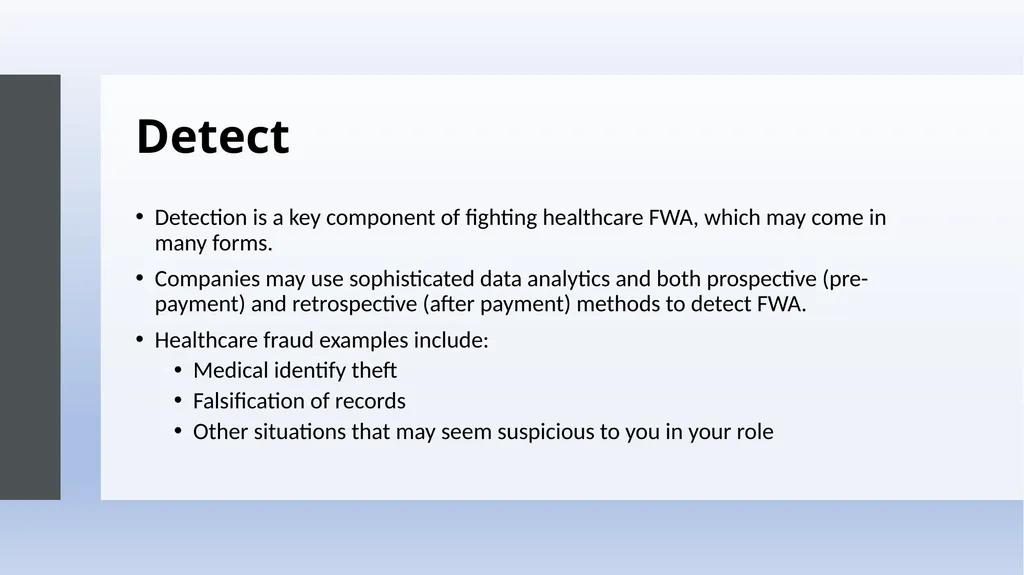
Detect Detection is a key component of fighting healthcare FWA, which may come in many forms.
Companies may use sophisticated data analytics and both prospective (pre-payment) and retrospective (after payment) methods to detect FWA.
Healthcare fraud examples include:
Medical identify theft
Falsification of records
Other situations that may seem suspicious to you in your role<br>
Companies may use sophisticated data analytics and both prospective (pre-payment) and retrospective (after payment) methods to detect FWA.
Healthcare fraud examples include:
Medical identify theft
Falsification of records
Other situations that may seem suspicious to you in your role<br>
17
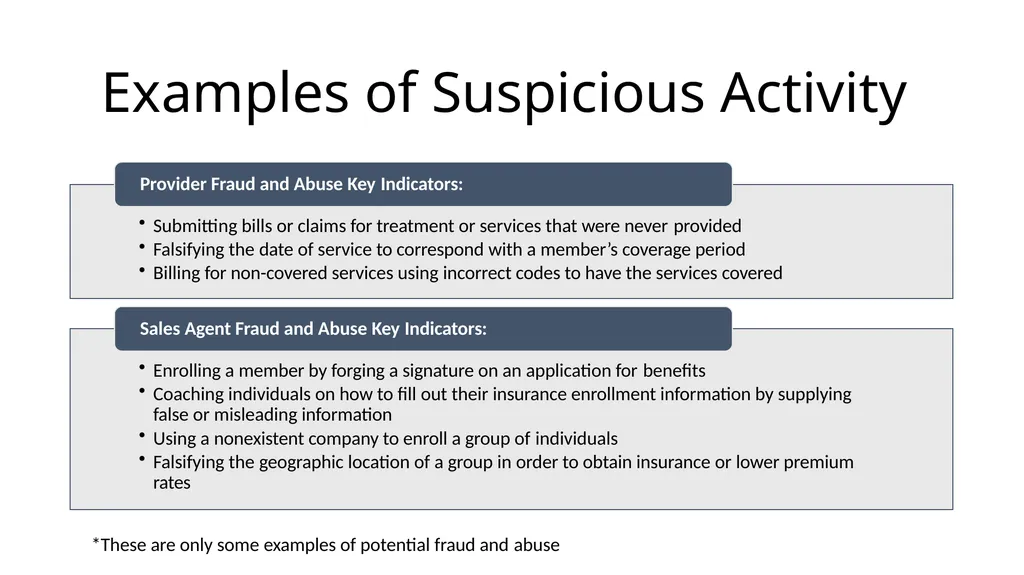
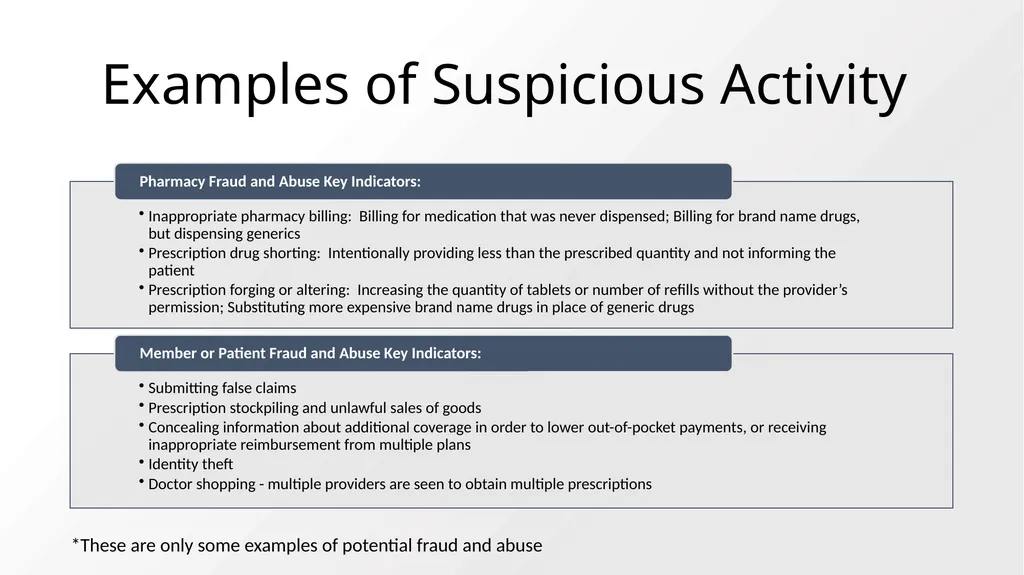
Examples of Suspicious Activity *These are only some examples of potential fraud and abuse<br>
18
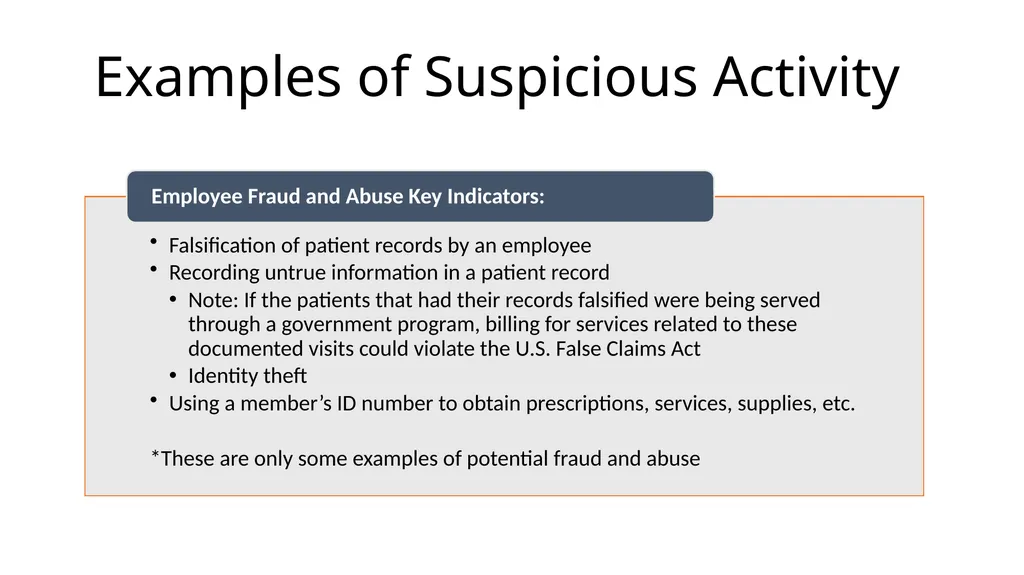
Examples of Suspicious Activity *These are only some examples of potential fraud and abuse<br>
19
Examples of Suspicious Activity<br>
20
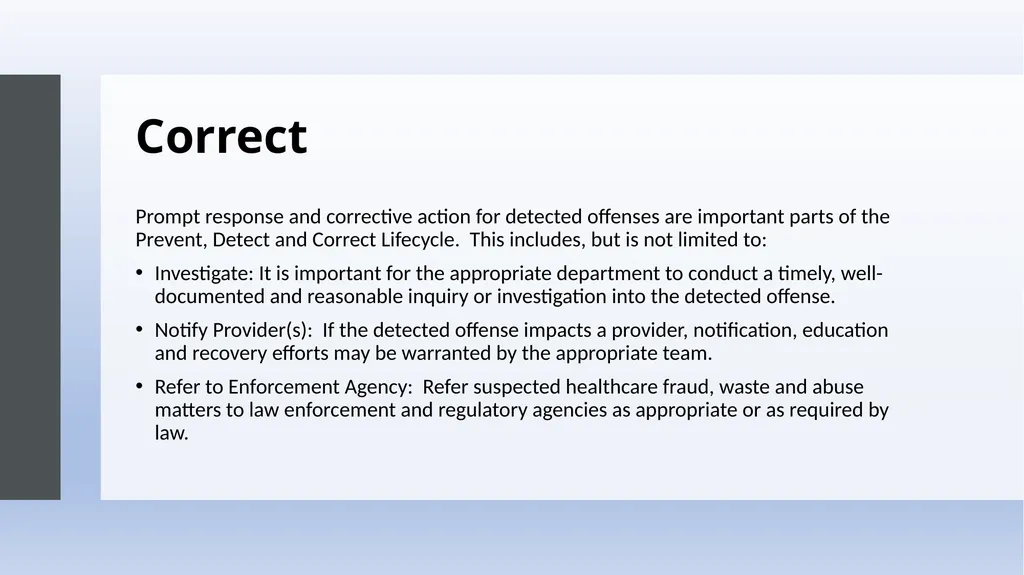
Correct Prompt response and corrective action for detected offenses are important parts of the Prevent, Detect and Correct Lifecycle. This includes, but is not limited to:
Investigate: It is important for the appropriate department to conduct a timely, well-documented and reasonable inquiry or investigation into the detected offense.
Notify Provider(s): If the detected offense impacts a provider, notification, education and recovery efforts may be warranted by the appropriate team.
Refer to Enforcement Agency: Refer suspected healthcare fraud, waste and abuse matters to law enforcement and regulatory agencies as appropriate or as required by law.<br>
Investigate: It is important for the appropriate department to conduct a timely, well-documented and reasonable inquiry or investigation into the detected offense.
Notify Provider(s): If the detected offense impacts a provider, notification, education and recovery efforts may be warranted by the appropriate team.
Refer to Enforcement Agency: Refer suspected healthcare fraud, waste and abuse matters to law enforcement and regulatory agencies as appropriate or as required by law.<br>
21
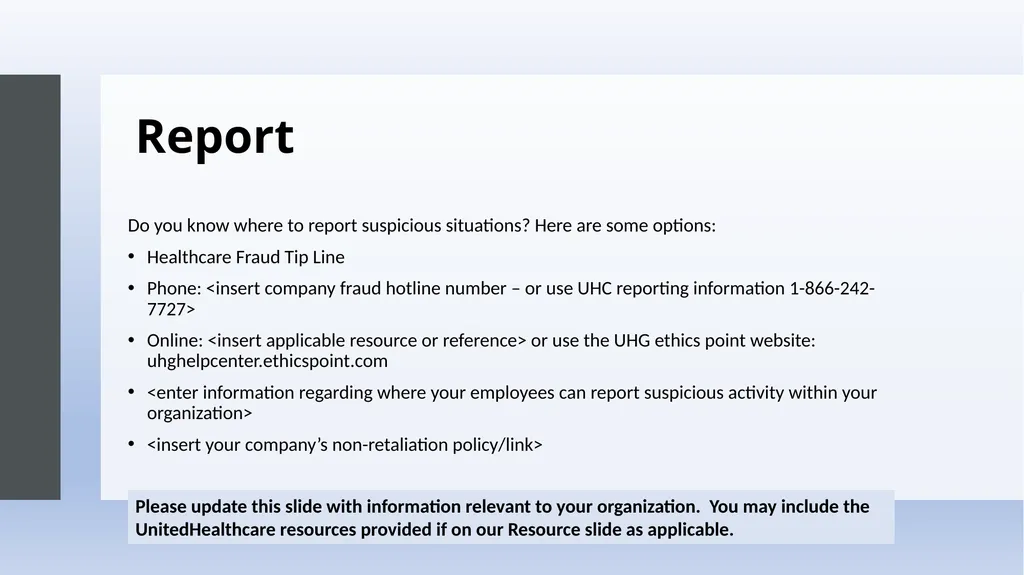
Report Do you know where to report suspicious situations? Here are some options:
Healthcare Fraud Tip Line
Phone: <insert company fraud hotline number – or use UHC reporting information 1-866-242-7727>
Online: <insert applicable resource or reference> or use the UHG ethics point website: uhghelpcenter.ethicspoint.com
<enter information regarding where your employees can report suspicious activity within your organization>
<insert your company’s non-retaliation policy/link> Please update this slide with information relevant to your organization. You may include the UnitedHealthcare resources provided if on our Resource slide as applicable.<br>
Healthcare Fraud Tip Line
Phone: <insert company fraud hotline number – or use UHC reporting information 1-866-242-7727>
Online: <insert applicable resource or reference> or use the UHG ethics point website: uhghelpcenter.ethicspoint.com
<enter information regarding where your employees can report suspicious activity within your organization>
<insert your company’s non-retaliation policy/link> Please update this slide with information relevant to your organization. You may include the UnitedHealthcare resources provided if on our Resource slide as applicable.<br>
22
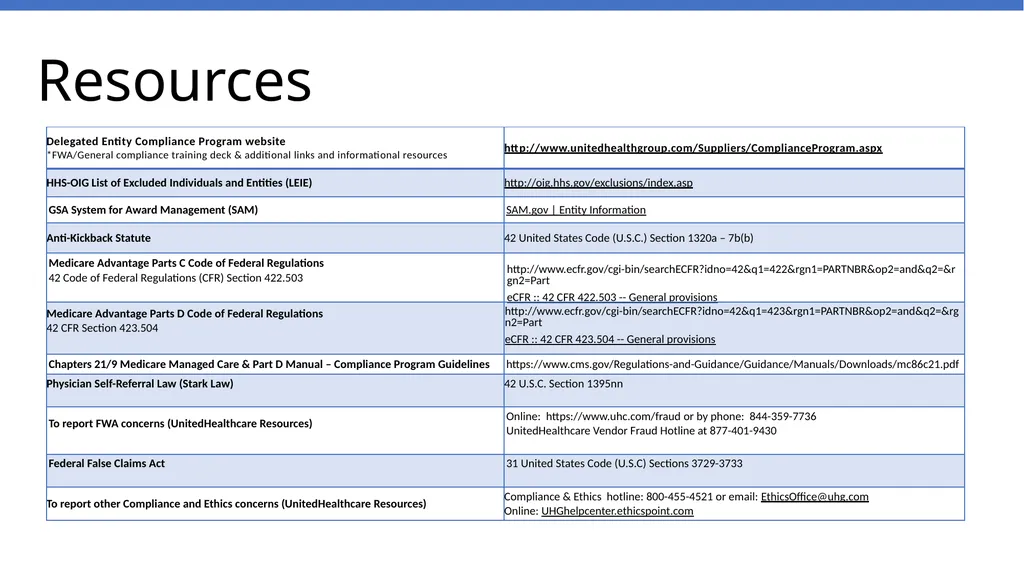
Resources<br>
23
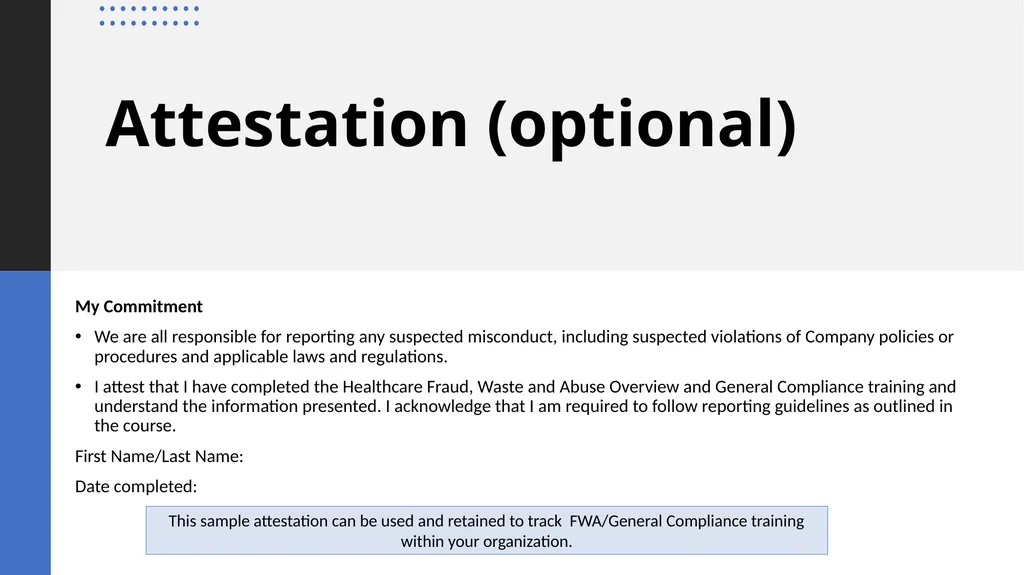
Attestation (optional) My Commitment
We are all responsible for reporting any suspected misconduct, including suspected violations of Company policies or procedures and applicable laws and regulations.
I attest that I have completed the Healthcare Fraud, Waste and Abuse Overview and General Compliance training and understand the information presented. I acknowledge that I am required to follow reporting guidelines as outlined in the course.
First Name/Last Name:
Date completed: This sample attestation can be used and retained to track FWA/General Compliance training within your organization.<br>
We are all responsible for reporting any suspected misconduct, including suspected violations of Company policies or procedures and applicable laws and regulations.
I attest that I have completed the Healthcare Fraud, Waste and Abuse Overview and General Compliance training and understand the information presented. I acknowledge that I am required to follow reporting guidelines as outlined in the course.
First Name/Last Name:
Date completed: This sample attestation can be used and retained to track FWA/General Compliance training within your organization.<br>
24
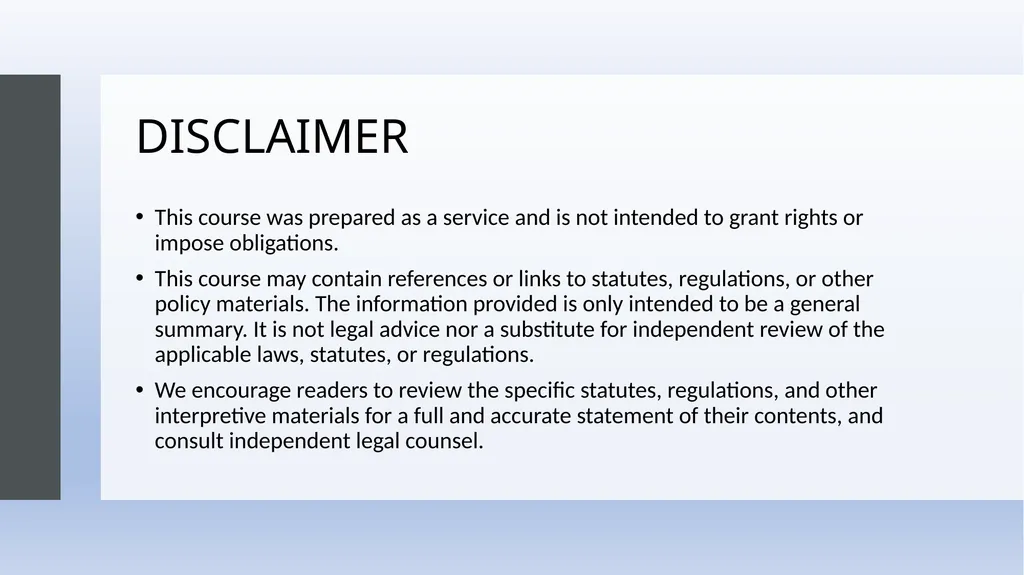
DISCLAIMER This course was prepared as a service and is not intended to grant rights or impose obligations.
This course may contain references or links to statutes, regulations, or other policy materials. The information provided is only intended to be a general summary. It is not legal advice nor a substitute for independent review of the applicable laws, statutes, or regulations.
We encourage readers to review the specific statutes, regulations, and other interpretive materials for a full and accurate statement of their contents, and consult independent legal counsel.<br>
This course may contain references or links to statutes, regulations, or other policy materials. The information provided is only intended to be a general summary. It is not legal advice nor a substitute for independent review of the applicable laws, statutes, or regulations.
We encourage readers to review the specific statutes, regulations, and other interpretive materials for a full and accurate statement of their contents, and consult independent legal counsel.<br>