Frog Care Sheet Sourced from the Code of Practice Vic Frogs are - Amphibian An amphibian is an exothermic (cold-blooded) vertebrate animal typically living on land but breeding in water, such as frogs and axolotls. Sell Under the
"Frog Care Sheet Sourced from the Code of Practice" is the property of its rightful owner. Permission is granted to
download and print the materials on this website for personal, non-commercial use only, and to display it
on your personal computer provided you do not modify the materials and that you retain all copyright
notices contained in the materials. By downloading content from our website, you accept the terms of this
agreement.
Presentation Transcript
01
Frog Care Sheet Sourced from the Code of Practice Vic<br>
02
Frogs are - Amphibian' — An amphibian is an exothermic (cold-blooded) vertebrate animal typically living on land but breeding in water, such as frogs and axolotls. 'Sell' — Under the Wildlife Act 1975, 'sell' includes 'barter or exchange and also agreeing to sell or offering or exposing for sale or keeping or having in possession for sale or sending, forwarding, delivering or receiving for or on sale or authorising, directing, causing suffering, permitting or attempting any of such acts or things'. For the purpose of this code 'sell' also includes: (a) supply for value (or offer or expose for supply for value) (b) supply for free (or offer or expose for supply for free) to gain or maintain custom, or otherwise for commercial gain 3. Licences All frogs, tadpoles and frog spawn are protected in Victoria. The collection of frogs from the wild or the release of frogs to the wild is prohibited. The release of frogs to your backyard or the raising of tadpoles for the purpose of release is illegal. It is necessary to obtain a licence from the Department of Environment, Land, Water and Planning (Phone 136 186 Customer Service Centre) to keep most species of frogs in captivity. All species of native amphibians are protected in Victoria under the Wildlife Act 1975. However, a wildlife licence is not required to keep the following amphibians for private purposes, provided they have come from a lawful source. What are Frogs? Do I need a Licence? Can I get one from the Wild? Lets answer some of your questions. 2 1/24/2021 Add a footer<br>
03
Frog Species - on Licence and off Licence No - Licence Licence - Required 3 1/24/2021 Add a footer<br>
04
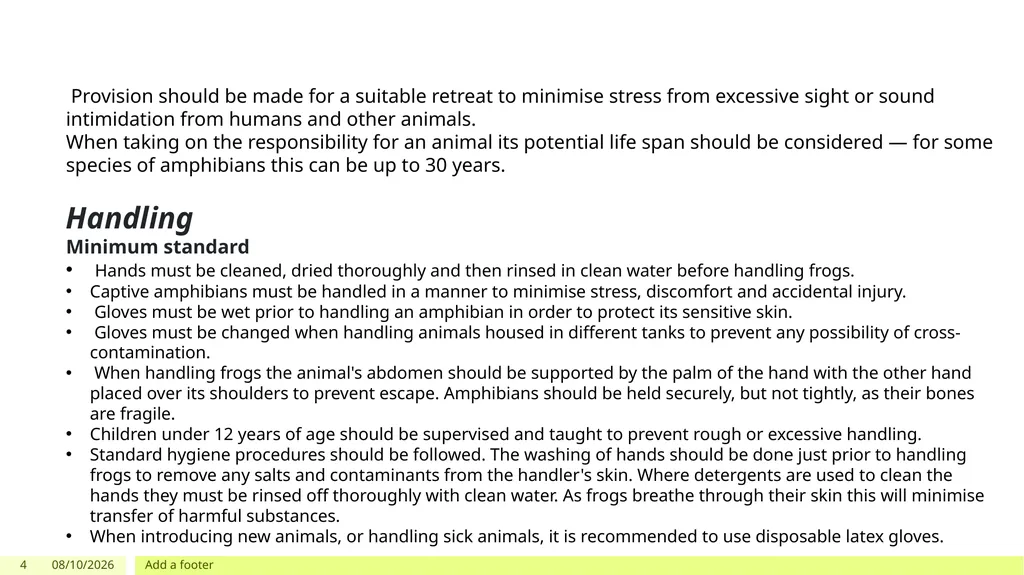
4 1/24/2021 Add a footer Provision should be made for a suitable retreat to minimise stress from excessive sight or sound intimidation from humans and other animals.
When taking on the responsibility for an animal its potential life span should be considered — for some species of amphibians this can be up to 30 years.
Handling
Minimum standard
Hands must be cleaned, dried thoroughly and then rinsed in clean water before handling frogs.
Captive amphibians must be handled in a manner to minimise stress, discomfort and accidental injury.
Gloves must be wet prior to handling an amphibian in order to protect its sensitive skin.
Gloves must be changed when handling animals housed in different tanks to prevent any possibility of cross-contamination.
When handling frogs the animal's abdomen should be supported by the palm of the hand with the other hand placed over its shoulders to prevent escape. Amphibians should be held securely, but not tightly, as their bones are fragile.
Children under 12 years of age should be supervised and taught to prevent rough or excessive handling.
Standard hygiene procedures should be followed. The washing of hands should be done just prior to handling frogs to remove any salts and contaminants from the handler's skin. Where detergents are used to clean the hands they must be rinsed off thoroughly with clean water. As frogs breathe through their skin this will minimise transfer of harmful substances.
When introducing new animals, or handling sick animals, it is recommended to use disposable latex gloves.<br>
05
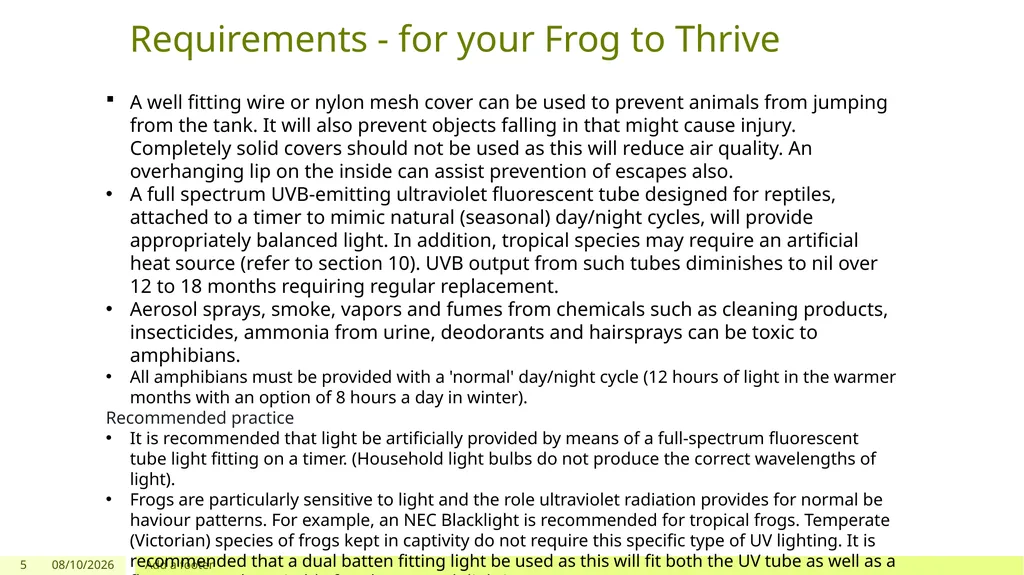
Requirements - for your Frog to Thrive 5 1/24/2021 Add a footer A well fitting wire or nylon mesh cover can be used to prevent animals from jumping from the tank. It will also prevent objects falling in that might cause injury. Completely solid covers should not be used as this will reduce air quality. An overhanging lip on the inside can assist prevention of escapes also.
A full spectrum UVB-emitting ultraviolet fluorescent tube designed for reptiles, attached to a timer to mimic natural (seasonal) day/night cycles, will provide appropriately balanced light. In addition, tropical species may require an artificial heat source (refer to section 10). UVB output from such tubes diminishes to nil over 12 to 18 months requiring regular replacement.
Aerosol sprays, smoke, vapors and fumes from chemicals such as cleaning products, insecticides, ammonia from urine, deodorants and hairsprays can be toxic to amphibians.
All amphibians must be provided with a 'normal' day/night cycle (12 hours of light in the warmer months with an option of 8 hours a day in winter).
Recommended practice
It is recommended that light be artificially provided by means of a full-spectrum fluorescent tube light fitting on a timer. (Household light bulbs do not produce the correct wavelengths of light).
Frogs are particularly sensitive to light and the role ultraviolet radiation provides for normal be haviour patterns. For example, an NEC Blacklight is recommended for tropical frogs. Temperate (Victorian) species of frogs kept in captivity do not require this specific type of UV lighting. It is recommended that a dual batten fitting light be used as this will fit both the UV tube as well as a fluorescent tube suitable for plant growth lighting.<br>
06
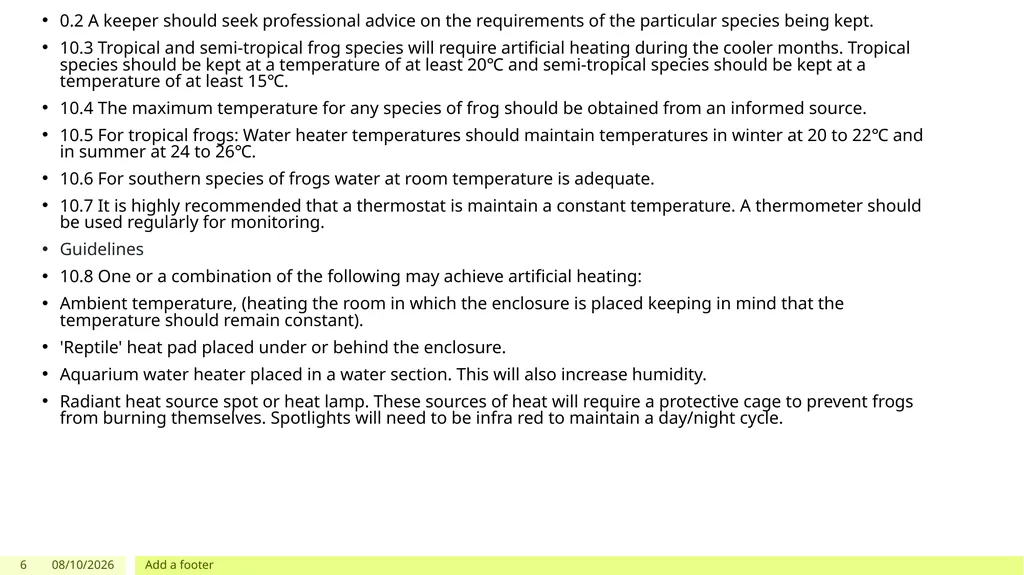
0.2 A keeper should seek professional advice on the requirements of the particular species being kept.
10.3 Tropical and semi-tropical frog species will require artificial heating during the cooler months. Tropical species should be kept at a temperature of at least 20℃ and semi-tropical species should be kept at a temperature of at least 15℃.
10.4 The maximum temperature for any species of frog should be obtained from an informed source.
10.5 For tropical frogs: Water heater temperatures should maintain temperatures in winter at 20 to 22℃ and in summer at 24 to 26℃.
10.6 For southern species of frogs water at room temperature is adequate.
10.7 It is highly recommended that a thermostat is maintain a constant temperature. A thermometer should be used regularly for monitoring.
Guidelines
10.8 One or a combination of the following may achieve artificial heating:
Ambient temperature, (heating the room in which the enclosure is placed keeping in mind that the temperature should remain constant).
'Reptile' heat pad placed under or behind the enclosure.
Aquarium water heater placed in a water section. This will also increase humidity.
Radiant heat source spot or heat lamp. These sources of heat will require a protective cage to prevent frogs from burning themselves. Spotlights will need to be infra red to maintain a day/night cycle. 6 1/24/2021 Add a footer<br>