
From defensive to offensive data-driven
NS
Published · 70 slides · 0 views
1 / 1














Description
From defensive to offensive data-driven engineering data strategy, examples of defensive and offensive data management activities, method for identify AI solutions, and AI in healthcare Erik Perjons Department of Computer and Systems
Related Topics
Share
Embed code
Download this presentation From Below
"From defensive to offensive data-driven" is the property of its rightful owner. Permission is granted to download and print the materials on this website for personal, non-commercial use only, and to display it on your personal computer provided you do not modify the materials and that you retain all copyright notices contained in the materials. By downloading content from our website, you accept the terms of this agreement.
Presentation Transcript
01
From defensive to offensive data-driven engineering
– data strategy, examples of defensive and offensive data management activities, method for identify AI solutions, and AI in healthcare Erik Perjons
Department of Computer and Systems Sciences
Stockholm University<br>
Department of Computer and Systems Sciences
Stockholm University<br>
02
Questions What is a data strategy?
What should a data strategy include?
Why do organisations need a data strategy?<br>
What should a data strategy include?
Why do organisations need a data strategy?<br>
03
Data strategy<br>
04
What is a data strategy? A data strategy - is a plan to organize, manage and govern the data assets in an organization (DalleMule, L., & Davenport, T. H. (2017). What’s your data strategy. Harvard Business Review, 95(3), 112-121.)<br>
05
What is the core of the data strategy? The data strategy needs to:
1) clarify the goal of the data strategy for organizations
2) given the goal, provide data management activities (DalleMule, L., & Davenport, T. H. (2017). What’s your data strategy. Harvard Business Review, 95(3), 112-121.)<br>
1) clarify the goal of the data strategy for organizations
2) given the goal, provide data management activities (DalleMule, L., & Davenport, T. H. (2017). What’s your data strategy. Harvard Business Review, 95(3), 112-121.)<br>
06
What is the core of the data strategy? DalleMule & Davenport (2017) claim that an organization’s data strategy should have a proper balance between offensive and defensive activities (DalleMule, L., & Davenport, T. H. (2017). What’s your data strategy. Harvard Business Review, 95(3), 112-121.)<br>
07
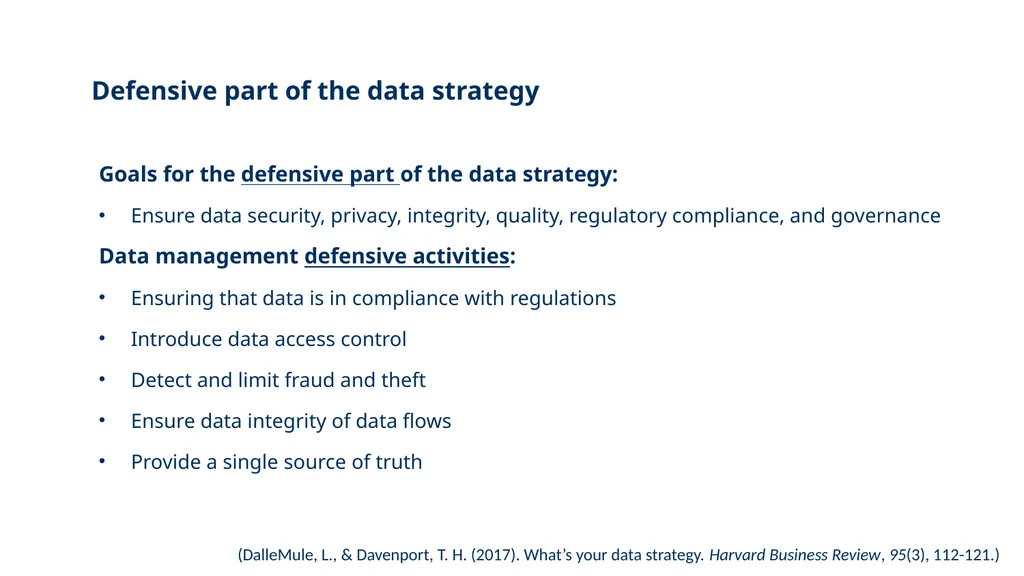
Defensive part of the data strategy Goals for the defensive part of the data strategy:
Ensure data security, privacy, integrity, quality, regulatory compliance, and governance
Data management defensive activities:
Ensuring that data is in compliance with regulations
Introduce data access control
Detect and limit fraud and theft
Ensure data integrity of data flows
Provide a single source of truth (DalleMule, L., & Davenport, T. H. (2017). What’s your data strategy. Harvard Business Review, 95(3), 112-121.)<br>
Ensure data security, privacy, integrity, quality, regulatory compliance, and governance
Data management defensive activities:
Ensuring that data is in compliance with regulations
Introduce data access control
Detect and limit fraud and theft
Ensure data integrity of data flows
Provide a single source of truth (DalleMule, L., & Davenport, T. H. (2017). What’s your data strategy. Harvard Business Review, 95(3), 112-121.)<br>
08
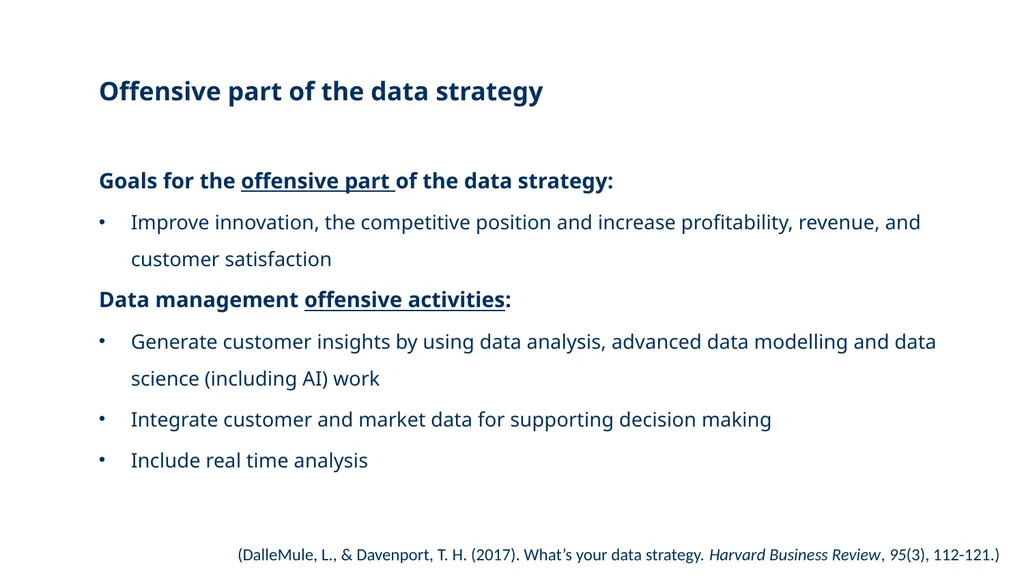
Offensive part of the data strategy Goals for the offensive part of the data strategy:
Improve innovation, the competitive position and increase profitability, revenue, and customer satisfaction
Data management offensive activities:
Generate customer insights by using data analysis, advanced data modelling and data science (including AI) work
Integrate customer and market data for supporting decision making
Include real time analysis (DalleMule, L., & Davenport, T. H. (2017). What’s your data strategy. Harvard Business Review, 95(3), 112-121.)<br>
Improve innovation, the competitive position and increase profitability, revenue, and customer satisfaction
Data management offensive activities:
Generate customer insights by using data analysis, advanced data modelling and data science (including AI) work
Integrate customer and market data for supporting decision making
Include real time analysis (DalleMule, L., & Davenport, T. H. (2017). What’s your data strategy. Harvard Business Review, 95(3), 112-121.)<br>
09
The proper balance depends on a number of factors Market competition and dynamic
Regulatory environment External factors (DalleMule, L., & Davenport, T. H. (2017). What’s your data strategy. Harvard Business Review, 95(3), 112-121.)<br>
Regulatory environment External factors (DalleMule, L., & Davenport, T. H. (2017). What’s your data strategy. Harvard Business Review, 95(3), 112-121.)<br>
10
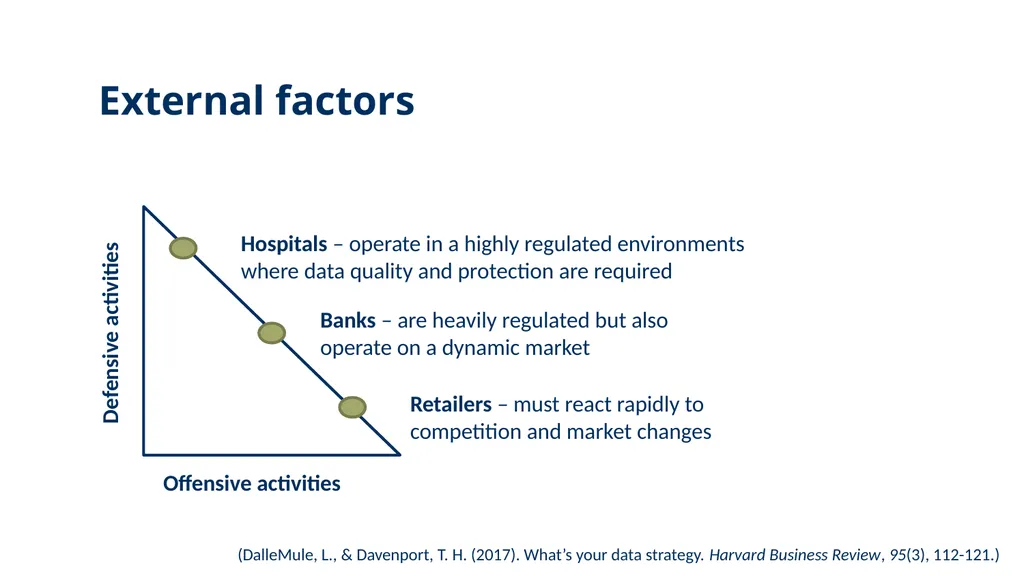
External factors Offensive activities Defensive activities Retailers – must react rapidly to competition and market changes Banks – are heavily regulated but also operate on a dynamic market Hospitals – operate in a highly regulated environments where data quality and protection are required (DalleMule, L., & Davenport, T. H. (2017). What’s your data strategy. Harvard Business Review, 95(3), 112-121.)<br>
11
The proper balance depends on a number of factors Market competition and dynamic
Regulatory environment External factors The overall strategy of the organisation
Maturity of data management
Centralized or decentralized data management
Size of data budget Internal factors (DalleMule, L., & Davenport, T. H. (2017). What’s your data strategy. Harvard Business Review, 95(3), 112-121.)<br>
Regulatory environment External factors The overall strategy of the organisation
Maturity of data management
Centralized or decentralized data management
Size of data budget Internal factors (DalleMule, L., & Davenport, T. H. (2017). What’s your data strategy. Harvard Business Review, 95(3), 112-121.)<br>
12
Focusing on just defensive activities can inhibit flexibility There is a risk that organisation focus too much on defensive activities – and data is not transformed into info that can be used by organizations strategically (DalleMule, L., & Davenport, T. H. (2017). What’s your data strategy. Harvard Business Review, 95(3), 112-121.)<br>
13
SSOT and MVOT The data strategy can include both defensive and offensive activities by introducing:
a single source of truth (SSOT) and
a multiple version of the truth (MVOT)
Therefore, the framework could be seen as a SSOT-MVOT model (DalleMule, L., & Davenport, T. H. (2017). What’s your data strategy. Harvard Business Review, 95(3), 112-121.)<br>
a single source of truth (SSOT) and
a multiple version of the truth (MVOT)
Therefore, the framework could be seen as a SSOT-MVOT model (DalleMule, L., & Davenport, T. H. (2017). What’s your data strategy. Harvard Business Review, 95(3), 112-121.)<br>
14
Singe source of truth (SSOT) Singe source of truth (SSOT) - is a repository that contains one authorative copy of crucial data, such as customers, suppliers and product details (often called the master data) (DalleMule, L., & Davenport, T. H. (2017). What’s your data strategy. Harvard Business Review, 95(3), 112-121.)<br>
15
More about SSOT SSOT requires data governance activities to ensure that the data is accurate and timely so that data can be relied on for both defensive and offensive activities
For example customers, suppliers and product details need to be specified in an agreed-upon way - supported by, for example a master data management system (DalleMule, L., & Davenport, T. H. (2017). What’s your data strategy. Harvard Business Review, 95(3), 112-121.)<br>
For example customers, suppliers and product details need to be specified in an agreed-upon way - supported by, for example a master data management system (DalleMule, L., & Davenport, T. H. (2017). What’s your data strategy. Harvard Business Review, 95(3), 112-121.)<br>
16
More about SSOT If a SSOT does not exist – the company may not understand:
what the relationships to customers and suppliers are
what details are correct about its customers, suppliers and products
SSOT is often implemented by introducing 1) a master data management system or 2) decide which systems are the master for different types of data (DalleMule, L., & Davenport, T. H. (2017). What’s your data strategy. Harvard Business Review, 95(3), 112-121.)<br>
what the relationships to customers and suppliers are
what details are correct about its customers, suppliers and products
SSOT is often implemented by introducing 1) a master data management system or 2) decide which systems are the master for different types of data (DalleMule, L., & Davenport, T. H. (2017). What’s your data strategy. Harvard Business Review, 95(3), 112-121.)<br>
17
Multiple versions of truth (MVOT) Multiple versions of truth (MVOT) – provide different data for different business units
MVOT is based on a SSOT but adapted to different units’ need.
That is, SSOT data have to be transformed, enriched and adapted to be useful for the different needs – for example, use different attributes for different concepts (DalleMule, L., & Davenport, T. H. (2017). What’s your data strategy. Harvard Business Review, 95(3), 112-121.)<br>
MVOT is based on a SSOT but adapted to different units’ need.
That is, SSOT data have to be transformed, enriched and adapted to be useful for the different needs – for example, use different attributes for different concepts (DalleMule, L., & Davenport, T. H. (2017). What’s your data strategy. Harvard Business Review, 95(3), 112-121.)<br>
18
More about MVOT For example, the marketing and financial department are both interested in ad spending
The marketing department is interested in the effectiveness of advertise product and services
The financial department is interested cash flow, for example, when the invoices were payed
That is, different departments are interested in different numbers, and therefore, their reports differs (DalleMule, L., & Davenport, T. H. (2017). What’s your data strategy. Harvard Business Review, 95(3), 112-121.)<br>
The marketing department is interested in the effectiveness of advertise product and services
The financial department is interested cash flow, for example, when the invoices were payed
That is, different departments are interested in different numbers, and therefore, their reports differs (DalleMule, L., & Davenport, T. H. (2017). What’s your data strategy. Harvard Business Review, 95(3), 112-121.)<br>
19
The need for MVOT According to DalleMule and Davenport (2017), the need for SSOT is well understood, but not the need for MVOT is not (DalleMule, L., & Davenport, T. H. (2017). What’s your data strategy. Harvard Business Review, 95(3), 112-121.)<br>
20
The need for MVOT Different business units have different needs
Therefore, SSOT data need to be transformed, enriched and adapted for different business unit
MVOT is the result such business-specific transformation
However, MVOT must diverge from SSOT in a carefully controlled way otherwise siloed and uncontrolled MVOT will be created (DalleMule, L., & Davenport, T. H. (2017). What’s your data strategy. Harvard Business Review, 95(3), 112-121.)<br>
Therefore, SSOT data need to be transformed, enriched and adapted for different business unit
MVOT is the result such business-specific transformation
However, MVOT must diverge from SSOT in a carefully controlled way otherwise siloed and uncontrolled MVOT will be created (DalleMule, L., & Davenport, T. H. (2017). What’s your data strategy. Harvard Business Review, 95(3), 112-121.)<br>
21
Centralized or a decentralized data management? If an organization should devolop a centralized or a decentralized data management depends on the organizations poisition on the offence-defence spectrum.
Organisations with a defensive strategy usually prefer a centralized data management
Organization with a offensive strategy has a more decentralised data management, where Unit Chief Data Officers have responsibility to MVOT and an Enterprise Chief Data Officer owns the SSOT (DalleMule, L., & Davenport, T. H. (2017). What’s your data strategy. Harvard Business Review, 95(3), 112-121.)<br>
Organisations with a defensive strategy usually prefer a centralized data management
Organization with a offensive strategy has a more decentralised data management, where Unit Chief Data Officers have responsibility to MVOT and an Enterprise Chief Data Officer owns the SSOT (DalleMule, L., & Davenport, T. H. (2017). What’s your data strategy. Harvard Business Review, 95(3), 112-121.)<br>
22
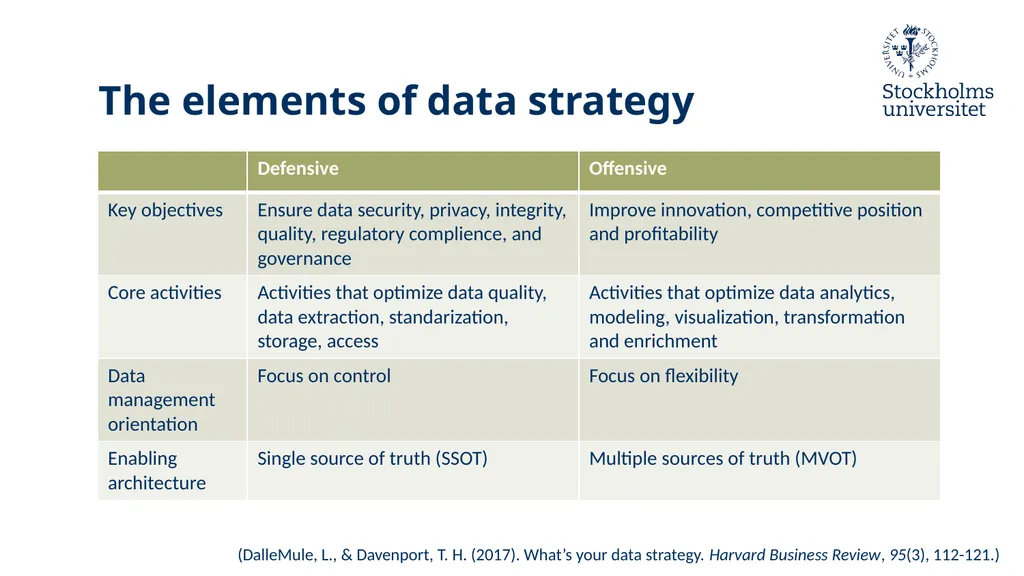
The elements of data strategy (DalleMule, L., & Davenport, T. H. (2017). What’s your data strategy. Harvard Business Review, 95(3), 112-121.)<br>
23
Data governance – focusing on a defensive data strategy – but is a good base for an offensive as well<br>
24
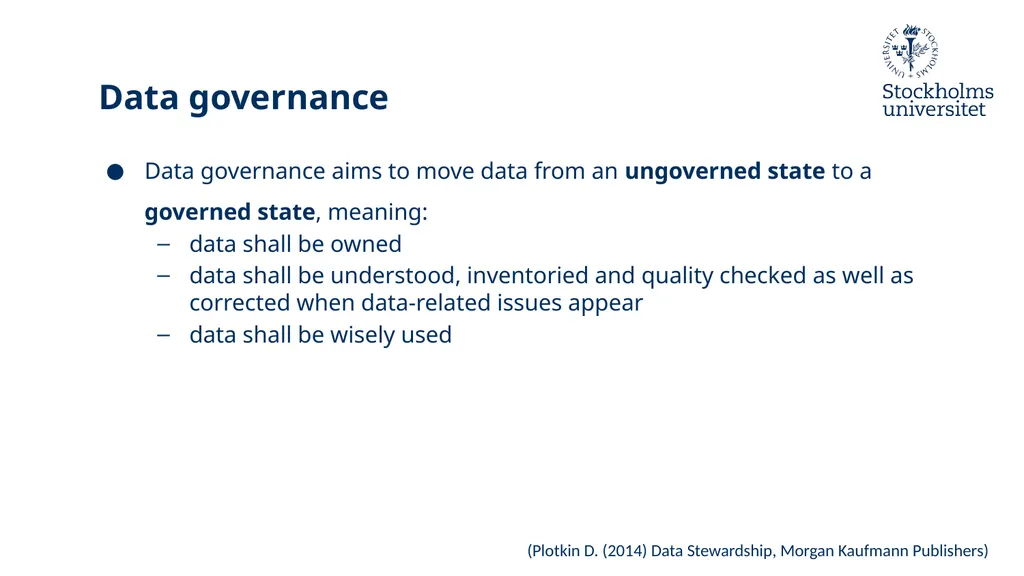
Data governance Data governance aims to move data from an ungoverned state to a governed state, meaning:
data shall be owned
data shall be understood, inventoried and quality checked as well as corrected when data-related issues appear
data shall be wisely used (Plotkin D. (2014) Data Stewardship, Morgan Kaufmann Publishers)<br>
data shall be owned
data shall be understood, inventoried and quality checked as well as corrected when data-related issues appear
data shall be wisely used (Plotkin D. (2014) Data Stewardship, Morgan Kaufmann Publishers)<br>
25
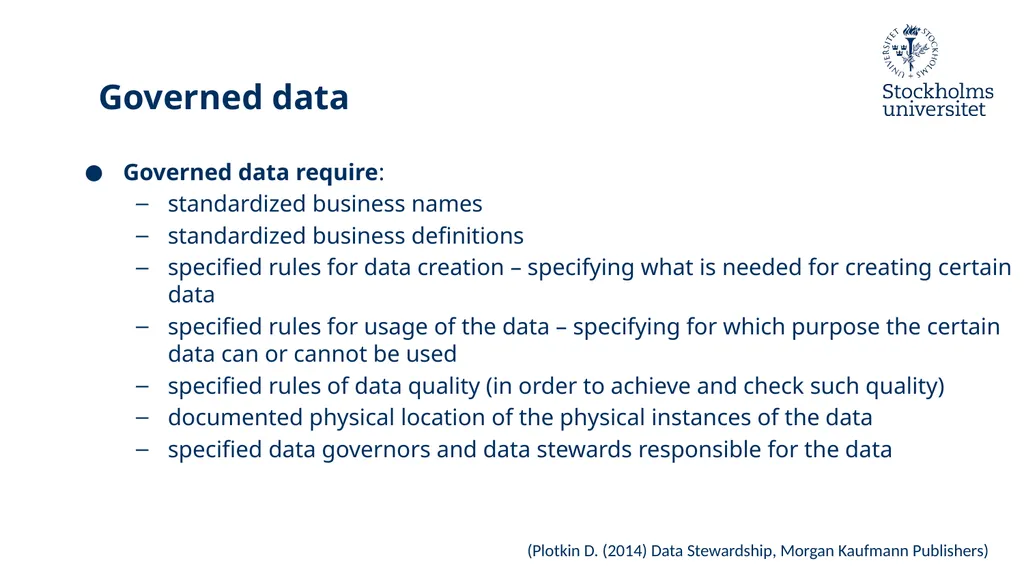
Governed data Governed data require:
standardized business names
standardized business definitions
specified rules for data creation – specifying what is needed for creating certain data
specified rules for usage of the data – specifying for which purpose the certain data can or cannot be used
specified rules of data quality (in order to achieve and check such quality)
documented physical location of the physical instances of the data
specified data governors and data stewards responsible for the data (Plotkin D. (2014) Data Stewardship, Morgan Kaufmann Publishers)<br>
standardized business names
standardized business definitions
specified rules for data creation – specifying what is needed for creating certain data
specified rules for usage of the data – specifying for which purpose the certain data can or cannot be used
specified rules of data quality (in order to achieve and check such quality)
documented physical location of the physical instances of the data
specified data governors and data stewards responsible for the data (Plotkin D. (2014) Data Stewardship, Morgan Kaufmann Publishers)<br>
26
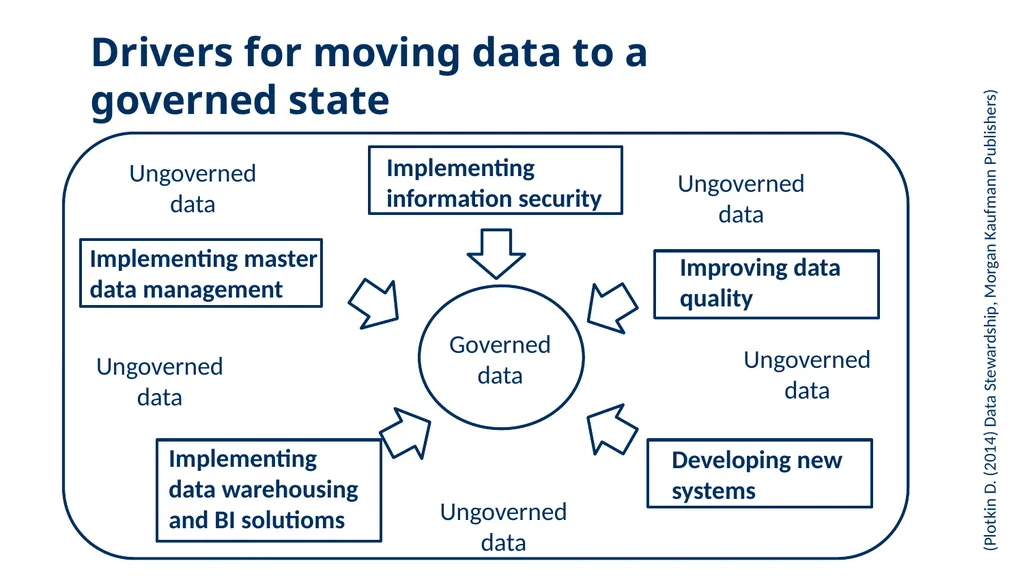
Drivers for moving data to a governed state Governed data Implementing master data management Implementing data warehousing and BI solutioms Implementing information security Developing new systems Improving data quality Ungoverned data Ungoverned data Ungoverned data Ungoverned data Ungoverned data (Plotkin D. (2014) Data Stewardship, Morgan Kaufmann Publishers)<br>
27
Data science – focusing on an offensive data strategy<br>
28
Questions How to identify new data-driven solutions, including AI, in an organization?<br>
29
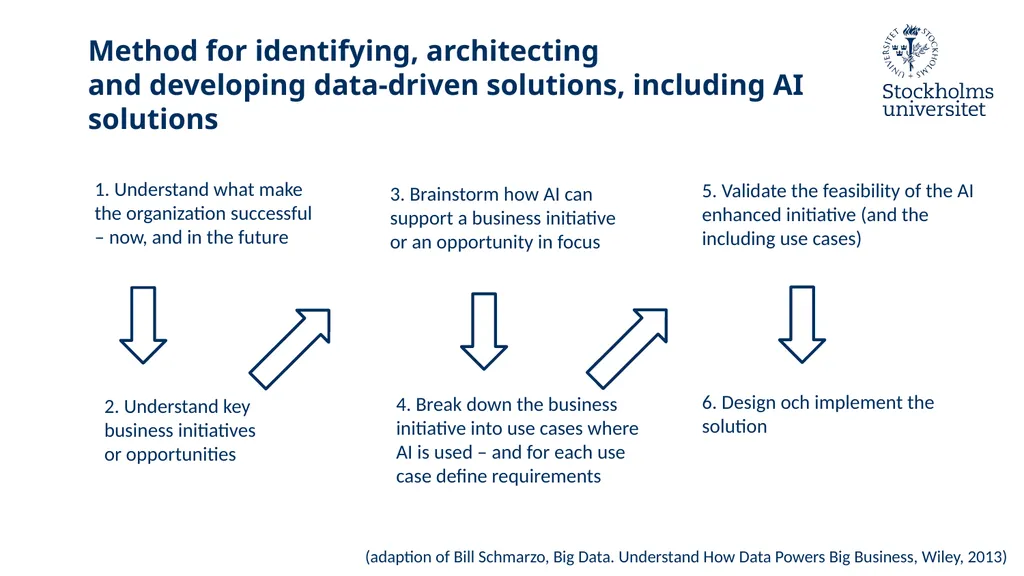
Method for identifying, architecting and developing data-driven solutions, including AI, in an organization<br>
30
The method is presented in Schmarzo (2013) and are developed for big data – not explicitly for AI, but I have adapted it for AI as well
Problem addressed by the adapted method: It is not clear for organizations how they can identify, architect and develop AI, big data - and other data-driven - solutions
Therefore, there is a need of a solution engineering method supporting the organizations addressing this problem Method for identifying, architecting and developing data-driven solutions, including AI solutions (adaption of Bill Schmarzo, Big Data. Understand How Data Powers Big Business, Wiley, 2013)<br>
Problem addressed by the adapted method: It is not clear for organizations how they can identify, architect and develop AI, big data - and other data-driven - solutions
Therefore, there is a need of a solution engineering method supporting the organizations addressing this problem Method for identifying, architecting and developing data-driven solutions, including AI solutions (adaption of Bill Schmarzo, Big Data. Understand How Data Powers Big Business, Wiley, 2013)<br>
31
Method for identifying, architecting
and developing data-driven solutions, including AI solutions 2. Understand key business initiatives or opportunities 4. Break down the business initiative into use cases where AI is used – and for each use case define requirements 3. Brainstorm how AI can support a business initiative or an opportunity in focus 5. Validate the feasibility of the AI enhanced initiative (and the including use cases) 6. Design och implement the solution 1. Understand what make the organization successful – now, and in the future (adaption of Bill Schmarzo, Big Data. Understand How Data Powers Big Business, Wiley, 2013)<br>
32
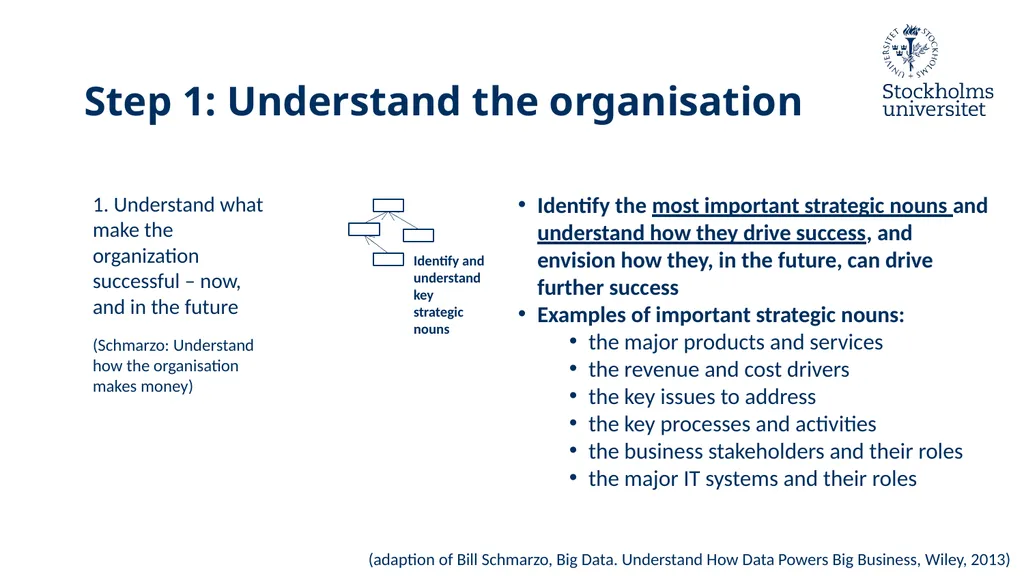
Identify and understand key strategic nouns (adaption of Bill Schmarzo, Big Data. Understand How Data Powers Big Business, Wiley, 2013) 1. Understand what make the organization successful – now, and in the future (Schmarzo: Understand how the organisation makes money) Identify the most important strategic nouns and understand how they drive success, and envision how they, in the future, can drive further success
Examples of important strategic nouns:
the major products and services
the revenue and cost drivers
the key issues to address
the key processes and activities
the business stakeholders and their roles
the major IT systems and their roles Step 1: Understand the organisation<br>
Examples of important strategic nouns:
the major products and services
the revenue and cost drivers
the key issues to address
the key processes and activities
the business stakeholders and their roles
the major IT systems and their roles Step 1: Understand the organisation<br>
33
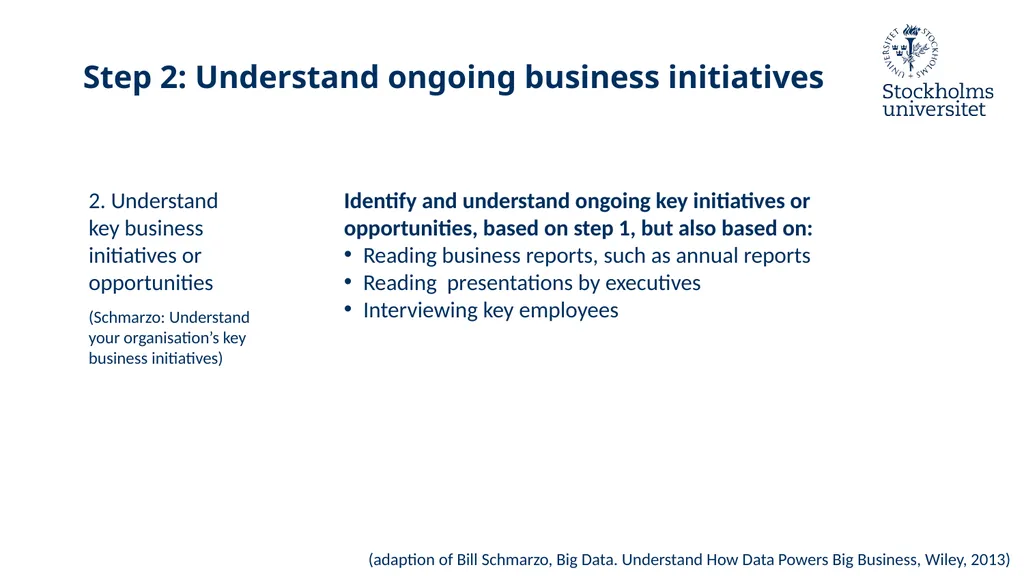
Step 2: Understand ongoing business initiatives 2. Understand key business initiatives or opportunities Identify and understand ongoing key initiatives or opportunities, based on step 1, but also based on:
Reading business reports, such as annual reports
Reading presentations by executives
Interviewing key employees (adaption of Bill Schmarzo, Big Data. Understand How Data Powers Big Business, Wiley, 2013) (Schmarzo: Understand your organisation’s key business initiatives)<br>
Reading business reports, such as annual reports
Reading presentations by executives
Interviewing key employees (adaption of Bill Schmarzo, Big Data. Understand How Data Powers Big Business, Wiley, 2013) (Schmarzo: Understand your organisation’s key business initiatives)<br>
34
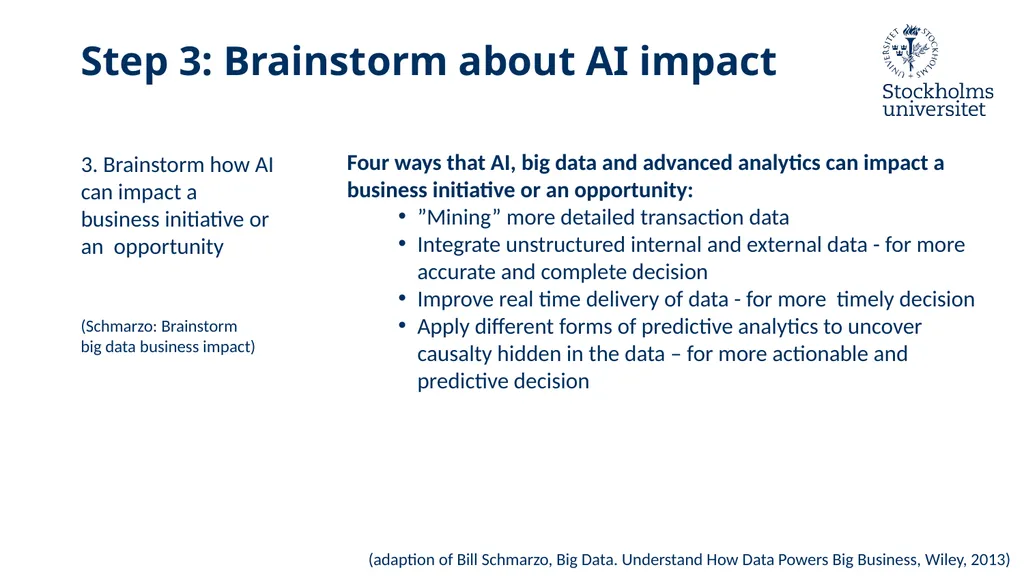
Step 3: Brainstorm about AI impact 3. Brainstorm how AI can impact a business initiative or an opportunity Four ways that AI, big data and advanced analytics can impact a business initiative or an opportunity:
”Mining” more detailed transaction data
Integrate unstructured internal and external data - for more accurate and complete decision
Improve real time delivery of data - for more timely decision
Apply different forms of predictive analytics to uncover causalty hidden in the data – for more actionable and predictive decision (Schmarzo: Brainstorm big data business impact) (adaption of Bill Schmarzo, Big Data. Understand How Data Powers Big Business, Wiley, 2013)<br>
”Mining” more detailed transaction data
Integrate unstructured internal and external data - for more accurate and complete decision
Improve real time delivery of data - for more timely decision
Apply different forms of predictive analytics to uncover causalty hidden in the data – for more actionable and predictive decision (Schmarzo: Brainstorm big data business impact) (adaption of Bill Schmarzo, Big Data. Understand How Data Powers Big Business, Wiley, 2013)<br>
35
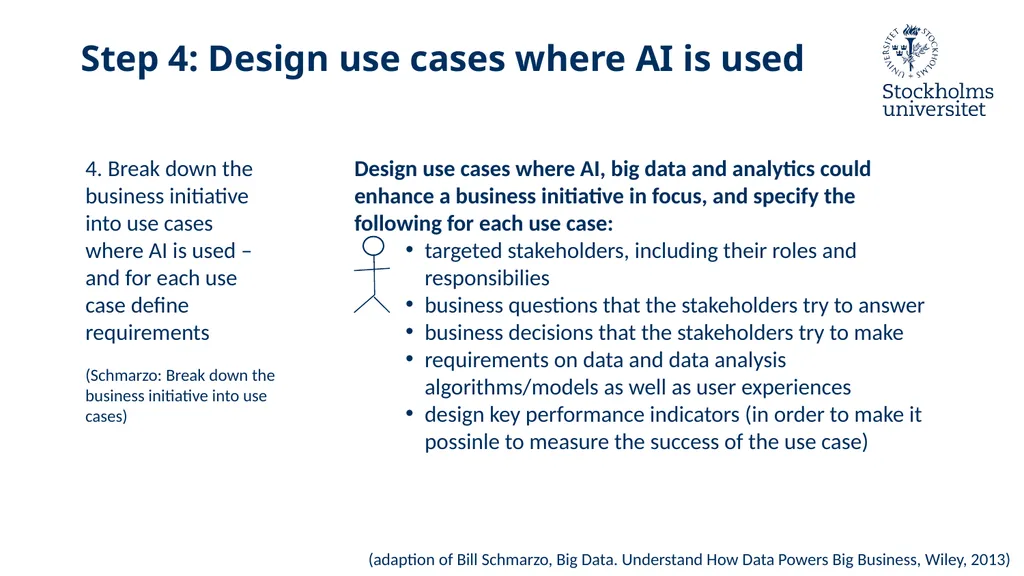
Step 4: Design use cases where AI is used 4. Break down the business initiative into use cases where AI is used – and for each use case define requirements Design use cases where AI, big data and analytics could enhance a business initiative in focus, and specify the following for each use case:
targeted stakeholders, including their roles and responsibilies
business questions that the stakeholders try to answer
business decisions that the stakeholders try to make
requirements on data and data analysis algorithms/models as well as user experiences
design key performance indicators (in order to make it possinle to measure the success of the use case) (Schmarzo: Break down the business initiative into use cases) (adaption of Bill Schmarzo, Big Data. Understand How Data Powers Big Business, Wiley, 2013)<br>
targeted stakeholders, including their roles and responsibilies
business questions that the stakeholders try to answer
business decisions that the stakeholders try to make
requirements on data and data analysis algorithms/models as well as user experiences
design key performance indicators (in order to make it possinle to measure the success of the use case) (Schmarzo: Break down the business initiative into use cases) (adaption of Bill Schmarzo, Big Data. Understand How Data Powers Big Business, Wiley, 2013)<br>
36
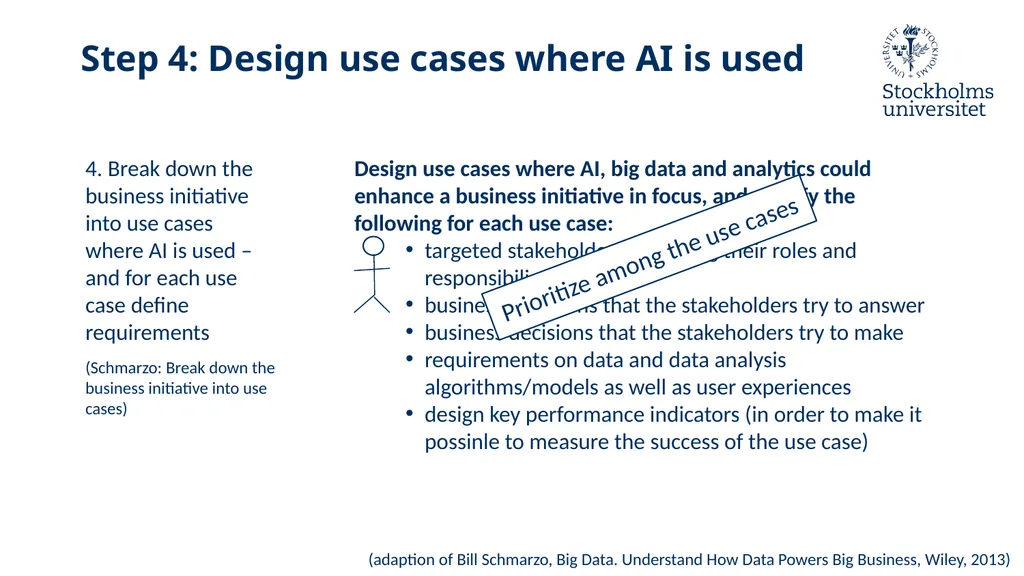
Step 4: Design use cases where AI is used 4. Break down the business initiative into use cases where AI is used – and for each use case define requirements Design use cases where AI, big data and analytics could enhance a business initiative in focus, and specify the following for each use case:
targeted stakeholders, including their roles and responsibilies
business questions that the stakeholders try to answer
business decisions that the stakeholders try to make
requirements on data and data analysis algorithms/models as well as user experiences
design key performance indicators (in order to make it possinle to measure the success of the use case) (Schmarzo: Break down the business initiative into use cases) (adaption of Bill Schmarzo, Big Data. Understand How Data Powers Big Business, Wiley, 2013) Prioritize among the use cases<br>
targeted stakeholders, including their roles and responsibilies
business questions that the stakeholders try to answer
business decisions that the stakeholders try to make
requirements on data and data analysis algorithms/models as well as user experiences
design key performance indicators (in order to make it possinle to measure the success of the use case) (Schmarzo: Break down the business initiative into use cases) (adaption of Bill Schmarzo, Big Data. Understand How Data Powers Big Business, Wiley, 2013) Prioritize among the use cases<br>
37
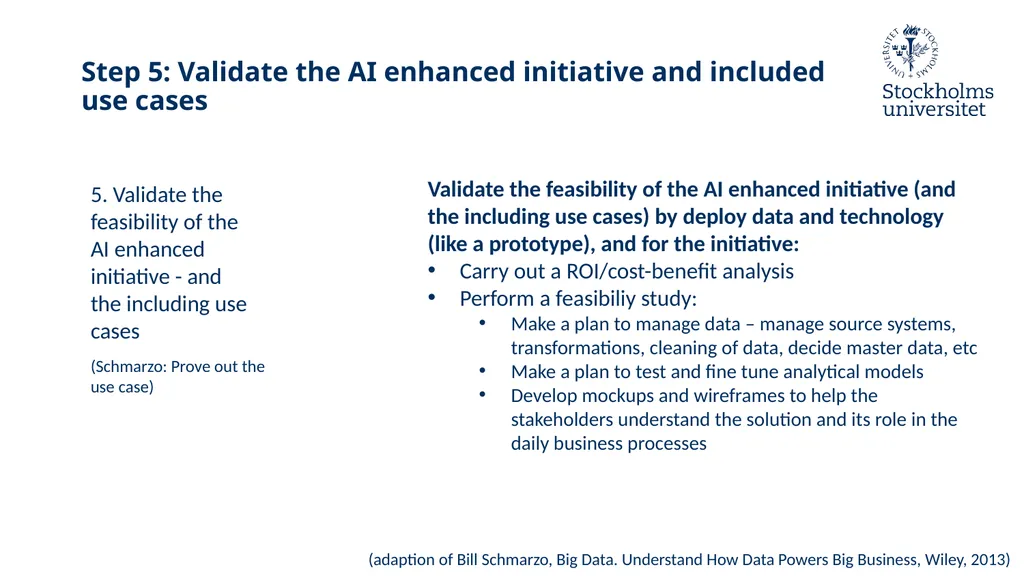
Step 5: Validate the AI enhanced initiative and included use cases 5. Validate the feasibility of the AI enhanced initiative - and the including use cases Validate the feasibility of the AI enhanced initiative (and the including use cases) by deploy data and technology (like a prototype), and for the initiative:
Carry out a ROI/cost-benefit analysis
Perform a feasibiliy study:
Make a plan to manage data – manage source systems, transformations, cleaning of data, decide master data, etc
Make a plan to test and fine tune analytical models
Develop mockups and wireframes to help the stakeholders understand the solution and its role in the daily business processes (Schmarzo: Prove out the use case) (adaption of Bill Schmarzo, Big Data. Understand How Data Powers Big Business, Wiley, 2013)<br>
Carry out a ROI/cost-benefit analysis
Perform a feasibiliy study:
Make a plan to manage data – manage source systems, transformations, cleaning of data, decide master data, etc
Make a plan to test and fine tune analytical models
Develop mockups and wireframes to help the stakeholders understand the solution and its role in the daily business processes (Schmarzo: Prove out the use case) (adaption of Bill Schmarzo, Big Data. Understand How Data Powers Big Business, Wiley, 2013)<br>
38
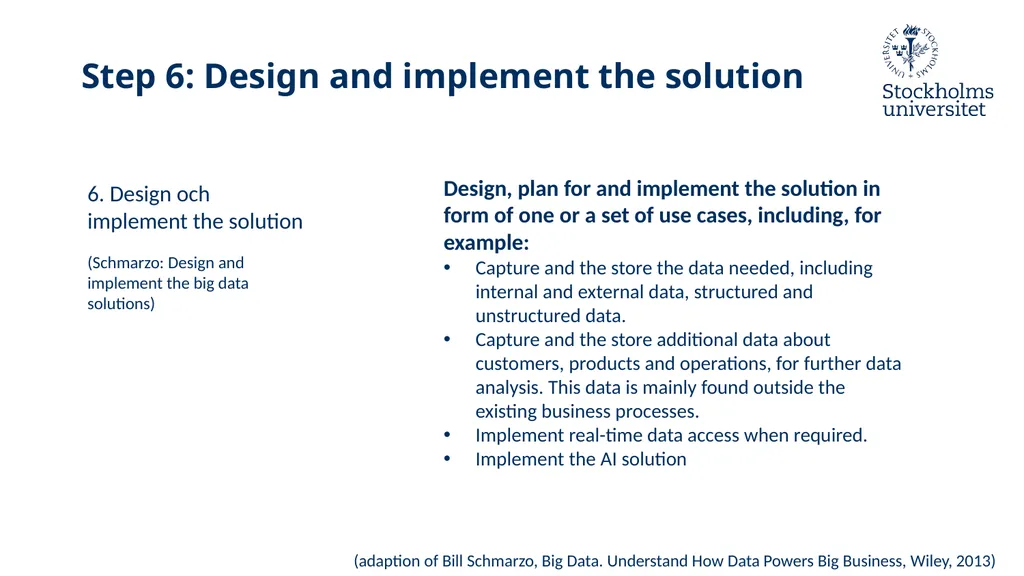
Step 6: Design and implement the solution 6. Design och implement the solution (Schmarzo: Design and implement the big data solutions) Design, plan for and implement the solution in form of one or a set of use cases, including, for example:
Capture and the store the data needed, including internal and external data, structured and unstructured data.
Capture and the store additional data about customers, products and operations, for further data analysis. This data is mainly found outside the existing business processes.
Implement real-time data access when required.
Implement the AI solution (adaption of Bill Schmarzo, Big Data. Understand How Data Powers Big Business, Wiley, 2013)<br>
Capture and the store the data needed, including internal and external data, structured and unstructured data.
Capture and the store additional data about customers, products and operations, for further data analysis. This data is mainly found outside the existing business processes.
Implement real-time data access when required.
Implement the AI solution (adaption of Bill Schmarzo, Big Data. Understand How Data Powers Big Business, Wiley, 2013)<br>
39
AI in healthcare<br>
40
AI in healthcare - benefits and issues<br>
41
Why AI in healtcare? AI has the potential to transform healthcare since healtcare is producing a large amount of clinical and administrative data
This large amount of data can be used for analysis
Moreover, research studies have shown that AI can carry out many key healthcare activities better than, or as well as, humans, such as diagnosing diseases, for example by analyzing radiology images (Davenport, T., & Kalakota, R. (2019). The potential for artificial intelligence in healthcare. Future healthcare journal, 6(2), 94)<br>
This large amount of data can be used for analysis
Moreover, research studies have shown that AI can carry out many key healthcare activities better than, or as well as, humans, such as diagnosing diseases, for example by analyzing radiology images (Davenport, T., & Kalakota, R. (2019). The potential for artificial intelligence in healthcare. Future healthcare journal, 6(2), 94)<br>
42
AI is sparsely implemented Today, AI solutions are sparsely implemented in practical healthcare
Existing AI solutions are mainly supporting the individual functions in healthcare, like radiology and pathology image analysis (Davenport, T., & Kalakota, R. (2019). The potential for artificial intelligence in healthcare. Future healthcare journal, 6(2), 94)<br>
Existing AI solutions are mainly supporting the individual functions in healthcare, like radiology and pathology image analysis (Davenport, T., & Kalakota, R. (2019). The potential for artificial intelligence in healthcare. Future healthcare journal, 6(2), 94)<br>
43
Why is AI sparsely implemented? 1(2) According to Davenport and Kalakota (2019), two major reasons for AI being sparsely implemented in practical healthcare are:
AI solutions are focusing on limited tasks and are rarely integrated into the clinical processes
Moreover, AI is not implemented in electronic record systems (EHR). Therefore, AI is not part of the system that most healthcare personnel use for their day-to-day work (Davenport, T., & Kalakota, R. (2019). The potential for artificial intelligence in healthcare. Future healthcare journal, 6(2), 94)<br>
AI solutions are focusing on limited tasks and are rarely integrated into the clinical processes
Moreover, AI is not implemented in electronic record systems (EHR). Therefore, AI is not part of the system that most healthcare personnel use for their day-to-day work (Davenport, T., & Kalakota, R. (2019). The potential for artificial intelligence in healthcare. Future healthcare journal, 6(2), 94)<br>
44
Why is AI sparsely implemented? 2(2) Panch et al. (2014) add additional important reasons for AI being sparsely implemented in practical healthcare are:
Healthcare systems are complex and fragmented, and will not easily change as a result of new technology
Healthcare organisations lack the capacity to collect the necessary training data of sufficient quality - while also respecting ethical principles and legal constraints (Panch, T., Mattie, H., & Celi, L. A. (2019). The “inconvenient truth” about AI in healthcare. NPJ digital medicine, 2(1), 1-3.)<br>
Healthcare systems are complex and fragmented, and will not easily change as a result of new technology
Healthcare organisations lack the capacity to collect the necessary training data of sufficient quality - while also respecting ethical principles and legal constraints (Panch, T., Mattie, H., & Celi, L. A. (2019). The “inconvenient truth” about AI in healthcare. NPJ digital medicine, 2(1), 1-3.)<br>
45
AI technologies in healthcare<br>
46
AI technologies in healthcare Note, according to Devenport and Kalakota (2019), AI is not one technology, but rather a collection of them.
Examples pf AI technologies:
Machine learning
Natural language processing
Rule based expert system
Physical robots
Robotic process automation (Davenport, T., & Kalakota, R. (2019). The potential for artificial intelligence in healthcare. Future healthcare journal, 6(2), 94)<br>
Examples pf AI technologies:
Machine learning
Natural language processing
Rule based expert system
Physical robots
Robotic process automation (Davenport, T., & Kalakota, R. (2019). The potential for artificial intelligence in healthcare. Future healthcare journal, 6(2), 94)<br>
47
Machine learning Traditional machine learning is the most common application in healthcare. This application is mostly using supervised learning, which requires a training datasets to be used to be able to do the work
Supervised learning systems are supporting the making of diagnosis, and predicting what treatment protocols are likely to be successful for a patient, based on various patient attributes and the treatment context (Davenport, T., & Kalakota, R. (2019). The potential for artificial intelligence in healthcare. Future healthcare journal, 6(2), 94)<br>
Supervised learning systems are supporting the making of diagnosis, and predicting what treatment protocols are likely to be successful for a patient, based on various patient attributes and the treatment context (Davenport, T., & Kalakota, R. (2019). The potential for artificial intelligence in healthcare. Future healthcare journal, 6(2), 94)<br>
48
Neural network and deep learning A more complex form of supervised machine learning is the neural network. Neural network make use of a network of variables that associate inputs with outputs and create weights on these associations, in order to predict outcome
A neural network can also have variables on many different so called hidden layers, called deep neural network or deep learning
Deep learning has been very successful for identifying clinically relevant features in imaging data - beyond what can be perceived by the human eye
Deep learning is also increasingly used for speech recognition in NLP, see next slide (Davenport, T., & Kalakota, R. (2019). The potential for artificial intelligence in healthcare. Future healthcare journal, 6(2), 94)<br>
A neural network can also have variables on many different so called hidden layers, called deep neural network or deep learning
Deep learning has been very successful for identifying clinically relevant features in imaging data - beyond what can be perceived by the human eye
Deep learning is also increasingly used for speech recognition in NLP, see next slide (Davenport, T., & Kalakota, R. (2019). The potential for artificial intelligence in healthcare. Future healthcare journal, 6(2), 94)<br>
49
Natural language processing Natural language processing (NLP) aims to make sense of human language. NLP includes application such as speech recognition, text analysis, translation.
In healthcare, NLP can, for example, be used for analyzing unstructured clinical notes and supporting the transformation from speech to text (Davenport, T., & Kalakota, R. (2019). The potential for artificial intelligence in healthcare. Future healthcare journal, 6(2), 94)<br>
In healthcare, NLP can, for example, be used for analyzing unstructured clinical notes and supporting the transformation from speech to text (Davenport, T., & Kalakota, R. (2019). The potential for artificial intelligence in healthcare. Future healthcare journal, 6(2), 94)<br>
50
Rule based expert system 1(2) Rule based expert system - require human experts and knowledge engineers to construct a series of rules in a particular knowledge domain, which will be the base for the expert system
Rule based expert systems in healthcare - are the base for many clinical decision support system
Rule based expert systems - are also be part of many medical record systems (i.e. EHR systems), for example, they provide functionality to warn for drug-to-drug interactions, and support the physician of making diagnoses (Davenport, T., & Kalakota, R. (2019). The potential for artificial intelligence in healthcare. Future healthcare journal, 6(2), 94)<br>
Rule based expert systems in healthcare - are the base for many clinical decision support system
Rule based expert systems - are also be part of many medical record systems (i.e. EHR systems), for example, they provide functionality to warn for drug-to-drug interactions, and support the physician of making diagnoses (Davenport, T., & Kalakota, R. (2019). The potential for artificial intelligence in healthcare. Future healthcare journal, 6(2), 94)<br>
51
Rule based expert system 2(2) The limitation of rule based expert systems:
Rule based expert systems - work well if the rules are not so many.
However, if number of rules is over several thousand, it is hard to maintain the rules, for example, the rules soon start to conflict with each other.
Moreover, if the knowledge domain changes, rules need to change, which may be time-consuming, especially if the rules are many, and related on each other
Therefore, due to this limitations, rule based expert systems are being replaced by systems based on ML algorithms (Davenport, T., & Kalakota, R. (2019). The potential for artificial intelligence in healthcare. Future healthcare journal, 6(2), 94)<br>
Rule based expert systems - work well if the rules are not so many.
However, if number of rules is over several thousand, it is hard to maintain the rules, for example, the rules soon start to conflict with each other.
Moreover, if the knowledge domain changes, rules need to change, which may be time-consuming, especially if the rules are many, and related on each other
Therefore, due to this limitations, rule based expert systems are being replaced by systems based on ML algorithms (Davenport, T., & Kalakota, R. (2019). The potential for artificial intelligence in healthcare. Future healthcare journal, 6(2), 94)<br>
52
Physical robots Physical robots - perform pre-defined tasks in factories and warehouses, like lifting and assembling objects
Applied in healthcare are surgical robots – which can improve the surgeons ability to see and make tasks more precise
Moreover, physical robots are also becoming more intelligent, as other AI capabilities are being embedded in their operating systems. (Davenport, T., & Kalakota, R. (2019). The potential for artificial intelligence in healthcare. Future healthcare journal, 6(2), 94)<br>
Applied in healthcare are surgical robots – which can improve the surgeons ability to see and make tasks more precise
Moreover, physical robots are also becoming more intelligent, as other AI capabilities are being embedded in their operating systems. (Davenport, T., & Kalakota, R. (2019). The potential for artificial intelligence in healthcare. Future healthcare journal, 6(2), 94)<br>
53
Robotic process automation (RPA) Robotic process automation (RPA) – record the keyboard and mouse actions of a human being, and repeat these actions automatically
RPA does not involve physical robots – instead RPA is a form of software
RPA act like a semi-intelligent user of the systems, following a script or a set of rules based on actions done by human beings
RPA can be used in healthcare for updating patient records, billing or other administrative tasks
Moreover, RPA can be used in combination with other technologies, for example combining image recognition and RPA, where RPA can be used for extract data from the recognitions of images and update EHR system with this data (Davenport, T., & Kalakota, R. (2019). The potential for artificial intelligence in healthcare. Future healthcare journal, 6(2), 94)<br>
RPA does not involve physical robots – instead RPA is a form of software
RPA act like a semi-intelligent user of the systems, following a script or a set of rules based on actions done by human beings
RPA can be used in healthcare for updating patient records, billing or other administrative tasks
Moreover, RPA can be used in combination with other technologies, for example combining image recognition and RPA, where RPA can be used for extract data from the recognitions of images and update EHR system with this data (Davenport, T., & Kalakota, R. (2019). The potential for artificial intelligence in healthcare. Future healthcare journal, 6(2), 94)<br>
54
AI technolgies can be combined AI technologies are being more and more combined and integrated, for example:
physical robots are getting AI-based features
image recognition is being integrated with RPA. (Davenport, T., & Kalakota, R. (2019). The potential for artificial intelligence in healthcare. Future healthcare journal, 6(2), 94)<br>
physical robots are getting AI-based features
image recognition is being integrated with RPA. (Davenport, T., & Kalakota, R. (2019). The potential for artificial intelligence in healthcare. Future healthcare journal, 6(2), 94)<br>
55
AI application areas in healthcare<br>
56
AI application areas Example of AI application areas in healthcare:
Diagnosis and treatment
Patient engagement and adherence
Administrative activities (Davenport, T., & Kalakota, R. (2019). The potential for artificial intelligence in healthcare. Future healthcare journal, 6(2), 94)<br>
Diagnosis and treatment
Patient engagement and adherence
Administrative activities (Davenport, T., & Kalakota, R. (2019). The potential for artificial intelligence in healthcare. Future healthcare journal, 6(2), 94)<br>
57
Diagnosis and treatment 1(3) IBM's Watson has received a lot of attention for its application in diagnosis and treatment area, particularly cancer diagnosis and treatment
Watson consisted of a set of ‘cognitive services’, employing a combination of machine learning and NLP technologies
However, IBM’s Watson’s application in healthcare has not been a success:
Watson has not been able to handle different types of cancer
Watson has also been hard to integrate into care processes and systems (Davenport, T., & Kalakota, R. (2019). The potential for artificial intelligence in healthcare. Future healthcare journal, 6(2), 94)<br>
Watson consisted of a set of ‘cognitive services’, employing a combination of machine learning and NLP technologies
However, IBM’s Watson’s application in healthcare has not been a success:
Watson has not been able to handle different types of cancer
Watson has also been hard to integrate into care processes and systems (Davenport, T., & Kalakota, R. (2019). The potential for artificial intelligence in healthcare. Future healthcare journal, 6(2), 94)<br>
58
Diagnosis and treatment 2(3) Other examples of the use of AI for diagnosis and treatment:
Several organizations work on ML based solutions to better understand the how different genetic variants of humans will response to different treatments, such as drugs and protocols.
Organizations are also working on ML based solution to predict populations at risk of particular diseases, high-risk conditions or to predict hospital readmission (Davenport, T., & Kalakota, R. (2019). The potential for artificial intelligence in healthcare. Future healthcare journal, 6(2), 94)<br>
Several organizations work on ML based solutions to better understand the how different genetic variants of humans will response to different treatments, such as drugs and protocols.
Organizations are also working on ML based solution to predict populations at risk of particular diseases, high-risk conditions or to predict hospital readmission (Davenport, T., & Kalakota, R. (2019). The potential for artificial intelligence in healthcare. Future healthcare journal, 6(2), 94)<br>
59
Drawbacks of using AI in the application of diagnosis and treatment:
To embed AI-based diagnosis and treatment recommendations into clinical workflows and EHR systems has not been successful
According to Davenport and Kalakota (2019), “such integration issues have probably been a greater barrier to broad implementation of AI than any inability to provide accurate and effective recommendations” Diagnosis and treatment 3(3) (Davenport, T., & Kalakota, R. (2019). The potential for artificial intelligence in healthcare. Future healthcare journal, 6(2), 94)<br>
To embed AI-based diagnosis and treatment recommendations into clinical workflows and EHR systems has not been successful
According to Davenport and Kalakota (2019), “such integration issues have probably been a greater barrier to broad implementation of AI than any inability to provide accurate and effective recommendations” Diagnosis and treatment 3(3) (Davenport, T., & Kalakota, R. (2019). The potential for artificial intelligence in healthcare. Future healthcare journal, 6(2), 94)<br>
60
Patient engagement and adherence 1(2) Patients engagement in their own well-being and care are important for receiving better outcome in healthcare
The major problem is that the patient may not make necessary behavioral adjustment, that is, does not follow a course of treatment or take the prescribed drugs (Davenport, T., & Kalakota, R. (2019). The potential for artificial intelligence in healthcare. Future healthcare journal, 6(2), 94)<br>
The major problem is that the patient may not make necessary behavioral adjustment, that is, does not follow a course of treatment or take the prescribed drugs (Davenport, T., & Kalakota, R. (2019). The potential for artificial intelligence in healthcare. Future healthcare journal, 6(2), 94)<br>
61
Therefore, ML and business rules engines can be used to support patient engagement and adherence, by:
sending message alert to patients,
providing targeted content given the patients’ status and characteristics,
tailoring recommendations by comparing patient data to other effective treatment pathways for similar cohorts
nudging patient behavior in a more anticipatory way Patient engagement and adherence 2(2) (Davenport, T., & Kalakota, R. (2019). The potential for artificial intelligence in healthcare. Future healthcare journal, 6(2), 94)<br>
sending message alert to patients,
providing targeted content given the patients’ status and characteristics,
tailoring recommendations by comparing patient data to other effective treatment pathways for similar cohorts
nudging patient behavior in a more anticipatory way Patient engagement and adherence 2(2) (Davenport, T., & Kalakota, R. (2019). The potential for artificial intelligence in healthcare. Future healthcare journal, 6(2), 94)<br>
62
Administrative activities Different AI technologies can be used for administrative tasks:
RPA can be used for a variety of applications in healthcare, like managing medical records
NLP can be applied in chatbots for patient interaction
ML could be used to verify whether millions of insurance claims are correct, for example, by applying probabilistic matching of data across different databases (Davenport, T., & Kalakota, R. (2019). The potential for artificial intelligence in healthcare. Future healthcare journal, 6(2), 94)<br>
RPA can be used for a variety of applications in healthcare, like managing medical records
NLP can be applied in chatbots for patient interaction
ML could be used to verify whether millions of insurance claims are correct, for example, by applying probabilistic matching of data across different databases (Davenport, T., & Kalakota, R. (2019). The potential for artificial intelligence in healthcare. Future healthcare journal, 6(2), 94)<br>
63
Healthcare workers<br>
64
Implication for healthcare workforce 1(2) According to Davenport and Kalakota (2019) estimate that it will take 20 years before will see any substantial change in healthcare employment due to AI
Instead, there is also the possibility that new jobs for working with AI technologies are created (Davenport, T., & Kalakota, R. (2019). The potential for artificial intelligence in healthcare. Future healthcare journal, 6(2), 94)<br>
Instead, there is also the possibility that new jobs for working with AI technologies are created (Davenport, T., & Kalakota, R. (2019). The potential for artificial intelligence in healthcare. Future healthcare journal, 6(2), 94)<br>
65
Implication for healthcare workforce 2(2) The area where most healthcare jobs will be automated are those dealing with digital information, radiology and pathology
However, for example, not even radiologist jobs will not disappear in the near future, and maybe not in the long term either – see next slides (Davenport, T., & Kalakota, R. (2019). The potential for artificial intelligence in healthcare. Future healthcare journal, 6(2), 94)<br>
However, for example, not even radiologist jobs will not disappear in the near future, and maybe not in the long term either – see next slides (Davenport, T., & Kalakota, R. (2019). The potential for artificial intelligence in healthcare. Future healthcare journal, 6(2), 94)<br>
66
Implication for radiology 1(2) Today, radiology AI systems can only perform single tasks.
Radiology AI systems cannot fully identify all potential findings in medical images. Radiologist are still needed for that
Radiologists also do a lot of other thing than just read and interpret images:
radiologists relate findings from images to other medical records and test results
radiologists consult with other physicians regarding diagnosis and treatment
radiologists discuss procedures and results with patients
radiologists define the technical parameters of imaging examinations. The parameters need to be tailored to the patient's condition (Davenport, T., & Kalakota, R. (2019). The potential for artificial intelligence in healthcare. Future healthcare journal, 6(2), 94)<br>
Radiology AI systems cannot fully identify all potential findings in medical images. Radiologist are still needed for that
Radiologists also do a lot of other thing than just read and interpret images:
radiologists relate findings from images to other medical records and test results
radiologists consult with other physicians regarding diagnosis and treatment
radiologists discuss procedures and results with patients
radiologists define the technical parameters of imaging examinations. The parameters need to be tailored to the patient's condition (Davenport, T., & Kalakota, R. (2019). The potential for artificial intelligence in healthcare. Future healthcare journal, 6(2), 94)<br>
67
Implication for radiology 2(2) Moreover, for employing full scale AI-based image work:
clinical processes need to be changed, which will take time
an aggregated repository of radiology images is required for training the AI system, but such an aggregated repository is lacking today
changes in medical regulation and health insurance contracts for automated image analysis are needed (Davenport, T., & Kalakota, R. (2019). The potential for artificial intelligence in healthcare. Future healthcare journal, 6(2), 94)<br>
clinical processes need to be changed, which will take time
an aggregated repository of radiology images is required for training the AI system, but such an aggregated repository is lacking today
changes in medical regulation and health insurance contracts for automated image analysis are needed (Davenport, T., & Kalakota, R. (2019). The potential for artificial intelligence in healthcare. Future healthcare journal, 6(2), 94)<br>
68
A brief summary<br>
69
To summarize 1(2) The greatest challenge to AI is to ensure its adoption in daily clinical practice.
There are a number of challenges to overcome to achieve this.
Therefore, Davenport and Kalakota (2019) estimate that we will see a limited use of AI in clinical practice within 5 years and more extensive use within 10 (Davenport, T., & Kalakota, R. (2019). The potential for artificial intelligence in healthcare. Future healthcare journal, 6(2), 94)<br>
There are a number of challenges to overcome to achieve this.
Therefore, Davenport and Kalakota (2019) estimate that we will see a limited use of AI in clinical practice within 5 years and more extensive use within 10 (Davenport, T., & Kalakota, R. (2019). The potential for artificial intelligence in healthcare. Future healthcare journal, 6(2), 94)<br>
70
To summarize 2(2) Moreover, “AI systems will not replace human clinicians on a large scale, but rather will augment their efforts to care for patients”.
According to Davenport and Kalakota (2019) it might take 20 years before will see any substantial change in healthcare employment (Davenport, T., & Kalakota, R. (2019). The potential for artificial intelligence in healthcare. Future healthcare journal, 6(2), 94)<br>
According to Davenport and Kalakota (2019) it might take 20 years before will see any substantial change in healthcare employment (Davenport, T., & Kalakota, R. (2019). The potential for artificial intelligence in healthcare. Future healthcare journal, 6(2), 94)<br>