From Efficient Markets Theory to Behavioral Finance Author: Dr. Robert J. Shiller Efficient Market Hypothesis I In general, EMH believes that the market is efficient No arbitrage opportunities Weak Form EMH: all past information is priced
"From Efficient Markets Theory to Behavioral" is the property of its rightful owner. Permission is granted to
download and print the materials on this website for personal, non-commercial use only, and to display it
on your personal computer provided you do not modify the materials and that you retain all copyright
notices contained in the materials. By downloading content from our website, you accept the terms of this
agreement.
Presentation Transcript
01
From Efficient Markets Theory to Behavioral Finance Author: Dr. Robert J. Shiller<br>
02
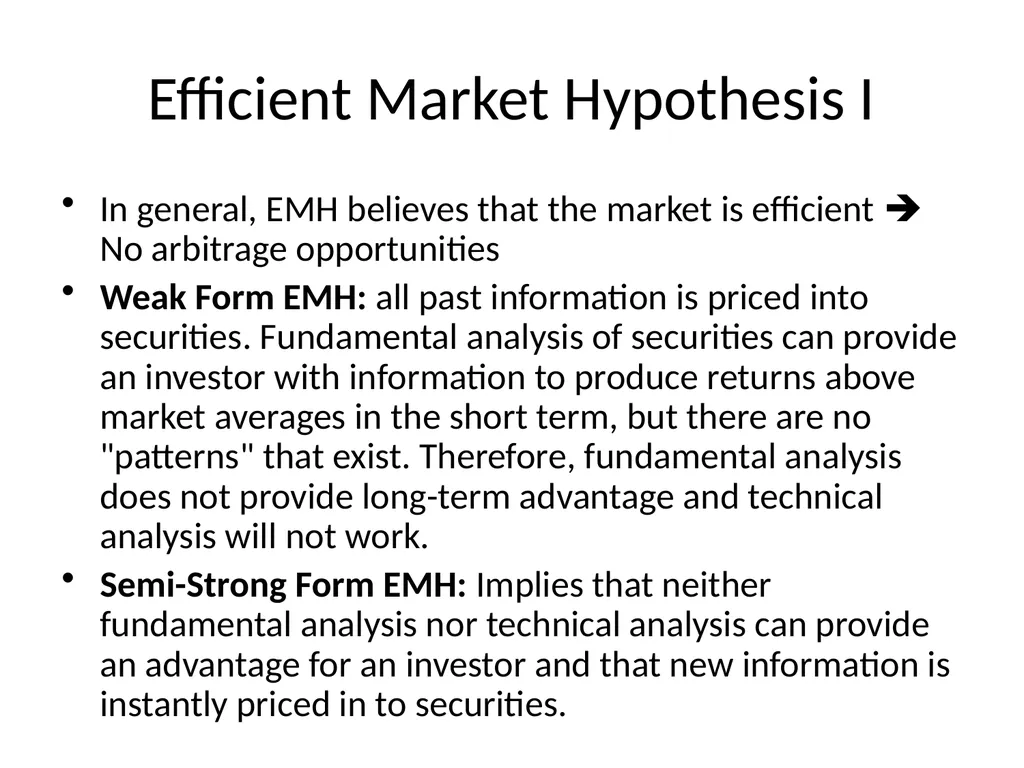
Efficient Market Hypothesis I In general, EMH believes that the market is efficient No arbitrage opportunities
Weak Form EMH: all past information is priced into securities. Fundamental analysis of securities can provide an investor with information to produce returns above market averages in the short term, but there are no "patterns" that exist. Therefore, fundamental analysis does not provide long-term advantage and technical analysis will not work.
Semi-Strong Form EMH: Implies that neither fundamental analysis nor technical analysis can provide an advantage for an investor and that new information is instantly priced in to securities.<br>
03
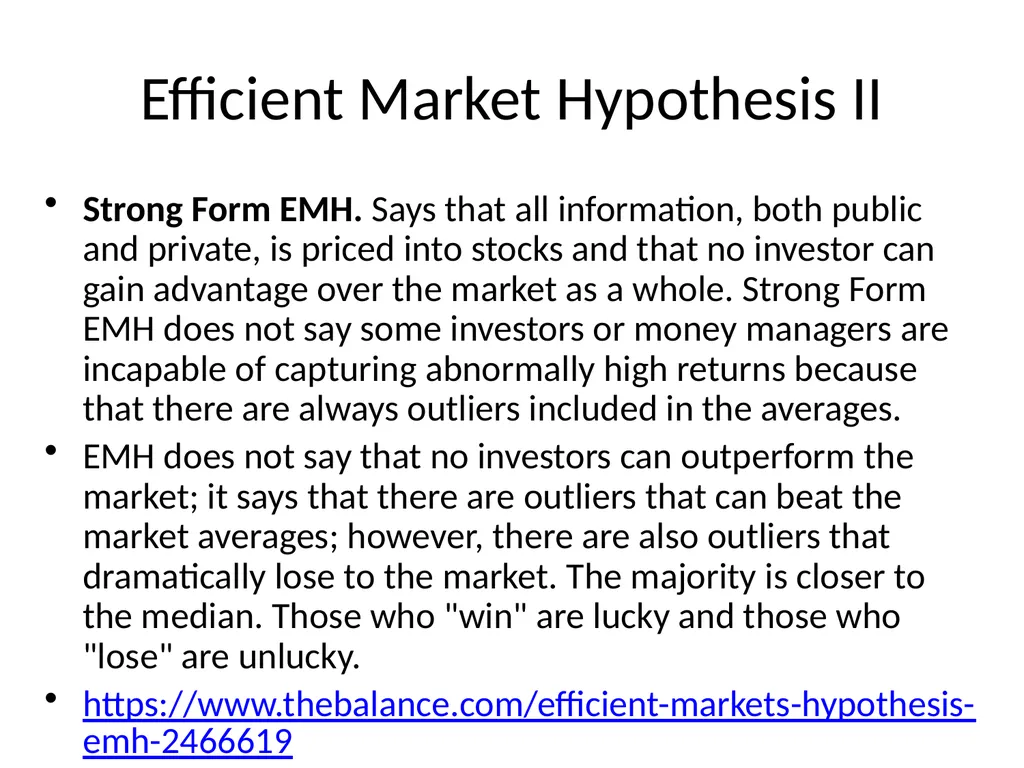
Efficient Market Hypothesis II Strong Form EMH. Says that all information, both public and private, is priced into stocks and that no investor can gain advantage over the market as a whole. Strong Form EMH does not say some investors or money managers are incapable of capturing abnormally high returns because that there are always outliers included in the averages.
EMH does not say that no investors can outperform the market; it says that there are outliers that can beat the market averages; however, there are also outliers that dramatically lose to the market. The majority is closer to the median. Those who "win" are lucky and those who "lose" are unlucky.
https://www.thebalance.com/efficient-markets-hypothesis-emh-2466619<br>
04
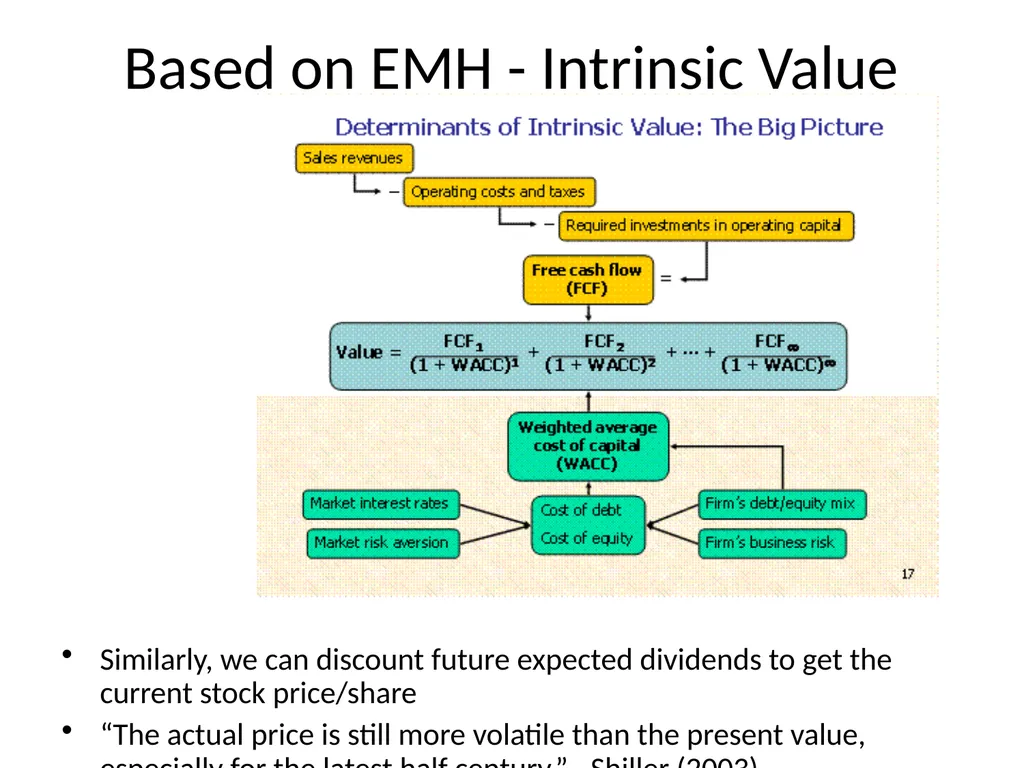
Based on EMH - Intrinsic Value Similarly, we can discount future expected dividends to get the current stock price/share
“The actual price is still more volatile than the present value, especially for the latest half century.”– Shiller (2003)<br>
05
Anomalies – Does the EMH hold? 7 Market Anomalies Every Investor Should Know
Small Firms Tend to Outperform.
January Effect.
Low Book Value.
Neglected Stocks.
Reversals.
The Days of the Week.
Dogs of the Dow.
The Bottom Line.
https://www.investopedia.com/articles/financial-theory/11/trading-with-market-anomalies.asp
And the stock market bubble
Conclusion: “anomalies that didn’t seem likely to square with the efficient markets theory” --- Shiller (2003)<br>
06
Shiller’s comments on Excess Volatility “these stocks show excess volatility relative to what would be predicted by the efficient markets model.”
“the present value of dividends as discounted in this model had only a tenuous relation to actual stock prices, and did not appear volatile enough to justify the price movements unless we pushed the coefficient of relative risk aversion to ridiculously high levels, higher than the value of three that was used for the plot”<br>
07
Shiller’s comments on EMH “even though the aggregate stock market appears to be wildly inefficient, individual stock prices do show some correspondence to efficient markets theory.”
“while markets are not totally crazy, they contain quite substantial noise, so substantial that it dominates the movements in the aggregate market. The efficient markets model, for the aggregate stock market, has still never been supported by any study effectively linking stock market fluctuations with subsequent fundamentals. “<br>
08
What is Behavior Finance Study the influence of psychology on the behavior of investors and the subsequent effects on the markets.
Investors are not always rational, have limits to their self-control, and hold biased opinions.
We can explain anomalies based on psychological theories --- behavior finance<br>
Examples in Shiller (2003) – Feedback Model “When speculative prices go up, creating successes for some investors, this may attract public attention, promote word-of-mouth enthusiasm, and heighten expectations for further price increases”
“This process in turn increases investor demand and thus generates another round of price increases. If the feedback is not interrupted, it may produce after many rounds a speculative bubble”
“The high prices are ultimately not sustainable, since they are high only because of expectations of further price increases, and so the bubble eventually bursts, and prices come falling down”<br>
11
Feedback Model Explanation cognitive psychology - human judgments of the probability of future events show systematic biases.
“people may tend to match stock price patterns into salient categories such as dramatic and persistent price trends, thus leading to feedback dynamics, even if these categories may be rarely seen in fundamental underlying factors”
Biased self-attribution – “individuals attribute events that confirm the validity of their actions to their own high ability and attribute events that disconfirm their actions to bad luck or sabotage”
Example: Ponzi schemes
Example: Momentum<br>
12
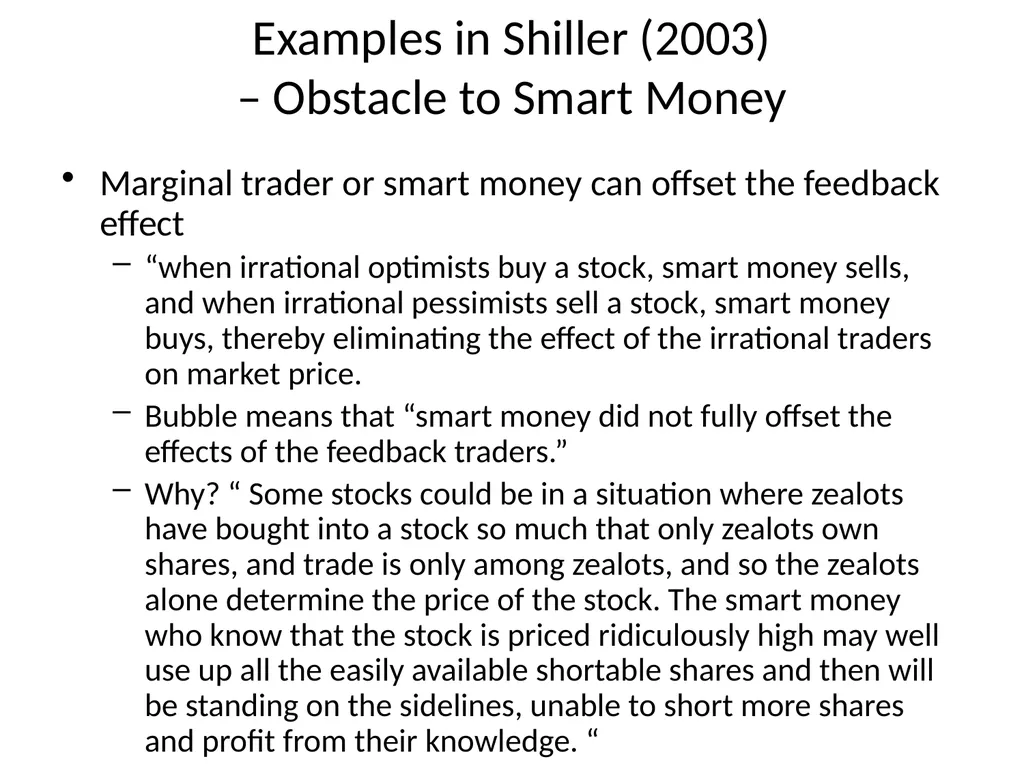
Examples in Shiller (2003) – Obstacle to Smart Money Marginal trader or smart money can offset the feedback effect
“when irrational optimists buy a stock, smart money sells, and when irrational pessimists sell a stock, smart money buys, thereby eliminating the effect of the irrational traders on market price.
Bubble means that “smart money did not fully offset the effects of the feedback traders.”
Why? “ Some stocks could be in a situation where zealots have bought into a stock so much that only zealots own shares, and trade is only among zealots, and so the zealots alone determine the price of the stock. The smart money who know that the stock is priced ridiculously high may well use up all the easily available shortable shares and then will be standing on the sidelines, unable to short more shares and profit from their knowledge. “<br>
13
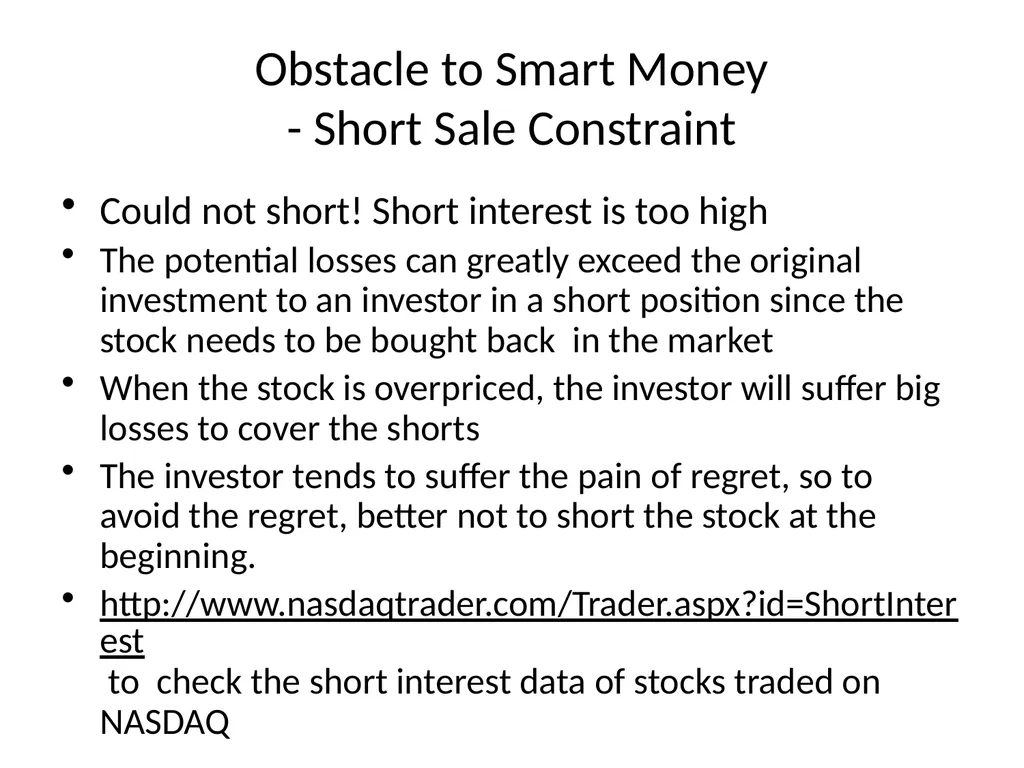
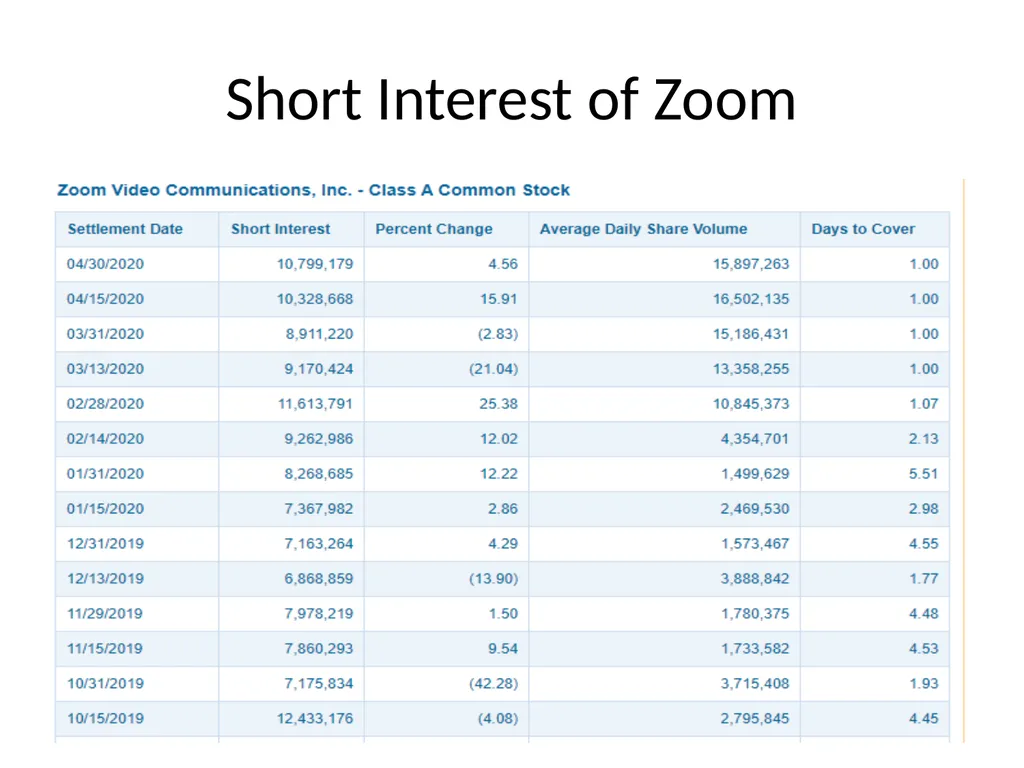
Obstacle to Smart Money - Short Sale Constraint Could not short! Short interest is too high
The potential losses can greatly exceed the original investment to an investor in a short position since the stock needs to be bought back in the market
When the stock is overpriced, the investor will suffer big losses to cover the shorts
The investor tends to suffer the pain of regret, so to avoid the regret, better not to short the stock at the beginning.
http://www.nasdaqtrader.com/Trader.aspx?id=ShortInterest to check the short interest data of stocks traded on NASDAQ<br>
14
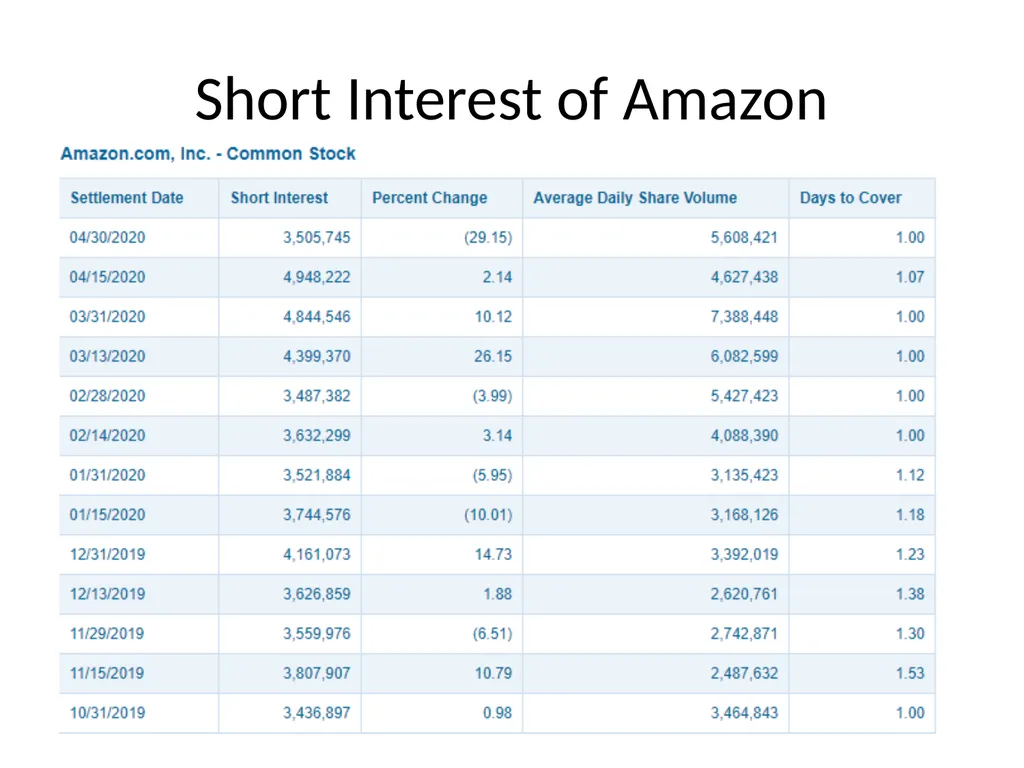
Short Interest of Amazon<br>
15
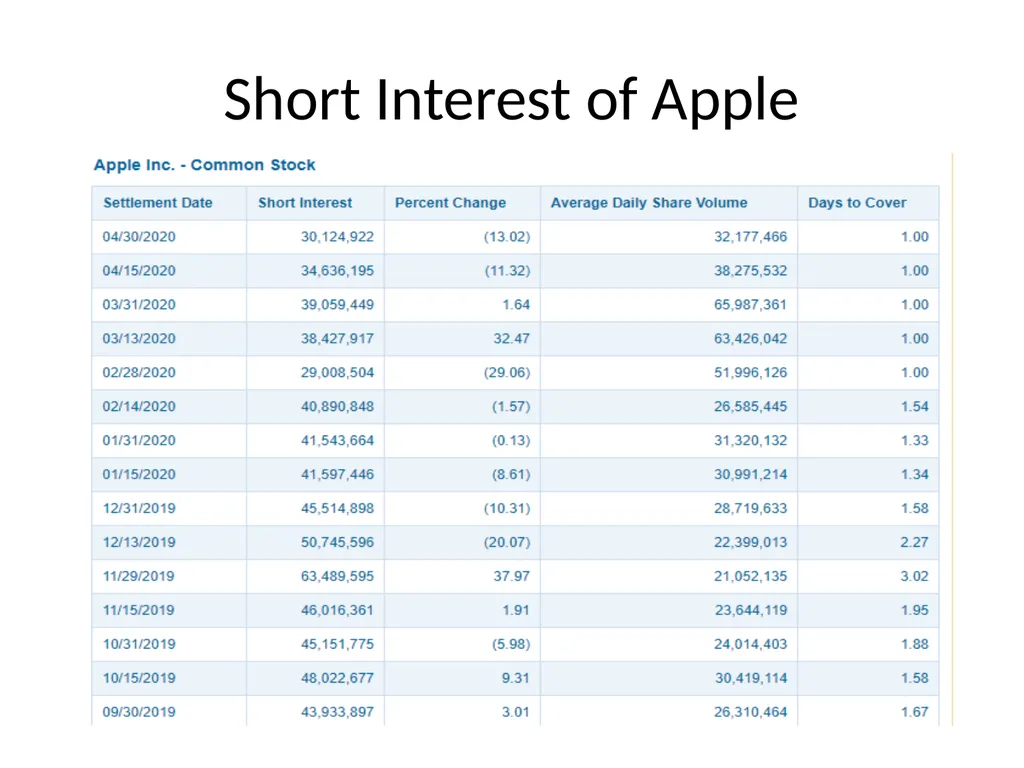
Short Interest of Apple<br>
16
Short Interest of Zoom<br>
17
Dr. Shiller on Youtube Robert J. Shiller discusses the importance of economic irrationality, crowd behavior, and other elements of behavioral finance in understanding the global economy and making effective economic policy
https://www.youtube.com/watch?v=LnX3DxFOdOc
Yale's Shiller on Economic Fallout From Virus, Fed Policy and Housing
What Will Cause The Next Recession - Robert Shiller On Human Behavior<br>