
From last lesson: Pythagoras’ Theorem c2 = a2 + b2
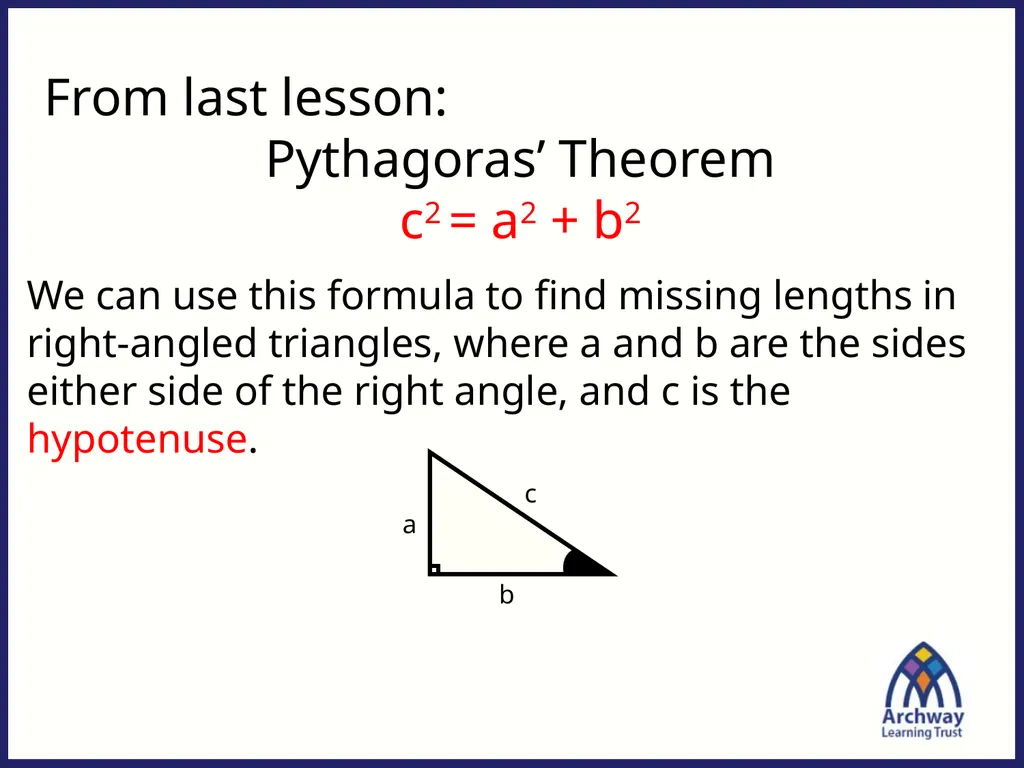
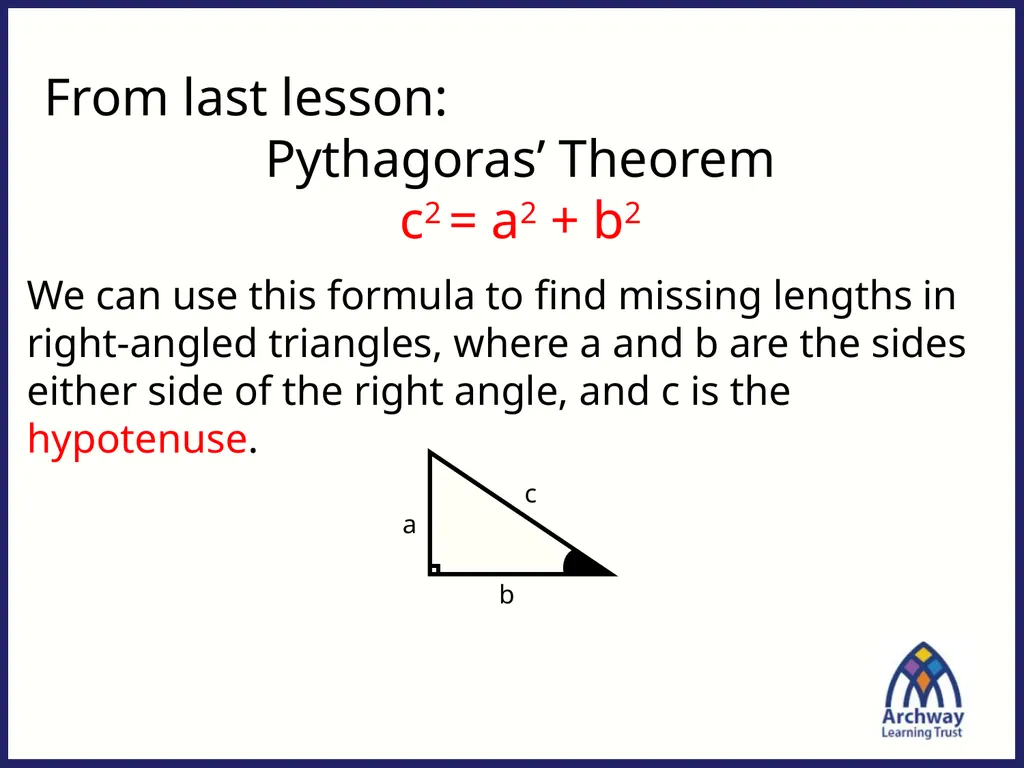

Description: From last lesson: Pythagoras Theorem c2 a2 b2 We can use this formula to find missing lengths in right-angled triangles, where a and b are the sides either side of the right angle, and c is the hypotenuse. a b c From last lesson:
Related Topics
Download Presentation
"From last lesson: Pythagoras’ Theorem c2 = a2 + b2" is the property of its rightful owner. Permission is granted to download and print the materials on this website for personal, non-commercial use only, and to display it on your personal computer provided you do not modify the materials and that you retain all copyright notices contained in the materials. By downloading content from our website, you accept the terms of this agreement.
Presentation Transcript
slide1. From last lesson:
Pythagoras’ Theorem
c2 = a2 + b2 We can use this formula to find missing lengths in right-angled triangles, where a and b are the sides either side of the right angle, and c is the hypotenuse. a b c<br>
slide2. From last lesson:
Pythagoras’ Theorem
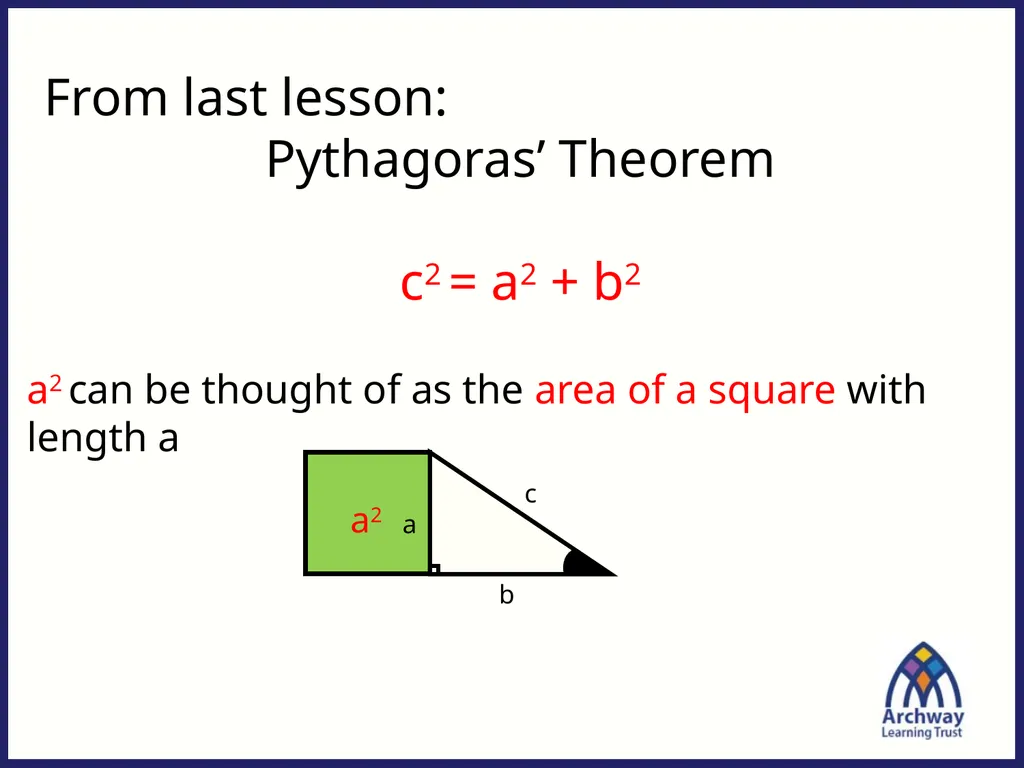
c2 = a2 + b2 a2 can be thought of as the area of a square with length a a b c a2<br>
slide3. From last lesson:
Pythagoras’ Theorem
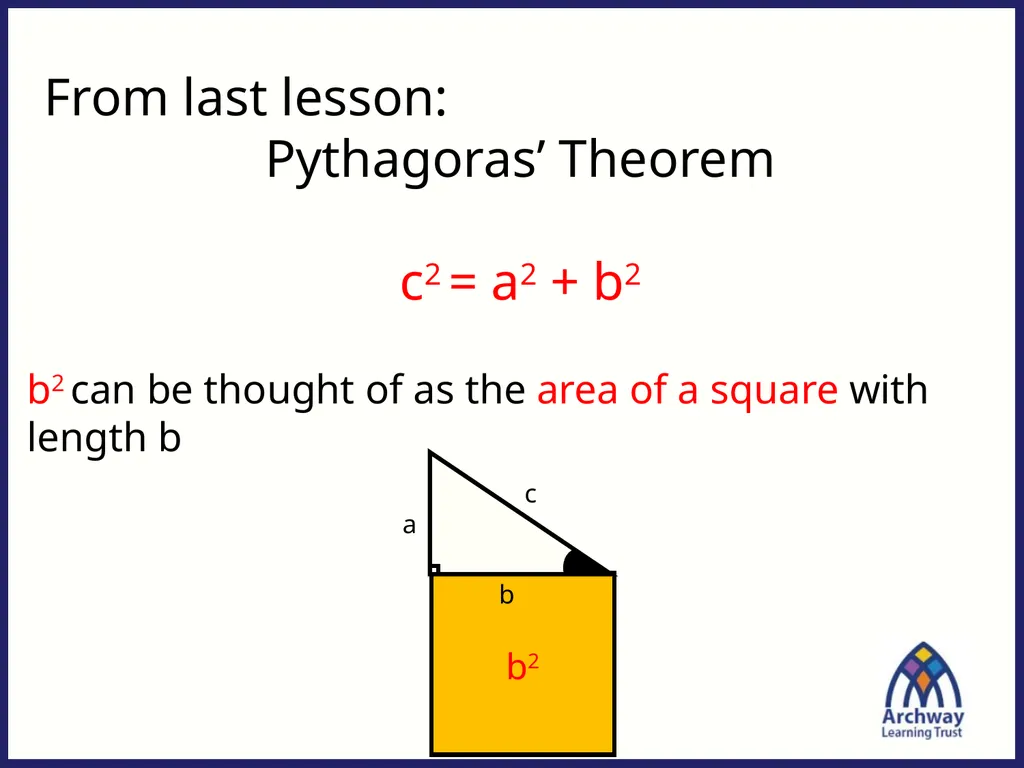
c2 = a2 + b2 b2 can be thought of as the area of a square with length b a b c b2<br>
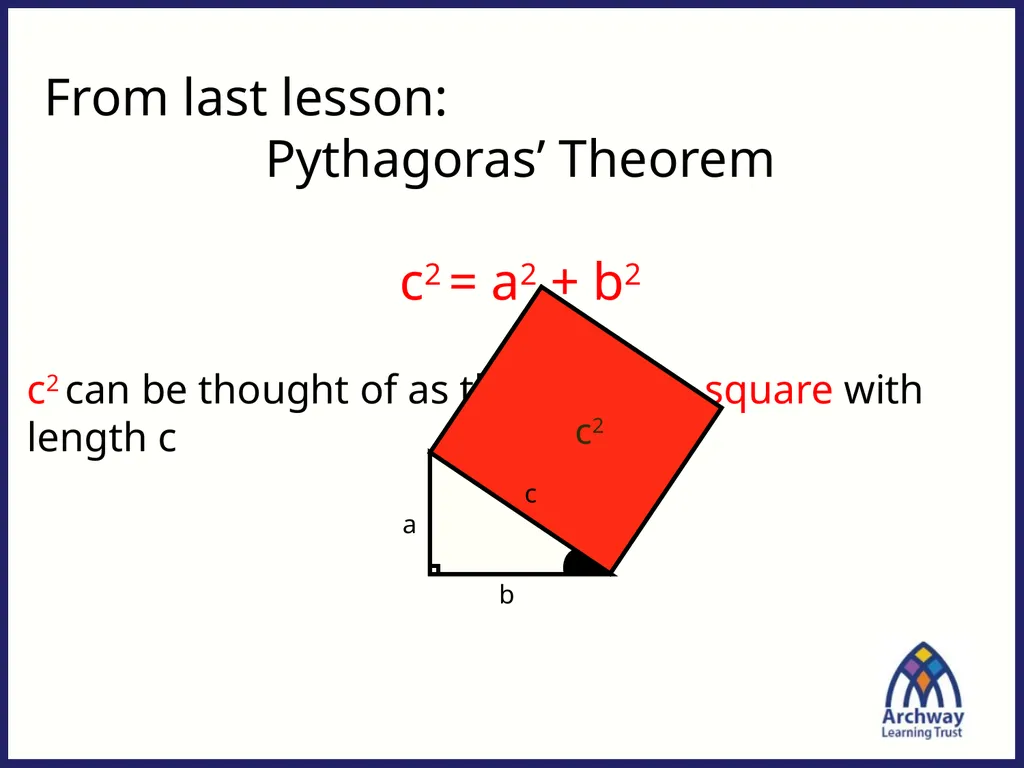
slide4. c2 can be thought of as the area of a square with length c From last lesson:
Pythagoras’ Theorem
c2 = a2 + b2 a b c c2<br>
slide5. From last lesson:
Pythagoras’ Theorem
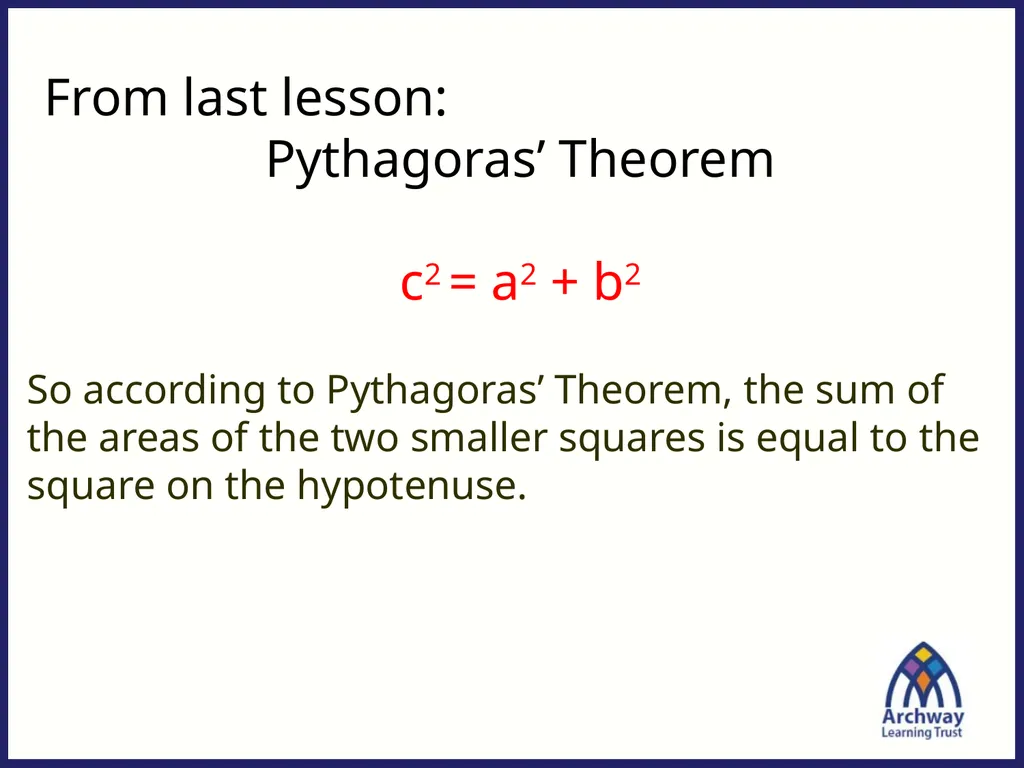
c2 = a2 + b2 So according to Pythagoras’ Theorem, the sum of the areas of the two smaller squares is equal to the square on the hypotenuse.<br>
slide6. From last lesson:
Pythagoras’ Theorem
c2 = a2 + b2 Watch Perigal’s dissection here
Watch another representation of the theorem here<br>
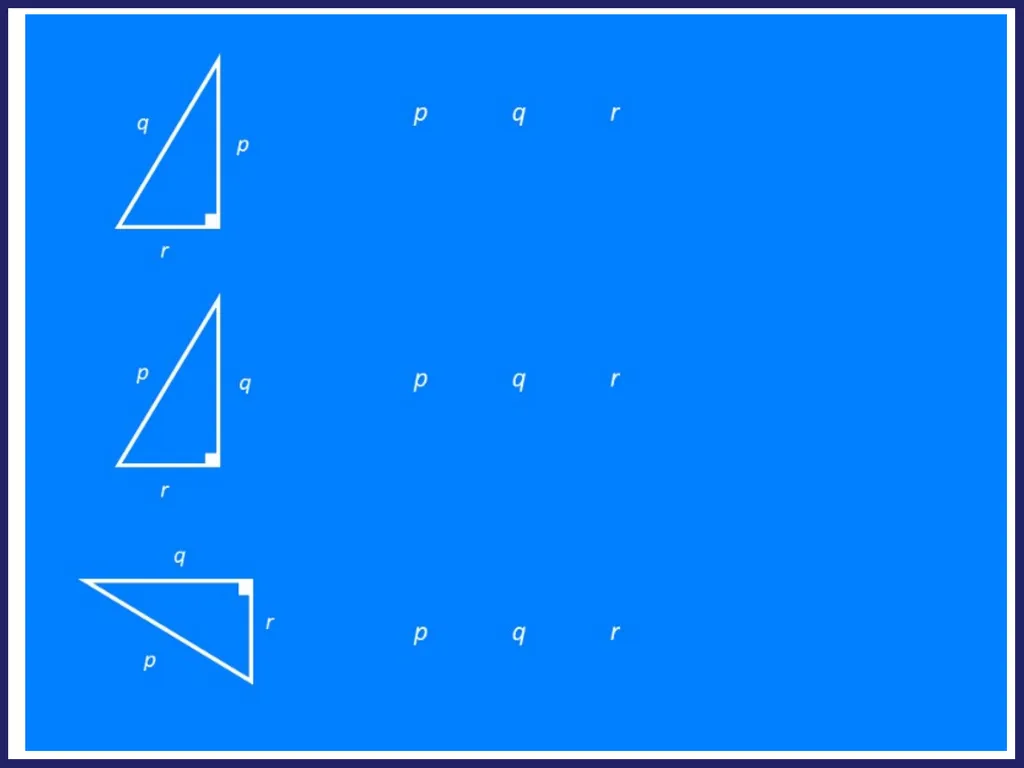
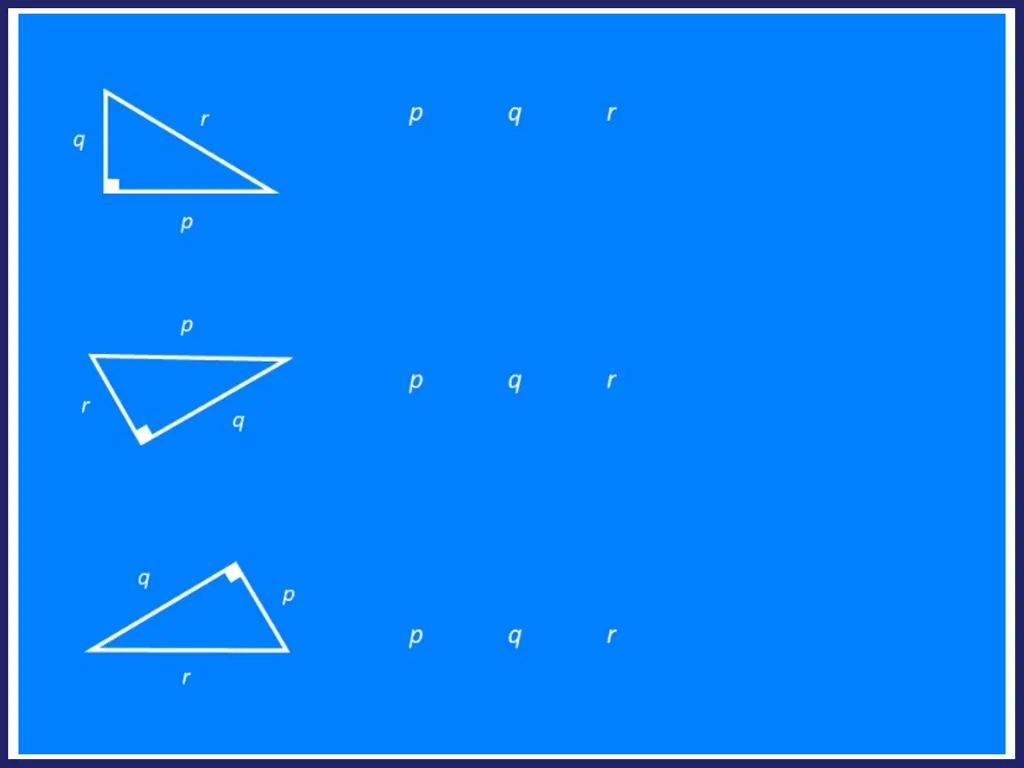
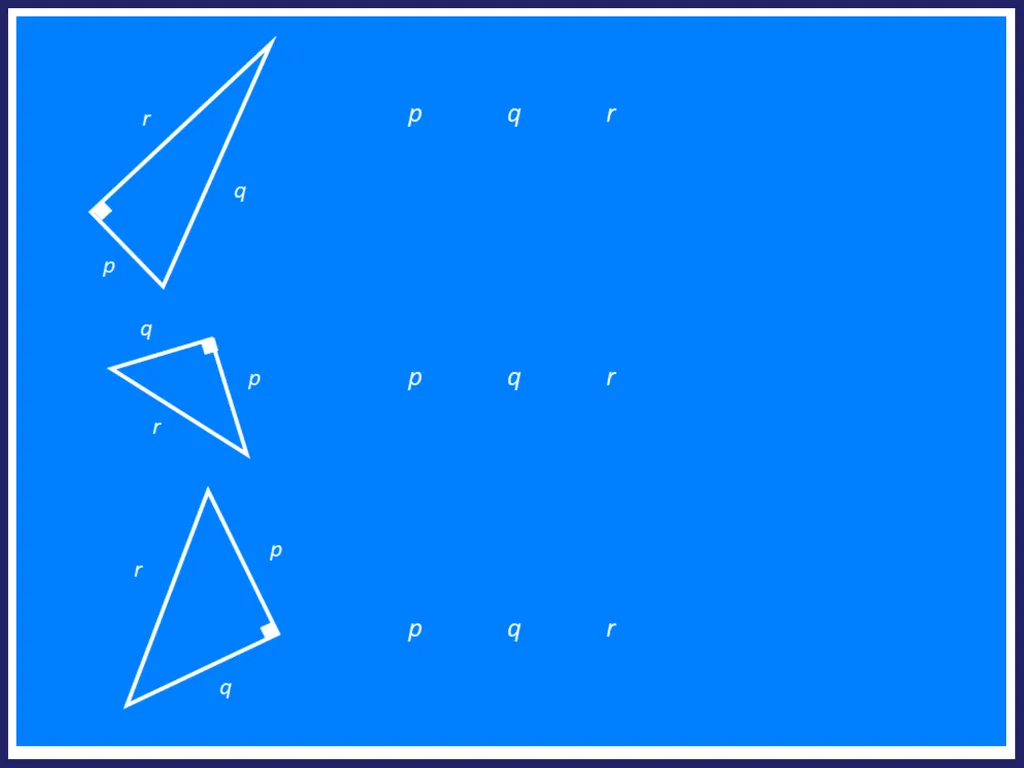
slide7. Before we begin, let’s make sure we know how to identify which side is the hypotenuse.
For the next three slides, identify which side is the hypotenuse.<br>
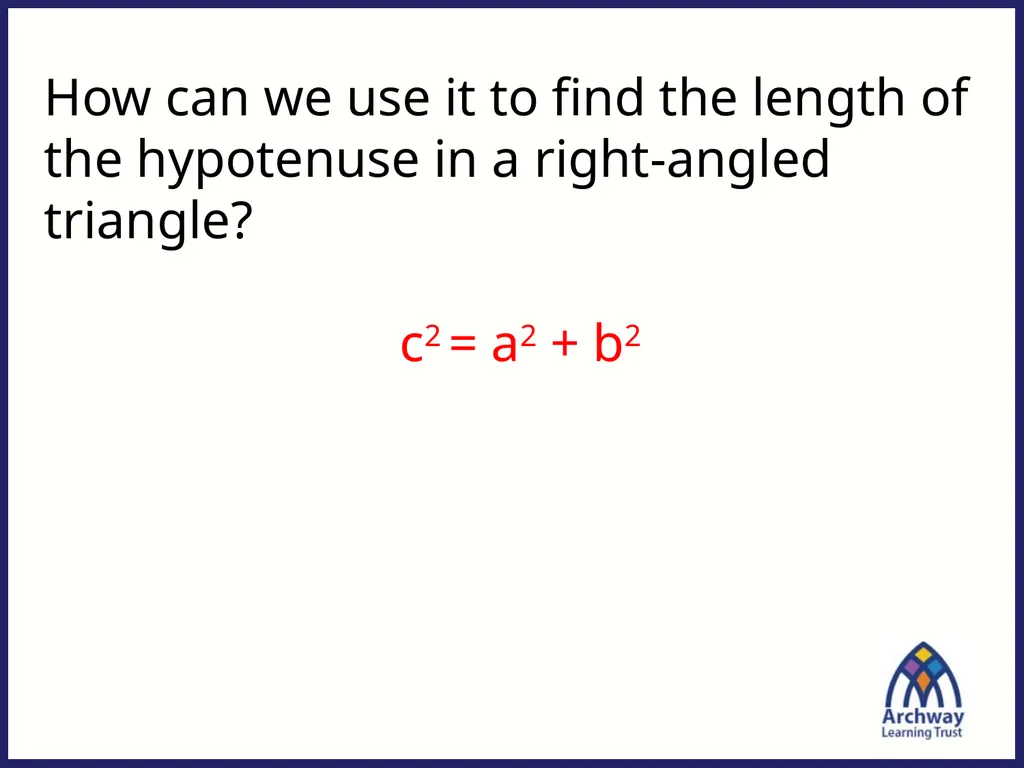
slide11. How can we use it to find the length of the hypotenuse in a right-angled triangle?
c2 = a2 + b2<br>
slide12. The silent teacher
The whole class will watch me very carefully in silence as I silently demonstrate the example. It is important that nobody asks questions during this time.
I will pause at key moments in the process. At these points you should try to think what is going to happen next.
Once I have done this (about 2 minutes) I will talk through the example and take questions.<br>
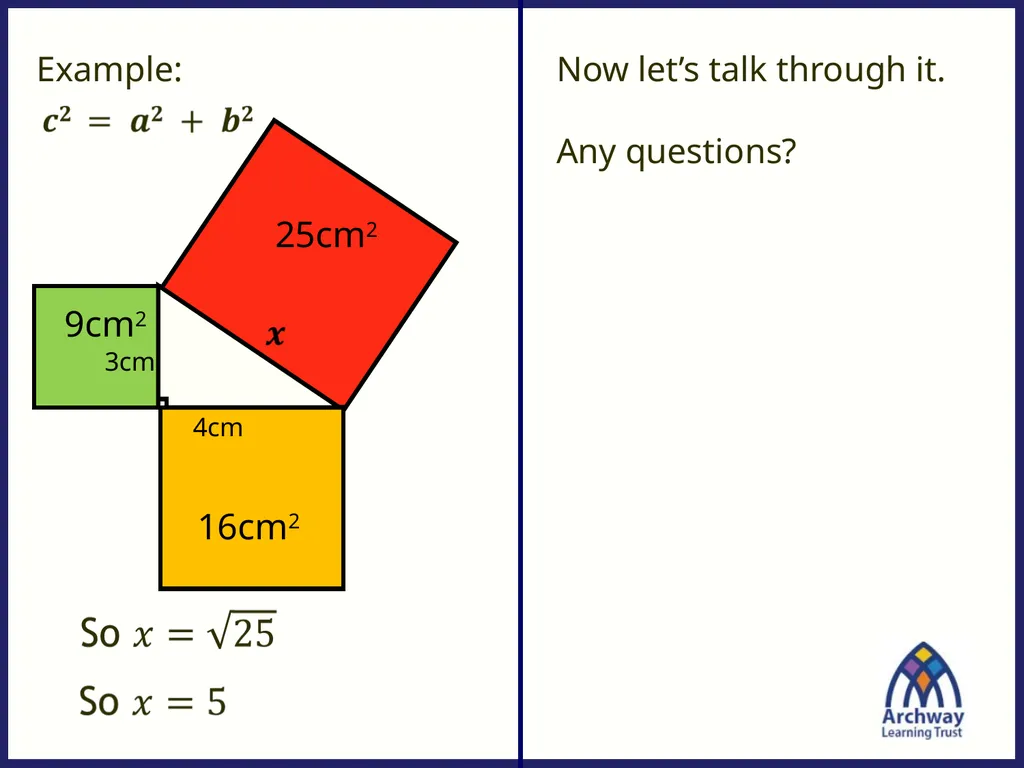
slide13. 9cm2 16cm2 3cm 4cm 25cm2 Example: Now let’s talk through it.
Any questions?<br>
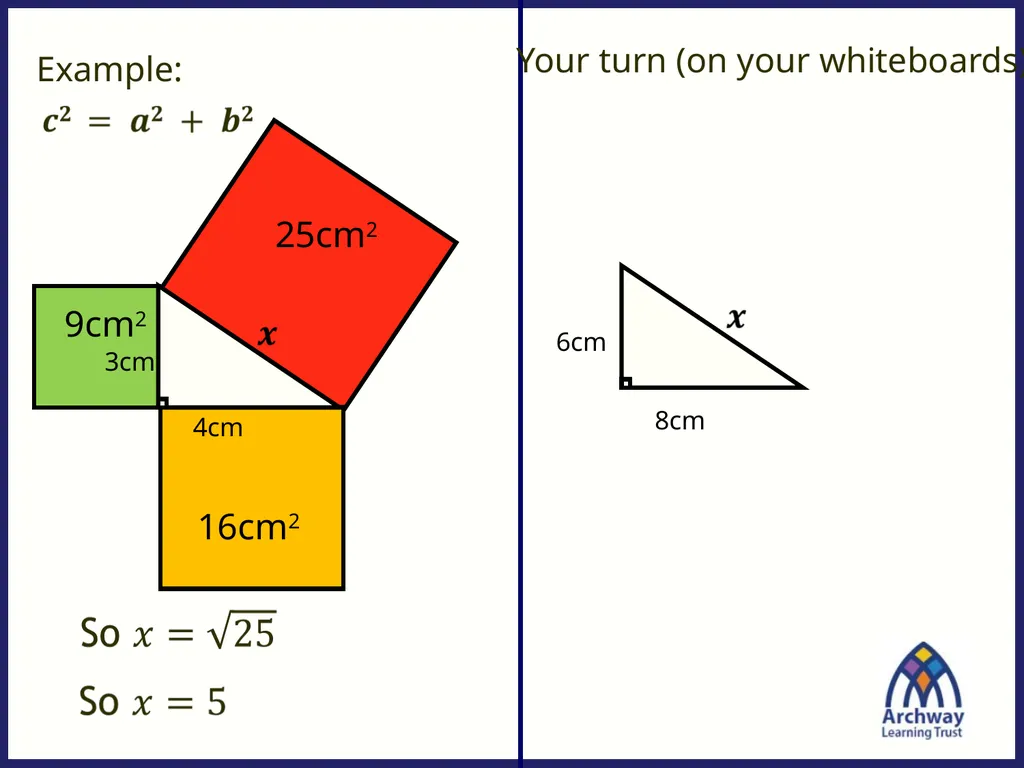
slide14. 9cm2 16cm2 3cm 4cm 25cm2 Example: Your turn (on your whiteboards) 6cm 8cm<br>
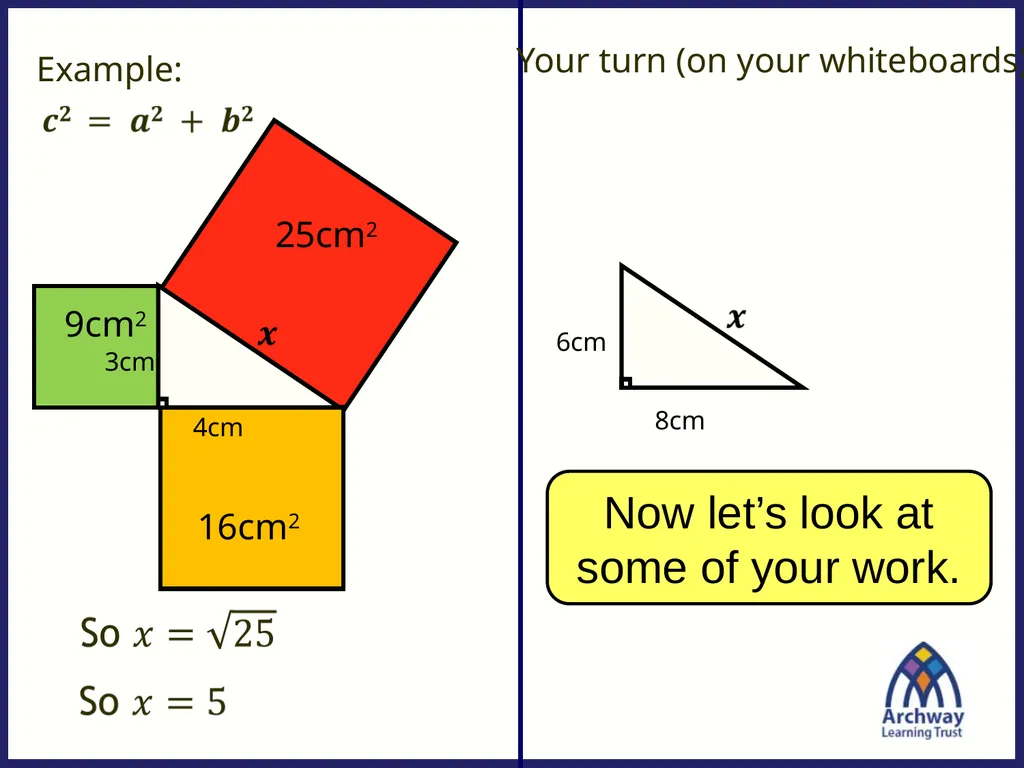
slide15. 9cm2 16cm2 3cm 4cm 25cm2 Example: Your turn (on your whiteboards) 6cm 8cm Now let’s look at some of your work.<br>
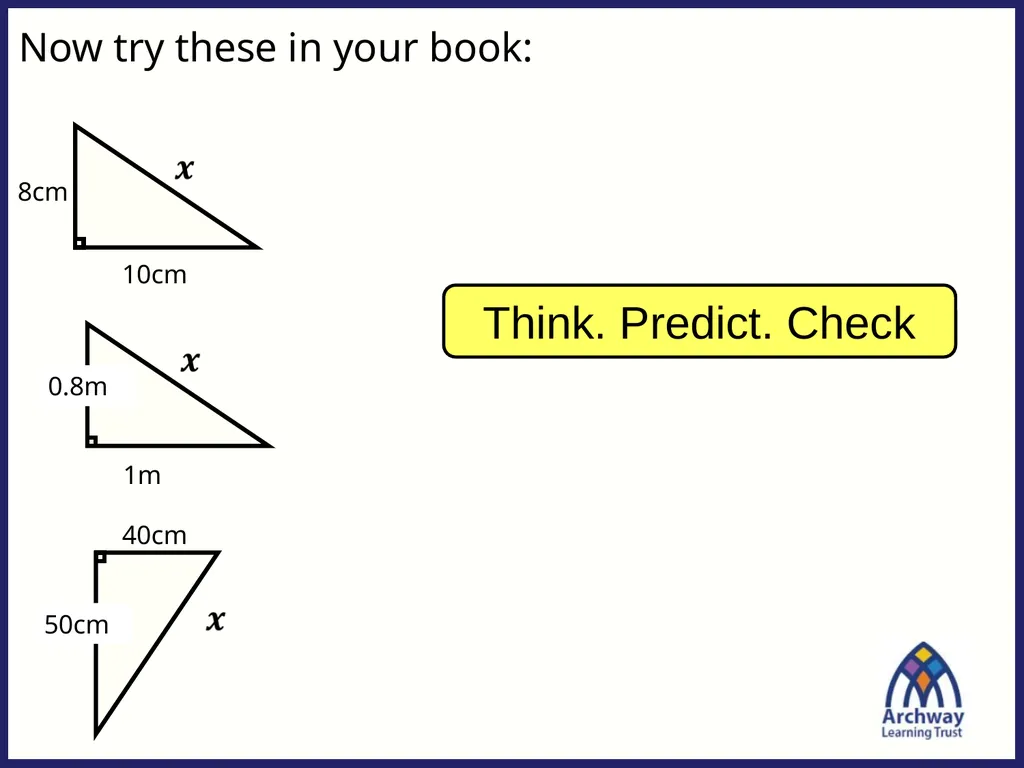
slide16. Now try these in your book: 10cm 8cm 1m 0.8m 50cm 40cm Think. Predict. Check<br>
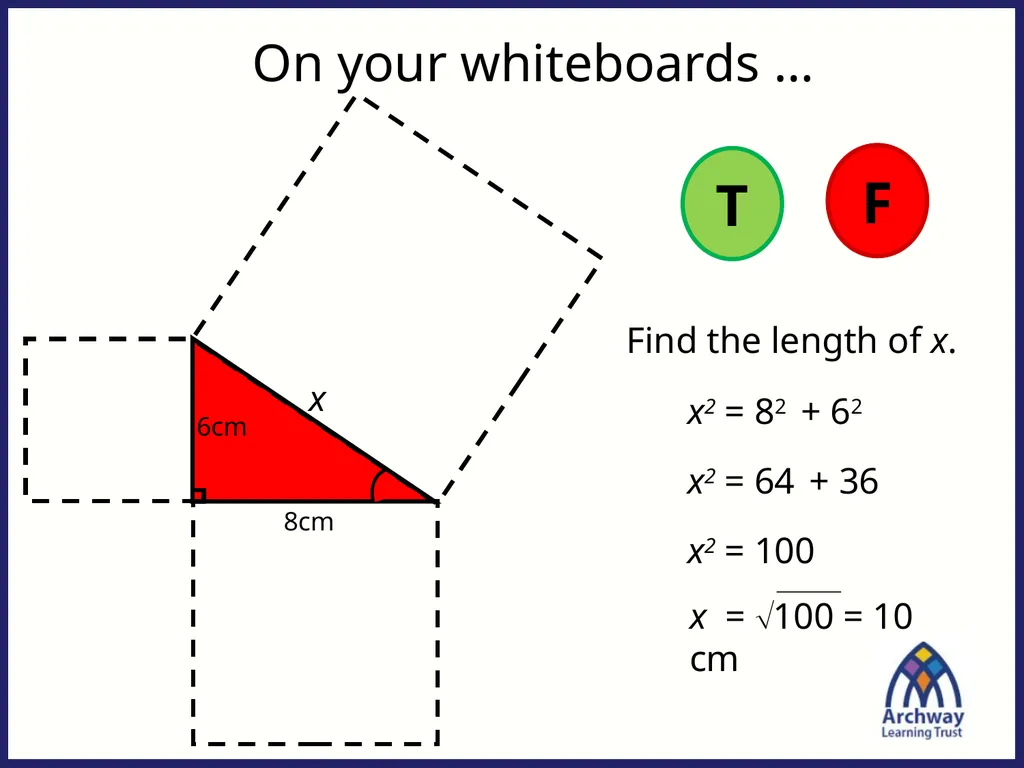
slide17. 6cm 8cm x Find the length of x. x2 = 82 + 62 x2 = 64 + 36 x2 = 100 On your whiteboards … F T<br>
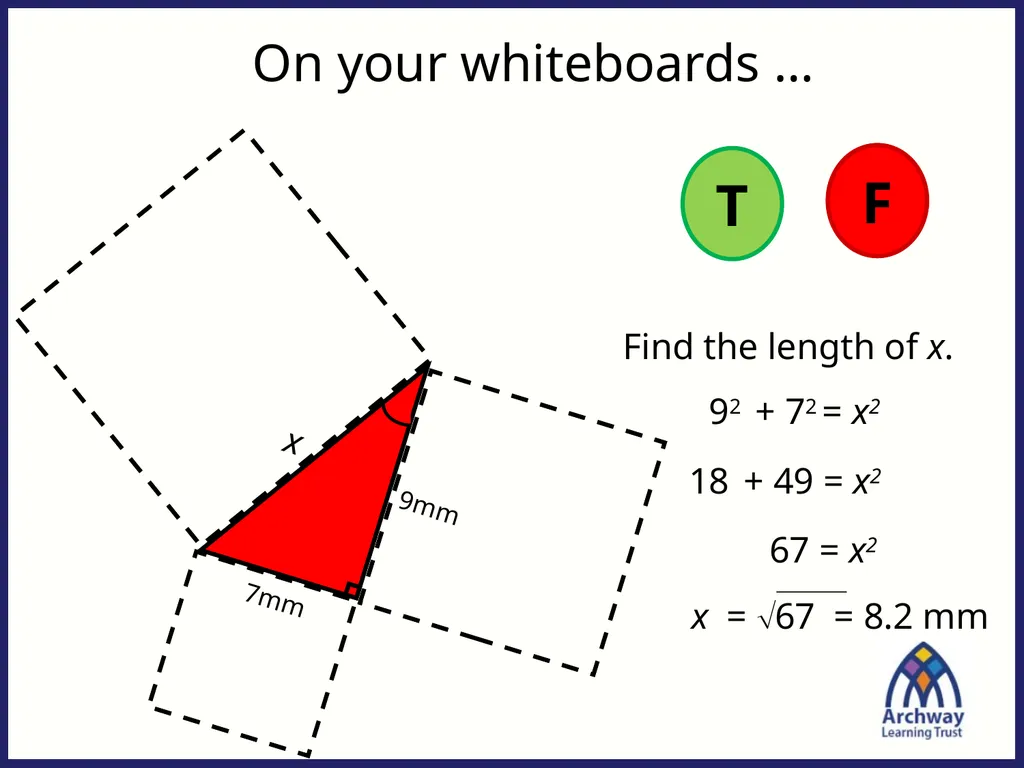
slide18. Find the length of x. 92 + 72 = x2 18 + 49 = x2 67 = x2 On your whiteboards … F T<br>
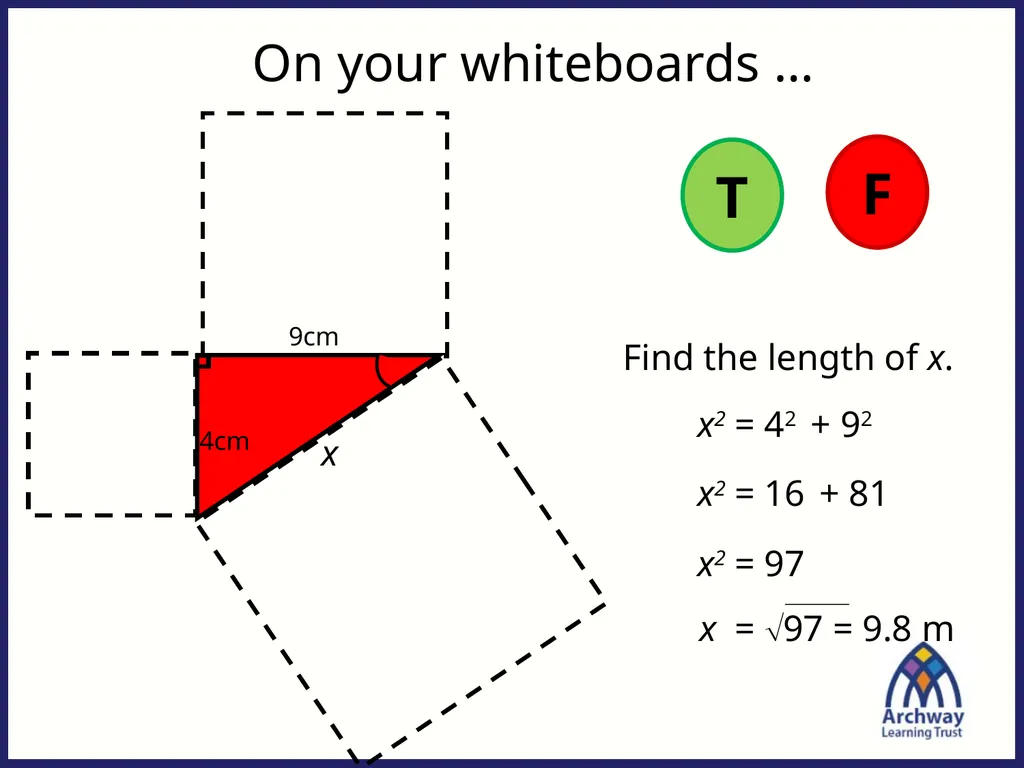
slide19. 4cm 9cm x Find the length of x. x2 = 42 + 92 x2 = 16 + 81 x2 = 97 On your whiteboards … F T<br>
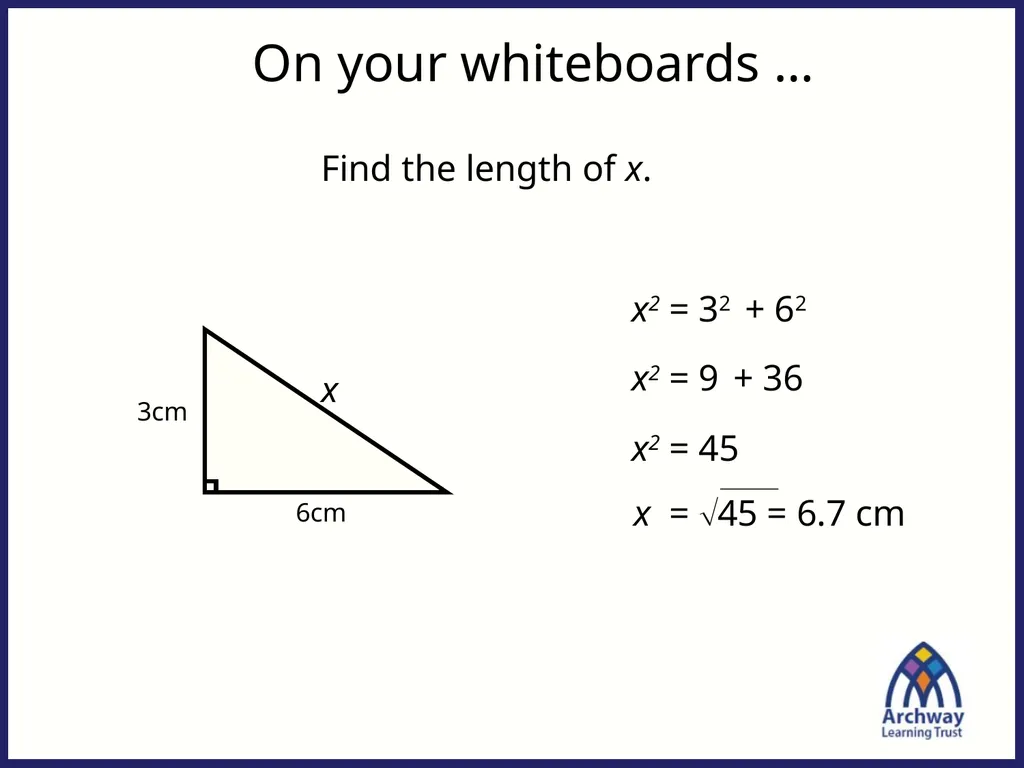
slide20. 3cm 6cm x Find the length of x. x2 = 32 + 62 x2 = 9 + 36 x2 = 45 On your whiteboards …<br>
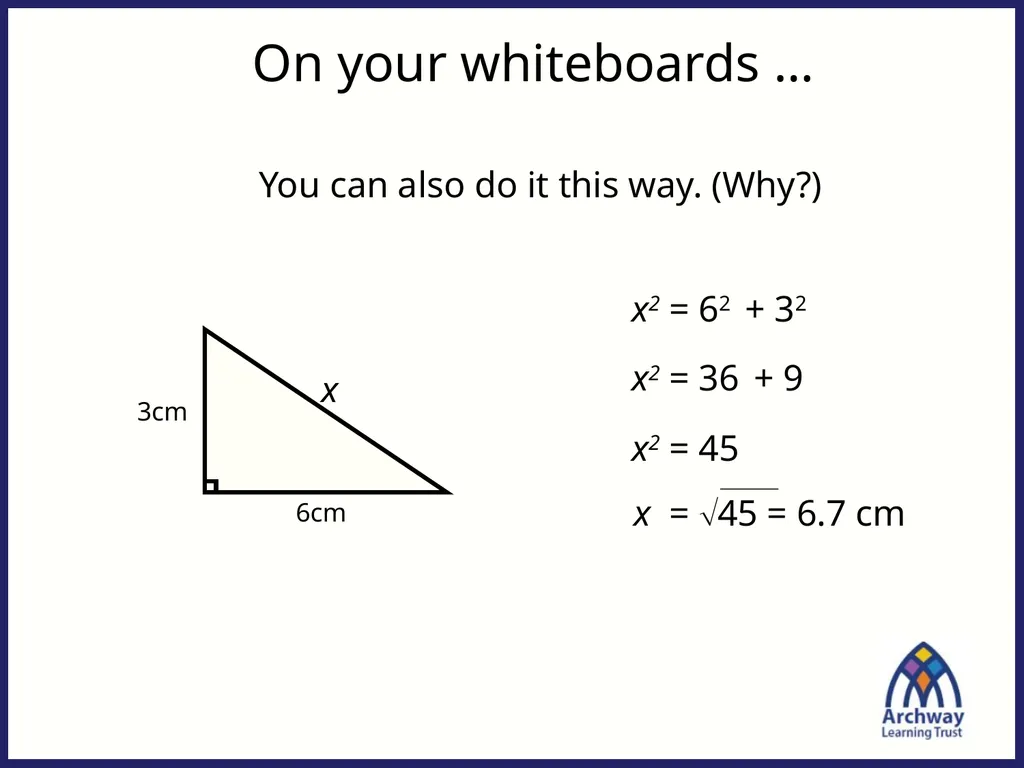
slide21. 3cm 6cm x You can also do it this way. (Why?) x2 = 62 + 32 x2 = 36 + 9 x2 = 45 On your whiteboards …<br>
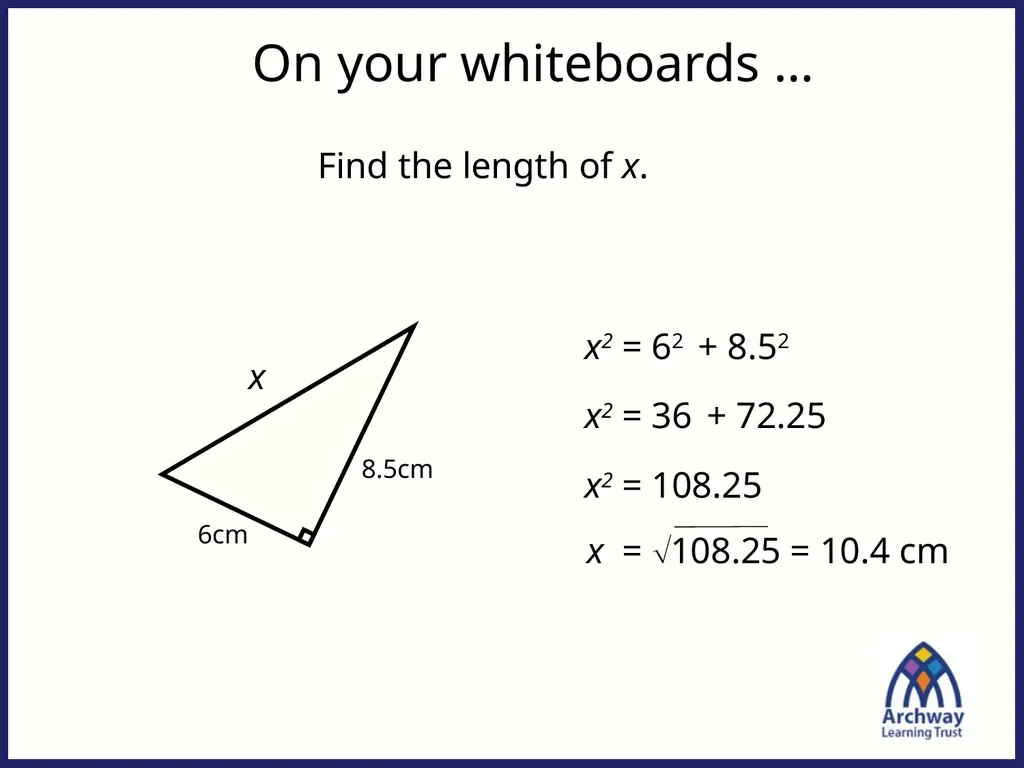
slide22. 6cm 8.5cm x Find the length of x. x2 = 62 + 8.52 x2 = 36 + 72.25 x2 = 108.25 On your whiteboards …<br>
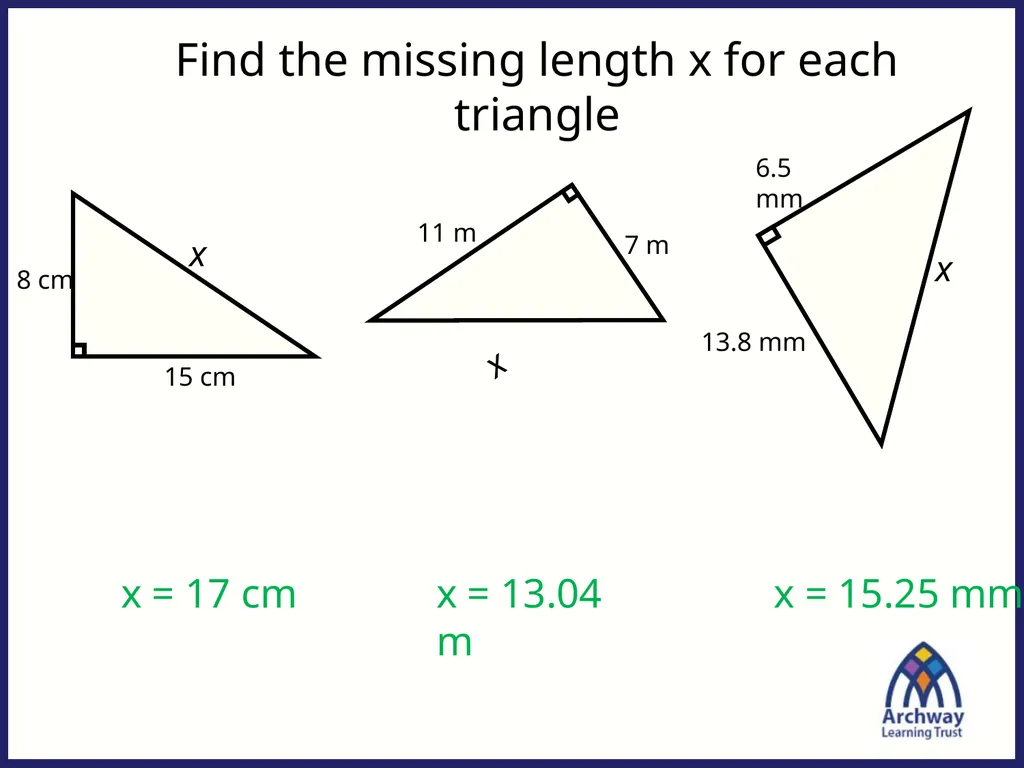
slide23. Find the missing length x for each triangle 8 cm 15 cm x 6.5 mm 13.8 mm x 11 m x 7 m x = 17 cm x = 13.04 m x = 15.25 mm<br>
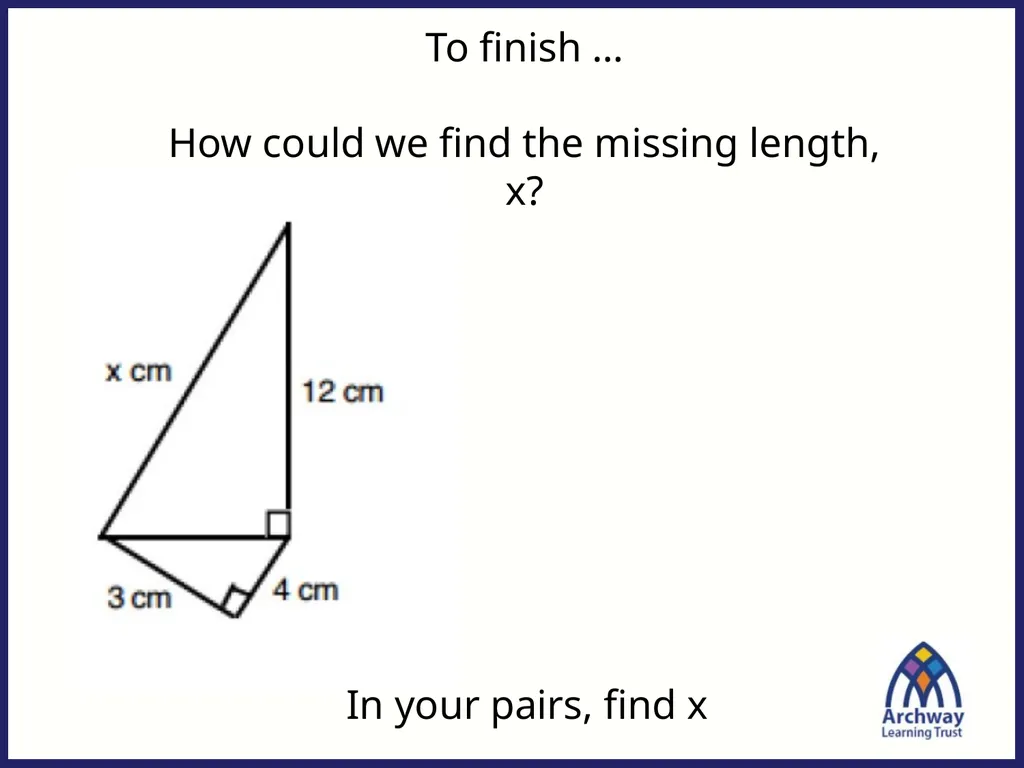
slide24. To finish …
How could we find the missing length, x? In your pairs, find x<br>
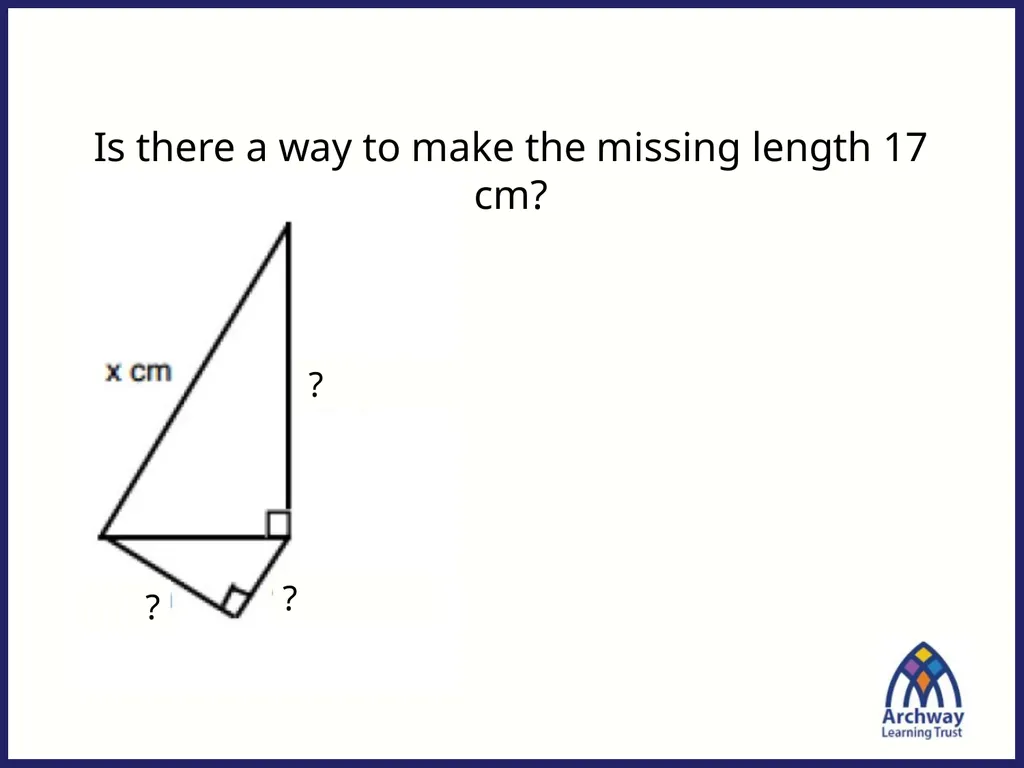
slide25. ? ? ? Is there a way to make the missing length 17 cm?<br>
Pythagoras’ Theorem
c2 = a2 + b2 We can use this formula to find missing lengths in right-angled triangles, where a and b are the sides either side of the right angle, and c is the hypotenuse. a b c<br>
slide2. From last lesson:
Pythagoras’ Theorem
c2 = a2 + b2 a2 can be thought of as the area of a square with length a a b c a2<br>
slide3. From last lesson:
Pythagoras’ Theorem
c2 = a2 + b2 b2 can be thought of as the area of a square with length b a b c b2<br>
slide4. c2 can be thought of as the area of a square with length c From last lesson:
Pythagoras’ Theorem
c2 = a2 + b2 a b c c2<br>
slide5. From last lesson:
Pythagoras’ Theorem
c2 = a2 + b2 So according to Pythagoras’ Theorem, the sum of the areas of the two smaller squares is equal to the square on the hypotenuse.<br>
slide6. From last lesson:
Pythagoras’ Theorem
c2 = a2 + b2 Watch Perigal’s dissection here
Watch another representation of the theorem here<br>
slide7. Before we begin, let’s make sure we know how to identify which side is the hypotenuse.
For the next three slides, identify which side is the hypotenuse.<br>
slide11. How can we use it to find the length of the hypotenuse in a right-angled triangle?
c2 = a2 + b2<br>
slide12. The silent teacher
The whole class will watch me very carefully in silence as I silently demonstrate the example. It is important that nobody asks questions during this time.
I will pause at key moments in the process. At these points you should try to think what is going to happen next.
Once I have done this (about 2 minutes) I will talk through the example and take questions.<br>
slide13. 9cm2 16cm2 3cm 4cm 25cm2 Example: Now let’s talk through it.
Any questions?<br>
slide14. 9cm2 16cm2 3cm 4cm 25cm2 Example: Your turn (on your whiteboards) 6cm 8cm<br>
slide15. 9cm2 16cm2 3cm 4cm 25cm2 Example: Your turn (on your whiteboards) 6cm 8cm Now let’s look at some of your work.<br>
slide16. Now try these in your book: 10cm 8cm 1m 0.8m 50cm 40cm Think. Predict. Check<br>
slide17. 6cm 8cm x Find the length of x. x2 = 82 + 62 x2 = 64 + 36 x2 = 100 On your whiteboards … F T<br>
slide18. Find the length of x. 92 + 72 = x2 18 + 49 = x2 67 = x2 On your whiteboards … F T<br>
slide19. 4cm 9cm x Find the length of x. x2 = 42 + 92 x2 = 16 + 81 x2 = 97 On your whiteboards … F T<br>
slide20. 3cm 6cm x Find the length of x. x2 = 32 + 62 x2 = 9 + 36 x2 = 45 On your whiteboards …<br>
slide21. 3cm 6cm x You can also do it this way. (Why?) x2 = 62 + 32 x2 = 36 + 9 x2 = 45 On your whiteboards …<br>
slide22. 6cm 8.5cm x Find the length of x. x2 = 62 + 8.52 x2 = 36 + 72.25 x2 = 108.25 On your whiteboards …<br>
slide23. Find the missing length x for each triangle 8 cm 15 cm x 6.5 mm 13.8 mm x 11 m x 7 m x = 17 cm x = 13.04 m x = 15.25 mm<br>
slide24. To finish …
How could we find the missing length, x? In your pairs, find x<br>
slide25. ? ? ? Is there a way to make the missing length 17 cm?<br>