From Research to Sustainable Development Action: How Far we have Come? 2019 GDN Conference, October 23, Bonn Knowledge for Sustainable Development: the Research Policy-Policy Nexus Njuguna Ndungu African Economic Research Consortium, AERC
"From Research to Sustainable Development Action:" is the property of its rightful owner. Permission is granted to
download and print the materials on this website for personal, non-commercial use only, and to display it
on your personal computer provided you do not modify the materials and that you retain all copyright
notices contained in the materials. By downloading content from our website, you accept the terms of this
agreement.
Presentation Transcript
01
From Research to Sustainable Development Action: How Far we have Come? 2019 GDN Conference, October 23, Bonn
Knowledge for Sustainable Development: the Research Policy-Policy Nexus
Njuguna Ndung’u
African Economic Research Consortium, AERC<br>
02
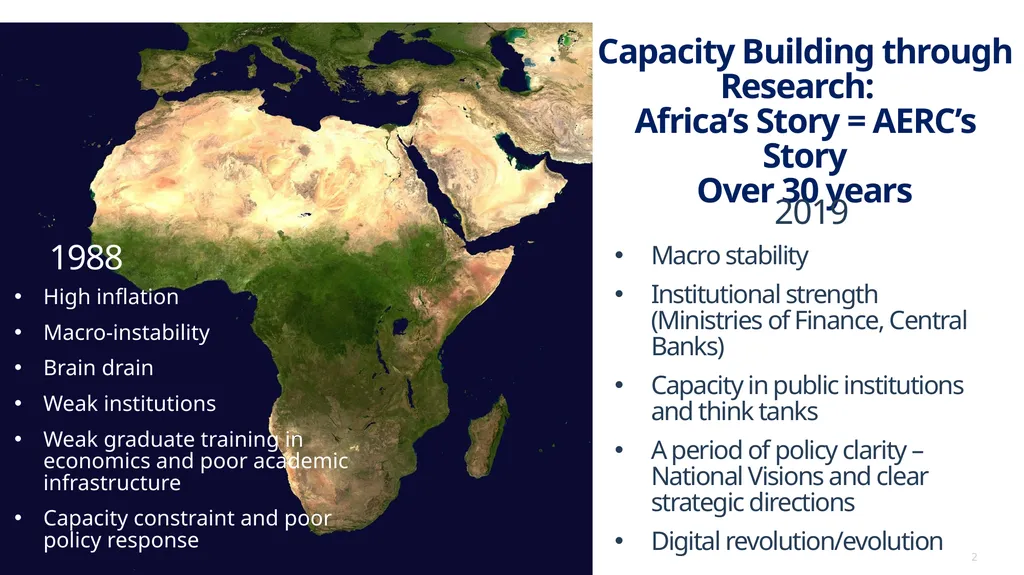
2 Capacity Building through Research: Africa’s Story = AERC’s Story Over 30 years High inflation
Macro-instability
Brain drain
Weak institutions
Weak graduate training in economics and poor academic infrastructure
Capacity constraint and poor policy response 1988 2019
Macro stability
Institutional strength (Ministries of Finance, Central Banks)
Capacity in public institutions and think tanks
A period of policy clarity – National Visions and clear strategic directions
Digital revolution/evolution<br>
03
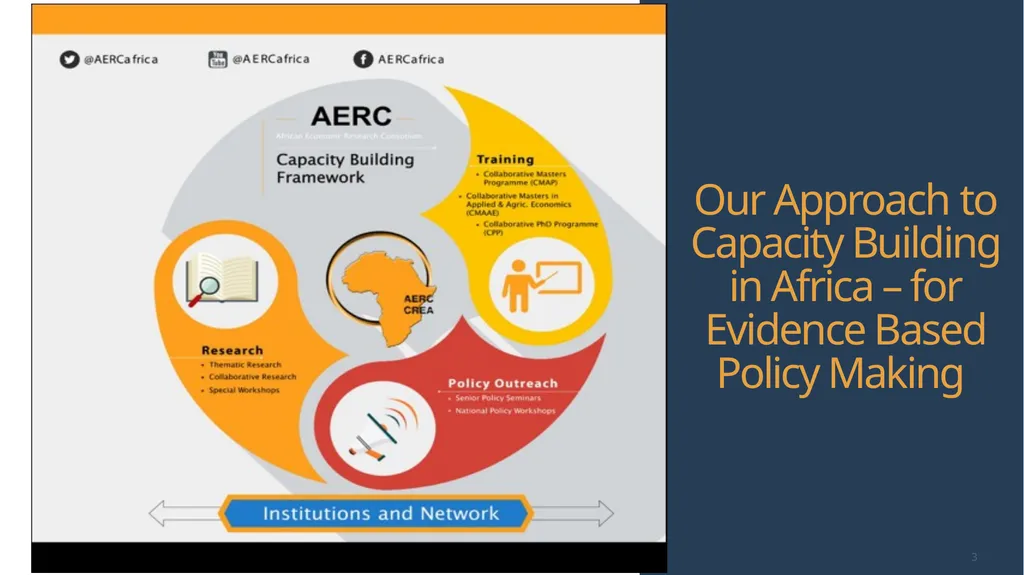
Our Approach to Capacity Building in Africa – for Evidence Based Policy Making 3<br>
04
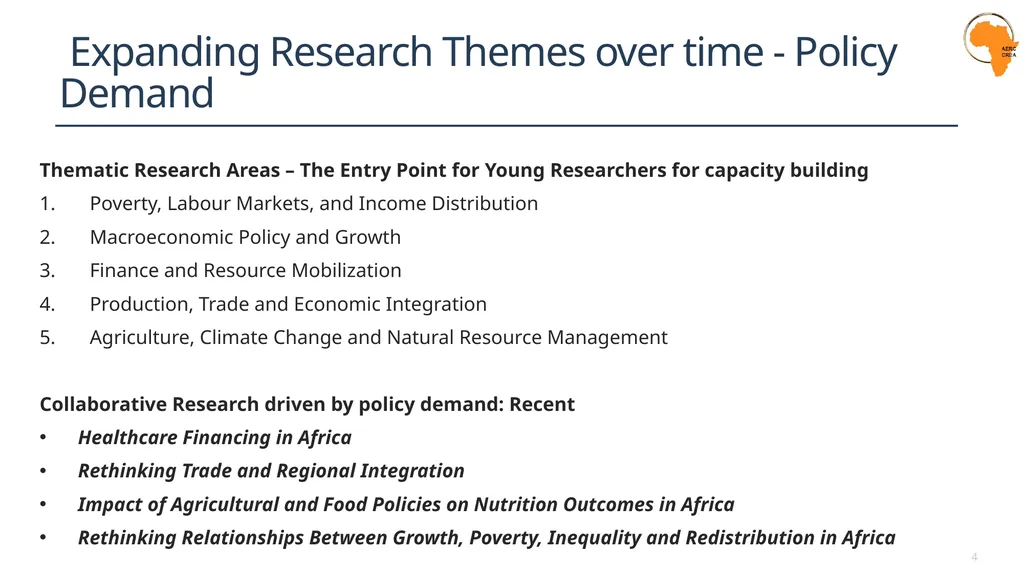
Expanding Research Themes over time - Policy Demand Thematic Research Areas – The Entry Point for Young Researchers for capacity building
1. Poverty, Labour Markets, and Income Distribution
2. Macroeconomic Policy and Growth
3. Finance and Resource Mobilization
4. Production, Trade and Economic Integration
5. Agriculture, Climate Change and Natural Resource Management
Collaborative Research driven by policy demand: Recent
Healthcare Financing in Africa
Rethinking Trade and Regional Integration
Impact of Agricultural and Food Policies on Nutrition Outcomes in Africa
Rethinking Relationships Between Growth, Poverty, Inequality and Redistribution in Africa 4<br>
05
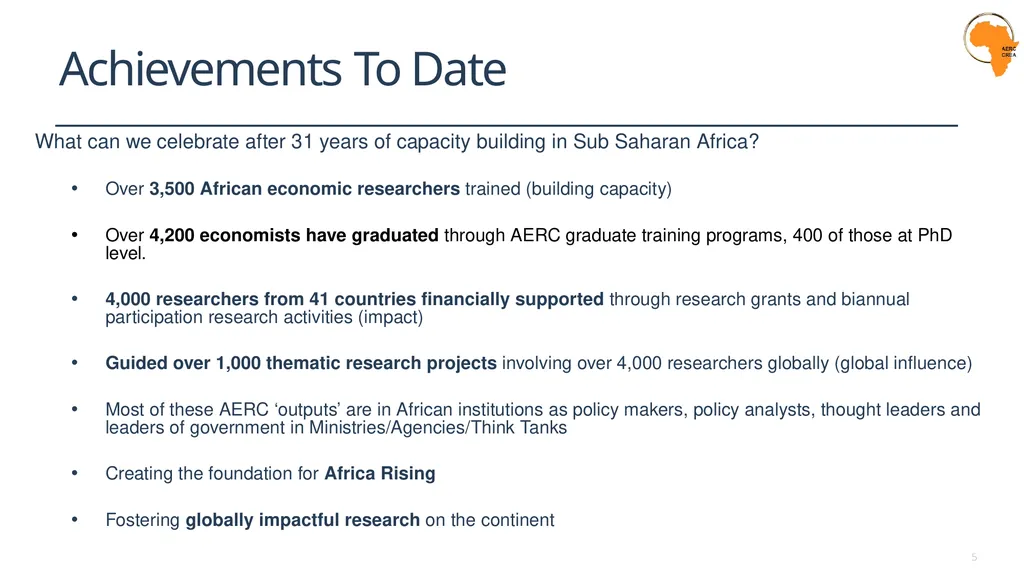
Achievements To Date What can we celebrate after 31 years of capacity building in Sub Saharan Africa?
Over 3,500 African economic researchers trained (building capacity)
Over 4,200 economists have graduated through AERC graduate training programs, 400 of those at PhD level.
4,000 researchers from 41 countries financially supported through research grants and biannual participation research activities (impact)
Guided over 1,000 thematic research projects involving over 4,000 researchers globally (global influence)
Most of these AERC ‘outputs’ are in African institutions as policy makers, policy analysts, thought leaders and leaders of government in Ministries/Agencies/Think Tanks
Creating the foundation for Africa Rising
Fostering globally impactful research on the continent 5<br>
06
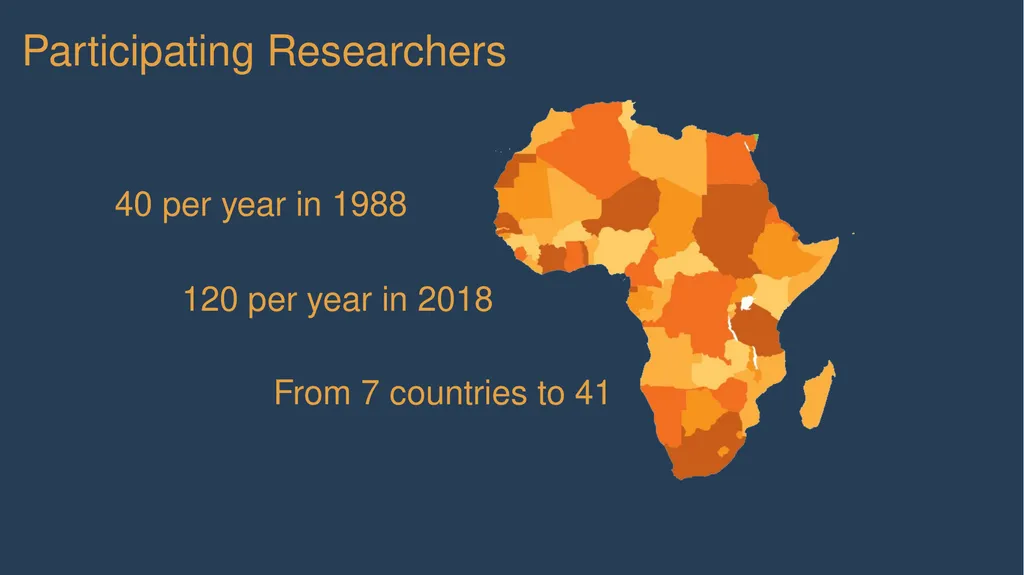
Participating Researchers 120 per year in 2018 40 per year in 1988 From 7 countries to 41<br>
07
But More Remains to be Done Declining economic performance, rising poverty, youth unemployment and deteriorating institutions.
Strengthening institutions and leadership in those institutions – Diversify economies to maximize growth and welfare
Critical mass to provide leadership at policy making levels and policy leadership
Expanding access to more diverse populations – language and gender - Fragile and post-conflict countries being left behind
Ever increasing economic policy and institutional challenges – Require new knowledge and new tools – Big data, AI and Digital evolution
Replicate the successes of digital financial services innovation across Africa economies – Financial inclusion can be an instrument of fighting poverty sustainably. 7<br>