
FTA Post Award Activities November 1, 2023
KB
Published · 46 slides · 0 views

1 / 1

Description
FTA Post Award Activities November 1, 2023 Charlene Lee Lorenzo Senior Director - Los Angeles Office Federal Transit Administration, Region 9 Grant Award Life Cycle Pre-Award Applicant drafts an application and submits in TrAMS for review
Related Topics
Share
Embed code
Download this presentation From Below
"FTA Post Award Activities November 1, 2023" is the property of its rightful owner. Permission is granted to download and print the materials on this website for personal, non-commercial use only, and to display it on your personal computer provided you do not modify the materials and that you retain all copyright notices contained in the materials. By downloading content from our website, you accept the terms of this agreement.
Presentation Transcript
01
FTA Post Award Activities November 1, 2023 Charlene Lee Lorenzo
Senior Director - Los Angeles Office
Federal Transit Administration, Region 9<br>
Senior Director - Los Angeles Office
Federal Transit Administration, Region 9<br>
02
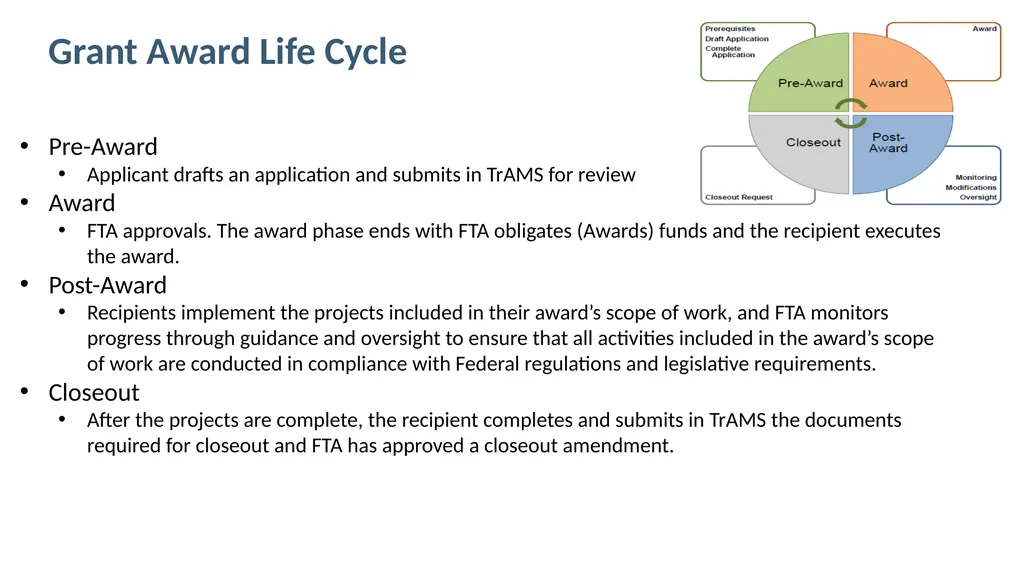
Grant Award Life Cycle Pre-Award
Applicant drafts an application and submits in TrAMS for review
Award
FTA approvals. The award phase ends with FTA obligates (Awards) funds and the recipient executes the award.
Post-Award
Recipients implement the projects included in their award’s scope of work, and FTA monitors progress through guidance and oversight to ensure that all activities included in the award’s scope of work are conducted in compliance with Federal regulations and legislative requirements.
Closeout
After the projects are complete, the recipient completes and submits in TrAMS the documents required for closeout and FTA has approved a closeout amendment.<br>
Applicant drafts an application and submits in TrAMS for review
Award
FTA approvals. The award phase ends with FTA obligates (Awards) funds and the recipient executes the award.
Post-Award
Recipients implement the projects included in their award’s scope of work, and FTA monitors progress through guidance and oversight to ensure that all activities included in the award’s scope of work are conducted in compliance with Federal regulations and legislative requirements.
Closeout
After the projects are complete, the recipient completes and submits in TrAMS the documents required for closeout and FTA has approved a closeout amendment.<br>
03
Post-Award Activities Once the Award is executed, the applicant becomes the recipient and the post-award phase begins.
The Post-Award Phase of a grant is usually the longest in terms of the life of an award.
During this phase, recipients implement the projects included in their award’s scope of work, and FTA monitors progress to ensure that all activities included in the award’s scope of work are conducted in compliance with Federal regulations and legislative requirements.<br>
The Post-Award Phase of a grant is usually the longest in terms of the life of an award.
During this phase, recipients implement the projects included in their award’s scope of work, and FTA monitors progress to ensure that all activities included in the award’s scope of work are conducted in compliance with Federal regulations and legislative requirements.<br>
04
Grants Management Grant Administration Responsibilities
Post-Award Reporting
FFR/MPR
NTD reporting
Civil Rights
Drug and Alcohol
Single Audits per 2 CFR Part 200 “Uniform Guidance”
Budget Revisions
Grant Amendment
Grant Closeouts
Other Considerations<br>
Post-Award Reporting
FFR/MPR
NTD reporting
Civil Rights
Drug and Alcohol
Single Audits per 2 CFR Part 200 “Uniform Guidance”
Budget Revisions
Grant Amendment
Grant Closeouts
Other Considerations<br>
05
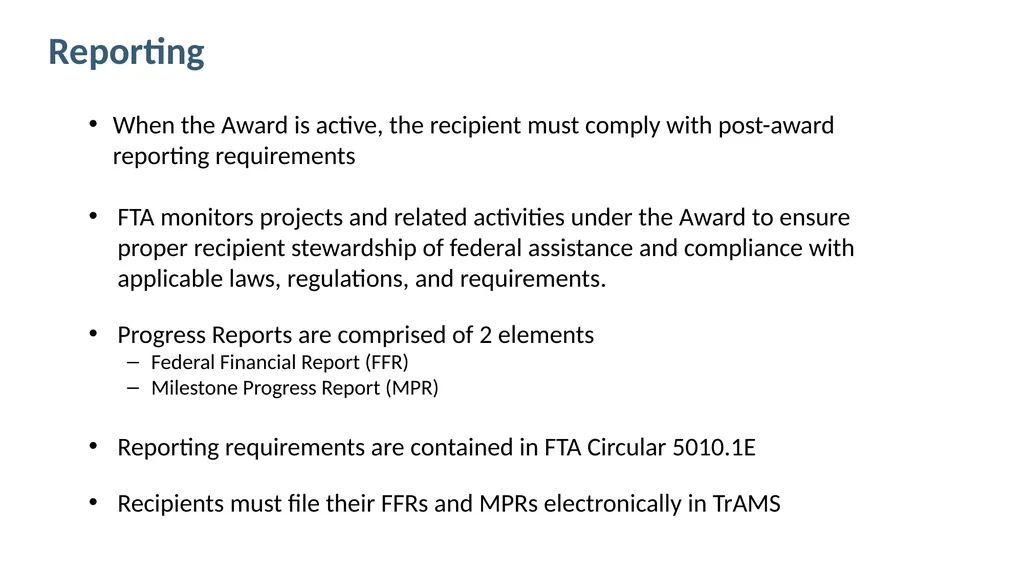
Reporting When the Award is active, the recipient must comply with post-award reporting requirements
FTA monitors projects and related activities under the Award to ensure proper recipient stewardship of federal assistance and compliance with applicable laws, regulations, and requirements.
Progress Reports are comprised of 2 elements
Federal Financial Report (FFR)
Milestone Progress Report (MPR)
Reporting requirements are contained in FTA Circular 5010.1E
Recipients must file their FFRs and MPRs electronically in TrAMS<br>
FTA monitors projects and related activities under the Award to ensure proper recipient stewardship of federal assistance and compliance with applicable laws, regulations, and requirements.
Progress Reports are comprised of 2 elements
Federal Financial Report (FFR)
Milestone Progress Report (MPR)
Reporting requirements are contained in FTA Circular 5010.1E
Recipients must file their FFRs and MPRs electronically in TrAMS<br>
06
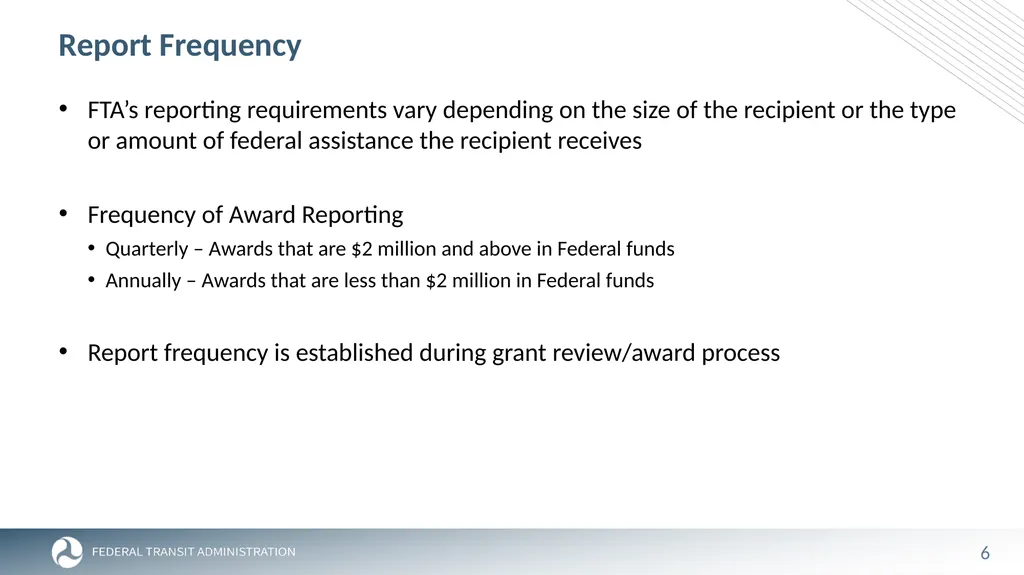
Report Frequency FTA’s reporting requirements vary depending on the size of the recipient or the type or amount of federal assistance the recipient receives
Frequency of Award Reporting
Quarterly – Awards that are $2 million and above in Federal funds
Annually – Awards that are less than $2 million in Federal funds
Report frequency is established during grant review/award process<br>
Frequency of Award Reporting
Quarterly – Awards that are $2 million and above in Federal funds
Annually – Awards that are less than $2 million in Federal funds
Report frequency is established during grant review/award process<br>
07
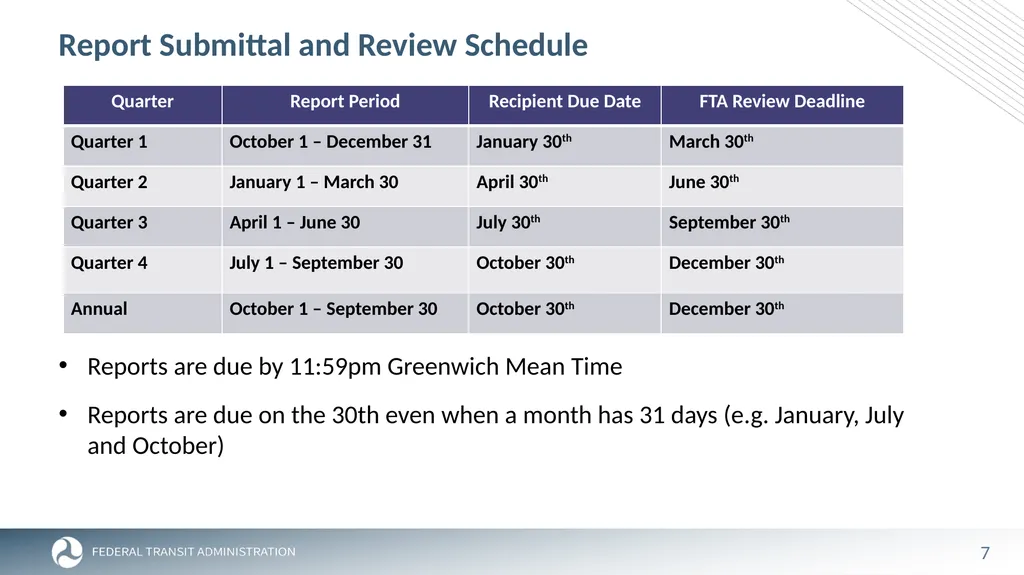
Report Submittal and Review Schedule Reports are due by 11:59pm Greenwich Mean Time
Reports are due on the 30th even when a month has 31 days (e.g. January, July and October)<br>
Reports are due on the 30th even when a month has 31 days (e.g. January, July and October)<br>
08
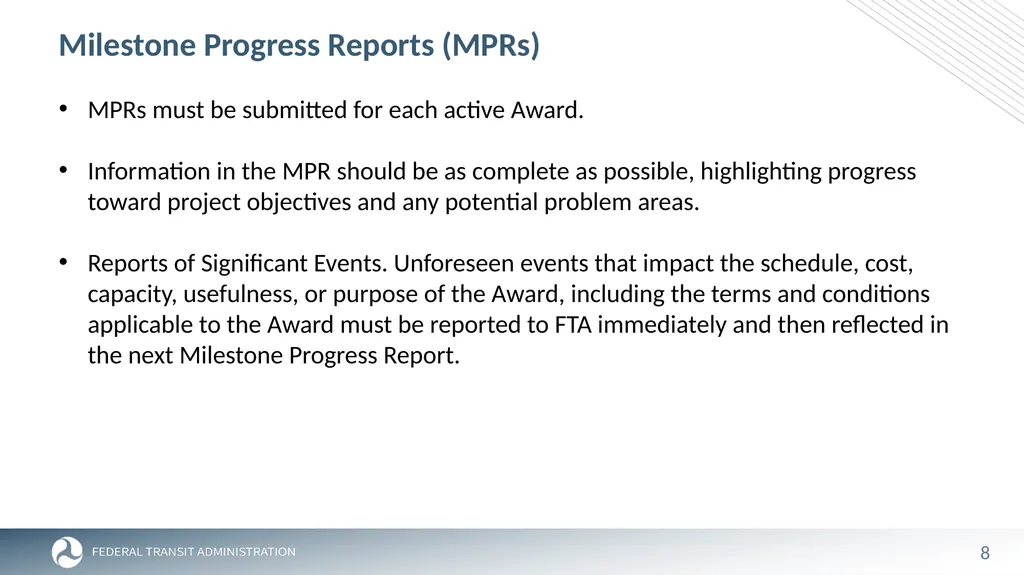
Milestone Progress Reports (MPRs) MPRs must be submitted for each active Award.
Information in the MPR should be as complete as possible, highlighting progress toward project objectives and any potential problem areas.
Reports of Significant Events. Unforeseen events that impact the schedule, cost, capacity, usefulness, or purpose of the Award, including the terms and conditions applicable to the Award must be reported to FTA immediately and then reflected in the next Milestone Progress Report.<br>
Information in the MPR should be as complete as possible, highlighting progress toward project objectives and any potential problem areas.
Reports of Significant Events. Unforeseen events that impact the schedule, cost, capacity, usefulness, or purpose of the Award, including the terms and conditions applicable to the Award must be reported to FTA immediately and then reflected in the next Milestone Progress Report.<br>
09
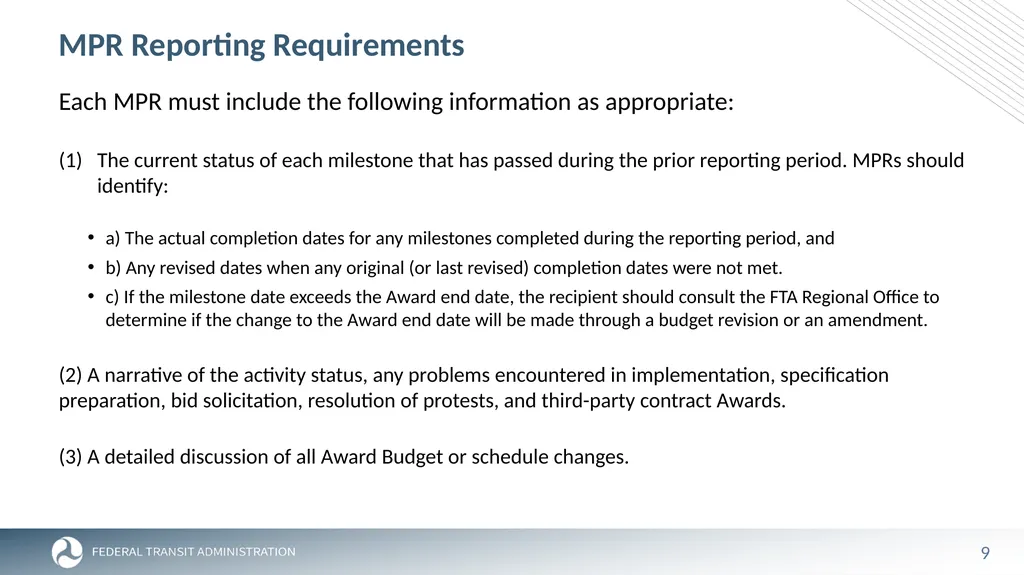
MPR Reporting Requirements Each MPR must include the following information as appropriate:
The current status of each milestone that has passed during the prior reporting period. MPRs should identify:
a) The actual completion dates for any milestones completed during the reporting period, and
b) Any revised dates when any original (or last revised) completion dates were not met.
c) If the milestone date exceeds the Award end date, the recipient should consult the FTA Regional Office to determine if the change to the Award end date will be made through a budget revision or an amendment.
(2) A narrative of the activity status, any problems encountered in implementation, specification preparation, bid solicitation, resolution of protests, and third-party contract Awards.
(3) A detailed discussion of all Award Budget or schedule changes.<br>
The current status of each milestone that has passed during the prior reporting period. MPRs should identify:
a) The actual completion dates for any milestones completed during the reporting period, and
b) Any revised dates when any original (or last revised) completion dates were not met.
c) If the milestone date exceeds the Award end date, the recipient should consult the FTA Regional Office to determine if the change to the Award end date will be made through a budget revision or an amendment.
(2) A narrative of the activity status, any problems encountered in implementation, specification preparation, bid solicitation, resolution of protests, and third-party contract Awards.
(3) A detailed discussion of all Award Budget or schedule changes.<br>
10
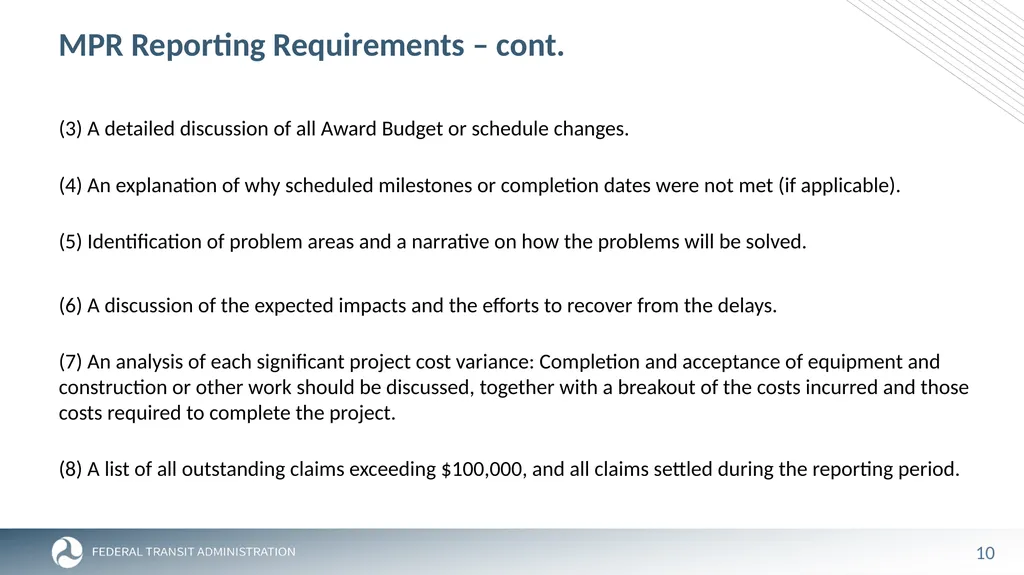
MPR Reporting Requirements – cont. (3) A detailed discussion of all Award Budget or schedule changes.
(4) An explanation of why scheduled milestones or completion dates were not met (if applicable).
(5) Identification of problem areas and a narrative on how the problems will be solved.
(6) A discussion of the expected impacts and the efforts to recover from the delays.
(7) An analysis of each significant project cost variance: Completion and acceptance of equipment and construction or other work should be discussed, together with a breakout of the costs incurred and those costs required to complete the project.
(8) A list of all outstanding claims exceeding $100,000, and all claims settled during the reporting period.<br>
(4) An explanation of why scheduled milestones or completion dates were not met (if applicable).
(5) Identification of problem areas and a narrative on how the problems will be solved.
(6) A discussion of the expected impacts and the efforts to recover from the delays.
(7) An analysis of each significant project cost variance: Completion and acceptance of equipment and construction or other work should be discussed, together with a breakout of the costs incurred and those costs required to complete the project.
(8) A list of all outstanding claims exceeding $100,000, and all claims settled during the reporting period.<br>
11
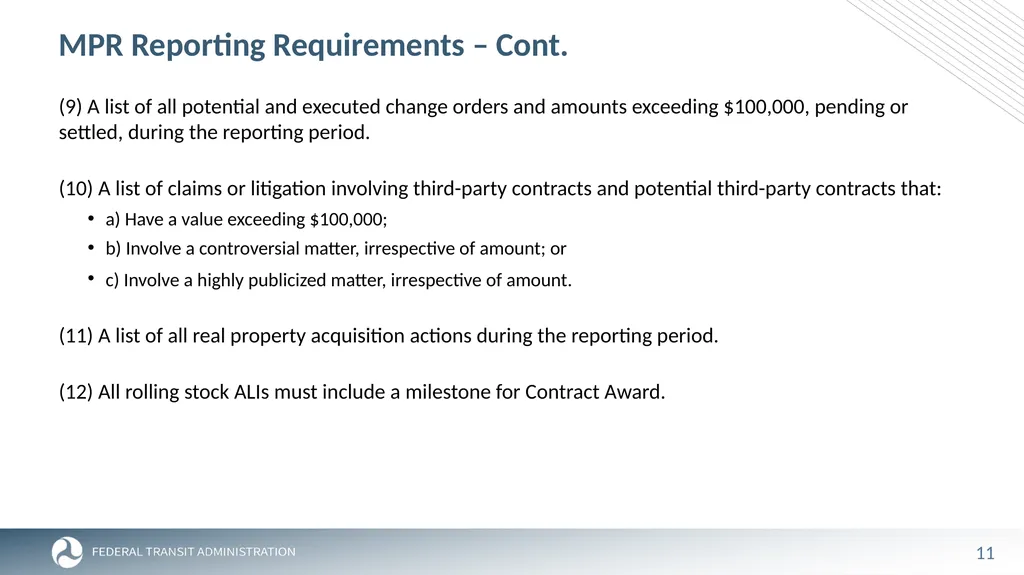
MPR Reporting Requirements – Cont. (9) A list of all potential and executed change orders and amounts exceeding $100,000, pending or settled, during the reporting period.
(10) A list of claims or litigation involving third-party contracts and potential third-party contracts that:
a) Have a value exceeding $100,000;
b) Involve a controversial matter, irrespective of amount; or
c) Involve a highly publicized matter, irrespective of amount.
(11) A list of all real property acquisition actions during the reporting period.
(12) All rolling stock ALIs must include a milestone for Contract Award.<br>
(10) A list of claims or litigation involving third-party contracts and potential third-party contracts that:
a) Have a value exceeding $100,000;
b) Involve a controversial matter, irrespective of amount; or
c) Involve a highly publicized matter, irrespective of amount.
(11) A list of all real property acquisition actions during the reporting period.
(12) All rolling stock ALIs must include a milestone for Contract Award.<br>
12
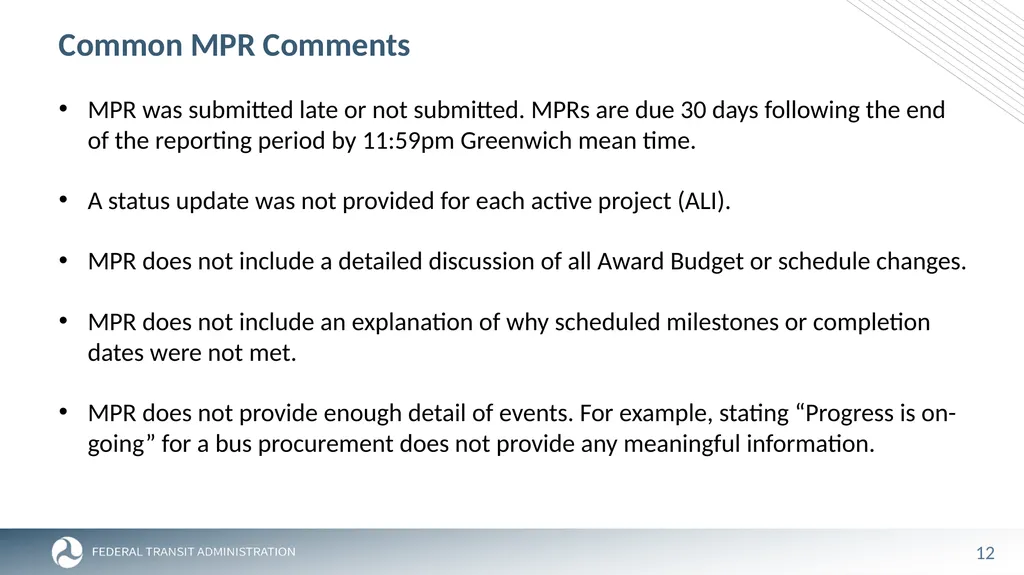
Common MPR Comments MPR was submitted late or not submitted. MPRs are due 30 days following the end of the reporting period by 11:59pm Greenwich mean time.
A status update was not provided for each active project (ALI).
MPR does not include a detailed discussion of all Award Budget or schedule changes.
MPR does not include an explanation of why scheduled milestones or completion dates were not met.
MPR does not provide enough detail of events. For example, stating “Progress is on-going” for a bus procurement does not provide any meaningful information.<br>
A status update was not provided for each active project (ALI).
MPR does not include a detailed discussion of all Award Budget or schedule changes.
MPR does not include an explanation of why scheduled milestones or completion dates were not met.
MPR does not provide enough detail of events. For example, stating “Progress is on-going” for a bus procurement does not provide any meaningful information.<br>
13
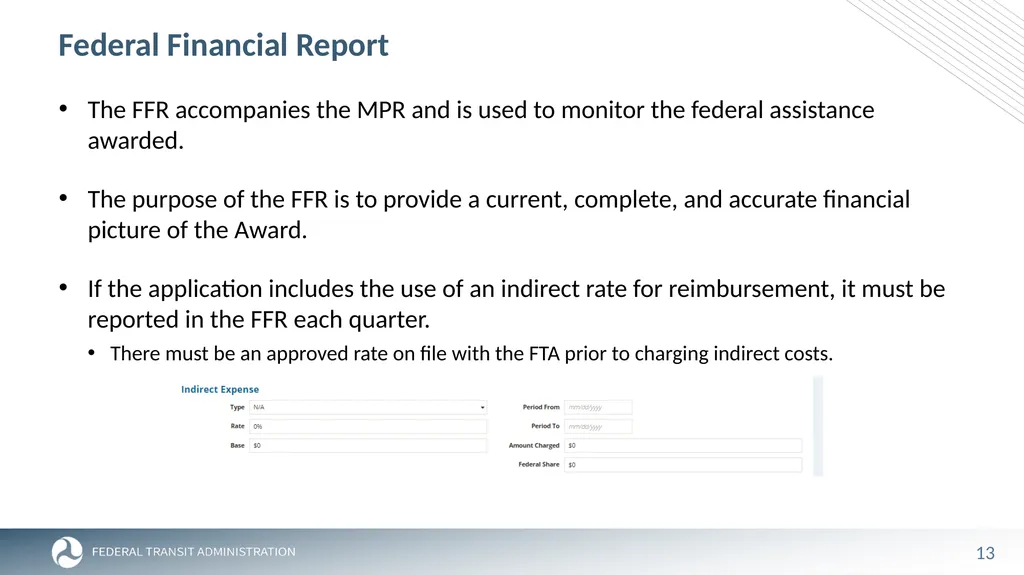
Federal Financial Report The FFR accompanies the MPR and is used to monitor the federal assistance awarded.
The purpose of the FFR is to provide a current, complete, and accurate financial picture of the Award.
If the application includes the use of an indirect rate for reimbursement, it must be reported in the FFR each quarter.
There must be an approved rate on file with the FTA prior to charging indirect costs.<br>
The purpose of the FFR is to provide a current, complete, and accurate financial picture of the Award.
If the application includes the use of an indirect rate for reimbursement, it must be reported in the FFR each quarter.
There must be an approved rate on file with the FTA prior to charging indirect costs.<br>
14
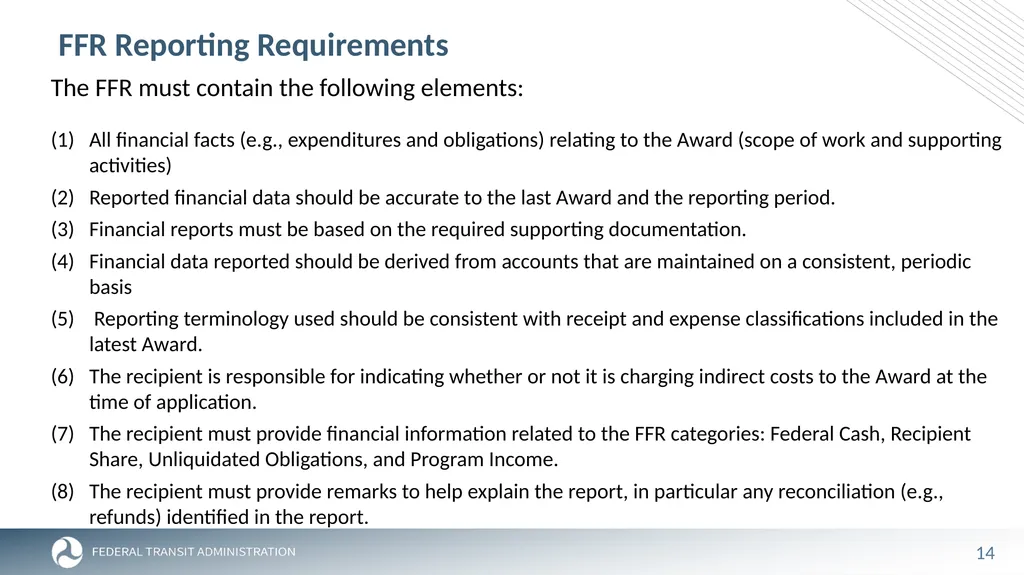
FFR Reporting Requirements The FFR must contain the following elements:
All financial facts (e.g., expenditures and obligations) relating to the Award (scope of work and supporting activities)
Reported financial data should be accurate to the last Award and the reporting period.
Financial reports must be based on the required supporting documentation.
Financial data reported should be derived from accounts that are maintained on a consistent, periodic basis
Reporting terminology used should be consistent with receipt and expense classifications included in the latest Award.
The recipient is responsible for indicating whether or not it is charging indirect costs to the Award at the time of application.
The recipient must provide financial information related to the FFR categories: Federal Cash, Recipient Share, Unliquidated Obligations, and Program Income.
The recipient must provide remarks to help explain the report, in particular any reconciliation (e.g., refunds) identified in the report.<br>
All financial facts (e.g., expenditures and obligations) relating to the Award (scope of work and supporting activities)
Reported financial data should be accurate to the last Award and the reporting period.
Financial reports must be based on the required supporting documentation.
Financial data reported should be derived from accounts that are maintained on a consistent, periodic basis
Reporting terminology used should be consistent with receipt and expense classifications included in the latest Award.
The recipient is responsible for indicating whether or not it is charging indirect costs to the Award at the time of application.
The recipient must provide financial information related to the FFR categories: Federal Cash, Recipient Share, Unliquidated Obligations, and Program Income.
The recipient must provide remarks to help explain the report, in particular any reconciliation (e.g., refunds) identified in the report.<br>
15
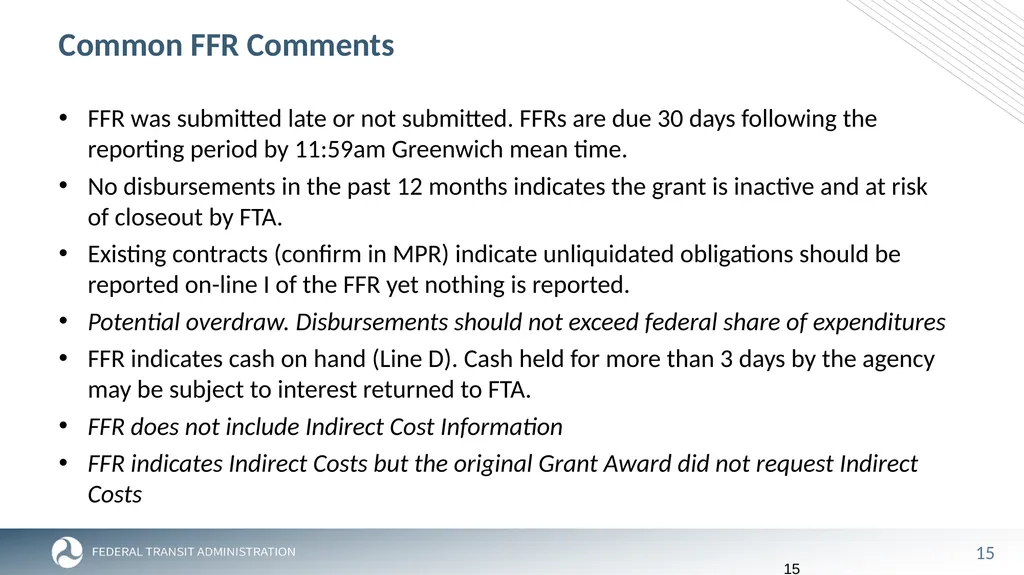
Common FFR Comments FFR was submitted late or not submitted. FFRs are due 30 days following the reporting period by 11:59am Greenwich mean time.
No disbursements in the past 12 months indicates the grant is inactive and at risk of closeout by FTA.
Existing contracts (confirm in MPR) indicate unliquidated obligations should be reported on-line I of the FFR yet nothing is reported.
Potential overdraw. Disbursements should not exceed federal share of expenditures
FFR indicates cash on hand (Line D). Cash held for more than 3 days by the agency may be subject to interest returned to FTA.
FFR does not include Indirect Cost Information
FFR indicates Indirect Costs but the original Grant Award did not request Indirect Costs 15<br>
No disbursements in the past 12 months indicates the grant is inactive and at risk of closeout by FTA.
Existing contracts (confirm in MPR) indicate unliquidated obligations should be reported on-line I of the FFR yet nothing is reported.
Potential overdraw. Disbursements should not exceed federal share of expenditures
FFR indicates cash on hand (Line D). Cash held for more than 3 days by the agency may be subject to interest returned to FTA.
FFR does not include Indirect Cost Information
FFR indicates Indirect Costs but the original Grant Award did not request Indirect Costs 15<br>
16
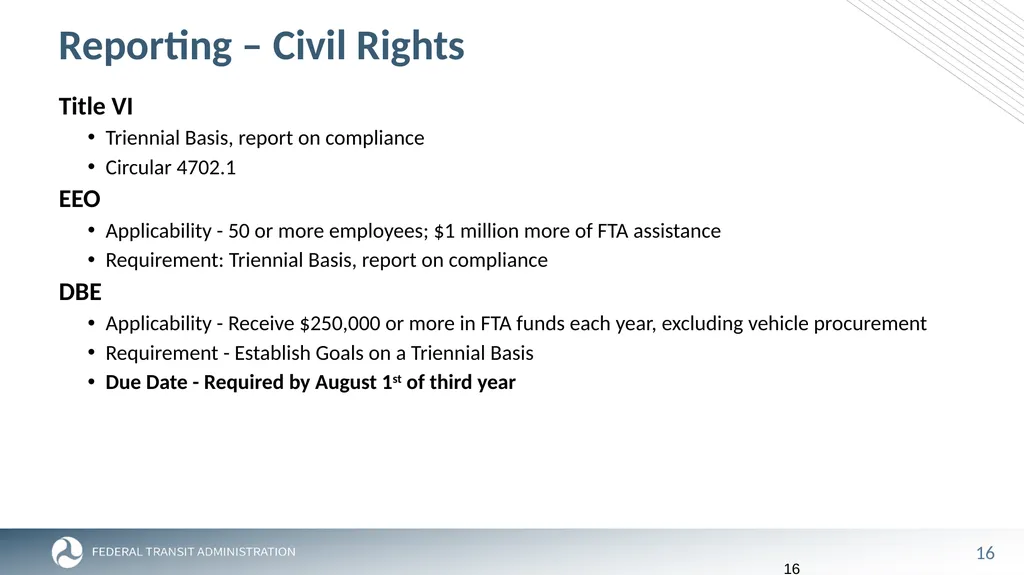
Reporting – Civil Rights Title VI
Triennial Basis, report on compliance
Circular 4702.1
EEO
Applicability - 50 or more employees; $1 million more of FTA assistance
Requirement: Triennial Basis, report on compliance
DBE
Applicability - Receive $250,000 or more in FTA funds each year, excluding vehicle procurement
Requirement - Establish Goals on a Triennial Basis
Due Date - Required by August 1st of third year 16<br>
Triennial Basis, report on compliance
Circular 4702.1
EEO
Applicability - 50 or more employees; $1 million more of FTA assistance
Requirement: Triennial Basis, report on compliance
DBE
Applicability - Receive $250,000 or more in FTA funds each year, excluding vehicle procurement
Requirement - Establish Goals on a Triennial Basis
Due Date - Required by August 1st of third year 16<br>
17
Reporting – National Transit Database (NTD) NTD is the primary source of info and statistics on US Transit systems
5307 and 5311 recipients or beneficiaries are required to submit data to NTD
Must provide a complete report of all transit operations regardless if funded in whole or part by FTA
Voluntary reporting (if not a required reporter) may be beneficial in obtaining additional funding if providing a transit service to another urbanized area
NTD Reporting Manual: Manuals | FTA (dot.gov)<br>
5307 and 5311 recipients or beneficiaries are required to submit data to NTD
Must provide a complete report of all transit operations regardless if funded in whole or part by FTA
Voluntary reporting (if not a required reporter) may be beneficial in obtaining additional funding if providing a transit service to another urbanized area
NTD Reporting Manual: Manuals | FTA (dot.gov)<br>
18
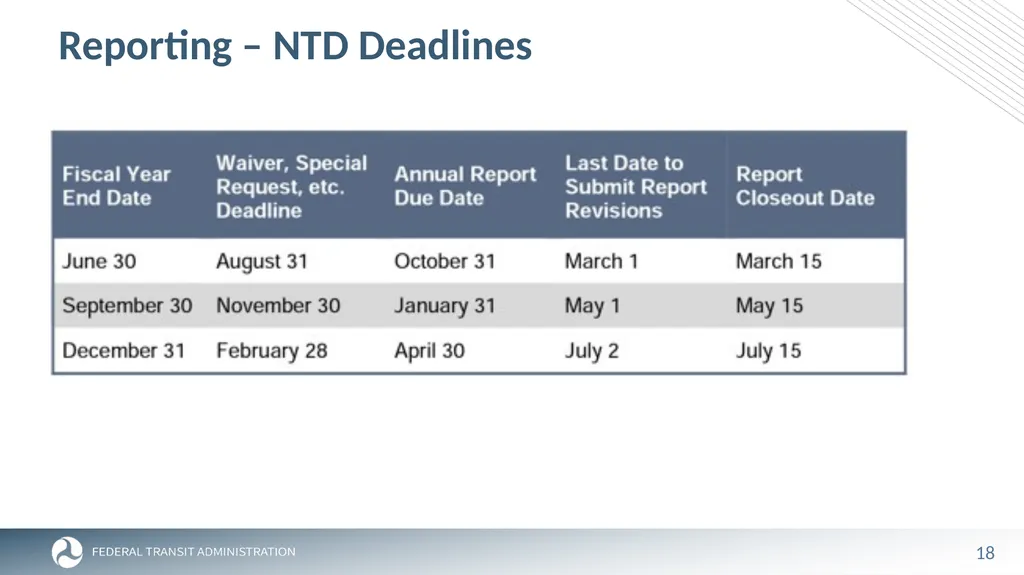
Reporting – NTD Deadlines<br>
19
Reporting - Significant Events Unforeseen events that impact schedule, cost, capacity, usefulness, or purpose of project should be reported to FTA immediately, for example
Problems, delays, or adverse conditions will affect the grantee’s ability to achieve project objectives within the scheduled time period or within budget
Favorable developments will enable the grantee to achieve project goals/complete project activities ahead of schedule or at lower cost
Local events that effect transit in general. Events such as bond issues, major new employer, loss of employer, public policy or transit district in news<br>
Problems, delays, or adverse conditions will affect the grantee’s ability to achieve project objectives within the scheduled time period or within budget
Favorable developments will enable the grantee to achieve project goals/complete project activities ahead of schedule or at lower cost
Local events that effect transit in general. Events such as bond issues, major new employer, loss of employer, public policy or transit district in news<br>
20
Reporting - Annual Single Audit Applicability: Non-Federal entities that expend $750,000 or more in Federal awards
Requirement: - Conduct an annual organization-wide audit in accordance with “Uniform Guidance” (2 CFR Part 200).
Due Date: - Audit completed within 9 months of the end of grantee’s fiscal year.<br>
Requirement: - Conduct an annual organization-wide audit in accordance with “Uniform Guidance” (2 CFR Part 200).
Due Date: - Audit completed within 9 months of the end of grantee’s fiscal year.<br>
21
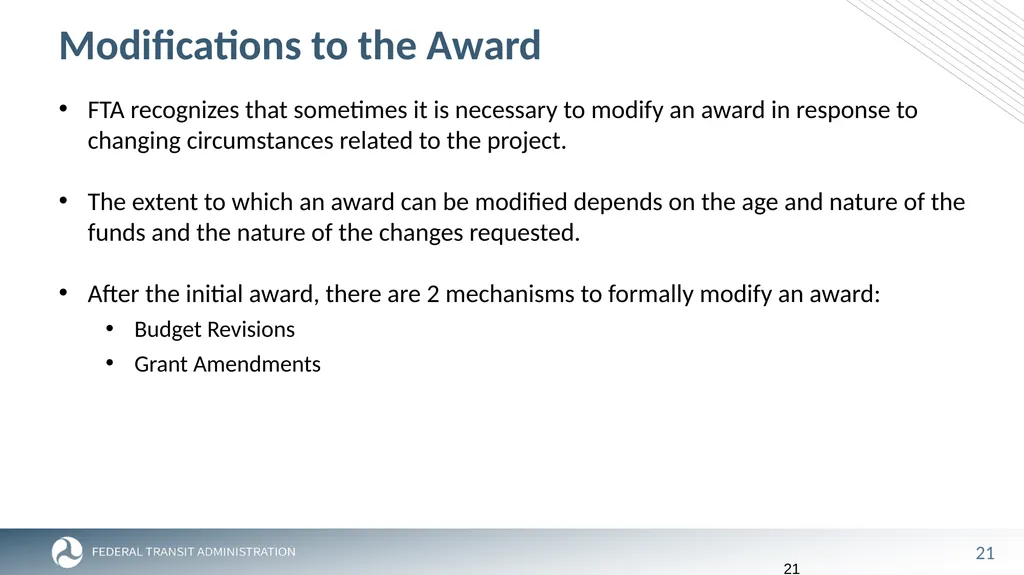
Modifications to the Award FTA recognizes that sometimes it is necessary to modify an award in response to changing circumstances related to the project.
The extent to which an award can be modified depends on the age and nature of the funds and the nature of the changes requested.
After the initial award, there are 2 mechanisms to formally modify an award:
Budget Revisions
Grant Amendments 21<br>
The extent to which an award can be modified depends on the age and nature of the funds and the nature of the changes requested.
After the initial award, there are 2 mechanisms to formally modify an award:
Budget Revisions
Grant Amendments 21<br>
22
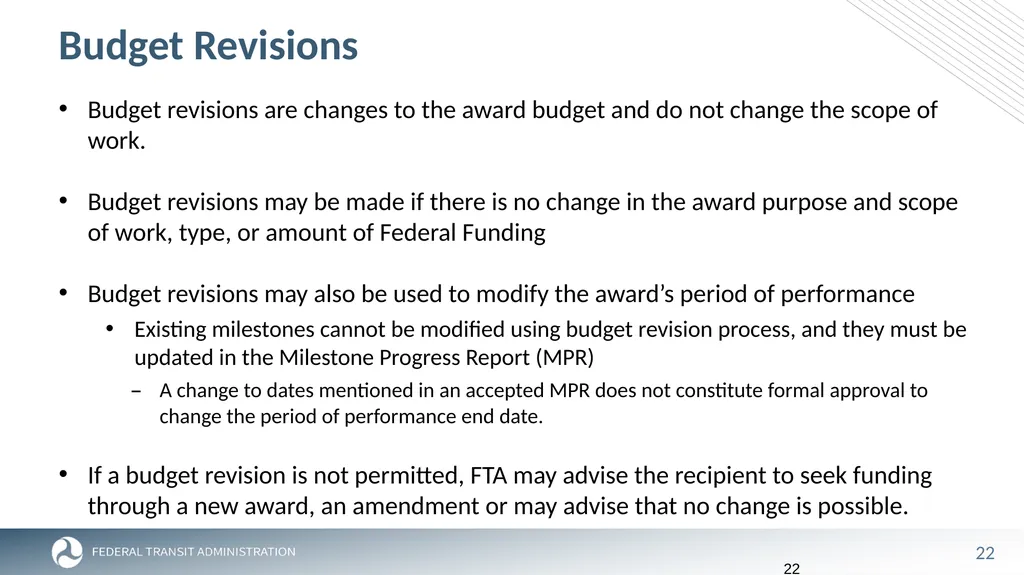
Budget Revisions Budget revisions are changes to the award budget and do not change the scope of work.
Budget revisions may be made if there is no change in the award purpose and scope of work, type, or amount of Federal Funding
Budget revisions may also be used to modify the award’s period of performance
Existing milestones cannot be modified using budget revision process, and they must be updated in the Milestone Progress Report (MPR)
A change to dates mentioned in an accepted MPR does not constitute formal approval to change the period of performance end date.
If a budget revision is not permitted, FTA may advise the recipient to seek funding through a new award, an amendment or may advise that no change is possible. 22<br>
Budget revisions may be made if there is no change in the award purpose and scope of work, type, or amount of Federal Funding
Budget revisions may also be used to modify the award’s period of performance
Existing milestones cannot be modified using budget revision process, and they must be updated in the Milestone Progress Report (MPR)
A change to dates mentioned in an accepted MPR does not constitute formal approval to change the period of performance end date.
If a budget revision is not permitted, FTA may advise the recipient to seek funding through a new award, an amendment or may advise that no change is possible. 22<br>
23
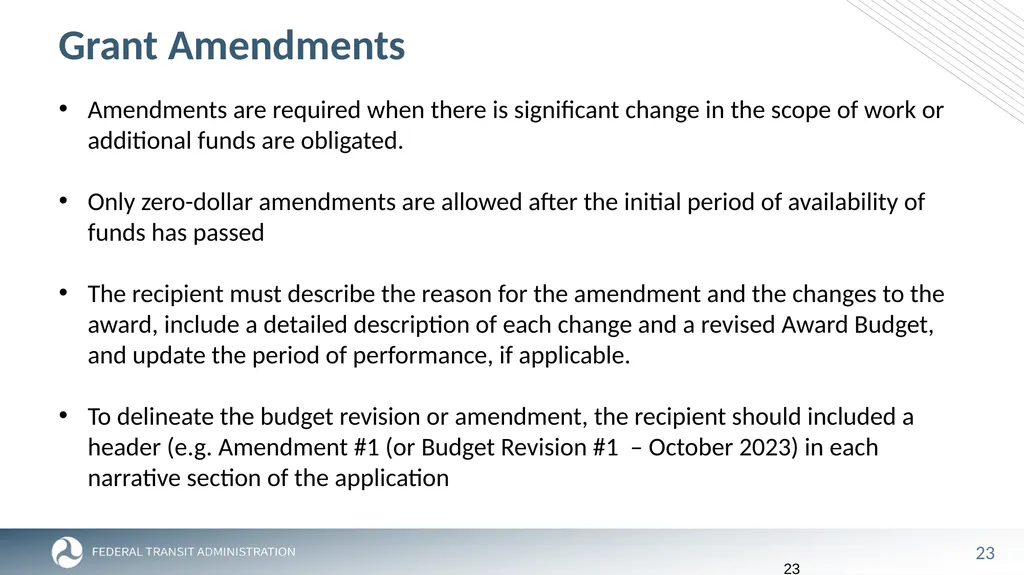
Grant Amendments Amendments are required when there is significant change in the scope of work or additional funds are obligated.
Only zero-dollar amendments are allowed after the initial period of availability of funds has passed
The recipient must describe the reason for the amendment and the changes to the award, include a detailed description of each change and a revised Award Budget, and update the period of performance, if applicable.
To delineate the budget revision or amendment, the recipient should included a header (e.g. Amendment #1 (or Budget Revision #1 – October 2023) in each narrative section of the application 23<br>
Only zero-dollar amendments are allowed after the initial period of availability of funds has passed
The recipient must describe the reason for the amendment and the changes to the award, include a detailed description of each change and a revised Award Budget, and update the period of performance, if applicable.
To delineate the budget revision or amendment, the recipient should included a header (e.g. Amendment #1 (or Budget Revision #1 – October 2023) in each narrative section of the application 23<br>
24
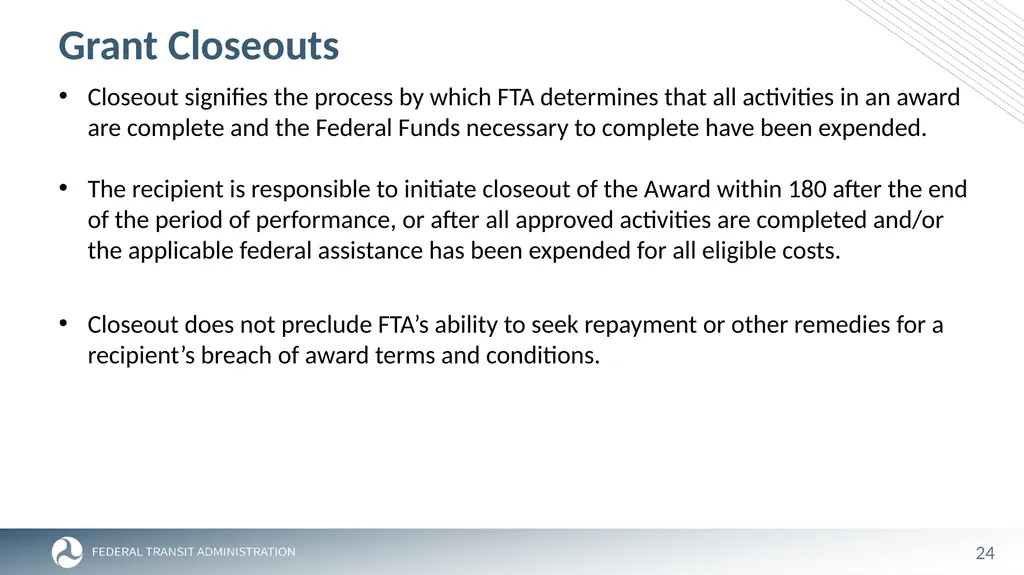
Grant Closeouts Closeout signifies the process by which FTA determines that all activities in an award are complete and the Federal Funds necessary to complete have been expended.
The recipient is responsible to initiate closeout of the Award within 180 after the end of the period of performance, or after all approved activities are completed and/or the applicable federal assistance has been expended for all eligible costs.
Closeout does not preclude FTA’s ability to seek repayment or other remedies for a recipient’s breach of award terms and conditions.<br>
The recipient is responsible to initiate closeout of the Award within 180 after the end of the period of performance, or after all approved activities are completed and/or the applicable federal assistance has been expended for all eligible costs.
Closeout does not preclude FTA’s ability to seek repayment or other remedies for a recipient’s breach of award terms and conditions.<br>
25
Grant Closeouts - Continued The closeout information submitted in TrAMS must include:
Confirmation that activities are complete and if the closeout amendment will deobligate any unexpended funds
A list of property acquired or improved
A final reconciled Award Budget reflecting actual Project costs by scope code and activity, reflecting adjustments to the federal and non-federal amounts
A final FFR, consistent with the reconciled Award Budget
A final narrative MPR indicating the actual completion date of each Activity Line Item (ALI) and a discussion of each ALI contained in the final award budget.
Any other documentation or reports required as part of the terms and conditions of the Grant or Cooperative Agreement.<br>
Confirmation that activities are complete and if the closeout amendment will deobligate any unexpended funds
A list of property acquired or improved
A final reconciled Award Budget reflecting actual Project costs by scope code and activity, reflecting adjustments to the federal and non-federal amounts
A final FFR, consistent with the reconciled Award Budget
A final narrative MPR indicating the actual completion date of each Activity Line Item (ALI) and a discussion of each ALI contained in the final award budget.
Any other documentation or reports required as part of the terms and conditions of the Grant or Cooperative Agreement.<br>
26
Other Considerations During Post-Award Other Considerations During Post-Award:
Environmental
Real Property
Incidental Use
Useful Life
Dispositions 26<br>
Environmental
Real Property
Incidental Use
Useful Life
Dispositions 26<br>
27
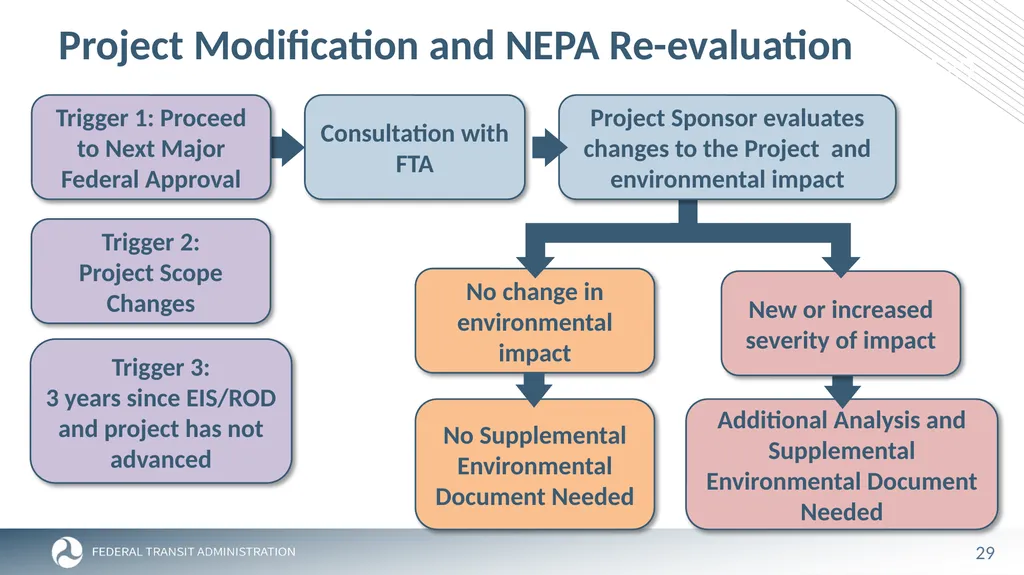
Project Modification and NEPA
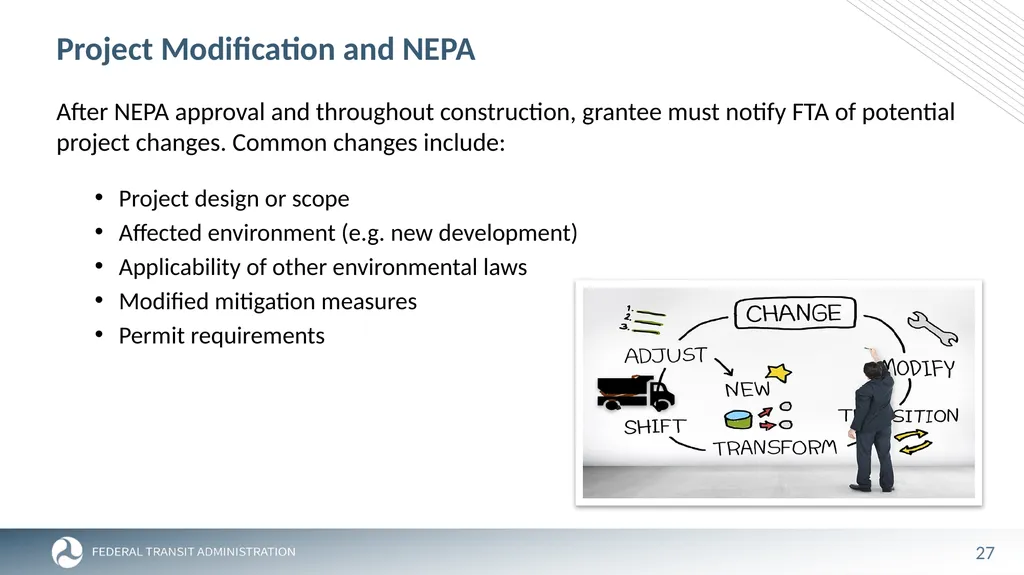
evaluation is required After NEPA approval and throughout construction, grantee must notify FTA of potential project changes. Common changes include:
Project design or scope
Affected environment (e.g. new development)
Applicability of other environmental laws
Modified mitigation measures
Permit requirements<br>
Project design or scope
Affected environment (e.g. new development)
Applicability of other environmental laws
Modified mitigation measures
Permit requirements<br>
28
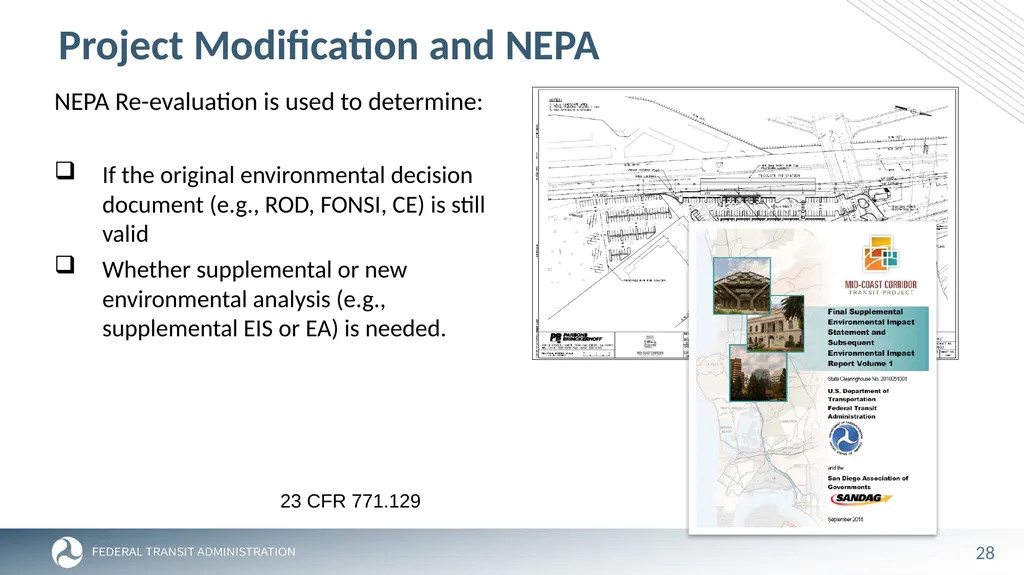
Purpose of a Re-evaluation NEPA Re-evaluation is used to determine:
If the original environmental decision document (e.g., ROD, FONSI, CE) is still valid
Whether supplemental or new environmental analysis (e.g., supplemental EIS or EA) is needed. Project Modification and NEPA 23 CFR 771.129<br>
If the original environmental decision document (e.g., ROD, FONSI, CE) is still valid
Whether supplemental or new environmental analysis (e.g., supplemental EIS or EA) is needed. Project Modification and NEPA 23 CFR 771.129<br>
29
Re-evaluation Process 23 CFR 771.129 Project Modification and NEPA Re-evaluation<br>
30
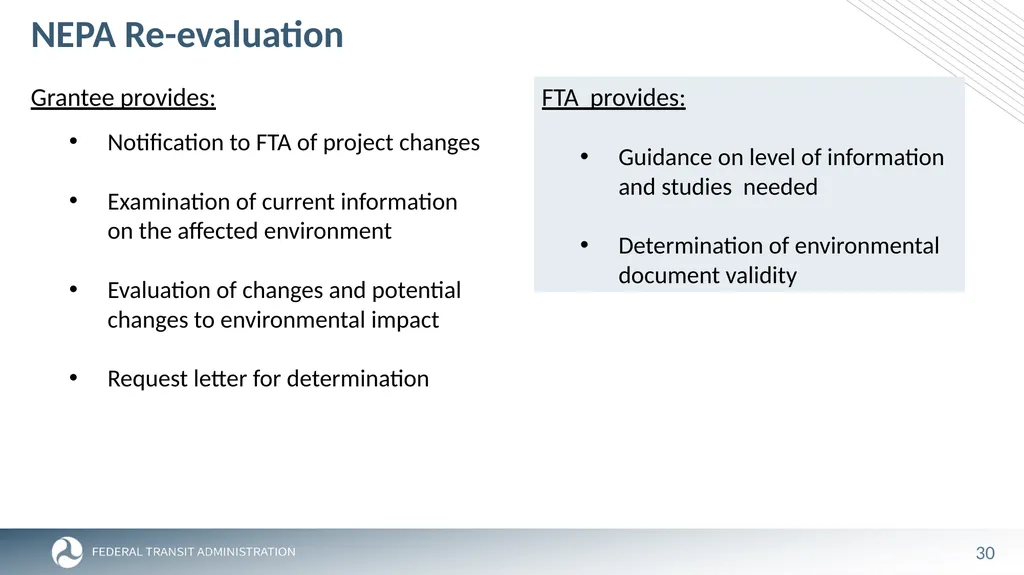
Grantee provides:
Notification to FTA of project changes
Examination of current information on the affected environment
Evaluation of changes and potential changes to environmental impact
Request letter for determination FTA provides:
Guidance on level of information and studies needed
Determination of environmental document validity NEPA Re-evaluation<br>
Notification to FTA of project changes
Examination of current information on the affected environment
Evaluation of changes and potential changes to environmental impact
Request letter for determination FTA provides:
Guidance on level of information and studies needed
Determination of environmental document validity NEPA Re-evaluation<br>
31
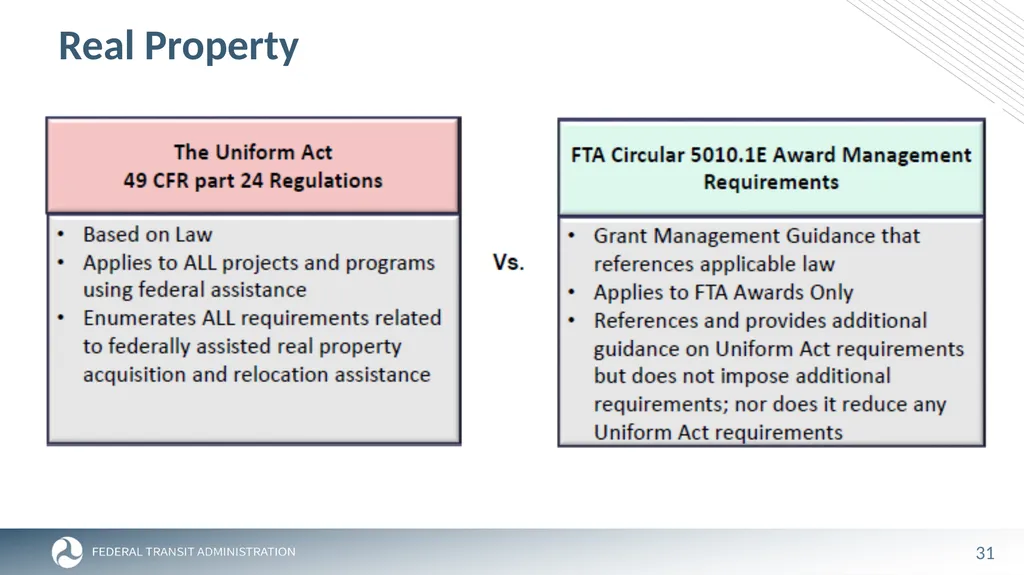
Real Property<br>
32
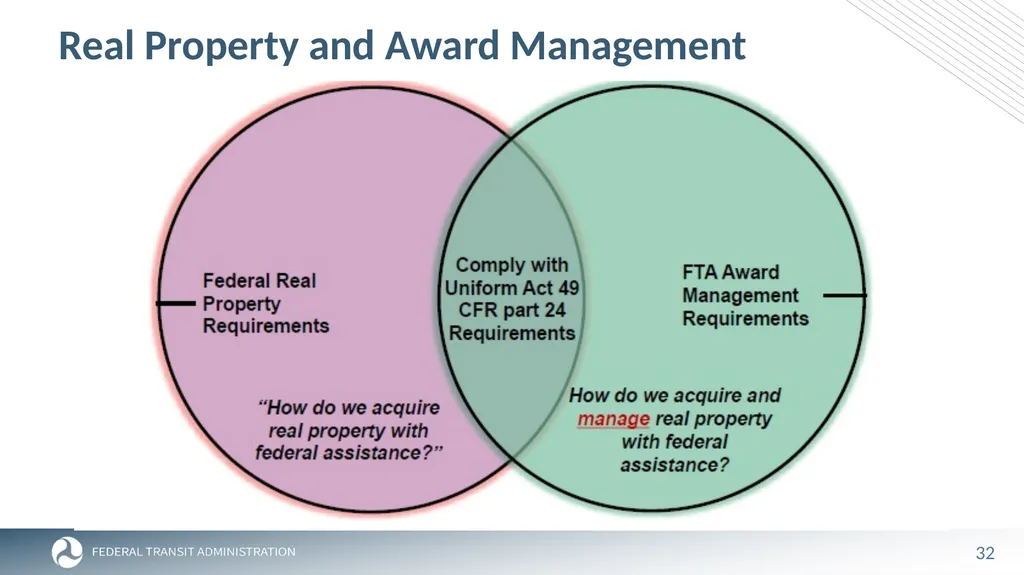
Real Property and Award Management<br>
33
Real Property: 5010.1E Chapter IV
Answers most questions on how real property is to be acquired, used, maintained, and/or disposed of as a condition of receiving federal assistance.<br>
Answers most questions on how real property is to be acquired, used, maintained, and/or disposed of as a condition of receiving federal assistance.<br>
34
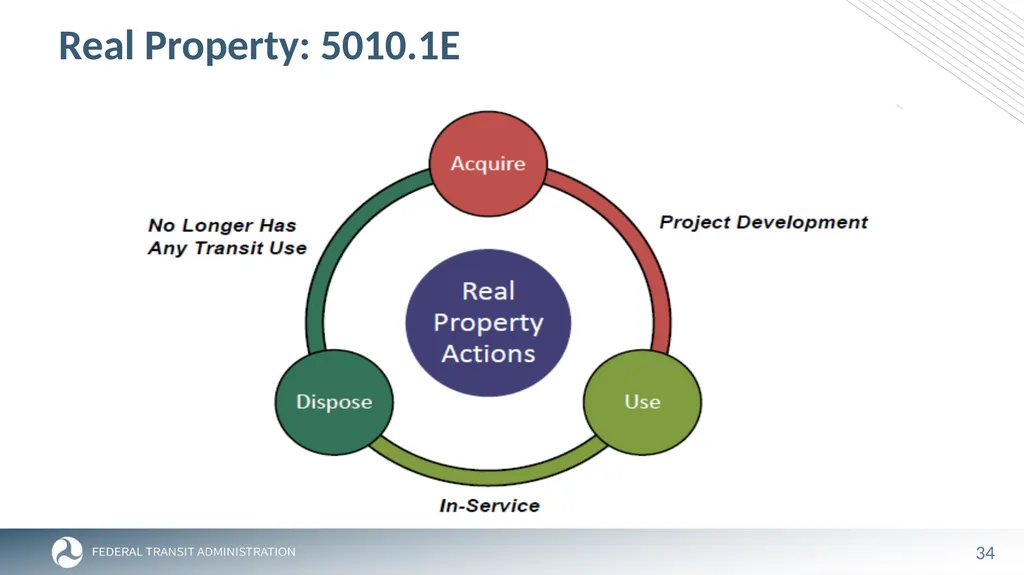
Real Property: 5010.1E<br>
35
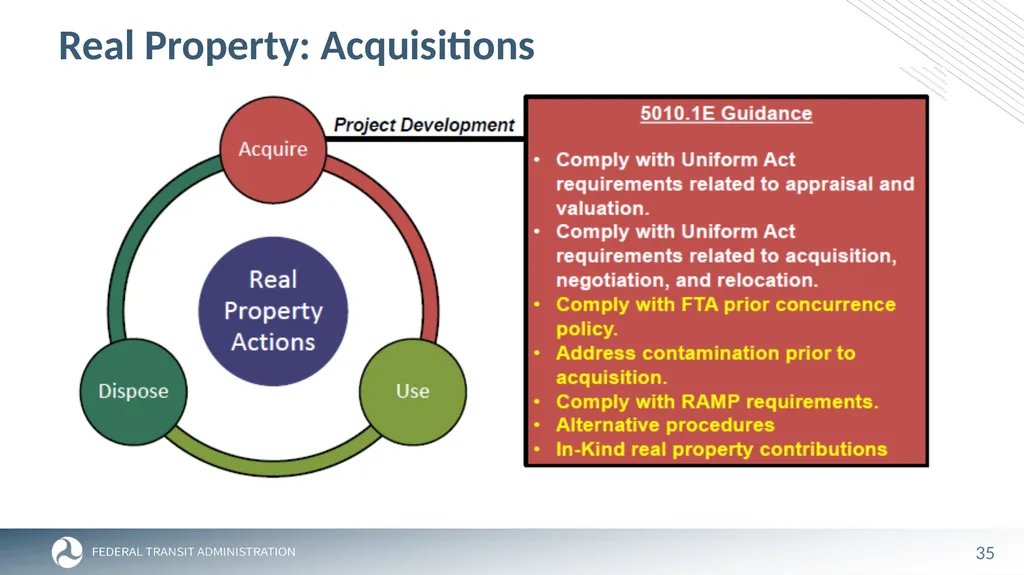
Real Property: Acquisitions<br>
36
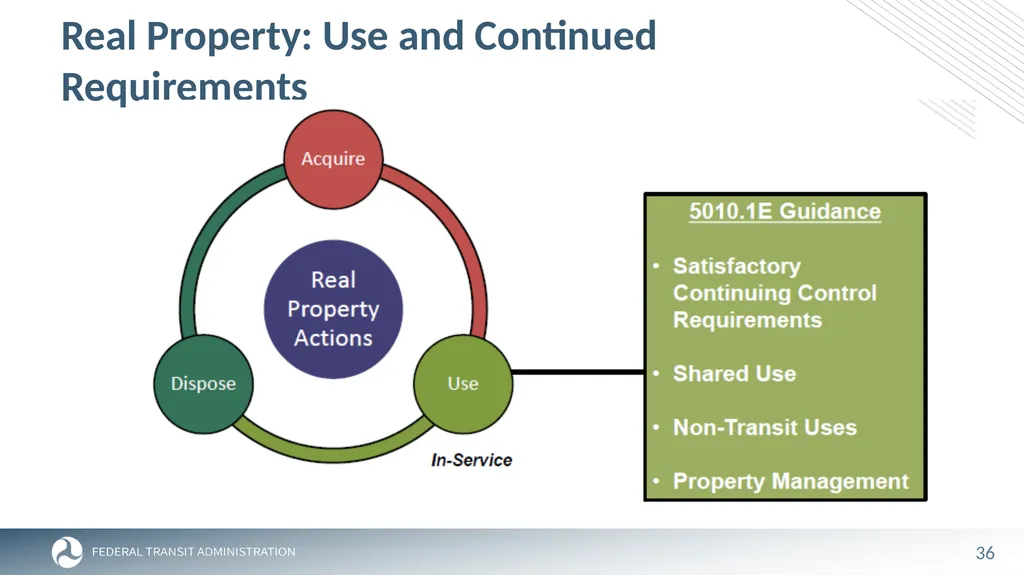
Real Property: Use and Continued Requirements<br>
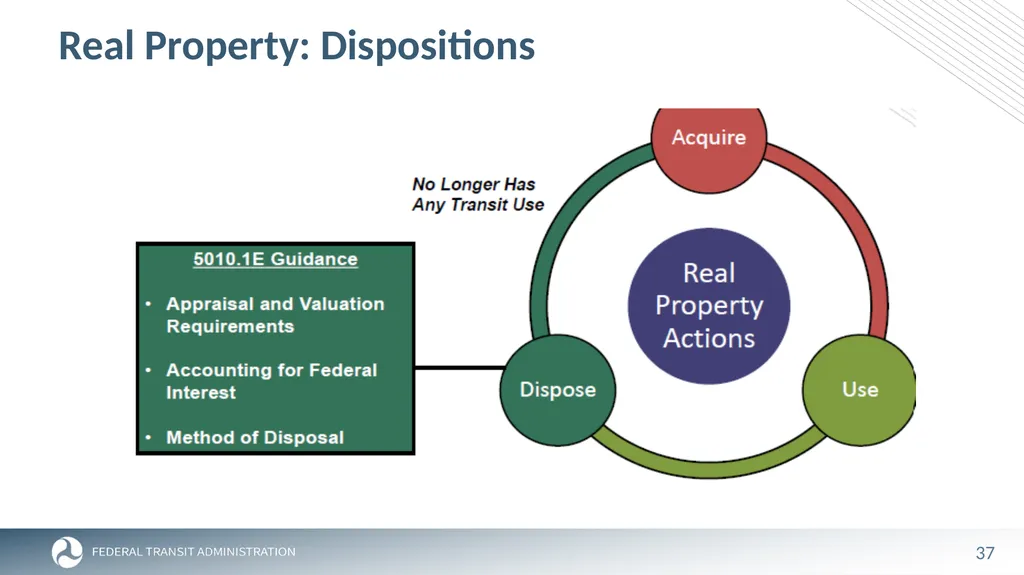
37
Real Property: Dispositions<br>
38
Incidental Use FTA Definition of Incidental Use: (5010.1E Chapter IV)
The limited authorized non-transit use of project property. Such use must not conflict with the approved purposes of the project and must not interfere with the intended transit uses of the project property. An acceptable incidental use does not affect a property's transit capacity or use. FTA may concur in incidental use after award of the grant.
Requires FTA approval except when it involves coordinated public transit human services transportation.<br>
The limited authorized non-transit use of project property. Such use must not conflict with the approved purposes of the project and must not interfere with the intended transit uses of the project property. An acceptable incidental use does not affect a property's transit capacity or use. FTA may concur in incidental use after award of the grant.
Requires FTA approval except when it involves coordinated public transit human services transportation.<br>
39
Incidental Use: Requirements Must Be Compatible with Original Grant Purpose
Needed Property
No interference with safety and public transportation purpose
Continuing Control
Income Retained for Capital and Operating Purposes; but not to match original grant<br>
Needed Property
No interference with safety and public transportation purpose
Continuing Control
Income Retained for Capital and Operating Purposes; but not to match original grant<br>
40
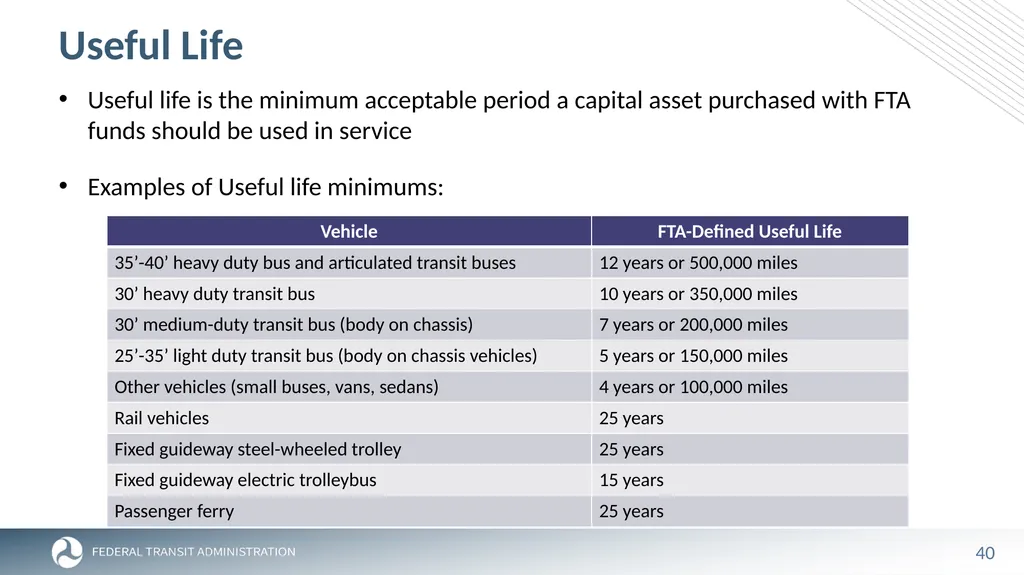
Useful Life Useful life is the minimum acceptable period a capital asset purchased with FTA funds should be used in service
Examples of Useful life minimums:<br>
Examples of Useful life minimums:<br>
41
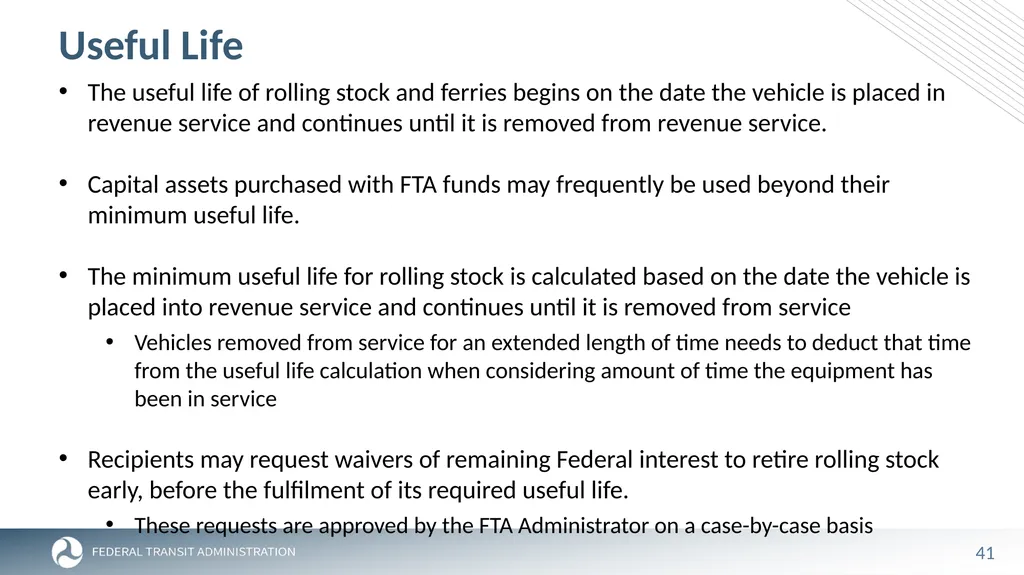
Useful Life The useful life of rolling stock and ferries begins on the date the vehicle is placed in revenue service and continues until it is removed from revenue service.
Capital assets purchased with FTA funds may frequently be used beyond their minimum useful life.
The minimum useful life for rolling stock is calculated based on the date the vehicle is placed into revenue service and continues until it is removed from service
Vehicles removed from service for an extended length of time needs to deduct that time from the useful life calculation when considering amount of time the equipment has been in service
Recipients may request waivers of remaining Federal interest to retire rolling stock early, before the fulfilment of its required useful life.
These requests are approved by the FTA Administrator on a case-by-case basis<br>
Capital assets purchased with FTA funds may frequently be used beyond their minimum useful life.
The minimum useful life for rolling stock is calculated based on the date the vehicle is placed into revenue service and continues until it is removed from service
Vehicles removed from service for an extended length of time needs to deduct that time from the useful life calculation when considering amount of time the equipment has been in service
Recipients may request waivers of remaining Federal interest to retire rolling stock early, before the fulfilment of its required useful life.
These requests are approved by the FTA Administrator on a case-by-case basis<br>
42
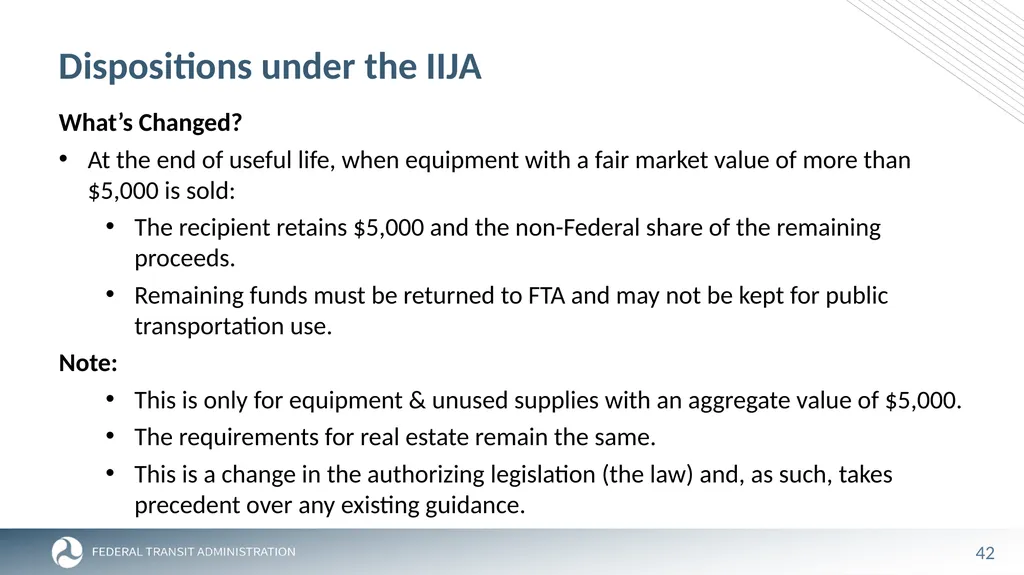
Dispositions under the IIJA What’s Changed?
At the end of useful life, when equipment with a fair market value of more than $5,000 is sold:
The recipient retains $5,000 and the non-Federal share of the remaining proceeds.
Remaining funds must be returned to FTA and may not be kept for public transportation use.
Note:
This is only for equipment & unused supplies with an aggregate value of $5,000.
The requirements for real estate remain the same.
This is a change in the authorizing legislation (the law) and, as such, takes precedent over any existing guidance.<br>
At the end of useful life, when equipment with a fair market value of more than $5,000 is sold:
The recipient retains $5,000 and the non-Federal share of the remaining proceeds.
Remaining funds must be returned to FTA and may not be kept for public transportation use.
Note:
This is only for equipment & unused supplies with an aggregate value of $5,000.
The requirements for real estate remain the same.
This is a change in the authorizing legislation (the law) and, as such, takes precedent over any existing guidance.<br>
43
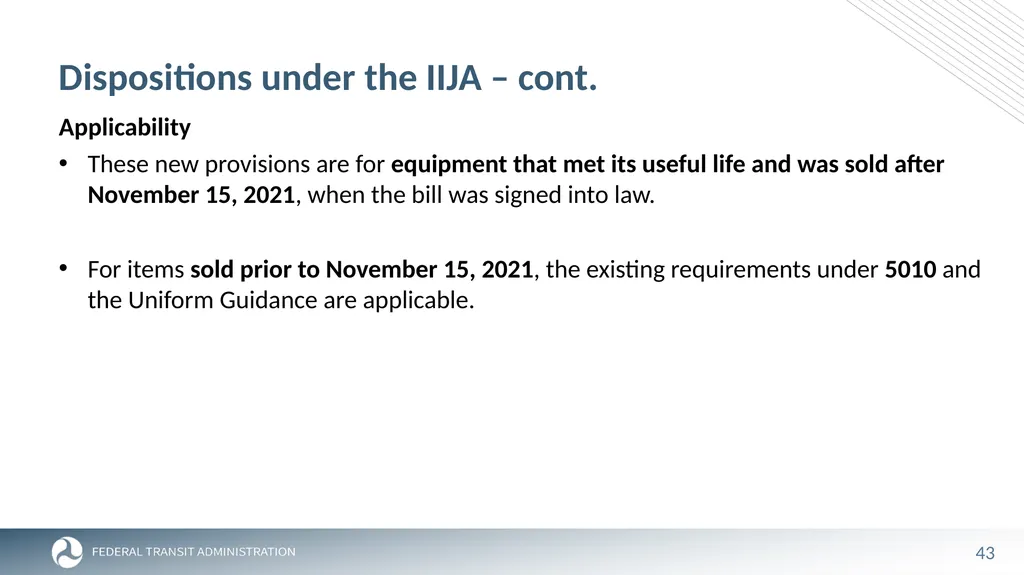
Dispositions under the IIJA – cont. Applicability
These new provisions are for equipment that met its useful life and was sold after November 15, 2021, when the bill was signed into law.
For items sold prior to November 15, 2021, the existing requirements under 5010 and the Uniform Guidance are applicable.<br>
These new provisions are for equipment that met its useful life and was sold after November 15, 2021, when the bill was signed into law.
For items sold prior to November 15, 2021, the existing requirements under 5010 and the Uniform Guidance are applicable.<br>
44
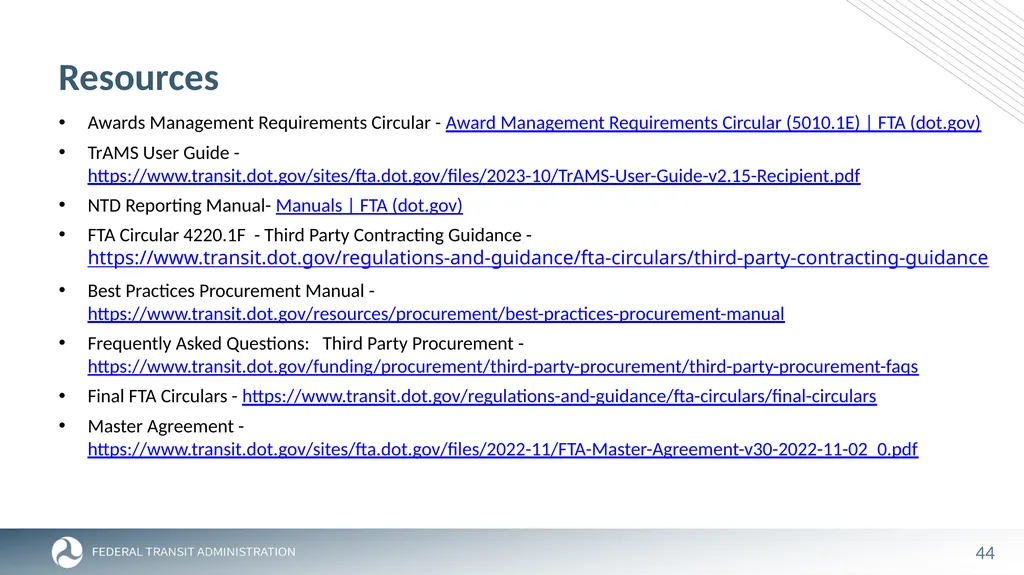
Resources Awards Management Requirements Circular - Award Management Requirements Circular (5010.1E) | FTA (dot.gov)
TrAMS User Guide - https://www.transit.dot.gov/sites/fta.dot.gov/files/2023-10/TrAMS-User-Guide-v2.15-Recipient.pdf
NTD Reporting Manual- Manuals | FTA (dot.gov)
FTA Circular 4220.1F - Third Party Contracting Guidance - https://www.transit.dot.gov/regulations-and-guidance/fta-circulars/third-party-contracting-guidance
Best Practices Procurement Manual - https://www.transit.dot.gov/resources/procurement/best-practices-procurement-manual
Frequently Asked Questions: Third Party Procurement - https://www.transit.dot.gov/funding/procurement/third-party-procurement/third-party-procurement-faqs
Final FTA Circulars - https://www.transit.dot.gov/regulations-and-guidance/fta-circulars/final-circulars
Master Agreement - https://www.transit.dot.gov/sites/fta.dot.gov/files/2022-11/FTA-Master-Agreement-v30-2022-11-02_0.pdf<br>
TrAMS User Guide - https://www.transit.dot.gov/sites/fta.dot.gov/files/2023-10/TrAMS-User-Guide-v2.15-Recipient.pdf
NTD Reporting Manual- Manuals | FTA (dot.gov)
FTA Circular 4220.1F - Third Party Contracting Guidance - https://www.transit.dot.gov/regulations-and-guidance/fta-circulars/third-party-contracting-guidance
Best Practices Procurement Manual - https://www.transit.dot.gov/resources/procurement/best-practices-procurement-manual
Frequently Asked Questions: Third Party Procurement - https://www.transit.dot.gov/funding/procurement/third-party-procurement/third-party-procurement-faqs
Final FTA Circulars - https://www.transit.dot.gov/regulations-and-guidance/fta-circulars/final-circulars
Master Agreement - https://www.transit.dot.gov/sites/fta.dot.gov/files/2022-11/FTA-Master-Agreement-v30-2022-11-02_0.pdf<br>
45
Resources - Continued Frequently Asked Questions: Third Party Procurement - https://www.transit.dot.gov/funding/procurement/third-party-procurement/third-party-procurement-faqs
Final FTA Circulars - https://www.transit.dot.gov/regulations-and-guidance/fta-circulars/final-circulars
Master Agreement - https://www.transit.dot.gov/sites/fta.dot.gov/files/2022-11/FTA-Master-Agreement-v30-2022-11-02_0.pdf<br>
Final FTA Circulars - https://www.transit.dot.gov/regulations-and-guidance/fta-circulars/final-circulars
Master Agreement - https://www.transit.dot.gov/sites/fta.dot.gov/files/2022-11/FTA-Master-Agreement-v30-2022-11-02_0.pdf<br>