Functional Commitments for All Functions from SIS with Transparent Setup Leo de Castro MIT Chris Peikert University of Michigan This Talk Functional Commitments for All Functions Post-Quantum Security: Relies only on standard lattice
"Functional Commitments for All Functions from SIS" is the property of its rightful owner. Permission is granted to
download and print the materials on this website for personal, non-commercial use only, and to display it
on your personal computer provided you do not modify the materials and that you retain all copyright
notices contained in the materials. By downloading content from our website, you accept the terms of this
agreement.
Presentation Transcript
01
Functional Commitments for All Functions from SIS with Transparent Setup Leo de Castro
MIT Chris Peikert
University of Michigan<br>
02
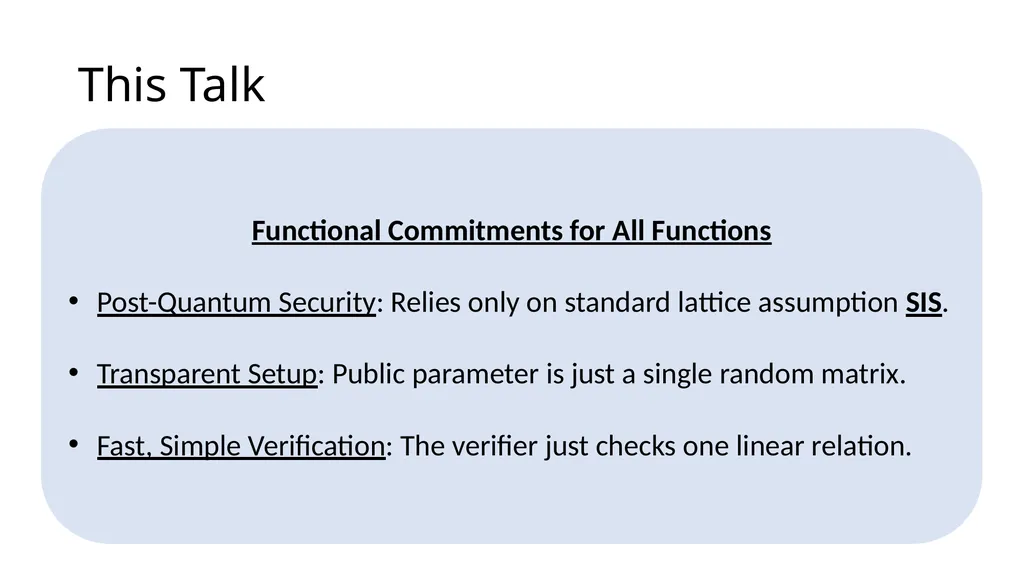
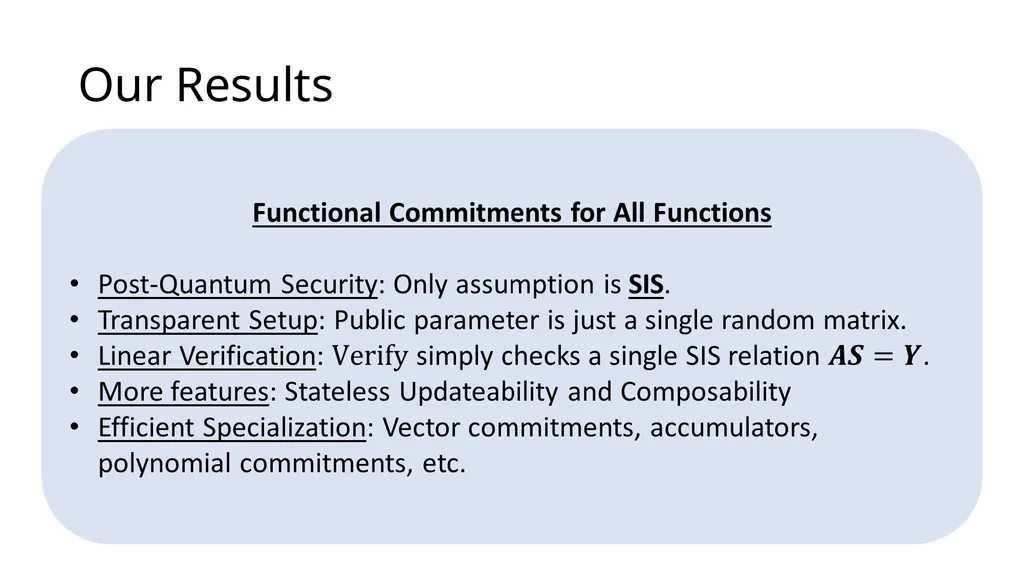
This Talk Functional Commitments for All Functions
Post-Quantum Security: Relies only on standard lattice assumption SIS.
Transparent Setup: Public parameter is just a single random matrix.
Fast, Simple Verification: The verifier just checks one linear relation.<br>
03
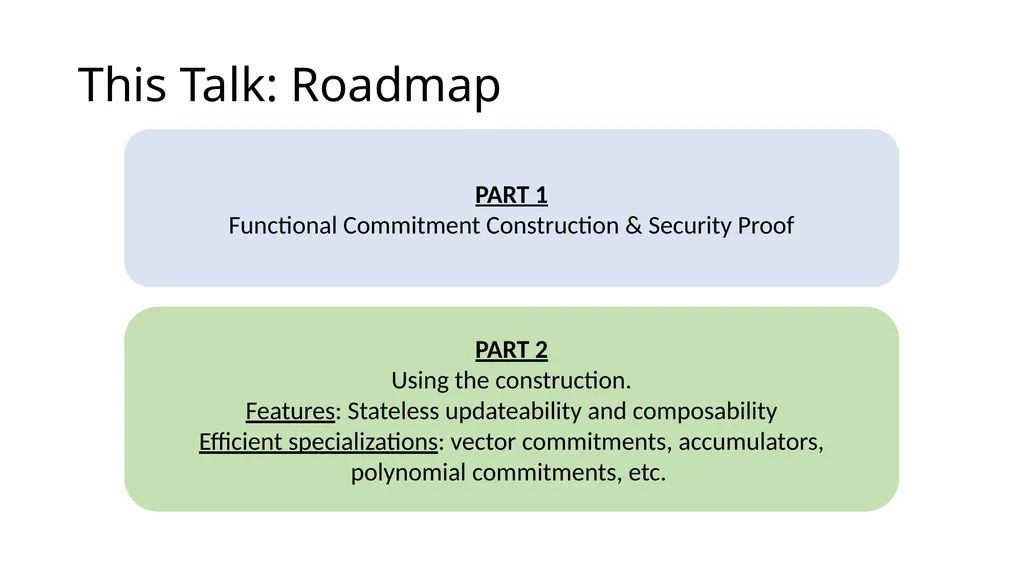
This Talk: Roadmap PART 1
Functional Commitment Construction & Security Proof PART 2
Using the construction.
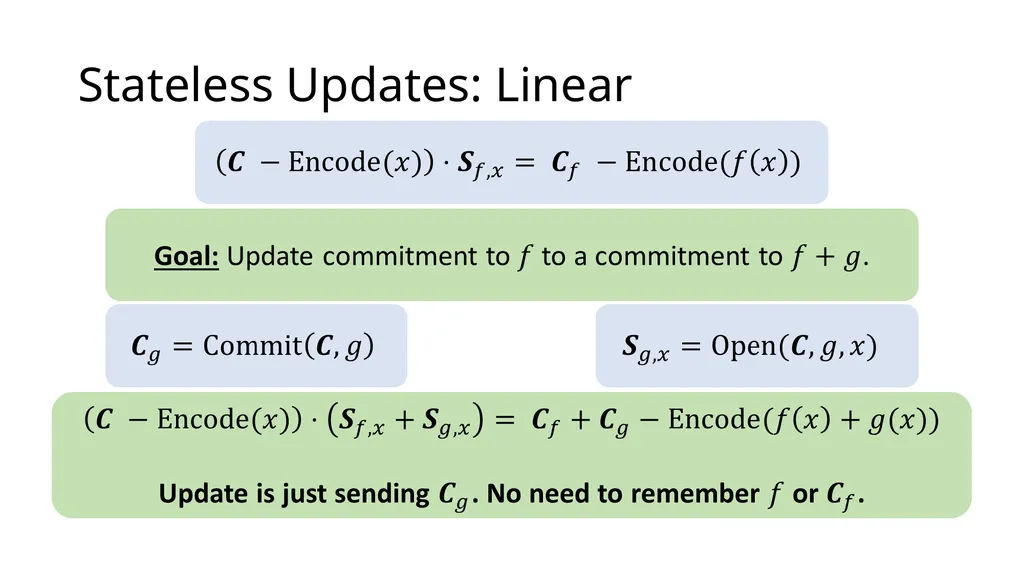
Features: Stateless updateability and composability
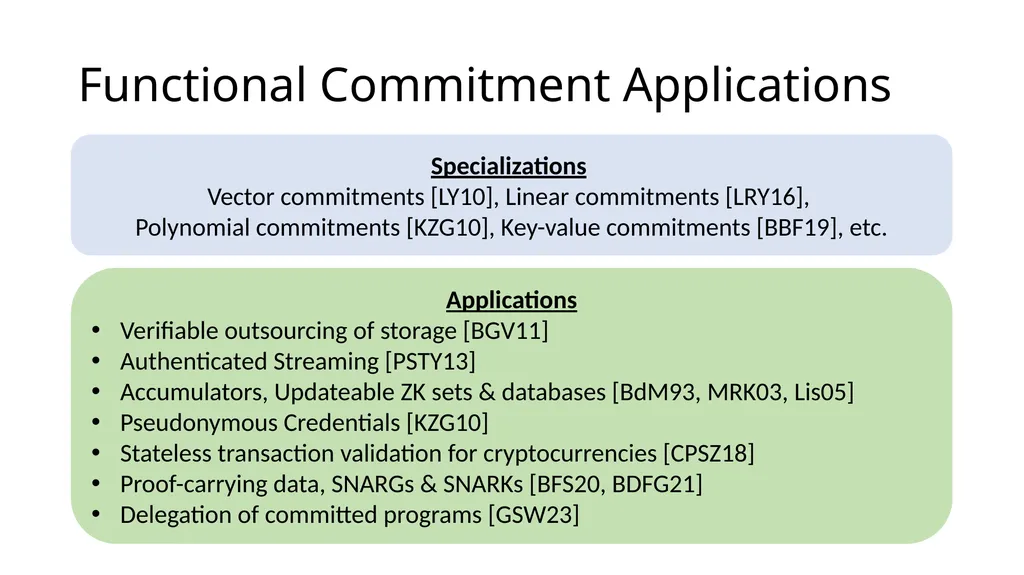
Efficient specializations: vector commitments, accumulators, polynomial commitments, etc.<br>
04
Part 1: Functional Commitment Construction<br>
05
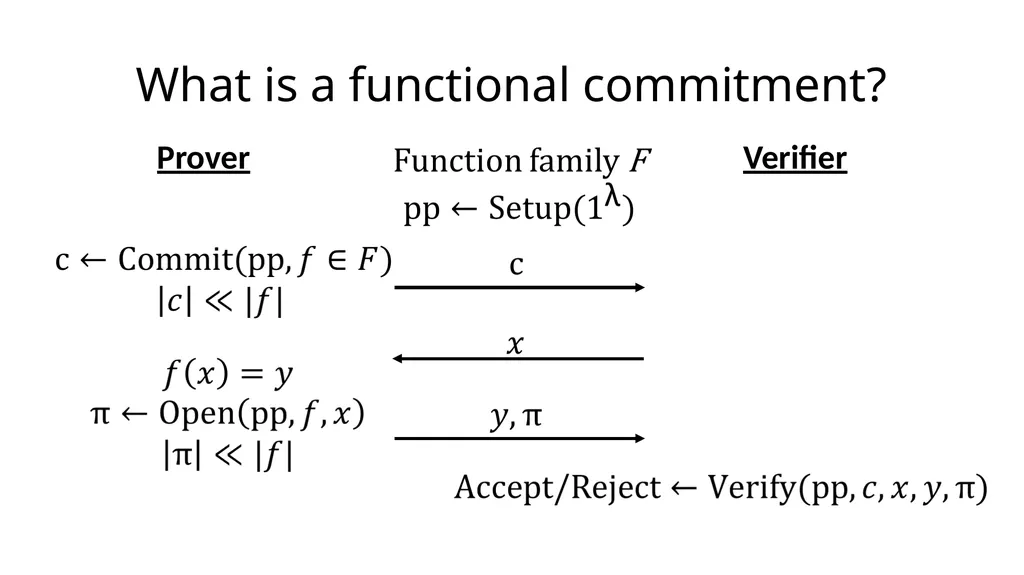
What is a functional commitment? Prover Verifier<br>
06
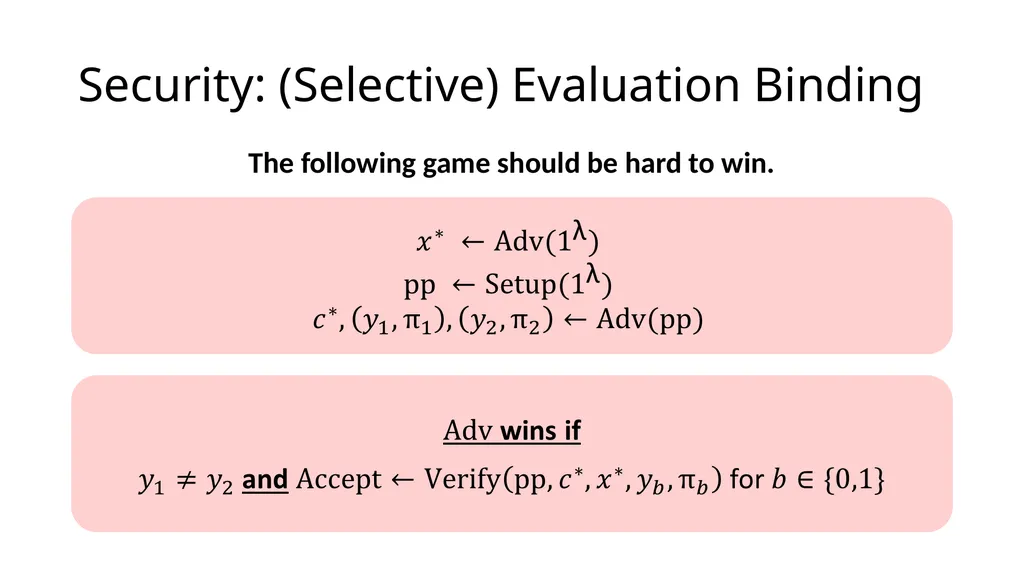
Security: (Selective) Evaluation Binding The following game should be hard to win.<br>
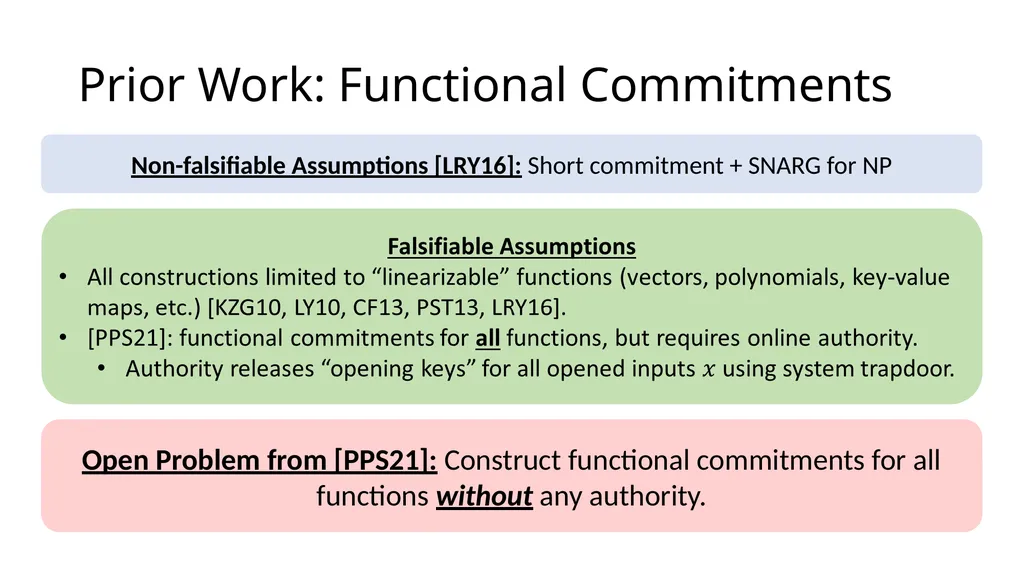
Prior Work: Functional Commitments Non-falsifiable Assumptions [LRY16]: Short commitment + SNARG for NP Open Problem from [PPS21]: Construct functional commitments for all functions without any authority.<br>
09
Our Results<br>
10
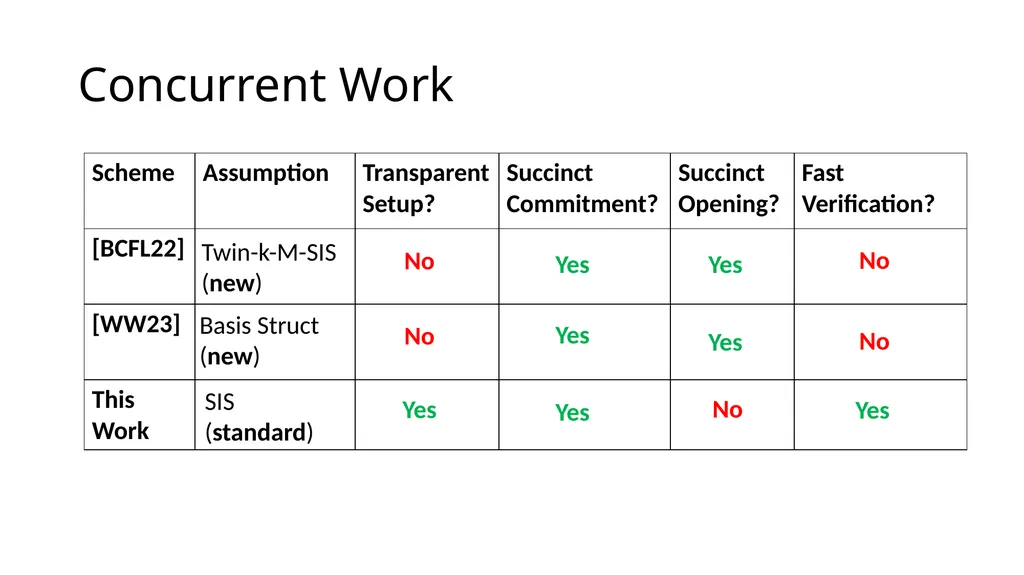
Concurrent Work Twin-k-M-SIS (new) Basis Struct (new) SIS
(standard) No No Yes Yes Yes Yes No Yes Yes Yes No No<br>
11
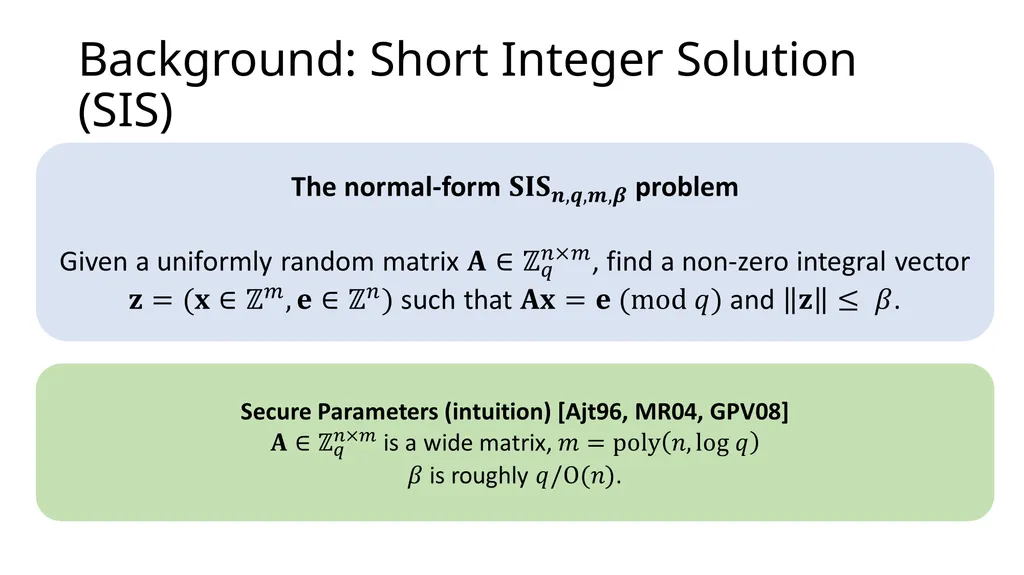
Background: Short Integer Solution (SIS)<br>
12
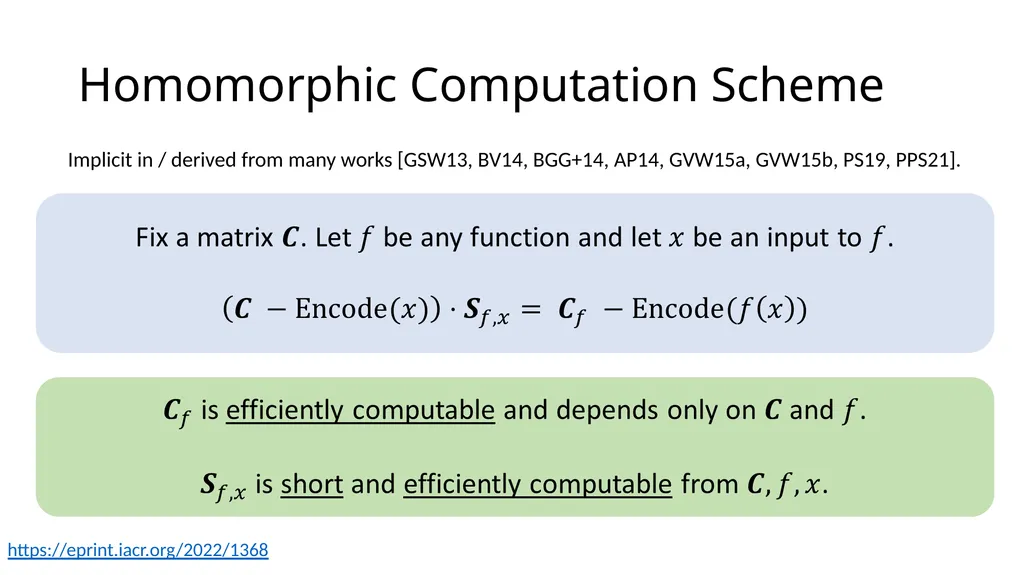
Homomorphic Computation Scheme Implicit in / derived from many works [GSW13, BV14, BGG+14, AP14, GVW15a, GVW15b, PS19, PPS21]. https://eprint.iacr.org/2022/1368<br>