
Fundamental Rights and Responsibilities by Steven
MS
Published · 15 slides · 0 views

1 / 1



Description
Fundamental Rights and Responsibilities by Steven Powe Toolkit for Serving on a Human Rights Committee by Steven Powe (May 2018) Why is it Important to Know Your Rights? Fundamental Rights and Responsibilities A Resource from the Toolkit
Related Topics
Share
Embed code
Download this presentation From Below
"Fundamental Rights and Responsibilities by Steven" is the property of its rightful owner. Permission is granted to download and print the materials on this website for personal, non-commercial use only, and to display it on your personal computer provided you do not modify the materials and that you retain all copyright notices contained in the materials. By downloading content from our website, you accept the terms of this agreement.
Presentation Transcript
01
Fundamental Rights and Responsibilities by Steven Powe Toolkit for Serving on a Human Rights Committee by Steven Powe (May 2018)<br>
02
Why is it Important to Know Your Rights? Fundamental Rights and Responsibilities
A Resource from the Toolkit for Serving on a Human Rights Committee
by Steven Powe (May 2018)<br>
03
Importance of Your Rights People who receive services should be informed of their rights and receive support to exercise them.
If you don’t know your rights, people can take advantage of you.
It is important for you to know your rights.
It is important to exercise your rights. Fundamental Rights and Responsibilities A Resource from the Toolkit for Serving on a Human Rights Committee by Steven Powe (May 2018)<br>
If you don’t know your rights, people can take advantage of you.
It is important for you to know your rights.
It is important to exercise your rights. Fundamental Rights and Responsibilities A Resource from the Toolkit for Serving on a Human Rights Committee by Steven Powe (May 2018)<br>
04
What Does it Mean to
Exercise your Rights? When you exercise your rights, you use them – for example, you have the right to vote. When you actually vote, you have exercised that right.
People have the right to be informed and educated about their rights.
AND to have access to advocacy support and information to exercise those rights.
People who buy things or become a member by joining a group should know their rights. Fundamental Rights and Responsibilities A Resource from the Toolkit for Serving on a Human Rights Committee by Steven Powe (May 2018)<br>
People have the right to be informed and educated about their rights.
AND to have access to advocacy support and information to exercise those rights.
People who buy things or become a member by joining a group should know their rights. Fundamental Rights and Responsibilities A Resource from the Toolkit for Serving on a Human Rights Committee by Steven Powe (May 2018)<br>
05
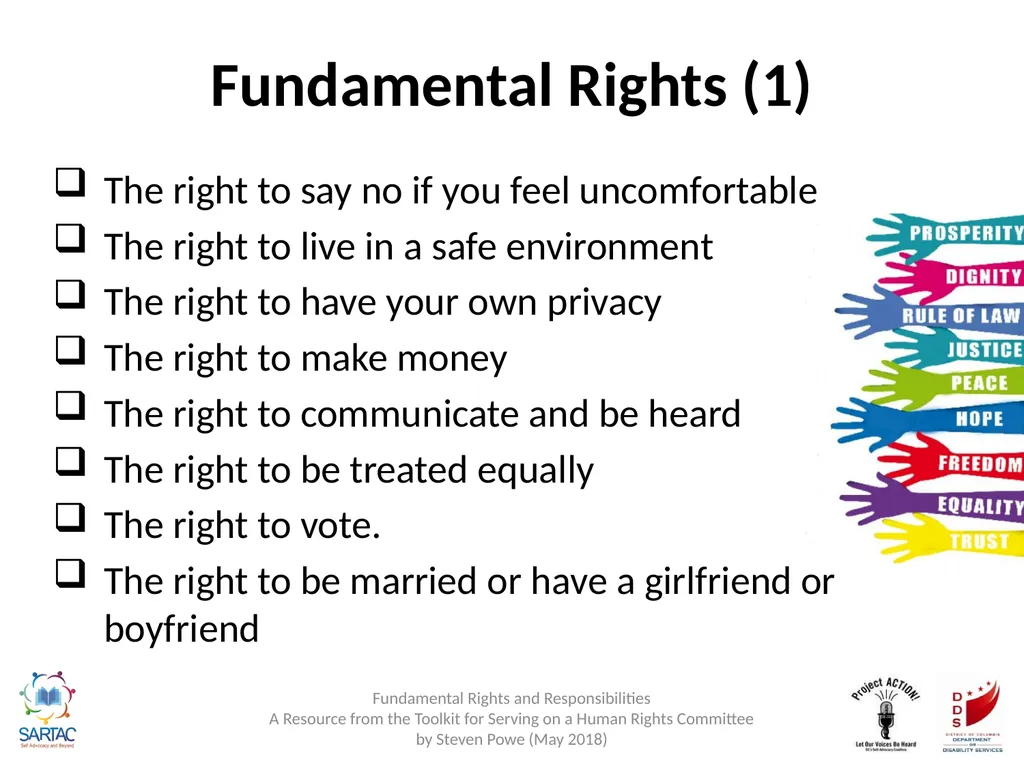
Fundamental Rights (1) The right to say no if you feel uncomfortable
The right to live in a safe environment
The right to have your own privacy
The right to make money
The right to communicate and be heard
The right to be treated equally
The right to vote.
The right to be married or have a girlfriend or boyfriend Fundamental Rights and Responsibilities A Resource from the Toolkit for Serving on a Human Rights Committee by Steven Powe (May 2018)<br>
The right to live in a safe environment
The right to have your own privacy
The right to make money
The right to communicate and be heard
The right to be treated equally
The right to vote.
The right to be married or have a girlfriend or boyfriend Fundamental Rights and Responsibilities A Resource from the Toolkit for Serving on a Human Rights Committee by Steven Powe (May 2018)<br>
06
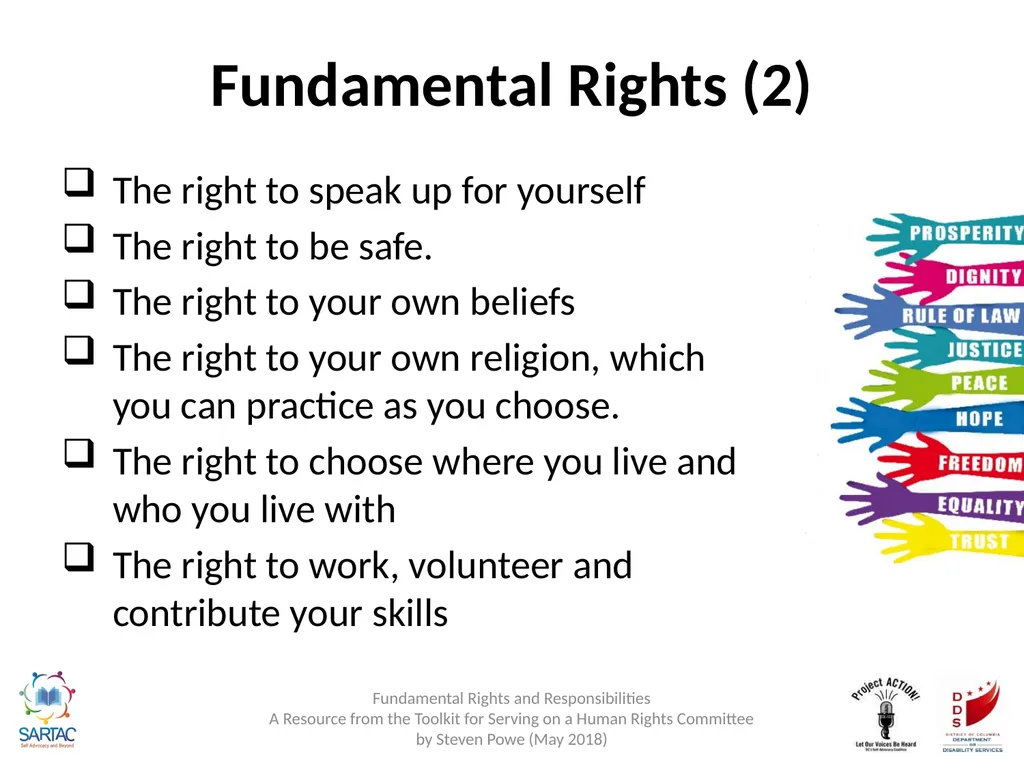
The right to speak up for yourself
The right to be safe.
The right to your own beliefs
The right to your own religion, which you can practice as you choose.
The right to choose where you live and who you live with
The right to work, volunteer and contribute your skills Fundamental Rights (2) Fundamental Rights and Responsibilities A Resource from the Toolkit for Serving on a Human Rights Committee by Steven Powe (May 2018)<br>
The right to be safe.
The right to your own beliefs
The right to your own religion, which you can practice as you choose.
The right to choose where you live and who you live with
The right to work, volunteer and contribute your skills Fundamental Rights (2) Fundamental Rights and Responsibilities A Resource from the Toolkit for Serving on a Human Rights Committee by Steven Powe (May 2018)<br>
07
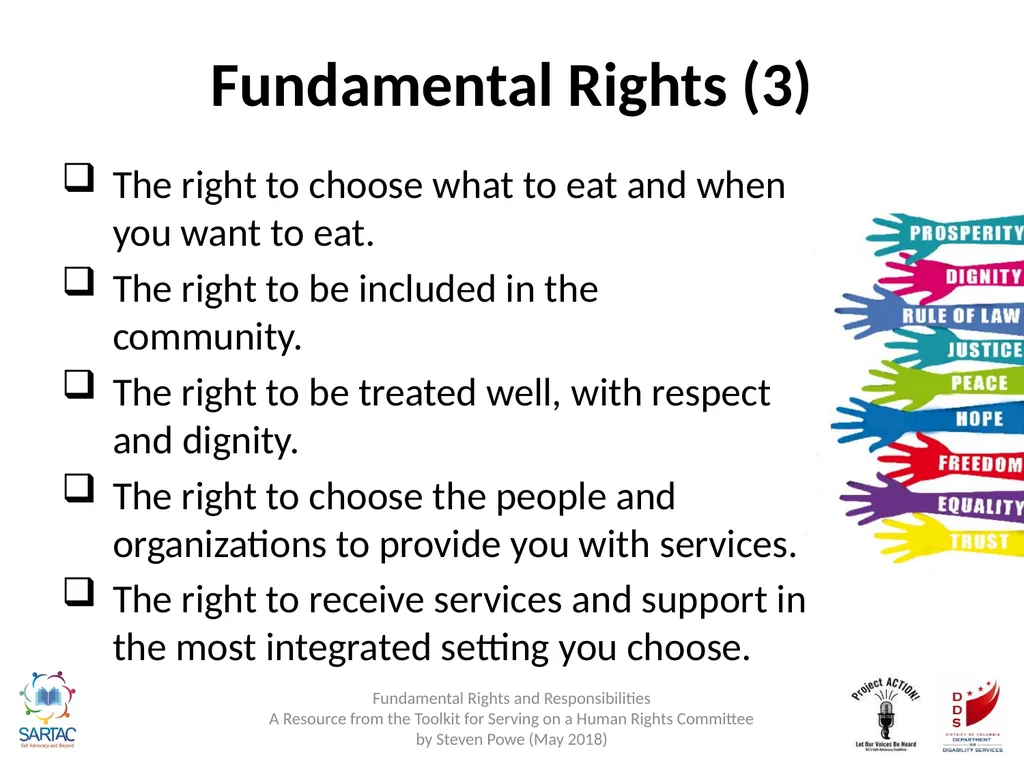
The right to choose what to eat and when you want to eat.
The right to be included in the community.
The right to be treated well, with respect and dignity.
The right to choose the people and organizations to provide you with services.
The right to receive services and support in the most integrated setting you choose. Fundamental Rights (3) Fundamental Rights and Responsibilities A Resource from the Toolkit for Serving on a Human Rights Committee by Steven Powe (May 2018)<br>
The right to be included in the community.
The right to be treated well, with respect and dignity.
The right to choose the people and organizations to provide you with services.
The right to receive services and support in the most integrated setting you choose. Fundamental Rights (3) Fundamental Rights and Responsibilities A Resource from the Toolkit for Serving on a Human Rights Committee by Steven Powe (May 2018)<br>
08
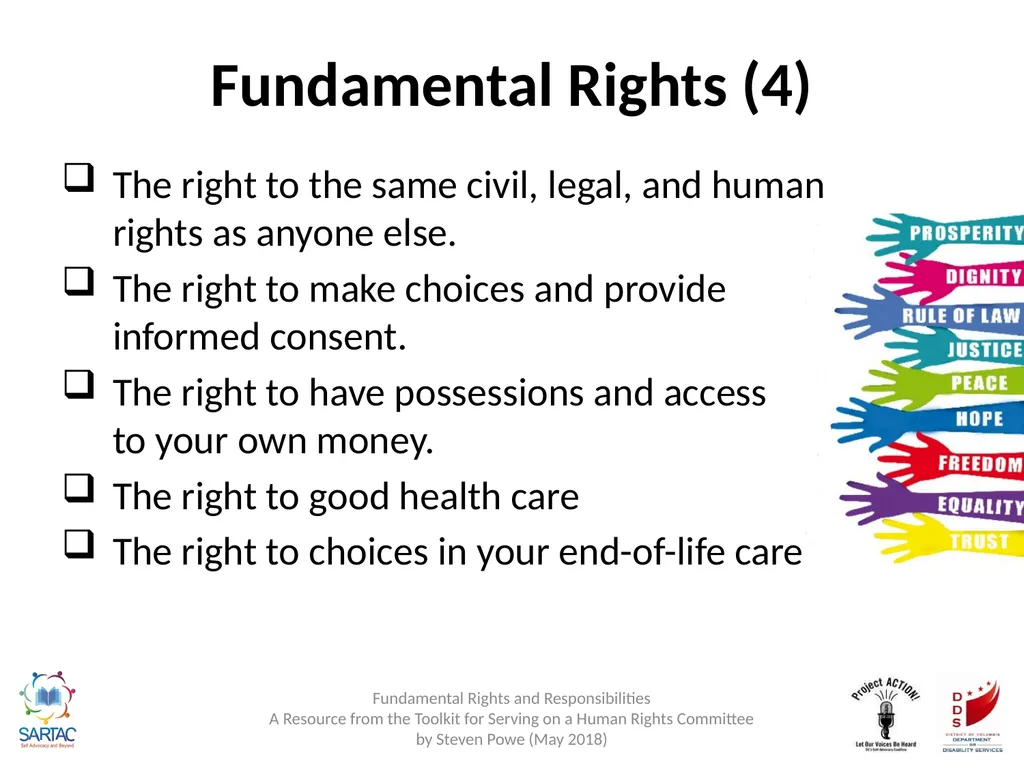
The right to the same civil, legal, and human rights as anyone else.
The right to make choices and provide informed consent.
The right to have possessions and access to your own money.
The right to good health care
The right to choices in your end-of-life care Fundamental Rights (4) Fundamental Rights and Responsibilities A Resource from the Toolkit for Serving on a Human Rights Committee by Steven Powe (May 2018)<br>
The right to make choices and provide informed consent.
The right to have possessions and access to your own money.
The right to good health care
The right to choices in your end-of-life care Fundamental Rights (4) Fundamental Rights and Responsibilities A Resource from the Toolkit for Serving on a Human Rights Committee by Steven Powe (May 2018)<br>
09
Individual Responsibilities (1) To obey all laws that apply to all other citizens.
To be informed and familiar with the rules and regulations that apply to your living situation, workplace, and the other settings in which you engage in activities.
To learn about and exercise the rights that are important to you. People who exercise rights also have to accept responsibilities. What do these mean to you? Fundamental Rights and Responsibilities A Resource from the Toolkit for Serving on a Human Rights Committee by Steven Powe (May 2018)<br>
To be informed and familiar with the rules and regulations that apply to your living situation, workplace, and the other settings in which you engage in activities.
To learn about and exercise the rights that are important to you. People who exercise rights also have to accept responsibilities. What do these mean to you? Fundamental Rights and Responsibilities A Resource from the Toolkit for Serving on a Human Rights Committee by Steven Powe (May 2018)<br>
10
To provide, to the best of your knowledge, accurate, complete and relevant information regarding your medical and life history.
To attend agreed-upon activities and keep appointments.
To take an active part in planning for your services, choosing services, and making transitions.
To be respectful of the property of others. Individual Responsibilities (2) Fundamental Rights and Responsibilities A Resource from the Toolkit for Serving on a Human Rights Committee by Steven Powe (May 2018)<br>
To attend agreed-upon activities and keep appointments.
To take an active part in planning for your services, choosing services, and making transitions.
To be respectful of the property of others. Individual Responsibilities (2) Fundamental Rights and Responsibilities A Resource from the Toolkit for Serving on a Human Rights Committee by Steven Powe (May 2018)<br>
11
Individual Responsibilities (3) To be responsible for your own actions.
To ask questions when you do not understand instructions, service descriptions, medical recommendations, etc.
To respect and take good care of yourself, your home, your workplace, and other places in which you engage in activities.
To be respectful of others.
To be considerate of the rights of others. Fundamental Rights and Responsibilities A Resource from the Toolkit for Serving on a Human Rights Committee by Steven Powe (May 2018)<br>
To ask questions when you do not understand instructions, service descriptions, medical recommendations, etc.
To respect and take good care of yourself, your home, your workplace, and other places in which you engage in activities.
To be respectful of others.
To be considerate of the rights of others. Fundamental Rights and Responsibilities A Resource from the Toolkit for Serving on a Human Rights Committee by Steven Powe (May 2018)<br>
12
Restoring Rights If someone’s rights are restricted, they need to understand how to get them back
Human Rights Committees need to ensure people have the opportunity to earn back their rights if they have been restricted and understand their responsibilities Fundamental Rights and Responsibilities A Resource from the Toolkit for Serving on a Human Rights Committee by Steven Powe (May 2018)<br>
Human Rights Committees need to ensure people have the opportunity to earn back their rights if they have been restricted and understand their responsibilities Fundamental Rights and Responsibilities A Resource from the Toolkit for Serving on a Human Rights Committee by Steven Powe (May 2018)<br>
13
Least Restrictive When serving on a Human Rights Committee (HRC), the committee members should ask themselves if any proposed restrictions or plans that limit people’s freedoms and rights are the least restrictive they can think of.
HRCs should ensure no one’s rights are restricted any more than might be necessary.
HRCs should ensure that restrictions are time-limited. Fundamental Rights and Responsibilities A Resource from the Toolkit for Serving on a Human Rights Committee by Steven Powe (May 2018)<br>
HRCs should ensure no one’s rights are restricted any more than might be necessary.
HRCs should ensure that restrictions are time-limited. Fundamental Rights and Responsibilities A Resource from the Toolkit for Serving on a Human Rights Committee by Steven Powe (May 2018)<br>
14
Case Study Tom punched and kicked his staff person after being told he could not take Tom to the movies tonight, but would try this weekend. The provider restricted Tom from being able travel independently and told his doctor about his behavior. The doctor increased Tom’s medication, which made Tom drowsy.
What questions should the Human Rights Committee (HRC) ask Tom?
What questions should the HRC ask the Provider?
What rights should the HRC ensure are protected for Tom?
How should the HRC discuss Tom’s rights being restored in the future? Fundamental Rights and Responsibilities A Resource from the Toolkit for Serving on a Human Rights Committee by Steven Powe (May 2018)<br>
What questions should the Human Rights Committee (HRC) ask Tom?
What questions should the HRC ask the Provider?
What rights should the HRC ensure are protected for Tom?
How should the HRC discuss Tom’s rights being restored in the future? Fundamental Rights and Responsibilities A Resource from the Toolkit for Serving on a Human Rights Committee by Steven Powe (May 2018)<br>
15
Recognition & Credits “This publication is supported in part by a cooperative agreement from the Administration on Intellectual and Developmental Disabilities, Administration for Community Living, U.S. Department of Health and Human Services. Grantees undertaking projects under government sponsorship are encouraged to express freely their findings and conclusions. Points of view or opinions do not, therefore, necessarily represent official Administration on Intellectual and Developmental Disabilities policy.”
“The Self Advocacy Resource and Technical Assistance Center (SARTAC) seeks to strengthen the self-advocacy movement by supporting self advocacy organizations to grow in diversity and leadership. The resource center is a project of Self Advocates Becoming Empowered (SABE), the oldest national self-advocacy organization in the country. SARTAC is a Developmental Disabilities Project of National Significance, funded by the Administration For Community Living – Administration on Intellectual and Developmental Disabilities (AIDD). The information in this manual was written to provide guidance for self Advocates and their allies to assist in understanding policy issues affecting their lives. It is not to be used to determine a person's legal rights or an organization's legal responsibilities under Section 504 of the Rehabilitation Act of 1973, as amended; the Americans with Disability Act of 1990, as amended or any other federal, state or local laws written to protect the rights of people with disabilities.”
This toolkit was created with the help of DC Department on Disability Services and Project ACTION! support and staff. Fundamental Rights and Responsibilities A Resource from the Toolkit for Serving on a Human Rights Committee by Steven Powe (May 2018)<br>
“The Self Advocacy Resource and Technical Assistance Center (SARTAC) seeks to strengthen the self-advocacy movement by supporting self advocacy organizations to grow in diversity and leadership. The resource center is a project of Self Advocates Becoming Empowered (SABE), the oldest national self-advocacy organization in the country. SARTAC is a Developmental Disabilities Project of National Significance, funded by the Administration For Community Living – Administration on Intellectual and Developmental Disabilities (AIDD). The information in this manual was written to provide guidance for self Advocates and their allies to assist in understanding policy issues affecting their lives. It is not to be used to determine a person's legal rights or an organization's legal responsibilities under Section 504 of the Rehabilitation Act of 1973, as amended; the Americans with Disability Act of 1990, as amended or any other federal, state or local laws written to protect the rights of people with disabilities.”
This toolkit was created with the help of DC Department on Disability Services and Project ACTION! support and staff. Fundamental Rights and Responsibilities A Resource from the Toolkit for Serving on a Human Rights Committee by Steven Powe (May 2018)<br>