
Fundamentals of Operations Management Chapter 4:

Description: Fundamentals of Operations Management Chapter 4: Strategic Capacity Planning 4.0 Learning Outcomes In this chapter, we will: Explain the importance of strategic capacity planning and its role in aligning production capabilities with market
Related Topics
Download Presentation
"Fundamentals of Operations Management Chapter 4:" is the property of its rightful owner. Permission is granted to download and print the materials on this website for personal, non-commercial use only, and to display it on your personal computer provided you do not modify the materials and that you retain all copyright notices contained in the materials. By downloading content from our website, you accept the terms of this agreement.
Presentation Transcript
slide1. Fundamentals of Operations Management Chapter 4: Strategic Capacity Planning<br>
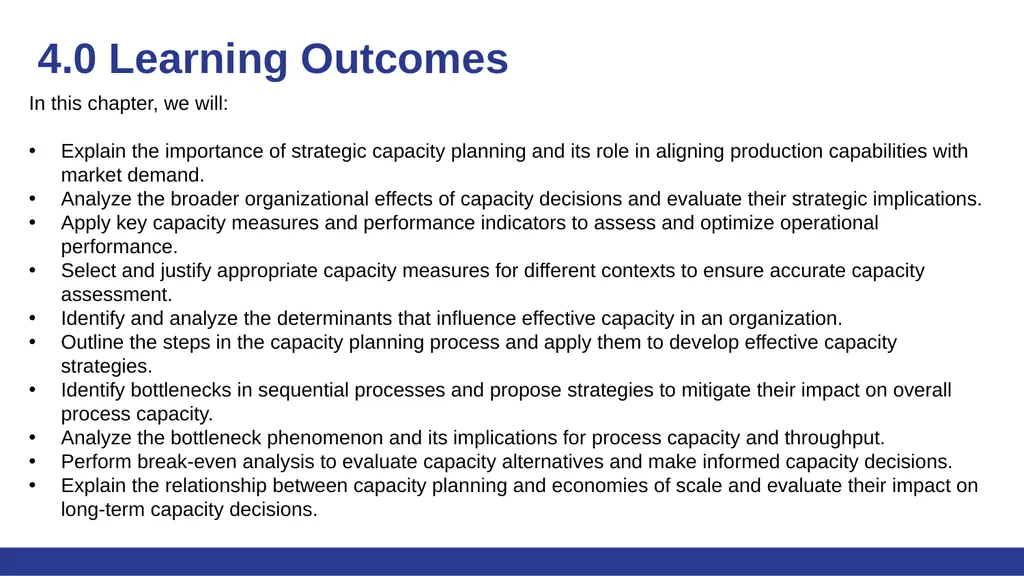
slide2. 4.0 Learning Outcomes In this chapter, we will:
Explain the importance of strategic capacity planning and its role in aligning production capabilities with market demand.
Analyze the broader organizational effects of capacity decisions and evaluate their strategic implications.
Apply key capacity measures and performance indicators to assess and optimize operational performance.
Select and justify appropriate capacity measures for different contexts to ensure accurate capacity assessment.
Identify and analyze the determinants that influence effective capacity in an organization.
Outline the steps in the capacity planning process and apply them to develop effective capacity strategies.
Identify bottlenecks in sequential processes and propose strategies to mitigate their impact on overall process capacity.
Analyze the bottleneck phenomenon and its implications for process capacity and throughput.
Perform break-even analysis to evaluate capacity alternatives and make informed capacity decisions.
Explain the relationship between capacity planning and economies of scale and evaluate their impact on long-term capacity decisions.<br>
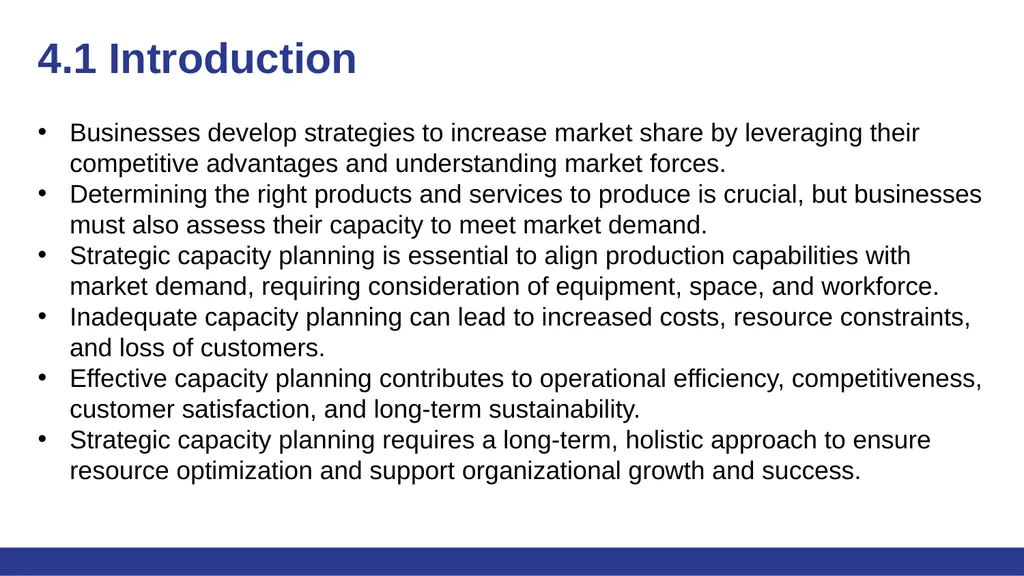
slide3. 4.1 Introduction Businesses develop strategies to increase market share by leveraging their competitive advantages and understanding market forces.
Determining the right products and services to produce is crucial, but businesses must also assess their capacity to meet market demand.
Strategic capacity planning is essential to align production capabilities with market demand, requiring consideration of equipment, space, and workforce.
Inadequate capacity planning can lead to increased costs, resource constraints, and loss of customers.
Effective capacity planning contributes to operational efficiency, competitiveness, customer satisfaction, and long-term sustainability.
Strategic capacity planning requires a long-term, holistic approach to ensure resource optimization and support organizational growth and success.<br>
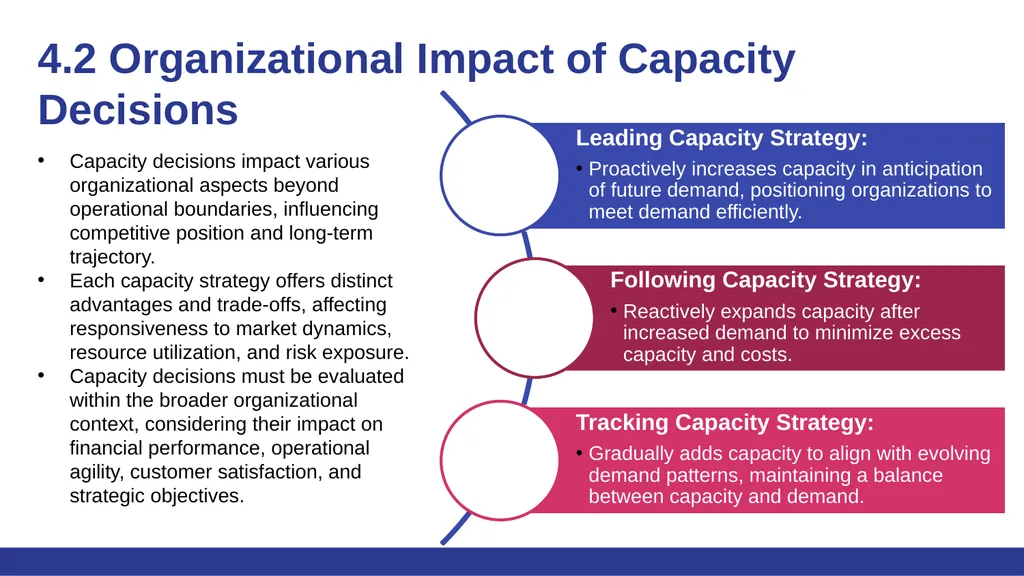
slide4. 4.2 Organizational Impact of Capacity Decisions Capacity decisions impact various organizational aspects beyond operational boundaries, influencing competitive position and long-term trajectory.
Each capacity strategy offers distinct advantages and trade-offs, affecting responsiveness to market dynamics, resource utilization, and risk exposure.
Capacity decisions must be evaluated within the broader organizational context, considering their impact on financial performance, operational agility, customer satisfaction, and strategic objectives.<br>
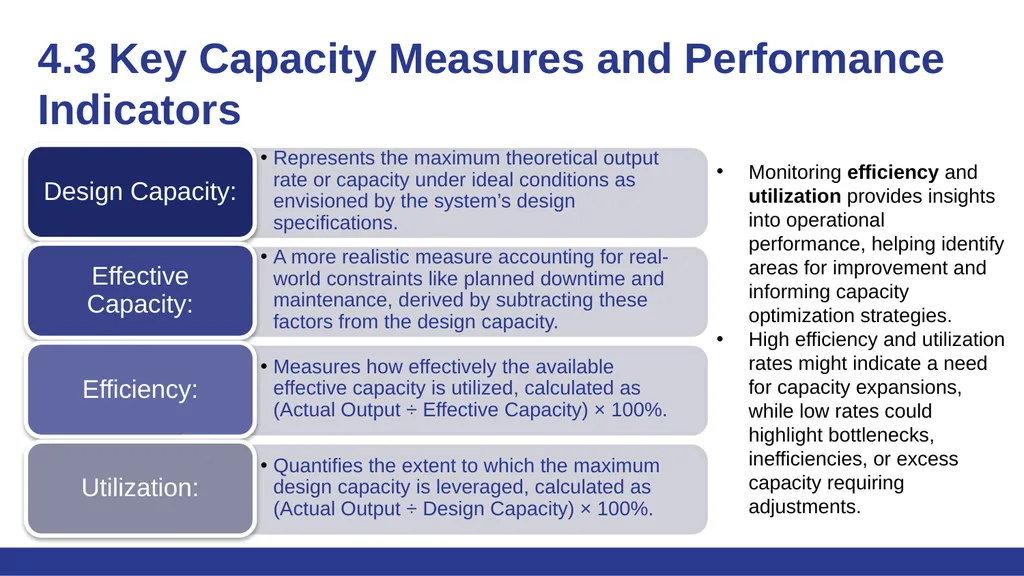
slide5. 4.3 Key Capacity Measures and Performance Indicators Monitoring efficiency and utilization provides insights into operational performance, helping identify areas for improvement and informing capacity optimization strategies.
High efficiency and utilization rates might indicate a need for capacity expansions, while low rates could highlight bottlenecks, inefficiencies, or excess capacity requiring adjustments.<br>
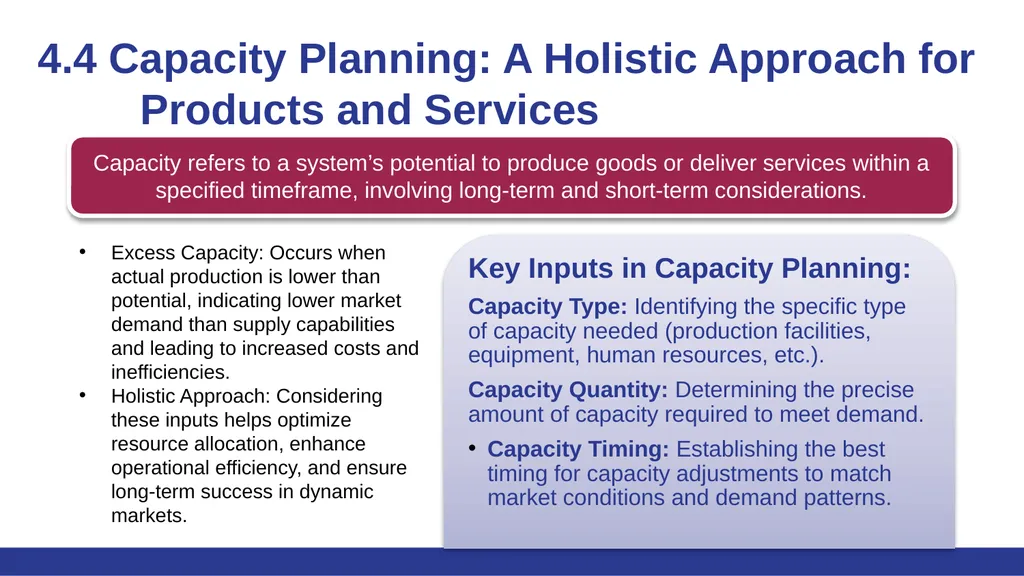
slide6. 4.4 Capacity Planning: A Holistic Approach for Products and Services Capacity refers to a system’s potential to produce goods or deliver services within a specified timeframe, involving long-term and short-term considerations. Excess Capacity: Occurs when actual production is lower than potential, indicating lower market demand than supply capabilities and leading to increased costs and inefficiencies.
Holistic Approach: Considering these inputs helps optimize resource allocation, enhance operational efficiency, and ensure long-term success in dynamic markets. Key Inputs in Capacity Planning:
Capacity Type: Identifying the specific type of capacity needed (production facilities, equipment, human resources, etc.).
Capacity Quantity: Determining the precise amount of capacity required to meet demand.
Capacity Timing: Establishing the best timing for capacity adjustments to match market conditions and demand patterns.<br>
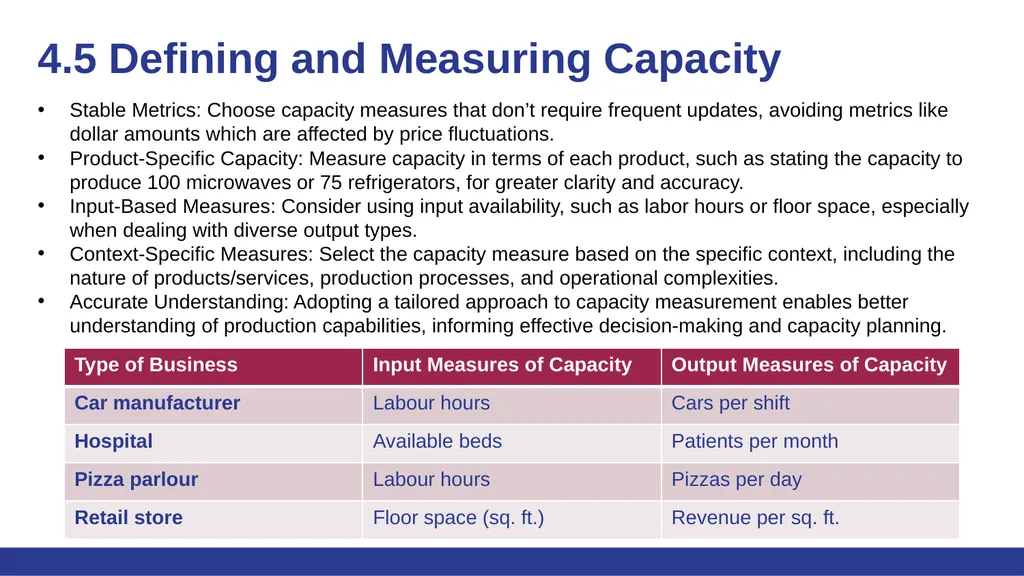
slide7. 4.5 Defining and Measuring Capacity Stable Metrics: Choose capacity measures that don’t require frequent updates, avoiding metrics like dollar amounts which are affected by price fluctuations.
Product-Specific Capacity: Measure capacity in terms of each product, such as stating the capacity to produce 100 microwaves or 75 refrigerators, for greater clarity and accuracy.
Input-Based Measures: Consider using input availability, such as labor hours or floor space, especially when dealing with diverse output types.
Context-Specific Measures: Select the capacity measure based on the specific context, including the nature of products/services, production processes, and operational complexities.
Accurate Understanding: Adopting a tailored approach to capacity measurement enables better understanding of production capabilities, informing effective decision-making and capacity planning.<br>
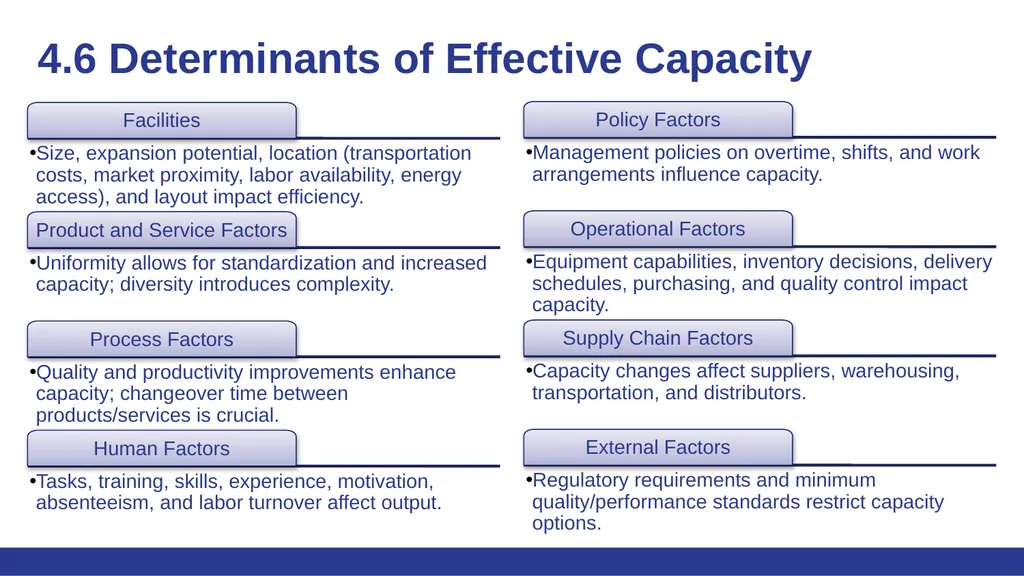
slide8. 4.6 Determinants of Effective Capacity<br>
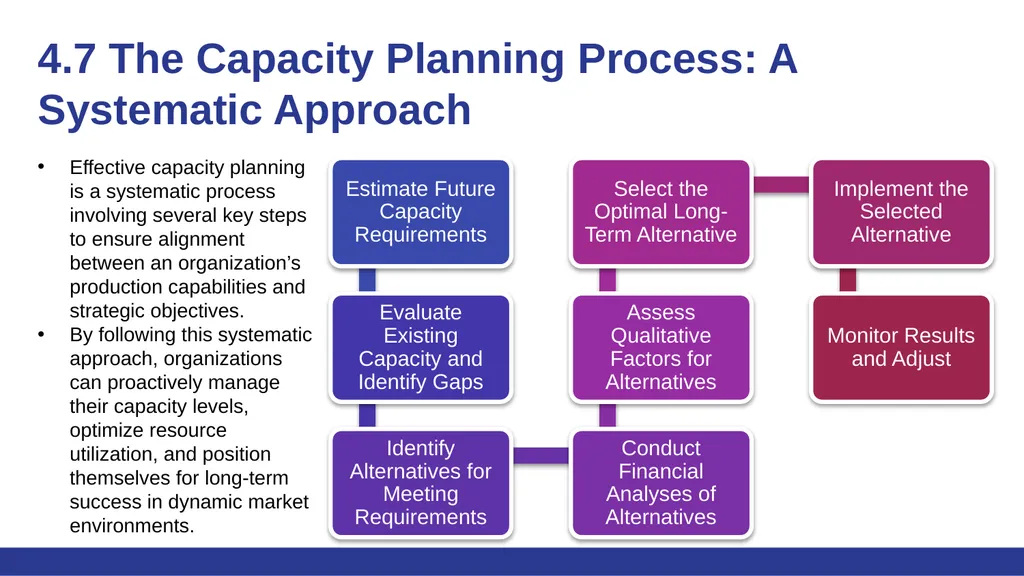
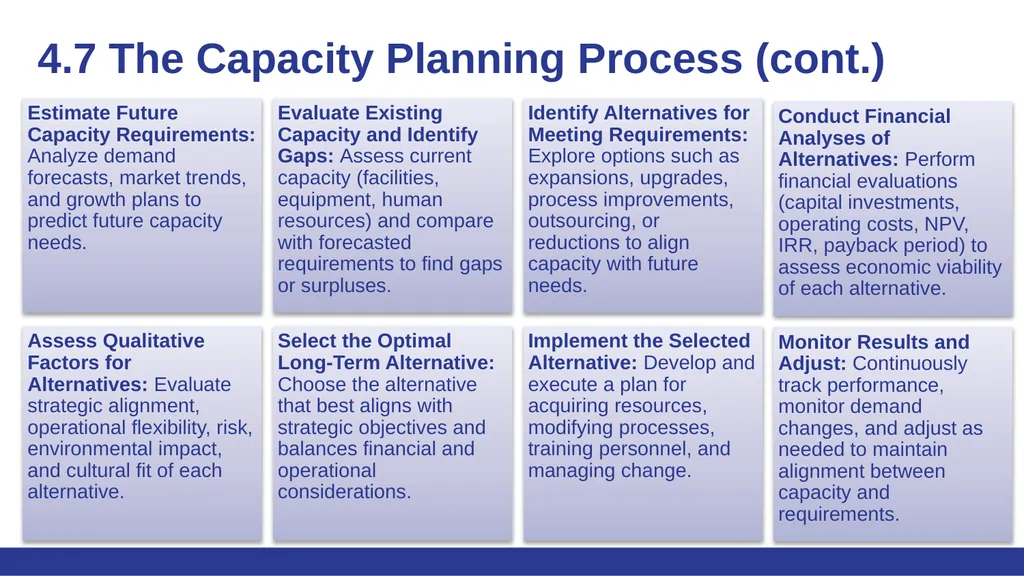
slide9. 4.7 The Capacity Planning Process: A Systematic Approach Effective capacity planning is a systematic process involving several key steps to ensure alignment between an organization’s production capabilities and strategic objectives.
By following this systematic approach, organizations can proactively manage their capacity levels, optimize resource utilization, and position themselves for long-term success in dynamic market environments.<br>
slide10. 4.7 The Capacity Planning Process (cont.)<br>
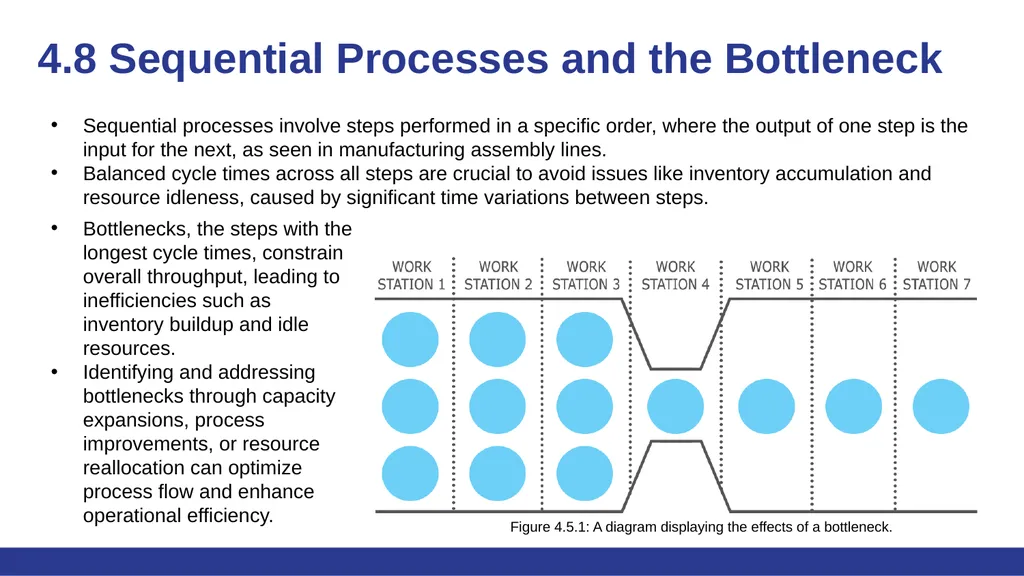
slide11. 4.8 Sequential Processes and the Bottleneck Sequential processes involve steps performed in a specific order, where the output of one step is the input for the next, as seen in manufacturing assembly lines.
Balanced cycle times across all steps are crucial to avoid issues like inventory accumulation and resource idleness, caused by significant time variations between steps. Bottlenecks, the steps with the longest cycle times, constrain overall throughput, leading to inefficiencies such as inventory buildup and idle resources.
Identifying and addressing bottlenecks through capacity expansions, process improvements, or resource reallocation can optimize process flow and enhance operational efficiency. Figure 4.5.1: A diagram displaying the effects of a bottleneck.<br>
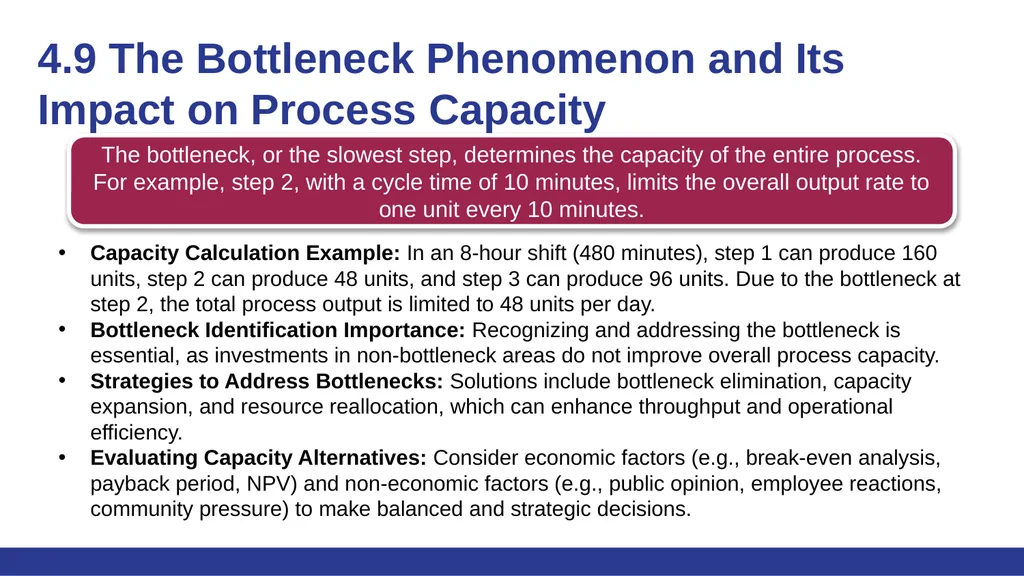
slide12. 4.9 The Bottleneck Phenomenon and Its Impact on Process Capacity The bottleneck, or the slowest step, determines the capacity of the entire process. For example, step 2, with a cycle time of 10 minutes, limits the overall output rate to one unit every 10 minutes. Capacity Calculation Example: In an 8-hour shift (480 minutes), step 1 can produce 160 units, step 2 can produce 48 units, and step 3 can produce 96 units. Due to the bottleneck at step 2, the total process output is limited to 48 units per day.
Bottleneck Identification Importance: Recognizing and addressing the bottleneck is essential, as investments in non-bottleneck areas do not improve overall process capacity.
Strategies to Address Bottlenecks: Solutions include bottleneck elimination, capacity expansion, and resource reallocation, which can enhance throughput and operational efficiency.
Evaluating Capacity Alternatives: Consider economic factors (e.g., break-even analysis, payback period, NPV) and non-economic factors (e.g., public opinion, employee reactions, community pressure) to make balanced and strategic decisions.<br>
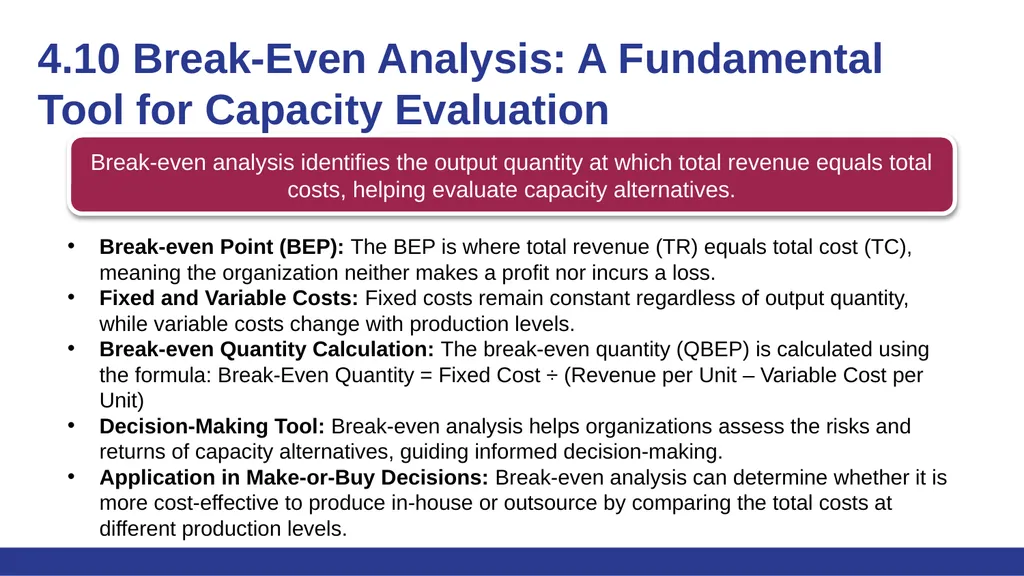
slide13. 4.10 Break-Even Analysis: A Fundamental Tool for Capacity Evaluation Break-even Point (BEP): The BEP is where total revenue (TR) equals total cost (TC), meaning the organization neither makes a profit nor incurs a loss.
Fixed and Variable Costs: Fixed costs remain constant regardless of output quantity, while variable costs change with production levels.
Break-even Quantity Calculation: The break-even quantity (QBEP) is calculated using the formula: Break-Even Quantity = Fixed Cost ÷ (Revenue per Unit – Variable Cost per Unit)
Decision-Making Tool: Break-even analysis helps organizations assess the risks and returns of capacity alternatives, guiding informed decision-making.
Application in Make-or-Buy Decisions: Break-even analysis can determine whether it is more cost-effective to produce in-house or outsource by comparing the total costs at different production levels. Break-even analysis identifies the output quantity at which total revenue equals total costs, helping evaluate capacity alternatives.<br>
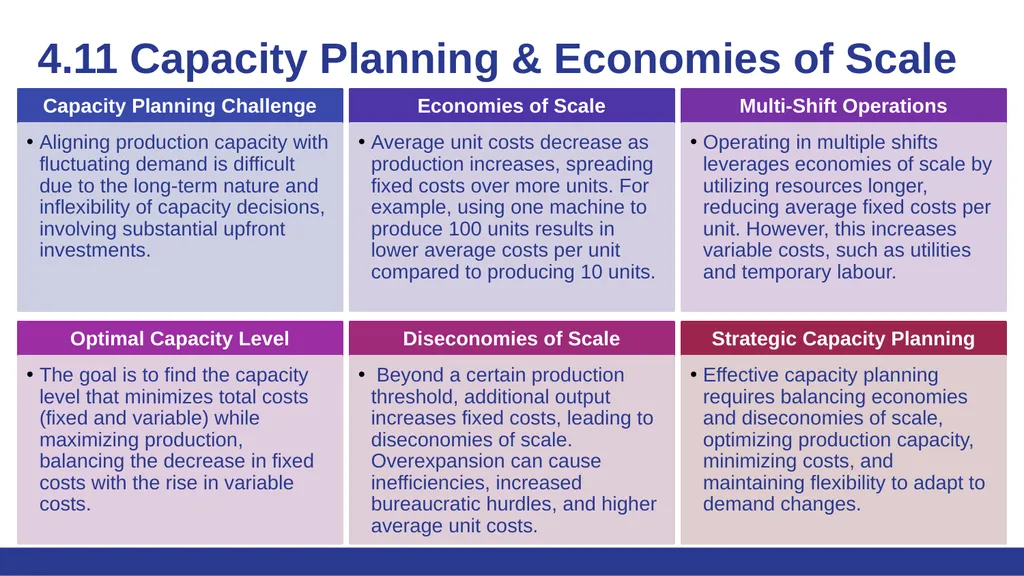
slide14. 4.11 Capacity Planning & Economies of Scale<br>
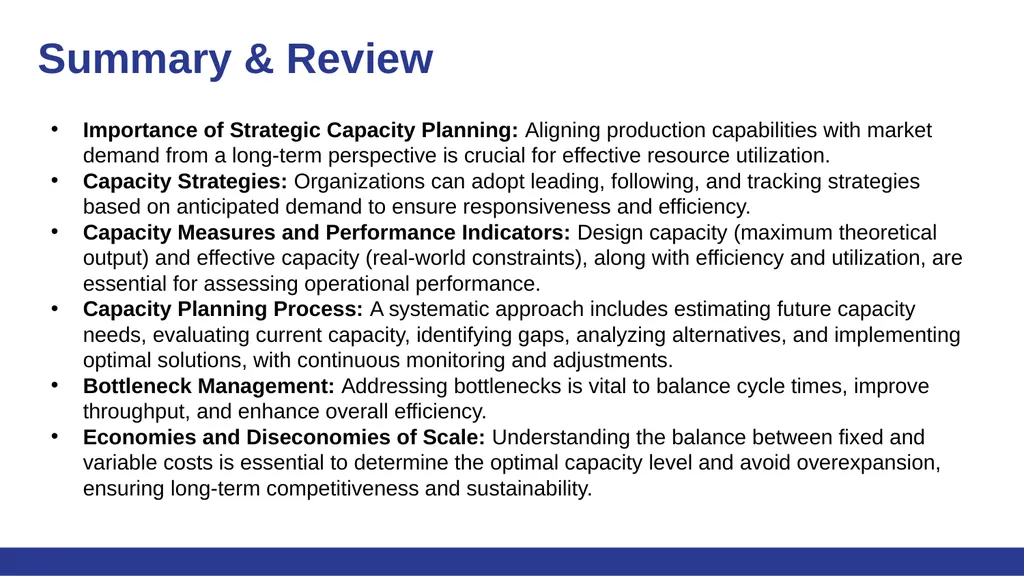
slide15. Summary & Review Importance of Strategic Capacity Planning: Aligning production capabilities with market demand from a long-term perspective is crucial for effective resource utilization.
Capacity Strategies: Organizations can adopt leading, following, and tracking strategies based on anticipated demand to ensure responsiveness and efficiency.
Capacity Measures and Performance Indicators: Design capacity (maximum theoretical output) and effective capacity (real-world constraints), along with efficiency and utilization, are essential for assessing operational performance.
Capacity Planning Process: A systematic approach includes estimating future capacity needs, evaluating current capacity, identifying gaps, analyzing alternatives, and implementing optimal solutions, with continuous monitoring and adjustments.
Bottleneck Management: Addressing bottlenecks is vital to balance cycle times, improve throughput, and enhance overall efficiency.
Economies and Diseconomies of Scale: Understanding the balance between fixed and variable costs is essential to determine the optimal capacity level and avoid overexpansion, ensuring long-term competitiveness and sustainability.<br>
slide2. 4.0 Learning Outcomes In this chapter, we will:
Explain the importance of strategic capacity planning and its role in aligning production capabilities with market demand.
Analyze the broader organizational effects of capacity decisions and evaluate their strategic implications.
Apply key capacity measures and performance indicators to assess and optimize operational performance.
Select and justify appropriate capacity measures for different contexts to ensure accurate capacity assessment.
Identify and analyze the determinants that influence effective capacity in an organization.
Outline the steps in the capacity planning process and apply them to develop effective capacity strategies.
Identify bottlenecks in sequential processes and propose strategies to mitigate their impact on overall process capacity.
Analyze the bottleneck phenomenon and its implications for process capacity and throughput.
Perform break-even analysis to evaluate capacity alternatives and make informed capacity decisions.
Explain the relationship between capacity planning and economies of scale and evaluate their impact on long-term capacity decisions.<br>
slide3. 4.1 Introduction Businesses develop strategies to increase market share by leveraging their competitive advantages and understanding market forces.
Determining the right products and services to produce is crucial, but businesses must also assess their capacity to meet market demand.
Strategic capacity planning is essential to align production capabilities with market demand, requiring consideration of equipment, space, and workforce.
Inadequate capacity planning can lead to increased costs, resource constraints, and loss of customers.
Effective capacity planning contributes to operational efficiency, competitiveness, customer satisfaction, and long-term sustainability.
Strategic capacity planning requires a long-term, holistic approach to ensure resource optimization and support organizational growth and success.<br>
slide4. 4.2 Organizational Impact of Capacity Decisions Capacity decisions impact various organizational aspects beyond operational boundaries, influencing competitive position and long-term trajectory.
Each capacity strategy offers distinct advantages and trade-offs, affecting responsiveness to market dynamics, resource utilization, and risk exposure.
Capacity decisions must be evaluated within the broader organizational context, considering their impact on financial performance, operational agility, customer satisfaction, and strategic objectives.<br>
slide5. 4.3 Key Capacity Measures and Performance Indicators Monitoring efficiency and utilization provides insights into operational performance, helping identify areas for improvement and informing capacity optimization strategies.
High efficiency and utilization rates might indicate a need for capacity expansions, while low rates could highlight bottlenecks, inefficiencies, or excess capacity requiring adjustments.<br>
slide6. 4.4 Capacity Planning: A Holistic Approach for Products and Services Capacity refers to a system’s potential to produce goods or deliver services within a specified timeframe, involving long-term and short-term considerations. Excess Capacity: Occurs when actual production is lower than potential, indicating lower market demand than supply capabilities and leading to increased costs and inefficiencies.
Holistic Approach: Considering these inputs helps optimize resource allocation, enhance operational efficiency, and ensure long-term success in dynamic markets. Key Inputs in Capacity Planning:
Capacity Type: Identifying the specific type of capacity needed (production facilities, equipment, human resources, etc.).
Capacity Quantity: Determining the precise amount of capacity required to meet demand.
Capacity Timing: Establishing the best timing for capacity adjustments to match market conditions and demand patterns.<br>
slide7. 4.5 Defining and Measuring Capacity Stable Metrics: Choose capacity measures that don’t require frequent updates, avoiding metrics like dollar amounts which are affected by price fluctuations.
Product-Specific Capacity: Measure capacity in terms of each product, such as stating the capacity to produce 100 microwaves or 75 refrigerators, for greater clarity and accuracy.
Input-Based Measures: Consider using input availability, such as labor hours or floor space, especially when dealing with diverse output types.
Context-Specific Measures: Select the capacity measure based on the specific context, including the nature of products/services, production processes, and operational complexities.
Accurate Understanding: Adopting a tailored approach to capacity measurement enables better understanding of production capabilities, informing effective decision-making and capacity planning.<br>
slide8. 4.6 Determinants of Effective Capacity<br>
slide9. 4.7 The Capacity Planning Process: A Systematic Approach Effective capacity planning is a systematic process involving several key steps to ensure alignment between an organization’s production capabilities and strategic objectives.
By following this systematic approach, organizations can proactively manage their capacity levels, optimize resource utilization, and position themselves for long-term success in dynamic market environments.<br>
slide10. 4.7 The Capacity Planning Process (cont.)<br>
slide11. 4.8 Sequential Processes and the Bottleneck Sequential processes involve steps performed in a specific order, where the output of one step is the input for the next, as seen in manufacturing assembly lines.
Balanced cycle times across all steps are crucial to avoid issues like inventory accumulation and resource idleness, caused by significant time variations between steps. Bottlenecks, the steps with the longest cycle times, constrain overall throughput, leading to inefficiencies such as inventory buildup and idle resources.
Identifying and addressing bottlenecks through capacity expansions, process improvements, or resource reallocation can optimize process flow and enhance operational efficiency. Figure 4.5.1: A diagram displaying the effects of a bottleneck.<br>
slide12. 4.9 The Bottleneck Phenomenon and Its Impact on Process Capacity The bottleneck, or the slowest step, determines the capacity of the entire process. For example, step 2, with a cycle time of 10 minutes, limits the overall output rate to one unit every 10 minutes. Capacity Calculation Example: In an 8-hour shift (480 minutes), step 1 can produce 160 units, step 2 can produce 48 units, and step 3 can produce 96 units. Due to the bottleneck at step 2, the total process output is limited to 48 units per day.
Bottleneck Identification Importance: Recognizing and addressing the bottleneck is essential, as investments in non-bottleneck areas do not improve overall process capacity.
Strategies to Address Bottlenecks: Solutions include bottleneck elimination, capacity expansion, and resource reallocation, which can enhance throughput and operational efficiency.
Evaluating Capacity Alternatives: Consider economic factors (e.g., break-even analysis, payback period, NPV) and non-economic factors (e.g., public opinion, employee reactions, community pressure) to make balanced and strategic decisions.<br>
slide13. 4.10 Break-Even Analysis: A Fundamental Tool for Capacity Evaluation Break-even Point (BEP): The BEP is where total revenue (TR) equals total cost (TC), meaning the organization neither makes a profit nor incurs a loss.
Fixed and Variable Costs: Fixed costs remain constant regardless of output quantity, while variable costs change with production levels.
Break-even Quantity Calculation: The break-even quantity (QBEP) is calculated using the formula: Break-Even Quantity = Fixed Cost ÷ (Revenue per Unit – Variable Cost per Unit)
Decision-Making Tool: Break-even analysis helps organizations assess the risks and returns of capacity alternatives, guiding informed decision-making.
Application in Make-or-Buy Decisions: Break-even analysis can determine whether it is more cost-effective to produce in-house or outsource by comparing the total costs at different production levels. Break-even analysis identifies the output quantity at which total revenue equals total costs, helping evaluate capacity alternatives.<br>
slide14. 4.11 Capacity Planning & Economies of Scale<br>
slide15. Summary & Review Importance of Strategic Capacity Planning: Aligning production capabilities with market demand from a long-term perspective is crucial for effective resource utilization.
Capacity Strategies: Organizations can adopt leading, following, and tracking strategies based on anticipated demand to ensure responsiveness and efficiency.
Capacity Measures and Performance Indicators: Design capacity (maximum theoretical output) and effective capacity (real-world constraints), along with efficiency and utilization, are essential for assessing operational performance.
Capacity Planning Process: A systematic approach includes estimating future capacity needs, evaluating current capacity, identifying gaps, analyzing alternatives, and implementing optimal solutions, with continuous monitoring and adjustments.
Bottleneck Management: Addressing bottlenecks is vital to balance cycle times, improve throughput, and enhance overall efficiency.
Economies and Diseconomies of Scale: Understanding the balance between fixed and variable costs is essential to determine the optimal capacity level and avoid overexpansion, ensuring long-term competitiveness and sustainability.<br>