
FUTURE DIRECTIONS Michael Beaven Director,

Description: FUTURE DIRECTIONS Michael Beaven Director, MaidEnergy Community Energy: distributed energy supply and use, community originated and owned, prioritises community benefit over profit, democratic businesses Growing sector - c600 organisations,
Related Topics
Download Presentation
"FUTURE DIRECTIONS Michael Beaven Director," is the property of its rightful owner. Permission is granted to download and print the materials on this website for personal, non-commercial use only, and to display it on your personal computer provided you do not modify the materials and that you retain all copyright notices contained in the materials. By downloading content from our website, you accept the terms of this agreement.
Presentation Transcript
slide1. FUTURE DIRECTIONS Michael Beaven
Director, MaidEnergy<br>
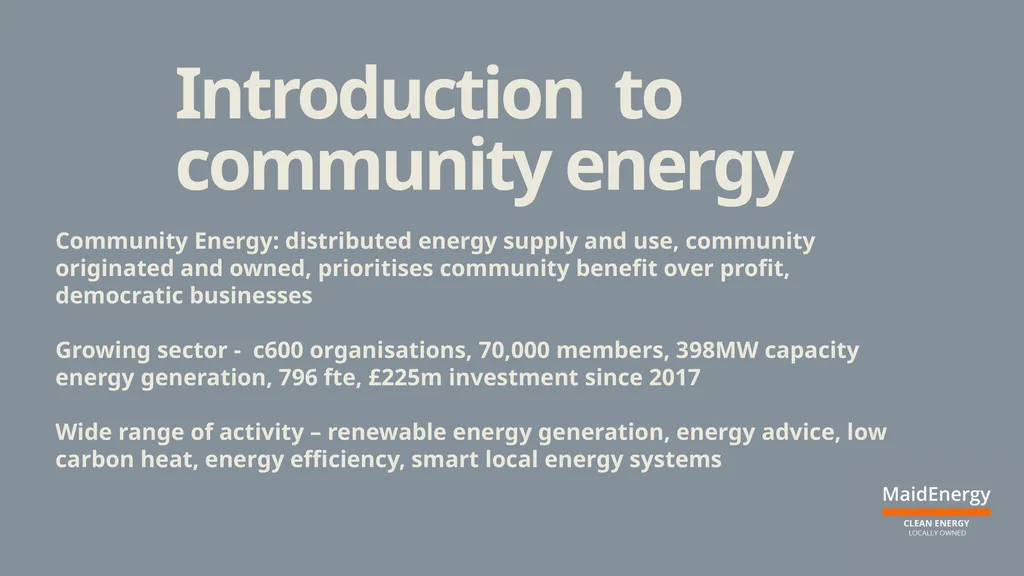
slide2. Community Energy: distributed energy supply and use, community originated and owned, prioritises community benefit over profit, democratic businesses
Growing sector - c600 organisations, 70,000 members, 398MW capacity energy generation, 796 fte, £225m investment since 2017
Wide range of activity – renewable energy generation, energy advice, low carbon heat, energy efficiency, smart local energy systems Introduction to community energy<br>
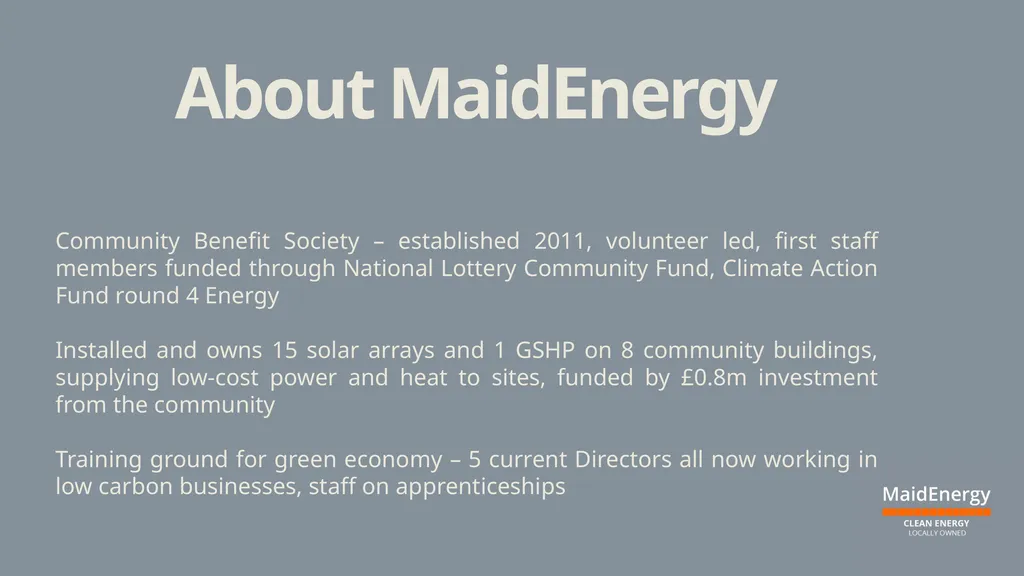
slide3. Community Benefit Society – established 2011, volunteer led, first staff members funded through National Lottery Community Fund, Climate Action Fund round 4 Energy
Installed and owns 15 solar arrays and 1 GSHP on 8 community buildings, supplying low-cost power and heat to sites, funded by £0.8m investment from the community
Training ground for green economy – 5 current Directors all now working in low carbon businesses, staff on apprenticeships About MaidEnergy<br>
slide4. Current community owned 251MW solar PV. 133MW wind, 13MW hydro. 0.25MW AD
Planned further 15MW roof-top + 78 MW ground solar, 92MW wind, 3MW hydro, 21 MW storage / heat / other
Local ownership of large-scale renewable assets in law, but never implemented; Community right to supply
Investigating low carbon heat networks coupled with community owned energy generation Distributed generation<br>
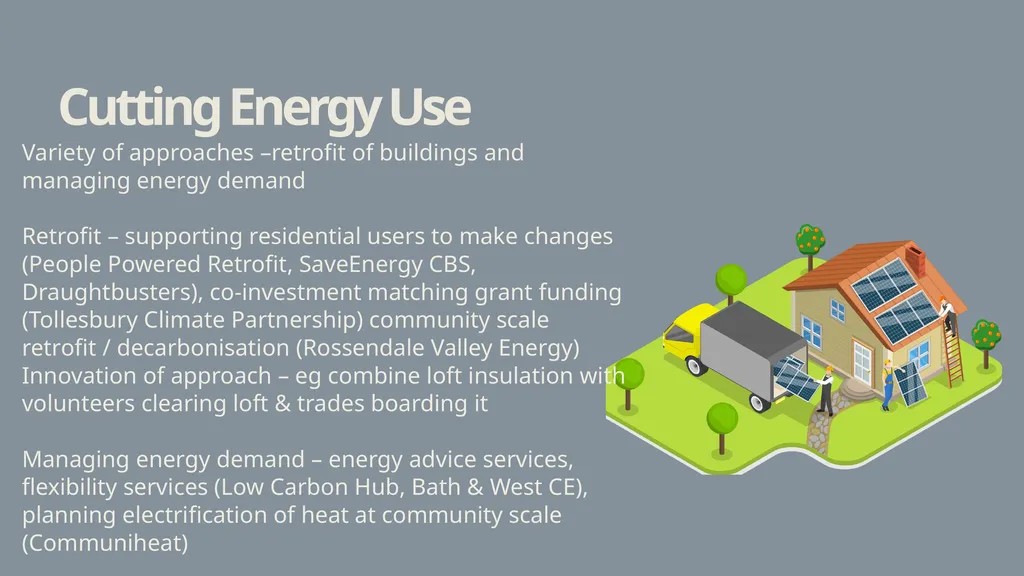
slide5. Cutting Energy Use Variety of approaches –retrofit of buildings and managing energy demand
Retrofit – supporting residential users to make changes (People Powered Retrofit, SaveEnergy CBS, Draughtbusters), co-investment matching grant funding (Tollesbury Climate Partnership) community scale retrofit / decarbonisation (Rossendale Valley Energy)
Innovation of approach – eg combine loft insulation with volunteers clearing loft & trades boarding it
Managing energy demand – energy advice services, flexibility services (Low Carbon Hub, Bath & West CE), planning electrification of heat at community scale (Communiheat)<br>
slide6. Community originated and volunteer led can favour areas with high social capital over greatest need, people with higher level qualifications
Easier to generate interest to build new capacity rather than improve operation of existing
Lack of capacity – fits and starts, hard to share knowledge and learn from others Challenges for community energy<br>
slide7. Ethical issues of solar PV - Uyghur Forced Labour in the Solar Supply Chain, variance in embodied carbon, difficulty of tracing supply chain
Fossil fuel industry followed tobacco misinformation playbook, risk that other incumbents who lose out follow same pattern (gas networks & heat pumps?)
Can community energy help with communication & investment? – mistrust of government, finances constrained, fear that private sector extracting profit rather than providing best solution Issues to think about?<br>
slide8. Community energy locally Reading Hydro – Generating renewable electricity from the power of the Thames Community Energy South The Voice of the Community Energy Sector | Community Energy England Reading Community Energy Society Centre for Sustainable Energy SaveEnergy Our Community Enterprise<br>
slide9. Further Information Michael Beaven
Michael@oce.org.uk
info@maidenergy.coop
www.maidenergy.coop Thank you for listening!<br>
Director, MaidEnergy<br>
slide2. Community Energy: distributed energy supply and use, community originated and owned, prioritises community benefit over profit, democratic businesses
Growing sector - c600 organisations, 70,000 members, 398MW capacity energy generation, 796 fte, £225m investment since 2017
Wide range of activity – renewable energy generation, energy advice, low carbon heat, energy efficiency, smart local energy systems Introduction to community energy<br>
slide3. Community Benefit Society – established 2011, volunteer led, first staff members funded through National Lottery Community Fund, Climate Action Fund round 4 Energy
Installed and owns 15 solar arrays and 1 GSHP on 8 community buildings, supplying low-cost power and heat to sites, funded by £0.8m investment from the community
Training ground for green economy – 5 current Directors all now working in low carbon businesses, staff on apprenticeships About MaidEnergy<br>
slide4. Current community owned 251MW solar PV. 133MW wind, 13MW hydro. 0.25MW AD
Planned further 15MW roof-top + 78 MW ground solar, 92MW wind, 3MW hydro, 21 MW storage / heat / other
Local ownership of large-scale renewable assets in law, but never implemented; Community right to supply
Investigating low carbon heat networks coupled with community owned energy generation Distributed generation<br>
slide5. Cutting Energy Use Variety of approaches –retrofit of buildings and managing energy demand
Retrofit – supporting residential users to make changes (People Powered Retrofit, SaveEnergy CBS, Draughtbusters), co-investment matching grant funding (Tollesbury Climate Partnership) community scale retrofit / decarbonisation (Rossendale Valley Energy)
Innovation of approach – eg combine loft insulation with volunteers clearing loft & trades boarding it
Managing energy demand – energy advice services, flexibility services (Low Carbon Hub, Bath & West CE), planning electrification of heat at community scale (Communiheat)<br>
slide6. Community originated and volunteer led can favour areas with high social capital over greatest need, people with higher level qualifications
Easier to generate interest to build new capacity rather than improve operation of existing
Lack of capacity – fits and starts, hard to share knowledge and learn from others Challenges for community energy<br>
slide7. Ethical issues of solar PV - Uyghur Forced Labour in the Solar Supply Chain, variance in embodied carbon, difficulty of tracing supply chain
Fossil fuel industry followed tobacco misinformation playbook, risk that other incumbents who lose out follow same pattern (gas networks & heat pumps?)
Can community energy help with communication & investment? – mistrust of government, finances constrained, fear that private sector extracting profit rather than providing best solution Issues to think about?<br>
slide8. Community energy locally Reading Hydro – Generating renewable electricity from the power of the Thames Community Energy South The Voice of the Community Energy Sector | Community Energy England Reading Community Energy Society Centre for Sustainable Energy SaveEnergy Our Community Enterprise<br>
slide9. Further Information Michael Beaven
Michael@oce.org.uk
info@maidenergy.coop
www.maidenergy.coop Thank you for listening!<br>