
Fuzzing for Security Flaws John Heasman Stanford
KB
Published · 40 slides · 0 views
1 / 1


Description
Fuzzing for Security Flaws John Heasman Stanford University, April 2009 Agenda Introductions What is fuzzing? What data can be fuzzed? What does fuzzed data look like? When (not) to fuzz? Two approaches and a basic methodology Advanced
Related Topics
Share
Embed code
Download this presentation From Below
"Fuzzing for Security Flaws John Heasman Stanford" is the property of its rightful owner. Permission is granted to download and print the materials on this website for personal, non-commercial use only, and to display it on your personal computer provided you do not modify the materials and that you retain all copyright notices contained in the materials. By downloading content from our website, you accept the terms of this agreement.
Presentation Transcript
01
Fuzzing for Security Flaws John Heasman
Stanford University, April 2009<br>
Stanford University, April 2009<br>
02
Agenda Introductions
What is fuzzing?
What data can be fuzzed?
What does fuzzed data look like?
When (not) to fuzz?
Two approaches and a basic methodology
Advanced techniques
Unsolved challenges<br>
What is fuzzing?
What data can be fuzzed?
What does fuzzed data look like?
When (not) to fuzz?
Two approaches and a basic methodology
Advanced techniques
Unsolved challenges<br>
03
Introduction: NGS Established 2001, acquired 2008 by NCC Group
Core offerings:
Consultancy
Training
Research
Software Products
World leaders in application assessment
Product assessment for vendor
Web application assessment for corporations<br>
Core offerings:
Consultancy
Training
Research
Software Products
World leaders in application assessment
Product assessment for vendor
Web application assessment for corporations<br>
04
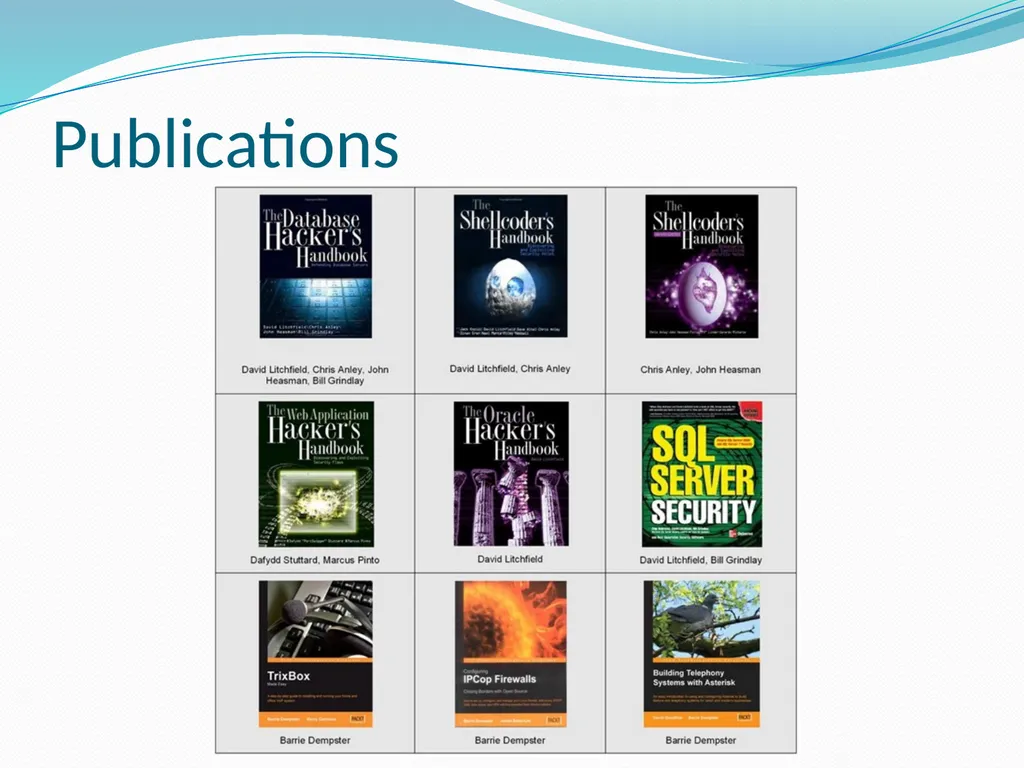
Publications<br>
05
About Me Masters in Engineering & CS from Oxford University
Joined NGS London office in 2003
Now VP of Research based in Seattle, WA
Regular presenter at the Black Hat conferences
Research interests:
Rootkits (ACPI, BIOS, PCI option ROMS, (U)EFI)
Web 2.0, Code execution vulnerabilities in Java
Vulnerability research<br>
Joined NGS London office in 2003
Now VP of Research based in Seattle, WA
Regular presenter at the Black Hat conferences
Research interests:
Rootkits (ACPI, BIOS, PCI option ROMS, (U)EFI)
Web 2.0, Code execution vulnerabilities in Java
Vulnerability research<br>
06
What is fuzzing? Feed target automatically generated malformed data designed to trigger implementation flaws
A fuzzer is the programmatic construct to do this
A fuzzing framework typically includes library code to:
Generate fuzzed data
Deliver test cases
Monitor the target
Publicly available fuzzing frameworks:
Spike, Peach Fuzz, Sulley, Schemer
Requirement of Microsoft’s Secure Development Lifecycle program
Still a long way to go - many vendors do no fuzzing!<br>
A fuzzer is the programmatic construct to do this
A fuzzing framework typically includes library code to:
Generate fuzzed data
Deliver test cases
Monitor the target
Publicly available fuzzing frameworks:
Spike, Peach Fuzz, Sulley, Schemer
Requirement of Microsoft’s Secure Development Lifecycle program
Still a long way to go - many vendors do no fuzzing!<br>
07
What data can be fuzzed? Virtually anything!
Basic types: bit, byte, word, dword, qword
Common language specific types: strings, structs, arrays
High level data representations: text, xml<br>
Basic types: bit, byte, word, dword, qword
Common language specific types: strings, structs, arrays
High level data representations: text, xml<br>
08
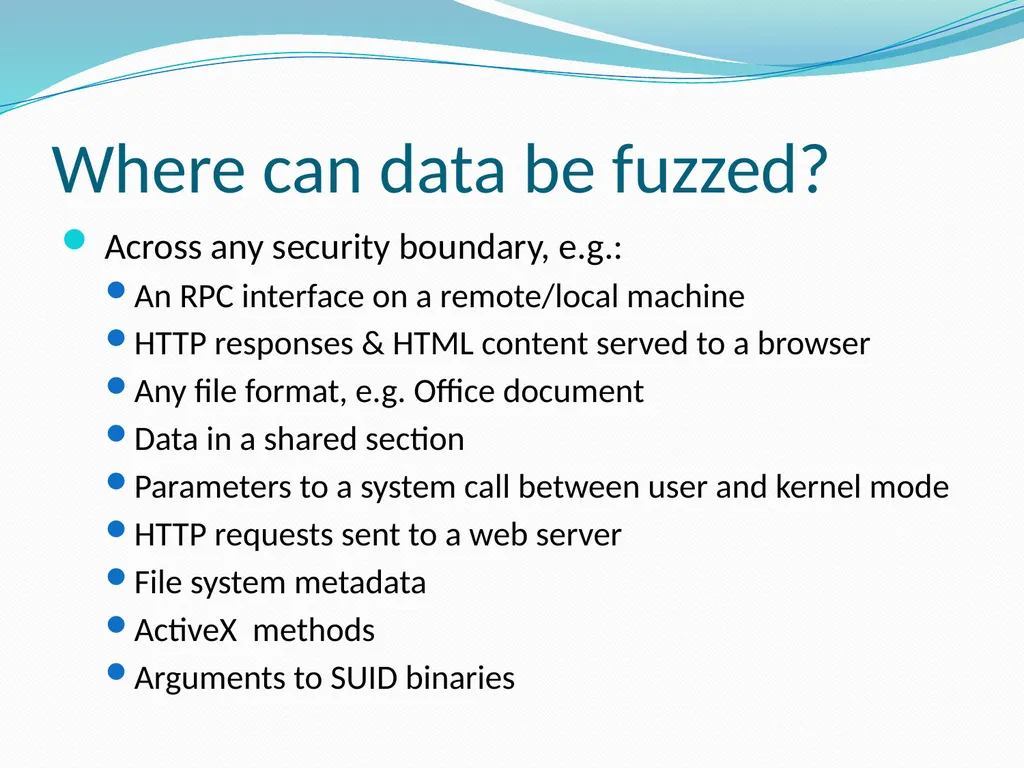
Where can data be fuzzed? Across any security boundary, e.g.:
An RPC interface on a remote/local machine
HTTP responses & HTML content served to a browser
Any file format, e.g. Office document
Data in a shared section
Parameters to a system call between user and kernel mode
HTTP requests sent to a web server
File system metadata
ActiveX methods
Arguments to SUID binaries<br>
An RPC interface on a remote/local machine
HTTP responses & HTML content served to a browser
Any file format, e.g. Office document
Data in a shared section
Parameters to a system call between user and kernel mode
HTTP requests sent to a web server
File system metadata
ActiveX methods
Arguments to SUID binaries<br>
09
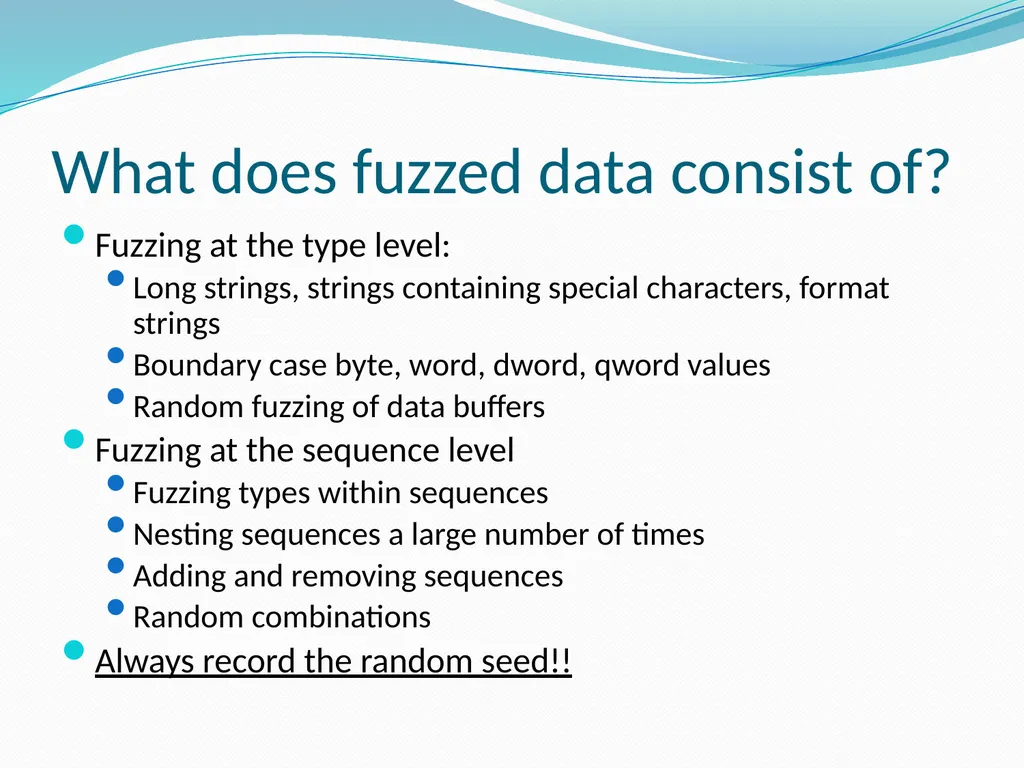
What does fuzzed data consist of? Fuzzing at the type level:
Long strings, strings containing special characters, format strings
Boundary case byte, word, dword, qword values
Random fuzzing of data buffers
Fuzzing at the sequence level
Fuzzing types within sequences
Nesting sequences a large number of times
Adding and removing sequences
Random combinations
Always record the random seed!!<br>
Long strings, strings containing special characters, format strings
Boundary case byte, word, dword, qword values
Random fuzzing of data buffers
Fuzzing at the sequence level
Fuzzing types within sequences
Nesting sequences a large number of times
Adding and removing sequences
Random combinations
Always record the random seed!!<br>
10
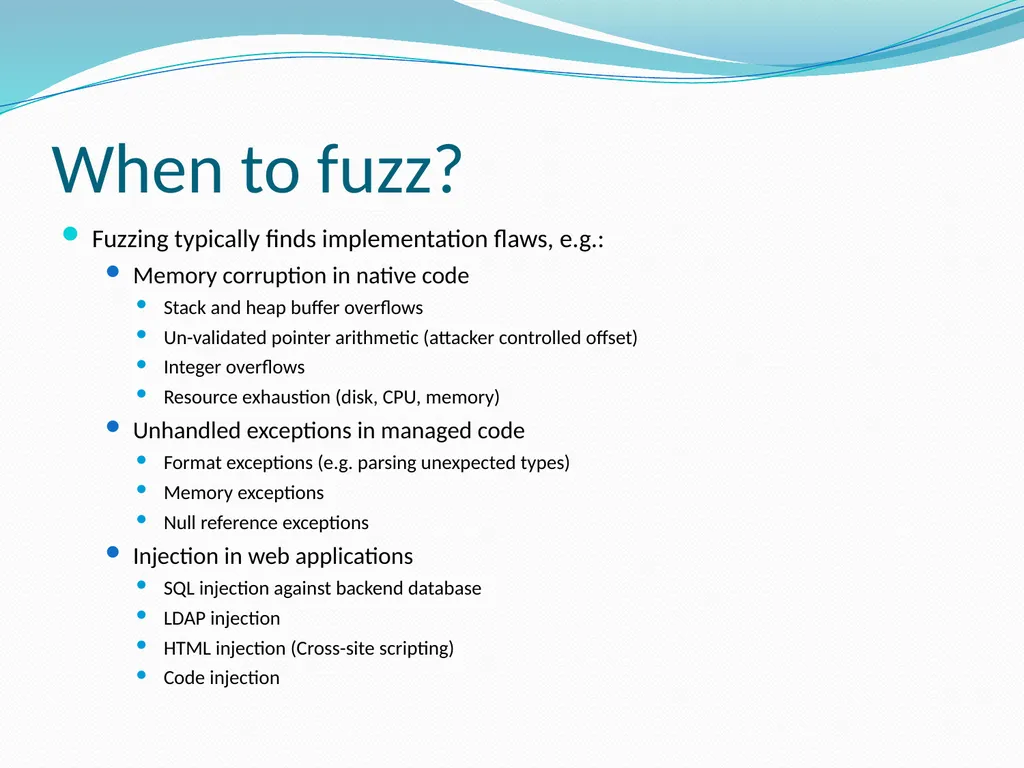
When to fuzz? Fuzzing typically finds implementation flaws, e.g.:
Memory corruption in native code
Stack and heap buffer overflows
Un-validated pointer arithmetic (attacker controlled offset)
Integer overflows
Resource exhaustion (disk, CPU, memory)
Unhandled exceptions in managed code
Format exceptions (e.g. parsing unexpected types)
Memory exceptions
Null reference exceptions
Injection in web applications
SQL injection against backend database
LDAP injection
HTML injection (Cross-site scripting)
Code injection<br>
Memory corruption in native code
Stack and heap buffer overflows
Un-validated pointer arithmetic (attacker controlled offset)
Integer overflows
Resource exhaustion (disk, CPU, memory)
Unhandled exceptions in managed code
Format exceptions (e.g. parsing unexpected types)
Memory exceptions
Null reference exceptions
Injection in web applications
SQL injection against backend database
LDAP injection
HTML injection (Cross-site scripting)
Code injection<br>
11
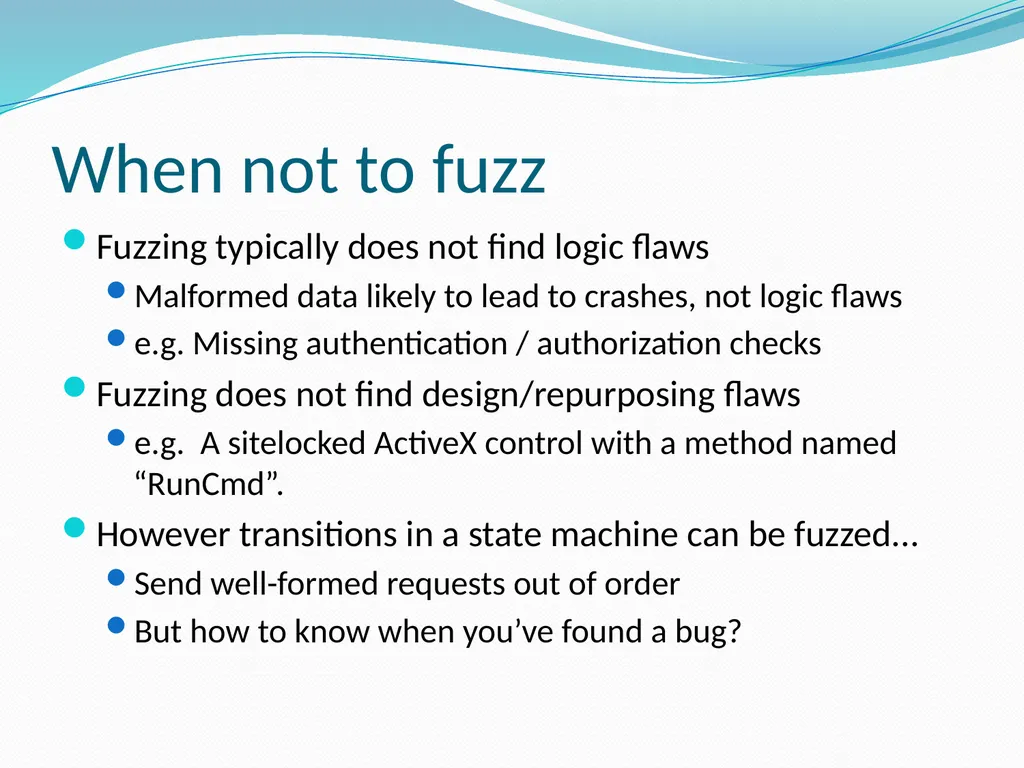
When not to fuzz Fuzzing typically does not find logic flaws
Malformed data likely to lead to crashes, not logic flaws
e.g. Missing authentication / authorization checks
Fuzzing does not find design/repurposing flaws
e.g. A sitelocked ActiveX control with a method named “RunCmd”.
However transitions in a state machine can be fuzzed...
Send well-formed requests out of order
But how to know when you’ve found a bug?<br>
Malformed data likely to lead to crashes, not logic flaws
e.g. Missing authentication / authorization checks
Fuzzing does not find design/repurposing flaws
e.g. A sitelocked ActiveX control with a method named “RunCmd”.
However transitions in a state machine can be fuzzed...
Send well-formed requests out of order
But how to know when you’ve found a bug?<br>
12
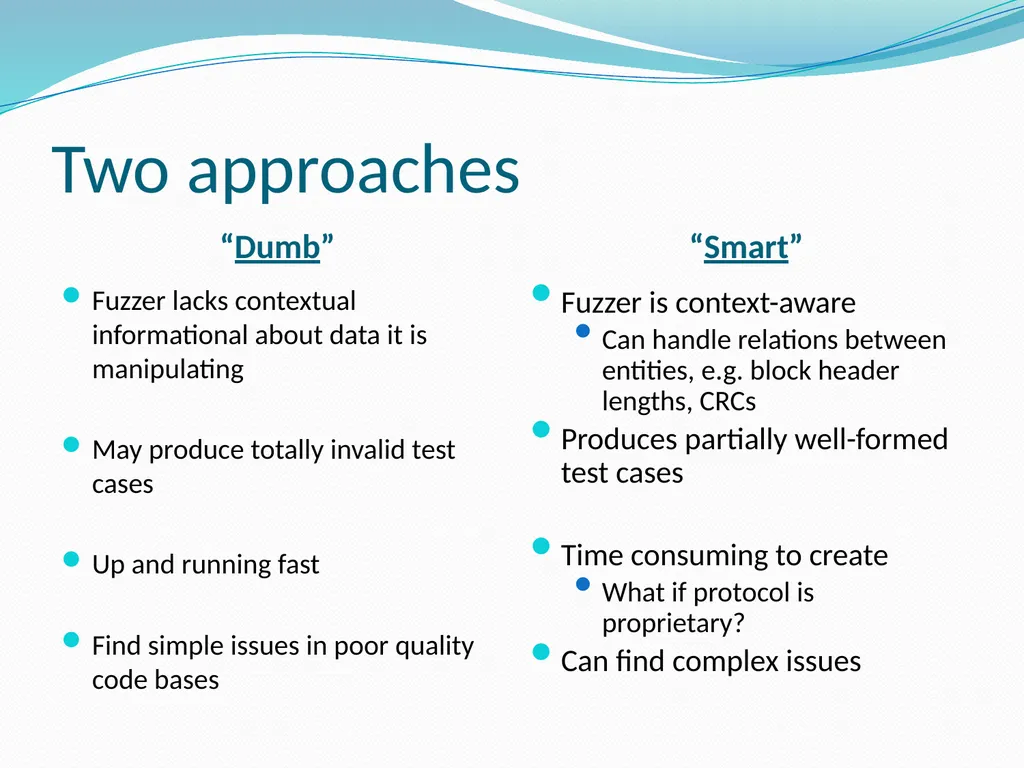
Two approaches “Dumb” “Smart” Fuzzer lacks contextual informational about data it is manipulating
May produce totally invalid test cases
Up and running fast
Find simple issues in poor quality code bases Fuzzer is context-aware
Can handle relations between entities, e.g. block header lengths, CRCs
Produces partially well-formed test cases
Time consuming to create
What if protocol is proprietary?
Can find complex issues<br>
May produce totally invalid test cases
Up and running fast
Find simple issues in poor quality code bases Fuzzer is context-aware
Can handle relations between entities, e.g. block header lengths, CRCs
Produces partially well-formed test cases
Time consuming to create
What if protocol is proprietary?
Can find complex issues<br>
13
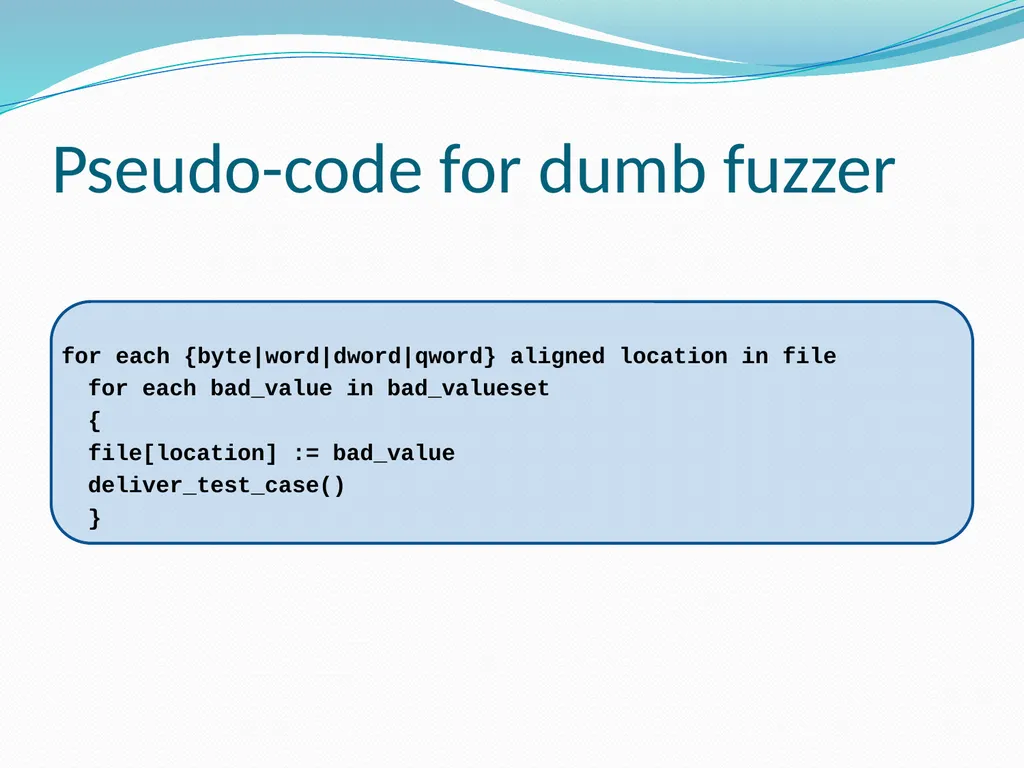
Pseudo-code for dumb fuzzer for each {byte|word|dword|qword} aligned location in file
for each bad_value in bad_valueset
{
file[location] := bad_value
deliver_test_case()
}<br>
for each bad_value in bad_valueset
{
file[location] := bad_value
deliver_test_case()
}<br>
14
...
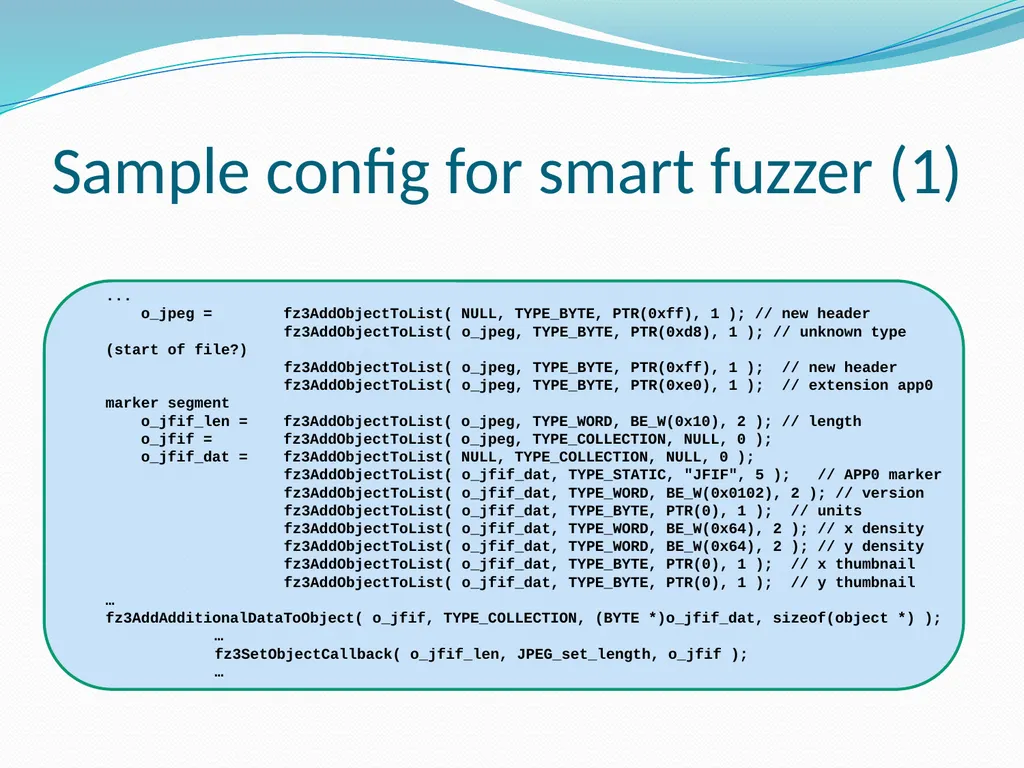
o_jpeg = fz3AddObjectToList( NULL, TYPE_BYTE, PTR(0xff), 1 ); // new header
fz3AddObjectToList( o_jpeg, TYPE_BYTE, PTR(0xd8), 1 ); // unknown type (start of file?)
fz3AddObjectToList( o_jpeg, TYPE_BYTE, PTR(0xff), 1 ); // new header
fz3AddObjectToList( o_jpeg, TYPE_BYTE, PTR(0xe0), 1 ); // extension app0 marker segment
o_jfif_len = fz3AddObjectToList( o_jpeg, TYPE_WORD, BE_W(0x10), 2 ); // length
o_jfif = fz3AddObjectToList( o_jpeg, TYPE_COLLECTION, NULL, 0 );
o_jfif_dat = fz3AddObjectToList( NULL, TYPE_COLLECTION, NULL, 0 );
fz3AddObjectToList( o_jfif_dat, TYPE_STATIC, "JFIF", 5 ); // APP0 marker
fz3AddObjectToList( o_jfif_dat, TYPE_WORD, BE_W(0x0102), 2 ); // version
fz3AddObjectToList( o_jfif_dat, TYPE_BYTE, PTR(0), 1 ); // units
fz3AddObjectToList( o_jfif_dat, TYPE_WORD, BE_W(0x64), 2 ); // x density
fz3AddObjectToList( o_jfif_dat, TYPE_WORD, BE_W(0x64), 2 ); // y density
fz3AddObjectToList( o_jfif_dat, TYPE_BYTE, PTR(0), 1 ); // x thumbnail
fz3AddObjectToList( o_jfif_dat, TYPE_BYTE, PTR(0), 1 ); // y thumbnail
…
fz3AddAdditionalDataToObject( o_jfif, TYPE_COLLECTION, (BYTE *)o_jfif_dat, sizeof(object *) );
…
fz3SetObjectCallback( o_jfif_len, JPEG_set_length, o_jfif );
… Sample config for smart fuzzer (1)<br>
o_jpeg = fz3AddObjectToList( NULL, TYPE_BYTE, PTR(0xff), 1 ); // new header
fz3AddObjectToList( o_jpeg, TYPE_BYTE, PTR(0xd8), 1 ); // unknown type (start of file?)
fz3AddObjectToList( o_jpeg, TYPE_BYTE, PTR(0xff), 1 ); // new header
fz3AddObjectToList( o_jpeg, TYPE_BYTE, PTR(0xe0), 1 ); // extension app0 marker segment
o_jfif_len = fz3AddObjectToList( o_jpeg, TYPE_WORD, BE_W(0x10), 2 ); // length
o_jfif = fz3AddObjectToList( o_jpeg, TYPE_COLLECTION, NULL, 0 );
o_jfif_dat = fz3AddObjectToList( NULL, TYPE_COLLECTION, NULL, 0 );
fz3AddObjectToList( o_jfif_dat, TYPE_STATIC, "JFIF", 5 ); // APP0 marker
fz3AddObjectToList( o_jfif_dat, TYPE_WORD, BE_W(0x0102), 2 ); // version
fz3AddObjectToList( o_jfif_dat, TYPE_BYTE, PTR(0), 1 ); // units
fz3AddObjectToList( o_jfif_dat, TYPE_WORD, BE_W(0x64), 2 ); // x density
fz3AddObjectToList( o_jfif_dat, TYPE_WORD, BE_W(0x64), 2 ); // y density
fz3AddObjectToList( o_jfif_dat, TYPE_BYTE, PTR(0), 1 ); // x thumbnail
fz3AddObjectToList( o_jfif_dat, TYPE_BYTE, PTR(0), 1 ); // y thumbnail
…
fz3AddAdditionalDataToObject( o_jfif, TYPE_COLLECTION, (BYTE *)o_jfif_dat, sizeof(object *) );
…
fz3SetObjectCallback( o_jfif_len, JPEG_set_length, o_jfif );
… Sample config for smart fuzzer (1)<br>
15
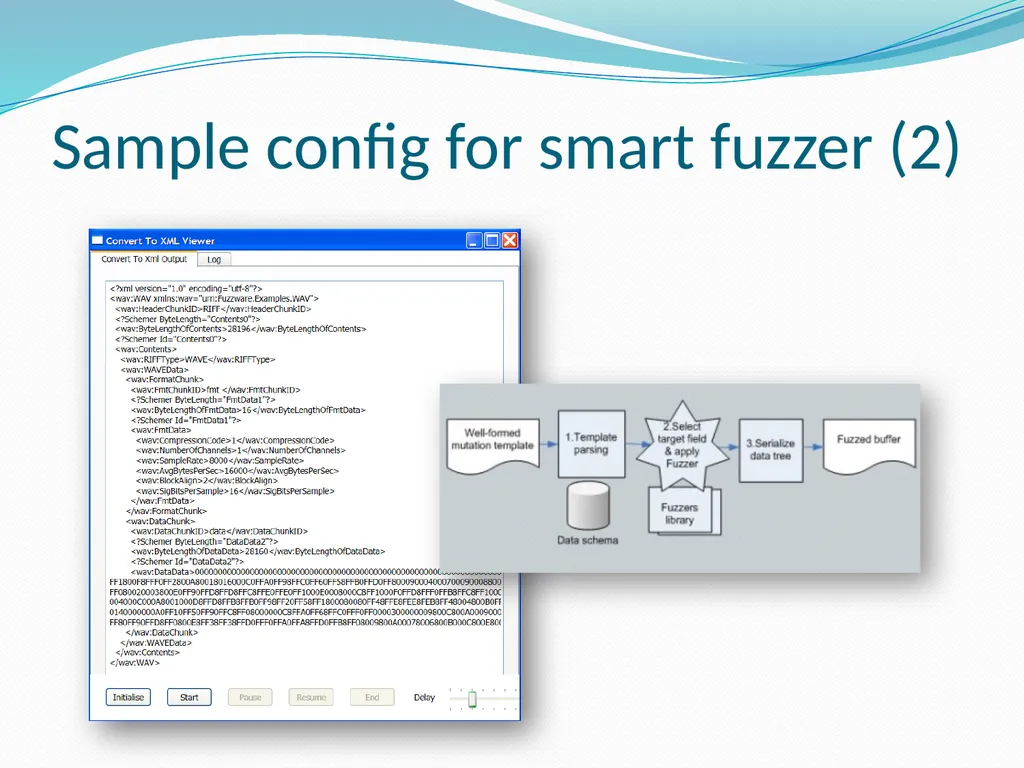
Sample config for smart fuzzer (2)<br>
16
Two approaches cont. Which approach is better?
Depends on:
Time: how long to develop and run fuzzer
[Security] Code quality of target
Amount of validation performed by target
Can patch out CRC check to allow dumb fuzzing
Complexity of relations between entities in data format
Don’t rule out either!
My personal approach: get a dumb fuzzer working first
Run it while you work on a smart fuzzer<br>
Depends on:
Time: how long to develop and run fuzzer
[Security] Code quality of target
Amount of validation performed by target
Can patch out CRC check to allow dumb fuzzing
Complexity of relations between entities in data format
Don’t rule out either!
My personal approach: get a dumb fuzzer working first
Run it while you work on a smart fuzzer<br>
17
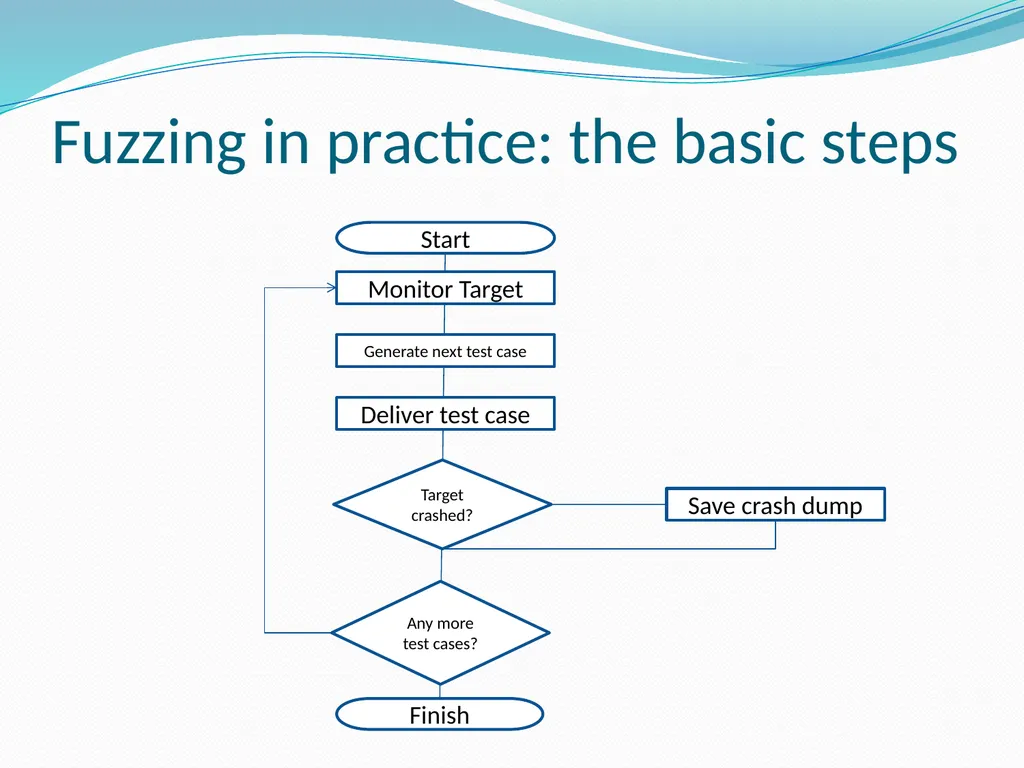
Fuzzing in practice: the basic steps Monitor Target Generate next test case Deliver test case Target crashed? Save crash dump Any more test cases? Finish Start<br>
18
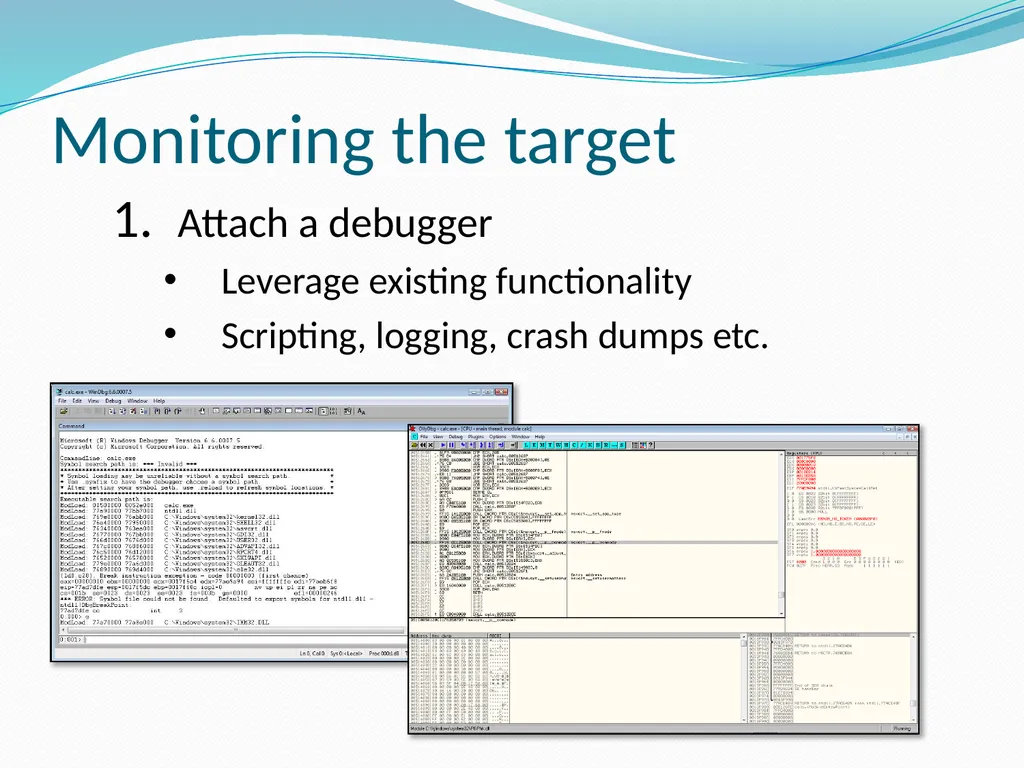
Monitoring the target 1. Attach a debugger
Leverage existing functionality
Scripting, logging, crash dumps etc.<br>
Leverage existing functionality
Scripting, logging, crash dumps etc.<br>
19
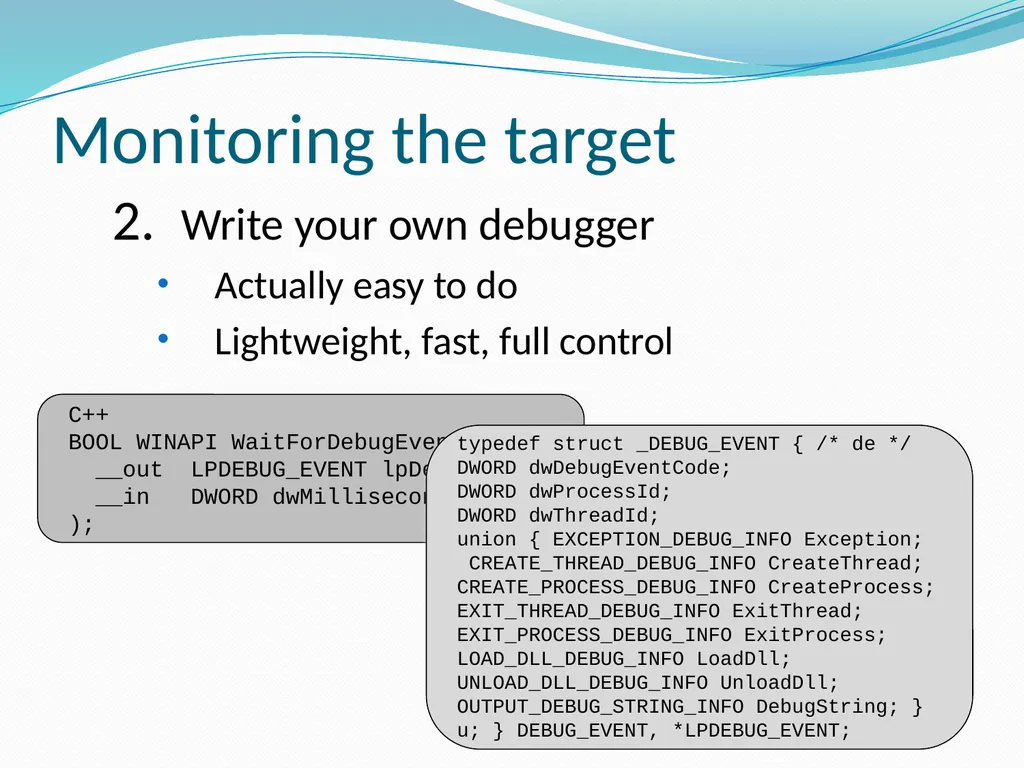
Monitoring the target 2. Write your own debugger
Actually easy to do
Lightweight, fast, full control<br>
Actually easy to do
Lightweight, fast, full control<br>
20
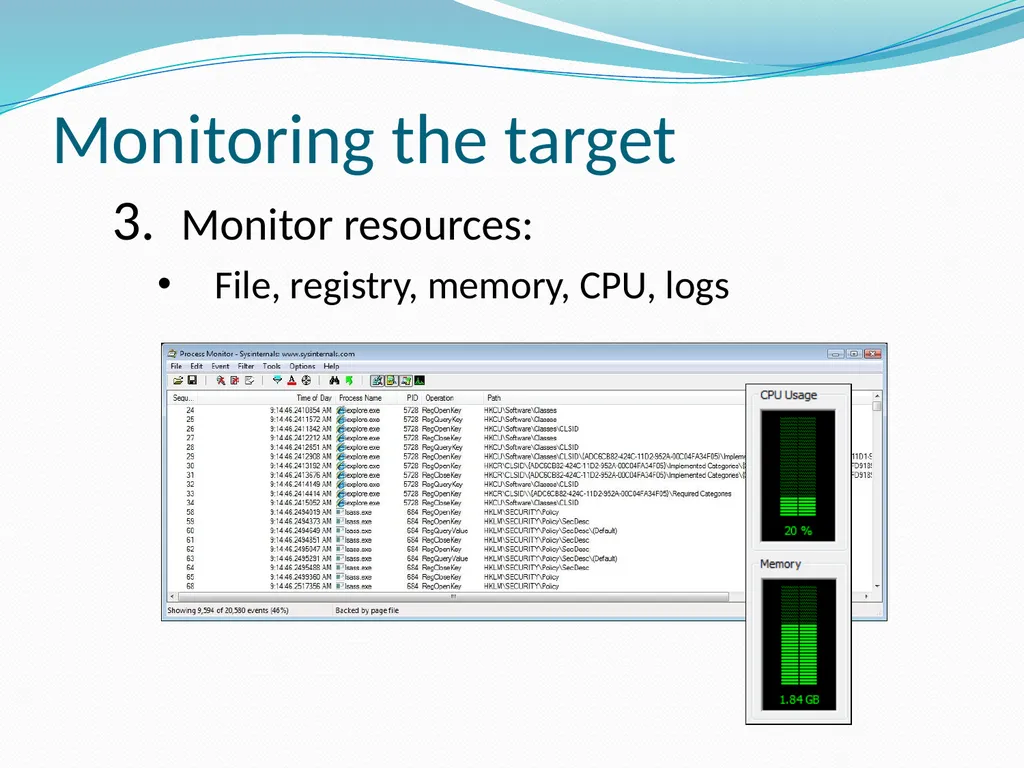
Monitoring the target 3. Monitor resources:
File, registry, memory, CPU, logs<br>
File, registry, memory, CPU, logs<br>
21
Deliver the test case 1. Standalone test harness
E.g. to launch to client application and have it load fuzzed file format
2. Instrumented client
Inject function hooking code into target client
Intercept data and substitute with fuzzed data
Useful if:
State machine is complex
Data is encoded in a non-standard format
Data is signed or encrypted<br>
E.g. to launch to client application and have it load fuzzed file format
2. Instrumented client
Inject function hooking code into target client
Intercept data and substitute with fuzzed data
Useful if:
State machine is complex
Data is encoded in a non-standard format
Data is signed or encrypted<br>
22
Determining exploitability<br>
23
Determining exploitability This process requires experience of debugging security issues, but some steps can be taken to gain a good idea of how exploitable an issue is…
Look for any cases where data is written to a controllable address – this is key to controlling code execution and the majority of such conditions will be exploitable
Verify whether any registers have been overwritten, if they do not contain part data sent from the fuzzer, step back in the disassembly to try and find where the data came from.
If the register data is controllable, point the register which caused the crash to a page of memory which is empty, fill that page with data (e.g., ‘aaaaa…’)
Repeat and step through each operation, until another crash occurs, reviewing all branch conditions which are controlled by data at the location of the (modified) register to ensure that they are executed<br>
Look for any cases where data is written to a controllable address – this is key to controlling code execution and the majority of such conditions will be exploitable
Verify whether any registers have been overwritten, if they do not contain part data sent from the fuzzer, step back in the disassembly to try and find where the data came from.
If the register data is controllable, point the register which caused the crash to a page of memory which is empty, fill that page with data (e.g., ‘aaaaa…’)
Repeat and step through each operation, until another crash occurs, reviewing all branch conditions which are controlled by data at the location of the (modified) register to ensure that they are executed<br>
24
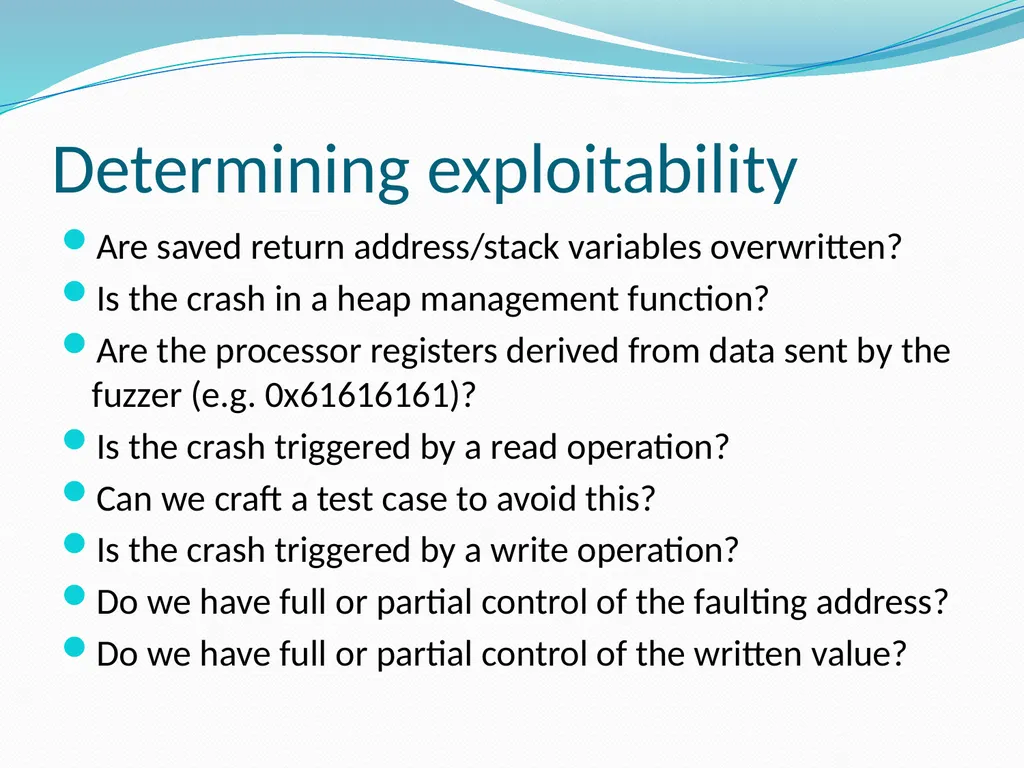
Determining exploitability Are saved return address/stack variables overwritten?
Is the crash in a heap management function?
Are the processor registers derived from data sent by the fuzzer (e.g. 0x61616161)?
Is the crash triggered by a read operation?
Can we craft a test case to avoid this?
Is the crash triggered by a write operation?
Do we have full or partial control of the faulting address?
Do we have full or partial control of the written value?<br>
Is the crash in a heap management function?
Are the processor registers derived from data sent by the fuzzer (e.g. 0x61616161)?
Is the crash triggered by a read operation?
Can we craft a test case to avoid this?
Is the crash triggered by a write operation?
Do we have full or partial control of the faulting address?
Do we have full or partial control of the written value?<br>
25
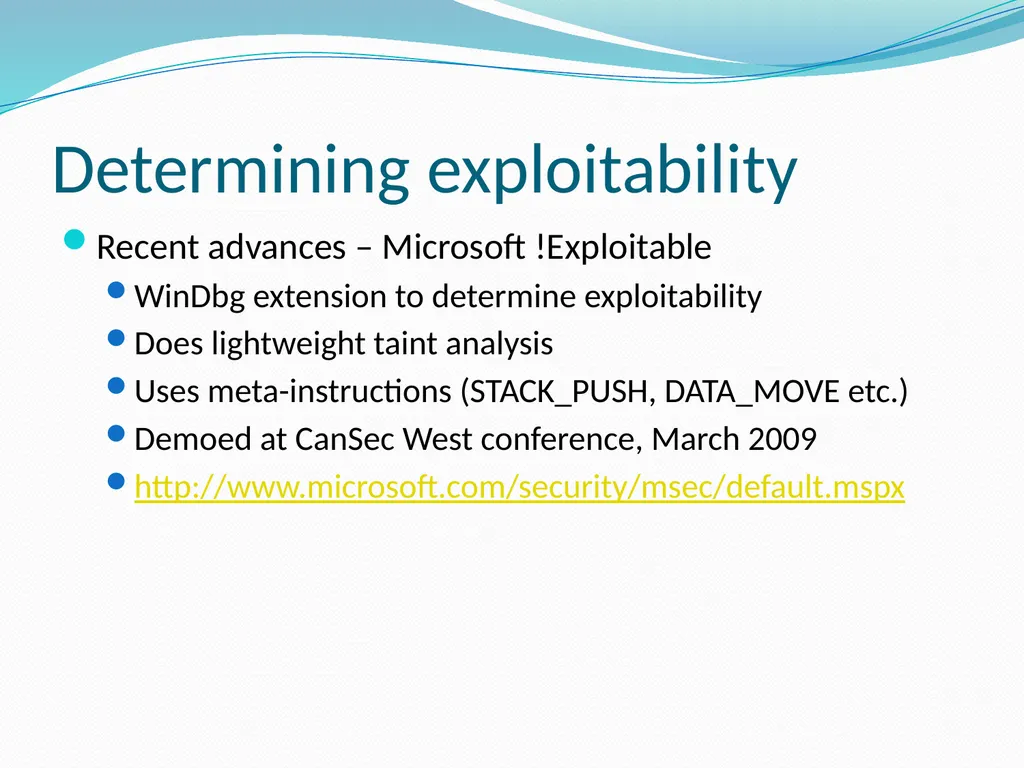
Determining exploitability Recent advances – Microsoft !Exploitable
WinDbg extension to determine exploitability
Does lightweight taint analysis
Uses meta-instructions (STACK_PUSH, DATA_MOVE etc.)
Demoed at CanSec West conference, March 2009
http://www.microsoft.com/security/msec/default.mspx<br>
WinDbg extension to determine exploitability
Does lightweight taint analysis
Uses meta-instructions (STACK_PUSH, DATA_MOVE etc.)
Demoed at CanSec West conference, March 2009
http://www.microsoft.com/security/msec/default.mspx<br>
26
A quick diversion These days you can get paid for finding vulnerabilities:
iDefense, Tipping Point, Pwn2Own
Write a fuzzer, find bugs, $$$!!
Here’s how to get started:
Download FileFuzz (iDefense)
Pick a media application and find some samples
Fuzz! You will find bugs…<br>
iDefense, Tipping Point, Pwn2Own
Write a fuzzer, find bugs, $$$!!
Here’s how to get started:
Download FileFuzz (iDefense)
Pick a media application and find some samples
Fuzz! You will find bugs…<br>
27
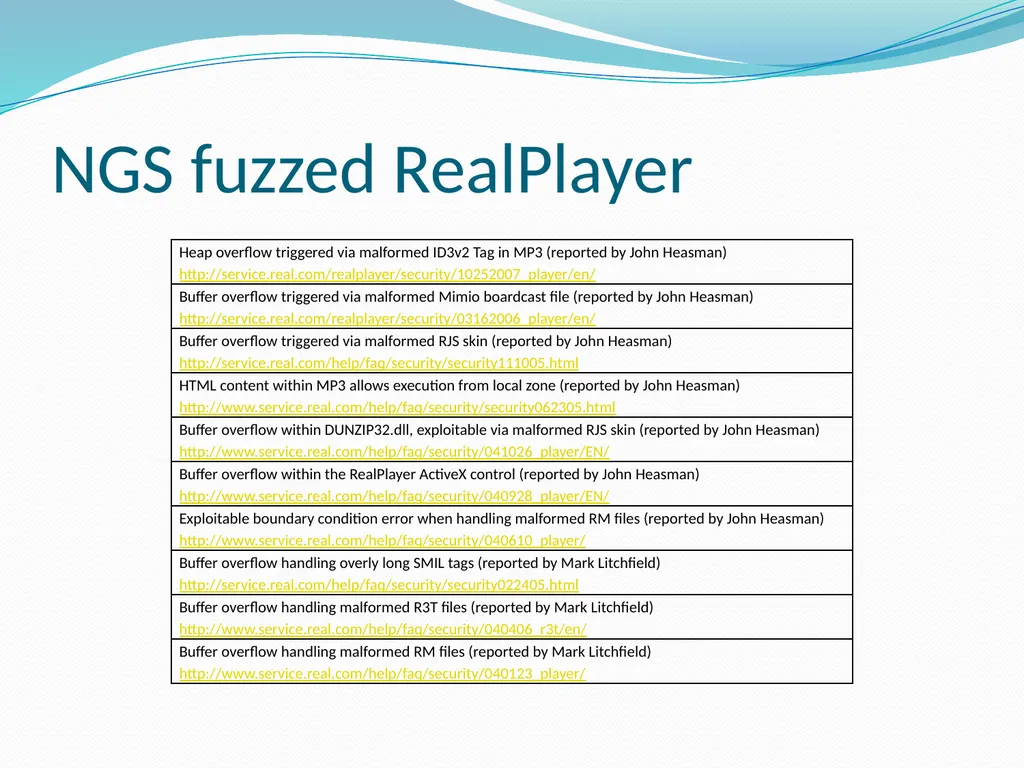
NGS fuzzed RealPlayer<br>
28
A quick diversion Cross-site scripting in server software… You Win!<br>
29
A quick diversion Code execution in Internet Explorer via 3rd party ActiveX control You Win!<br>
30
A quick diversion Vulnerability in widely used enterprise-level software You Win!<br>
31
A quick diversion Remotely exploitability vulnerability in critical infrastructure/the core OS You Win!<br>
32
A quick diversion Why isn’t everyone in the security community rich…
The best (= $$$) targets are the most secure
Few remote vulnerabilities in Vista
Even less in IIS or Apache
Clued up vendors are fuzzing:
Windows Vista file fuzzing effort in numbers:
350M iterations total
250+ file parsers fuzzed
300+ issues fixed<br>
The best (= $$$) targets are the most secure
Few remote vulnerabilities in Vista
Even less in IIS or Apache
Clued up vendors are fuzzing:
Windows Vista file fuzzing effort in numbers:
350M iterations total
250+ file parsers fuzzed
300+ issues fixed<br>
33
Advanced fuzzing Problems with our basic model:
Fuzzer and target are not in sync
Fuzzer has no feedback mechanism
We have no visibility into fuzzer’s effectiveness
Revised model:
Send good requests at regular intervals to check health of target
Fuzzer is able to control target debugger
Use a code coverage build if possible<br>
Fuzzer and target are not in sync
Fuzzer has no feedback mechanism
We have no visibility into fuzzer’s effectiveness
Revised model:
Send good requests at regular intervals to check health of target
Fuzzer is able to control target debugger
Use a code coverage build if possible<br>
34
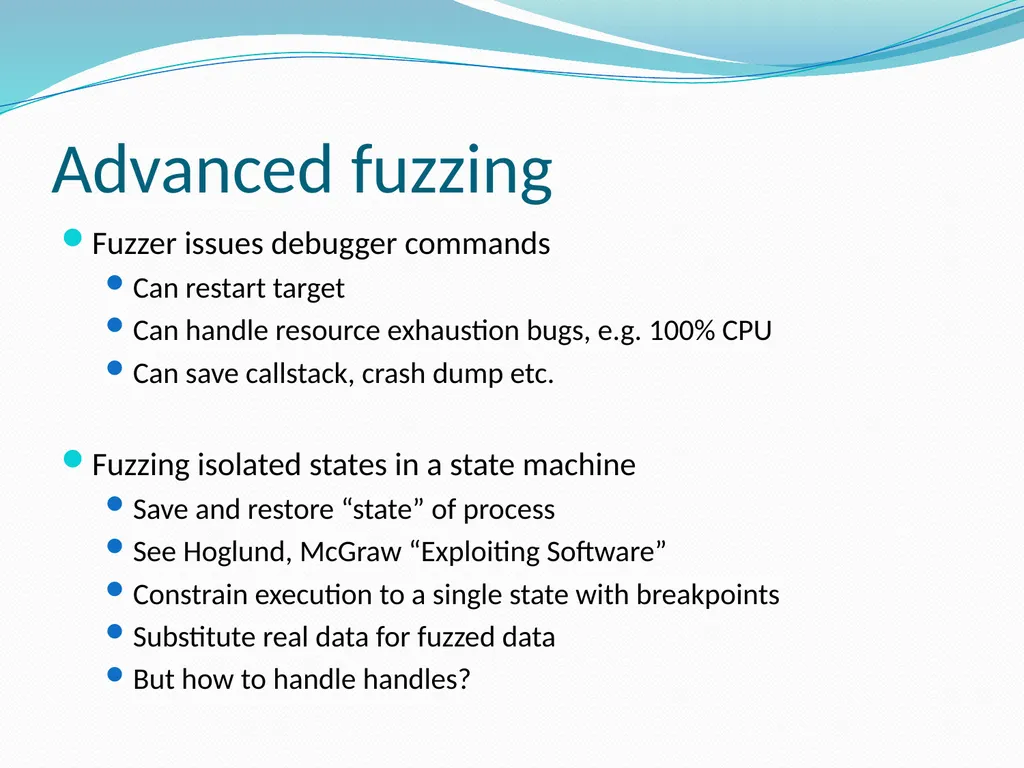
Advanced fuzzing Fuzzer issues debugger commands
Can restart target
Can handle resource exhaustion bugs, e.g. 100% CPU
Can save callstack, crash dump etc.
Fuzzing isolated states in a state machine
Save and restore “state” of process
See Hoglund, McGraw “Exploiting Software”
Constrain execution to a single state with breakpoints
Substitute real data for fuzzed data
But how to handle handles?<br>
Can restart target
Can handle resource exhaustion bugs, e.g. 100% CPU
Can save callstack, crash dump etc.
Fuzzing isolated states in a state machine
Save and restore “state” of process
See Hoglund, McGraw “Exploiting Software”
Constrain execution to a single state with breakpoints
Substitute real data for fuzzed data
But how to handle handles?<br>
35
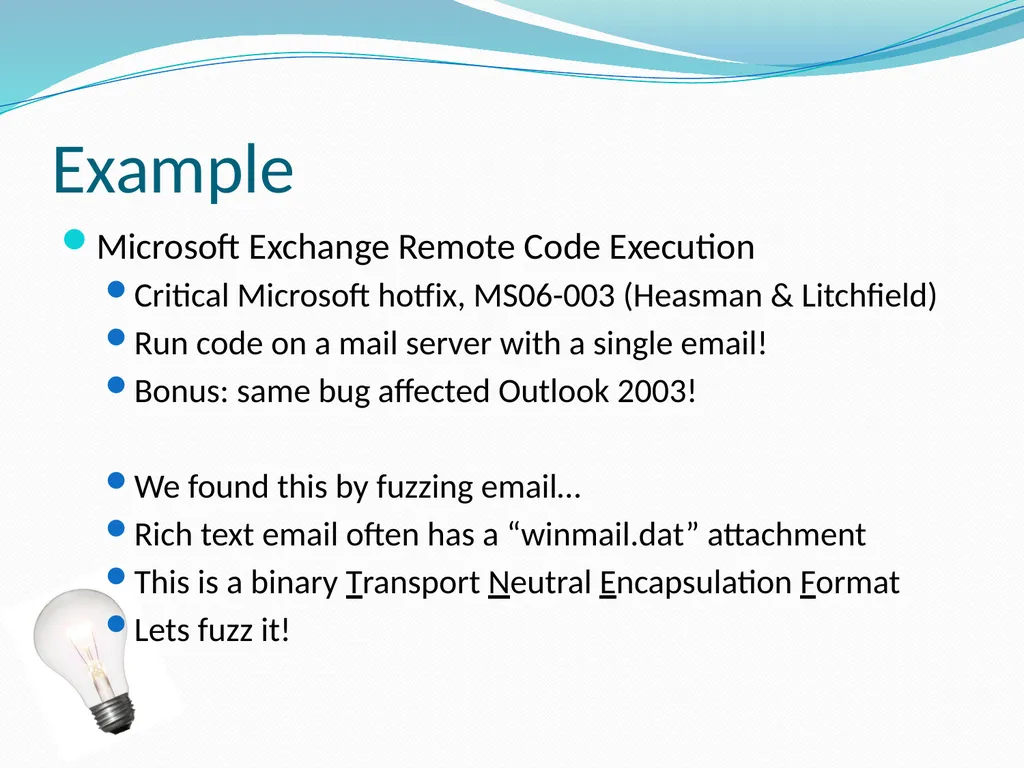
Example Microsoft Exchange Remote Code Execution
Critical Microsoft hotfix, MS06-003 (Heasman & Litchfield)
Run code on a mail server with a single email!
Bonus: same bug affected Outlook 2003!
We found this by fuzzing email…
Rich text email often has a “winmail.dat” attachment
This is a binary Transport Neutral Encapsulation Format
Lets fuzz it!<br>
Critical Microsoft hotfix, MS06-003 (Heasman & Litchfield)
Run code on a mail server with a single email!
Bonus: same bug affected Outlook 2003!
We found this by fuzzing email…
Rich text email often has a “winmail.dat” attachment
This is a binary Transport Neutral Encapsulation Format
Lets fuzz it!<br>
36
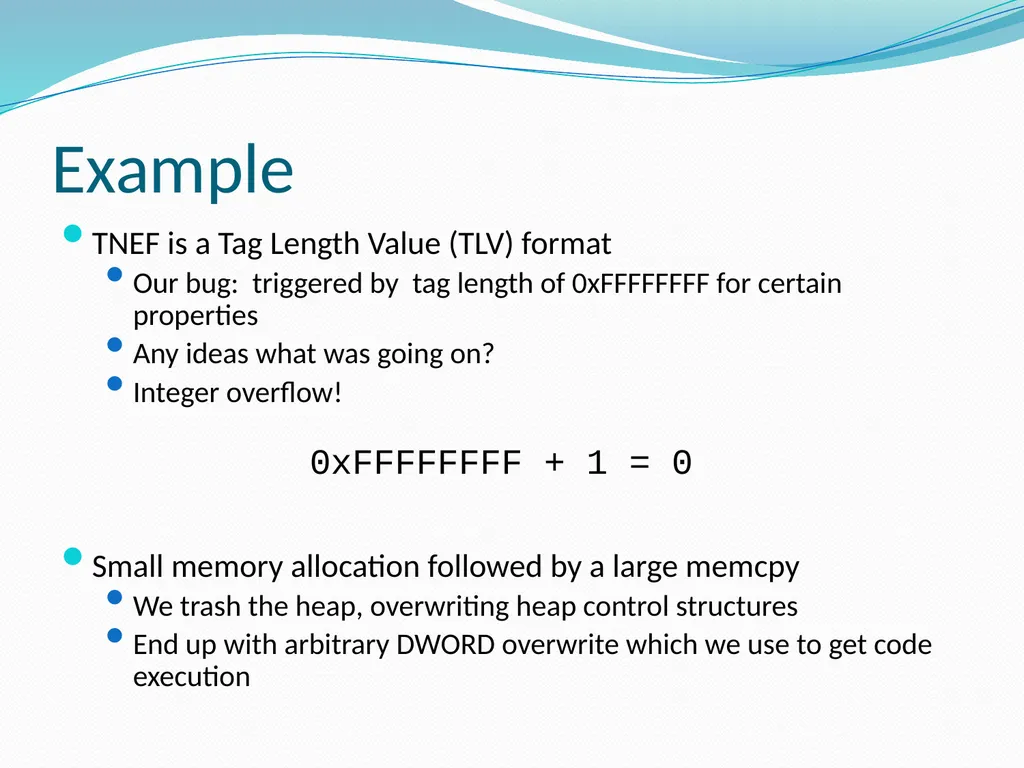
Example TNEF is a Tag Length Value (TLV) format
Our bug: triggered by tag length of 0xFFFFFFFF for certain properties
Any ideas what was going on?
Integer overflow!
Small memory allocation followed by a large memcpy
We trash the heap, overwriting heap control structures
End up with arbitrary DWORD overwrite which we use to get code execution 0xFFFFFFFF + 1 = 0<br>
Our bug: triggered by tag length of 0xFFFFFFFF for certain properties
Any ideas what was going on?
Integer overflow!
Small memory allocation followed by a large memcpy
We trash the heap, overwriting heap control structures
End up with arbitrary DWORD overwrite which we use to get code execution 0xFFFFFFFF + 1 = 0<br>
37
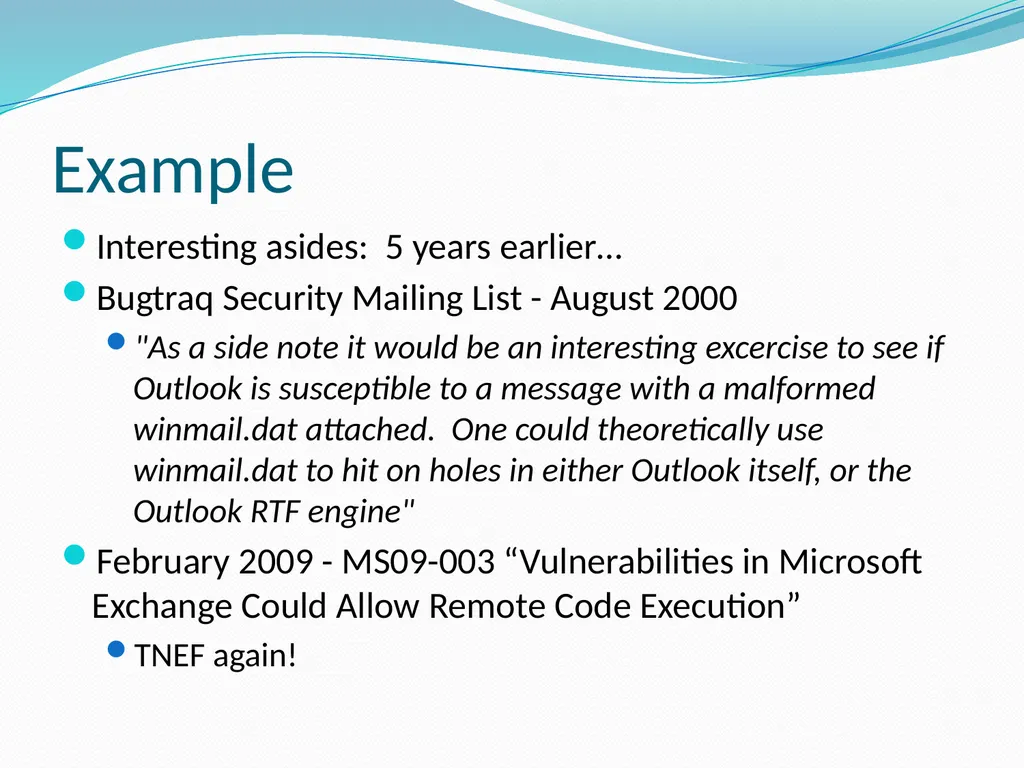
Example Interesting asides: 5 years earlier…
Bugtraq Security Mailing List - August 2000
"As a side note it would be an interesting excercise to see if Outlook is susceptible to a message with a malformed winmail.dat attached. One could theoretically use winmail.dat to hit on holes in either Outlook itself, or the Outlook RTF engine"
February 2009 - MS09-003 “Vulnerabilities in Microsoft Exchange Could Allow Remote Code Execution”
TNEF again!<br>
Bugtraq Security Mailing List - August 2000
"As a side note it would be an interesting excercise to see if Outlook is susceptible to a message with a malformed winmail.dat attached. One could theoretically use winmail.dat to hit on holes in either Outlook itself, or the Outlook RTF engine"
February 2009 - MS09-003 “Vulnerabilities in Microsoft Exchange Could Allow Remote Code Execution”
TNEF again!<br>
38
Existing challenges Fuzzing likely to trigger same bug repeatedly
Automatically remove duplicate bugs
Compare call stacks, register values, memory locations
What if they are trashed?
Or slightly different?
Seems like this problem would benefit from a fuzzy approach
How to implement code coverage on a binary?
… Without degrading performance
How to effectively use code coverage to direct fuzzing ?<br>
Automatically remove duplicate bugs
Compare call stacks, register values, memory locations
What if they are trashed?
Or slightly different?
Seems like this problem would benefit from a fuzzy approach
How to implement code coverage on a binary?
… Without degrading performance
How to effectively use code coverage to direct fuzzing ?<br>
39
Existing challenges How to measure effectiveness of a fuzzer?
Number of test cases?
Number of bugs?
Severity of bugs?
% Code coverage?
How many test cases to run?
How to balance complexity vs. time
constraints?<br>
Number of test cases?
Number of bugs?
Severity of bugs?
% Code coverage?
How many test cases to run?
How to balance complexity vs. time
constraints?<br>
40
Questions? And one last thing…
NGS is always looking to hire talented people!
john@ngssoftware.com
http://www.ngssoftware.com<br>
NGS is always looking to hire talented people!
john@ngssoftware.com
http://www.ngssoftware.com<br>