04
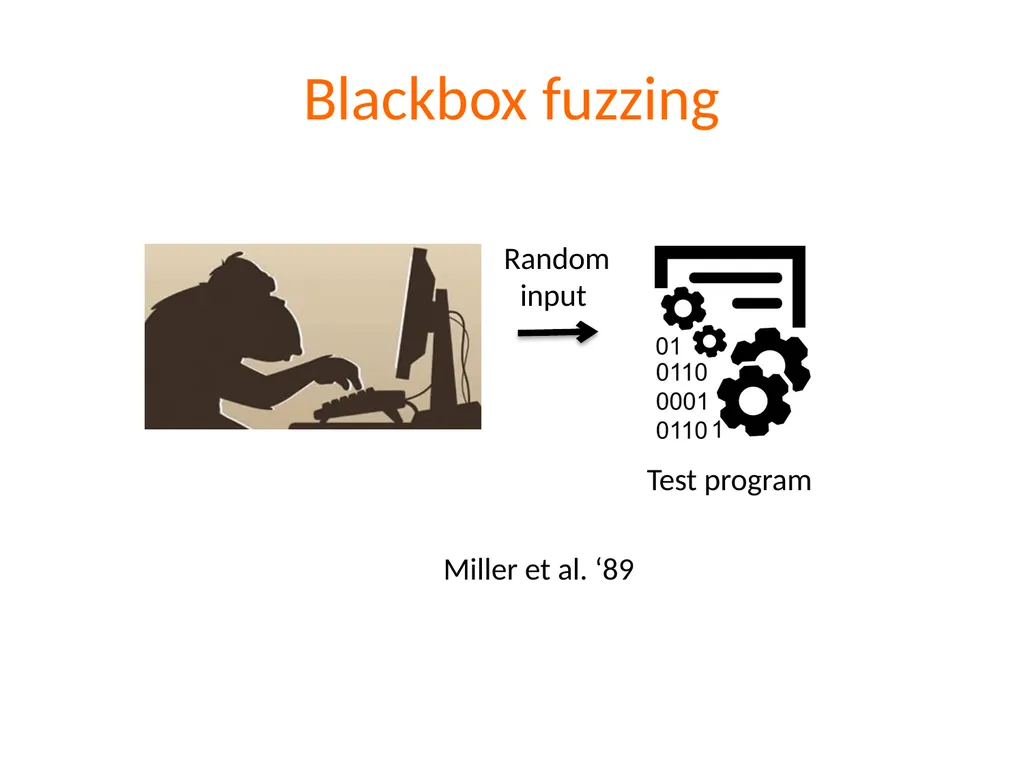
Blackbox fuzzing Given a program simply feed random inputs and see whether it exhibits incorrect behavior (e.g., crashes)
Advantage: easy, low programmer cost
Disadvantage: inefficient
Inputs often require structures, random inputs are likely to be malformed
Inputs that trigger an incorrect behavior is a a very small fraction, probably of getting lucky is very low<br>
05
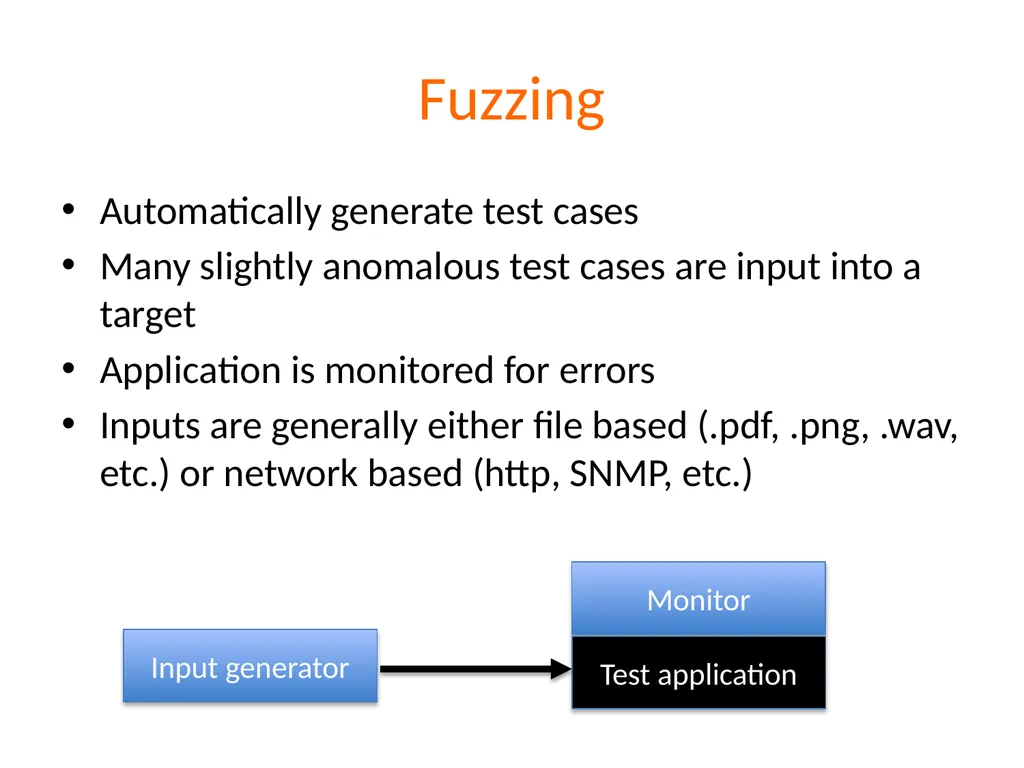
Fuzzing Automatically generate test cases
Many slightly anomalous test cases are input into a target
Application is monitored for errors
Inputs are generally either file based (.pdf, .png, .wav, etc.) or network based (http, SNMP, etc.) Input generator Monitor Test application<br>
06
Problem detection See if program crashed
Type of crash can tell a lot (SEGV vs. assert fail)
Run program under dynamic memory error detector (valgrind/purify/AddressSanitizer)
Catch more bugs, but more expensive per run.
See if program locks up
Roll your own dynamic checker e.g. valgrind skins<br>
07
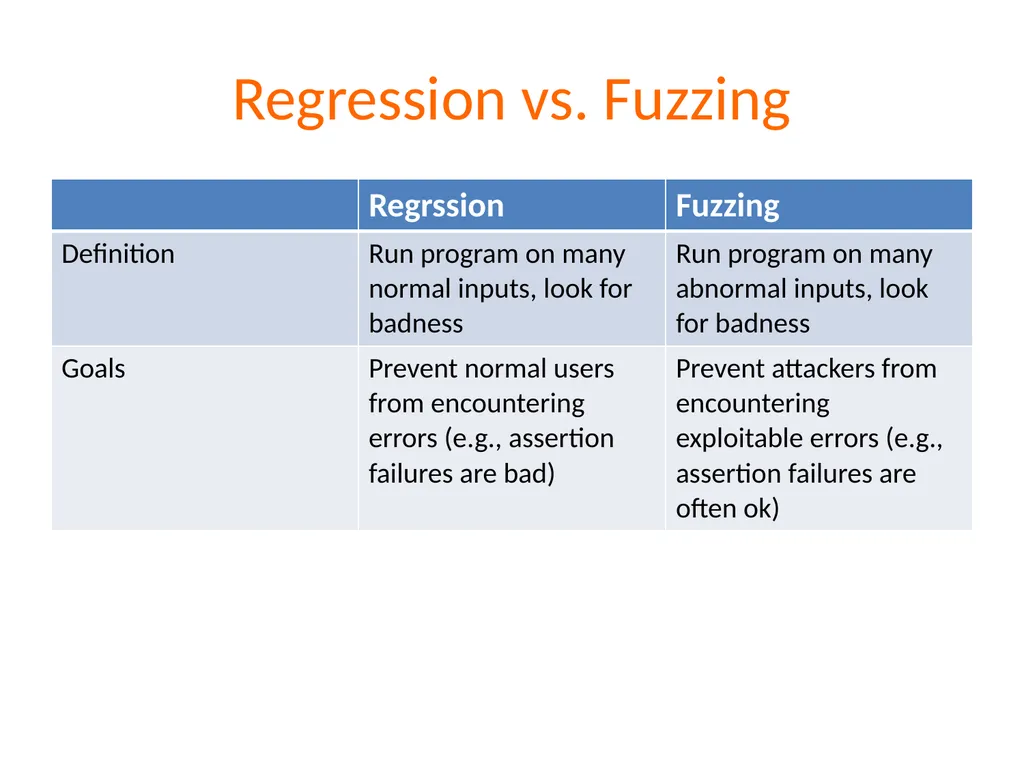
Regression vs. Fuzzing<br>
08
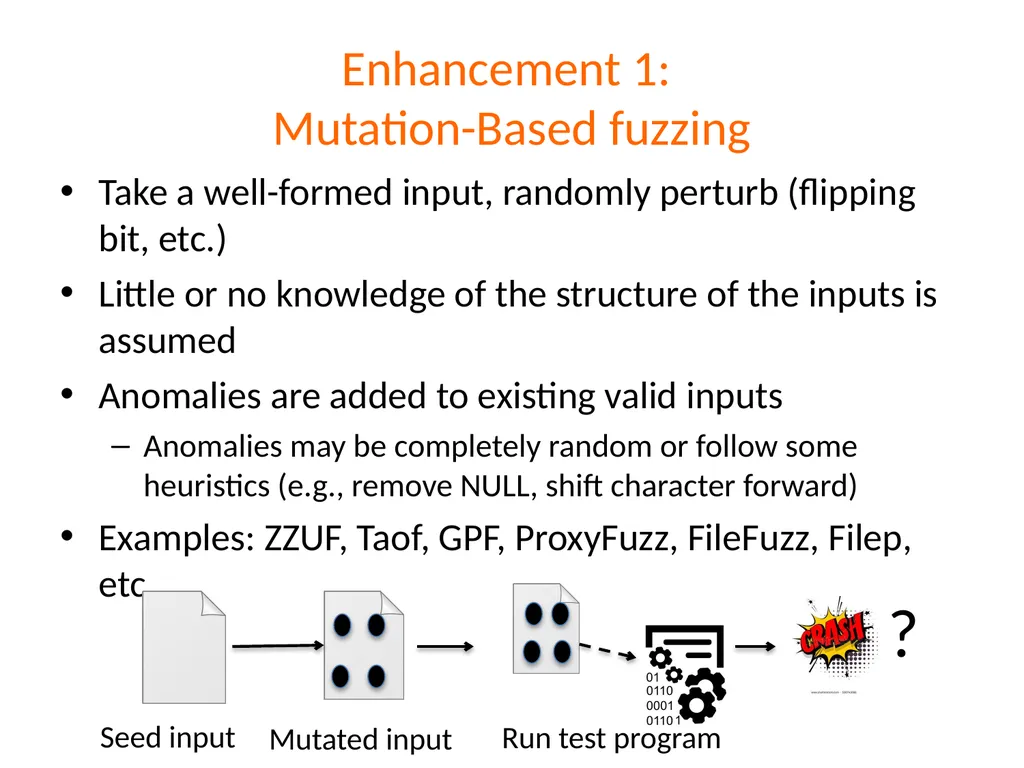
Enhancement 1: �Mutation-Based fuzzing Take a well-formed input, randomly perturb (flipping bit, etc.)
Little or no knowledge of the structure of the inputs is assumed
Anomalies are added to existing valid inputs
Anomalies may be completely random or follow some heuristics (e.g., remove NULL, shift character forward)
Examples: ZZUF, Taof, GPF, ProxyFuzz, FileFuzz, Filep, etc. Seed input Mutated input Run test program ?<br>
09
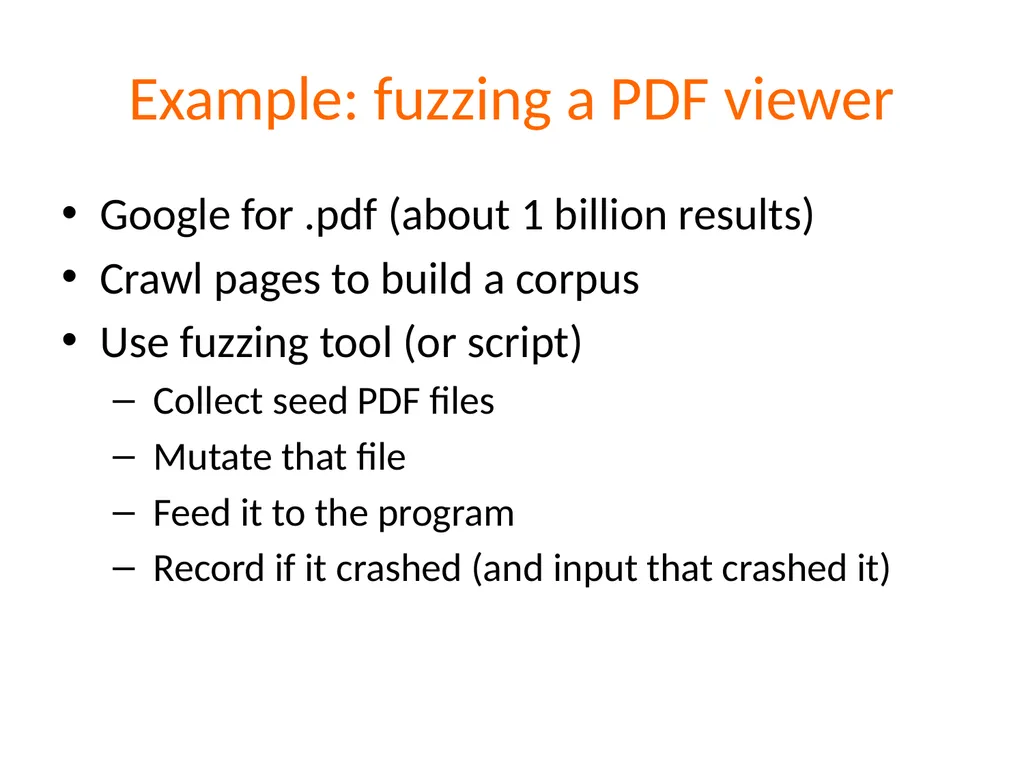
Example: fuzzing a PDF viewer Google for .pdf (about 1 billion results)
Crawl pages to build a corpus
Use fuzzing tool (or script)
Collect seed PDF files
Mutate that file
Feed it to the program
Record if it crashed (and input that crashed it)<br>
10
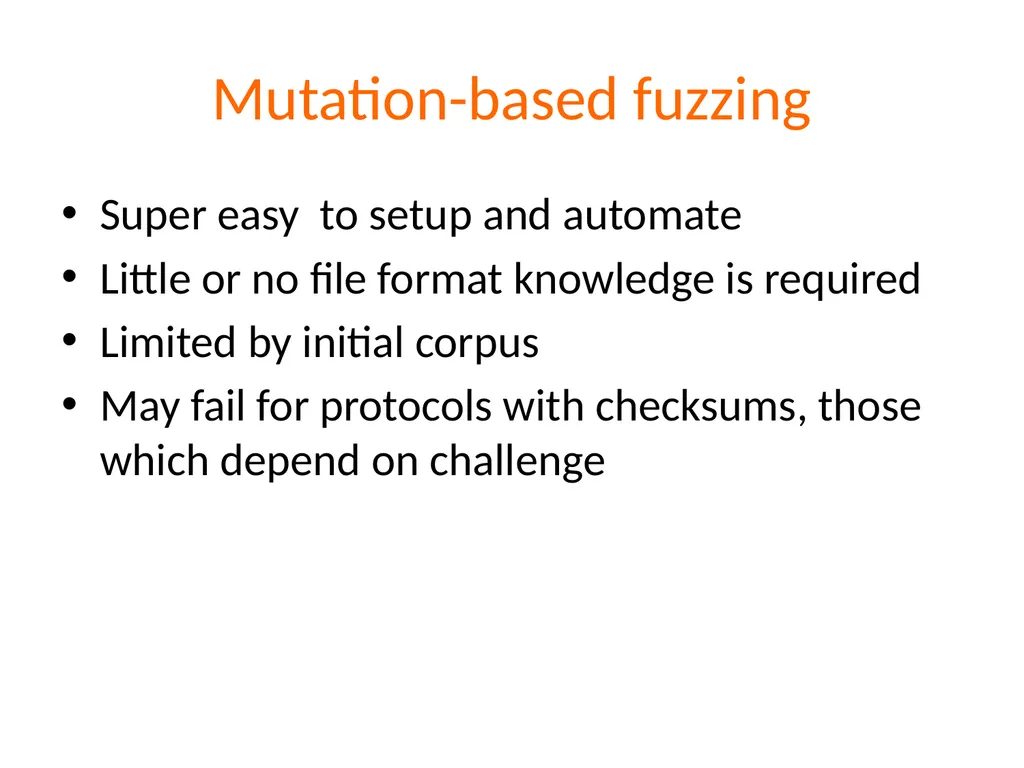
Mutation-based fuzzing Super easy to setup and automate
Little or no file format knowledge is required
Limited by initial corpus
May fail for protocols with checksums, those which depend on challenge<br>
11
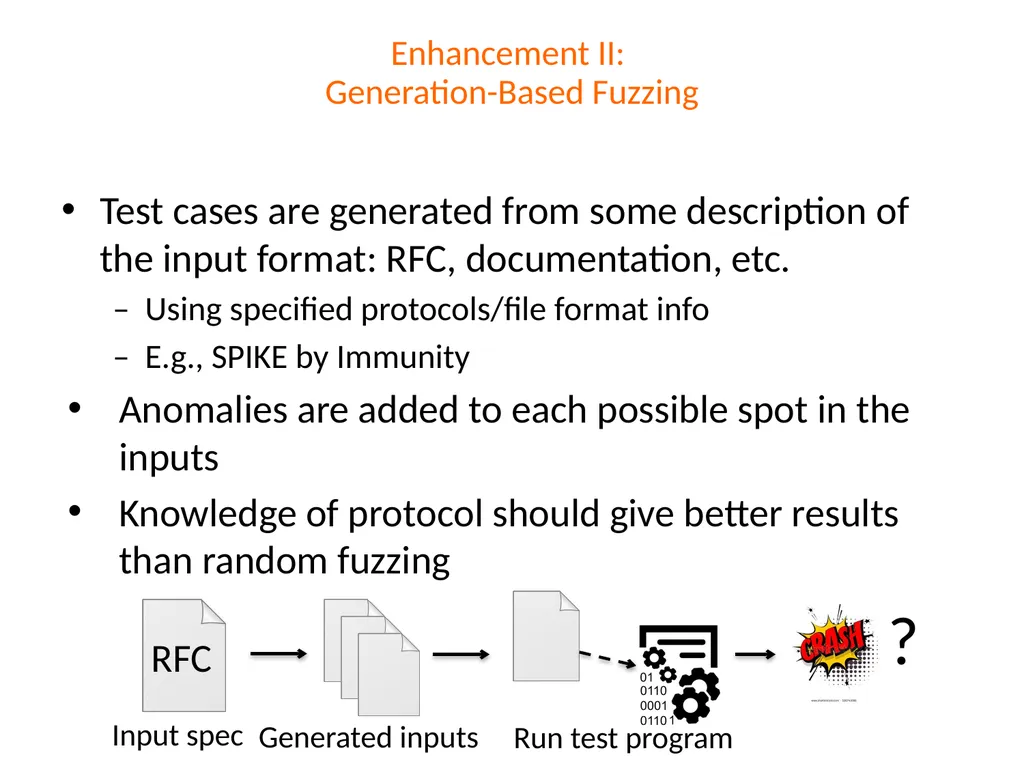
Enhancement II: �Generation-Based Fuzzing Test cases are generated from some description of the input format: RFC, documentation, etc.
– Using specified protocols/file format info
– E.g., SPIKE by Immunity
Anomalies are added to each possible spot in the inputs
Knowledge of protocol should give better results than random fuzzing Input spec Generated inputs Run test program ? RFC<br>
12
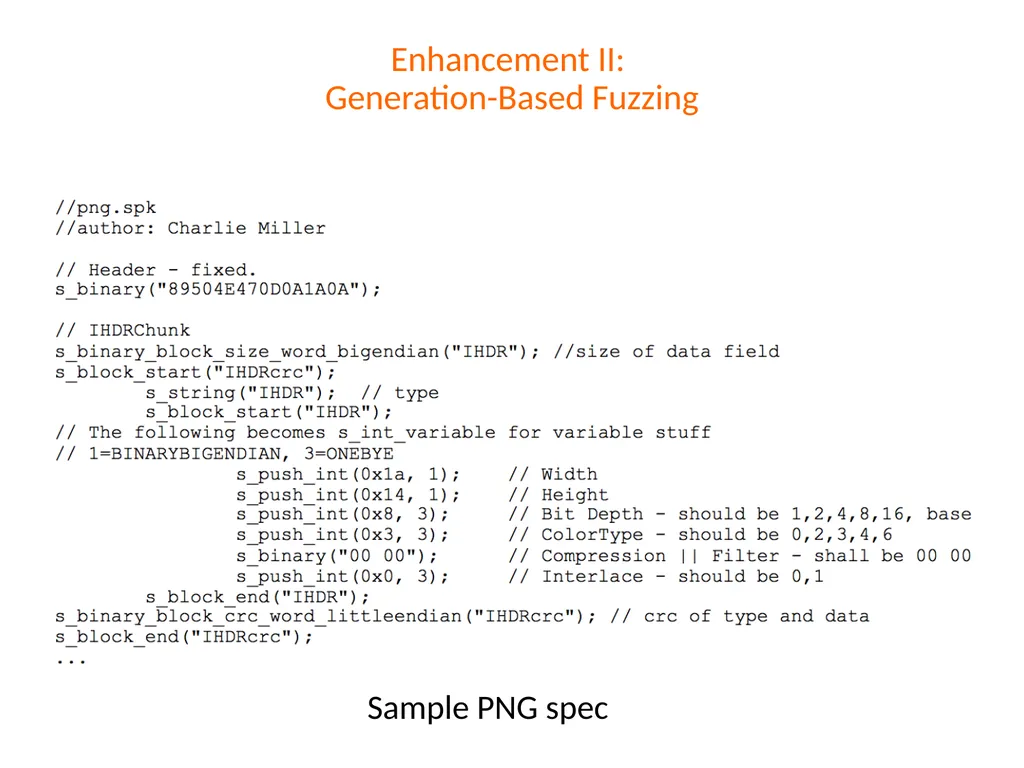
Enhancement II: �Generation-Based Fuzzing Sample PNG spec<br>
13
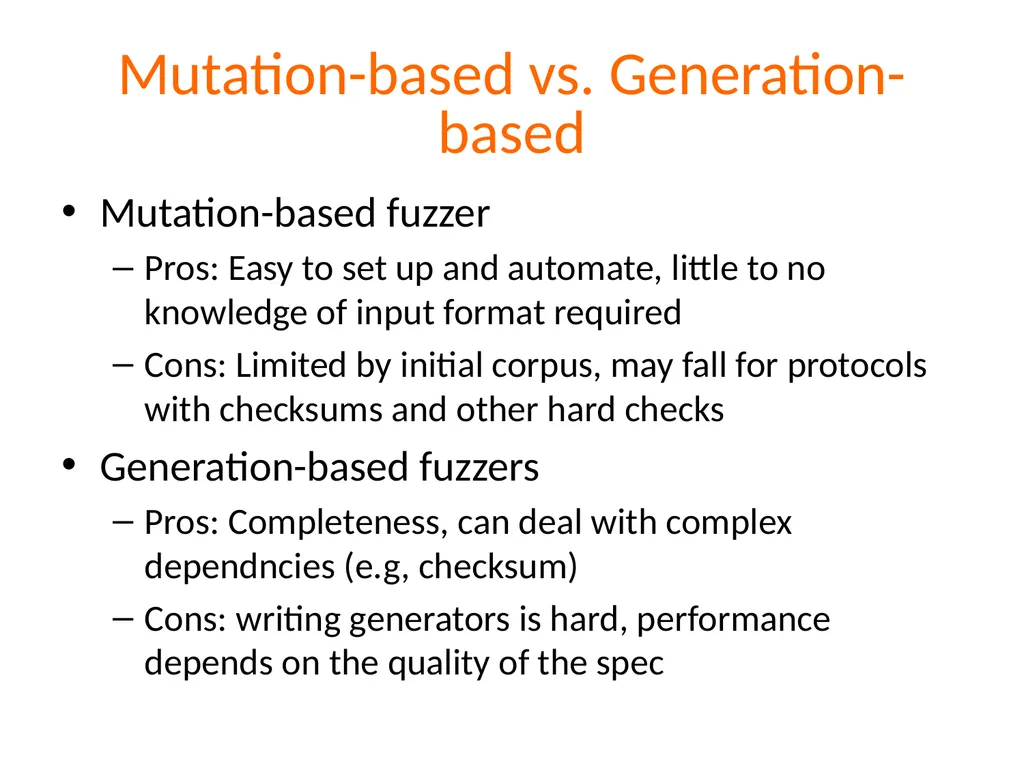
Mutation-based vs. Generation-based Mutation-based fuzzer
Pros: Easy to set up and automate, little to no knowledge of input format required
Cons: Limited by initial corpus, may fall for protocols with checksums and other hard checks
Generation-based fuzzers
Pros: Completeness, can deal with complex dependncies (e.g, checksum)
Cons: writing generators is hard, performance depends on the quality of the spec<br>
14
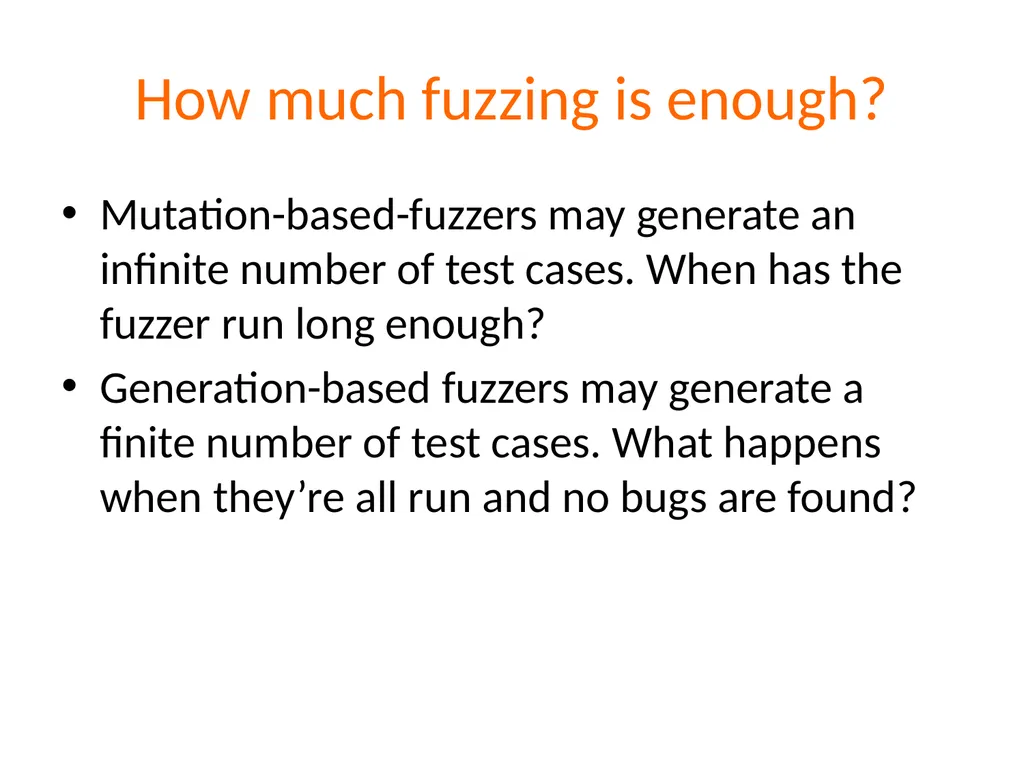
How much fuzzing is enough? Mutation-based-fuzzers may generate an infinite number of test cases. When has the fuzzer run long enough?
Generation-based fuzzers may generate a finite number of test cases. What happens when they’re all run and no bugs are found?<br>
15
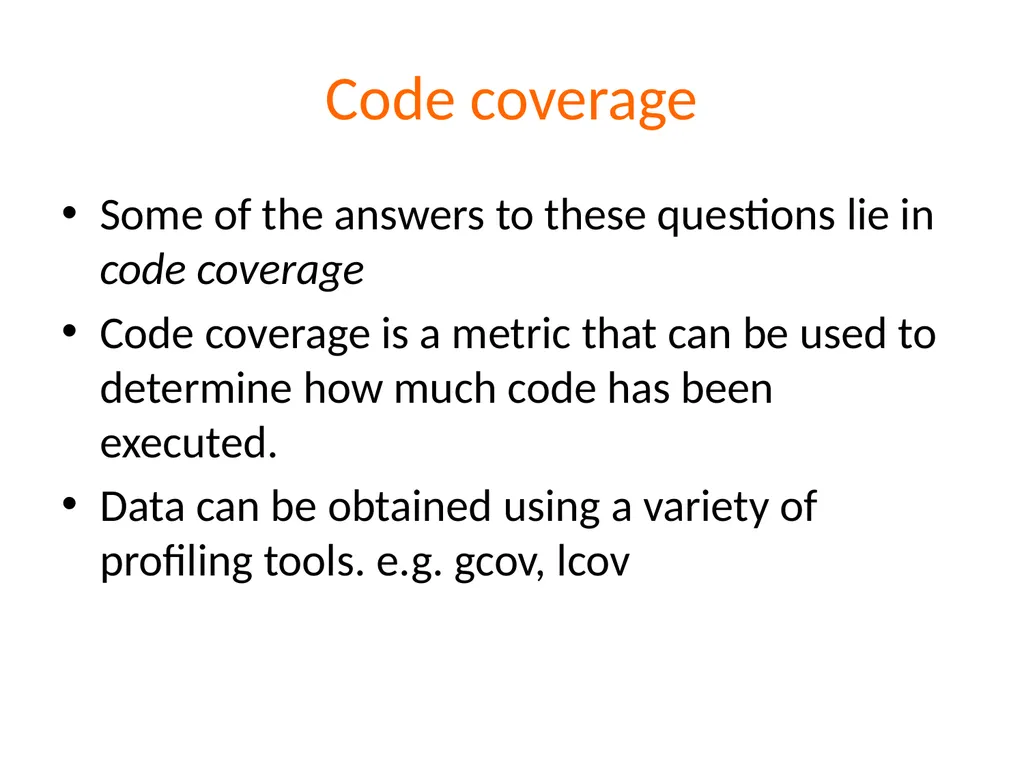
Code coverage Some of the answers to these questions lie in code coverage
Code coverage is a metric that can be used to determine how much code has been executed.
Data can be obtained using a variety of profiling tools. e.g. gcov, lcov<br>
16
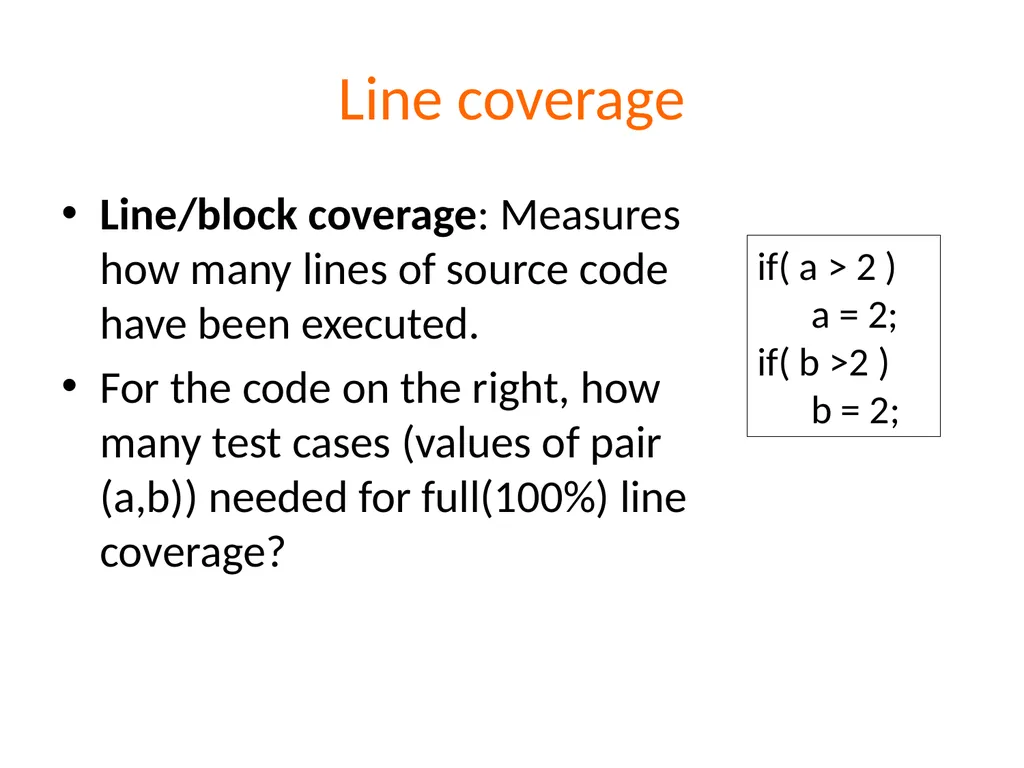
Line coverage Line/block coverage: Measures how many lines of source code have been executed.
For the code on the right, how many test cases (values of pair (a,b)) needed for full(100%) line coverage? if( a > 2 )
a = 2;
if( b >2 )
b = 2;<br>
17
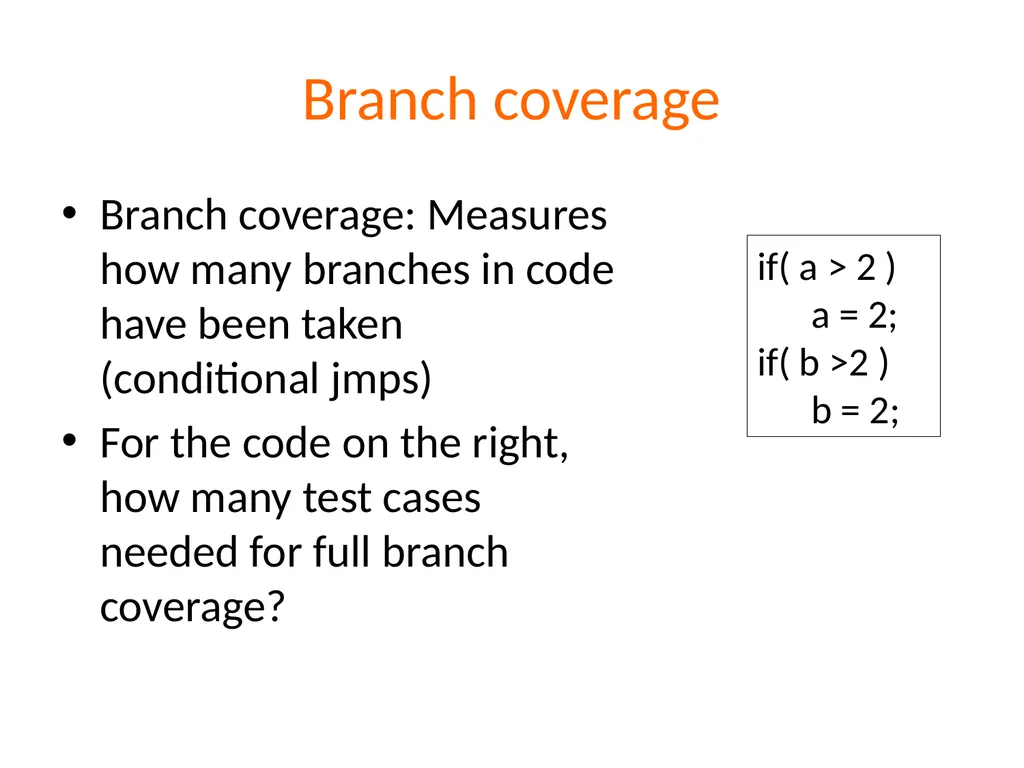
Branch coverage Branch coverage: Measures how many branches in code have been taken (conditional jmps)
For the code on the right, how many test cases needed for full branch coverage? if( a > 2 )
a = 2;
if( b >2 )
b = 2;<br>
18
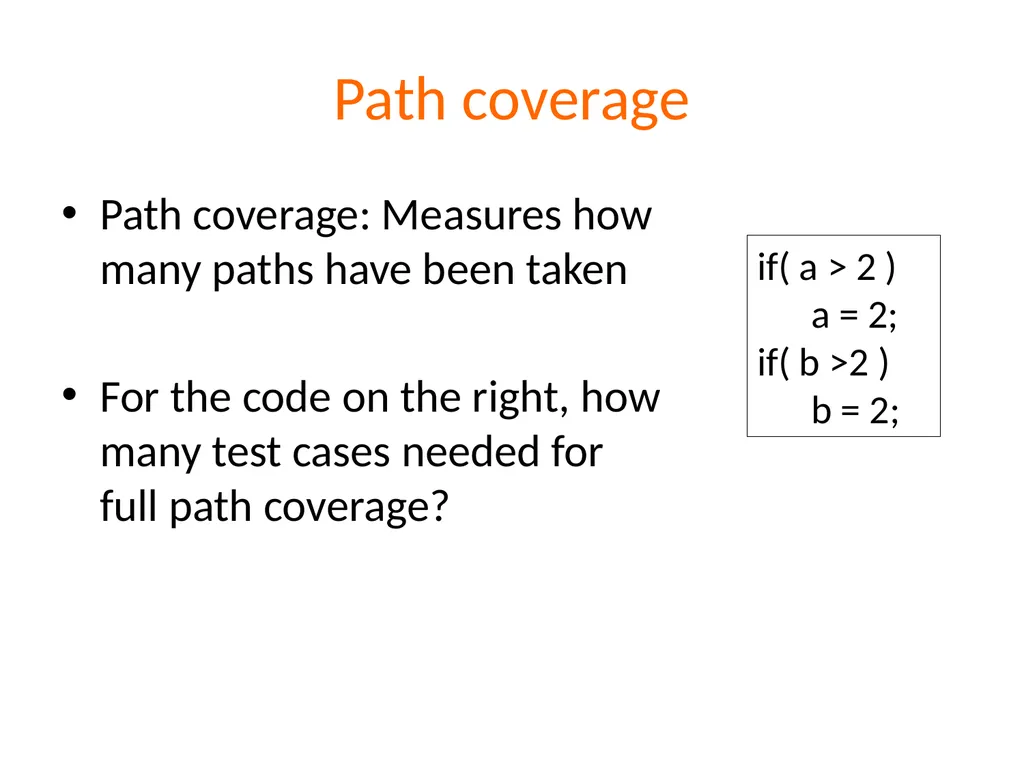
Path coverage Path coverage: Measures how many paths have been taken
For the code on the right, how many test cases needed for full path coverage? if( a > 2 )
a = 2;
if( b >2 )
b = 2;<br>
19
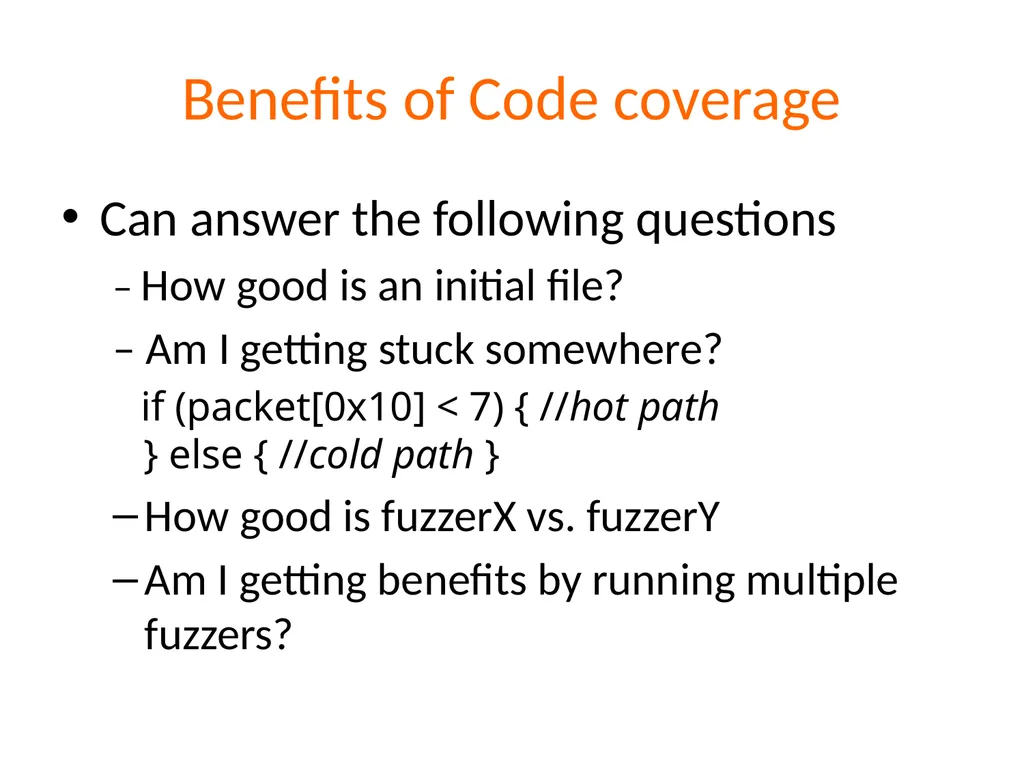
Benefits of Code coverage Can answer the following questions
– How good is an initial file?
– Am I getting stuck somewhere?
if (packet[0x10] < 7) { //hot path� } else { //cold path }
How good is fuzzerX vs. fuzzerY
Am I getting benefits by running multiple fuzzers?<br>
20
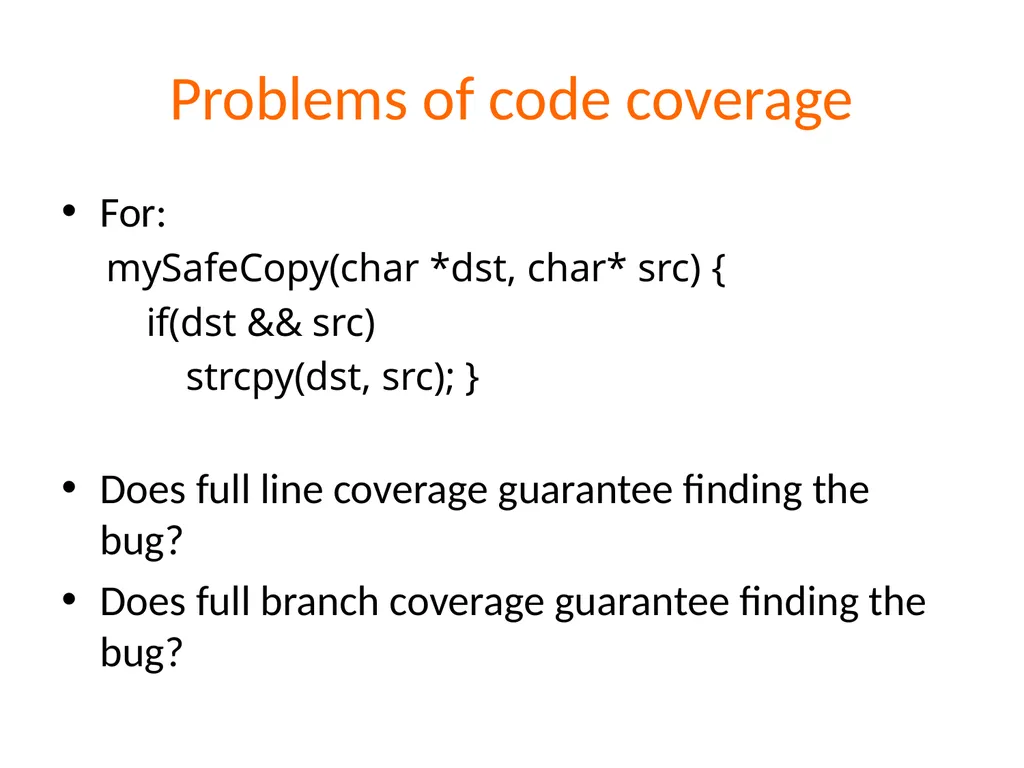
Problems of code coverage For:
mySafeCopy(char *dst, char* src) {
if(dst && src)
strcpy(dst, src); }
Does full line coverage guarantee finding the bug?
Does full branch coverage guarantee finding the bug?<br>
21
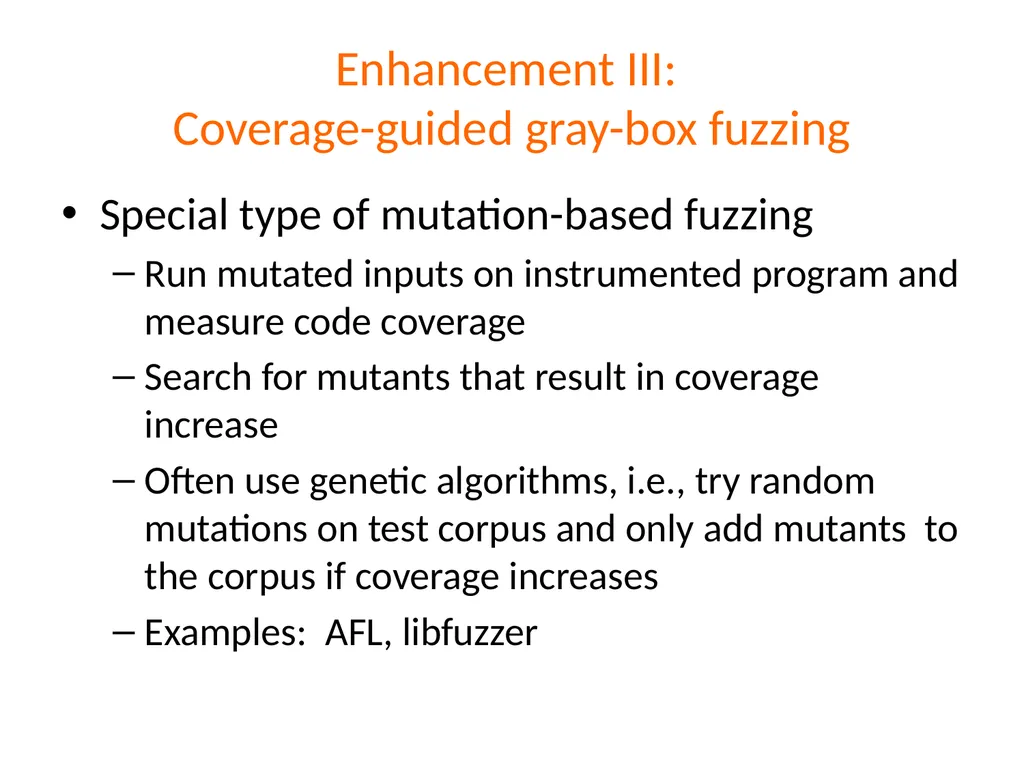
Enhancement III: �Coverage-guided gray-box fuzzing Special type of mutation-based fuzzing
Run mutated inputs on instrumented program and measure code coverage
Search for mutants that result in coverage increase
Often use genetic algorithms, i.e., try random mutations on test corpus and only add mutants to the corpus if coverage increases
Examples: AFL, libfuzzer<br>
22
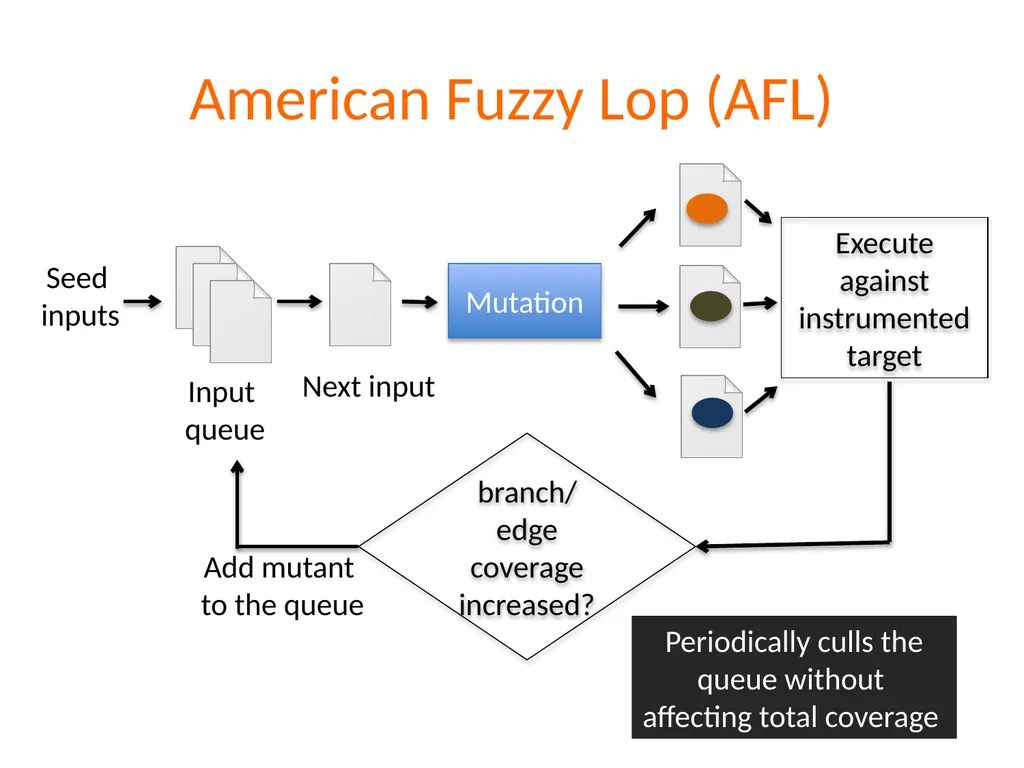
American Fuzzy Lop (AFL) Input
queue Seed
inputs Next input Mutation Execute against instrumented
target branch/edge coverage increased? Add mutant
to the queue Periodically culls the queue without
affecting total coverage<br>
23
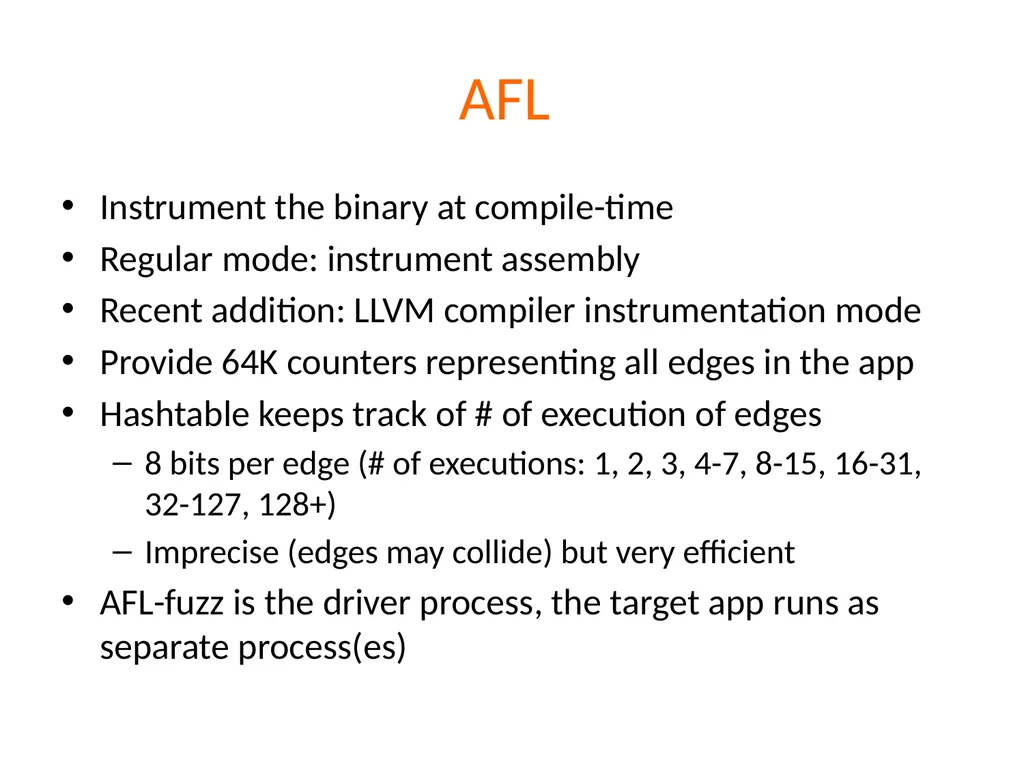
AFL Instrument the binary at compile-time
Regular mode: instrument assembly
Recent addition: LLVM compiler instrumentation mode
Provide 64K counters representing all edges in the app
Hashtable keeps track of # of execution of edges
8 bits per edge (# of executions: 1, 2, 3, 4-7, 8-15, 16-31, 32-127, 128+)
Imprecise (edges may collide) but very efficient
AFL-fuzz is the driver process, the target app runs as separate process(es)<br>
24
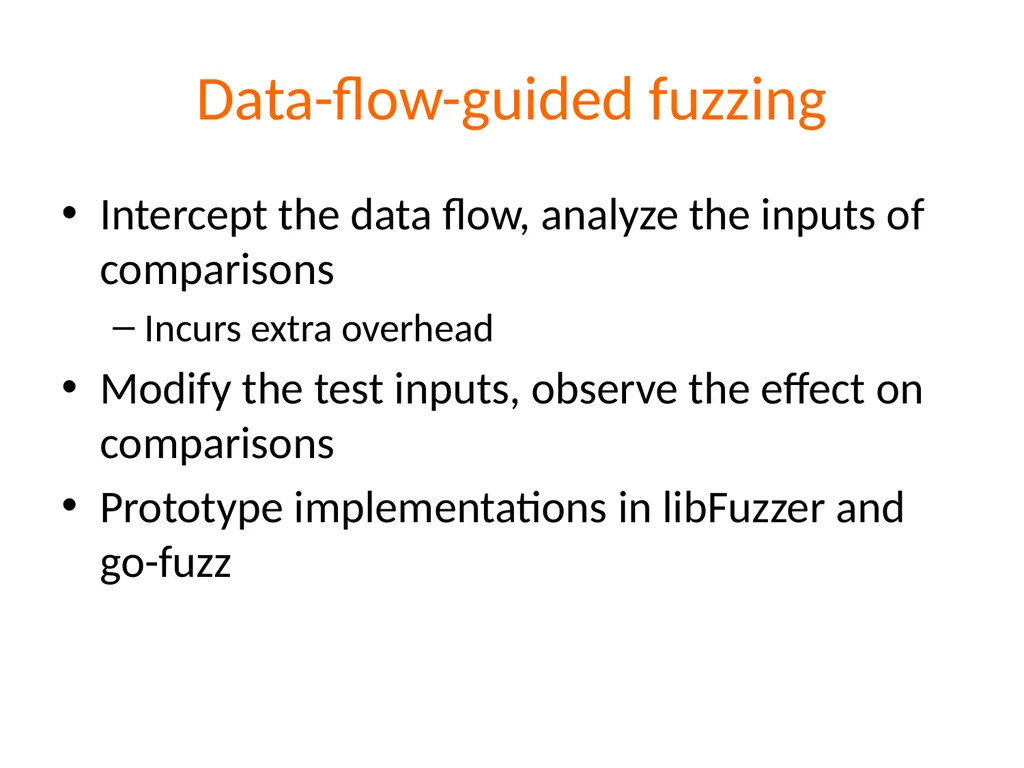
Data-flow-guided fuzzing Intercept the data flow, analyze the inputs of comparisons
Incurs extra overhead
Modify the test inputs, observe the effect on comparisons
Prototype implementations in libFuzzer and go-fuzz<br>
25
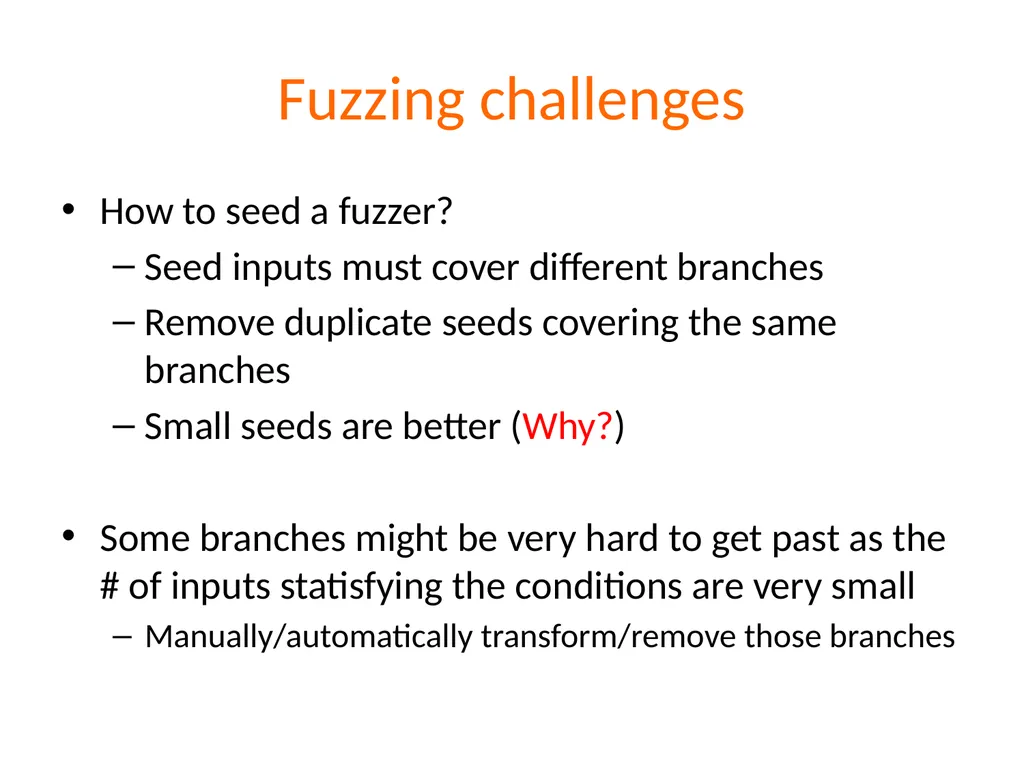
Fuzzing challenges How to seed a fuzzer?
Seed inputs must cover different branches
Remove duplicate seeds covering the same branches
Small seeds are better (Why?)
Some branches might be very hard to get past as the # of inputs statisfying the conditions are very small
Manually/automatically transform/remove those branches<br>
26
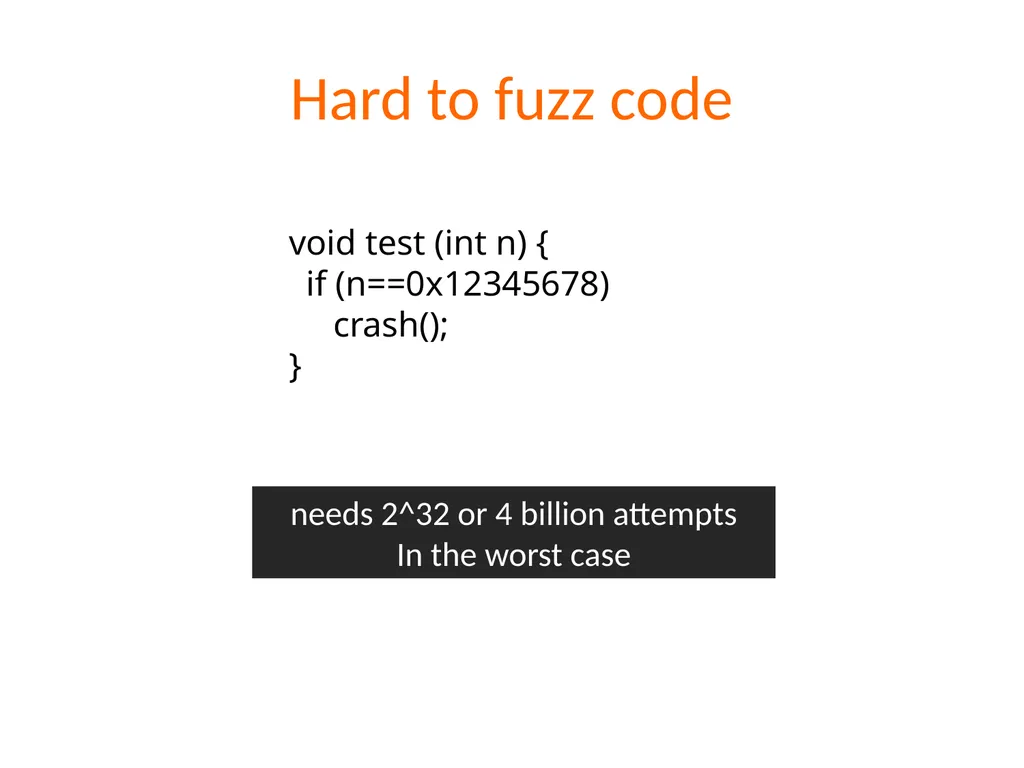
Hard to fuzz code void test (int n) {
if (n==0x12345678)
crash();
} needs 2^32 or 4 billion attempts
In the worst case<br>
27
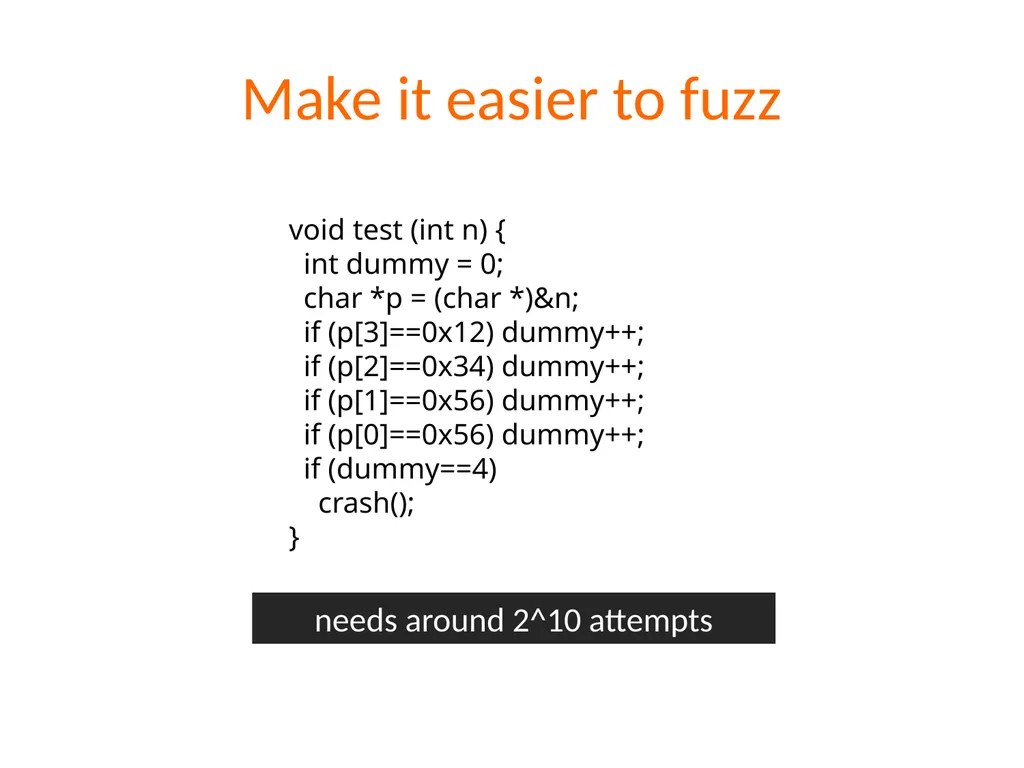
Make it easier to fuzz void test (int n) {
int dummy = 0;
char *p = (char *)&n;
if (p[3]==0x12) dummy++;
if (p[2]==0x34) dummy++;
if (p[1]==0x56) dummy++;
if (p[0]==0x56) dummy++;
if (dummy==4)
crash();
} needs around 2^10 attempts<br>
28
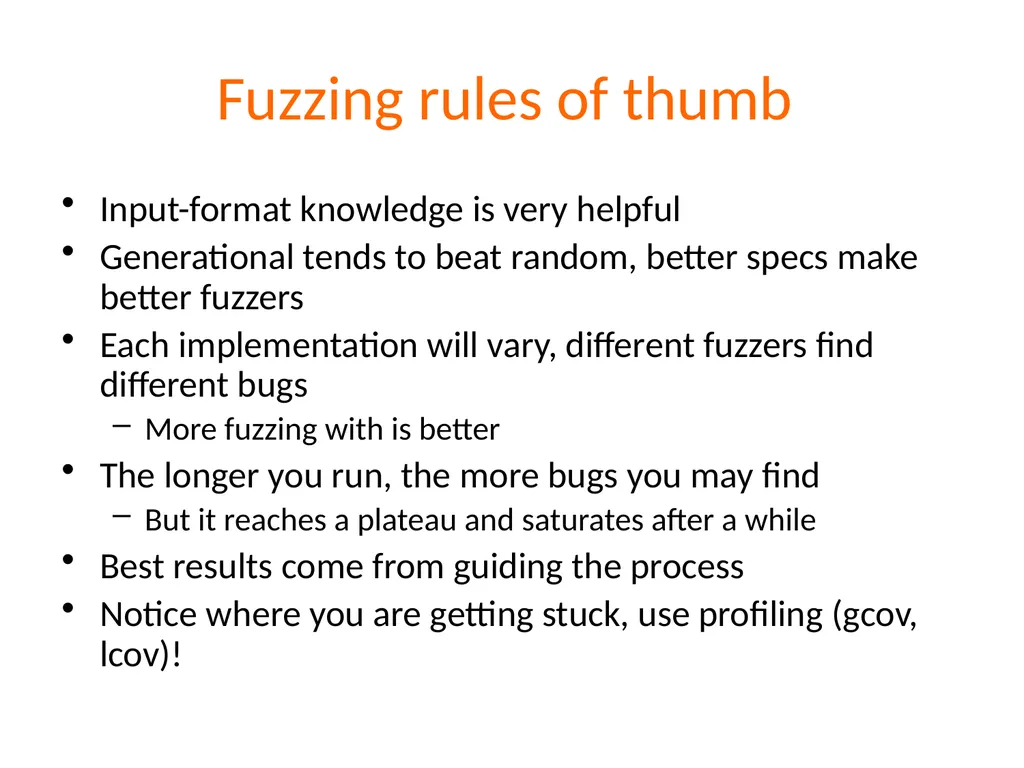
Fuzzing rules of thumb Input-format knowledge is very helpful
Generational tends to beat random, better specs make better fuzzers
Each implementation will vary, different fuzzers find different bugs
More fuzzing with is better
The longer you run, the more bugs you may find
But it reaches a plateau and saturates after a while
Best results come from guiding the process
Notice where you are getting stuck, use profiling (gcov, lcov)!<br>