
FYBCOM SEM I COMMERCE PAPER I PROF. ANUJA BAPAT
TG
Published · 42 slides · 0 views
1 / 1
Description
FYBCOM SEM I COMMERCE PAPER I PROF. ANUJA BAPAT SYLLABUS MODULE I: BUSINESS Introduction to Business: Concept, Functions, Scope and Significance of business, Traditional and Modern Concept of business. Objectives of Business: Steps in
Related Topics
Share
Embed code
Download this presentation From Below
"FYBCOM SEM I COMMERCE PAPER I PROF. ANUJA BAPAT" is the property of its rightful owner. Permission is granted to download and print the materials on this website for personal, non-commercial use only, and to display it on your personal computer provided you do not modify the materials and that you retain all copyright notices contained in the materials. By downloading content from our website, you accept the terms of this agreement.
Presentation Transcript
01
FYBCOM SEM I
COMMERCE PAPER I PROF. ANUJA BAPAT<br>
02
SYLLABUS MODULE I: BUSINESS
Introduction to Business: Concept, Functions, Scope and Significance of business, Traditional and Modern Concept of business.
Objectives of Business: Steps in setting business objectives, Classification of business objectives, Reconciliation of Economic and Social objectives
New Trends in Business: Impact of Liberalization, Privatization and Globalization, Strategy alternatives in the changing scenario, Restructuring and Turnaround Strategies.<br>
03
Introduction to business The term “Business” refers to commercial activities relating to production and distribution of goods and services for economic gain i.e. profit.
“Business is an institution organized and operated to provide goods and services to society under the incentive of private gain.” –B.O.Wheeler.<br>
“Business is an institution organized and operated to provide goods and services to society under the incentive of private gain.” –B.O.Wheeler.<br>
04
Nature/Feature of Business<br>
05
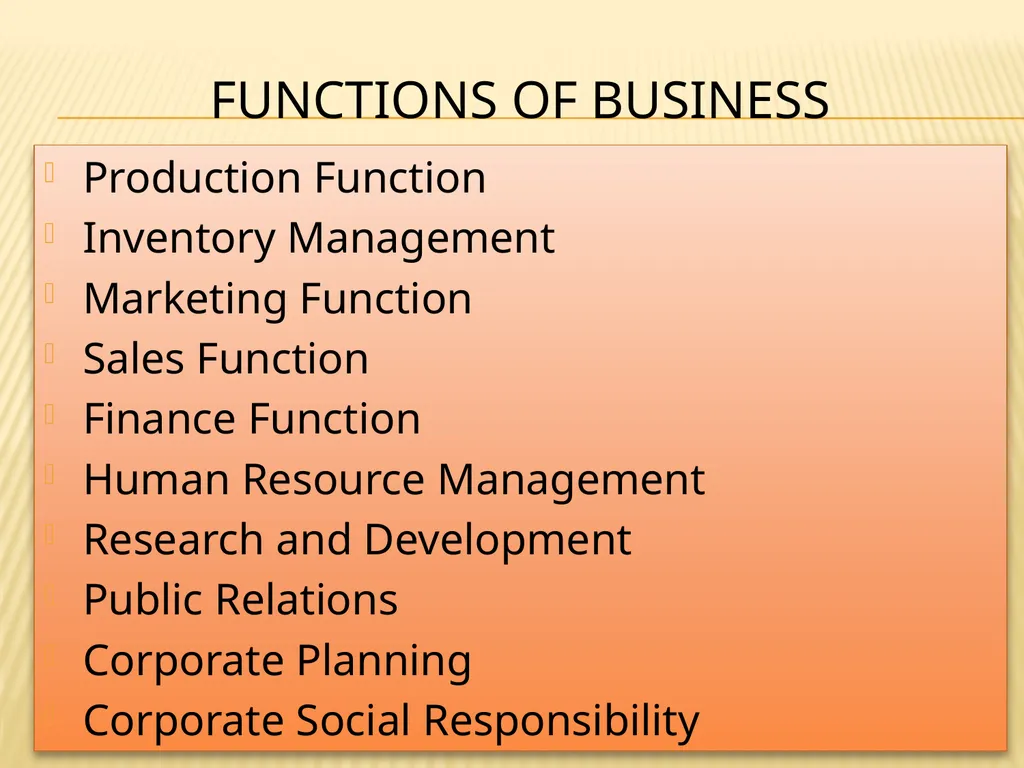
Functions of business Production Function
Inventory Management
Marketing Function
Sales Function
Finance Function
Human Resource Management
Research and Development
Public Relations
Corporate Planning
Corporate Social Responsibility<br>
Inventory Management
Marketing Function
Sales Function
Finance Function
Human Resource Management
Research and Development
Public Relations
Corporate Planning
Corporate Social Responsibility<br>
06
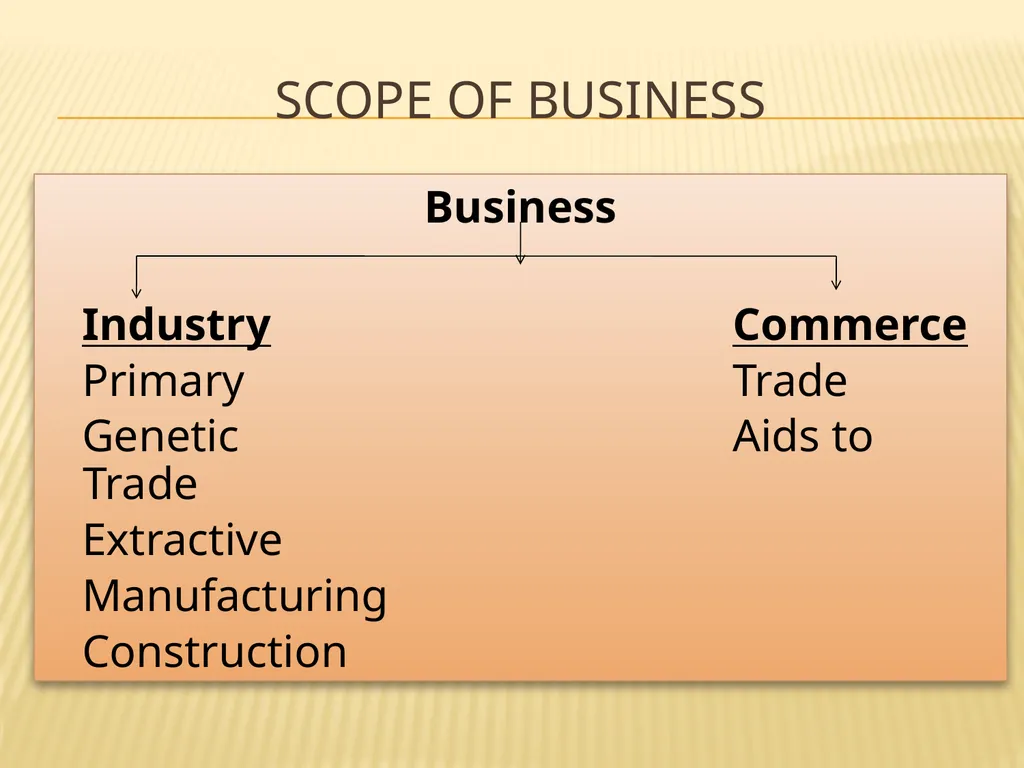
Scope of business Business
Industry Commerce
Primary Trade
Genetic Aids to Trade
Extractive
Manufacturing
Construction<br>
Industry Commerce
Primary Trade
Genetic Aids to Trade
Extractive
Manufacturing
Construction<br>
07
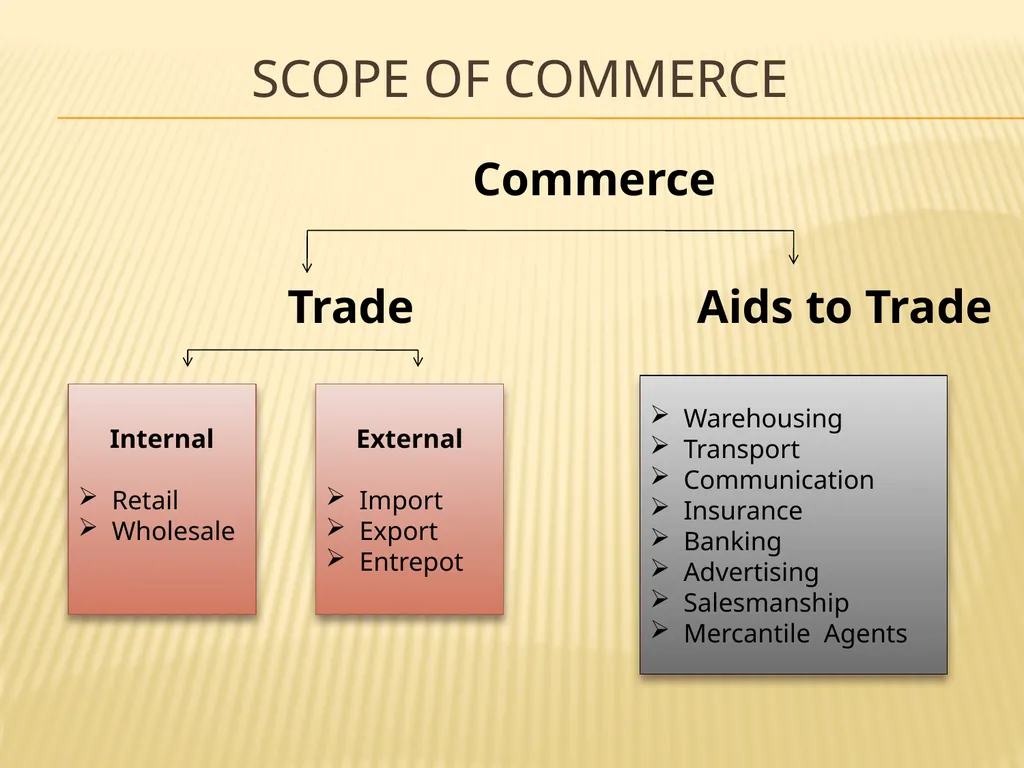
Scope of commerce Commerce
Trade Aids to Trade Internal
Retail
Wholesale External
Import
Export
Entrepot Warehousing
Transport
Communication
Insurance
Banking
Advertising
Salesmanship
Mercantile Agents<br>
Trade Aids to Trade Internal
Retail
Wholesale External
Import
Export
Entrepot Warehousing
Transport
Communication
Insurance
Banking
Advertising
Salesmanship
Mercantile Agents<br>
08
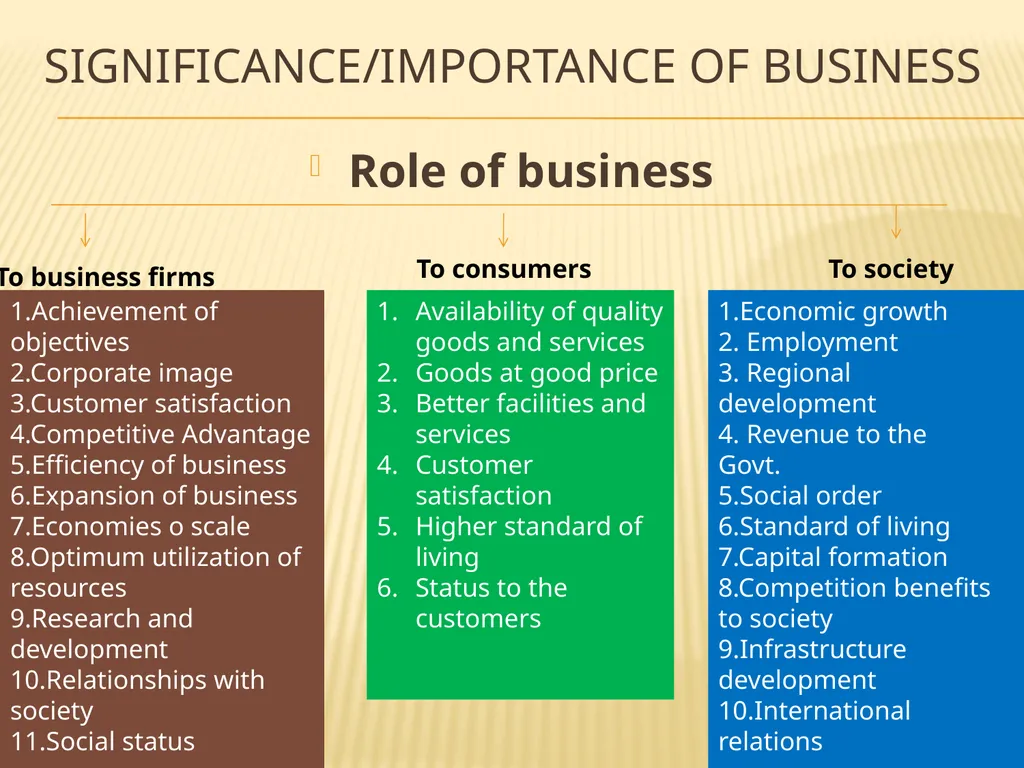
Significance/importance of business Role of business To business firms 1.Achievement of objectives
2.Corporate image
3.Customer satisfaction
4.Competitive Advantage
5.Efficiency of business
6.Expansion of business
7.Economies o scale
8.Optimum utilization of resources
9.Research and development
10.Relationships with society
11.Social status To consumers Availability of quality goods and services
Goods at good price
Better facilities and services
Customer satisfaction
Higher standard of living
Status to the customers To society 1.Economic growth
2. Employment
3. Regional development
4. Revenue to the Govt.
5.Social order
6.Standard of living
7.Capital formation
8.Competition benefits to society
9.Infrastructure development
10.International relations<br>
09
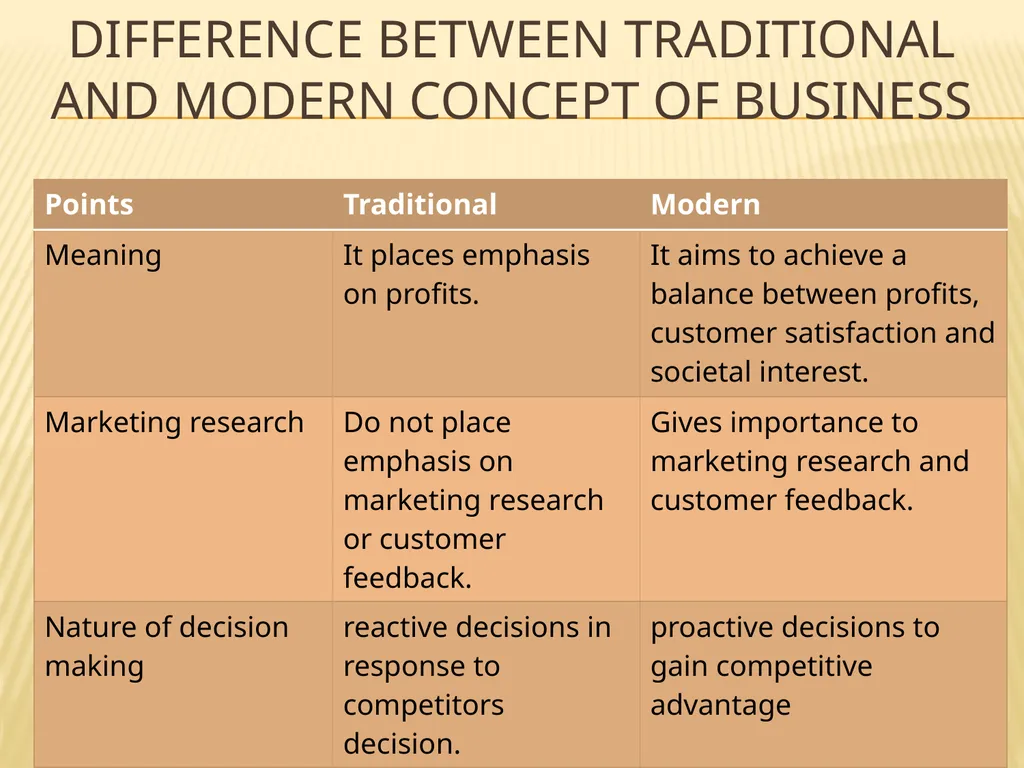
Difference between traditional and modern concept of business<br>
10
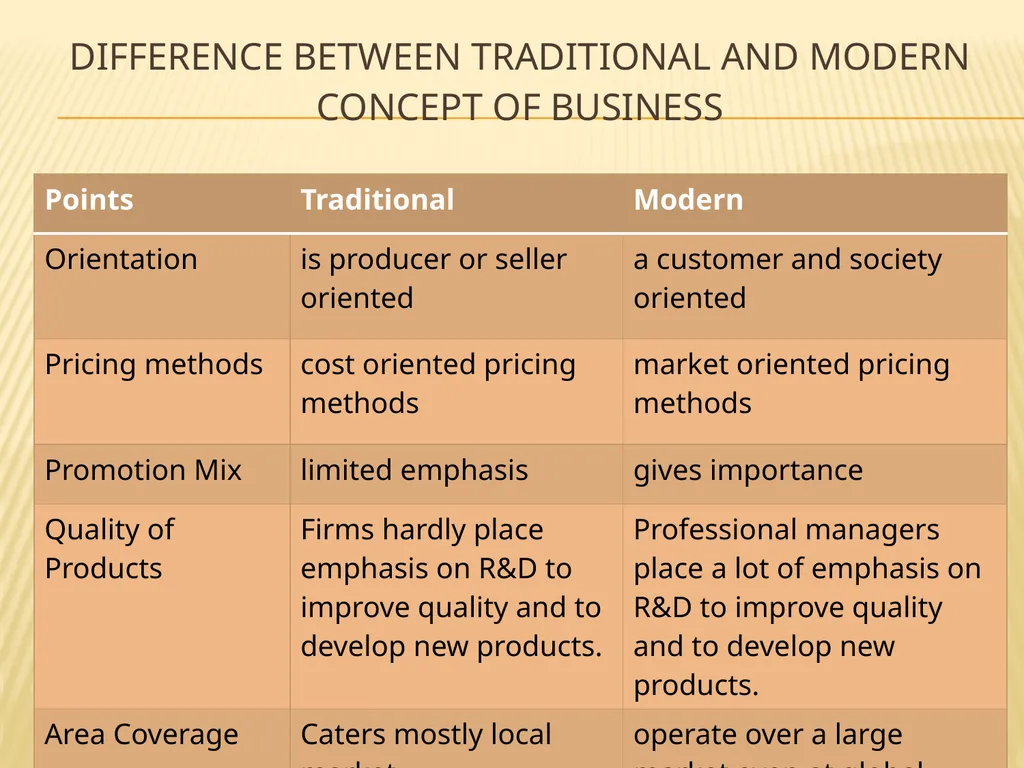
Difference between traditional and modern concept of business<br>
11
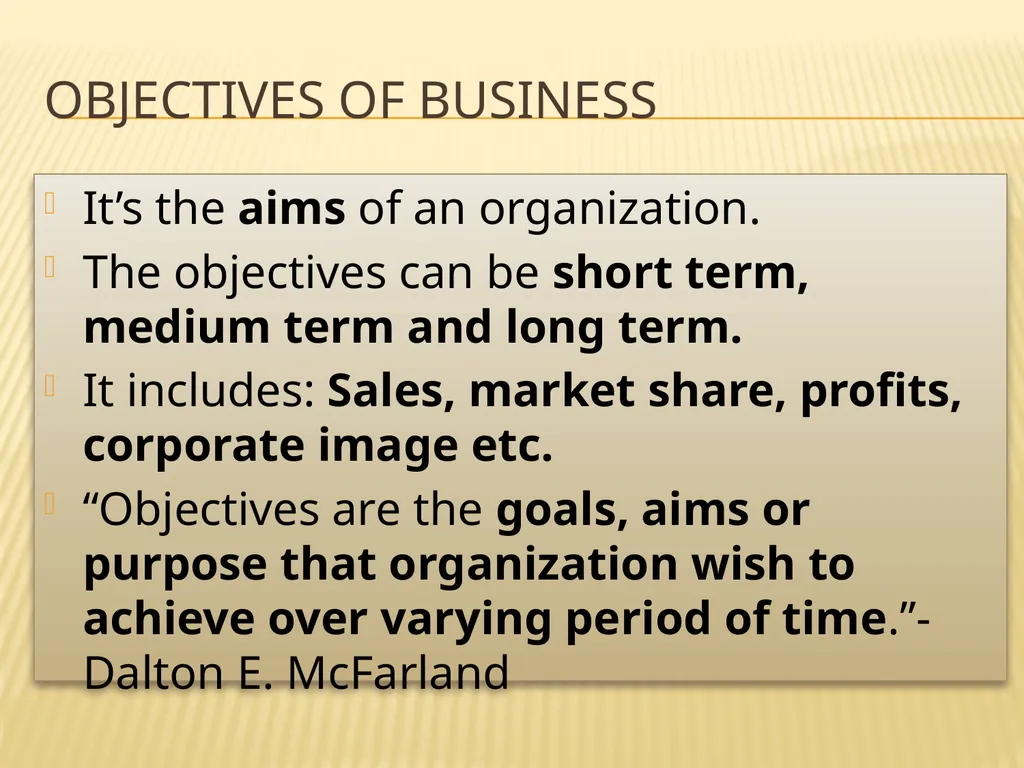
Objectives of business It’s the aims of an organization.
The objectives can be short term, medium term and long term.
It includes: Sales, market share, profits, corporate image etc.
“Objectives are the goals, aims or purpose that organization wish to achieve over varying period of time.”- Dalton E. McFarland<br>
The objectives can be short term, medium term and long term.
It includes: Sales, market share, profits, corporate image etc.
“Objectives are the goals, aims or purpose that organization wish to achieve over varying period of time.”- Dalton E. McFarland<br>
12
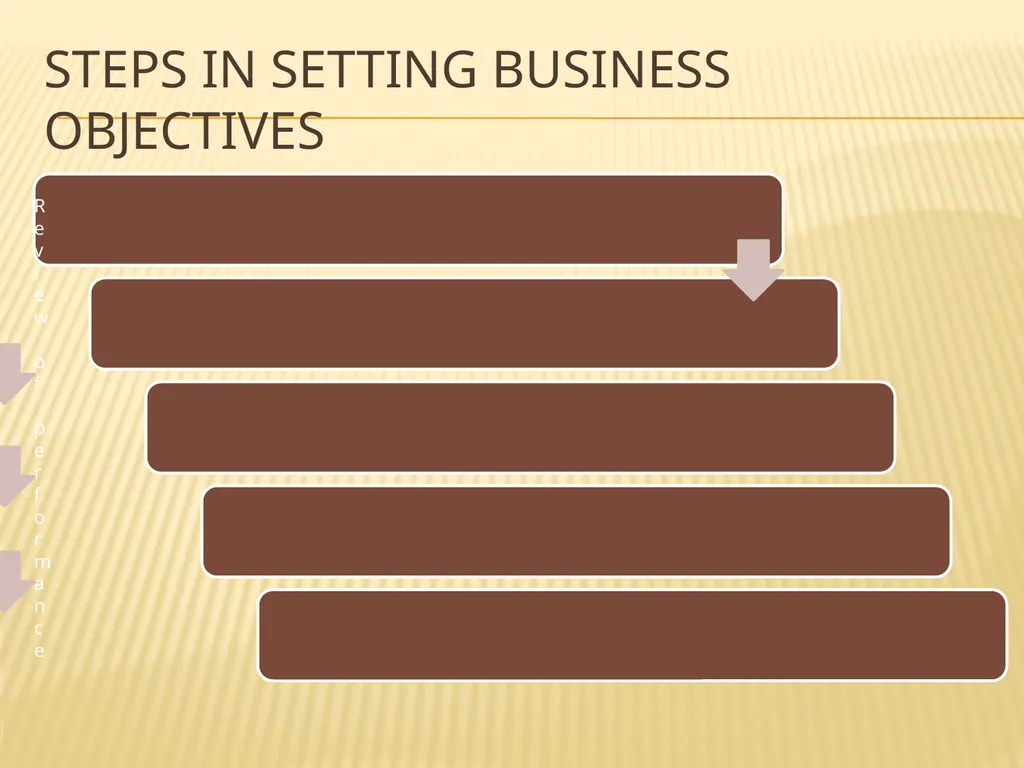
Steps in setting business objectives<br>
13
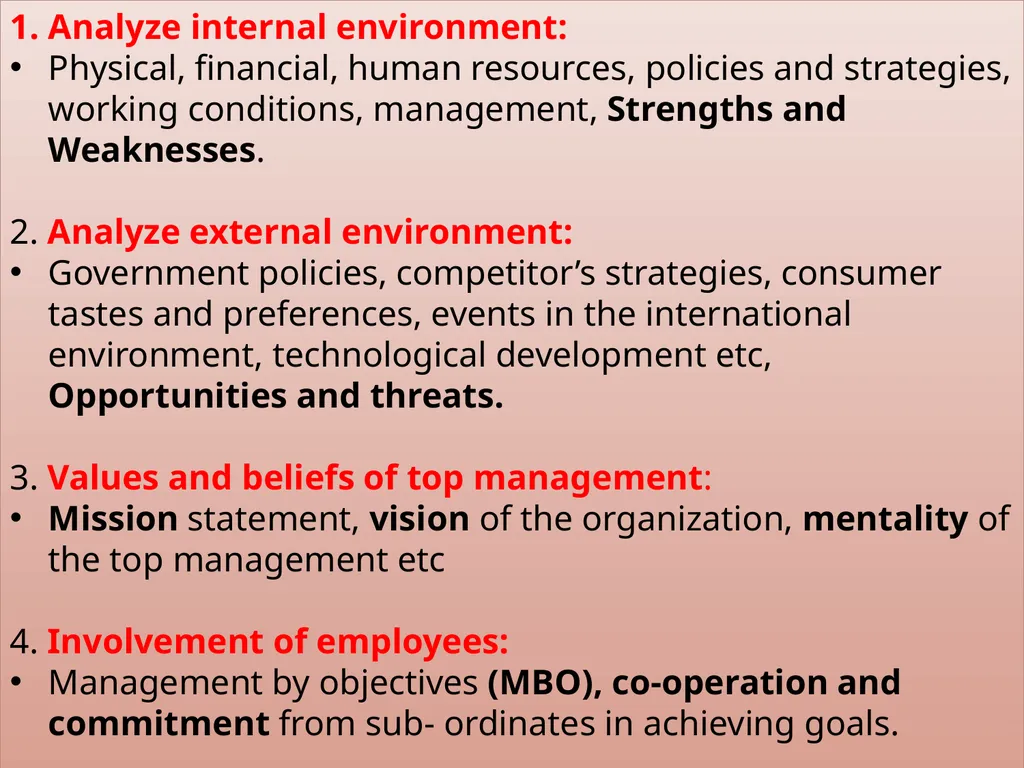
Analyze internal environment:
Physical, financial, human resources, policies and strategies, working conditions, management, Strengths and Weaknesses.
2. Analyze external environment:
Government policies, competitor’s strategies, consumer tastes and preferences, events in the international environment, technological development etc, Opportunities and threats.
3. Values and beliefs of top management:
Mission statement, vision of the organization, mentality of the top management etc
4. Involvement of employees:
Management by objectives (MBO), co-operation and commitment from sub- ordinates in achieving goals.<br>
14
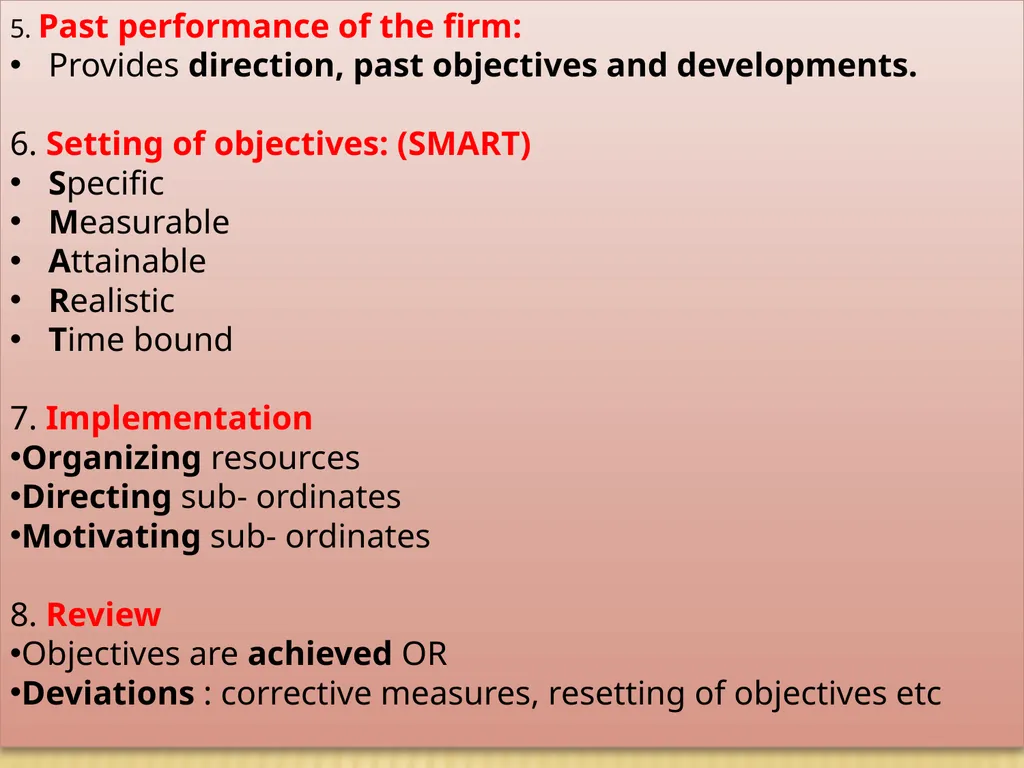
5. Past performance of the firm:
Provides direction, past objectives and developments.
6. Setting of objectives: (SMART)
Specific
Measurable
Attainable
Realistic
Time bound
7. Implementation
Organizing resources
Directing sub- ordinates
Motivating sub- ordinates
8. Review
Objectives are achieved OR
Deviations : corrective measures, resetting of objectives etc<br>
15
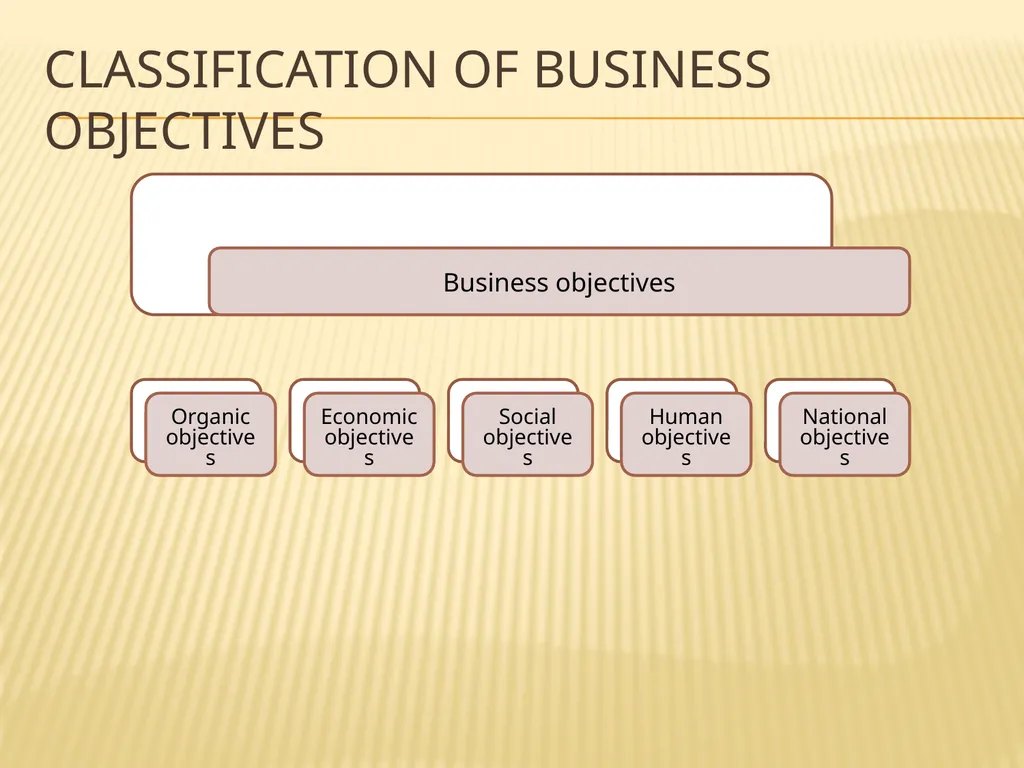
Classification of business objectives<br>
16
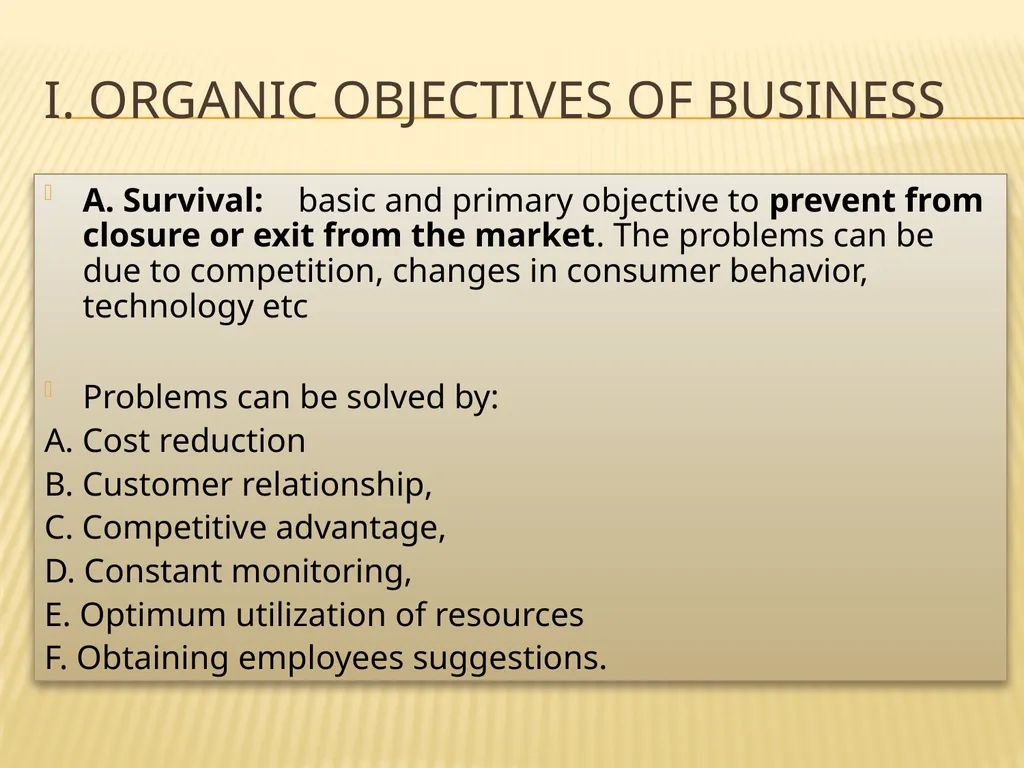
I. Organic objectives of business A. Survival: basic and primary objective to prevent from closure or exit from the market. The problems can be due to competition, changes in consumer behavior, technology etc
Problems can be solved by:
A. Cost reduction
B. Customer relationship,
C. Competitive advantage,
D. Constant monitoring,
E. Optimum utilization of resources
F. Obtaining employees suggestions.<br>
Problems can be solved by:
A. Cost reduction
B. Customer relationship,
C. Competitive advantage,
D. Constant monitoring,
E. Optimum utilization of resources
F. Obtaining employees suggestions.<br>
17
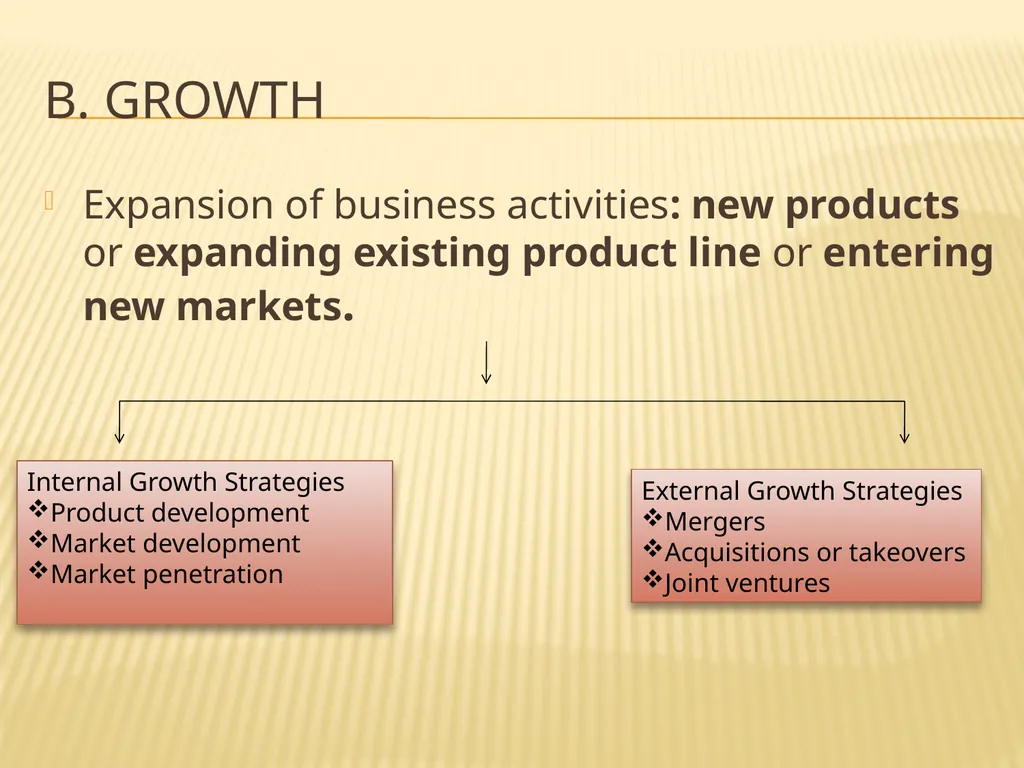
B. growth Expansion of business activities: new products or expanding existing product line or entering new markets. Internal Growth Strategies
Product development
Market development
Market penetration External Growth Strategies
Mergers
Acquisitions or takeovers
Joint ventures<br>
Product development
Market development
Market penetration External Growth Strategies
Mergers
Acquisitions or takeovers
Joint ventures<br>
18
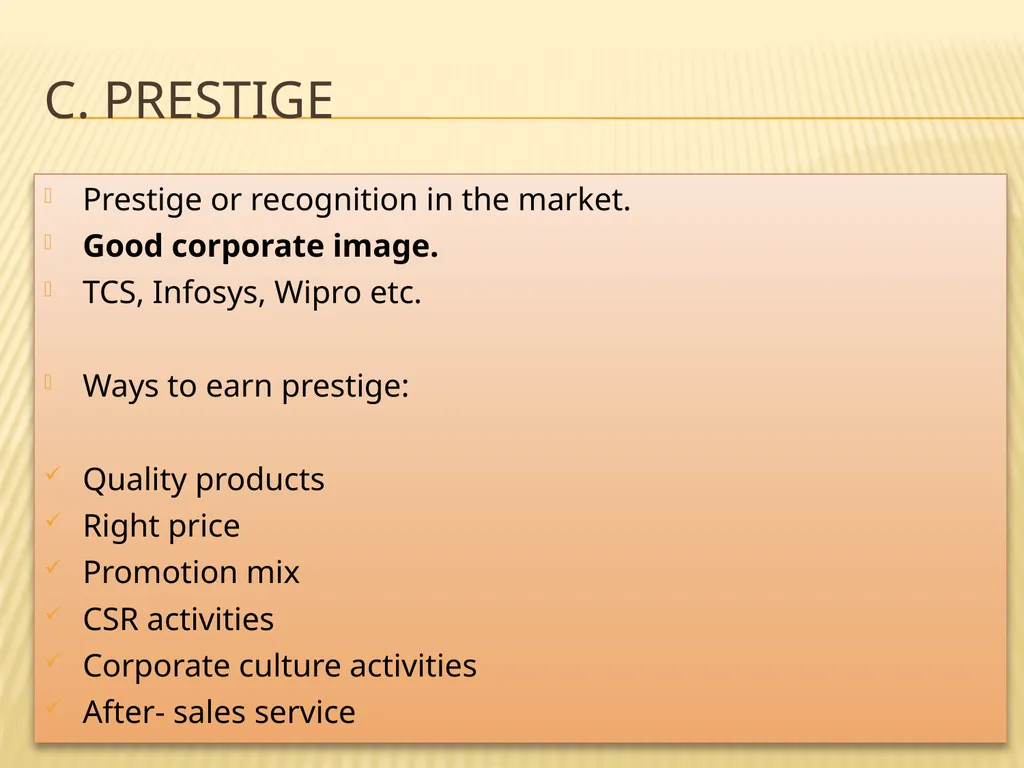
C. prestige Prestige or recognition in the market.
Good corporate image.
TCS, Infosys, Wipro etc.
Ways to earn prestige:
Quality products
Right price
Promotion mix
CSR activities
Corporate culture activities
After- sales service<br>
Good corporate image.
TCS, Infosys, Wipro etc.
Ways to earn prestige:
Quality products
Right price
Promotion mix
CSR activities
Corporate culture activities
After- sales service<br>
19
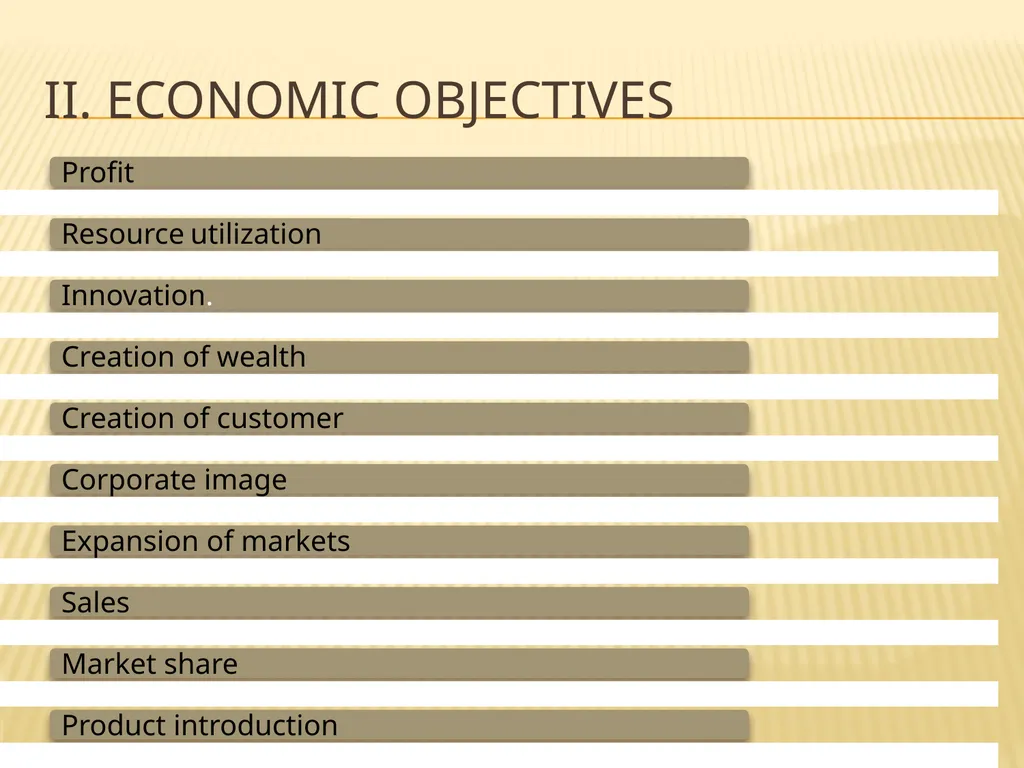
II. Economic objectives<br>
20
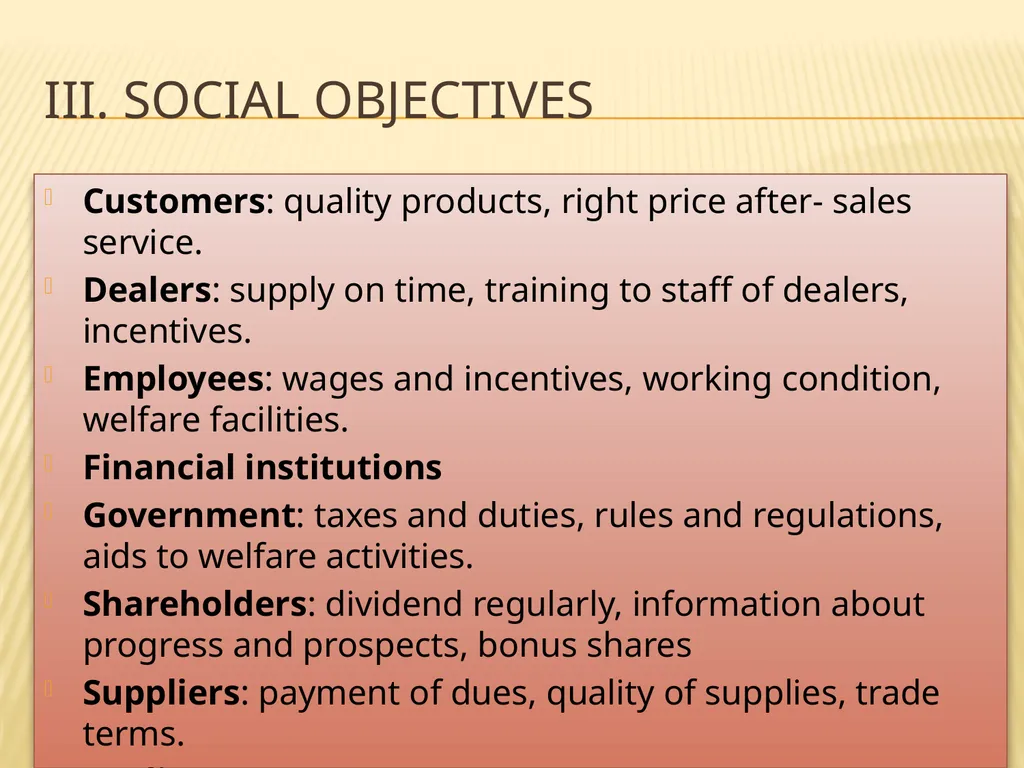
III. Social objectives Customers: quality products, right price after- sales service.
Dealers: supply on time, training to staff of dealers, incentives.
Employees: wages and incentives, working condition, welfare facilities.
Financial institutions
Government: taxes and duties, rules and regulations, aids to welfare activities.
Shareholders: dividend regularly, information about progress and prospects, bonus shares
Suppliers: payment of dues, quality of supplies, trade terms.
Media
Competitors<br>
21
IV. Human objectives<br>
22
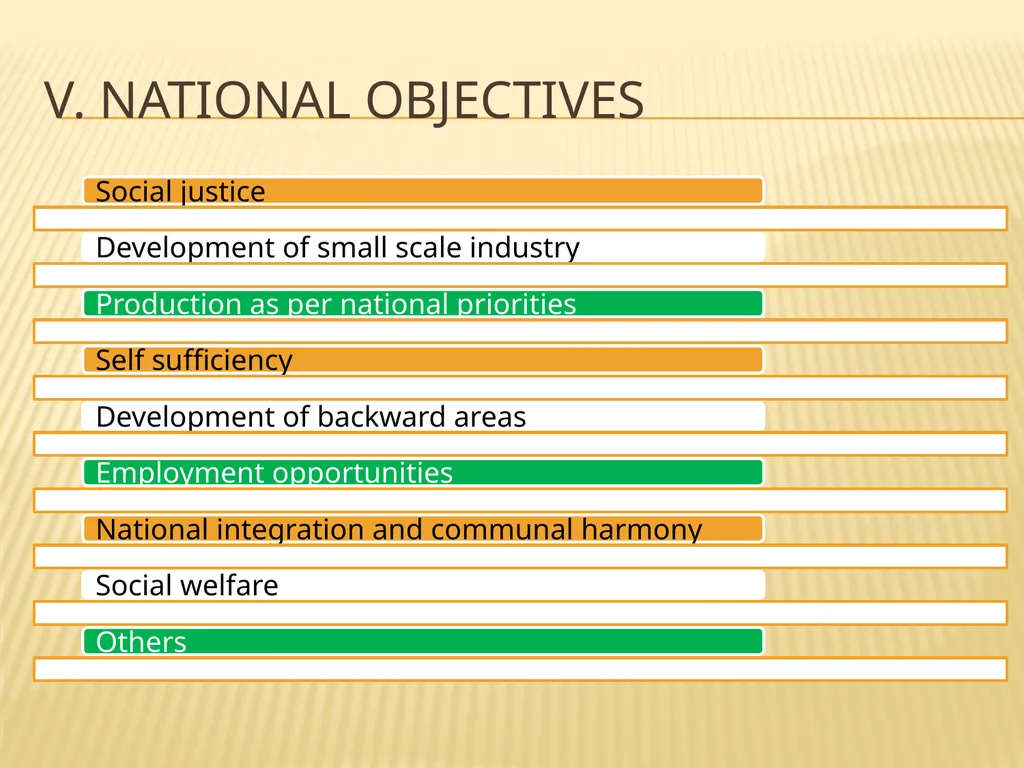
V. National objectives<br>
23
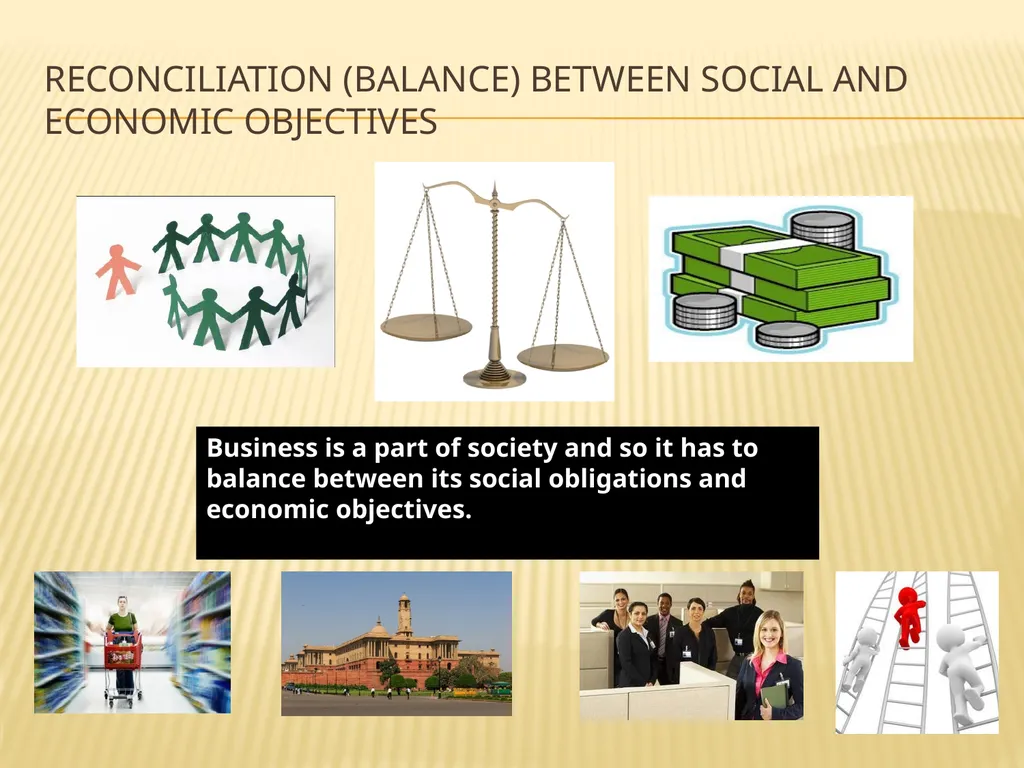
Reconciliation (Balance) between social and economic objectives Business is a part of society and so it has to balance between its social obligations and economic objectives.<br>
24
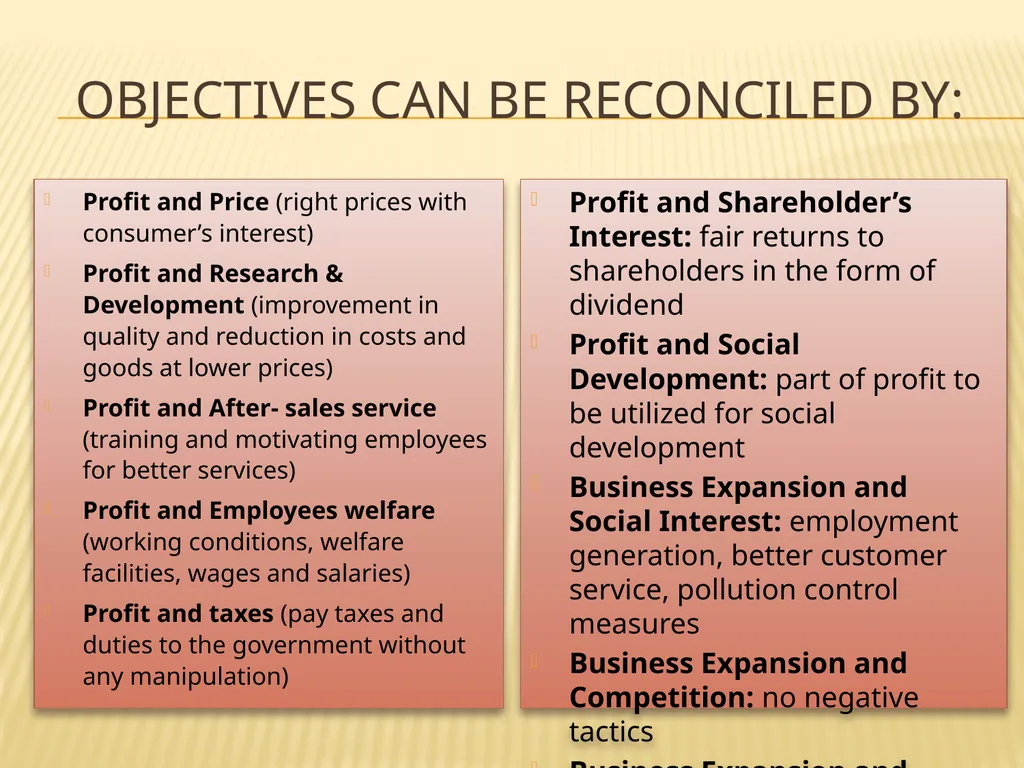
Objectives can be reconciled by: Profit and Price (right prices with consumer’s interest)
Profit and Research & Development (improvement in quality and reduction in costs and goods at lower prices)
Profit and After- sales service (training and motivating employees for better services)
Profit and Employees welfare (working conditions, welfare facilities, wages and salaries)
Profit and taxes (pay taxes and duties to the government without any manipulation) Profit and Shareholder’s Interest: fair returns to shareholders in the form of dividend
Profit and Social Development: part of profit to be utilized for social development
Business Expansion and Social Interest: employment generation, better customer service, pollution control measures
Business Expansion and Competition: no negative tactics
Business Expansion and Supplier: no exploitation of suppliers<br>
25
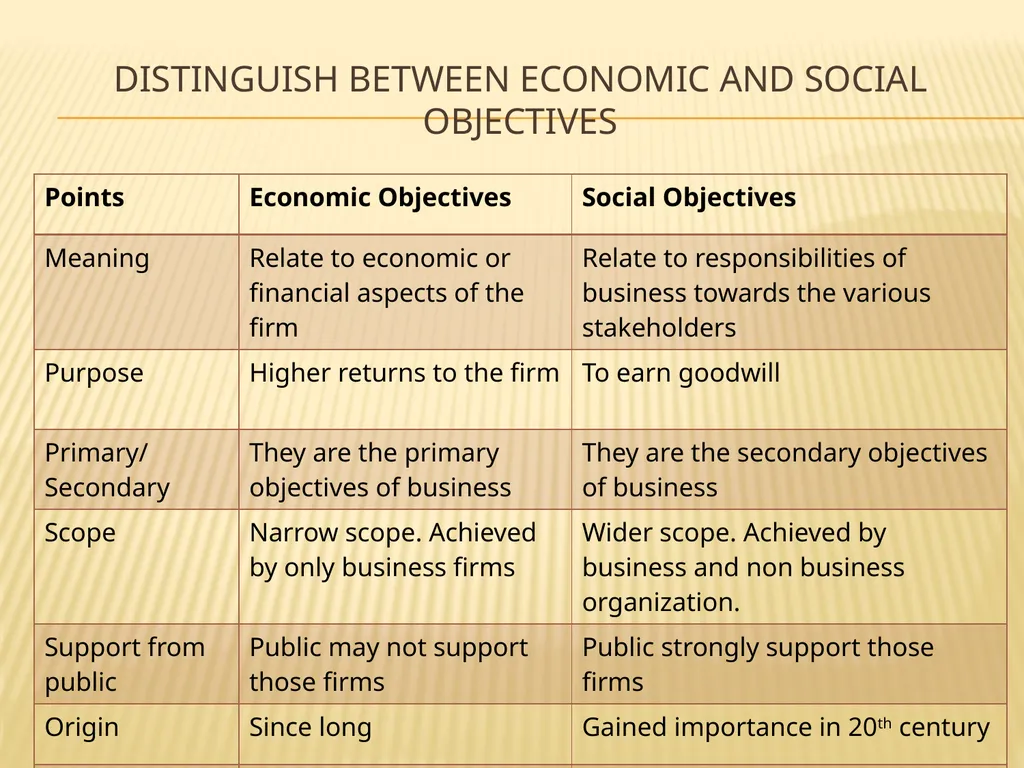
Distinguish between economic and social objectives<br>
26
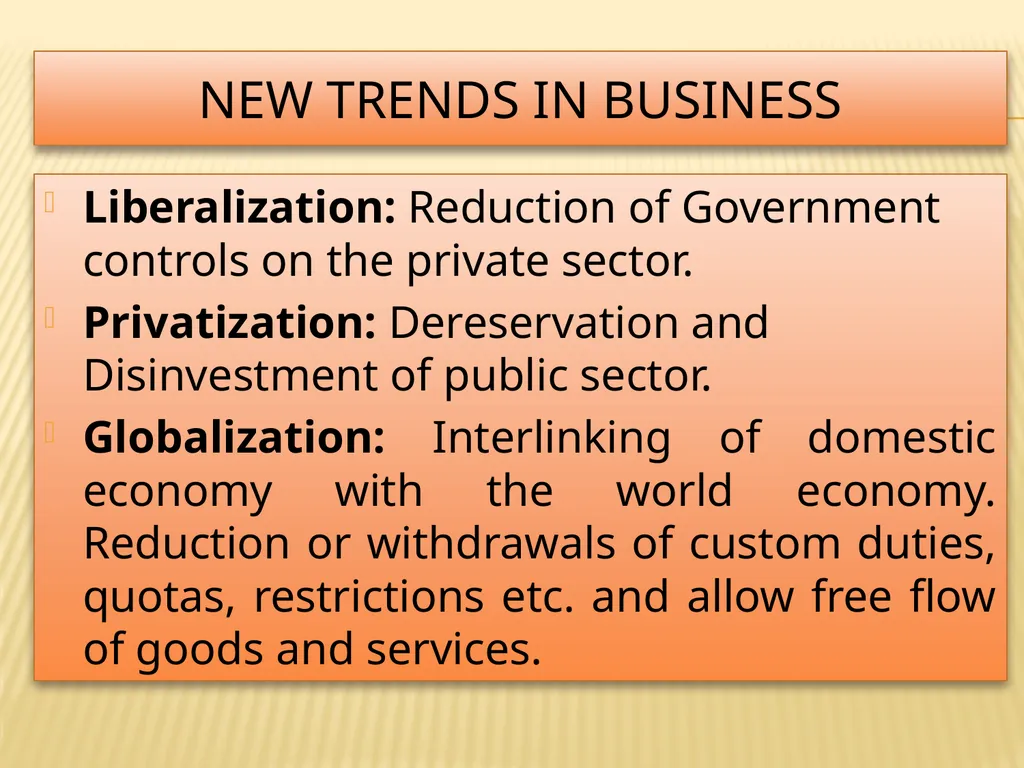
New trends in business Liberalization: Reduction of Government controls on the private sector.
Privatization: Dereservation and Disinvestment of public sector.
Globalization: Interlinking of domestic economy with the world economy. Reduction or withdrawals of custom duties, quotas, restrictions etc. and allow free flow of goods and services. NIP - New Industrial Policy - 1991<br>
Privatization: Dereservation and Disinvestment of public sector.
Globalization: Interlinking of domestic economy with the world economy. Reduction or withdrawals of custom duties, quotas, restrictions etc. and allow free flow of goods and services. NIP - New Industrial Policy - 1991<br>
27
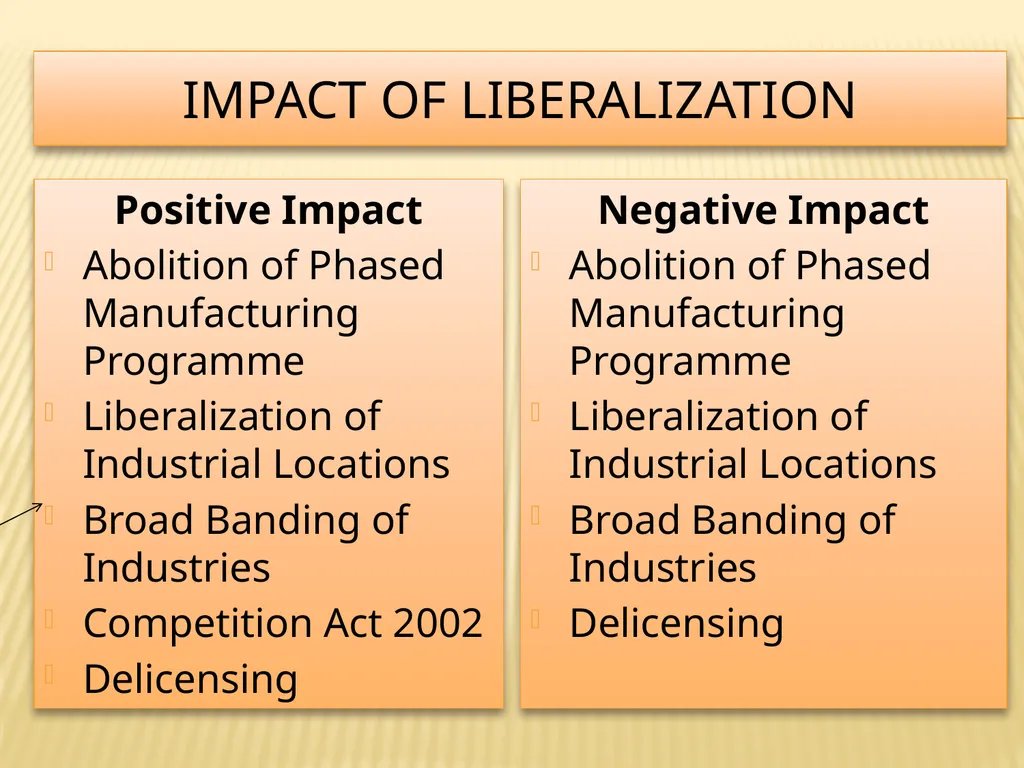
Impact of liberalization Positive Impact
Abolition of Phased Manufacturing Programme
Liberalization of Industrial Locations
Broad Banding of Industries
Competition Act 2002
Delicensing Negative Impact
Abolition of Phased Manufacturing Programme
Liberalization of Industrial Locations
Broad Banding of Industries
Delicensing Domestic contents RM
100% RM import - allowing 6 industries – license – pollution created
- Permission – locate - industry Car, tempo, truck SS > DD<br>
Abolition of Phased Manufacturing Programme
Liberalization of Industrial Locations
Broad Banding of Industries
Competition Act 2002
Delicensing Negative Impact
Abolition of Phased Manufacturing Programme
Liberalization of Industrial Locations
Broad Banding of Industries
Delicensing Domestic contents RM
100% RM import - allowing 6 industries – license – pollution created
- Permission – locate - industry Car, tempo, truck SS > DD<br>
28
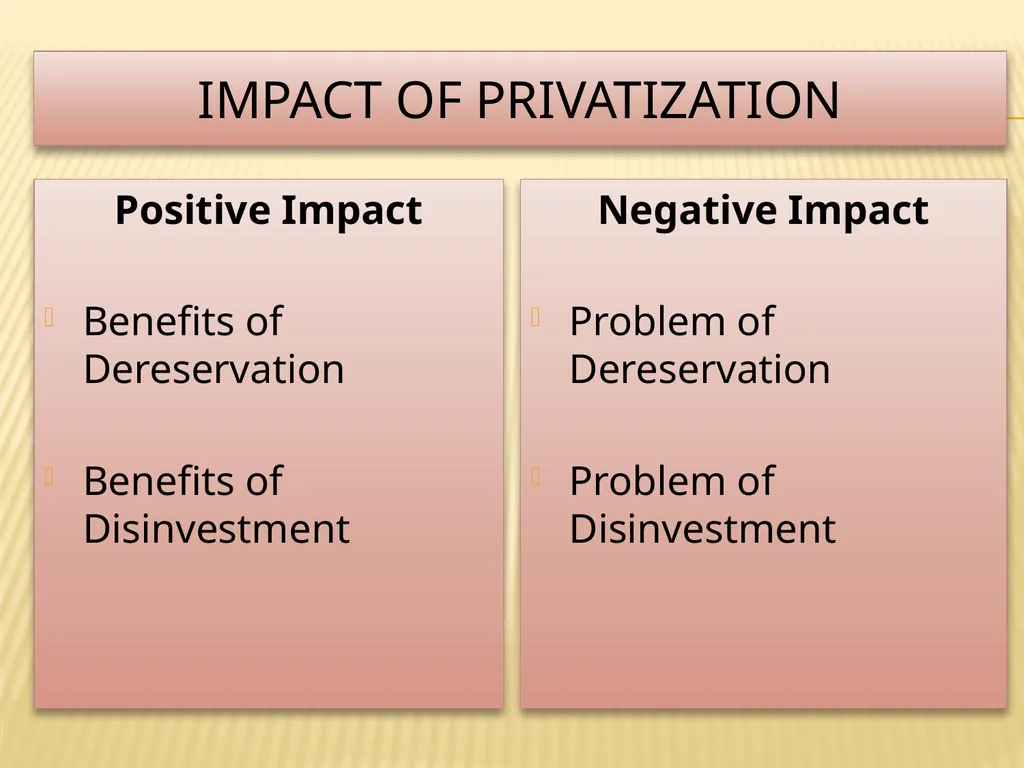
Impact of Privatization Positive Impact
Benefits of Dereservation
Benefits of Disinvestment Negative Impact
Problem of Dereservation
Problem of Disinvestment PRODUCTION
SS > DD
RECESSION<br>
Benefits of Dereservation
Benefits of Disinvestment Negative Impact
Problem of Dereservation
Problem of Disinvestment PRODUCTION
SS > DD
RECESSION<br>
29
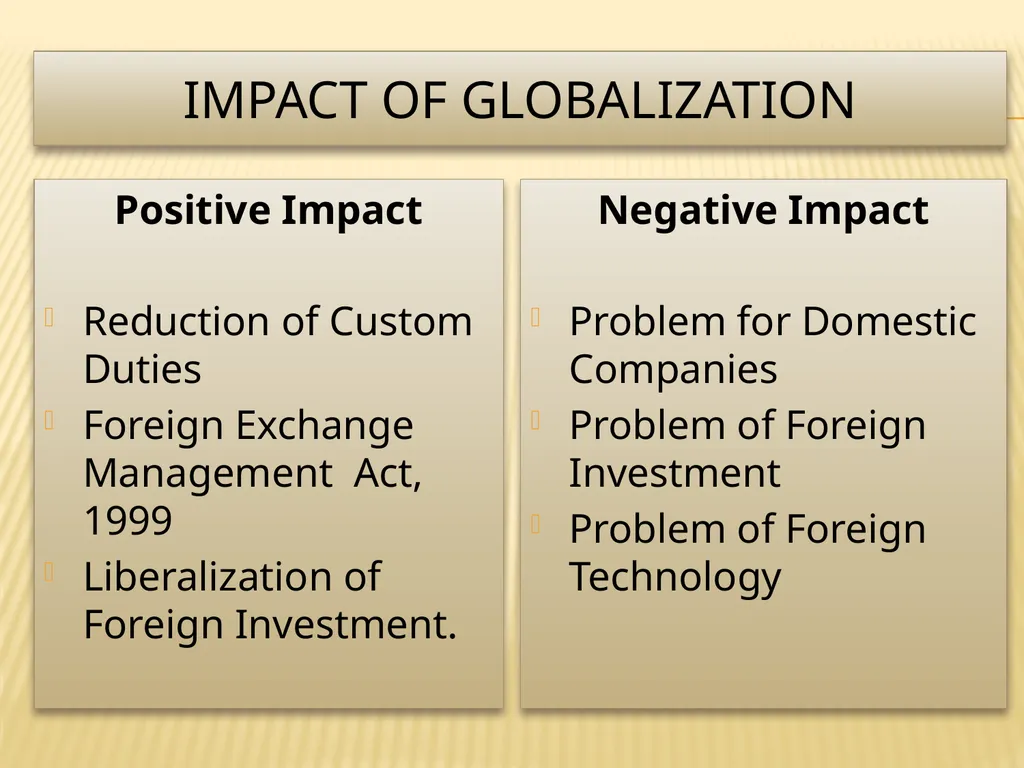
Impact of globalization Positive Impact
Reduction of Custom Duties
Foreign Exchange Management Act, 1999
Liberalization of Foreign Investment. Negative Impact
Problem for Domestic Companies
Problem of Foreign Investment
Problem of Foreign Technology GOODS
SERVICES
GOVT. BARRIERS X
FREELY FDI LPG<br>
Reduction of Custom Duties
Foreign Exchange Management Act, 1999
Liberalization of Foreign Investment. Negative Impact
Problem for Domestic Companies
Problem of Foreign Investment
Problem of Foreign Technology GOODS
SERVICES
GOVT. BARRIERS X
FREELY FDI LPG<br>
30
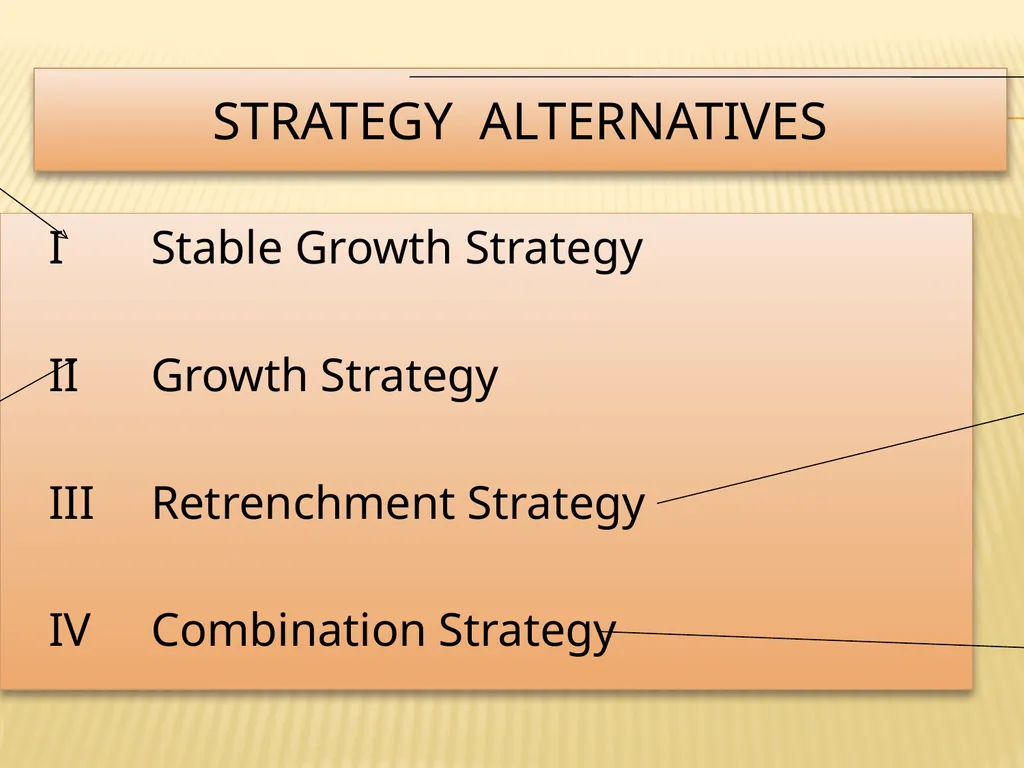
Strategy alternatives I Stable Growth Strategy
II Growth Strategy
III Retrenchment Strategy
IV Combination Strategy LONG TERM PLAN MKT SHARE 2%
+ 2%
+ 2%
+ 2% PRODUCTS 1
2
3
4
5
MARKETS 1
3
4 REDUCING/SELL UNITS All the above strategies, followed
Growth & retrenchment
A B C X D<br>
II Growth Strategy
III Retrenchment Strategy
IV Combination Strategy LONG TERM PLAN MKT SHARE 2%
+ 2%
+ 2%
+ 2% PRODUCTS 1
2
3
4
5
MARKETS 1
3
4 REDUCING/SELL UNITS All the above strategies, followed
Growth & retrenchment
A B C X D<br>
31
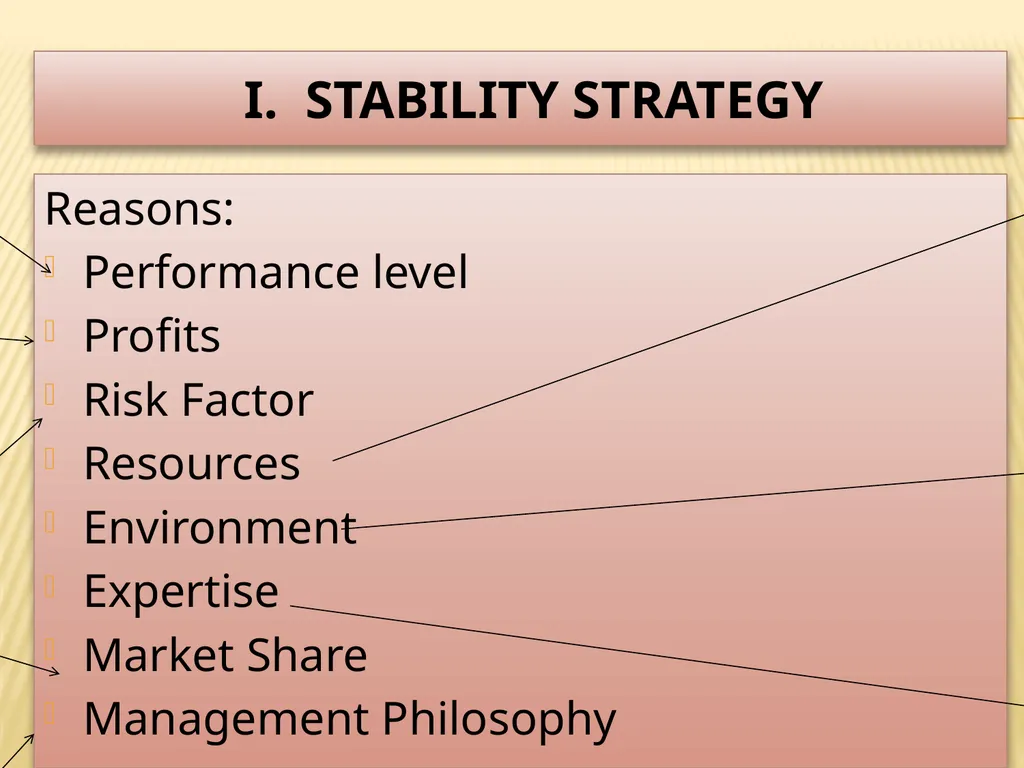
I. Stability strategy Reasons:
Performance level
Profits
Risk Factor
Resources
Environment
Expertise
Market Share
Management Philosophy Market share 7%
satisfactory happy Growth x = risk x Finance
Human
Machineries
Expert knowledge
Less Internal
External
Stable/favourable CA, legal advisor, company secretary Mkt share 10 % traditional<br>
32
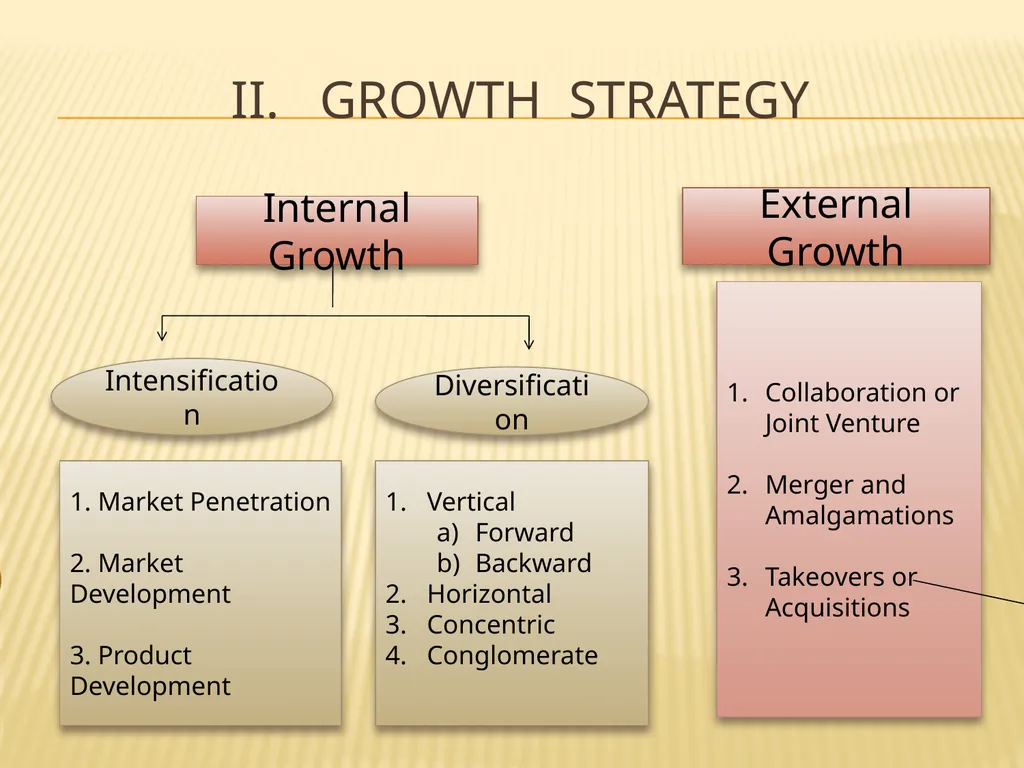
II. Growth strategy Internal Growth External Growth Intensification Diversification 1. Market Penetration
2. Market Development
3. Product Development 1. Vertical
Forward
Backward
2. Horizontal
3. Concentric
4. Conglomerate Collaboration or Joint Venture
Merger and Amalgamations
Takeovers or Acquisitions A B FOREIGN COLLABERATION A B B shares
Maximum 30% Finance institution Car dealer customer Iron & steel electronic Pharma textile A B AB 70%<br>
33
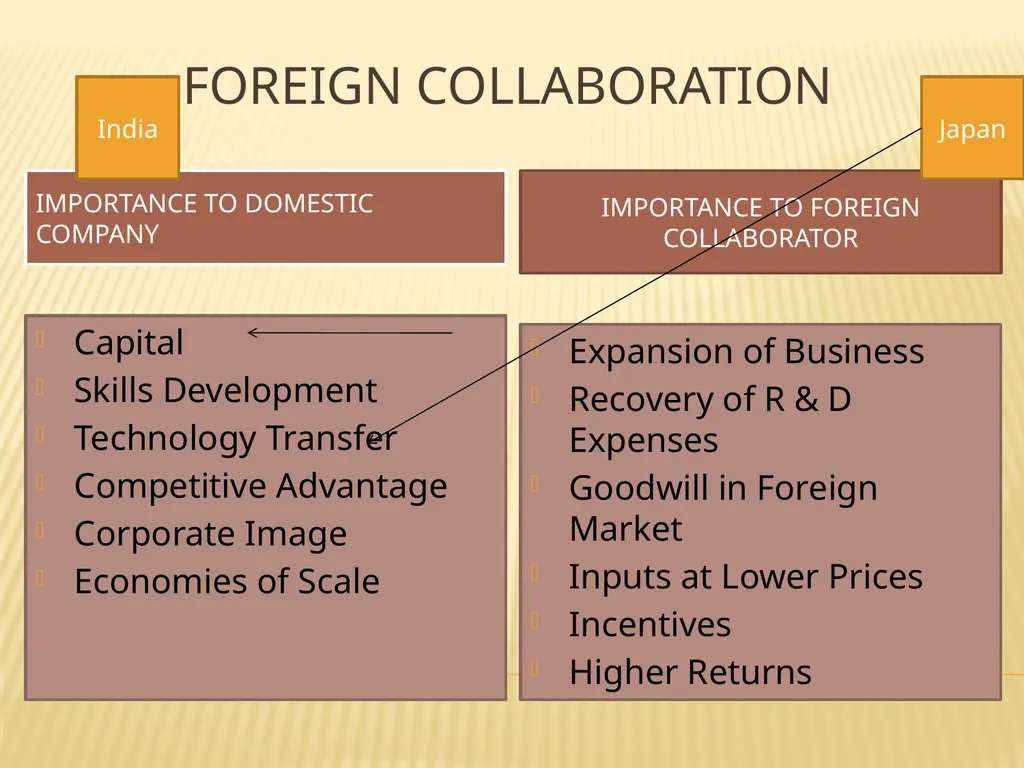
Foreign collaboration Importance to domestic company Importance to foreign collaborator Capital
Skills Development
Technology Transfer
Competitive Advantage
Corporate Image
Economies of Scale Expansion of Business
Recovery of R & D Expenses
Goodwill in Foreign Market
Inputs at Lower Prices
Incentives
Higher Returns India Japan Grow, expand, technology, m/c, R&D LARGE SCALE
C.P.U.
BULK PURCHASE, bulk distribute, heavy discount, fixed cost same, variable cost increases,---- total cost / no. of units manufacturing Japan Mfg unit
Technology R&D cost I
Tax holiday USA UK S Singapore<br>
34
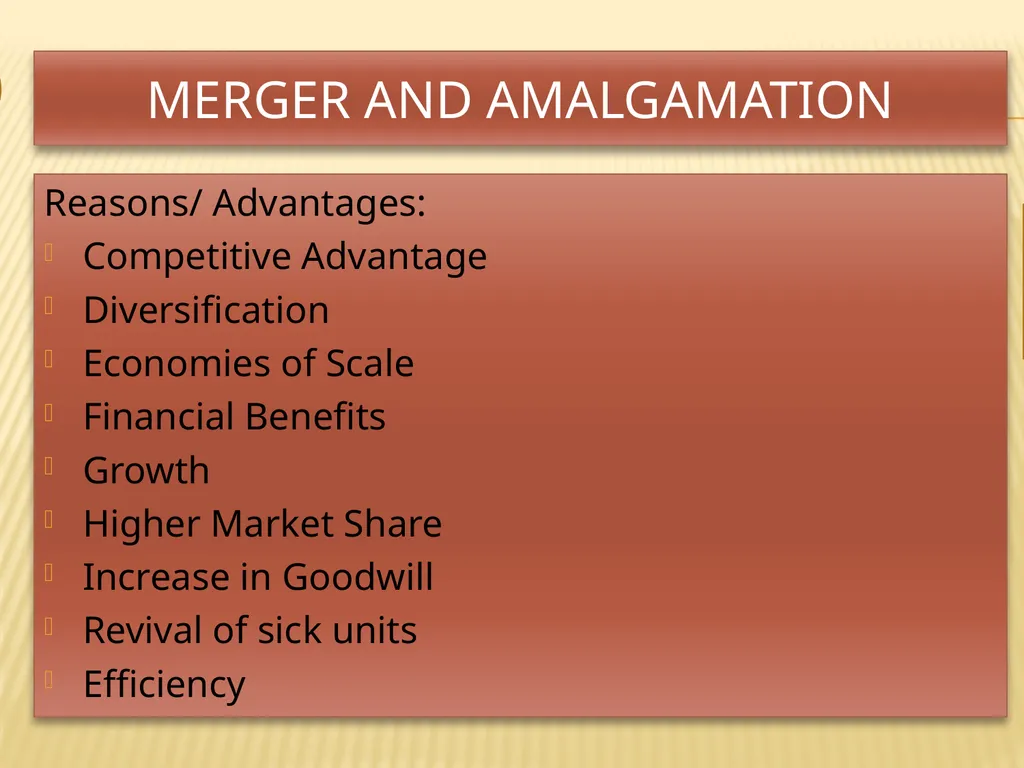
Merger and amalgamation Reasons/ Advantages:
Competitive Advantage
Diversification
Economies of Scale
Financial Benefits
Growth
Higher Market Share
Increase in Goodwill
Revival of sick units
Efficiency B
5% A
12% AB
17%
R&D, technology- efficiency
Higher returns at a lower cost LARGE SCALE PRODUCTION
C.P.U. PROFIT/REVENUE
B LTD. REVITAL
TRAINING, MACHINARIES Save the tax
Profit----tax
Profit – training, m/c, E = R/C HERO –CYLES
HONDA - BIKES A B<br>
35
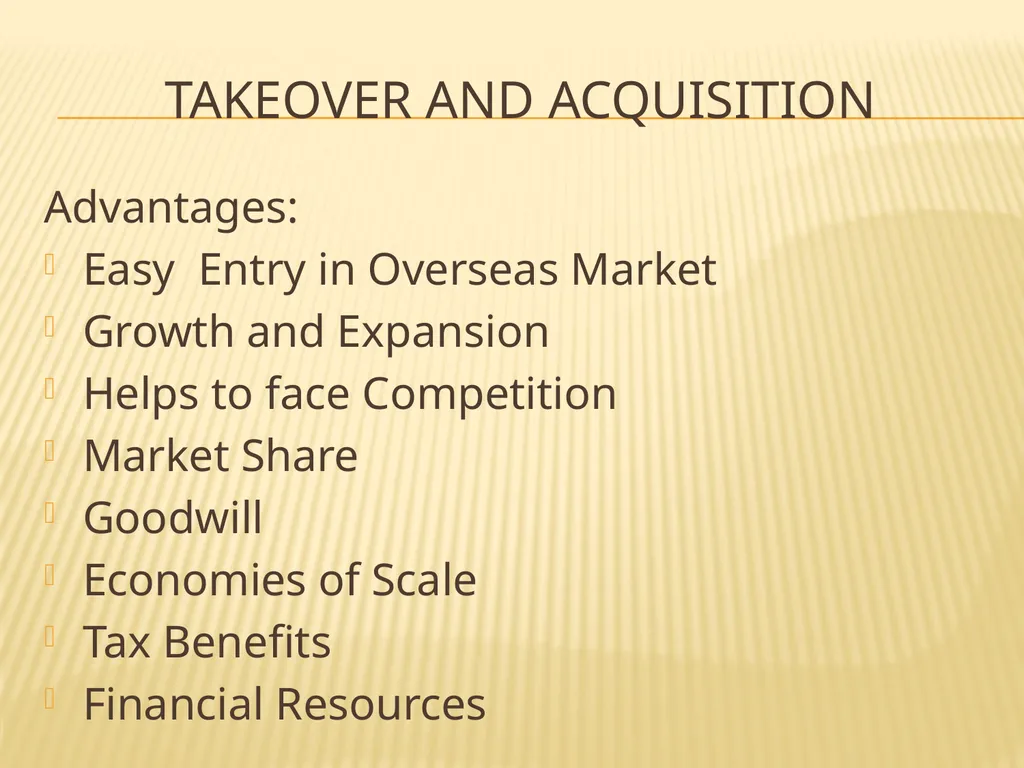
Takeover and acquisition Advantages:
Easy Entry in Overseas Market
Growth and Expansion
Helps to face Competition
Market Share
Goodwill
Economies of Scale
Tax Benefits
Financial Resources X Y SHARES<br>
Easy Entry in Overseas Market
Growth and Expansion
Helps to face Competition
Market Share
Goodwill
Economies of Scale
Tax Benefits
Financial Resources X Y SHARES<br>
36
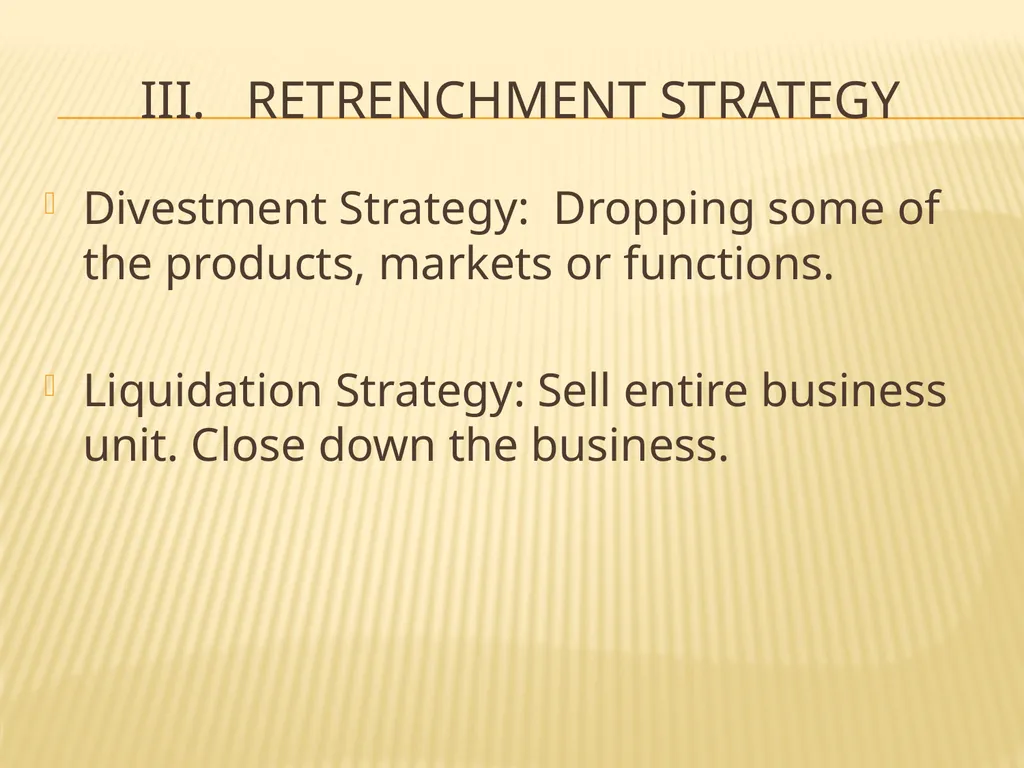
III. Retrenchment strategy Divestment Strategy: Dropping some of the products, markets or functions.
Liquidation Strategy: Sell entire business unit. Close down the business. DISTRIBUTION
OUTSOURCES
LOGISTICS
UNITS/FACTORS --CLOSE Reduction in no of activities.<br>
Liquidation Strategy: Sell entire business unit. Close down the business. DISTRIBUTION
OUTSOURCES
LOGISTICS
UNITS/FACTORS --CLOSE Reduction in no of activities.<br>
37
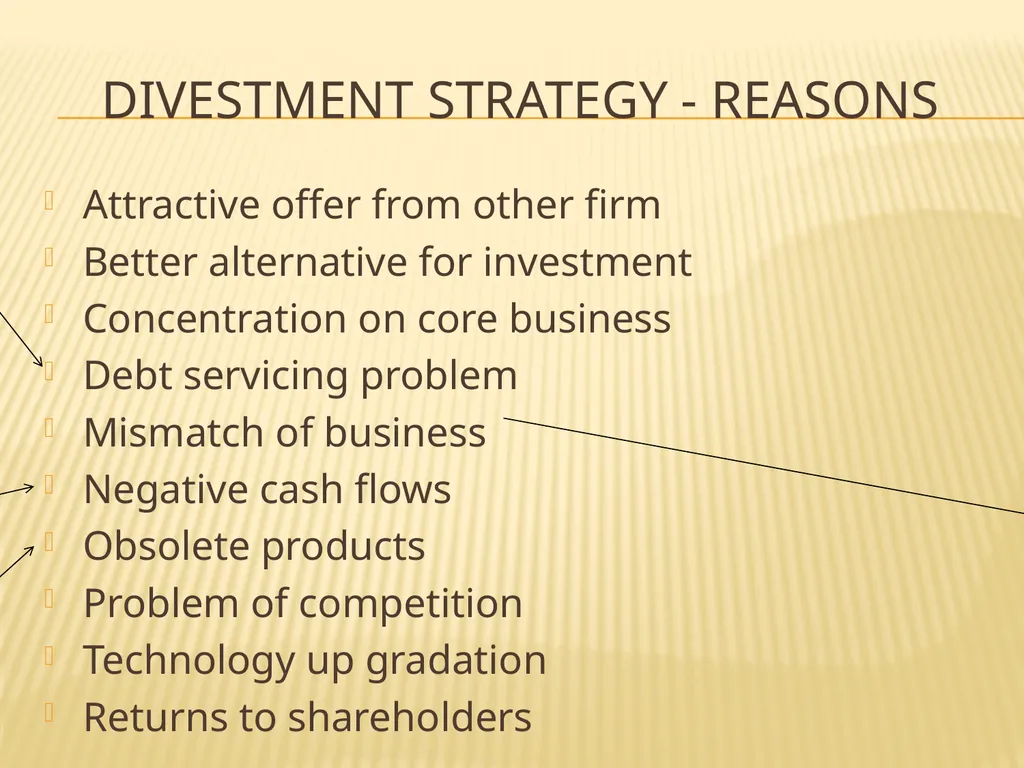
Divestment Strategy - Reasons Attractive offer from other firm
Better alternative for investment
Concentration on core business
Debt servicing problem
Mismatch of business
Negative cash flows
Obsolete products
Problem of competition
Technology up gradation
Returns to shareholders Pharma – medicines and drugs,
Health tonics, drinks, x Debt – loan burden Cloth/textile garments Fashion designing Chemical goods Income< expenses outdated<br>
38
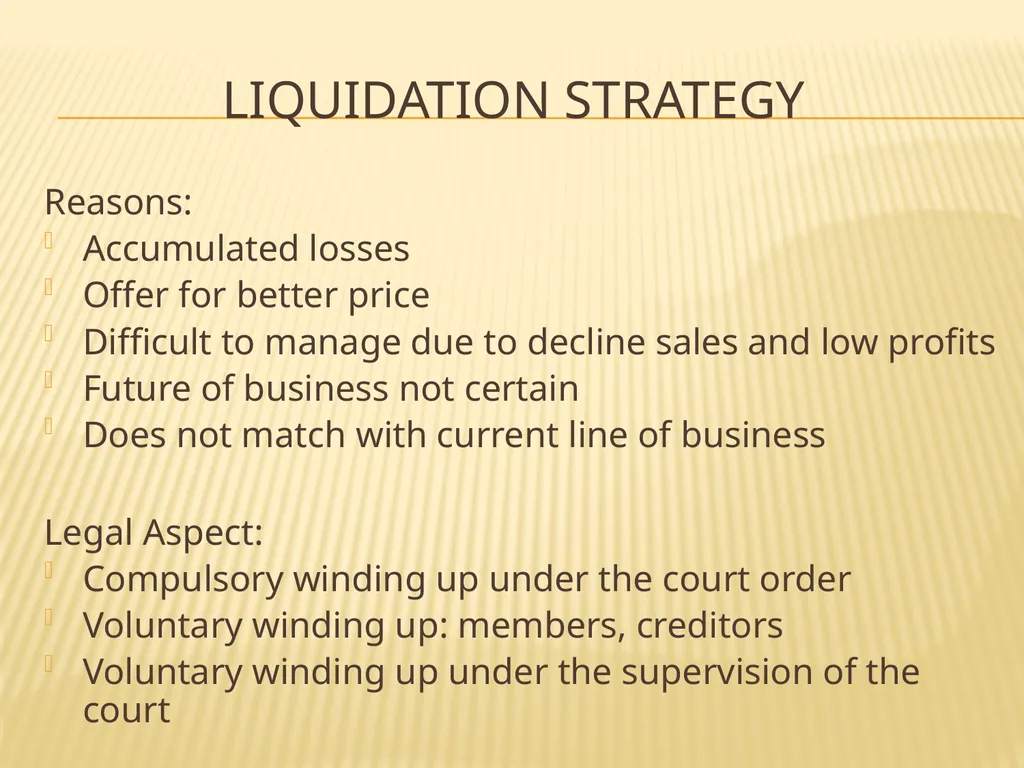
Liquidation Strategy Reasons:
Accumulated losses
Offer for better price
Difficult to manage due to decline sales and low profits
Future of business not certain
Does not match with current line of business
Legal Aspect:
Compulsory winding up under the court order
Voluntary winding up: members, creditors
Voluntary winding up under the supervision of the court<br>
39
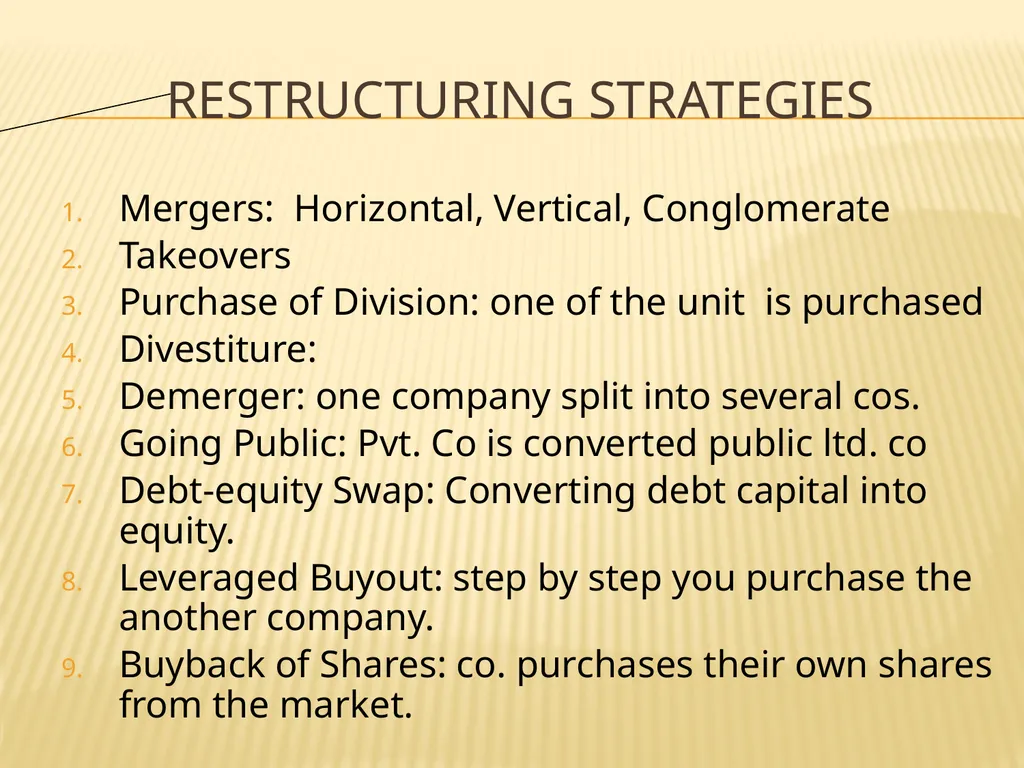
Restructuring strategies Mergers: Horizontal, Vertical, Conglomerate
Takeovers
Purchase of Division: one of the unit is purchased
Divestiture:
Demerger: one company split into several cos.
Going Public: Pvt. Co is converted public ltd. co
Debt-equity Swap: Converting debt capital into equity.
Leveraged Buyout: step by step you purchase the another company.
Buyback of Shares: co. purchases their own shares from the market. Changes - split of one company into two or three companies Pvt co. --------public ltd. co Converting borrowed capital into equity capital<br>
40
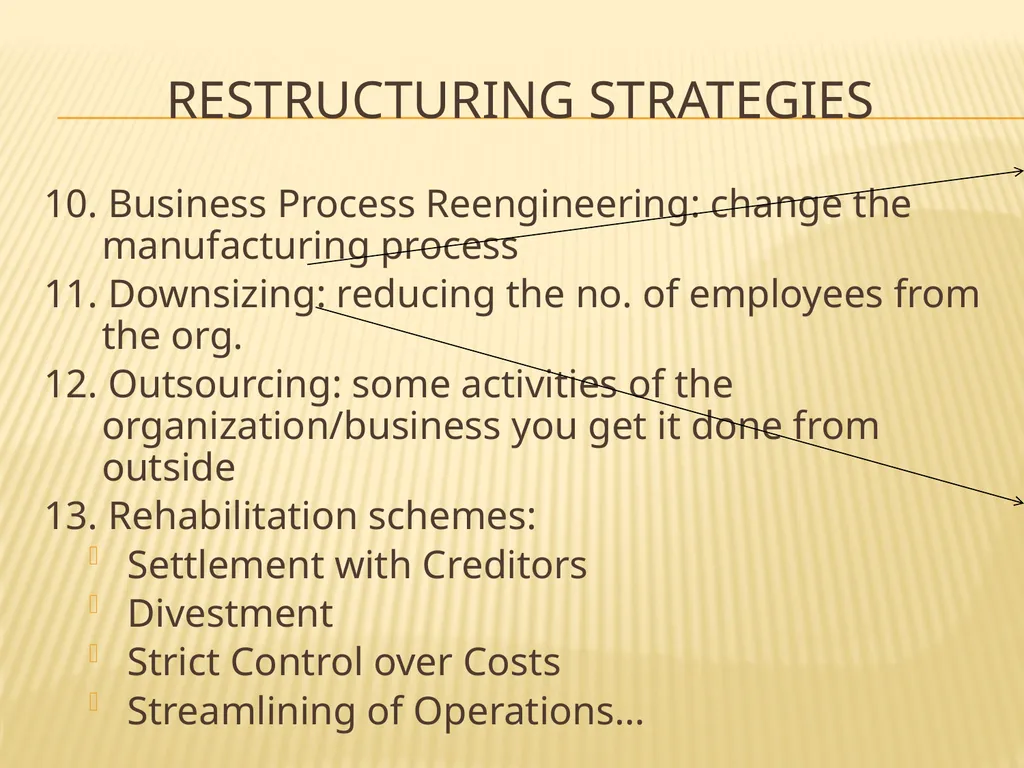
Restructuring strategies 10. Business Process Reengineering: change the manufacturing process
11. Downsizing: reducing the no. of employees from the org.
12. Outsourcing: some activities of the organization/business you get it done from outside
13. Rehabilitation schemes:
Settlement with Creditors
Divestment
Strict Control over Costs
Streamlining of Operations… Changes 1000 workers
400 removed workers Car industry
Body, engine, glass, tyers , seats, Size, shape, width No good performance<br>
41
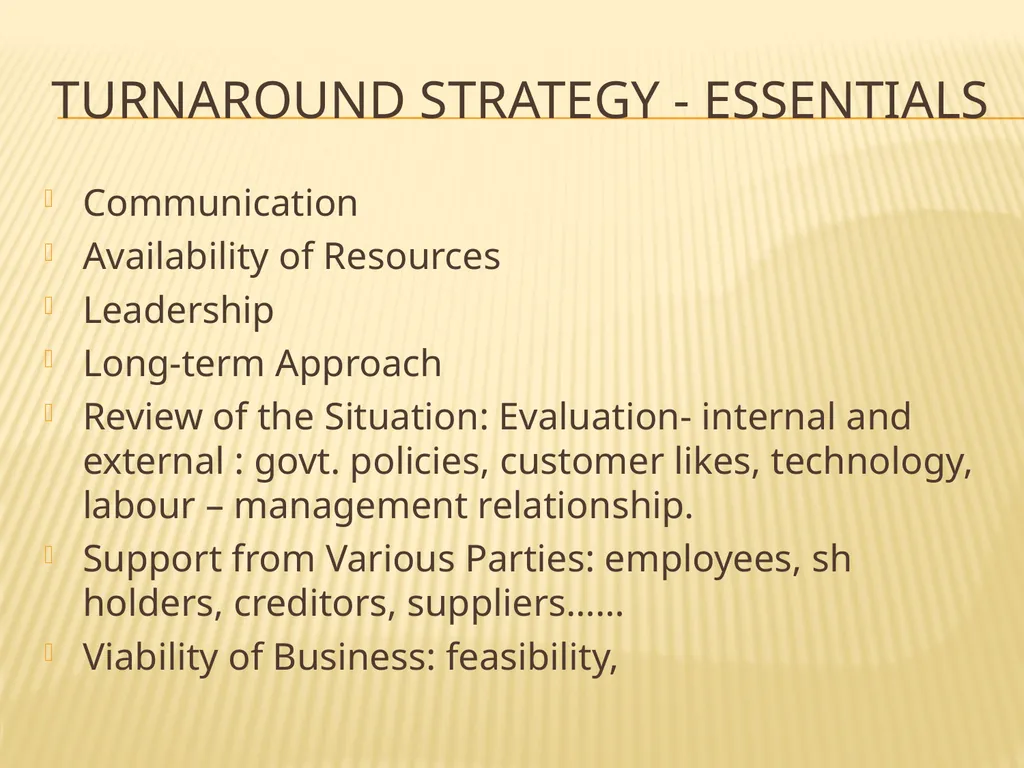
Turnaround strategy - essentials Communication
Availability of Resources
Leadership
Long-term Approach
Review of the Situation: Evaluation- internal and external : govt. policies, customer likes, technology, labour – management relationship.
Support from Various Parties: employees, sh holders, creditors, suppliers……
Viability of Business: feasibility, Convert a loss making unit into profit making once again. Quick, clear and complete<br>
42
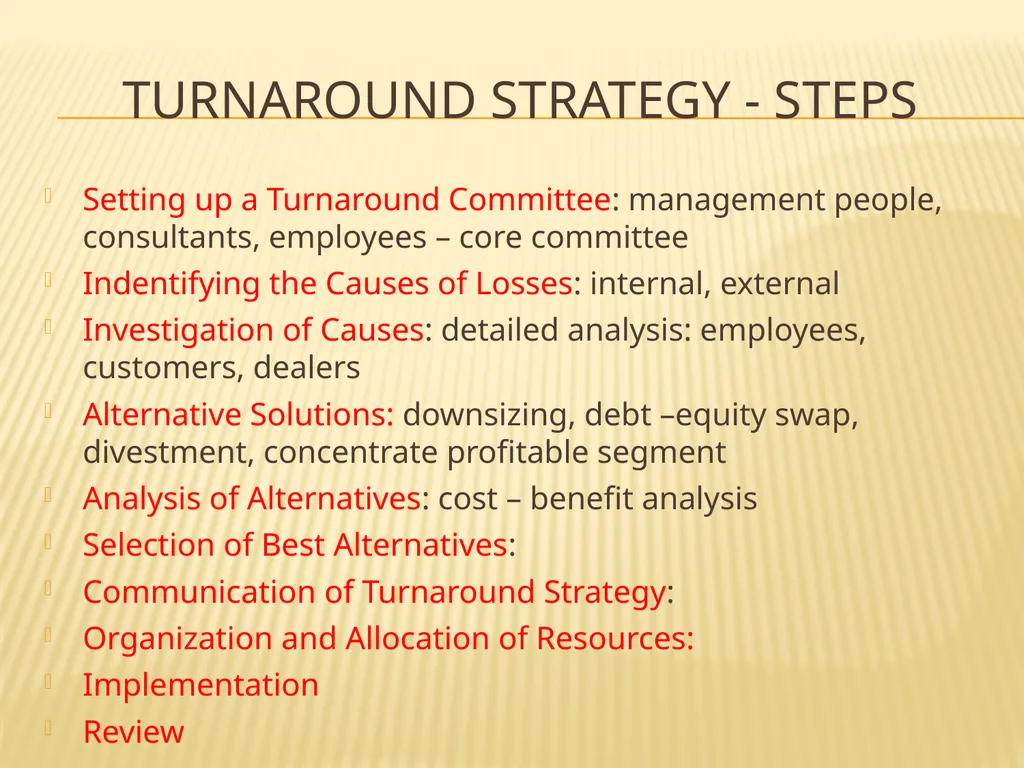
Turnaround strategy - steps Setting up a Turnaround Committee: management people, consultants, employees – core committee
Indentifying the Causes of Losses: internal, external
Investigation of Causes: detailed analysis: employees, customers, dealers
Alternative Solutions: downsizing, debt –equity swap, divestment, concentrate profitable segment
Analysis of Alternatives: cost – benefit analysis
Selection of Best Alternatives:
Communication of Turnaround Strategy:
Organization and Allocation of Resources:
Implementation
Review<br>