04
University of Warwick and G&T The University of Warwick has a long & continuing association with G&T provision for school students.
The National Academy for Gifted & Talented Youth (NAGTY) was founded at Warwick in 2002 as a DfES funded initiative. The university did not bid for NAGTY to continue after 2007.
NAGTY was replaced by Warwick with its own centre, the International Gateway for Gifted Youth (IGGY) (2008-date). In October 2012, IGGY became an international network for gifted young people.
Warwick’s G&T work continues, with, for example, its national outreach programme for 14-18 year olds, ‘Unitracks’:
http://www2.warwick.ac.uk/study/outreach/programmes/unitracks<br>
05
CEDAR & G&T evaluation CEDAR heavily involved in providing the DfES with independent evaluations of NAGTY projects:
Residential university summer schools (Warwick, York, Lancaster, Imperial, Durham, Bristol, Leeds, CCC Canterbury)
Enhanced ITT – ‘PGCE Plus’ in maths and science
Short, weekend university courses
National competitions – GOAL, GEP, Big Deal.
These opportunities took young people beyond the national curriculum, both in terms of subjects and content.<br>
06
G&T : (recent) origins in England Could argue that the 1944 Education Act was early G&T, in relation to grammar schools.
Assisted Places Scheme, 1980-1997. In 1997, 35,000 pupils in 355 schools.
Assisted Places ended in 1997, and ‘Gifted & Talented’ became one of ‘The National Strategies’ (1997-2011).
But now….?<br>
07
G&T now Governments, the education department, embedding & sustainability…. (or not)
http://www.bbc.co.uk/news/education-30279230
http://www.bbc.co.uk/news/education-31005170
http://www.independent.co.uk/news/education/education-news/gifted-pupils-from-deprived-areas-to-attend-regular-seminars-at-top-universities-9896616.html<br>
08
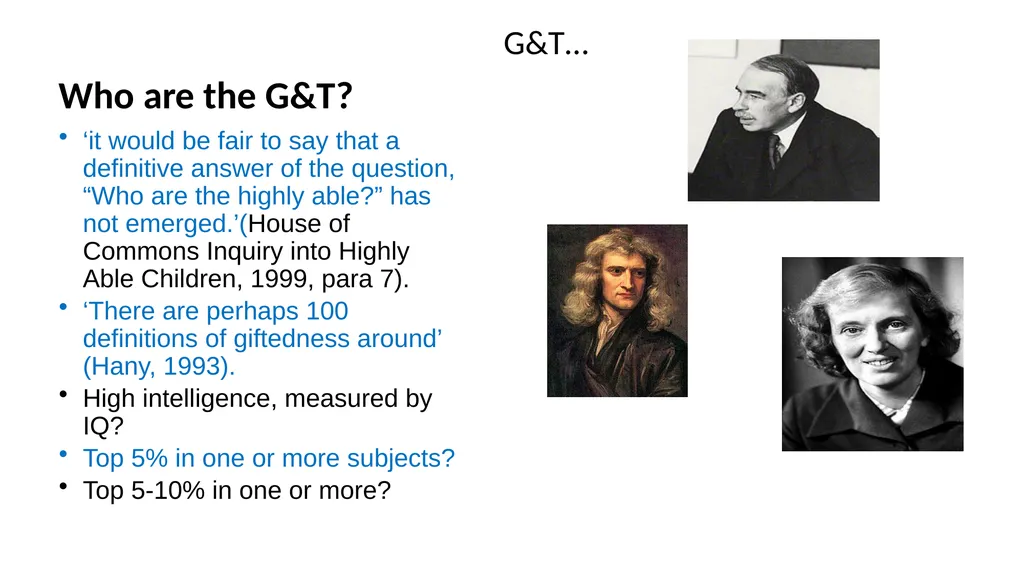
Who are the G&T? G&T… ‘it would be fair to say that a definitive answer of the question, “Who are the highly able?” has not emerged.’(House of Commons Inquiry into Highly Able Children, 1999, para 7).
‘There are perhaps 100 definitions of giftedness around’ (Hany, 1993).
High intelligence, measured by IQ?
Top 5% in one or more subjects?
Top 5-10% in one or more?<br>
09
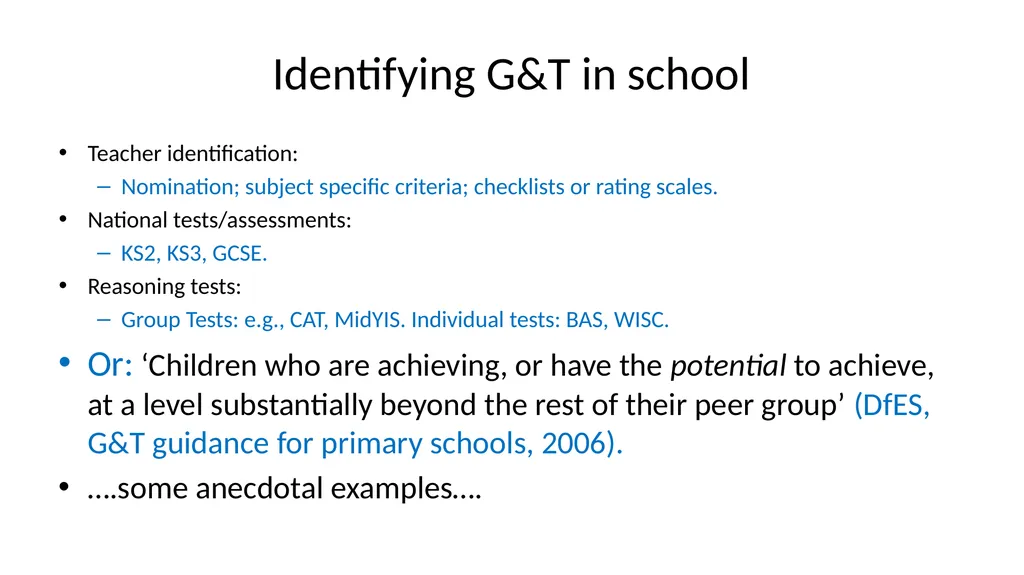
Identifying G&T in school Teacher identification:
Nomination; subject specific criteria; checklists or rating scales.
National tests/assessments:
KS2, KS3, GCSE.
Reasoning tests:
Group Tests: e.g., CAT, MidYIS. Individual tests: BAS, WISC.
Or: ‘Children who are achieving, or have the potential to achieve, at a level substantially beyond the rest of their peer group’ (DfES, G&T guidance for primary schools, 2006).
….some anecdotal examples….<br>
10
Bees and the La Nouvelle Vague The Bee Keeper
and
The SPS candidate. https://www.youtube.com/watch?v=u1MKUJN7vUk<br>
11
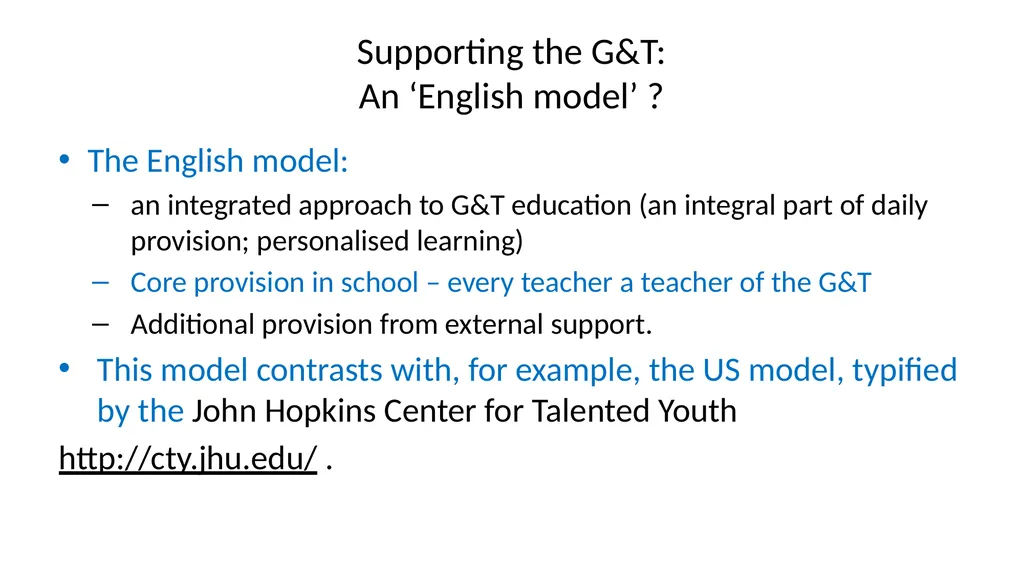
Supporting the G&T:�An ‘English model’ ? The English model:
an integrated approach to G&T education (an integral part of daily provision; personalised learning)
Core provision in school – every teacher a teacher of the G&T
Additional provision from external support.
This model contrasts with, for example, the US model, typified by the John Hopkins Center for Talented Youth
http://cty.jhu.edu/ .<br>
12
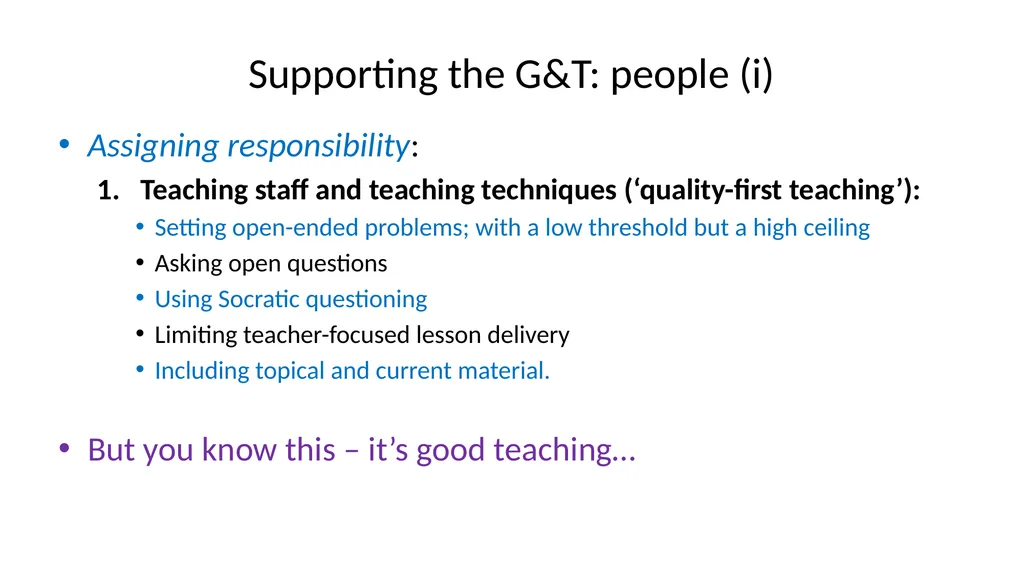
Supporting the G&T: people (i) Assigning responsibility:
Teaching staff and teaching techniques (‘quality-first teaching’):
Setting open-ended problems; with a low threshold but a high ceiling
Asking open questions
Using Socratic questioning
Limiting teacher-focused lesson delivery
Including topical and current material.
But you know this – it’s good teaching…<br>
13
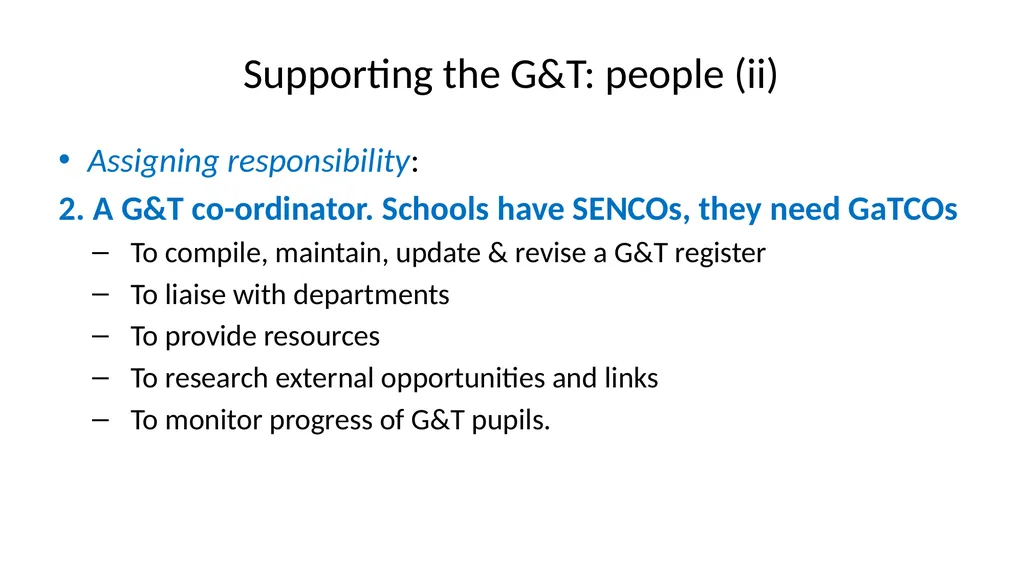
Supporting the G&T: people (ii) Assigning responsibility:
2. A G&T co-ordinator. Schools have SENCOs, they need GaTCOs
To compile, maintain, update & revise a G&T register
To liaise with departments
To provide resources
To research external opportunities and links
To monitor progress of G&T pupils.<br>
14
Supporting the G&T: people (iii) Leadership:
For G&T provision to be effective, to be embedded & sustainable, the leadership has to be there. The message from the top has to be clear and consistent. The head teacher (and SMT) have to be the GaTCo’s ‘big stick’, so that he/she can ‘speak softly’, and successfully.
What it looks like without leadership: ‘None of the staff are aware of G&T issues & there is no real provision’; ‘It’s low priority because G&T education is not linked to funding’, ‘I think some of the senior management don’t think much of G&T, they think it elitist’.<br>
15
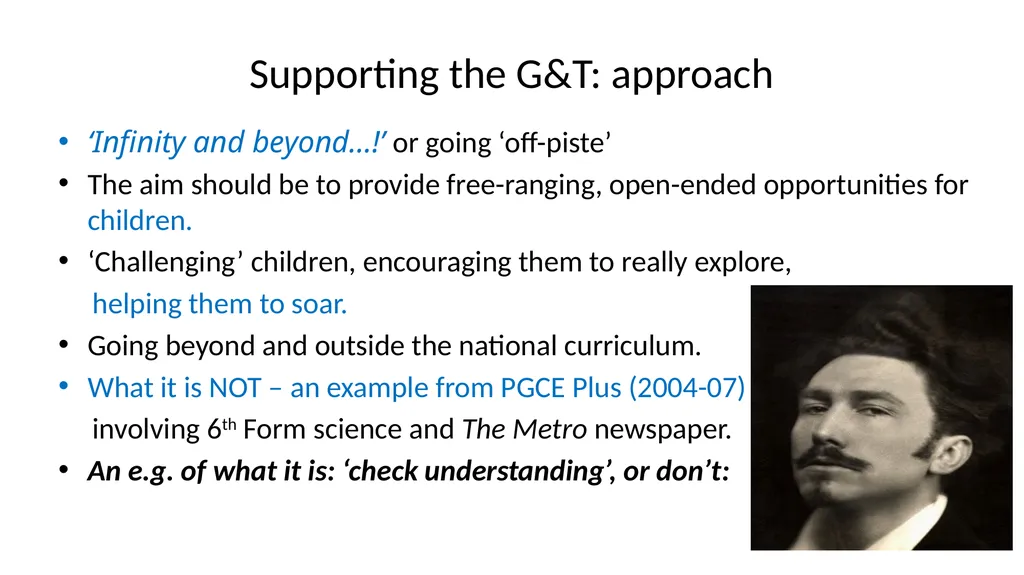
Supporting the G&T: approach ‘Infinity and beyond…!’ or going ‘off-piste’
The aim should be to provide free-ranging, open-ended opportunities for children.
‘Challenging’ children, encouraging them to really explore,
helping them to soar.
Going beyond and outside the national curriculum.
What it is NOT – an example from PGCE Plus (2004-07)
involving 6th Form science and The Metro newspaper.
An e.g. of what it is: ‘check understanding’, or don’t:<br>
16
Supporting the G&T: in-school activities Subject clubs and societies:
After school clubs, lunchtime clubs; facilitated by staff, but led by pupils.
Hobby clubs and societies:
Chess, puzzle clubs, gaming clubs, journalists club.
National, subject-based events:
E.g. maths challenge: http://www.ukmt.org.uk/individual-competitions/intermediate-challenge/
1st Story : http://www.firststory.org.uk/2014/09/24/first-story-national-writing-competition/<br>
17
Supporting the G&T: structures (i) If your school GaTCO (and G&T provision) is to survive and thrive in your school, then external buttressing structures are necessary.
Links and networks:
Local universities. Universities’ accepted that part of the quid pro quo for the £9k fee was that they would take widening participation (WP) seriously. Approach local universities, contact the outreach & WP offices, find out how they can help make links with pupils in your school.
/…<br>
18
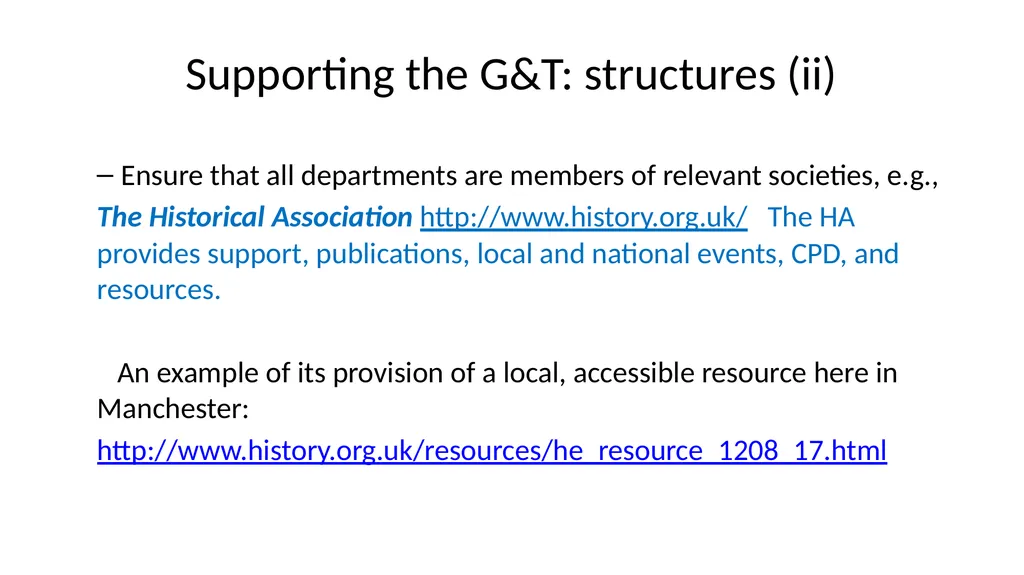
Supporting the G&T: structures (ii) Ensure that all departments are members of relevant societies, e.g.,
The Historical Association http://www.history.org.uk/ The HA provides support, publications, local and national events, CPD, and resources.
An example of its provision of a local, accessible resource here in Manchester:
http://www.history.org.uk/resources/he_resource_1208_17.html<br>
19
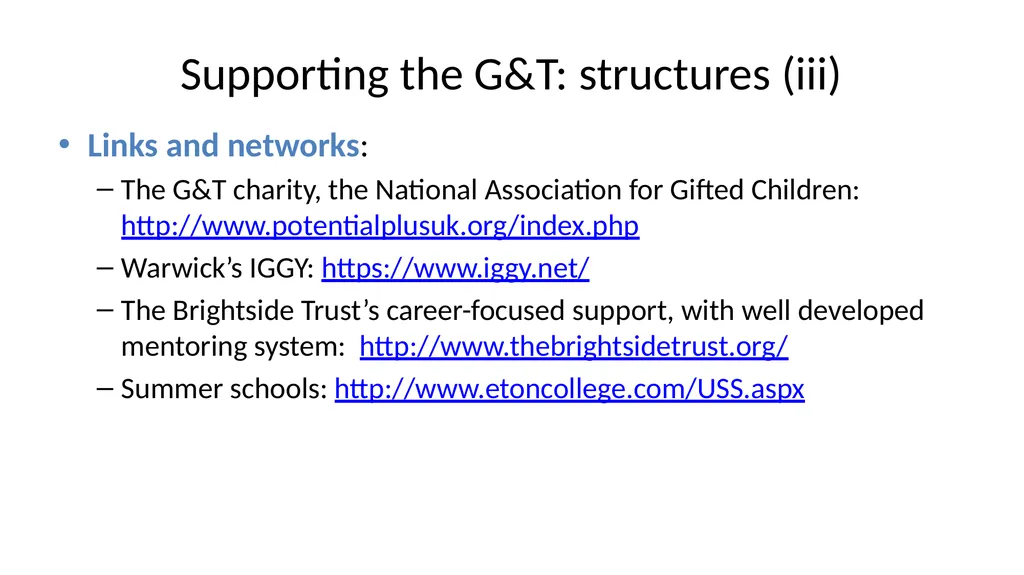
Supporting the G&T: structures (iii) Links and networks:
The G&T charity, the National Association for Gifted Children: http://www.potentialplusuk.org/index.php
Warwick’s IGGY: https://www.iggy.net/
The Brightside Trust’s career-focused support, with well developed mentoring system: http://www.thebrightsidetrust.org/
Summer schools: http://www.etoncollege.com/USS.aspx<br>
20
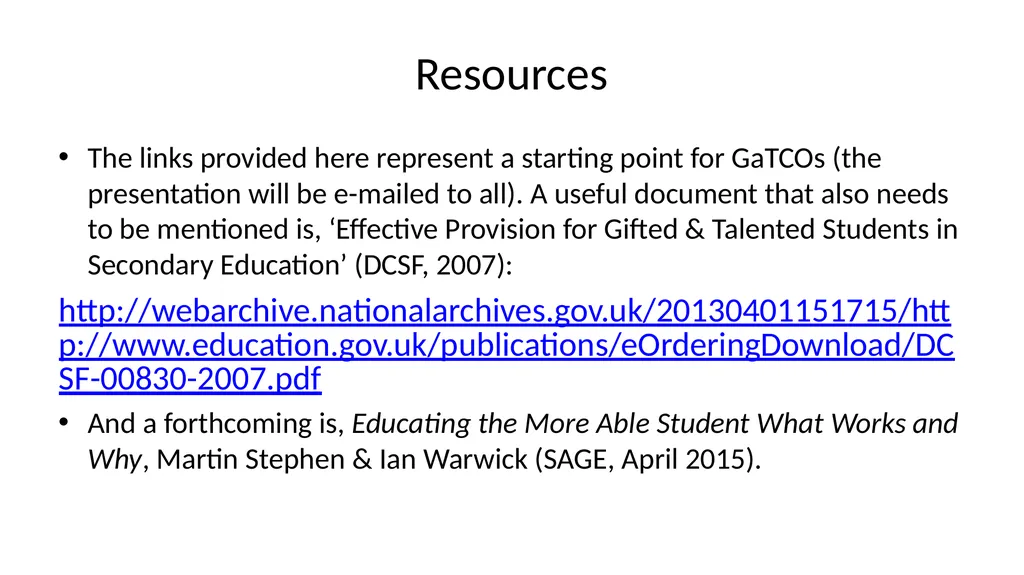
Resources The links provided here represent a starting point for GaTCOs (the presentation will be e-mailed to all). A useful document that also needs to be mentioned is, ‘Effective Provision for Gifted & Talented Students in Secondary Education’ (DCSF, 2007):
http://webarchive.nationalarchives.gov.uk/20130401151715/http://www.education.gov.uk/publications/eOrderingDownload/DCSF-00830-2007.pdf
And a forthcoming is, Educating the More Able Student What Works and Why, Martin Stephen & Ian Warwick (SAGE, April 2015).<br>