
GAAP Training How to prepare the GAAP forms
DJ
Published · 111 slides · 0 views

1 / 1










Description
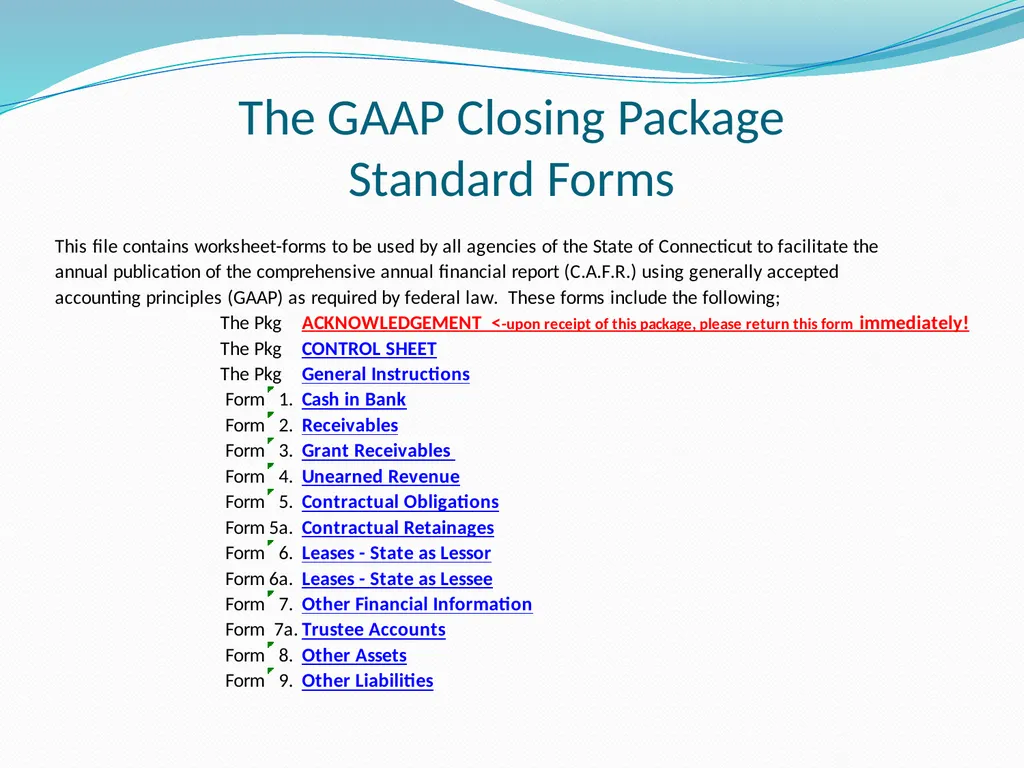
GAAP Training How to prepare the GAAP forms COMPREHENSIVE ANNUAL FINANCIAL REPORT Fiscal Year Ended June 30, 20x8 Kevin Lembo State Comptroller Overview of OSC Requests Standard forms package GAAP Forms 1 thru 9 Additional Agency
Related Topics
Share
Embed code
Download this presentation From Below
"GAAP Training How to prepare the GAAP forms" is the property of its rightful owner. Permission is granted to download and print the materials on this website for personal, non-commercial use only, and to display it on your personal computer provided you do not modify the materials and that you retain all copyright notices contained in the materials. By downloading content from our website, you accept the terms of this agreement.
Presentation Transcript
01
GAAP Training How to prepare the GAAP forms COMPREHENSIVE
ANNUAL
FINANCIAL
REPORT
Fiscal Year Ended
June 30, 20x8
Kevin Lembo
State Comptroller<br>
ANNUAL
FINANCIAL
REPORT
Fiscal Year Ended
June 30, 20x8
Kevin Lembo
State Comptroller<br>
02
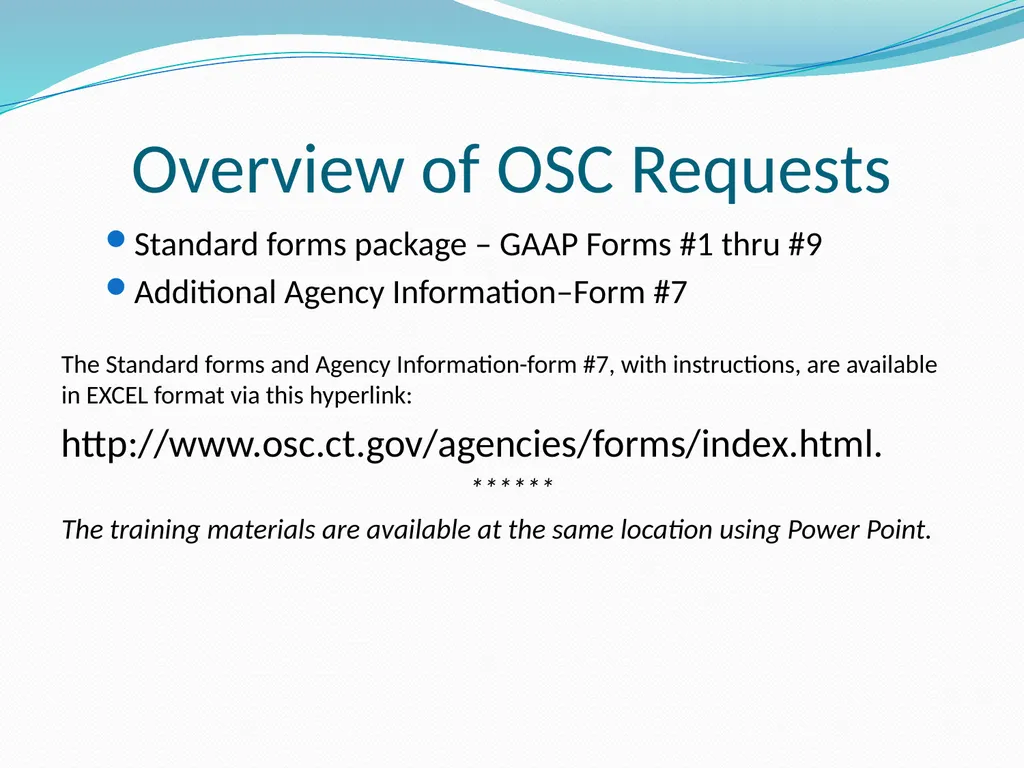
Overview of OSC Requests Standard forms package – GAAP Forms #1 thru #9
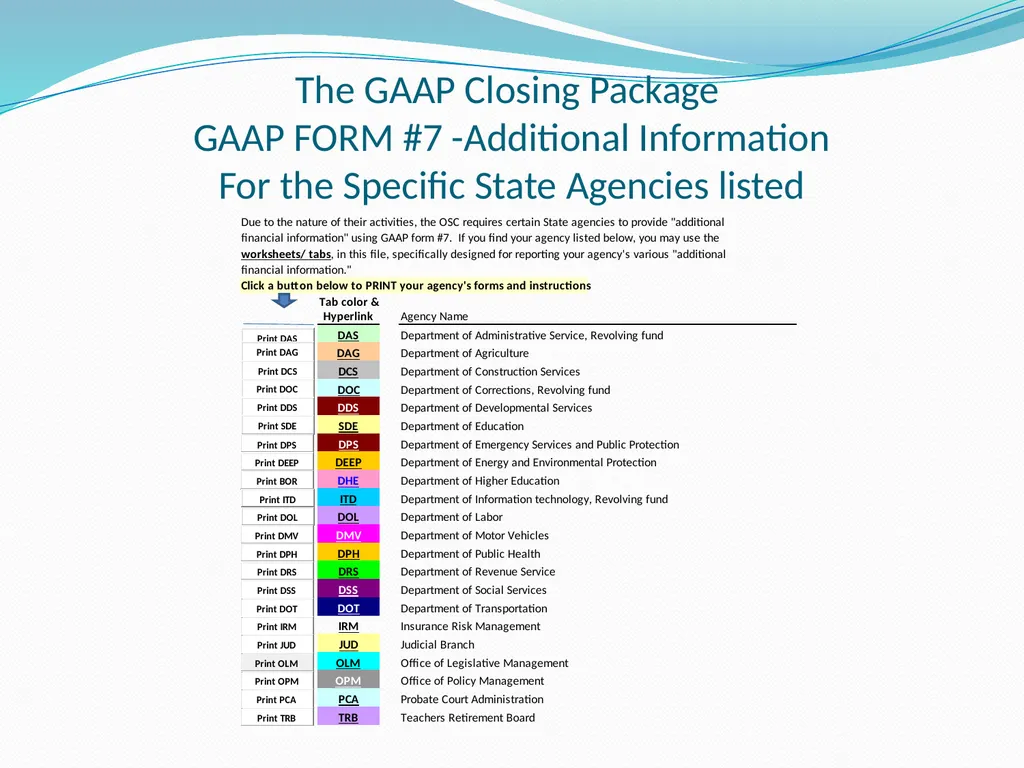
Additional Agency Information–Form #7
The Standard forms and Agency Information-form #7, with instructions, are available in EXCEL format via this hyperlink:
http://www.osc.ct.gov/agencies/forms/index.html.
******
The training materials are available at the same location using Power Point.<br>
Additional Agency Information–Form #7
The Standard forms and Agency Information-form #7, with instructions, are available in EXCEL format via this hyperlink:
http://www.osc.ct.gov/agencies/forms/index.html.
******
The training materials are available at the same location using Power Point.<br>
03
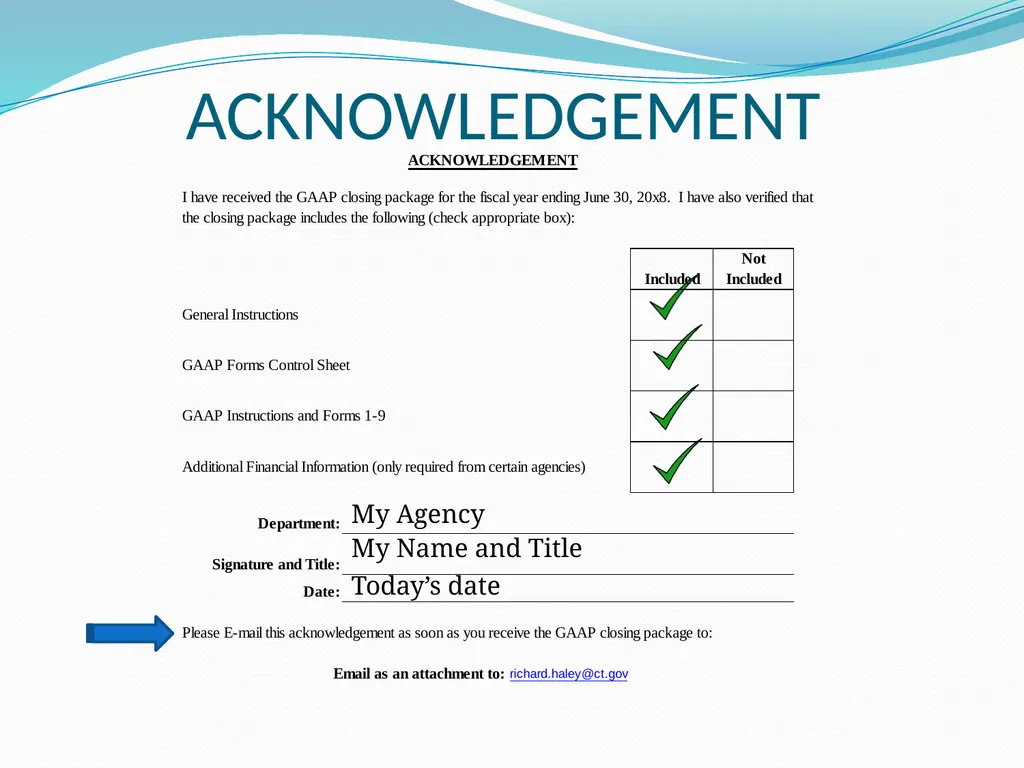
ACKNOWLEDGEMENT My Agency My Name and Title Today’s date<br>
04
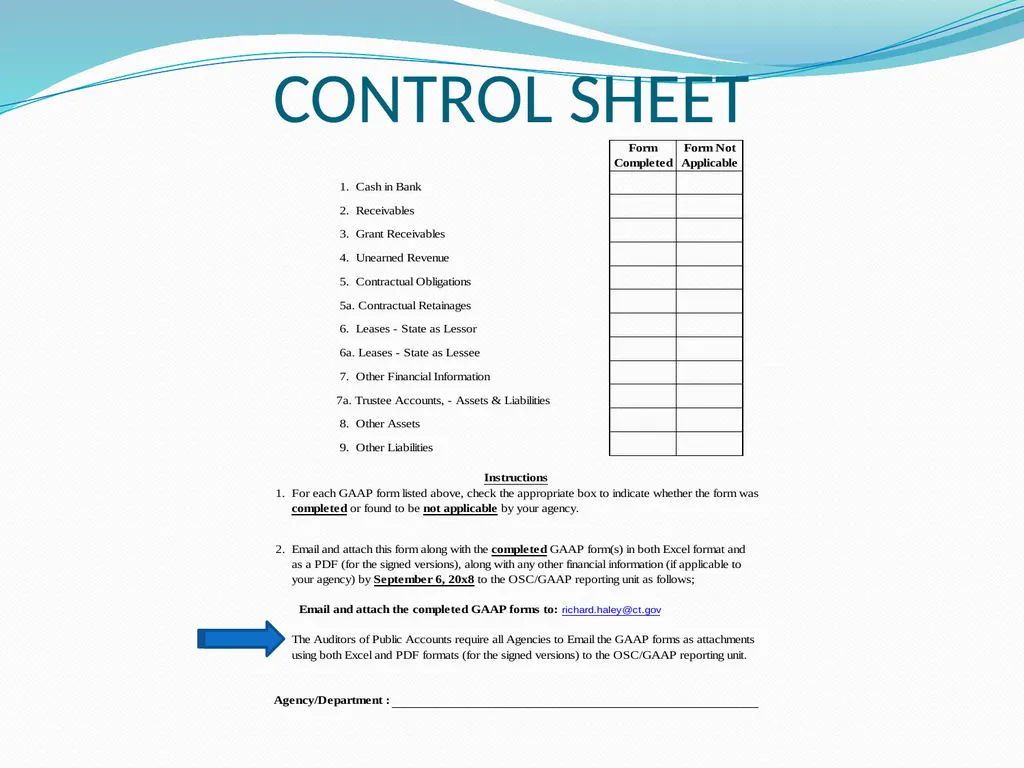
CONTROL SHEET<br>
05
GENERAL INSTRUCTIONS Please read the following instructions before completing any forms.
1. Please ascertain that your closing package has all the forms listed on the enclosed “Control Sheet”.
2. You should read the instructions for each form before completing it.
3. These forms apply to every fund (e.g. General, Transportation, etc.) which your agency is accountable for. However, GAAP forms No.’s 2‑6, 8 and 9 do not apply to the trustee accounts (formerly known as activity or welfare funds).
4. Each completed form should be signed by the person responsible for completing it, and by the person responsible for reviewing it (preferably the chief financial officer).
5. The attached GAAP Forms Control Sheet must be completed and emailed along with the completed form(s) and other financial information (if applicable to your agency).
6. You should make a copy of your completed closing package and keep it with your permanent records along with all pertinent information which was used to support your work. Your closing package will be subject to review by auditors so it is very important that you are able to justify your responses, especially if you had to work with estimates.
7. You should make sure that the account coding information required in these forms is filled out completely and accurately (we use this information to determine where and how to record the amounts reported on these forms).
8. If you are missing any GAAP forms or have any questions about them, please feel free to contact Nancy Walsh at 860-702-3378 or Richard Haley at 860-702-3383.
Please include your completed GAAP Control sheet when sending your completed forms to the OSC via E-mail.<br>
1. Please ascertain that your closing package has all the forms listed on the enclosed “Control Sheet”.
2. You should read the instructions for each form before completing it.
3. These forms apply to every fund (e.g. General, Transportation, etc.) which your agency is accountable for. However, GAAP forms No.’s 2‑6, 8 and 9 do not apply to the trustee accounts (formerly known as activity or welfare funds).
4. Each completed form should be signed by the person responsible for completing it, and by the person responsible for reviewing it (preferably the chief financial officer).
5. The attached GAAP Forms Control Sheet must be completed and emailed along with the completed form(s) and other financial information (if applicable to your agency).
6. You should make a copy of your completed closing package and keep it with your permanent records along with all pertinent information which was used to support your work. Your closing package will be subject to review by auditors so it is very important that you are able to justify your responses, especially if you had to work with estimates.
7. You should make sure that the account coding information required in these forms is filled out completely and accurately (we use this information to determine where and how to record the amounts reported on these forms).
8. If you are missing any GAAP forms or have any questions about them, please feel free to contact Nancy Walsh at 860-702-3378 or Richard Haley at 860-702-3383.
Please include your completed GAAP Control sheet when sending your completed forms to the OSC via E-mail.<br>
06
The GAAP Closing Package
Standard Forms<br>
07
GAAP
FORM #
1 Instructions for completing the form and
Case Examples for preparation of Standard GAAP forms<br>
Case Examples for preparation of Standard GAAP forms<br>
08
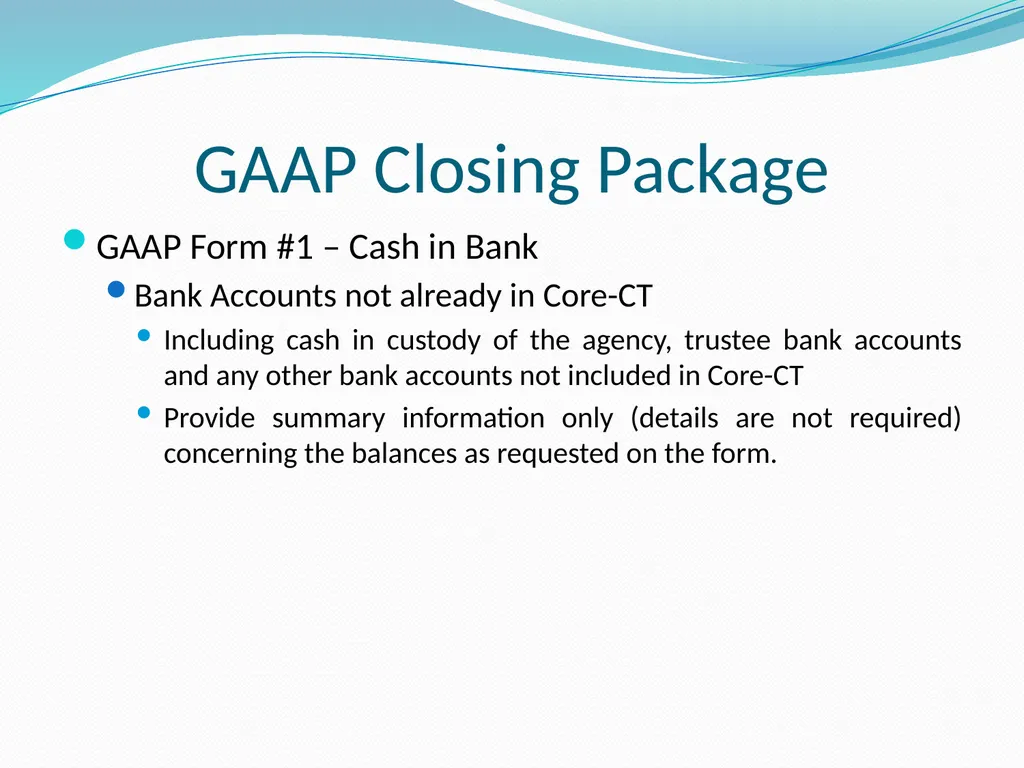
GAAP Closing Package GAAP Form #1 – Cash in Bank
Bank Accounts not already in Core-CT
Including cash in custody of the agency, trustee bank accounts and any other bank accounts not included in Core-CT
Provide summary information only (details are not required) concerning the balances as requested on the form.<br>
Bank Accounts not already in Core-CT
Including cash in custody of the agency, trustee bank accounts and any other bank accounts not included in Core-CT
Provide summary information only (details are not required) concerning the balances as requested on the form.<br>
09
GAAP Form #1
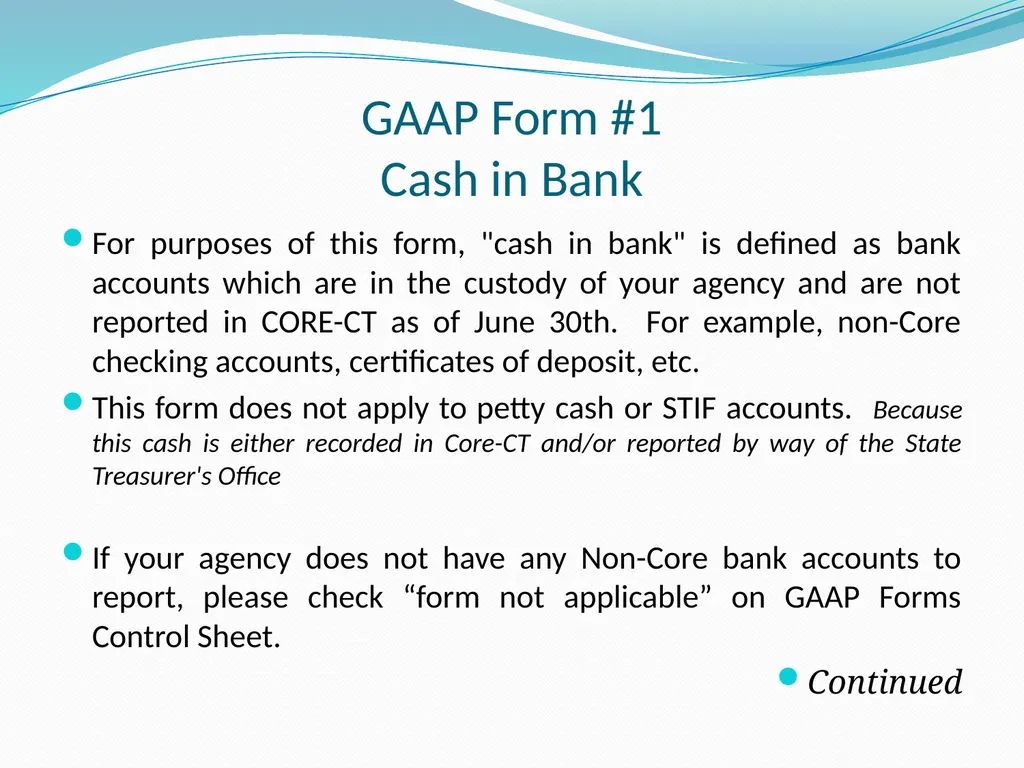
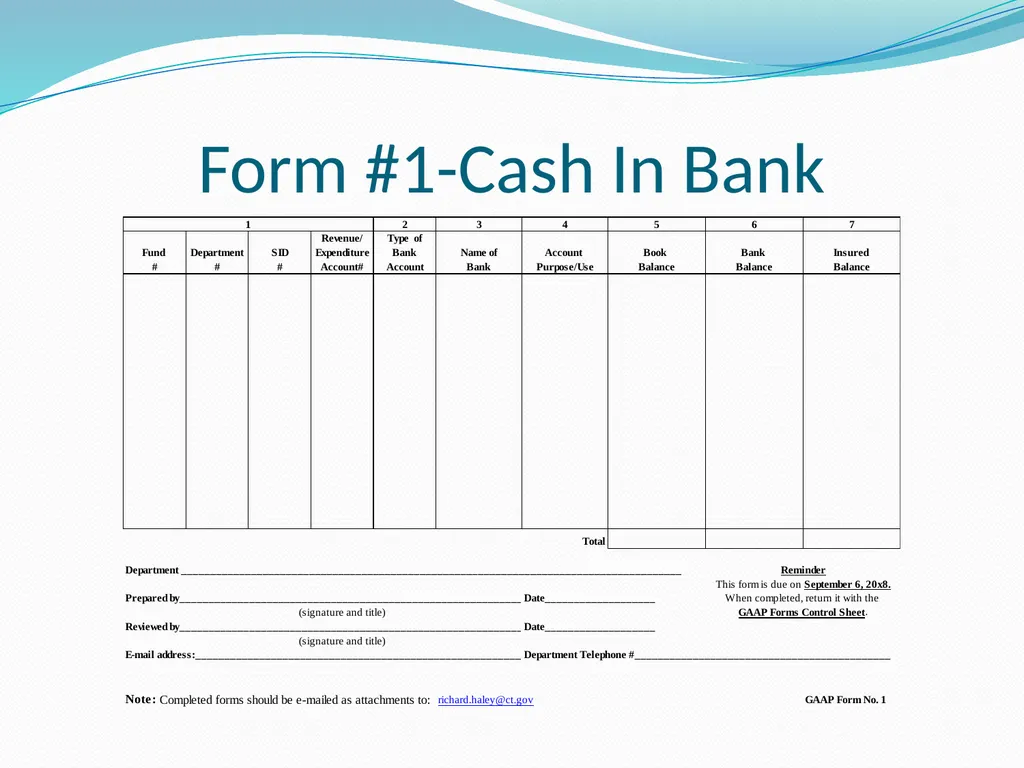
Cash in Bank For purposes of this form, "cash in bank" is defined as bank accounts which are in the custody of your agency and are not reported in CORE-CT as of June 30th. For example, non-Core checking accounts, certificates of deposit, etc.
This form does not apply to petty cash or STIF accounts. Because this cash is either recorded in Core-CT and/or reported by way of the State Treasurer's Office
If your agency does not have any Non-Core bank accounts to report, please check “form not applicable” on GAAP Forms Control Sheet.
Continued<br>
This form does not apply to petty cash or STIF accounts. Because this cash is either recorded in Core-CT and/or reported by way of the State Treasurer's Office
If your agency does not have any Non-Core bank accounts to report, please check “form not applicable” on GAAP Forms Control Sheet.
Continued<br>
10
Form #1-Cash In Bank<br>
11
Instructions GAAP Form #1 Do not include cash accounts already recorded on the State General ledger<br>
12
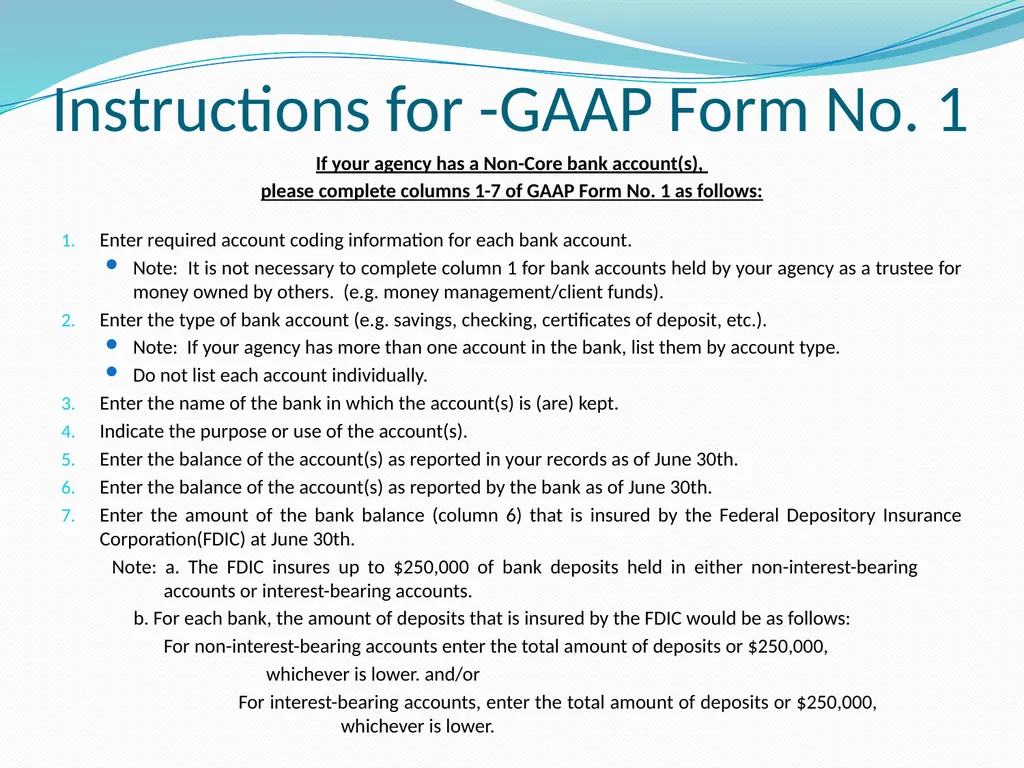
Instructions for -GAAP Form No. 1 If your agency has a Non-Core bank account(s),
please complete columns 1-7 of GAAP Form No. 1 as follows:
Enter required account coding information for each bank account.
Note: It is not necessary to complete column 1 for bank accounts held by your agency as a trustee for money owned by others. (e.g. money management/client funds).
Enter the type of bank account (e.g. savings, checking, certificates of deposit, etc.).
Note: If your agency has more than one account in the bank, list them by account type.
Do not list each account individually.
Enter the name of the bank in which the account(s) is (are) kept.
Indicate the purpose or use of the account(s).
Enter the balance of the account(s) as reported in your records as of June 30th.
Enter the balance of the account(s) as reported by the bank as of June 30th.
Enter the amount of the bank balance (column 6) that is insured by the Federal Depository Insurance Corporation(FDIC) at June 30th.
Note: a. The FDIC insures up to $250,000 of bank deposits held in either non-interest-bearing accounts or interest-bearing accounts.
b. For each bank, the amount of deposits that is insured by the FDIC would be as follows:
For non-interest-bearing accounts enter the total amount of deposits or $250,000,
whichever is lower. and/or
For interest-bearing accounts, enter the total amount of deposits or $250,000, whichever is lower.<br>
please complete columns 1-7 of GAAP Form No. 1 as follows:
Enter required account coding information for each bank account.
Note: It is not necessary to complete column 1 for bank accounts held by your agency as a trustee for money owned by others. (e.g. money management/client funds).
Enter the type of bank account (e.g. savings, checking, certificates of deposit, etc.).
Note: If your agency has more than one account in the bank, list them by account type.
Do not list each account individually.
Enter the name of the bank in which the account(s) is (are) kept.
Indicate the purpose or use of the account(s).
Enter the balance of the account(s) as reported in your records as of June 30th.
Enter the balance of the account(s) as reported by the bank as of June 30th.
Enter the amount of the bank balance (column 6) that is insured by the Federal Depository Insurance Corporation(FDIC) at June 30th.
Note: a. The FDIC insures up to $250,000 of bank deposits held in either non-interest-bearing accounts or interest-bearing accounts.
b. For each bank, the amount of deposits that is insured by the FDIC would be as follows:
For non-interest-bearing accounts enter the total amount of deposits or $250,000,
whichever is lower. and/or
For interest-bearing accounts, enter the total amount of deposits or $250,000, whichever is lower.<br>
13
GAAP Form Training GAAP Form #1 Cash in bank
Examples/Cases
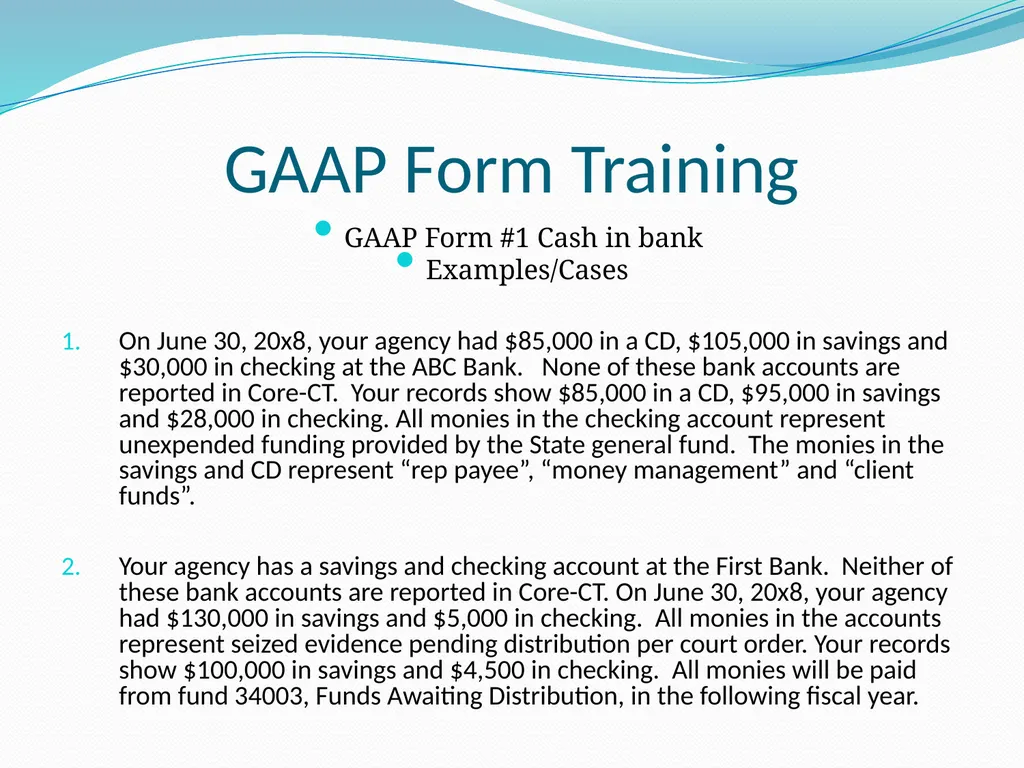
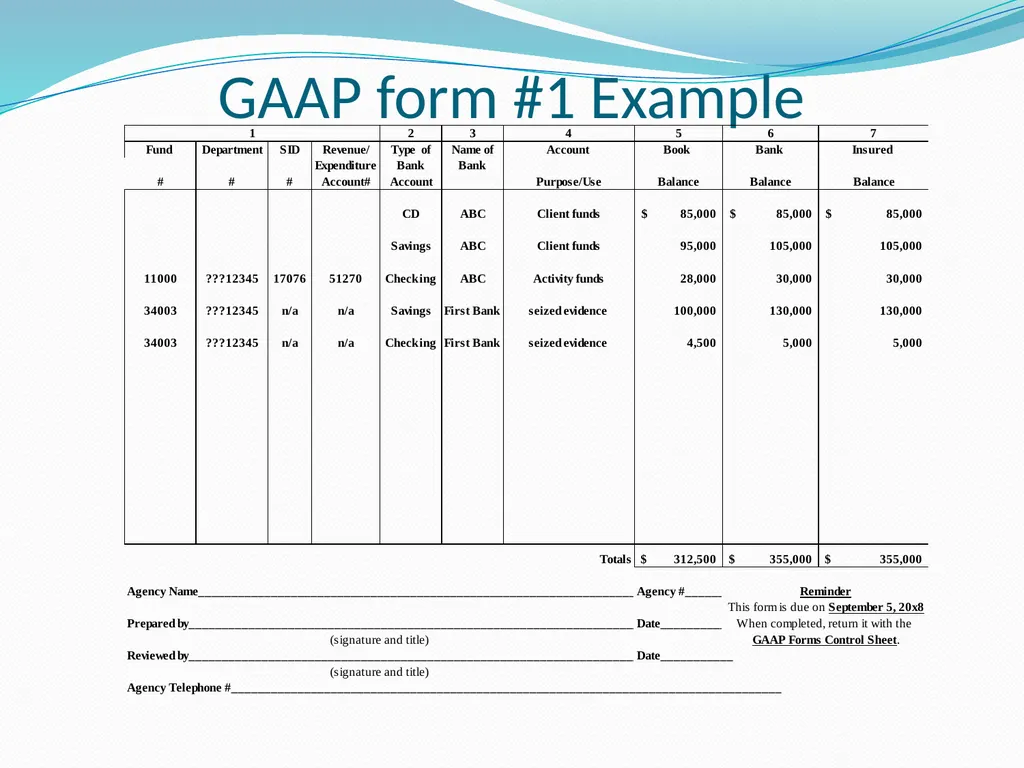
On June 30, 20x8, your agency had $85,000 in a CD, $105,000 in savings and $30,000 in checking at the ABC Bank. None of these bank accounts are reported in Core-CT. Your records show $85,000 in a CD, $95,000 in savings and $28,000 in checking. All monies in the checking account represent unexpended funding provided by the State general fund. The monies in the savings and CD represent “rep payee”, “money management” and “client funds”.
Your agency has a savings and checking account at the First Bank. Neither of these bank accounts are reported in Core-CT. On June 30, 20x8, your agency had $130,000 in savings and $5,000 in checking. All monies in the accounts represent seized evidence pending distribution per court order. Your records show $100,000 in savings and $4,500 in checking. All monies will be paid from fund 34003, Funds Awaiting Distribution, in the following fiscal year.<br>
Examples/Cases
On June 30, 20x8, your agency had $85,000 in a CD, $105,000 in savings and $30,000 in checking at the ABC Bank. None of these bank accounts are reported in Core-CT. Your records show $85,000 in a CD, $95,000 in savings and $28,000 in checking. All monies in the checking account represent unexpended funding provided by the State general fund. The monies in the savings and CD represent “rep payee”, “money management” and “client funds”.
Your agency has a savings and checking account at the First Bank. Neither of these bank accounts are reported in Core-CT. On June 30, 20x8, your agency had $130,000 in savings and $5,000 in checking. All monies in the accounts represent seized evidence pending distribution per court order. Your records show $100,000 in savings and $4,500 in checking. All monies will be paid from fund 34003, Funds Awaiting Distribution, in the following fiscal year.<br>
14
GAAP form #1 Example<br>
15
GAAP
FORM #
2 Instructions for completing the form and
Case Examples for preparation of Standard GAAP forms<br>
Case Examples for preparation of Standard GAAP forms<br>
16
GAAP Closing Package GAAP Form #2 Receivables
Accounts receivable from ordinary business in trade
Claims receivable<br>
Accounts receivable from ordinary business in trade
Claims receivable<br>
17
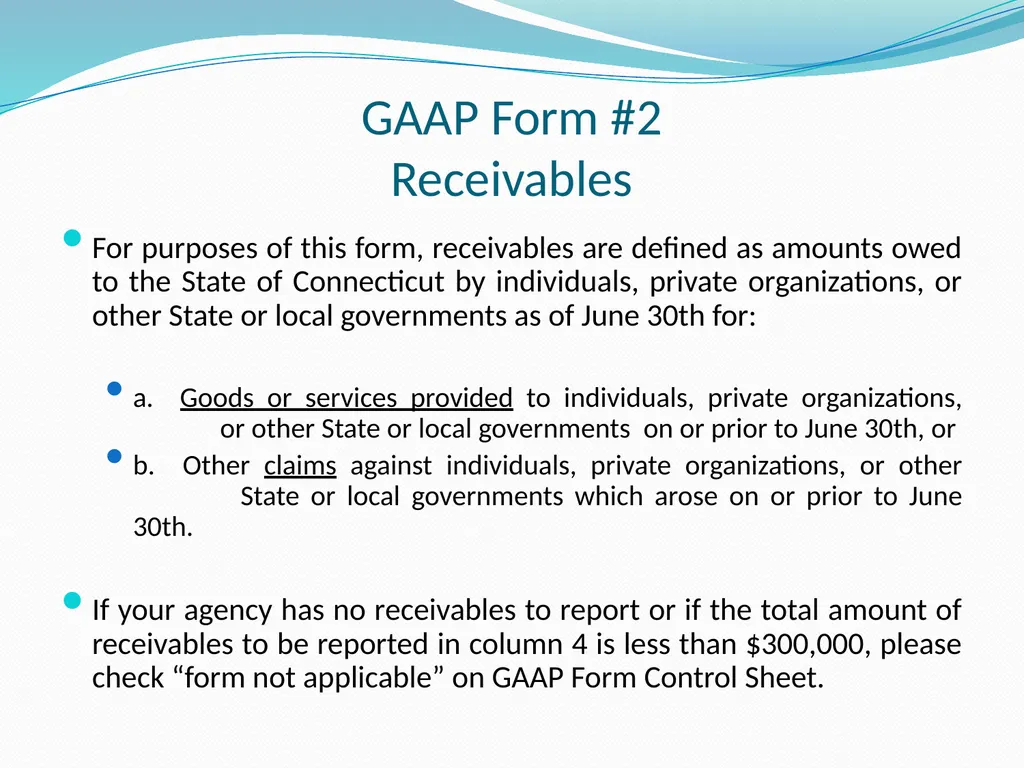
GAAP Form #2
Receivables For purposes of this form, receivables are defined as amounts owed to the State of Connecticut by individuals, private organizations, or other State or local governments as of June 30th for:
a. Goods or services provided to individuals, private organizations, or other State or local governments on or prior to June 30th, or
b. Other claims against individuals, private organizations, or other State or local governments which arose on or prior to June 30th.
If your agency has no receivables to report or if the total amount of receivables to be reported in column 4 is less than $300,000, please check “form not applicable” on GAAP Form Control Sheet.<br>
a. Goods or services provided to individuals, private organizations, or other State or local governments on or prior to June 30th, or
b. Other claims against individuals, private organizations, or other State or local governments which arose on or prior to June 30th.
If your agency has no receivables to report or if the total amount of receivables to be reported in column 4 is less than $300,000, please check “form not applicable” on GAAP Form Control Sheet.<br>
18
GAAP Form # 2 Receivables<br>
19
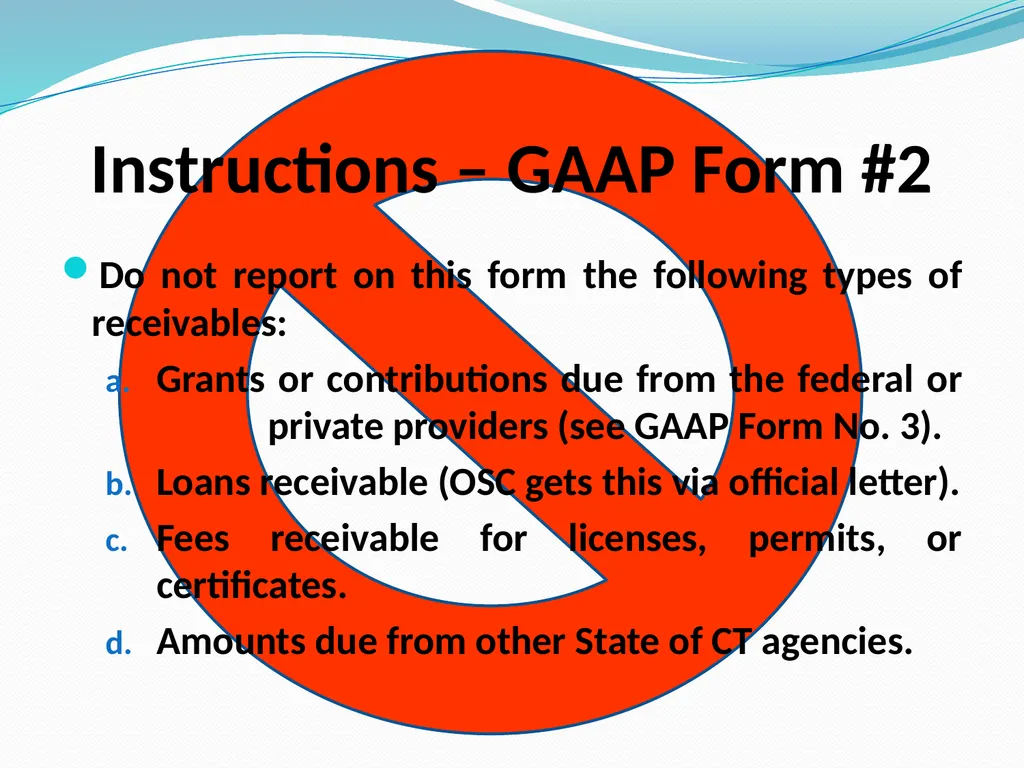
Instructions – GAAP Form #2 Do not report on this form the following types of receivables:
Grants or contributions due from the federal or private providers (see GAAP Form No. 3).
Loans receivable (OSC gets this via official letter).
Fees receivable for licenses, permits, or certificates.
Amounts due from other State of CT agencies.<br>
Grants or contributions due from the federal or private providers (see GAAP Form No. 3).
Loans receivable (OSC gets this via official letter).
Fees receivable for licenses, permits, or certificates.
Amounts due from other State of CT agencies.<br>
20
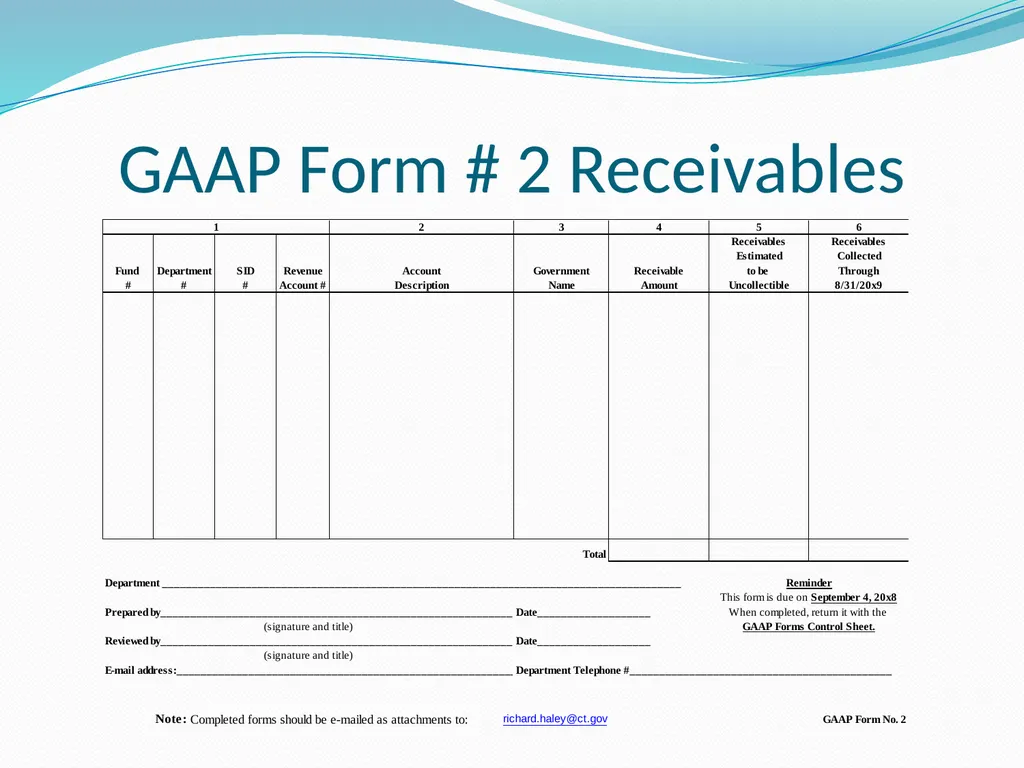
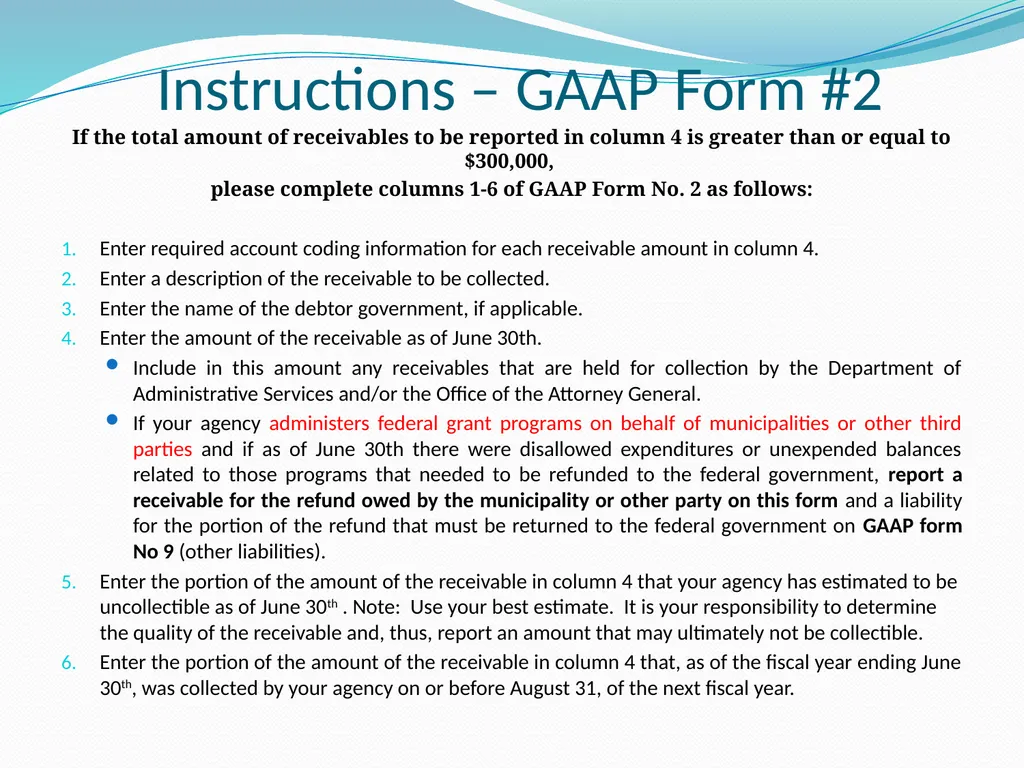
Instructions – GAAP Form #2 If the total amount of receivables to be reported in column 4 is greater than or equal to $300,000,
please complete columns 1-6 of GAAP Form No. 2 as follows:
Enter required account coding information for each receivable amount in column 4.
Enter a description of the receivable to be collected.
Enter the name of the debtor government, if applicable.
Enter the amount of the receivable as of June 30th.
Include in this amount any receivables that are held for collection by the Department of Administrative Services and/or the Office of the Attorney General.
If your agency administers federal grant programs on behalf of municipalities or other third parties and if as of June 30th there were disallowed expenditures or unexpended balances related to those programs that needed to be refunded to the federal government, report a receivable for the refund owed by the municipality or other party on this form and a liability for the portion of the refund that must be returned to the federal government on GAAP form No 9 (other liabilities).
Enter the portion of the amount of the receivable in column 4 that your agency has estimated to be uncollectible as of June 30th . Note: Use your best estimate. It is your responsibility to determine the quality of the receivable and, thus, report an amount that may ultimately not be collectible.
Enter the portion of the amount of the receivable in column 4 that, as of the fiscal year ending June 30th, was collected by your agency on or before August 31, of the next fiscal year.<br>
please complete columns 1-6 of GAAP Form No. 2 as follows:
Enter required account coding information for each receivable amount in column 4.
Enter a description of the receivable to be collected.
Enter the name of the debtor government, if applicable.
Enter the amount of the receivable as of June 30th.
Include in this amount any receivables that are held for collection by the Department of Administrative Services and/or the Office of the Attorney General.
If your agency administers federal grant programs on behalf of municipalities or other third parties and if as of June 30th there were disallowed expenditures or unexpended balances related to those programs that needed to be refunded to the federal government, report a receivable for the refund owed by the municipality or other party on this form and a liability for the portion of the refund that must be returned to the federal government on GAAP form No 9 (other liabilities).
Enter the portion of the amount of the receivable in column 4 that your agency has estimated to be uncollectible as of June 30th . Note: Use your best estimate. It is your responsibility to determine the quality of the receivable and, thus, report an amount that may ultimately not be collectible.
Enter the portion of the amount of the receivable in column 4 that, as of the fiscal year ending June 30th, was collected by your agency on or before August 31, of the next fiscal year.<br>
21
GAAP Form Training GAAP Form #2 Receivables
Examples/Cases
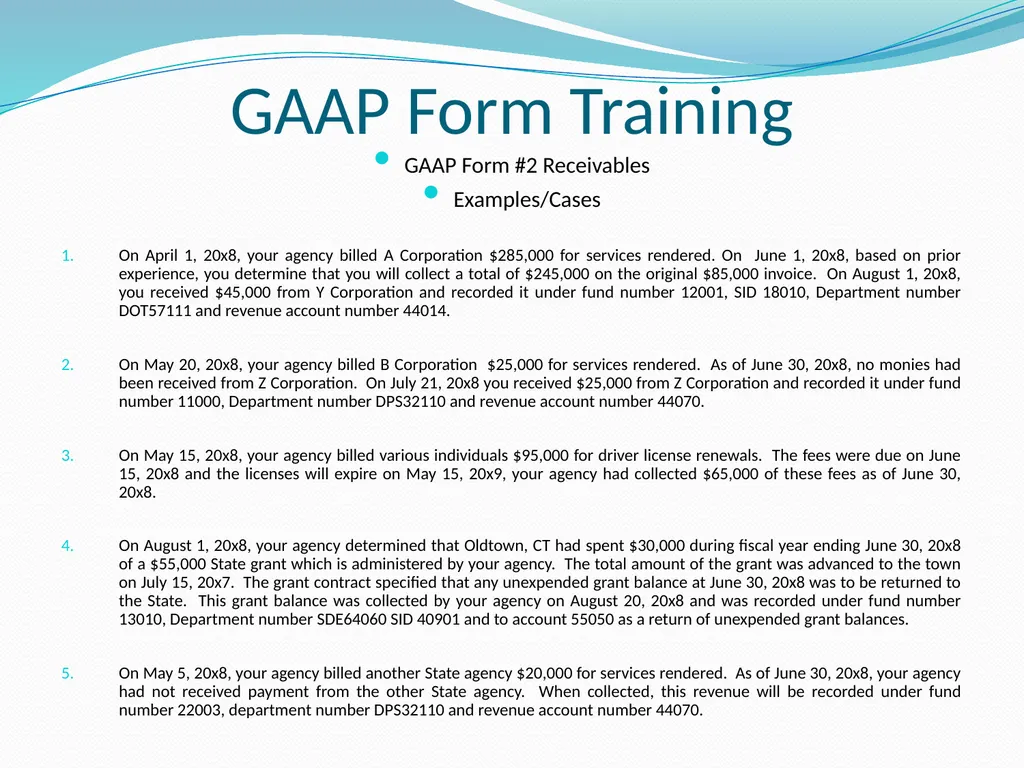
On April 1, 20x8, your agency billed A Corporation $285,000 for services rendered. On June 1, 20x8, based on prior experience, you determine that you will collect a total of $245,000 on the original $85,000 invoice. On August 1, 20x8, you received $45,000 from Y Corporation and recorded it under fund number 12001, SID 18010, Department number DOT57111 and revenue account number 44014.
On May 20, 20x8, your agency billed B Corporation $25,000 for services rendered. As of June 30, 20x8, no monies had been received from Z Corporation. On July 21, 20x8 you received $25,000 from Z Corporation and recorded it under fund number 11000, Department number DPS32110 and revenue account number 44070.
On May 15, 20x8, your agency billed various individuals $95,000 for driver license renewals. The fees were due on June 15, 20x8 and the licenses will expire on May 15, 20x9, your agency had collected $65,000 of these fees as of June 30, 20x8.
On August 1, 20x8, your agency determined that Oldtown, CT had spent $30,000 during fiscal year ending June 30, 20x8 of a $55,000 State grant which is administered by your agency. The total amount of the grant was advanced to the town on July 15, 20x7. The grant contract specified that any unexpended grant balance at June 30, 20x8 was to be returned to the State. This grant balance was collected by your agency on August 20, 20x8 and was recorded under fund number 13010, Department number SDE64060 SID 40901 and to account 55050 as a return of unexpended grant balances.
On May 5, 20x8, your agency billed another State agency $20,000 for services rendered. As of June 30, 20x8, your agency had not received payment from the other State agency. When collected, this revenue will be recorded under fund number 22003, department number DPS32110 and revenue account number 44070.<br>
Examples/Cases
On April 1, 20x8, your agency billed A Corporation $285,000 for services rendered. On June 1, 20x8, based on prior experience, you determine that you will collect a total of $245,000 on the original $85,000 invoice. On August 1, 20x8, you received $45,000 from Y Corporation and recorded it under fund number 12001, SID 18010, Department number DOT57111 and revenue account number 44014.
On May 20, 20x8, your agency billed B Corporation $25,000 for services rendered. As of June 30, 20x8, no monies had been received from Z Corporation. On July 21, 20x8 you received $25,000 from Z Corporation and recorded it under fund number 11000, Department number DPS32110 and revenue account number 44070.
On May 15, 20x8, your agency billed various individuals $95,000 for driver license renewals. The fees were due on June 15, 20x8 and the licenses will expire on May 15, 20x9, your agency had collected $65,000 of these fees as of June 30, 20x8.
On August 1, 20x8, your agency determined that Oldtown, CT had spent $30,000 during fiscal year ending June 30, 20x8 of a $55,000 State grant which is administered by your agency. The total amount of the grant was advanced to the town on July 15, 20x7. The grant contract specified that any unexpended grant balance at June 30, 20x8 was to be returned to the State. This grant balance was collected by your agency on August 20, 20x8 and was recorded under fund number 13010, Department number SDE64060 SID 40901 and to account 55050 as a return of unexpended grant balances.
On May 5, 20x8, your agency billed another State agency $20,000 for services rendered. As of June 30, 20x8, your agency had not received payment from the other State agency. When collected, this revenue will be recorded under fund number 22003, department number DPS32110 and revenue account number 44070.<br>
22
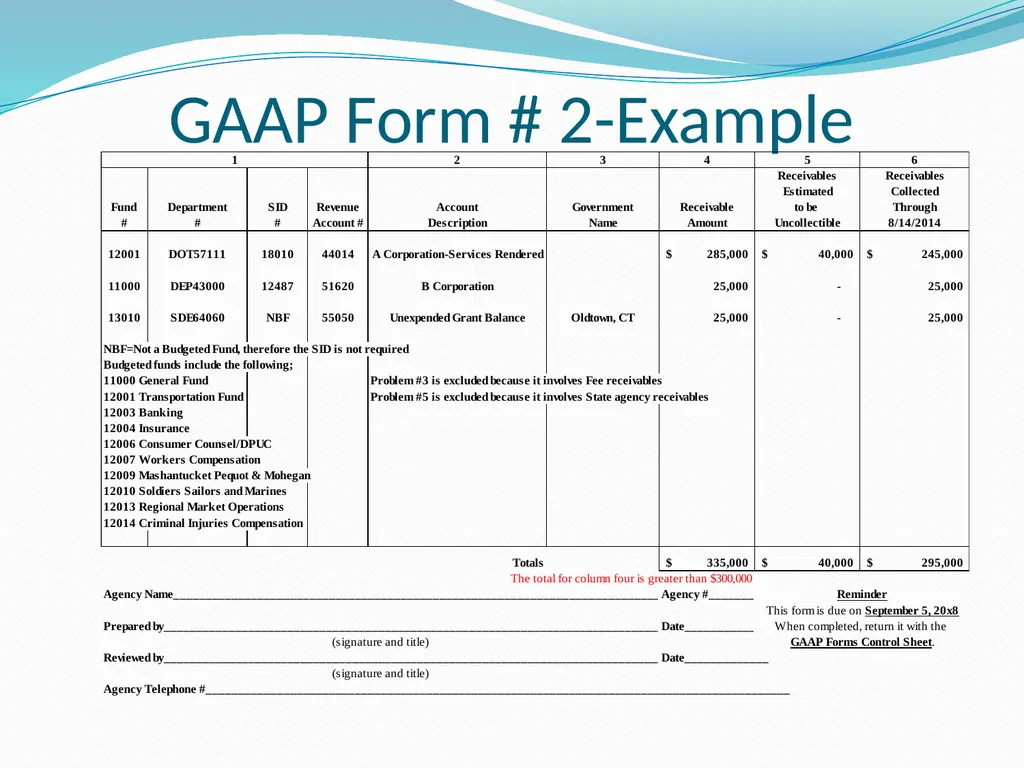
GAAP Form # 2-Example<br>
23
GAAP
FORM #
3 Instructions for completing the form and
Case Examples for preparation of Standard GAAP forms<br>
Case Examples for preparation of Standard GAAP forms<br>
24
GAAP Form #3
Grants Receivable For reimbursement of State expenditures or
When State expenditures are Funded in Advance
[See closing package instructions for GAAP form #3 concerning “other than reimbursement” grants]<br>
When State expenditures are Funded in Advance
[See closing package instructions for GAAP form #3 concerning “other than reimbursement” grants]<br>
25
GAAP form #3
Grants Receivable For purposes of this form, grants receivable are defined as grant (or other financial assistance) amounts owed to the State of CT by the federal government (provider) as of June 30th.
However, this form also applies to those rare cases in which the provider of a grant or contribution, is an individual or a private organization.
If your agency has no grants receivable to report or if the total amount of grants receivable to be reported in column 4 is less than $300,000, please check “form not applicable” on the GAAP Form Control Sheet.<br>
However, this form also applies to those rare cases in which the provider of a grant or contribution, is an individual or a private organization.
If your agency has no grants receivable to report or if the total amount of grants receivable to be reported in column 4 is less than $300,000, please check “form not applicable” on the GAAP Form Control Sheet.<br>
26
GAAP Form # 3 Grants Receivable<br>
27
Instructions – GAAP Form #3 Do not report on this form grant activities that are reimbursed by another State of CT agency. Generally, Receivables for “pass-thru” grants are reported by the “drawdown” agency<br>
28
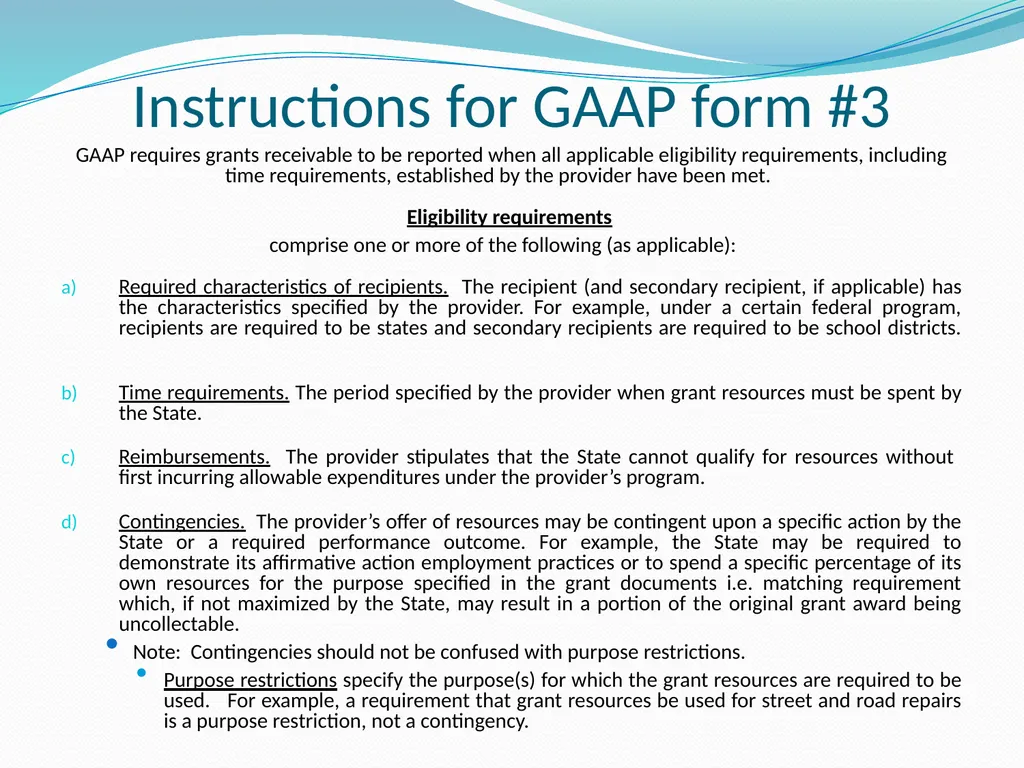
Instructions for GAAP form #3 GAAP requires grants receivable to be reported when all applicable eligibility requirements, including time requirements, established by the provider have been met.
Eligibility requirements
comprise one or more of the following (as applicable):
Required characteristics of recipients. The recipient (and secondary recipient, if applicable) has the characteristics specified by the provider. For example, under a certain federal program, recipients are required to be states and secondary recipients are required to be school districts.
Time requirements. The period specified by the provider when grant resources must be spent by the State.
Reimbursements. The provider stipulates that the State cannot qualify for resources without first incurring allowable expenditures under the provider’s program.
Contingencies. The provider’s offer of resources may be contingent upon a specific action by the State or a required performance outcome. For example, the State may be required to demonstrate its affirmative action employment practices or to spend a specific percentage of its own resources for the purpose specified in the grant documents i.e. matching requirement which, if not maximized by the State, may result in a portion of the original grant award being uncollectable.
Note: Contingencies should not be confused with purpose restrictions.
Purpose restrictions specify the purpose(s) for which the grant resources are required to be used. For example, a requirement that grant resources be used for street and road repairs is a purpose restriction, not a contingency.<br>
Eligibility requirements
comprise one or more of the following (as applicable):
Required characteristics of recipients. The recipient (and secondary recipient, if applicable) has the characteristics specified by the provider. For example, under a certain federal program, recipients are required to be states and secondary recipients are required to be school districts.
Time requirements. The period specified by the provider when grant resources must be spent by the State.
Reimbursements. The provider stipulates that the State cannot qualify for resources without first incurring allowable expenditures under the provider’s program.
Contingencies. The provider’s offer of resources may be contingent upon a specific action by the State or a required performance outcome. For example, the State may be required to demonstrate its affirmative action employment practices or to spend a specific percentage of its own resources for the purpose specified in the grant documents i.e. matching requirement which, if not maximized by the State, may result in a portion of the original grant award being uncollectable.
Note: Contingencies should not be confused with purpose restrictions.
Purpose restrictions specify the purpose(s) for which the grant resources are required to be used. For example, a requirement that grant resources be used for street and road repairs is a purpose restriction, not a contingency.<br>
29
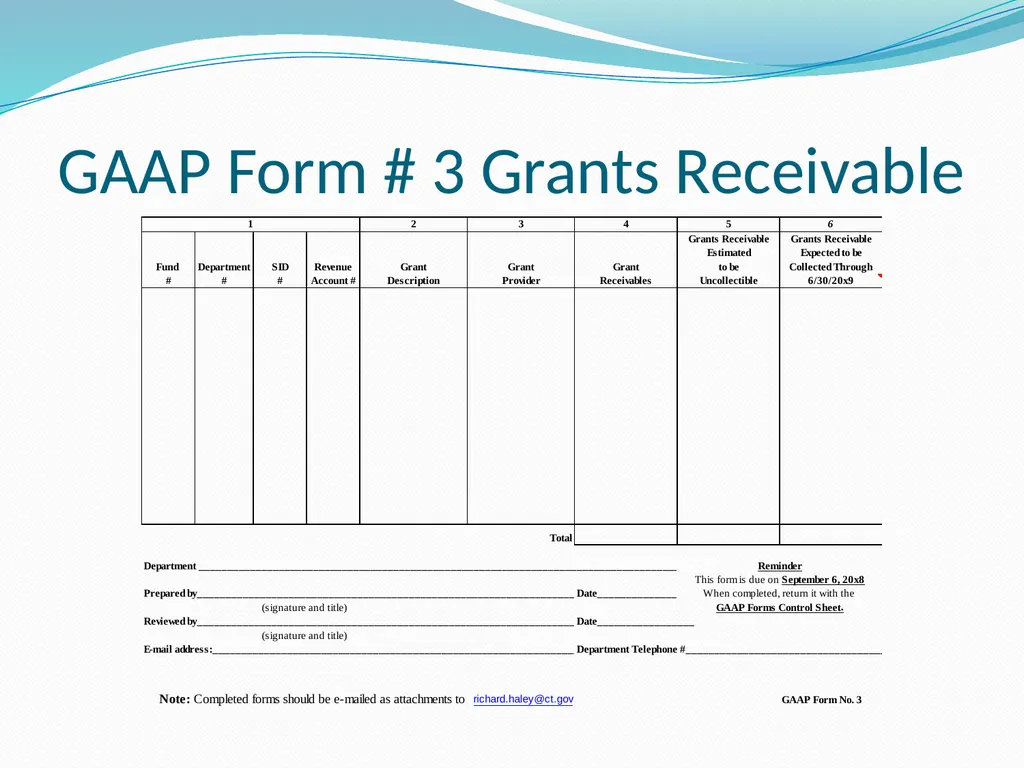
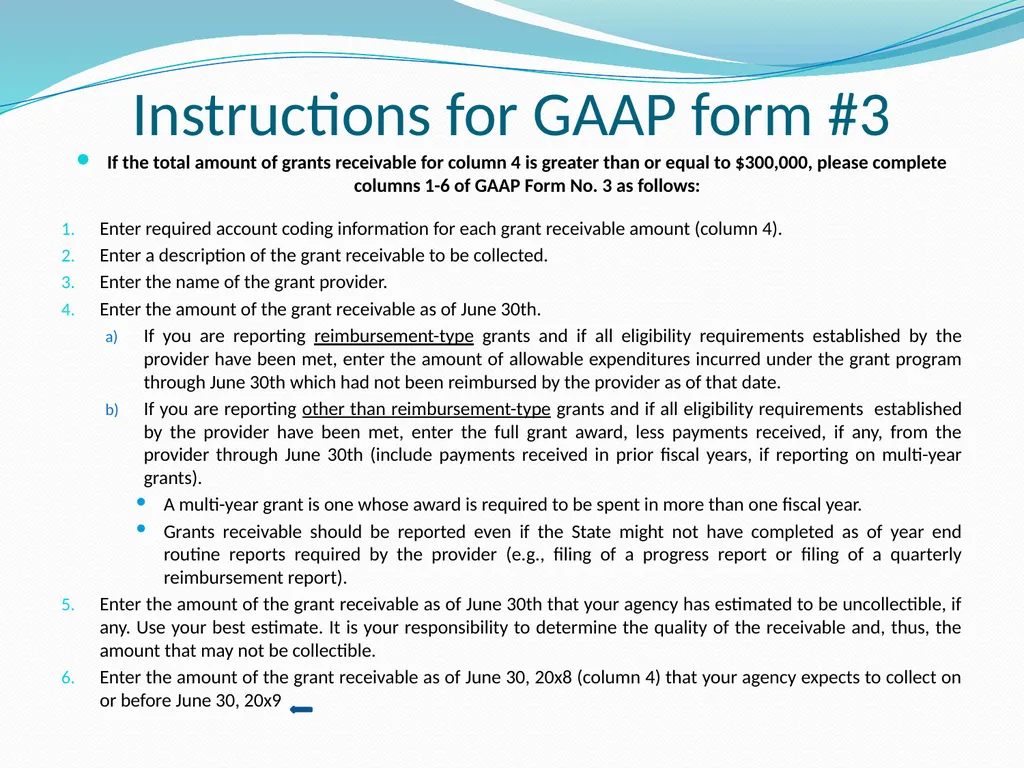
Instructions for GAAP form #3 If the total amount of grants receivable for column 4 is greater than or equal to $300,000, please complete columns 1-6 of GAAP Form No. 3 as follows:
Enter required account coding information for each grant receivable amount (column 4).
Enter a description of the grant receivable to be collected.
Enter the name of the grant provider.
Enter the amount of the grant receivable as of June 30th.
If you are reporting reimbursement-type grants and if all eligibility requirements established by the provider have been met, enter the amount of allowable expenditures incurred under the grant program through June 30th which had not been reimbursed by the provider as of that date.
If you are reporting other than reimbursement-type grants and if all eligibility requirements established by the provider have been met, enter the full grant award, less payments received, if any, from the provider through June 30th (include payments received in prior fiscal years, if reporting on multi-year grants).
A multi-year grant is one whose award is required to be spent in more than one fiscal year.
Grants receivable should be reported even if the State might not have completed as of year end routine reports required by the provider (e.g., filing of a progress report or filing of a quarterly reimbursement report).
Enter the amount of the grant receivable as of June 30th that your agency has estimated to be uncollectible, if any. Use your best estimate. It is your responsibility to determine the quality of the receivable and, thus, the amount that may not be collectible.
Enter the amount of the grant receivable as of June 30, 20x8 (column 4) that your agency expects to collect on or before June 30, 20x9<br>
Enter required account coding information for each grant receivable amount (column 4).
Enter a description of the grant receivable to be collected.
Enter the name of the grant provider.
Enter the amount of the grant receivable as of June 30th.
If you are reporting reimbursement-type grants and if all eligibility requirements established by the provider have been met, enter the amount of allowable expenditures incurred under the grant program through June 30th which had not been reimbursed by the provider as of that date.
If you are reporting other than reimbursement-type grants and if all eligibility requirements established by the provider have been met, enter the full grant award, less payments received, if any, from the provider through June 30th (include payments received in prior fiscal years, if reporting on multi-year grants).
A multi-year grant is one whose award is required to be spent in more than one fiscal year.
Grants receivable should be reported even if the State might not have completed as of year end routine reports required by the provider (e.g., filing of a progress report or filing of a quarterly reimbursement report).
Enter the amount of the grant receivable as of June 30th that your agency has estimated to be uncollectible, if any. Use your best estimate. It is your responsibility to determine the quality of the receivable and, thus, the amount that may not be collectible.
Enter the amount of the grant receivable as of June 30, 20x8 (column 4) that your agency expects to collect on or before June 30, 20x9<br>
30
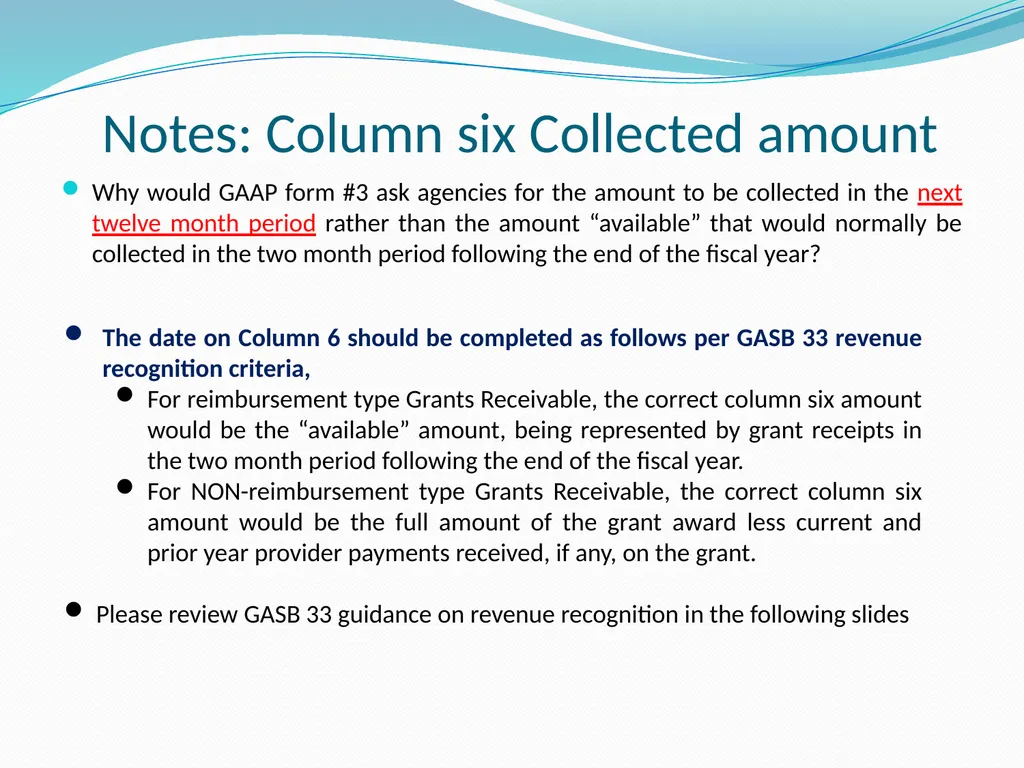
Notes: Column six Collected amount Why would GAAP form #3 ask agencies for the amount to be collected in the next twelve month period rather than the amount “available” that would normally be collected in the two month period following the end of the fiscal year? The date on Column 6 should be completed as follows per GASB 33 revenue recognition criteria,
For reimbursement type Grants Receivable, the correct column six amount would be the “available” amount, being represented by grant receipts in the two month period following the end of the fiscal year.
For NON-reimbursement type Grants Receivable, the correct column six amount would be the full amount of the grant award less current and prior year provider payments received, if any, on the grant.
Please review GASB 33 guidance on revenue recognition in the following slides<br>
For reimbursement type Grants Receivable, the correct column six amount would be the “available” amount, being represented by grant receipts in the two month period following the end of the fiscal year.
For NON-reimbursement type Grants Receivable, the correct column six amount would be the full amount of the grant award less current and prior year provider payments received, if any, on the grant.
Please review GASB 33 guidance on revenue recognition in the following slides<br>
31
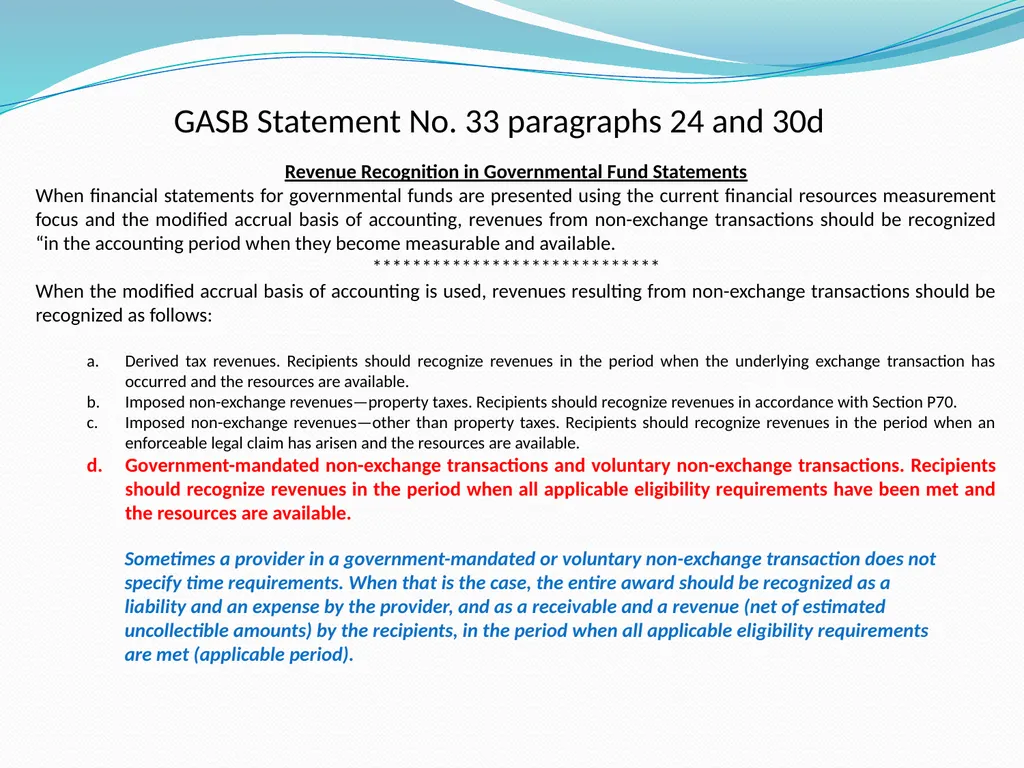
Revenue Recognition in Governmental Fund Statements
When financial statements for governmental funds are presented using the current financial resources measurement focus and the modified accrual basis of accounting, revenues from non-exchange transactions should be recognized “in the accounting period when they become measurable and available.
*****************************
When the modified accrual basis of accounting is used, revenues resulting from non-exchange transactions should be recognized as follows:
Derived tax revenues. Recipients should recognize revenues in the period when the underlying exchange transaction has occurred and the resources are available.
Imposed non-exchange revenues—property taxes. Recipients should recognize revenues in accordance with Section P70.
Imposed non-exchange revenues—other than property taxes. Recipients should recognize revenues in the period when an enforceable legal claim has arisen and the resources are available.
Government-mandated non-exchange transactions and voluntary non-exchange transactions. Recipients should recognize revenues in the period when all applicable eligibility requirements have been met and the resources are available. GASB Statement No. 33 paragraphs 24 and 30d Sometimes a provider in a government-mandated or voluntary non-exchange transaction does not specify time requirements. When that is the case, the entire award should be recognized as a liability and an expense by the provider, and as a receivable and a revenue (net of estimated uncollectible amounts) by the recipients, in the period when all applicable eligibility requirements are met (applicable period).<br>
When financial statements for governmental funds are presented using the current financial resources measurement focus and the modified accrual basis of accounting, revenues from non-exchange transactions should be recognized “in the accounting period when they become measurable and available.
*****************************
When the modified accrual basis of accounting is used, revenues resulting from non-exchange transactions should be recognized as follows:
Derived tax revenues. Recipients should recognize revenues in the period when the underlying exchange transaction has occurred and the resources are available.
Imposed non-exchange revenues—property taxes. Recipients should recognize revenues in accordance with Section P70.
Imposed non-exchange revenues—other than property taxes. Recipients should recognize revenues in the period when an enforceable legal claim has arisen and the resources are available.
Government-mandated non-exchange transactions and voluntary non-exchange transactions. Recipients should recognize revenues in the period when all applicable eligibility requirements have been met and the resources are available. GASB Statement No. 33 paragraphs 24 and 30d Sometimes a provider in a government-mandated or voluntary non-exchange transaction does not specify time requirements. When that is the case, the entire award should be recognized as a liability and an expense by the provider, and as a receivable and a revenue (net of estimated uncollectible amounts) by the recipients, in the period when all applicable eligibility requirements are met (applicable period).<br>
32
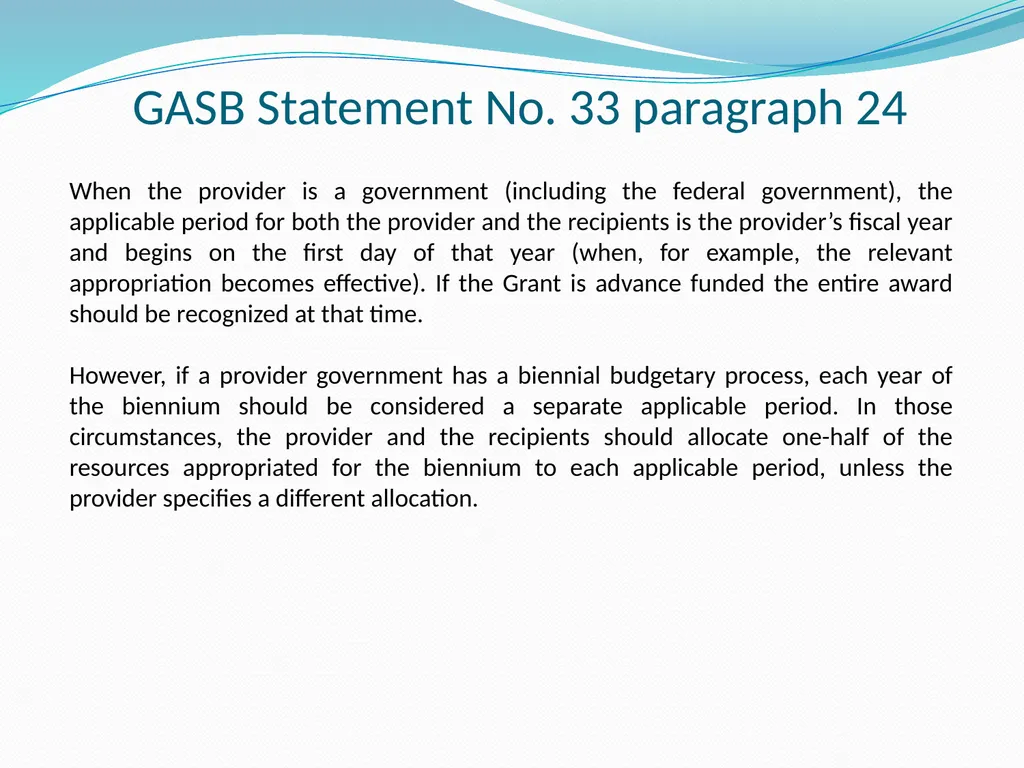
When the provider is a government (including the federal government), the applicable period for both the provider and the recipients is the provider’s fiscal year and begins on the first day of that year (when, for example, the relevant appropriation becomes effective). If the Grant is advance funded the entire award should be recognized at that time.
However, if a provider government has a biennial budgetary process, each year of the biennium should be considered a separate applicable period. In those circumstances, the provider and the recipients should allocate one-half of the resources appropriated for the biennium to each applicable period, unless the provider specifies a different allocation. GASB Statement No. 33 paragraph 24<br>
However, if a provider government has a biennial budgetary process, each year of the biennium should be considered a separate applicable period. In those circumstances, the provider and the recipients should allocate one-half of the resources appropriated for the biennium to each applicable period, unless the provider specifies a different allocation. GASB Statement No. 33 paragraph 24<br>
33
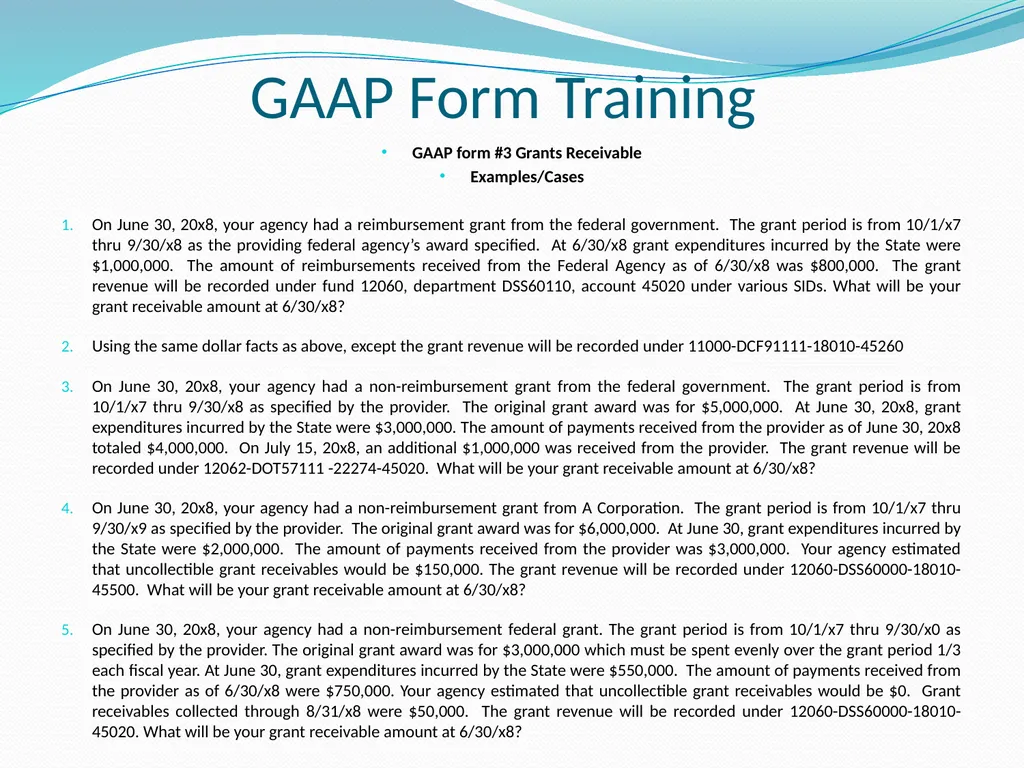
GAAP Form Training GAAP form #3 Grants Receivable
Examples/Cases
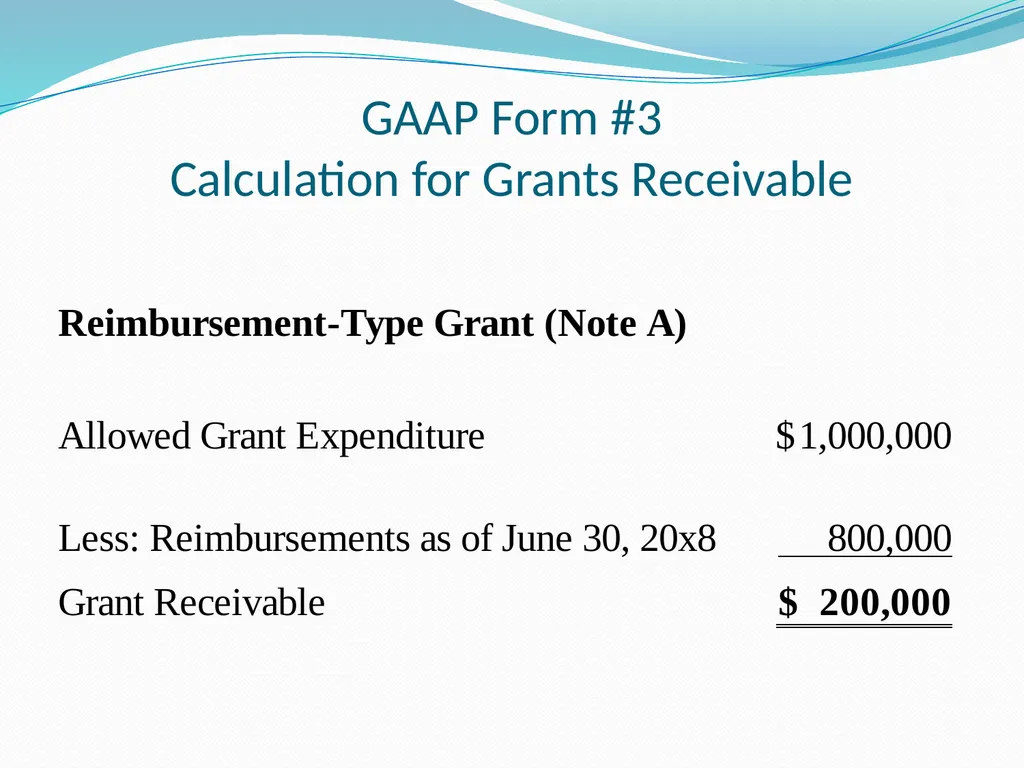
On June 30, 20x8, your agency had a reimbursement grant from the federal government. The grant period is from 10/1/x7 thru 9/30/x8 as the providing federal agency’s award specified. At 6/30/x8 grant expenditures incurred by the State were $1,000,000. The amount of reimbursements received from the Federal Agency as of 6/30/x8 was $800,000. The grant revenue will be recorded under fund 12060, department DSS60110, account 45020 under various SIDs. What will be your grant receivable amount at 6/30/x8?
Using the same dollar facts as above, except the grant revenue will be recorded under 11000-DCF91111-18010-45260
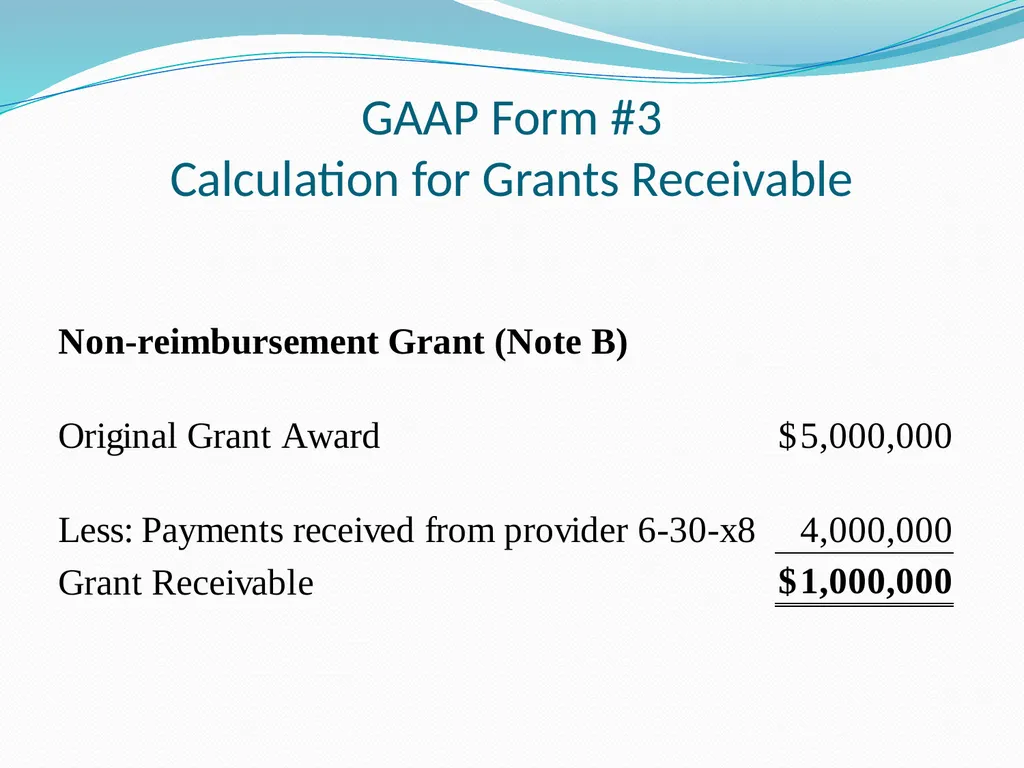
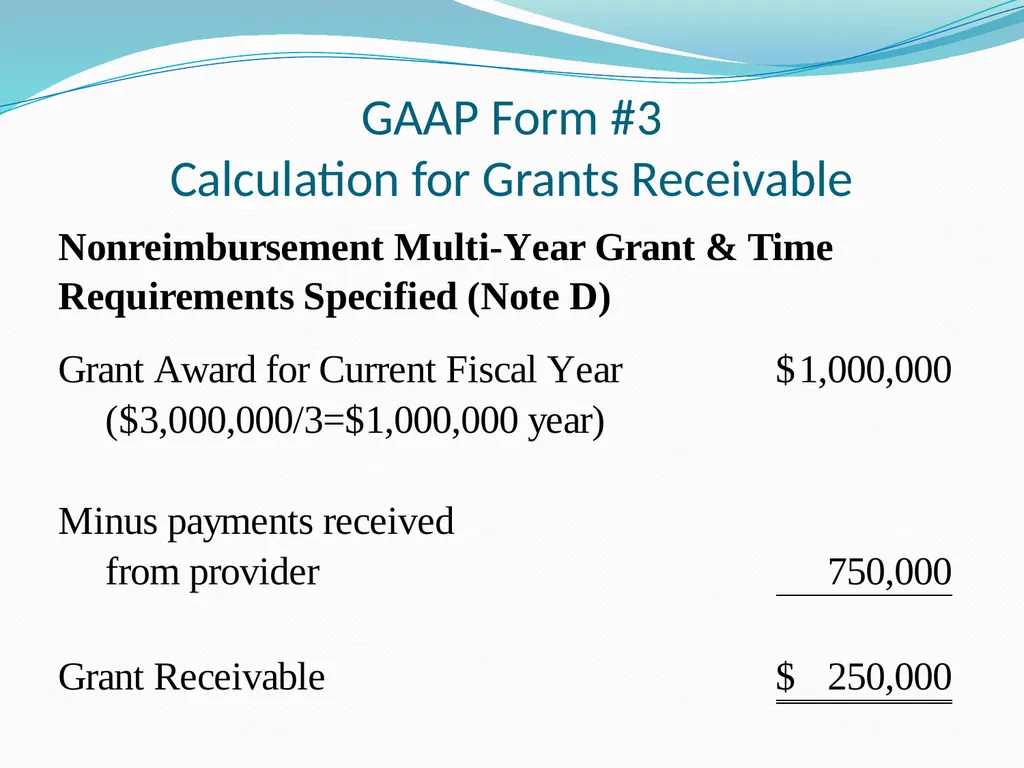
On June 30, 20x8, your agency had a non-reimbursement grant from the federal government. The grant period is from 10/1/x7 thru 9/30/x8 as specified by the provider. The original grant award was for $5,000,000. At June 30, 20x8, grant expenditures incurred by the State were $3,000,000. The amount of payments received from the provider as of June 30, 20x8 totaled $4,000,000. On July 15, 20x8, an additional $1,000,000 was received from the provider. The grant revenue will be recorded under 12062-DOT57111 -22274-45020. What will be your grant receivable amount at 6/30/x8?
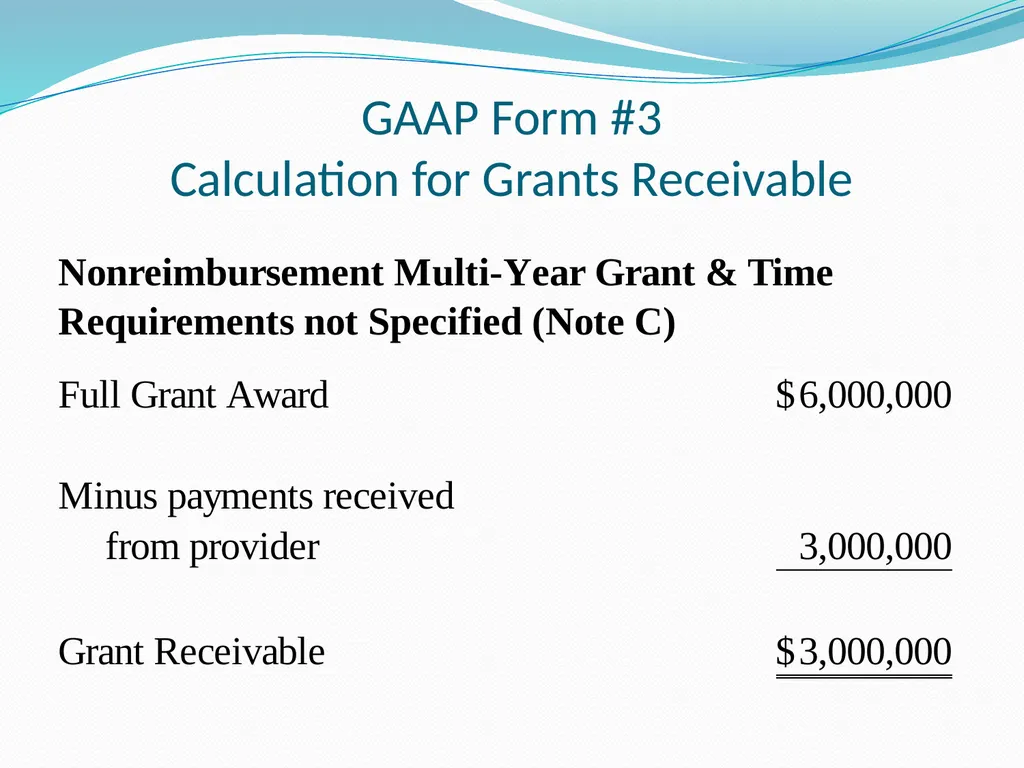
On June 30, 20x8, your agency had a non-reimbursement grant from A Corporation. The grant period is from 10/1/x7 thru 9/30/x9 as specified by the provider. The original grant award was for $6,000,000. At June 30, grant expenditures incurred by the State were $2,000,000. The amount of payments received from the provider was $3,000,000. Your agency estimated that uncollectible grant receivables would be $150,000. The grant revenue will be recorded under 12060-DSS60000-18010-45500. What will be your grant receivable amount at 6/30/x8?
On June 30, 20x8, your agency had a non-reimbursement federal grant. The grant period is from 10/1/x7 thru 9/30/x0 as specified by the provider. The original grant award was for $3,000,000 which must be spent evenly over the grant period 1/3 each fiscal year. At June 30, grant expenditures incurred by the State were $550,000. The amount of payments received from the provider as of 6/30/x8 were $750,000. Your agency estimated that uncollectible grant receivables would be $0. Grant receivables collected through 8/31/x8 were $50,000. The grant revenue will be recorded under 12060-DSS60000-18010-45020. What will be your grant receivable amount at 6/30/x8?<br>
Examples/Cases
On June 30, 20x8, your agency had a reimbursement grant from the federal government. The grant period is from 10/1/x7 thru 9/30/x8 as the providing federal agency’s award specified. At 6/30/x8 grant expenditures incurred by the State were $1,000,000. The amount of reimbursements received from the Federal Agency as of 6/30/x8 was $800,000. The grant revenue will be recorded under fund 12060, department DSS60110, account 45020 under various SIDs. What will be your grant receivable amount at 6/30/x8?
Using the same dollar facts as above, except the grant revenue will be recorded under 11000-DCF91111-18010-45260
On June 30, 20x8, your agency had a non-reimbursement grant from the federal government. The grant period is from 10/1/x7 thru 9/30/x8 as specified by the provider. The original grant award was for $5,000,000. At June 30, 20x8, grant expenditures incurred by the State were $3,000,000. The amount of payments received from the provider as of June 30, 20x8 totaled $4,000,000. On July 15, 20x8, an additional $1,000,000 was received from the provider. The grant revenue will be recorded under 12062-DOT57111 -22274-45020. What will be your grant receivable amount at 6/30/x8?
On June 30, 20x8, your agency had a non-reimbursement grant from A Corporation. The grant period is from 10/1/x7 thru 9/30/x9 as specified by the provider. The original grant award was for $6,000,000. At June 30, grant expenditures incurred by the State were $2,000,000. The amount of payments received from the provider was $3,000,000. Your agency estimated that uncollectible grant receivables would be $150,000. The grant revenue will be recorded under 12060-DSS60000-18010-45500. What will be your grant receivable amount at 6/30/x8?
On June 30, 20x8, your agency had a non-reimbursement federal grant. The grant period is from 10/1/x7 thru 9/30/x0 as specified by the provider. The original grant award was for $3,000,000 which must be spent evenly over the grant period 1/3 each fiscal year. At June 30, grant expenditures incurred by the State were $550,000. The amount of payments received from the provider as of 6/30/x8 were $750,000. Your agency estimated that uncollectible grant receivables would be $0. Grant receivables collected through 8/31/x8 were $50,000. The grant revenue will be recorded under 12060-DSS60000-18010-45020. What will be your grant receivable amount at 6/30/x8?<br>
34
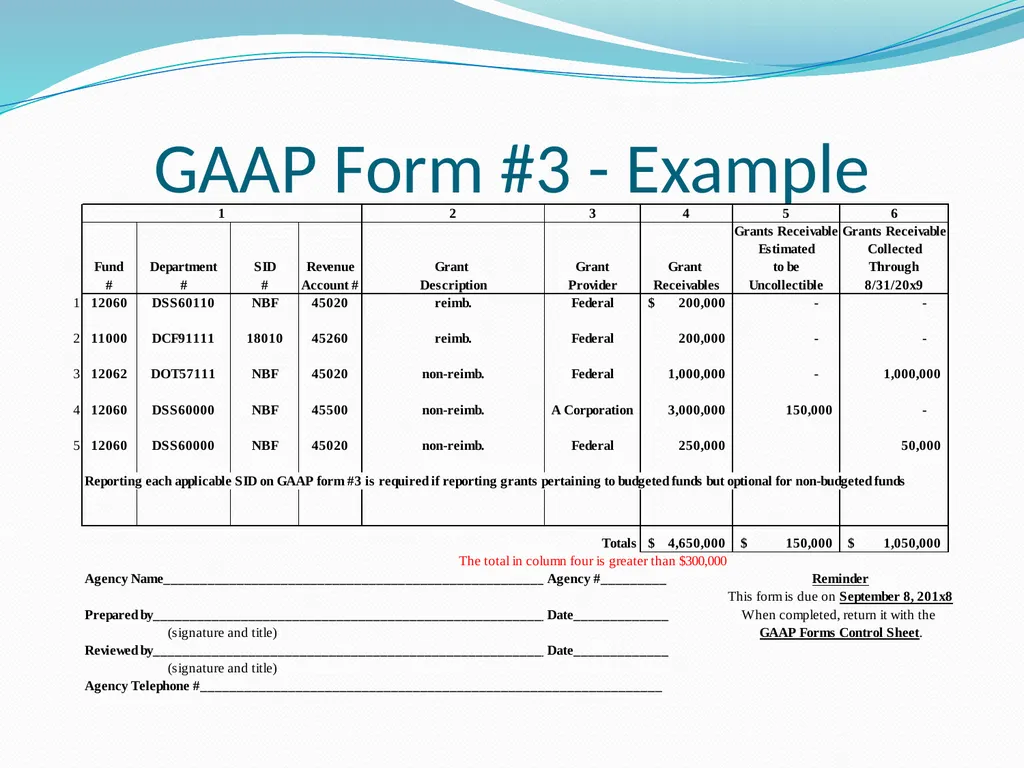
GAAP Form #3 - Example<br>
35
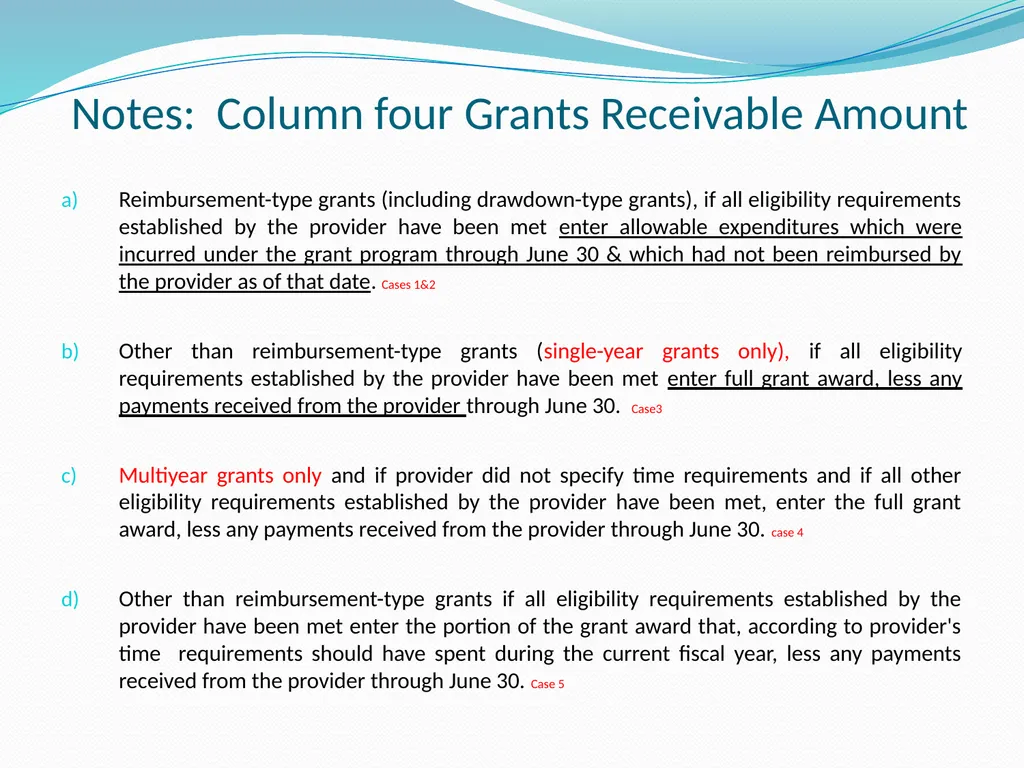
Notes: Column four Grants Receivable Amount Reimbursement-type grants (including drawdown-type grants), if all eligibility requirements established by the provider have been met enter allowable expenditures which were incurred under the grant program through June 30 & which had not been reimbursed by the provider as of that date. Cases 1&2
Other than reimbursement-type grants (single-year grants only), if all eligibility requirements established by the provider have been met enter full grant award, less any payments received from the provider through June 30. Case3
Multiyear grants only and if provider did not specify time requirements and if all other eligibility requirements established by the provider have been met, enter the full grant award, less any payments received from the provider through June 30. case 4
Other than reimbursement-type grants if all eligibility requirements established by the provider have been met enter the portion of the grant award that, according to provider's time requirements should have spent during the current fiscal year, less any payments received from the provider through June 30. Case 5<br>
Other than reimbursement-type grants (single-year grants only), if all eligibility requirements established by the provider have been met enter full grant award, less any payments received from the provider through June 30. Case3
Multiyear grants only and if provider did not specify time requirements and if all other eligibility requirements established by the provider have been met, enter the full grant award, less any payments received from the provider through June 30. case 4
Other than reimbursement-type grants if all eligibility requirements established by the provider have been met enter the portion of the grant award that, according to provider's time requirements should have spent during the current fiscal year, less any payments received from the provider through June 30. Case 5<br>
36
GAAP Form #3
Calculation for Grants Receivable<br>
37
GAAP Form #3
Calculation for Grants Receivable<br>
38
GAAP Form #3
Calculation for Grants Receivable<br>
39
GAAP Form #3
Calculation for Grants Receivable<br>
40
GAAP
FORM #
4 Instructions for completing the form and
Case Examples for preparation of Standard GAAP forms<br>
Case Examples for preparation of Standard GAAP forms<br>
41
GAAP Closing Package GAAP form #4 unearned Revenue
Advances<br>
Advances<br>
42
GAAP Form #4
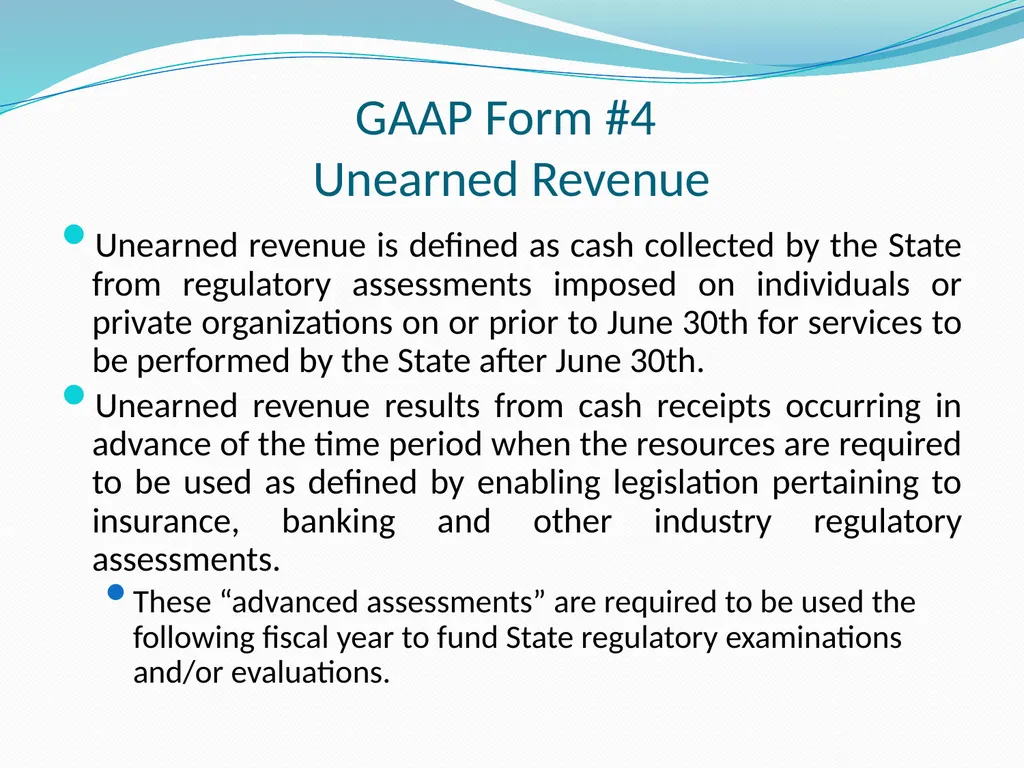
Unearned Revenue Unearned revenue is defined as cash collected by the State from regulatory assessments imposed on individuals or private organizations on or prior to June 30th for services to be performed by the State after June 30th.
Unearned revenue results from cash receipts occurring in advance of the time period when the resources are required to be used as defined by enabling legislation pertaining to insurance, banking and other industry regulatory assessments.
These “advanced assessments” are required to be used the following fiscal year to fund State regulatory examinations and/or evaluations.<br>
Unearned revenue results from cash receipts occurring in advance of the time period when the resources are required to be used as defined by enabling legislation pertaining to insurance, banking and other industry regulatory assessments.
These “advanced assessments” are required to be used the following fiscal year to fund State regulatory examinations and/or evaluations.<br>
43
Instructions for GAAP form #4 Do not report on this form fees collected in advance for licenses, permits, or certificates.<br>
44
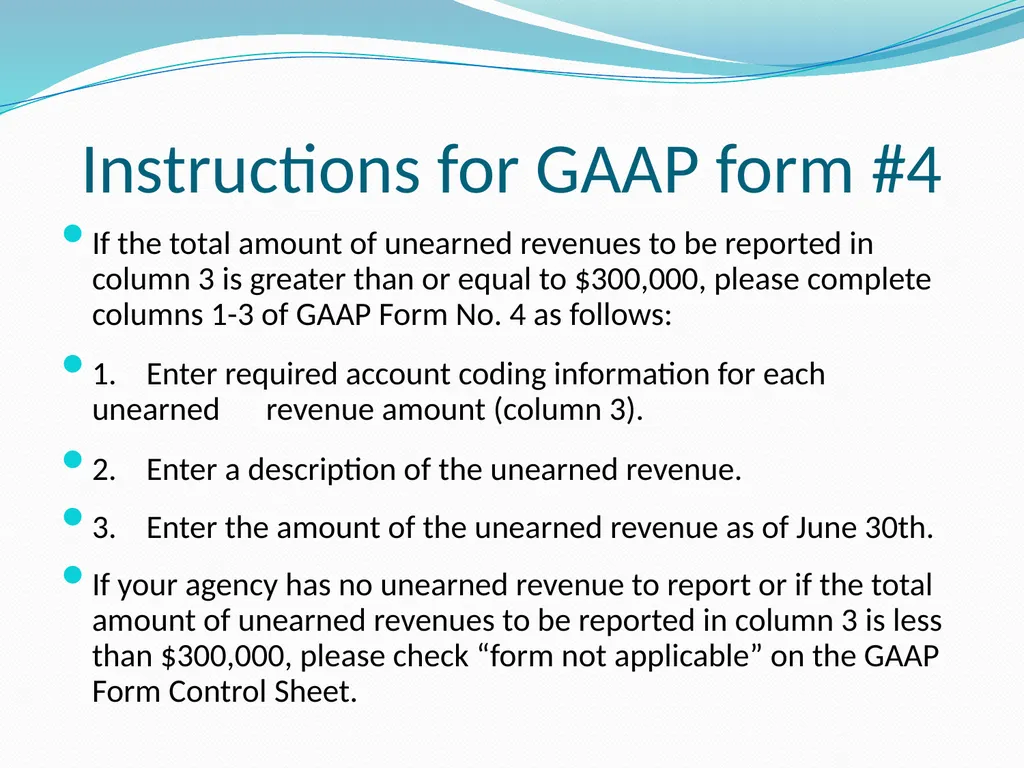
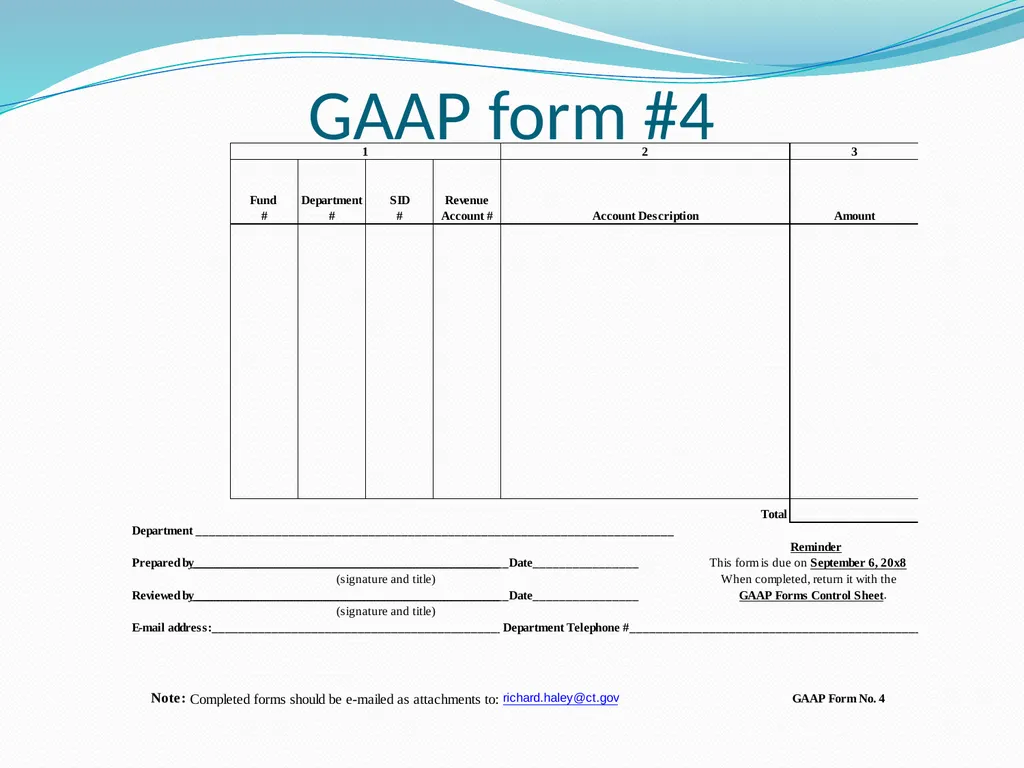
Instructions for GAAP form #4 If the total amount of unearned revenues to be reported in column 3 is greater than or equal to $300,000, please complete columns 1-3 of GAAP Form No. 4 as follows:
1. Enter required account coding information for each unearned revenue amount (column 3).
2. Enter a description of the unearned revenue.
3. Enter the amount of the unearned revenue as of June 30th.
If your agency has no unearned revenue to report or if the total amount of unearned revenues to be reported in column 3 is less than $300,000, please check “form not applicable” on the GAAP Form Control Sheet.<br>
1. Enter required account coding information for each unearned revenue amount (column 3).
2. Enter a description of the unearned revenue.
3. Enter the amount of the unearned revenue as of June 30th.
If your agency has no unearned revenue to report or if the total amount of unearned revenues to be reported in column 3 is less than $300,000, please check “form not applicable” on the GAAP Form Control Sheet.<br>
45
GAAP form #4<br>
46
GAAP Form Training GAAP form #4 Unearned Revenue
Examples/Cases
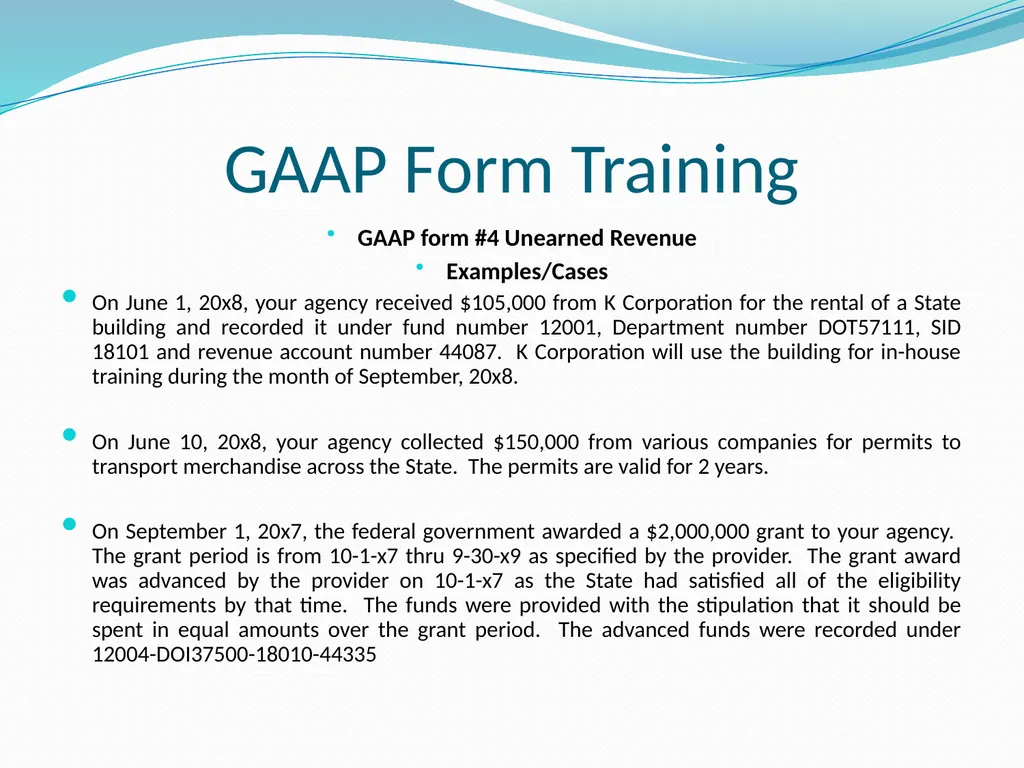
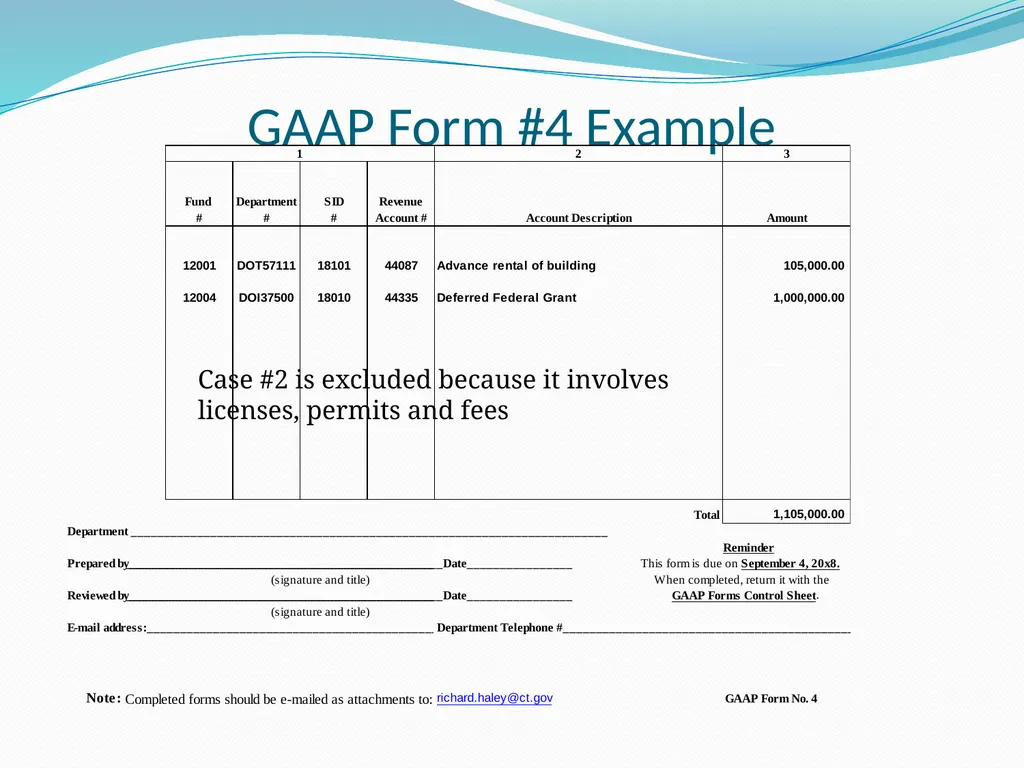
On June 1, 20x8, your agency received $105,000 from K Corporation for the rental of a State building and recorded it under fund number 12001, Department number DOT57111, SID 18101 and revenue account number 44087. K Corporation will use the building for in-house training during the month of September, 20x8.
On June 10, 20x8, your agency collected $150,000 from various companies for permits to transport merchandise across the State. The permits are valid for 2 years.
On September 1, 20x7, the federal government awarded a $2,000,000 grant to your agency. The grant period is from 10-1-x7 thru 9-30-x9 as specified by the provider. The grant award was advanced by the provider on 10-1-x7 as the State had satisfied all of the eligibility requirements by that time. The funds were provided with the stipulation that it should be spent in equal amounts over the grant period. The advanced funds were recorded under 12004-DOI37500-18010-44335<br>
Examples/Cases
On June 1, 20x8, your agency received $105,000 from K Corporation for the rental of a State building and recorded it under fund number 12001, Department number DOT57111, SID 18101 and revenue account number 44087. K Corporation will use the building for in-house training during the month of September, 20x8.
On June 10, 20x8, your agency collected $150,000 from various companies for permits to transport merchandise across the State. The permits are valid for 2 years.
On September 1, 20x7, the federal government awarded a $2,000,000 grant to your agency. The grant period is from 10-1-x7 thru 9-30-x9 as specified by the provider. The grant award was advanced by the provider on 10-1-x7 as the State had satisfied all of the eligibility requirements by that time. The funds were provided with the stipulation that it should be spent in equal amounts over the grant period. The advanced funds were recorded under 12004-DOI37500-18010-44335<br>
47
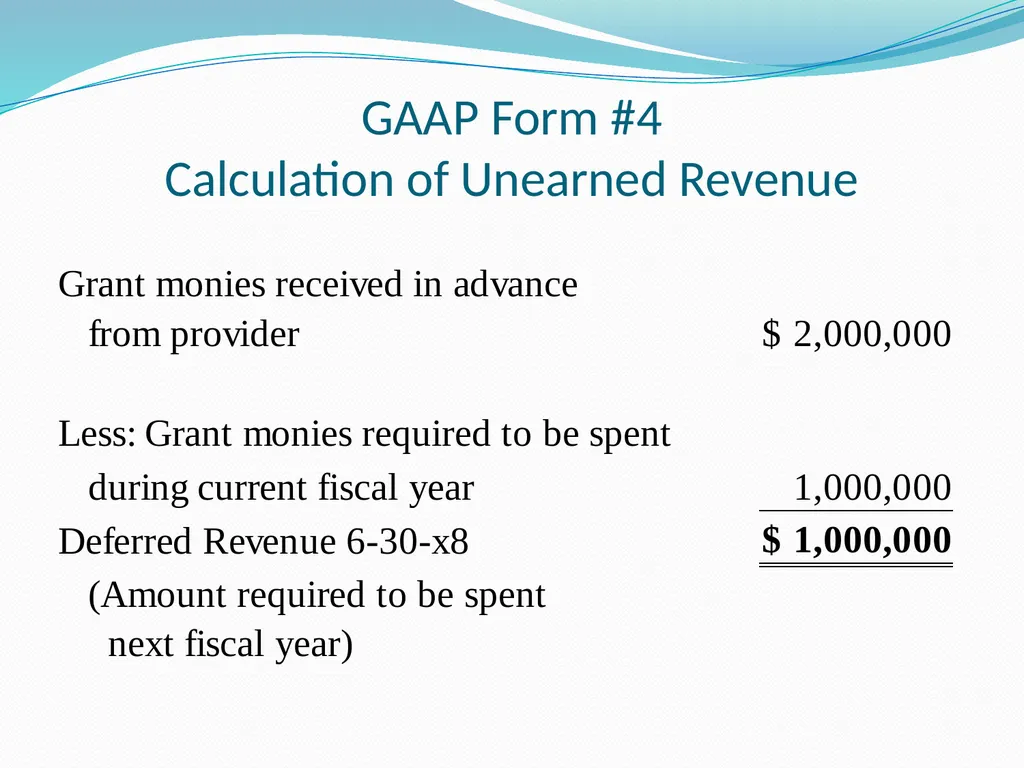
GAAP Form #4 Example Case #2 is excluded because it involves licenses, permits and fees<br>
48
GAAP Form #4
Calculation of Unearned Revenue<br>
49
GAAP
FORM #
5 Instructions for completing the form and
Case Examples for preparation of Standard GAAP forms<br>
Case Examples for preparation of Standard GAAP forms<br>
50
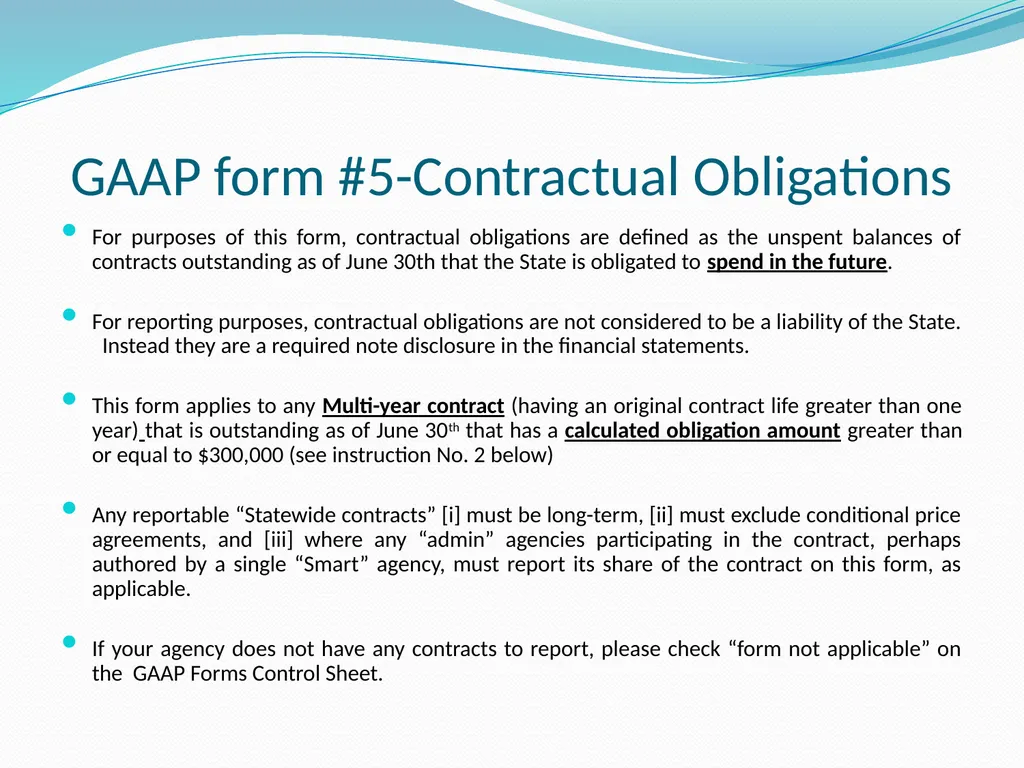
GAAP form #5-Contractual Obligations For purposes of this form, contractual obligations are defined as the unspent balances of contracts outstanding as of June 30th that the State is obligated to spend in the future.
For reporting purposes, contractual obligations are not considered to be a liability of the State. Instead they are a required note disclosure in the financial statements.
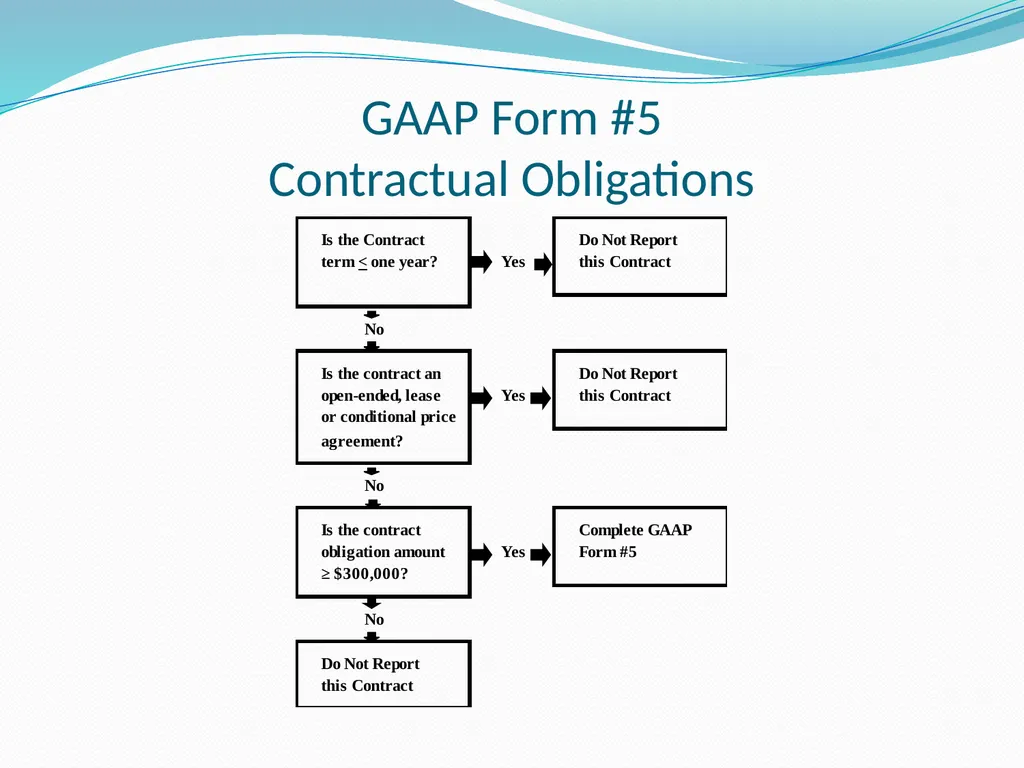
This form applies to any Multi-year contract (having an original contract life greater than one year) that is outstanding as of June 30th that has a calculated obligation amount greater than or equal to $300,000 (see instruction No. 2 below)
Any reportable “Statewide contracts” [i] must be long-term, [ii] must exclude conditional price agreements, and [iii] where any “admin” agencies participating in the contract, perhaps authored by a single “Smart” agency, must report its share of the contract on this form, as applicable.
If your agency does not have any contracts to report, please check “form not applicable” on the GAAP Forms Control Sheet.<br>
For reporting purposes, contractual obligations are not considered to be a liability of the State. Instead they are a required note disclosure in the financial statements.
This form applies to any Multi-year contract (having an original contract life greater than one year) that is outstanding as of June 30th that has a calculated obligation amount greater than or equal to $300,000 (see instruction No. 2 below)
Any reportable “Statewide contracts” [i] must be long-term, [ii] must exclude conditional price agreements, and [iii] where any “admin” agencies participating in the contract, perhaps authored by a single “Smart” agency, must report its share of the contract on this form, as applicable.
If your agency does not have any contracts to report, please check “form not applicable” on the GAAP Forms Control Sheet.<br>
51
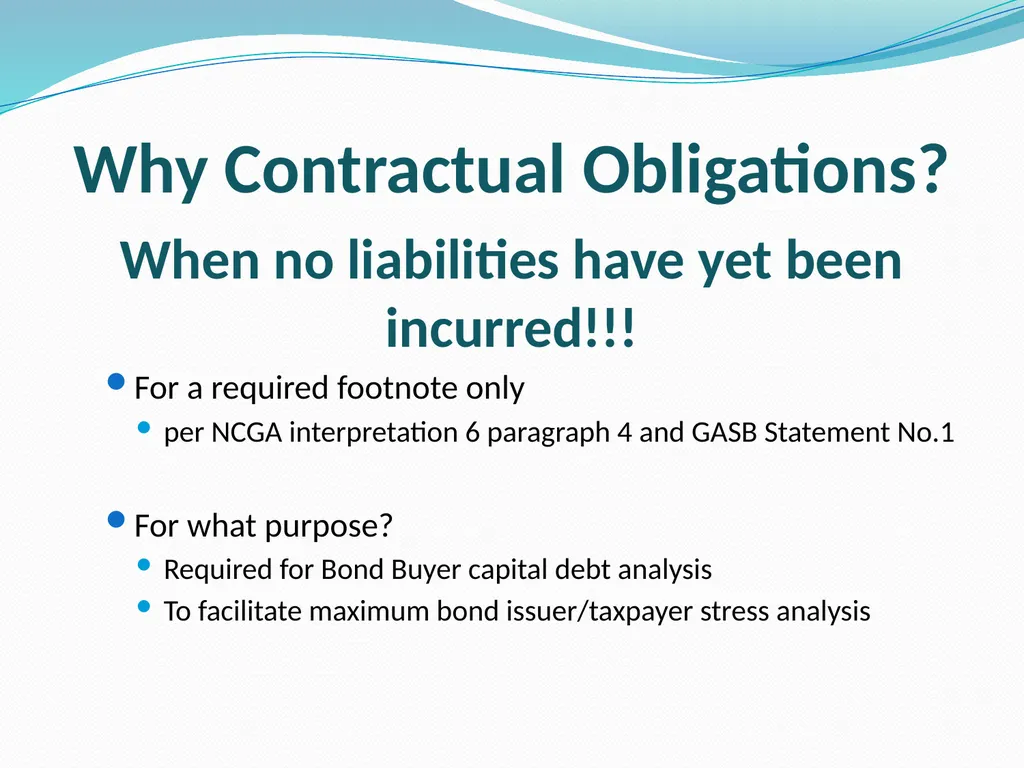
Why Contractual Obligations? When no liabilities have yet been incurred!!!
For a required footnote only
per NCGA interpretation 6 paragraph 4 and GASB Statement No.1
For what purpose?
Required for Bond Buyer capital debt analysis
To facilitate maximum bond issuer/taxpayer stress analysis<br>
For a required footnote only
per NCGA interpretation 6 paragraph 4 and GASB Statement No.1
For what purpose?
Required for Bond Buyer capital debt analysis
To facilitate maximum bond issuer/taxpayer stress analysis<br>
52
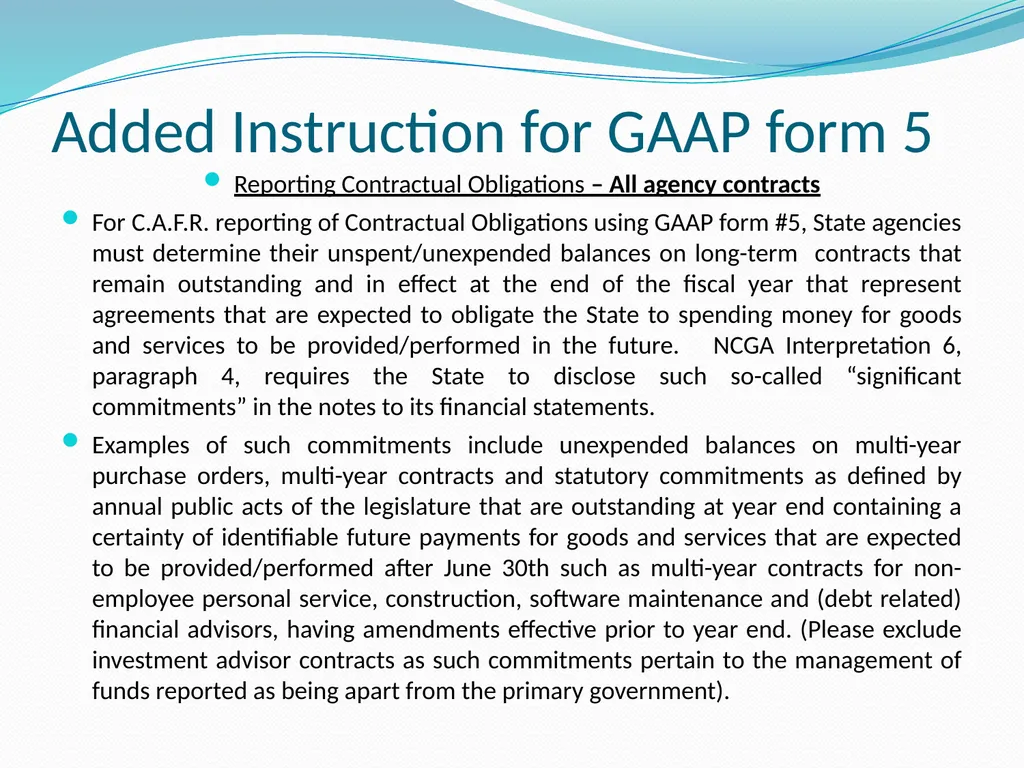
Added Instruction for GAAP form 5 Reporting Contractual Obligations – All agency contracts
For C.A.F.R. reporting of Contractual Obligations using GAAP form #5, State agencies must determine their unspent/unexpended balances on long-term contracts that remain outstanding and in effect at the end of the fiscal year that represent agreements that are expected to obligate the State to spending money for goods and services to be provided/performed in the future. NCGA Interpretation 6, paragraph 4, requires the State to disclose such so-called “significant commitments” in the notes to its financial statements.
Examples of such commitments include unexpended balances on multi-year purchase orders, multi-year contracts and statutory commitments as defined by annual public acts of the legislature that are outstanding at year end containing a certainty of identifiable future payments for goods and services that are expected to be provided/performed after June 30th such as multi-year contracts for non-employee personal service, construction, software maintenance and (debt related) financial advisors, having amendments effective prior to year end. (Please exclude investment advisor contracts as such commitments pertain to the management of funds reported as being apart from the primary government).<br>
For C.A.F.R. reporting of Contractual Obligations using GAAP form #5, State agencies must determine their unspent/unexpended balances on long-term contracts that remain outstanding and in effect at the end of the fiscal year that represent agreements that are expected to obligate the State to spending money for goods and services to be provided/performed in the future. NCGA Interpretation 6, paragraph 4, requires the State to disclose such so-called “significant commitments” in the notes to its financial statements.
Examples of such commitments include unexpended balances on multi-year purchase orders, multi-year contracts and statutory commitments as defined by annual public acts of the legislature that are outstanding at year end containing a certainty of identifiable future payments for goods and services that are expected to be provided/performed after June 30th such as multi-year contracts for non-employee personal service, construction, software maintenance and (debt related) financial advisors, having amendments effective prior to year end. (Please exclude investment advisor contracts as such commitments pertain to the management of funds reported as being apart from the primary government).<br>
53
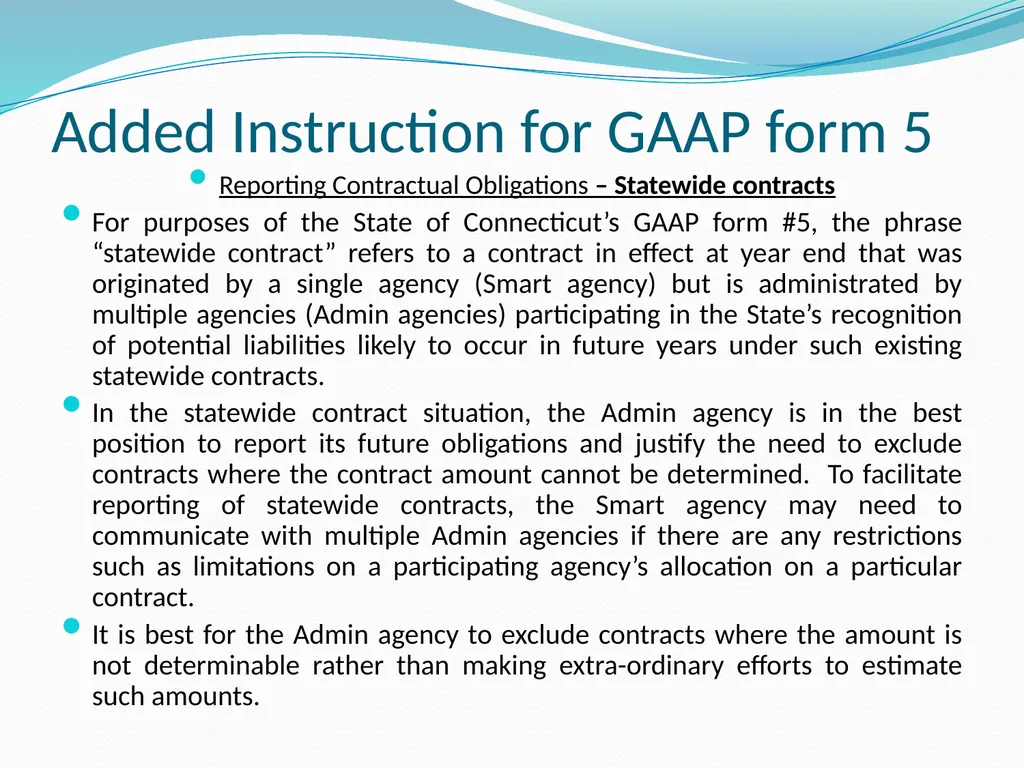
Added Instruction for GAAP form 5 Reporting Contractual Obligations – Statewide contracts
For purposes of the State of Connecticut’s GAAP form #5, the phrase “statewide contract” refers to a contract in effect at year end that was originated by a single agency (Smart agency) but is administrated by multiple agencies (Admin agencies) participating in the State’s recognition of potential liabilities likely to occur in future years under such existing statewide contracts.
In the statewide contract situation, the Admin agency is in the best position to report its future obligations and justify the need to exclude contracts where the contract amount cannot be determined. To facilitate reporting of statewide contracts, the Smart agency may need to communicate with multiple Admin agencies if there are any restrictions such as limitations on a participating agency’s allocation on a particular contract.
It is best for the Admin agency to exclude contracts where the amount is not determinable rather than making extra-ordinary efforts to estimate such amounts.<br>
For purposes of the State of Connecticut’s GAAP form #5, the phrase “statewide contract” refers to a contract in effect at year end that was originated by a single agency (Smart agency) but is administrated by multiple agencies (Admin agencies) participating in the State’s recognition of potential liabilities likely to occur in future years under such existing statewide contracts.
In the statewide contract situation, the Admin agency is in the best position to report its future obligations and justify the need to exclude contracts where the contract amount cannot be determined. To facilitate reporting of statewide contracts, the Smart agency may need to communicate with multiple Admin agencies if there are any restrictions such as limitations on a participating agency’s allocation on a particular contract.
It is best for the Admin agency to exclude contracts where the amount is not determinable rather than making extra-ordinary efforts to estimate such amounts.<br>
54
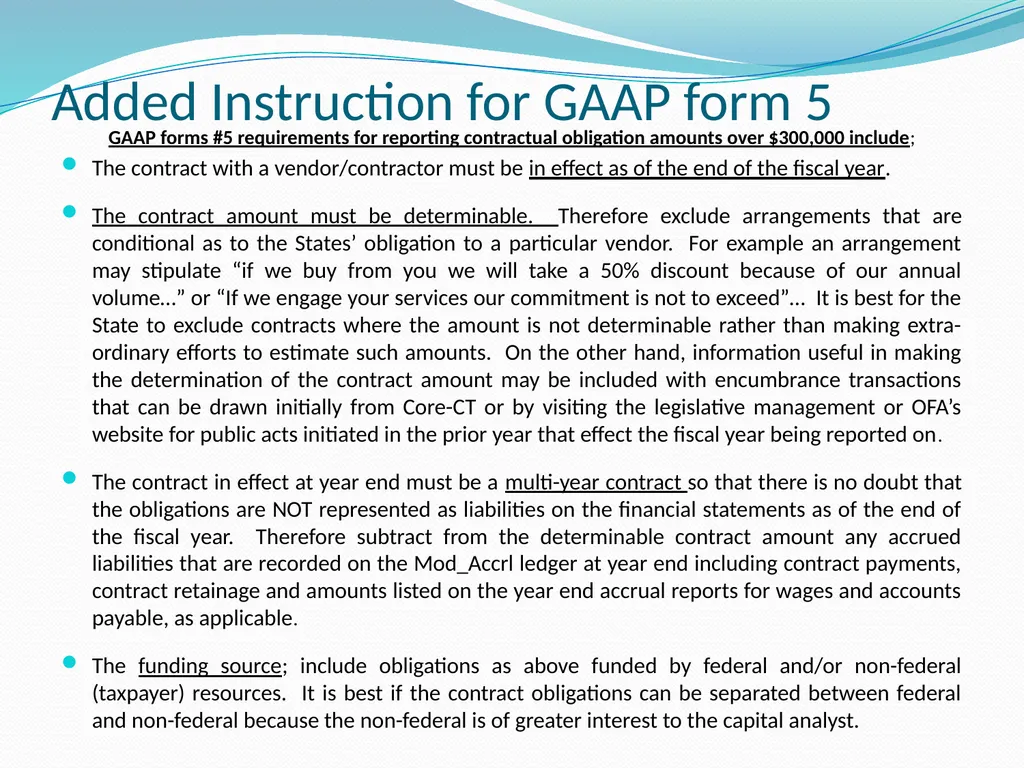
Added Instruction for GAAP form 5 GAAP forms #5 requirements for reporting contractual obligation amounts over $300,000 include;
The contract with a vendor/contractor must be in effect as of the end of the fiscal year.
The contract amount must be determinable. Therefore exclude arrangements that are conditional as to the States’ obligation to a particular vendor. For example an arrangement may stipulate “if we buy from you we will take a 50% discount because of our annual volume…” or “If we engage your services our commitment is not to exceed”… It is best for the State to exclude contracts where the amount is not determinable rather than making extra-ordinary efforts to estimate such amounts. On the other hand, information useful in making the determination of the contract amount may be included with encumbrance transactions that can be drawn initially from Core-CT or by visiting the legislative management or OFA’s website for public acts initiated in the prior year that effect the fiscal year being reported on.
The contract in effect at year end must be a multi-year contract so that there is no doubt that the obligations are NOT represented as liabilities on the financial statements as of the end of the fiscal year. Therefore subtract from the determinable contract amount any accrued liabilities that are recorded on the Mod_Accrl ledger at year end including contract payments, contract retainage and amounts listed on the year end accrual reports for wages and accounts payable, as applicable.
The funding source; include obligations as above funded by federal and/or non-federal (taxpayer) resources. It is best if the contract obligations can be separated between federal and non-federal because the non-federal is of greater interest to the capital analyst.<br>
The contract with a vendor/contractor must be in effect as of the end of the fiscal year.
The contract amount must be determinable. Therefore exclude arrangements that are conditional as to the States’ obligation to a particular vendor. For example an arrangement may stipulate “if we buy from you we will take a 50% discount because of our annual volume…” or “If we engage your services our commitment is not to exceed”… It is best for the State to exclude contracts where the amount is not determinable rather than making extra-ordinary efforts to estimate such amounts. On the other hand, information useful in making the determination of the contract amount may be included with encumbrance transactions that can be drawn initially from Core-CT or by visiting the legislative management or OFA’s website for public acts initiated in the prior year that effect the fiscal year being reported on.
The contract in effect at year end must be a multi-year contract so that there is no doubt that the obligations are NOT represented as liabilities on the financial statements as of the end of the fiscal year. Therefore subtract from the determinable contract amount any accrued liabilities that are recorded on the Mod_Accrl ledger at year end including contract payments, contract retainage and amounts listed on the year end accrual reports for wages and accounts payable, as applicable.
The funding source; include obligations as above funded by federal and/or non-federal (taxpayer) resources. It is best if the contract obligations can be separated between federal and non-federal because the non-federal is of greater interest to the capital analyst.<br>
55
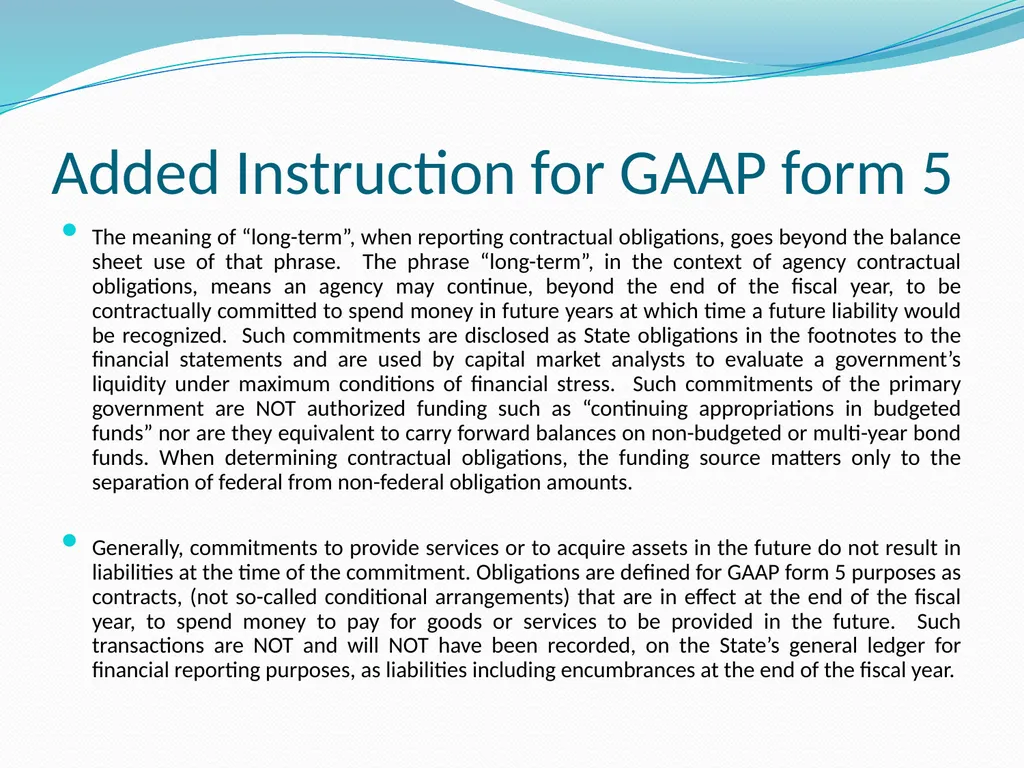
Added Instruction for GAAP form 5 The meaning of “long-term”, when reporting contractual obligations, goes beyond the balance sheet use of that phrase. The phrase “long-term”, in the context of agency contractual obligations, means an agency may continue, beyond the end of the fiscal year, to be contractually committed to spend money in future years at which time a future liability would be recognized. Such commitments are disclosed as State obligations in the footnotes to the financial statements and are used by capital market analysts to evaluate a government’s liquidity under maximum conditions of financial stress. Such commitments of the primary government are NOT authorized funding such as “continuing appropriations in budgeted funds” nor are they equivalent to carry forward balances on non-budgeted or multi-year bond funds. When determining contractual obligations, the funding source matters only to the separation of federal from non-federal obligation amounts.
Generally, commitments to provide services or to acquire assets in the future do not result in liabilities at the time of the commitment. Obligations are defined for GAAP form 5 purposes as contracts, (not so-called conditional arrangements) that are in effect at the end of the fiscal year, to spend money to pay for goods or services to be provided in the future. Such transactions are NOT and will NOT have been recorded, on the State’s general ledger for financial reporting purposes, as liabilities including encumbrances at the end of the fiscal year.<br>
Generally, commitments to provide services or to acquire assets in the future do not result in liabilities at the time of the commitment. Obligations are defined for GAAP form 5 purposes as contracts, (not so-called conditional arrangements) that are in effect at the end of the fiscal year, to spend money to pay for goods or services to be provided in the future. Such transactions are NOT and will NOT have been recorded, on the State’s general ledger for financial reporting purposes, as liabilities including encumbrances at the end of the fiscal year.<br>
56
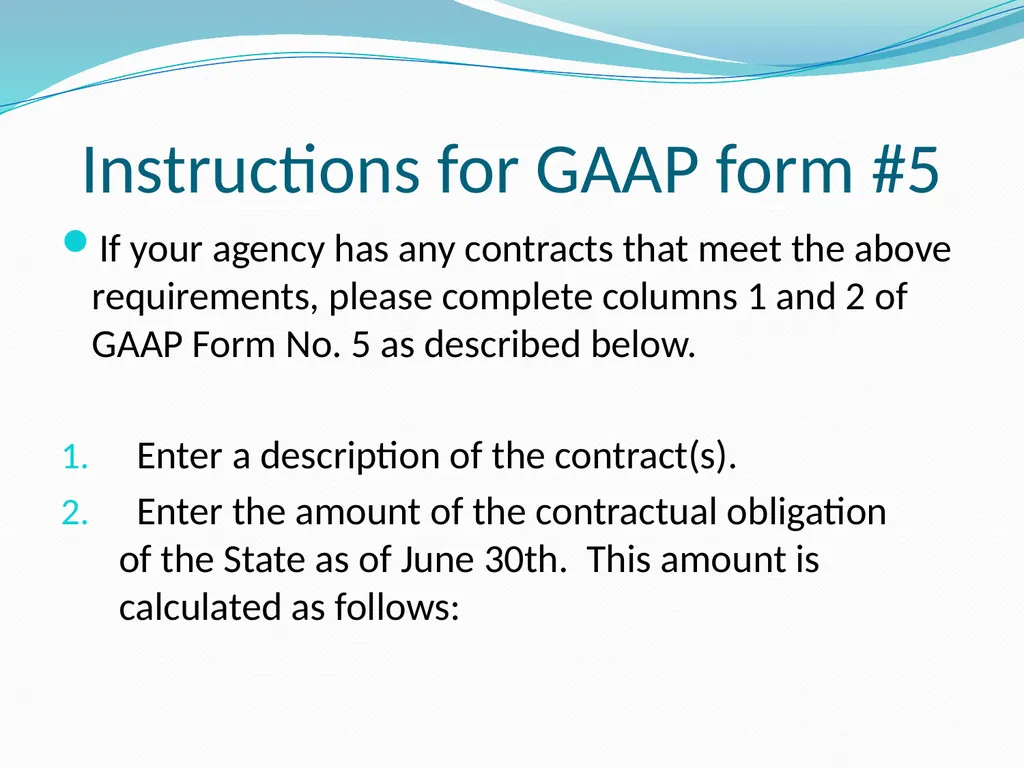
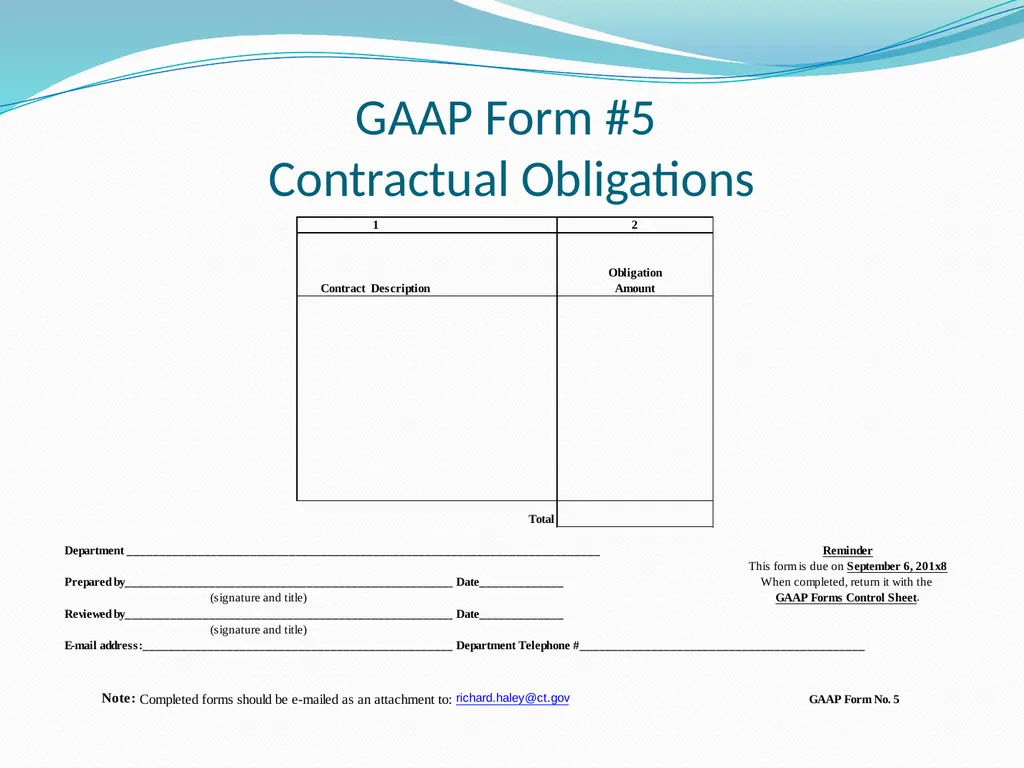
Instructions for GAAP form #5 If your agency has any contracts that meet the above requirements, please complete columns 1 and 2 of GAAP Form No. 5 as described below.
Enter a description of the contract(s).
Enter the amount of the contractual obligation of the State as of June 30th. This amount is calculated as follows:<br>
Enter a description of the contract(s).
Enter the amount of the contractual obligation of the State as of June 30th. This amount is calculated as follows:<br>
57
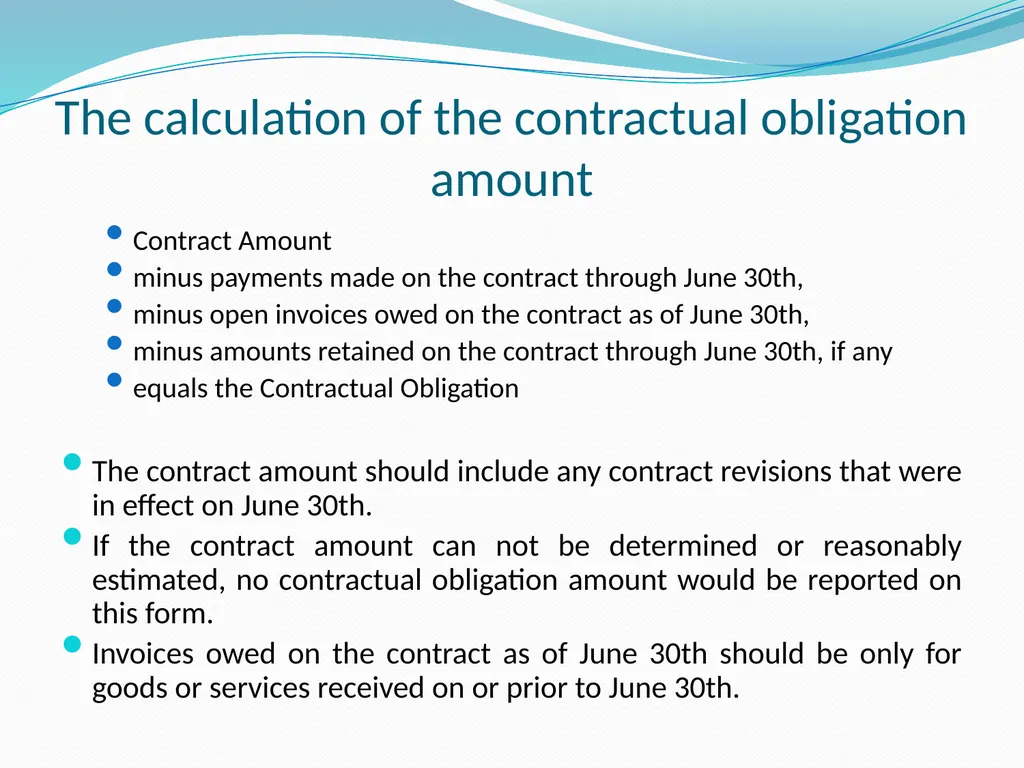
The calculation of the contractual obligation amount Contract Amount
minus payments made on the contract through June 30th,
minus open invoices owed on the contract as of June 30th,
minus amounts retained on the contract through June 30th, if any
equals the Contractual Obligation
The contract amount should include any contract revisions that were in effect on June 30th.
If the contract amount can not be determined or reasonably estimated, no contractual obligation amount would be reported on this form.
Invoices owed on the contract as of June 30th should be only for goods or services received on or prior to June 30th.<br>
minus payments made on the contract through June 30th,
minus open invoices owed on the contract as of June 30th,
minus amounts retained on the contract through June 30th, if any
equals the Contractual Obligation
The contract amount should include any contract revisions that were in effect on June 30th.
If the contract amount can not be determined or reasonably estimated, no contractual obligation amount would be reported on this form.
Invoices owed on the contract as of June 30th should be only for goods or services received on or prior to June 30th.<br>
58
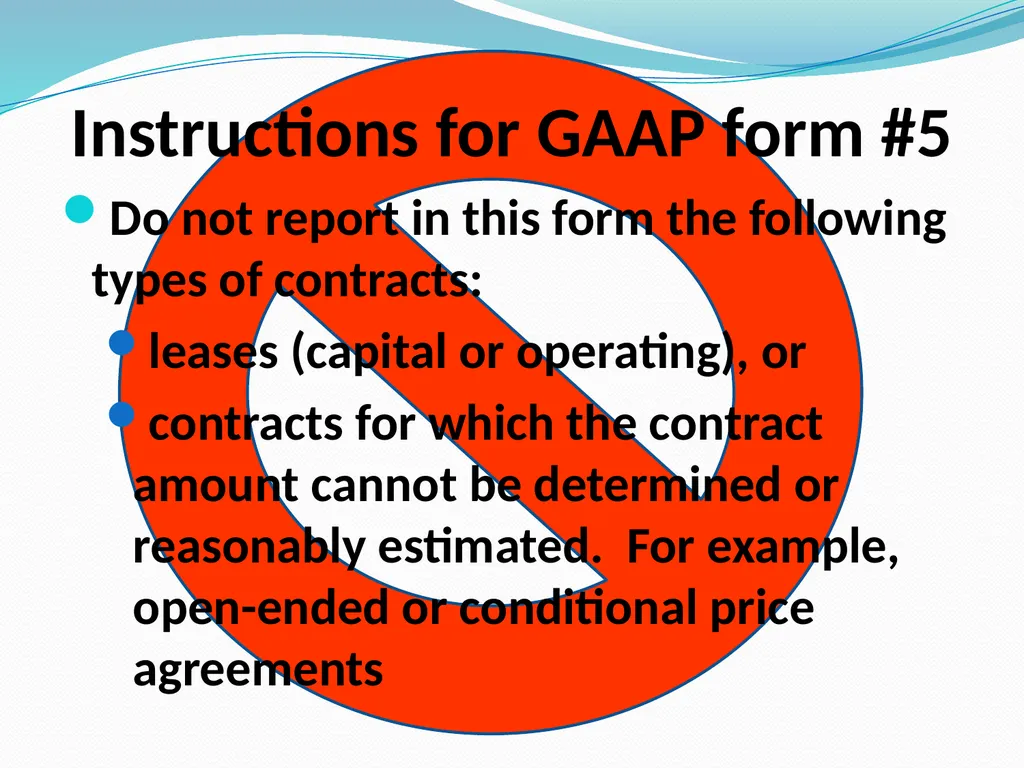
Instructions for GAAP form #5 Do not report in this form the following types of contracts:
leases (capital or operating), or
contracts for which the contract amount cannot be determined or reasonably estimated. For example, open-ended or conditional price agreements<br>
leases (capital or operating), or
contracts for which the contract amount cannot be determined or reasonably estimated. For example, open-ended or conditional price agreements<br>
59
GAAP Form #5
Contractual Obligations<br>
60
GAAP Form #5
Contractual Obligations<br>
61
GAAP Form Training GAAP form #5 Contractual Obligations
Examples/Cases
Unexpended Balance on Multi-year Contracts
Third Party Vendors and Non-employee personal service contracts<br>
Examples/Cases
Unexpended Balance on Multi-year Contracts
Third Party Vendors and Non-employee personal service contracts<br>
62
GAAP Form Training GAAP form #5 Contractual Obligations
Examples/Cases
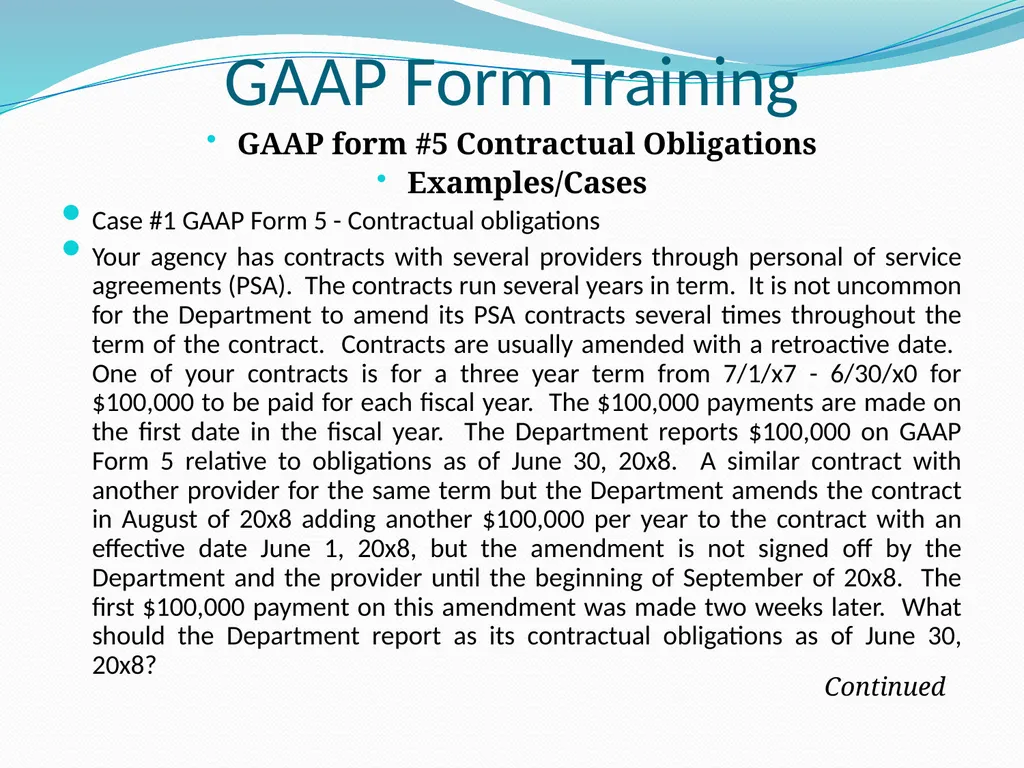
Case #1 GAAP Form 5 - Contractual obligations
Your agency has contracts with several providers through personal of service agreements (PSA). The contracts run several years in term. It is not uncommon for the Department to amend its PSA contracts several times throughout the term of the contract. Contracts are usually amended with a retroactive date. One of your contracts is for a three year term from 7/1/x7 - 6/30/x0 for $100,000 to be paid for each fiscal year. The $100,000 payments are made on the first date in the fiscal year. The Department reports $100,000 on GAAP Form 5 relative to obligations as of June 30, 20x8. A similar contract with another provider for the same term but the Department amends the contract in August of 20x8 adding another $100,000 per year to the contract with an effective date June 1, 20x8, but the amendment is not signed off by the Department and the provider until the beginning of September of 20x8. The first $100,000 payment on this amendment was made two weeks later. What should the Department report as its contractual obligations as of June 30, 20x8? Continued<br>
Examples/Cases
Case #1 GAAP Form 5 - Contractual obligations
Your agency has contracts with several providers through personal of service agreements (PSA). The contracts run several years in term. It is not uncommon for the Department to amend its PSA contracts several times throughout the term of the contract. Contracts are usually amended with a retroactive date. One of your contracts is for a three year term from 7/1/x7 - 6/30/x0 for $100,000 to be paid for each fiscal year. The $100,000 payments are made on the first date in the fiscal year. The Department reports $100,000 on GAAP Form 5 relative to obligations as of June 30, 20x8. A similar contract with another provider for the same term but the Department amends the contract in August of 20x8 adding another $100,000 per year to the contract with an effective date June 1, 20x8, but the amendment is not signed off by the Department and the provider until the beginning of September of 20x8. The first $100,000 payment on this amendment was made two weeks later. What should the Department report as its contractual obligations as of June 30, 20x8? Continued<br>
63
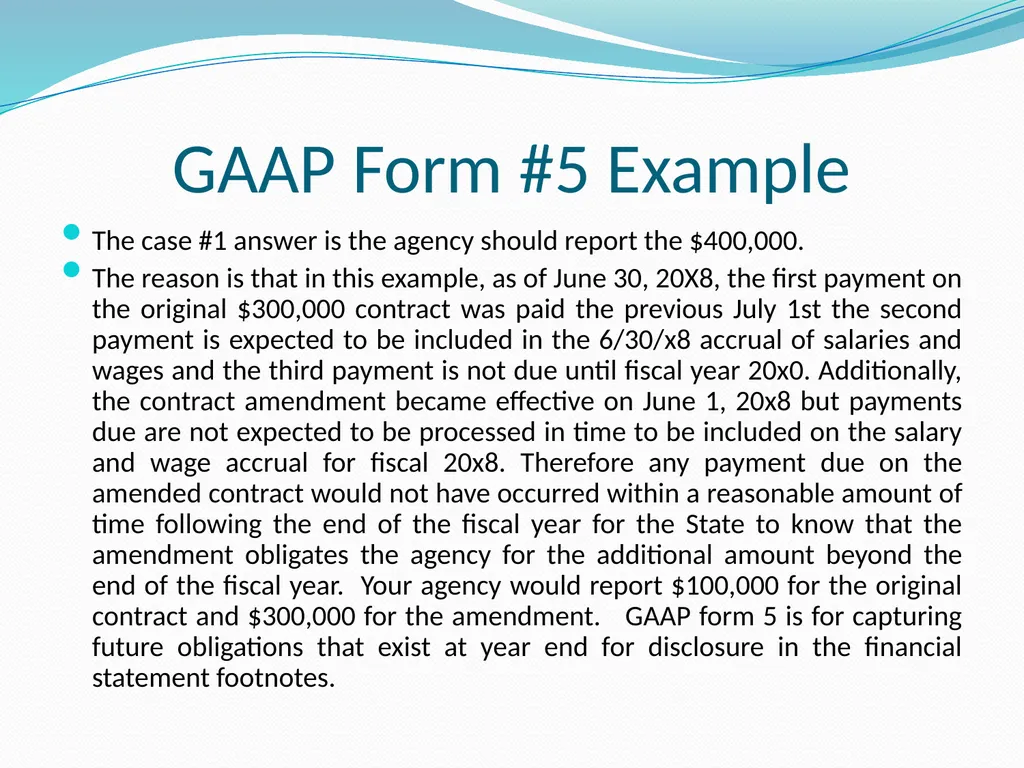
GAAP Form #5 Example The case #1 answer is the agency should report the $400,000.
The reason is that in this example, as of June 30, 20X8, the first payment on the original $300,000 contract was paid the previous July 1st the second payment is expected to be included in the 6/30/x8 accrual of salaries and wages and the third payment is not due until fiscal year 20x0. Additionally, the contract amendment became effective on June 1, 20x8 but payments due are not expected to be processed in time to be included on the salary and wage accrual for fiscal 20x8. Therefore any payment due on the amended contract would not have occurred within a reasonable amount of time following the end of the fiscal year for the State to know that the amendment obligates the agency for the additional amount beyond the end of the fiscal year. Your agency would report $100,000 for the original contract and $300,000 for the amendment. GAAP form 5 is for capturing future obligations that exist at year end for disclosure in the financial statement footnotes.<br>
The reason is that in this example, as of June 30, 20X8, the first payment on the original $300,000 contract was paid the previous July 1st the second payment is expected to be included in the 6/30/x8 accrual of salaries and wages and the third payment is not due until fiscal year 20x0. Additionally, the contract amendment became effective on June 1, 20x8 but payments due are not expected to be processed in time to be included on the salary and wage accrual for fiscal 20x8. Therefore any payment due on the amended contract would not have occurred within a reasonable amount of time following the end of the fiscal year for the State to know that the amendment obligates the agency for the additional amount beyond the end of the fiscal year. Your agency would report $100,000 for the original contract and $300,000 for the amendment. GAAP form 5 is for capturing future obligations that exist at year end for disclosure in the financial statement footnotes.<br>
64
GAAP Form Training GAAP form #5 Contractual Obligations
Examples/Cases
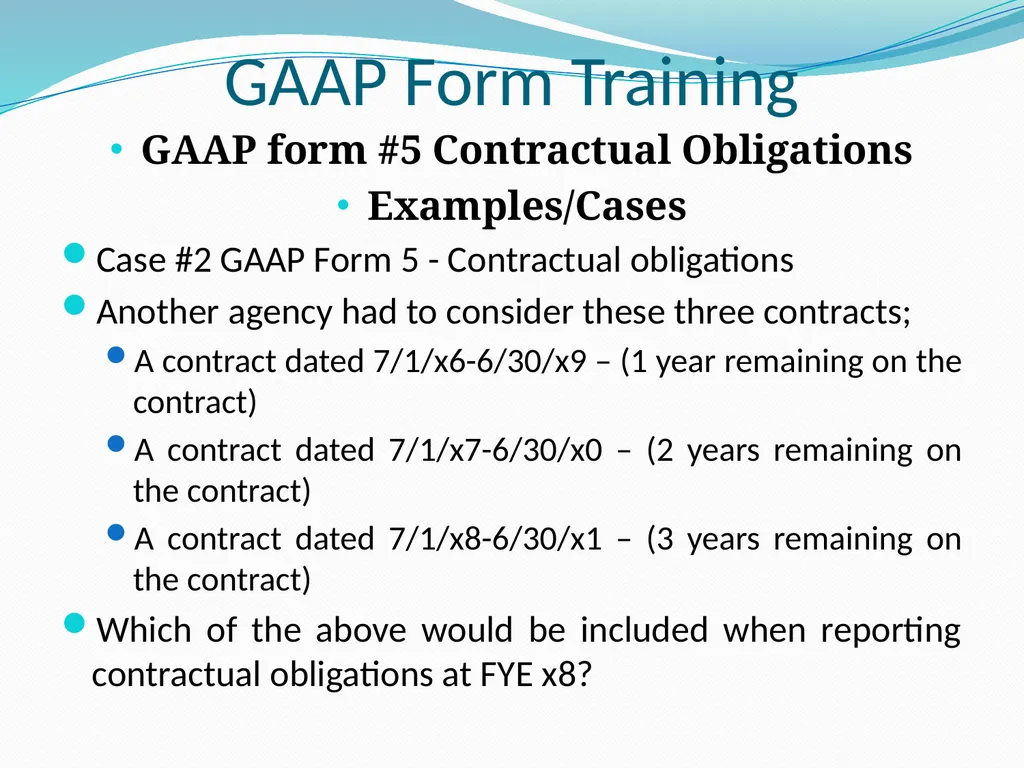
Case #2 GAAP Form 5 - Contractual obligations
Another agency had to consider these three contracts;
A contract dated 7/1/x6-6/30/x9 – (1 year remaining on the contract)
A contract dated 7/1/x7-6/30/x0 – (2 years remaining on the contract)
A contract dated 7/1/x8-6/30/x1 – (3 years remaining on the contract)
Which of the above would be included when reporting contractual obligations at FYE x8?<br>
Examples/Cases
Case #2 GAAP Form 5 - Contractual obligations
Another agency had to consider these three contracts;
A contract dated 7/1/x6-6/30/x9 – (1 year remaining on the contract)
A contract dated 7/1/x7-6/30/x0 – (2 years remaining on the contract)
A contract dated 7/1/x8-6/30/x1 – (3 years remaining on the contract)
Which of the above would be included when reporting contractual obligations at FYE x8?<br>
65
GAAP Form #5 Example The case #2 answer is the agency should report only the first two contracts.
Contracts are excluded from form 5 when the effective "starting" date of the contract is beyond the date of the fiscal year end because the contract would not have been in existence at the end of fiscal year 6/30/x8 for reporting purposes. Therefore, the 7/1/x8 - 6/30-x1 contract is excluded from being reported on GAAP form 5.<br>
Contracts are excluded from form 5 when the effective "starting" date of the contract is beyond the date of the fiscal year end because the contract would not have been in existence at the end of fiscal year 6/30/x8 for reporting purposes. Therefore, the 7/1/x8 - 6/30-x1 contract is excluded from being reported on GAAP form 5.<br>
66
GAAP
FORM #
5a Instructions for completing the form and
Case Examples for preparation of Standard GAAP forms<br>
Case Examples for preparation of Standard GAAP forms<br>
67
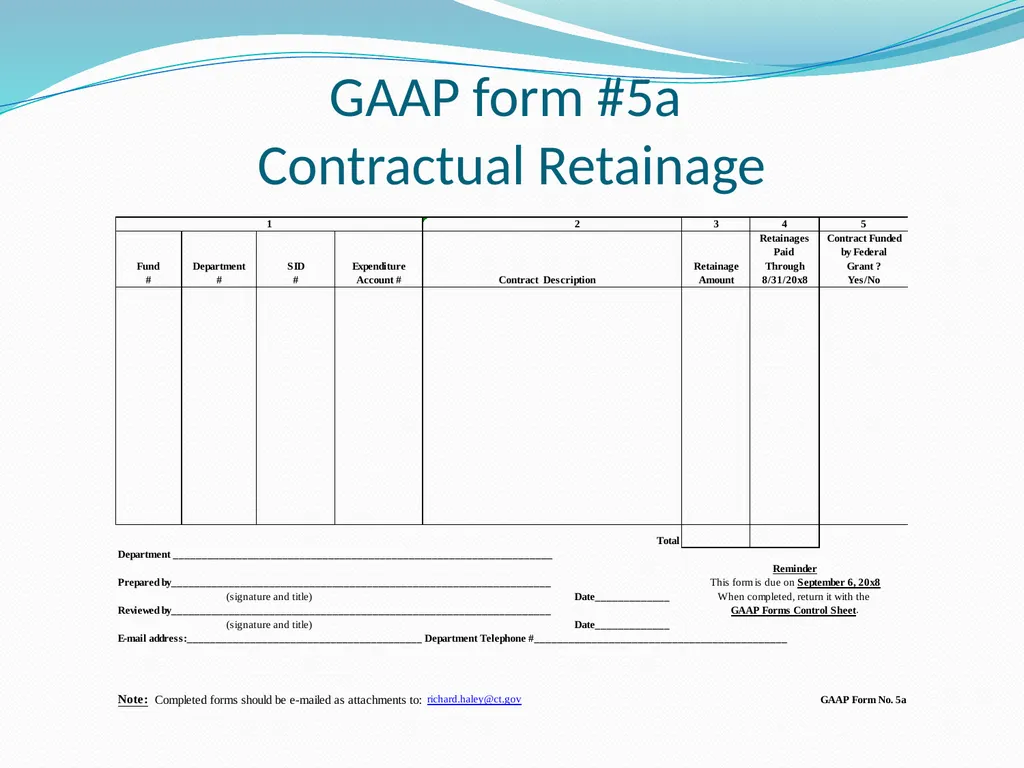
GAAP Closing Package GAAP form #5a – Contractual Retainage
The portion of the contract amount that is otherwise payable but is retained by the State pending its evaluation of acceptable performance by the contractor.<br>
The portion of the contract amount that is otherwise payable but is retained by the State pending its evaluation of acceptable performance by the contractor.<br>
68
GAAP from #5a-Contractual Retainage For purposes of this form, contractual retainages are defined as amounts owed by the State as of June 30th on outstanding contracts for which a stated percentage of the contract price has not been paid, pending final inspection or the lapse of a specified time period, or both.
This form applies to any contract outstanding as of June 30th that has a retainage amount greater than or equal to $300,000.
If your agency does not have any contracts to report, please check “form not applicable” on the GAAP Forms Control Sheet.<br>
This form applies to any contract outstanding as of June 30th that has a retainage amount greater than or equal to $300,000.
If your agency does not have any contracts to report, please check “form not applicable” on the GAAP Forms Control Sheet.<br>
69
Instructions for GAAP form #5a If your agency has any contracts that meet the above requirements,
please complete columns 1-5 of GAAP Form No. 5a as described below.
Enter required account coding for each contractual retainage amount (column3)
Enter a description of the contract(s)
Enter the amount of the contractual retainage owed by the State as of June 30th
Enter the amount of the retainage as of June 30th (column 3) that was paid by your agency on or before August 31, 20x8
Note: For payments to be included in this column, supporting invoices must have receipt dates of June or prior months
Indicate whether or not the contract is funded by a Federal grant<br>
please complete columns 1-5 of GAAP Form No. 5a as described below.
Enter required account coding for each contractual retainage amount (column3)
Enter a description of the contract(s)
Enter the amount of the contractual retainage owed by the State as of June 30th
Enter the amount of the retainage as of June 30th (column 3) that was paid by your agency on or before August 31, 20x8
Note: For payments to be included in this column, supporting invoices must have receipt dates of June or prior months
Indicate whether or not the contract is funded by a Federal grant<br>
70
GAAP form #5a
Contractual Retainage<br>
71
GAAP Form Training GAAP form #5a Contractual Retainage
Examples/Cases
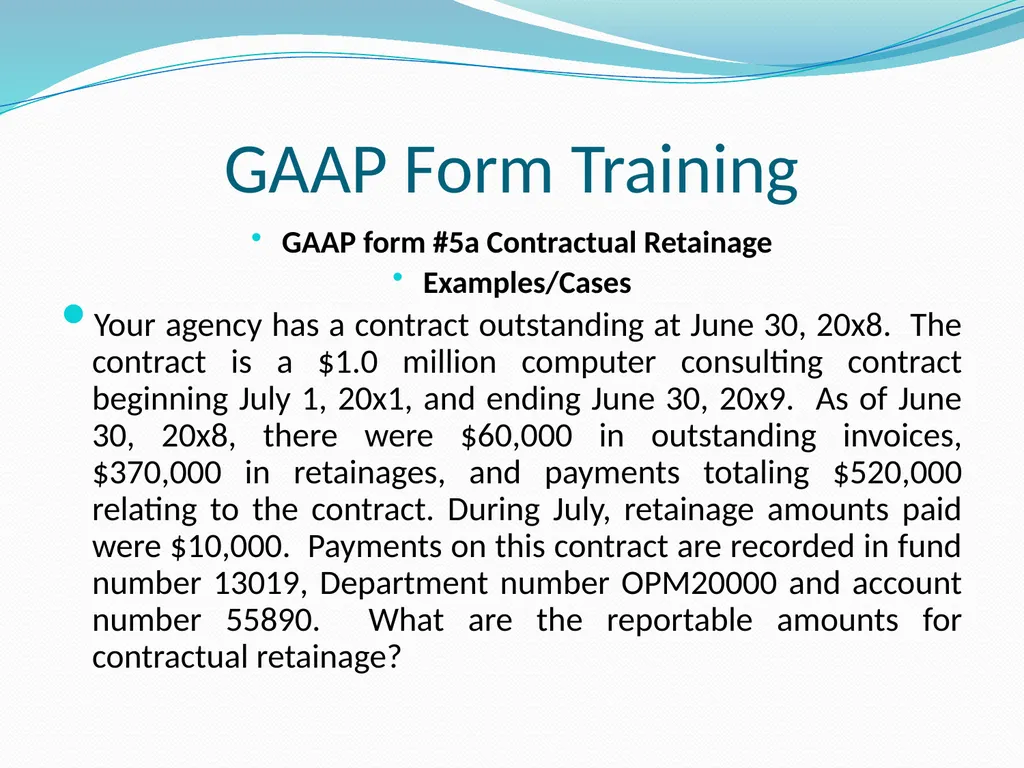
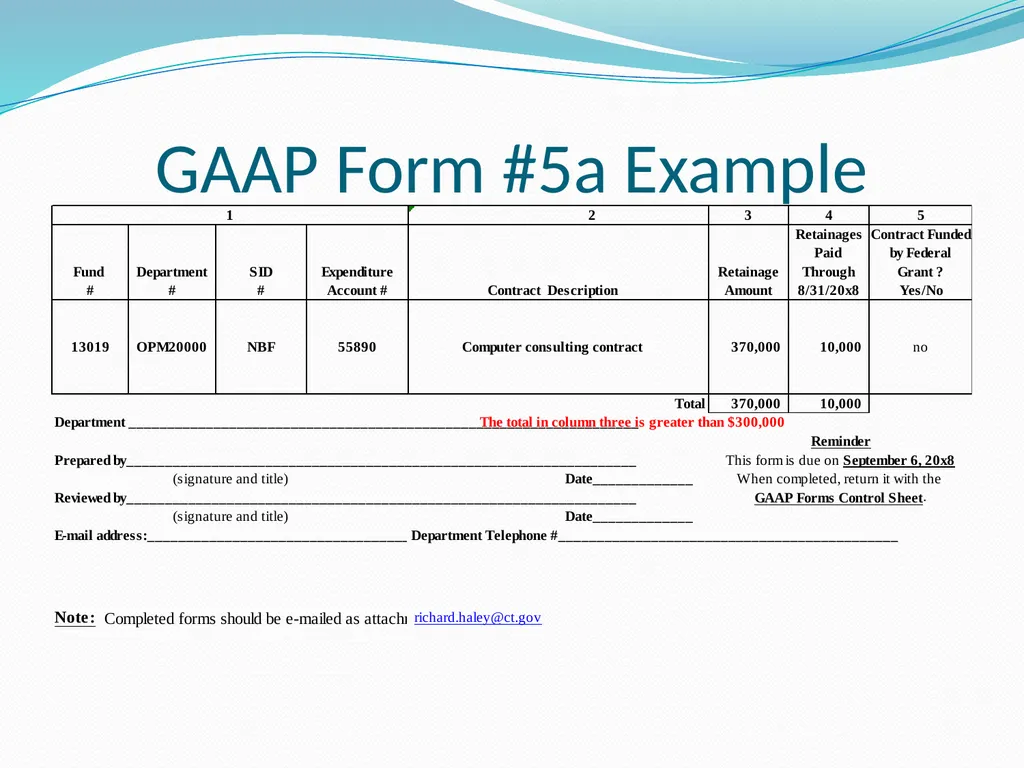
Your agency has a contract outstanding at June 30, 20x8. The contract is a $1.0 million computer consulting contract beginning July 1, 20x1, and ending June 30, 20x9. As of June 30, 20x8, there were $60,000 in outstanding invoices, $370,000 in retainages, and payments totaling $520,000 relating to the contract. During July, retainage amounts paid were $10,000. Payments on this contract are recorded in fund number 13019, Department number OPM20000 and account number 55890. What are the reportable amounts for contractual retainage?<br>
Examples/Cases
Your agency has a contract outstanding at June 30, 20x8. The contract is a $1.0 million computer consulting contract beginning July 1, 20x1, and ending June 30, 20x9. As of June 30, 20x8, there were $60,000 in outstanding invoices, $370,000 in retainages, and payments totaling $520,000 relating to the contract. During July, retainage amounts paid were $10,000. Payments on this contract are recorded in fund number 13019, Department number OPM20000 and account number 55890. What are the reportable amounts for contractual retainage?<br>
72
GAAP Form #5a Example<br>
73
GAAP
FORM #
6 Instructions for completing the form and
Case Examples for preparation of Standard GAAP forms<br>
Case Examples for preparation of Standard GAAP forms<br>
74
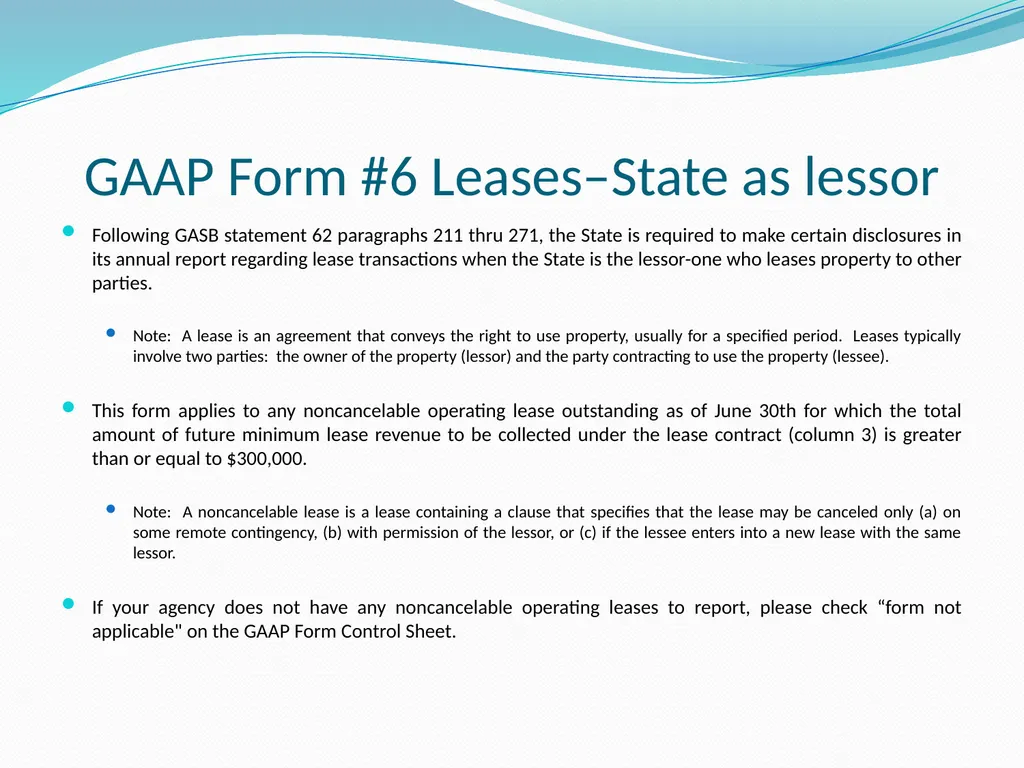
GAAP Form #6 Leases–State as lessor Following GASB statement 62 paragraphs 211 thru 271, the State is required to make certain disclosures in its annual report regarding lease transactions when the State is the lessor-one who leases property to other parties.
Note: A lease is an agreement that conveys the right to use property, usually for a specified period. Leases typically involve two parties: the owner of the property (lessor) and the party contracting to use the property (lessee).
This form applies to any noncancelable operating lease outstanding as of June 30th for which the total amount of future minimum lease revenue to be collected under the lease contract (column 3) is greater than or equal to $300,000.
Note: A noncancelable lease is a lease containing a clause that specifies that the lease may be canceled only (a) on some remote contingency, (b) with permission of the lessor, or (c) if the lessee enters into a new lease with the same lessor.
If your agency does not have any noncancelable operating leases to report, please check “form not applicable" on the GAAP Form Control Sheet.<br>
Note: A lease is an agreement that conveys the right to use property, usually for a specified period. Leases typically involve two parties: the owner of the property (lessor) and the party contracting to use the property (lessee).
This form applies to any noncancelable operating lease outstanding as of June 30th for which the total amount of future minimum lease revenue to be collected under the lease contract (column 3) is greater than or equal to $300,000.
Note: A noncancelable lease is a lease containing a clause that specifies that the lease may be canceled only (a) on some remote contingency, (b) with permission of the lessor, or (c) if the lessee enters into a new lease with the same lessor.
If your agency does not have any noncancelable operating leases to report, please check “form not applicable" on the GAAP Form Control Sheet.<br>
75
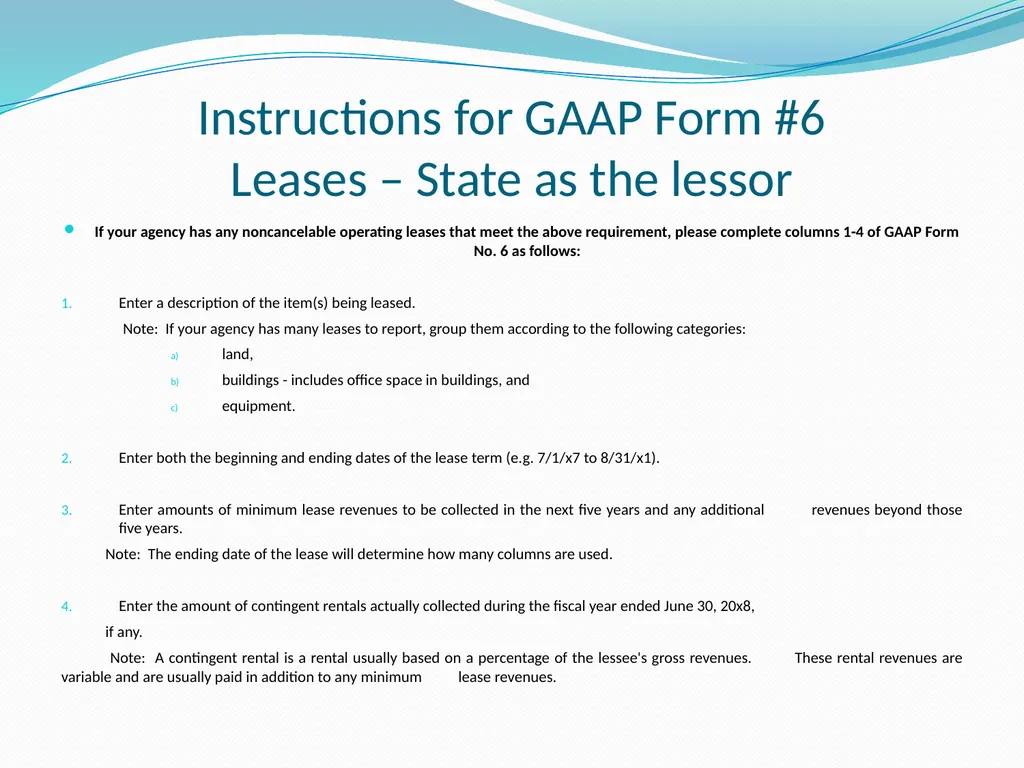
Instructions for GAAP Form #6
Leases – State as the lessor If your agency has any noncancelable operating leases that meet the above requirement, please complete columns 1-4 of GAAP Form No. 6 as follows:
Enter a description of the item(s) being leased.
Note: If your agency has many leases to report, group them according to the following categories:
land,
buildings - includes office space in buildings, and
equipment.
Enter both the beginning and ending dates of the lease term (e.g. 7/1/x7 to 8/31/x1).
Enter amounts of minimum lease revenues to be collected in the next five years and any additional revenues beyond those five years.
Note: The ending date of the lease will determine how many columns are used.
Enter the amount of contingent rentals actually collected during the fiscal year ended June 30, 20x8,
if any.
Note: A contingent rental is a rental usually based on a percentage of the lessee's gross revenues. These rental revenues are variable and are usually paid in addition to any minimum lease revenues.<br>
Enter a description of the item(s) being leased.
Note: If your agency has many leases to report, group them according to the following categories:
land,
buildings - includes office space in buildings, and
equipment.
Enter both the beginning and ending dates of the lease term (e.g. 7/1/x7 to 8/31/x1).
Enter amounts of minimum lease revenues to be collected in the next five years and any additional revenues beyond those five years.
Note: The ending date of the lease will determine how many columns are used.
Enter the amount of contingent rentals actually collected during the fiscal year ended June 30, 20x8,
if any.
Note: A contingent rental is a rental usually based on a percentage of the lessee's gross revenues. These rental revenues are variable and are usually paid in addition to any minimum lease revenues.<br>
76
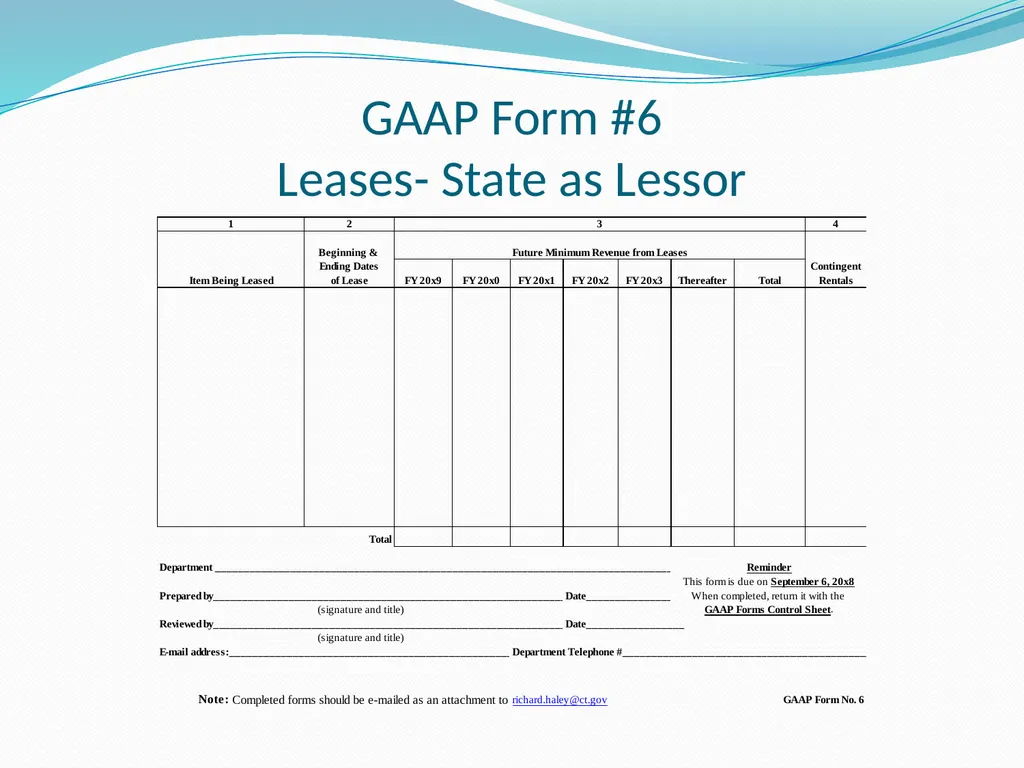
GAAP Form #6
Leases- State as Lessor<br>
77
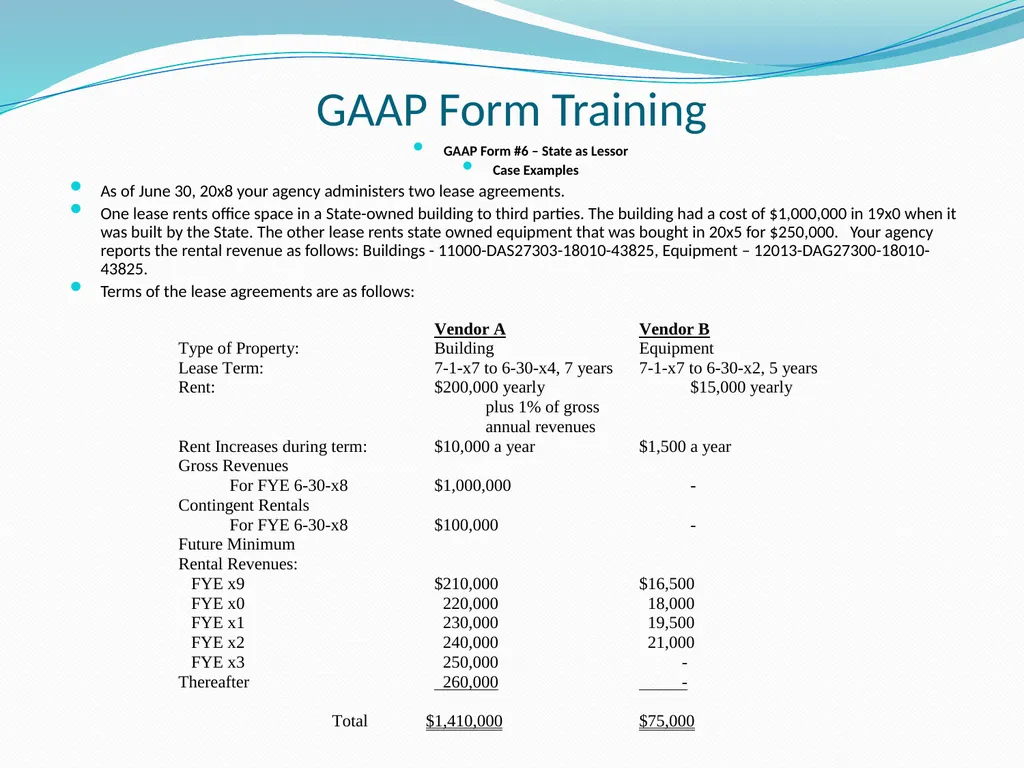
GAAP Form Training GAAP Form #6 – State as Lessor
Case Examples
As of June 30, 20x8 your agency administers two lease agreements.
One lease rents office space in a State-owned building to third parties. The building had a cost of $1,000,000 in 19x0 when it was built by the State. The other lease rents state owned equipment that was bought in 20x5 for $250,000. Your agency reports the rental revenue as follows: Buildings - 11000-DAS27303-18010-43825, Equipment – 12013-DAG27300-18010-43825.
Terms of the lease agreements are as follows:<br>
Case Examples
As of June 30, 20x8 your agency administers two lease agreements.
One lease rents office space in a State-owned building to third parties. The building had a cost of $1,000,000 in 19x0 when it was built by the State. The other lease rents state owned equipment that was bought in 20x5 for $250,000. Your agency reports the rental revenue as follows: Buildings - 11000-DAS27303-18010-43825, Equipment – 12013-DAG27300-18010-43825.
Terms of the lease agreements are as follows:<br>
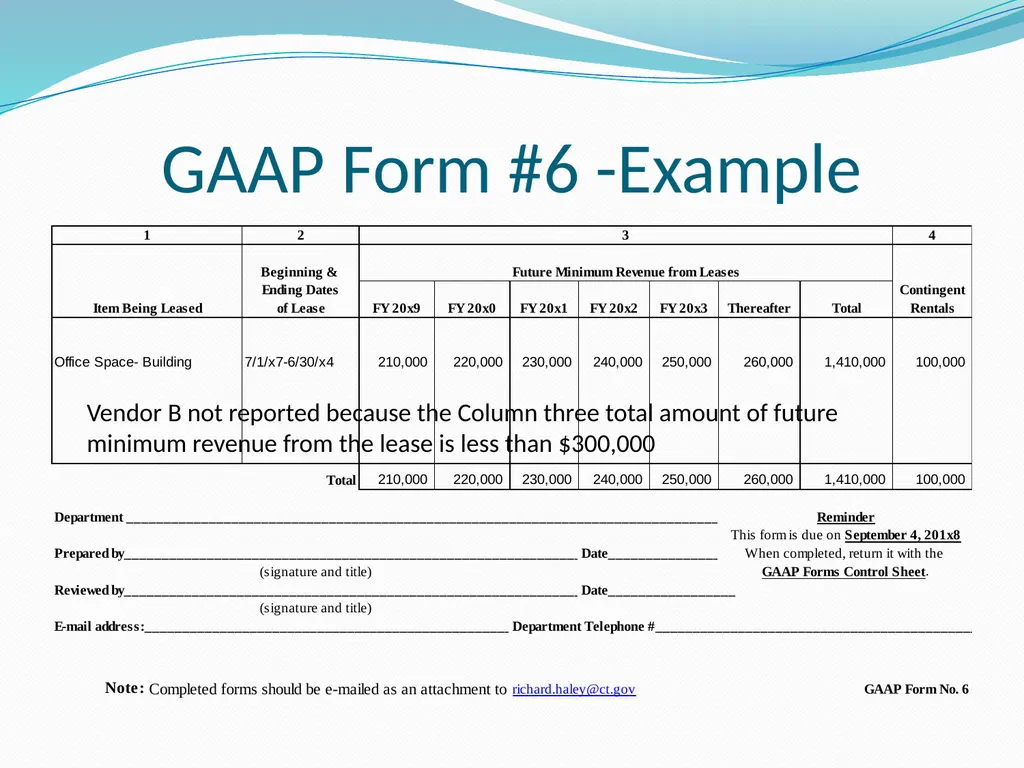
78
GAAP Form #6 -Example Vendor B not reported because the Column three total amount of future minimum revenue from the lease is less than $300,000<br>
79
GAAP
FORM #
6a Instructions for completing the form and
Case Examples for preparation of Standard GAAP forms<br>
Case Examples for preparation of Standard GAAP forms<br>
80
Instructions for GAAP Form # 6a
Leases – State as lessee Following GASB statement 62 paragraphs 211 thru 271, the State is required to make certain disclosures in its annual report regarding lease transactions when the State is the lessee-one who leases property from other parties.
Note: A lease is an agreement that conveys the right to use property, usually for a specified period. Leases typically involve two parties: the owner of the property (lessor) and the party contracting to use the property (lessee). Lease contracts can be entered into for real property (land and buildings) and for personal property (copiers, cars, etc.).
If your agency does not have any lease agreements as described above, please check “form not applicable” on the GAAP Forms Control Sheet.<br>
Note: A lease is an agreement that conveys the right to use property, usually for a specified period. Leases typically involve two parties: the owner of the property (lessor) and the party contracting to use the property (lessee). Lease contracts can be entered into for real property (land and buildings) and for personal property (copiers, cars, etc.).
If your agency does not have any lease agreements as described above, please check “form not applicable” on the GAAP Forms Control Sheet.<br>
81
GAAP Form # 6a Leases–State as lessee This form applies to any noncancelable lease agreement (capital or operating) entered into by your agency during fiscal year 20x8 for which the total amount of future minimum lease payments to be made under the lease contract (column 3) is greater than or equal to $300,000. Agencies may group like-assets being leased for the $300,000 new lease threshold.
Notes:
A noncancelable lease is a lease containing a clause that specifies that the lease may be canceled only (a) on some remote contingency, (b) with permission of the lessor, or (c) if the lessee enters into a new lease with the same lessor.
A lease may contain a clause stating that the lease is cancelable if funds are not appropriated in the annual budget to make the required lease payments. If the possibility of exercise of this clause is deemed as being remote, the lease would be considered a noncancelable lease; otherwise, the lease would be considered cancelable and excluded from reporting on this form.
Real property lease contracts entered into by the Department of Administrative Services (formerly DPW) for other State agencies (tenants) should be reported by DAS only, regardless of whether DAS or tenant agencies make the lease payments.<br>
Notes:
A noncancelable lease is a lease containing a clause that specifies that the lease may be canceled only (a) on some remote contingency, (b) with permission of the lessor, or (c) if the lessee enters into a new lease with the same lessor.
A lease may contain a clause stating that the lease is cancelable if funds are not appropriated in the annual budget to make the required lease payments. If the possibility of exercise of this clause is deemed as being remote, the lease would be considered a noncancelable lease; otherwise, the lease would be considered cancelable and excluded from reporting on this form.
Real property lease contracts entered into by the Department of Administrative Services (formerly DPW) for other State agencies (tenants) should be reported by DAS only, regardless of whether DAS or tenant agencies make the lease payments.<br>
82
GAAP Form #6a
Leases – State as Lessee<br>
83
GAAP Form # 6a
Capital Leases – State as lessee A noncancelable lease should be classified as a capital lease if any one of the following criteria is met; otherwise, it should be classified as an operating lease, if the lease term exceeds one year.
The lease transfers ownership of the property to the lessee by the end of the lease term.
The lease contains a bargain purchase option.
The lease term is equal to 75% or more of the estimated economic life of the leased property, including earlier years of use.
The present value of the minimum lease payments at the inception of the lease, excluding executory costs such as insurance paid by the lessor, equals at least 90% of the fair value of the leased property (if unknown, use a discount rate of 3.66%)
Notes:
If the lease begins within the last 25% of the original estimated economic life of the leased property, criteria 3 and 4 are not applicable.
Real property leases are usually classified as capital leases only if either criterion 1 or 2 is met.<br>
The lease transfers ownership of the property to the lessee by the end of the lease term.
The lease contains a bargain purchase option.
The lease term is equal to 75% or more of the estimated economic life of the leased property, including earlier years of use.
The present value of the minimum lease payments at the inception of the lease, excluding executory costs such as insurance paid by the lessor, equals at least 90% of the fair value of the leased property (if unknown, use a discount rate of 3.66%)
Notes:
If the lease begins within the last 25% of the original estimated economic life of the leased property, criteria 3 and 4 are not applicable.
Real property leases are usually classified as capital leases only if either criterion 1 or 2 is met.<br>
84
Instructions for GAAP Form # 6a
Leases – State as lessee If your agency has entered into any such lease agreements, please complete columns 1-3 of GAAP Form 6a as follows:
Enter a description of the item(s) being leased.
Enter type of lease (capital or operating).
Enter amounts of minimum lease payments in the next five years and in 5 year increments thereafter.
Note: If the lease extends beyond 2038, please also provide that information in a separate sheet in 5 year increments.<br>
Enter a description of the item(s) being leased.
Enter type of lease (capital or operating).
Enter amounts of minimum lease payments in the next five years and in 5 year increments thereafter.
Note: If the lease extends beyond 2038, please also provide that information in a separate sheet in 5 year increments.<br>
85
GAAP Form Training GAAP Form # 6a – State as lessee
Case Examples
During fiscal 20x8 your agency entered into two NEW leases for NEW equipment from Best Stuff, Inc. Each of the two pieces of equipment costs $500,000 having an expected market value of $150,000 each after five years. Lease A has the monthly payments arranged to result in an ending “buyout” value that will be substantially below its expected market value by the end of the lease term. Your agency records the lease payments on both leases using the following appropriation: 11000-MHA53582-10020-14000-53512. Your analysis of these leases indicates that while State policy is to use revolving fund # 22004 to separately capitalize and depreciate computer equipment whenever the cost of which is expected to be recovered from user charges imposed on other agencies, in this case, the cost of the equipment is NOT expected to be recovered in this way. Only lease A is structured as an installment purchase. The terms of the two lease agreements are as follows:<br>
Case Examples
During fiscal 20x8 your agency entered into two NEW leases for NEW equipment from Best Stuff, Inc. Each of the two pieces of equipment costs $500,000 having an expected market value of $150,000 each after five years. Lease A has the monthly payments arranged to result in an ending “buyout” value that will be substantially below its expected market value by the end of the lease term. Your agency records the lease payments on both leases using the following appropriation: 11000-MHA53582-10020-14000-53512. Your analysis of these leases indicates that while State policy is to use revolving fund # 22004 to separately capitalize and depreciate computer equipment whenever the cost of which is expected to be recovered from user charges imposed on other agencies, in this case, the cost of the equipment is NOT expected to be recovered in this way. Only lease A is structured as an installment purchase. The terms of the two lease agreements are as follows:<br>
86
GAAP Form #6a Example<br>
87
GAAP
FORM #
7 Instructions for completing the form and
Case Examples for preparation of Standard GAAP forms<br>
Case Examples for preparation of Standard GAAP forms<br>
88
GAAP Form #7
Additional Information
ALL State Agencies Please review the Core-CT generated Compensated Absences Report for errors, when directed by Core via email in late August, and report any agency corrections your review identifies via email, to richard.haley@ct.gov using reference to GAAP form #7 on your forms control sheet.
If your agency's GAAP closing package includes additional forms, please provide the requested additional financial information as of June 30th.
Note: If your agency has no errors to report and is not required to provide additional financial information, please check "form not applicable" on the GAAP Forms Control Sheet.<br>
If your agency's GAAP closing package includes additional forms, please provide the requested additional financial information as of June 30th.
Note: If your agency has no errors to report and is not required to provide additional financial information, please check "form not applicable" on the GAAP Forms Control Sheet.<br>
89
Core-CT Compensated Absences
Detail Report<br>
90
Core-CT Compensated Absences Report<br>
91
Core-CT annually generated
Compensated Absences Report Compensated absences refer to unpaid (accumulated) vacation and sick leave benefits of State employees at June 30. These unpaid benefits represent a F.Y.E. liability of the State.
Paid Vacation leave
The Core-CT Report lists the total number of accumulated vacation hours as of June 30 for all the employees within your agency. The reporting rules are;
Employees hired before June 30, 1977 and managers can accumulate a maximum of 120 vacation days representing a maximum of 840 hours based on a 7 hour work day, or 960 hours based on an 8 hour work day.
Employees hired after that date, can accumulate a maximum of 60 vacation days representing 420 hours based on a 7 hour work day, or 480 hours based on an 8 hour work day.
Paid Sick Leave
The Core-CT Report lists the total number of accumulated sick hours as of June 30 for all the employees within your agency. The reporting rules are;
At retirement, Employees are entitled to be paid for a maximum of 60 sick days representing 25% of the maximum number of accumulated sick hours. This maximum is equivalent to twenty-five percent of 1680 hours based on a 7 hour work day, or 1920 hours based on an 8 hour work day.
The Core-CT Report reduces the total liability for sick leave by applying separate probabilities for the employees who have worked for the State for less than five years and to employees who have worked for the State for five or more years, as of June 30.
The Core-CT Report lists the average hourly wage rate as of June 30 for all the employees within your agency that was in effect for the last payroll of the year. This rate is applied to all hours earned.<br>
Paid Vacation leave
The Core-CT Report lists the total number of accumulated vacation hours as of June 30 for all the employees within your agency. The reporting rules are;
Employees hired before June 30, 1977 and managers can accumulate a maximum of 120 vacation days representing a maximum of 840 hours based on a 7 hour work day, or 960 hours based on an 8 hour work day.
Employees hired after that date, can accumulate a maximum of 60 vacation days representing 420 hours based on a 7 hour work day, or 480 hours based on an 8 hour work day.
Paid Sick Leave
The Core-CT Report lists the total number of accumulated sick hours as of June 30 for all the employees within your agency. The reporting rules are;
At retirement, Employees are entitled to be paid for a maximum of 60 sick days representing 25% of the maximum number of accumulated sick hours. This maximum is equivalent to twenty-five percent of 1680 hours based on a 7 hour work day, or 1920 hours based on an 8 hour work day.
The Core-CT Report reduces the total liability for sick leave by applying separate probabilities for the employees who have worked for the State for less than five years and to employees who have worked for the State for five or more years, as of June 30.
The Core-CT Report lists the average hourly wage rate as of June 30 for all the employees within your agency that was in effect for the last payroll of the year. This rate is applied to all hours earned.<br>
92
GAAP Form Training GAAP form #7 Additional Agency Information
Examples
All agencies must review and correct, as necessary, the Core-CT annually generated Compensated Absences Report for their agency.
Some State agencies are required to complete specific additional forms. Those forms are considered to be self-explanatory.<br>
Examples
All agencies must review and correct, as necessary, the Core-CT annually generated Compensated Absences Report for their agency.
Some State agencies are required to complete specific additional forms. Those forms are considered to be self-explanatory.<br>
93
The GAAP Closing Package
GAAP FORM #7 -Additional Information
For the Specific State Agencies listed<br>
94
GAAP
FORM #
7a Instructions for completing the form and
Case Examples for preparation of Standard GAAP forms<br>
Case Examples for preparation of Standard GAAP forms<br>
95
GAAP Form 7a
Trustee Accounts For purposes of this form, trustee accounts are any account operated in any state educational institution, welfare or medical agency for the benefit of the employees or students of such institution or agency, including so called clients funds in state hospitals, the revenue of which is derived from the operation of canteens, vending machines, dramatics, recitals, student activity fees, membership fees, deposits, gifts, donations, bequests or any other legal source compatible with the good government of such institution or agency.
This form applies to any assets and liabilities that need to be reported as trustee accounts.
Note: If your agency has cash balances included on the State's general ledger at year end please do not include those balances on this form. Also, exclude any STIF balances from this form.
If your agency does not have any trustee accounts to report, please check "form not applicable" on the GAAP Forms Control Sheet.<br>
This form applies to any assets and liabilities that need to be reported as trustee accounts.
Note: If your agency has cash balances included on the State's general ledger at year end please do not include those balances on this form. Also, exclude any STIF balances from this form.
If your agency does not have any trustee accounts to report, please check "form not applicable" on the GAAP Forms Control Sheet.<br>
96
Instructions for GAAP form 7a
Trustee Accounts If your agency has any trustee accounts, please complete
columns 1-3 of GAAP Form No. 7a as described below.
Enter the type of account being reported
Enter required account coding only for trustee accounts which are provided by the State. The account coding that is required for FUND and SID should be from where the resources were originally provided (i.e. the general fund)
Enter dollar amount provided by State funds.
Enter dollar amount provided by Third Party funds.<br>
columns 1-3 of GAAP Form No. 7a as described below.
Enter the type of account being reported
Enter required account coding only for trustee accounts which are provided by the State. The account coding that is required for FUND and SID should be from where the resources were originally provided (i.e. the general fund)
Enter dollar amount provided by State funds.
Enter dollar amount provided by Third Party funds.<br>
97
GAAP form #7a - Trustee Accounts<br>
98
GAAP Form Training GAAP form #7a Trustee Accounts
Case Example
You want to be certain that the proper summary information is used for GAAP reporting purposes so you decide it is best to complete GAAP form #7a because you learned, from reading your GAAP package instructions, that your agency’s “year end trustee balance sheet” does not include the “original budget appropriation codes for the unexpended balances of funds” provided by the State that remain at year end in activity accounts as required for GAAP reporting purposes.
You know your agency has administrative responsibility for several trustee accounts totaling $500,000 some of which has NOT been recorded on the state’s general ledger. Some of these accounts represent Client money management and “Rep Payee” type activities, while others include client activity STIF accounts in the custody of the Treasurer’s office and unexpended balances in your agency’s client activity checking accounts that were originally funded by appropriations of the State general fund.
Your records indicate that as of June 20x8 there are receivables from clients of $1,000 and client payables of $500. The cash balances consist of $3,000 in client funds, $6,000 in Rep payee funds, $190,000 of money management funds, $200,000 in STIF accounts and $100,000 in unexpended balances of funds in an activity account that were originally provided last April from the following appropriations of the state general fund;
80% from 11000-DVA21000-10020-52742 and
20% from 11000-DVA21000-10020-54210
How would you report these trustee accounts using GAAP form #7a?<br>
Case Example
You want to be certain that the proper summary information is used for GAAP reporting purposes so you decide it is best to complete GAAP form #7a because you learned, from reading your GAAP package instructions, that your agency’s “year end trustee balance sheet” does not include the “original budget appropriation codes for the unexpended balances of funds” provided by the State that remain at year end in activity accounts as required for GAAP reporting purposes.
You know your agency has administrative responsibility for several trustee accounts totaling $500,000 some of which has NOT been recorded on the state’s general ledger. Some of these accounts represent Client money management and “Rep Payee” type activities, while others include client activity STIF accounts in the custody of the Treasurer’s office and unexpended balances in your agency’s client activity checking accounts that were originally funded by appropriations of the State general fund.
Your records indicate that as of June 20x8 there are receivables from clients of $1,000 and client payables of $500. The cash balances consist of $3,000 in client funds, $6,000 in Rep payee funds, $190,000 of money management funds, $200,000 in STIF accounts and $100,000 in unexpended balances of funds in an activity account that were originally provided last April from the following appropriations of the state general fund;
80% from 11000-DVA21000-10020-52742 and
20% from 11000-DVA21000-10020-54210
How would you report these trustee accounts using GAAP form #7a?<br>
99
GAAP Form #7a Example<br>
100
GAAP
FORM #
8 Instructions for completing the form and
Case Examples for preparation of Standard GAAP forms<br>
Case Examples for preparation of Standard GAAP forms<br>
101
GAAP Form #8 – Other Assets For purposes of this form, other assets are defined as any assets that your agency might have had as of June 30th that were not reported in the other GAAP forms or additional information.
This form does not apply to fixed assets (such as equipment or supplies inventory).
If your agency does not have other assets to report or if the total amount of other assets to be reported in column 3 is less than $300,000, please check “form not applicable” on GAAP Form Control Sheet.
If the total amount of other assets to be reported in column 3 is greater than or equal to $300,000, please complete columns 1-3 of GAAP Form No. 8 as follows:
1. Enter required account coding information for each asset amount (column 3).
2. Enter a description of the asset.
3. Enter the amount of the asset as of June 30th.<br>
This form does not apply to fixed assets (such as equipment or supplies inventory).
If your agency does not have other assets to report or if the total amount of other assets to be reported in column 3 is less than $300,000, please check “form not applicable” on GAAP Form Control Sheet.
If the total amount of other assets to be reported in column 3 is greater than or equal to $300,000, please complete columns 1-3 of GAAP Form No. 8 as follows:
1. Enter required account coding information for each asset amount (column 3).
2. Enter a description of the asset.
3. Enter the amount of the asset as of June 30th.<br>
102
GAAP Form #8 – Other Assets<br>
103
GAAP Form Training GAAP Form #8 – Other Assets
Case examples
Agency records indicate your agency has $450,000 of prepaid postage not otherwise reportable on any other GAAP forms.
Postage expenditures for your agency are funded by the following appropriation:
11000-DSS60415-10020-14000-51764.<br>
Case examples
Agency records indicate your agency has $450,000 of prepaid postage not otherwise reportable on any other GAAP forms.
Postage expenditures for your agency are funded by the following appropriation:
11000-DSS60415-10020-14000-51764.<br>
104
GAAP Form #8 Example<br>
105
GAAP
FORM #
9 Instructions for completing the form and
Case Examples for preparation of Standard GAAP forms<br>
Case Examples for preparation of Standard GAAP forms<br>
106
GAAP Form #9 – Other Liabilities For purposes of this form, other liabilities are defined as any liabilities that your agency might have had as of June 30th and that were not reported in the other GAAP forms or additional information.<br>
107
GAAP Form #9
Other Liabilities<br>
108
Instructions for GAAP form #9 Do not report on this form unpaid vendor invoices as of June 30th which were paid on or before August 30th through Core-CT, having receipt dates of June or prior months.<br>
109
Instructions for GAAP form #9 If your agency does not have other liabilities to report or if the total amount of other liabilities to be reported in column 3 is less than $300,000, please check “form not applicable” on GAAP Form Control Sheet.
If the total amount of other liabilities to be reported in column 3 is greater than or equal to $300,000, please complete columns 1-4 of GAAP Form No. 9 as follows:
Enter required account coding information for each liability amount (column 3).
Enter a description of the liability.
Enter the amount of the liability as of June 30th.
Enter the amount of the liability as of June 30th (column 3) that was paid by your agency on or before August 31, 20x8.
Note: For payments to be reported in this column, supporting invoices must have receipt dates of June or prior months.<br>
If the total amount of other liabilities to be reported in column 3 is greater than or equal to $300,000, please complete columns 1-4 of GAAP Form No. 9 as follows:
Enter required account coding information for each liability amount (column 3).
Enter a description of the liability.
Enter the amount of the liability as of June 30th.
Enter the amount of the liability as of June 30th (column 3) that was paid by your agency on or before August 31, 20x8.
Note: For payments to be reported in this column, supporting invoices must have receipt dates of June or prior months.<br>
110
GAAP Form Training GAAP Form #9 – Other Liabilities
Case examples
Your records indicate your agency, as of June 30, 20x8, has administrative responsibility for implementation of a settlement agreement stemming from an accident involving State owned property and a private individual. The State has elected not to utilize its sovereign immunity protections even though it was self-insured in this case. Your understanding is that the settlement requires the State to pay $100,000 a year for three years beginning on the next accident anniversary date of May 1 20x9. The payments are funded by the following appropriation: 11000-OSC15910-12003-22003-51152.
Your agency has its own checking account & payment system that does not link with Core-CT. Every month your agency receives funding to facilitate child adoption and foster care services from appropriations of the general fund. The funding is regularly wired by the Treasurer’s office into an account set aside for your agency’s zero balance requirements. This account primarily funds “placement driven” payments to service providers, paid within two weeks of when the services were performed. Your understanding is the providers have earned $8 million of this money as of year-end which will be paid on the 15th of July via ACH wire transfer, all vouchers of which used new year accounting dates. The Treasurer's payment vouchers indicate the funding was paid using appropriation: 11000-DCF91147-16135-28050-52710. You therefore conclude the $8 million represents a liability to the service providers at June 30th that can only be reported via GAAP form #9.<br>
Case examples
Your records indicate your agency, as of June 30, 20x8, has administrative responsibility for implementation of a settlement agreement stemming from an accident involving State owned property and a private individual. The State has elected not to utilize its sovereign immunity protections even though it was self-insured in this case. Your understanding is that the settlement requires the State to pay $100,000 a year for three years beginning on the next accident anniversary date of May 1 20x9. The payments are funded by the following appropriation: 11000-OSC15910-12003-22003-51152.
Your agency has its own checking account & payment system that does not link with Core-CT. Every month your agency receives funding to facilitate child adoption and foster care services from appropriations of the general fund. The funding is regularly wired by the Treasurer’s office into an account set aside for your agency’s zero balance requirements. This account primarily funds “placement driven” payments to service providers, paid within two weeks of when the services were performed. Your understanding is the providers have earned $8 million of this money as of year-end which will be paid on the 15th of July via ACH wire transfer, all vouchers of which used new year accounting dates. The Treasurer's payment vouchers indicate the funding was paid using appropriation: 11000-DCF91147-16135-28050-52710. You therefore conclude the $8 million represents a liability to the service providers at June 30th that can only be reported via GAAP form #9.<br>
111
GAAP Form #9 – Other Liabilities<br>