GASEOUS STATE Paper: PHYSICAL CHEMISTRY (BSc. Part I) By Dr. Lokesh Kumar Agarwal University College of Science, MLS University, Udaipur Introduction Amongst the three common states of matter, the gaseous state is simplest. In contrast with
"GASEOUS STATE Paper: PHYSICAL CHEMISTRY (BSc. Part" is the property of its rightful owner. Permission is granted to
download and print the materials on this website for personal, non-commercial use only, and to display it
on your personal computer provided you do not modify the materials and that you retain all copyright
notices contained in the materials. By downloading content from our website, you accept the terms of this
agreement.
Presentation Transcript
01
GASEOUS STATE
Paper: PHYSICAL CHEMISTRY
(BSc. Part I)
By
Dr. Lokesh Kumar Agarwal
University College of Science,
MLS University, Udaipur<br>
02
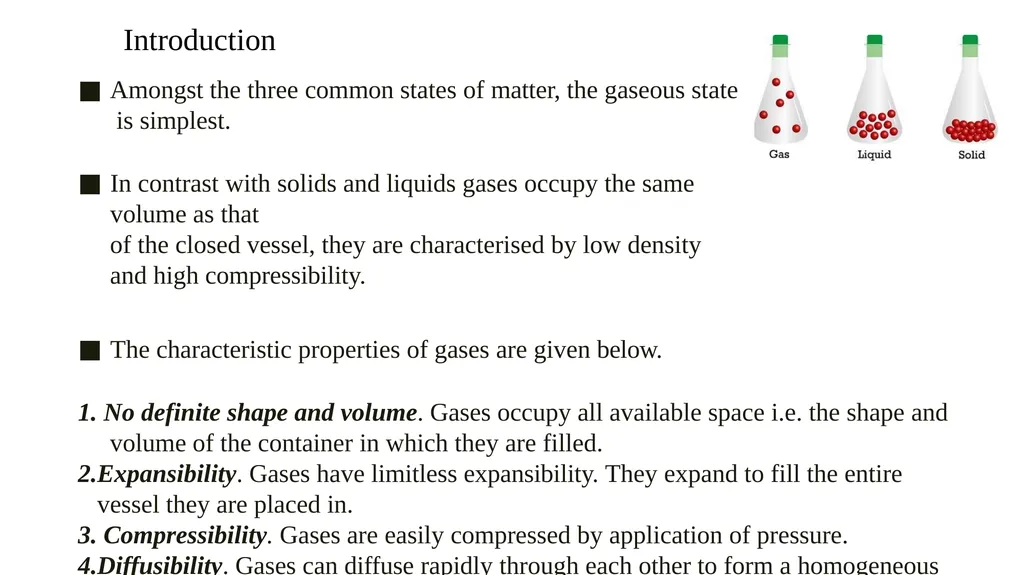
Introduction Amongst the three common states of matter, the gaseous state is simplest.
In contrast with solids and liquids gases occupy the same volume as that
of the closed vessel, they are characterised by low density and high compressibility.
The characteristic properties of gases are given below.
No definite shape and volume. Gases occupy all available space i.e. the shape and volume of the container in which they are filled.
Expansibility. Gases have limitless expansibility. They expand to fill the entire vessel they are placed in.
Compressibility. Gases are easily compressed by application of pressure.
Diffusibility. Gases can diffuse rapidly through each other to form a homogeneous mixture.<br>
03
Postulates of kinetic theory of gases The kinetic theory of gases explained the behavior of the gases. The main postulates of kinetic
theory of gases may be given as follows.
Every gas consists of large number of tiny particles called point masses i.e. the actual volume of molecules is negligible when compared to the total volume of the gas.
The gas molecules are always in a state of rapid zig-zag motion in all directions. These
molecules collide with each other and with the walls of the containing vessel.
A molecule moves in a straight line with uniform velocity between two collisions.
The molecular collisions are perfectly elastic so that there is no net loss of energy when the gas molecules collide with one another or against the walls of the vessel.
There are no attractive forces operating between molecules or between molecules and the walls of the vessel in which the gas has been contained. The molecule move independently of one another.
The pressure of the gas is the hits recorded by the molecules on the walls of the container in which the gas is contained.
The average kinetic energy of gas molecules is directly proportional to absolute temperature. This means that the average kinetic energy of molecules is the same ata given temperature.<br>
04
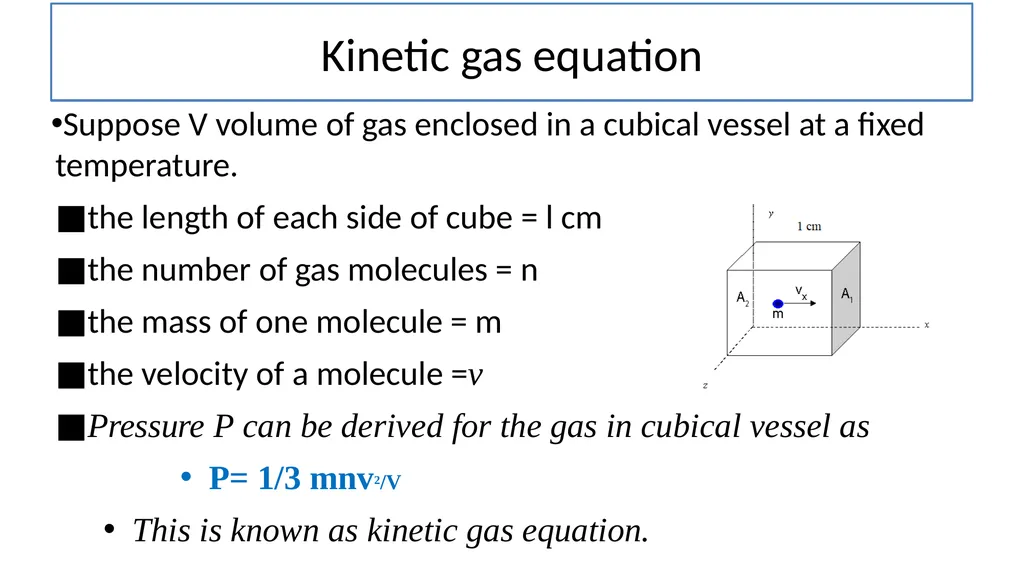
Kinetic gas equation Suppose V volume of gas enclosed in a cubical vessel at a fixed temperature.
the length of each side of cube = l cm
the number of gas molecules = n
the mass of one molecule = m
the velocity of a molecule =v
Pressure P can be derived for the gas in cubical vessel as
P= 1/3 mnv2/V
This is known as kinetic gas equation.<br>
05
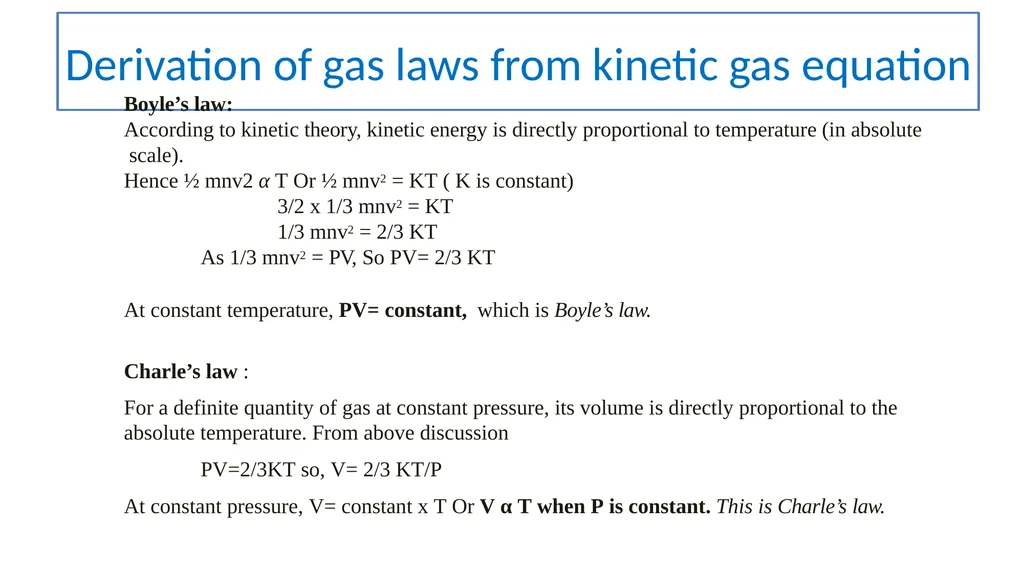
Derivation of gas laws from kinetic gas equation Boyle’s law:
According to kinetic theory, kinetic energy is directly proportional to temperature (in absolute scale).
Hence ½ mnv2 α T Or ½ mnv2 = KT ( K is constant)
3/2 x 1/3 mnv2 = KT
1/3 mnv2 = 2/3 KT
As 1/3 mnv2 = PV, So PV= 2/3 KT
At constant temperature, PV= constant, which is Boyle’s law.
Charle’s law :
For a definite quantity of gas at constant pressure, its volume is directly proportional to the
absolute temperature. From above discussion
PV=2/3KT so, V= 2/3 KT/P
At constant pressure, V= constant x T Or V α T when P is constant. This is Charle’s law.<br>
06
Avogadro’s law: It is states that equal volume of gases at same temperature and pressure contain equal number of molecules.
Suppose there are two gases for first gas mass of one molecule is m1, velocity is v1 and number of molecules are n1. And for the second gas mass of one molecule is m2, velocity is v2 and number of molecules are n2
Then for first gas PV= 1/3 m1n1v12 For second gas PV= 1/3 m2n2v22
As pressure and volume are same for both gases Hence 1/3 m1n1v12 = 1/3 m2n2v22
m1n1v12 = m2n2v22 -------------- (1)
If temperature is same average kinetic energy per molecule will be same
for both gases that means
½ m1v12 = ½ m2v22 ---------------------(2)
Comparing (1) and (2)
n1 = n2, this is Avogadro’s law<br>
07
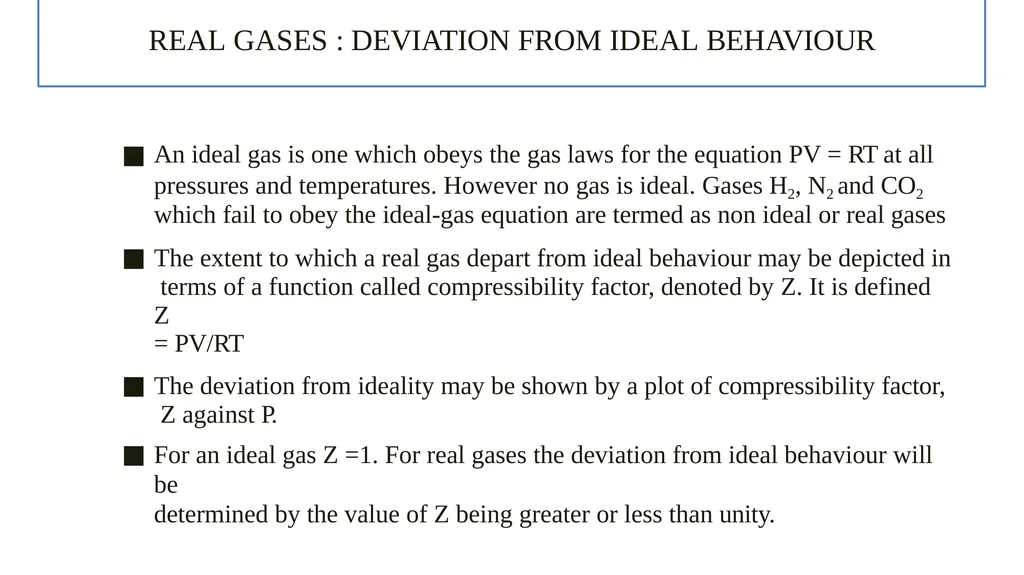
REAL GASES : DEVIATION FROM IDEAL BEHAVIOUR An ideal gas is one which obeys the gas laws for the equation PV = RT at all pressures and temperatures. However no gas is ideal. Gases H2, N2 and CO2 which fail to obey the ideal-gas equation are termed as non ideal or real gases
The extent to which a real gas depart from ideal behaviour may be depicted in terms of a function called compressibility factor, denoted by Z. It is defined Z
= PV/RT
The deviation from ideality may be shown by a plot of compressibility factor, Z against P.
For an ideal gas Z =1. For real gases the deviation from ideal behaviour will be
determined by the value of Z being greater or less than unity.<br>
08
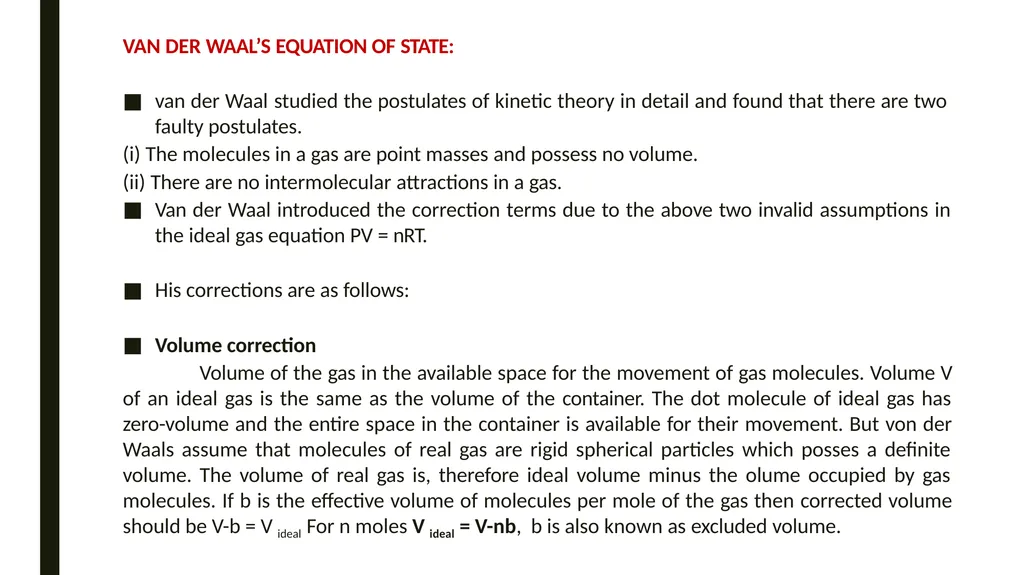
VAN DER WAAL’S EQUATION OF STATE:
van der Waal studied the postulates of kinetic theory in detail and found that there are two faulty postulates.
The molecules in a gas are point masses and possess no volume.
There are no intermolecular attractions in a gas.
Van der Waal introduced the correction terms due to the above two invalid assumptions in the ideal gas equation PV = nRT.
His corrections are as follows:
Volume correction
Volume of the gas in the available space for the movement of gas molecules. Volume V of an ideal gas is the same as the volume of the container. The dot molecule of ideal gas has zero-volume and the entire space in the container is available for their movement. But von der Waals assume that molecules of real gas are rigid spherical particles which posses a definite volume. The volume of real gas is, therefore ideal volume minus the olume occupied by gas molecules. If b is the effective volume of molecules per mole of the gas then corrected volume should be V-b = V ideal For n moles V ideal = V-nb, b is also known as excluded volume.<br>
09
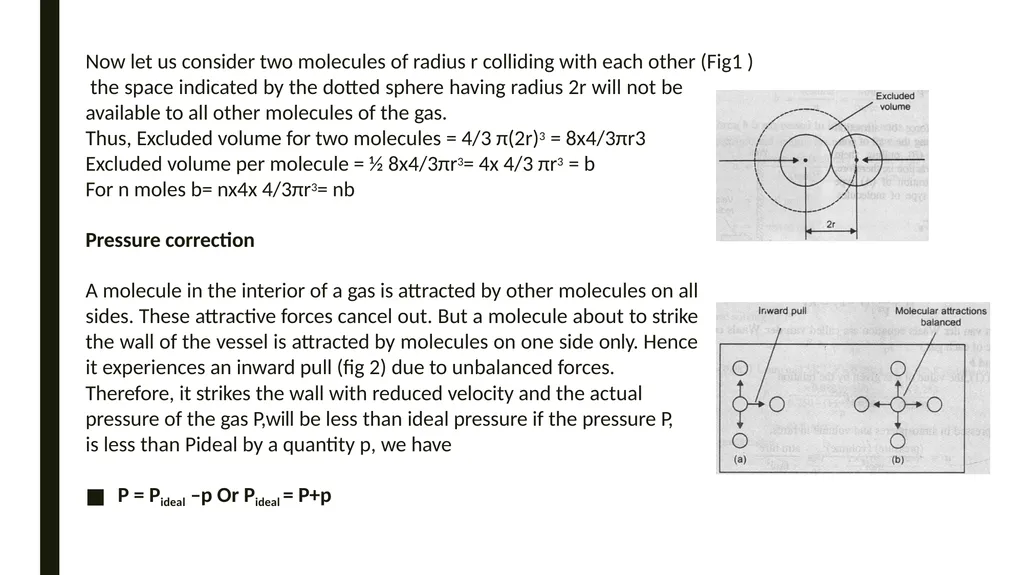
Now let us consider two molecules of radius r colliding with each other (Fig1 ) the space indicated by the dotted sphere having radius 2r will not be available to all other molecules of the gas.
Thus, Excluded volume for two molecules = 4/3 π(2r)3 = 8x4/3πr3
Excluded volume per molecule = ½ 8x4/3πr3= 4x 4/3 πr3 = b
For n moles b= nx4x 4/3πr3= nb
Pressure correction
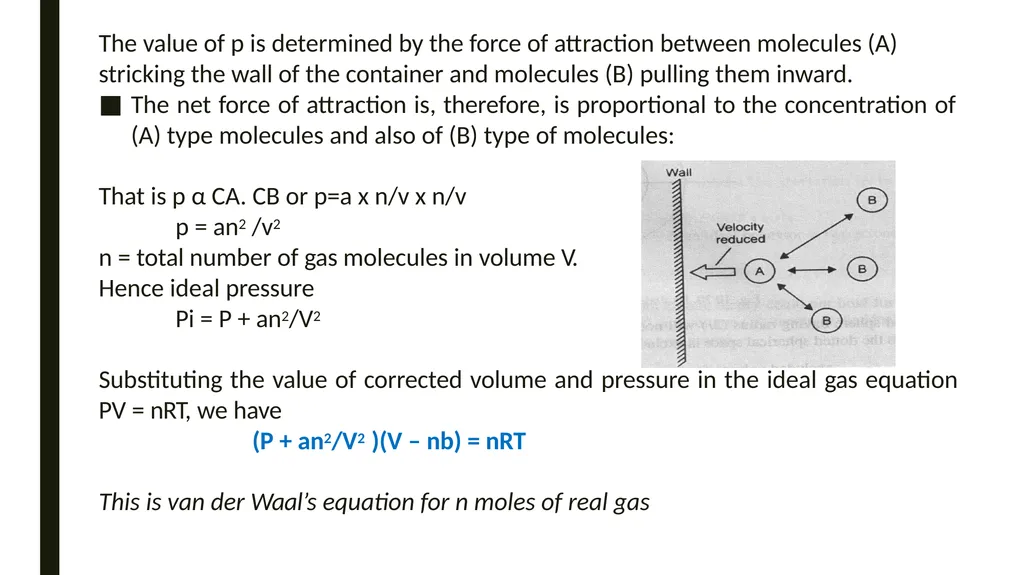
A molecule in the interior of a gas is attracted by other molecules on all sides. These attractive forces cancel out. But a molecule about to strike the wall of the vessel is attracted by molecules on one side only. Hence it experiences an inward pull (fig 2) due to unbalanced forces.
Therefore, it strikes the wall with reduced velocity and the actual pressure of the gas P,will be less than ideal pressure if the pressure P, is less than Pideal by a quantity p, we have
P = Pideal –p Or Pideal = P+p<br>
10
The value of p is determined by the force of attraction between molecules (A) stricking the wall of the container and molecules (B) pulling them inward.
The net force of attraction is, therefore, is proportional to the concentration of
type molecules and also of (B) type of molecules:
That is p α CA. CB or p=a x n/v x n/v
p = an2 /v2
n = total number of gas molecules in volume V. Hence ideal pressure
Pi = P + an2/V2
Substituting the value of corrected volume and pressure in the ideal gas equation PV = nRT, we have
(P + an2/V2 )(V – nb) = nRT
This is van der Waal’s equation for n moles of real gas<br>
11
Referred Books:
Puri, Sharma, Pathania, Principle of Physical chemistry, 44th edition, 2010
K.L. Kapoor, A Textbook of Physical Chemistry, 2nd Edition, Macmillan, 2011
P. Atkins and J. de Paula, Physical Chemistry, 9th Edition, W. H. Freeman, 2009<br>